Showing posts with label video. Show all posts

Friday, January 31, 2020

May the Earth feel your love

Michael Brunnock putting Caitlin Johnstone's poem to music is a truly wonderful thing.


A Blessing for Anyone:


May all of your illusions be shattered beyond your ability to reassemble them.

May you learn quickly from your failures and successes.

May life treat you how you treat life.

May you reap swiftly that which you sow, and may it be highly educational for you.

May all of the hidden parts of yourself enter the light.

May all of your unfelt feelings be felt.

May you have a crystal clear glimpse of your own boundlessness.

May you have a crystal clear glimpse of your own insignificance.

May your inner monologue cease and may you experience stillness.

May you experience the beauty of each moment that the babbling mind eclipses.

May you uncover the mystery that hides behind the veil of separation.

May you know true courage.

May you know true wisdom.

May you know true humility.

May you know true truth.

May you know yourself intimately, without disguises or distortions.

May you meet the world lucidly, without projections or prejudices.

May you perceive the world clearly, without filters or fantasies.

May your delusions disappoint you and may authenticity astonish you.

May everything you have constructed in untruth crumble before your eyes.

May life conspire to unmake every false object you have made.

May you live each moment fully, not for the goal of grandiose achievement, but for living itself.

May you truly, deeply see yourself, and find there what you’ve always been looking for.

May you be truly, deeply seen by someone else.

May you let yourself be seen by them.

May you end your war against the feminine.

May you finally let in the enormity of what your mother did for you.

May you find a home in your body.

May your body feel at home on this earth.

May the earth feel your sorrow.

May you feel the earth’s forgiveness.

May the earth feel your gratitude.

May the earth feel your love.

May the thrum of the earth dance through you.

May you fall in love with that dance.


Amen.

Saturday, May 18, 2019

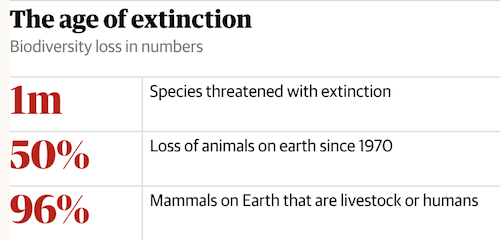
Topic: Extinction

Would Human Extinction Be a Tragedy? Todd May, NYT. Dec. 17, 2018.
Our species possesses inherent value, but we are devastating the earth and causing unimaginable animal suffering.

To make that case, let me start with a claim that I think will be at once depressing and, upon reflection, uncontroversial. Human beings are destroying large parts of the inhabitable earth and causing unimaginable suffering to many of the animals that inhabit it. 
This is happening through at least three means. First, human contribution to climate change is devastating ecosystems, as the recent article on Yellowstone Park in The Times exemplifies. Second, increasing human population is encroaching on ecosystems that would otherwise be intact. Third, factory farming fosters the creation of millions upon millions of animals for whom it offers nothing but suffering and misery before slaughtering them in often barbaric ways. There is no reason to think that those practices are going to diminish any time soon. Quite the opposite. 
Humanity, then, is the source of devastation of the lives of conscious animals on a scale that is difficult to comprehend.


Mammals cannot evolve fast enough to escape current extinction crisis. Science Daily. Oct. 15, 2018.
Summary:The sixth mass extinction is underway, this time caused by humans. A team of researchers have calculated that species are dying out so quickly that nature's built-in defense mechanism, evolution, cannot keep up. If current conservation efforts are not improved, so many mammal species will become extinct during the next five decades that nature will need 3-5 million years to recover to current biodiversity levels. And that's a best-case scenario.


Co-extinctions annihilate planetary life during extreme environmental change. Giovanni Strona & Corey J. A. Bradshaw, Nature. November 2018.
Abstract

Climate change and human activity are dooming species at an unprecedented rate via a plethora of direct and indirect, often synergic, mechanisms. Among these, primary extinctions driven by environmental change could be just the tip of an enormous extinction iceberg. As our understanding of the importance of ecological interactions in shaping ecosystem identity advances, it is becoming clearer how the disappearance of consumers following the depletion of their resources — a process known as ‘co-extinction’ — is more likely the major driver of biodiversity loss. Although the general relevance of co-extinctions is supported by a sound and robust theoretical background, the challenges in obtaining empirical information about ongoing (and past) co-extinction events complicate the assessment of their relative contributions to the rapid decline of species diversity even in well-known systems, let alone at the global scale. By subjecting a large set of virtual Earths to different trajectories of extreme environmental change (global heating and cooling), and by tracking species loss up to the complete annihilation of all life either accounting or not for co-extinction processes, we show how ecological dependencies amplify the direct effects of environmental change on the collapse of planetary diversity by up to ten times. 
Introduction

Being in the midst of the sixth mass extinction1, it is fitting to quantify the relative contribution of different mechanisms driving catastrophic biodiversity loss. Drivers directly related to anthropogenic modifications of the biosphere are apparent and well-described: habitat destruction, over-exploitation, and biotic invasions2. Similarly, the effects of environmental change (e.g., temperature rise, increased droughts, ocean acidification, et cetera) can be easily interpreted — when the environmental conditions of a certain locality become incompatible with the tolerance limits of inhabiting species, in many cases these will go locally extinct, just like fish in an aquarium with a broken thermostat (even if there are counter examples of species that have been capable of rapid adaptation to novel environmental conditions3). Yet, there are other, more complicated mechanisms that can exacerbate species loss. In particular, it is becoming increasingly evident how biotic interactions, in addition to permitting the emergence and maintenance of diversity, also build up complex networks through which the loss of one species can make more species disappear (a process known as ‘co-extinction’), and possibly bring entire systems to an unexpected, sudden regime shift, or even total collapse4,5,6,7,8,9. 
In a simplified view, the idea of co-extinction reduces to the obvious conclusion that a consumer cannot survive without its resources. Because resource and consumer interactions in natural systems (e.g., food webs) are organized in various hierarchical levels of complexity (e.g., trophic levels), it follows that the removal of resources could result in the cascading (bottom-up) extinction of several higher-level consumers8,10. Several studies based on either simulated or real-world data suggest that we should expect most events of species loss to cause co-extinctions5, as corroborated by the worrisome, unnatural rate at which populations and species are now disappearing11, and which goes far beyond what one expects as a simple consequence of human endeavour1. In fact, even the most resilient species will inevitably fall victim to the synergies among extinction drivers2 as extreme stresses drive biological communities to collapse. Furthermore, co-extinctions are often triggered well before the complete loss of an entire species12, so that even oscillations in the population size of a species could result in the local disappearance of other species depending on the first13. 
This makes it difficult to be optimistic about the future of species diversity in the ongoing trajectory of global change, let alone in the case of additional external, planetary-scale catastrophes. A previous study14contended this idea by using the remarkable tolerance of tardigrades to extreme temperature, pressure, and radiation as a reference to calculate the likelihood of global sterilization on an Earth-like planet following different, dramatic astrophysical events. The stunning conclusion of that study is that life on our planet has the potential to survive asteroid impacts, supernovae, and gamma-ray bursts14. This ostensibly reassuring news highlights how some scientists still tend to disregard the role of co-extinctions within collapsing communities in driving global biodiversity loss, while focusing on individual species’ tolerance limits as the only criteria relevant to species survival in a changing world. Ecologists know the optimism is not supported quantitatively, but can we estimate the magnitude of the bias? 
Here we attempt to do this by combining real-world ecological and environmental data to generate several virtual Earths populated by interconnected species-interaction networks where we allow species to move and adapt, that we then subjected to extreme, global environmental change. By comparing scenarios of extinctions based only on species’ environmental tolerances with others accounting also for co-extinctions, we show that neglecting to consider the cascading effect of biodiversity loss leads to a large overestimation of the robustness of planetary life to global change.

videos:

Human extinction in 10 years. Interview with Guy McPherson. Nov. 25, 2016. youtube. video (10 min)

Last Hours. RT. youtube.

The Sixth Extinction. it's okay to be smart. youtube.

6th mass extinction. Barry Sinvervo, TEDx, via youtube.

Peter Wadhams interview: Could modern civilization collapse? youtube. Dec. 16, 2015. video (18 min)

Racing to the precipice. Prof. Noam Chomsky. March 2017. via youtube. video (1hr 24min).


media articles:

Humanity is getting verrrry close to extinction. Nathan Curry, vice. Aug. 21, 2013.

Earth's worst-ever mass extinction of life holds 'apocalyptic' warning about climate change, say scientists. Ian Johnston, Independent. Mar. 24,  2017.
“Global warming triggered by the massive release of carbon dioxide may be catastrophic, but the release of methane from hydrate [its frozen state] may be apocalyptic."

Climate Change and the New Age of Extinction.  Elizabeth Kolbert, New Yorker. May 13, 2019.
People easily forget “last of” stories about individual species, but the loss of nature also threatens our existence.


Life Itself Is Being Patented, Privatized and Re-engineered. By Mark Karlin, Truthout | Interview. Aug. 21, 2016.
Ashley Dawson: ‘Today’s mass extinction crisis is one of the clearest indications of the fundamental irrationality and destructiveness of the capitalist system.’ 
Ashley Dawson is the author of  Extinction: A Radical History. He was interviewed for Truthout by Mark Karlin. 


Biodiversity
Biodiversity touches every aspect of our lives – so why has its loss been ignored? Robert Watson, Guardian. Sep. 19, 2019.

scientific articles:

How to kill (almost) all life: the end-Permian extinction event. Michael Benton. 2003.

     related: 2013 interview with Prof Benton. youtube.

Battered Earth revived by mineral weathering after mass extinction. CAGE. May 2, 2017,


books:

The Fate of the Species: Why the Human Race May Cause its Own Extinction and How We Can Stop It. Fred Guterl.

The End of the World: The Science and Ethics of Human Extinction. John A. Leslie.

The Sixth Extinction: Patterns of Life and the Future of Humankind. Richard E. Leakey, Roger Lewin.

Under a Green Sky: Global Warming, the Mass Extinctions of the Past, and What They Can Tell Us About Our Future. Peter D. Ward.

The Sixth Extinction: An Unnatural History. Elizabeth Kolbert.

Global Catastrophic Risks. Nick Bostrom (Editor), Eliezer Yudkowsky (Contributor).

Sunday, April 14, 2019

Our Planet

A True Reality Show: The Unexpectedly Distressing ‘Our Planet’. Alison Herman, the ringer. Apr. 12, 2019.
Nature docu-series have traditionally been more of a comfort watch for curious animal-lovers. David Attenborough’s new Netflix series is decidedly not that.

The skeleton key to Our Planet, Netflix’s foray into the flourishing ecosystem of nature documentaries, is the word “remain.” In the voiceover that introduces each episode, narrator David Attenborough promises a survey of Earth’s natural wonders in all their splendor—or at least the ones we’ve left standing. Before Our Planet has shown a single mating songbird or grazing wildebeest, it’s already harshed its own vibe.

Our Planet is an unusually brazen instance of a deep-pocketed tech company airlifting a successful TV show template through sheer financial might. Not that Netflix is alone in adapting this strategy: Amazon is currently developing a fashion competition show starring the former co-hosts of Project Runway and a would-be next Game of Thrones with the quarter-billion dollar rights to another beloved series of epic fantasy novels. The marquee offering of Apple’s soon-to-launch TV+ streaming service will Voltron together the stars of Big Little Lies, Friends, and The Office. 
Our Planet, meanwhile, doesn’t just follow in the footsteps of the BBC’s bar-setting opus Planet Earth. Its production company, Silverback Films, is headed by Planet Earth and Blue Planet maestro Alastair Fothergill; its distinctive sound is that of Attenborough, the nonagenarian whose trademark instrument my colleague Brian Phillips has described as “somewhere between the voice of a golf announcer and the voice of a loving god.” 
Plenty of tropes carry over from Planet Earth to its successor. Shot over four years in 50 countries, Our Planet can’t resist the occasional humble brag about just how difficult and rare it is to capture an Arabian leopard in the wild, or a concentration of cheetahs hunting as a group. Episodes are organized into biomes like “Frozen Worlds” and “Fresh Water,” hopscotching continents to spotlight nature’s recurring patterns. Scoring and narration help anthropomorphize the animals onscreen, turning courtship rituals into full-blown relationships and the everyday work of survival into an epic struggle. 
But Our Planet distinguishes itself by emphasizing nature’s fragility as much as its beauty. Attenborough’s script is deeply concerned with the immediate effects and potential fallout of climate change. Forests and ice caps are shown shrinking from space to emphasize the sheer scale of humankind’s destruction; animals are depicted suffering the consequences of limited resources to show the intimate and devastating impact of global warming. So distressing are certain passages of Our Planet that Netflix issued a content warning for certain scenes that might disturb sensitive viewers, complete with time stamps. An interlude featuring walruses, overcrowded by vanishing sea ice onto a rocky beach, tumbling off a sheer cliff face to their likely deaths has already become infamous. Emotional trauma is an occupational hazard more commonly associated with slasher films than ecological surveys, but in this case the heads up is warranted. 
If Our Planet’s intention is to impress upon viewers the gravity of the crisis facing its namesake, Fothergill and his team succeed. But in the process, the show threads several tricky lines: between the expectations of viewers and the goals of producers; between the need to communicate a message and keep audiences engaged so they can absorb it.  
How will those who tune in expecting a mellow, possibly THC-assisted evening of stunning visuals react to an abject lesson in the impending apocalypse? Once they’ve been suitably cowed by the carnage we’ve wrought on our home and its occupants, will viewers have the will to continue or will they remain curled into the fetal position on their couch? 
Like many, I took in the recent Planet Earth and Blue Planet sequels in long, sustained gulps. I wanted to live in the world these shows presented—or rather, take reassurance in the knowledge I already did. These updates included their fair share of concessions to environmental realities, including a heartbreaking sequence in which newly hatched sea turtles were drawn to city lights instead of the sea. Mostly, however, they served as an escape from the pressures of everyday life, not a reminder of them. Nature documentaries tend to emphasize the simplicity of life in the wild, in contrast with the complexities of human civilization. Much like the gathering spots where the film crews strategically position their cameras, they serve as an oasis, a resting place for weary travelers to zone out and take in some beauty. 
Our Planet does not have this same effect, nor is it meant to. Rather than illustrate nature’s separation from humanity, Our Planet underscores how every region explored is connected on a geologic level—and that disrupting any point on this supply chain can lead to an unpleasant domino effect. Ice caps reflect sunlight back into space, keeping the rest of the planet cool; rain forests emit clouds of vapor, which result in precipitation hundreds if not thousands of miles away. Interfere with one part of these reactions, as we continue to with alarming speed, and you choke off the other. Even the rare unsullied patch of land Our Planet manages to stake out comes with a reminder that while this watering hole may be legally protected from poachers and development, others aren’t. A scenic interlude in a Madagascar forest is followed by a somber announcement the grove has been razed entirely since filming. 
Our Planet impresses the dire threat posed by climate change and unchecked growth; it does not quite inspire the compulsion to continue watching. This is not, precisely, Our Planet’s stated goal; on the spectrum of education to entertainment, this show skews heavily toward the former. At times, such commitment to principle sharpens Our Planet’s appeal as an empathetic argument for climate justice. At others, the prospect of queuing up yet another cavalcade of man-made atrocities heightens the temptation to defect for lighter fare. This creates something of a dilemma: Can Our Planet fully get its point across if receptive viewers can’t bear to stick around? Ironically, the very sympathy Our Planet works to foster is exactly what can make it so hard to endure. 
Fittingly, Our Planet’s most optimistic scene is also, in another light, its grimmest. The show’s final episode, “Forests,” includes a look at an unlikely hotspot: the ruins of Chernobyl. Among Soviet-era signage and concrete apartment blocs, trees have flourished and wildlife moved in. The result is a lush, haunting postapocalypse, with shades of films like Annihilation or Stalker—except this dreamscape is very much real. In the forced absence of human life, nature has reclaimed itself, with wolves and deer thriving where radiation-infected Homo sapiens cannot. Here, Our Planet presents a potential solution to its seemingly intractable problems. Earth is surprisingly durable, capable of recovering once its immediate source of distress is removed from the picture. 
Our Planet may be able to survive after all. The question is: Will we?

Saturday, March 2, 2019

Nate Hagens Video Series

2019

1. Energy Blindness

2. Energy Surplus

3. Energy Benefits

4.  Energy Scale

5. Energy Impacts

6. Energy Primacy Part 1

7. Energy Primacy Part 2

8.  Energy Primacy Part 3

9. Energy Primacy Part 4

10. Energy Primacy Part 5

11. Energy Remoteness

12. Energy Depletion

13. Energy Fungibility

14. Energy Transitions

15. Energy and Happiness

16. Energy and Our Future


Other videos by Hagens

2009: Energy Resources and Human Demand on a Full Planet.
Part 1
Part 2
Part 3
Part 4
Part 5
Part 6

2011: We're not facing a shortage of energy but a longage of expectations.

2012: The End of Growth

2013: What if the future is real?

2014: Limits to Growth: Where we are and what to do about it

2015: Energy, credit and the end of growth.

2016: A bird's eye view of the future.

2017: Blindspots and Superheroes

2018: Where are we going?

Sunday, September 30, 2018

Climate Links: September 2018 #2

Ho Hum. 6th IPCC Report Says World Is Headed For Existential Crisis. What Else Is New? Steve Hanley, Clean Technica. Sep. 27, 2018.
Drew Shindell, a Duke University climate scientist and a co-author of the report, tells The Guardian that meeting the under 1.5º C goal will require a massive change in how humans behave and how they derive the energy they need to maintain their accustomed lifestyle. 
Emissions from transportation, electricity generation, and agriculture will need to be slashed dramatically or eliminated entirely in order for there to be any hope of meeting the goal, Shindell says. “It’s extraordinarily challenging to get to the 1.5º C target and we are nowhere near on track to doing that. While it’s technically possible, it’s extremely improbable, absent a real sea change in the way we evaluate risk. We are nowhere near that.” 
Even assuming carbon emissions can be greatly reduced, the world will have to remove massive amounts of carbon dioxide from the atmosphere to meet the 1.5º C goal. That will be a problem. “The penetration rate of new technology historically takes a long time,” Shindell says. “It’s not simple to change these things. There aren’t good examples in history of such rapid, far reaching transitions.”


World 'nowhere near on track' to avoid warming beyond 1.5C target. Oliver Milman, Guardian. Sep. 27, 2018.
Exclusive: Author of key UN climate report says limiting temperature rise would require enormous, immediate transformation in human activity

A massive, immediate transformation in the way the world’s population generates energy, uses transportation and grows food will be required to limit the global temperature rise to 1.5C and the forthcoming analysis is set to lay bare how remote this possibility is.

“It’s extraordinarily challenging to get to the 1.5C target and we are nowhere near on track to doing that,” said Drew Shindell, a Duke University climate scientist and a co-author of the Intergovernmental Panel on Climate Change report, which will be unveiled in South Korea next month. 
“While it’s technically possible, it’s extremely improbable, absent a real sea change in the way we evaluate risk. We are nowhere near that.”


New Evidence That Climate Change Poses a Much Greater Threat to Humanity Than Recently Understood Because the IPCC has been Systematically Underestimating Climate Change Risks: An Ethical Analysis. Donald Brown, Ethics and Climate. Sep. 21, 2018.
Three papers have been recently published that lead to the conclusion that human-induced climate change poses a much more urgent and serious threat to life on Earth than many have thought who have been relying primarily on the conclusions of the Intergovernmental Panel on Climate Change (IPCC). This paper first reviews these papers and then examines the ethical questions by the issues discussed in these papers.


Climate study ‘pulls punches’ to keep polluters on board. Robin McKie, Guardian. Sep. 23, 2018.
‘True risks’ of warming played down to placate fossil-fuel nations
Warnings about the dangers of global warming are being watered down in the final version of a key climate report for a major international meeting next month, according to reviewers who have studied earlier versions of the report and its summary. 
They say scientists working on the final draft of the summary are censoring their own warnings and “pulling their punches” to make policy recommendations seem more palatable to countries – such as the US, Saudi Arabia and Australia – that are reluctant to cut fossil-fuel emissions, a key cause of global warming. “Downplaying the worst impacts of climate change has led the scientific authors to omit crucial information from the summary for policymakers,”


New Climate Debate: How to Adapt to the End of the World. Christopher Flavelle, Bloomberg. Sep. 26, 2018.


While economic growth continues we’ll never kick our fossil fuels habit. George Monbiot, Guardian. Sep. 26, 2018.
There may be more bicycles but there will also be more planes. We’re still in denial about the scale of the threat to the planet.
We’re getting there, aren’t we? We’re making the transition towards an all-electric future. We can now leave fossil fuels in the ground and thwart climate breakdown. Or so you might imagine, if you follow the technology news. 
So how come oil production, for the first time in history, is about to hit 100m barrels a day? How come the oil industry expects demand to climb until the 2030s? How is it that in Germany, whose energy transition (Energiewende) was supposed to be a model for the world, protesters are being beaten up by police as they try to defend the 12,000-year-old Hambacher forest from an opencast mine extracting lignite – the dirtiest form of coal? Why have investments in Canadian tar sands – the dirtiest source of oil – doubled in a year? 
The answer is, growth. There may be more electric vehicles on the world’s roads, but there are also more internal combustion engines. There be more bicycles, but there are also more planes. It doesn’t matter how many good things we do: preventing climate breakdown means ceasing to do bad things. Given that economic growth, in nations that are already rich enough to meet the needs of all, requires an increase in pointless consumption, it is hard to see how it can ever be decoupled from the assault on the living planet.
When a low-carbon industry expands within a growing economy, the money it generates stimulates high-carbon industry. Anyone who works in this field knows environmental entrepreneurs, eco-consultants and green business managers who use their earnings to pay for holidays in distant parts of the world and the flights required to get there. Electric vehicles have driven a new resource rush, particularly for lithium, that is already polluting rivers and trashing precious wild places. Clean growth is as much of an oxymoron as clean coal. But making this obvious statement in public life is treated as political suicide.

Satellite images show 'runaway' expansion of coal power in China. Adam Vaughan, Guardian. Sep. 26, 2018.
Extra 259GW capacity from coal in pipeline despite Beijing’s restrictions on plants

The Energy 202: Something strange is happening with Arctic lakes. Chris Mooney. Wa Po. Sep. 25 2018.
What does that mean? Well, so far, Walter Anthony is working from the hypothesis that at least in this location -- but perhaps others, too -- long-buried fossil fuels are being exposed to the atmosphere, thanks to the thawing of permafrost which had previously sealed them below the ground. 
If this turns out to be widespread -- it could only occur in areas where thawing permafrost sits atop older fossil fuel reserves -- then the fear is there could be another source of greenhouse gas emissions that is tied to permafrost thaw, but is actually in addition to it.

Space Station Earth. Andy Miles, Clean Technica. Sep. 22, 2018.


Living in the Future's Past. trailer via youtube.


contributors include:
Jeff Bridges — Actor, Artist, Producer
Dr. Piers Sellers — Director of the Earth Science Division at NASA Meteorologist and Astronaut (IN MEMORIAM)
Wesley Clark — General, US Army (Ret.) former NATO Supreme Allied Commander
Oren Lyons — Environmental Activist Professor of American Studies
Dr. Timothy Morton — Philosopher; Professor, Rice University; Texas Author, Humankind and Dark Ecology
Bob Inglis — Former (R) Congressman, South Carolina; Founder, Enterprise and Energy Initiative
Dr. Rich Pancost — Head of School of Earth Sciences; Professor of Biogeochemistry (Earth Systems); Director of the University of Bristol Cabot Institute, Bristol, UK
Dr. Ruth Gates — Marine Biologist; Director, Hawaii Institute of Marine Biology, The University of Hawaii at Manoa
Dr. Renee Lertzman — Author, Environmental Melancholia
Dr. Leonard Mlodinow — Physicist and Author, The Upright Thinkers
Dr. Bruce Hood — Professor of Developmental Psychology, University of Bristol; UK Author, The Self Illusion
Dr. Mark Plotkin — Ethnobotanist President, Amazon Conservation Team
Dr. Amy Jacobson — Evolutionary Anthropologist, Human Behavioral Ecologist
Daniel Goleman — Psychologist; Science Journalist; Author, Emotional Intelligence
Dr. Stephan Lewandowsky — Professor of Cognitive Psychology, University of Bristol, UK DR.
Nathan Hagens — Director, Institute for the Study of Energy and Our Future; Co-Founder, Bottleneck Foundation; Ph.D., Natural Resources; Reality 101, University of Minnesota Honors Program
Dr. Joseph Tainter — Professor of Anthropology; Author, Collapse of Complex Societies
Dr. Ugo Bardi — Professor of Physical Chemistry, University of Florence, Italy
Paul Roberts — Journalist; Author, End of Oil and The Impulse Society
Dr. Ian Robertson — Cognitive Neuroscientist; Co-Director, Global Brain Health Institute Professor Emeritus, Trinity College Institute of Neuroscience

Thursday, August 16, 2018

Views of Amory B. Lovins

Energy Strategy: The Road Not Taken? Amory B. Lovins, Foreign Affairs. Oct. 1976.

Two roads diverged in a wood, and I-
I took the one less traveled by,
And that has made all the difference.
-Robert Frost
 
Where are America's formal or de facto energy policies leading us? Where might we choose to go instead? How can we find out? 
Addressing these questions can reveal deeper questions-and a few answers -- that are easy to grasp, yet rich in insight and in international relevance. This paper will seek to explore such basic concepts in energy strategy by outlining and contrasting two energy paths that the United States might follow over the next 50 years -- long enough for the full implications of change to start to emerge. The first path resembles present federal policy and is essentially an extrapolation of the recent past. It relies on rapid expansion of centralized high technologies to increase supplies of energy, especially in the form of electricity. The second path combines a prompt and serious commitment to efficient use of energy, rapid development of renewable energy sources matched in scale and in energy quality to end-use needs, and special transitional fossil-fuel technologies. This path, a whole greater than the sum of its parts, diverges radically from incremental past practices to pursue long-term goals. 
Both paths, as will be argued, present difficult -- but very different -- problems. The first path is convincingly familiar, but the economic and sociopolitical problems lying ahead loom large, and eventually, perhaps, insuperable. The second path, though it represents a shift in direction, offers many social, economic and geopolitical advantages, including virtual elimination of nuclear proliferation from the world. It is important to recognize that the two paths are mutually exclusive. Because commitments to the first may foreclose the second, we must soon choose one or the other -- before failure to stop nuclear proliferation has foreclosed both. 
II 
Most official proposals for future U.S. energy policy embody the twin goals of sustaining growth in energy consumption (assumed to be closely and causally linked to GNP and to social welfare) and of minimizing oil imports. The usual proposed solution is rapid expansion of three sectors: coal (mainly strip-mined, then made into electricity and synthetic fluid fuels) ; oil and gas (increasingly from Arctic and offshore wells) ; and nuclear fission (eventually in fast breeder reactors). All domestic resources, even naval oil reserves, are squeezed hard—in a policy which David Brower calls "Strength Through Exhaustion." Conservation, usually induced by price rather than by policy, is conceded to be necessary but it is given a priority more rhetorical than real. "Unconventional" energy supply is relegated to a minor role, its significant contribution postponed until past 2000. Emphasis is overwhelmingly on the short term. Long-term sustainability is vaguely assumed to be ensured by some eventual combination of fission breeders, fusion breeders, and solar electricity. Meanwhile, aggressive subsidies and regulations are used to hold down energy prices well below economic and prevailing international levels so that growth will not be seriously constrained....
PDF available here. also at JSTOR (free with registration).

Fueling a Competitive Economy. Joseph J. Romm and Amory B. Lovins, Foreign Affairs. Nov. 1992.

Profiting from Energy 
AMERICA’S ENERGY and economic policies remain tied to Cold War concepts of national security. For nearly fifty years all of America’s vast resources were directed toward one purpose: containing the Soviet threat of global communism. But the need for a military-oriented industrial strategy fell with the Berlin Wall; long subordinated economic, energy and environmental concerns have risen to the top of the national agenda. Integrating those elements with a refocused military strategy can create a coherent American approach to national and global security for the post-Cold War world: one that is not costly but profitable, and not centrally planned but market-oriented. 
The most fruitful starting point for boosting America’s economy and reordering its priorities is energy. Wise energy policy creates both a healthier economy and healthier environment. But energy policy does not work in isolation. Only in combination with farsighted economic, environmental and military policies can it help secure America’s global position for the 21st century. Taken together, those interconnected policies constitute a new and comprehensive approach to U.S. security, defined in the broad sense of sustaining and improving the quality of life of Americans. 
America remains an enormously wealthy nation. Reordering priorities and redirecting resources would be enough to ensure that a new national strategy does not require higher taxes for the vast majority of Americans. A coherent national approach combining energy, economic and environmental security creates higher-paying jobs and puts more money in the hands of consumers and businesses. Sensible energy policy reduces the civilian and military costs and the risks of importing foreign oil and frees up huge amounts of domestic capital. Sensible economic policy guides more of that capital, as well as some shifted from military restructuring, toward investments that enhance the nation’s long-term competitiveness. The two policies together reduce the costs of unsustainable resource depletion and environmental damage. The result, an "industrial ecosystem," would make America a more efficient and competitive manufacturer. 
Harnessing the market to promote...

More profit with less carbon. Amory Lovins, Scientific American. Sep. 2005.


A 40-year plan for energy. Amory Lovins, TED Talks. 2012.


Monday, July 23, 2018

Video: Albatross

Albatross.
In the heart of the great Pacific, a story is taking place that may change the way you see everything. ALBATROSS is offered as a free public artwork. Watch the 3-minute trailer now:


"Do we have the courage to face the realities of our time?

And to allow ourselves to feel deeply enough, that it transforms us... 

and our future?"

Thursday, June 28, 2018

Views of Glen Peters

A journey from 5°C to 2°C. Glen Peters. Apr. 30, 2015.

The models that take us to a world where global warming is limited to 2°C, are much too optimistic.


The trouble with negative emissions. July 2017.


Thursday, June 22, 2017

F That

F*ck that. An honest meditation.


Inner f*cking peace. A guided meditation.


Thursday, April 7, 2016

Bill Nye's Global Meltdown

Topic: Solutions

How to pull Earth back from the brink. Johan Rockstrom, World Economic Forum via Business Insider.

A little hope and some VERY scary math about climate change. David Ropeik, Big Think.

Reducing carbon emissions won't halt economic growth. naked capitalism. Mar 19, 2016.
So what we did not succeed in doing in Paris, in my mind, is two fundamental things. Number 1, we still don’'t have a sense of the magnitude, the urgency if we believe climate science. China is talking about stabilizing emissions in 2030. They need to get emissions down by 20% by 2030. You know realistically, India needs to stabilize emissions where they are now or even get them down modestly; not let them grow 3 fold. Now, secondly, the United States needs to reduce emissions by 40-50%. That’s the magnitude of the challenge. 
Secondly, the point is all of this can be done in the context of economic growth by investing in energy efficiency and clean renewable energy. It'’s good for jobs, it'’s good for poverty reduction, it’'s good for community development, it’'s good for urban development. Those are the messages that need to get through and that’s the way through which, in my view, is the only way we’’re going to generate enough activity that is going to reach the stabilization goals.

Climate Change Solutions: What you thought you knew is obsolete. Dr. Joe Romm. Sep 2016. via youtube. video (52 min)


Sucking carbon out of the air won’t solve climate change. David Roberts, vox. Jun. 14, 2018.

A chat with Paul Hawken about his ambitious effort to “map, measure, and model” global warming solutions.

An electrifying idea. George Monbiot. Nov. 6, 2018.
if this works, it could help, alongside political mobilisation, to change almost everything. Places which have become agricultural deserts, trashed by giant corporations, could be reforested, drawing carbon dioxide from the air on a vast scale. The ecosystems of land and sea could recover, not just in pockets but across great tracts of the planet. A new age of global hunger becomes less likely. 
Crude and destructive technologies got us into this mess. Refined technologies can help get us out of it. The struggle to save every possible species and ecosystem from the current wave of destruction is worthwhile. One day, perhaps within our lifetimes, they could repopulate a thriving world.