Saturday, June 29, 2019

Climate Links June 2019

Climate Chaos and Our Own Responsibilities. Arshad Khan, CounterPunch. June 28, 2019.
On the last day of the UN Climate Change (June 17-27, 2019) meeting in Bonn the key IPCC report on 1.5 C was blocked from further discussion by Saudi Arabia and an unlikely set of allies: the US, Iran and Russia. The report, as the saying goes, has been deep-sixed meriting only a five-para watered down waffle at the end of the agreement, so what next?
There is worse for at a 2C rise the cycle becomes self-sustaining, meaning a runaway feedback loop cycle. Clearly the Paris agreement, holding temperature increase to 2C, is no longer viable if we are not to leave behind a raging planet to our children and grandchildren.
... 
In short, to stop hothouse earth, we have to start removing CO2 from the air.


Canada’s Climate Change Election: An Energy Mix Special Report Launches Today. Energy Central. June 16, 2019.
Climate change and the transition off fossil fuels are emerging as top-tier issues in the federal election coming up this fall. And between now and October 21, The Energy Mix has got you covered. 
Today, we’re proud to launch Canada’s Climate Change Election 2019, a special report where we will consolidate the news and opinion that will shape the next four years on the single biggest issue the country faces. 
We’ll keep updating the page right up to Election Day, with breaking news and feature reporting on Canada’s climate action gap, political party campaigns and platforms, public opinion, the continuing contention on carbon pricing, fossil and pipeline politics, climate impacts and adaptation, and the practicalities of the off-carbon transition.

Alberta Taxpayers Will Get Stuck With $400 Billion+ Oil & Gas Cleanup Bill. Steve Hanley, CleanTechnica. June 14, 2019.


Scientists shocked by Arctic permafrost thawing 70 years sooner than predicted. Guardian. June 18, 2019.


Permafrost collapses 70 years early. Robert Hunziker, CounterPunch. June 21, 2019.
These instances of collapsing permafrost are deafening bell-ringers and exactly the type of awful news that presages Runaway Global Warming (RGW). 
In point of fact, Farquharson’s “70-yr too early permafrost collapse” makes the onset of RGW look like a dead-ringer, but when? Still, nobody really knows for sure how horrible it will be for society at large, but it’s 100% guaranteed to upend capitalism’s rampant growth machine. Functioning ecosystems and roughshod capitalism that willy-nilly consumes ecosystems, punctuated by the advent of plutocracy, don’t jive very well. 
Maybe a change is in order. 
There’s no getting around the fact that ecosystems are collapsing. The evidence is too palpable to ignore. It’s serious; it’s deadly, and it could be too late to do much to stop it, other than a last-ditch WWII Marshall Plan Worldwide Consortium dedicated to converting the world to renewable energy, and forcing removal of CO2 from the atmosphere, yet, those solutions take years and years of planning, setup, construction, and billions upon billions of funding. It’s not happening. 
Meanwhile, carbon that has been trapped in and under permafrost over eons readies to escape to turbo-charge an already oversaturated turbo-charged climate. It’s literally happening right now. The waiting room is already full. Farquharson’s study proves it, and Alaska’s permafrost carbon emissions that compete with U.S. commercial CO2 emissions prove it, as sled dogs wade through it. 
It’s postulated that Runaway Global Warming, which could wipe out huge swaths of civilized society, starts in the North, where few people live. Egad! They’re already seeing it.


Extreme Temperatures Are Melting The Arctic. Steve Hanley, CleanTechnica. June 18, 2019.
Any hope that the world can limit global warming to merely disastrous levels is fading rapidly. In fact, it may already be too late for humans to do anything significant about the rotten, stinking mess they have made, which reminds me of this prophetic ditty by Yip Harburg:
God made the world in six days flat.
On the seventh, He said, “I’ll rest.”
So He let the thing into orbit swing,
To give it a dry run test.
A billion years went by,
Then he took a look at the whirling blob.
His spirits fell as he said,
“Oh well. It was only a six day job.”

Monday, June 24, 2019

CJ, PCR, Tom Murphy and un-denial

The Fact That Americans Need To Be Deceived Into War Proves Their Underlying Goodness. Caitlin Johnstone. June 22, 2019.

The US empire does indeed have an extensive and well-documented history of using lies, manipulations and distortions to manufacture consent for war from a populace that would otherwise choose peace, and a Reuters poll released last month found that only 12 percent of Americans favor attacking Iranian military interests without having been attacked first. 
Watching Americans react online to the jarring report about how close they may have just come to a war which would have impacted most of the world to varying degrees, I’ve been experiencing a deep appreciation for what truly, sincerely good people they are underneath all the propaganda and deceit. 
The fact that Americans have had to be tricked into every major military action since the Spanish-American War is telling in itself. If Americans were truly a war-hungry mob, the hawks wouldn’t need to do that. Notice too how these tricks almost always hinge on manipulating Americans’ desire to help others. The manipulators literally have to use people’s goodness to manufacture consent for war by making it all about a “dictator” who is harming his people or some variation of this theme. The hawks could try to play off of hatred or fear, but they know it wouldn’t work nearly as effectively as manipulating the already-installed “Save the day!” helping desire that most Americans live and breathe. 
Now, these tricks are becoming more and more conscious for an increasing number of Americans. For instance, on the day of the Gulf of Oman incident, “Gulf of Tonkin” briefly trended on Twitter. As it becomes more apparent that they’ve been lied to, you could expect people to compartmentalize away from the bloodshed by arguing for exceptionalism and for strengthening the petrodollar and US geostrategic interests no matter the cost. They could simply switch gears and take their cues from Bolton and the neocons. But the large majority don’t. They are horrified. There is shame and there is palpable grief. They hate the thought that they might be the baddies, and they want to do what they can to stop the next senseless military bloodbath.
... 
Whenever I try to talk about this I get a lot of pushback, not from outsiders like myself but from Americans themselves. When you’re in the thick of a society that keeps seeing itself manipulated into war after war after war, it can feel like being in the middle of an endless zombie apocalypse, and it’s easy to grow impatient with one’s countrymen. 
But it’s so important that the blame be placed in the right place. We must be vigilant in directing our anger at the manipulators and not the manipulated. It’s always the conman’s fault, never the victim


Be Wary of Undue Optimism. Paul Craig Roberts. June 24, 2019.

Caitlin Johnstone, one of my favorite commentators whose columns I often repost, apparently has felt some pressure from some readers for a bit of optimism. She found it in the “underlying goodness” of Americans who must be deceived into war. If Americans were really bad, she says, they would not have to be deceived and manipulated into going to war. She concludes that the fact that they are deceived and manipulated means that it is not their fault. As Caitlin puts it, “We must be vigilant in directing our anger at the manipulators and not the manipulated. It’s always the conman’s fault, never the victim.” Thus does she absolve Americans for any responsibility for the massive crimes their country has committed against other peoples.

It is always more comfortable to blame others than ourselves. Before writing this column, Caitlin might have benefitted from recalling the old adage: “Fool me once, shame on you; fool me twice, shame on me.” 
... 
What Caitlin overlooks is that there is something desperately wrong with Americans that they can be consistently fooled again, and again, and again, and yet again, and never catch on. Their gullibility is especially difficult to comprehend in face of the 21st century’s concentrated dose of deceptions — 9/11, Afghanistan, Saddan Hussein’s weapons of mass destruction, Assad’s use of chemical weapons, Iranian nukes, Russian invasions, MH-17, the long list of lies about Gaddafi, the bombings of Pakistan, Maduro starving his own people – one deception rapidly following the other and never does a doubt arise in the good Americans’ minds.

Before accusing me of being a male chauvinist for “attacking a woman,” rest assured that Caitlin can take care of herself.


MW: You may have a point, PCR, that Americans are too naive and credulous... but CJ did not "overlook" the fact that Americans get fooled time and again... she assigned blame to the manipulators, rather than the manipulated. I, too, like you, get seriously discouraged and annoyed that the manipulated are so susceptible to the manipulations. But as CJ has pointed out time and again, the propaganda-ists have been working on their propaganda for over a century now, and have refined their methods and tools. And tech, as foreseen by Bradbury and Huxley and Orwell, has made their jobs easier over time as well.

What I have come to recognize, and grudgingly accept, is that we are all wired differently in many ways: not just from height and shoe size to hair or eye color but in the ways we think and learn. As Tom Murphy pointed out 4 years ago on his excellent (and sadly seemingly dormant) site Do The Math, much of humanity is Programmed to Ignore.

Reinforced Resignation
As stated at the beginning, my impetus for all the Do the Math work was to lay out a rational, quantitative foundation for why we should not take future growth/wealth/happiness for granted. We could really blow this thing. Our best hope, as I saw it, was to get people to acknowledge and accept the threat and thereby endeavor to make it go away. As with any 12-step program, admitting that there is a problem is step one. 
Failure to acknowledge what, to me, is a wholly plausible set of major concerns triggers a strong reaction on my part. How can we mitigate what we don’t acknowledge? Failure to acknowledge the risk serves only to solidify the likelihood of the risk, in my mind. 
Perversely, calling me wrong outright probably makes me more right. Saying I might be wrong, or even that I am probably wrong while admitting some chance of my being on target and acknowledging the enormity if so is just fine by me. 
This personality analysis helps me understand the scope of the challenge. It mostly serves to reinforce my concern. It seems we have a built-in impediment to preventive mitigation for unprecedented crises. At some level, it just makes me feel resigned: no hope in politicians, now no hope in human nature. 
But as a cerebral type, it gives me some satisfaction to have insight into how and why we may fail. If the world falls apart before I die, at least I’ll have some inkling as to what’s going on, and won’t be as psychologically shattered by the affair. But I’ll be one of a pitifully small number, I’m afraid.


See also Rob Mielcarski's un-denial: Theory (short) or un-denial Manifesto.


Have I mentioned before the Caitlin Johnstone is the best?

You Are Fighting In The Most Important Battle Of All Time. Caitlin Johnstone. June 24, 2019.

If you are reading this, it’s most likely the result of a series of events in your life which have drawn your interest and attention to the fact that our world is quite a bit different from what we’ve been told by our school teachers, by the news media, by Hollywood, and by politicians.

At some point, for whatever reason, you’ve come to realize that the consensus narratives in our society about what’s going on are false. The tools that people are taught to use to inform themselves about their government, their nation and their world are not just full of inaccuracies, but deliberate distortions, ranging from the reasons we’re given for why wars are started, to the way our political systems work, to where real power and authority actually lies, to the way nations and governments actually behave in the world.

This awareness has come with a degree of alienation. Not buying into the same consensus narratives about the world as your friends, loved ones and peers comes with an inability to relate to them on some levels, which can cause you to feel a lack of intimacy in those areas. You may have also found yourself the odd one out in conversations about politics or other controversial issues, maybe even lost old friends over it.

But you kept going anyway. For some of us, it’s more important to be true to the truth than it is to fit in. You’re one of those people.

So, I just want to say thank you. Sincerely. Thank you from the bottom of my heart. I’m on-my-knees grateful to anyone who sets about untangling themselves and their species from the deceitful narratives which pervade our society. It is the most important battle that can possibly be fought. The most important battle that has ever been fought.

There is nothing more important than this fight. Our species is on a sure trajectory toward Orwellian dystopia if climate collapse or nuclear war don’t send us the way of the dinosaur first, and the only thing that has the power to steer us out of that trajectory is the people using the strength of their numbers to force an end to the oppressive, ecocidal, omnicidal status quo.

But they don’t. The people don’t use the strength of their numbers to force an end to the oppressive, ecocidal, omnicidal status quo, because they aren’t interested in doing so. Why aren’t they interested in doing so? Because their minds are being manipulated on a mass scale by the same people who have been granted immense power and wealth by the existence of that status quo.

All of mankind’s biggest dilemmas are ultimately due to the fact that propaganda is far more ubiquitous and far more advanced than most people realize.

And it’s not their fault. Not really. Nobody teaches you in school that throughout your entire life your plutocratic overlords will be working to control the thoughts in your head using a highly sophisticated arsenal of psychological operations funneled into your mind via their near-total control of the media. Nobody warns you as a kid that if you ever really want to grow up, you’ll first have to extricate the vast network of lies which have been deliberately sewn into your consciousness since birth.

But their tricks didn’t work on you. You found your way out of that matrix of deception. It wasn’t easy, and it wasn’t comfortable, but you did it. And now you’re ready to fight.

And fight you have. You have already been doing what you can to share information which counters the disinformation, doing your best to throw sand in the gears of the propaganda machine and show people the little gaps in the code of the matrix in the hope that some light sleeper might spot it and begin waking up from the dream. You don’t need me to tell you to do this, because it’s obvious to anyone who’s seen through the illusion. You’re doing it already.

And you’re going to keep doing it. And you’re going to get better at it.

You’re going to get better at it because you’re going to keep learning and gaining a better and better understanding of how the oppression machine operates, so that you can describe it more lucidly to others.

You’re going to get better at it because you’re going to keep practicing your craft: attacking the propaganda matrix at its weakest and most vulnerable points at every opportunity. Practice makes perfect, and the more you keep at it the more skillful you’ll get at spotting gaps in its armor and firing the most damaging truth bombs straight into them.

You’re going to get better at it because you’re going to keep doing your own inner work to expunge all lies from your system, from the most surface-level propaganda narratives all the way down to your most fundamental assumptions about the nature of reality itself. You understand that only turkeys are done, and that it will always be possible to get a little bit clearer inside every day. The less your vision is impeded by falsehood, the better you’ll be able to see on the battlefield.

You’re going to get better at fighting, and you’re going to keep fighting no matter what. Not because it’s an easy war, nor even because it’s a winnable war, but because you have made truth your highest value, and untruth is therefore intolerable to you. You will keep attacking the lie factory at every turn until it collapses into its own foundations beyond any possibility of repair. You will keep driving your sword through until you see it come out the other side.

And others will join you, because they have awakened to what’s going on too. And then there will be more of them. And more. And more.

There is no more important fight than this. The survival and wellbeing of our entire species depends upon it. The oligarchs and their government agency allies cannot be defeated as long as their propaganda machine is killing off all desire to defeat them.

You are already engaged in this fight, so my purpose here is only to thank you and to encourage you, and to urge you to redouble your efforts. Never doubt that your energy poured into this effort is well-spent. Never let anyone shame you into silence or make you believe that your efforts are in vain. Never doubt that you’re on the right path.

Your edge is your agility and your access to inspiration. No amount of social engineering can move as fast or shine as bright as the truth. You have everything you need to win, and there are more signs than ever that the win is on the horizon. What once seemed impossible now seems inevitable.

I love you.

Keep pushing.


Have I mentioned before that Caitlin Johnstone is the best?
see all her writing that I've linked to here.

Sunday, June 23, 2019

War and Empire Links June 2019 #2

Starvation Sanctions Are Worse Than Overt Warfare. Caitlin Johnstone. June 23, 2019.
I’m titling this essay “Starvation Sanctions Are Worse Than Overt Warfare”, and I mean it. I am not saying that starvation sanctions are more destructive or deadly than overt military force in and of themselves; what I am saying is that the overall effect is worse, because there’s no public accountability for them and because they deliberately target civilians. 
If the US were to launch a barrage of Tomahawk missiles into an Iranian suburb with the goal of killing civilians, there’d be international outrage and the cohesion of the US-centralized power alliance would take a major hit. Virtually everyone would recognize this as an unforgivable war crime. Yet America will be able to kill the same number of civilians with the same deliberate intention of inflicting deadly force, and it would suffer essentially no consequences at all. There’s no public or international pressure holding that form of violence at bay, because it’s invisible and poorly understood.

Pause A Moment And Think About How Many People AREN’T Whistleblowing. CJ. June 19, 2019.
And this has all been a long-winded preamble for me to get to what I really want to say here, which is this: think about how many government insiders aren’t whistleblowing. 
Seriously, just pause and really think about that for a minute. Let it sink all the way in. We know about just a teeny, tiny fraction of the evils that our governments have been up to behind the scenes, because the people who are in a position to expose those evils and who are willing to do so are exceedingly rare. And, because of the public flagellations of whistleblowers like Chelsea Manning, we may be certain that they are becoming much rarer. We appear to be moving rapidly toward a world with no Chelsea Mannings at all. 
The celebrated author, journalist and historian William Blum once said that “No matter how paranoid or conspiracy-minded you are, what the government is actually doing is worse than you imagine.”


Narrative Management = Reality ManagementCaitlin Johnstone. June 17, 2019.
The Grayzone‘s Max Blumenthal has published the first part of an investigative series on how so-called non-governmental organizations (NGOs) are being used to manipulate the narrative about what’s going on in Syria by posing as impartial investigative bodies and circulating pro-imperialist disinformation to the western political/media class as objective fact. Part one is titled “Behind the Syrian Network for Human Rights: How an opposition front group became Western media’s go-to monitor“, and it documents a mountain of evidence that one of these “NGOs” is in fact very much state-funded and highly biased in favor of anti-Assad forces, yet still gets cited as an independent source by western mass media outlets in a way that just so happens to help make the case for western interventionism in Syria. 
“Citing the Syrian Network for Human Rights as an independent and credible source is the journalistic equivalent of sourcing statistics on head trauma to a research front created by the National Football League, or turning to tobacco industry lobbyists for information on the connection between smoking and lung cancer. And yet this has been standard practice among correspondents covering the Syrian conflict,” Blumenthal writes. “Indeed, Western press has engaged for years in an insidious sleight of hand, basing reams of shock journalism around claims by a single, highly suspect source that is deeply embedded within the Syrian opposition – and hoped that no one would notice.”
...

But narrative management is in no way limited to Syria. You see all sorts of organizations used to manipulate public narratives all the time, like the cybersecurity company Crowdstrike for example, whose highly suspicious analysis of the DNC’s servers formed the foundation of the official Russian hacking narrative, and whose CEO is now a billionaire. Whether it’s longstanding foreign policy agendas like shoving Russia off the world stage, or longstanding domestic agendas like preserving the dominance of the plutocratic class and expanding surveillance and police militarization, our understanding of what’s going on in the world is constantly being messed with.

...

The media-owning plutocratic class and its allies in opaque and unaccountable government agencies are in this way able to control reality, both in the way we experience it in our minds and in the way it expresses concretely. The ability to reach into people’s minds on a mass scale and interfere with their ability to understand what’s happening on their own planet and in their own society is a power so immense it’s hard to appreciate, and so staggeringly creepy it’s hard to comprehend. It’s a violation of a part of us that is so intimate and so sacred it could almost be said to border on the metaphysical. 
If we could truly see what grave intercessions into every human’s mental sovereignty these manipulators are getting away with, it would look not unlike the British Empire of old as it slaughtered, stole, raped and enslaved its way across the planet. These same colonialist actions are occurring today, largely from the descendants of these same groups of people, but stories are being fed to us day after day to keep it hidden from us.


Seven Reasons To Be Highly Skeptical Of The Gulf Of Oman IncidentCaitlin Johnstone. June 14, 2019.
  1. Pompeo is a known liar, especially when it comes to Iran.
  2. The US empire is known to use lies and false flags to start wars.
  3. John Bolton has openly endorsed lying to advance military agendas.
  4. Using false flags to start a war with Iran is already an established idea in the DC swamp.
  5. The US State Department has already been running psyops to manipulate the public Iran narrative.
  6. The Gulf of Oman narrative makes no sense.
  7. Even if Iran did perpetrate the attack, Pompeo would still be lying.

Propaganda Is The Root Of All Our ProblemsCaitlin Johnstone. June 13, 2019.
... As I never tire of saying, the real underlying currency in our world is not gold, nor bureaucratic fiat, nor even raw military might. The real underlying currency of our world is narrative, and the ability to control it. 
As soon as you really grok this dynamic, you start noticing it everywhere. George Kurtz is one clear example today of narrative control’s central role in the maintenance and expansion of existing power structures, as well as an illustration of how the empire is wired to reward those who advance pro-empire narratives and punish those who damage them; just compare how he’s doing to how Julian Assange is doing, for example.
...

This is why I pay far more attention in my work to narrative control than to politics. Politics is downstream from narrative control, which is why the 2020 US presidential race is already a contest to see what level of Democratic corporatist warmonger will be running against the incumbent Republican corporatist warmonger. The narrative-controlling class does its level best to hide the fact that anything’s fundamentally wrong with the system, then when people notice it’s deeply broken they encourage them to use completely impotent tools to fix it. “Don’t like how things are run? Here, vote for our other puppet!”
...

The root of all our problems right now is the fact that human minds are very hackable with enough resources, combined with the fact that war, oppression, exploitation and ecocide are highly profitable. This dynamic has caused human collective consciousness to generally dead-end into a kind of propagandized, zombified state in which all our knowledge and all our thinking moves in alignment with the agendas of existing power structures. It’s much easier to continue believing the official narratives than to sort through everything you’ve been told about your society, your nation and your world since grade school and work out what’s true and what’s false. Many don’t have the time. Many more don’t have the courage. 
We will remain in this collective dead-end, hurtling toward either Orwellian dystopia or extinction via climate collapse or nuclear armageddon, until we find a way out of it.


Saturday, June 22, 2019

Moving in to emergency mode

Moving into emergency mode on climate change. Margaret Klein Salamon, The Hill. June 21, 2019.


No one is planning for the collapse of civilization, for food shortages, epidemics and mass displacement, but that could happen as the result of a major climate disaster. The vast majority of Americans move ahead with their daily lives as normal. Few actually consider the national, global and personal implications of the breakdown of our climate.

This is not something most of us want to pay attention to. It’s scary and overwhelming, so we leave it to scientists and politicians and focus on our careers, our families, or recreational pursuits. But the climate emergency is no longer a future threat; it’s here, and we underestimate it at our own peril. It’s devastating the Midwest, our bread basket, with flooding and tornadoes. It’s causing wildfires and melting Arctic ice at an unprecedented rate. A recent paper by Australians David Spratt and Ian Dunlop demonstrates how warming could cause the collapse of civilization by 2050. 

This is not easy information to process. Feeling overwhelmed and helpless can paralyze us or force us into denial. I get that. As a former clinical psychologist, I know that many of us want to do something — anything — to stop the climate crisis, but don’t know how.

This week, The Climate Mobilization joined a number of climate justice, environmental groups, professors, activists and celebrities to call on Congress to declare #ClimateEmergency. We’ve launched a petition asking Congress to wake up and move into emergency mode.

We need to eliminate emissions as quickly as possible — in 10 years or less, as some experts including Harvard University Professor James Anderson, believe. Andersen’s research demonstrates that the Greenland ice sheet, which is melting four times faster than originally assumed, alone could raise sea levels by 23 feet. Anderson emphasizes that we need to eliminate — not reduce — emissions at emergency speed and draw down excess greenhouse gasses to restore a safe climate.

The only possible way we could achieve this is through a mobilization of national resources, of our top minds and industry on the scale of our mobilization during World War II. Rep. Alexandria Ocasio-Cortez (D-N.Y.) has called for a mobilization on this scale as part of the Green New Deal, and Nobel Prize-winning economist Joseph Stiglitz recently supported the Green New Deal with a call for a WWII-scale climate mobilization.

During WWII, we faced the existential threat of fascism and mobilized together, and we transformed our economy incredibly quickly in order to protect ourselves. All hands were on deck. Women flooded into factories, and millions of Americans moved to a new state to work a “war job.” Families including children were also mobilized — and 40 percent of vegetables were grown at home, in “victory gardens.” The government laid down strong regulations, such as a ban on the production of new consumer cars. More than 37 percent of our gross domestic product was spent on the war effort. 

If the United States rises to the challenge of confronting the climate emergency, we can still “cancel the apocalypse” and begin restoring a safe climate and healthy society. The first step is telling the truth. We need a national acknowledgement that we face a climate emergency.

Our petition launches ahead of the first Democratic National Committee (DNC) debates, in which we are asking candidates to acknowledge the emergency. Some already have, though their proposed policies don’t necessarily demonstrate that they have internalized the concept. Despite the incredible work done by groups such as Youth Climate Strike, the Sunrise Movement and others, the DNC has refused to hold a debate focused on climate change. They still don’t get it.

We don’t have time to dilute the truth, regardless of how harsh it may sound at times.

The Climate Mobilization is an organization based on telling the truth about the climate emergency and advocating for the only solution that could protect humanity and the living world: WWII-scale climate mobilization. We have been advocating for mobilization for five years, and pioneering and spreading #ClimateEmergency declarations for two years. We have ushered in ideas around zero emissions and a national mobilization to address the emergency that many have refused to take seriously.

Fortunately, some around the world are getting it.

Today, more than 600 cities in 13 countries have issued climate emergency declarations. In May, the United Kingdom as a whole declared a climate emergency, following an extended protest by our allies, Extinction Rebellion. Canada followed this week, though Prime Minister Justin Trudeau’s subsequent approval of the Transmountain pipeline makes it clear that the Canadian government is not ready to act in accordance with recognizing the emergency situation.

Last week, Pope Francis, in a meeting with major fossil fuel corporations, declared a climate emergency and warned them that failure to move swiftly against global warming would represent “a brutal act of injustice toward the poor and future generations.”

Critics will say “declaring a climate emergency is just words. It doesn’t actually solve anything.” And this is true — declaring an emergency won’t, on its own, decarbonize anything. Governments need to not only “declare” a climate emergency, but to act with emergency speed and focus. It is troubling to see the United Kingdom and Canada make action commitments, along with their declarations, that are insufficient and dangerously slow.

But, we are just getting started. A few years ago, emergency climate mobilization was a marginal idea, and within five years’ time a vigorous climate mobilization movement exists. Words have the power to shift the paradigm, connect us, educate and provide momentum for the emergency response needed by Congress to reverse climate change and protect humanity. We urge everyone to join us.

Margaret Klein Salamon, Ph.D., is the founder and executive director of The Climate Mobilization. Follow on Twitter @ClimatePsych and @MobilizeClimate

Friday, June 21, 2019

Canada's changing climate presentation

So so so many questions:


What is your view of scientific reticence? Do you communicate your expectations and concerns any differently in private than in public?


Given political considerations (I.e. policy prescriptions must be consistent with continued economic growth) as well as optimism bias and other behavioural psych factors that we all tend to suffer from to some degree, are we still, even now as govts are declaring climate "emergency"s, potentially downplaying the risks?


Is your report Independent or based on IPCC? (Science made in Canada? Or predicated on global scientific consensus)


If at 415ppm now and 500ish on CO2e basis... even without any further emissions.. when was planet last there.. and what was sea level and temp then?


What impacts are we seeing now that are already worse than scientific consensus had assumed we would yet be experiencing? E.g. arctic temps? Antarctic ice sheet destabilization?


Do ranges of RCPs totally encapsulate all possible scenarios? If worst case RCP 8.5 is actually BAU, do we really think it cant be worse than that?


Ecs?
Assumptions
E.g.  is Ecs static or dynamic
Changes over time as other factors change... e.g. deforestation and ocean heating and acidification changing ability of carbon sinks to keep operating... also albedo etc from sea ice loss... and increasing release of methane not just from industrial sources like fracking but also permafrost and seafloor release


What will make temp stabilize at current levels give climate system inertia and lagged effects of past emissions?


If we are on track for 3+C..and 6 in Canada and 10 in the arctic...  how do we stop there?


Tipping points and feedback loops

New wave of Climate models?

Isnt ECS being increased in new gen models?

Carbon budget based on 50% chance of staying under temp target

Precautionary principle re probabilities

But range of climate outcomes isnt normal curve...what about fat tail risks... should govts be basing their policy decisions on 50% chance of failure particularly when those probabilities based on models that dont yet capture all poorly understood climate phenomena meaning models potentially understating prospective temp changes?


Does conservatism in cli sci  communication provide a false sense of precision?

Tuesday, June 18, 2019

The end of super-giants

The end of super-giants; and what if means. Dr. Louis Arnoux. View Damn the Matrix. May 16, 2019.
The meaning of this news snippet takes a bit of explaining.  What the specialised media did not emphasise is what follows:
When giant oil fields go into decline, they usually decline abruptly. Ghawar’s decline is ominous. It was discovered in 1948 and until recently represented about 50% of the oil crude production of the Kingdom of Saudi Arabia (KSA). Ghawar is representative of some 100 to 200 giant oil fields. Most of them are old.  The most recently discovered giants are of a diminutive size compared with those old giants.[2]


Giants represent about 1% of the total number of oil fields and yet produce over 60% of conventional oil crude.[3] Very few real giants have been discovered in recent years. The geology of the planet is now known well enough and prospects for new significant giant oil discoveries are known to be low.  In recent decades, discoveries of smaller oil fields have not been able to compensate for the eventual loss of the giants. Figure 1 illustrates the matter. It shows the net flux of addition to reserves per year (additional volumes less volumes used). Since 2010 the steep declining trend has worsened. The level of new discoveries per year is now only about 5% of yearly reserves depletion. That is, since the late 1970s the oil industry has been steadily depleting its stock-in-trade at a rather fast rate.
The fact that Ghawar is in terminal decline means that we must consider that most of the old giants are in a similar situation.  Some were already known to be in a terminal status, e.g. Cantarell in Mexico or the main North Sea fields.[4]  However, there is a paucity of recent public data on giants.  The matter of their depletion status is commercially sensitive.  Still, a number of public databases and studies from about 10 years ago provide a robust backdrop to the Ghawar news.[5]  This needs to be unpacked a bit more.  Older giants have been developed more slowly and as a result, tend to have lower depletion rates once they pass their peak of production.  More recent ones have been developed more aggressively with more recent technology and as a result, tend to have a much steeper depletion rate once past their production peak.  In short, we now must expect a “bunching”of abrupt declines of oil giants, old and more recent, between now and about 2030.
So, in fact, this little snippet of news about Ghawar tells us a lot.  It corroborates the assessment developed since 2010 with a number of colleagues, based on a thermodynamics analysis of the PPS and summarised in Figure 2.  In short, our world runs on net energy from oil.  Due to resource depletion, it takes more and more net energy from oil to get more oil. We estimate that in consequence, since the early 1980s, the absolute amount of net energy delivered by the oil industry to the non-oil part of the industrial world has been in steep decline.  The data summarised in Figure 3 corroborates Figure 2.


Almost no one noticed how dire the situation has become because most analysts reason in terms of barrels of crude or in financial terms. GDP growth data aggregates the growth of the oil industry world (oil industry plus everything and everyone that are necessary for the oil industry to operate) with that of the non-oil world.  This aggregation masks what is actually taking place. To keep operating the oil world progressively starves the non-oil world of the net energy that is vital for its continued existence.
It is in our view significant that it is precisely in the early 1980s that total global debt took off to high heaven (source Bank of America Meryl Lynch). This steep debt growth, evaluated in fiat currencies, masks the decline in net energy from oil; net energy that is at the source of all, actual tangible, real economic growth. Due to this decline, it is most unlikely that this global debt will ever be repaid.
The terminal decline of Ghawar also corroborates the more indirect analyses of the PPS summarised in Figure 3.  This means that the part-floating of Aramco that KSA wants to achieve in the near future is most likely so as to pre-empt having to go into a “fire sale” at a later stage when the decline of Ghawar and of the other Saudi large fields become rather obvious to even the most ignorant traders.


More importantly, the corroboration of our earlier analyses by the Ghawar news and the data summarised in Figure 3 tell us that we must expect abrupt turmoil from 2020 onwards not only re oil, but also concerning all other forms of energy supply, as well as socially and financially (consider the tail end of the orange curve on Figure 2). The present turmoil in Venezuela will probably appear as a forerunner of a nasty situation becoming global.
To emerge, develop and flourish, every civilisation requires a self-powered energy supply chain – i.e. it takes energy to get energy, so any civilisation lives on the energy surplus delivered to it by its self-powered energy supply chain(s). In the globalised industrial world’s case and until recently this was the oil industry (including the whole of the support systems required for the oil industry to operate).  Since oil overtook coal and biomass during the earlier part of the 20th century, the oil industry has been the sole self-powered supply chain of the industrial world. All other forms of energy depend on it, coal, natural gas, nuclear, all so-called “renewables”, and all the way to feed and food production. In our estimates, the oil industry entered terminal decline about 7 years ago and this decline will be over by about 2030 or before.  In our view, the decline of Ghawar corroborates that this end is most likely than not going to be abrupt.
The big problem is that presently we do not have a substitute energy supply chain that could be deployed in time. As summarised in Figure 4, what one calls “renewables” is not quite so and by a wide margin. Not only current “renewable” equipment requires net energy from oil for its manufacture, transport, maintenance, and eventual decommissioning but also its production results in substantial greenhouse gases emissions (GHGs).  Even more importantly, the current “renewable” technology mix cannot form the basis for a new, sustainable, self-powered energy supply chain able to substitute for the oil-based one within the time frame defined by the decline of net energy from oil and the imperatives to combat catastrophic global warming (at least 45% greenhouse gases emissions reduction by 2030).


We call the present situation the Energy Seneca (after the Roman philosopher who first identified patterns of progressive growth followed with a peak and then abrupt decline). Figure 5 explains why the industrial world is now in a very tight spot, just after it has passed through the Energy Seneca apex.  On the one hand, the oil industry world is trapped in the famous Red Queen effect (RQ).  It has to keep pumping at an ever-faster rate to keep delivering net energy while, per barrel extracted, this net energy is in steep decline.  Soon it will run out of breath…  On the other hand, alternatives face what I call the Inverse Red Queen effect (1/RQ).  If the alternatives grow too fast, their manufacture and deployment drain energy from the industrial world just when it desperately needs more. And if those alternatives do not grow fast enough, then the industrial world is bound to abruptly decline or even collapse.


The harsh reality that few have identified is that presently none of the solutions touted by “green” business interests, governmental bodies, and NGOs alike can extricate us in time from the combination of RQ and 1/RQ effects. Not only this combination precludes building a new self-powered energy supply chain in time but also it precludes augmenting the present oil industry with non-oil energy sources to extend its terminal operations.  In short, unbeknown to most, our world is in the process of losing access to all the energy forms it depends on.  This thermodynamic conundrum compounds global warming and all other ecological, social and financial global issues to form a lethal avalanche that has been in train since about 2008.  There is global cognitive failure on the part of world elites to recognise this situation and address it.
As shown in Figure 6, the abrupt end of the Oil Age converges with the surge in protests that have taken place in recent years and that keeps gathering momentum. While most do not understand the intricacies summarised here, thousands of scientists and millions of people now do realise that they no longer have a future.  There is a “demand-for-something-else” than what they presently have.  This now strident demand is for a way forward that breaks through prevailing cognitive failure and re-opens a future for the younger ones.


To conclude, in our view Ghawar’s decline heralds the abrupt end of the Oil Age, as we have known it so far, over the next ten years.  It does not mean that we are “running out of oil”; there is plenty left but most of it will stay underground.  If a resource cannot be used to generate economic activity it loses all value and ceases to be a resource.  Like it or not, we now have to face the harsh emerging reality on the downside of the Energy Seneca.

Sunday, June 16, 2019

Ian Welsh says "Good luck."

Why The Consensus Environmental Predictions Are Wrong. Ian Welsh. Jun. 15, 2019.

So, a little bit ago I noted that with temperatures of 70 degrees in the arctic, we could expect permafrost to melt, and that would release methane. Methane is a lot stronger greenhouse gas than carbon, in the short run, and there is a lot held in arctic permafrost.

It was suggested that this was “alarmism” and the temperatures would [not] penetrate enough for the permafrost to really melt.

Yeah, about that…

Researchers also recorded thawing at depths not expected until air temperatures rose to levels that the UN Intergovernmental Panel on Climate Change (IPCC) predicted it would reach in 2090.
So…70 years early. Swell
https://t.co/9sMxdOqHRn
— Lori Freshwater(@loufreshwater) June 15, 2019

One point I have made consistently now for many years is that virtually everything will happen faster than the consensus estimates. That point has been, well, consistently true.

The estimates made by organizations like the UN are always way too optimistic. Always. They are always wrong.

This is partially because they are playing politics: they’re trying to tell decision makers what they are willing to hear. It is partially because decision makers trim their estimates; and it is partially because most people, even most scientists, are shitty system thinkers.

(I am fundraising to determine how much I’ll write this year. If you value my writing and want more of it, please consider donating.)

The concept of break points and exponential growth don’t really penetrate into most people’s thinking.

The way the world works for long periods is that it’s mostly the same, and there are trends, and the trends are mostly linear. Assume the world [will] be about how it was yesterday, add or subtract the trends, and you’re done.

But when the world actually changes it changes fast. Those linear trends (which often aren’t linear, they just look like it) hit break points, and they go exponential or geometric or they just change their linearity dramatically (from a 1% change to a 3% change a year, say.)

And everything then changes, big time.

This is true for human affairs and for non-human systems (though the two are largely the same now that humanity is the elephant in the ecosystem tea shop.) So everything changes after the Great Depression and after the War. Everything changes because of the oil shocks leading to stagflation leading to Reagan/Thatcher.

There’s a status quo, with slow change, then something breaks the status quo, and BOOM.

This is how climate change is working and will work. Slow change, then a threshold is crossed and BOOM. Weeks of tornadoes. Category 6 hurricanes (5 was supposed to be the top.)

Or permafrost melts.

And the permafrost melt is happening 70 years before expected by the consensus estimate.

People suck at systems thinking, even most scientists.

The world is changing. We have the foreshocks now of changes which in a decade or two, will lead to a VERY different world. Ecologically, and socially.

This can no longer be stopped. It will not happen. (Maybe we can, once we take it seriously, make it better with geo-engineering, but that will not stop it from first happening.)

So, again, we are now in “something bad is going to happen, what are you going to do?” stage. Organizing to stop it failed. It failed. It failed. It is done. You can organize to mitigate and prepare, and you can prepare yourself.

Good luck.

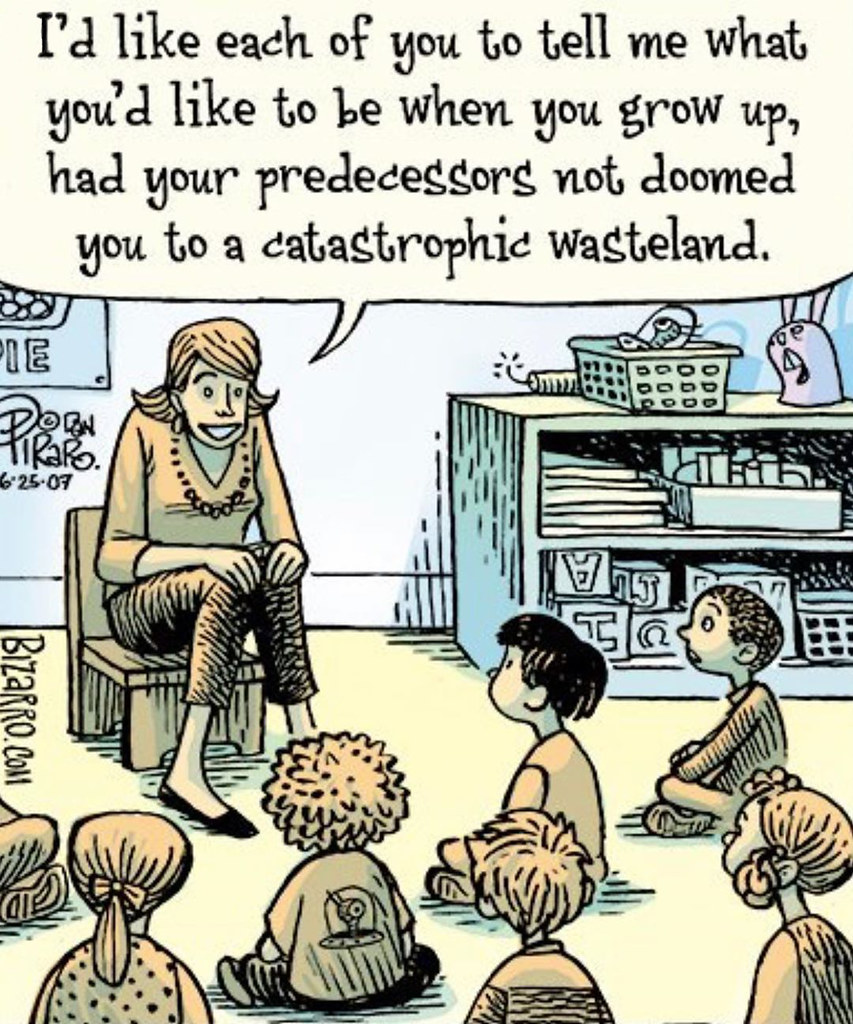
Funnies for the Depressed Collapsitarian

Weekend Funnies for the Depressed Collapsitarian #11. Collapse of Industrial Civilization. Jun 15, 2019.


It’s been a while since I’ve published one of these dark humor posts, but I think that as the catastrophic flooding, heat waves, and other extreme weather events continue to multiply and intensify and as more and more people start losing their minds, all we can do is laugh at the absurdity of our self-inflicted predicament. As has been said many times before, the Anthropocene carbon spike is just one of many symptoms from an overpopulated technocapitalist-driven world chasing too few resources, whether it be wild fish, potable water, rare earth minerals, or arable land. No one is putting the breaks on this race towards the abyss because no one is truly in charge, except for the cold and amoral calculator of corporate profits and stock market returns. 

In an age of “worse than expected” and “faster than anticipated”, the true cost of environmental collapse cannot be fully appreciated because humans have never existed in a world that is 500ppm CO2e and accelerating. One thing is certain —most of Earth’s mass extinctions were caused by a disruption in the carbon cycle which happened slowly over a much longer time span compared to today and without all the other human-forced pressures on the planet. All the technological advances and creature comforts we value today came at a rising environmental cost which is now impossible to repay since we have essentially ‘sold the farm’ in terms of the stability of the Holocene and the biochemistry of the planet.

There’s no techno-fixing our way out of this mess. We didn’t build a durable civilization; we built a superficial and fleeting one blinded by delusions of technological grandeur and human superiority.

So as we all slowly arrive at the fifth stage of grief, here’s a toast to humans before the party ends


And this cartoon is becoming more accurate as time passes and oil executives mourn for the loss of future profits


Earth will be fine. Humans?…not so much


No need to plan for retirement, the beach will come to you…


I’m sure Greta Thunberg would have something to say…


And lastly…
A Final Warning to Planet Earth

15,364 scientists from 184 countries issue a ‘warning to humanity’ and present a radical agenda to protect planet Earth. We, the billions of people believing in human exceptionalism, categorically reject this agenda and issue in return a stark warning to planet Earth…We officially summon planet Earth to abandon its intransigent attitude and accept the inevitable: an extension of its biological and physical limits. Should planet Earth stick with its hardline ideological stance, it needs to be aware that mankind will never compromise and that we will seek a second planet. The universe is like our ambition: limitless…

Wednesday, June 12, 2019

Is humanity dying?

Is humanity dying? Christian Mihatsch, Climate reporter, June 9, 2019.

The climate crisis is becoming increasingly apocalyptic. It is unlikely that our civilization will end soon — but possible. And this possibility is still receiving too little attention.

The perception of the climate problem is currently changing rapidly. The term "climate change" is increasingly being replaced by "climate crisis", and instead of "warming", what will probably prevail is "climate overheating" or a similar term. But is it appropriate to speak of the end of our civilization or even the extinction of humanity?

Some of the most important climate movements are doing just that. Extinction Rebellion is already carrying extinction in its name and the movement's first call is: Tell the truth and explain the state of emergency.

Fridays for Future's Greta Thunberg also clearly states what options humanity has: "Either we choose to preserve our civilization or we do not." And addressing world leaders, Thunberg says: "I want you to panic."

But is there really a reason to panic? The IPCC says that overheating can theoretically be stopped at 1.5 degrees. The IPCC reports are considered the "gold standard" of climate science because they summarize the findings of thousands of studies.

But the reports are also criticized, for example, because of their language. Prof. Hans Joachim Schellnhuber, ex-head of the Potsdam Institute for Climate Impact Research and an IPCC author, says that among IPCC authors a trend has developed "to err on the side of least drama". So you may present a better situation than exists in order not to sound alarmist.

The “probability obsession" of the IPCC


In addition, the IPCC assumes that warming will continue in a linear fashion. However, many climate models show that warming is accelerating. The difference: Instead of 2040, the 1.5-degree threshold will be reached in 2030 (see diagram).

In addition, the IPCC does not take into account feedback processes such as permafrost thawing, which may [will] cause climate overheating to increase.

According to Schellnhuber, however, the biggest drawback is the IPCC's "probability obsession" because it means not enough attention is paid to the most dangerous developments: "Calculating probabilities has little meaning in the most critical areas, such as the thawing of permafrost or the possible collapse of entire states."

In addition, the damage of, for example, the collapse of our civilization cannot be quantified. A recent study by the Australian think tank Breakthrough states: "A risk is usually calculated by multiplying the probability of an event by the expected damage, but if the damage can no longer be quantified, this method breaks down."

But even in the quantifiable realm, one underestimates the risk by focusing on relatively probable warming and masking worst-case scenarios. For these damages increase exponentially (see chart below).

Unlikely, but catastrophic

Schellnhuber calls for less attention be paid to "probabilities" and more to "possibilities". "This corresponds to the scenario planning in the economy, where the consequences of possible developments are examined, which seem unlikely, but have far-reaching consequences."

That's exactly what the authors of the Breakthrough study, David Spratt and Ian Dunlop, have done, developing a scenario that will raise the climate by three degrees by 2050. That's not extreme. For the 30 years to the middle of the century, there is a five percent chance that the climate will warm up by 3.5 to 4 degrees.


How sensitive is the climate to the warming of the atmosphere
(climate sensitivity) and what are the consequences?
The probability (likelihood) multiplied by the damage (impact)
gives the risk (risk). The light blue bar shows that very
unlikely developments are the biggest risk.
(Graphic from the study).


To show how this can happen, Spratt and Dunlop tell a "story": In the coming decade, the climate crisis is still receiving too little attention, and emissions will continue to rise until 2030, only to decline thereafter. Then it is already too late and the climate warms by 2050 by three degrees.

In retrospect, scientists then find that several tipping points have been reached, such as the thawing of permafrost and droughts in the Amazon rainforest. One-third of the earth is now too hot for at least 20 days a year to allow people to survive outdoors. Food production is no longer enough to feed all people, and there are more than a billion climate refugees.

As I said: The probability of this development is around five percent. 

[MW: nope: its higher... this estimate of probability is based on the IPCC stuff, which, as mentioned above, is plagued by "conservatism" and "scientific reticence"... how can you properly calculate the probabilities if you ignore the positive feedback effects that you can't include in your models because you don't understand them well enough yet?! next gen climate models are increasingly showing that ECS, or earth climate sensitivity, is higher than previously assumed. see the Ian Welsh article posted June 16 about everything happening faster, in a bad way, than scientific consensus said it would. UN is always too optimistic (in the same way the consensus of economists always is)]

Extinction Rebellion and Greta Thunberg invoke such scenarios with their apocalyptic language. Still, it is more likely that our civilization will not end and humanity will not die out. 
[says you, and your optimism bias, i.e. wishful thinking not based on facts... but under business as usual, we are f'd; and even if we transform everything NOW (As Naomi Klein says, This Changes Everything), it may still be too late due to tipping points, in particular methane release from permafrost and seafloor

Nevertheless, it is possible if our protection from climate change continues to be only half-hearted.

These "possibilities" must be given more attention, says Schellnhuber: "This is especially true when it comes to the survival of our civilization."


Existential climate-related security risk. David Spratt and Ian Dunlop, Breakthrough Institute. 
A scenario approach

Understanding climate-driven security risks relies on climate impact projections, but much knowledge produced for policymakers is too conservative. Because the risks are now existential, a new approach to climate and security risk assessment is required using scenario analysis.

Friday, June 7, 2019

Roy Scranton: No Happy Ending

No Happy Ending: On Bill McKibben’s “Falter” and David Wallace-Wells’s “The Uninhabitable Earth”Roy Scranton, LA Review of Books. June 3, 2019.


MANY YEARS AGO, when I was a college dropout with bad credit, having defaulted on my student loans, I worked briefly as a phone psychic. There was some training involved: how to use the system that routed callers to your home phone, for instance, but also how to keep callers on the line and, even more important, keep them coming back. On some level, of course, one’s success as a psychic depended on one’s supernatural abilities: either you have the gift or you don’t. The business side, however, depended a lot more on telling the right story. Asking open-ended questions and having a sympathetic ear helped, but the key was in reading the tarot spread in such a way that you crafted a compelling narrative of struggle and overcoming. “Basically, you tell them things will be hard,” my trainer instructed me, “then you tell them things will get better.”

I wasn’t a phone psychic long. The people who called had real problems — cancer, family members in prison, abusive relationships, drugs and alcohol — and my simple story of struggle and overcoming seemed not only inadequate but unethical, a comforting sop to make the unbearable bearable, especially given that my goal was to get them hooked on paying several dollars a minute to hear me interpret the relationship between the seven of wands and the Wheel of Fortune. The stories these people were living didn’t match the story I was being paid to tell them, and deceiving them with happy-ending fables seemed wrong. But the narrative insight my psychic trainer offered was important, and came in use a few years later, when I worked as a door-to-door grassroots canvasser for the largest progressive nonprofit fundraising organization in the United States.

The basic tool of the door-to-door canvasser is “the rap.” It’s a concise, punchy narrative that always follows the same five-part formula: introduce yourself, describe the problem, describe the solution, identify the opposition, and solicit engagement. It’s a subtle variation on the narrative my psychic trainer taught me, in that it adds a villain and ends with an appeal to action. I would learn later that it closely resembles classic Ciceronian structure. Best of all, it worked. Not every door, not every time, but reliably over the long haul. If you knocked on 75 doors and talked to 40 people, which was an average night, you could usually get four or five people to contribute, which was enough to make quota.

I turned out to be pretty good at canvassing, regularly beating quota by significant margins, which was a shock to me, since I’d never really thought of myself as a “people person.” I was quickly promoted to field manager, then assistant campaign director, and soon found myself training canvassers, writing raps for new campaigns, and troubleshooting problems in the field. Any time a canvasser seemed to be flailing, the first and best advice was to have them focus on the rap. It was a sturdy and dependable tool, an effective rhetorical framework for presenting any problem as solvable and for convincing people to write checks and sign petitions — not someday, but right now: “We need your help tonight.”

The last campaign I worked on was a WashPIRG summer campaign to stop the Olympic Pipeline Company from building a petroleum pipeline across the Cascade mountains. It was a noble fight against a dastardly villain, and I brought all my working-class rage to bear on the struggle. Who makes a better enemy than oil executives? What starker conflict could there be than the one between rapacious greedheads and sacred wilderness? By June, the campaign was going great: our canvas was expanding, our canvassers were building powerful esprit de corps, and donations were rolling in. Then something terrible happened.

We won.

Or rather, an underground gas pipeline exploded in Bellingham, Washington, and killed three people, two of them 10-year-old boys. That pipeline was owned by the Olympic Pipeline Company, which prudently withdrew the cross-Cascades proposal we’d been fighting. It was something of a crisis, since we weren’t even halfway through the summer campaign: we still had thousands of postcards, flyers, posters, and factsheets, all urging Washingtonians to “Stop the Pipeline.” The decision WashPIRG leadership made was to count this as a victory and go on the offensive. Our campaign shifted from “Stop the Pipeline” to “No New Pipelines.” The trouble came when we designed the new rap, which didn’t talk about the dead boys at all and gave WashPIRG credit for stopping the pipeline.

There can be no doubt that the pressure WashPIRG put on the Olympic Pipeline Company contributed to that company’s sense that it couldn’t go forward in the wake of the explosion. Yet to claim that WashPIRG was primarily responsible dishonored the memory of those dead boys and deceived the people we were asking to support us. What had happened wasn’t a victory, but a tragedy. The problem was, there’s no room in the rap for tragedy. It’s not that kind of story.

There are few periods in my life as dispiriting as were the last weeks of that campaign, when I went out every night and lied in the service of a good cause. I trained canvassers to dissemble and evade, to downplay tragedy in favor of a story with a happy ending, and to unscrupulously prey on the good faith of well-meaning people because we believed that what we were doing was right. My numbers slipped, and my passion evaporated. I couldn’t even depend on the rap.

The slippage turned into a full-blown ethical crisis, which opened my eyes to the power of institutional inertia and to the dangers of finding yourself trapped in the wrong story. It made me question whether any real social change was possible within the constraints of the system we lived in. If the only stories we could tell had to have happy endings, what else were we lying about? And if our fight was based on lies, what the hell were we fighting for?

I left the Fund and spent some time in Mexico, then came back to Washington for the WTO protests in Seattle in 1999. Participating in that protest, an experience at once chastening and sublime, crippled what faith I had left in protest-based social movements. The WTO protestors were adaptable, passionate, and cunning, but divided, incoherent, and critically weakened by a lack of discipline. The Seattle police and the National Guard were slow and reactive, but they also had all the resources, including time. All they had to do to win was to keep us from winning, which turned out to be relatively easy. The next two years I remember as a complicated search for a way forward. In the spring of 2002, I enlisted in the US Army, in large part for the GI Bill and Army College Fund, but also to understand how the world had changed after 9/11, and soon found myself in a new narrative: protecting America from WMDs by bringing democracy to the people of Iraq in what would be, we were promised, a short and easy war.

¤

The stories we tell ourselves matter. As beings whose social existence is structured by symbolic reasoning, we comprehend our lives through collectively-agreed-upon narratives about what is important, what to attend to, what reality itself is and means. These narratives undergird our politics, inform our notions of identity, and give shape to our desires. They tell us what is possible and what is not, what is known and what is inconceivable, what must be true and what cannot be. It is therefore essential that we always keep testing our narratives against reality, and always be willing to edit, revise, or even wholly rewrite them in light of new information.

Indeed, there are moments when changing the stories we live within is the only way to keep going. Today, facing worldwide ecological collapse, we find ourselves in such a moment. Two new books illustrate and embody this challenge: Falter: Has the Human Game Begun to Play Itself Out? by Bill McKibben and The Uninhabitable Earth: Life After Warmingby David Wallace-Wells.

The first, Falter, is journalist-turned-activist Bill McKibben’s 15th book. In it, he presents climate change, economic inequality, artificial intelligence, automation, and genetic engineering as threats to human existence and human identity. McKibben sees the “human game” as risking “playing itself out” primarily because of what he calls “leverage,” by which he means the scale of changes humans are causing. For McKibben, the “human game” is “the entirety of our ceaseless activity,” a game which “has no rules and no end,” but goes “well when it creates more dignity for its players, and badly when that dignity diminishes.”

The threats McKibben discusses are real enough, though his discussion of them tends toward shallow recapitulations of trendy think pieces and internet journalism. The bigger problem is that McKibben never bothers to clarify why it makes sense to think of the sum total of human existence on the planet Earth as a “game,” especially one that has no rules and doesn’t end, since the very definition of game is that it is a structured form of play. The idea of a game with neither rules nor boundaries makes no sense. And while thinkers such as John von Neumann, Ludwig Wittgenstein, Roger Caillois, and Johan Huizinga have all used the idea of games to explore what it means to be human, McKibben doesn’t seem to care much about how games actually work. Rather, he seems to want to use the idea of the “human game” as a secular framework for conceptualizing human values.

McKibben has always been a particularly American kind of public intellectual, in the tradition of Cotton Mather, Jonathan Edwards, Ralph Waldo Emerson, and Henry David Thoreau. Indeed, the historian Richard White once described Bill McKibben’s style as a combination of Emerson and Walt Disney, a comparison White made not “glibly or mockingly,” but rather because of Disney’s “great influence on how Americans […] think about nature.” According to White,
McKibben can so readily bring to mind both Emerson and Disney because a common Protestant sensibility unites all of them. For each, a common religiosity pervades the natural world. Humans learn […] that there is a power that made all of them and is greater than all of them. It must be acknowledged and obeyed.
Thus, McKibben’s notion of the “human game” begins to come into focus, as does the problem it means to solve. Climate change poses such profound challenges to the ways that we conceive of human existence that we are compelled to rethink what that existence means. In some sense, this was apparent from McKibben’s first book, The End of Nature, published in 1989. Since then, he has been a leading voice in framing the problems climate change poses, yet his solutions lean always toward the homiletic. The story McKibben knows best is one in which our mission in the wilderness has foundered but can be saved by spiritual renewal. When he turns to face the future, he does so dressed in a faded patchwork of Protestant confessionalism, Disneyfied Romanticism, and faith in human redemption.

Bill McKibben’s worldview is steeped in the spiritual dregs of ’60s hippie optimism. David Wallace-Wells is of another generation; he was seven when Bill McKibben pronounced the “end of nature,” and belongs to one of the first cohorts that grew up knowing it lived in a world transformed by global warming. “I am not an environmentalist,” he writes, “and [I] don’t even think of myself as a nature person.” Indeed, Wallace-Wells asserts that he wouldn’t mind losing “much of what we think of as ‘nature’ […] so long as we could go on living as we have in the world left behind.” The reason this self-described gadget-loving, beef-eating, bitcoin-buying human chauvinist has written a book about climate change is that we can’t.

The Uninhabitable Earth expands on Wallace-Wells’s alarming and controversial 2017 New York magazine article of the same name and takes a close look at the likely effects of climate change over the next several decades. Wallace-Wells begins with an introductory overview that seeks to dismantle what he calls the “comforting delusions” of climate-change complacency: that it is happening slowly, that it is happening far away, that it is primarily about sea level rise, that wealth can defend against it, that we can expect an easy technological fix, or “that there is any analogue to the scale or scope of this threat, in the long span of human history, that might give us confidence in staring it down.” He then spends the next hundred pages or so taking each consequence of global warming in turn, from “Heat Death” to “Dying Oceans” to “Economic Collapse.” These first two sections of the book are the strongest: while occasionally repetitive, sometimes overwritten, and often mind-numbingly abstract (what, for instance, would it mean that 3.7 degrees of warming could cost the world $551 trillion?), Wallace-Wells paints a compelling, comprehensive, solidly researched, and genuinely terrifying picture of our future.

Wallace-Wells also does justice to the limits and obstacles we face in addressing the problem, which he explores in the book’s last third, building a thorough and convincing argument that we moderns, especially and specifically 21st-century Americans, are prodigiously ill-equipped for coping with or even really understanding the global cataclysm we’ve unleashed. As the reader closes in on the final 30 pages, a dizzying narrative suspense takes hold: the problem Wallace-Wells presents is so overwhelming, so comprehensive, so frightening, and so far beyond the grasp of current political institutions that you wonder how the author will confront the abyss toward which the story seems headed. Disappointingly, Wallace-Wells flinches.

The book’s last two chapters are the least persuasive. In the penultimate chapter, “Ethics at the End of the World,” Wallace-Wells engages in a weak argument with several writers he misleadingly lumps together under the pejorative “ecological nihilism.” While the chapter’s title suggests some discussion of the problem of ethics in a world shaped by climate change, perhaps with reference to the work of thinkers such as Dipesh Chakrabarty, Stephen Gardiner, Donna Haraway, Dale Jamieson, Bruno Latour, Samuel Scheffler, Eugene Thacker, or Anna Tsing, Wallace-Wells instead beats up on a straw man. He starts with the fringe scientist Guy McPherson, who makes an easy target: McPherson’s paranoid style, his outrageous confidence in his predictions (such as that climate change will cause human extinction by 2030), his polyamorous homestead, and his goofy mustache all scream “crank.” And yet as Wallace-Wells himself points out, many of McPherson’s fears are legitimate. Even among McPherson’s mistakes, Wallace-Wells writes, “there is enough real science to give rise to real alarm: a good summary of the albedo effect, a convenient assemblage of rigorous readings of the Arctic ice sheets.” McPherson’s biggest bugbear, Arctic methane emissions, remains poorly understood and controversial, but a recent study shows a surge in atmospheric methane strong enough to negate even the most rigorous plans for CO2 reduction outlined in the Paris Agreement, were they to be enacted. More to the point, McPherson’s ethical quietism is a legitimate philosophical position, not one that can be waved away with a sneer, as Wallace-Wells attempts. It’s easy to dismiss McPherson, less so Epictetus, the Buddha, St. Benedict, and Voltaire.

Wallace-Wells seems to have decided that anyone who takes seriously the possibility that climate change has slipped out of our control isn’t worth seriously considering. It’s not a great loss with McPherson, but it is disappointing to see Wallace-Wells treat Paul Kingsnorth, a provocative and original writer, with condescension and misunderstanding. While McPherson believes he can tell the future, Kingsnorth’s pessimism is grounded in the past, founded on “a simple fact which any historian could confirm: human civilisation is an intensely fragile construction […] built on little more than belief,” as he writes in Uncivilization: The Dark Mountain Manifesto. Such a skeptical, historically informed pessimism has substantial force, and deep literary and philosophical roots. It can be argued against, as can McPherson’s quietism, but not the way Wallace-Wells does here, by implying it’s merely a kind of moral cowardice, then dishonestly mislabeling it “ecological nihilism.” Believing that humans are fallible and that the universe has meaning above and beyond human existence is not nihilism; it is rather the opposite.

In his conclusion, Wallace-Wells writes:
The emergent portrait of suffering is, I hope, horrifying. It is also, entirely, elective. If we allow global warming to proceed, and to punish us with all the ferocity we have fed it, it will be because we have chosen that punishment — collectively walking down a path of suicide. If we avert it, it will be because we have chosen to walk a different path, and endure.
Here’s the crux: climate change is our choice, for we have all the tools we need to stop it. The solutions Wallace-Wells offers are familiar ones (carbon tax, investment in green energy and carbon capture, changing the ways we produce and eat food), but he doesn’t spend much time thinking about the practical steps such policies would require. He doesn’t think much about how politics and governance work. He doesn’t look at history to see how humans in crisis have handled such challenges before. He doesn’t even follow through the implications of everything he’s written in the rest of his book. In spite of his own evidence, Wallace-Wells ends on a note of hope, choosing to see climate change as an “invigorating picture” that “flatters our sense of power, and in so doing calls the world […] to action.”

Whereas McKibben’s book is breezy and rambling, Wallace-Wells’s is more tightly constructed, more focused, and relies more substantially on primary scientific research, but ultimately both adhere to the same basic narrative: things are bad, but they can get better if we’re good. Both books convey alarming visions of the near human future, as temperatures and seas rise, crops fail, diseases spread, refugees suffer, fires burn, conflicts erupt, and the oceans die; yet both books emphasize the power of human agency in deciding our collective future, insisting that in spite of such dire prognostications, we have the capacity to avert the worst and bend the course of human history back from the abyss.

In this way, both authors adhere neatly to the genre of the monitory ecological sermon, which found archetypal form in Theodor Geisel’s 1971 story The Lorax: industrial capitalism has wrought total ecological devastation upon the Earth, denuding it of Truffula Trees, brown Bar-ba-loots, Humming Fish, and Swomee Swans, which devastated world is fated to be our grim gray home forever … unless. Unless, that is, we heed the Lorax who speaks for the trees. The future depends upon cultivating the right feelings: “Unless someone like you cares a whole awful lot, nothing is going to get better. It’s not.” Which implies that if you do care, things will get better — a kind of magical thinking to which Americans seem especially susceptible.

Both The Uninhabitable Earth and Falter swerve in their final pages into this “unless,” in equally desperate and unconvincing ways. Wallace-Wells insists that “[i]f humans are responsible for the problem, they must be capable of undoing it,” which assertion is false in two ways. First, I may be responsible for knocking a glass of wine onto the floor, but I cannot simply undo the shattering. George W. Bush was responsible for the American invasion of Iraq, but no executive order could unbomb Baghdad and resurrect all the children he killed. Both ecological thinking and human history teach the same lesson: actions have complex, unforeseeable, and often irrevocable consequences.

Second, Wallace-Wells’s assertion attributes conscious deliberation to an abstract entity — “humanity” — which has shown no evidence of having any such quality. At the global scale, we act not as rational agents making individual decisions, but as a concatenation of competing actors. Even at the level of the individual, we often face limitations when it comes to doing what we think we ought. Simply because someone is responsible for drinking too much, losing their temper, or making a fool of themselves does not mean that they are necessarily capable of doing otherwise, much less of undoing the consequences of their actions.

While Wallace-Wells subscribes to the standard checklist of proposals to fight climate change, he neglects to present a convincing case for how policies such as the Green New Deal, a carbon tax, or massive global investment in direct air capture technology might be enacted and put into practice. Any environmental studies undergrad can tell you what we need to do; the problem is doing it. Wallace-Wells’s personal exhortations that we “choose to feel empowered” and “take responsibility” for climate change ring as hollow as the self-help slogans they so resemble.

McKibben’s “unless” relies less on contemporary language of empowerment than on a mashup of 1960s social activism and 1970s techno-utopianism. He argues that “two new technologies” offer us the chance to save the Bar-ba-loots: “One is the solar panel, and the other is the nonviolent movement.” To support this claim, McKibben first turns to Thomas Friedman–style anecdotes about poor families in Côte d’Ivoire, Ghana, and rural Vermont relying on solar panels for home power generation, then descends into a stupefying mix of cheerleading, moral hectoring, and small-is-beautiful nostalgia.

Solar panels, on their own, cannot meet global energy needs, and will not solve the problems caused by CO2 currently in the atmosphere and oceans, the catastrophic collapse of the biosphere, imminent crises in industrial agriculture, and accelerating climate feedbacks. And at this point — after the 2003 protests against the Iraq War, the “largest anti-war rally in history,” which saw millions of people in hundreds of cities across the world protesting the American invasion of Iraq and which utterly failed to stop the war — after the “People’s Climate March” in 2014, the “largest climate change march in history,” which utterly failed to have any noticeable effect on global climate policy — after decades of failed protests against institutional racism, gun violence, sexism, nuclear weapons, abortion, war, environmental degradation, and a raft of other issues — only the deluded and naïve could maintain that nonviolent protest politics is much more than ritualized wishful thinking. In the end, McKibben’s argument falls into the same vague preaching as does Wallace-Wells’s. Human beings are special, McKibben insists, because we have free will: “We’re the only creature who can decide not to do something we’re capable of doing.” Asking hard questions about who that “we” is, how “we” make decisions, how power works, and the limits of human freedom are beyond the reach of both writers, because such questions lie outside the narrative they’re both trapped in.

Unluckily for us, climate change is not a moral fable, a point Wallace-Wells makes but then seems to forget. “There is nothing to learn from global warming,” he writes early on, “because we do not have the time, or the distance, to contemplate its lessons; we are after all not merely telling the story but living it.” And therein lies the problem with both books. The story we’re living is one of failure, catastrophe, suffering, and tragedy: an out-of-control car careening off a dark road. The story Wallace-Wells and McKibben wind up telling, however, is that we’re in control and the skid is manageable, if only we choose to take the wheel. It’s a story I’ve heard before:

Things are hard but they’re gonna get better … Our enemies are strong but we can defeat them … The odds are long but we can do it … The problem is solvable if we have the political will … We will pass through this time of peril and carry on the work of peace … We’ve reached a turning point … The movement is growing … We need your help tonight …

The lag time between carbon emissions and consequent warming means that even if humans stopped emitting CO2 worldwide today, we would still face levels of warming over the next several decades that will not only put colossal political and economic stress on poor and wealthy nations alike, but also have a good chance of initiating runaway climate change, presuming such a tipping point hasn’t already been passed. Climate feedbacks such as permafrost melt, ice collapse, and wildfires are accelerating. The oceans are both dying and rising, like some Lovecraftian sea monster. Absent a Herculean effort devoting trillions of dollars to building direct-air-capture carbon scrubbers, none of this can be changed.

Despite the unconvincing cheer for human empowerment with which he ends his book, however, David Wallace-Wells understands the seriousness of our predicament. And despite his atavistic Protestant optimism, even Bill McKibben can see that the odds are not in our favor. The challenge these two capable, intelligent writers struggle with so powerfully, and which they so disappointingly fail to meet, is a challenge that anyone who thinks seriously about climate change confronts: the danger we face is utterly unlike anything humanity has ever faced before. Their moral fables don’t really fit our situation, but neither does the traditional narrative of apocalypse, nor the story of wartime mobilization, nor the story of innovation and progress, nor narratives of heroic overcoming.

Climate change is bigger than any individual moral choice. It’s bigger than the New Deal, bigger than the Marshall Plan, bigger than World War II, bigger than racism, sexism, inequality, slavery, the Holocaust, the end of nature, the Sixth Extinction, famine, war, and plague all put together, because the chaos it’s bringing is going to supercharge every other problem. Successfully meeting this crisis would require an abrupt, traumatic revolution in global human society; failing to meet it will be even worse. This is the truth we struggle to comprehend in narrative, the reality our stories must make sense of. The all-too-real possibility we must confront — and which David Wallace-Wells and Bill McKibben notably refuse — is that the story we’re living is a tragedy that ends in disaster, no matter what.