The Apocalypse Will Not Be Televised. Mike, Collapse of Industrial Civilization. Jan. 28, 2020.
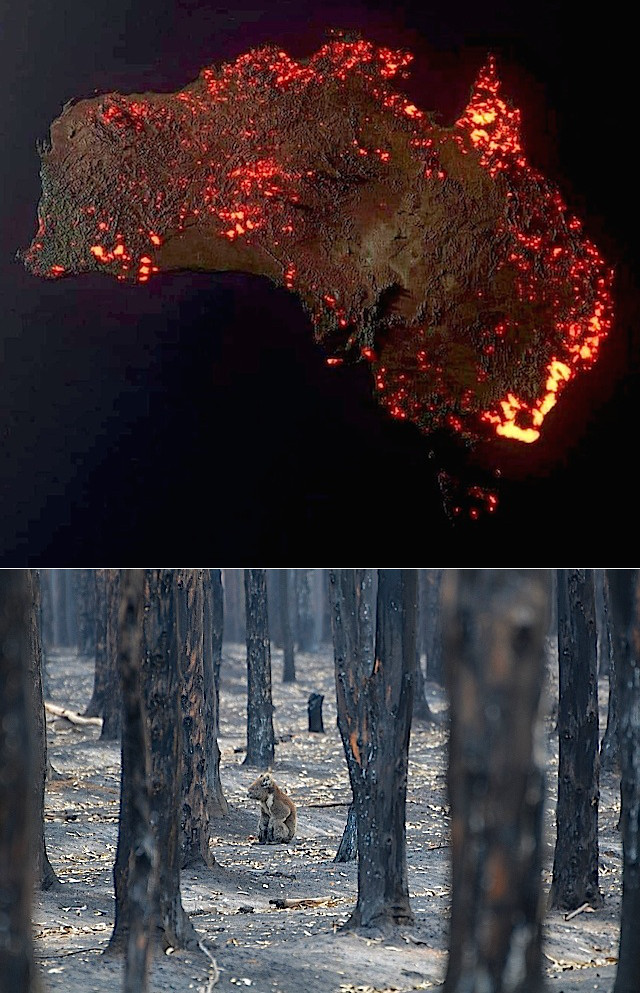
“3D visualization” of the Australian fires by Anthony Hearsey, compiled from NASA satellite data collected across the span of a month/an injured koala bear sits alone on the ‘apocalyptic’ Kangaroo Island
“3D visualization” of the Australian fires by Anthony Hearsey, compiled from NASA satellite data collected across the span of a month/an injured koala bear sits alone on the ‘apocalyptic’ Kangaroo Island
The year is 2020 and climate change-related disasters are in full swing while at the same time, the most influential country in the world is under the leadership of someone who calls scientists “foolish fortune tellers.” Australia, another country being led to its slaughter by the willfully and criminally ignorant, is literally going up in flames as we speak. Its rich millennia-old evolutionary legacy is disappearing before our eyes. The pictures of charred kangaroo corpses entangled in barbed wire fences and koala bears curled up in the fetal position as they tried to flee the fires are gut-wrenching and should be a wake-up call to our leaders. The platypus, another of the country’s iconic creatures, is dying off in drought-stricken cesspools. To make matters worse, recent heavy rains are causing massive fish kills as bushfire ash washes into rivers. More than a billion creatures (excluding frogs, insects, other invertebrates, or livestock) are estimated to have perished, and the wildlife that do manage to survive the country’s apocalyptic conditions are now at risk of starvation. Scientists fear these fires are causing the extinction of entire species of insects which play a vital role in “processing waste, pollination, providing nutrition for other species, and myriad other ecological functions.” While warming at twice the global rate from humanity’s fossil fuel binge, Australia continues to be the biggest net exporter of coal in the world, thus fueling its own conflagration.
The Australian mega-fires are not a one-off, but just the latest manifestation of an increasingly disrupted global climate system. Australia’s fate was predicted by scientists many years ago. The forever legacy of greenhouse gas emissions means the dust won’t settle in any time scale appreciable to humans. Sea levels will continue to rise for millennia, droughts and storms will grow in frequency and intensity, thousand-year rains will become common occurrences, entire ecosystems will unravel, and the human experiment will undoubtedly come to an end.
The Australian mega-fires are not a one-off, but just the latest manifestation of an increasingly disrupted global climate system. Australia’s fate was predicted by scientists many years ago. The forever legacy of greenhouse gas emissions means the dust won’t settle in any time scale appreciable to humans. Sea levels will continue to rise for millennia, droughts and storms will grow in frequency and intensity, thousand-year rains will become common occurrences, entire ecosystems will unravel, and the human experiment will undoubtedly come to an end.
To quote an Australian on Reddit:
Australia’s annual fire season is only at its midpoint, yet the massive pulse of carbon from these bushfires is now estimated at 900 million tons —double the country’s annual emissions. As horrific as the fires have made life on land, what’s happening in Australia’s oceans out of site and mind is equally disturbing, but of course this is not confined to Australia. Scientists have found that a ‘heat blob’ in the north Pacific ocean killed a million seabirds and wiped out 100 million cod.
We are destroying the life support systems to which all creatures, including man, are dependent, yet it does not appear that any climate disaster no matter how catastrophic will alter mankind’s tragic path to extinction. Wiping out an entire continent’s flora and fauna does not register on the Stock Market. No number of five-alarm fire warnings planet Earth sends will be heeded by this carbon-fueled corporate kleptocracy which carries us all toward a very dark future. Why would we expect any differently from an economic paradigm that tolerates no disruption as it plunders the planet in search of the almighty dollar? A report from two years ago called Australia’s extinction crisis a “national disgrace” and described its institutions tasked with protecting threatened plants and animals as “broken”. We see today that nothing has changed to prevent Australia’s natural treasures from disappearing into the black void of the Anthropocene extinction, never to be seen or heard from again.
This is what disturbs me about my countrymen. This is not just a one-off terrible event, this is a permanent step down, a large nail in our collective coffin. Long before we recover from this, we will suffer it again, and again. Those poor animals. Worse than being glorified, or not televised, our collapse is being looked at without seeing. It is misunderstood and denied.
For those not from here I’d say that one can’t overstate what is happening here, it is truly awful. We will never recover.
Australia’s annual fire season is only at its midpoint, yet the massive pulse of carbon from these bushfires is now estimated at 900 million tons —double the country’s annual emissions. As horrific as the fires have made life on land, what’s happening in Australia’s oceans out of site and mind is equally disturbing, but of course this is not confined to Australia. Scientists have found that a ‘heat blob’ in the north Pacific ocean killed a million seabirds and wiped out 100 million cod.
We are destroying the life support systems to which all creatures, including man, are dependent, yet it does not appear that any climate disaster no matter how catastrophic will alter mankind’s tragic path to extinction. Wiping out an entire continent’s flora and fauna does not register on the Stock Market. No number of five-alarm fire warnings planet Earth sends will be heeded by this carbon-fueled corporate kleptocracy which carries us all toward a very dark future. Why would we expect any differently from an economic paradigm that tolerates no disruption as it plunders the planet in search of the almighty dollar? A report from two years ago called Australia’s extinction crisis a “national disgrace” and described its institutions tasked with protecting threatened plants and animals as “broken”. We see today that nothing has changed to prevent Australia’s natural treasures from disappearing into the black void of the Anthropocene extinction, never to be seen or heard from again.
In fact, current assessments show extinction rates are accelerating:
I am loath to repeat these numbers because no price can be placed on intact ecosystems, but the economic costs of this year’s fire season in Australia are estimated to be approaching $100 billion, the costliest natural disaster in that country’s history. And in the U.S., the last decade has been ‘unprecedented‘:
The U.S. billion-dollar disaster damage costs over the last decade (2010-2019) were also historically large, exceeding $800 billion from 119 separate billion-dollar events. After adjusting for inflation, the U.S. experienced more than twice the number of billion-dollar disasters during the 2010s than the 2000s decade: 119 versus 59…Clearly, the historically large U.S. losses from hurricanes and wildfires over the last few years have further skewed the total distribution of extreme weather costs. This increase reflects a combination of increased exposure, vulnerability and the fact the climate change is playing an increasing role in the frequency of some types of extremes that lead to billion-dollar disasters.

The finance industry is starting to see that climate change is an existential crisis, yet offer no alternative to their ideological stalemate of infinite growth on a finite planet. In fact, they believe that the personal sacrifices needed to halt greenhouse gas emissions will create a public backlash towards such efforts. In other words, business-as-usual will rule the day until the hard laws of physics, chemistry, and biology make our bubble economy impossible. We’re undergoing that process right now as anthropogenic climate disruption returns planet Earth to the chaotic climatic conditions of the Pleistocene — a time in which organized societies and agriculture will be impossible. Water shortages, degraded soils, and loss of pollinators will only compound the problem. No amount of accounting tricks will bring back the habitability of the planet.
Cheap and abundant fossil fuels have given us modern science and technology which have allowed humans to feel detached and independent from nature, but when this civilization inevitably collapses we will once again be at the mercy of the natural world. If we have destroyed the biosphere and set in motion a mass extinction event at a time when we strongly need to rely on nature, then our prospects for survival are very grim indeed! Yet another study released this week shows that Earth’s biodiversity is crashing under a perfect storm of global warming, extreme weather events, and human activity. Collapse of industrial civilization and its vast amount of specialization along with a simultaneous planet-wide ecological collapse can very easily lead to human extinction. It’s not hard to imagine a Third World War being ignited by deteriorating environmental conditions and resource depletion as nations fall under the sway of propaganda from demagogues inciting fear, hatred, and violence.
With Earth Overshoot Day arriving ever earlier each year, we have arrived at the last stage of global civilization’s doubling time. The next twenty years will be the final tick of the clock in which our mass resource extraction, consumption, and waste irreparably damage the planet’s regenerative abilities and life support systems. Decades of greenwashing, empty rhetoric, and regulatory capture by the fossil fuel industry have brought us to this precipice:
 As you can see, any mitigation efforts at this late date rely heavily on the fantasy of carbon capture with nonexistent technologies that, truthfully, will never scale up to the enormous problem. To some degree or another, we are all in denial of what is unfolding in our final century as we go about our daily lives within a set of living arrangements completely incompatible to the survival of our descendants. Everyone is riding the peak of industrial civilization as we watch the world fall apart on our smart phones and LED TVs. In the meantime, the nightly news drones on about hyperpartisan politics and economic growth. That barely a vague mention is made in the news cycle of the most important story in mankind’s history tells you all you need to know about who controls mass media and why the story of our imminent demise will remain buried.
Our fossil record will be comprised mainly of plastics, radioactive waste and billions of human bones and that of our domesticated animals. The remnants of wild animals will be extremely rare since we have supplanted them with our livestock. All civilizations, especially complex ones, eventually collapse. Ours, like many before, will be undone by overshoot of the environment’s carrying capacity, albeit this time on a planetary scale and with no second chance for a do-over.

- Nature is in ‘unprecedented’ decline. A substantial proportion of assessed species are threatened with extinction and overall trends are deteriorating, with extinction rates increasing sharply in the past century.
- This decline is a direct result of human activity, the most devastating being changes in land and sea use, including natural habitat destruction.
- Since 1980, greenhouse gas emissions have doubled, raising average global temperatures by at least 0.7 degrees Celsius. 75% of fossil fuel burning and anthropogenic CO2 emissions in the atmosphere has occurred since 1970; their effects are just beginning to be felt.
- In the near future, climate change is expected to surpass the impacts of land and sea use change as well as other drivers (direct exploitation of organisms, pollution, invasive alien species).
- Increased human population and per capita consumption is a key driver of the above.
- By destroying the foundations of Earth’s interconnected web of life, we are threatening our own health and existence.
I am loath to repeat these numbers because no price can be placed on intact ecosystems, but the economic costs of this year’s fire season in Australia are estimated to be approaching $100 billion, the costliest natural disaster in that country’s history. And in the U.S., the last decade has been ‘unprecedented‘:
The U.S. billion-dollar disaster damage costs over the last decade (2010-2019) were also historically large, exceeding $800 billion from 119 separate billion-dollar events. After adjusting for inflation, the U.S. experienced more than twice the number of billion-dollar disasters during the 2010s than the 2000s decade: 119 versus 59…Clearly, the historically large U.S. losses from hurricanes and wildfires over the last few years have further skewed the total distribution of extreme weather costs. This increase reflects a combination of increased exposure, vulnerability and the fact the climate change is playing an increasing role in the frequency of some types of extremes that lead to billion-dollar disasters.
The finance industry is starting to see that climate change is an existential crisis, yet offer no alternative to their ideological stalemate of infinite growth on a finite planet. In fact, they believe that the personal sacrifices needed to halt greenhouse gas emissions will create a public backlash towards such efforts. In other words, business-as-usual will rule the day until the hard laws of physics, chemistry, and biology make our bubble economy impossible. We’re undergoing that process right now as anthropogenic climate disruption returns planet Earth to the chaotic climatic conditions of the Pleistocene — a time in which organized societies and agriculture will be impossible. Water shortages, degraded soils, and loss of pollinators will only compound the problem. No amount of accounting tricks will bring back the habitability of the planet.
Cheap and abundant fossil fuels have given us modern science and technology which have allowed humans to feel detached and independent from nature, but when this civilization inevitably collapses we will once again be at the mercy of the natural world. If we have destroyed the biosphere and set in motion a mass extinction event at a time when we strongly need to rely on nature, then our prospects for survival are very grim indeed! Yet another study released this week shows that Earth’s biodiversity is crashing under a perfect storm of global warming, extreme weather events, and human activity. Collapse of industrial civilization and its vast amount of specialization along with a simultaneous planet-wide ecological collapse can very easily lead to human extinction. It’s not hard to imagine a Third World War being ignited by deteriorating environmental conditions and resource depletion as nations fall under the sway of propaganda from demagogues inciting fear, hatred, and violence.
With Earth Overshoot Day arriving ever earlier each year, we have arrived at the last stage of global civilization’s doubling time. The next twenty years will be the final tick of the clock in which our mass resource extraction, consumption, and waste irreparably damage the planet’s regenerative abilities and life support systems. Decades of greenwashing, empty rhetoric, and regulatory capture by the fossil fuel industry have brought us to this precipice:
Our fossil record will be comprised mainly of plastics, radioactive waste and billions of human bones and that of our domesticated animals. The remnants of wild animals will be extremely rare since we have supplanted them with our livestock. All civilizations, especially complex ones, eventually collapse. Ours, like many before, will be undone by overshoot of the environment’s carrying capacity, albeit this time on a planetary scale and with no second chance for a do-over.


