Showing posts with label geoengineering. Show all posts

Friday, April 23, 2021

Climate scientists: concept of net zero is a dangerous trap

Climate scientists: concept of net zero is a dangerous trap. James Dyke, Robert Watson, Wolfgang Knorr.  April 22,2021.


Sometimes realisation comes in a blinding flash. Blurred outlines snap into shape and suddenly it all makes sense. Underneath such revelations is typically a much slower-dawning process. Doubts at the back of the mind grow. The sense of confusion that things cannot be made to fit together increases until something clicks. Or perhaps snaps.

Collectively we three authors of this article must have spent more than 80 years thinking about climate change. Why has it taken us so long to speak out about the obvious dangers of the concept of net zero? In our defence, the premise of net zero is deceptively simple – and we admit that it deceived us.

The threats of climate change are the direct result of there being too much carbon dioxide in the atmosphere. So it follows that we must stop emitting more and even remove some of it. This idea is central to the world’s current plan to avoid catastrophe. In fact, there are many suggestions as to how to actually do this, from mass tree planting, to high tech direct air capture devices that suck out carbon dioxide from the air.


Read more: There aren’t enough trees in the world to offset society’s carbon emissions – and there never will be


The current consensus is that if we deploy these and other so-called “carbon dioxide removal” techniques at the same time as reducing our burning of fossil fuels, we can more rapidly halt global warming. Hopefully around the middle of this century we will achieve “net zero”. This is the point at which any residual emissions of greenhouse gases are balanced by technologies removing them from the atmosphere.

This is a great idea, in principle. Unfortunately, in practice it helps perpetuate a belief in technological salvation and diminishes the sense of urgency surrounding the need to curb emissions now.

We have arrived at the painful realisation that the idea of net zero has licensed a recklessly cavalier “burn now, pay later” approach which has seen carbon emissions continue to soar. It has also hastened the destruction of the natural world by increasing deforestation today, and greatly increases the risk of further devastation in the future.

To understand how this has happened, how humanity has gambled its civilisation on no more than promises of future solutions, we must return to the late 1980s, when climate change broke out onto the international stage.


Steps towards net zero

On June 22 1988, James Hansen was the administrator of Nasa’s Goddard Institute for Space Studies, a prestigious appointment but someone largely unknown outside of academia.

By the afternoon of the 23rd he was well on the way to becoming the world’s most famous climate scientist. This was as a direct result of his testimony to the US congress, when he forensically presented the evidence that the Earth’s climate was warming and that humans were the primary cause: “The greenhouse effect has been detected, and it is changing our climate now.”

If we had acted on Hanson’s testimony at the time, we would have been able to decarbonise our societies at a rate of around 2% a year in order to give us about a two-in-three chance of limiting warming to no more than 1.5°C. It would have been a huge challenge, but the main task at that time would have been to simply stop the accelerating use of fossil fuels while fairly sharing out future emissions.
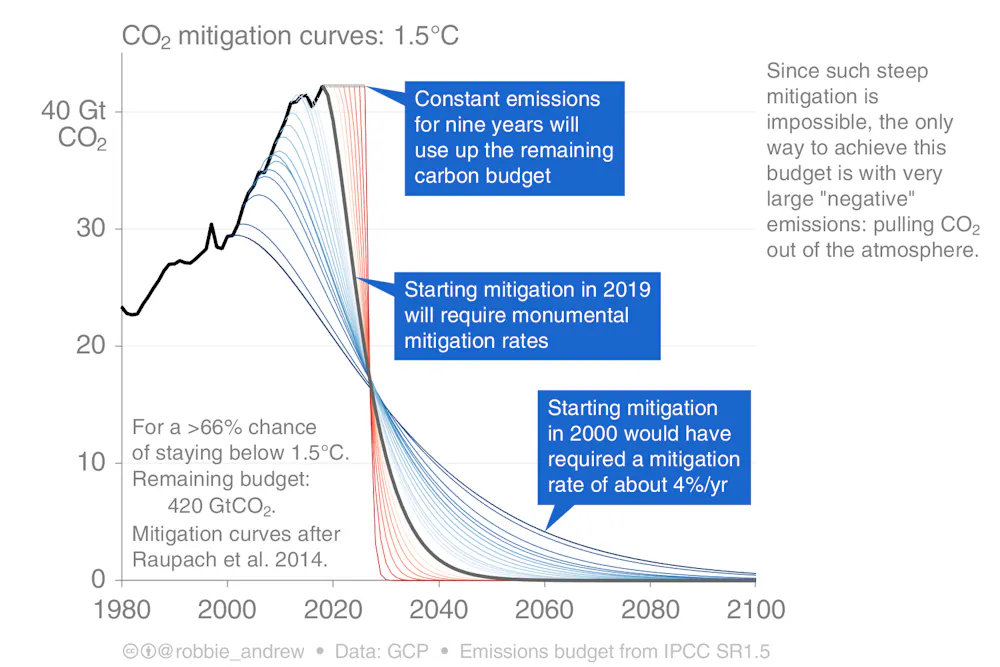


Graph demonstrating how fast mitigation has to happen to keep to 1.5℃. © Robbie Andrew,


Four years later, there were glimmers of hope that this would be possible. During the 1992 Earth Summit in Rio, all nations agreed to stabilise concentrations of greenhouse gases to ensure that they did not produce dangerous interference with the climate. The 1997 Kyoto Summit attempted to start to put that goal into practice. But as the years passed, the initial task of keeping us safe became increasingly harder given the continual increase in fossil fuel use.

It was around that time that the first computer models linking greenhouse gas emissions to impacts on different sectors of the economy were developed. These hybrid climate-economic models are known as Integrated Assessment Models. They allowed modellers to link economic activity to the climate by, for example, exploring how changes in investments and technology could lead to changes in greenhouse gas emissions.

They seemed like a miracle: you could try out policies on a computer screen before implementing them, saving humanity costly experimentation. They rapidly emerged to become key guidance for climate policy. A primacy they maintain to this day.

Unfortunately, they also removed the need for deep critical thinking. Such models represent society as a web of idealised, emotionless buyers and sellers and thus ignore complex social and political realities, or even the impacts of climate change itself. Their implicit promise is that market-based approaches will always work. This meant that discussions about policies were limited to those most convenient to politicians: incremental changes to legislation and taxes.

Around the time they were first developed, efforts were being made to secure US action on the climate by allowing it to count carbon sinks of the country’s forests. The US argued that if it managed its forests well, it would be able to store a large amount of carbon in trees and soil which should be subtracted from its obligations to limit the burning of coal, oil and gas. In the end, the US largely got its way. Ironically, the concessions were all in vain, since the US senate never ratified the agreement

Postulating a future with more trees could in effect offset the burning of coal, oil and gas now. As models could easily churn out numbers that saw atmospheric carbon dioxide go as low as one wanted, ever more sophisticated scenarios could be explored which reduced the perceived urgency to reduce fossil fuel use. By including carbon sinks in climate-economic models, a Pandora’s box had been opened.

It’s here we find the genesis of today’s net zero policies.
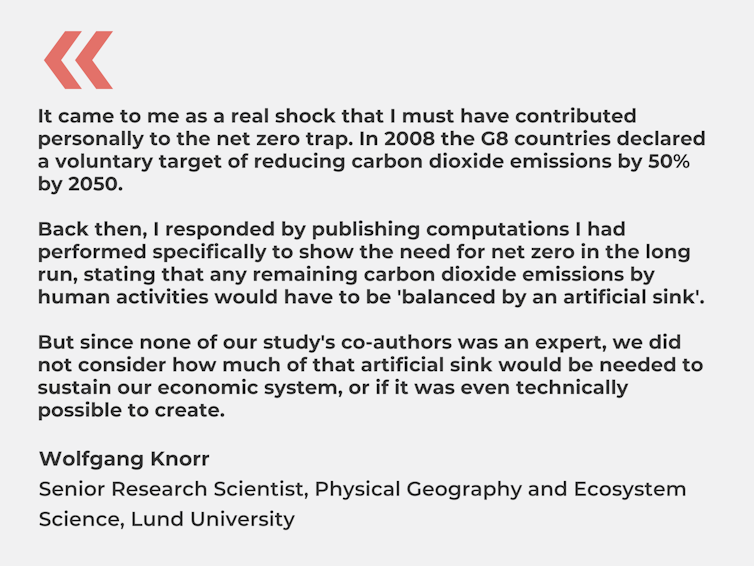


That said, most attention in the mid-1990s was focused on increasing energy efficiency and energy switching (such as the UK’s move from coal to gas) and the potential of nuclear energy to deliver large amounts of carbon-free electricity. The hope was that such innovations would quickly reverse increases in fossil fuel emissions.

But by around the turn of the new millennium it was clear that such hopes were unfounded. Given their core assumption of incremental change, it was becoming more and more difficult for economic-climate models to find viable pathways to avoid dangerous climate change. In response, the models began to include more and more examples of carbon capture and storage, a technology that could remove the carbon dioxide from coal-fired power stations and then store the captured carbon deep underground indefinitely.

This had been shown to be possible in principle: compressed carbon dioxide had been separated from fossil gas and then injected underground in a number of projects since the 1970s. These Enhanced Oil Recovery schemes were designed to force gases into oil wells in order to push oil towards drilling rigs and so allow more to be recovered – oil that would later be burnt, releasing even more carbon dioxide into the atmosphere.

Carbon capture and storage offered the twist that instead of using the carbon dioxide to extract more oil, the gas would instead be left underground and removed from the atmosphere. This promised breakthrough technology would allow climate friendly coal and so the continued use of this fossil fuel. But long before the world would witness any such schemes, the hypothetical process had been included in climate-economic models. In the end, the mere prospect of carbon capture and storage gave policy makers a way out of making the much needed cuts to greenhouse gas emissions.


The rise of net zero

When the international climate change community convened in Copenhagen in 2009 it was clear that carbon capture and storage was not going to be sufficient for two reasons.

First, it still did not exist. There were no carbon capture and storage facilities in operation on any coal fired power station and no prospect the technology was going to have any impact on rising emissions from increased coal use in the foreseeable future.

The biggest barrier to implementation was essentially cost. The motivation to burn vast amounts of coal is to generate relatively cheap electricity. Retrofitting carbon scrubbers on existing power stations, building the infrastructure to pipe captured carbon, and developing suitable geological storage sites required huge sums of money. Consequently the only application of carbon capture in actual operation then – and now – is to use the trapped gas in enhanced oil recovery schemes. Beyond a single demonstrator, there has never been any capture of carbon dioxide from a coal fired power station chimney with that captured carbon then being stored underground.

Just as important, by 2009 it was becoming increasingly clear that it would not be possible to make even the gradual reductions that policy makers demanded. That was the case even if carbon capture and storage was up and running. The amount of carbon dioxide that was being pumped into the air each year meant humanity was rapidly running out of time.

With hopes for a solution to the climate crisis fading again, another magic bullet was required. A technology was needed not only to slow down the increasing concentrations of carbon dioxide in the atmosphere, but actually reverse it. In response, the climate-economic modelling community – already able to include plant-based carbon sinks and geological carbon storage in their models – increasingly adopted the “solution” of combining the two.

So it was that Bioenergy Carbon Capture and Storage, or BECCS, rapidly emerged as the new saviour technology. By burning “replaceable” biomass such as wood, crops, and agricultural waste instead of coal in power stations, and then capturing the carbon dioxide from the power station chimney and storing it underground, BECCS could produce electricity at the same time as removing carbon dioxide from the atmosphere. That’s because as biomass such as trees grow, they suck in carbon dioxide from the atmosphere. By planting trees and other bioenergy crops and storing carbon dioxide released when they are burnt, more carbon could be removed from the atmosphere.

With this new solution in hand the international community regrouped from repeated failures to mount another attempt at reining in our dangerous interference with the climate. The scene was set for the crucial 2015 climate conference in Paris.


A Parisian false dawn

As its general secretary brought the 21st United Nations conference on climate change to an end, a great roar issued from the crowd. People leaped to their feet, strangers embraced, tears welled up in eyes bloodshot from lack of sleep.

The emotions on display on December 13, 2015 were not just for the cameras. After weeks of gruelling high-level negotiations in Paris a breakthrough had finally been achieved. Against all expectations, after decades of false starts and failures, the international community had finally agreed to do what it took to limit global warming to well below 2°C, preferably to 1.5°C, compared to pre-industrial levels.

The Paris Agreement was a stunning victory for those most at risk from climate change. Rich industrialised nations will be increasingly impacted as global temperatures rise. But it’s the low lying island states such as the Maldives and the Marshall Islands that are at imminent existential risk. As a later UN special report made clear, if the Paris Agreement was unable to limit global warming to 1.5°C, the number of lives lost to more intense storms, fires, heatwaves, famines and floods would significantly increase.

But dig a little deeper and you could find another emotion lurking within delegates on December 13. Doubt. We struggle to name any climate scientist who at that time thought the Paris Agreement was feasible. We have since been told by some scientists that the Paris Agreement was “of course important for climate justice but unworkable” and “a complete shock, no one thought limiting to 1.5°C was possible”. Rather than being able to limit warming to 1.5°C, a senior academic involved in the IPCC concluded we were heading beyond 3°C by the end of this century.

Instead of confront our doubts, we scientists decided to construct ever more elaborate fantasy worlds in which we would be safe. The price to pay for our cowardice: having to keep our mouths shut about the ever growing absurdity of the required planetary-scale carbon dioxide removal.


Taking centre stage was BECCS because at the time this was the only way climate-economic models could find scenarios that would be consistent with the Paris Agreement. Rather than stabilise, global emissions of carbon dioxide had increased some 60% since 1992.

Alas, BECCS, just like all the previous solutions, was too good to be true.

Across the scenarios produced by the Intergovernmental Panel on Climate Change (IPCC) with a 66% or better chance of limiting temperature increase to 1.5°C, BECCS would need to remove 12 billion tonnes of carbon dioxide each year. BECCS at this scale would require massive planting schemes for trees and bioenergy crops.

The Earth certainly needs more trees. Humanity has cut down some three trillion since we first started farming some 13,000 years ago. But rather than allow ecosystems to recover from human impacts and forests to regrow, BECCS generally refers to dedicated industrial-scale plantations regularly harvested for bioenergy rather than carbon stored away in forest trunks, roots and soils.

Currently, the two most efficient biofuels are sugarcane for bioethanol and palm oil for biodiesel – both grown in the tropics. Endless rows of such fast growing monoculture trees or other bioenergy crops harvested at frequent intervals devastate biodiversity.

It has been estimated that BECCS would demand between 0.4 and 1.2 billion hectares of land. That’s 25% to 80% of all the land currently under cultivation. How will that be achieved at the same time as feeding 8-10 billion people around the middle of the century or without destroying native vegetation and biodiversity?


Read more: Carbon capture on power stations burning woodchips is not the green gamechanger many think it is


Growing billions of trees would consume vast amounts of water – in some places where people are already thirsty. Increasing forest cover in higher latitudes can have an overall warming effect because replacing grassland or fields with forests means the land surface becomes darker. This darker land absorbs more energy from the Sun and so temperatures rise. Focusing on developing vast plantations in poorer tropical nations comes with real risks of people being driven off their lands.

And it is often forgotten that trees and the land in general already soak up and store away vast amounts of carbon through what is called the natural terrestrial carbon sink. Interfering with it could both disrupt the sink and lead to double accounting.


As these impacts are becoming better understood, the sense of optimism around BECCS has diminished.


Pipe dreams


Given the dawning realisation of how difficult Paris would be in the light of ever rising emissions and limited potential of BECCS, a new buzzword emerged in policy circles: the “overshoot scenario. Temperatures would be allowed to go beyond 1.5°C in the near term, but then be brought down with a range of carbon dioxide removal by the end of the century. This means that net zero actually means carbon negative. Within a few decades, we will need to transform our civilisation from one that currently pumps out 40 billion tons of carbon dioxide into the atmosphere each year, to one that produces a net removal of tens of billions.

Mass tree planting, for bioenergy or as an attempt at offsetting, had been the latest attempt to stall cuts in fossil fuel use. But the ever-increasing need for carbon removal was calling for more. This is why the idea of direct air capture, now being touted by some as the most promising technology out there, has taken hold. It is generally more benign to ecosystems because it requires significantly less land to operate than BECCS, including the land needed to power them using wind or solar panels.

Unfortunately, it is widely believed that direct air capture, because of its exorbitant costs and energy demand, if it ever becomes feasible to be deployed at scale, will not be able to compete with BECCS with its voracious appetite for prime agricultural land.

It should now be getting clear where the journey is heading. As the mirage of each magical technical solution disappears, another equally unworkable alternative pops up to take its place. The next is already on the horizon – and it’s even more ghastly. Once we realise net zero will not happen in time or even at all, geoengineering – the deliberate and large scale intervention in the Earth’s climate system – will probably be invoked as the solution to limit temperature increases.

One of the most researched geoengineering ideas is solar radiation management – the injection of millions of tons of sulphuric acid into the stratosphere that will reflect some of the Sun’s energy away from the Earth. It is a wild idea, but some academics and politicians are deadly serious, despite significant risks. The US National Academies of Sciences, for example, has recommended allocating up to US$200 million over the next five years to explore how geoengineering could be deployed and regulated. Funding and research in this area is sure to significantly increase.


Difficult truths

In principle there is nothing wrong or dangerous about carbon dioxide removal proposals. In fact developing ways of reducing concentrations of carbon dioxide can feel tremendously exciting. You are using science and engineering to save humanity from disaster. What you are doing is important. There is also the realisation that carbon removal will be needed to mop up some of the emissions from sectors such as aviation and cement production. So there will be some small role for a number of different carbon dioxide removal approaches.

The problems come when it is assumed that these can be deployed at vast scale. This effectively serves as a blank cheque for the continued burning of fossil fuels and the acceleration of habitat destruction.

Carbon reduction technologies and geoengineering should be seen as a sort of ejector seat that could propel humanity away from rapid and catastrophic environmental change. Just like an ejector seat in a jet aircraft, it should only be used as the very last resort. However, policymakers and businesses appear to be entirely serious about deploying highly speculative technologies as a way to land our civilisation at a sustainable destination. In fact, these are no more than fairy tales.

The only way to keep humanity safe is the immediate and sustained radical cuts to greenhouse gas emissions in a socially just way.

Academics typically see themselves as servants to society. Indeed, many are employed as civil servants. Those working at the climate science and policy interface desperately wrestle with an increasingly difficult problem. Similarly, those that champion net zero as a way of breaking through barriers holding back effective action on the climate also work with the very best of intentions.

The tragedy is that their collective efforts were never able to mount an effective challenge to a climate policy process that would only allow a narrow range of scenarios to be explored.

Most academics feel distinctly uncomfortable stepping over the invisible line that separates their day job from wider social and political concerns. There are genuine fears that being seen as advocates for or against particular issues could threaten their perceived independence. Scientists are one of the most trusted professions. Trust is very hard to build and easy to destroy.


But there is another invisible line, the one that separates maintaining academic integrity and self-censorship. As scientists, we are taught to be sceptical, to subject hypotheses to rigorous tests and interrogation. But when it comes to perhaps the greatest challenge humanity faces, we often show a dangerous lack of critical analysis.

In private, scientists express significant scepticism about the Paris Agreement, BECCS, offsetting, geoengineering and net zero. Apart from some notable exceptions, in public we quietly go about our work, apply for funding, publish papers and teach. The path to disastrous climate change is paved with feasibility studies and impact assessments.

Rather than acknowledge the seriousness of our situation, we instead continue to participate in the fantasy of net zero. What will we do when reality bites? What will we say to our friends and loved ones about our failure to speak out now?

The time has come to voice our fears and be honest with wider society. Current net zero policies will not keep warming to within 1.5°C because they were never intended to. They were and still are driven by a need to protect business as usual, not the climate. If we want to keep people safe then large and sustained cuts to carbon emissions need to happen now. That is the very simple acid test that must be applied to all climate policies. The time for wishful thinking is over.

Saturday, November 2, 2019

Global Warming, Market Opportunity

Global Warming, Market Opportunity. Troy Vettese, Boston Review. Oct. 8, 2019.

On the lure of climate entrepreneurism


In 2001 the economist George Reisman gave the annual Ludwig von Mises Memorial Lecture entitled “Environmentalism in the Light of Mises and Menger” at Auburn University in Alabama. A protégé of Mises—a leading Austrian School economist—he provided a telling early indication of how neoliberals understood atmospheric politics.

Speaking with a forked tongue, Reisman discussed hypothetical responses to climate change in the same breath that he denied that there was proof for ozone depletion and global warming. He began with the proposition that both were best seen as “equivalent” to “acts of nature” because they were “not being caused by the actions of individual human beings,” but rather by “the combined effect of the actions of several billion people”—in other words, by industrial capitalism. In this formulation he crystallizes a central feature of the neoliberal imagination, the conceit that the market is less a social institution than a force of nature.

Reisman then rules out a state response to the crisis, appealing to Mises’s “enormous spirit of individualism,” according to which “only individuals think and only individuals act.” Since no one individual or firm is solely responsible for degrading the environment, he reasons, no individual should be “punished” by “government controls.” The “appropriate response,” instead, is for individuals to “deal with nature to their own maximum individual advantage”—while respecting private property, of course—even though vast swathes of the Earth might become “uninhabitable.” Catastrophe on such a scale would be “too great a problem for government bureaucrats to handle. . . . But it would certainly not be too great a problem for tens and hundreds of millions of free, thinking individuals living under capitalism to solve.”

Over the last two decades the neoliberal framework has evolved far beyond this sketch. As the heterodox economist Philip Mirowski explains in Never Let a Serious Crisis Go to Waste (2013), neoliberal efforts to defeat the movement to confront climate change now form a robust set of interlocking policies. The first line of defense is denial, and a great deal of money has been spent on that front. The total sums are difficult to calculate given how the operation is shrouded in secrecy, but between 2003 and 2010 conservative foundations certainly directed more than half a billion dollars to organizations dedicated to climate denial. Since the Paris agreement of 2015, Big Oil alone has spent a billion dollars fighting climate change legislation.

Then there are the flawed cap-and-trade programs that have done very little to restrict emissions (consider the EU’s feckless Emissions Trading System). And in the end, all these policies appear to be no more than stopgaps meant to buy time until the permanent solution, geoengineering. In Mirowski’s estimation, this set of technologies, especially solar radiation management, is “the final neoliberal fallback” because it “derives from the core neoliberal doctrine that entrepreneurs, unleashed to exploit acts of creative destruction, will eventually innovate market solutions to address dire economic problems.” In the face of this concerted neoliberal strategy of delay and deflection, the environmental movement has thus far failed to implement a cohesive framework for action, offering instead only a patchwork of reactive, piecemeal policies, such as blocking certain fossil fuel infrastructure or championing cap-and-trade (as in the unsuccessful 2009 Waxman-Markey bill).

It is not as if there has been a drought of environmentally minded scholarship. Indeed, the last decade has seen a deluge of new works in this genre. Timothy Mitchell’s Carbon Democracy (2011) makes a creative and influential argument that links labor history to different energy regimes. In a more Marxist and historical vein, Andreas Malm examines the first energy transition from water-power to coal during the 1830s in Fossil Capital (2016) to argue that capitalists have long used fossil fuels as weapons in the history of class struggle. While renewable energy sources restrict production temporally and geographically, fossil fuels offer no such constraint leaving capital free to pack up and leave should workers grow unruly. To see the nefarious origins and contemporary implications of geoengineering, one can turn to Clive Hamilton’s Earthmasters (2013) or the report by the Heinrich Böll Foundation (a close affiliate of the German Green Party), The Big Bad Fix: The Case Against Geoengineering (2017).

This scholarship has achieved real results, enriching our understanding of the way previous energy transitions were predicated on the dynamics of class struggle and the materiality of the energy systems themselves. We now have a better idea of the history of geoengineering and what it will likely mean for the future. Yet these works represent only the start of intellectual work in these areas. Environmental history lacks an overarching, consensus narrative for the last two centuries, and the environmental movement still does not have a plan for what to do when things get rough. 

Two recent books—Simon Pirani’s Burning Up and Holly Jean Buck’s After Geoengineering—hint, though, that the movement is at last starting to offer strategic thinking commensurate with the crisis at hand. They reveal how the environmental movement must thoroughly understand neoliberalism to avoid underestimating it as an adversary—or, worse, falling for its charms.


As a researcher at the Oxford Institute for Energy Studies, Pirani might sound like yet another energy analyst, but what sets him apart is his approach, for there aren’t many dyed-in-the-wool Marxists in this line of work. A former member of the Trotskyist Workers Revolutionary Party, Pirani has traded on his close acquaintance with Russia to have a second career studying its methane industry. He has also worked as a journalist and penned books on the Russian revolution and contemporary politics during the Putin era. Burning Up represents the convergence of his parallel professions: it is a history of fossil fuels couched in a Marxist armature. To explain his aim for the book, he quotes the economic historian Adam Tooze, who in 2016 called for “a history that shows how consumption and production became tied together in an expanding feedback loop of ever greater economic and material scope.” Pirani hopes “this book is a step on that path,” but he is too modest. He has written an ambitious history of fossil fuels.

Burning Up is a dense technical treatise of a sprawling subject, but one can tease out a few overarching themes. Most prominent is the contrast between planned and market-based energy systems. Planning offers certain efficiencies, and nowhere is this clearer than cogeneration, which Pirani analyzes in great detail. Rather than letting “waste” heat from industrial production simply dissipate, for example, cogeneration systems pipe it to neighboring buildings.

This technique increases energy efficiency dramatically to 58 percent, compared to the 37 percent achieved by conventional electrical production. In some cases cogenerations systems can even reach 80 percent efficiency. In 1975 cogeneration accounted for 42 percent of urban heating in the Soviet Union and slightly less in Scandinavia, but only 4 percent in the United States. U.S. electricity firms saw cogeneration as a threat to their bottom line, so they refused to give factories access to the grid. After the collapse of communism in Eastern Europe, cogeneration networks were left to rot as privatization separated electrical and heating markets.

The efficiency of cogeneration is so impressive that one can find praise for it even in the pages of the neoliberal periodical, the Journal of Political Economy. In Marshall Goldman's essay “Externalities and the Race for Economic Growth in the USSR” (1972), which otherwise excoriated the Soviets for their environmental record, he acknowledged that cogeneration infrastructure was an exceptional success of “planned policy for conservation” that had no counterpart in the United States.

In a similar ode to the virtues of planning, Pirani demonstrates that only the state has proven able to achieve electrification in the countryside. The Soviet Union and especially China have exemplary records in this regard and quickly achieved high rates of penetration despite the countries’ low per capita wealth. The unique success of the Chinese state is apparent in comparison to India, as the two started out with electrical industries of similar scope when they achieved independence in the late 1940s. Now, however, only one million Chinese citizens are without power, compared to 237 million Indians (and that number is likely an underestimate), after the privatization schemes of the 1990s did little to help the poor.

In both rich and poor countries, the private sector has had a poor record in rural electrification because most households are simply too poor and dispersed to be worth any firm’s bother. Entrepreneurs such as Samuel Insull of Chicago, the public utilities magnate, preferred urban clients as the foundation of their private electrical empires. Despite the great wealth of the United States, only 10 percent of rural households were hooked up to the grid during the 1920s. It was only when Insull’s tangle of holding companies collapsed during the Great Depression—forcing him to flee the country in disgrace—that the state finally stepped in. The Rural Electrification Agency during the so-called Second New Deal in the latter half of the 1930s supported small co-operatives and behemoths such as the Tennessee Valley Authority to complete the task that the private sector had barely begun.

The exception to the urban/rural divide could be found in countries dedicated to extractive industries. South Africa’s mining firms created their own ambitious electrical infrastructure to dig deeper mines and sift through uprooted mountains for flecks of gold. By 1920 South African mining firms were able to generate as much electricity as London, Birmingham, and Sheffield combined, but this did not alter capitalism’s poor record of providing electricity to the poor; the homes of the miners remained unconnected to this state-of-the-art network. As Pirani observes, “the Orlando power station [in Soweto], commissioned in 1943, supplied the mines but not the township around it: pylons from it, dwarfing un-electrifed shacks beneath, became symbolic.”

Where planning can ensure equal access to energy systems, private firms not only serve only those who can pay, but also encourage profitable profligate consumption. A century ago, Pirani notes, “air conditioning manufacturers battled furiously with engineers, and New York state regulators, who argued that schools would serve their pupils’ health better with fresh air from open windows than conditioned air.” The car industry was perhaps the worst example in terms of promoting waste for private gain. Pirani quotes a lobbyist from 1939 who identified city-dwellers who “refuse to own cars” as “the greatest untapped field of potential customers” and declared that “cities must be remade” and that road builders should “dream of gashing our way ruthlessly through built-up sections of over-crowded cities.”

The car companies’ conspiracy against public transportation is now well known, thanks especially to Barry Commoner’s description of it in The Poverty of Power (1976), but Pirani recounts in excruciating detail how firms bought out streetcar companies, ripped up tracks, and demanded contracts with local transit companies to prohibit the purchase of electric vehicles. The result has been a new breed of cities of an unprecedented scale. Comparing Atlanta to Barcelona, two cities of similar populations, Pirani discovers that “the greatest distance between two points in Atlanta’s city area is 137 km, compared to 37 km in Barcelona; the proportion of trips made on foot is 20 percent in Barcelona; in Atlanta it is too small to be recorded.”

Although the examples of cogeneration, rural electrification, and pedestrian-friendly city planning seem to hint at a stark dichotomy between the state and the market, in some industries there has been a close embrace. This is most manifest in the case of the car industry, especially in the United States. In addition to the eye-watering sums of direct state subsidies to fossil fuel firms, ranging from tax breaks to free government research, another “gigantic stimulation” has been “road transport subsidies, usually in the form of government support for building roads and parking spaces in preference to the transport infrastructure.”

It is not just that such infrastructure is rarely included in the tally of fossil fuel subsidies; this problem is so under-researched that the full scale of such corporate welfare is unknown. The Eastern Bloc again was an exception, with its well-developed public transportation systems and low car density, but they have embarked on the U.S. route since the 1990s. More than any other commodity, cars prove Pirani’s assertion that when individuals consume fossil fuels, “they do so in the context of social and economic systems over which they may have little control,” and that “production and consumption in the global economy have a symbiotic relationship, determined ultimately by relations of wealth and power in the economy.”

In addition to the imperative of pursuing and trapping customers, energy systems are distorted by capital’s drive to reduce labor costs. De-skilling workers and mechanizing production can lead to an extraordinary waste of resources. A recent study from the University of Cambridge found that steel and aluminum producers used sheet metal when less energy-intensive materials would have sufficed (e.g., bars, beams, or wire) because of an effort to reduce labor inputs. Astonishingly, “the researchers concluded the total potential energy savings from ‘practically achievable design changes’ to the most energy-hungry technological system—building design, vehicles and industrial systems—amounted to 73 percent of global primary energy use.” Such practices extend to the fossil fuel industry itself. Coal mining, for instance, has largely shifted from subterranean manual labor to mechanized strip-mining operations, leading to astonishing productivity gains (“in the USA, from 1 tonne per work shift in 1900 to 3.5 tonnes per labor hour in 2003”). The waste in this case is the extreme damage to local environments, from decapitated mountains to mountains of slag.

One of the greatest strengths of Burning Up is its global perspective. Certain dates in the history of climate change science may be familiar to U.S. readers, such as 1958, when Charles Keeling began measuring CO2 particulates from the Mauna Loa Observatory, or 1988, when James Hansen testified in Congress during a heat wave. Pirani, however, stresses the importance of other milestones, including the extraction of 400,000-year-old ice cores from the Soviet’s Vostok base in Antarctica in the 1990s, as well as the meeting in the Austrian town of Villach in 1985, when the UN Environmental Program, the World Meteorological Organization, and the International Council of Scientific Unions warned the world of the threat of global warming. Throughout Burning Up, Pirani conscientiously extends his comparative history of fossil fuels to nations of the Global South such as Nigeria, South Africa, India, and Brazil.

One can quibble with a few points of his interpretation. Although the Soviet Union provides insights into the virtues of planning an energy-system, it would have been helpful if Pirani had delved deeper into the flaws of that model too. He could have drawn on the work of Robert Allen, the polymathic economic historian, who argued that Soviet energy use per unit of GDP was double the OECD rate because of wastefulness in heavy industry. Also, Pirani attributes the economic crisis of the 1970s to powerful unions who squeezed profit rates, but this cannot explain why the high rates of economic growth of the Trente Glorieuse never returned to rich countries even after labor movements had been crushed. Robert Brenner argues in The Economics of Global Turbulence (1998) that the roots of the “Long Downturn” lie instead in the over-capitalization of the manufacturing sector due to the entrance of new competitors such as West Germany and Japan in the 1960s and China in the 2000s. Furthermore, it is odd for Pirani to endorse the ecological economics of Herman Daly. It makes little sense for a Marxist to argue—as Daly does—that economic growth is an “ideology,” as if profit is a matter of opinion rather than a structural necessity for capitalist social reproduction. Moreover, Daly espouses a strange blend of Malthusian and neoliberal solutions, such as a cap-and-trade program for the right to have children. Pirani, who makes his distaste for neoliberalism and Malthusianism evident enough, should look for inspiration elsewhere.

Overall, though, Burning Up is to be heartily recommended as both rich in detail and capacious in scope. The environmental movement has been in need of a book like this for some time.


For her part, Holly Jean Buck reduces the problem of climate change to a matter of watts per square meter. The sun’s rays on average warm the earth about 180 W/m2, but over the last three centuries carbon pollution has increased this by 2.29 W/m2. Solar geoengineering, Buck says, is just “an effort to change this math.” In fact, existing aerosol pollution already masks the full extent of global warming by perhaps as much as a degree centigrade—things could be much worse than we think! Solar radiation management (SRM)—technologies for reflecting sunlight back into space before it warms the planet—would turn this accident into policy. SRM is not the only way to geoengineer the planet, though, and After Geoengineering guides the reader through the latest research on an array of options to tinker with the global thermostat.

Like Pirani, Buck has an atypical resume for an energy specialist, having been a creative writing teacher, a “geospatial technician,” and a foreign affairs analyst before writing her dissertation on environmental technologies at Cornell University. One can discern the imprint of all these experiences in the book, especially in the way it intersperses slivers of science fiction set in exotic locales between technical chapters on the latest developments in geoengineering. The purpose of these sections is to allow the reader to imagine what a geoengineered future might look like.

Moreover, Buck attempts to articulate a vision of geoengineering consistent with other progressive aims. As she explains, there is an “abyss” between optimists who lack “historical awareness of how technology has developed in and through contexts that are often exploitative, unequal and even violent” and pessimists who have a “deep understanding of colonialism, imperialism, and the historical evolution of capitalism” but reject technical solutions to climate change. Precariously, she tries to straddle the abyss, to reconcile geoengineering with justice. While sympathetic to groups such as Sunrise and Extinction Rebellion, she criticizes the “cognitive gap between the demand for [carbon] drawdown and the scale of industrial acuity required to accomplish it,” and thus After Geoengineering is meant to present a more hard-nosed account than what one usually finds in the Green New Deal corpus.

When debates over geoengineering took off in the 1990s, carbon capture and sequestration (CCS) technologies were discussed in the same breath as the more audacious intervention of SRM. In the following decade the two were prized apart to escape SRM’s bad press, and a major PR effort was undertaken by fossil fuel firms and states alike to tout CCS’s benefits. Tellingly, a major shift occurred when the United States and Saudi Arabia prompted the International Panel on Climate Change (IPCC) to produce a special report on the technology in 2005. Governments and firms promised to spend billions on CCS research and infrastructure, but little of it has materialized. CCS was simply uncompetitive without a high carbon price (i.e., $200 per tonne) as an equalizer. The coup de grace for “clean coal” came when cheap fracked methane flooded markets near the end of the noughties. For a while MIT’s Institute for the Study of CCS compiled a list of “Cancelled and Inactive Projects,” but the institute itself closed down in 2016. After Geoengineering signals a return to the status quo ante by coupling CCS with SRM. One wonders whether it is with the intent to make SRM seem innocuous by associating it with the less ambitious CCS.

At times, the sheer strangeness of geoengineering makes it hard to distinguish the real from the sci-fi in After Geoengineering. Buck giddily surveys one real-world efficiency-optimizing solution after another. One project funded by the U.S. military aims to grow seaweed—to be used as food and livestock feed (seaweed-fed cows belch less methane), or burned as bioenergy—with automated submarine elevators that bring kelp up to the surface during the day for sunlight and then plunge them to the nutrient-rich ocean depths at night. “Drone submarines,” Buck explains, “would tow these kelp farms to new waters, communicating with harvesters by satellite, which would save labor costs.” If seaweed bioenergy were paired with CCS to become a BECCS project—Bio-Energy with Carbon Capture and Storage, the new darling of the IPCC—it could also reduce atmospheric carbon (by trapping it in kelp biomass).

Just as a lot of kelp will have to be burnt to make a dint in the stores of atmospheric carbon, the sheer scale of so-called “enhanced weathering”—another project Buck considers—is simply Olympian. Weathering, a part of the carbon cycle, is a natural form of carbon sequestration. Carbon dioxide in the atmosphere interacts with water to form carbonic acid, which then falls with to the earth in rain, dissolving exposed rock. The process releases compounds that flow to the oceans, where they are converted into carbon-containing rocks such as limestone buried at the bottom of the sea. Scientists have devised a way to enhance this natural process a thousandfold: rocks are dug up, crushed (to increase the surface area exposed to rain), and then dispersed on cropland or forests, or dumped into the sea.

To make any significant impact, though, such enhanced weathering would need to become a massive industry in its own right. Mountains kilometers tall, Buck acknowledges, would have to be dug up, crushed, scattered, and disposed of every year. She laments that there are few “obvious champions” for the technology, but it does quite closely fit the expertise of the mining industry. The De Beers Group, which still digs up mountains, has shown considerable interest in the idea; it could get some carbon credits for all that rock it exposes.

Surprisingly, Buck is less open-minded about large-scale afforestation and reforestation. Planting new trees or letting old forests recover is safe, low-tech, and could be implemented immediately. In the long-run it could sequester gigatonnes of carbon. It would require a lot of land, though, some of which would inevitably include large swathes of pasture (because that is the greatest single category of land-use). It would thus pit activists and planners against the livestock industry and, if successfully implemented, require billions of people to reduce how much meat and dairy they eat.

Though it figures in some of the emissions mitigation pathways studied in the IPCC's recent report Global Warming of 1.5 ºC, Buck paints a mostly negative picture, pointing to some studies that suggest boreal forests, in particular, may do more harm than good. She also characterizes the scheme as a “social project” because it requires “defanging” the powerful meat and dairy industry and “cultural and behavioral change” to get people to eat less meat. Rather than reflecting on the advantages of rewilding and reversing the damage done by deforestation—as made brutally clear by the recent fires in the Amazon rainforest—she accepts the hypothesis that “earth’s lands are full and used,” and saves her enthusiasm for other solutions.

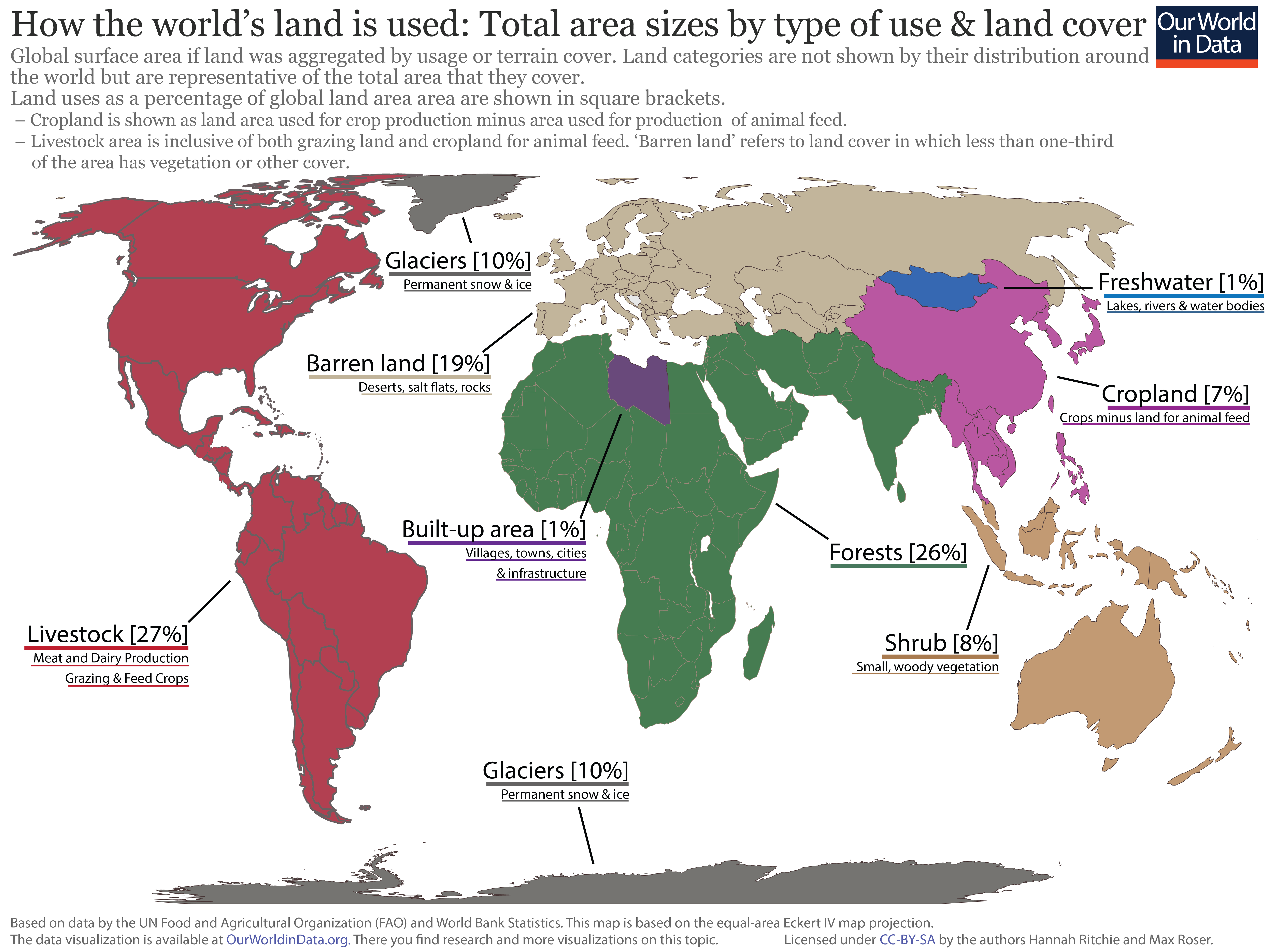
But given that the meat and dairy industry take up just over a quarter of the earth’s land surface—some four billion hectares—while contributing only a puny percentage of GDP, any truly committed effort to combat climate change must take it seriously. Changing eating habits is vastly easier than rebuilding cities and transportation infrastructure, let alone finding a sustainable way to make cement or smelt steel. Yet, Buck simply can’t imagine a meatless society, for even in her science fiction the characters eat chicken and tuna. She seems to have forgotten that the crew members of Star Trek are vegans.

As for geoengineering, Buck contends that environmentalists who reject it out of hand are indulging in an “aesthetic luxury” (and eating meat is…?). She does go to great lengths to stress how concern for climate workers, ecosystems, and global justice must be priorities for any geoengineering effort. But she also applauds a meeting in Beijing in 2017, a sort of geoengineering Bandung Conference, where Chinese scientists invited colleagues from the Global South to work on an algorithm that could be used to operate a SRM program. She fails to anticipate that to many readers, perhaps the only thing more terrifying than SRM is SRM operated by AI—a true Skynet.

In Buck’s vision, “solar geoengineering would be done by states or not at all,” but this seems to be wishful thinking. One can easily imagine a corporation or a billionaire acting as a climate change vigilante. SRM is cheap, after all. For only a few hundred million dollars a year a company such as ExxonMobil could protect its billions in assets. (Geoengineers have discussed among themselves the so-called “Greenfinger,” a James Bond–esque villain who goes rogue.) And once SRM starts, we are stuck with it. As Buck notes, “most stratospheric aerosol scenarios last 200 years . . . and there’s probably no deployment scenario that’s less than a hundred years.” Even with workers’ rights and an international team of coders, geoengineering would mark a defeat for the environmental movement.

Despite engaging these critiques, Buck remains wedded to the idea, perhaps because of her fascination with the entrepreneurial scene surrounding it. “The socially conscious entrepreneur will play a vital role in the near term,” she declares. She is keen on Nori, a blockchain marketplace based on buying and trading of sequestered carbon—or as it describes itself, “a scalable incentive system to measure and verify soil carbon.” Buck hopes that such voluntary markets would eventually lead to compulsory ones. Perhaps. But despite her enthusiasm, it is hard to see how Nori would succeed where government cap-and-trade programs failed, for at least the latter had a cap.

Another valiant entrepreneur in Buck’s story is Russ George, who headed the carbon-trading start-up Planktos in the 2000s and organized the first geoengineering experiment in 2012 when he dumped iron filings into the ocean to actuate a bloom of phytoplankton. This was meant to feed the salmon in British Columbian waters and sequester carbon. Alas, it did not work and George’s offices were raided by the Canadian government in 2013 because of the illegality of the experiment. George’s client, the Haida Salmon Restoration Corporation, fired him and complained that he had lied about his qualifications (an episode omitted from After Geoengineering). Nonetheless, Buck praises George as one of the entrepreneurs who are “rolling up their sleeves and playing around and doing.”

In the end, it is this allure of action and results that leads Buck to the market for environmental salvation. For her, entrepreneurs are “visionary” and “disruptive,” leading the way out of the current impasse in climatic politics. They are the ones getting things done—in her vision, the only ones who could. She warns progressives that entrepreneurs are the “wrong focus of critique.” Buck does warn that “zombified neoliberal capitalism” could fail to implement the needed technologies and that “workers and voters” might need to take matters upon themselves. But the entrepreneur earns more of her esteem than the scientist, who in her telling is a mere bureaucrat in a “big institutional laboratory.” Paraphrasing one of her interview subjects, Buck uncritically conveys the argument that “we are closing out an era that focused on scientific monitoring and scientific discovery. . . . now, we’re in an era of solution building, where entrepreneurs are needed to take a shot, to fail, to try things.” This encapsulates the neoliberalization of science as Mirowski lampoons it in his study Science-Mart: Privatizing American Science (2011):
Hierarchies are a temporary stopgap, the efficiency experts warn, but can never usurp the greatest information processor known to humanity: the Market. . . . If you really believe that academic kingpins in their ivy cocoons can efficiently run the scientific enterprise, then think again. The final destination of market reform is to let commercial considerations modularize, standardize, and spin off almost every aspect of the process of scientific research, and consequently erase all boundaries between professional and wage labor. No human being, and especially no scientist, can comprehend the dispersed complexity of knowledge better than the market itself.

At the horizon of climate catastrophe, the science-market dichotomy is collapsing from both ends; entrepreneurs not only have tried to replace scientists, but scientists have become entrepreneurs. David Keith, a prominent climate physicist at Harvard University, also runs the startup Carbon Engineering. As Mirowski noted in Never Let A Serious Crisis Go to Waste, it was not the environmental movement that prevented a planned geoengineering experiment in 2012, led by a consortium of UK universities. The SPICE project—Stratospheric Particle Injection for Climate Engineering—was cancelled after it was revealed that two scientists had patented the technology beforehand without telling their collaborators. Global warming is a dire emergency, but it is also an opportunity to make a killing.


This brings us back to Reisman—his dark future of Mad Max capitalists blazing the trail forward in a heating world. (Incidentally, one of his latest books has the winning and all-caps title: MARXISM/SOCIALISM, A SOCIOPATHIC PHILOSOPHY CONCEIVED IN GROSS ERROR AND IGNORANCE, CULMINATING IN ECONOMIC CHAOS, ENSLAVEMENT, TERROR, AND MASS MURDER: A CONTRIBUTION TO ITS DEATH.) In this picture the entrepreneurs are our Kulturträger, carrying with them our hopes for civilization’s survival.

As both Burning Up and After Geoengineering make clear, we need a history of fossil fuels and a clear program to deal with the climate crisis. But we also need to understand neoliberal environmental thought so that we may inoculate ourselves against its enduring power. Like Pirani, whose account of economic growth holds out the promise of central planning as a solution, Buck believes that capitalists can be convinced to act responsibly. “Investors aren’t aware that carbon budgets exist, or what they mean for high-emission companies,” she writes, optimistically—as if all we must do is inform them. “We need to create comprehensible accounts of the risks to investors,” she concludes. But capitalists know very well what their interests are. That is why they are winning.

Although Pirani is not as impressed by the whiz-bang of geoengineering as Buck is, he displays remarkably little interest in understanding the enemy. He dismisses neoliberal philosophy as little more than warmed-up arguments from Adam Smith and relies on David Harvey’s argument that neoliberalism is just crass class warfare.

But neoliberals are much more sophisticated than that, in part because theirs is less an economic theory than a totalizing epistemology. For all their trenchant analyses, critics of neoliberalism have enjoyed little success in dismantling the popular appeal of its central axiom—that market will always collect and process more information than any other institution, especially the state. Yet there is now very little time to devise a popular new metaphysics of political economy, let alone an effective response to global warming. As we scramble to preempt the death of the Great Barrier Reef or the collapse of the West Antarctic ice sheet, the geoengineers and the entrepreneurs will be there, waiting for us to beg for their help.

Sunday, June 30, 2019

Topic: Geoengineering

first posted April 2017; updated June 2019


A Disappointing New Problem With Geo-Engineering. Robinson Meyer, The Atlantic. Aug. 8, 2018.
Dimming the sky won’t save the world’s harvests. 

Geoengineering is no closer to working. Tim Radford, Climate News Network. Oct 30, 2018.
Scientists have established a strategic error in one version of the climate change debate: they still say geoengineering is no guarantee of a cooler world. 
There is no practical technology available to cool the Earth, they say – except the obvious one of ceasing to stoke the fires with fossil fuels. 
One new study looks at all the tested and yet-to-be-explored mechanisms for either lowering global temperatures by reducing sunlight, or by harnessing new and old ways to capture the extra carbon dioxide released by two centuries of industrial growth. 
And, the authors report, the sure way to reduce the dangers of global warming and keep the planetary temperature increase to 2°C or lower by 2100, is to switch to wind and solar energy sources and drastically cut fossil fuel emissions. 
A second, separate study looks closely at an often-proposed form of geoengineering – the injection of sulphate aerosols into the stratosphere to intercept sunlight and shade the planet – and delivers a cautious verdict.

“None of the proposed technologies can realistically be implemented on a global scale in the next few decades”

For Geoengineers, a Scientific Existential Crisis. Dave Levitan, UnDark. Jan. 16, 2019.
Technofixes for the climate crisis are no one’s first choice. What is it like to study something you wish would disappear?

A Best-Case Scenario for Putting Carbon Back Underground. Holly Jean Buck. Science for the People. Special Issue, Summer 2018.
If we buy into thinking of carbon removal technologies as substitutes for reducing carbon output, then industrial interests have already won: they have set the narrative and the framing, where carbon capture exists so that they can continue to emit. But we should demand more from these technologies. Industrial carbon capture technologies could instead be used as an extension of decarbonization—mitigation to get us to zero, and carbon removal going a step further to take emissions negative and address some of the climate impacts already being felt. It won’t be easy. But climate science suggests it’s a challenge the Left must take up. 
Climate change has already warmed the planet over 1°C relative to pre-industrial levels. Paradoxically, cleaning up the air pollution that’s currently masking some of the global warming in the pipeline would raise temperatures another 0.5 – 1.1 degrees.1 This means that if we waved a magic wand and suddenly (1) stopped using fossil fuels, and (2) cleaned up air pollution, we would already be breaching 1.5°C, the amount of warming that most climate advocates have argued for. The carbon budget is not an exact science, but it seems we are hovering at the point where 1.5°C of warming is locked in by what has already been emitted. Put differently, the most recent scientific evidence suggests we have zero to five years before every additional ton of carbon dioxide emitted would need to be compensated by a ton of negative emissions to stay below 1.5°C.2 
In fact, the scenarios used in the fifth Intergovernmental Panel on Climate Change (IPCC) report rely on massive amounts of negative emissions to curb warming to 1.5°C, primarily via a method known as bioenergy with carbon capture and storage (BECCS). This led a team of modelers to try and see what it would take to achieve 1.5° without BECCS. Even a scenario where renewables, electrification, and energy efficiency were aggressively pursued—as well as replacing 80 percent of meat and eggs with cultivated meat, flying less, and eliminating tumble dryers—could not eliminate the need for carbon removal. This scenario still required about 400 billion tons (Gt) of carbon dioxide removed via reforestation


Can we build power plants that actually take carbon dioxide out of the air? Brad Plumer, vox. Mar. 11, 2015.


Why has carbon capture and storage not taken off yet? Michael McDonald, via naked capitalism. Nov 4, 2015.

To meet the Paris climate goals, do we need to engineer the climate? Simon Nicholson and Michael Thompson, The Conversation. Feb 23, 2016.


It's time to start talking about "negative" carbon dioxide emissions. David Roberts, vox. Aug. 18, 2017.
We have to bury gigatons of carbon to slow climate change. We’re not even close to ready.


A geophysiologist's thoughts on geoengineering. James Lovelock, Philosophical Transactions of the Royal Society. Nov. 13, 2008.

Abstract

The Earth is now recognized as a self-regulating system that includes a reactive biosphere; the system maintains a long-term steady-state climate and surface chemical composition favourable for life. We are perturbing the steady state by changing the land surface from mainly forests to farm land and by adding greenhouse gases and aerosol pollutants to the air. We appear to have exceeded the natural capacity to counter our perturbation and consequently the system is changing to a new and as yet unknown but probably adverse state. I suggest here that we regard the Earth as a physiological system and consider amelioration techniques, geoengineering, as comparable to nineteenth century medicine.
... 
Whatever we do is likely to lead to death on a scale that makes all previous wars, famines and disasters small. To continue business as usual will probably kill most of us during the century. Is there any reason to believe that fully implementing Bali, with sustainable development and the full use of renewable energy, would kill less? We have to consider seriously that, as with nineteenth century medicine, the best option is often kind words and pain killers but otherwise do nothing and let Nature take its course. 
... 
Had we heeded Malthus’s warning and kept the human population to less than one billion, we would not now be facing a torrid future. Whether or not we go for Bali or use geoengineering, the planet is likely, massively and cruelly, to cull us, in the same merciless way that we have eliminated so many species by changing their environment into one where survival is difficult.


Human intervention with the climate system has long been viewed as an ill-advised and risky step to slow global warming. But with carbon emissions soaring, initiatives to study and develop geoengineering technologies are gaining traction as a potential last resort.

Once seen as spooky sci-fi, geoengineering to halt runaway climate change is now being looked at with growing urgency. A spate of dire scientific warnings that the world community can no longer delay major cuts in carbon emissions, coupled with a recent surge in atmospheric concentrations of CO2, has left a growing number of scientists saying that it’s time to give the controversial technologies a serious look.

“Time is no longer on our side,” one geoengineering advocate, former British government chief scientist David King, told a conference last fall. “What we do over the next 10 years will determine the future of humanity for the next 10,000 years.”

King helped secure the Paris Climate Agreement in 2015, but he no longer believes cutting planet-warming emissions is enough to stave off disaster. He is in the process of establishing a Center for Climate Repair at Cambridge University. It would be the world’s first major research center dedicated to a task that, he says, “is going to be necessary.”

Technologies earmarked for the Cambridge center’s attention include a range of efforts to restrict solar radiation from reaching the lower atmosphere, including spraying aerosols of sulphate particles into the stratosphere, and refreezing rapidly warming parts of the polar regions by deploying tall ships to pump salt particles from the ocean into polar clouds to make them brighter.

U.S. scientists are on the case, too. The National Academies last October launched a study into sunlight reflectiontechnologies, including their feasibility, impacts and risks, and governance requirements. Marcia McNutt, president of the National Academy of Sciences, said: “We are running out of time to mitigate catastrophic climate change. Some of these interventions … may need to be considered in future.”

The study’s prospective authors held their first meeting in Washington, D.C., at the end of April. Speakers included David Keith, a Harvard University physicist who has developed his own patented technology for using chemistry to remove CO2 directly from the atmosphere, and Kelly Wanser of the Marine Cloud Brightening Project, which is studying the efficacy of seeding clouds with sea salt and other materials to reflect more sunlight back into space. The project is preparing for future field trials.

China too has an active government-funded research program. It insists it has no current plans for deployment, but is looking, among other things, at how solar shading might slow the rapid melting of Himalayan glaciers.

Geoengineering the climate to halt global warming has been discussed almost as long as the threat of warming itself. American researchers back in the 1960s suggested floating billions of white objects such as golf balls on the oceans to reflect sunlight. In 1977, Cesare Marchetti of the Austria-based International Institute for Applied Systems Analysis discussed ways of catching all of Europe’s CO2 emissions and injecting them into sinking Atlantic Ocean currents.

In 1982, Soviet scientist Mikhail Budyko proposed filling the stratosphere with sulphate particles to reflect sunlight back into space. The first experiments to test the idea of fertilizing the oceans with iron to stimulate the growth of CO2-absorbing algae were carried out by British researchers in 1995. Two years later, Edward Teller, inventor of the hydrogen bomb, proposed putting giant mirrors into space.

Still, many climate scientists until recently regarded such proposals as fringe, if not heretical, arguing that they undermine the case for urgent reductions in greenhouse gas emissions. A group of scientists writing in Nature as recently as April last year, called solar geoengineering “outlandish and unsettling … redolent of science fiction.”
But the mood is shifting. There is broad, international scientific agreement that the window of opportunity to avoid breaching the Paris climate target of staying “well below” 2 degrees C (3.6 degrees F), is narrowing sharply. A pause in the rise in CO2 emissions that brought hope in 2015 and 2016 has ended; the increase has resumed at a time when we should be making progress toward a goal of halving emissions by 2030, says Johan Rockstrom, science director of the Potsdam Institute for Climate Impacts Research. CO2 concentrations in the atmosphere — the planetary thermostat — are now at 415 parts per million (ppm) and rising by almost 3 ppm each year, reaching levels that have not been seen in 3 million years.“We have two years left to bend the curve” downward, says Rockstrom.

Some experts contend we may be approaching a moment when nothing other than geoengineering can meet the international community’s promise — made when signing the U.N. Climate Change Convention at the Earth Summit in 1992 — to prevent “dangerous anthropogenic interference with the climate system.” Myles Allen of Oxford University’s Environmental Change Institute says: “Every year we are not even trying to reduce emissions is another 40 billion tons of CO2 dumped into the atmosphere that we are blithely committing future generations to scrub out again.

Possible geoengineering schemes and schedules are now being discussed. Take this plan published last fall by Gernot Wagner, executive director of Harvard University’s Solar Geoengineering Research Program:

In 15 years’ time, as the impacts of warming worsen, planes loaded with sulphate particles start taking off from airfields around the world. They fly to 65,000 feet, well above existing air lanes, and spray their loads into the stratosphere: 4,000 flights in the first year, 8,000 in the second, 12,000 in the third, and so on until, after another 15 years, fleets of purpose-built, high-altitude tankers are making 60,000 flights annually.

The thickening shroud of particles would fight climate change by mimicking the output of volcanic eruptions that deflect solar radiation streaming into the atmosphere. Famously, the eruption of sulphate particles from Mount Pinatubo in the Philippines in 1991 caused a global cooling of up to 0.6 degrees C for the following two years. The planned 15-year human-made “eruption” would shave 0.3 degrees C off warming, halving the likely increase during that time.

The sulphate spraying would, Wagner and a coauthor said, be “remarkably inexpensive,” at not much above $2 billion a year over the first 15 years of deployment. Much cheaper than actually cutting emissions. So mission accomplished? Not quite. In fact, arguably not at all.

For one thing, most of the sulphate particles, like those from Pinatubo, would not stay aloft for more than a couple of years. Planes would have to keep flying and spraying ever-larger quantities essentially forever, or the world would resume warming with redoubled force.

For another, while the sulphate shroud might keep down global temperatures, the suppression of solar radiation could well create massive changes in weather systems and rainfall patterns, which are mostly driven by solar energy. The Asian monsoon, on which 2 billion people depend for their food crops, might shut down. The accumulating carbon dioxide in the atmosphere would have many other effects, such as acidifying the oceans.

“The fact that researchers at one of the world’s top universities are costing the deployment of such a radical scheme shows how urgent the climate change problem has become,”says Peter Cox of the University of Exeter in England. It also underlines concerns about who would be in charge of such endeavors.

Steve Rayner of the Oxford Geoengineering Program at Oxford University says “the technology’s potential to promote conflict … is likely to be substantial.” A decade ago, he helped draw up the Oxford Principles, which call for “public participation on geoengineering decision-making” and its regulation “as a public good.” But when push comes to shove, how would that work? Which world leaders would we trust with our climate?

Critics say even researching such technologies creates a moral hazard, because by suggesting an easy fix for global warming, it encourages delay in ending our addiction to fossil fuels. The stratospheric sulphate plan “may well encourage weaker action on emissions reduction,” says Joanna Haigh, an atmospheric physicist at Imperial College London.

Geoengineering is defined by the Oxford Geoengineering Program as “the deliberate large-scale intervention in the Earth’s natural systems to counteract climate change.” There are two main types. One is shading the earth from solar radiation, of which the shroud of sulphates in the stratosphere is emerging as the quickest, most effective, and least costly. The other is to remove more CO2 or other greenhouse gases from the atmosphere than nature currently achieves — so-called negative emissions.

Right now the oceans absorb a lot of CO2. One way of helping them take more is likely to be on the Cambridge unit’s agenda. It involves seeding the oceans with iron to stimulate growth of marine algae. The resulting algal blooms would, the theory goes, soak up CO2 from the water and cause more to be absorbed from the atmosphere. Concerns range from the effects that such blooms of algae could have on the marine food web to uncertainty about whether such local absorption would actually increase the ocean’s total uptake of carbon.

A second, more measurable idea involves removing carbon from the atmosphere, either by the massive deployment of devices to extract CO2 from the ambient air — known as direct air capture — or by more natural methods. One of those would be to turn large areas of land over to carbon-absorbing crops, probably trees. The harvested biomass could then be used as fuel in power stations, and the emissions from burning them reabsorbed by new crops. The net emissions could be zero.

If biomass burning were combined with technology to capture and bury the carbon emissions from the power plants — delivering a technological combo known as Bioenergy with Carbon Capture and Storage (BECCS) — emissions could be negative. In theory, the more you burned, the more CO2 you would suck from the air.

The U.N.’s Intergovernmental Panel on Climate Change (IPCC) enthusiastically adopted BECCS in its fifth assessment, published in 2014. It said most scenarios for keeping warming below 2 degrees C would require “the availability and widespread deployment of BECCS and afforestation in the second half of the century.”

It could happen. Biomass burning is increasingly popular in power stations. And carbon capture and storage (CCS) is a proven technology, though not yet adopted at scale. That could soon change, following the announcement this month that industrial emitters in the European ports of Rotterdam, Antwerp, and Ghent plan to join forces to pump 10 million tons of CO2 a year into adjacent offshore gas fields.

But critics say the problems with BECCS are manifold. The land requirement would be huge. And the forests created to provide the fuel would be monocultures of fast-growing tree species like eucalyptus and acacia. If the land were taken from farmers, then who would feed the world? And if it were taken from existing natural forest areas, the carbon benefits of BECCS would largely disappear, says Simon Lewis of University College London. That’s because plantation forests typically hold only 5 percent as much carbon as mature natural forests.

Maybe there is a simpler solution. Maybe the most promising answer lies in going back to nature — in restoring natural forests. A broad coalition of environmentalists — from those who embrace corporate environmentalism, such as The Nature Conservancy (TNC), to the British anti-capitalist columnist George Monbiot — have recently endorsed this “natural” climate solution.

Their touchstone is a 2017 paper by Bronson Griscom of TNC and 24 others, which concluded that a third of the measures required between now and 2030 to keep the world on track to stabilize climate could be achieved cost-effectively by boosting natural ecosystems. They could take an extra 11 billion tons more CO2 out of the air each year. This could be done mostly by reforestation, but also by better soil management, the protection of carbon-rich wetlands such as peatlands, and growing more trees on farmland.

Proponents see this not as a substitute for emissions reductions, but as a “biological bridge … to a zero-emissions economy.” The plan fits the Oxford definition of geoengineering, though they avoid using the term.

The scientific case for this route is compelling. Most of it could be achieved on existing damaged and degraded forests. The World Resources Institute estimates that globally there are 7.7 million square miles of forests degraded by logging or shifting cultivation that could be restored. That is an area twice the size of Canada.

Some planting, especially of nitrogen-fixing species in poor soils, could help speed up the restoration, says Robin Chazdon, an ecologist at the University of Connecticut and author of an influential book called Second Growth. But mostly, given the chance, forests will regrow naturally.

In fact, natural regrowth is usually better than planting, since “allowing nature to choose which species predominate during natural regeneration allows for local adaptation and higher functional diversity,” she says. A study published in March by 87 researchers, including Chazdon, concluded that “secondary forests recover remarkably fast” with 80 percent of their species typically back in 20 years and 100 percent in 50 years.

It looks like it could be a win-win, delivering a climate payoff on the scale of geoengineering without any of the downsides. Tim Lenton of Exeter University, a proponent of research into geoengineering, says it could be an ideal solution. “I am against introducing new forces such as sulphate aerosol injection in the stratosphere,” he says. “But I am in favor of emulating and enhancing natural feedback loops and cycles, such as regenerating degraded forests.”

It would, he says, strengthen the biosphere’s natural forces of self-regulation that British scientist James Lovelock has termed “Gaia.” Lenton has a new term for what is required. Not geoengineering, but “Gaia-engineering.”


Sunday, August 12, 2018

Feature Reference Articles #12

Carbon Ironies. Wen Stephenson, The Baffler. June 13, 2018.

ADDRESSING AN IMAGINED READER in the all-too-likely “hot dark world” of our all-too-near human future, William T. Vollmann begins his two-volume, twelve-hundred-plus-page Carbon Ideologies (the second volume of which was published last week) with a curious and characteristically audacious gambit. In the opening pages of Volume I: No Immediate Danger, as he sets out upon this tome concerning fossil fuels and nuclear energy, Vollmann explains: “I do my best to look as will the future upon the world in which I lived—namely, as surely, safely vanished. Nothing can be done to save it; therefore, nothing need be done. Hence this little book scrapes by without offering solutions. There were none; we had none.” 
Some twelve hundred pages later, near the end of Volume II: No Good Alternative—having heard from coal miners and refinery workers, oil executives and nuclear engineers, fracking enthusiasts and carbon lobbyists, politicians and industry-captured regulators, residents of variously poisoned communities and even a few beleaguered activists—Vollmann beseeches his future reader to go easy on him and us. “If you could end up saying, ‘well, yes, we might have made the same mistakes as you, if we’d been lucky enough to live when you did,’ I’d feel that Carbon Ideologies had accomplished some of its purpose,” Vollmann writes. “How you judge us can mean nothing to us who are dead, but to you it might mean something, to accept that we were not all monsters; and forgiveness benefits the forgiver, so why wouldn’t I prefer you to call our doings mistakes instead of crimes?” But Vollmann suspects this is a bit much to ask. “Most likely,” he wearily admits, “you are a hard, angry person. . . . Beset by floods, droughts, diseases and insect plagues . . . fearing for your children in the face of multiplying perils, how can you feel anything better than impatient contempt for my daughter and me, who lived so wastefully for our own pleasure?” 
Now, perhaps this is unfair, but it occurs to me that Vollmann’s imagined reader, sweating and hungry beside a dead, acidic ocean, may be entitled to ask why the author spent years of his comfortable (as he never tires of confessing) carbon-powered life writing a twelve-hundred-page book about energy and global warming without offering more than a dismissive hand-wave in the direction of “solutions” like solar, wind, geothermal, batteries, smart grids, etc.—at the very moment in history when such renewable energy technologies and their economics were beating all expectations. Well, it seems Mr. Vollmann simply doesn’t believe there’s anything we humans can do about a problem as big and complicated as climate change—after all, as a friendly pastor in West Virginia said to him, the Earth is so large! And even if there were, it would almost certainly require people like himself to engage politically and make some kind of sustained collective effort, which would be tedious and boring and difficult. And while it’s possible that the logically fallacious (see tu quoque) obsession with his own carbon complicity and supposed “hypocrisy” may offer him a convenient excuse for not lifting a finger, it may also be the case that he simply doesn’t want to look like the sentimental chump who falls for some hope-mongering twaddle about fighting for humanity and not giving up on each other, and all of that. Whatever the reason, he tells his misfortunate reader: “I am sorry.”
... 
And yet, for all that I find enjoyable and admirable in Vollmann’s project, I’m also sharply opposed to his brand of climate fatalism, which seems to be symptomatic, a kind of irresistible temptation, among intellectuals and other expensively educated types these days. And it’s this sense of utter futility and resignation in the face of our human emergency which would seem to warrant a reply. Because Vollmann is correct on some important level, but only up to a point. To borrow the phrase he used in Rising Up and Rising Down (2003), his seven-volume moral treatise on violence—which, along with Poor People (2007), he considers a companion to Carbon Ideologies—his “moral calculus” here is fundamentally flawed, based as it is on a common misunderstanding or mischaracterization of the climate catastrophe.
... 
And there’s a good bit that Vollmann gets right, or so it seems to me, in terms of the moral calculus on climate. This is especially the case in his vivid, often affecting, unerringly humane portraits of ordinary people caught up in the carbon system—and nowhere more so than in West Virginia, where the people he meets, at all social levels, have been literally poisoned by that system, indoctrinated and deceived by its ideologues, sacrificed on the altar of limitless profits and the so-called patriotic duty to “keep the lights on.” He knows there’s no moral equivalence between these folks and the executives, lobbyists, politicians, and revolving-door regulators who do everything in their considerable power—including pitiful appeals to victimhood—to keep the system humming along. So it’s satisfying when he drops all sarcasm near the end of the book and lays it on the line:
Those who found themselves compelled by economics to be complicit in the production, distribution and consumption of harmful energies . . . were not especially at fault. For them, fossil fuels constituted sheer subsistence. . . . Even less could I accuse those who had not been educated to understand the almost invisibly approaching misery.  
However, I began to believe that those who selfishly, maliciously or with gross negligence did harm ought to be singled out, shamed and maybe even . . . punished.—What constituted gross negligence? A parent who left a loaded gun in reach of a baby was surely responsible for the result. Those West Virginia officials, Colorado lobbyists and Oklahoma Chamber of Commerce types who publicly advanced the agendas of their chosen fossil fuels but refused to even acknowledge questions about global warming stood convicted, in my mind at least, of authoritarian partisanship. I would have heard their side; they were not even willing to tell me theirs, much less ask about mine. And they had power. . . . These are the ones, my friend. These are the ones who laid you low.
... 
Nevertheless, for a writer so finely attuned to the nuances of moral reasoning, Vollmann displays a surprisingly simplistic and binary view of the climate catastrophe.

Just how fucked ‘we’ or ‘they’ will be—that is, what kind of civilization, or any sort of social justice, will be possible in the coming centuries or decades—depends on many things. 
Yes, of course, we’re fucked. (Though it’s important to specify the “we” in this formulation, because the global poor, the disenfranchised, the young, and the yet-to-be-born are certifiably far more fucked than such affluent, white, middle-aged Americans as Vollmann and myself.) But here’s the thing: with climate change as with so much else, all fuckedness is relative. Climate catastrophe is not a binary win or lose, solution or no-solution, fucked or not-fucked situation. Just how fucked we/they will be—that is, what kind of civilization, or any sort of social justice, will be possible in the coming centuries or decades—depends on many things, including all sorts of historic, built-in systemic injustices we know all too well, and any number of contingencies we can’t foresee. But most of all it depends on what we do right now, in our lifetimes. And by that I mean: what we do politically, not only on climate but across the board, because large-scale political action—the kind that moves whole countries and economies in ways commensurate with the scale and urgency of the situation—has always been the only thing that matters here. (I really don’t care about your personal carbon footprint. I mean, please do try to lower it, because that’s a good thing to do, but fussing and guilt-tripping over one’s individual contribution to climate change is neither an intellectually nor a morally serious response to a global systemic crisis. That this still needs to be said in 2018 is, to say the least, somewhat
disappointing.)

As experts (and other people, like me) have been saying for years now, it is almost certainly too late to prevent highly disruptive and, in many places, catastrophic climate change within this century, with all the human misery and death that will bring. But it’s also the case that rigorous analyses (though you won’t find them in Carbon Ideologies) show how most of the world’s energy systems could in fact be radically decarbonized in the coming decades; that the barriers are not technological or economic; and that there are now signs of the political and economic winds shifting globally, in spite of (and in response to) Donald Trump’s election. Are they shifting fast enough? Not even close. Is the carbon lobby still doing everything it can to obstruct and delay? Yes, by all means. And even if the world somehow miraculously moves as fast as possible between now and mid-century, as scientists are calling for, will it prevent dangerous and destabilizing climate disruption for centuries and possibly millennia to come? Probably not. In fact, achieving the vaunted Paris Agreement goals would actually require “negative emissions” technologies, capable of pulling carbon dioxide out of the atmosphere on a vast scale, which remain largely speculative (not to say fantasy).

So, yes, Vollmann and other doomists are right that it’s a no-win situation—depending on what you mean by “win.” If you mean “stopping” or “solving” climate change and preserving the world as we’ve known it, then the climate fight was “lost” a long time ago, maybe before it began. And yet science also tells us that, even at this late date, some versions of “losing” could look far worse than others. We can still lose less badly! Not the most inspiring battle cry, perhaps, but when you understand the stakes—human survival—still a cause worth lifting a finger for.

Scientists don’t really know with precision (which means William T. Vollmann doesn’t really know) where the atmospheric tipping points actually are, and whether we’ve already crossed some of them or soon will—see, for example, the accelerating collapse of Arctic sea ice and the melting permafrost—making worst-case scenarios unstoppable. Climate experts will tell you that every fraction of a degree of warming we prevent could be well worth the effort. So is it too late to prevent many catastrophic impacts across much of the world? Almost certainly. Is it too late to prevent the worst-case scenarios and thus even greater suffering of billions more human beings? Maybe. Maybe not. We don’t know. And that’s the point. As for the politics, maybe the obstacles really are insurmountable. But maybe they’re not. History shows that revolutionary change, both political and technological, is almost never foreseen—or even believed possible—by those living in the historical moment. Again, that’s the point. We don’t know exactly when it will be “too late” (“too late for what?,” we should always ask), or what may be possible if we keep pushing hard enough.

If you’re comfortable throwing up your hands and doing nothing in the face of this kind of uncertainty, very well; it’s your choice. Vollmann won’t think any less of you, and quite honestly, neither will I. Political action, sustained commitment, sacrifice—these are a lot to ask of anyone. But please don’t take moral comfort from assurances that there is nothing to be done. There’s plenty.

Which is one reason it’s too bad that Vollmann, though he does profile a few seemingly isolated activists fighting the Carbon Goliaths in West Virginia and Colorado and Bangladesh, never acknowledges the existence of the global grassroots climate movement that has become a serious force over the past decade. In case you’re unaware, this is the bottom-up movement that has not only stopped fossil-fuel mega-projects like the Keystone XL pipeline, Pacific Northwest coal export terminals, and regional fracked-gas infrastructure in the Northeast, with thousands of ordinary citizens putting their bodies on the line—and hundreds of thousands coming into the streets—to do so. It’s also the movement that’s pushed global institutions with more than $6 trillion in assets to divest from the fossil-fuel industry, fundamentally altering the conversation on climate and carbon—bringing concepts like “stranded assets” and “carbon bubble” into the mainstream (but not into Carbon Ideologies)—putting the industry’s political culpability and its criminally reckless business model front and center, even beginning to hurt its bottom line. These are no small accomplishments.

But there’s plenty to be done, too, for those who can’t see themselves as climate activists—because the basic political struggles for democracy and human rights, in this country and around the world, are as central to our climate future as the fights to keep carbon in the ground. For those who must try to adapt and live through what’s coming—including Vollmann’s daughter and my own kids—there won’t be any climate justice, or any justice at all, no matter what the global temperature may be, if we lose our democracy.

Unfortunately, many of the sort of educated, literate folks Vollmann is writing for don’t seem to understand all this. Or maybe they don’t want to understand. Perhaps they prefer to look away. It’s so much easier to tell oneself the game is up, that nothing can be done, that nothing ever could have been done, so why bother? It’s perversely comforting to wallow in tragic-ironic guilt over one’s carbon complicity, using it as a pathetic excuse.

The fact that there’s no purity and no “solution” (a word that should be struck from the climate lexicon) in the simplistic binary sense doesn’t mean that nothing can or should be done, even at this late date, even in the face of catastrophe on some unknowable schedule and scale—especially if you care at all about your fellow human inhabitants of this planet, as William T. Vollmann most clearly, and unironically, does. If nothing else, just holding onto our humanity as we sweat in the dark ought to keep us busy.

No Wiser Than Before: An Introduction. Erik Wallenberg & Ansar Fayyazuddin, Science for the People. Special Issue, Summer 2018.

“Beware of the man who works hard to learn something, learns it, and finds himself no wiser than before.” – Kurt Vonnegut, Cat’s Cradle 
The world is predominantly conceptualized as split between the subjects of history (humans) and the objects of history (everything else). The undifferentiated mass of everything else–identified as nature, or the environment – is treated as if it is simply for human use. Only in periods of crisis do we recognize that there are limits to what can be done to nature before the balance is tilted to a degree that things begin to go horribly wrong for humans as well. Against this reductive split, the world is in fact an ecological whole. Whatever conceptual divisions one makes, one cannot wish away our interdependence and the ultimate unity of the human and non-human worlds. 
We are living through an ecological disaster. Fueled by the drive for profit, the exploitation of both nature and human labor are defining features of our time. Ecosystems are collapsing under the assault of fossil fuel extraction, geological manipulation, and the systematic release of toxins into our water, air and earth. Islands are sinking as sea levels rise. Children are poisoned by lead in their water. Bee colonies are dying off as weather patterns change. And rapacious capitalist greed remains unabated. 
The crisis of climate change is undeniable and requires urgent attention for anyone concerned with the fate of humanity and the world. However, when thought of in the narrowest terms, climate change is shorthand for the rise in global temperatures driven by the precipitous increase in heat trapping greenhouse gases. When the problem is formulated entirely in terms of physical data and timeless mechanism, it is shorn of its historical and social specificity and its provenance in the capitalist drive for profit and its reliance on fossil fuels. Without historical and social context, climate change appears simply as a problem of science, to be solved with technology. 
From Barack Obama’s science advisor to the current Republican House Science Committee, the large-scale manipulation of the climate to mitigate global warming–geoengineering, for short–has gained a hearing in the halls of government.1 For their part, billionaire tycoons such as Bill Gates and Richard Branson champion their own role to drive geoengineering innovation. As several contributors to this collection point out, even the United Nations’ Intergovernmental Panel on Climate Change (IPCC) has legitimated geoengineering as a possible solution. 
With this special issue of Science for the People, we aim to engage with this current of thought and interrogate the research and technology, the assumptions and costs, as well as the general focus on the technological and how that relates to the social, political, and economic questions that drive this crisis. 
Geoengineering: A Fix or a Cover? 
Clive Hamilton, author of Earthmasters: The Dawn of the Age of Geoengineering, divides geoengineering schemes into two broad categories. He identifies “Carbon dioxide removal technologies” that “aim to extract excess carbon from the atmosphere and store in somewhere less dangerous,” as a “kind of clean-up operation.” The second category he sees as “an attempt to mask one of the effects of dumping waste into the sky.” This is exemplified by “Solar radiation management technologies” that “seek to reduce the amount of sunlight reaching the planet” in order to reduce the amount of trapped energy in the atmosphere.2 He concludes that, “While advances in climate science ought to be teaching us to be more humble, advocates of schemes aimed at regulating sunlight or interfering in Earth-system processes seem to draw the opposite conclusion.”3 
The first category—the “cleanup operation” school of geoengineering thought—enjoys near common sense status, particularly as more thoroughgoing political solutions to overhaul the energy sector appear too far off to make the needed difference. And yet, as reported last year in WIRED and The New Yorker, even the carbon capture methods that the IPCC mitigation strategies rely on, remain speculative. And if such negative emissions technologies do emerge, their implementation on the scale necessary guarantees massive disruptions to ecosystems and food markets. So what happens when the pragmatic option is itself unrealistic? 
Hamilton’s second, more desperate category has become increasingly prominent. One speculative scientific paper touted by authors from both the political mainstream and on the radical left proposes a geoengineering project to save the Great Barrier Reef from a warming ocean.4 By spraying salt water into the air, the scientists suggest, clouds will form, reflecting more sun and lowering local temperatures just enough to prevent ocean warming. But even if this lowered local temperatures, it would need to be done in perpetuity as global temperatures would continue to rise all around it. Any glitch in the system of salt water spraying would send temperatures soaring and could be even more catastrophic, allowing no time for adaptation, migration, or evolution of coral species.

The original Science for the People ended publication in 1989, just as the modern consensus about anthropogenic climate change was beginning to emerge. In this collection of essays, contributors delve into the technical and political–as well as legal and ethical – challenges raised by the specter of geoengineering. Here, we step into today’s debates about the role of technology in resolving the climate crisis. But first, we look at 20th century experiments in weather modification–a useful corollary to today’s proposals to manipulate the climate–and some of Science for the People’s coverage and analysis at the time.
... 
Alternatives to Geoengineering 
The task at hand appears to us to be the creation of healthy relationships for human and non-human interactions on this finite planet. Our debate should not be about whether technology is good or bad, or whether humans should or should not shape the environment; rather we must find a way to incorporate ecological complexity into a democratic system. When we neglect the historical and social context in favor of a narrow focus on technical aspects of a problem, the sources of the problem remain unaddressed.
... 
In a debate on geoengineering, physicist, ecologist, and environmentalist Vandana Shiva noted,

Einstein warned us, you can’t solve problems with the same mindset that created them…The geoengineers don’t realize, sunshine is not a curse on the planet. The sun is not the problem, the problem is the mess of pollution we are creating. These shortcuts that are attempted from places of power, and I would add places of ignorance of the ecological web of life, are then creating the war solution. Because geoengineering becomes war on a planetary scale; with ignorance; and blind spots.”
We’re faced with a pile of unknowns from those advocating and conducting geoengineering research. While time and money are spent researching technological fixes with unintended consequences, the solutions that we know will work–leaving fossil fuels in the ground, transitioning to sustainable forms of energy, increasing energy efficiencies, eliminating military spending, and engineering buildings and transport to cut out the waste–all of these solutions, which could be immediately implemented, are not funded because they do not fit into the current paradigm.

“In our progress-minded society,” Barry Commoner wrote in 1971,
“anyone who presumes to explain a serious problem is expected to offer to solve it as well… But none of us…can possibly blueprint a specific ‘plan’ for resolving the environmental crisis. To pretend otherwise is only to evade the real meaning of the environmental crisis: that the world is being carried to the brink of ecological disaster not by a singular fault, which some clever scheme can correct, but by the phalanx of powerful economic, political, and social forces.” 
It’s these forces we need to change.

How big does the fire need to be? J.D. ALT, New Economic Perspectives. Aug. 13, 2018.

I have written about this before, but it bears repeating now—and perhaps it bears repeating every week until somebody with more leverage than me picks the message up and carries it a step further: America (and the rest of the world, for that matter) has the resources needed to limit and mitigate the enormous damage and dislocations that climate-change is now beginning to impose. The “resources” I’m referring to are not dollars. They are materiel, labor, and human ingenuity. The only question is how and when we’ll stop simply raising warning flags and marshal those resources to take real action against the growing challenges.

To date, virtually nothing concrete has been done, or even started. The reason is because—to date—we insist on imagining that the “money” needed to pay for serious planning, and to begin real actions, must come, directly or indirectly, from tax-payer’s pockets. Virtually by definition, this means the “money” is not available—nor, we should admit, will it ever be. Therefore, since we insist on believing that is where the money must come from, we cannot even begin. There are a multitude of scientists and informed advocates who are now sounding alarm bells about what’s coming down the road, but not a single one of them, unfortunately, can tell an audience how their local, state, or national governments are going to pay for the actions that need to be planned and implemented. Until that changes, we are like the proverbial deer frozen in the headlights of an on-coming tractor-trailer.

Fortunately, history has shown us how to get unfrozen. History has shown us that, when necessary, we can easily imagine a money-reality different than what we habitually insist is true: that money can be newly “created” to buy whatever is needed—labor, materiel, human ingenuity—to undertake and accomplish something we all recognize needs to be done for our collective benefit. Whether we “see” this alternative money-reality simply depends, apparently, on how big the fire is.

The history lesson I’m specifically referring to is America’s mobilization out of the Great Depression and into World War II. As documented in the books American Default, by Sebastian Edwards, and A Call to Arms, by Maury Klein, in 1933 America was facing its own frozen-in-the-headlights-how-can-we-pay-for-it predicament: The economy then had essentially collapsed into the Great Depression. The banking system was in a death-spiral as panicking families and businesses were withdrawing their deposits for cash dollars—then redeeming their cash for the gold the dollars promised, forcing the banks into insolvency. Family savings had been wiped out, farmers had abandoned their land, businesses had closed their doors, a fourth of the working population lost their jobs, breadlines formed in every major city.

At the same time, wild-fires of armed fascism were destabilizing Europe and southeast Asia. Hitler gained dictatorial control of Germany and soon began mobilizing and arming the war machine of the Third Reich. Paralyzed by its myopic political insistence on maintaining the “sound-money” (gold backed) foundations of the U.S. monetary system—even though it had rendered the system itself virtually useless—America was ill-prepared, either to climb out of the Depression or defend itself against the growing conflagrations of fascism.

Half the U.S. army in 1933 could be seated in Chicago’s Soldier Field stadium—with the other half standing at attention on the football field. The U.S. Navy consisted of a few hundred left-over World War I rust-heaps, mostly in mothballs. As Germany’s Luftwaffe began demonstrating its newly minted warplanes, the U.S. Airforce did not even exist. Nor did the dollars that would be necessary build it: Where could the dollars possibly come from when America’s families had lost their savings, when America’s businesses had closed their doors, when America’s banks had declared insolvency? Sell War Bonds? Who had the dollars to buy them? Declare an income tax? Who had the income to pay it?

The American mobilization—and the transformation of the understanding of money—began with the election of Franklin Roosevelt. Almost immediately, the federal government began to spend money (no one thought existed) to pay American citizens to undertake and accomplish what needed to be done. Here is a brief, but astonishing, list (annotated from the website The Living New Deal) of the concrete actions that were paid for in U.S. dollars during the first 12 months of Roosevelt’s presidency:
March 4, 1933: Franklin Roosevelt is sworn in as President. 
March 31, 1933: The Civilian Conservation Corps (CCC) is created by the Emergency Conservation Work Act, putting unemployed young men to work in the nation’s forests and parks. 
May 12, 1933: The Federal Emergency Relief Administration (FERA) is created, via the Federal Emergency Relief Act of 1933, to provide work and cash relief for Americans struggling to get through the Great Depression. 
May 18, 1933: The Tennessee Valley Authority (TVA) is created with the passage of the Tennessee Valley Authority Act to provide affordable power and flood control, which it still does to this day. 
June 13, 1933: President Roosevelt signs the Home Owners’ Loan Act of 1933. The law assists mortgage lenders and individual home owners by issuing bonds and loans for troubled mortgages, back taxes, home owners’ insurance, and necessary home repairs. 
June 16, 1933: President Roosevelt signs the Farm Credit Act, making credit more accessible to farmers, and with fairer terms than private sector lending (e.g., lower interest rates). 
June 16, 1933: President Roosevelt creates the Federal Emergency Administration of Public Works, which eventually becomes known as the Public Works Administration (PWA). During the next 10 years the PWA contributes billions of dollars towards tens of thousands of infrastructure projects all across the nation. 
June 16, 1933: With Executive Order No. 6174, President Roosevelt authorizes up to $238 million in Public Works Administration (PWA) funds for the Navy. From these funds, 32 naval vessels are built. 
October 23, 1933: The Army Corps of Engineers begins the construction of the Fort Peck Dam, one of the many large Corps projects made possible with New Deal funding. 
November 9, 1933: The Civil Works Administration (CWA)is created with Executive Order No. 6420B, under the power granted to President Roosevelt by the National Industrial Recovery Act. By January 1934, over 4 million formerly-jobless Americans are employed by the CWA. to build 44,000 miles of new roads, install 1,000 miles of new water mains, construct or improve 4,000 schools, and much more. 
December 8, 1933: The Public Works of Art Project (PWAP)is created by an allocation of funds from the Civil Works Administration. Unemployed artists are hired to create works of art for public buildings and parks. They will create nearly 16,000 works of art.

Where did the dollars come from to make all this happen? Were they tax-dollars collected from the American people? Were they dollars borrowed from the banking industry and titans of finance? No. They were dollars issued by the sovereign government out of thin air—fiat dollars. As described by Roosevelt’s Secretary of the Treasury, William H. Woodin, the new dollars were “money that looked like money.” And so, as demonstrated by what the spending of it accomplished, it was money. (What Woodin meant by this was that the “Federal Reserve Bank Notes” which the central bank was authorized to issue—as needed—by the Emergency Banking Act of 1933 looked exactly like the old “Federal Reserve Notes” they replaced, except for one tiny detail: they could not be redeemed for gold.)

This course of action, of course, was vehemently opposed by certain interests and forces outraged at the idea of having to trade their gold for fiat currency. They did everything in their power to shut down Roosevelt’s presidency and his gradual and experimental shifts toward a fiat money system. From the perspective of the financial titans—who were, in one form or another, creditors—being repaid in gold was the only thing of importance. The country be damned. Roosevelt called them out in a speech a few days before he was elected, in a landslide, to his second term as President:
“We had to struggle with the old enemies of peace – business and financial monopoly, speculation, reckless banking, class antagonism, sectionalism, war profiteering. They had begun to consider the Government of the United States as a mere appendage to their own affairs. And we know now that Government by organized money is just as dangerous as Government by organized mob. Never before in all our history have these forces been so united against one candidate as they stand today. They are unanimous in their hate for me, and I welcome their hatred.”
By 1941, fiat money—and all the things it had paid American’s to accomplish—had begun to pull the country out of the abyss. And just in time. For it turned out the New Deal had only been a warm-up exercise in the creative use of sovereign money to accomplish collective goals. Europe was in the flames of war. Germany was threatening England from a French country-side it had already invaded and occupied—and was stalking American shipping off the U.S. Eastern seaboard with its submarine “wolf-packs.” Then December 7th happened.

Over the next four years, miraculously, America built—and paid for with fiat money—the largest and most technologically advanced war machine that had ever existed on Earth. The scale of the spending was staggering. The most astonishing thing is what the unprecedented spending accomplished in the long run: It transformed an entire society to confront a new reality and created, for all practical purposes, a new “America” to thrive in that reality.

The American people had “paid themselves”—through the fiat monetary actions of their sovereign government—to invent an array of new technologies and apparatuses originally conceived for waging war, but which, after the war, were clearly seen to have useful applications to peaceful life as well—and they had paid themselves to build a great many factories, research and production facilities capable of adapting and producing these useful things to civilian life—andthey had paid themselves to train a very large workforce of engineers, technicians and skilled workers who knew how to make it all work. This was a powerful economic brew—and it was spiced by the fact that the returning G.I.s were getting paidto go to college to explore how to make the whole thing run even better. America never looked back. Until now.

We could ask what happened. We could ask why, today, we cannot marshal enough resources to rebuild the Puerto Rican electric grid and the Virgin Islands hurricane devastation. We could ask why there isn’t a national engineering effort to begin planning for sea-level rise. We could ask why the U.S. forestry service doesn’t have the budget it needs to pay American workers to clear deadfalls and underbrush from its most vulnerable tree-stands. Or why we cannot imagine deploying a fleet of tanker planes to California large enough to deluge any wild-fire before it has a chance to become a conflagration.

The only question we really need to ask, though, is this: How big does the fire need to be before we “understand,” once again, how we can pay ourselves to put it out?