Showing posts with label COVID19. Show all posts

Saturday, April 23, 2022

awesome post by Raelle Kaia, worth posting in full

The Moral Reckoning. by Raelle Kaia. April 23, 2022


To where have we arrived? Has the New Normal truly come and gone?

This spring, many of us find ourselves warily adjusting to the apparent conclusion of two utterly surreal years in human history. We wonder if it is really possible to cast aside the legacy our leaders left us—the mask and vaccine mandates, the terror, division, social paranoia, and isolation—free to resume to the numb, hypnotic trance of life as we once knew it. Shall we continue our march into the soul-sucking banality of digitally mediated virtual life, with ever-increasing surveillance, alienation, and ubiquitous technological overwhelm of our humanity? Are we really free to wake up from the nightmare-dream of covid-induced fear, condemnation, segregation, and authoritarianism?


We wonder whether our fearless leaders have truly released us from our obedience training—from our dutiful imperatives to serve the greater good through compliance and self-sacrifice. It kind of looks that way on the surface, but an eerie feeling hangs in the air. In my old life, I still clung to scraps and shreds of trust in our society’s leadership. Now, in the wake of the calamity wrought through the course of these past two years, my trust has been irreparably broken. Millions share in this journey with me.

As one result of this, I no longer tune into the promulgations of the mainstream media and its corporate press. But through my contacts with others who remain plugged in, I still pick up on some of its prevailing messages and narratives. As such, I’ve gleaned that our leaders have radically altered their instructions to the populace in recent months. Previously, we were all supposed to be obsessed with covid at the exclusion of all else, implored to eliminate the virus by harassing, haranguing, and expelling the unvaccinated and maskless from society. Now it seems we’re supposed to believe that the most important thing is “standing with Ukraine,” vilifying Russia and Russians, and worrying about World War III. Or at least we were for a while. Then it seemed like the thing we were all supposed to care about was Will Smith slapping Chris Rock.

This 1984-style narrative shift has us all confused about whether Eurasia or East Asia is the enemy we’ve always been at war with. We seem to remember it both ways. Meanwhile, behind our muddled confusion, all the foundations of covid tyranny are still lying in place—just waiting to be reactivated. Governments have established their prerogative to abrogate all personal freedoms and human rights any time they declare an emergency. We are now supposed to accept total surveillance, the automation of everything, the end of medical privacy and bodily autonomy, and the unaccountable rule of technocratic corporations, NGOs, and oligarchs. We are supposed to have internalized our new role as obedient soldiers in the fight against (insert cause célèbre here), ready to surrender our speech, our minds, and our critical thinking the moment we receive instructions to do so. We are now supposed to vilify and persecute whatever proffered enemy our masters supply us with whenever the narrative changes.

This is called “getting our freedoms back.” On April 18, I was waiting for a flight at the Tucson Airport when one of the staff announced that the federal mask mandate in airports and airplanes no longer applied, effective immediately. And just like that, almost two years of forcing masks on travelers was gone. One moment, it’s absolutely necessary we do this—the next moment, it makes no difference at all. I wandered around the airport, observing as others gradually got the news and began to show their faces, the hallways still littered with imposing signs about the grave necessity to keep one’s face covered at all times—artifacts of an ancient bygone era that ended 10 minutes earlier.

When I got on the plane, I took note of how many people continued to wear a mask of their own volition. It seemed to be about half the people. I also noted that none of the airplane crew chose to continue wearing masks. In the airports, very few of the airline staff continued to wear masks either. Are people who work for airlines naturally disposed to right-wing, anti-science, white-supremacist, conspiracy-theorizing, anti-mask sentiments? Or is it possible that having existed at the center of this mask controversy for the past two years, airline employees actually looked into the thing on a deeper level than the average person—and in so doing discovered the absurdity of the whole enterprise?

Later, I discovered why the mandate had been lifted. Earlier that day, a federal judge ruled that the mandate had been illegal all along. It seems that as long as someone in authority (or with presumed authority) orders anyone to do anything, most people will just obey as if they had no rights at all. They will never look into the question of whether that authority is illegally derived, or whether the orders are morally grounded or rationally sound. Instead, most people will act as if they were subjects of a monarch or a dictator rather than citizens with inalienable rights, governed by representatives with limited powers. They will assume it’s someone else’s job to tell them whether they have to stop following the authority’s dictates or whether they have to continue. They will defer to another authority to tell them which authority they must obey. All this time—even though half of airline travelers and almost all airline staff did not believe in wearing masks—they all collectively went along with illegally promulgated mask orders until the moment they were told not to anymore.

What else will people do as long as they are ordered to? What else have people already done? This is the moral reckoning that faces us as people.


Segregation and Discrimination

During the nightmare of covid governance, the populace has been strongly encouraged to practice segregation and discrimination. Millions enthusiastically answered the call in their private lives as well as public lives. Millions more went along with the segregation and discrimination without enthusiasm, but simply because they were told to.

When I was a child in the ‘80s, I learned about how in the bad old days of America, black people were banned from all kinds of jobs, were banned from restaurants, hotels, and other public venues, were segregated from white people regarding the neighborhoods they could live in, the section of the bus they sat in, the schools they attended, and even the swimming pools and water fountains they drank from. This system was called Jim Crow. I also learned that this was still going in in South Africa, but it was called Apartheid there. I was told that these things were wrong, but I also didn’t need to be told that. I immediately identified them as wrong as soon as they were described to me.

“You don’t need to explain to me what Jim Crow was or what Apartheid was,” I hear you say. “I know what those things were. I know they were wrong.”

Well, that’s a relief. Because it seems as if a lot of people either don’t know what those things were—or they do know, but they don’t realize they were wrong. How else could so many people have supported the discrimination and segregation regime of vaccine passports and mandates? These regimes also segregate and discriminate against a targeted class of people, but apply even stronger restrictions than Jim Crow or Apartheid did. Instead banning the targeted people from some jobs, some commercial establishments, and some schools, they were (in many places) banned from all jobs, all commercial establishments, all schools, and all public places. Instead of being forced to occupy the back of the bus, they were banished from the bus entirely.

The justification seems to be as follows: “Jim Crow and Apartheid were only wrong because those systems targeted the incorrect people to be stripped of their humanity, rights, and equality under the law. It’s actually good to institute segregation and discrimination regimes as long as the correct people are targeted to lose all their rights and humanity—and as long as it’s for an important enough reason.

This is different from the moral lesson I took away from Jim Crow and Apartheid. The lesson I learned was that it is always wrong to discriminate against people, and that it is always wrong to segregate society. It doesn’t matter how good your reasons are, or how good you think your reasons are. It’s wrong to treat human beings this way, no matter who they are, no matter how superior one believes oneself to be, no matter how inferior or dangerous the targeted group is believed to be.

Perhaps I’m the one who’s mistaken here. Perhaps I’m the one who is morally undeveloped. Perhaps I’m the one who has not realized that although we used to believe discrimination and segregation were always wrong—were always a gross violation of human rights and dignity—we know better now. We received a new memo: it teaches us that from now on, segregation and discrimination are not only permissible, but are good things. Our leaders will inform us when it is appropriate to do so, and who the new targeted classes of people are to be stripped of human considerations. My moral failing was in questioning this memo rather than abandoning my own moral sense when instructed to do so by the powerful.

Perhaps I’m the one who dropped the moral ball here, but I really don’t think so. I think we had it right before. In fact, I’m quite confident that the wrongness, dare I say the evils, of segregation and discrimination are as reprehensible today as they ever were in the past. I’m quite confident there is no correct group to discriminate against or segregate from society. There is no correct group to strip of basic human rights as a consequence of belonging to that group.

As society regains its (relative) sobriety, the depth and gravity of the moral crimes committed in the name of fighting covid will become increasingly apparent. The moral bankruptcy of leaders across the world will become evident, and the moral weight that adheres to those who followed them will be felt. Some will come to recognize their support for systems of segregation and discrimination after years of believing they had just been “doing what’s right.” They will look at their old Black Lives Matter signs lying in their closets and will start to ask themselves “Who am I really? What have I become? How did this happen?” Others will come to recognize that they are willing to support (or at least go along with) any atrocity, any societal crime, as long as it enjoys popular approval and the plaudits of our brave leadership class. It will be someone else’s responsibility—someone wielding power—to tell them what is right and wrong.

Jobs lost. Careers ended. Families riven. Homes and livelihoods shattered. Friendships destroyed. Hearts broken. Humanity divided. These are some of the consequences of the vaccine segregation and discrimination regime that thankfully seems to have receded, gradually passing into the annals of history as a moral stain on the human conscience of the 2020s. But no problem, right? There was never anything to worry about. It was always safe to do nothing and say nothing in protest of what was happening. It was always inevitable that other people would resist these measures and prevent them from becoming permanent.

Except it wasn’t inevitable. These measures would have become permanent if no one had resisted them—if there hadn’t been protests around the world, week after week, month after month—protests like that of the Canadian trucker convoy. We owe it to those truckers and other protestors whose very bank accounts were frozen by the Canadian government for the crime of opposing official state policies of segregation and discrimination. We owe it to them, and to everyone the world over who saw what was happening and said a word against it, lifted a sign or a voice in protest, donated a dollar to resistance movements, or refused to comply with an immoral mandate. We owe it to them for sparing us the horror of plumbing the depths of humanity’s moral weakness and vacant conscience—spared from witnessing how far human beings of the ‘20s are willing to be led down the path of moral atrocity.


No Reckoning for the Leadership

Most will not wish to invite a moral reckoning regarding these matters. It doesn’t feel great. And if no one is forcing a moral reckoning to occur, it’s only natural to push that reckoning aside and retreat into denial and amnesia. If our brave leaders implore us to forget what was done in the name of fighting covid, to let it all flutter down the memory hole, why not permit ourselves to do so? Didn’t we allow ourselves to be led by them without question? Didn’t we trust them when they assured us that anyone who questioned their policies, their reasoning, their morality, or their scientific assertions should be censored, silenced, and ignored? Why not trust them again when they assure us that no moral crimes were committed—that no lies or deceptions occurred, only mistakes—that we can continue to trust them in silencing and stripping rights from their enemies? Why not do so? Why have a moral reckoning when the corrupt leaders of society are willing to give you a free pass? It’s an all-around good deal: no moral reckoning for them, and no moral reckoning for us either.

Among the most astonishing examples of memory-hole denialism the general public seems willing to offer these leaders is in regards to the origins and existence of covid and SarsCov2 itself. Do you remember how they self-righteously proclaimed back in March 2020 (and for the next year) that SarsCov2 had a natural origin, that it couldn’t possibly have originated in a bioweapons research lab? Do you remember how they censored and deplatformed anyone who insisted that a laboratory origin made sense, or that evidence pointed to this as a reality? Do you remember how Dr. Fauci and others denied having funded the gain-of-function research that resulted in the creation of SarsCov2 in American and Chinese laboratories? Do you remember how the funding for this research was found to have originated in DARPA, the technological development arm of the Pentagon? Do you remember how the government and the media quietly retracted everything they said about the natural origin pangolin/bat/wet market mythology they had invented from whole cloth and foisted upon the public? Do you remember how our corporate press eventually admitted that SarsCov2 was “probably” an artificially created chimeric virus? One that would never have existed but for the illegal and immoral bioweapons research of the US and Chinese governments?

It doesn’t seem that anyone remembers these things aside from me and a few other disreputable troublemakers who can’t just let bygones be bygones. We can’t seem to accept that part of the price of having governments is that highly contagious bioweapons are going to be created by them and released from time to time. We can’t just accept that when our hapless governments create and release these microscopic frankenviruses, we will all be duty-bound to allow those same governments to strip our rights away from us, to institute immoral segregation and discrimination regimes, and to issue illegal mandates in order to “win the fight” against the atrocious bioweapons they were responsible for creating and unleashing on us in the first place.

“Let’s not get crazy,” I hear you say, speaking with the voice of kind, gentle, wise reason. “Let’s have compassion for our brave leaders in the military and government, and for their courageous talking puppet heads in the corporate press. You can’t possibly be saying they would release such a virus on purpose! It was just an accident! It could happen to the best of us.”

Does it matter if it was on purpose or an accident? They created it on purpose. They violated international treaties on bioweapons in doing so on purpose. They lied about doing so on purpose. I don’t care if they released it on purpose or if it was just an accident. I demand accountability. Every citizen in the world ought to demand accountability. Where is the reckoning for our morally reprehensible leadership class? It’s nowhere to be found. Even among those of us who have protested all of these covid measures and the long-term technocratic agenda behind them—there is little interest in a moral accounting for the creation and release of SarsCov2, nor for the lies about doing so. It’s as if both supporters and opponents of unaccountable government and military criminality have just resigned themselves to this as the inevitable state of affairs. Of course we’re going to have criminal governments that create bioweapons with no other purpose than infecting and harming as many human beings as their mad scientists can figure out how to achieve. The only question is whether or not to allow those governments to impose authoritarian public health regimes on the populace after their bioweapons are unleashed on them.

We ought to have Barack Obama, Donald Trump, Peter Daszak, Tony Fauci, Xi Jinping—and anyone else who had any part or responsibility in this happening—on trial and under oath. They ought to be giving us the names of the scientists, politicians, financiers, officials, generals, and journalists who had a hand in creating this damned thing or covering it up. Head should roll (figuratively of course). If all those who are guilty don’t go to jail, they should at least be removed from their positions of power. There should be consequences for this kind of crime. Any of these amoral leaders who have us all by the balls in this world ought to think twice before afflicting the planet with their reckless science experiments in the future. They won’t think even once about it if there are never consequences; they’ll just keep making more of these diseases. And it seems almost certain there will be zero consequences for these people or for those who follow in their footsteps in the years to come. Our leaders have a blank check to do whatever they want to us and the world because the people of that world are suffering from collective amnesia, denial, and moral resignation.

When one truly stops to consider this issue, the situation is utterly abhorrent. Billions around the world have been panicked and terrorized by their fear of this virus for two years. Some have lost their lives to it. And yet there is no public discussion about the fact that these bioweapons programs exist, no questioning about whether they should exist, no scrutiny regarding who has responsibility for oversight of these programs, no scrutiny of safety procedures, no risk evaluations of the programs themselves, no discussion of accountability for those who lied about these programs, no demands for those responsible for SarsCov2 to be affirmatively identified and removed from power. Nothing. Nothing but the deafening silence of a terrorized, demoralized populace that has come to expect that their governments will spend years creating viruses designed to harm human beings, infect the world with such viruses once created, lie about doing so, and then impose draconian lockdowns and mandates on the afflicted populace, along with ubiquitous propaganda and censorship campaigns to control public perception and protect the criminals responsible for it. All of this is accepted as a matter of course.

We are living in a moral vacuum—a dreamspell of hypnosis, denial, and programmable reactivity. The public has been trained to export their moral agency to the institutional leaders of government, science, medicine, academia, business, and the mass media. The public has been instructed that the way to be a good person is to obey whatever rules and commands are promulgated by these leaders—to leave the moral reasoning to them. It’s no wonder the public does not demand a moral reckoning. Once the abject lack of any recognizable moral sense is clearly revealed and acknowledged among this leadership class, the people would no longer be able to abdicate their own moral reasoning to them—they would be forced to engage in this reasoning themselves, to assume personal responsibility for it—and this would bring up a whole host of further moral reckonings.


The Moral Consequences of Medical Malfeasance

There is much more to reckon with. At the time of this writing, in April 2022, large numbers of people still have no idea at all that the covid vaccines have caused high numbers of deaths and injury. Most Americans have no idea what VAERS (the vaccine adverse event reporting system) is; they have no idea that the CDC runs this database to catalog vaccine deaths and injuries. They have no idea that over 25,000 American deaths and 1,000,000 injuries from the covid vaccines have already been catalogued in this database, nor do they suspect that these deaths and injuries may be vastly underreported. Please consult prior articles of mine for information and external links that will confirm these facts—that is, if you really want to know. The wealth of links and resources I provided in How to Inform Oneself While Living Under a Censorship Regime will be more than adequate as a starting place.

Most people likewise have no idea that numerous studies have demonstrated time and time again that ivermectin, hydroxychloroquine, and vitamin D3, among other covid treatment and preventative protocols have stellar efficacy and safety records. They have no idea that in countries around the world where these medications and protocols were employed, cases of covid and deaths from the disease plummeted to very low levels. They have no idea that these treatments were deliberately suppressed by Western governments, and by their institutional and media leaders, in order to pave the way for the covid vaccines as the only accepted remedy. They have no idea that officially sanctioned hospital treatments of ventilators and Remdesivir have resulted in thousands of needless deaths rather than saving lives. They have no conception of the hundreds of thousands of preventable deaths these policies have wrought across the world, or the millions of injuries.

In most cases, when paragraphs like the ones I’ve written above somehow sneak through the censorship dragnet and enter the eyes of a reader who still trusts and obeys the institutional powers that shape our perception, the words and meaning they convey will never register. The dutiful reader has already been informed that any negative information about covid vaccines and any positive information about other treatments are all to be considered dangerous misinformation. This information is to be considered so dangerous and so insidious it should never be examined to determine whether it might actually be true, other than by clicking on a spurious debunking blurb from a self-appointed “fact-checker.” Misinformation, you see, is so powerful, and so cleverly constructed that anyone who actually engages with it is bound to be deceived into believing it is actually true. The actual truth has no chance to prevail in the light of day when challenged by covid misinformation, probably created by Russian assets to turn the minds of pliant Westerners into mishmash and mush.

That’s what happened to me, I’m afraid. You see, I’m one of those people who trusts my own ability to discern truth and logic more than I trust established authorities to decide for me what is true and what I should believe

I should have known that these elite authorities are the only people in the world who have the mental power and acuity required to unweave the mind-altering deceptions promulgated by Putin and other enemies of decency. As a result, I listened to both sides of every dispute, I reviewed the evidence cited on every side, I considered the critiques and counter-critiques offered in all directions, I applied reasoning, logic, and context, informed by values and moral principles—and became hopelessly transformed into a deranged QAnon, Trump loving, right-wing fanatic and Putin puppet. My feeble mind proved too weak for their dastardly manipulations.

Or did it? If the above narrative about my brainwashing (and that of millions of others) is losing credibility in your mind, dear reader, perhaps you might consider the alternative—that I, like millions of others, have arrived at these views because evidence, logic, and reason support these views. And if that is true, it means our leaders have abused their power in unconscionable ways—and their moral reckoning awaits.


Coming to Terms with Responsibility

It’s quite understandable that most people would choose to continue believing the prevailing narrative of the institutional leaders, rather than come to terms with the moral consequences of what has been done. The gravity of the harm inflicted on the people of the world is truly staggering, especially since they recruited all of us to be willing (but unwitting) accomplices. Like good soldiers, we were supposed to do our part. We were supposed to sacrifice, follow orders, remain faithful and loyal, and harm the enemies selected for us by our generals. We were supposed to trust—and we were promised that we could contribute to the greater good by doing so. The noblest instincts of care and compassion for humanity were activated in the people of the world and then callously subverted and betrayed. This has enriched and empowered the predator class who issued our orders and grievously harmed millions throughout the world.

Let us summarize some of the harms:

1. Creating and (intentionally or not) releasing a highly contagious bioweapon on the people of the world—then lying about having done that.

2. Deceiving the public regarding the nature of the harms and dangers of the bioweapon (including exaggerating these harms to instill greater levels of terror and justify stricter lockdowns and mandates).

3. Deceiving the public into rejecting safe and effective covid treatments already available at the time the bioweapon was released.

4. Preventing the public from accessing these treatments, resulting in untold thousands of preventable deaths and injuries.

5. Using lockdowns to psychologically terrorize the people of the world, devastate world economic systems, seize power, transfer wealth upwards, and induce unquestioning obedience to authority.

6. Disrupting food security and access to medical care for millions through these lockdowns, causing uncounted thousands of deaths.

7. Afflicting millions with psychological distress through imposed isolation, job loss, and business closures, with uncounted thousands of additional deaths as a result.

8. Forcing masks on people (through more deception), which impaired health through lack of fresh air, disrupted social connections, turned people against one another, and psychologically abused them further.

9. Promoting dangerous and ineffective vaccines that did almost nothing to protect people from covid while exposing them to risk of injury and death, killing or maiming many thousands in the process.

10. Imposing a censorship regime to stifle knowledge, restrict access to the truth, and shield the powerful from all criticisms and accountability.

11. Introducing societal systems of discrimination and segregation to separate people from their rights, their dignity, and their humanity.


None of these measures did anything to prevent the spread of covid. None of these measures were capable of stopping the spread of SarsCov2, let alone eliminate it. Yet at the time of implementation, those who critiqued or even questioned the measures were met with bile and opprobrium. Consider the harm that could have been prevented if critiques had been permitted. Consider the lives that could have been saved if not for the self-righteous surety that our institutional leaders could never lead us astray—and if not for the willingness to act on that misplaced surety. The moral reckoning beckons.

The only measure that could have spared the world from SarsCov2 would have been to refrain from creating it in the first place. Since it is not possible to go back in time and prevent global military biotech interests from creating SarsCov2, the only measure left to us—the only measure that makes sense—is to demand accountability and consequences for those who did so. This, at least, may prevent the creation and release of new bioweapons in the future. The measure we need, and the one that is not happening, is that of a moral reckoning.

Worse than all the harms listed above are the harms that have been done to the children of the world. As adults, we can be held responsible for ourselves and our actions, even though most of us have abdicated that responsibility to leaders in government, media, and industry. But our children have no choice but to rely on us for guidance and provision of safety. They have no choice but to trust us, and that trust has been deeply betrayed. Our children have been psychologically terrorized as well. They have been forced into masks at school that distort their sense of their own humanity, warp their social relationships, and humiliate them into obedience training while stifling their breath and access to fresh air. They are left utterly confused about questions of risk, health, and safety. Moreover, millions of children have received covid vaccines they do not need (and which do very little to protect against covid anyway), bearing almost zero risk from covid at that age. Thousands of these children have been injured or killed as a result.

In particular, the potential long-term damage done to the immune systems of millions of children and adults by these vaccines represent another massive harm, the scope of which still remains to be seen.


A River in Egypt

When it comes to the harms caused by these vaccines, we are all encouraged, even implored, to deny any possibility of the harm they have caused. Denial is the coin of the realm in our global technocratic biohacking medical regime. We are required to believe that synthetic toxins in our food, water, air, and medicine cannot possibly be harming us. We are required to believe that DNA and RNA modification imbedded in our food and vaccines could not possibly harm the natural immune function of our bodies. All over the world, people discover themselves to be suffering from mysterious bouts of chronic fatigue, inflammation, malaise, allergies, and digestive disorders. We discover ourselves to be suffering from neurological conditions and autoimmune disorders with no understanding of their origin. We are told that such conditions must be due to our own faulty genetics, that they occur spontaneously. We are told to ignore the explosive rate of growth in these conditions over the past 30 years as our bodies have become bombarded with glyphocate, GMO foods, EMF radiation, and a vastly expanded childhood vaccine schedule.

To understand the role of this denial, consider a lens on two different worlds.

In World A, we view masked children at school with appreciation. We are thankful for this precaution to guard their safety. As parents, we dutifully learn the steps to take from our trusted leaders to provide for our children and keep them safe from harm so they can grow and flourish. We conscientiously ensure they receive every recommended vaccine at the scheduled time throughout their lives to protect them from disease, and we get them vaccinated and boosted with covid shots as soon as we’re able, adding a further layer of protection, love and care. Our children’s autism, ADHD, allergies, immune disorders, and other chronic health conditions are all the consequence of genetic circumstance. When our children receive these diagnoses, we lovingly provide them with recommended pharmaceutical interventions to support them as best we can. We are thankful to live in a world of advanced medical science and trusted authorities so our children are able to receive treatment for these conditions and stay safe from infectious disease.

In World B, on the other hand, we view masked children at school as victims of psychological child abuse, forced to cover their faces in service to a series of lies, training them to view their own breath as a threat to themselves and others, obscuring the unique and precious humanity expressed by their beautiful faces, instilling them with fear, shame, and conformity, arresting their spirits. We are wracked with guilt and doubt, wondering if the food we fed them, or the vaccines they received at our insistence were responsible for their immune, neurological and allergic conditions. We see a medical-state-industrial establishment that refuses to answer our questions about these pharmaceuticals, refuses to acknowledge or engage with the evidence we’ve found of the risks they pose to our children’s health. We see this establishment with its mask and vaccine mandates, conveying one uniform message: your body is not your own, you are not allowed to question, you do not deserve honest or thorough answers—your only duty is to obey, and to place your health and body, and the health and body of your child, wholly in the hands of a faceless, profit-driven bureaucracy that views human beings as numbers. And your duty is to socialize your children to do the same when they come of age.

It’s thoroughly clear why most parents would choose to live in World A, given the option. And it’s so easy to do. All that’s required is to trust authority and leave the decision-making to them. There is one more requirement: one must never look into the perspective that informs the parents who live in World B. One must never honestly engage in the research and evidence that supports it. One must never listen to the stories of parents with vaccine-injured children, or to those children themselves, or to the doctors who have studied the issue. One must simply look the other way. Just look the other way.

I’ve never met someone who honestly looked into the perspective of World B in good faith and came away from it still living in World A

One does not always emerge with total confidence regarding what’s true after engaging in World B—there may be questions about some, but not all vaccines; some, but not all pharmaceuticals; some, but not all synthetic foods; some, but not all covid restrictions. But however one emerges, there will be grave doubts about the tenets of World A. There will be deep concerns and distrust regarding the ways that these doubts are forbidden to talk about and are never adequately answered by the keepers of the World A reality. The profound moral implications of refusing to bring these concerns to light will cut deep to the bone.


The Crux of the Moral Reckoning

At the heart of this entire dynamic lies a social contract that props up the World A narrative and forbids a moral reckoning. Under the terms of this contract, we, the good citizens, are perpetually kept in a state of childhood. We are not responsible moral agents. Our leaders and institutions assume that responsibility for us. They remain forever our parents. Father knows best. There can be no moral reckoning, because we are not morally responsible. It is therefore unthinkable to attempt to hold our parents morally responsible. We implicitly trust that they are good parents, not abusive parents. We train our children to regard them the same way. As child-parents to our own children, our job is to successfully condition our children to remain moral children forever, as we have. They, and we, are to be socialized as respectful, obedient, and cooperative. We are not to become self-responsible as full adults with moral agency. Our responsibility is to be good children: to listen attentively for our instructions and carry them out to the letter. Our entire school system is designed to produce adult children of this character.

We live in a complex world with innumerable demands on our time, energy, and thought. The social contract acknowledges this and assures us the only possible way such a world can function is by accepting our roles as children, obedient to the institutional parents. We have never been prepared for adulthood. Our entire conditioning has forcefully dissuaded us from assuming the role of a self-responsible moral agent. We have never been prepared for sovereignty. It’s completely understandable that stepping into ourselves fully in this way seems impossible and absurd.

And yet, for those of us who have discovered ourselves to be living in World B, assuming our moral responsibility and sovereignty is the only possible response, given the realities of our world. Our institutional parents are not wise; they are not loving; they are not truthful. They are abusive. They are immoral. And from this perspective, we are able to recognize that the parent/child dynamic of the social contract we’ve been offered could never have led to a different result. The contract has been shattered, trust has been betrayed, and no leader can arise to restore morality to the system. A system of leaders and children can never be moral. This is because children cannot hold adults responsible. Only sovereign moral agents can hold another moral agent responsible. Only adults are equipped to experience a moral reckoning, or to deliver the reckoning to others. Absent these adults, only the unscrupulous and corrupt are able to achieve leadership and maintain power.

It is not our destiny to remain perpetual children. This cannot be the purpose or proper outcome for the life of a human being. Our moral reckoning must begin with ourselves, and it must begin by assuming responsibility for ourselves, our beliefs, our actions, and our values. We may not be prepared for adulthood. It may come as a shock to discover that although we have held jobs, paid bills, and raised children, we did not become adults by doing so. There is no need for shame in this. There is no need for condemnation or defensiveness. These are the tools used to cow and condition children into obedience and collapse. It is time to set these tools aside; they have no use in our moral reckoning. All that is needed is to assume self-responsibility as a moral agent from this moment forward.

Two years to flatten the curve has brought many of us to this reckoning. Since the summer of 2020, I’ve been writing articles about our collective hypnosis, seeking ways to raise consciousness on these issues, to release our minds from the grips of our morally bankrupt leaders and institutions. The moral awakening must arise from the people themselves. Humanity has reached a crisis point in its spiritual evolution. We are called to reclaim our sovereignty as individuals and remake our societal collective in alignment with that principle. Failure to do so will perpetuate our arrested development. We will remain helpless, disempowered children, ruled over by leaders who are children themselves. The technocratic leadership class has vacated its own moral agency as well, you see. As such, they are no more adults than we. They defer to the principles of the machine, of power for the sake of control—spiritual oblivion for the sake of illusory order.

Our moral rebirth will require an understanding of spiritual principles and truths. It will require a deeper knowledge of our own psyches. We are called upon to confront our shadows, reclaim our exiled parts, and bring daylight to bear on disturbing truths. My future articles will increasingly be written in service of this calling. Evidence already abounds of the moral failings present in our leadership and institutions—of their lies, deceptions, and power grabs. But such evidence can find no purchase among hearts and minds closed to their own moral agency. The systems of containment that perpetuate our prolonged childhood must be identified and dissolved. In casting aside moral abdication through deference to authority, we must rediscover ourselves and reclaim our self-respect, dignity, and responsibility. We must become the spiritually aware adults we truly are.

A New Earth awaits. Join us.

Monday, December 20, 2021

covid, not climate: Kingsnorth's 3rd part on the vaccine moment

 The Vaccine Moment, part three

Or: How to think about Klaus Schwab

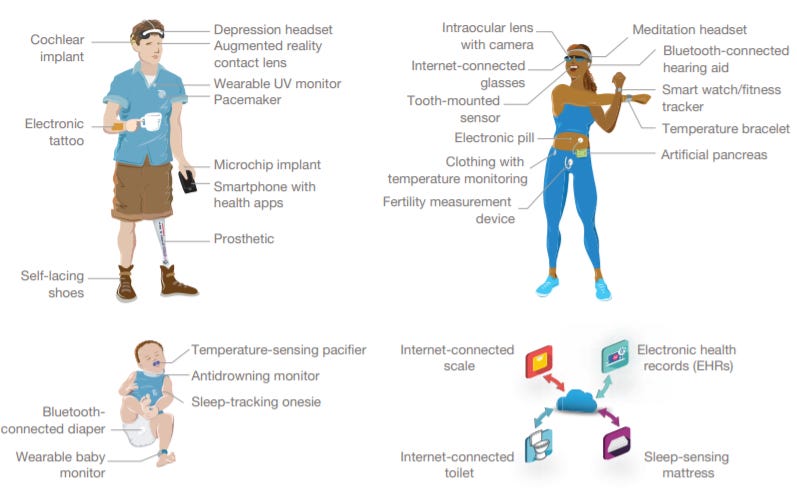
The coming ‘Internet of Bodies’, according to the Rand Corporation.

Everybody knows that the plague is coming
Everybody knows that it's moving fast
Everybody knows that the naked man and woman
Are just a shining artifact of the past
Everybody knows the scene is dead
But there's gonna be a meter on your bed
That will disclose
What everybody knows

- Leonard Cohen, 1988


When is a conspiracy theory not a conspiracy theory? The answer to this question has a bearing on the shape of the coming world.

In this covidian miniseries, I’ve been writing about the stories we tell about the pandemic. In the first essay, I explained why I had grown to disbelieve much of the official story - what I called the Narrative - about the virus and the response to it. For me, the straws that broke the back of this story were the Austrian lockdown of the ‘unvaxxed’, and the Australian quarantine camps: after this, I couldn’t tell myself that what was going on was anything to do with any sane definition of ‘public health’.

Maybe I was slow to get there, but I was only one of many who reached the same conclusion. This last month seems to have marked a tipping point, as resistance continues to grow to what is happening, and hundreds of thousands of people take to the streets across the world, from Turin to Paris, London to Vienna, Melbourne to Barcelona, Christchurch to Tblisi. Mandates, passports, segregation, quarantine camps, censorship, the chilling demonisation of the ‘unvaxxed’: all of this seems to have brought a new clarity about the unprecedented territory into which we are headed.

In the second instalment, I tried to dig into why so many of us see this situation so differently: why those mandates and passports, for example, are seen by some as a necessary health measure which it is irresponsible to refuse, and by others as the beginning of a tyranny which must be resisted. I looked at how the stories we tell about the world determine our responses to the corona moment, and how these stories can divide us against each other, even as we all aim for our own version of a healthier society.

This time around, I want to look at the story the Machine is telling us about these times. I want to look at the world we are being rapidly steered into, as covid-19 becomes a kind of techno-political sandbox: a testing-ground for new ways of being human in an increasingly post-human world.

Stories are the means by which we navigate reality, but they are also the means by which we control it - and by which we are controlled. Control the story, control the population: this has been understood since the Pharaohs, and it is why the narrative battle over covid has been so fierce. It is why the media and the social media companies have worked so hard to shut down difficult questions about the vaccines, and why constant efforts have been made to silence, intimidate or bully people who are said to be spreading ‘misinformation’. And it is also why we have seen a new focus on a very different kind of storyteller, one previously mocked but now increasingly looked upon with both nervousness and wrath: the ‘conspiracy theorist.’

Once upon a time, not so long ago, we knew what a ‘conspiracy theorist’ was. It was somebody who offered up an outsider take - often a very weird one - on an official version of a well-known story. Sometimes the take was convincing (JFK wasn’t shot by a lone gunman), sometimes it wasn’t (the UN wants to kill 95% of the world’s population), and sometimes it was downright poisonous (the Jews are behind it all.) But we all knew that a ‘conspiracy theory’ was a story that pointed towards dark, hidden forces operating in the world: a story that said, something is being hidden, and should be exposed.

Of course, the phrase was something else, too: a smear. The ‘conspiracy theorist’ (who probably wore a ‘tinfoil hat’) was basically unhinged: not like us good and sensible people who obtain our information from TV news, peer-reviewed science and books featured in broadsheet newspapers. Still, these people were mostly harmless - and more importantly, they were irrelevant. People who obsess over the Roswell Incident or the faking of the moon landings are no threat to power, so they are ignored by it. In normal times, ‘conspiracy theorists’ simply don’t matter.

But what about the abnormal times? Times like this one, when trust in official sources of authority is cratering, when the narratives are fractured, and when more and more people are grasping in the fog for new maps? In times like this, three things happen. Firstly, a lot of new conspiracy theories proliferate, like flowers in long-dry soil newly opened by rain. Secondly, the phrase ‘conspiracy theorist’ becomes a useful tool for those trying to hold the official line: a term of dismissal that can be applied to any and all who question the Narrative, no matter how reasonable their questions might be.

Thirdly, some of those theories will turn out to be right.

It’s fair to say that the ‘conspiracy theorists’ have had a good pandemic. I can still remember a glorious headline from a well-known publication which appeared in early 2020, and hasn’t aged well: “Anti-vaxx conspiracy theorists are suggesting that covid-19 will lead to the introduction of ‘vaccine passports.’” There have been countless articles like this over the last eighteen months in numerous outlets, dismissing predictions of everything from passports to mandates to quarantine camps as crazy tinfoil-hattishness. This has only served to underline the craven and unprecedented manner in which much of the media has been behaving, as well as the shredding of their remaining credibility. But that’s another story.

Perhaps the most reported-on ‘conspiracy theory’ of the past year, though, has been that of the ‘Great Reset’. In this lurid tale - so we are told by those same media outlets - globalist evil genius Klaus Schwab, who lives under a volcano in Davos, plans to kill off 95% of the population (again), and take control of the world’s resources. The 5% of us who remain will own nothing but be happy, because there is no longer any climate change and we are all fully vaccinated and boosted and entirely onboard with whatever Klaus and Bill Gates have planned for us next, which will probably involve robots.

It’s true that there are various, shall we say, creative tales doing the rounds about Schwab and the agenda of his World Economic Forum (WEF). But the Great Reset itself is no invention of the paranoid, and neither is it a conspiracy. You could call it a plan, or an agenda, but it is best understood as another story: one that Schwab and his colleagues would like us all to adopt as our map for the coming territory. If you want to understand the simultaneously boring and sinister nature of this story, you don’t need to penetrate the deepest recesses of the mountain redoubt in which it was secretly hatched: you can just watch the online lectures, attend the virtual conferences, or browse the relevant section of the WEF’s website. Or, if you’re really keen, you can do what I did last week, and read Klaus Schwab’s book on the subject.

Covid-19: The Great Reset is disappointingly free of mind control devices, microchips-in-vaccines and reptilian overlords. It is, in fact, almost entirely free of anything interesting at all. It is a standard-issue globalist manifesto, of the kind that could have been put out by any editorial functionary at the WEF, WTO, G8, UN, World Bank or IMF, or any writer for the Economist or Forbes, in any year after 1990. When I was writing my first book, One No, Many Yeses, back in the early 2000s, I read dozens of books and papers like this, in an attempt to understand what drove the promoters of economic and cultural globalisation. They were - and are - always the same: a hymn to the saving grace of global capitalism, dressed up in social justice clichés and aspirational NGO-speak. Diversity, vibrancy, equality, inclusivity, poverty alleviation, motherhood, apple pie: since they first started falling victim to mobs of activists outside their conference centres in the late nineties, the captains of the Black Ships of global capitalism have been careful to disguise their piratical raids as charity projects, powered by a Lennonist desire for universal oneness.

Schwab’s book, then, has to be read on two levels. On the surface, his argument is bland, unsurprising and deliberately hard to disagree with. He says that the pandemic has changed everything, and that the world will never return to what it was. He also argues that ‘what it was’ wasn’t working in any case. The global economy (the one he helped to build) is changing the climate, causing inequalities in and between nations and giving rise to other contemporary bad things, from racism to ocean pollution. We should thus ‘seize the opportunity’ that the virus has conveniently brought about to ‘reset’ the world: to rebuild it in a fairer, better, and more sustainable shape.

So far, so agreeable. Who could object to less poverty and cleaner seas? You have to dig below the surface to understand what any of this actually entails - and, more to the point, how it is to be achieved. And you don’t have to dig very far to see the story beneath the story.

The covid event, explains Schwab, has shown that ‘we live in a world in which no-one is really in charge.’ For plenty of us, this might sound like a good thing, but for globalist thinkers like Schwab it is a problem to be solved. ‘There cannot be a lasting recovery without a global strategic framework of governance’, he writes. Nation states and their kindly allies in the ‘global business community’ must unite to ‘build back better’ (you may have heard this somewhere before). What does this mean? It means that there is no going back.

Schwab is clear that the measures taken to tackle covid - lockdowns, vaccine passports and mandates, medical segregation, mass sackings, widespread destruction of small businesses, the deepening of the profit and reach of Big Tech, and a radical normalisation of digital monitoring, surveillance and state control - have wrought permanent changes on our societies which will not be going away. ‘What was until recently unthinkable’, he writes, ‘suddenly became possible’. This is especially true when we look at the real winner of the covid years: the technological system itself.

While ‘some of the old habits will certainly return’ after the pandemic ends, writes Schwab, ‘many of the tech behaviours that we were forced to adopt during confinement will through familiarity become more natural.’ Home working, digital monitoring of employees by their companies, Zoom meetings and e-deliveries, not to mention the whole structure of the QR-coded ‘vaccine passport’ system: much of this is likely to remain in the new normal that covid has created. In the reset future, we will reconsider things which once would have been second-nature: things like spending time with our loved ones. Why, asks Schwab, would we endure ‘driving to a distant family gathering for the weekend’ when ‘the WhatsApp family group’ (though admittedly ‘not as fun’) is nevertheless ‘safer, cheaper and greener’? Why indeed?

This is the essence of the Great Reset: the construction of a future which is at once controlled and catatonic, dystopian and dull, monitored and monotonous beyond bearing. A future in which global corporations are free to build the world they have long desired: a borderless, interconnected market technocracy, in which each human individual is a tracked, traced and monitored production and consumption machine - all in the name of public health and safety.

Interestingly, Schwab openly observes, in a claim which might land anyone else a Youtube ban, that covid is ‘one of the least deadly pandemics the world has experienced over the last 2000 years’ and that ‘the consequences … in terms of health and mortality will be mild.’ The really lasting consequences, he writes, will not be wrought by the virus itself, but by the response to it. This culminates in the only striking image in the book, which Schwab uses to illustrate how the fear of sickness will linger long after any threat of covid itself has receded, and what this might lead to:

A new obsession with cleanliness will particularly entail the creation of new forms of packaging. We will be encouraged not to touch the products we buy. Simple pleasures like smelling a melon or squeezing a fruit will be frowned upon and may even become a thing of the past.

A smooth, clean, ordered world, free of dangerous melons on little market stalls, free of small businesses and anarchic commercial arrangements and awkward human interactions of any sort - a world run by efficient, clean, digitised corporations offering ‘e-solutions’ for any activity that might threaten our safety and wellbeing: this has been on offer for years now, but the pandemic - as Schwab openly acknowledges - has been a blessing for those behind it. We are prepared to accept things now which would have been inconceivable three years ago. What will be conceived next year? And who will listen to the ragtag mob of conspiracy theorists, anti-vaxxers, fascists and nutters who want us to say no to it?

This is the sort of thing that fuels the genuinely weird ‘conspiracy theories’ around Schwab and his agenda. But it’s not necessary to believe that the virus was deliberately released or doesn’t exist, to simply observe the wider picture. For decades now, nation states and their political leaders have been progressively disempowered by globalisation, and power has been concentrated in the hands of those who create and control the world’s technological infrastructure. Bill Gates, Mark Zuckerberg, Klaus Schwab, Jeff Bezos, Sergey Brin, Ray Kurzweil and the like have been moulding our reality for decades, and the limbic capitalism they pioneered has been hyper-charged by covid - as has awareness of it, and a growing counter-reaction.

We are living through a time in which the conflict between technocracy and democracy has spilled out into the open: the battle is being fought daily now on street and screen. Schwab has caught the spotlight because he is publicly attempting to put a storytelling framework around this conflict. Only last month, at a conference in (where else?) Dubai, he made this ambition explicit by rebranding his Great Reset as the ‘Great Narrative’. The world needed a new global story to unite it, he said. He and the WEF would help to ‘imagine the future, design the future, and then execute the future.’

Klaus Schwab planning to ‘execute the future’ is exactly the kind of thing that gets Alex Jones salivating. But though Schwab and the WEF’s power and influence should not be underplayed, he is not pulling the strings. There are no strings: there is only the Machine, and its direction of travel is long-set. Covid has provided the perfect testing ground and launchpad for a next generation of digital surveillance-and-control technologies which have been on the drawing board for years. The confusion, anger and division swirling around us all right now is a result of our confused inability to navigate the techno-coup we are living through, or even to quite understand what is happening.

But the future is off the drawing board now. Take those QR-enabled vaccine passports, which have been rolled out so rapidly all over the world over the last twelve months. They make little sense from a ‘public health’ perspective, since we know that the currently available vaccines don’t prevent transmission of the virus. But they do have the effect of normalising the technologies involved: technologies which were in the pipeline anyway. Digital vaccine passports have been in preparation in the European Union, for instance, since at 2018. In late 2019, months before the pandemic began, trials of ‘digital identity systems’ linked to vaccination status began in Bangladesh. It was hoped that they would demonstrate how to ‘leverage immunization as an opportunity to establish digital identity’ on a worldwide scale.

Again: no outlandish claims are required to make sense of this. It is simply an acceleration of the existing direction of travel. Most of us already carry around in our pockets a portable tracking device, which monitors our geographical location, harvests data on everything from our political views to our shopping preferences, and can be used by the State in extremis to determine who our friends and contacts are. It’s called a smartphone. As covid becomes endemic over the next year or two, and as new variants keep popping up, there will likely be continuing pressure for permanent guarantees of health and safety. Handily, we may be able to use those smartphones, already apped-up with our covid QR codes, as permanent ‘health passports’, which will allow us to access goods and services safely and digitally in the dangerous new world - whilst penalising or excluding anyone who refuses to avail of the recommended public health measures.

If this sounds like one of those nutty old conspiracy theories, bear in mind that actual passports - the ones we use to go on holiday - were themselves introduced as a temporary measure after World War One. The later justification for making them permanent on a global scale was ‘considerations of health or national security’ provoked by the Spanish Flu outbreak of 1918. A century on, the digital version is close to fruition, and the pandemic provides the perfect opportunity for its rollout. The WHO is currently negotiating with nation states, regional blocs and corporations to agree on the standards for global harmonisation of digital passports:

New tools developed as part of WHO efforts are almost ready. By the end of 2021, the DDCC Gateway (PKI) beta reference software is expected and a Universal Status Checking app beta, using Google Android FHIR SDK and based on the EU DCC … It is intended to be able to recognize all the health pass QR code formats being used worldwide.

So we will have have our permanent, global health passports, and they will then merge with already-existing digital ID technologies and the rollout of digital currency, to create for us all a personalised digital identity wallet which will be presented as an optional convenience but will soon enough become a basic requirement for taking part in the life of society, just as smartphones, credit cards and paper passports have. If you want to experience this future for yourself, you can watch this short film, made especially for you by one of the companies which is pioneering it. Doesn’t it look appealing? Safe? Frictionless? Speaking for myself, I’m feeling tremendously empowered already:

Once we have accepted the premise that deep and ubiquitous levels of surveillance, monitoring and control are a price worth paying for safety - and we seem to have done that already - then almost anything is possible. South Korea has just introduced mass facial recognition technologies in order to ‘speed up notifications of potential exposure to COVID-19.’ China famously operates a social credit system through which citizens are rewarded or penalised for their behaviour in multiple spheres. Media outlets are producing slick little films detailing how your covid passport could be conveniently stored on a microchip embedded in your skin. In the US, the FDA has already approved pills implanted with ‘digital ingestion tracking systems’, which send a signal to a smartphone when the medicine is taken. Perhaps you will be able to pay for them with your biometric cash card, imprinted with your fingerprint data.

Buckle up: these are the coming times, and they are herding us directly and deliberately towards the main target: the ‘Internet of Bodies’, in which we begin to merge, finally, with the machines we have made. Microchip brain implants - ‘human enhacements’ which will allow us to ‘interface’ directly with the web - will be with us sooner than we think: their development is currently being funded by, among others, Elon Musk and Mark Zuckerberg. The Royal Society, Britain’s premier league scientific thinktank, can’t contain its excitement about the possibilities they will offer:

Linking human brains to computers using the power of artificial intelligence could enable people to merge the decision-making capacity and emotional intelligence of humans with the big data processing power of computers, creating a new and collaborative form of intelligence. People could become telepathic to some degree, able to converse not only without speaking but without words—through access to each others’ thoughts at a conceptual level. Not only thoughts, but experiences, could be communicated from brain to brain ...

In this story - the story of the Machine - the whole world, and everyone and everything in it, becomes a node in the glowing web that will make and direct our every waking hour. This future has, of course, been long anticipated. William Morris saw it coming, and so did William Blake. Aldous Huxley and E. M. Forster had its number a century ago, and Edward Abbey predicted it before I was born:

Call it the Anthill State, the Beehive Society, a technocratic despotism — perhaps benevolent, perhaps not, but in either case the enemy of personal liberty, family independence, and community sovereignty, shutting off for a long time to come the freedom to choose among alternate ways of living. The domination of nature made possible by misapplied science leads to the domination of people; to a dreary and totalitarian uniformity.

Covid has both accelerated and justified our dive into the digital anthill, and in coming years it will become more and more relentless. Perhaps many, even most, of us will welcome it. After all, it has been advertised at us for years, in the most deliberate, manipulative mass assault on our wills in human history. We have been trained to love - or at least accept - our smartphones, satnavs, Smart fridges, drones and Alexas. Luddites like me have always been a fringe sect. Certainly the people selected by the WEF as ‘young global leaders’ of tomorrow are excited by the future that they are being groomed to build:

When AI and robots took over so much of our work, we suddenly had time to eat well, sleep well and spend time with other people. The concept of rush hour makes no sense anymore, since the work that we do can be done at any time. I don't really know if I would call it work anymore. It is more like thinking-time, creation-time and development-time.

Although, of course, every society has its downsides:

Once in a while I get annoyed about the fact that I have no real privacy. Nowhere I can go and not be registered. I know that, somewhere, everything I do, think and dream of is recorded. I just hope that nobody will use it against me.

This is not satire; this is prophecy. Or maybe it’s just marketing. Whichever it is, we have come at long last to the foothills of the future: an inverted version of The Matrix in which Agent Smith is the hero. A world both terrible and boring at the same time. As climate change bites, ecosystems continue to degrade, supply chains jam up, the social fabric frays, and mass urbanisation and mass migrations accelerate, it will become more and more necessary to micromanage, nudge and control the citizens of our mass societes just to keep the growth-&-progress show on the road. The pandemic has shown us how this can be achieved. Schwab is right that there is no turning back from the lessons it has taught.

Sometimes I think that what is happening now has no precedent in human history. At other times, it seems like human history as usual, only faster. When did we start augmenting ourselves, after all? When we invented glasses, shoes, armour, chipped flint? If this is what humans do, and what we are - animals who invent ourselves stronger, think worlds into being and then try to build them - is there any way to halt the march towards the merger of man and machine? Or did that already happen?

I could go on - I have gone on for years now. But it’s Christmas week, and I don’t want to end on this note. I want to end instead by saying something else: something I may not have expected to say at the beginning. But then that first essay, from a month ago, already seems like it was written in another time, so fast is everything shifting.

Here’s the thing: for some reason, despite all I have written about in this little trilogy, despite the coming winter, despite the new partial lockdown that my vaxxed-and-passported country has just entered, despite everything that the future seems to hold: despite it all, I feel some strange glimmer of hope. Control: this is the story that the Machine tells about itself, and it is the story that we would all, at some level, like to be true. But control systems never last. The world is beyond both our understanding and our control, and so, in the end, are people. We barely understand ourselves. Perhaps Klaus Schwab’s desire to ‘improve the world’ is real and felt: but he will still never be able to grip it tightly enough to bend it to his will. Who can?

The world is not a mechanism: it is a mystery, one that we participate in daily. When we try to redesign it like a global CEO, or explain it like an essayist, we are going to fail: weakly or gloriously, but fail we shall. The Machine, the technium, the metaverse: whatever we name our 21st century Babel, and however overwhelming it seems to us in the moment, it can never conquer in the end, because it is a manifestation of human will and not the will of God. If you don’t believe in the will of God, call it the law of nature instead: either way, it speaks the same thing to us. It says, gently or firmly: you are not in charge.

I can’t pretend to understand all of this. All I have is my intuition, and these words. But I think that the world is more surprising, and more alive, than I sometimes see or even want to believe. I think that the corona moment highlights an ancient ongoing struggle, between the spirit of the wild and the spirit of the Machine, and that this struggle goes on inside us all every minute of the day. Sometimes, battles must be fought, stands taken, lines drawn. This is one of those times. Once we begin to understand all the stories at play, we can begin to see which one we are taking part in, and what choices we must make.

Winter is here in the north. Tomorrow is the solstice. In the west of Ireland it is dark, damp and cold. The times are raging around us, and it can be hard to keep our heads. But candles are lit in the windows here at night, for it is advent, and an unexpected light is about to break through the shortest of days. The times demand now that we remember and cultivate some of the old virtues. We could start with courage: courage and patience. It may take years, decades, centuries, but the Machine we have built to manage life itself, to squeeze the world into our own small shape - it will come down in the end, and the humming wires will fall silent. Our task in the meantime is to understand, so that we can resist, the shape of the tyranny it brings. But D. H. Lawrence knew: all the prophets knew. The Earth cannot be reset. Not by us; not ever.

They talk of the triumph of the machine,
but the machine will never triumph.

Out of the thousands and thousands of centuries of man
the unrolling of ferns, white tongues of the acanthus lapping at the sun,
for one sad century
machines have triumphed, rolled us hither and thither,
shaking the lark’s nest till the eggs have broken.

Shaken the marshes, till the geese have gone
and the wild swans flown away singing the swan-song at us.

Hard, hard on the earth the machines are rolling,
but through some hearts they will never roll.


This was the third and final part of my three-part series on the virus and the Machine. I’m retreating from screens until the new year, but in January I will return to my wider essay project, digging further into how the Machine age is transforming every aspect of our world.

Saturday, September 18, 2021

Holmgren: Pandemic Brooding

Pandemic Brooding. David Holmgren, via The Automatic Earth. Sept 13, 2021.


As the pandemic rolled into its second year, I became concerned that the psychosocial fallout of the pandemic, and especially the response at the global and local levels, could represent an existential threat to permaculture and kindred movements. At one level, this threat is the same as that to families, workplaces, networks and organisations more generally, where a sense of urgency to implement the official response, especially lockdowns and mass vaccination, is producing a huge gulf between an ever more certain majority and a smaller minority questioning or challenging the official response.

My aim in this essay is to focus on the critical importance of using all our physical, emotional and intellectual resources towards maintaining connections across what could be a widening gulf of frustration and distrust within our movement, reflecting society at large. I want to explore how permaculture ethics and design principles can help us empathetically bridge that gulf without needing to censor our truth or simply avoid the issues.

While the pandemic and the responses to it will pass in time, I believe the future will be characterised by similar issues that test our ability to tolerate uncertainty and diversity and to thus exercise solidarity within kin, collegiate and network communities of practise.


Future Scenarios and the Brown Tech future

The positive grounded thinking that characterises permaculture has always been informed by a dark view of the state of the world and long-term emerging threats. Future Scenarios is my 2008 exploration of four near-future ‘energy descent’ scenarios driven by the variable rates of oil and resource depletion on the one hand and rate of onset of serious climate change on the other. Six years later, I wrote the essay ‘Crash on Demand: Welcome to the Brown Tech Future’ where I ‘called’ Brown Tech as being the already emergent scenario.

In the longer version of this ‘Pandemic brooding’ essay, I review and reinterpret this work in light of the pandemic and responses to it.


Permaculture pluralism

Anyone involved in permaculture knows that permies can come to quite different conclusions about what is the most ethical and practical solution to the same problem. For example faced with marauding wildlife, some will go to considerable expense (and resource consumption) building elaborate fences, anti-aviaries and other deterrents to separate wildlife from food. Others will treat the wildlife as another abundance of the system to be harvested. Various permaculture principles, as well as the fundamental ethic of Care of Earth, might be invoked to support both approaches.

Likewise, many permies believe taxation is essential to redistribute resources from places of abundance to those of scarcity and as an expression of solidarity essential to any functioning, let alone ethical, society. Others see almost all the expenditure by governments of tax revenues as representing rape of Mother Earth’s abundance and theft from Indigenous peoples, and further as either downright evil or at best a band-aid covering festering wounds. An ethical response is to minimise taxpaying (by reducing income and consumption). Again, design principles and ethics can be invoked to support either position.

From my perspective, grappling with the ethical and systemic issue is more important than the notion that there might be a correct answer, and therefore a wrong answer, to the challenge. In the past, there have been heated debates, and agreements to disagree, but rarely would participants in permaculture design courses, convergences or networks see the answers of others as reasons to reject permaculture. Many celebrate personal actions as small-scale experiments with their good, bad and interesting outcomes informing other experiments, especially the next generation’s, as we muddle through energy descent to hopefully more benign, or at least less-bad, futures.


Pandemic flavoured Brown Tech

I believe the pandemic and the responses to it represent a major turning point in crystalising the Brown Tech future. It ticks so many boxes:
  • a nature-driven crisis which has been long predicted, and to some extent, planned for
  • rolling uncertainty that progressively breaks down past expectations
  • a crisis which, like a war, requires the suspension of normal economic activity, personal rights and governance processes
  • a demand for strong action by government for the common good informed by science
  • a revival of Keynesian policies including a massive increase in government debt
  • an enemy (the virus) that can be easily demonised without there being too many defenders to ignore or silence
  • strong censorship of broadcast media and novel efforts to censor social media to sideline debate that could undermine the rapidly emergent and evolving program.
If the crisis is not solved, then demonisation progressively shifts to those resisting the plan.

This situation is creating the fork in the road where some permies will find themselves (perhaps surprisingly) following the program, while others will have become certain that they will at least quietly resist complying to some degree or other, right up to a radicalised public resistance, whether that be through resigning from work, street protest or satirical art.

We can learn and gain, individually and collectively, from these increasingly divergent paths – but the learnings could be painful. Let’s consider the benefits that might have led permies down one or another path, perhaps unwittingly, to increasingly polarised positions.


The mainstream plan

Although there are differences of emphasis and policies around the government responses to the pandemic, these debates are around the margins, even if they are at times heated. Most fundamentally, the mainstream plan, informed by the scientific and medical establishment, takes the following as self-evident:
  • The virus is an existential threat to society that must be contained and disarmed if not eliminated before an establishment of some hoped-for, tolerable new normal.
  • Social distancing, disinfectant cleaning, testing, contract tracing, masks and various levels of quarantine, border controls and lockdowns are the only mechanisms available to prevent collapse of the health system and deaths escalating to horrific levels in the short term.
  • Novel vaccine technology is the only real hope for a tolerable new normal.
  • To achieve effective herd immunity and minimise death, some great majority of the adult population and probably children need to get vaccinated as soon as possible.
  • The adverse effects of these provisionally approved vaccines are minor and/or rare and much less than the risk of the disease.
  • Preventative and early treatments are at best of marginal value, or more likely based on false hope and fraud.
  • The suspension of normal civil liberties is a necessary, albeit temporary, measure to achieve the plan in a timely fashion and reduce the suffering both from the virus and the plan itself.
  • People who actively resist the plan need stronger social, economic and, where necessary, legal sanctions to ensure their actions don’t prevent the plan from working for the common good.
  • Apart from debate around the margins about how best to respond to these givens, debate and questioning at the level of science, logistics, economics, law, politics, media and social media is not just unnecessary, but an existential threat to the plan and society at large, so must be prevented by unprecedented means.
  • It is the responsibility of every citizen to play a part in the plan, be bold in convincing those who are hesitant, and challenging those not following the plan, especially those actively resisting it.
Permies following the plan are likely to see themselves as being part of a society-wide collective effort to minimise pain and suffering in the aged, the disadvantaged and those in poor health; a choice in favour of collective and longer-term gain at the cost of individual and short-term sacrifice. For many of us, this is a perfect metaphor for what is needed to address the climate emergency. By accepting what appears to be a broad consensus of global, national and local medical and scientific experts, we avoid the protracted debate and lack of a technical consensus that has stymied governments in initiating strong action to address the climate emergency.

For permies in despair about the waste and dysfunction of the consumer economy, the closure, albeit temporary, of many discretionary services and businesses is a taste for how we might need to decide what is important; maximum consumer choice for the affluent versus the provision of basic needs for all. The personal sacrifice and adaptation to difficulties, including stay-at-home lockdown, have been opportunities to focus more on the important things in life and get a taste of what social solidarity feels like.

Reports of contrarian views seem to mostly come from sources contaminated by association with climate denial and other views we categorically reject. The resisters’ outrage looks to many like just more selfish, science denying and ignorant right-wing rednecks, trying to prevent collective wisdom and social solidarity from working. Familiar powerful bad players in global corporations or nation states have been replaced by much more immediate angry undesirables, who without much power or vision, could wreck the hard work of the collective to create a workable new normal.


The dissident view

It is more difficult to generalise about those who question or reject the program. A great diversity of views, explanations, feelings and actions flourish in an environment of unprecedented censorship. While there is great sensitivity about the term ‘censorship’, let alone ‘propaganda’ by those supporting the plan, for those on the other side, it is astonishing how rapidly the axe has fallen on enquiry, and debate, in the mainstream media, social media, workplaces and families, let alone in defence of what – until very recently – most of us took as our inalienable rights.

For many permies, the pandemic seems another example of hyped threat like the ‘war on weeds’, ‘war on drugs’, ‘war on terror’ used to manipulate the population to comply with some version of disaster capitalist. Disaster capitalism feeds off natural (climate change) and other disasters to provide recovery and reconstruction services funded by the public that typically benefit the corporate providers and contribute to ongoing dependencies. The term was used by Naomi Klein to describe the evolution of late stage capitalism over recent decades. Most sceptics acknowledge the virus as real, but not as dangerous as the cure in lockdowns and other draconian measures. The ‘war on the virus’ seems just as futile or misguided as all the other wars on nature, substances and concepts. So much for trying to have nuanced discussions about viruses as an essential and largely symbiotic mechanism for the exchange of genetic material and mediation of evolution!

While the closure and loss of cafés, gyms and hairdressers might not be a great loss, except to those directly affected, many of us have noticed that the official response to the pandemic tends to follow a pattern of support and strengthening of dominant corporations while leading to the weakening and likely collapse of small business and community self-organised activities.

During the first lockdown, ‘stay at home in your household’ was celebrated as a great plus for people getting the RetroSuburbia message. More recently, the messaging about the problem of shared and multi-generation households being suspect has been building, especially in the working-class western suburbs of Sydney and Melbourne where many of essential and less well paid workers live. We have shifted from a joke about ‘which permie created the pandemic?’ to a gritted teeth recognition that the response to the pandemic is working to vacuum people into another level of dependence on techno-industrial systems.

Many permies have taken advantage of the shift online to network more effectively around the country and the world, but we are deeply troubled by our increasing dependence on mediated experiences and what seems like draconian regulation of informal engagement with people and nature. The concerns for what this is doing to children are far more serious than the loss of the regulated version of social interaction that children get at school.

For many of us, it is completely natural to be sceptical about one big fast answer provided by the giants of the pharma industry, while they have been granted legal immunity for the consequences of their novel products. Many have made the rational assessment that the very low risks of the virus (for most of us at least) seem better than the unknown of a novel technology approved and pushed on a frustrated and frightened population in record time. Some in this camp were sceptical about vaccines in general but most have been influenced by the largely censored views from some leading global experts, that these vaccines are in a totally different risk category to all previous vaccines.

While waiting and seeing what happens next may look selfish to the majority, the difficulty in getting access to data and unbiased interpretation drives many to rely on their gut feelings. One or more examples of spin and manipulation of data by officials, and especially the media, leads to a general collapse in trust about any, and even all, aspects of the official story. For instance:
  • Many of us have seen evidence that existing low cost and low risk treatments are available and used effectively in some countries resisting the ‘no available treatment’ orthodoxy.
  • Most understand that while the vaccines seemed to give some protection from more severe effects at least in the early stages, they do not appear to stop transmission, at least of the latest variant.
  • Many wonder why the build-up of natural immunity from prior exposure to the virus is not considered as part of the solution that should at least be discussed before vaccine passports are implemented.
Concerns about more serious adverse effects of the vaccines, as predicted by some experts, have developed into alarm, anger and resistance as both the evidence increases and efforts at cover up and spin become worse. Extreme consequences that many of us dismissed early on as highly unlikely are now showing up in hard-to-read scientific papers, clinical reports and official records and databases.

A similar process has happened with the official responses. For example vaccine passports are now widely discussed and debated as part of the attempt to get as many people vaccinated as possible, as the efficacy of vaccines falls and concerns about adverse effects lock in resistance by a minority. At the start of the pandemic this possibility was decried as paranoid conspiracy theory.

France has been leading the charge to impose vaccine passports for many public and work spaces including hospitals. It’s hard to assess how large the resistance will be in different countries and circumstances but there are already signs that whole industries will lose a significant part of their workforce as some substantial minority of the population withdraw their work, consumption and investment in the system rather than getting the vaccine. Whether by design, policy stupidity or the unexplained viral power of censored scientists and vaccine doubters to overcome the largest public health education/public relations/propaganda effort in history, it is conceivable that the result could be economic contraction on a much larger scale than has occurred as a result of lockdowns so far. I can’t help but see what is unfolding as a bizarre version of my ‘Crash on Demand’ scenario

Economic contraction could mostly be in the discretionary economy, but how would the health system cope with a loss of staff, especially if some combination of ineffective vaccines against new strains and antibody-enhanced disease lead to medically informed people losing faith before the general public? Part of the solution might be doctors and nurses from overseas. In the week since I wrote this sentence, doctors from overseas are now part of the plan for Australia or the adoption of treatment options for Covid currently being used with success in countries like Mexico and India.

Australia and New Zealand seem to be something of a test bed for the most authoritarian regulations in an attempt to keep Covid as close to zero as possible (and failing). Large numbers of people in other countries see us as a police state and wonder why there hasn’t been more resistance Down Under.

Some of us have noted plans promoted by the World Economic Forum for a Global Reset that will require a command economy to respond to the climate emergency, and that the pandemic is an opportunity to implement some of the structures and processes needed to create what some fear is a global new world order.

For many people, the trajectory from trust to mistrust often leads to either deep depression or an energised anger, mostly focused on the authorities but often expressed to friends and family at great cost to all concerned.

Although I have some of those thoughts and feelings, I mostly feel a great tension between a deep and somewhat detached fascination with the big picture and the sense of urgency I habitually feel in spring to get fully cranking with the seasonal garden and generally keeping our home at Melliodora shipshape. I feel like I finally have a box seat to watch the train of techno-industrial civilization hitting the Limits to Growth stone wall and breaking apart, all in slow motion.

The rapidly evolving situation and all its psychological, sociological and economic dimensions suggest an expanding field of possibilities. These could include:
  • a cyber pandemic that crashes the global financial system,
  • a short war between China and the USA (Part of my ‘A History from the Future’ story happening in 2022)
  • rapid reduction in consumption of oil and other critical resources and consequently greenhouse gas emissions as a result of the virus,
  • plus of course accelerating climate disasters.
In different scenarios, concern about the virus and the ability to implement the plan could become ever more intense, or alternatively, be shunted offstage or metastatized into dealing with the next crisis. Consequently, the details of what worked, what didn’t, who takes the credit and who gets the blame, would probably all be lost in the swirling muddy waters of compounding crises.


A personal view of the pandemic

Up until this point, I have not indicated my personal interpretation of either the virus or the response because I wanted to focus on the bigger systemic drivers without getting muddied in the good/bad, right/wrong, us/them polarities. However we all have to face what life throws in our path with whatever internal and collective resources we have at hand. As is my lifelong habit, I have done my own ‘due diligence’ to understand and guide my personal decisions. In the past I have always been open about my conclusions and decisions, whether around the campfire or on the most public of forums. I have often joked about the comfort I feel in being a dissident about most things including being beaten up at primary school in the early days of the Vietnam war for being a ‘commie traitor’ to being ostracised in the 1990s for opposing the ‘war on weeds’ orthodoxy of the environmental mainstream. But today being a dissident is no joking matter. Unfortunately the psychosocial environment has now become so toxic that the pressures to self-censor have become much more complex and powerful. Much more is at stake than personal emotions, ego, reputation or opportunities and penalties.

Following my instinct for transparency, I will state my position, which has been evolving since I first started to consider whether the novel virus in Wuhan might lead to a repeat of the 1919 flu pandemic or even something on the scale of the Black Death. I can summarise my current position and beliefs as follows:
  • The virus is real, novel and kills mostly aged, ill and obese people with symptoms both similar to and different from related corona viruses.
  • It most likely is a result of ‘Gain of Function’ research at Wuhan Institute of Virology in China supported by funding from the US government.
  • Escape rather than release was the more likely start of the pandemic.
  • Vaccines in use in western world countries are based on novel technology developed over many years, but without resulting in effective or safe vaccines previously.
  • The fear about the virus generated by the official response and media propaganda is out of proportion to the impact of the disease.
  • Effective treatment protocols for Covid-19 exist and if those are implemented early in the disease, then hospitalisation and deaths can be greatly reduced, as achieved in some countries that faced severe impacts (especially Mexico and India).
  • The socioeconomic and psychosocial impacts of the response will cause more deaths than the virus has so far, especially in poor countries.
  • The efficacy of vaccines is falling while reported adverse effects are now much greater proportionally than for previous vaccines.
  • The under-reporting of adverse events is also much higher than for previous vaccines, although this is still an open question.
  • The possibility of antibody dependent enhancement (ADE) leading to higher morbidity and death in the future is a serious concern and could be unfolding already in countries such as Israel where early and high rates of vaccination have occurred.
Given the toxic nature of views already expressed about (and by) people I know and respect, I am not going to engage in an extensive collating of evidence, referencing who I think are reliable experts and intermediaries who can interpret the virus, the vaccine or any of the related parts of the puzzle. Outsourcing personal responsibility for due diligence to authorities is a risky strategy at the best of times; in times of challenge and rapid change the risks escalate. I do not want to convince anyone to not have the vaccine, but I do want to provide solidarity with those struggling (often alone and isolated) to find answers, so the following are two starting points that I think could be helpful:
As a healthy 66-year-old I am not personally afraid of the virus, but if greater virulence and death rate do emerge with new variants, I might consider the preventative regimen recommended by the FLCCA doctors. There is no way I will be getting any of the current vaccines in the foreseeable future, no matter what the sanctions and demonisation of my position on this matter.

At this point there may be readers who decide to ignore anything and everything I have written as obviously deluded. These are the costs of transparency.


Valuing the Marginal

Tolerance, let alone celebration of diversity, is not the easy permaculture principle many of us assume. Valuing the marginal can be even harder, especially if we study the darker periods of human history.

Over most of history, minority ethnicities and subcultures lived in ambiguous complementarity with dominant majorities. For hundreds, if not a thousand, years my Jewish ancestors made valuable contributions to European culture while managing to maintain their own culture to an extraordinary extent. They lived in ghettos not just for protection from the eruptions of intolerance in the dominant Christian communities but to ensure their language and culture wasn’t swamped by that of the majority. While the Jews carried the elitist belief that they were God’s Chosen People, they didn’t attempt to gain converts and were naturally respectful to the majority Christians. They survived through all but the worst of antisemitic pogroms by not antagonising the majority, largely accepting the restrictions placed on them by society. What else could they do?

Similar dynamics could emerge from the virus and the vaccine, where a subculture of home birth, home education, home food production and alternative health brings together people of previously diverse subcultures, including permies, who are excluded from society. That exclusion will seem self-inflicted to the majority, but for those excluded it will feel critical to both survival and identity.

Is it sensible to plead for tolerance in line with sensitivities to the rights of other minorities? Or is that just an invitation to be stoned to death, if not literally then virtually, on social media?

Unfortunately one of the weaknesses of western culture, which shows up in both Christian and Muslim traditions, is the idea that if a particular path is the correct one, then everyone should follow it. From the perspective of east Asian philosophy and many Indigenous traditions, harmonious balance is more important than the right way. The yin yang symbol showing each polarity containing the seed of its opposite encapsulates this critically important antidote to the recurring western theme about the triumph of good over evil. In The Patterning Instinct Jeremy Lent explores how these different world views have shaped history and that any emergent ecological world view will foreground the importance of harmonious balance.


The wisdom of the collective

I want to lead by example in trying to understand and articulate why it is good that the majority of the population appears to be strongly behind the official plan and that maybe it is even good that a majority of my permaculture colleagues might be lining up to get vaccinated, when I have no intention of doing so.

Firstly, I acknowledge the obvious reason that if the official story is right, the majority getting vaccinated will combine with naturally acquired immunity and control the worst effects of the virus without the need to get every last dissenter vaccinated.

Secondly, given the pressure to push the vaccination rate in every way possible, encouraging some extra hesitators to resist will only increase the pressure and possibly lead to harsher sanctions as well as more broken family relationships, reputations, pain and suffering, which could be worse than potential adverse effects of the virus, or the vaccine, on those people.

Thirdly, because so many people I respect as intelligent and ethical are following the plan, I won’t fall into the trap of losing respect for who they are, what they have done and what else they might do in the future. And if it turns out this is the start of a more permanent hard fascist command state, then we need people of good values on the inside to keep open whatever channels of communication remain possible.

As systems unravel, the stories that make sense of the world also fall apart and in the desperate search for mental lifeboats, different stories come to the fore. The mainstream story around the pandemic is one such mental lifeboat that allows people to maintain faith and function. Without the renewed source of faith and order from rational science guiding technological wizardry, the psychosocial shock from a pandemic could be enough to create social, economic and political chaos on a historically unprecedented scale, at least in long-affluent countries like Australia.

Whatever the nature of the next crisis, I think it will require citizens to by and large accept that the behaviours, rights and freedoms we took for granted are artifacts of a vanishing world. Further, it will provide a harsh reality check on how dependent most of us are on systems we have no control over, so most will find they have little choice but to accept the new state of affairs.

While I might resent what I see as unnecessary sanctions on those resisting, I accept than in the early stage of Brown Tech energy descent, harsh and by some perspectives, arbitrary, controls on behaviour will be part of our reality and are arguably necessary to maintain some sort of social order (even if short-sighted or not sustainable in the long run). My aim is to focus on how we ameliorate the adverse effects of a predicament that humanity cannot escape.

More philosophically, the virus and the response to it could be seen as a meditation practise showing us how no one is an island separated from the whole of life. To break down the toxic notion that we are free agents to do as we choose without consideration of consequences, especially for future generations and the wider community of life, is something permaculture teaching has tried to bring to daily life. How we do this in meaningful ways is a constant challenge.


Sympathy for the devil

Having at least had a go at seeing the good in the mainstream plan, I now want to articulate quite passionately why the majority should at least tolerate and not seek to further punish the minority for their resistance. To advocate for this within the permaculture movement, I appeal to our pluralism in celebrating the diversity of action. This is especially where permies take the risk of being the unvaccinated guinea pigs, who can at least be a control group in this grand experiment on the human family. Beyond that, I hope our colleagues inside the tent will see the need to express solidarity with our right to chart our own course and not feel they have to be silent for fear of being cast out of the tent.

While I respect the younger permaculture folk following the plan for the common good, I still believe the most creative deep adaptations to the Brown Tech world will be crafted at the geographic and conceptual fringes by younger risk takers coming together in new communities of hope. While the paths to the armoured centre and the feral fringes both have their risks, those on the inside, especially older people, should accept that the young risk takers on the fringes might create pathways though the evolutionary bottleneck of energy descent more effectively than the best resourced and rationally devised plans from within the system of thinking that has created the civilisation crises.

Whether or not the pandemic will lead to the flowering of creative light-footed models for adaptation, the larger energy descent crisis for which permaculture was originally designed (that most permies recognise as the ‘Climate Emergency’) needs these responses at the margins. If the permaculture movement cannot digest this basic truth and at least defend the right of people to craft their own pathways in response to collapse of all certainties, then our movement will have failed the first great test of its relevance in a world of energy descent.

Some permie dissidents will double down in their focus on preparation to survive and thrive in spite of the sanctions, while others will be energised by non-violent direct action to resist what they see as draconian and counterproductive collective punishment. In doing so they may draw on past experience, or inspiration, from the frontlines of anti-war, environmental defence and free communication resistance.

In the past, more apolitical permies trying to introduce permaculture to socially conservative punters could still acknowledge, at least privately, the element of truth in the quip ‘permaculture is revolution disguised as gardening’. In today’s climate, can permies inside the tent accept and appreciate their colleagues on the frontlines of a new resistance movement that might moderate the extremes of how society navigates the larger climate emergency? Or will they flip and decide permaculture was, after all, mostly hippy nonsense now further contaminated with toxic right wing conspiracy madness, so must be dumped as unfit for purpose in our new world?

In saying this, I’m not suggesting we should all follow suit, let alone belittle or demonise those who don’t take the walk on the wild side. That would also be a contradiction of permaculture ethics and design principles. As we have always taught, ethics and design principles are universal but rarely lead to clear and conclusive solutions. Strategies and techniques vary with the context; wonderful elegant design solutions for one context can be hopeless white elephants, or worse, in another. Context is everything and as colleague Dan Palmer has so effectively applied in his Living Design Process, the people context is as complex, subtle and diverse as that of the land and nature.

The sovereignty of persons to choose freely how they grapple with the tension between autonomy and the needs of the commonwealth is not just an ideal from western Enlightenment civilisation working out how to apply the gift of fossil fuel wealth. It is a fundamental expression of how the ecology of context is constantly shifting, and that all systems simultaneously express life through bottom-up autonomy of action and top-down guidance of collective wisdom.

In times of great stability, the distilled wisdom of the collective, embodied in institutions, carries human culture for the long run. Sometimes the sanctions on the individuals who rejected the rules of the collective were harsh and, according to modern thinking, arbitrary but over long periods of relative stability, those rules kept society working. In times of challenge and change it is, ironically, dissidents at the fringes who salvage and conserve some of the truths of the dying culture into the unknown future to craft new patterns of recombinant culture.

What we call ‘science’ had its origins in what Pythagoras salvaged, almost single handedly, from the decadent and corrupt theocracies of ancient Egypt of which he was an initiate, before he walked away from the centre to the margins of civilisation. Major failures in the application of so-called trusted science have been a feature of our lived experience. Tragically, science could be one of the casualties as humanity passes through the cultural evolution bottleneck of climate chaos and energy descent. Permaculture was one attempt to craft a holistic applied design science grounded in observation and interaction, taking personal responsibility and accepting (negative) feedback, designing from patterns to details, and creatively using and responding to change. I still believe that salvaged and retrofitted versions of practical science crafted at the margins will serve humanity better than rigid faith in the priests of arcane specialised knowledge maintained by an empire of extraction and exploitation. Can we be sure what the father of science and mathematics would do in this time of turmoil?

Whatever the historical significance of these times, maintaining connections across differences of understanding and action within permaculture and kindred networks will strengthen us all in dealing with the unfolding challenges and opportunities of the energy descent future.