Too Late for 2

But not too late for 4. Urgent action needed to prevent worst-case climate change scenarios and limit repercussions of abrupt runaway climate change..... OR, that's what I used to think, 5+ years ago; NOW I think it is indeed too late; we're f'd. Tipping points have tipped. Positive feedback effects in play. Bring on the methane. Abrupt climate change on the horizon. Exponential changes will escalate. Homo sapiens may not survive the current on-going 6th mass extinction.

Pages

  • Home
  • Bibliography
  • Climate Change Charts
  • Videos: Climate Change
  • Videos: Animal Rights
  • Videos: Geopolitics and Corporatocracy
Showing posts with label tipping point. Show all posts

Wednesday, November 27, 2019

We've been blithely betting against them for 30 years

Climate tipping points — too risky to bet against

The growing threat of abrupt and irreversible climate changes must compel political and economic action on emissions.

Timothy M. Lenton, Johan Rockström, Owen Gaffney, Stefan Rahmstorf, Katherine Richardson, Will Steffen & Hans Joachim Schellnhuber. Nature. November 27, 2019.


Politicians, economists and even some natural scientists have tended to assume that tipping points1 in the Earth system — such as the loss of the Amazon rainforest or the West Antarctic ice sheet — are of low probability and little understood. Yet evidence is mounting that these events could be more likely than was thought, have high impacts and are interconnected across different biophysical systems, potentially committing the world to long-term irreversible changes.


Here we summarize evidence on the threat of exceeding tipping points, identify knowledge gaps and suggest how these should be plugged. We explore the effects of such large-scale changes, how quickly they might unfold and whether we still have any control over them.


In our view, the consideration of tipping points helps to define that we are in a climate emergency and strengthens this year’s chorus of calls for urgent climate action — from schoolchildren to scientists, cities and countries.


The Intergovernmental Panel on Climate Change (IPCC) introduced the idea of tipping points two decades ago. At that time, these ‘large-scale discontinuities’ in the climate system were considered likely only if global warming exceeded 5 °C above pre-industrial levels. Information summarized in the two most recent IPCC Special Reports (published in 2018 and in September this year)2,3 suggests that tipping points could be exceeded even between 1 and 2 °C of warming (see ‘Too close for comfort’).
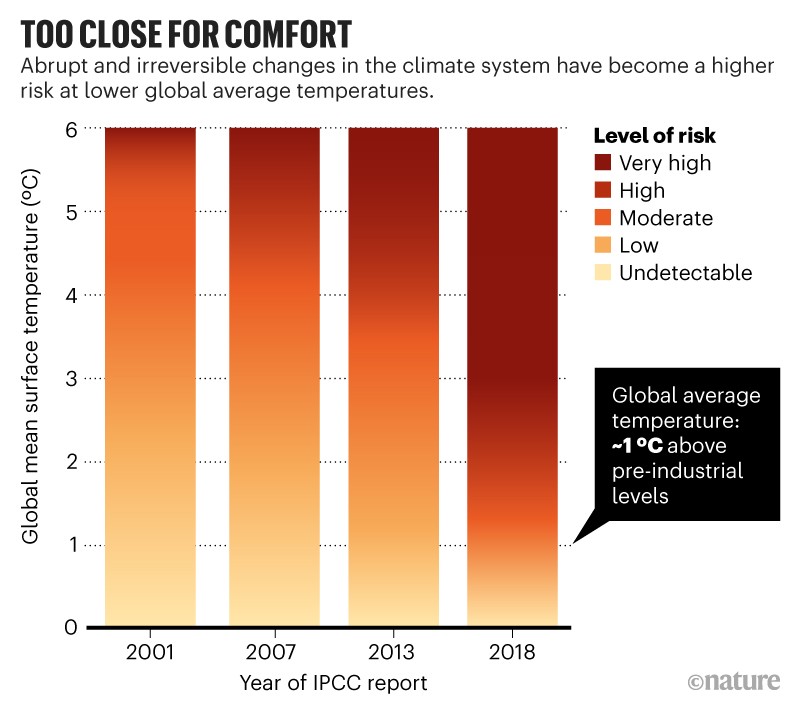


Source: IPCC


If current national pledges to reduce greenhouse-gas emissions are implemented — and that’s a big ‘if’ — they are likely to result in at least 3 °C of global warming. This is despite the goal of the 2015 Paris agreement to limit warming to well below 2 °C. Some economists, assuming that climate tipping points are of very low probability (even if they would be catastrophic), have suggested that 3 °C warming is optimal from a cost–benefit perspective. However, if tipping points are looking more likely, then the ‘optimal policy’ recommendation of simple cost–benefit climate-economy models4 aligns with those of the recent IPCC report2. In other words, warming must be limited to 1.5 °C. This requires an emergency response.


Ice collapse


We think that several cryosphere tipping points are dangerously close, but mitigating greenhouse-gas emissions could still slow down the inevitable accumulation of impacts and help us to adapt.


Research in the past decade has shown that the Amundsen Sea embayment of West Antarctica might have passed a tipping point3: the ‘grounding line’ where ice, ocean and bedrock meet is retreating irreversibly. A model study shows5 that when this sector collapses, it could destabilize the rest of the West Antarctic ice sheet like toppling dominoes — leading to about 3 metres of sea-level rise on a timescale of centuries to millennia. Palaeo-evidence shows that such widespread collapse of the West Antarctic ice sheet has occurred repeatedly in the past.


The latest data show that part of the East Antarctic ice sheet — the Wilkes Basin — might be similarly unstable3. Modelling work suggests that it could add another 3–4 m to sea level on timescales beyond a century.


The Greenland ice sheet is melting at an accelerating rate3. It could add a further 7 m to sea level over thousands of years if it passes a particular threshold. Beyond that, as the elevation of the ice sheet lowers, it melts further, exposing the surface to ever-warmer air. Models suggest that the Greenland ice sheet could be doomed at 1.5 °C of warming3, which could happen as soon as 2030.


Thus, we might already have committed future generations to living with sea-level rises of around 10 m over thousands of years3. But that timescale is still under our control. The rate of melting depends on the magnitude of warming above the tipping point. At 1.5 °C, it could take 10,000 years to unfold3; above 2 °C it could take less than 1,000 years6. Researchers need more observational data to establish whether ice sheets are reaching a tipping point, and require better models constrained by past and present data to resolve how soon and how fast the ice sheets could collapse.


Whatever those data show, action must be taken to slow sea-level rise. This will aid adaptation, including the eventual resettling of large, low-lying population centres.


A further key impetus to limit warming to 1.5 °C is that other tipping points could be triggered at low levels of global warming. The latest IPCC models projected a cluster of abrupt shifts7 between 1.5 °C and 2 °C, several of which involve sea ice. This ice is already shrinking rapidly in the Arctic, indicating that, at 2 °C of warming, the region has a 10–35% chance3 of becoming largely ice-free in summer.


Biosphere boundaries

Climate change and other human activities risk triggering biosphere tipping points across a range of ecosystems and scales (see ‘Raising the alarm’).
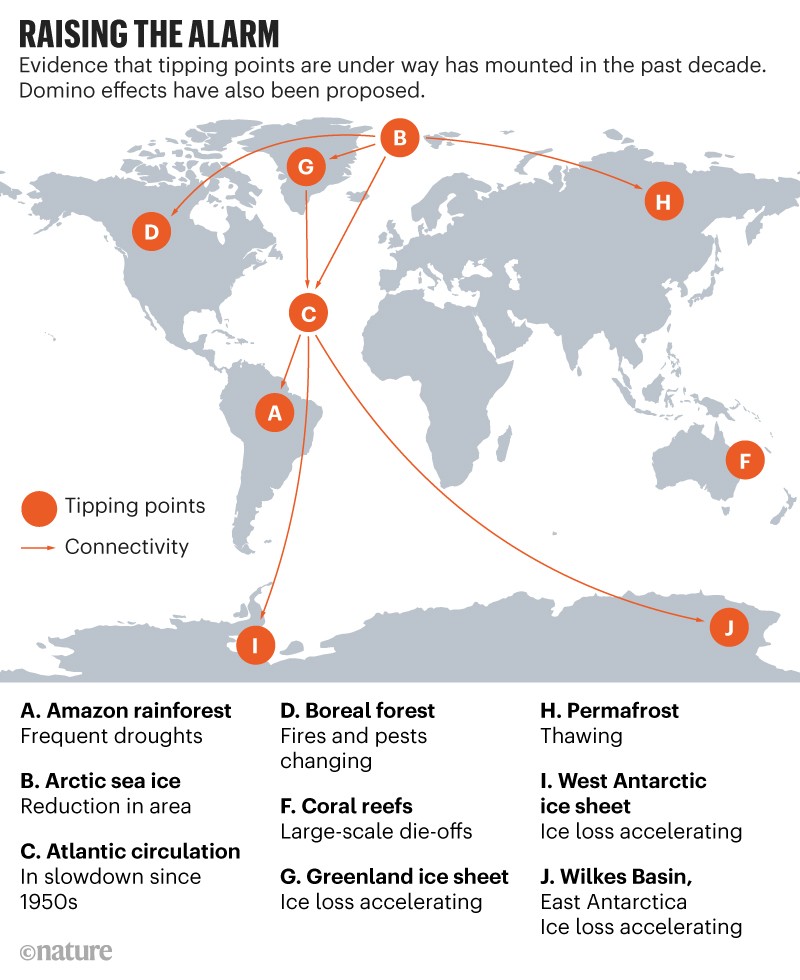


Source: T. M. Lenton et al.


Ocean heatwaves have led to mass coral bleaching and to the loss of half of the shallow-water corals on Australia’s Great Barrier Reef. A staggering 99% of tropical corals are projected2 to be lost if global average temperature rises by 2 °C, owing to interactions between warming, ocean acidification and pollution. This would represent a profound loss of marine biodiversity and human livelihoods.


As well as undermining our life-support system, biosphere tipping points can trigger abrupt carbon release back to the atmosphere. This can amplify climate change and reduce remaining emission budgets.


Deforestation and climate change are destabilizing the Amazon — the world’s largest rainforest, which is home to one in ten known species. Estimates of where an Amazon tipping point could lie range from 40% deforestation to just 20% forest-cover loss8. About 17% has been lost since 1970. The rate of deforestation varies with changes in policy. Finding the tipping point requires models that include deforestation and climate change as interacting drivers, and that incorporate fire and climate feedbacks as interacting tipping mechanisms across scales.


With the Arctic warming at least twice as quickly as the global average, the boreal forest in the subarctic is increasingly vulnerable. Already, warming has triggered large-scale insect disturbances and an increase in fires that have led to dieback of North American boreal forests, potentially turning some regions from a carbon sink to a carbon source9. Permafrost across the Arctic is beginning to irreversibly thaw and release carbon dioxide and methane — a greenhouse gas that is around 30 times more potent than CO2 over a 100-year period.


Researchers need to improve their understanding of these observed changes in major ecosystems, as well as where future tipping points might lie. Existing carbon stores and potential releases of CO2 and methane need better quantification.


The world’s remaining emissions budget for a 50:50 chance of staying within 1.5 °C of warming is only about 500 gigatonnes (Gt) of CO2. Permafrost emissions could take an estimated 20% (100 Gt CO2) off this budget10, and that’s without including methane from deep permafrost or undersea hydrates. If forests are close to tipping points, Amazon dieback could release another 90 Gt CO2 and boreal forests a further 110 Gt CO211. With global total CO2 emissions still at more than 40 Gt per year, the remaining budget could be all but erased already.



Bleached corals on a reef near the island of Moorea in French Polynesia in the South Pacific.Credit: Alexis Rosenfeld/Getty


Global cascade


In our view, the clearest emergency would be if we were approaching a global cascade of tipping points that led to a new, less habitable, ‘hothouse’ climate state11. Interactions could happen through ocean and atmospheric circulation or through feedbacks that increase greenhouse-gas levels and global temperature. Alternatively, strong cloud feedbacks could cause a global tipping point12,13.


We argue that cascading effects might be common. Research last year14 analysed 30 types of regime shift spanning physical climate and ecological systems, from collapse of the West Antarctic ice sheet to a switch from rainforest to savanna. This indicated that exceeding tipping points in one system can increase the risk of crossing them in others. Such links were found for 45% of possible interactions14.


In our view, examples are starting to be observed. For example, Arctic sea-ice loss is amplifying regional warming, and Arctic warming and Greenland melting are driving an influx of fresh water into the North Atlantic. This could have contributed to a 15% slowdown15 since the mid-twentieth century of the Atlantic Meridional Overturning Circulation (AMOC) , a key part of global heat and salt transport by the ocean3. Rapid melting of the Greenland ice sheet and further slowdown of the AMOC could destabilize the West African monsoon, triggering drought in Africa’s Sahel region. A slowdown in the AMOC could also dry the Amazon, disrupt the East Asian monsoon and cause heat to build up in the Southern Ocean, which could accelerate Antarctic ice loss.


The palaeo-record shows global tipping, such as the entry into ice-age cycles 2.6 million years ago and their switch in amplitude and frequency around one million years ago, which models are only just capable of simulating. Regional tipping occurred repeatedly within and at the end of the last ice age, between 80,000 and 10,000 years ago (the Dansgaard–Oeschger and Heinrich events). Although this is not directly applicable to the present interglacial period, it highlights that the Earth system has been unstable across multiple timescales before, under relatively weak forcing caused by changes in Earth’s orbit. Now we are strongly forcing the system, with atmospheric CO2 concentration and global temperature increasing at rates that are an order of magnitude higher than those during the most recent deglaciation.


Atmospheric CO2 is already at levels last seen around four million years ago, in the Pliocene epoch. It is rapidly heading towards levels last seen some 50 million years ago — in the Eocene — when temperatures were up to 14 °C higher than they were in pre-industrial times. It is challenging for climate models to simulate such past ‘hothouse’ Earth states. One possible explanation is that the models have been missing a key tipping point: a cloud-resolving model published this year suggests that the abrupt break-up of stratocumulus cloud above about 1,200 parts per million of CO2 could have resulted in roughly 8 °C of global warming12.


Some early results from the latest climate models — run for the IPCC’s sixth assessment report, due in 2021 — indicate a much larger climate sensitivity (defined as the temperature response to doubling of atmospheric CO2) than in previous models. Many more results are pending and further investigation is required, but to us, these preliminary results hint that a global tipping point is possible.


To address these issues, we need models that capture a richer suite of couplings and feedbacks in the Earth system, and we need more data — present and past — and better ways to use them. Improving the ability of models to capture known past abrupt climate changes and ‘hothouse’ climate states should increase confidence in their ability to forecast these.


Some scientists counter that the possibility of global tipping remains highly speculative. It is our position that, given its huge impact and irreversible nature, any serious risk assessment must consider the evidence, however limited our understanding might still be. To err on the side of danger is not a responsible option.


If damaging tipping cascades can occur and a global tipping point cannot be ruled out, then this is an existential threat to civilization. No amount of economic cost–benefit analysis is going to help us. We need to change our approach to the climate problem.


Act now


In our view, the evidence from tipping points alone suggests that we are in a state of planetary emergency: both the risk and urgency of the situation are acute (see ‘Emergency: do the maths’).


EMERGENCY: DO THE MATHS

We define emergency (E) as the product of risk and urgency. Risk (R) is defined by insurers as probability (p) multiplied by damage (D). Urgency (U) is defined in emergency situations as reaction time to an alert (τ) divided by the intervention time left to avoid a bad outcome (T). Thus:
E = R × U = p × D × τ / T
The situation is an emergency if both risk and urgency are high. If reaction time is longer than the intervention time left (τ / T > 1), we have lost control.

We argue that the intervention time left to prevent tipping could already have shrunk towards zero, whereas the reaction time to achieve net zero emissions is 30 years at best. Hence we might already have lost control of whether tipping happens. A saving grace is that the rate at which damage accumulates from tipping — and hence the risk posed — could still be under our control to some extent.


The stability and resilience of our planet is in peril. International action — not just words — must reflect this.


Posted by mw at 7:12 PM No comments:
Email ThisBlogThis!Share to XShare to FacebookShare to Pinterest
Labels: Lenton, Rahmstorf, Rockstrom, Schellnhuber, scientists, Steffen, tipping point

Thursday, January 31, 2019

Climate Links: January 2019

To Those Who Think We Can Reform Our Way Out of the Climate Crisis. Ben Ehrenreich. The Nation. Jan. 15, 2019.
Our only hope is to stop exploiting the earth—and its people.

Welcome to the future. It feels like it, doesn’t it? Like we have reached the end of something—of the days when the Arctic was not actually in flames, when the permafrost was not a sodden mush, when the Greenland and Antarctic ice sheets were not rushing to join the quickly rising seas. Perhaps we have also, finally, reached the end of the days when we could soothe ourselves with lies, or delusions at least; when we imagined that we were the only masters here, that we could keep taking what we wanted, and that no one would ever have to pay. 
We are paying now. Twenty eighteen was the year that temperatures scraped 90 degrees in the Norwegian Arctic; that permafrost in northern Siberia failed to freeze at all; that wildfires burned on the taiga there, as well as above the Arctic Circle in Alaska and Sweden, in the moors of northern England, in Greece, and in California, where they showed no sense of poetic restraint whatsoever and reduced a place called Paradise to ash.

And where there wasn’t fire, there were floods: Hundreds died and millions were evacuated from rising waters in Japan, southern China, and the Indian state of Kerala. Venice flooded too, and Paris, where the Louvre had to close its Department of Islamic Arts, which it had consigned, ahem, to a basement. It was also the year the United Nations’ climate change body warned that, to avoid full-on cataclysm, we, the humans of planet Earth, would have just 12 years (11 now) to cut carbon emissions by 45 percent, and 32 years (31 and counting) to eliminate such emissions altogether. 
Still, the weather may be the least of our problems. The fire that razed Paradise displaced 52,000 people overnight, forcing many into the ranks of California’s swelling homeless population and what passes for a safety net these days: free berths on the asphalt in a Walmart parking lot. Millions more of us will become refugees when a mega-storm drowns Miami or Manila, and when the Bay of Bengal rises high enough to swallow Bangladesh. Narendra Modi’s India is ready, and has nearly finished stretching barbed wire across the entire 2,500-mile border with Bangladesh. By conservative estimates, climate change will displace a quarter of a billion people over the next 31 years. Most will not be wealthy, and most will not be white.

We do know, at least, how we got here. It was all that oil and coal that we burned, that we’re still burning. But that “we” is misleading. It isn’t all of us, and never was. As the Swedish scholar Andreas Malm recounts in Fossil Capital, his exhaustive account of the rise of the coal-powered steam engine, coal was initially embraced by a tiny subclass of wealthy Englishmen, the ones who owned the mills. They came to favor steam over hydropower in large part because it allowed them to erect factories in cities and towns—rather than submitting to the dictates of distant rivers and streams—giving them access to what we would now call a flexible workforce: masses of hungry urbanites accustomed to the indignities of factory labor, willing to toil for less, easily replaceable if they refused. 
[…] 
From its inception, then, the carbon economy has been tied to the basic capitalist mandate to disempower workers, to squeeze the most sweat out of people for the least amount of money. For the last 200-odd years, the exploitation of the planet has been inseparable from the exploitation of living human beings....

Trudeau's environmental record on the line in Canada election year. Leyland Cecco, Guardian. Jan. 2, 2019.
October’s parliamentary elections may hinge on the recent pipeline nationalisation and the government’s carbon tax plan

The Democrats Are Climate Deniers. Branko Marcetic, Jacobin. Jan. 28, 2019.
If the Democrats really believed the science on climate change, they'd be offering far more radical proposals. We have to make them.

Preliminary US Emissions Estimates for 2018. Rhodium Group. Jan. 8, 2019.
After three years of decline, US carbon dioxide (CO2) emissions rose sharply last year. Based on preliminary power generation, natural gas, and oil consumption data, we estimate emissions increased by 3.4% in 2018. This marks the second largest annual gain in more than two decades — surpassed only by 2010 when the economy bounced back from the Great Recession. While a record number of coal-fired power plants were retired last year, natural gas not only beat out renewables to replace most of this lost generation but also fed most of the growth in electricity demand. As a result, power sector emissions overall rose by 1.9%. The transportation sector held its title as the largest source of US emissions for the third year running, as robust growth in demand for diesel and jet fuel offset a modest decline in gasoline consumption. The buildings and industrial sectors also both posted big year-on-year emissions gains. Some of this was due to unusually cold weather at the start of the year. But it also highlights the limited progress made in developing decarbonization strategies for these sectors. The US was already off track in meeting its Paris Agreement targets. The gap is even wider headed into 2019.

Air travel is surging. That’s a huge problem for the climate. Umair Irfan. Vox. Jan. 13, 2019.
US airlines have an abysmal carbon footprint.

Warming Of Oceans Equivalent To An Atomic Bomb Per Second For 150 Years. Damian Carrington, Guardian. Jan. 7, 2019.
Global warming has heated the oceans by the equivalent of one atomic bomb explosion per second for the past 150 years, according to analysis of new research. 
More than 90% of the heat trapped by humanity’s greenhouse gas emissions has been absorbed by the seas, with just a few per cent heating the air, land and ice caps respectively. The vast amount of energy being added to the oceans drives sea-level rise and enables hurricanes and typhoons to become more intense. Much of the heat has been stored in the ocean depths but measurements here only began in recent decades and existing estimates of the total heat the oceans have absorbed stretch back only to about 1950. The new work extends that back to 1871. Scientists have said that understanding past changes in ocean heat was critical for predicting the future impact of climate change.

A Guardian calculation found the average heating across that 150-year period was equivalent to about 1.5 Hiroshima-size atomic bombs per second. But the heating has accelerated over that time as carbon emissions have risen, and was now the equivalent of between three and six atomic bombs per second. “I try not to make this type of calculation, simply because I find it worrisome,” said Prof Laure Zanna, at the University of Oxford, who led the new research. “We usually try to compare the heating to [human] energy use, to make it less scary.” She added: “But obviously, we are putting a lot of excess energy into the climate system and a lot of that ends up in the ocean,. There is no doubt.” The total heat taken up by the oceans over the past 150 years was about 1,000 times the annual energy use of the entire global population.

Accelerating changes in ice mass within Greenland, and the ice sheet’s sensitivity to atmospheric forcing. Michael Bevis et al, PNAS. Jan. 22, 2019.


Permafrost Is Warming Around the Globe, Study Shows. That's a Problem for Climate Change. Bob Berwyn, InsideClimateNews. Jan. 16, 2019.
Rapid changes in the long-frozen soil are raising concerns about a surge of planet-warming greenhouse gases as the permafrost thaws.

Climate Forecast: World Is “Sleepwalking into Catastrophe”. Anne C. Mulkern, E&E News, Scientific American. Jan. 17, 2019.
In an annual World Economic Forum report, climate change, extreme weather and biodiversity loss were named among the highest global risks

If you can't deny it, downplay it. How capitalists talk about climate change. Rob Larson and Nathan J. Robinson, Current Affairs. Jan. 13, 2019.


We Need to Accept We're Likely Underestimating the Climate Crisis. Jack Holmes, Esquire. Jan. 22, 2019.
Three new reports in the last month suggest we are.


Are We Living Through Climate Change’s Worst-Case Scenario? Robinson Meyer, The Atlantic. Jan. 15, 2019.
“We’re a lot closer than we should be,” one Stanford scientist warned.
When climate scientists want to tell a story about the future of the planet, they use a set of four standard scenarios called “representative concentration pathways,” or RCPs. RCPs are ubiquitous in climate science, appearing in virtually any study that uses climate models to investigate the 21st century. They’ve popped up in research about subjects as disparate as southwestern mega-droughts, future immigration flows to Europe, and poor nighttime sleep quality. 
Each RCP is assigned a number that describes how the climate will fare in the year 2100. Generally, a higher RCP number describes a scarier fate: It means that humanity emitted more carbon dioxide into the atmosphere during the 21st century, further warming the planet and acidifying the ocean. The best-case scenario is called RCP 2.6. The worst case is RCP 8.5.

“God help us if 8.5 turns out to be the right scenario,” Jackson told me. Under RCP 8.5, the world’s average temperature would rise by 4.9 degrees Celsius, or nearly 9 degrees Fahrenheit. “That’s an inconceivable increase for global temperatures—especially when we think about them being global average temperatures,” he said. “Temperatures will be even higher in the northern latitudes, and higher over land than over the ocean.” 
This scenario could still be in the planet’s future, according to Zeke Hausfather, an analyst and climate scientist at Berkeley Earth. Since 2005, total global greenhouse-gas emissions have most closely tracked the RCP 8.5 scenario, he says. “There may be good reasons to be skeptical of RCP 8.5’s late-century values, but observations to-date don’t really give us grounds to exclude it,” he recently wrote. 
Even if we avoid RCP 8.5, the less dramatic possibilities still could lead to catastrophic warming. Jackson, the Stanford professor, warned that every emissions scenario that meets the Paris Agreement’s 2-degree Celsius “goal” assumes that humanity will soon develop technology to remove carbon directly from the atmosphere. Such technology has never existed at industrial scales.

“Even some [of the scenarios] for 3 degrees Celsius assume that at some point in the next 50 years, we will have large-scale industrial activities to remove greenhouse gases from the atmosphere,” he said. “It’s a very dangerous game, I think. We’re assuming that this thing we can’t do today will somehow be possible and cheaper in the future. I believe in tech, but I don’t believe in magic.”

Climate change tipping point could be coming sooner than we think. Holly Evarts, Columbia Engineering. Jan. 23, 2019.
Global carbon emissions reached a record high in 2018, rising by an estimated 3.4 percent in the U.S. alone. This trend is making scientists, government officials, and industry leaders more anxious than ever about the future of our planet. As United Nations Secretary General António Guterres said at the opening of the 24th annual U.N. climate conference on 3 December 2018, “We are in deep trouble with climate change.” 
A Columbia Engineering study, published today in Nature, confirms the urgency to tackle climate change. While it’s known that extreme weather events can affect the year-to-year variability in carbon uptake, and some researchers have suggested that there may be longer-term effects, this new study is the first to actually quantify the effects through the 21st century and demonstrates that wetter-than-normal years do not compensate for losses in carbon uptake during dryer-than-normal years, caused by events such as droughts or heatwaves. 
Anthropogenic emissions of CO2—emissions caused by human activities—are increasing the concentration of CO2 in the Earth’s atmosphere and producing unnatural changes to the planet’s climate system. The effects of these emissions on global warming are only being partially abated by the land and ocean. Currently, the ocean and terrestrial biosphere (forests, savannas, etc.) are absorbing about 50% of these releases—explaining the bleaching of coral reefs and acidification of the ocean, as well as the increase of carbon storage in our forests. 
“It is unclear, however, whether the land can continue to uptake anthropogenic emissions at the current rates,” says Pierre Gentine, associate professor of earth and environmental engineering and affiliated with the Earth Institute, who led the study. “Should the land reach a maximum carbon uptake rate, global warming could accelerate, with important consequences for people and the environment. This means that we all really need to act now to avoid greater consequences of climate change.”


What can you do to prepare when you can't? Albert Bates. Jan. 20, 2019.


Capricious foes, Big Sister & high-carbon plutocrats: irreverent musings from Katowice’s COP24. Kevin Anderson. Jan. 10, 2019.
1) An Orwellian tale: myths & hidden enemies 
A quick glance at COP24 suggests three steps forward and two steps back. But whilst to the naïve optimist this may sound like progress, in reality it’s yet another retrograde bound towards a climate abyss. As government negotiators play poker with the beauty of three billion years of evolution, climate change emissions march on. This year with a stride 2.7% longer than last year – which itself was 1.6% longer than the year before. Whilst the reality is that every COP marks another step backwards, the hype of these extravaganzas gives the impression that we’re forging a pathway towards a decarbonised future. 
For me the fantasy-land of COP24 was epitomised at the UK’s ever-busy Green is Great stand. Here, the nation that kick-started the fossil-fuel era, regaled passers-by with a heart-warming tale of rapidly falling emissions and a growing green economy. This cheerful narrative chimed with those desperate to believe these annual junkets are forging a decarbonised promise-land...
[which reminds me of those f'g TV commercials our federal govt has spent our tax dollars on producing to propagandize us into believing that the Kinder Morgan pipeline makes Canada somehow greener]


The new elite’s phoney crusade to save the world – without changing anything. Anand Giridharadas, Guardian. Jan. 22, 2019.
Today’s titans of tech and finance want to solve the world’s problems, as long as the solutions never, ever threaten their own wealth and power. 

UK has biggest fossil fuel subsidies in the EU, finds commission. Damian Carrington, Guardian. Jan. 23, 2019.
Subsidies for coal, oil and gas are not falling despite EU pledges to tackle climate change

IEA Chief: EVs Are Not The End Of The Oil Era. Tsvetana Paraskova, OilPrice.com. Jan 22, 2019.
Electric vehicles (EVs) today are not the end of global oil demand growth, nor are they the key solution to reducing carbon emissions, Fatih Birol, the Executive Director of the International Energy Agency (IEA), said during the ‘Strategic Outlook on Energy’ panel at the World Economic Forum in Davos on Tuesday. 
According to Birol, analysts need to put things into perspective and consider that five million EVs globally is nothing compared to 1 billion internal combustion engine (ICE) cars. 
“This year we expect global oil demand to increase by 1.3 million barrels per day. The effect of 5 million cars is 50,000 barrels per day. 50,000 versus 1.3 million.” 
“Cars are not the driver of oil demand growth. Full stop,” Birol said. 


Drilling Towards Disaster: Why U.S. Oil and Gas Expansion Is Incompatible with Climate Limits. Kelly Trout, Price of Oil. January 16, 2019.

A new study released by Oil Change International and 17 partner organizations examines the urgent need for U.S. leadership to manage a rapid and just decline of fossil fuel production. 
The United States should be a global leader in winding down fossil fuel use and production. Instead, the U.S. oil and gas industry is gearing up to unleash the largest burst of new carbon emissions in the world between now and 2050. At precisely the time in which the world must begin rapidly decarbonizing to avoid runaway climate disaster, the United States is moving further and faster than any other country to expand oil and gas extraction. 
Key findings include: 
Unprecedented Oil & Gas Expansion: Between 2018 and 2050, U.S. drilling into new oil and gas reserves could unlock 120 billion metric tons of new carbon pollution, which is equivalent to the lifetime CO2 emissions of nearly 1,000 coal-fired power plants. If not curtailed, U.S. oil and gas expansion will impede the rest of the world’s ability to manage a climate-safe, equitable decline of oil and gas production. 
Expansion Hot Spots: Some 90% of U.S. drilling into new oil and gas reserves through 2050 would depend on fracking; nearly 60% of the carbon emissions enabled by new U.S. drilling would come from the epicenters of fracking – the Permian Basin of Texas and New Mexico and the Appalachian Basin across Pennsylvania, West Virginia, and Ohio. 
Coal – Too Much Already: Given U.S. coal mining should be phased out by 2030 or sooner if the world is to equitably achieve the Paris Agreement goals, at least 70% of the coal in existing U.S. mines should stay in the ground. 
These findings show that leadership is urgently needed towards a U.S. fossil fuel phase-out that aligns with climate limits, takes care of workers and communities on its front lines, and builds a more healthy and just economy for all in the process. 
Key recommendations for what U.S. policymakers must do to show real climate leadership:
  1. Ban new leases or permits for new fossil fuel exploration, production, and infrastructure;
  2. Plan for the phase-out of existing fossil fuel projects in a way that prioritizes environmental justice;
  3. End subsidies and other public finance for the fossil fuel industry;
  4. Champion a Green New Deal that ensures a just transition to 100 percent renewable energy; and
  5. Reject the influence of fossil fuel money over U.S. energy policy.


Eight charts show how ‘aggressive’ railway expansion could cut emissions. Jocelyn Timperley, CarbonBrief. Jan. 30, 2019.
Global transport emissions could peak in the 2030s if railways are “aggressively” expanded, says the International Energy Agency (IEA). 
Rail is among the most efficient and lowest emitting modes of transport, according to the IEA’s new report focusing on the opportunities it offers for energy and the environment. 
In particular, urban and high-speed rail hold “major promise to unlock substantial benefits”, the report says, which include reducing greenhouse gas emissions, congestion and air pollution.

OPINION: SOONER OR LATER, WE HAVE TO STOP ECONOMIC GROWTH — AND WE’LL BE BETTER FOR IT. Richard Heinberg Ensia. Jan. 8, 2019.
The end of growth will come one day, perhaps very soon, whether we’re ready or not. If we plan for and manage it, we could well wind up with greater well-being.

The Green New Deal: How We Will Pay For It Isn't 'A Thing' - And Inflation Isn't Either. Robert Hockett, Forbes. Jan. 16, 2019.


8 percent of Americans recently changed their minds on climate. What gives? Kate Yoder, Grist. Jan. 16, 2019.

what the headline doesn't tell you: of those that have changed their minds on climate change in the last year, they haven't ALL become more concerned... about 85% of mind-changers are more concerned, but 15% have actually said they are LESS concerned


Shift the focus from the super-poor to the super-rich. Ilona M. Otto et al, Nature Climate Change. Jan. 28, 2019.
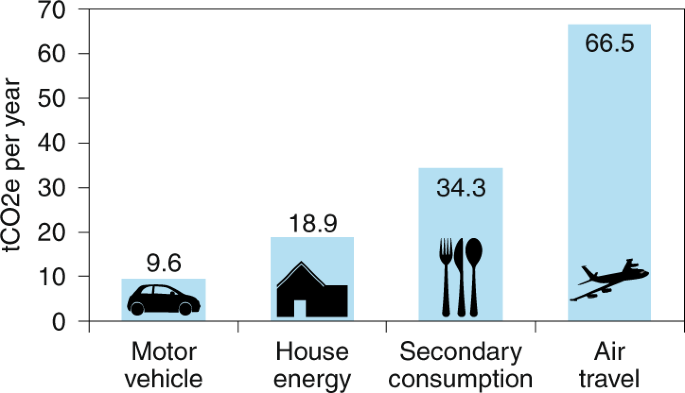
Fig. 1: The estimated carbon footprint of a typical super-rich household of two people.


We need to rethink everything we know about global warming. Jan. 20, 2019.

Israeli researcher claims his calculations show scientists have grossly underestimated the effects of air pollution.
The world’s scientific community has known for a long time that global warming is caused by man-made emissions in the form of greenhouse gases, while global cooling is caused by air pollution in the form of aerosols. 
In a new study published in the journal Science, Hebrew University of Jerusalem Prof. Daniel Rosenfeld argues that the degree to which aerosol particles cool the earth has been grossly underestimated. 
Aerosols are tiny particles of many different materials that get into the air, like dust and vehicle exhaust. They cool our environment by enhancing the cloud cover that reflects the sun’s heat back to space.  
Rosenfeld says his findings necessitate a recalculation of climate-change models to more accurately predict the pace of global warming. 
He and his colleague Yannian Zhu from the Meteorological Institute of Shaanxi Province in China developed a new method that uses satellite images to calculate the effect of vertical winds as well as aerosol cloud droplet numbers. Until now, it was impossible to separate the effects of rising winds, which create the clouds, from the effects of aerosols, which determine clouds’ composition. 
Using this new methodology, Rosenfeld and his colleagues were able to more accurately calculate aerosols’ cooling effects on the Earth. They discovered this effect is nearly two times higher than previously thought. 
But this finding does not necessarily mean we can stop worrying about global warming. Rosenfeld has several theories about why temperatures are rising despite the aerosol effect. 
“If the aerosols indeed cause a greater cooling effect than previously estimated, then the warming effect of the greenhouse gases has also been larger than we thought, enabling greenhouse-gas emissions to overcome the cooling effect of aerosols,” Rosenfeld said.

Aerosol-driven droplet concentrations dominate coverage and water of oceanic low level clouds. Daniel Rosenfeld, Science. Jan. 17, 2019.


Adelaide breaks its all-time heat record, hitting 46.6C, in extreme Australia heatwave. Guardian. Jan. 24, 2019.

huge animal culls, including thousands of camels dying of thirst that had to be shot to put them out of their misery
Posted by mw at 11:58 PM No comments:
Email ThisBlogThis!Share to XShare to FacebookShare to Pinterest
Labels: Heinberg, Kevin Anderson, links, tipping point, Trudeau

Sunday, December 2, 2018

Feature Reference Articles #15

End of days: Is Western civilisation on the brink of collapse? Laura Spinney, New Scientist. Jan. 17, 2018.
The sandwich boards have mostly gone and the world is still here, but the gloomy predictions keep coming, and not all of them are based on creative interpretations of religious texts. Scientists, historians and politicians alike have begun to warn that Western culture is reaching a critical juncture. Cycles of inequality and resource use are heading for a tipping point that in many past civilisations precipitated political unrest, war and finally collapse. 
For the most part, though, people are carrying on as usual, shopping for their next holiday or posing on social media. In fact, many people seem blissfully unaware that collapse might be imminent. Are Westerners doing the modern equivalent of sitting around eating grapes while the barbarians hammer on the doors? And more importantly, does science have any ideas about what is really going on, what might happen next and how people could turn things around? 
... 
So is there any evidence that the West is reaching its end game? According to Peter Turchin, an evolutionary anthropologist at the University of Connecticut [and the author of Secular Cycles, as well as Historical Dynamics: Why States Rise and Fall], there are certainly some worrying signs 
... 
This doesn’t bode well for Western societies, which are dangerously unequal. According to a recent analysis, the world’s richest 1 per cent now owns half the wealth, and the gap between the super-rich and everyone else has been growing since the financial crisis of 2008. 
The West might already be living on borrowed time. Motesharrei’s group has shown that by rapidly using non-renewable resources such as fossil fuels, a society can grow by an order of magnitude beyond what would have been supported by renewables alone, and so is able to postpone its collapse. “But when the collapse happens,” they concluded, “it is much deeper.” 
... 
Joseph Tainter, an anthropologist at Utah State University, and author of The Collapse of Complex Societies, offers a similarly bleak outlook. He sees the worst-case scenario as a rupture in fossil fuel availability, causing food and water supplies to fail and millions to die within a few weeks. 
... 
The problem with these kinds of solutions, however, is that humans haven’t proved themselves to be great at playing the long game. New psychology research may help to explain why that is the case. 
Cognitive scientists recognise two broad modes of thought – a fast, automatic, relatively inflexible mode, and a slower, more analytical, flexible one. Each has its uses, depending on the context, and their relative frequency in a population has long been assumed to be stable. David Rand, a psychologist at Yale University, though, argues that populations might actually cycle between the two over time. 
... 
But Tainter says trying to instill more forethought might be a pipe dream. If behavioural economics has taught us anything, he says, it is that human beings are much more emotional than rational when it comes to decision-making. He thinks a more pressing issue to tackle is the dwindling rate of invention relative to investment in R & D, as the world’s problems become harder to solve. “I foresee a pattern in the future where technological innovation is not going to be able to bail us out as it has in the past,” he says. 
So, is the West really on the ropes? Perhaps. But ultimately its survival will depend on the speed at which people can adapt. If we don’t reduce our dependency on fossil fuels, tackle inequality and find a way to stop elites from squabbling among themselves, things will not end well. In Tainter’s view, if the West makes it through, it will be more by luck than by good judgement.


What’s the point of growth if it creates so much misery? Lynsey Hanley, Guardian. Oct. 15, 2018.
The late Prof Mick Moran, who taught politics and government at Manchester University for most of his professional life, had, according to his colleagues, once had “a certain residual respect for our governing elites”. That all changed during the 2008 financial crisis, after which he experienced an epiphany “because it convinced him that the officer class in business and in politics did not know what it was doing”. 
After his epiphany, Moran formed a collective of academics dedicated to exposing the complacency of finance-worship and to replacing it with an idea of running modern economies focused on maximising social good.


Scientists uncover evidence of impending tipping point for Earth. Robert Sanders, Berkley News. June 6, 2012.
A prestigious group of scientists from around the world is warning that population growth, widespread destruction of natural ecosystems, and climate change may be driving Earth toward an irreversible change in the biosphere, a planet-wide tipping point that would have destructive consequences absent adequate preparation and mitigation.

“It really will be a new world, biologically, at that point,” warns Anthony Barnosky, professor of integrative biology at the University of California, Berkeley, and lead author of a review paper appearing in the June 7 issue of the journal Nature. “The data suggests that there will be a reduction in biodiversity and severe impacts on much of what we depend on to sustain our quality of life, including, for example, fisheries, agriculture, forest products and clean water. This could happen within just a few generations.” 
The Nature paper, in which the scientists compare the biological impact of past incidences of global change with processes under way today and assess evidence for what the future holds, appears in an issue devoted to the environment in advance of the June 20-22 United Nations Rio+20 Earth Summit in Rio de Janeiro, Brazil. 
The result of such a major shift in the biosphere would be mixed, Barnosky noted, with some plant and animal species disappearing, new mixes of remaining species, and major disruptions in terms of which agricultural crops can grow where.

The paper by 22 internationally known scientists describes an urgent need for better predictive models that are based on a detailed understanding of how the biosphere reacted in the distant past to rapidly changing conditions, including climate and human population growth. In a related development, groundbreaking research to develop the reliable, detailed biological forecasts the paper is calling for is now underway at UC Berkeley. The endeavor, The Berkeley Initiative in Global Change Biology, or BiGCB, is a massive undertaking involving more than 100 UC Berkeley scientists from an extraordinary range of disciplines that already has received funding: a $2.5 million grant from the Gordon and Betty Moore Foundation and a $1.5 million grant from the Keck Foundation. The paper by Barnosky and others emerged from the first conference convened under the BiGCB’s auspices. 
“One key goal of the BiGCB is to understand how plants and animals responded to major shifts in the atmosphere, oceans, and climate in the past, so that scientists can improve their forecasts and policy makers can take the steps necessary to either mitigate or adapt to changes that may be inevitable,” Barnosky said. “Better predictive models will lead to better decisions in terms of protecting the natural resources future generations will rely on for quality of life and prosperity.” Climate change could also lead to global political instability, according to a U.S. Department of Defense study referred to in the Nature paper.
... 
How close is a global tipping point? 
The authors of the Nature review – biologists, ecologists, complex-systems theoreticians, geologists and paleontologists from the United States, Canada, South America and Europe – argue that, although many warning signs are emerging, no one knows how close Earth is to a global tipping point, or if it is inevitable. The scientists urge focused research to identify early warning signs of a global transition and an acceleration of efforts to address the root causes.

“We really do have to be thinking about these global scale tipping points, because even the parts of Earth we are not messing with directly could be prone to some very major changes,” Barnosky said. “And the root cause, ultimately, is human population growth and how many resources each one of us uses.” 
Co-author Elizabeth Hadly from Stanford University said “we may already be past these tipping points in particular regions of the world. I just returned from a trip to the high Himalayas in Nepal, where I witnessed families fighting each other with machetes for wood – wood that they would burn to cook their food in one evening. In places where governments are lacking basic infrastructure, people fend for themselves, and biodiversity suffers. We desperately need global leadership for planet Earth.” 
The authors note that studies of small-scale ecosystems show that once 50-90 percent of an area has been altered, the entire ecosystem tips irreversibly into a state far different from the original, in terms of the mix of plant and animal species and their interactions. 
This situation typically is accompanied by species extinctions and a loss of biodiversity. 
Currently, to support a population of 7 billion people, about 43 percent of Earth’s land surface has been converted to agricultural or urban use, with roads cutting through much of the remainder. The population is expected to rise to 9 billion by 2045; at that rate, current trends suggest that half Earth’s land surface will be disturbed by 2025. To Barnosky, this is disturbingly close to a global tipping point. 
“Can it really happen? Looking into the past tells us unequivocally that, yes, it can really happen. It has happened. The last glacial/interglacial transition 11,700 years ago was an example of that,” he said, noting that animal diversity still has not recovered from extinctions during that time. “I think that if we want to avoid the most unpleasant surprises, we want to stay away from that 50 percent mark.” 
Global change biology 
The paper emerged from a conference held at UC Berkeley in 2010 to discuss the idea of a global tipping point, and how to recognize and avoid it. 
Following that meeting, 22 of the attendees summarized available evidence of past global state-shifts, the current state of threats to the global environment, and what happened after past tipping points. 
They concluded that there is an urgent need for global cooperation to reduce world population growth and per-capita resource use, replace fossil fuels with sustainable sources, develop more efficient food production and distribution without taking over more land, and better manage the land and ocean areas not already dominated by humans as reservoirs of biodiversity and ecosystem services. 
“Ideally, we want to be able to predict what could be detrimental biological change in time to steer the boat to where we don’t get to those points,” Barnosky said. “My underlying philosophy is that we want to keep Earth, our life support system, at least as healthy as it is today, in terms of supporting humanity, and forecast when we are going in directions that would reduce our quality of life so that we can avoid that.” 
“My view is that humanity is at a crossroads now, where we have to make an active choice,” Barnosky said. “One choice is to acknowledge these issues and potential consequences and try to guide the future (in a way we want to). The other choice is just to throw up our hands and say, ‘Let’s just go on as usual and see what happens.’ 
Posted by mw at 8:09 PM No comments:
Email ThisBlogThis!Share to XShare to FacebookShare to Pinterest
Labels: Barnosky, collapse, Tainter, tipping point, Turchin
Older Posts Home
View mobile version
Subscribe to: Posts (Atom)

My Other Blog

  • Skeptical Investment

Resources

  • State of Our Climate
  • World Climate Research Program
  • World Bank Climate Change Knowledge Portal
  • Climate Reanalyzer
  • Earth Nullschool
  • National Academy of Sciences – Science Museum: Earthlab
  • Global Carbon Atlas
  • Global Carbon Project
  • The Climate Web
  • Discovery of Global Warming: AIP
  • Guy's Monster Climate Change essay
  • Energy & Our Future
  • Bloomberg Carbon Clock
  • Trillionth Tonne
  • Influence Map
  • Smoke and Fumes
  • Planetary Limits Academic Network

Climate Change Blogs

  • Robbie Andrew, CICERO
  • Jem Bendell
  • Robert Scribbler
  • Arctic News
  • Cassandra's Legacy
  • Climate Change: Next Generation
  • Climate Denial Crocks
  • Nature Bats Last
  • Paul Beckwith
  • Real Climate
  • Climate Code Red
  • Skeptical Science
  • Climate Etc.
  • Darrin Qualman
  • DeSmog Blog
  • Do The Math
  • Dredd Blog
  • Ethics and Climate
  • G-Feed
  • The Keeling Curve
  • Our Finite World

Climate Change News

  • The Ecologist
  • Climate Progress
  • The Guardian - Keep it in the Ground
  • Scientific American - Climate
  • Inside Climate News
  • Corporate Knights
  • Truthout

Climate Change Science Groups

  • Earth's Future
  • CICERO
  • NASA Climate
  • NASA GISS
  • NOAA ESRL
  • NOAA NCEI
  • UNFCCC
  • Berkeley Earth
  • UCS
  • AMEG
  • Arctic Monitoring
  • Future of Life
  • NSIDC

Climate - Other Links

  • Carbon Dioxide Information Analysis Center
  • Climate Ontario
  • Climate Central
  • Climate Analytics
  • Climate Feedback
  • Climate Reality Project
  • Climate Change Policy & Practice
  • Climate Nexus
  • Climate Emergency Institute
  • 350
  • Preventable Surprises
  • Paleovegetation

Carbon Pricing and Clean Energy Links

  • Clean Energy Canada
  • Carbon Pricing Leadership

Geoengineering

  • Geoengineering Monitor
  • Biofuelwatch UK
  • IAGP
  • Carbon Brief

Investor Links

  • CDP
  • Client Earth
  • Investor Platform for Climate Actions
  • positive+investment
  • Science Based Targets
  • SHARE
  • As You Sow

Systems / Polymaths? Links

  • Nate Hagens
  • Rob Mielcarski
  • George Mobus
  • ReThinking Everything
  • Jean-Marc Jancovici
  • Jack Alpert
  • Tim Garrett
  • Tim Morgan
  • Tim Watkins
  • Tad Patzek
  • Tom Murphy
  • James @MegaCancer
  • Richard Nolthenius
  • Jem Bendell
  • Mike Stasse
  • Paul Chefurka
  • Al Bartlett
  • Peter Watts
  • Geoffrey Chia

Other Links

  • Palaeos
  • Population Speakout
  • Edward Burtynsky
  • Transform Defence

Solutions

  • Mercy for Animals

Blog Archive

  • ▼  2026 (13)
    • ▼  August (2)
      • Collapse 2040
      • Radagast: Agricultural Collapse
    • ►  July (2)
    • ►  June (2)
    • ►  May (1)
    • ►  April (3)
    • ►  February (1)
    • ►  January (2)
  • ►  2025 (10)
    • ►  December (1)
    • ►  November (1)
    • ►  October (1)
    • ►  September (1)
    • ►  May (1)
    • ►  April (1)
    • ►  February (4)
  • ►  2024 (22)
    • ►  October (4)
    • ►  September (5)
    • ►  July (1)
    • ►  June (4)
    • ►  May (1)
    • ►  March (2)
    • ►  February (3)
    • ►  January (2)
  • ►  2023 (22)
    • ►  December (3)
    • ►  November (4)
    • ►  September (1)
    • ►  August (3)
    • ►  June (2)
    • ►  May (2)
    • ►  April (2)
    • ►  March (1)
    • ►  February (3)
    • ►  January (1)
  • ►  2022 (13)
    • ►  December (2)
    • ►  October (1)
    • ►  September (4)
    • ►  May (1)
    • ►  April (2)
    • ►  February (1)
    • ►  January (2)
  • ►  2021 (51)
    • ►  December (4)
    • ►  November (4)
    • ►  October (3)
    • ►  September (6)
    • ►  August (4)
    • ►  July (5)
    • ►  May (3)
    • ►  April (5)
    • ►  March (3)
    • ►  February (6)
    • ►  January (8)
  • ►  2020 (69)
    • ►  December (4)
    • ►  November (1)
    • ►  October (1)
    • ►  September (5)
    • ►  August (3)
    • ►  July (7)
    • ►  June (11)
    • ►  May (2)
    • ►  April (7)
    • ►  March (2)
    • ►  February (5)
    • ►  January (21)
  • ►  2019 (174)
    • ►  December (17)
    • ►  November (25)
    • ►  October (19)
    • ►  September (15)
    • ►  August (19)
    • ►  July (8)
    • ►  June (14)
    • ►  May (11)
    • ►  April (13)
    • ►  March (9)
    • ►  February (12)
    • ►  January (12)
  • ►  2018 (86)
    • ►  December (10)
    • ►  November (8)
    • ►  October (11)
    • ►  September (6)
    • ►  August (18)
    • ►  July (10)
    • ►  June (5)
    • ►  May (5)
    • ►  April (5)
    • ►  March (4)
    • ►  February (1)
    • ►  January (3)
  • ►  2017 (90)
    • ►  December (3)
    • ►  November (6)
    • ►  October (4)
    • ►  September (7)
    • ►  August (28)
    • ►  July (4)
    • ►  June (10)
    • ►  May (11)
    • ►  April (13)
    • ►  March (2)
    • ►  February (2)
  • ►  2016 (54)
    • ►  November (1)
    • ►  October (3)
    • ►  September (2)
    • ►  August (6)
    • ►  July (1)
    • ►  June (3)
    • ►  May (8)
    • ►  April (30)

Search This Blog

Pages

  • Home
  • Climate Change Charts

Twitter Links

  • ALEX Steffen
  • Andrew Dessler
  • BEN See
  • Bill McKibben
  • CHRIS Cartwright
  • Climate Council
  • DAVID Windt
  • Doctor Vive
  • EcoWarriors
  • Elizabeth Swain
  • Gernot Wagner
  • Glen Peters
  • Jim Baird
  • Johan Rockstrom
  • Kate Aronoff
  • Ken Caldeira
  • Ketan Joshi
  • KEVIN Anderson
  • Margaret Klein Salamon
  • MARK Cranfield
  • Naomi Klein
  • Paul Beckwith
  • Paul Dawson
  • PAUL Maidowski
  • Peter Kalmus
  • Rob Mielcarski
  • Stefan Rahmstorf
  • Tim Garrett
  • Tim Osborn
  • Ugo Bardi
  • Wen Stephenson
  • We Don't Have Time

War and Empire Links

  • Kunstler
    KunstlerCast 451 — Alan Berman's Psychohistory Prediction Engine, Mapping the Matrix
  • PaulCraigRoberts.org
    Feminism and Family Collapse
  • Dissident Voice
    Tulsi Gabbard and Joe Kent
  • Moon of Alabama
    Media Say ... Gloom And Doom In China
  • Caitlin Johnstone
    CaitlinJohnstone.com Is Now At CaitlinJohnstone.com.au
  • The Vineyard of the Saker
    Alternative Copy of thesaker.is site is available
  • Dmitry Orlov | Patreon

Labels

2C (1) 4C (1) 5G (1) 9/11 (6) abrupt climate change (7) Ackerman (1) adaptation (1) aerosols (1) Afghanistan (2) agriculture (3) Ahmed (1) Alan Urban (1) albedo (1) Alberta (1) AMOC (2) Amory Lovins (1) anarchy (1) Andreas Malm (2) animals (3) Antarctica (2) anthropocene (2) antifa (1) apology (1) Arctic (6) Aronoff (1) Arthur Silber (2) Assange (4) Attenborough (1) Atwood (2) Aurelien (1) Australia (2) baby boomer (1) Bacevich (2) Bardi (5) Barnosky (1) Bates (9) Bayer (1) BECCS (7) Beckwith (1) beef (1) beer (1) bees (1) behavioural finance (1) behavioural investing (1) behavioural psychology (2) belt and road initiative (1) Bendell (2) Bernays (1) Bernie (4) bibliography (1) Biden (1) Bill McKibben (8) Bill Nye (1) biodiversity (1) biofuels (1) Bios (1) Bittman (2) Blair Fix (2) Blanchard (1) BLM (2) Bloomberg (1) blue ocean event (1) Blum (2) Bolivia (2) book notes (1) book review (11) Boston Marathon (1) BP (1) Bradshaw (1) Bush (1) Canada (12) Carana (1) carbon bubble (2) carbon budget (1) carbon cycle (1) carbon footprint (1) carbon pricing (1) carbon tax (1) CARE (1) Carey Wedler (4) Carney (1) Catton (1) CDR (2) cell phones (1) censorship (1) Chefurka (1) Chia (3) China (2) Chomsky (3) church (1) CJ Hopkins (2) clean energy (3) climate change depression (5) climate change economics (11) climate learning tree (1) climate mobilization (4) climate models (3) climate refugees (1) Clintons (1) Clive Hamilton (1) Club of Rome (1) CMIP6 (1) Cognitive dissonance (3) Cohen (2) collapse (29) concrete (1) consensus (1) conspiracy theory (2) Conway (1) COP (2) corporate scum (2) corporatocracy (2) Cory Morningstar (1) cost-benefit analysis (1) coup (2) COVID19 (11) Craig Murray (5) crisis actors (1) critical thinking (7) Crittenden (3) Curtin (6) Czech (1) DAC (2) Daniel Brooks (1) Daniel Gilbert (1) Dark Mountain (1) debate (1) decarbonization (2) decoupling (1) deep adaptation (1) deep state (2) degrowth (6) Democrats (1) denial (1) Devo (1) Diana Johnstone (1) DICE (1) Discordianism (1) discount rate (1) divestment (1) DNC (1) documentary (1) Donald Brown (2) doomberg (1) doomer (4) doomsday clock (1) doughnut economics (1) drawdown (1) Drumright (1) Dunlop (1) E. O. Wilson (2) eco-anxiety (1) ecobuddhism (1) ecology (1) ecomodernism (2) economy (1) ecosocialism (1) ECS (3) Eisenstein (1) election (1) Elizabeth May (1) EMFs (1) emissions gap (1) empire (34) energy (6) Eocene (1) EPA (1) Erik Michaels (1) ESAS (1) Escobar (3) essays (1) essential reading (6) ethics (2) Eugene Linden (2) Evil (1) evolutionary psychology (1) EVs (3) externalities (1) extinction (11) extractivism (1) factory farming (1) fake news (6) false flag (8) fertilizer (1) film reviews (1) FIPA (1) Flannery (1) flashback (5) Foer (1) food (5) fossil fuels (1) Franzen (3) Frumhoff (1) Fuentes (1) future (1) Gaia (1) Gail Tverberg (2) Galloway (1) Garrett (4) Geden (2) geoengineering (5) George Floyd (1) Gernot Wagner (1) Ghosh (2) Gideon Polya (1) gifs (1) Gilding (1) glaciers (1) Glen Barry (2) Glikson (5) global dimming (1) GMO (1) Gore (1) Grantham (1) green new deal (4) Greenland (1) Greenwald (4) Greer (4) Griffin (3) Hagens (3) Hawken (1) Hedges (6) Heinberg (5) Henshaw (1) Henson (1) Hickel (2) Himalayas (1) history (1) Hoexter (1) Holdren (1) Holmgren (2) Holocene (1) Holthaus (1) Homer-Dixon (1) hope (1) Hornborg (1) Hothouse Earth (2) Hugo Salinas Price (1) humor (1) Humphrey (3) Hunziker (2) Ian Angus (1) Ian Welsh (24) ice (1) IEA (1) ikonoclast (1) Ilargi (1) Impossible Hamster (1) insects (1) international agreements (1) investing (2) IPAT (1) IPCC (4) Iran (3) IRENA (1) J.D. Alt (1) Jack Alpert (1) Jacobson (2) Jamail (1) James Anderson (1) James Hansen (4) Jancovici (1) Jane Fonda (1) Jared Diamond (2) Jason Box (5) Jason Hickel (2) Jem Bendell (3) JFK (1) Jim Carrey (1) Jim Quinn (1) John Bellamy Foster (4) John Michael Greer (1) Johnstone (48) Kahneman (2) Kate Marvel (1) Katowice (1) Kavanaugh (1) Keen (1) Kelton (1) Ken Avidor (2) Kevin Anderson (7) Kingsnorth (1) Klein (4) Kolbert (1) Korea (1) Krieger (2) Kunstler (8) Lars Syll (1) Lee Camp (3) Lenton (2) liberalism (1) Libya (1) limits to growth (4) links (88) lithium (1) Liz Warren (1) Loeb (1) Lovelock (2) Lynas (1) Lynn Margulis (1) Macy (1) Margolis (1) Mark Blyth (1) Mark Jaccard (1) Martenson (2) martial law (1) Marx (1) Mate (1) Mazz Alone (1) McCain (1) McPherson (6) Meadows (1) meat (5) media (4) melt (1) methane (7) MeToo (1) Michael Mann (5) Michael Moore (2) Mills (1) Mish (1) MIT (1) MMT (2) MoA (2) Mobus (3) Monbiot (3) money (2) Monsanto (1) Montgomery (1) Montier (1) Morgan (9) Moser (1) MP (1) Mueller (1) music (1) myths (1) Nathan Robinson (4) NEF (1) negative interest rates (1) neoliberalism (2) net zero (3) Nobel (1) Nobu (1) Nordhaus (6) NTHE (2) Nuremberg (1) Obama (6) oceans (1) Odum (1) oil (3) omnicide (1) Ontario (1) OPCW (1) opioids (1) Oppenheimer (2) Oreskes (2) Orlov (6) Our Planet (1) overshoot (4) Pagett (1) paleoclimate (1) pandemic (1) Paris (2) passivhaus (1) Patzek (1) PCR (13) Pearl Harbor (1) Peripheral (1) permaculture (1) permafrost (5) Peter Watts (1) Peters (1) PFAS (1) Pie (1) Pilger (2) pipelines (1) Planet of the Humans (2) planetary boundaries (1) plastic (2) Pliocene (1) police state (2) politics (8) Polychroniou (1) polycrisis (1) polymaths (1) poppies (1) positive feedbacks (2) predicament (3) propaganda (11) psychology (4) psychopathy (2) pumped hydro (1) Putin (2) QAnon (1) quotes (1) racism (3) Radagast (4) Rahmstorf (4) Randers (1) rape (2) rare earth metals (1) rationality (4) Raworth (1) reading list (2) recycling (1) red pill (1) red tide (1) reference articles (34) reforestation (1) religion. irrationality (1) Remembrance Day (1) renewables (4) resilience (2) Richard Smith (1) Rignot (1) Robert Allen (1) Rockstrom (5) Romer (1) Ronald Wright (1) Roosevelt Institute (1) Ropeik (1) Rothman (1) runaway (2) Russia (3) Russiagate (6) Safran Foer (1) Saker (2) Salamon (3) sapience (1) Sarah Anne Edwards (1) Scahill (1) Schellnhuber (7) scientific reticence (3) scientists (25) Scranton (2) sea level rise (1) SEEDs (6) sensitivity (2) sentinel intelligence (1) sexual McCarthyism (1) Shakhova (1) shale (1) Sharon Lerner (2) Shindell (1) Simms (1) Skripals (1) sky news (1) slavery (2) Sliwa (1) SLR (1) Smil (1) sociopaths (1) soil (1) solar (1) solastalgia (1) solutions (3) Splash (1) Spotlight (1) Spratt (3) steady state (1) Steffen (5) Steinbeck (1) Steinberger (1) Stephen Hawking (1) Stern (1) Steve Keen (4) storms (2) stranded assets (3) Strassel (2) suicide (1) Sullivan (1) survival (1) sustainability (2) sustainable development (1) Syria (1) systems (2) Taibbi (2) Tainter (3) tankie (1) tar sands (2) TDS (4) Thatcher (2) the Jackpot (1) The Onion (1) The Pearl (1) Thunberg (1) Tillman (1) Tim Watkins (6) tipping point (3) Tol (2) Tom Murphy (6) Tooze (1) topics (37) trade (1) Trainer (1) troops (1) Trudeau (4) truth (3) Turchin (2) Turner (1) Tyndall Centre (1) Ugo Bardi (4) Umair (1) un-denial (4) underestimation (4) UNEP (1) UnionConcernedScientists (1) US civil war (1) US politics (2) Usha Alexander (1) vegetarianism (4) Venezuela (1) Venus syndrome (2) video (14) videos (20) Vietnam (1) VIPS (1) Vollmann (1) Wadhams (2) Waking up (1) Wallace-Wells (4) war (33) warning (2) Wasdell (1) WASF (2) Watts (2) Weitzman (1) Wen Stephenson (1) what if? (1) William Gibson (1) William Rees (3) WMO (1) Wolfgang Knorr (1) Wray (1) WWII (1) XR (2) Yemen (3) Yves (1) Zawacki (2) Zeusse (2)

Pages

  • Home
  • Climate Change Charts
Simple theme. Powered by Blogger.