Too Late for 2

But not too late for 4. Urgent action needed to prevent worst-case climate change scenarios and limit repercussions of abrupt runaway climate change..... OR, that's what I used to think, 5+ years ago; NOW I think it is indeed too late; we're f'd. Tipping points have tipped. Positive feedback effects in play. Bring on the methane. Abrupt climate change on the horizon. Exponential changes will escalate. Homo sapiens may not survive the current on-going 6th mass extinction.

Pages

  • Home
  • Bibliography
  • Climate Change Charts
  • Videos: Climate Change
  • Videos: Animal Rights
  • Videos: Geopolitics and Corporatocracy
Showing posts with label Trudeau. Show all posts

Thursday, January 31, 2019

Climate Links: January 2019

To Those Who Think We Can Reform Our Way Out of the Climate Crisis. Ben Ehrenreich. The Nation. Jan. 15, 2019.
Our only hope is to stop exploiting the earth—and its people.

Welcome to the future. It feels like it, doesn’t it? Like we have reached the end of something—of the days when the Arctic was not actually in flames, when the permafrost was not a sodden mush, when the Greenland and Antarctic ice sheets were not rushing to join the quickly rising seas. Perhaps we have also, finally, reached the end of the days when we could soothe ourselves with lies, or delusions at least; when we imagined that we were the only masters here, that we could keep taking what we wanted, and that no one would ever have to pay. 
We are paying now. Twenty eighteen was the year that temperatures scraped 90 degrees in the Norwegian Arctic; that permafrost in northern Siberia failed to freeze at all; that wildfires burned on the taiga there, as well as above the Arctic Circle in Alaska and Sweden, in the moors of northern England, in Greece, and in California, where they showed no sense of poetic restraint whatsoever and reduced a place called Paradise to ash.

And where there wasn’t fire, there were floods: Hundreds died and millions were evacuated from rising waters in Japan, southern China, and the Indian state of Kerala. Venice flooded too, and Paris, where the Louvre had to close its Department of Islamic Arts, which it had consigned, ahem, to a basement. It was also the year the United Nations’ climate change body warned that, to avoid full-on cataclysm, we, the humans of planet Earth, would have just 12 years (11 now) to cut carbon emissions by 45 percent, and 32 years (31 and counting) to eliminate such emissions altogether. 
Still, the weather may be the least of our problems. The fire that razed Paradise displaced 52,000 people overnight, forcing many into the ranks of California’s swelling homeless population and what passes for a safety net these days: free berths on the asphalt in a Walmart parking lot. Millions more of us will become refugees when a mega-storm drowns Miami or Manila, and when the Bay of Bengal rises high enough to swallow Bangladesh. Narendra Modi’s India is ready, and has nearly finished stretching barbed wire across the entire 2,500-mile border with Bangladesh. By conservative estimates, climate change will displace a quarter of a billion people over the next 31 years. Most will not be wealthy, and most will not be white.

We do know, at least, how we got here. It was all that oil and coal that we burned, that we’re still burning. But that “we” is misleading. It isn’t all of us, and never was. As the Swedish scholar Andreas Malm recounts in Fossil Capital, his exhaustive account of the rise of the coal-powered steam engine, coal was initially embraced by a tiny subclass of wealthy Englishmen, the ones who owned the mills. They came to favor steam over hydropower in large part because it allowed them to erect factories in cities and towns—rather than submitting to the dictates of distant rivers and streams—giving them access to what we would now call a flexible workforce: masses of hungry urbanites accustomed to the indignities of factory labor, willing to toil for less, easily replaceable if they refused. 
[…] 
From its inception, then, the carbon economy has been tied to the basic capitalist mandate to disempower workers, to squeeze the most sweat out of people for the least amount of money. For the last 200-odd years, the exploitation of the planet has been inseparable from the exploitation of living human beings....

Trudeau's environmental record on the line in Canada election year. Leyland Cecco, Guardian. Jan. 2, 2019.
October’s parliamentary elections may hinge on the recent pipeline nationalisation and the government’s carbon tax plan

The Democrats Are Climate Deniers. Branko Marcetic, Jacobin. Jan. 28, 2019.
If the Democrats really believed the science on climate change, they'd be offering far more radical proposals. We have to make them.

Preliminary US Emissions Estimates for 2018. Rhodium Group. Jan. 8, 2019.
After three years of decline, US carbon dioxide (CO2) emissions rose sharply last year. Based on preliminary power generation, natural gas, and oil consumption data, we estimate emissions increased by 3.4% in 2018. This marks the second largest annual gain in more than two decades — surpassed only by 2010 when the economy bounced back from the Great Recession. While a record number of coal-fired power plants were retired last year, natural gas not only beat out renewables to replace most of this lost generation but also fed most of the growth in electricity demand. As a result, power sector emissions overall rose by 1.9%. The transportation sector held its title as the largest source of US emissions for the third year running, as robust growth in demand for diesel and jet fuel offset a modest decline in gasoline consumption. The buildings and industrial sectors also both posted big year-on-year emissions gains. Some of this was due to unusually cold weather at the start of the year. But it also highlights the limited progress made in developing decarbonization strategies for these sectors. The US was already off track in meeting its Paris Agreement targets. The gap is even wider headed into 2019.

Air travel is surging. That’s a huge problem for the climate. Umair Irfan. Vox. Jan. 13, 2019.
US airlines have an abysmal carbon footprint.

Warming Of Oceans Equivalent To An Atomic Bomb Per Second For 150 Years. Damian Carrington, Guardian. Jan. 7, 2019.
Global warming has heated the oceans by the equivalent of one atomic bomb explosion per second for the past 150 years, according to analysis of new research. 
More than 90% of the heat trapped by humanity’s greenhouse gas emissions has been absorbed by the seas, with just a few per cent heating the air, land and ice caps respectively. The vast amount of energy being added to the oceans drives sea-level rise and enables hurricanes and typhoons to become more intense. Much of the heat has been stored in the ocean depths but measurements here only began in recent decades and existing estimates of the total heat the oceans have absorbed stretch back only to about 1950. The new work extends that back to 1871. Scientists have said that understanding past changes in ocean heat was critical for predicting the future impact of climate change.

A Guardian calculation found the average heating across that 150-year period was equivalent to about 1.5 Hiroshima-size atomic bombs per second. But the heating has accelerated over that time as carbon emissions have risen, and was now the equivalent of between three and six atomic bombs per second. “I try not to make this type of calculation, simply because I find it worrisome,” said Prof Laure Zanna, at the University of Oxford, who led the new research. “We usually try to compare the heating to [human] energy use, to make it less scary.” She added: “But obviously, we are putting a lot of excess energy into the climate system and a lot of that ends up in the ocean,. There is no doubt.” The total heat taken up by the oceans over the past 150 years was about 1,000 times the annual energy use of the entire global population.

Accelerating changes in ice mass within Greenland, and the ice sheet’s sensitivity to atmospheric forcing. Michael Bevis et al, PNAS. Jan. 22, 2019.


Permafrost Is Warming Around the Globe, Study Shows. That's a Problem for Climate Change. Bob Berwyn, InsideClimateNews. Jan. 16, 2019.
Rapid changes in the long-frozen soil are raising concerns about a surge of planet-warming greenhouse gases as the permafrost thaws.

Climate Forecast: World Is “Sleepwalking into Catastrophe”. Anne C. Mulkern, E&E News, Scientific American. Jan. 17, 2019.
In an annual World Economic Forum report, climate change, extreme weather and biodiversity loss were named among the highest global risks

If you can't deny it, downplay it. How capitalists talk about climate change. Rob Larson and Nathan J. Robinson, Current Affairs. Jan. 13, 2019.


We Need to Accept We're Likely Underestimating the Climate Crisis. Jack Holmes, Esquire. Jan. 22, 2019.
Three new reports in the last month suggest we are.


Are We Living Through Climate Change’s Worst-Case Scenario? Robinson Meyer, The Atlantic. Jan. 15, 2019.
“We’re a lot closer than we should be,” one Stanford scientist warned.
When climate scientists want to tell a story about the future of the planet, they use a set of four standard scenarios called “representative concentration pathways,” or RCPs. RCPs are ubiquitous in climate science, appearing in virtually any study that uses climate models to investigate the 21st century. They’ve popped up in research about subjects as disparate as southwestern mega-droughts, future immigration flows to Europe, and poor nighttime sleep quality. 
Each RCP is assigned a number that describes how the climate will fare in the year 2100. Generally, a higher RCP number describes a scarier fate: It means that humanity emitted more carbon dioxide into the atmosphere during the 21st century, further warming the planet and acidifying the ocean. The best-case scenario is called RCP 2.6. The worst case is RCP 8.5.

“God help us if 8.5 turns out to be the right scenario,” Jackson told me. Under RCP 8.5, the world’s average temperature would rise by 4.9 degrees Celsius, or nearly 9 degrees Fahrenheit. “That’s an inconceivable increase for global temperatures—especially when we think about them being global average temperatures,” he said. “Temperatures will be even higher in the northern latitudes, and higher over land than over the ocean.” 
This scenario could still be in the planet’s future, according to Zeke Hausfather, an analyst and climate scientist at Berkeley Earth. Since 2005, total global greenhouse-gas emissions have most closely tracked the RCP 8.5 scenario, he says. “There may be good reasons to be skeptical of RCP 8.5’s late-century values, but observations to-date don’t really give us grounds to exclude it,” he recently wrote. 
Even if we avoid RCP 8.5, the less dramatic possibilities still could lead to catastrophic warming. Jackson, the Stanford professor, warned that every emissions scenario that meets the Paris Agreement’s 2-degree Celsius “goal” assumes that humanity will soon develop technology to remove carbon directly from the atmosphere. Such technology has never existed at industrial scales.

“Even some [of the scenarios] for 3 degrees Celsius assume that at some point in the next 50 years, we will have large-scale industrial activities to remove greenhouse gases from the atmosphere,” he said. “It’s a very dangerous game, I think. We’re assuming that this thing we can’t do today will somehow be possible and cheaper in the future. I believe in tech, but I don’t believe in magic.”

Climate change tipping point could be coming sooner than we think. Holly Evarts, Columbia Engineering. Jan. 23, 2019.
Global carbon emissions reached a record high in 2018, rising by an estimated 3.4 percent in the U.S. alone. This trend is making scientists, government officials, and industry leaders more anxious than ever about the future of our planet. As United Nations Secretary General António Guterres said at the opening of the 24th annual U.N. climate conference on 3 December 2018, “We are in deep trouble with climate change.” 
A Columbia Engineering study, published today in Nature, confirms the urgency to tackle climate change. While it’s known that extreme weather events can affect the year-to-year variability in carbon uptake, and some researchers have suggested that there may be longer-term effects, this new study is the first to actually quantify the effects through the 21st century and demonstrates that wetter-than-normal years do not compensate for losses in carbon uptake during dryer-than-normal years, caused by events such as droughts or heatwaves. 
Anthropogenic emissions of CO2—emissions caused by human activities—are increasing the concentration of CO2 in the Earth’s atmosphere and producing unnatural changes to the planet’s climate system. The effects of these emissions on global warming are only being partially abated by the land and ocean. Currently, the ocean and terrestrial biosphere (forests, savannas, etc.) are absorbing about 50% of these releases—explaining the bleaching of coral reefs and acidification of the ocean, as well as the increase of carbon storage in our forests. 
“It is unclear, however, whether the land can continue to uptake anthropogenic emissions at the current rates,” says Pierre Gentine, associate professor of earth and environmental engineering and affiliated with the Earth Institute, who led the study. “Should the land reach a maximum carbon uptake rate, global warming could accelerate, with important consequences for people and the environment. This means that we all really need to act now to avoid greater consequences of climate change.”


What can you do to prepare when you can't? Albert Bates. Jan. 20, 2019.


Capricious foes, Big Sister & high-carbon plutocrats: irreverent musings from Katowice’s COP24. Kevin Anderson. Jan. 10, 2019.
1) An Orwellian tale: myths & hidden enemies 
A quick glance at COP24 suggests three steps forward and two steps back. But whilst to the naïve optimist this may sound like progress, in reality it’s yet another retrograde bound towards a climate abyss. As government negotiators play poker with the beauty of three billion years of evolution, climate change emissions march on. This year with a stride 2.7% longer than last year – which itself was 1.6% longer than the year before. Whilst the reality is that every COP marks another step backwards, the hype of these extravaganzas gives the impression that we’re forging a pathway towards a decarbonised future. 
For me the fantasy-land of COP24 was epitomised at the UK’s ever-busy Green is Great stand. Here, the nation that kick-started the fossil-fuel era, regaled passers-by with a heart-warming tale of rapidly falling emissions and a growing green economy. This cheerful narrative chimed with those desperate to believe these annual junkets are forging a decarbonised promise-land...
[which reminds me of those f'g TV commercials our federal govt has spent our tax dollars on producing to propagandize us into believing that the Kinder Morgan pipeline makes Canada somehow greener]


The new elite’s phoney crusade to save the world – without changing anything. Anand Giridharadas, Guardian. Jan. 22, 2019.
Today’s titans of tech and finance want to solve the world’s problems, as long as the solutions never, ever threaten their own wealth and power. 

UK has biggest fossil fuel subsidies in the EU, finds commission. Damian Carrington, Guardian. Jan. 23, 2019.
Subsidies for coal, oil and gas are not falling despite EU pledges to tackle climate change

IEA Chief: EVs Are Not The End Of The Oil Era. Tsvetana Paraskova, OilPrice.com. Jan 22, 2019.
Electric vehicles (EVs) today are not the end of global oil demand growth, nor are they the key solution to reducing carbon emissions, Fatih Birol, the Executive Director of the International Energy Agency (IEA), said during the ‘Strategic Outlook on Energy’ panel at the World Economic Forum in Davos on Tuesday. 
According to Birol, analysts need to put things into perspective and consider that five million EVs globally is nothing compared to 1 billion internal combustion engine (ICE) cars. 
“This year we expect global oil demand to increase by 1.3 million barrels per day. The effect of 5 million cars is 50,000 barrels per day. 50,000 versus 1.3 million.” 
“Cars are not the driver of oil demand growth. Full stop,” Birol said. 


Drilling Towards Disaster: Why U.S. Oil and Gas Expansion Is Incompatible with Climate Limits. Kelly Trout, Price of Oil. January 16, 2019.

A new study released by Oil Change International and 17 partner organizations examines the urgent need for U.S. leadership to manage a rapid and just decline of fossil fuel production. 
The United States should be a global leader in winding down fossil fuel use and production. Instead, the U.S. oil and gas industry is gearing up to unleash the largest burst of new carbon emissions in the world between now and 2050. At precisely the time in which the world must begin rapidly decarbonizing to avoid runaway climate disaster, the United States is moving further and faster than any other country to expand oil and gas extraction. 
Key findings include: 
Unprecedented Oil & Gas Expansion: Between 2018 and 2050, U.S. drilling into new oil and gas reserves could unlock 120 billion metric tons of new carbon pollution, which is equivalent to the lifetime CO2 emissions of nearly 1,000 coal-fired power plants. If not curtailed, U.S. oil and gas expansion will impede the rest of the world’s ability to manage a climate-safe, equitable decline of oil and gas production. 
Expansion Hot Spots: Some 90% of U.S. drilling into new oil and gas reserves through 2050 would depend on fracking; nearly 60% of the carbon emissions enabled by new U.S. drilling would come from the epicenters of fracking – the Permian Basin of Texas and New Mexico and the Appalachian Basin across Pennsylvania, West Virginia, and Ohio. 
Coal – Too Much Already: Given U.S. coal mining should be phased out by 2030 or sooner if the world is to equitably achieve the Paris Agreement goals, at least 70% of the coal in existing U.S. mines should stay in the ground. 
These findings show that leadership is urgently needed towards a U.S. fossil fuel phase-out that aligns with climate limits, takes care of workers and communities on its front lines, and builds a more healthy and just economy for all in the process. 
Key recommendations for what U.S. policymakers must do to show real climate leadership:
  1. Ban new leases or permits for new fossil fuel exploration, production, and infrastructure;
  2. Plan for the phase-out of existing fossil fuel projects in a way that prioritizes environmental justice;
  3. End subsidies and other public finance for the fossil fuel industry;
  4. Champion a Green New Deal that ensures a just transition to 100 percent renewable energy; and
  5. Reject the influence of fossil fuel money over U.S. energy policy.


Eight charts show how ‘aggressive’ railway expansion could cut emissions. Jocelyn Timperley, CarbonBrief. Jan. 30, 2019.
Global transport emissions could peak in the 2030s if railways are “aggressively” expanded, says the International Energy Agency (IEA). 
Rail is among the most efficient and lowest emitting modes of transport, according to the IEA’s new report focusing on the opportunities it offers for energy and the environment. 
In particular, urban and high-speed rail hold “major promise to unlock substantial benefits”, the report says, which include reducing greenhouse gas emissions, congestion and air pollution.

OPINION: SOONER OR LATER, WE HAVE TO STOP ECONOMIC GROWTH — AND WE’LL BE BETTER FOR IT. Richard Heinberg Ensia. Jan. 8, 2019.
The end of growth will come one day, perhaps very soon, whether we’re ready or not. If we plan for and manage it, we could well wind up with greater well-being.

The Green New Deal: How We Will Pay For It Isn't 'A Thing' - And Inflation Isn't Either. Robert Hockett, Forbes. Jan. 16, 2019.


8 percent of Americans recently changed their minds on climate. What gives? Kate Yoder, Grist. Jan. 16, 2019.

what the headline doesn't tell you: of those that have changed their minds on climate change in the last year, they haven't ALL become more concerned... about 85% of mind-changers are more concerned, but 15% have actually said they are LESS concerned


Shift the focus from the super-poor to the super-rich. Ilona M. Otto et al, Nature Climate Change. Jan. 28, 2019.
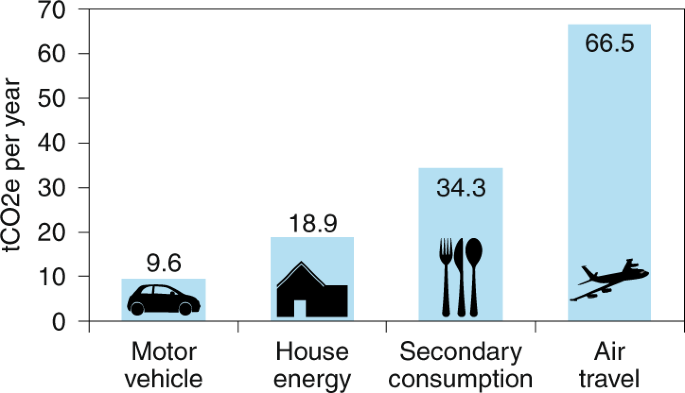
Fig. 1: The estimated carbon footprint of a typical super-rich household of two people.


We need to rethink everything we know about global warming. Jan. 20, 2019.

Israeli researcher claims his calculations show scientists have grossly underestimated the effects of air pollution.
The world’s scientific community has known for a long time that global warming is caused by man-made emissions in the form of greenhouse gases, while global cooling is caused by air pollution in the form of aerosols. 
In a new study published in the journal Science, Hebrew University of Jerusalem Prof. Daniel Rosenfeld argues that the degree to which aerosol particles cool the earth has been grossly underestimated. 
Aerosols are tiny particles of many different materials that get into the air, like dust and vehicle exhaust. They cool our environment by enhancing the cloud cover that reflects the sun’s heat back to space.  
Rosenfeld says his findings necessitate a recalculation of climate-change models to more accurately predict the pace of global warming. 
He and his colleague Yannian Zhu from the Meteorological Institute of Shaanxi Province in China developed a new method that uses satellite images to calculate the effect of vertical winds as well as aerosol cloud droplet numbers. Until now, it was impossible to separate the effects of rising winds, which create the clouds, from the effects of aerosols, which determine clouds’ composition. 
Using this new methodology, Rosenfeld and his colleagues were able to more accurately calculate aerosols’ cooling effects on the Earth. They discovered this effect is nearly two times higher than previously thought. 
But this finding does not necessarily mean we can stop worrying about global warming. Rosenfeld has several theories about why temperatures are rising despite the aerosol effect. 
“If the aerosols indeed cause a greater cooling effect than previously estimated, then the warming effect of the greenhouse gases has also been larger than we thought, enabling greenhouse-gas emissions to overcome the cooling effect of aerosols,” Rosenfeld said.

Aerosol-driven droplet concentrations dominate coverage and water of oceanic low level clouds. Daniel Rosenfeld, Science. Jan. 17, 2019.


Adelaide breaks its all-time heat record, hitting 46.6C, in extreme Australia heatwave. Guardian. Jan. 24, 2019.

huge animal culls, including thousands of camels dying of thirst that had to be shot to put them out of their misery
Posted by mw at 11:58 PM No comments:
Email ThisBlogThis!Share to XShare to FacebookShare to Pinterest
Labels: Heinberg, Kevin Anderson, links, tipping point, Trudeau

Wednesday, November 28, 2018

Climate Links: November 2018

Rang-tan.


“South Park” apologizes to Al Gore and admits it was wrong about global warming. Matthew Rozsa, Salon. Nov. 8, 2018.
The latest episode of “South Park” attempts to make up for its past of denying the reality of global warming


FOURTH NATIONAL CLIMATE ASSESSMENT. Volume II: Impacts, Risks, and Adaptation in the United States. Nov. 23, 2018.

The National Climate Assessment (NCA) assesses the science of climate change and
variability and its impacts across the United States, now and throughout this century.


New Research Shows That Only Two [of the top 10] Large Petroleum Companies Have Meaningful Emission Reduction Targets. Kyle Field, CleanTechnica. Nov. 9, 2018.
Absent a public commitment to reducing emissions, these companies have made it clear that the people of the world will have to rely on regulators to mandate emission reductions. Pulling back the curtain on the business implications of the missing targets reveals businesses that see little incentive and little risk to proactively complying with the global imperative to reduce emissions or the risk of future regulations that have the potential to have a financial impact on the company.

...

"It is encouraging to see two major oil and gas companies, Shell and Total, setting out long-term ambitions to reduce carbon emissions intensity in a way that is compatible with the government pledges made at the Paris climate agreement,” Professor Simon Dietz, leading TPI’s Research at the Grantham Institute, London School of Economics said. “However, there is a long way to go. None of the ten largest global oil & gas firms currently set a path that would align them with limiting global warming to 2°C or below before 2050."
... 
The most awkward of the findings from the research was that half of the companies – Chevron, EOG Resources, ExxonMobil, Occidental and Reliance – have no quantified targets to reduce internal or external emissions … at all. This, my friends, is the failure of the system and speaks loudly to the fact that the oil and gas majors of the world might be talking a good game when it comes to climate change, emissions and the energy transition, but in reality, are doing nothing about it.


Fossil Fuel Companies Spend Next To Nothing On Renewable Energy. Steve Hanley, CleanTechnica. Nov. 13, 2018.
A new report from CDP, formerly known as the Carbon Disclosure Project, gives the lie to all that greenwashing claptrap. Based in the UK, CDP has spent decades tracking how much various companies contribute to climate change and how much they spend trying to fix it, according to Popular Mechanics. The report finds that the 24 largest fossil fuel companies in the world spent a paltry 1.8% of their 2018 operating budgets on renewable energy investments. 


Policies of China, Russia and Canada threaten 5C climate change, study finds. Jonathan Watts, Guardian. Nov 16, 2018.
Ranking of countries’ goals shows even EU on course for more than double safe level of warming


What Is Canada Waiting For To Start Its Transition? Imre Szeman, University of Waterloo via The Beam. Nov. 1, 2018.
In Canada, genuine changes in public attitudes toward the environment seem to be afoot. 
In January 2018, a poll conducted by Environics Research revealed that an overwhelming number of Canadians supported the growth and development of the country’s renewable energy sources. 93% of poll participants backed solar, 91% approved of hydroelectricity, and 86% wanted more wind projects. More than three times as many Canadians reported that the reduction of greenhouse gases should guide the ongoing development of natural resources, as opposed to the creation of energy jobs (34% to 10%). This represents a remarkable shift in a country whose entire history and economy has been deeply linked to resource extraction.

The public opinion captured in this poll hasn’t instigated a shift in government policy — at least not entirely so. While the Canadian federal government has released draft legislation for its national carbon-pricing scheme (which starts at $20 CAD per tonne in 2019 and grows quickly to $50 CAD per tonne in 2022), the government’s own projections suggest that it will only have achieved half the emissions needed to meet its 2020 target. In recent months, a number of European countries, regions and cities have announced aggressive new policies designed to generate their own German-style Energiewende, and to do so in short order. Canada, by contrast, has committed itself to continued fossil fuel extraction, through the approval of projects such as $7.4 billion CAD Trans Mountain pipeline designed to move oil from the Athabasca Tar Sands to the Pacific coast, and the Keystone XL project, green-lighted by the Trump Administration as one of its first acts of state.

The logic can’t help but strike one as bizarre: Canada will get around to meeting its emissions targets, but only by first putting huge additional amounts of CO2 into the atmosphere. To most, the actions of the government are cynical and self-interested — a way of keeping energy-rich provinces (such as Alberta) happy while paying lip service to Canada’s international commitments. It’s not the best way to deal with the environment. And it’s clearly out of step with what most Canadians want. 
The unofficial Canadian policy of both/and — both extractive industries and greenhouse gas reduction —  combined with the retreat of the US federal government on almost anything having to do with the environment —  impedes efforts to address and prepare the nation to cope with the consequences of global warming. 
What might Canada do instead? 
Now is the time for Canada to get serious about developing a national energy transition policy. 
Even though federal and provincial governments have acknowledged the need for a transition (followed by meek program and policy gestures), no such energy transition policy exists. Such a policy would directly and concretely speak to the need to shift from fossil fuels to renewable forms of energy. It would outline programs and interventions that would make this happen sooner rather than later. And it would make clear that this transition can’t be left to the energy market or be shaped by the price for energy. Carbon pricing does very little, in the end, to transform a country’s energy landscape, nor does it properly capture the carbon liabilities that come with fossil fuel extraction. The recent report by David Janzen and Ian Hussey ‘What the Paris Agreement Means for Alberta’s Oil Sands Majors’ demonstrates that the carbon liabilities of Canada’s five biggest companies in the oil sands far outweigh their assets and market capitalization.

... 
Unfortunately, these bottom-up worker initiatives face a federal government (and many Canadian provincial governments) that seems to believe that fossil fuels will be the primary source of jobs for the near future. In a country built up around extraction, protecting the environment is imagined as coming at the expense of jobs; on the flip side, Canadians seem to think that energy jobs can’t but come at a cost to the environment. Yet this is a false dichotomy, which reflects the desire of both industry and government to keep things just the way they are instead of innovating transition policies that protect the environment and produce good jobs. 
Instead of taking on the challenge and opportunity of developing new transition policies capable of curbing greenhouse gas emissions and creating jobs for a economy undergoing transformation, governments play worried citizens off of one another (in the hopes of keeping votes at the ballot box), while fossil fuel companies generate profits in a declining yet still destructive industry. Like citizens of countries around the world, Canadians are ready to take on the work of the environment and do jobs that work for the environment. They just need some help from their governments; they need an energy transition plan, one that focuses on them and not on markets and profit.


The Rise and Fall of Trudeau’s ‘Grand Bargain’ on Climate. Donald Gutstein, TheTyee.ca. Nov. 14, 2018.
From the new book on Canada and global warming: ‘The Big Stall.’
...

When Trudeau the elder created Petro-Canada and introduced the National Energy Program, Keynesianism still reigned supreme. Government intervention in the economy was legitimate. By the time of Trudeau the younger, neoliberalism had transformed economic and political thinking, decreeing that only the market can make decisions.
Neoliberalism reduces the role of government to creating and enforcing markets, and propping them up when they fail, as in the 2008 financial meltdown. Otherwise, just get out of the way.


Climate change, oilsands and the carbon tax are at the heart of Alberta's 2019 battleground. Trish Audette-Longo & Mike De Souza. National Observer. Nov. 12, 2018.


Alberta officials are signalling they have no idea how to clean up toxic oilsands tailings ponds. Emma McIntosh & David Bruser, National Observer. Nov. 23, 2018.


Bitcoin emissions alone could push global warming above 2°C. Camilo Mora et al, Nature Climate Change. Oct. 29, 2018.


Climate change: Oceans soaking up more heat than estimated. Matt McGrath, BBC. Nov. 1, 2018.
The world has seriously underestimated the amount of heat soaked up by our oceans over the past 25 years, researchers say.
Their study suggests that the seas have absorbed 60% more than previously thought.
They say it means the Earth is more sensitive to fossil fuel emissions than estimated.
This could make it much more difficult to keep global warming within safe levels this century.
... 
The researchers involved in the study believe the new finding will make it much harder to keep within the temperature rise targets set by governments in the Paris agreement. 
... 
The report suggests that to prevent temperatures rising above 2C, carbon emissions from human activities must be reduced by 25% more than previously estimated. 
CORRECTION:
High-profile ocean warming paper to get a correction. Science Mag. Nov. 14, 2018.
The overall conclusion that oceans are trapping more and more heat mirrors other studies and is not inaccurate, but the margin of error in the study is larger than originally thought, said Ralph Keeling, a professor of geosciences at Scripps and co-author of the paper.

Polar amplification dominated by local forcing and feedbacks. Nature Climate Change. Nov. 19, 2018.


Climate change on track to make world 'uninsurable': IAG. James Fernyhough, Australia Financial Review. Nov. 15, 2018.
Insurance giant IAG has warned a failure to reduce greenhouse gas emissions could result in a world that is "pretty much uninsurable", with poorer communities likely to bear the brunt of the effects. 
...
"There is some commentary globally that in a 4-degree world, the world becomes pretty much uninsurable." 
This week 16 of the world's biggest insurers, including IAG and QBE, launched an initiative with the United Nations to develop new risk assessment tools in an effort to make insurance accessible and affordable. 
Participating insurers, which also include AXA, Allianz, and Swiss Re, will work with climate scientists to develop a better understanding of the new and unpredictable weather events resulting from climate change. 
The focus of the initiative is on responding to climate change, rather than preventing it. 
However, Ms Johnson said the future of insurance depended upon limiting global temperature rises, which could only be achieved by a reduction in greenhouse gas emissions. 
... 
While the Paris agreement officially aims to keep global temperature rises below 1.5 degrees above pre-industrial levels, current policies would result in far higher temperature rises. 
According to Climate Action Tracker, a German-government backed initiative, under current policies global temperatures are on track to rise by 3.4 degrees by the end of the century. 
Will Steffen, professor emeritus at Australian National University and member of the Climate Council, predicted rises would be even higher. 
"I suspect on current trajectories it will be more like 4 degrees. So we're not on a good track at all," he told The Australian Financial Review.

Principles for Sustainable Insurance.
A global sustainability framework and initiative of the United Nations Environment Programme Finance Initiative


Stop biodiversity loss or we could face our own extinction, warns UN. Jonathan Watts, Guardian. Nov. 3, 2018.
The world must thrash out a new deal for nature in the next two years or humanity could be the first species to document our own extinction, warns the United Nation’s biodiversity chief. Ahead of a key international conference to discuss the collapse of ecosystems, Cristiana Pasca Palmer said people in all countries need to put pressure on their governments to draw up ambitious global targets by 2020 to protect the insects, birds, plants and mammals that are vital for global food production, clean water and carbon sequestration.

“The loss of biodiversity is a silent killer,” she told the Guardian. “It’s different from climate change, where people feel the impact in everyday life. With biodiversity, it is not so clear but by the time you feel what is happening, it may be too late.”


Is The Evidence of Global Warming Too Scary For Humans To Cope With? Paul Craig Roberts. Nov. 2, 2018.
The book, Unprecedented Crime, about which I reported, caused me to start thinking more seriously about man-made global warming. I already was thinking about it, because capitalism owes its profits to the costs that it imposes on the environment, costs that are external to the capitalist entity. I have been thinking about this since I addressed “external costs” in my 2013 book, The Failure of Laissez Faire Capitalism. I am thinking that if man-made global warming is indeed in the cards, as the current evidence supports, the external costs of capitalism will far exceed the total value of all the goods produced over the course of the industrial revolution. Past material comforts will be paid for by future curtailment of life on Earth.

Greenhouse gas levels in atmosphere reach new record. World Meterological Organization. Nov. 20, 2018.


US could meet Paris emissions pledge with ‘natural climate solutions’, study says. Robert McSweeney, CarbonBrief. Nov. 14, 2018.
study:
Natural climate solutions for the United States. Joseph E. Fargione et al, Science Advances. Nov. 14, 2018. 
Abstract 
Limiting climate warming to <2°C requires increased mitigation efforts, including land stewardship, whose potential in the United States is poorly understood. We quantified the potential of natural climate solutions (NCS)—21 conservation, restoration, and improved land management interventions on natural and agricultural lands—to increase carbon storage and avoid greenhouse gas emissions in the United States. We found a maximum potential of 1.2 (0.9 to 1.6) Pg CO2e year−1, the equivalent of 21% of current net annual emissions of the United States. At current carbon market prices (USD 10 per Mg CO2e), 299 Tg CO2e year−1 could be achieved. NCS would also provide air and water filtration, flood control, soil health, wildlife habitat, and climate resilience benefits.
INTRODUCTION 
Limiting global warming below the 2°C threshold set by the Paris Climate Agreement is contingent upon both reducing emissions and removing greenhouse gases (GHGs) from the atmosphere. Natural climate solutions (NCS), a portfolio of discrete land stewardship options, are the most mature approaches available for carbon conservation and uptake compared to nascent carbon capture technologies and could complement increases in zero-carbon energy production and energy efficiency to achieve needed climate change mitigation. Within the United States, the maximum and economically viable mitigation potentials from NCS are unclear. 
Here, we quantify the maximum potential for NCS in the United States and the portion of this maximum that could be achieved at several price points. We consider 21 distinct NCS to provide a consistent and comprehensive exploration of the mitigation potential of conservation, restoration, and improved management in forests, grasslands, agricultural lands, and wetlands, carefully defined to avoid double counting (details in the Supplementary Materials). We estimate the potential for NCS in the year 2025, which is the target year for the United States’ Nationally Determined Contribution (NDC) under the Paris Agreement to reduce GHG emissions by 26 to 28% from 2005 levels....


Warming assessment of the bottom-up Paris Agreement emissions pledges.
Yann Robiou du Pont &
Malte Meinshausen. Nature Communicationsvolume. Nov. 16. 2018.


Peak Oil & Drastic Oil Shortages Imminent, Says IEA. Dr. Harry Brinkmann, CleanTechnica. Nov. 22 2018.


467 ways to die on a warming globe. Clive Hamilton, The Guardian. Nov. 27, 2018.
Last week Donald Trump, who calls climate science a hoax, visited a California devastated by wildfires. When asked whether his visit would change his mind about climate change he said “No”. What else could he say? The journalist was asking him if he would change who he was. 
Yet it’s too easy to blame the world’s slowness to act on crazy American deniers. 
Because, in a way, we are all climate science deniers. 
The full truth of what humans have done is almost impossible to take in. To fully embrace the message of the climate scientists means giving up the deepest presupposition of modernity – the idea of progress. Relinquishing our belief in progress means we must let go of the future, because we have been taught from infancy that the future is progress. 
In our minds, replacing the old future defined by progress with a new future defined by endless struggle requires a period of grieving. Not many people have the stomach for that. 
While most people in most countries accept the truth of climate science, they don’t accept its implications.


An Economist's Guide to Climate Change Science. Solomon Hsiang and Robert E. Kopp. JOURNAL OF ECONOMIC PERSPECTIVES. Nov. 2018.
Abstract
This article provides a brief introduction to the physical science of climate change, aimed towards economists. We begin by describing the physics that controls global climate, how scientists measure and model the climate system, and the magnitude of human-caused emissions of carbon dioxide. We then summarize many of the climatic changes of interest to economists that have been documented and that are projected in the future. We conclude by highlighting some key areas in which economists are in a unique position to help climate science advance. An important message from this final section, which we believe is deeply underappreciated among economists, is that all climate change forecasts rely heavily and directly on economic forecasts for the world. On timescales of a half-century or longer, the largest source of uncertainty in climate science is not physics, but economics.
Posted by mw at 9:46 PM No comments:
Email ThisBlogThis!Share to XShare to FacebookShare to Pinterest
Labels: Canada, IEA, links, Trudeau, WMO

Wednesday, October 31, 2018

Climate Links: October 2018 #2

Oh, shit!
Time to get serious about climate change... global beer supply at risk!
Decreases in global beer supply due to extreme drought and heat. Wei Xie et al, Nature.


If I stop eating meat, will it really help climate change? Asian correspondent. Oct. 26, 2018.Perhaps treat meat as just a condiment?
(Hat tip Yves Smith.. for the link and the condiment suggestion)


Humanity has wiped out 60% of animal populations since 1970, report finds. Damian Carrington, Guardian. Oct. 30, 2018.
The huge loss is a tragedy in itself but also threatens the survival of civilisation, say the world’s leading scientists
“We are rapidly running out of time,” said Prof Johan Rockström, a global sustainability expert at the Potsdam Institute for Climate Impact Research in Germany. “Only by addressing both ecosystems and climate do we stand a chance of safeguarding a stable planet for humanity’s future on Earth.”
... 
Wildlife and the ecosystems are vital to human life, said Prof Bob Watson, one of the world’s most eminent environmental scientists and currently chair of an intergovernmental panel on biodiversity that said in March that the destruction of nature is as dangerous as climate change.
... 
“there is this direct link between the food system and the depletion of wildlife,” said Barrett. Eating less meat is an essential part of reversing losses, he said.


Scientists Warn World Facing Major Famine, Could "Lead To Severe Shocks To Global Food System". zerohedge. Oct. 17, 2018.


How Feedback Loops Are Driving Runaway Climate Change. Dahr Jamail, truthout. Oct. 1, 2018.
Wadhams .. noted that the change of albedo (a measure of reflection of solar radiation) due to the loss of sea ice and snowline retreat across the Arctic “is sufficient to add 50 percent to the warming effect of CO2 emissions alone.”


MW: notwithstanding the fact that the neoliberal form of so-called capitalism, under the likes of Clinton/Bush/Obama, etc. (and their contemporaries around the world), already made catastrophic climate change inevitable ... and thus that the tilt towards more fascist forms of government is just the icing on the cake...  this is still worth a read: 

Why Catastrophic Climate Change is Probably Inevitable Now. Udair Haque, e&co. Oct. 10, 2018.
How Capitalism Torched the Planet by Imploding Into Fascism
The reality is: we’re probably not going to make it. It’s highly dubious at this juncture that humanity is going to win the fight against climate change. 
Yet that is for a very unexpected — yet perfectly predictable — reason: the sudden explosion in global fascism — which in turn is a consequence of capitalism having failed as a model of global order. If, when, Brazil elects a neo-fascist who plans to raze and sell off the Amazon — the world’s lungs — then how do you suppose the fight against warming will be won? It will be set back by decades — decades…we don’t have. America’s newest Supreme Court justice is already striking down environmental laws — in his first few days in office — but he will be on the bench for life…beside a President who hasn’t just decimated the EPA, but stacked it with the kind of delusional simpletons who think global warming is a hoax. Again, the world is set by back by decades…it doesn’t have. Do you see my point yet? Let me make it razor sharp. ...


Global Warming Is Real. The Threat Is Real. Ecocide Is On The Horizon. Paul Craig Roberts. Oct. 26, 2018.
The tobacco companies’ response to the US Surgeon General’s report in 1964 linking smoking to lung cancer was countered by the tobacco companies setting up propaganda organizations to create a controversy by generating doubt over the link. This strategy staved off the inevitable for more than two decades. 
The same tactic is being used by the carbon energy companies against the independent climate scientists who have established that the climate is warming as a result of CO2 emissions. After a certain amount of warming, feedback mechanisms come into play that accelerate the warming. For example, as CO2 emissions raise temperatures, permafrost begins melting releasing methane, a greenhouse gas that speeds the warming. 
Another example of feedback is the loss of sea ice and snow cover on land. Ice and snow reflect the sun’s heat, but the dark surface of the ocean and land absorb the heat, resulting in a further rise in temperature. 
The greenhouse gases around the planet trap heat radiation. The oceans, which cover about 75% of the planet, have enormous heat capacity and can soak up a lot of energy. Being very deep, they take a long time to heat up. As the oceans absorb the heat, it takes decades for the atmosphere to heat up. This “climate lag” delays the full impact of global warming. 
As temperatures rise, the feedback mechanisms come into play and the planet arrives at tipping points at which things spin out of control. Once that happens, it is too late to control carbon emissions. The release of methane and nitrous oxide, the acidification of the oceans, the destruction of rain forests—which turns them from their service as carbon sinks into net carbon sources—work together to destroy the oceans and coral reefs as a source of food, to deplete water resources, and to raise temperatures beyond those at which life can exist. 
It is important to understand that global warming is not a theory. It is observable fact. It is documented. The measurements are made. The numbers are actual measurements, not predictions from a model. If CO2 emissions are not controlled in time, there is no way to avoid the consequences. 
It is important to understand that we are talking about whether planet Earth will be able to sustain life in the near future. 
It is important to understand that mass bleaching of the Great Barrier Reef is already occurring, that CO2 is rising as a percentage of the atmosphere, that the acidification of the oceans is increasing. 
These are facts. 
It is also important to understand that unlike the hired guns of the carbon energy industry, independent climate scientists have no material interest in misrepresenting the facts. 
It is important to understand that the National Oceanic and Atmospheric Administration is not a fake news organization. Neither is NASA. Neither is the Intergovernmental Panel on Climate Change. 
It is important to understand that glaciers have melted away, that the Greenland ice shelf is rapidly shrinking, that ships now move year round through the Artic ice. 
The carbon energy industry has put out all manner of disinformation and conspiracy theories about the independent scientists. They are said to be part of a plot to install global government, as part of a plot to reduce the human population, as part of a plot to reduce living standards for the mass of humanity to primitive levels so that the one percent can have even more, and so on. 
If you want to gain an understanding of climate science and to discover that there is much more to the ecocide threat than you are aware of, and if you want to see the hard, documented evidence, read the just published book, Unprecedented Crime: Climate Science Denial and Game Changers for Survival(Clarity Press, 2018) by Dr. Peter D. Carter and Elizabeth Woodworth, with a foreword by Dr. James E. Hansen. The authors write: “Since the United Nations Paris conference in late 2015, climate change indicators have escalated so quickly that an emergency response is imperative if civilization is to avoid breakdown and eventual collapse.” The authors provide the hard and extensive evidence in a science appendix titled “Evidence of the Climate Emergency.”


Rebelling against extinction. George Monbiot. Oct. 19, 2018.

As for the economic elite, as the consequences of their own greed and self-interest emerge, they seek, like the Roman oligarchs fleeing the collapse of the Western Empire, only to secure their survival against the indignant mob. An essay by the visionary author Douglas Rushkoff this summer, documenting his discussion with some of the world’s richest people, reveals that their most pressing concern is to find a safe refuge from climate breakdown, economic and societal collapse. Should they move to New Zealand or Alaska? How will they pay their security guards once money is worthless? Could they upload their minds onto supercomputers? Survival Condo, the company turning former missile silos in Kansas into fortified bunkers, has so far sold every completed unit. 
Trust, the Edelman Corporation observes, “is now the deciding factor in whether a society can function.” Unfortunately, our mistrust is fully justified. Those who have destroyed belief in governments exploit its collapse, railing against a liberal elite (by which they mean people still engaged in public service) while working for the real and illiberal elite. As the political economist Will Davies points out, “sovereignty” is used as a code for rejecting the very notion of governing as “a complex, modern, fact-based set of activities that requires technical expertise and permanent officials.” 
Nowhere is the gulf between public and private interests more obvious than in governments’ response to the climate crisis. 
... 
These people are not serving the nation. They are serving each other. 
In Germany, the government that claimed to be undergoing a great green energy transition instead pours public money into the coal industry, and deploys an army of police to evict protesters from an ancient forest to clear it for a lignite mine. On behalf of both polluting power companies and the car industry, it has sabotaged the EU’s attempt to improve its carbon emissions target. Before she was re-elected, I argued that Angela Merkel was the world’s leading eco-vandal. She might also be the world’s most effective spin doctor: she can mislead, cheat and destroy, and people still call her Mutti. Since then, she has done all she can to retain her position as the leading planetary delinquent. That she has now slipped to third place shows only that the collapse of the public service ethos has become a global phenomenon. 
Other governments shamelessly flaunt their service to private interests, as they evade censure by owning their corruption. 
... 
In Australia, the new Prime Minister, Scott Morrison, has turned coal burning into a sacred doctrine.

... 
If Jair Bolsonaro takes office in Brazil, their gleeful annihilation on behalf of private interests will seem mild by comparison. He claims that climate breakdown is a fable invented by a “globalist conspiracy”, and seeks to withdraw from the Paris Agreement, abolish the environment ministry, put the congressional beef caucus (representing the murderous and destructive ranching industry) in charge of agriculture, open the Amazon Basin for clearance and dismantle almost all environmental and indigenous protections. 
With the exception of Costa Rica’s, no government has the policies required to prevent more than 2°C of global warming, let alone 1.5°. ...


How Brazil’s presidential election could eff up the planet for everyone. Paola Rosa-Aquino, Grist. Oct 9, 2018.
As the vast Brazilian rainforest steadily dwindles, so do our chances of limiting global warming to 1.5 degrees Celsius. And with the possible election of Jair Bolsonaro, the so-called “Trump of the Tropics” and far-right frontrunner in the Brazilian presidential election, a crucial part of the planet’s carbon emission-curbing toolkit might be in jeopardy.

What’s Another Way to Say ‘We’re F-cked’? Jeff Goodell, Rolling Stone. Oct. 12, 2018.


Revealing the Dark Side of Wind Power. Mark Buchanan, Bloomberg. Oct. 4, 2018.
Surprising new research suggests harvesting cleaner energy may have serious consequences for the environment.


Billionaires Are the Leading Cause of Climate Change. Luke Darby, GQ. Oct. 11, 2018.


Who cares what old people think about climate change? J.R. Hennessy, The Outline. Oct. 11, 2018.
If you won’t live to see the worst of it, kindly shut up.

Trudeau on back foot as frustration builds over PM's climate strategy. Leyland Cecco, Guardian. Oct. 10, 2018.
Several provinces unhappy with PM’s national carbon tax, while green groups oppose government investment in fossil fuels

Huge reduction in meat-eating ‘essential’ to avoid climate breakdown. Damian Carrington, Guardian. Oct. 10, 2018.
Major study also finds huge changes to farming are needed to avoid destroying Earth’s ability to feed its population


Save the Climate, Eat Less Red Meat. Jessica Fanzo and Shreya Das, Bloomberg. Oct. 31, 2018.
Dietary change could substantially reduce greenhouse gases.


Nature will need up to five million years to fill the gaps caused by man-made mass extinctions, study finds. Chris Baynes, The Independent. Oct. 16, 2018.

also covered here:
Humanity’s ongoing annihilation of wildlife is cutting down the tree of life, including the branch we are sitting on, according to a stark new analysis. Damian Carrington, Guardian. Oct. 15, 2018.

and:
'Hyperalarming' study shows massive insect loss. Ben Guarino, WashPo. Oct. 15, 2018.


State of the climate: New record ocean heat content and a growing El Niño. Zeke Hausfather, Carbon Brief. Oct. 23, 2018.
Ocean heat content (OHC) set a new record in the first half of 2018, with more warmth in the oceans than at any time since OHC records began in 1940. 
That’s one of the headlines from Carbon Brief’s latest “state of the climate” report, a quarterly series on global climate data that now includes temperatures, ocean heat, sea levels, greenhouse gas concentrations, climate model performance and polar ice.

Bioenergy carbon capture: climate snake oil or the 1.5-degree panacea? Paul Behrens, RenewEconomy. Oct. 23, 2018.


Nobel Prizes in Economics, Awarded and Withheld. Peter Dorman, EconoSpeak. Oct. 8, 2018.

Most of the commentary today on the decision to award Nobel prizes in economics to William Nordhaus and Paul Romer has focused on the recipients. I want to talk about the nonrecipient whose nonprize is perhaps the most important statement by the Riksbank, the Swedish central bank that decides who should be recognized each year for their work in economics “in memory of Alfred Nobel”.

Nordhaus was widely expected to be a winner for his work on the economics of climate change. For decades he has assembled and tweaked a model called DICE (Dynamic Integrated Climate-Economy), that melds computable general equilibrium theory from economics and equations from the various strands of climate science. His goal has been to estimate the “optimal” amount of climate change, where the marginal cost of abating it equals the marginal cost of undergoing it. From this comes an optimal carbon price, the “social cost of carbon”, which should be implemented now and allowed to rise over time at the rate of interest. In his first published work using DICE, from the early 1990s, he recommended a carbon tax of $5 a tonne of CO2, inching slowly upward until peaking at $20 in 2085. His “optimal” policy was expected to result in an atmospheric concentration of CO2 of over 1400 ppm (parts per million) at the end of this planning horizon, yielding global warming in excess of 3º C. (Nordhaus, 1992)

Over time Nordhaus has become slightly more concerned with the potential economic costs of climate change but also more sanguine about the prospects for decarbonized economic growth, even in the absence of policy. In his latest work he advocates a carbon tax of $31 per tonne in 2015, increasing at 3% per year over the following century. This too would result in more than 3º warming. To give a sense of how modest his suggestion is, consider that, in the same paper, Nordhaus calculates that the most efficient carbon tax to limit warming to 2.5º is between $107-184 per tonne depending on assumptions. The target of the Paris Accord is 2º, and most scientists consider this an upper bound for the amount of warming we should permit.

What do these “optimal” tax numbers mean? Based on the carbon content of gas, each $1 carbon tax translates into a one cent tax on a gallon of gas at the pump. If we adopted Nordhaus’ suggestion for carbon pricing, the result would be minuscule compared to the year-to-year fluctuations in energy prices due to other causes. In other words, while his prize is being trumpeted as a statement from the Swedish bankers on the importance of climate change, in fact he is a key spokesman for the position, rejected by nearly all climate scientists, that the problem is modest and can be solved by easy-to-digest, nearly imperceptible adjustments to energy prices. If we go down his road we face a significant risk of a climate apocalypse.

But Nordhaus is not the only climate economist on the block. In fact, he has been locked in debate for many years with Harvard’s Martin Weitzman. Weitzman rejects the entire social-cost-of-carbon approach on the grounds that rational policy should be based on the insurance principle of avoiding worst-case outcomes. His “dismal theorem” demonstrates that, under reasonable assumptions, the likelihood of tail events does not fall as rapidly as their degree of catastrophe increases, so their expected cost rises without limit—and this applies to climate scenarios. (I explain this graphically here.) Not surprisingly, Weitzman’s work is often invoked by those who, like me, believe much more aggressive action is needed to limit carbon emissions.

It also happens that Weitzman is a giant in the field of environmental economics quite apart from his particular contribution to the climate debate. He did the original work on environmental policy under uncertainty and has contributed significantly to other areas of economic theory. (His analysis of the uncertainty problem is explained here.) Even if the greenhouse effect never existed he would be a candidate for a top prize.

Because of this, whenever economists speculated on who would win the econ Nobel, the Nordhaus scenario was always couched as Nordhaus-Weitzman. (For a recent example, see Tyler Cowen, who adds Partha Dasgupta, here.) It seemed logical to pair a go-slow climate guy with a go-fast one. But as it happened, Nordaus was paired not with Weitzman but Paul M. Romer for the latter’s work on endogenous growth theory. I won’t take up Romer’s contribution here, but what is interesting is that the Riksbank committee chose to yoke together two economists whose work is only loosely related. I can’t recall any forecaster ever predicting a joint prize for them, no matter how much commentators have scrambled to justify it after the fact.

The reality is this is a nonprize for Weitzman, an attempt to dismiss his approach to combating climate change, even though his position is far closer to the scientific mainstream than Nordhaus’. An example of the enlistment of the uncritical media in this enterprise is today’s New York Times, where Binyamin Appelbaum writes:
Mr. Nordhaus also was honored for his role in developing a model that allows economists to analyze the costs of climate change. His work undergirds a new United Nations report on the dangers of climate change, released Monday in South Korea.
Wrong. The work Nordhaus pioneered in the social cost of carbon is mentioned only twice in the IPCC report, a box in Chapter 2 and another in Chapter 3. The reason it appears only in boxes is that, while the authors of the report wanted to include this work in the interest of being comprehensive, it plays no role in any of their substantive conclusions. And how could it? The report is about the dangers of even just 1.5º of warming, less than the conventional 2º target, and far less than the 3+º Nordhaus is comfortable with. Damages are expressed primarily in terms of uninhabitable land and climate refugees, agricultural failure and food security, and similarly nonmonetary outcomes, not the utility-from-consumption metric on which Nordhaus’ work rests.

The Nordhaus/Romer combo is so artificial and unconvincing it’s hard to avoid the impression that the prize not given to Weitzman is as important as the one given to Nordhaus. This is a clear political statement about how to deal with climate change and how not to deal with it. The Riksbank has spoken: it wants a gradual approach to carbon, one that makes as few economic demands as possible.


A Not-So-Nobel Prize for Growth Economists. Brian Czech, CASSE. Oct. 15, 2018
In 1991 Nordhaus uttered one of the most iconic sentences in the history of unsustainability: “Agriculture, the part of the economy that is sensitive to climate change, accounts for just 3% of national output. That means that there is no way to get a very large effect on the US economy” (Science, September 14, 1991, p. 1206).  Think about that. He must have set a graveyard’s worth of classical economists (Adam Smith, David Ricardo, John Stuart Mill…) to rolling. They’d be rolling in laughter if the folly of Nordhaus wasn’t so dangerous.
... 
For [Romer], all that mattered was capital and labor; he said nothing about land, natural resources, or the environment. ... For Romer, it was as if ideas alone [R&D] could overcome water shortages, biodiversity loss, mineral depletion, soil erosion, pollution, and climate change. As if ideas could be perpetually borne out of human minds struggling in a degrading environment, a warming climate, and an imperiled agricultural base (not to mention a crowded, noisy, and stressed out society). Romer was like a cook thinking up recipes with no idea where the ingredients would come from.


A Few Things You Probably Didn't Know About William Nordhaus, Winner of the Nobel Prize in Economics. Ugo Bardi, Cassandra's Legacy. Oct. 14, 2018.
The strong non-linearity of the behavior of complex systems -- including the global economy -- is nearly impossible to understand for people trained in economics. William Nordhaus, the recent Nobel prize winner in economics, is no exception to the rule. In this post, I'll report how, at the beginning of his career, Nordhaus criticized "The Limits to Growth", showing in the process that he had understood nothing of the way complex systems work.

After having been awarded the Nobel prize in economics of this year, William Nordhaus has been often presented as some sort of an ecologist (see, e.g. this article on Forbes). Surely, Nordhaus' work on climate has merit and he is one of the leading world economists who recognize the importance of the problem and who propose remedies for it. On the other hand, Nordhaus' approach on climate can be criticized. Nordhaus tend to see the problem in terms of costs and solvable just by means of modest changes, for instance by means of a carbon tax. This has led him to clash rather heavily with another economist, Nicholas Stern, who sees the problem in more dramatic terms.

Nordhaus' approach to climate change mitigation highlights a general problem with how economists tend to tackle complex systems: their training makes them tend to see changes as smooth and gradual. But real-world systems, normally, do what they damn please, including crashing down in what we call the Seneca Effect.

On this point, let me tell you a little story of how Nordhaus started his career at Yale by an all-out attack against system dynamics, the method used to prepare the 1972 study "The Limits to Growth," showing in the process that he had understood nothing on the way complex systems work.
... 
Nordhaus just didn't understand Forrester's ideas and methods, claiming over and over that standard economics was a better tool to describe the world system. He couldn't understand -- just as most modern economists can't -- that standard economics doesn't account for the kind of oscillations -- including crashes - which are observed in history and that system dynamics describes very well. This is an especially serious limitation when dealing with the earth's climate, which is a complex system subjected to abrupt changes and tipping points: here Nordhaus' approach is not only wrong but outright dangerous because it leads decision makers to a false sensation of safety and control which, in reality, we don't have.


The Nordhaus Racket: How to use capitalization to minimize the cost of climate change and win a ‘Nobel’ for ‘sustainable growth’. Shimshon Bichler and Jonathan Nitzan, Real-World Economics Review. Nov. 5, 2018.
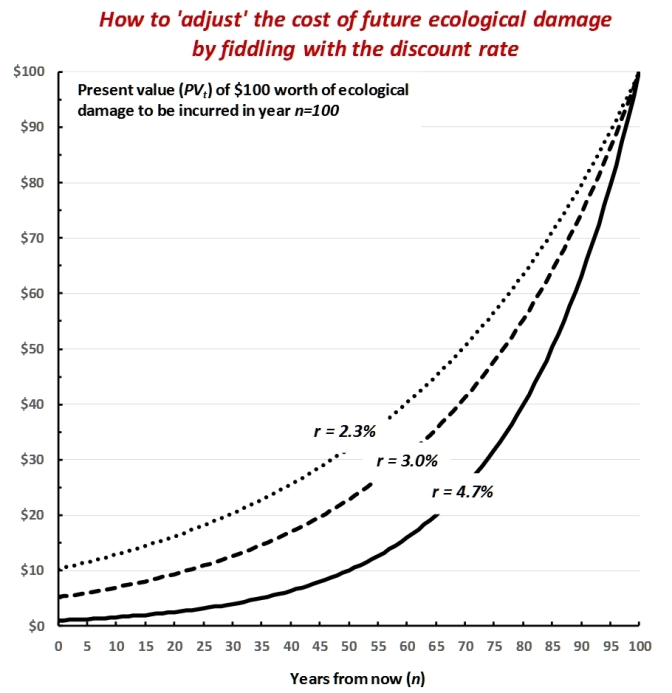
Fiddling with the discount rate 
To illustrate, consider the following example. Suppose Nordhaus wants to cut the estimated PVt of climate change costs incurred 100 years from now by 50% below the scientific consensus. One way of doing so is to convince his readers that, 100 years from now, Ct+n will be half as large as most scientists think. But that won’t be easy. After all, Nordhaus is no climate scientist, he is a mere economist, and it would be a tall order, even for a future Economics Nobel Laureate, to argue that the climatological consensus is 50% off the mark. 
But there is a much easier route, and that is to fiddle with the discount rate (r). The enclosed chart shows how the same $100 worth of climate damage incurred 100 years from now (rightmost point on the horizontal axis, where n=100) changes as we get closer to the present (leftmost point, where n=0). Each line shows the changing present value under a different discount rate, with lower/higher discount rates causing smaller/greater reductions in present value. 


Now, suppose the conventional discount rate is 2.3% (dotted series). With this discount rate, today’s present value (PV0) of $100 worth of climate cost incurred one hundred years from now (n=100) is approximately $10. But there is nothing to prevent Nordhaus from using a different rate. A slightly higher rate of 3% (dashed series), for example, will cause today’s present value to drop by one half, to a mere $5, give or take. And Nordhaus doesn’t have to stop there. He can go the Full Monty, push the discount rate up to 4.7% (solid series), and reduce the present value to a paltry $1. Blessed are the wonders of compound interest. 
The nice thing about these discount-rate ‘adjustments’ is that, unlike the commotion stirred by debates over the actual cost of climate change, here there are no messy quarrels with scientists, no raised eyebrows from journalists and no outcries from the cheated public. Only contented politicians and delighted capitalists. 
And that is exactly the route chosen by William D. Nordhaus. 
Leveraging the capitalization ritual 
In his 2007 ‘Review of the Stern Review on the Economics of Climate Change’, he mocked Lord Nicolas Stern’s assumption of a low discount rate of 1.4%, suggesting we should instead discount the future by his favourite rate of 6%. 
And that mockery succeeded wonderfully. By leveraging the capitalization ritual in the name of profit and glory, Nordhaus managed to not only help investors minimize the apparent cost of climate change, but also win the Economics Nobel Prize as the white knight of nothing less than . . . ‘sustainable global economic growth’! Who says you can’t eat your cake and have it too?


ExxonMobil CEO Depressed After Realizing Earth Could End Before They Finish Extracting All the Oil. The Onion. Oct. 10, 2018.


Time travel with Galileo. Leanne  Ogasawara. 3QD. Oct. 15, 2018
Who in the world wants to travel forward in time? Is there any evidence whatsoever that things are going to become more interesting in the future? 
I would argue that every indication suggests that not only is our world going to get hotter, more barbaric and unjust–but as if that isn’t bad enough, conversations and romance will continue to decline precipitously. Evidence is surely on my side, right? Clinking my glass with my fork to get their attention, I patiently tried explaining what the future has in store: 
“Temperatures will rise,” I said, as their eyes glazed over. “And as people begin to jostle for resources, the elite class (I looked at them accusingly) will begin hunkering down in comfortable enclaves, while the vast global majority suffers outside.” 
I then painted a picture of what I imagined to be a dark version of today’s gated communities. “These enclaves for the wealthy will be like medieval castles. But whereas medieval castles served as a defense against 16th century artillery, the cities of the future will be fortresses for better control of scarce resources.”
Posted by mw at 8:00 AM No comments:
Email ThisBlogThis!Share to XShare to FacebookShare to Pinterest
Labels: beer, discount rate, extinction, links, meat, Monbiot, Nobel, Nordhaus, Romer, The Onion, Trudeau
Older Posts Home
View mobile version
Subscribe to: Posts (Atom)

My Other Blog

  • Skeptical Investment

Resources

  • State of Our Climate
  • World Climate Research Program
  • World Bank Climate Change Knowledge Portal
  • Climate Reanalyzer
  • Earth Nullschool
  • National Academy of Sciences – Science Museum: Earthlab
  • Global Carbon Atlas
  • Global Carbon Project
  • The Climate Web
  • Discovery of Global Warming: AIP
  • Guy's Monster Climate Change essay
  • Energy & Our Future
  • Bloomberg Carbon Clock
  • Trillionth Tonne
  • Influence Map
  • Smoke and Fumes
  • Planetary Limits Academic Network

Climate Change Blogs

  • Robbie Andrew, CICERO
  • Jem Bendell
  • Robert Scribbler
  • Arctic News
  • Cassandra's Legacy
  • Climate Change: Next Generation
  • Climate Denial Crocks
  • Nature Bats Last
  • Paul Beckwith
  • Real Climate
  • Climate Code Red
  • Skeptical Science
  • Climate Etc.
  • Darrin Qualman
  • DeSmog Blog
  • Do The Math
  • Dredd Blog
  • Ethics and Climate
  • G-Feed
  • The Keeling Curve
  • Our Finite World

Climate Change News

  • The Ecologist
  • Climate Progress
  • The Guardian - Keep it in the Ground
  • Scientific American - Climate
  • Inside Climate News
  • Corporate Knights
  • Truthout

Climate Change Science Groups

  • Earth's Future
  • CICERO
  • NASA Climate
  • NASA GISS
  • NOAA ESRL
  • NOAA NCEI
  • UNFCCC
  • Berkeley Earth
  • UCS
  • AMEG
  • Arctic Monitoring
  • Future of Life
  • NSIDC

Climate - Other Links

  • Carbon Dioxide Information Analysis Center
  • Climate Ontario
  • Climate Central
  • Climate Analytics
  • Climate Feedback
  • Climate Reality Project
  • Climate Change Policy & Practice
  • Climate Nexus
  • Climate Emergency Institute
  • 350
  • Preventable Surprises
  • Paleovegetation

Carbon Pricing and Clean Energy Links

  • Clean Energy Canada
  • Carbon Pricing Leadership

Geoengineering

  • Geoengineering Monitor
  • Biofuelwatch UK
  • IAGP
  • Carbon Brief

Investor Links

  • CDP
  • Client Earth
  • Investor Platform for Climate Actions
  • positive+investment
  • Science Based Targets
  • SHARE
  • As You Sow

Systems / Polymaths? Links

  • Nate Hagens
  • Rob Mielcarski
  • George Mobus
  • ReThinking Everything
  • Jean-Marc Jancovici
  • Jack Alpert
  • Tim Garrett
  • Tim Morgan
  • Tim Watkins
  • Tad Patzek
  • Tom Murphy
  • James @MegaCancer
  • Richard Nolthenius
  • Jem Bendell
  • Mike Stasse
  • Paul Chefurka
  • Al Bartlett
  • Peter Watts
  • Geoffrey Chia

Other Links

  • Palaeos
  • Population Speakout
  • Edward Burtynsky
  • Transform Defence

Solutions

  • Mercy for Animals

Blog Archive

  • ▼  2026 (13)
    • ▼  August (2)
      • Collapse 2040
      • Radagast: Agricultural Collapse
    • ►  July (2)
    • ►  June (2)
    • ►  May (1)
    • ►  April (3)
    • ►  February (1)
    • ►  January (2)
  • ►  2025 (10)
    • ►  December (1)
    • ►  November (1)
    • ►  October (1)
    • ►  September (1)
    • ►  May (1)
    • ►  April (1)
    • ►  February (4)
  • ►  2024 (22)
    • ►  October (4)
    • ►  September (5)
    • ►  July (1)
    • ►  June (4)
    • ►  May (1)
    • ►  March (2)
    • ►  February (3)
    • ►  January (2)
  • ►  2023 (22)
    • ►  December (3)
    • ►  November (4)
    • ►  September (1)
    • ►  August (3)
    • ►  June (2)
    • ►  May (2)
    • ►  April (2)
    • ►  March (1)
    • ►  February (3)
    • ►  January (1)
  • ►  2022 (13)
    • ►  December (2)
    • ►  October (1)
    • ►  September (4)
    • ►  May (1)
    • ►  April (2)
    • ►  February (1)
    • ►  January (2)
  • ►  2021 (51)
    • ►  December (4)
    • ►  November (4)
    • ►  October (3)
    • ►  September (6)
    • ►  August (4)
    • ►  July (5)
    • ►  May (3)
    • ►  April (5)
    • ►  March (3)
    • ►  February (6)
    • ►  January (8)
  • ►  2020 (69)
    • ►  December (4)
    • ►  November (1)
    • ►  October (1)
    • ►  September (5)
    • ►  August (3)
    • ►  July (7)
    • ►  June (11)
    • ►  May (2)
    • ►  April (7)
    • ►  March (2)
    • ►  February (5)
    • ►  January (21)
  • ►  2019 (174)
    • ►  December (17)
    • ►  November (25)
    • ►  October (19)
    • ►  September (15)
    • ►  August (19)
    • ►  July (8)
    • ►  June (14)
    • ►  May (11)
    • ►  April (13)
    • ►  March (9)
    • ►  February (12)
    • ►  January (12)
  • ►  2018 (86)
    • ►  December (10)
    • ►  November (8)
    • ►  October (11)
    • ►  September (6)
    • ►  August (18)
    • ►  July (10)
    • ►  June (5)
    • ►  May (5)
    • ►  April (5)
    • ►  March (4)
    • ►  February (1)
    • ►  January (3)
  • ►  2017 (90)
    • ►  December (3)
    • ►  November (6)
    • ►  October (4)
    • ►  September (7)
    • ►  August (28)
    • ►  July (4)
    • ►  June (10)
    • ►  May (11)
    • ►  April (13)
    • ►  March (2)
    • ►  February (2)
  • ►  2016 (54)
    • ►  November (1)
    • ►  October (3)
    • ►  September (2)
    • ►  August (6)
    • ►  July (1)
    • ►  June (3)
    • ►  May (8)
    • ►  April (30)

Search This Blog

Pages

  • Home
  • Climate Change Charts

Twitter Links

  • ALEX Steffen
  • Andrew Dessler
  • BEN See
  • Bill McKibben
  • CHRIS Cartwright
  • Climate Council
  • DAVID Windt
  • Doctor Vive
  • EcoWarriors
  • Elizabeth Swain
  • Gernot Wagner
  • Glen Peters
  • Jim Baird
  • Johan Rockstrom
  • Kate Aronoff
  • Ken Caldeira
  • Ketan Joshi
  • KEVIN Anderson
  • Margaret Klein Salamon
  • MARK Cranfield
  • Naomi Klein
  • Paul Beckwith
  • Paul Dawson
  • PAUL Maidowski
  • Peter Kalmus
  • Rob Mielcarski
  • Stefan Rahmstorf
  • Tim Garrett
  • Tim Osborn
  • Ugo Bardi
  • Wen Stephenson
  • We Don't Have Time

War and Empire Links

  • Kunstler
    KunstlerCast 451 — Alan Berman's Psychohistory Prediction Engine, Mapping the Matrix
  • PaulCraigRoberts.org
    Feminism and Family Collapse
  • Dissident Voice
    Tulsi Gabbard and Joe Kent
  • Moon of Alabama
    Media Say ... Gloom And Doom In China
  • Caitlin Johnstone
    CaitlinJohnstone.com Is Now At CaitlinJohnstone.com.au
  • The Vineyard of the Saker
    Alternative Copy of thesaker.is site is available
  • Dmitry Orlov | Patreon

Labels

2C (1) 4C (1) 5G (1) 9/11 (6) abrupt climate change (7) Ackerman (1) adaptation (1) aerosols (1) Afghanistan (2) agriculture (3) Ahmed (1) Alan Urban (1) albedo (1) Alberta (1) AMOC (2) Amory Lovins (1) anarchy (1) Andreas Malm (2) animals (3) Antarctica (2) anthropocene (2) antifa (1) apology (1) Arctic (6) Aronoff (1) Arthur Silber (2) Assange (4) Attenborough (1) Atwood (2) Aurelien (1) Australia (2) baby boomer (1) Bacevich (2) Bardi (5) Barnosky (1) Bates (9) Bayer (1) BECCS (7) Beckwith (1) beef (1) beer (1) bees (1) behavioural finance (1) behavioural investing (1) behavioural psychology (2) belt and road initiative (1) Bendell (2) Bernays (1) Bernie (4) bibliography (1) Biden (1) Bill McKibben (8) Bill Nye (1) biodiversity (1) biofuels (1) Bios (1) Bittman (2) Blair Fix (2) Blanchard (1) BLM (2) Bloomberg (1) blue ocean event (1) Blum (2) Bolivia (2) book notes (1) book review (11) Boston Marathon (1) BP (1) Bradshaw (1) Bush (1) Canada (12) Carana (1) carbon bubble (2) carbon budget (1) carbon cycle (1) carbon footprint (1) carbon pricing (1) carbon tax (1) CARE (1) Carey Wedler (4) Carney (1) Catton (1) CDR (2) cell phones (1) censorship (1) Chefurka (1) Chia (3) China (2) Chomsky (3) church (1) CJ Hopkins (2) clean energy (3) climate change depression (5) climate change economics (11) climate learning tree (1) climate mobilization (4) climate models (3) climate refugees (1) Clintons (1) Clive Hamilton (1) Club of Rome (1) CMIP6 (1) Cognitive dissonance (3) Cohen (2) collapse (29) concrete (1) consensus (1) conspiracy theory (2) Conway (1) COP (2) corporate scum (2) corporatocracy (2) Cory Morningstar (1) cost-benefit analysis (1) coup (2) COVID19 (11) Craig Murray (5) crisis actors (1) critical thinking (7) Crittenden (3) Curtin (6) Czech (1) DAC (2) Daniel Brooks (1) Daniel Gilbert (1) Dark Mountain (1) debate (1) decarbonization (2) decoupling (1) deep adaptation (1) deep state (2) degrowth (6) Democrats (1) denial (1) Devo (1) Diana Johnstone (1) DICE (1) Discordianism (1) discount rate (1) divestment (1) DNC (1) documentary (1) Donald Brown (2) doomberg (1) doomer (4) doomsday clock (1) doughnut economics (1) drawdown (1) Drumright (1) Dunlop (1) E. O. Wilson (2) eco-anxiety (1) ecobuddhism (1) ecology (1) ecomodernism (2) economy (1) ecosocialism (1) ECS (3) Eisenstein (1) election (1) Elizabeth May (1) EMFs (1) emissions gap (1) empire (34) energy (6) Eocene (1) EPA (1) Erik Michaels (1) ESAS (1) Escobar (3) essays (1) essential reading (6) ethics (2) Eugene Linden (2) Evil (1) evolutionary psychology (1) EVs (3) externalities (1) extinction (11) extractivism (1) factory farming (1) fake news (6) false flag (8) fertilizer (1) film reviews (1) FIPA (1) Flannery (1) flashback (5) Foer (1) food (5) fossil fuels (1) Franzen (3) Frumhoff (1) Fuentes (1) future (1) Gaia (1) Gail Tverberg (2) Galloway (1) Garrett (4) Geden (2) geoengineering (5) George Floyd (1) Gernot Wagner (1) Ghosh (2) Gideon Polya (1) gifs (1) Gilding (1) glaciers (1) Glen Barry (2) Glikson (5) global dimming (1) GMO (1) Gore (1) Grantham (1) green new deal (4) Greenland (1) Greenwald (4) Greer (4) Griffin (3) Hagens (3) Hawken (1) Hedges (6) Heinberg (5) Henshaw (1) Henson (1) Hickel (2) Himalayas (1) history (1) Hoexter (1) Holdren (1) Holmgren (2) Holocene (1) Holthaus (1) Homer-Dixon (1) hope (1) Hornborg (1) Hothouse Earth (2) Hugo Salinas Price (1) humor (1) Humphrey (3) Hunziker (2) Ian Angus (1) Ian Welsh (24) ice (1) IEA (1) ikonoclast (1) Ilargi (1) Impossible Hamster (1) insects (1) international agreements (1) investing (2) IPAT (1) IPCC (4) Iran (3) IRENA (1) J.D. Alt (1) Jack Alpert (1) Jacobson (2) Jamail (1) James Anderson (1) James Hansen (4) Jancovici (1) Jane Fonda (1) Jared Diamond (2) Jason Box (5) Jason Hickel (2) Jem Bendell (3) JFK (1) Jim Carrey (1) Jim Quinn (1) John Bellamy Foster (4) John Michael Greer (1) Johnstone (48) Kahneman (2) Kate Marvel (1) Katowice (1) Kavanaugh (1) Keen (1) Kelton (1) Ken Avidor (2) Kevin Anderson (7) Kingsnorth (1) Klein (4) Kolbert (1) Korea (1) Krieger (2) Kunstler (8) Lars Syll (1) Lee Camp (3) Lenton (2) liberalism (1) Libya (1) limits to growth (4) links (88) lithium (1) Liz Warren (1) Loeb (1) Lovelock (2) Lynas (1) Lynn Margulis (1) Macy (1) Margolis (1) Mark Blyth (1) Mark Jaccard (1) Martenson (2) martial law (1) Marx (1) Mate (1) Mazz Alone (1) McCain (1) McPherson (6) Meadows (1) meat (5) media (4) melt (1) methane (7) MeToo (1) Michael Mann (5) Michael Moore (2) Mills (1) Mish (1) MIT (1) MMT (2) MoA (2) Mobus (3) Monbiot (3) money (2) Monsanto (1) Montgomery (1) Montier (1) Morgan (9) Moser (1) MP (1) Mueller (1) music (1) myths (1) Nathan Robinson (4) NEF (1) negative interest rates (1) neoliberalism (2) net zero (3) Nobel (1) Nobu (1) Nordhaus (6) NTHE (2) Nuremberg (1) Obama (6) oceans (1) Odum (1) oil (3) omnicide (1) Ontario (1) OPCW (1) opioids (1) Oppenheimer (2) Oreskes (2) Orlov (6) Our Planet (1) overshoot (4) Pagett (1) paleoclimate (1) pandemic (1) Paris (2) passivhaus (1) Patzek (1) PCR (13) Pearl Harbor (1) Peripheral (1) permaculture (1) permafrost (5) Peter Watts (1) Peters (1) PFAS (1) Pie (1) Pilger (2) pipelines (1) Planet of the Humans (2) planetary boundaries (1) plastic (2) Pliocene (1) police state (2) politics (8) Polychroniou (1) polycrisis (1) polymaths (1) poppies (1) positive feedbacks (2) predicament (3) propaganda (11) psychology (4) psychopathy (2) pumped hydro (1) Putin (2) QAnon (1) quotes (1) racism (3) Radagast (4) Rahmstorf (4) Randers (1) rape (2) rare earth metals (1) rationality (4) Raworth (1) reading list (2) recycling (1) red pill (1) red tide (1) reference articles (34) reforestation (1) religion. irrationality (1) Remembrance Day (1) renewables (4) resilience (2) Richard Smith (1) Rignot (1) Robert Allen (1) Rockstrom (5) Romer (1) Ronald Wright (1) Roosevelt Institute (1) Ropeik (1) Rothman (1) runaway (2) Russia (3) Russiagate (6) Safran Foer (1) Saker (2) Salamon (3) sapience (1) Sarah Anne Edwards (1) Scahill (1) Schellnhuber (7) scientific reticence (3) scientists (25) Scranton (2) sea level rise (1) SEEDs (6) sensitivity (2) sentinel intelligence (1) sexual McCarthyism (1) Shakhova (1) shale (1) Sharon Lerner (2) Shindell (1) Simms (1) Skripals (1) sky news (1) slavery (2) Sliwa (1) SLR (1) Smil (1) sociopaths (1) soil (1) solar (1) solastalgia (1) solutions (3) Splash (1) Spotlight (1) Spratt (3) steady state (1) Steffen (5) Steinbeck (1) Steinberger (1) Stephen Hawking (1) Stern (1) Steve Keen (4) storms (2) stranded assets (3) Strassel (2) suicide (1) Sullivan (1) survival (1) sustainability (2) sustainable development (1) Syria (1) systems (2) Taibbi (2) Tainter (3) tankie (1) tar sands (2) TDS (4) Thatcher (2) the Jackpot (1) The Onion (1) The Pearl (1) Thunberg (1) Tillman (1) Tim Watkins (6) tipping point (3) Tol (2) Tom Murphy (6) Tooze (1) topics (37) trade (1) Trainer (1) troops (1) Trudeau (4) truth (3) Turchin (2) Turner (1) Tyndall Centre (1) Ugo Bardi (4) Umair (1) un-denial (4) underestimation (4) UNEP (1) UnionConcernedScientists (1) US civil war (1) US politics (2) Usha Alexander (1) vegetarianism (4) Venezuela (1) Venus syndrome (2) video (14) videos (20) Vietnam (1) VIPS (1) Vollmann (1) Wadhams (2) Waking up (1) Wallace-Wells (4) war (33) warning (2) Wasdell (1) WASF (2) Watts (2) Weitzman (1) Wen Stephenson (1) what if? (1) William Gibson (1) William Rees (3) WMO (1) Wolfgang Knorr (1) Wray (1) WWII (1) XR (2) Yemen (3) Yves (1) Zawacki (2) Zeusse (2)

Pages

  • Home
  • Climate Change Charts
Simple theme. Powered by Blogger.