Showing posts with label agriculture. Show all posts

Wednesday, August 5, 2026

Radagast: Agricultural Collapse

Overly simplistic models obscure the risk of agricultural collapse. Rintrah by Radagast. August 5, 2026.

please see his post at the link above to see the charts and access hyperlinks in the article


There’s a big dispute in climatology, in regards to equilibrium climate sensitivity: How much does the Earth warm up, when you double CO2 in the air?

The IPCC maintains an estimate of 3 degree Celsius per doubling. Some, like James Hansen, think the number is much higher. He thinks it’s 4.8 per doubling, but many of the climate models the IPCC uses sit even higher, above 5 degree. The general idea is that these models “must be wrong”, so they’re not given the same weight when it comes to making predictions for how much warming we will get in the future as models that predict less dramatic warming get.

The main argument given to dispute the credibility of these models, is that they don’t properly reproduce the warming we have seen so far.

The dispute between models mostly comes down to differences in how the clouds are expected to respond. The “hot models” predict that the warming we experience from more CO2 results in a reduction in clouds that reflect sunlight. Thus these models are said to have “positive cloud feedback”.

But not everyone believes these models get it right of course, that’s why there is a scientific dispute. If these “apocalypse predicting” hot models were right, the Earth should be warmer than it actually is right now, that’s the idea upheld by those who are not convinced the hot models get it right.

The counter-argument to this idea, is that the hot models predict greater warming than we have seen so far, because there is other stuff we’re doing that is still keeping temperatures down.

So what are those things? One of them is the temperature reducing effect of air pollution, an effect known as global dimming.

This is the same effect that led some scientists to predict “global cooling” in the past, but as we succeeded at cleaning up a lot of this pollution, it became obvious we would find ourselves faced with rapid global warming in the future instead.

Estimates of how much global dimming we’re causing right now still vary quite a lot from one study to another.

How much it keeps temperatures down matters a lot, because this air pollution is something we will eventually stop dumping into the air: It kills millions of people by damaging our lungs and it acidifies the soil.

So far so good, anyone who has looked into climate change is probably familiar with what I have explained so far.

There is however another important thing we’re doing that helps keep our temperatures down, especially during summer. When you realise what it is, it feels pretty obvious, but it also confronts you with a massive looming problem.

As the author of one study puts it:
“In summary, we showed that irrigation expansion has regionally masked the historical warming of hot extremes from anthropogenic greenhouse gas emissions and all other climate drivers combined,”
And as the authors of a different study put it:
Given our results for California and the global importance of irrigated agriculture, past expansion of irrigated land has likely affected observations of surface temperature, potentially masking the full warming signal caused by greenhouse gas increases.
We irrigate about 17% of the world’s land, to produce 40% of the world’s food. This land has its surface temperature reduced by about 5 to 7 degree Celsius, because the land cools as the water evaporates. This is not all positive, as the resulting higher humidity makes it harder for humans and other animals to sweat, but it does bring temperatures down.

More importantly however, when the water evaporates, it increases the formation of clouds. With satellites you can see that irrigated land has an average cloud cover of 40% during the day, versus 25% for non-irrigated land. These clouds peak between 2 and 4 PM, which is also when the heat influx into the environment from the sun is most intense. These clouds reduce temperature stress for the crops and reduce their water demand. In addition, photosynthesis tends to benefit from how these clouds turn direct sunlight into diffuse sunlight.

In large parts of the world, the water that is evaporated from irrigation, leads to an increase in rainfall, often up to hundreds of kilometers downwind. As a good example, the irrigation in the central valley of California increases water availability by 28% in the Colorado river basin.

Irrigation causes significant cooling of global average surface temperatures, primarily over land. The authors estimate 0.07 degree Celsius reduction in global temperature for the Earth as a whole, or 0.17 degree specifically on land.

A lot of people have been wondering, why India is lagging behind in global warming, compared to the rest of the world. Over the past 40 years, India has only warmed by 0.09 degree Celsius per decade, versus the global average of 0.30C per decade, and below the 0.23C recorded for regions at similar latitudes.

How did that happen? Well we know the answer. They began ramping up their irrigation:


Right now, it’s estimated that around 1 degree of global warming is suppressed over India, thanks to irrigation, both from the direct effect and the indirect effect (enhanced cloud formation):


The effect is strongest, in India’s agricultural powerhouse, the Northwest:


In Northern Italy, studies find that irrigation reduces the peak of a heatwave, by 6.6 degree Celsius. Humidity in the air does increase, but the wind blows that humid air away, so you’re still much better off, thanks to the irrigation.

But here’s the thing. Around the world, a lot of the water we use to irrigate our crops is groundwater, 43%. That groundwater, is generally being depleted faster than natural processes can refill the aquifer. In other parts of the world, we’re getting the water for irrigation from rivers that are supposed to be feeding lakes. The great salt lake is dying, because 62% of the river water that used to feed the lake, is now used for irrigation. Most irrigation as currently practiced by humans is unsustainable.

Farmers and governments know this. So how do they respond? Well, one solution is drip irrigation. Instead of just spraying a lot of water on your land, you slowly drip water on your crops. This causes less water to be lost through evaporation. This is great for the farmer and for the local aquifer, but think about the consequences.

Less water is used for irrigation. This means less water now evaporates. This mean you get less cloud formation, less reduction in temperatures over the land, less rain further downwind. All the positive externalities from irrigation are basically eliminated, when the farmers switch to drip irrigation. The farmers however, don’t have much of a choice. A lot of these farmers can’t just keep using the large amount of water they’re using right now.


The Water Situation in the Indian Subcontinent


After a terrorist attack, the government of India suspended the Indus water treaty, which requires India to share water with Pakistan. The Indian minister of water declared that not a drop of water will flow into Pakistan. India doesn’t have the infrastructure yet, to follow up on that threat. They’re now working on building the infrastructure, to deny Pakistan any water.

First they started dredging their dams. They have also now started planning the construction of new dams. They’re also building new canals, where the water can be used. They’re also diverting water to the northern Indian states, with a new tunnel that is supposed to be operational by 2029.

So, what happens to Pakistan? Well for starters, the Pakistani government is not happy. Their climate change minister has threatened to “chop off the hand” that tries to control its water. Pakistan was supposed to receive 80% of water from the Indus, under the Indus water treaty.

Pakistan has two main sources of water: They have the water from the Indus river system and they have groundwater from their aquifers. I can’t really find consistent reliable estimates on what percentage they derive from the Indus river system and what percentage they derive from their aquifers. Pakistan’s minister says half the population depends on the Indus river system. Some sources say 90% of agriculture in Pakistan depends on the Indus river system.

Other sources say that more than half of Pakistan’s water use in agriculture, comes from groundwater. The problem however, is that they’re using their groundwater much faster than nature can replenish it. Most cities in Pakistan have rapidly declining groundwater tables. A study recently estimated when groundwater extraction will peak in Pakistan. They arrived at 2040 as the most likely year when groundwater extraction from the Indus aquifer would peak. But that was before India suspended the Indus water treaty.

So, why is India doing this? The official reason is because of the terrorist attack. In reality however, they simply need the water themselves. Estimates are that by 2030, 40% of India’s population will have no access to drinking water. Estimates are that lack of water will reduce cropping intensity in India by 20%, with a reduction of 68% in the most water-scarce regions.

When an aquifer is depleted, the grains of sand that used to leave room for water are gradually compacted by the pressure from the soil above. As a result, after depleting an aquifer, it tends to be unable to properly recharge, even once you stop using the aquifer.

India’s recent heatwave was much worse than anything we faced in Europe. During these heatwaves, if you live in a city like New Delhi, there is just not any water coming out of the tap. Drinking water has to be driven into the city, by a “water mafia”, that bores illegal well holes. Then the population has to stand in a cue, to buy water from these tankers.

In Bangladesh, it’s the same problem. They just declared 5,000 villages as “water-stressed areas”, meaning the people are just not allowed to use the ground water to irrigate their crops anymore, they can only use the water to drink it themselves. In 1950, Bangladesh had 40 million people. Today, Bangladesh has 178 million people.

In Bangladesh, you have 20 million people living in the capital city, Dhaka. In Dhaka, the groundwater table is declining by 2 meters per year. By 2030, they’re looking at the groundwater table declining by 4 meters per year. As you have to delve deeper, there’s more arsenic and other pollutants in there. But eventually, it just gets so deep that it costs you too much energy to get the water up.

In other parts of the country, their problem is that when they use up the water beneath their feet, salty seawater infiltrates the groundwater. Salt water infiltration is threatening drinking water and water for agriculture, for more than 20 million people in Bangladesh. That’s more people than live in the entire Netherlands.

So, is there a technofix? Could India’s government just deliver desalinated water to Northern India instead? No, the math doesn’t math. Desalinated water would be about three times more expensive than the wheat it produces, so your food would become four times as expensive.

This is just the cost of desalinating the water at the coast. To transport all the water inland all the way from the coast to Northern India would roughly equal the cost of desalinating the water. In other words, your bread would be seven times as expensive as it is today.


The Water Situation In California

California produces huge amounts of food, the valley is said to produce a quarter of all food in the United States. The problem is, they depend on an aquifer that’s being depleted to produce that food, but the ground has now compacted, so that it has become physically impossible for the aquifer to be refilled by nature.

In parts of California, the situation with the aquifer is so bad, that the government has simply instructed farmers to stop using groundwater like the government did in Bangladesh, so the farmers are just leaving their land dry.

So with these new rules that means California is going to struggle to produce as much food from now on, as it did in the past. But think about all the feedback effects we now start to get as a result:
  • Local temperatures get higher
  • Less clouds are being generated
  • The rest of the United States now gets less rainfall
The people in Arizona know very well how dependent they are, on water from the Colorado river. Well, that water is declining. And the summer flow of the Colorado river is increased by 28%, by Californian farmers irrigating their crops.

Through irrigation we’re both increasing rainfall when it is most needed and reducing the amount of water our plants need, by reducing peak heatwave temperatures.

If you take this into consideration, you’ll realize that when we have to stop irrigating our crops, we’ve got one hell of a feedback coming.

One study looked at what we can actually expect, in regards to groundwater depletion. They looked at 235 groundwater basins and found that total global human groundwater extraction will peak at 625 km3 yr−1 around mid-century, followed by a decline through 2100.

The peak and decline occur in about one-third (82) of basins, including 21 that may have already peaked. This will result in exposing about half (44%) of the global population to groundwater stress. The countries that are worst affected, are the United States, Mexico, Pakistan, India, China, Saudi Arabia and Iran.

There are also places, where groundwater use just doesn’t really seem to be an issue. Global warming is an easier environmental problem to understand, we’re all suffering from the pollution of the global commons. But groundwater is a stranger one: There are places that have already exhausted their groundwater, there are places busy exhausting it and there are other places where the groundwater reserve is actually increasing.

Soil erosion is a similar problem, there are places where we’re losing our fertile soil to erosion and there are other places where this is just not a serious problem.

Add the whole picture together however, and you see the problem: There are parts of the world where we’re running out of the soil our crops need, there are parts of the world where we’re running out of the water our crops need and there are parts of the world where the temperatures are simply getting too hot to properly grow crops.

Finally, there are places where the soil is good, the water we need is available and the temperatures are acceptable, but we’re running out of people who can grow the crops! Japan is a good example of this. They’re shrinking their farmland from 4.2 million hectare in 2020 to just 2.7 million by 2050. Their caloric self-sufficiency, will decline from 37% in 2020, to just 29% by 2050. The reason is because their farmers are old and they have nobody to inherit the farm.

Russia is another example. You have all these climate models, that predict that although food production will decrease as a result of climate change in countries near the equator, it’s no big deal because food production will increase in Russia and that will compensate on a global level. Here’s an example of what I mean:


This is what the World Bank published, back in 2010. Most of the world sees yields go down by 2050, but don’t worry, because Russia, Canada, New Zealand and Scandinavia will bail the rest of us out!

Well, that’s not going to happen, because the Russian government has been stupid enough to spend the past few years invading Ukraine. By now, a fifth of Russian farmers face bankruptcy. They don’t have the diesel they need. Russia is not going to increase its food production, they’re struggling to hold onto what they have.

Nobody seems to bother accurately modeling the situation that lies ahead of us, by incorporating all variables. Example, there’s much ado now, about a study that claims 1 degree of global warming reduces rice yields by 8.1%, rather than 3.8%.

But read the study and they admit:
Our estimates should be interpreted within the context of physiological effects. The temperature-yield relationships are derived from single-factor warming experiments, which allow us to isolate high-temperature effects from confounding water and nutrient stresses. However, these experimental conditions may differ from farmer-managed fields, where yield outcomes also depend on complex interactions among temperature, water availability, crop physiology, and canopy energy balance.

They’re looking at one variable in isolation. Globally, 75% of rice agriculture is irrigated. If you can’t irrigate your rice anymore, yields don’t drop 8.1%, they collapse.

But let’s take a look again, at the study that predicts what’s going to happen to our groundwater. At the end they write:
Our model does not include an explicit physical representation of processes such as recharge, capture or lateral flows. However, these dynamics are embedded in the historical depletion datasets we use to calibrate our model, and alternative depletion limits (described above) allow us to capture a range of plausible future groundwater availabilities resulting from changing human-induced or naturally varying fluxes.
Alright, so you’re not properly modeling how the aquifer recharges. Well that’s a problem, because the recharging of our aquifers changes too. As our climate changes, what happens is that you get longer periods of drought, followed by an increase in rain that falls all at once.

That’s a problem. Dried up land, struggles to absorb water. What is now happening in practice all across the world, is that we get a bunch of rain all simultaneously on dried land, that ends up in the rivers and is eventually dumped into the ocean. It no longer recharges our aquifers!

So again, when they say we will hit peak groundwater around 2050, that fails to take into consideration that our aquifers are no longer getting properly recharged.

And in fact, aquifers that now look sustainable to these scientists, that look like they are not being overexploited, may turn out to be overexploited after all, because the rain will stop refilling these aquifers for us, because it all falls simultaneously on dried-out soil that can’t absorb the water!

This is just lack of water that I’ve talked about. Your crops will get the opposite side of the coin too: Too much water, all at once. When your farmland is flooded for an extended period of time, your crop yields drop to zero, because the plants die and rot.

You can look at what happened to Pakistan’s rice production in 2022, when the country suffered severe flooding. They lost a third of their rice output that year.

And then there are the dense plumes of wildfire smoke, which can be enough to wipe out your harvest in their own way. If your crops don’t get sunlight, they don’t grow.

Our entire system of food production, depends on cereal grains. Two thirds of all the calories we consume, directly or through the animals we eat, come from grasses.

And when you understand that, you understand our problem. Grass ecosystems on this planet, are new.


The first true grass biomes (grasslands) did not form until the Miocene epoch, roughly 20 to 30 million years ago. Although individual grass species and tiny plants evolved over 100 million years ago during the Cretaceous period, they only grew as rare forest-edge or moist patches.

Why is that? You’re finding out as we speak. A forest is good at generating its own rain, because it releases water during periods of drought and absorbs massive amounts of water during periods of heavy rainfall.

Grassy ecosystems, which our entire system of food production depends on, can’t do that.

The last time CO2 concentrations in the air were as high as they are now, was between 14-16 million years ago.

The tropical grassy biomes only developed into expansive, dominant regional biomes roughly 8 to 3 million years ago. Today they support a fifth of the world’s human population.

With the climate trajectory we are on, there is essentially no guarantee, that the Earth will be capable of sustaining grassland ecosystems, including the artificial ones we depend on for our food.

If we stopped our greenhouse gas emissions today, you would be left with the kind of climatic circumstances, where grasses as we know them today, were minor plants on the outskirts of our forests.

Back then, the grasslands that now cover 27% of the Earth’s surface and 70% of our agricultural area, did not exist.

Under the climate we’re now creating, grasses could not survive, except as a kind of pioneer species that lived on the outskirts of forests.

The atmosphere can hold 8% more moisture with every degree of warming, so during summer the air now ruthlessly sucks up all the water out of the soil until the grasses start dying, then in autumn when it cools down, this massive amount of water is dumped onto these poor grasses with tiny roots that struggle to let all the rain flush down into the soil.

You can see this happening in England today. England has recorded its driest July on record, in a series since 1836, with just 6.5mm of rainfall recorded – just 10% of its long-term meteorological average for the month, and less than half of the previous record of 13.4mm set in 1911. That’s why England now looks like this:


Our animals are not safe either. A healthy young adult can survive a wet-bulb temperature of about 31 °C for a few hours in the shade. Cattle standing in an open pasture, with no shade and no relief overnight, start dying around 26 °C. They just don’t have bodies that can sweat as effectively as ours.

These conditions we are now dealing with, are not conditions under which we can sustain agriculture.

This only becomes obvious, once you start to look at multiple interacting variables. If you just look at heatwaves, rice yield goes down by 8.1% per degree of warming. If you actually take into consideration that rice dies when exposed to too little or too much water, you realize 1 degree of warming leads to a collapse in agriculture.

And then we haven’t even looked at what happens to your crops because of pest species yet. In India, they lose a fifth of their crop to rats. In other parts of the world, you lose your crop to insects. Plant defenses against insects are shut down, when CO2 concentrations in the air are increased. The plants you eat, can no longer defend themselves against insects. And because the winters get warmer, those insects no longer die off during winter.

What we also haven’t looked at yet, are the dust storms. Climate change causes dust storms to increase, but what’s particularly worrisome, is when you have arid soils that you can no longer use for agriculture, because once you abandon those soils, it takes years before nature can stabilize them for you. That’s the risk they now face in Arizona for example.

When you have dust storms, the leaves of your young plants are damaged by the dust. This can dramatically reduce yields. In other cases, your soil is damaged by large amounts of salt deposited by the dust storms. Again, nobody really tries to put a proper number on this.

So, could we just block the sun instead? Would that bail us out? I wouldn’t count on it. There are numerous studies that take a look at what happens when you block the sun. When you start blocking the sun, you start changing everything. How much rain falls, where the rain falls, where the wind blows, all this stuff starts changing.

And to make matters worse, we don’t even known if blocking the sun would even work to reduce warming. When you spray these sulfate aerosols in the stratosphere, they can react with ammonia in the atmosphere to form ice-nucleating particles such as ammonium sulfate. Those particles then give rise to cirrus clouds, which have the effect of causing further global warming.

And keep in mind, the effect of these aerosols in the stratosphere that block the sun is not symmetrically opposed to the greenhouse effect. You will reduce warming more during summer than during winter, you reduce warming more during the day than the night, you reduce it more near the equator than near the poles. This is all opposite of how the greenhouse gasses affect the climate, so when you try to compensate for it by blocking the sun, you still just create a whole new global climate. There’s no real guarantee it will work.

The most likely outcome of what we are doing, is that we simply end up with a climate in which agriculture just no longer works. The methods we’ve so far used to mask the damage we’ve caused to our climate, the unsustainable use of irrigation, the blocking of the sun through air pollution, are falling away. The ecosystems we depend on for our food today simply did not exist, in the climatic circumstances we are now creating.

Sunday, February 3, 2019

Jared Diamond, 1987: Agriculture, World's Worst Mistake

The Worst Mistake in the History of the Human Race

Jared Diamond*
May 1987


To science we owe dramatic changes in our smug self-image. Astronomy taught us that our earth isn’t the center of the universe but merely one of billions of heavenly bodies. From biology we learned that we weren’t specially created by God but evolved along with millions of other species. Now archaeology is demolishing another sacred belief: that human history over the past million years has been a long tale of progress. In particular, recent discoveries suggest that the adoption of agriculture, supposedly our most decisive step toward a better life, was in many ways a catastrophe from which we have never recovered. With agriculture came the gross social and sexual inequality, the disease and despotism, that curse our existence.

At first, the evidence against this revisionist interpretation will strike twentieth century Americans as irrefutable. We’re better off in almost every respect than people of the Middle Ages, who in turn had it easier than cavemen, who in turn were better off than apes. Just count our advantages. We enjoy the most abundant and varied foods, the best tools and material goods, some of the longest and healthiest lives, in history. Most of us are safe from starvation and predators. We get our energy from oil and machines, not from our sweat. What neo-Luddite among us would trade his life for that of a medieval peasant, a caveman, or an ape?


For most of our history we supported ourselves by hunting and gathering: we hunted wild animals and foraged for wild plants. It’s a life that philosophers have traditionally regarded as nasty, brutish, and short. Since no food is grown and little is stored, there is (in this view) no respite from the struggle that starts anew each day to find wild foods and avoid starving. Our escape from this misery was facilitated only 10,000 years ago, when in different parts of the world people began to domesticate plants and animals. The agricultural revolution spread until today it’s nearly universal and few tribes of hunter-gatherers survive.

From the progressivist perspective on which I was brought up, to ask “Why did almost all our hunter-gatherer ancestors adopt agriculture?” is silly. Of course they adopted it because agriculture is an efficient way to get more food for less work. Planted crops yield far more tons per acre than roots and berries. Just imagine a band of savages, exhausted from searching for nuts or chasing wild animals, suddenly grazing for the first time at a fruit-laden orchard or a pasture full of sheep. How many milliseconds do you think it would take them to appreciate the advantages of agriculture?

The progressivist party line sometimes even goes so far as to credit agriculture with the remarkable flowering of art that has taken place over the past few thousand years. Since crops can be stored, and since it takes less time to pick food from a garden than to find it in the wild, agriculture gave us free time that hunter-gatherers never had. Thus it was agriculture that enabled us to build the Parthenon and compose the B-minor Mass.

While the case for the progressivist view seems overwhelming, it’s hard to prove. How do you show that the lives of people 10,000 years ago got better when they abandoned hunting and gathering for farming?

Until recently, archaeologists had to resort to indirect tests, whose results (surprisingly) failed to support the progressivist view. Here’s one example of an indirect test: Are twentieth century hunter-gatherers really worse off than farmers? Scattered throughout the world, several dozen groups of so-called primitive people, like the Kalahari bushmen, continue to support themselves that way. It turns out that these people have plenty of leisure time, sleep a good deal, and work less hard than their farming neighbors. For instance, the average time devoted each week to obtaining food is only 12 to 19 hours for one group of Bushmen, 14 hours or less for the Hadza nomads of Tanzania. One Bushman, when asked why he hadn’t emulated neighboring tribes by adopting agriculture, replied, “Why should we, when there are so many mongongo nuts in the world?”

While farmers concentrate on high-carbohydrate crops like rice and potatoes, the mix of wild plants and animals in the diets of surviving hunter-gatherers provides more protein and a better balance of other nutrients. In one study, the Bushmen’s average daily food intake (during a month when food was plentiful) was 2,140 calories and 93 grams of protein, considerably greater than the recommended daily allowance for people of their size. It’s almost inconceivable that Bushmen, who eat 75 or so wild plants, could die of starvation the way hundreds of thousands of Irish farmers and their families did during the potato famine of the 1840s.

So the lives of at least the surviving hunter-gatherers aren’t nasty and brutish, even though farms have pushed them into some of the world’s worst real estate. But modern hunter-gatherer societies that have rubbed shoulders with farming societies for thousands of years don’t tell us about conditions before the agricultural revolution. The progressivist view is really making a claim about the distant past: that the lives of primitive people improved when they switched from gathering to farming. Archaeologists can date that switch by distinguishing remains of wild plants and animals from those of domesticated ones in prehistoric garbage dumps.

How can one deduce the health of the prehistoric garbage makers, and thereby directly test the progressivist view? That question has become answerable only in recent years, in part through the newly emerging techniques of paleopathology, the study of signs of disease in the remains of ancient peoples.

In some lucky situations, the paleopathologist has almost as much material to study as a pathologist today. For example, archaeologists in the Chilean deserts found well preserved mummies whose medical conditions at time of death could be determined by autopsy (Discover, October). And feces of long-dead Indians who lived in dry caves in Nevada remain sufficiently well preserved to be examined for hookworm and other parasites.

Usually the only human remains available for study are skeletons, but they permit a surprising number of deductions. To begin with, a skeleton reveals its owner’s sex, weight, and approximate age. In the few cases where there are many skeletons, one can construct mortality tables like the ones life insurance companies use to calculate expected life span and risk of death at any given age. Paleopathologists can also calculate growth rates by measuring bones of people of different ages, examine teeth for enamel defects (signs of childhood malnutrition), and recognize scars left on bones by anemia, tuberculosis, leprosy, and other diseases.

One straight forward example of what paleopathologists have learned from skeletons concerns historical changes in height. Skeletons from Greece and Turkey show that the average height of hunger-gatherers toward the end of the ice ages was a generous 5’ 9" for men, 5’ 5" for women. With the adoption of agriculture, height crashed, and by 3000 B. C. had reached a low of only 5’ 3" for men, 5’ for women. By classical times heights were very slowly on the rise again, but modern Greeks and Turks have still not regained the average height of their distant ancestors.

Another example of paleopathology at work is the study of Indian skeletons from burial mounds in the Illinois and Ohio river valleys. At Dickson Mounds, located near the confluence of the Spoon and Illinois rivers, archaeologists have excavated some 800 skeletons that paint a picture of the health changes that occurred when a hunter-gatherer culture gave way to intensive maize farming around A. D. 1150. Studies by George Armelagos and his colleagues then at the University of Massachusetts show these early farmers paid a price for their new-found livelihood. Compared to the hunter-gatherers who preceded them, the farmers had a nearly 50 per cent increase in enamel defects indicative of malnutrition, a fourfold increase in iron-deficiency anemia (evidenced by a bone condition called porotic hyperostosis), a threefold rise in bone lesions reflecting infectious disease in general, and an increase in degenerative conditions of the spine, probably reflecting a lot of hard physical labor. “Life expectancy at birth in the pre-agricultural community was bout twenty-six years,” says Armelagos, “but in the post-agricultural community it was nineteen years. So these episodes of nutritional stress and infectious disease were seriously affecting their ability to survive.”

The evidence suggests that the Indians at Dickson Mounds, like many other primitive peoples, took up farming not by choice but from necessity in order to feed their constantly growing numbers. “I don’t think most hunger-gatherers farmed until they had to, and when they switched to farming they traded quality for quantity,” says Mark Cohen of the State University of New York at Plattsburgh, co-editor with Armelagos, of one of the seminal books in the field, Paleopathology at the Origins of Agriculture. “When I first started making that argument ten years ago, not many people agreed with me. Now it’s become a respectable, albeit controversial, side of the debate.”

There are at least three sets of reasons to explain the findings that agriculture was bad for health. First, hunter-gatherers enjoyed a varied diet, while early farmers obtained most of their food from one or a few starchy crops. The farmers gained cheap calories at the cost of poor nutrition. (Today just three high-carbohydrate plants –wheat, rice, and corn– provide the bulk of the calories consumed by the human species, yet each one is deficient in certain vitamins or amino acids essential to life.) Second, because of dependence on a limited number of crops, farmers ran the risk of starvation if one crop failed. Finally, the mere fact that agriculture encouraged people to clump together in crowded societies, many of which then carried on trade with other crowded societies, led to the spread of parasites and infectious disease. (Some archaeologists think it was the crowding, rather than agriculture, that promoted disease, but this is a chicken-and-egg argument, because crowding encourages agriculture and vice versa.) Epidemics couldn’t take hold when populations were scattered in small bands that constantly shifted camp. Tuberculosis and diarrheal disease had to await the rise of farming, measles and bubonic plague the appearance of large cities.


Besides malnutrition, starvation, and epidemic diseases, farming helped bring another curse upon humanity: deep class divisions. Hunter-gatherers have little or no stored food, and no concentrated food sources, like an orchard or a herd of cows: they live off the wild plants and animals they obtain each day. Therefore, there can be no kings, no class of social parasites who grow fat on food seized from others. Only in a farming population could a healthy, non-producing élite set itself above the disease-ridden masses. Skeletons from Greek tombs at Mycenae c. 1500 B. C. suggest that royals enjoyed a better diet than commoners, since the royal skeletons were two or three inches taller and had better teeth (on the average, one instead of six cavities or missing teeth). Among Chilean mummies from c. A. D. 1000, the élite were distinguished not only by ornaments and gold hair clips but also by a fourfold lower rate of bone lesions caused by disease.

Similar contrasts in nutrition and health persist on a global scale today. To people in rich countries like the U. S., it sounds ridiculous to extol the virtues of hunting and gathering. But Americans are an élite, dependent on oil and minerals that must often be imported from countries with poorer health and nutrition. If one could choose between being a peasant farmer in Ethiopia or a bushman gatherer in the Kalahari, which do you think would be the better choice?

Farming may have encouraged inequality between the sexes, as well. Freed from the need to transport their babies during a nomadic existence, and under pressure to produce more hands to till the fields, farming women tended to have more frequent pregnancies than their hunter-gatherer counterparts–with consequent drains on their health. Among the Chilean mummies for example, more women than men had bone lesions from infectious disease.

Women in agricultural societies were sometimes made beasts of burden. In New Guinea farming communities today I often see women staggering under loads of vegetables and firewood while the men walk empty-handed. Once while on a field trip there studying birds, I offered to pay some villagers to carry supplies from an airstrip to my mountain camp. The heaviest item was a 110-pound bag of rice, which I lashed to a pole and assigned to a team of four men to shoulder together. When I eventually caught up with the villagers, the men were carrying light loads, while one small woman weighing less than the bag of rice was bent under it, supporting its weight by a cord across her temples.

As for the claim that agriculture encouraged the flowering of art by providing us with leisure time, modern hunter-gatherers have at least as much free time as do farmers. The whole emphasis on leisure time as a critical factor seems to me misguided. Gorillas have had ample free time to build their own Parthenon, had they wanted to. While post-agricultural technological advances did make new art forms possible and preservation of art easier, great paintings and sculptures were already being produced by hunter-gatherers 15,000 years ago, and were still being produced as recently as the last century by such hunter-gatherers as some Eskimos and the Indians of the Pacific Northwest.

Thus with the advent of agriculture and élite became better off, but most people became worse off. Instead of swallowing the progressivist party line that we chose agriculture because it was good for us, we must ask how we got trapped by it despite its pitfalls.
One answer boils down to the adage “Might makes right.” Farming could support many more people than hunting, albeit with a poorer quality of life. (Population densities of hunter-gatherers are rarely over one person per ten square miles, while farmers average 100 times that.) Partly, this is because a field planted entirely in edible crops lets one feed far more mouths than a forest with scattered edible plants. Partly, too, it’s because nomadic hunter-gatherers have to keep their children spaced at four-year intervals by infanticide and other means, since a mother must carry her toddler until it’s old enough to keep up with the adults. Because farm women don’t have that burden, they can and often do bear a child every two years.


As population densities of hunter-gatherers slowly rose at the end of the ice ages, bands had to choose between feeding more mouths by taking the first steps toward agriculture, or else finding ways to limit growth. Some bands chose the former solution, unable to anticipate the evils of farming, and seduced by the transient abundance they enjoyed until population growth caught up with increased food production. Such bands outbreed and then drove off or killed the bands that chose to remain hunter-gatherers, because a hundred malnourished farmers can still outfight one healthy hunter. It’s not that hunter-gatherers abandoned their life style, but that those sensible enough not to abandon it were forced out of all areas except the ones farmers didn’t want.

At this point it’s instructive to recall the common complaint that archaeology is a luxury, concerned with the remote past, and offering no lessons for the present. Archaeologists studying the rise of farming have reconstructed a crucial stage at which we made the worst mistake in human history. Forced to choose between limiting population or trying to increase food production, we chose the latter and ended up with starvation, warfare, and tyranny.

Hunter-gatherers practiced the most successful and longest-lasting life style in human history. In contrast, we’re still struggling with the mess into which agriculture has tumbled us, and it’s unclear whether we can solve it. Suppose that an archaeologist who had visited from outer space were trying to explain human history to his fellow spacelings. He might illustrate the results of his digs by a 24-hour clock on which one hour represents 100,000 years of real past time. If the history of the human race began at midnight, then we would now be almost at the end of our first day. We lived as hunter-gatherers for nearly the whole of that day, from midnight through dawn, noon, and sunset. Finally, at 11:54 p. m. we adopted agriculture. As our second midnight approaches, will the plight of famine-stricken peasants gradually spread to engulf us all? Or will we somehow achieve those seductive blessings that we imagine behind agriculture’s glittering façade, and that have so far eluded us?

Tuesday, January 29, 2019

Topics: Agriculture, Factory Farming, Food, Meat, Vegetarianism

You wont believe what goes on at these farms. Lee Camp, redacted tonight.


Farm to Fridge.


Beef-eating 'must fall drastically' as world population grows. Damian Carrington, Guardian. Dec. 5, 2018.
Current food habits will lead to destruction of all forests and catastrophic climate change by 2050, report finds

Creating a Sustainable Food Future. World Resources Institute.
By 2050, nearly 10 billion people will live on the planet. Can we produce enough food sustainably? 
The synthesis report of the World Resources Report: Creating a Sustainable Food Future shows that it is possible – but there is no silver bullet. This report offers a five-course menu of solutions to ensure we can feed everyone without increasing emissions, fueling deforestation or exacerbating poverty. Intensive research and modeling examining the nexus of the food system, economic development, and the environment show why each of the 22 items on the menu is important and quantifies how far each solution can get us. 
Creating a Sustainable Food Future has been produced by World Resources Institute in partnership with the World Bank, UN Environment, UN Development Programme, and the French agricultural research agencies CIRAD and INRA.


The way we eat is killing us – and the planetFelicity Lawrence, Guardian. Jan. 28, 2019.
The global food system is causing an ecological and health catastrophe – individual action won’t be enough.

The distinguished medical journal The Lancet has issued not one but two apocalyptic warnings about our food in under a month. One of its special commissions reported earlier this month that civilisation itself was at risk from the effects of the current food system on both human health and the Earth’s ecosystems. 
This week comes the next instalment from another special Lancet commission which finds that pandemics of obesity and malnutrition are interacting with climate change in a feedback loop and represent an existential threat to humans and the planet. The modern western diet has become a highly damaging thing that needs a complete overhaul if we are to avoid potential ecological catastrophe. It concluded that we need to halve global meat consumption, and more than double the volume of whole grains, pulses, nuts, fruit and vegetables we eat. 
Cue howls of indignation from big food and its cheerleaders, the libertarian right. Those nanny statists have gone nuts eating their own double dose of nuts! Cue cries of distress from champions of local, low-impact agriculture who include grass-fed animals, and their meat and manure, in their sustainable mix. These self-appointed experts don’t understand farming! Cue grim food wheels with only a quarter of a rasher of bacon or a fifth of an egg a day. Those miserabilist medics want us all to go vegan!
Yet the evidence that our diets are the largest cause of climate change and biodiversity loss is now overwhelming. The global food system is responsible for up to 30% of total greenhouse gas emissions, the livestock sector on its own accounting for about half of that total or 14.5%. The modern western way of eating is also making very large numbers of people fat and sick as other parts of the world adopt it. Diet-related diseases now cause roughly 11 million deaths a year as preventable cancers, heart disease and strokes, obesity and diabetes have spread along with our way of eating. More than 800 million people are estimated to be chronically undernourished, and 2 billion suffer from micronutrient deficiencies, yet at the same time 2 billion are overweight or obese. In poorer counties you can even find obesity and stunting within the same family as calorie-heavy but nutrient-light processed industrialised foods are adopted. 
In other words, something has gone horribly wrong and we don’t have much time to fix it.


European farms could grow green and still be able to feed population. Rebecca Smithers, Guardian. Feb. 20, 2019.
Research shows loss in yields could be offset by reorienting diets away from grain-fed meat


Can We End Animal Farming Forever? Nathan J. Robinson, Current Affairs. Nov. 12, 2018.
A new book says we should stop killing animals altogether... and that it's possible.

Here is a bit of bad news: Humanity is committing an ongoing moral atrocity at an almost unthinkable scale.
 
There is, however, also some good news: We might be able to end it more easily than people assume. 
The moral problem with our current practice of killing and eating of animals is very clear. Non-human animals are quite obviously sentient and feel fear, pain, and sorrow. Most of us know this, which is why we object to animal cruelty when it’s perpetrated against puppies or kittens. But off in places we keep out of sight, billions of animals are being constantly subjected to unimaginable cruelty. Baby chicks are thrown away by the thousand to suffocate, animals are raised in crowded darkness, their entire lives consisting of never-ending stress and pain. This only begins to touch on the horrors
Even though many people are queasy about industrial farming, most of us do not make it one of our main causes. People think that human issues are more important, but they are also simply overwhelmed by the scale of the problem. Meat is such a core part of the average diet (only a tiny fraction of people are vegetarian), and there are so many people on earth, that it’s unclear how you could possibly eliminate, or even substantially reduce, animal suffering. You could convince people one by one to go vegan, since if everyone was a vegan there would be no problem. But as a practical matter, that seems unlikely to work: It’s good to create new vegans where possible, but knowing about the problem does not turn people vegan. (I am not a vegan myself, though I have been a vegetarian for 10 years. I have had to eat a lot of shitty food, and pass up a lot of delicious food, in order to keep it up. Once, when I went to a steak restaurant with some friends and asked for something vegetarian, I was brought nothing but an entire plate of almost-raw broccoli, stalks and all. Here I am looking at it. Many chefs hate vegetarians.) In the absence of a sudden mass conversion to a fruit and nut diet, are we stuck with this problem forever? 
In his new book The End of Animal Farming, Jacy Reese argues that we are not. Reese believes that with considerable effort, we can end animal farming altogether within 100 years, and that when we do, our era will come to seem as morally backward as the distant past now seems to us today.


How Can You Talk to Kids About Factory Farming? These Books Can Help. Reynard Loki, Truthout. Oct. 28, 2018.
Many children play with toys that evoke the bucolic life on a farm. And many will likely visit a small local farm, where animals have space and access to sunlight and the outdoors. But most kids are probably not aware that, for the vast majority of farmed animals, life is anything but happy.

Consider the life of a chicken trapped on a factory farm. If she is one of the 9 billion chickens who suffer and die on US factory farms for their meat, she is committed to a life of unending misery, fed an unnatural diet to spur abnormally rapid and painful growth. Perhaps she is one of the 26 to 30 percent of chickens raised for their meat who can’t even walk normally because their skeletons are not able to support their rapidly growing bodies. She will live an average of just 42 days. If she is one of more than 300 million chickens raised in factory farms every year for their eggs, most of her beak was cut off with a scalding hot blade when she was just hours or days old. As a hen, she lives her entire life in a tiny wire “battery” cage, with up to 10 other hens. She may be sick or injured, but she will receive no medical care. She is forced to live alongside dead and dying cagemates. After about two years of this unimaginable suffering, she is considered “spent,” and sent to a slaughterhouse. After her brief life, she must endure a terrible death as she is stunned in an electrified water bath before her throat is slit. (There is no law requiring chickens to be rendered unconscious before slaughter.)

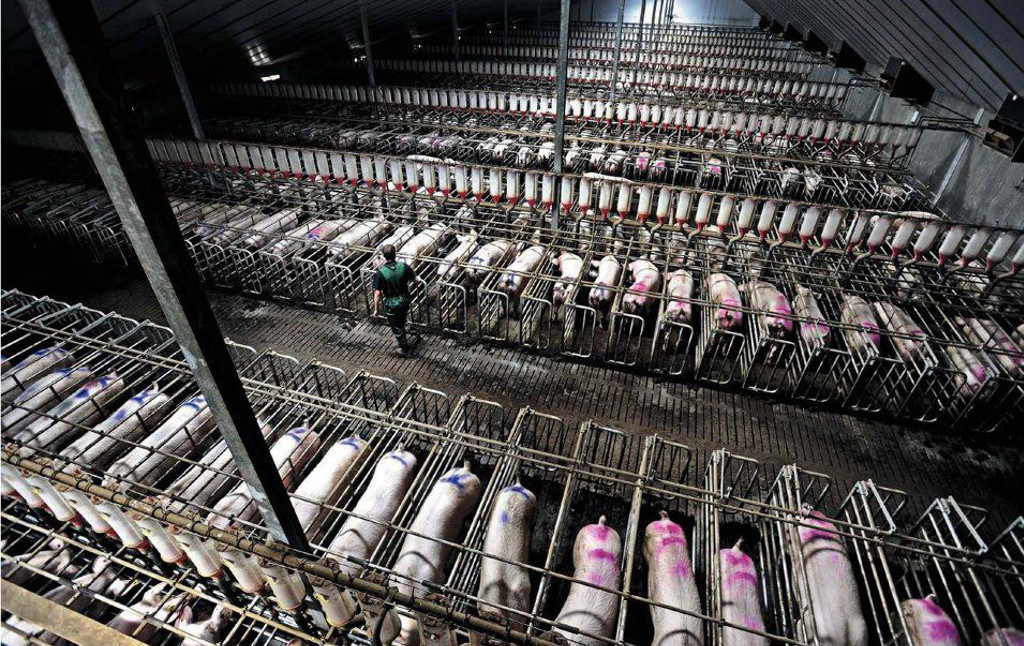
Consider also the life of a mother pig trapped on a factory farm, where she is confined to a gestation crate barely larger than her own body. She is unable to turn around or even lie down comfortably for almost her entire life. Once she gives birth, she is impregnated again, in a cruel cycle that goes on for up to four years before she is killed for her meat. Her piglets are ripped from her when they are just 10 days old, and their tails cut off and their teeth clipped. Her sons have their testicles ripped out without any anesthesia or painkillers.

These are the brutal realities for millions of animals trapped on factory farms. ...
... 
Q: What would you tell parents who want to avoid purchasing meat produced in factory farms, or parents who are considering switching their families’ diets to more plant-based eating? 
A: I’d tell them they are helping not only the planet but themselves and their children by encouraging them to eat more fruits, vegetables and grains. Factory farming heats up our planet, pollutes waterways and air, and eats up land used to grow the grain that feeds livestock — and lots of water too. It also hurts the people who live near and work at [the farms]. Even if a family isn’t vegetarian or vegan, just reducing the amount of meat and dairy we eat can make a difference, and there are so many good plant-based options these days, with many more coming to market every week.


Investigation Exposes Animal Abuse at US Supplier to World’s Largest Meat Company. Reynard Loki, Truthout. Sep. 8, 2018.
“From the day pigs are born until the day they are violently killed for JBS pork, their lives are filled with misery and deprivation,” said Matt Rice, president of MFA, in a press statement. “If JBS executives abused even one dog or cat the way their suppliers abuse millions of pigs, they would be jailed for cruelty to animals."

Death by Fertilizer. Nathanael Johnson, Grist. Oct. 2, 2018.
This breakthrough solution created a crisis as large as the one it solved. Since Haber’s discovery, humans have nearly doubled Earth’s natural flow of fixed nitrogen, overwhelming the capacity of ecosystems to remove it. The resulting buildup is poisoning the planet’s waterways, creating a crisis some consider even more threatening than the buildup of carbon dioxide in the atmosphere.

Time to Drive Factory-Farmed Food Off the Market. Ronnie Cummins & Martha Rosenberg, Organic Consumers Association. Truthout. Sep. 12, 2016.
Factory farming is a trillion-dollar industry that has a devastating impact on food quality, human health, animal welfare, farmworkers, rural communities, water quality, air pollution, biodiversity, and greenhouse gas emissions. Globally, two-thirds of all farm animals are now confined on factory farms. In the US the figure is even higher — 90-95 percent.

The overwhelming majority of US and global farmland today is used either to raise animals before they are sent to the CAFO feedlots, or to grow the GMO and chemical intensive crops such as alfalfa, canola, corn, cotton, soybeans and sugar beets.

The US factory farm meat, dairy and poultry industry is an out-of-control system based on cruel, filthy, disease-ridden and environmentally destructive animal prisons; GMO-and pesticide-tainted feeds; labor exploitation; false advertising; corporate corruption of government; and the use of massive amounts of dangerous pesticides, chemical fertilizers, antibiotics, hormones and growth promoters.

Factory-farm meat, dairy, poultry and fish are the number one cause of water pollution, soil degradation, greenhouse gas emissions diseases such as cancer, heart disease, diabetes, reproductive defects, hormone disruption and obesity.


More weight on less meat. Mark Bittman, NYT. July 18, 2011.

Meat eater's guide to climate change and health. Environmental Working Group.


Plant-Based Diets Can Help Us Reach The 2 Degree Threshold. Carolyn Fortuna, Clean Technica. Oct. 5, 2018.
A report from researchers Poore and Nemecek at the University of Oxford points to one significant solution to meet the 2 degree threshold — avoiding meat and dairy products. They say that this is the single biggest way to reduce our environmental impact on the planet. Meat and dairy provide just 18% of calories and 37% of protein, yet they use the vast majority – 83% – of farmland and produce 60% of agriculture’s GHG emissions. The report indicates that, without meat and dairy consumption, global farmland use could be reduced by more than 75%.
... 
“A vegan diet is probably the single biggest way to reduce your impact on planet Earth, not just greenhouse gases, but global acidification, eutrophication, land use and water use,” Joseph Poore, who led the research, said in an interview with The Guardian. “It is far bigger than cutting down on your flights or buying an electric car,” he said, as these only cut greenhouse gas emissions. “Agriculture is a sector that spans all the multitude of environmental problems. Really it is animal products that are responsible for so much of this. Avoiding consumption of animal products delivers far better environmental benefits than trying to purchase sustainable meat and dairy.”


Slaughter Age vs. Natural Life Span. Colleen Patrick Goudreau. Apr. 11, 2012.

Though we kill over 10 billion land animals every year to please our palates, we too often try to absolve ourselves by making what we want to believe are guilt-free choices, failing to recognize the paradox of “humane slaughter” and never really knowing what the whole experience is for an animal from cradle (domestication) to grave (our bodies).

Though modern animal factories look nothing like what is idealized in children’s books and advertisements, there are also many misconceptions about the practices and principles of a “humane” operation. When we think about it for just a moment, the idea of breeding animals only to kill them is absurd at best, and people are often surprised to learn that most of the animals sent to slaughter are just babies, whether they are raised conventionally or in operations that are labeled “humane,” “sustainable,” “natural,” “free-range,” “cage-free,” “heritage-bred,” “grass-fed” or “organic.”

Slaughter Age vs. Natural Life Span

Pigs: Slaughtered at 6 months young; Natural life span: 6 to 10 years

Chickens: Slaughtered at 6 weeks young; Natural life span: 5 to 8 years for those birds bred as "egg layers" such as Rhode Island Reds; 1 to 4 years for factory layer breeds such as leghorns; and 1 to 3 years for "meat" breeds.

Turkeys: Slaughtered at 5 to 6 months young; Natural life span: 2 to 6 years

Ducks/Geese: Slaughtered at 7 to 8 weeks young; Natural life span: domestic ducks: 6 to 8 years; geese from 8 to 15 years.

Cattle: “Beef” cattle slaughtered at 18 months young; dairy cows slaughtered at 4 to 5 years young; Natural life span: 18 to 25+ years

Veal Calves: Slaughtered at 16 weeks young; Natural life span: 18 to 25+ years

Goats: Slaughtered at 3 to 5 months young; Natural life span: 12 to 14 years

Rabbits: Slaughtered at 10 to 12 weeks young; Natural life span: 8 to 12+ years

Lambs: Slaughtered at 6 to 8 weeks young for “young lamb” and under 1 year for all other; Natural life span: 12 to 14 years

Horses/Donkeys: Slaughter age varies; Natural life span: 30 to 40 years 

When we tell ourselves we’re eating meat from “humanely raised animals,” we tend to refer to the conditions under which animals are raised—not killed. The slaughtering of an animal is a bloody and unpleasant act, and death does not come easy for those who want to live – whether done on a backyard farm or in a chaotic slaughterhouse where desensitized, stressed-out workers often commit unthinkable acts of cruelty – simply because they can. And this end is the same for all animals, whether they’re used for their flesh, milk, or eggs. Dairy cows and egg-laying hens are ultimately slaughtered for meat when the profits to be gained from their flesh outweigh the cost of keeping them alive.

In my opinion, the movement toward “humanely raised food animals” simply assuages our guilt more than it reduces animal suffering. If we truly want our actions to reflect the compassion for animals we say we have, then the answer is very simple. We can stop eating them.


The lives of beef cattle and dairy cows. Animal Defenders International. December 2018


Cattle are farmed either to produce milk or to produce meat but the two industries are intrinsically linked.

Cows reared for beef

In the UK, some beef cattle spend their time between living indoors in sheds during the winter months and outside for the rest of the year, others are reared indoors in intensive systems year-round. While calves in less intensive systems may stay with their mother until they are weaned, others are taken from their mothers as soon as 12 hours after their birth and are raised in pens on milk replacements and pellet feed. Within the first weeks of life male calves are castrated and have the buds of their horns burned off with no anaesthetic.
Outdoor reared cows feed on pastures before slaughter whilst others are transported to ‘fattening sheds’ and fed high-bulk cereals. The conditions in the fattening sheds are barren and crowded and may or may not have straw covering the slatted concrete floors; the cows often find it difficult to stand and may become lame as a result. They are sent for slaughter at approximately 10-12 months of age. Sometimes transported great distances, this adds to the stress they must endure, and the spread of disease. Once arriving at the slaughterhouse, the cattle are stunned (often ineffectively) using a captive bolt pistol before being shackled upside down by the leg and having their throat slit.

Cows reared for dairy

In the UK, dairy cows are most commonly kept in pastures during the summer months and indoors in the winter. However, the practice of keeping cows indoors all year round, known as zero-grazing, is becoming more prevalent. Cows naturally produce milk for their own babies after giving birth, but dairy cows are subjected to the same cruelty as in other intensive farming systems to constantly supply humans with milk. Maximum production is paramount to farmers and cows are bred to produce between 20 and 50 litres of milk each day; around ten times the amount her calf would suckle.

Calves are usually taken from their mothers within the first two days of birth, breaking the strong maternal bond and causing suffering, anxiety and depression for both mother and baby. Under natural circumstances, a calf would suckle between six months and a year. Cows are impregnated again approximately 60 days after giving birth to continue the cycle of milk production.

Despite being able to live up to twenty years of age, dairy cow milk production reduces after the first two or three years, and so they are sent to slaughter, usually at around 6 years of age. Their meat often ends up in low-grade burgers or pet foods.

Female infants taken from their mothers may also become dairy cows, going through the same process of impregnation and losing several babies, as their mother did. Male infants may be killed as soon as they are removed from the mother or grown for ‘low quality’ meat. Male or female calves could also be sold and reared as veal.

Action

You can help cows reared for meat and dairy by adopting a plant-based, vegan diet.


Options for keeping the food system within environmental limits. Marco Springmann et al, Nature. Oct. 10, 2018.
Abstract
The food system is a major driver of climate change, changes in land use, depletion of freshwater resources, and pollution of aquatic and terrestrial ecosystems through excessive nitrogen and phosphorus inputs. Here we show that between 2010 and 2050, as a result of expected changes in population and income levels, the environmental effects of the food system could increase by 50–90% in the absence of technological changes and dedicated mitigation measures, reaching levels that are beyond the planetary boundaries that define a safe operating space for humanity. We analyse several options for reducing the environmental effects of the food system, including dietary changes towards healthier, more plant-based diets, improvements in technologies and management, and reductions in food loss and waste. We find that no single measure is enough to keep these effects within all planetary boundaries simultaneously, and that a synergistic combination of measures will be needed to sufficiently mitigate the projected increase in environmental pressures.


Mighty Meat Proposes A World Where Meat Alternatives Are Better For You & The Environment. Kyle Field, CleanTechnica. Oct. 12, 2018.
Digging into the ingredients for Mighty Meat’s products will reveal that the core ingredients are a few types of legumes and mushrooms. From a protein standpoint, it is comparable with chicken and ranks positively on every single nutritional marker against any meat.

The Best Vegetarian and Vegan Meat Substitutes to Try. Jolinda Hackett, The Spruce Eats. May 31, 2018.


An electrifying idea. George Monbiot. Nov. 6, 2018.
The most important environmental action we can take is to reduce the area of land and sea used by farming and fishing. This means, above all, switching to a plant-based diet: research published in the journal Science shows that cutting out animal products would reduce the global requirement for farmland by 76%. It would also give us a fair chance of feeding the world. Grazing is no answer to the ecocide caused by grain-fed livestock: it is an astonishingly wasteful use of vast tracts of land that would otherwise support wildlife and wild ecosystems. 
The same action is essential to prevent climate breakdown. Because governments, bowing to the demands of capital, have left it so late, it is almost impossible to see how we can stop more than 1.5° of global warming without drawing carbon dioxide out of the atmosphere. The only way of doing it that has been demonstrated at scale is to allow trees to return to deforested land
But could we go beyond even a plant-based diet? Could we go beyond agriculture itself? What if, instead of producing food from soil, we were to produce it from air? What if, instead of basing our nutrition on photosynthesis, we were to use electricity, to fuel a process whose conversion of sunlight into food is ten times more efficient? 
This sounds like science fiction, but it is already approaching commercialization

...

We have allowed a mythical aesthetic to blind us to the ugly realities of industrial agriculture. Instilled with an image of farming that begins in infancy, as about half the books for very small children involve a rosy-cheeked farmer with one cow, one horse, one pig and one chicken, living in bucolic harmony, we fail to see the amazing cruelty of large-scale animal farming, the blood and gore, filth and pollution. We fail to apprehend the mass clearance of land required to feed us, the Insectageddon caused by pesticides, the drying up of rivers, the loss of soil, the reduction of the magnificent diversity of life on Earth to a homogenous grey waste.


3 simple tasks to improve your carbon footprint. Kyle Field, CleanTechnica. Dec. 14, 2018.


According to The Guardian, the meat and dairy industries produce 60% of agriculture’s greenhouse gases, but only 18% of the calories consumed by humans around the world. Additionally, it uses 83% of farmland, which is directly contributing to climate change and, “Loss of wild areas to agriculture is the leading cause of the current mass extinction of wildlife.” That’s a pretty tall side order to take in along with every portion of meat and dairy just by itself. 
Meat fans will list out the ways meat can be raised more responsibly, but it is simply on a different level entirely. It’s to the point where, “even the very lowest impact meat and dairy products still cause much more environmental harm than the least sustainable vegetable and cereal growing,” according to The Guardian. 
I’m not proposing that everyone give up meat entirely, though that is clearly the most sustainable, low carbon way to live. Instead, I think it’s easier to either give up meat most days during the week, or just eat meat as a special treat. Alternately, significant gains could be had from just dropping beef and opting for chicken or pork, which are responsible for just 1/4 of the emissions per serving compared to beef.


What’s the alternative to factory farms? Book review by Martin Empson, Climate & Capitalism. Jan. 20, 2019.

‘Farming, Food and Nature’ offers a powerful critique of industrial livestock production, but fails to challenge the profit-system that drives it.

Joyce D’Silva and Carol McKenna, editors
FARMING, FOOD AND NATURE: Respecting Animals, People and the Environment
Routledge, 2018