Too Late for 2

But not too late for 4. Urgent action needed to prevent worst-case climate change scenarios and limit repercussions of abrupt runaway climate change..... OR, that's what I used to think, 5+ years ago; NOW I think it is indeed too late; we're f'd. Tipping points have tipped. Positive feedback effects in play. Bring on the methane. Abrupt climate change on the horizon. Exponential changes will escalate. Homo sapiens may not survive the current on-going 6th mass extinction.

Pages

  • Home
  • Bibliography
  • Climate Change Charts
  • Videos: Climate Change
  • Videos: Animal Rights
  • Videos: Geopolitics and Corporatocracy
Showing posts with label Kevin Anderson. Show all posts

Saturday, September 21, 2019

Topic: Green New Deal

ONLY A GREEN NEW DEAL CAN DOUSE THE FIRES OF ECO-FASCISM. Naomi Klein, The Intercept. September 16 2019.


The Green New Deal: A Fight for Our Lives. Naomi Klein, New York Review of Books. Sept. 17, 2019.


Only a Global Green New Deal Can Save the Planet. And Bernie Sanders has a plan for that. Tom Athanasiou, The Nation. Sept. 17, 2019
But the true genius of Sanders’s Green New Deal—its secret weapon for achieving the massive emissions cuts he promises—has gone unnoticed by mainstream news organizations and even most climate activists. He clearly recognizes that eliminating greenhouse gas emissions by 2030, as some climate activists have demanded, is all but impossible in an economy as enormous and energy intensive as the United States’—at least without paralyzing transportation systems, endangering food supplies, and otherwise triggering a social backlash. But rather than just endorse the 2030 deadline anyway, as some activists insist, or pretend that the science is negotiable, as most politicians do, Sanders has found a credible way around the dilemma. 
... 
What makes the Sanders plan special is that he accepts the hard scientific truth that steep emissions cuts are essential but he makes such cuts feasible by refusing to limit his vision on how to achieve them. Rather, he adds another hard truth: If humanity is to stabilize the global climate system, rich nations must do their fair share by going beyond domestic action and providing support for emissions reductions in poorer countries. Sanders is the first major American political figure to face the reality and scale of this necessity.

The Hope of the Green New Deal. Roger Blanchard, Resilience. Sept. 25, 2019.
One individual who is more realistic about what needs to be done – but will not be done – to reduce CO2 emissions is the prominent climate scientist Kevin Anderson. Approximately 6 years ago he stated that the world had to reduce CO2 emissions by 10%/year starting immediately to prevent a worst-case scenario in terms of warming. He was very likely right about that, but at the time I stated the world would not do what he said needed to be done.  As it has turned out, CO2 emissions have increased since then not decreased.

Kevin is now stating that we have to fundamentally change the way we live.  Specifically we need to get away from a materialist lifestyle.  The problem is that in the U.S., and much of the world now, we have a hedonic lifestyle which most Americans worship.  Thus, we have lots of magical thinking when it comes to addressing the global warming issue and we prefer to kick the can down the road and test the worst-case scenario.

To be clear, those who deny the conclusions of climate science are partaking in magical thinking because the science is overwhelming.  As well, those who believe that renewables will largely or wholly replace fossil fuels are partaking in magical thinking because it’s based upon nothing more than naïve optimism.  The fundamental problem we face is that there are too many people consuming too much fossil fuels and producing too much CO2.  Either we will correct the problem or nature will correct the problem.


A Serious Green New Deal Would Take Up One-Third of the Economy—Are We Ready for That? Yves Smith, nakedcapitalism. Feb. 2, 2019.
I have to confess to being not keen about various Green New Deal proposals. They feed the idea that we can largely preserve our lifestyles and still make a big enough reduction in greenhouse gas output soon enough to ward off catastrophic outcomes. 
There are in my mind, three fallacies here:

1. The fastest and most effective way to reduce greenhouse gas output is radical conservation. The urgency of the challenge means this approach needs to be top of the list. Every year more of status quo or not much different is more greenhouse gases pumped into the atmosphere. No one is proposing that we even take measures of the sort imposed in the oil crisis, like lowering speed limits and requiring businesses to set their thermostats to 67 in the winter and 77 in the summer. If we were serious, we’d have to be willing to bankrupt the airlines by forcing 90% reductions in flight levels and outlaw private jets.

2. Building green infrastructure has an energy cost, and those costs are seldom incorporated (like the greenhouse gas cost of mining and delivering materials for production of various inputs). They are also not factoring in that some of the materials that are important in current “green” technologies don’t exist in sufficient quantity to satisfy anticipated needs (Jack Lifton has written extensively about lithium). And some materials are costly in environmental terms. See, for example: 
Critical minerals scarcity could threaten renewable energy future. Stanford
We may face a huge shortage of essential raw materials stiffling green energy if governments don’t step up their game ZME Science
 3. While Green New Deal approaches would be valuable in conjunction with radical conservation, they aren’t sufficient on their own, if nothing else because they will take too long to be implemented when time is of the essence. And they have a tendency to perpetuate the idea that there will be no or little sacrifice needed in cutting carbon output levels.
People accepted rationing and other forms of sacrifice at times of war. I’d take the Green New Deal people a lot more seriously if they firmly opposed US military activity as a source of greenhouse gases and also opposed non-essential, energy costly technology planned obsolescence schemes like 5G.


let's declare war on climate change:  “What You Need To Know About The $22 Trillion National Debt”: The Alternative SHORT Interview. Eric Tymoigne. Feb. 17, 2019.


Jobs, the Environment, and a Planet in Crisis. Unions vs. Environmentalists or Unions and Environmentalists?  Aviva Chomsky, via TomDispatch. Aug. 6, 2019.

When it comes to heat, extreme weather, wildfires, and melting glaciers, the planet is now in what the media increasingly refers to as “record” territory, as climate change’s momentum outpaces predictions. In such a situation, in a country whose president and administration seem hell-bent on doing everything they conceivably can to make matters worse, the Green New Deal (GND) seems to offer at least a modest opening to a path forward.

You know, the resolution introduced this February in the House of Representatives by Alexandria Ocasio-Cortez (D-NY) and Edward Markey (D-MA). Unsurprisingly, the proposal has been roundly attacked by the right. But it’s stirred up some controversy on the left as well. You might imagine that labor unions and environmental organizations would be wholeheartedly for a massive federal investment in good jobs and a just transition away from fossil fuels. But does organized labor actually support or oppose the Green New Deal? What about environmental organizations? If you’re not even sure how to answer such questions, you’re not alone.

That 14-page resolution calls for “a new national, social, industrial, and economic mobilization on a scale not seen since World War II and the New Deal era.” Its purpose: to reduce U.S. carbon emissions to net zero within a decade, while guaranteeing significant numbers of new jobs and social welfare to American workers. Read it and you’ll find that it actually attempts to overcome historical divisions between the American labor and environmental movements by linking a call for good jobs and worker protection to obvious and much-needed environmental goals.

In the process, the GND proposal goes impressively far beyond the modest goals of the Paris Climate Accords and other international agreements. It supports specific, enforceable targets for bringing climate change under control, while drawing clear connections between social, labor, and environmental rights. Acknowledging in blunt terms the urgency of making systemic change on a rapidly warming planet, it calls for the kind of national mobilization Americans haven’t experienced since the end of the Second World War. Described that way, it sounds like something both the labor and environmental movements would naturally support without a second thought. There is, however, both a history of mistrust and real disagreement over issues, which both movements are now grappling with. And the media is doing its part by exaggerating labor’s opposition to the proposal, while ignoring what environmental organizations have to say.

One Green New Deal controversy focuses on the future role of fossil fuels in that plan. A number of environmental organizations believe that such energy sources have no place in our future, that they need to stay in the ground, period. They cite climate science and the urgent need to move rapidly and drastically to eliminate carbon emissions as the basis for such a conclusion. As it happens, the Green New Deal avoids directly challenging the fossil-fuel industry. In fact, it doesn’t even use the term “fossil fuels.”

From another perspective, some unions hope that new technologies like carbon capture, utilization, and storage (CCUS) will make those fuels more efficient and far cleaner. If the addition of carbon to the atmosphere could be reduced significantly or offset in some fashion, while humanity still burned natural gas, oil, or even coal, they say, jobs in those sectors could be preserved. And the unions have other concerns as well. They tend, for instance, to look skeptically on the GND’s promises of a “just transition” for displaced fossil-fuel workers like coal miners, given the devastation that has fallen on workers and their communities when industries have shut down in the past. They also fear that, without accompanying trade protections, polluting industries will simply export their emissions rather than reduce them.

Being more of a statement of purpose than an elaborated plan, the Green New Deal is short on both detail and answers when it comes to such issues. The actual roadmap to achieving its goals, the proposal states, “must be developed through transparent and inclusive consultation, collaboration, and partnership with frontline and vulnerable communities, labor unions, worker cooperatives, civil society groups, academia, and businesses.” Both unions and environmental organizations are already mobilizing to make sure their voices are part of the process.

The right wing was quick to mockingly publicize the Green New Deal not just as thoroughly unrealistic but as utterly un-American. ...

yup, because what's truly American is all that's wrong with our unsustainable civilization.

Is There An Upper Limit On Human Self-Deceptive Bullshit? Dave Cohen, Deline of the Empire. Feb. 7, 2019.

So, even a non-binding resolution expressing humanity's positive but delusional hopes and fantasies is unlikely to make it through the U.S. Congress.
Posted by mw at 4:12 PM No comments:
Email ThisBlogThis!Share to XShare to FacebookShare to Pinterest
Labels: Bernie, Blanchard, green new deal, Kevin Anderson, Klein, topics

Saturday, March 16, 2019

Kevin Anderson

Delivering on 2C. Kevin Anderson. 


The Gordon Goodman Memorial Lecture.


Edinburgh. Oct 2018.


Beyond dangerous climate change. Philosophical Transactions of the Royal Society. Jan. 2011.

This paper demonstrates how meeting the international community’s commitment to “hold the increase in global temperature below 2 degrees Celsius” demands emission reductions far beyond those suggested in the plethora of politically-palatable analysis informing governments. Relying on real rather than naïve modelled data the paper demonstrates how even a 50:50 chance of not exceeding 2°C requires emission reductions of over 7% p.a. – a conclusion made all the more demanding once equity-issues are considered. Put simply, if even a small emission space is assumed for the poorer (non-Annex 1) nations, there is virtually no space available for the wealthier (Annex 1) nations. The paper concludes that “dangerous climate change can only be avoided if economic growth is exchanged for a period of planned austerity within Annex 1 nations at the same time as there is a rapid transition away from fossil-fuelled development within non-Annex 1 nations.” Unfortunately, in 2011, and despite the evidence, such a conclusion is still beyond anything we are yet prepared to countenance.


Duality in climate science. Nature Geoscience. Oct. 2015.

Brief Abstract:
The commentary demonstrates the endemic bias prevalent amongst many of those developing emission scenarios to severely underplay the scale of the 2°C mitigation challenge. In several important respects the modelling community is self-censoring its research to conform to the dominant political and economic paradigm. Moreover, there is a widespread reluctance of many within the climate change community to speak out against unsupported assertions that an evolution of ‘business as usual’ is compatible with the IPCC’s 2°C carbon budgets. 
With specific reference to energy, this analysis concludes that even a slim chance of “keeping below” a 2°C rise, now demands a revolution in how we both consume and produce energy. Such a rapid and deep transition will have profound implications for the framing of contemporary society and is far removed from the rhetoric of green growth that increasingly dominates the climate change agenda.

On the duality of climate scientists:
… how integrated assessment models are hard-wired to deliver politically palatable outcomes
The value of science is undermined when we adopt questionable assumptions and fine-tune our analysis to conform to dominant political and economic sensibilities. The pervasive inclusion of speculative negative emission technologies to deliver politically palatable 2°C mitigation is but one such example. Society needs scientists to make transparent and reasoned assumptions, however uncomfortable the subsequent conclusions may be for the politics of the day.

What if ‘negative emission technologies’ (NETs) fail at scale: Implications of the Paris Agreement for big emitting nations. Alice Larkin, Jaise Kuriakose, Maria Sharmina, and Kevin Anderson. Climate Policy. Aug. 2017.

Abstract
A cumulative emissions approach is increasingly used to inform mitigation policy. However, there are different interpretations of what ‘2°C’ implies. Here it is argued that cost-optimisation models, commonly used to inform policy, typically underplay the urgency of 2°C mitigation. The alignment within many scenarios of optimistic assumptions on negative emissions technologies (NETs), with implausibly early peak emission dates and incremental short-term mitigation, delivers outcomes commensurate with 2°C commitments. In contrast, considering equity and socio-technical barriers to change, suggests a more challenging short-term agenda. To understand these different interpretations, short-term CO2 trends of the largest CO2 emitters, are assessed in relation to a constrained CO2 budget, coupled with a ‘what if’ assumption that negative emissions technologies fail at scale. The outcomes raise profound questions around high-level framings of mitigation policy. The paper concludes that applying even weak equity criteria, challenges the feasibility of maintaining a 50% chance of avoiding 2°C without urgent mitigation efforts in the short-term. This highlights a need for greater engagement with: (1) the equity dimension of the Paris Agreement, (2) the sensitivity of constrained carbon budgets to short-term trends and (3) the climate risks for society posed by an almost ubiquitous inclusion of NETs within 2°C scenarios.
Posted by mw at 8:52 PM No comments:
Email ThisBlogThis!Share to XShare to FacebookShare to Pinterest
Labels: Kevin Anderson, videos

Thursday, January 31, 2019

Climate Links: January 2019

To Those Who Think We Can Reform Our Way Out of the Climate Crisis. Ben Ehrenreich. The Nation. Jan. 15, 2019.
Our only hope is to stop exploiting the earth—and its people.

Welcome to the future. It feels like it, doesn’t it? Like we have reached the end of something—of the days when the Arctic was not actually in flames, when the permafrost was not a sodden mush, when the Greenland and Antarctic ice sheets were not rushing to join the quickly rising seas. Perhaps we have also, finally, reached the end of the days when we could soothe ourselves with lies, or delusions at least; when we imagined that we were the only masters here, that we could keep taking what we wanted, and that no one would ever have to pay. 
We are paying now. Twenty eighteen was the year that temperatures scraped 90 degrees in the Norwegian Arctic; that permafrost in northern Siberia failed to freeze at all; that wildfires burned on the taiga there, as well as above the Arctic Circle in Alaska and Sweden, in the moors of northern England, in Greece, and in California, where they showed no sense of poetic restraint whatsoever and reduced a place called Paradise to ash.

And where there wasn’t fire, there were floods: Hundreds died and millions were evacuated from rising waters in Japan, southern China, and the Indian state of Kerala. Venice flooded too, and Paris, where the Louvre had to close its Department of Islamic Arts, which it had consigned, ahem, to a basement. It was also the year the United Nations’ climate change body warned that, to avoid full-on cataclysm, we, the humans of planet Earth, would have just 12 years (11 now) to cut carbon emissions by 45 percent, and 32 years (31 and counting) to eliminate such emissions altogether. 
Still, the weather may be the least of our problems. The fire that razed Paradise displaced 52,000 people overnight, forcing many into the ranks of California’s swelling homeless population and what passes for a safety net these days: free berths on the asphalt in a Walmart parking lot. Millions more of us will become refugees when a mega-storm drowns Miami or Manila, and when the Bay of Bengal rises high enough to swallow Bangladesh. Narendra Modi’s India is ready, and has nearly finished stretching barbed wire across the entire 2,500-mile border with Bangladesh. By conservative estimates, climate change will displace a quarter of a billion people over the next 31 years. Most will not be wealthy, and most will not be white.

We do know, at least, how we got here. It was all that oil and coal that we burned, that we’re still burning. But that “we” is misleading. It isn’t all of us, and never was. As the Swedish scholar Andreas Malm recounts in Fossil Capital, his exhaustive account of the rise of the coal-powered steam engine, coal was initially embraced by a tiny subclass of wealthy Englishmen, the ones who owned the mills. They came to favor steam over hydropower in large part because it allowed them to erect factories in cities and towns—rather than submitting to the dictates of distant rivers and streams—giving them access to what we would now call a flexible workforce: masses of hungry urbanites accustomed to the indignities of factory labor, willing to toil for less, easily replaceable if they refused. 
[…] 
From its inception, then, the carbon economy has been tied to the basic capitalist mandate to disempower workers, to squeeze the most sweat out of people for the least amount of money. For the last 200-odd years, the exploitation of the planet has been inseparable from the exploitation of living human beings....

Trudeau's environmental record on the line in Canada election year. Leyland Cecco, Guardian. Jan. 2, 2019.
October’s parliamentary elections may hinge on the recent pipeline nationalisation and the government’s carbon tax plan

The Democrats Are Climate Deniers. Branko Marcetic, Jacobin. Jan. 28, 2019.
If the Democrats really believed the science on climate change, they'd be offering far more radical proposals. We have to make them.

Preliminary US Emissions Estimates for 2018. Rhodium Group. Jan. 8, 2019.
After three years of decline, US carbon dioxide (CO2) emissions rose sharply last year. Based on preliminary power generation, natural gas, and oil consumption data, we estimate emissions increased by 3.4% in 2018. This marks the second largest annual gain in more than two decades — surpassed only by 2010 when the economy bounced back from the Great Recession. While a record number of coal-fired power plants were retired last year, natural gas not only beat out renewables to replace most of this lost generation but also fed most of the growth in electricity demand. As a result, power sector emissions overall rose by 1.9%. The transportation sector held its title as the largest source of US emissions for the third year running, as robust growth in demand for diesel and jet fuel offset a modest decline in gasoline consumption. The buildings and industrial sectors also both posted big year-on-year emissions gains. Some of this was due to unusually cold weather at the start of the year. But it also highlights the limited progress made in developing decarbonization strategies for these sectors. The US was already off track in meeting its Paris Agreement targets. The gap is even wider headed into 2019.

Air travel is surging. That’s a huge problem for the climate. Umair Irfan. Vox. Jan. 13, 2019.
US airlines have an abysmal carbon footprint.

Warming Of Oceans Equivalent To An Atomic Bomb Per Second For 150 Years. Damian Carrington, Guardian. Jan. 7, 2019.
Global warming has heated the oceans by the equivalent of one atomic bomb explosion per second for the past 150 years, according to analysis of new research. 
More than 90% of the heat trapped by humanity’s greenhouse gas emissions has been absorbed by the seas, with just a few per cent heating the air, land and ice caps respectively. The vast amount of energy being added to the oceans drives sea-level rise and enables hurricanes and typhoons to become more intense. Much of the heat has been stored in the ocean depths but measurements here only began in recent decades and existing estimates of the total heat the oceans have absorbed stretch back only to about 1950. The new work extends that back to 1871. Scientists have said that understanding past changes in ocean heat was critical for predicting the future impact of climate change.

A Guardian calculation found the average heating across that 150-year period was equivalent to about 1.5 Hiroshima-size atomic bombs per second. But the heating has accelerated over that time as carbon emissions have risen, and was now the equivalent of between three and six atomic bombs per second. “I try not to make this type of calculation, simply because I find it worrisome,” said Prof Laure Zanna, at the University of Oxford, who led the new research. “We usually try to compare the heating to [human] energy use, to make it less scary.” She added: “But obviously, we are putting a lot of excess energy into the climate system and a lot of that ends up in the ocean,. There is no doubt.” The total heat taken up by the oceans over the past 150 years was about 1,000 times the annual energy use of the entire global population.

Accelerating changes in ice mass within Greenland, and the ice sheet’s sensitivity to atmospheric forcing. Michael Bevis et al, PNAS. Jan. 22, 2019.


Permafrost Is Warming Around the Globe, Study Shows. That's a Problem for Climate Change. Bob Berwyn, InsideClimateNews. Jan. 16, 2019.
Rapid changes in the long-frozen soil are raising concerns about a surge of planet-warming greenhouse gases as the permafrost thaws.

Climate Forecast: World Is “Sleepwalking into Catastrophe”. Anne C. Mulkern, E&E News, Scientific American. Jan. 17, 2019.
In an annual World Economic Forum report, climate change, extreme weather and biodiversity loss were named among the highest global risks

If you can't deny it, downplay it. How capitalists talk about climate change. Rob Larson and Nathan J. Robinson, Current Affairs. Jan. 13, 2019.


We Need to Accept We're Likely Underestimating the Climate Crisis. Jack Holmes, Esquire. Jan. 22, 2019.
Three new reports in the last month suggest we are.


Are We Living Through Climate Change’s Worst-Case Scenario? Robinson Meyer, The Atlantic. Jan. 15, 2019.
“We’re a lot closer than we should be,” one Stanford scientist warned.
When climate scientists want to tell a story about the future of the planet, they use a set of four standard scenarios called “representative concentration pathways,” or RCPs. RCPs are ubiquitous in climate science, appearing in virtually any study that uses climate models to investigate the 21st century. They’ve popped up in research about subjects as disparate as southwestern mega-droughts, future immigration flows to Europe, and poor nighttime sleep quality. 
Each RCP is assigned a number that describes how the climate will fare in the year 2100. Generally, a higher RCP number describes a scarier fate: It means that humanity emitted more carbon dioxide into the atmosphere during the 21st century, further warming the planet and acidifying the ocean. The best-case scenario is called RCP 2.6. The worst case is RCP 8.5.

“God help us if 8.5 turns out to be the right scenario,” Jackson told me. Under RCP 8.5, the world’s average temperature would rise by 4.9 degrees Celsius, or nearly 9 degrees Fahrenheit. “That’s an inconceivable increase for global temperatures—especially when we think about them being global average temperatures,” he said. “Temperatures will be even higher in the northern latitudes, and higher over land than over the ocean.” 
This scenario could still be in the planet’s future, according to Zeke Hausfather, an analyst and climate scientist at Berkeley Earth. Since 2005, total global greenhouse-gas emissions have most closely tracked the RCP 8.5 scenario, he says. “There may be good reasons to be skeptical of RCP 8.5’s late-century values, but observations to-date don’t really give us grounds to exclude it,” he recently wrote. 
Even if we avoid RCP 8.5, the less dramatic possibilities still could lead to catastrophic warming. Jackson, the Stanford professor, warned that every emissions scenario that meets the Paris Agreement’s 2-degree Celsius “goal” assumes that humanity will soon develop technology to remove carbon directly from the atmosphere. Such technology has never existed at industrial scales.

“Even some [of the scenarios] for 3 degrees Celsius assume that at some point in the next 50 years, we will have large-scale industrial activities to remove greenhouse gases from the atmosphere,” he said. “It’s a very dangerous game, I think. We’re assuming that this thing we can’t do today will somehow be possible and cheaper in the future. I believe in tech, but I don’t believe in magic.”

Climate change tipping point could be coming sooner than we think. Holly Evarts, Columbia Engineering. Jan. 23, 2019.
Global carbon emissions reached a record high in 2018, rising by an estimated 3.4 percent in the U.S. alone. This trend is making scientists, government officials, and industry leaders more anxious than ever about the future of our planet. As United Nations Secretary General António Guterres said at the opening of the 24th annual U.N. climate conference on 3 December 2018, “We are in deep trouble with climate change.” 
A Columbia Engineering study, published today in Nature, confirms the urgency to tackle climate change. While it’s known that extreme weather events can affect the year-to-year variability in carbon uptake, and some researchers have suggested that there may be longer-term effects, this new study is the first to actually quantify the effects through the 21st century and demonstrates that wetter-than-normal years do not compensate for losses in carbon uptake during dryer-than-normal years, caused by events such as droughts or heatwaves. 
Anthropogenic emissions of CO2—emissions caused by human activities—are increasing the concentration of CO2 in the Earth’s atmosphere and producing unnatural changes to the planet’s climate system. The effects of these emissions on global warming are only being partially abated by the land and ocean. Currently, the ocean and terrestrial biosphere (forests, savannas, etc.) are absorbing about 50% of these releases—explaining the bleaching of coral reefs and acidification of the ocean, as well as the increase of carbon storage in our forests. 
“It is unclear, however, whether the land can continue to uptake anthropogenic emissions at the current rates,” says Pierre Gentine, associate professor of earth and environmental engineering and affiliated with the Earth Institute, who led the study. “Should the land reach a maximum carbon uptake rate, global warming could accelerate, with important consequences for people and the environment. This means that we all really need to act now to avoid greater consequences of climate change.”


What can you do to prepare when you can't? Albert Bates. Jan. 20, 2019.


Capricious foes, Big Sister & high-carbon plutocrats: irreverent musings from Katowice’s COP24. Kevin Anderson. Jan. 10, 2019.
1) An Orwellian tale: myths & hidden enemies 
A quick glance at COP24 suggests three steps forward and two steps back. But whilst to the naïve optimist this may sound like progress, in reality it’s yet another retrograde bound towards a climate abyss. As government negotiators play poker with the beauty of three billion years of evolution, climate change emissions march on. This year with a stride 2.7% longer than last year – which itself was 1.6% longer than the year before. Whilst the reality is that every COP marks another step backwards, the hype of these extravaganzas gives the impression that we’re forging a pathway towards a decarbonised future. 
For me the fantasy-land of COP24 was epitomised at the UK’s ever-busy Green is Great stand. Here, the nation that kick-started the fossil-fuel era, regaled passers-by with a heart-warming tale of rapidly falling emissions and a growing green economy. This cheerful narrative chimed with those desperate to believe these annual junkets are forging a decarbonised promise-land...
[which reminds me of those f'g TV commercials our federal govt has spent our tax dollars on producing to propagandize us into believing that the Kinder Morgan pipeline makes Canada somehow greener]


The new elite’s phoney crusade to save the world – without changing anything. Anand Giridharadas, Guardian. Jan. 22, 2019.
Today’s titans of tech and finance want to solve the world’s problems, as long as the solutions never, ever threaten their own wealth and power. 

UK has biggest fossil fuel subsidies in the EU, finds commission. Damian Carrington, Guardian. Jan. 23, 2019.
Subsidies for coal, oil and gas are not falling despite EU pledges to tackle climate change

IEA Chief: EVs Are Not The End Of The Oil Era. Tsvetana Paraskova, OilPrice.com. Jan 22, 2019.
Electric vehicles (EVs) today are not the end of global oil demand growth, nor are they the key solution to reducing carbon emissions, Fatih Birol, the Executive Director of the International Energy Agency (IEA), said during the ‘Strategic Outlook on Energy’ panel at the World Economic Forum in Davos on Tuesday. 
According to Birol, analysts need to put things into perspective and consider that five million EVs globally is nothing compared to 1 billion internal combustion engine (ICE) cars. 
“This year we expect global oil demand to increase by 1.3 million barrels per day. The effect of 5 million cars is 50,000 barrels per day. 50,000 versus 1.3 million.” 
“Cars are not the driver of oil demand growth. Full stop,” Birol said. 


Drilling Towards Disaster: Why U.S. Oil and Gas Expansion Is Incompatible with Climate Limits. Kelly Trout, Price of Oil. January 16, 2019.

A new study released by Oil Change International and 17 partner organizations examines the urgent need for U.S. leadership to manage a rapid and just decline of fossil fuel production. 
The United States should be a global leader in winding down fossil fuel use and production. Instead, the U.S. oil and gas industry is gearing up to unleash the largest burst of new carbon emissions in the world between now and 2050. At precisely the time in which the world must begin rapidly decarbonizing to avoid runaway climate disaster, the United States is moving further and faster than any other country to expand oil and gas extraction. 
Key findings include: 
Unprecedented Oil & Gas Expansion: Between 2018 and 2050, U.S. drilling into new oil and gas reserves could unlock 120 billion metric tons of new carbon pollution, which is equivalent to the lifetime CO2 emissions of nearly 1,000 coal-fired power plants. If not curtailed, U.S. oil and gas expansion will impede the rest of the world’s ability to manage a climate-safe, equitable decline of oil and gas production. 
Expansion Hot Spots: Some 90% of U.S. drilling into new oil and gas reserves through 2050 would depend on fracking; nearly 60% of the carbon emissions enabled by new U.S. drilling would come from the epicenters of fracking – the Permian Basin of Texas and New Mexico and the Appalachian Basin across Pennsylvania, West Virginia, and Ohio. 
Coal – Too Much Already: Given U.S. coal mining should be phased out by 2030 or sooner if the world is to equitably achieve the Paris Agreement goals, at least 70% of the coal in existing U.S. mines should stay in the ground. 
These findings show that leadership is urgently needed towards a U.S. fossil fuel phase-out that aligns with climate limits, takes care of workers and communities on its front lines, and builds a more healthy and just economy for all in the process. 
Key recommendations for what U.S. policymakers must do to show real climate leadership:
  1. Ban new leases or permits for new fossil fuel exploration, production, and infrastructure;
  2. Plan for the phase-out of existing fossil fuel projects in a way that prioritizes environmental justice;
  3. End subsidies and other public finance for the fossil fuel industry;
  4. Champion a Green New Deal that ensures a just transition to 100 percent renewable energy; and
  5. Reject the influence of fossil fuel money over U.S. energy policy.


Eight charts show how ‘aggressive’ railway expansion could cut emissions. Jocelyn Timperley, CarbonBrief. Jan. 30, 2019.
Global transport emissions could peak in the 2030s if railways are “aggressively” expanded, says the International Energy Agency (IEA). 
Rail is among the most efficient and lowest emitting modes of transport, according to the IEA’s new report focusing on the opportunities it offers for energy and the environment. 
In particular, urban and high-speed rail hold “major promise to unlock substantial benefits”, the report says, which include reducing greenhouse gas emissions, congestion and air pollution.

OPINION: SOONER OR LATER, WE HAVE TO STOP ECONOMIC GROWTH — AND WE’LL BE BETTER FOR IT. Richard Heinberg Ensia. Jan. 8, 2019.
The end of growth will come one day, perhaps very soon, whether we’re ready or not. If we plan for and manage it, we could well wind up with greater well-being.

The Green New Deal: How We Will Pay For It Isn't 'A Thing' - And Inflation Isn't Either. Robert Hockett, Forbes. Jan. 16, 2019.


8 percent of Americans recently changed their minds on climate. What gives? Kate Yoder, Grist. Jan. 16, 2019.

what the headline doesn't tell you: of those that have changed their minds on climate change in the last year, they haven't ALL become more concerned... about 85% of mind-changers are more concerned, but 15% have actually said they are LESS concerned


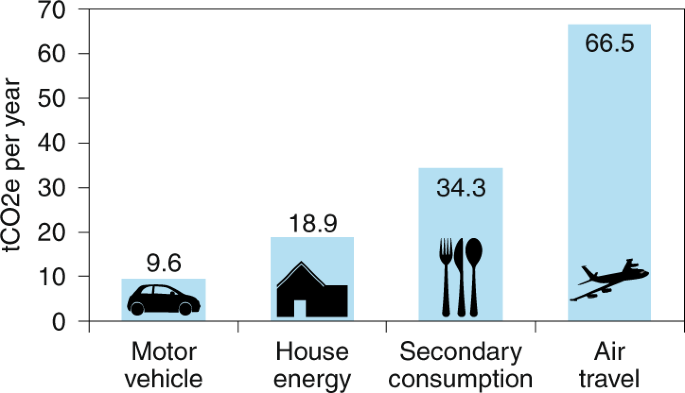
Shift the focus from the super-poor to the super-rich. Ilona M. Otto et al, Nature Climate Change. Jan. 28, 2019.
Fig. 1: The estimated carbon footprint of a typical super-rich household of two people.


We need to rethink everything we know about global warming. Jan. 20, 2019.

Israeli researcher claims his calculations show scientists have grossly underestimated the effects of air pollution.
The world’s scientific community has known for a long time that global warming is caused by man-made emissions in the form of greenhouse gases, while global cooling is caused by air pollution in the form of aerosols. 
In a new study published in the journal Science, Hebrew University of Jerusalem Prof. Daniel Rosenfeld argues that the degree to which aerosol particles cool the earth has been grossly underestimated. 
Aerosols are tiny particles of many different materials that get into the air, like dust and vehicle exhaust. They cool our environment by enhancing the cloud cover that reflects the sun’s heat back to space.  
Rosenfeld says his findings necessitate a recalculation of climate-change models to more accurately predict the pace of global warming. 
He and his colleague Yannian Zhu from the Meteorological Institute of Shaanxi Province in China developed a new method that uses satellite images to calculate the effect of vertical winds as well as aerosol cloud droplet numbers. Until now, it was impossible to separate the effects of rising winds, which create the clouds, from the effects of aerosols, which determine clouds’ composition. 
Using this new methodology, Rosenfeld and his colleagues were able to more accurately calculate aerosols’ cooling effects on the Earth. They discovered this effect is nearly two times higher than previously thought. 
But this finding does not necessarily mean we can stop worrying about global warming. Rosenfeld has several theories about why temperatures are rising despite the aerosol effect. 
“If the aerosols indeed cause a greater cooling effect than previously estimated, then the warming effect of the greenhouse gases has also been larger than we thought, enabling greenhouse-gas emissions to overcome the cooling effect of aerosols,” Rosenfeld said.

Aerosol-driven droplet concentrations dominate coverage and water of oceanic low level clouds. Daniel Rosenfeld, Science. Jan. 17, 2019.


Adelaide breaks its all-time heat record, hitting 46.6C, in extreme Australia heatwave. Guardian. Jan. 24, 2019.

huge animal culls, including thousands of camels dying of thirst that had to be shot to put them out of their misery
Posted by mw at 11:58 PM No comments:
Email ThisBlogThis!Share to XShare to FacebookShare to Pinterest
Labels: Heinberg, Kevin Anderson, links, tipping point, Trudeau

Sunday, January 13, 2019

Views of Kevin Anderson

Capricious foes, Big Sister & high-carbon plutocrats: irreverent musings from Katowice’s COP24. Jan. 10, 2019.

… the time for action is not at COP25, but now and during the intervening months …

Four weeks on and the allure of Christmas and New Year festivities fade into the grey light of a Manchester January – a fine backdrop for revisiting December’s COP24

1) An Orwellian tale: myths & hidden enemies 


A quick glance at COP24 suggests three steps forward and two steps back. But whilst to the naïve optimist this may sound like progress, in reality it’s yet another retrograde bound towards a climate abyss. As government negotiators play poker with the beauty of three billion years of evolution, climate change emissions march on. This year with a stride 2.7% longer than last year – which itself was 1.6% longer than the year before. Whilst the reality is that every COP marks another step backwards, the hype of these extravaganzas gives the impression that we’re forging a pathway towards a decarbonised future.

For me the fantasy-land of COP24 was epitomised at the UK’s ever-busy Green is Great stand. Here, the nation that kick-started the fossil-fuel era, regaled passers-by with a heart-warming tale of rapidly falling emissions and a growing green economy. This cheerful narrative chimed with those desperate to believe these annual junkets are forging a decarbonised promise-land. Despite my cynicism, I was nevertheless surprised just how pervasive the UK’s mirage had become.

Adjacent to Brexit Blighty’s pavilion was the WWF’s Panda Hub. Here I attended a session at which two British speakers offered advice to the New Zealand government on their forthcoming energy law. The mantra of the UK being at the vanguard of climate action was reiterated by a ‘great & good’ of the NGO world and by the Director of Policy at a prestigious climate change institute. A similar fable from a couple of Government stooges would not have been a surprise. But surely the NGO and academic communities should demonstrate greater integrity and a more discerning appraisal of government assertions?

If you ignore rising emissions from aviation and shipping along with those related to the UK’s imports and exports, a chirpy yarn can be told. But then why not omit cars, cement production and other so-called “hard to decarbonise” sectors? In reality, since 1990 carbon dioxide emissions associated with operating UK plc. have, in any meaningful sense, remained stubbornly static.[1] But let’s not just pick on the UK. The same can be said of many self-avowed climate-progressive nations, Denmark, France and Sweden amongst them. And then there’s evergreen Norway with emissions up 50% since 1990.

Sadly the subterfuge of these supposed progressives was conveniently hidden behind the new axis of climate-evil emerging in Katowice[2]: Trump’s USA; MBS’s Saudi; Putin’s Russia; and the Emir’s Kuwait – with Scott Morrison, Australia’s prime minister, quietly sniggering from the side-lines. But surely no one really expected more from this quintet of regressives. It’s the self-proclaimed paragons of virtue where the real intransigence (or absence of imagination) truly resides. When it comes to commitments made in Paris, the list of climate villains extends far and wide – with few if any world leaders escaping the net.

2) Let them eat cake: a legacy of failure & escalating inequity 

How is it that behind the glad-handing of policy makers and the mutterings of progress by many academics, NGOs and journalists, we continue to so fundamentally fail?

On mitigation, endless presentations infused with ‘negative emissions’, hints of geo-engineering and offsetting salved the conscience of Katowice’s high-carbon delegates. But when it came to addressing issues of international equity and climate change, no such soothing balm was available. I left my brief foray into the murky realm of equity with the uneasy conclusion that, just as we have wilfully deluded ourselves over mitigation, so we are doing when it comes to issues of fairness and funding.

COP after COP has seen the principal of ‘common but differentiated responsibility’ (CBDR) weakened. Put simply, CBDR requires wealthier nations (i.e. greater financial capacity) with high-emissions per capita (i.e. greater relative historical responsibility for emissions) to “take the lead in combating climate change”. This was a central tenet of the 1992 UN Framework Convention on Climate Change (UNFCCC), and specifically committed such wealthy nations to peak their emissions before 2000. Virtually all failed to do so.

In 1997, the Kyoto Protocol established binding but weak emission targets for these nations, with the intention of tightening them in a subsequent ‘commitment period’. The all-important second ‘commitment period’ was never ratified – partly because a new ‘regime’ for international mitigation was anticipated.

In 2015, and to wide acclaim, the new regime emerged in the guise of the Paris Agreement. This saw the dismantling of any legally binding framework for wealthier high CO2/capita countries to demonstrate leadership. Instead nations submitted voluntary bottom-up mitigation plans based on what they determined was their appropriate national responsibility for holding to a global rise of between 1.5 and 2°C. True to form, world leaders dispensed with any pretence of integrity, choosing instead to continue playing poker with physics & nature. Even under the most optimistic interpretation of the collective nonsense offered, the aggregate of world leaders’ proposals aligned more with 3.5°C of warming than the 1.5 to 2°C that they had committed to.

So, has the shame of repeated failure on mitigation initiated greater international funding for those poorer nations vulnerable to climate impacts and in the early phases of establishing their energy systems?

In Copenhagen ‘developing’ nations agreed to produce mitigation plans, with the understanding that their “means of implementation” would attract financial support from the wealthier hi-emitters. Move on to Paris, and the wealthy nations flex their financial muscles and begin to backtrack. Rather than deliver a new and anticipated post-2020 finance package, they chose to extend what was supposed to be their $100billion per year ‘floor’ (i.e. starting value) out to 2025. To put that in perspective, $100billion equates to one twenty-eighth of the UK’s annual GDP – and even this paltry sum is proving difficult to collect from rich nations.

Surely COP24 couldn’t belittle poor nations further? Yet the Katowice text stoops to new lows. Funding initially intended to mobilise action on mitigation and adaptation is transposed into various financial instruments, with the very real prospect of economically burdening poorer countries with still more debt.

3) Big Sister & ‘badge-less’ delegates

Finally, I want to touch on something far outside my experience and probably one of the most damning aspects of the COPs that I’ve become aware of.

As a professor in the gentle world of academia, I can speak wherever I’m able to get a forum. I can explain my analysis in direct language that accurately reflects my judgements – free from any fear of being actively shut down. Certainly, there are academics (usually senior) who favour backstabbing over face to face engagement, but typically their comments are later relayed via their own (and more honest) Post-Doc & PhD colleagues. And if I find myself on a stage with climate Glitterati & accidently step on a few hi-emitting toes – the worse I face is an insincere smile and being crossed off their Christmas card list. But such bruising of egos and prestige is relatively harmless. Elsewhere however this is not the case – for both early career academics and civil society.

At COP24 I spoke at some length with both these groups. Not uncommonly early career researchers feared speaking out “as it would affect their chances of funding”. This specific example arose during a national side event on the miraculous low-carbon merits of coal and extractive industries. However, similar language is frequently used to describe how hierarchical structures in universities stifle open debate amongst researchers working on short-term contracts. Given senior academics have collectively and demonstrably failed to catalyse a meaningful mitigation agenda, fresh perspectives are sorely needed. Consequently, the new generation of academics and researchers should be encouraged to speak out, rather than be silenced and co-opted.

Turning to wider civil society, I hadn’t realised just how tightly constrained their activities were, or that they are required to operate within clear rules. At first this appears not too unreasonable – but probe a bit further and the friendly face of the UNFCCC morphs into an Orwellian dictator. Whilst country and industry representatives can extol the unrivalled virtues of their policies and commercial ventures, – civil society is forced to resort to platitudes and oblique references. Directly questioning a rich oil-based regime’s deceptions or even openly referring to Poland’s addiction to “dirty “coal is outlawed. By contrast eulogising on the wonders of clean coal is welcomed, as is praising a government’s mitigation proposals – even if they are more in line with 4°C than the Paris commitments.

All this is itself disturbing. Whilst the negotiators haggle over the colour of the Titanic’s deckchairs and how to minimise assistance for poorer nations, the UNFCCC’s overlord ensures a manicured flow of platitudes. The clever trick here is to facilitate the occasional and highly choreographed protest. To those outside the COP bubble, such events support the impression of a healthy balanced debate. National negotiators with their parochial interests and hydrocarbon firms with their slick PR, all being held to account by civil society organisations maintaining a bigger-picture & long-term perspective. But that is far from the truth.

For civil-society groups getting an “observer” status badge is an essential passport to the COPs. These are issued by the UNFCCC and can easily be revoked. Without ‘badges’, or worse still, by forcibly being “de-badged” (as it’s referred to), civil society delegates have very limited opportunity to hold nations and companies to account or to put counter positions to the press. Such tight policing has a real impact in both diluting protests and, perhaps more disturbingly, enabling nations and companies to go relatively unchallenged. The latter would be less of a concern, if the eminent heads of NGOs were standing up to be counted. But over the years the relationship between the heads of many NGOs and senior company and government representatives has become all too cosy. Witness the UK Government’s decoupling mantra forthcoming from the lips of one of the UK’s highest profile NGO figures.

So what level of ‘control’ is typically exerted at COPs? To avoid compromising badges for those wishing to attend future UNFCCC events, I can’t provide detail here, but the range is wide: highlighting the negative aspects of a country or company’s proposals or activities; displaying temporary (unauthorised) signs; asking too challenging questions in side events; circulating ‘negative’ photographs or images; and countering official accounts. In brief, criticising a specific country, company or individual is not allowed in material circulated within the conference venue. Previously, some civil-society delegates have had to delete tweets and issue a UNFCCC dictated apology – or lose their badges. This year, and following a climate-related protest in Belgium, those involved were subsequently stopped from entering Poland and the Katowice COP; so much for the EU’s freedom of speech and movement.

If the COP demonstrated significant headway towards delivering on the Paris agreement, perhaps there would be some argument for giving the process leeway to proceed unhindered by anything that may delay progress. But no amount of massaging by the policy-makers and the UNFCCC’s elite can counter the brutal and damning judgement of the numbers. Twenty-four COPs on, annual carbon dioxide emissions are over 60% higher now than in 1990, and set to rise further by almost 3% in 2018.

4) Conclusion

It’s a month now since I returned from the surreal world of COP24. I’ve had time to flush out any residual and unsubstantiated optimism and remind myself that climate change is still a peripheral issue within the policy realm. The UK is an interesting litmus of just how fragmented government thinking is. A huge effort went into the UK’s COP presence – yet back at home our Minister for Clean Growth celebrates the new Clair Ridge oil platform and its additional 50 thousand tonnes of CO2 per day (a quarter of a billion tonnes over its lifetime). Simultaneously, the government remains committed to a new shale gas revolution whilst plans are afoot for expanding Heathrow airport and the road network.

COP can be likened to an ocean gyre with the ‘axis of evil’, Machiavellian subterfuge and naïve optimism circulating with other climate flotsam and with nothing tangible escaping from it. Twenty-four COPs on, questions must surely be asked as to whether continuing with these high-carbon jamborees serves a worthwhile purpose or not? Thus far the incremental gains delivered by the yearly COPs are completely dwarfed by the annual build-up of atmospheric carbon emissions. In some respects the Paris Agreement hinted at a potential step change – but this moment of hope has quickly given way to Byzantine technocracy – the rulebook, stocktaking, financial scams, etc.; not yet a hint of mitigation or ethical conscience.

But is this jettisoning of COPs too simple? Perhaps international negotiations could run alongside strong bilateral agreements (e.g. China and the EU)? Stringent emission standards imposed on all imports and exports to these regions could potentially lead to a much more ambitious international agenda. The US provides an interesting and long-running model for this approach. For just over half a century, California has established increasingly tighter vehicle emission standards, each time quickly adopted at the federal level by the Environmental Protection Agency. Clearly internationalising such a model would have implications for WTO. But in 2018, and with global emissions still on the rise, perhaps now is the time for a profound political tipping point where meaningful mitigation takes precedent over political expediency?

Of course, the COPs are much more than simply a space for negotiations. They are where a significant swathe of the climate community comes together, with all the direct and tacit benefits physical engagement offers. But did Katowice, Fiji-Bonn, Marrakech or even Paris represent the pinnacle of high-quality and low carbon discussion and debate? Could we have done much better? Perhaps established regional COP hubs throughout the different continents of the world, all with seamless virtual links to each other and the central venue. Could journalists have listened, interviewed and written from their offices? Could civil society have engaged vociferously in their home nations whilst facilitating climate vulnerable communities in having their voices heard? Almost fifty years on from the first moon landing, are the challenges of delivering high-quality virtual engagement really beyond our ability to resolve?

If the COPs are to become part of the solution rather than continuing to contribute to the problem, then they need to undergo a fundamental transformation. Moreover the UNFCCC’s elite needs to escape their Big Sister approach and embrace rather than endeavour to close down a wider constituency of voices. Neither of these will occur without considerable and ongoing pressure from those external to, as well as within, the UNFCCC. The time for action is not at COP25, but now and during the intervening months.

Lowlights of COP24
  1. Several climate glitterati & their entourages again jet in and parade around making vacuous noises. This would be a harmless aside if it were just a tasteless comedy act, but it is these carbon bloaters and their clamouring sycophants that set much of the agenda within which the rest of us work. Whilst they remain the conduit between the Davos mind-set and the research community, climate change will continue to be a failing techno-economic issue, ultimately bequeathed to future generations.
  2. The pathetic refusal of several nations to formally ‘welcome’ the IPCC’s 1.5°C report (and I say this as someone who has serious reservations about the mitigation analysis within the report).
  3. The blatant travel-agency nature of many of the national pavilions – with the periodic glasses of bubbly and exotic nibbles undermining the seriousness of the issues we were supposed to be there to address.
  4. The level of co-option, with academics and NGOs all too often singing from official Hymn sheets.
  5. The absence of younger voices presenting and on panels.

Highlights of COP24
  1. Amy Goodman and the excellent Democracy Now (DN) team providing a unique journalistic conduit between the COPs and the outside world. Certainly DN has a political leaning, but this is not hidden. Consequently, and regardless of political inclination, any discerning listener can engage with the rich and refreshingly diverse content of DN’s reporting. For a candid grasp of just where we are (or are not) in addressing climate change Amy’s full interviews give time to extend well beyond the polarising headlines preferred by many journalists and editors.
  2. Listening to John Schellnhuber call for “system change” and “a new narrative for modernity”. John is arguably the most prestigious climate scientist present at COPs and the science darling of ‘the great & the good’ (from Merkel to the Pope). Whilst many others in Professor Schellnhuber’s exalted position have long forgone their scientific integrity, John continues to voice his conclusions directly and without spin. I really can’t exaggerate just how refreshing this is. I may not agree with all he has to say, but I know that what he is saying is carefully considered and sincere. 
  3. At the other end of the academic and age spectrum was the ever-present voice of Greta Thunberg soaring like a descant above the monotonic mutterings of the status-quo choir. We need many more voices from her generation prepared to boldly call out the abysmal and ongoing failure of my generation. Applying Occam’s razor to our delusional substitutes for action, this fifteen year old (now sixteen) revealed just how pathetic our efforts have been. In so doing Greta opened up space for a vociferous younger generation to force through a new and constructive dialogue.


The new revolutionaries: Climate scientists demand radical change. Renfrey Clarke, Climate & Capitalism. Jan. 9, 2014.


To prevent catastrophic climate change, Britain’s top experts call for emissions cuts that require “revolutionary change to the political and economic hegemony”


“Today, after two decades of bluff and lies, the remaining 2°C budget demands revolutionary change to the political and economic hegemony.” That was in a blog posting last year [i.e. 2013!] by Kevin Anderson, Professor of Energy and Climate Change at Manchester University. One of Britain’s most eminent climate scientists, Anderson is also Deputy Director of the Tyndall Centre for Climate Change Research.

Or, we might take this blunt message, from an interview in November: “We need bottom-up and top-down action. We need change at all levels.” Uttering those words was Tyndall Centre senior research fellow and Manchester University reader Alice Bows-Larkin. Anderson and Bows-Larkin are world-leading specialists on the challenges of climate change mitigation.

During December, the two were key players in a Radical Emission Reduction Conference, sponsored by the Tyndall Centre and held in the London premises of Britain’s most prestigious scientific institution, the Royal Society. The “radicalism” of the conference title referred to a call by the organisers for annual emissions cuts in Britain of at least 8 per cent – twice the rate commonly cited as possible within today’s economic and political structures.

The conference drew keen attention and wide coverage. In Sydney, the Murdoch-owned Daily Telegraph described the participants as “unhinged” and “eco-idiots,” going on to quote a “senior climate change adviser” for Shell Oil as stating:
“This was a room of catastrophists (as in ‘catastrophic global warming’), with the prevailing view…that the issue could only be addressed by the complete transformation of the global energy and political systems…a political ideology conference.”
Indeed. The traditional “reticence” of scientists, which in the past has seen them mostly stick to their specialities and avoid comment on the social and political implications of their work, is no longer what it was.

Angered

Climate scientists have been particularly angered by the refusal of governments to act on repeated warnings about the dangers of climate change. Adding to the researchers’ bitterness, in more than a few cases, have been demands placed on them to soft-pedal their conclusions so as to avoid showing up ministers and policy-makers. Pressures to avoid raising “fundamental and uncomfortable questions” can be strong, Anderson explained to an interviewer last June.

“Scientists are being cajoled into developing increasingly bizarre sets of scenarios…that are able to deliver politically palatable messages. Such scenarios underplay the current emissions growth rate, assume ludicrously early peaks in emissions and translate commitments ‘to stay below [warming of] 2°C’ into a 60 to 70 per cent chance of exceeding 2°C.”

Anderson and Bows-Larkin have been able to defy such pressures to the extent of co-authoring two remarkable, related papers, published by the Royal Society in 2008 and 2011.

In the second of these, the authors draw a distinction between rich and poor countries (technically, the UN’s “Annex 1” and “non-Annex 1” categories), while calculating the rates of emissions reduction in each that would be needed to keep average global temperatures within 2 degrees of pre-industrial levels.

The embarrassing news for governments is that the rich countries of Annex 1 would need to start immediately to cut their emissions at rates of about 11 per cent per year [more, now, much more, given that 7 years of inaction have passed... and news about positive feedbacks and tipping points has worsened]. That would allow the non-Annex 1 countries to delay their “peak emissions” to 2020, while developing their economies and raising living standards.

But the poor countries too would then have to start cutting their emissions at unprecedented rates – and the chance of exceeding 2 degrees of warming would still be around 36 per cent. [assuming the models they used were correct; given escalation of feedbacks in the interim, including ice-melt in Arctic, AMOC changes, and methane releases, the probability of irreversible climate change or abrupt climate change, has likely been elevated in the interim]. Even for a 50 per cent chance of exceeding 2 degrees, the rich countries would need to cut their emissions each year by 8-10 per cent.

As Anderson points out, it is virtually impossible to find a mainstream economist who would see annual emissions reductions of more than 3-4 per cent as compatible with anything except severe recession, given an economy constituted along present lines.

Four degrees?

What if the world kept its market-based economies, and after a peak in 2020, started reducing its emissions by this “allowable” 3-4 per cent? In their 2008 paper, Anderson and Bows-Larkin present figures that suggest a resulting eventual level of atmospheric carbon dioxide equivalent of 600-650 parts per million. Climate scientist Malte Meinshausen estimates that 650 ppm would yield a 40 per cent chance of exceeding not just two degrees, but four.

Anderson in the past has spoken out on what we might expect a “four-degree” world to be like. In a public lecture in October 2011 he described it as “incompatible with organised global community”, “likely to be beyond ‘adaptation’” and “devastating to the majority of ecosystems”. Moreover, a four-degree world would have “a high probability of not being stable”. That is, four degrees would be an interim temperature on the way to a much higher equilibrium level.

Reported in the Scotsman newspaper in 2009, he focused on the human element:

“I think it’s extremely unlikely that we wouldn’t have mass death at 4C. If you have got a population of nine billion by 2050 and you hit 4C, 5C or 6C, you might have half a billion people surviving.”

No wonder intelligent people are in revolt.

Market methods?

Anderson has also emerged as a powerful critic of the orthodoxy that emissions reduction must be based on market methods if it is to have a chance of working. His views on this point were brought into focus last October in a sharp rejoinder to United Nations climate-change chief – and market enthusiast – Rajendra Pachauri:

“I disagree strongly with Dr Pachauri’s optimism about markets and prices delivering on the international community’s 2°C commitments,” the British Independent quoted Anderson as saying. “I hold that such a market-based approach is doomed to failure and is a dangerous distraction from a comprehensive regulatory and standard-based framework.”

Anderson’s critique of market-led abatement schemes centres on his conclusion that the two-degree threshold “is no longer deliverable through gradual mitigation, but only through deep cuts in emissions, i.e., non-marginal reductions at almost step-change levels.

“By contrast, a fundamental premise of contemporary neo-classical economics is that markets (including carbon markets) are only efficient at allocating scarce resources when the changes being considered are very small – i.e. marginal.

“For a good chance of staying below two degrees Celsius,” Anderson notes, “future emissions from the EU’s energy system … need to reduce at rates of around 10 per cent per annum – mitigation far below what marginal markets can reasonably be expected to deliver.”

If an attempt were made to secure these reductions through cap-and-trade methods, he argues, “the price would almost certainly be beyond anything described as marginal (probably many hundreds of euros per tonne) – hence the great ‘efficiency’ and ‘least-cost’ benefits claimed for markets would no longer apply.”

At the same time, the equity and social justice implications would be devastating. Anderson points out.:

“A carbon price can always be paid by the wealthy. We may buy a slightly more efficient 4WD/SUV, cut back a little on our frequent flying, consider having a smaller second home…but overall we’d carry on with our business as usual. Meanwhile, the poorer sections of our society…would have to cut back still further in heating their inadequately insulated and badly designed rented properties.”

Energy agenda

In the short-term, Anderson argues, a two-degree energy agenda requires “rapid and deep reductions in energy demand, beginning immediately and continuing for at least two decades.” This could buy time while a low-carbon energy supply system is constructed. A “radical plan” for emissions reduction, he indicates, is among the projects under way within the Tyndall Centre.

The cost of emissions cuts, he insists, needs to fall on “those people primarily responsible for emitting.”[17] As quoted by writer Naomi Klein, Anderson estimates that 1-5 per cent of the population is responsible for 40-60 per cent of carbon pollution.

While not rejecting price mechanisms in a supporting role, Anderson argues that the required volume of emissions cuts can only be achieved through stringent and increasingly demanding regulations. His “provisional and partial list” includes the following:
  1. Strict energy/emission standards for appliances with a clear long-term market signal of the amount by which the standards would annually tighten; e.g. 100gC02/km for all new cars commencing 2015 and reducing at 10 per cent each year through to 2030.
  2. Strict energy supply standards; e.g. for electricity 350gCO2/kWh as the mean emissions level of a supplier’s portfolio of power stations; tightened at ~10 per cent per annum.
  3. A programme of rolling out stringent energy/emission standards for industry equipment.
  4. Stringent minimum efficiency standards for all properties for sale or rent.
  5. World leading low-energy standards for all new-build houses, offices etc.

Enforcing these radical standards, he argues, “could be achieved, at least initially, with existing technologies and at little to no additional cost.”

Economic growth

For a reasonable chance of keeping warming below 2 degrees, Anderson maintains, wealthier countries would need to forgo economic growth for at least ten to twenty years. Here, he bases himself on the conventional wisdom of “integrated assessment modellers” – and arguably gets things quite wrong. Leading American climate blogger Joseph Romm last year came to sharply different conclusions:

“The IPCC’s last review of the mainstream economic literature found that even for stabilization at CO2 levels as low as 350 ppm, ‘global average macro-economic costs’ in 2050 correspond to ‘slowing average annual global GDP growth by less than 0.12 percentage points’. It should be obvious the net cost is low. Energy use is responsible for the overwhelming majority of emissions, and energy costs are typically about 10 percent of GDP.”

At a time when jobless workers abound, and large amounts of industrial capacity lie unused, mobilising resources and labour to replace polluting equipment could sharply increase Gross Domestic Product. Moreover, account needs to be taken of the absurdities of GDP itself – as a measurement tool that counts as useful activity building prisons and developing weapons systems. Anderson senses some of these contradictions when he states:

“Mitigation rates well above the economists’ 3 to 4 per cent per annum range may yet prove compatible with some form of economic prosperity.”

Indeed, reconstructing our inefficient, polluting industrial system could allow the great majority of us to lead richer, more rewarding lives.

Reprisals

Where Anderson is not wrong is in anticipating, at various points in his blogging and interviews, that any serious move to cut emissions at the required rates will encounter fierce resistance. Huge industrial assets, primarily fossil-fuelled generating plant, would be “stranded”. Already-proven reserves of coal, oil and gas would need to be left in the ground.

Like the scientists accused in 2009 in the spurious “Climategate” affair, the people who spoke out at the Radical Emission Reduction Conference can now expect to feel the blow-torch of conservative reprisals.

Along with Anderson and Bows-Larkin, a particular target is likely to be Tyndall Centre Director Professor Corinne Le Quéré, who presented the scientific case for rapid emissions reduction. Four Australian academics who contributed via weblink, including noted climate scientist Mark Diesendorf, have already come under venomous personal attack in the Daily Telegraph.

The “offence” committed by the Tyndall researchers is much greater than the loosely phrased e-mails that were seized on as the pretext for “Climategate.” With others in the climate-science community, these courageous people have shredded the pretence that polluter corporations and their supporting-act governments care a damn about preserving nature, civilisation, and human life.


What They Won’t Tell You About Climate Catastrophe. Radio EcoShock. Nov. 14, 2012.
In a devastating speech at Bristol University Tuesday November 6th, 2012, Dr. Kevin Anderson accused too many climate scientists of keeping quiet about the unrealistic assessments put out by governments, and our awful odds of reaching global warming far above the proposed 2 degree safe point. 
In fact, says Anderson, we are almost guaranteed to reach 4 degrees of warming, as early as 2050, and may soar far beyond that –beyond the point which agriculture, the ecosystem, and industrial civilization can survive.

Scientists accused of downplaying ‘revolution’ needed for 2C warming goal. Ed King, Climate Change News. Oct. 15, 2015.
The world’s top climate scientists are deliberately downplaying the challenge of avoiding warming above the 2C danger zone because of pressure from funders and politicians. 
That’s the view of Kevin Anderson, professor of climate change at University of Manchester, in an article published in the journal Nature Geoscience on Wednesday. 
He argues the rapid level of greenhouse gas cuts required to ensure the world does not blow what the Intergovernmental Panel on Climate Change (IPCC) termed a “carbon budget” would mean a radical shift in consumption and energy use in rich countries. 
“Delivering on such a 2C emission pathway cannot be reconciled with the repeated and high-level claims that in transitioning to a low-carbon energy system global economic growth would not be strongly affected,” he says. 
But instead of warning governments that they need to implement an energy revolution, Anderson argues many influential scientists continue to suggest warming above 2C can be avoided through a steady transition away from fossil fuels. 
“We simply are not prepared to accept the revolutionary implications of our own findings, and even when we do we are reluctant to voice such thoughts openly,” he writes. 
Anderson adds: “It is not our job to be politically expedient with our analysis or to curry favour with our funders. Whether our conclusions are liked or not is irrelevant.”

Magical Thinking Won’t Stop Climate Change. Mark Buchanan, Bloomberg. Oct. 26, 2016.
A recent wave of optimism is based on some wishful assumptions, including about technology.

The Gordon Goodman Memorial Lecture 2017. Kevin Anderson. Resilience.org. Oct. 6, 2017.


Scientist Kevin Anderson: Our Socioeconomic Paradigm is Incompatible with Climate Change Objectives. Democracy Now! Nov. 15, 2017.


2°C: 'We have a 5 percent chance of success'. DW. Nov. 16, 2017.

Climate scientist Kevin Anderson is one of the world's leading authorities on carbon budgets. He told DW keeping global warming below 2 degrees is a choice — but it's one we have to make it fast.
...

What are our chances of keeping within the 2-degree limit?

I think our chances of failure are about 95 percent. I think we're going to hell in a handcart. 
But that 5 percent isn't a random chance. That 5 percent is a choice. Realistically, unless emissions start coming down very rapidly in the next three or four years — I mean very rapidly indeed — then I think we will fail on 2 degrees centigrade of warming.

We have we have a handful of years to make some very rapid and radical changes. We know what we need to do. We know it's all of our responsibility to engage with this. We have everything at our fingertips to solve this problem. We have chosen to fail so far but we could choose to succeed.

Posted by mw at 2:36 PM No comments:
Email ThisBlogThis!Share to XShare to FacebookShare to Pinterest
Labels: Kevin Anderson, scientists

Tuesday, October 30, 2018

Climate Links: special October 2018 IPCC edition

GLOBAL WARMING OF 1.5C. IPCC Special Report. Oct. 8, 2018.


Final call to save the world from 'climate catastrophe'. Matt McGrath, BBC. Oct. 8, 2018.
It’s the final call, say scientists, the most extensive warning yet on the risks of rising global temperatures. Their dramatic report on keeping that rise under 1.5 degrees C states that the world is now completely off track, heading instead towards 3C. Staying below 1.5C will require “rapid, far-reaching and unprecedented changes in all aspects of society”. It will be hugely expensive, the report says, but the window of opportunity is not yet closed.

UN Says Climate Genocide Is Coming. It’s Actually Worse Than That. David Wallace-Wells, NYMag. Oct. 10, 2018.
If you are alarmed by those sentences, you should be — they are horrifying. But it is, actually, worse than that — considerably worse. That is because the new report’s worst-case scenario is, actually, a best case. In fact, it is a beyond-best-case scenario. What has been called a genocidal level of warming is already our inevitable future. The question is how much worse than that it will get. 
Barring the arrival of dramatic new carbon-sucking technologies, which are so far from scalability at present that they are best described as fantasies of industrial absolution, it will not be possible to keep warming below two degrees Celsius — the level the new report describes as a climate catastrophe. As a planet, we are coursing along a trajectory that brings us north of four degrees by the end of the century. The IPCC is right that two degrees marks a world of climate catastrophe. Four degrees is twice as bad as that. And that is where we are headed, at present — a climate hell twice as hellish as the one the IPCC says, rightly, we must avoid at all costs. But the real meaning of the report is not “climate change is much worse than you think,” because anyone who knows the state of the research will find nothing surprising in it. The real meaning is, “you now have permission to freak out.”
Ahh, I didn't need permission... I've been freaking out for years


'Tipping points' could exacerbate climate crisis, scientists fear. Fiona Harvey, Guardian. Oct. 9, 2018.
IPCC report ‘underestimates potential of these key dangers to send Earth into spiral of runaway climate change’
Key dangers largely left out of the IPCC special report on 1.5C of warming are raising alarm among some scientists who fear we ~may~ have underestimated the impacts of humans on the Earth’s climate. 
The IPCC report sets out the world’s current knowledge of the impacts of 1.5C of warming and clearly shows the dangers of breaching such a limit. However, many scientists are increasingly worried about factors about which we know much less. 
These “known unknowns” of climate change are tipping points, or feedback mechanisms within the climate system – thresholds that, if passed, ~could~ send the Earth into a spiral of runaway climate change. 
Tipping points merit only a few mentions in the IPCC report. 
[MW: that's f'g insane... about as sane as analyzing the state of the US economy in 2006/07 and not paying any attention to either the credit bubble or the housing bubble.]
For more on self-reinforcing positive feedback effects and tipping points, see here, and read about the Venus syndrome here, and, finally, see here.


In-depth Q&A: The IPCC’s special report on climate change at 1.5C. CarbonBrief. Oct. 8, 2018.


U.N. warns world must take "unprecedented" steps to avert worst effects of global warming. Nina Chestney and Jane Chung, Reuters. Oct. 7, 2018.


A major new climate report slams the door on wishful thinking. Umair Irfan, vox. Oct. 7, 2018.
The IPCC says that even the most optimistic scenario for climate change is dire.


Meanwhile...

Energy sector's carbon emissions to grow for second year running. Adam Vaughan, Guardian. Oct. 8, 2018.
"This is definitely worrying news for our climate goals. We need to see a steep decline in emissions. We are not seeing even flat emissions.”

Michael Mann: We are even closer to climate disaster than IPCC predicts. Realnewsnetwork. Oct. 10, 2018.
DHARNA NOOR: So, Michael, you’ve been raising the alarm about climate change for decades. Talk about the significance of this IPCC report. The Paris climate accord years ago actually set 1.5 degrees above pre-industrial levels as an aspirational target, but this report makes it seem like that target is nowhere near enough. 
MICHAEL MANN: Yeah, and in fact, even this report is overly conservative, as these IPCC reports often are. It turns out that in some ways this latest report has actually understated the amount of warming that we’ve already experienced because of the burning of fossil fuels and the increase in the concentration of carbon dioxide in the atmosphere. And so arguably we are actually closer to those 1.5 degrees Celsius and 2.0 Celsius thresholds, temperature thresholds, that are discussed in the report. We’re probably closer to them than the report implies. We probably have less carbon left to burn if we are to avoid crossing those thresholds.

Twelve More Years to Do Nothing. Albert Bates. Oct. 14, 2018.
To keep global warming to 1.5 degrees, the report says that human emissions of carbon dioxide must fall dramatically: by about 45 percent from 2010 levels by 2030, and to “net zero” around 2050. The real situation is worse than that. 
Depending on where you start, we are already close enough to 1.5 that we can feel its hot breath on our collar. The IPCC did a nifty trick of shifting the starting point nearly a century forward from its earliest reports, the ones the set the temperature goal. They literally moved the goal posts. If they can keep doing that, we will never warm 1.5 degrees. Pretty cool, huh? The report’s authors say that 1.5 degrees is still financially and technologically feasible, and maybe this is why. We can always just manipulate the numbers.

Most of the media, from Democracy Now! to the Wall Street Journal, reported the news as a chance to procrastinate for another decade more.

Response to the IPCC 1.5°C Special Report. Kevin Anderson. Oct. 8, 2018.
The IPCC report meticulously lays out how the serious climate impacts of 1.5°C of warming are still far less destructive than those for 2°C. Sadly, the IPCC then fails, again, to address the profound implications of reducing emissions in line with both 1.5 and 2°C. Dress it up however we may wish, climate change is ultimately a rationing issue. 
The responsibility for global emissions is heavily skewed towards the lifestyles of a relatively few high emitters – professors and climate academics amongst them. Almost 50% of global carbon emissions arise from the activities of around 10% of the global population, increasing to 70% of emissions from just 20% of citizens. Impose a limit on the per-capita carbon footprint of the top 10% of global emitters, equivalent to that of an average European citizen, and global emissions could be reduced by one third in a matter of a year or two. 
Ignoring this huge inequality in emissions, the IPCC chooses instead to constrain its policy advice to fit neatly within the current economic model. This includes, significant reliance on removal of carbon dioxide from the atmosphere much later in the century, when today’s senior scientists and policy makers will be either retired or dead. Conjuring up such futuristic ‘negative emission technologies’ to help achieve the virtually impossible 1.5°C target is perhaps understandable, but such intergenerational buck-passing also dominates the IPCC’s 2°C advice. 
To genuinely reduce emissions in line with 2°C of warming requires a transformation in the productive capacity of society, reminiscent of the Marshall Plan. The labour and resources used to furnish the high-carbon lifestyles of the top 20% will need to shift rapidly to deliver a fully decarbonised energy system. No more second or very large homes, SUVs, business and first-class flights, or very high levels of consumption. Instead, our economy should be building new zero-energy houses, retrofitting existing homes, huge expansion of public transport, and a 4-fold increase in (zero-carbon) electrification. 
The Paris Agreement notes how it will take a little longer for poorer countries to fully decarbonise, raising the bar still further for the UK, USA and other wealthy nations. Even for 2°C the maths points to such nations moving to zero-carbon energy by 2035-2040, with poorer nations following suit a decade later. For 1.5°C, such ‘real’ 2°C mitigation will need to be complemented with planetary scale negative emissions. Whilst the IPCC’s 1.5°C report rightly emphasises the urgent need to research these speculative technologies, it continues to run scared of the economic elephant dominating the room. Until the IPCC (and society more generally) are prepared to acknowledge the huge asymmetry in consumption and hence emissions, temperatures will continue to rise beyond 1.5 and 2°C – bequeathing future generations the climate chaos of 3°C, 4°C or even higher.


It's Already Here. Ajay Singh Chaudhary, n+1. Oct. 10, 2018.
What’s more is that the very idea embodied in the Paris Agreement—a transition to sustainability within existing political, economic, and social systems—is simply not plausible. To use the language of the administration’s study, such efforts are not currently “economically practicable.” The Intergovernmental Panel on Climate Change (IPCC) report released just a week after the administration study emphatically underlines this point: at every turn, mitigation and adaptation efforts are “limited by economic, financial, human capacity and institutional constraints.”


“Not One Country” On Track To Limit Global Warming To 2°C. Joshua Hill, CleanTechnica. Oct. 4, 2018.


Partisanship derails MP’s six-hour emergency meeting on UN climate report. Anna Desmarais, The Star. Oct. 16, 2018.
When Green Party Leader Elizabeth May took the floor, she begged Environment and Climate Change Minister Catherine McKenna to adopt the new emissions targets before the Canadian delegation heads to the United Nations’ COP24 meetings in December. 
“It’s clear this minister (McKenna) cares, she’s doing a lot more than what others would do … but the IPCC says we need to do twice what we are doing now,” May said in an impassioned speech. “I’m begging her (McKenna) to commit … to the emissions targets.” 
... 
Under the Paris Agreement, Canada committed to reducing emissions by 30 per cent of 2005 levels. The opposition members note these are the same targets first put forward by former Conservative prime minister Stephen Harper. However, the agreement includes a section asking governments to re-evaluate their targets every five years. 
Last week, McKenna admitted to knowing what the United Nations was going to publish, but doubled down on the government’s stance, telling the Canadian Press the solution to the planet’s climate woes exist in the plan already brought forward by the Liberals. ...


IPCC Releases Climate Report - First Thoughts. Gaius Publius, naked capitalism. Oct. 16, 2018.

I’m just delving into the new IPCC special report on the effects of limiting, or not limiting, global warming of 1.5°C (full report here), and there are a number of bottom lines coming out of it, including this one, which we reported earlier: “IPCC Manipulating Climate Report Summary to Favor Wealthy Nations.”

The reference to manipulation refers to the executive summary part of the report (titled “Summary for Policymakers“), which national representatives are allowed to edit line by line. The rest of the report is written by climate scientists, but written by consensus, which causes it to “lean conservative” in its prognostication and prescriptions.

On that last point, Climate Central wrote in 2012:
Across two decades and thousands of pages of reports, the world’s most authoritative voice on climate science has consistently understated the rate and intensity of climate change and the danger those impacts represent, say a growing number of studies on the topic. 
This conservative bias, say some scientists, could have significant political implications, as reports from the group – the U.N. Intergovernmental Panel on Climate Change – influence policy and planning decisions worldwide, from national governments down to local town councils. … 
A comparison of past IPCC predictions against 22 years of weather data and the latest climate science find that the IPCC has consistently underplayed the intensity of global warming in each of its four major reports released since 1990. 
The drastic decline of summer Arctic sea ice is one recent example: In the 2007 report, the IPCC concluded the Arctic would not lose its summer ice before 2070 at the earliest. But the ice pack has shrunk far faster than any scenario scientists felt policymakers should consider; now researchers say the region could see nearly ice-free summers within 20 years.

Sea ice predictions that are way off the mark are just the first of the prognostication failures the article lists.

Yet taking all that into account, the bulk of which will strike most people as obvious, I still want to write several pieces about this publication, starting with this one. Greenpeace bottom-lines the report as follows:
Key takeaways
• 2°C is much more dangerous than thought when the Paris deal was signed. We are closer to critical tipping points and other key risks than we thought. Four out of the five main Reasons for Concern have been revised to signal substantially higher risks with lower levels of warming for humans, species and economies.
• Limiting warming to 1.5°C instead of 2°C would make a huge difference for the life in oceans and land. It would protect hundreds of millions of people from frequent extreme heatwaves, halve the proportion of additional populations suffering water scarcity and help achieve sustainable development and poverty eradication goals.
• Limiting warming to 1.5°C or below is challenging but still achievable, if we are fast, bold and lucky, and accelerate action on all fronts now.
• Solutions exist that could enable halving global carbon emissions by 2030 in ways that support development goals, build climate resilience and deliver us healthier and more prosperous societies.
• The next few years are critical for the world to embark on a transformational path to reduce its carbon emissions and increase its forests to bring emissions to net zero by mid century the latest. With countries’ current climate targets for 2030, we would have no chance. So they must be improved.
• We need to think big, at all levels, with everyone on board. The challenge is unprecedented and it won’t be solved by technology or economics alone. We need better governance and deeper understanding of system transformations, agency and motivation for change. And we need to prepare for the impacts and losses that can no longer be avoided, meeting the needs of people at risk.

Greenpeace has other takeaways with more detail; the short info-sheet is worth reading in its entirety. Two that caught my eye are this one:
• With countries’ current climate targets we are heading for well above 3°C. …
and this one:
• To get below 1.5°C global CO2 emissions would need to be halved by 2030 and reach net zero by mid-century at the latest, with substantial reductions in other gases.
Greenpeace is doing its best to be equally alarming and encouraging, as is, I suspect the IPCC (though we’ll find out more after reading the full report). Since no one really knows the future (an obvious statement that’s still only partly true), there may be a chance to avoid the worst of the climate outcomes by stopping our emissions “now” — meaning ASAP, on an WWII-style emergency timeline.

The problem, of course, is that even though everyone, including the Fox News drones, believes the worst is on the way, no one among the masses believes a real solution is possible. Thus, nothing meaningful will be done, since no one thinks a meaningful think can be done. A circular checkmate, to mix metaphors.


Climate Change and Confederate Flags

More on the last point later, but I do want to show you a recent Saturday Night Live take on the IPCC report, which restates the above problem in a novel and comic way. This is from their “Weekend Update” segment. After talking about the Kanye West’s bizarre appearance in the Oval Office, the hosts pivot to the climate report (emphasis added):
Colin Jost: This [Kanye West’s pro-Trump pronouncement] was pretty crazy. But look, it’s not the end of the world, O.K., because this is the end of the world. That’s right. Scientists basically published an obituary for the earth this week and people were like, yeah, but like what does Taylor Swift think? 
We don’t really worry about climate change because it’s too overwhelming and we’re already in too deep. It’s like if you owe your bookie $1,000, you’re like, oh yeah, I gotta pay this dude back. But if you owe your bookie $1 million, you’re like, I guess I’m just gonna die. 
Michael Che: This story has been stressing me out all week. I just keep asking myself, why don’t I care about this? Don’t get me wrong: I 100-percent believe in climate change. Yet, I’m willing to do absolutely nothing about it. 
I mean, we’re all going to lose the planet. We should be sad, right? This whole episode should be like a telethon or something, but it’s not. I think it’s because they keep telling us we’re going to lose everything and nobody cares about everything. 
People only care about some things. Like, if Fox News reported that climate change is going to take away all the flags and Confederate statues? Oh, there’d be recycling bins outside of every Cracker Barrel and Dick’s Sporting Goods.

Nice double use of “cracker” and two good points. First, disaster freezes action (until it doesn’t). And second, most people don’t care about the planet or “humanity” in the abstract nearly as much as they care about their kin, their immediate friends, and their tribe. So what will make the TV-watching masses care enough to act?

I’ve often thought, for example, that something as non-lethal as the permanent inability to play college football anywhere on the East Coast from October 1 through November 30 — eight solid weeks — due to constant hurricanes and torrential rainstorms might do the trick.

After all, imagine: no home games for two entire months in much of the ACC or SEC, none in Florida, the Carolinas or Georgia, ever again. Would that get the Fox News and Fox Sports fanboys’ attention, enough for them to act? I think it might, and with a lot less loss of life than something much more drastic.


Some thoughts on climate change. Caitlin Johnstone. Oct. 8, 2018.


A new IPCC report written and edited by 91 scientists from 40 countries who analyzed more than 6,000 scientific studies says we’re looking at climate catastrophe as early as 2040 unless changes are made worldwide on a scale and speed which has no historic precedent. $54 trillion worth of damage is predicted to result from the 1.5 degree Celsius rise in global average temperatures we’re expected to be facing at that time if drastic changes are not made.

To be clear, when climate scientists talk about a 1.5 degree hike in global average temperatures, they are not saying that days will tend to be around 1.5 degrees warmer, which doesn’t sound bad at all. What they are saying is that there will be drastic heat spikes which elevate the overall average by 1.5 degrees Celsius (2.7 degrees Fahrenheit) around the globe. This means moving into a world which sees sea levels rising and destroying coastal and island civilizations, it means mass famine due to destruction of crops from heat spikes in summer months, freezes in the winter and other extreme weather events, it means potential worldwide violence and predation as livable regions and resources become scarce on a rapidly changing planet.

This is coming off the back of the Trump administration’s seamless shift from claiming climate change is a Chinese hoax to saying it’s very real and very bad but there’s nothing that can be done about it. In a Draft Environmental Impact Statement, Trump’s National Highway Traffic Safety Administration said that a temporary freeze in fuel efficiency requirements for cars won’t be that big of a deal in terms of environmental impact because we’re headed toward a four degree Celsius increase in global average temperatures by the end of the century and avoiding that “would require substantial increases in technology innovation and adoption compared to today’s levels and would require the economy and the vehicle fleet to move away from the use of fossil fuels, which is not currently technologically feasible or economically feasible.”

This also follows a recent report about the frightening phenomenon of positive feedback loops, warming effects which make themselves worse, which climate science has been reluctant to examine closely and as a group until recently. An example of a positive feedback loop would be the release of methane trapped in thawing Siberian permafrost, which exacerbates warming because methane is a potent and fast-acting greenhouse gas, which then causes more thawing and the release of more methane. After examining just a few of these feedback loops (there are dozens), the paper concluded that it may be possible for the earth to hit a “hothouse” point of accelerated warming from which there can be no coming back, regardless of changes made in human industry or behavior.
In just a few hours, the final call to save the world from #ClimateEmergency has slipped into near-invisibility on the @BBCNews front page. That says it all. pic.twitter.com/ejSxLTJIkt
— Media Lens (@medialens) October 8, 2018

Alarming new reports like these are pouring out constantly, and, contrary to the narrative promulgated by climate change deniers, they don’t generally get that much attention in the mainstream media. The British analysis website Media Lens just reported that the IPCC study was on the front of the BBC website for just a few hours before getting buried, despite its cataclysmic implications for our species. It’s much easier to get a reader interested in high-profile boogie men like Vladimir Putin and Donald Trump than it is to get them to look at data suggesting that they are staring down the barrel of an actual armageddon event in their lifetime, and the establishment powers which the corporate media serve have a vested interest in preserving the status quo. You are far more likely to see a news story about a celebrity or a politician when you switch on CNN than you are to see a report about the most important and pressing subject of our time.

This essay is guaranteed to get a lot of pushback from many of the conspiracy buffs who follow me, because they, unlike the Trump administration, still subscribe to the right-wing belief that anthropogenic global warming is a hoax being used by globalist elites to seize control of the world. And you know what? I get it. I will say that it is perfectly reasonable to believe that powerful plutocrats would be interested in using the concept of climate change to lock down control of human behavior and the world economy, and I will take it a step further and say it is a virtual certainty that there are plutocrats and their lackeys currently doing exactly that. When you’re talking about a shift in industry and energy worth tens of trillions of dollars and the potential to degrade national sovereignty with global regulations, you may be absolutely certain that there are extremely powerful people scheming to exploit it. Of course they are.

But that doesn’t mean it isn’t real. The science showing the warming effect of man’s carbon-releasing industrial activities was discovered in 1896 by a man named Svante Arrhenius. Nobody accused him of being a pawn in a globalist conspiracy; the scientific world simply noted his discovery with an “Oh cool, yeah, that makes sense.” One of his colleagues even suggested setting fire to unused coal seams in order to increase global temperature, because back then milder winters sounded like a nice idea. It wasn’t until this line of scientific inquiry became threatening to the fossil fuel industry that it turned into a radically politicized debate propelled by Koch-funded research teams and Fox News.
If this insane story is any indication, Trump may be trying out FUCK THE PLANET as a campaign slogan to replace MAGA. https://t.co/ZcsgPBtnpB
— Matt Taibbi (@mtaibbi) September 28, 2018

I’ve been watching climate deniers for a long time. They used to deny climate change altogether, then sometime around the turn of the century they started admitting that yes, we are seeing a warming trend, but that doesn’t mean it’s caused by human behavior. Now I’m starting to see them admitting that yes, the earth is warming, and yes, it probably is anthropogenic, but that doesn’t mean it will necessarily be a bad thing. That’s the dumbest one yet, in my opinion. In response to the latest IPCC report I’ve seen a flood of comments saying “Yeah, yeah, you guys have been predicting an approaching climate disaster for decades,” despite the fact that the new report concludes that climate catastrophe appears to be approaching far faster than most had predicted.

I used to involve myself in the climate change debate very extensively, and I’ve yet to encounter an argument against it that couldn’t be thoroughly debunked with a little research. It’s one of those things like Russiagate or QAnon which has a lot of emotional appeal but doesn’t hold up well to critical thinking. It seems clear to me from all the goalpost-shifting and straw-man arguments that the primary impulse behind climate denial is distrust of authority (which is always a good idea) and a basic desire to avoid the psychological discomfort of grappling with the reality that in a few short decades humanity could be extinct (which is just garden variety cowardice).

It’s always seemed so weird to me that conspiracy enthusiasts can understand nuance in so many other fields, but not this one. They generally understand that a false flag isn’t necessarily a completely manufactured event from top to bottom and can in fact be as simple as allowing someone to make an attack they’d been planning. They can grasp complex financial arrangements and understand that alliances and power structures don’t always move in the way your view of the world would predict, but the idea that anthropogenic climate change can be real at the same time as the existence of oligarchic plans to exploit it is something that rarely seems to occur to people.
Love to be twenty years away from an actual apocalypse and the main political response is “science isn’t real”
— pixelated (something halloween-related) (@pixelatedboat) October 8, 2018

Billions of large mammals digging up fuel sources from the earth and pouring their exhaust into the air for decades will necessarily change the environment. Of course it will. This should be obvious to everyone. Powerful manipulators who work constantly to control as much of the world as possible will necessarily try to make sure they grab up as much power as possible in a historically unprecedented global shift in energy and industry. Of course they will. This too should be obvious to everyone. Both are true. Both need to be dealt with. The fact that we are ruled by depraved oligarchs doesn’t mean we shouldn’t fight climate change, it means we should overthrow the oligarchs so that they don’t find a way to herd us into a globalist Orwellian dystopia as they shore up power in the fight against climate change.

In fact, if seen in the right light, if you take both into account, you will see this is also a huge opportunity to spot the machinations of the plutocracy as it shuffles everything into place, and in the chaos, for the people to seize back control. The smooth running machine of the oligarchy will necessarily have to change shape to take advantage of the new industries and to keep in control. That’s a tricky dance and one they haven’t been planning for that long, so there will be many openings where the people can seep in like water and gum up the gears.

In order to do this, we must have as complete a roadmap as possible, and that means letting go of loyalties to partisan theories and taking a step back and engaging with all the data as it is. It can be done. It must be done. Our lives depend on it.


A Climate Fit for a Groundhog. Ilargi, Automatic Earth. Oct. 9, 2018.

And there we go again. Another IPCC report, and they all keep getting more alarming than the previous one. And then nothing substantial happens. Until the next report is issued and makes everybody’s headlines for a day, or two. Rinse, spin and repeat. “Now we really have to do something!”. “World leaders have a moral obligation to act!”.

Oh boy. To start with that last bit, world leaders don’t act because of moral obligations. They act to stay in, or get in, power. And they all know that to achieve that goal they must keep their people happy, even if dictators do this differently from ‘democratically elected’ leaders.

The first tool they have for this is control of the media, control of the narratives that define -or seem to- their societies. If a society is in bad shape, they will control the media to show that it is doing fine. if it’s actually doing fine, they will make sure all the praise for this is theirs and theirs alone.

So what makes their people happy? One thing far ahead of anything else is material comfort. If leaders can’t convince people that they’re comfortable, their power is in danger. Once enough people are miserable or hungry, a process is set in motion that threatens to push leaders aside in favor of someone who promises to make things better. There’s never a shortage of those.

Leaders, politicians, think short-term. They may see further into the future than the next election, but that is not useful information. If they enact measures aimed at 10 years from today or more, they risk being voted out in 2 years, or 4. It’s not even their fault, it’s how the system works. It is different for dictators, but not even that much.

The general notion is clear. But that means we can’t rely on our leaders to act against the climate change the IPCC keeps warning of. because it has a -much- longer time window than the next elections -or the next coup in dictator terms. Even if every IPCC report depicts a shorter window than the last one, it’s still not inside those 4-year election cycles (numbers vary slightly, 4 is typical).

A typical ‘response’ to the climate threat are the COP meetings and agreements. I have fulminated plenty against COP21, the Paris accord, even named it CON21. Because that was signed by those very leaders tied down in their election cycles. Completely useless. That most of the other signees were business leaders who represent oil companies, airlines and Big Tech with huge server parks seals the reality of the deal.

These are not the people who will solve the problems. They have too much interest in not doing so. The CEO’s have their profits to think about, the politicians their elections. They should be kept out of the decision-making process. But they’re the only ones who are in it.

I still think the issue was never better epitomized than in the December 2016 piece in the Guardian by Michael Bloomberg and Mark Carney entitled “How To Make A Profit From Defeating Climate Change” , about which I said at the time:
These fine gents probably actually believe that this is perfectly in line with our knowledge of, say, human history, of evolution, of the laws of physics, and of mass psychology. All of which undoubtedly indicate to them that we can and will defeat the problems we have created -and still are-, literally with the same tools and ideas -money and profit- that we use to create them with. Nothing ever made more sense. 
That these problems originated in the same relentless quest for profit that they now claim will help us get rid of them, is likely a step too far for them; must have been a class they missed. “We destroyed it for profit” apparently does not in their eyes contradict “we’ll fix it for profit too”. Not one bit. It does, though. It’s indeed the very core of what is going wrong. 
Profit, or money in general, is all these people live for, it’s their altar. That’s why they are successful in this world. It’s also why the world is doomed. Is there any chance I could persuade you to dwell on that for a few seconds? That, say, Bloomberg and Carney, and all they represent, are the problem dressed up as the solution?

This week’s IPCC report says the efforts to keep warming at acceptable levels (1.5ºC) will cost many trillions of dollars every year. But a billionaire publisher and a central bank head want to make a profit?! Hey, perhaps they can, as long as you and I pay… But they won’t solve a thing. if only because not doing that will be too profitable. Still, while they’re at it, maybe they can do us a favor.

You see, what is hardly ever mentioned, let alone acknowledged, is that we have more than one major existential problem, and they exist in such a form of symbiosis that solving only one doesn’t make much difference.

We have a changing climate, we have accelerating species extinction, we have plastics in our fish, and we have a global economy that’s about to topple over. The common thread in all these is an overkill in energy use and therefore an overkill in waste. Thermodynamics, 2nd law. Waste kills. By raising temperatures, finishing off wildlife, plugging rivers and oceans with plastics, making increasing amounts of people economically miserable.

But as I wrote a while ago, our economies exist to produce waste, it’s not just a by-product -anymore. If we stop making things we don’t need, and things that do harm to our world and our lives, our economies will collapse. We must continue on our path or see our lifetstyles plummet. They will anyway, we’re just delaying the inevitable, but we’re stuck.

And politicians are utterly useless and utterly unfit in situations like this. But ask yourself: are you any better? If you were told that in order to ‘save the planet’, you’d have to cut your energy use in half, which would take away many of your comforts and luxuries, would you do it?

A better question yet is, if you would agree to do that, and then see that your neighbor does not, would you still cut your driving and flying and electricity? That’s hard enough on an individual level, but how about if one nation does, while another refuses? Or when nations that have much lower per capita energy consumption tell the West: you go first?

What do you think the odds are that we’ll find a global solution, approach, before the 2030 cutoff date the IPCC provides in its latest report? While the likes of Bloomberg and Carney still talk about climate change as a profit opportunity? I know what I think.

The report says we need to drastically ‘reform’ our economies and lifestyles. Cutting our energy use in the West in half won’t be enough, if only because billions of people demand more energy at their disposal. Will you cut into your lifestyle, will your children, when they see their neighbors increasing their energy use, when they see entire nations increase theirs?

We don’t have ‘leaders’ that can stop species extinction or a warming planet or an economic collapse, because they either are clueless or they will be voted out of power if they tell the truth. Extend and pretend is a term that’s used to describe economic policies a lot, but it actually paints an accurate picture of everything we do.

“Free”, surplus, energy can come in the shape of sugar in a petri dish full of bacteria, or of stored carbon on planet earth. In both cases, the outcome is as predictable as can be. Can we, with our billions of cars and billions of miles flown every year, and billions of phones and computers, return to the energy use of only 100 years ago? Don’t think so.

On the contrary, we’re constantly increasing our energy consumption. Just like the bacteria do in the petri dish. Until they no longer can, until reality, physics, thermodynamics, sets a limit. One of my favorite themes is that we are the most tragic species ever because we can see ourselves doing things that we know are harmful to us, but we can’t stop ourselves from continuing.

The best we can hope for is that tomorrow morning everything will be the same again as where we started today. But no, that’s not sufficient, either, many of the things we’ve unleashed have 20+ year runtimes, and they’re already baked into the cake of our futures. We can’t start afresh every morning, no Groundhog Day for us. Every morning the alarm goes off things have gotten worse. And we can’t stop that.


Ecosocialists Believe the Only Way to Stop Climate Change Is to Abandon Capitalism. Kayleigh Rogers, Motherboard. Oct. 10, 2018.

(yup, that coulda been the answer... but now it would be too late.. because of global dimming, that ship has sailed)


Bend Over And Kiss Your Ass Goodbye: IPCC Report Version. Ian Welsh.  Oct. 24, 2018.
Once more. Climate change is settled science. Climate change is pas the point of no return. (If you believe that nations are even going to keep the Paris agreement targets, you’re such a fool you’ll be sold all the world’s bridges.) 
These numbers are catastrophic, and the IPCC reports are always over-optimistic. Always. 
There are quite a number of scenarios where this stuff happens faster. You’ll notice that this chart has straight line assumptions. That’s—almost certainly wrong. What will actually happen is that we’ll get some feedback loop like arctic or permafrost methane release and that will lead to parabolic increases. When it breaks, it will break hard. 
At that point a lot of other problems could also blow up, the most serious of which would be the oceans losing their ability produce oxygen. If that happens, well, we’re dead. 
Even if it doesn’t, things like the thermohaline currents flipping or shutting off are possible. Europe could, in the middle of everyone else getting hot, have a mini-ice age. 
People don’t realize how far north Europe is. If it didn’t have warm currents, it would be like parts of Canada that are, well, almost uninhabited, and for damn good reasons. 
This will also, certainly, screw with weather systems. Imagine Indian monsoons failing for even three years in a row. Can you say hundreds of millions of deaths. Move your lips. 
And it isn’t that we are decelerating, Brazil’s Jair Bolsonaro, who will likely win election, has essentially promised to chop down what remains of the Amazon jungle as fast as possible (and also, to commit genocide on the remaining indigenous tribes. No, don’t pretend; that’s what he means.) 
We are so far up shit creek we are never seeing clear waters again. 
Be very clear on this, and if you want to survive (deciding to not bother is a legitimate decision and if you’re old you may die before the worst of it) start doing what you can for yourself. 
We are long past (a good 10 years past, at a minimum) any possibility of stopping this. 
This is triage time. Are you going to survive? Your family, friends and loved ones?


The Adorable Optimism of the IPCC. Peter Watts. Oct. 26, 2018.
It’s been a couple of weeks now since the IPCC report came out. You know what it says. If the whole damn species pulls together in a concerted effort “without historical precedent”— if we start right now, and never let up on the throttle— we just might be able to swing the needle back from Catastrophe to mere Disaster. If we cut carbon emissions by half over the next decade, eliminate them entirely by 2050; if the species cuts its meat and dairy consumption by 90%; if we invent new unicorn technologies for sucking carbon back out of the atmosphere (or scale up extant prototype tech by a factor of two million in two years) — if we commit to these and other equally Herculean tasks, then we might just barely be able to keep global temperature from rising more than 1.5°C.
...

Up here in Canada, the reigning Liberals— for all their noble rhetoric about fighting climate change— are still buying pipelines and forcing Tar Sands down our throats and subsidizing Big Oil to the tune of over three billion dollars a year; the Conservative Opposition won’t even pay mealy-mouth lip service to the issue. Down in the states both mainstream parties are sucking too hard on the corporate teat to do anything that might actually endanger the profits of their owners. Individual actions can’t fix things: the very scale of the problem guarantees that institutional responses have always been necessary. All of this is true. 
But you know what, people? There were always alternatives. You could have voted for Sanders. You could have voted Green. You could have voted for Ralph fucking Nader, when he was running. Hell, am I the only one who remembers Jerry Brown’s abortive run at the presidency, back in 1980? I still remember his announcement, the Three Priorities he laid out for his administration:
  1. Protect the Environment
  2. Serve the People
  3. Explore the Universe
That’s a damned good mission statement if you ask me. All it got him was jokes from Johnny Carson about how Jerry Brown had locked up the Grey Whale vote, and jokes from everyone else that usually revolved around the fact he was fucking Linda Ronstadt. 
Of course he didn’t have a chance. Of course voting for him, or Nader, or the Greens was “throwing away your vote”. None of them had a chance. 
And that’s my fucking point. It’s not that no one had heard of these people. It’s not that you weren’t familiar with their platforms. You knew what they stood for and you wrote them off. You were told they were fringe, that they never stood a chance, so you went out and made it true. You voted en masse for the status quo and the corporate teat-sucklers. Now Darby and Klein and Guenther trip over themselves to let you off the hook, to blame Capitalism and Neoliberalism and its stranglehold on the groupthink of modern politics— but how did you end up with leaders who so willingly abased themselves at that altar in the first place, you ignorant shit-heads? There were always alternatives, and you saw them, and you laughed. 
Sure, the Neolibs conned you. Because you wanted to be conned. 
Reap the whirlwind, you miserable fuckers. May your children choke on it.


Catastrophe – Collapse – Apology – Words missing from the IPCC report. Jem Bendell. Oct. 8, 2018.
In complex systems people’s choice of time horizons for future events is as much a reflection of how they want to feel and how they want to communicate as it is an actual forecast. Especially so when combining so many different models on so many different ecosystem impacts and feedbacks.
... 
Some words missing from the IPCC SR 15 summary for policymakers are: Catastrophe, Collapse, Starvation, Emergency, Apology, Sorry. 
So what to do? Lots of things! But here are a few: 
  • Seed clouds in the Artic and Antarctic at scale immediately and research the impacts.
  • Research how else to stop methane escaping the artic shelf off Siberia and try it
  • Global carbon tax embedded in trade agreements right now
  • Implement means of drawing down carbon from atmosphere by restoring and growing natural carbon sinks, including transformation of modern agriculture
  • Explore how to prepare for collapse locally and globally within a Deep Adaptation framing, which doesn’t assume or try to preserve our current ideas of development and progress. This is in itself a huge agenda, involving everyone, and seriously under-discussed because it has hitherto been taboo.
  • Do not dismiss ideas on what to do now because they do not fit with your story of self or reality which gives you a sense of confidence or calm. Our attachment to our stories is what got us into this mess in the first place.
  • Look within, at what you most value, as if these are our last years on Earth and we won’t succeed in achieving collective goals on development or environment. That means deeply adapting ourselves to collapse and it’s lessons for humanity and self. 
That last one is important because nothing is now likely to work in preventing a near term social collapse due to climate change. But it is also important because it always was important. Afterall, why are we here!?


Hi friends. Let’s talk about the IPCC report. David Estrada, Medium. Oct. 18, 2018.
Okay, well, when I say “we can do it” I don’t really mean you and me. Even if everyone who has ever known someone that has read an article on medium.com were to stop driving their cars and eating meat today, by itself this would have very little impact on global warming trends. Individual behavior isn’t the problem. The global industrial dependence on fossil fuels is the problem. The “we” who can do this are the international regulatory bodies and multinational corporations, mostly energy companies, who are responsible for the heavy infrastructural dependence on fossil fuels. 
Don’t get me wrong: if we can turn the system around, you will absolutely see dramatic changes in your individual daily routines, including basic things like transportation infrastructure, diet, and energy use habits. You should expect and prepare for those changes to arrive, and quickly. But we aren’t going to stop global climate change because you’ve made those changes. Rather, the fact that you’ve made those changes will add to the (hopefully growing) evidence that we’re effectively addressing climate change at the global scale. If we aren’t seen these sweeping changes in our own lives relatively soon we can be certain that we’re failing globally.
...

we have some responsibility to recognize that our institutions have fundamentally failed us, and we should collectively declare a vote of no confidence. A declaration of no confidence would assert the people’s collective power to render the political framework in its current incarnation null, void, and inert. Perhaps we clean house and start fresh, perhaps we try some attractive alternative frameworks. If we suspect a no confidence vote going into 2028, we ought to be hard at work preparing alternatives beforehand. Regardless of which alternatives we advance, however, we should under no circumstances allow 2028 to pass without fundamental, sweeping political reform. One way or another, our political institutions after 2028 cannot resemble our political institutions before.

... 
Interlude: a confession  
If you’re still reading, I’ll suspend my central thesis of optimism for a moment of honesty. I lost confidence in our political process a long time ago. I personally don’t trust our political institutions to manage this challenge. At all. I don’t think there’s enough leverage in the system to counteract the fundamental greed embedded in every facet of global capitalism. If you want my opinion, we should have demanded these sweeping reforms decades ago. 
... 
there’s nothing inherently anti-capitalist about using government powers to prevent conditions that threaten the survival of the very populations which compose those markets. An empty market is only trivially free. It is in the interest of most capitalists to engineer a solution to climate change. The only big losers among the capitalists will be in the energy sector, because their business practices have triggered a global extinction event. If your primary concern is that a coordinated response to climate genocide is somehow anti-capitalist, perhaps your priorities are not where they should be. Any politician with this position is working for the energy industry, and should be treated as an enemy of the people and stripped of power immediately.

Posted by mw at 9:00 PM No comments:
Email ThisBlogThis!Share to XShare to FacebookShare to Pinterest
Labels: Bates, Ian Welsh, IPCC, Jem Bendell, Johnstone, Kevin Anderson, Michael Mann, Watts
Older Posts Home
View mobile version
Subscribe to: Posts (Atom)

My Other Blog

  • Skeptical Investment

Resources

  • State of Our Climate
  • World Climate Research Program
  • World Bank Climate Change Knowledge Portal
  • Climate Reanalyzer
  • Earth Nullschool
  • National Academy of Sciences – Science Museum: Earthlab
  • Global Carbon Atlas
  • Global Carbon Project
  • The Climate Web
  • Discovery of Global Warming: AIP
  • Guy's Monster Climate Change essay
  • Energy & Our Future
  • Bloomberg Carbon Clock
  • Trillionth Tonne
  • Influence Map
  • Smoke and Fumes
  • Planetary Limits Academic Network

Climate Change Blogs

  • Robbie Andrew, CICERO
  • Jem Bendell
  • Robert Scribbler
  • Arctic News
  • Cassandra's Legacy
  • Climate Change: Next Generation
  • Climate Denial Crocks
  • Nature Bats Last
  • Paul Beckwith
  • Real Climate
  • Climate Code Red
  • Skeptical Science
  • Climate Etc.
  • Darrin Qualman
  • DeSmog Blog
  • Do The Math
  • Dredd Blog
  • Ethics and Climate
  • G-Feed
  • The Keeling Curve
  • Our Finite World

Climate Change News

  • The Ecologist
  • Climate Progress
  • The Guardian - Keep it in the Ground
  • Scientific American - Climate
  • Inside Climate News
  • Corporate Knights
  • Truthout

Climate Change Science Groups

  • Earth's Future
  • CICERO
  • NASA Climate
  • NASA GISS
  • NOAA ESRL
  • NOAA NCEI
  • UNFCCC
  • Berkeley Earth
  • UCS
  • AMEG
  • Arctic Monitoring
  • Future of Life
  • NSIDC

Climate - Other Links

  • Carbon Dioxide Information Analysis Center
  • Climate Ontario
  • Climate Central
  • Climate Analytics
  • Climate Feedback
  • Climate Reality Project
  • Climate Change Policy & Practice
  • Climate Nexus
  • Climate Emergency Institute
  • 350
  • Preventable Surprises
  • Paleovegetation

Carbon Pricing and Clean Energy Links

  • Clean Energy Canada
  • Carbon Pricing Leadership

Geoengineering

  • Geoengineering Monitor
  • Biofuelwatch UK
  • IAGP
  • Carbon Brief

Investor Links

  • CDP
  • Client Earth
  • Investor Platform for Climate Actions
  • positive+investment
  • Science Based Targets
  • SHARE
  • As You Sow

Systems / Polymaths? Links

  • Nate Hagens
  • Rob Mielcarski
  • George Mobus
  • ReThinking Everything
  • Jean-Marc Jancovici
  • Jack Alpert
  • Tim Garrett
  • Tim Morgan
  • Tim Watkins
  • Tad Patzek
  • Tom Murphy
  • James @MegaCancer
  • Richard Nolthenius
  • Jem Bendell
  • Mike Stasse
  • Paul Chefurka
  • Al Bartlett
  • Peter Watts
  • Geoffrey Chia

Other Links

  • Palaeos
  • Population Speakout
  • Edward Burtynsky
  • Transform Defence

Solutions

  • Mercy for Animals

Blog Archive

  • ▼  2026 (13)
    • ▼  August (2)
      • Collapse 2040
      • Radagast: Agricultural Collapse
    • ►  July (2)
    • ►  June (2)
    • ►  May (1)
    • ►  April (3)
    • ►  February (1)
    • ►  January (2)
  • ►  2025 (10)
    • ►  December (1)
    • ►  November (1)
    • ►  October (1)
    • ►  September (1)
    • ►  May (1)
    • ►  April (1)
    • ►  February (4)
  • ►  2024 (22)
    • ►  October (4)
    • ►  September (5)
    • ►  July (1)
    • ►  June (4)
    • ►  May (1)
    • ►  March (2)
    • ►  February (3)
    • ►  January (2)
  • ►  2023 (22)
    • ►  December (3)
    • ►  November (4)
    • ►  September (1)
    • ►  August (3)
    • ►  June (2)
    • ►  May (2)
    • ►  April (2)
    • ►  March (1)
    • ►  February (3)
    • ►  January (1)
  • ►  2022 (13)
    • ►  December (2)
    • ►  October (1)
    • ►  September (4)
    • ►  May (1)
    • ►  April (2)
    • ►  February (1)
    • ►  January (2)
  • ►  2021 (51)
    • ►  December (4)
    • ►  November (4)
    • ►  October (3)
    • ►  September (6)
    • ►  August (4)
    • ►  July (5)
    • ►  May (3)
    • ►  April (5)
    • ►  March (3)
    • ►  February (6)
    • ►  January (8)
  • ►  2020 (69)
    • ►  December (4)
    • ►  November (1)
    • ►  October (1)
    • ►  September (5)
    • ►  August (3)
    • ►  July (7)
    • ►  June (11)
    • ►  May (2)
    • ►  April (7)
    • ►  March (2)
    • ►  February (5)
    • ►  January (21)
  • ►  2019 (174)
    • ►  December (17)
    • ►  November (25)
    • ►  October (19)
    • ►  September (15)
    • ►  August (19)
    • ►  July (8)
    • ►  June (14)
    • ►  May (11)
    • ►  April (13)
    • ►  March (9)
    • ►  February (12)
    • ►  January (12)
  • ►  2018 (86)
    • ►  December (10)
    • ►  November (8)
    • ►  October (11)
    • ►  September (6)
    • ►  August (18)
    • ►  July (10)
    • ►  June (5)
    • ►  May (5)
    • ►  April (5)
    • ►  March (4)
    • ►  February (1)
    • ►  January (3)
  • ►  2017 (90)
    • ►  December (3)
    • ►  November (6)
    • ►  October (4)
    • ►  September (7)
    • ►  August (28)
    • ►  July (4)
    • ►  June (10)
    • ►  May (11)
    • ►  April (13)
    • ►  March (2)
    • ►  February (2)
  • ►  2016 (54)
    • ►  November (1)
    • ►  October (3)
    • ►  September (2)
    • ►  August (6)
    • ►  July (1)
    • ►  June (3)
    • ►  May (8)
    • ►  April (30)

Search This Blog

Pages

  • Home
  • Climate Change Charts

Twitter Links

  • ALEX Steffen
  • Andrew Dessler
  • BEN See
  • Bill McKibben
  • CHRIS Cartwright
  • Climate Council
  • DAVID Windt
  • Doctor Vive
  • EcoWarriors
  • Elizabeth Swain
  • Gernot Wagner
  • Glen Peters
  • Jim Baird
  • Johan Rockstrom
  • Kate Aronoff
  • Ken Caldeira
  • Ketan Joshi
  • KEVIN Anderson
  • Margaret Klein Salamon
  • MARK Cranfield
  • Naomi Klein
  • Paul Beckwith
  • Paul Dawson
  • PAUL Maidowski
  • Peter Kalmus
  • Rob Mielcarski
  • Stefan Rahmstorf
  • Tim Garrett
  • Tim Osborn
  • Ugo Bardi
  • Wen Stephenson
  • We Don't Have Time

War and Empire Links

  • Kunstler
    KunstlerCast 451 — Alan Berman's Psychohistory Prediction Engine, Mapping the Matrix
  • PaulCraigRoberts.org
    Feminism and Family Collapse
  • Dissident Voice
    Tulsi Gabbard and Joe Kent
  • Moon of Alabama
    Media Say ... Gloom And Doom In China
  • Caitlin Johnstone
    CaitlinJohnstone.com Is Now At CaitlinJohnstone.com.au
  • The Vineyard of the Saker
    Alternative Copy of thesaker.is site is available
  • Dmitry Orlov | Patreon

Labels

2C (1) 4C (1) 5G (1) 9/11 (6) abrupt climate change (7) Ackerman (1) adaptation (1) aerosols (1) Afghanistan (2) agriculture (3) Ahmed (1) Alan Urban (1) albedo (1) Alberta (1) AMOC (2) Amory Lovins (1) anarchy (1) Andreas Malm (2) animals (3) Antarctica (2) anthropocene (2) antifa (1) apology (1) Arctic (6) Aronoff (1) Arthur Silber (2) Assange (4) Attenborough (1) Atwood (2) Aurelien (1) Australia (2) baby boomer (1) Bacevich (2) Bardi (5) Barnosky (1) Bates (9) Bayer (1) BECCS (7) Beckwith (1) beef (1) beer (1) bees (1) behavioural finance (1) behavioural investing (1) behavioural psychology (2) belt and road initiative (1) Bendell (2) Bernays (1) Bernie (4) bibliography (1) Biden (1) Bill McKibben (8) Bill Nye (1) biodiversity (1) biofuels (1) Bios (1) Bittman (2) Blair Fix (2) Blanchard (1) BLM (2) Bloomberg (1) blue ocean event (1) Blum (2) Bolivia (2) book notes (1) book review (11) Boston Marathon (1) BP (1) Bradshaw (1) Bush (1) Canada (12) Carana (1) carbon bubble (2) carbon budget (1) carbon cycle (1) carbon footprint (1) carbon pricing (1) carbon tax (1) CARE (1) Carey Wedler (4) Carney (1) Catton (1) CDR (2) cell phones (1) censorship (1) Chefurka (1) Chia (3) China (2) Chomsky (3) church (1) CJ Hopkins (2) clean energy (3) climate change depression (5) climate change economics (11) climate learning tree (1) climate mobilization (4) climate models (3) climate refugees (1) Clintons (1) Clive Hamilton (1) Club of Rome (1) CMIP6 (1) Cognitive dissonance (3) Cohen (2) collapse (29) concrete (1) consensus (1) conspiracy theory (2) Conway (1) COP (2) corporate scum (2) corporatocracy (2) Cory Morningstar (1) cost-benefit analysis (1) coup (2) COVID19 (11) Craig Murray (5) crisis actors (1) critical thinking (7) Crittenden (3) Curtin (6) Czech (1) DAC (2) Daniel Brooks (1) Daniel Gilbert (1) Dark Mountain (1) debate (1) decarbonization (2) decoupling (1) deep adaptation (1) deep state (2) degrowth (6) Democrats (1) denial (1) Devo (1) Diana Johnstone (1) DICE (1) Discordianism (1) discount rate (1) divestment (1) DNC (1) documentary (1) Donald Brown (2) doomberg (1) doomer (4) doomsday clock (1) doughnut economics (1) drawdown (1) Drumright (1) Dunlop (1) E. O. Wilson (2) eco-anxiety (1) ecobuddhism (1) ecology (1) ecomodernism (2) economy (1) ecosocialism (1) ECS (3) Eisenstein (1) election (1) Elizabeth May (1) EMFs (1) emissions gap (1) empire (34) energy (6) Eocene (1) EPA (1) Erik Michaels (1) ESAS (1) Escobar (3) essays (1) essential reading (6) ethics (2) Eugene Linden (2) Evil (1) evolutionary psychology (1) EVs (3) externalities (1) extinction (11) extractivism (1) factory farming (1) fake news (6) false flag (8) fertilizer (1) film reviews (1) FIPA (1) Flannery (1) flashback (5) Foer (1) food (5) fossil fuels (1) Franzen (3) Frumhoff (1) Fuentes (1) future (1) Gaia (1) Gail Tverberg (2) Galloway (1) Garrett (4) Geden (2) geoengineering (5) George Floyd (1) Gernot Wagner (1) Ghosh (2) Gideon Polya (1) gifs (1) Gilding (1) glaciers (1) Glen Barry (2) Glikson (5) global dimming (1) GMO (1) Gore (1) Grantham (1) green new deal (4) Greenland (1) Greenwald (4) Greer (4) Griffin (3) Hagens (3) Hawken (1) Hedges (6) Heinberg (5) Henshaw (1) Henson (1) Hickel (2) Himalayas (1) history (1) Hoexter (1) Holdren (1) Holmgren (2) Holocene (1) Holthaus (1) Homer-Dixon (1) hope (1) Hornborg (1) Hothouse Earth (2) Hugo Salinas Price (1) humor (1) Humphrey (3) Hunziker (2) Ian Angus (1) Ian Welsh (24) ice (1) IEA (1) ikonoclast (1) Ilargi (1) Impossible Hamster (1) insects (1) international agreements (1) investing (2) IPAT (1) IPCC (4) Iran (3) IRENA (1) J.D. Alt (1) Jack Alpert (1) Jacobson (2) Jamail (1) James Anderson (1) James Hansen (4) Jancovici (1) Jane Fonda (1) Jared Diamond (2) Jason Box (5) Jason Hickel (2) Jem Bendell (3) JFK (1) Jim Carrey (1) Jim Quinn (1) John Bellamy Foster (4) John Michael Greer (1) Johnstone (48) Kahneman (2) Kate Marvel (1) Katowice (1) Kavanaugh (1) Keen (1) Kelton (1) Ken Avidor (2) Kevin Anderson (7) Kingsnorth (1) Klein (4) Kolbert (1) Korea (1) Krieger (2) Kunstler (8) Lars Syll (1) Lee Camp (3) Lenton (2) liberalism (1) Libya (1) limits to growth (4) links (88) lithium (1) Liz Warren (1) Loeb (1) Lovelock (2) Lynas (1) Lynn Margulis (1) Macy (1) Margolis (1) Mark Blyth (1) Mark Jaccard (1) Martenson (2) martial law (1) Marx (1) Mate (1) Mazz Alone (1) McCain (1) McPherson (6) Meadows (1) meat (5) media (4) melt (1) methane (7) MeToo (1) Michael Mann (5) Michael Moore (2) Mills (1) Mish (1) MIT (1) MMT (2) MoA (2) Mobus (3) Monbiot (3) money (2) Monsanto (1) Montgomery (1) Montier (1) Morgan (9) Moser (1) MP (1) Mueller (1) music (1) myths (1) Nathan Robinson (4) NEF (1) negative interest rates (1) neoliberalism (2) net zero (3) Nobel (1) Nobu (1) Nordhaus (6) NTHE (2) Nuremberg (1) Obama (6) oceans (1) Odum (1) oil (3) omnicide (1) Ontario (1) OPCW (1) opioids (1) Oppenheimer (2) Oreskes (2) Orlov (6) Our Planet (1) overshoot (4) Pagett (1) paleoclimate (1) pandemic (1) Paris (2) passivhaus (1) Patzek (1) PCR (13) Pearl Harbor (1) Peripheral (1) permaculture (1) permafrost (5) Peter Watts (1) Peters (1) PFAS (1) Pie (1) Pilger (2) pipelines (1) Planet of the Humans (2) planetary boundaries (1) plastic (2) Pliocene (1) police state (2) politics (8) Polychroniou (1) polycrisis (1) polymaths (1) poppies (1) positive feedbacks (2) predicament (3) propaganda (11) psychology (4) psychopathy (2) pumped hydro (1) Putin (2) QAnon (1) quotes (1) racism (3) Radagast (4) Rahmstorf (4) Randers (1) rape (2) rare earth metals (1) rationality (4) Raworth (1) reading list (2) recycling (1) red pill (1) red tide (1) reference articles (34) reforestation (1) religion. irrationality (1) Remembrance Day (1) renewables (4) resilience (2) Richard Smith (1) Rignot (1) Robert Allen (1) Rockstrom (5) Romer (1) Ronald Wright (1) Roosevelt Institute (1) Ropeik (1) Rothman (1) runaway (2) Russia (3) Russiagate (6) Safran Foer (1) Saker (2) Salamon (3) sapience (1) Sarah Anne Edwards (1) Scahill (1) Schellnhuber (7) scientific reticence (3) scientists (25) Scranton (2) sea level rise (1) SEEDs (6) sensitivity (2) sentinel intelligence (1) sexual McCarthyism (1) Shakhova (1) shale (1) Sharon Lerner (2) Shindell (1) Simms (1) Skripals (1) sky news (1) slavery (2) Sliwa (1) SLR (1) Smil (1) sociopaths (1) soil (1) solar (1) solastalgia (1) solutions (3) Splash (1) Spotlight (1) Spratt (3) steady state (1) Steffen (5) Steinbeck (1) Steinberger (1) Stephen Hawking (1) Stern (1) Steve Keen (4) storms (2) stranded assets (3) Strassel (2) suicide (1) Sullivan (1) survival (1) sustainability (2) sustainable development (1) Syria (1) systems (2) Taibbi (2) Tainter (3) tankie (1) tar sands (2) TDS (4) Thatcher (2) the Jackpot (1) The Onion (1) The Pearl (1) Thunberg (1) Tillman (1) Tim Watkins (6) tipping point (3) Tol (2) Tom Murphy (6) Tooze (1) topics (37) trade (1) Trainer (1) troops (1) Trudeau (4) truth (3) Turchin (2) Turner (1) Tyndall Centre (1) Ugo Bardi (4) Umair (1) un-denial (4) underestimation (4) UNEP (1) UnionConcernedScientists (1) US civil war (1) US politics (2) Usha Alexander (1) vegetarianism (4) Venezuela (1) Venus syndrome (2) video (14) videos (20) Vietnam (1) VIPS (1) Vollmann (1) Wadhams (2) Waking up (1) Wallace-Wells (4) war (33) warning (2) Wasdell (1) WASF (2) Watts (2) Weitzman (1) Wen Stephenson (1) what if? (1) William Gibson (1) William Rees (3) WMO (1) Wolfgang Knorr (1) Wray (1) WWII (1) XR (2) Yemen (3) Yves (1) Zawacki (2) Zeusse (2)

Pages

  • Home
  • Climate Change Charts
Simple theme. Powered by Blogger.