Showing posts with label Glikson. Show all posts

Monday, February 15, 2021

Glikson: The extreme rate of global warming

The extreme rate of global warming: IPCC Oversights of future climate trendsAndrew Glikson, Arctic News. Feb. 12, 2021.


Intergovernmental Panel on Climate Change (IPCC) reports and comprehensive summaries of the peer-reviewed literature raise questions regarding the assumptions inherent in computer modelling of future climate changes, including the supposed linearity of future global temperature trends (Figure 1).

Figure 1. Global mean surface temperature increase as a function of cumulative total global carbon dioxide (CO2) emissions from various lines of evidence. IPCC

Computer modelling does not necessarily capture the sensitivity, complexity and feedbacks of the atmosphere-ocean-land system as observed from paleoclimate studies. Underlying published IPCC computer models appears to be an assumption of mostly gradual or linear responses of the atmosphere to compositional variations. This overlooks self-amplifying effects and transient reversals associated with melting of the ice sheets. 

Leading paleoclimate scientists have issued warnings regarding the high sensitivity of the atmosphere in response to extreme forcing, such as near-doubling of greenhouse gas concentrations: According to Wallace Broecker, “The paleoclimate record shouts out to us that, far from being self-stabilizing, the Earth's climate system is an ornery beast which overreacts to even small nudges, and humans have already given the climate a substantial nudge”. As stated by James Zachos, “The Paleocene hot spell should serve as a reminder of the unpredictable nature of climate”.

Holocene examples are abrupt stadial cooling events which followed peak warming episodes which trigger a flow of large volumes of ice melt water into the oceans, inducing stadial events. Stadial events can occur within very short time, as are the Younger dryas stadial (12.9-11.7 kyr) (Steffensen et al. 2008) (Figure 2) and the 8.2 kyr Laurentian cooling episode,

Despite the high rates of warming such stadial cooling intervals do not appear to be shown in IPCC models (Figure 1).

Figure 2. The younger dryas stadial cooling (Steffensen et al., 2008). Note the abrupt freeze and thaw boundaries of ~3 years and ~1 year.

Comparisons with paleoclimate warming rates follow: The CO₂ rise interval for the K-T impact is estimated to range from instantaneous to a few 10³ years or a few 10⁴ years (Beerling et al, 2002), or near-instantaneous (Figure 3A). An approximate CO₂ growth range of ~0.114 ppm/year applies to the Paleocene-Eocene Thermal Maximum (PETM) (Figure 3B) and ~0.0116 ppm/year to the Last Glacial Termination (LGT) during 17-11 kyr ago (Figure 3C). Thus the current warming rate of 2 to 3 ppm/year is about or more than 200 times the LGT rate (LGT: 17-11 kyr; ~0.0116 ppm/yr) and 20-30 times faster than the Paleocene-Eocene Thermal Maximum (PETM) rate of ~0.114 ppm/year.

Therefore the term “climate change” for the extreme warming reaching +1.5°C over the continents and more than +3°C over the Arctic over a period of less than 100 years, requires reconsideration.

However, comparisons between the PETM and current global warming may be misleading since, by distinction from the current existence of large ice sheets on Earth, no ice was present about 55 million years ago.

Figure 3. (A) Reconstructed atmospheric CO₂ variations during the Late Cretaceous–early Tertiary, based on -
Stomata indices of fossil leaf cuticles calibrated using inverse regression and stomatal ratios (Beerling et al. 2002);
(B) Simulated atmospheric CO₂ at and after the Palaeocene-Eocene boundary (after Zeebe et al., 2009);
(C) Global CO₂ and temperature during the last glacial termination (After Shakun et al., 2012) (LGM - Last Glacial Maximum; OD – Older dryas; BA - Bølling–Alerød; YD - Younger dryas)

Observed climate complexities leading to the disturbance of linear temperature variations include:
  1. The weakening of climate zone boundaries, such as the circum-Arctic jet stream, allowing cold air and water masses to shift from polar to mid-latitude zones and tropical air masses to penetrate polar zones (Figure 4), induce collisions between air masses of contrasted temperatures and storminess, with major effects on continental margins and island chains.

  2. Amplifying feedbacks, including release of carbon from warming oceans due to reduced CO₂ solubility and therefore reduced intake from the atmosphere, release of methane from permafrost and from marine sediments, desiccated vegetation and extensive bush fires release of CO₂.

  3. The flow of cold ice melt water into the oceans from melting ice sheets—Greenland (Rahmstorf et al., 2015) and Antarctica (Bonselaer et al., 2018)—ensuing in stadial cooling effects, such as the Younger dryas and following peak interglacial phases during the last 800,000 years (Cortese et al., 2007Glikson, 2019).
Figure 4. Weakening and undulation of the jet stream, shifts of climate zones and penetration of air masses across the weakened climate boundary. NOAA.

In the shorter term such international targets as “zero emissions by 2050” apparently do not include the export of petroleum, coal and gas, thus allowing nations to circumvent domestic emission limits. Australia, the fifth biggest miner and third biggest exporter of fossil fuels, is responsible for about 5% of global greenhouse gas emissions.

At present the total CO₂+CH₄+N₂O level (mixing ratio) is near 500 ppm CO₂-equivalent (Figure 5). From the current atmospheric CO₂ level of above ~415 ppm, at the rise rate of 2 - 3 ppm/year, by 2050 the global CO₂ level would reach about 500 ppm and the CO₂-equivalent near 600 ppm, raising mean temperatures to near-2°C above preindustrial level, enhancing further breakdown of the large ice sheets and a further rise of sea levels.

Figure 5. Evolution of the CO₂+CH₄+N₂O level (mixing ratio)

Monday, November 30, 2020

Climate Links: November 2020

There is no time to lose. Arctic News. Nov. 25, 2020.

Carbon dioxide levels continue at record levels, despite COVID-19 lockdown, the WMO reports. The increase in carbon dioxide from 2018 to 2019 was larger than that observed from 2017 to 2018 and larger than the average annual growth rate over the last decade.

The rise has continued in 2020. The lockdown did cut emissions of many pollutants and greenhouse gases, but any impact on carbon dioxide levels - the result of cumulative past and current emissions - is in fact no bigger than the normal year to year fluctuations. 

“Carbon dioxide remains in the atmosphere for centuries and in the ocean for even longer. The last time the Earth experienced a comparable concentration of CO₂ was 3-5 million years ago, when the temperature was 2-3°C warmer and sea level was 10-20 meters higher than now. But there weren’t 7.7 billion inhabitants,” said WMO Secretary-General Professor Petteri Taalas.


Accelerated global warming and stadial cooling events: IPCC oversights regarding future climate trends. Andrew Glikson, via Arctic News. Nov. 16, 2020.

The linear nature of global warming projections by the IPCC (2014) Assessment Report (AR5) (Figure 1) appears to take little account of stadial cooling events, such as have followed peak temperature rises in previous interglacial stages. The linear trends appear to take only limited account of amplifying positive feedback effects of the warming from land and ocean. A number of factors cast doubt on IPCC climate change projections to 2100 AD and 2300 AD, including:


However, global temperature measurements for 2015-2020 indicate accelerated warming due to both the greenhouse effect reinforced by a solar radiation maximum (Hansen and Sato 2020) (Figure 2).

The weakening of the northern Jet stream, due to polar warming and thus reduced longitudinal temperature contrasts, allows penetration of warm air masses into the polar region and consequent fires (Figure 3). The clash between tropical and polar air and water masses (Figure 3A) leads to regional storminess and contrasting climate change trajectories in different parts of the Earth, in particular along land-ocean boundaries and island chains.

The weakening of the jet stream and migration of climate zones constitute manifestations of an evolving Earth’s energy imbalance¹, namely a decrease in reflection of solar radiation from Earth to space and thereby global warming. Earth retained 0.6 Watt/m² during 2005-2010 and 0.87 Watt/m² during 2010-2020 (Hansen and Sato 2020), primarily due to a rise in greenhouse gases but also due to a solar radiation peak. During 2015-2020 global warming rates exceeded the 1970-2015 warming rate of 0.18°C/per decade, a deviation greater than climate variability. Hansen and Sato (2020) conclude the accelerated warming is caused by an increasing global climate forcing, specifically by the role of atmospheric aerosols.

....

The consequences for future climate change trends include:
  • Further expansion of the tropical climate zones and a polar-ward shift of intermediate climate zones, leading to encroachment of subtropical deserts over fertile Mediterranean zones.
  • Spates of regional to continent-scale fires, including in Brazil, Siberia, California, around the Mediterranean, Australia.
  • A weakened undulating jet stream (Figure 3) allowing penetration of and clashes between warm and cold air and water masses, with ensuing storms.
  • In Australia the prolonged drought, low vegetation moisture, high temperatures and warm winds emanating from the northern Indian Ocean and from the inland, rendering large parts of the continent tinder dry and creating severe fire weather subject to ignition by lightning.
  • The delayed melting of the large ice sheets due to hysteresis², would be followed by sea level rise to Pliocene levels, ~25 meters above pre-industrial levels, once sea level reaches equilibrium with temperature of 2 to 3 degrees Celsius or higher, changing the geography of the continents.


Abstract
The risk of points-of-no-return, which, once surpassed lock the world into new dynamics, have been discussed for decades. Recently, there have been warnings that some of these tipping points are coming closer and are too dangerous to be disregarded. In this paper we report that in the ESCIMO climate model the world is already past a point-of-no-return for global warming. In ESCIMO we observe self-sustained melting of the permafrost for hundreds of years, even if global society stops all emissions of man-made GHGs immediately. We encourage other model builders to explore our discovery in their (bigger) models, and report on their findings. The melting (in ESCIMO) is the result of a continuing self-sustained rise in the global temperature. This warming is the combined effect of three physical processes: (1) declining surface albedo (driven by melting of the Arctic ice cover), (2) increasing amounts of water vapour in the atmosphere (driven by higher temperatures), and (3) changes in the concentrations of the GHG in the atmosphere (driven by the absorption of CO2 in biomass and oceans, and emission of carbon (CH4 and CO2) from melting permafrost). This self-sustained, in the sense of no further GHG emissions, melting process (in ESCIMO) is a causally determined, physical process that evolves over time. It starts with the man-made warming up to the 1950s, leading to a rise in the amount of water vapour in the atmosphere-further lifting the temperature, causing increasing release of carbon from melting permafrost, and simultaneously a decline in the surface albedo as the ice and snow covers melts. To stop the self-sustained warming in ESCIMO, enormous amounts of CO2 have to be extracted from the atmosphere.


No Matter Who Wins. Nate Hagens. Nov. 1, 2020.

Modern elections—despite their social and political importance—have become more like sporting events than referendums around ideas. We so intensely identify with our partisan tribe, that we focus on the slogans, the rooting against the ‘other guy’ and other us-vs-them dynamics, and often lose sight of the issues, the context, and how ‘winning’ for our country (and world) might actually be influenced by our choices.

We are inherently tribal, after all. Of all of our inherited ancestral heuristics, defending our (historically small) tribe and ostracizing/rooting against the other tribe is one of the strongest human universals. In fact, perhaps humans’ best quality – cooperation and collaboration – was a byproduct of the strong unity born out of common threats, accessing surplus, and tribal warfare. We cooperate – for the good of our group – and for tens/hundreds of thousands of years, this meant survival.

Fast forward to November 2020, USA and the four year inflection point where half the country is rooting for Joe Biden and the other half (roughly) for Donald Trump – in our minds we know this election is an important guidepost for our collective future, but we approach this week with similar temperament and behavior as a Packer/Viking pre-game tailgate.

We are now in the liminal space between our nation’s long history and uncertain future. Facts and expertise matter less by the day. Emotions and tribal affiliations rivet our attention on the ‘cars’ instead of focusing at the road ahead of us. Later this week 50% of our population will be elated and the other 50% will be angry. And most of both camps will be variously: righteous, anxious and uncertain, and perhaps violent. This, along with the various trivia of Democrat and Republican victories and defeats will be the hyper-focus of our media. But below, in no particular order, is a look at some of the critical guideposts of the next 4 years along the winding road of our collective future that – as colleagues, citizens and neighbors in the United States of America, we’ll have to navigate with each other – no matter who wins the election.


COVID 19- Spilling into 2021

As I wrote in March, the ‘cure’ (lockdowns) for COVID would be worse than the disease in aggregate impact. Though death rates were perhaps overblown, the virulence -and ‘long COVID complications’ were not. Various vaccines and treatments and protocols will be developed but the worst months may still be ahead of us. This virus may or may not ultimately have a cure, but either way COVID has permanently redirected the vascular system of the human superorganism, explained below. No matter who wins the election, the Coronavirus will still be with us. And we’ll have to respond in creative ways.


V vs K

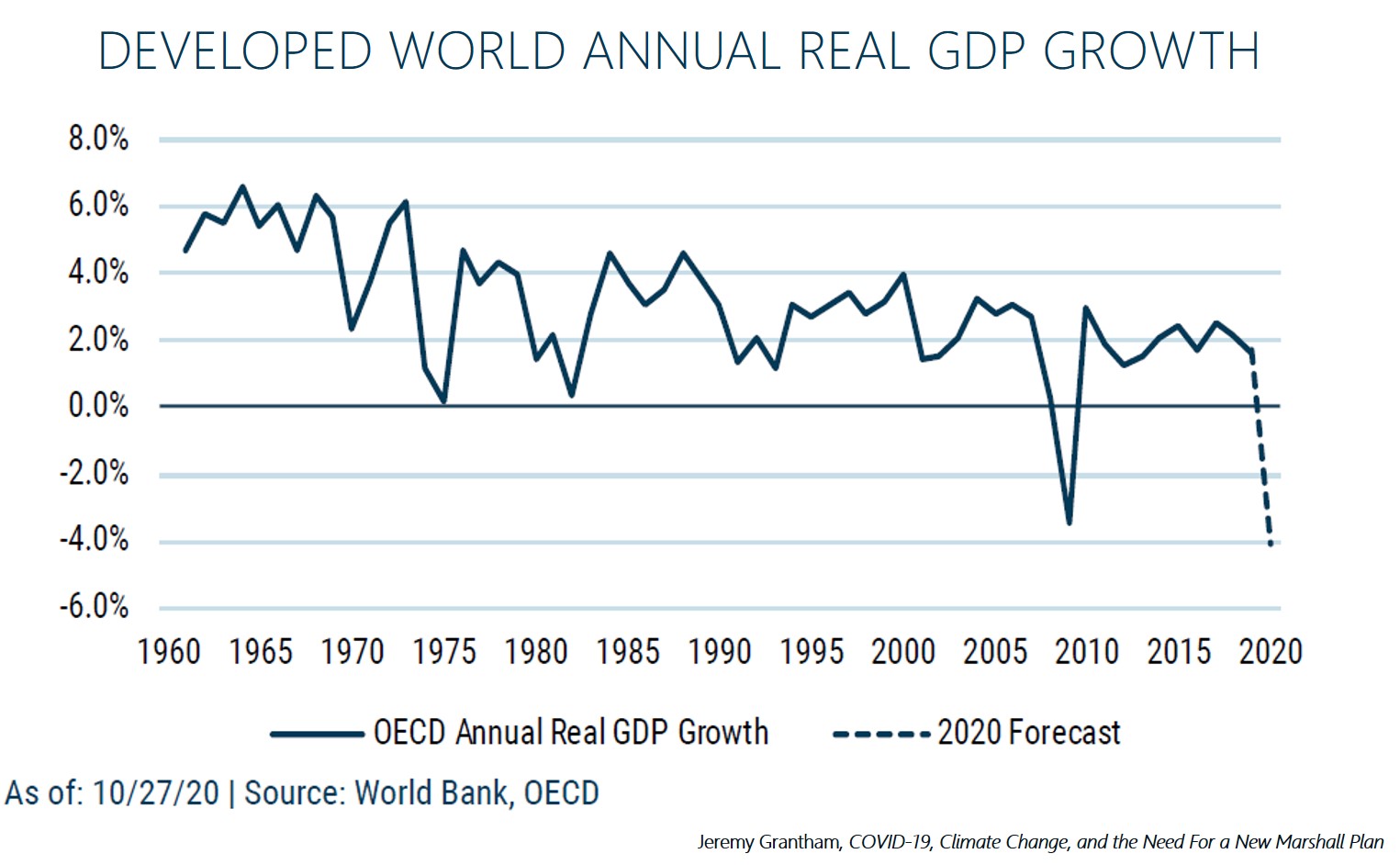
Economies tanked in the 2nd quarter and – on the backs of stimulus and central bank support – roared back in Q3. Through July 31, 2020 -when direct stimulus ran out – the US government was responsible for fully 25% of our national wages. While the professional class (and tech companies) are experiencing a sharp V recovery, many hourly workers, small businesses, retail, leisure, transportation, restaurants are seriously struggling. Many people are hanging on via donations and loans from friends and family and ‘food insecurity’ is becoming widespread. The conventional thinking is that in either a Democratic or Republican ‘sweep’, considerably more stimulus (aka borrowing from future to consume today) will arrive. If, there is e.g. a Biden win and the Senate stays Republican, continued government stabilization of the economic patient will be in jeopardy, and many systemic risks ensue.

But headline GDP statistics aside, the pandemic has widened already large disparities between the haves and have nots. The COVID recession is the most unequal one in US history. As we recover – or don’t – distribution of resources within our population is going to be a critical issue – (more on this below). At some point if the have nots have nothing, they may be forced to take from the haves – or do without. No matter who wins the election we are going to have to find ways to support the weak, the vulnerable and the unemployed. And I expect these will number in the 10s of millions.


Ideology, Memes and Icebergs


If you haven’t been asleep, traveling or drugged these past few years, you’re aware there is a growing movement pointing out the racial, social and economic injustices of our current system. This is in large part because there are considerable racial, social and economic injustices in our current system. But fairness was never the objective built into our cultural goals or institutions – we optimize for (economic) efficiency, not fairness, nor for resilience. The situation is this: various demographics now quite vocally (and reasonably) want a larger share of the economic pie, but the pie itself is about to shrink, which is something few are aware of – and don’t like to hear/think about.

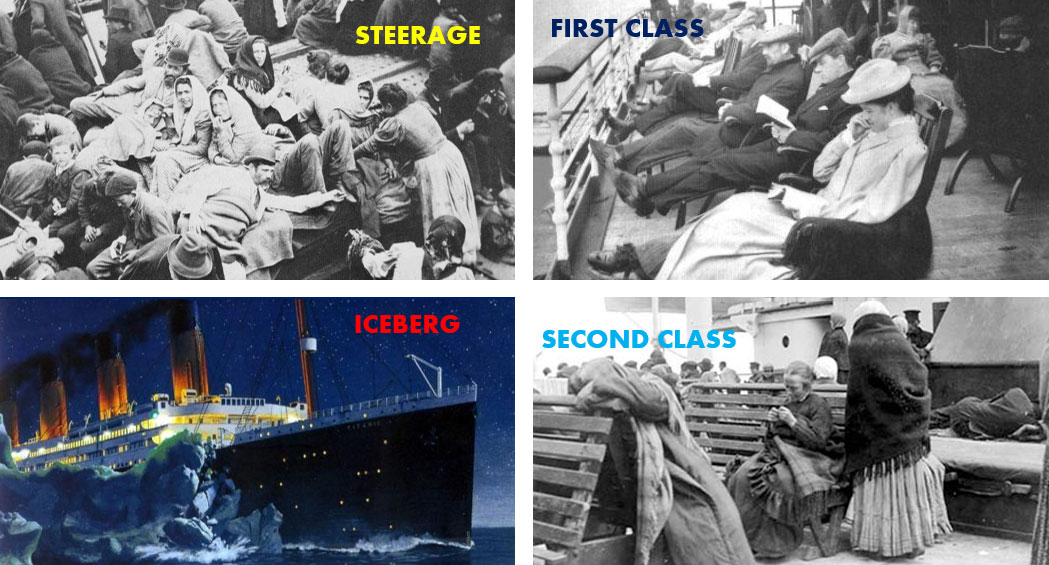
Let’s unpack this using an overused analogy – the Titanic. On the Titanic were 3 classes of passengers – First Class, Second Class and Steerage (or 3rd Class). You can imagine the conversations, hopes, dreams and concerns of the various people on that ship over a century ago. And, history tells us that the tragedy did not befall each class equally – 39% of 1st class passengers perished, 58% of 2nd class and 76% of steerage passengers drowned. The same demographics exist today and are probably having similar conversations within and between groups, focused on maintaining status, moving up in class, or demanding better conditions.

And then there is someone like me – shouting (to all 3 classes) that we just hit an iceberg and need to use science, discourse, reason and planning to find the best solution to navigating evacuation, lifeboats and a new course. You can imagine the reaction – indeed you see it in the news and in your town hall meetings. The ‘first class passengers’ publicly decry that there is no iceberg that technology would never allow the ship to hit an iceberg let alone sink (but privately they are looking to ‘lifeboats’ aka gated communities and the like). The second class passengers are scrambling like mad to ingratiate themselves to the first class passengers to get crumbs of surplus lest they slip into steerage. And the steerage passengers – a full 50%+ of American society today have 2 common responses: 1) “Ok sure there may be an iceberg, but we need to solve our more immediate concerns like our current unacceptable living/working conditions, because we’ll drown from those before any freaking iceberg” (they have valid points) or 2) “Ya right, an iceberg -that is just another story by elites and governments telling us what we have to do and taking away our rights and freedoms”. The difference now (vs on the actual Titanic) is that the steerage class (economically) houses both the far left and the far right, effectively creating additional ‘iceberg’ conditions within the ship itself. The people in ‘steerage’ can’t easily process that in addition to their current challenges, society ALSO has hit an iceberg (see below).

The point here is that the narratives (and religions) that make people feel good are often not based on reality. Which makes discussing, planning and responding to ‘the iceberg of the 2020s’ a very difficult task. The key will be to acknowledge the moral failings of our economic and cultural past while simultaneously acknowledging and planning the lifeboat situation. That’s a difficult thing for a human mind to do.

No matter who wins the election we will be faced with multiple non-overlapping memes and explanations for the upheaval that is coming. Our plight is biophysical (biology and physics) in nature but will be blamed on class, race, politics, and ideology. Navigating this is going to be exceedingly difficult. A new captain can change the morale and surround himself by great minds to make the best civic decisions, but he/she cannot change the fact that our economy and culture has hit an iceberg.


The Zombies are Coming

The central bank purchases and guarantees of various offerings of debt has turned the financial system into a digital Rube Goldberg machine. One of the externalities is that – while the economy was suffering from an exogenous shock from COVID – public companies used the FED bond guarantees to raise cheap debt. For instance, Boeing – a company who arguably will come out of the COVID crisis with worse business prospects due to less demand for planes – nearly doubled its long term debt because it could do so at low rates (the bonds being guaranteed by the FED). This means Boeing – and many other companies – will emerge from this crisis with both lower revenues and higher debt loads, putting them at risk of becoming ‘zombies’. Zombie companies are those whose profits are not enough to pay their interest payments – and they need to take on even more debt (or get direct aid from governments) to stay solvent.

Yes – it’s true stock markets are near all time highs. But this too is a distribution (and expectation) problem. Going into Q3 earnings, the five largest S&P 500 stocks (AAPL, MSFT, AMZN, GOOGL, FB) were expected to grow 3Q sales and EPS by +13% and +1% while the other 495 stocks in SP500 are expected to have a -5% revenue drop and a -24% drop in EPS.

Some great companies. Lots of zombies. No matter who wins this election, we (and the rest of developed world) are going to face a large and growing number of bankrupt and insolvent companies. Stimulus will help – and is critically necessary – but isn’t a long-term solution. And, as the government takes on more and more of this burden, it too risks zombification.


A Cul-de-Sac – and Full of Cans


At year end 2019 we were still recovering from the Great Recession -the ‘temporary’ measures initiated in 2008 – artificially low interest rates, too big to fail guarantees, Quantitative Easing, explosion of government debt, expansion of central bank balance sheets, etc. are still in effect a dozen years later. Even with all this, productivity gains have been tiny – and a fraction of earlier decades.

Now, in addition to all this, governments are adding fiscal stimulus – because they must. The little green man behind the curtain – (currently Jerome Powell) is a very capable and good person but he is not superman. The institution he oversees - the Federal Reserve – is using a giant, and mostly invisible, magic wand to beam what we might’ve consumed in 2030 or 2040 forward to 2020 (in the process leaving less available in 2030 and 2040). Modern Monetary Theory tells us deficits don’t matter – but from a biophysical lens they do – when we create money, we do not create the energy and materials needed to pay it back, so adding more and more debt becomes less productive over time – and has limits, both for companies, for nations, and for economic systems.

What happens when either the government decides to stop stimulus (hard to imagine) or the bond market says ‘no mas’ via higher rates? What is the plan by either the Left or the Right (or anyone) for when QE and stimulus combined cannot plug the economic hole for people and businesses? My opinion is that this question will be answered before 2025 – and the answer will be a drop in GDP akin to the 1930s. Yes, more debt and creative stimulus/infrastructure spending will forestall this for a while, but we will soon face a situation when we can no longer kick the can of growing GDP again to the future. COVID is but a foreshadowing. Money isn’t reality – it’s a marker for the things that matter: built, social, natural and human capital. No matter who wins the election we have a 50+ year physical/financial bill that’s coming due.


Our Basement Larder, is -Unbeknown to Most – Going Bare


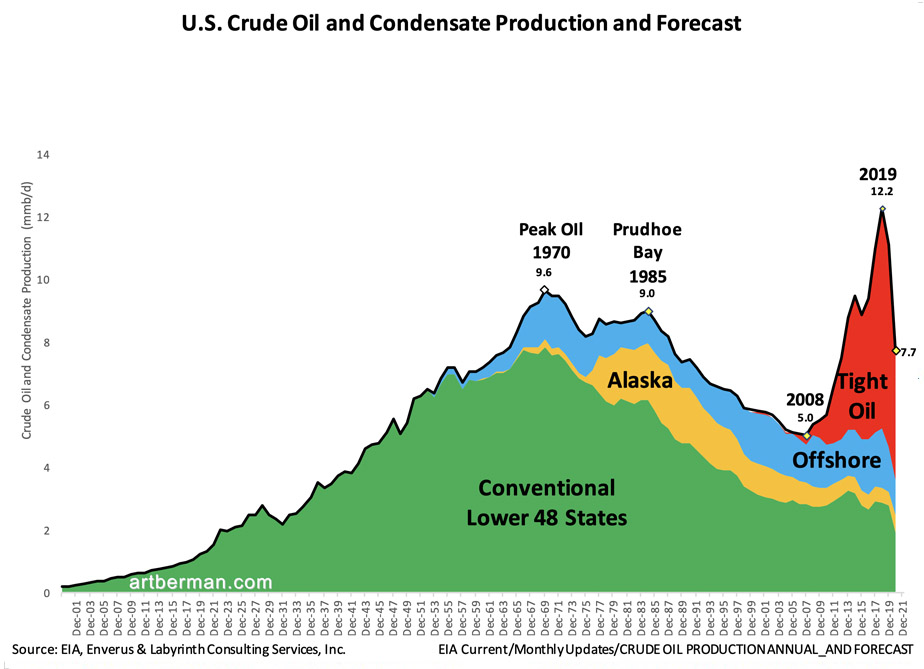
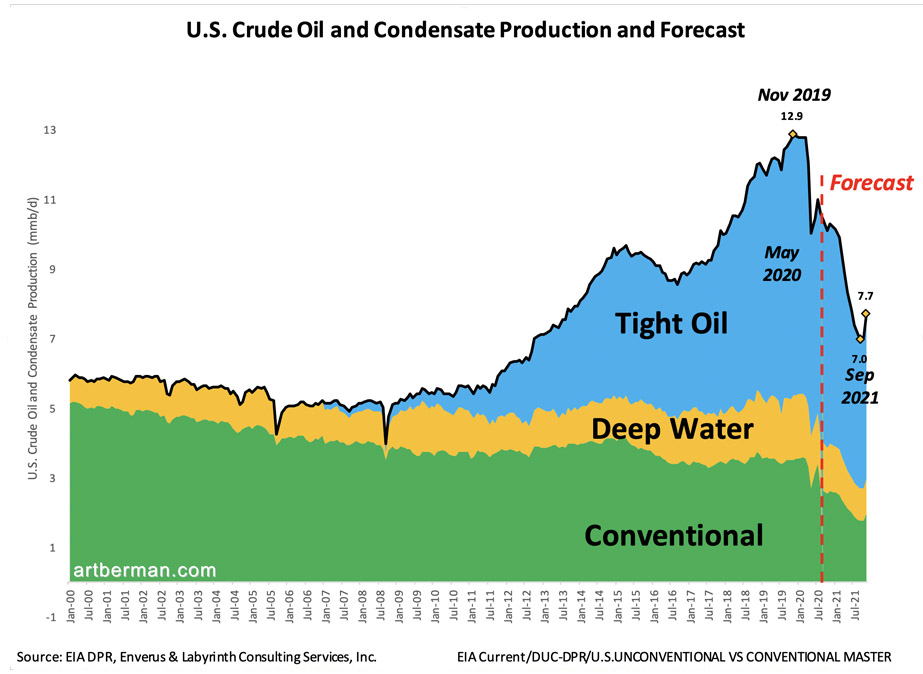
(Charts from Labyrinth Consulting. Assumptions: EIA & Enverus data through August 2020. Sept and Oct guided by EIA tight oil estimates plus Labyrinth estimates for OCS & conventional. Nov 2020 thru Nov 2021 calibrated speculation using to-date tight oil rig count and production correlation extrapolating 2020 ratio average for deep water & conventional production.)


If you took a poll and asked people what the single biggest casualty was from the pandemic, very few people would respond with ‘oil’. But no matter who wins the election, US oil production, including shale oil, is about to fall off a cliff, with massive consequences for society. For the setup of our modern way of life, oil is effectively our hemoglobin – and the COVID arrow hit at the heart of the industry as market prices are far below what it costs to extract oil from the ground. Yet this is all invisible to most people as the media (and economics departments) still conflate price with cost and cost with value. We were in bad shape BEFORE Covid-19 and now the Red Queen (drilling faster and faster just to maintain static production) has stepped off the treadmill for 6+months – meaning the large underlying decline rates of existing fields are not being offset much by new drilling. Worse, most of the recent decline in production is because wells have been shut in. Many of these will never be brought back on line because they cannot meet basic operating expenses and production taxes at current oil prices. In aggregate, US production is so far down -2.28 mmbpd from a 2019 monthly average high of of 12.86 mmbpd. Assuming rig counts and prices stay roughly where they are (and with no stimulus they may get worse), this implies a level of about 7 mmbpd by late summer 2021 – nearly a 50% drop. Globally, the reduction in travel, leisure and transport due to COVID effectively squeezed upstream investment- we are down to 72.8 mb of crude and condensate from 84.6 in November 2018, -which date is highly likely to be the all time peak in global production. Note: this will likely never be recognized as such because there will always be a non-biophysical reason articulated as to why we aren’t getting more oil. E.g. ‘the chinese’ or ‘the environmentalists’ or ‘the war’.)

To label this geologic phenomenon as ‘peak demand for oil’ is the economic equivalent of saying the reindeer on St Matthew Island faced ‘peak demand for lichen’. Oil is the lifeblood of our (current) economy -peak demand for oil also likely means peak growth for economies (unless massive efficiencies and fuel switching occur very fast). We probably won’t notice any lack of oil for many years because affordability by citizens will likely decline faster than oil itself (unless massive stimulus and central bank bazookas arrive). Regardless an accelerated retiring of the fossil armies that do most of our work, and create and deliver our modern smorgasbord of goods and services is now on the horizon.

(Note: I think the graph from my friend Art may be a bit pessimistic, but maybe not. We face a biophysical gauntlet where the price citizens can afford is getting lower and lower and the price energy companies need is higher and higher. If governments guarantee high prices to oil companies, or there are other incentives, production might be higher than indicated here – but here is a glaring statistic – if we were to stop drilling in USA entirely we would lose around 40% of our entire oil production in 1 year – we have to keep investing/drilling in more difficult and costly spots to avoid such a decline. (the 1 year decline rates are: Texas 40%, ND is 52%, Oklahoma 50%, GOM/deepwater 32% New Mexico 45% – these 5 regions are 80% of US production).

This is not remotely being discussed in our culture.

No matter who wins the election, US oil production has peaked – again - and this time including the tight oil provinces – from the ‘source rock’. This will have….large long term consequences, whether one is left, right or libertarian.


Complexity


Increasingly I think it’s neither oil nor finance, nor social disruption that is our core risk but declining returns to complexity

Historian Joseph Tainter famously studied how ancient civilizations declined due to the inability of resources/productivity to keep pace with complexity. In today’s world, this can be seen in myriad ways, from the unemployment software in US States being written in COBOL and FORTRAN, to APIs for majority of our medicines made in India and China, to the paint for a Ford truck only made in Fukushima, Japan.

It’s not something we think about, but we all are part of a complex global supply chain. On the way up, using the concept of ‘comparative advantage’ our society outsourced various manufacturing to countries of the lowest cost production – which in many cases meant locations in Asia with cheap labor. COVID gave us a glimpse of the dangerous underbelly of those decades old decisions: almost 200 drugs currently listed as in short supply by FDA, 6 month wait for bicycles, heavy equipment delays etc. This is a separate issue from short term kinks in the supply chain for e.g. ammunition, canned goods, and toilet paper etc. This issue goes to the embedded fragility of a global system based on growth by perpetually relying on import substitution models of production.

No matter who wins the election, with the geopolitical context that is COVID 19 on financial steroids, making sure that important things are made domestically (or regionally) may become an important question.


Other Energy


Humans – during periods of growth – and contraction – self-organize around energy. Oil is central but our entire energy balance sheet is going to be a critical issue in the coming decade. Under a Biden win, various Green New Deal proposals will lead to a massive increase in scale for renewable energy. In many ways this is good news, because it will be good for GDP, it will create jobs, and grow our supply of low carbon energy. But the key problem with what’s coming is the goal is ‘lower carbon energy’ not ‘systemically addressing human futures’. 

Briefly: 1) renewable energy isn’t renewable, it’s rebuildable and requires vast amounts of non-energy materials, minerals and land 2) only ~20% of (current) energy mix is electricity which is the type of energy produced from most renewables 3) the higher % of RE in our mix the more important back up (NG and coal) will become – and the US is facing an impending gas shortage as US drilling has plummeted. (the largest growth component of supply was the associated gas from tight oil production), 4) the cost of RE isn’t merely adding some solar panels or wind turbines but the full system cost of integrating RE into the grid which will be higher than consumers currently pay, which will weigh on a fragile economy 5) all RE blueprints expect a LARGER economy in the future when (see above) most realistic scenarios using systemic analysis (finance, politics, biophysical inputs) point to a smaller economy.

Still, renewables are our only hope – they are mature, robust and inexpensive vis-à-vis even a decade ago. The problem will be how to ‘increase renewables to a smaller and more complex system’. No matter who wins the election, we will have to face a more complex and less dependable energy future.


Meaning and Well-being


One of the silver linings (if you will) of the pandemic is that now a great number of people are personally aware that US GDP/ 330 million does not represent how well we are doing as individuals or as a nation. The constant media reminders that the SP500 and Dow Jones just made all-time highs is incongruous with most peoples real lived experience (and most of whom have zero money in the stock market). Whether one understands or agrees with the risks of climate change, energy depletion or limits to growth, tens of millions of people are now hungry for living a decent life with access to basic needs, while doing something good and meaningful. The coming decades – by definition but also by desire – are going to be more about well-being than they are about growing our consumption of stuff.

No matter who wins the election, our nation needs to embark on a deep conversation about what our cultural goal is – we are going to need complementary metrics to the econometric measures quantifying how much energy we burned. What is all this energy for is a question that should be part of our national discourse.


Protecting Heaven


Lost in the discussions of Republicans vs Democrats, stimulus, PPP, COVID statistics, stock market gyrations and geopolitics is perhaps the most important story of all – the state of Earth’s ecosystems and the ~10 million species we share the planet with. They are ‘downstream’ of our elections and financial/economic systems, but none of them have a vote.

I have concluded that natural systems and species futures – for better or worse – are linked to human futures – we have to ‘bend not break’ to have the best outcome for (most) Earth Systems (other than perhaps oceans and very remote species). I believe humans are not any better or worse than we were 100 years, 1000 years or 100,000 years ago – there are just more of us so our impact is (much) larger and each and every one of us consuming much more resources than our ancestors did. Humans are good at heart but we are biological organisms following cultural goals that have expiry dates. We have arrived at a ‘species level’ juncture and need to use systems science, reason, discourse, and leadership to navigate a glide path to intact futures.

No matter who wins the election, the state of the natural world needs to be included in our plans and discussions. Unfortunately, it first needs to be included in our values.


Joy, Living, and Goals


The Great Depression, unless you lived in a big city, mostly happened in slow motion. Similarly, unless we’re very unlucky, the events of the coming decade will unfold gradually. We have to take it upon ourselves to civically engage, but also find time to enjoy and appreciate our lives – being alive at this amazing and perilous time.

We all have ‘conditional’ goals, those which rely on something external to us to change in order to succeed. Many of those goals will not get met because external conditions prevent them – perhaps the ‘guy who we didn’t vote for’ winning the election. The key is to also find “unconditional” goals – those which we ourselves can be 100% responsible for. That way we can feel more empowered to reach those goals, which many times can influence the conditional goals in positive ways. Growing food, spending time with your neighbors, learning a new (useful to the future) skill, mutual aid, etc. The key for all of us – is to meet the future halfway.

No matter who wins the election, life, and the opportunity for joy, impact, and meaning will exist, perhaps even more so.


The 2020 Election and beyond


So, dear reader and fellow countrymen/women, go vote. But voting is merely the beginning of our civic duty. Our country will be shaped by how we citizens respond to the challenges ahead of us as much (or more) than it will by which party wins the election. What am I rooting for? Rationality, science, civility, discourse, which opens up other potential pathways. Our culture is capable of much more than guns, germs and steel or being an energy dissipating superorganism.

People who practice common decency and respect are by far the majority in our (and other) countries. When matched with perseverance, common goals and prioritizing social capital and relationships, we might just happen upon the glide path to decent futures. There are 10s of millions of Americans craving having their basic needs met and just doing some good with their lives – they just don’t yet have a roadmap and convening place. Could such a thing be the emergent result of the 2020 election?

Society right now is dancing – and fighting on the roof of an A-frame with the winds blowing hard and a storm shooting lightning at our heads. We need to keep dancing (less fighting) while we climb down to more stable ground.

No matter who wins the election this week we are on the cusp of major change which will require both top-down and bottom up interventions and cultural emergence. I hope you can play a role.


The objective economy, part one. Tim Morgan, Surplus Energy Economics. Nov. 12, 2020


Saturday, January 11, 2020

Glikson: Planetary arson and amplifying feedbacks

Planetary arson and amplifying feedbacks: No alternative to CO2 drawdown. Andrew Glikson, Earth and climate scientist, Australian National University. Dec. 26, 2019.

No one knows how to impose 1.5 or 2.0 degrees Celsius limits on the mean global temperature, unless drawdown / carbon sequestration of atmospheric CO₂ is attempted, nor are drawdown methods normally discussed in most political or economic forums. According to Kevin Drum (2019), “Meeting the climate goals of the Paris Agreement is going to be nearly impossible without removing carbon dioxide from the atmosphere”.

The release of some 910 billion tons of carbon dioxide is leading human society, indeed much of nature, to an existential impasse. The widest chasm has developed between what climate science is indicating and between climate policies and negotiations controlled by governments, politicians, economists and journalists—none of whom fully comprehends, or is telling the whole truth about, the full consequences of the current trend in the atmosphere-ocean-land system.

The evidence for future projections, as understood by climate scientists, has been largely put to one side, mainly because it is economically and politically “inconvenient” or is frightening. Reports from the Madrid climate COP-25 Conference suggest negotiations, focusing on emission reductions, are overlooking the evidence that at the current concentration of CO₂, which have reached 412 ppm and 496 ppm-equivalent (when the CO₂-equivalents of methane and nitrous oxide are included), amplifying feedbacks from land and ocean are pushing temperatures further upwards. This is driven by the replacement of sea ice and land ice and snow surfaces by open water surfaces, by methane leaks, desiccated vegetation, fires and reduced CO₂ absorption by warming oceans. Given the long atmospheric residence time of CO₂ (Solomon et al. 2009, Eby et al. 2009) and the short life span of aerosols, attempts at CO₂ drawdown are essential if complete devastation of the biosphere is to be avoided.


Figure 1. (A) 1990-2019 Global growth of CO₂ emissions (gigaton);
(B) 1960-2019 Annual fossil CO₂ emissions from coal, oil, natural gas and cement (gigaton).
From: CSIRO News Release


The prevailing political and economic focus in international climate projects, conferences and advisory councils is concerned with (a) limits on, or a decrease of, carbon emissions from power generation, industry, agriculture, transport and other sources; (b) limits on the current rise in global temperatures to +1.5 degrees Celsius, and a maximum of +2.0 degrees Celsius, above mean pre-industrial (pre-1750) temperatures.

However, no one knows how to impose these limits unless drawdown/sequestration of atmospheric CO₂ is attempted, nor are drawdown methods normally discussed in most forums.


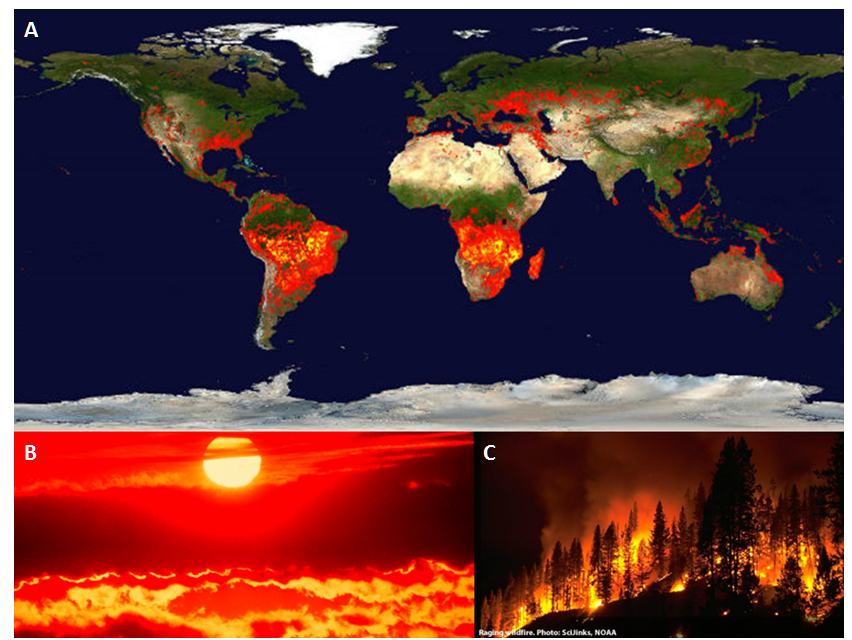
Figure 2. (A) Distribution of global fires (NASA);
(B) Fire storms over the southwest USA;
(C) Pine forest fire California.


At the present the concentration of greenhouse gases of just under-500 ppm CO₂-equivalent is activating amplifying feedbacks of greenhouse gases from land, oceans and melting ice sheets, namely further warming:

  1. An increase in evaporation due to warming of land and oceans leads to further warming due to the greenhouse effect of water vapor but also to increased cloudiness which retards warming. The water vapor factor, significant in the tropics, is somewhat less important in the dry subtropical zones and relatively minor in the Polar Regions (Figure 3).
  2. The melting of ice sheets, reducing reflective (high-albedo) ice and snow surfaces, and concomitant opening of open water surfaces (heat absorbing low-albedo) is generating a powerful positive (warming) feedback. Hudson (2011) estimates the rise in warming due to total removal of Arctic summer sea ice as approximately +1.0 degrees Celsius.
  3. The release of methane from melting permafrost and bubbling of methane hydrates from the oceans has already raised atmospheric methane levels from about 800 to 1863 parts per billion which, given the radiative forcing of methane of X25< times, renders methane highly significant.
  4. As the oceans warm they become less capable of taking up carbon dioxide. As a result, more of our carbon pollution will stay in the atmosphere, exacerbating global warming. 
  5. As tropical and subtropical climate zones overtake temperate Mediterranean-type climate zones, desiccated and burnt vegetation release copious amounts of carbon dioxide to the atmosphere. For example the current bushfires in Australia have already emitted 250 million tonnes of CO₂, almost half of country's annual emissions in 2018.

Figure 3. Total water vapor that can precipitate, as observed by
the Atmospheric Infrared Sounder (AIRS) on NASA's Aqua satellite.
With rising global temperatures and further encroachment of subtropical climate zones desertification and warming can only become more severe.


Abrupt reductions in emissions may be insufficient to stem global warming, unless accompanied by sequestration of greenhouse gases from the atmosphere, recommended as below 350 ppm CO₂.
According to Hansen et al. (2008) carbon sequestration in soil (the biochar method) has significant potential, applying pyrolysis of residues of crops, forestry and animal waste. Biochar helps soil retain nutrients and fertilizers, reducing release of greenhouse gases such as N₂O. Replacing slash-and-burn agriculture with a slash-and-char method and the use of agricultural and forestry wastes for biochar production could provide a CO₂ drawdown of ~8 ppm or more in half a century.

Stabilization and cooling of the climate could include two principle approaches (Table 1): (a) solar shielding, and (b) CO₂ drawdown/sequestration. However, solar shielding by injected aerosols or water vapor is bound to be transient, requiring constant replenishment.

Table 1. Solar shielding and atmospheric CO₂ sequestration methods.

Method
Supposed advantages
Problems
SO2 injections
Relatively cheap and rapid application
Short atmospheric residence time; ocean acidification; retardation of precipitation and of monsoons
Space satellite-mounted sunshades/mirrors
Rapid application. No direct effect on ocean chemistry
Longer space residence time. Does not mitigate ocean acidification by CO2 emissions.
Streaming of air through basalt and serpentine
(Figure 4)
CO2 capture by Ca and Mg carbonates
In operation on a limited scale in Iceland. Significant potential 
Soil carbon burial/biochar
Effective means of controlling the carbon cycle (plants+ soil exchange more than 100 GtC/year with the atmosphere) 
Requires a collaborative international effort by millions of farmers. Significant potential
CO2 capture by seaweeds 
An effective method applied in South Korea 
Decay of seaweeds releases CO₂ to ocean water. Significant potential
Ocean iron filing fertilization enhancing phytoplankton
CO2 sequestration
Phytoplankton residues would release CO2 back to the ocean water and atmosphere.
Ocean pipe system for vertical circulation of cold water to enhance CO2 sequestration
CO2 sequestration
Further warming would render such measure transient.
“Sodium trees” – pipe systems of liquid NaOH sequestering CO2 to sodium carbonate Na2CO3, followed by separation and burial of CO2.
CO2 sequestration, estimated by Hansen et al. (2008) at a cost of ~$200/ton CO₂ where the cost of removing 50 ppm of CO₂ is ~$20 trillion.
Unproven efficiency; need for CO2 burial; $trillions expense, though no more than the military expenses since WWII.


Figure 4. Iceland: The streaming of CO₂-containing air and of water through
basaltic rocks and CO₂-capture as carbonate minerals.

The big question is how effective are the above methods in reducing CO₂ levels on a global scale, at the very least to balance emissions, currently 36.8 billion tons CO₂ per year. Whereas each of the methods outlined in Table 1 has advantages and disadvantages, it is hard to see an alternative way of cooling the atmosphere and oceans than a combination of several of the more promising methods. Budgets on a scale of military spending ($1.7 trillion in 2017) are required in an attempt to slow down the current trend across climate tipping points. The choice humanity is facing is whether to spend resources on this scale on wars or on defense from the climate calamity.

Time is running out.

Sunday, December 15, 2019

The portent of runaway greenhouse warming

The portent of runaway greenhouse warming. Andrew Glikson, Earth and climate scientist, Australian National University. Dec. 11, 2019.


Figure 1. Relations between CO₂ levels in the atmosphere and mass extinctions of genera.
Data cited from D. Royer et al. (2002), from G. Keller (2016) and P. Wignall et al. (2002).
Carbon, the essential element underpinning photosynthesis and life, is transformed into toxic substances in the remnants of plants and organisms buried in sediments. Once released to the atmosphere in the form of CO₂, CO and methane, in large quantities these gases become lethal and have been responsible for mass extinctions of species (Fig. 1).


Figure 2. Potential heating, Carana (2019)

Given amplifying feedbacks from land and oceans triggered by rising temperatures, the concept of an upper limit of warming determined by limitation on carbon emissions alone is unlikely, since, under a rising high greenhouse gas concentration, amplifying feedbacks triggered by methane release, bushfires, warming oceans and loss of reflectivity of melting ice, temperatures would keep rising. As an example, findings show that warmer ocean water is melting hydrates and releasing methane into the sediment and waters off the coast of Washington state, at levels that reach the same amount of methane from the Deepwater Horizon blowout. Carana (2019) finds a potential for abrupt warming of 18°C or 32.4°F (Fig. 2).

Attempts at CO₂ drawdown (sequestration), if urgently applied on a global scale, may conceivably be able to slow down further warming. This article refers to natural methane reservoirs and human-induced methane emissions, indicating that, once temperatures supersede a critical level, a further rise in methane release would result regardless of restrictions of emissions.

According to Kelley (2003) a planetary “runaway greenhouse event” may be triggered when a planet overheats due to absorption of more solar energy than it can give off to retain equilibrium. As a result, the oceans may boil filling its atmosphere with steam, which leaves the planet uninhabitable, as Venus is now. Planetary geologists think there is good evidence that Venus was the victim of a runaway greenhouse effect which turned the planet into the boiling hell we see today. According to Hansen (2010): “If we burn all fossil fuels, the forcing will be at least comparable to that of the PETM, but it will have been introduced at least ten times faster. [. .] The warming ocean can be expected to affect methane hydrate stability at a rate that could exceed that in the PETM, where the rate of change was driven by the speed of the methane hydrate climate feedback, not by the nearly instantaneous introduction of all fossil fuel carbon.” In a critical review of the theory of runaway greenhouse warming, Goldblatt and Watson (2012) state: “We cannot therefore completely rule out the possibility that human actions might cause a transition, if not to full runaway, then at least to a much warmer climate state than the present one.”

The concentration of fossil carbon deposits in the form of coal, oil, natural gas, coal seam gas, permafrost methane, ice clathrates, shale oil, and oil sands, once released to the atmosphere in large quantities, generates powerful feedbacks from land, ocean, atmosphere and cryosphere. This includes further release of greenhouse gases, warming oceans, loss of reflectivity of melting ice, and bushfires, pushing temperatures further upward. With carbon dioxide concentrations rising at a rate of 2–3 parts per million (ppm) per year (October 2018: 406.00 ppm; October 2019: 408.53 ppm) and the Earth heating-up by 0.98°C since 1951-1980, the ultimate consequences of this trend belong to the unthinkable.

Through 2012, total accumulated emissions are estimated to have reached 384 GtC, with an annual amount of 43.1 billion tonnes of carbon dioxide expected to be added in 2019.

A 2016 IPCC analysis found that no more than 275 GtC of the world’s reserves of fossil fuels of 746 GtC could be emitted, if the global temperature rise is to be restricted to 2°C above pre-industrial temperatures, an impossible target since amplifying carbon feedbacks would push temperatures upwards.

According to Heede and Oreskes (2016), global reserves of oil (~171 GtC), natural gas (~95) and coal (479 GtC) add up to a total of 746 GtC. Hansen et al. (2013) estimates that recoverable fossil fuel reserves include ~120 GtC gas, ~80 GtC oil, >10,000 GtC coal, >2000 GtC unconventional gas, and ~700 GtC unconventional oil, adding up to a total of ~13,000 GtC (Fig. 3).


Figure 4. Vulnerable carbon pools. (A) Land: Permafrost ~900 GtC; High-latitude peatlands ~400 GtC;
Tropical peatlands ~100 GtC; Vegetation subject to fire and/or deforestation ~650 GtC;
(B) Oceans: Methane hydrates ~10,000 GtC; Solubility pump ~2700 GtC; Biological pump ~3300 GtC;
Total (A) + (B): ~18,050 GtC (Canadell 2007

The amount of unstable methane deposits in permafrost and methane hydrates (clathrates) in ocean sediments is of a similar order of magnitude as the amount of fossil fuel reserves. Vulnerable carbon pools include methane hydrates in sediments (~10,000 GtC), solubility and biological pump (~6000 GtC), permafrost methane (~900 GtC), and peatlands and vulnerable vegetation (~1150 GtC), adding up to a total of ~18,050 GtC (Fig. 4).

Unoxidized metastable deposits of methane and methane hydrates, accumulated during the Pleistocene glacial-interglacial cycles and vulnerable to temperature rise, are already leaking as indicated by atmospheric concentrations which have risen from 1988 (~1700 ppb CH₄) to 2019 (~1860 ppb CH₄) at a rate of ~5.2 ppb/year, a rise of more than 4 ppm CO₂-equivalent at GWP25xCO₂ or 24 ppm CO₂-e at GWP150xCO₂.


Meinshausen et al. (2011) estimated global-mean surface temperature increases, applying a climate sensitivity of 3°C per doubling of CO₂, resulting by 2100 in a temperature rise of between 1.5°C to 4.5°C relative to pre-industrial levels. By 2300, under constant emissions, CO₂ concentrations would rise to ~2000 ppm, methane to 3.5 ppm and nitrous oxide to 0.52 ppm (Fig. 5). Amplifying feedbacks are taken into account, but the effects of tipping points and of cold ice-melt pools formed in the oceans near Greenland and Antarctica ice sheets are unclear.

Given the estimated total of exploitable hydrocarbon resources (~13.000 GtC) and of vulnerable carbon pools (~18,050 GtC), the amount released under different future climate conditions is subject to estimates:

Assuming mean global temperature of +2°C (above pre-industrial), with allowance made for the masking effects of sulphur aerosols, the combustion of ~2% of the fossil fuel reserves (13,000 GtC), i.e. ~260 GtC, would raise CO₂ concentration by ~130 ppm (100 GtC = 50 ppm CO₂) (Fig. 3). Combustion of ~5% of the fossil fuel reserve would raise CO₂ concentration by ~325 ppm.
Under +2°C above pre-industrial, release of CO₂ from fires and other feedback effects such as melting of permafrost and release of methane would raise atmospheric carbon by at least 1 percent of vulnerable carbon pools (~18,050 GtC). 

The flow of ice melt water from Greenland and Antarctica into the oceans would create large regions of cold water capable of absorption of atmospheric CO₂. Hansen (2010) concludes: “if we burn all reserves of oil, gas, and coal, there's a substantial chance that we will initiate the runaway greenhouse. If we also burn the tar sands and tar shale, I believe the Venus syndrome [runaway greenhouse warming] is a dead certainty”. Stephen Hawking (2017) appears to agree with Hansen’s warning, stating: “if the US pulls out of the Paris climate agreement it may lead to runaway global warming, eventually turning Earth's atmosphere into something resembling Venus”. Goldblatt and Watson (2012) wrote: “The ultimate climate emergency is a ‘runaway greenhouse’: a hot and water-vapor-rich atmosphere limits the emission of thermal radiation to space, causing runaway warming … This would evaporate the entire ocean and exterminate all planetary life … We cannot therefore completely rule out the possibility that human actions might cause a transition, if not to full runaway, then at least to a much warmer climate state than the present one … However, our understanding of the dynamics, thermodynamics, radiative transfer and cloud physics of hot and steamy atmospheres is weak.”

An analysis by Carana (2013) suggests that accelerated release of methane from permafrost and methane hydrates (clathrates) could trigger runaway global warming (Fig. 6). A polynomial trend for the Arctic shows temperature anomalies of +4°C by 2020, +7°C by 2030 and +11°C by 2040, threatening major feedbacks, further albedo changes and methane releases leading to global temperature anomalies of 20°C+ by 2050.


Figure 6. A polynomial 2 trend line points at global temperature anomalies (Carana 2013). A polynomial function is a function such as a quadratic, a cubic, a quartic, and so on, involving only non-negative integer powers of x.

The magnitude of the runaway greenhouse effect that now threatens to eventuate becomes evident when looking at the geological record. For example, the 55 million years-old PETM event (Paleocene-Eocene Thermal Maximum), lasting for about 100,000 years, driven by CO₂ levels as hugh as 1700 ppm, does not appear to have triggered a runaway greenhouse process. The PETM is attributed to ¹³C-depleted methane (Zeebe et al. 2009), reaching 5 - 8°C and leading to a mass extinction of 35-50% of benthic foraminifera. By sharp contrast, the current Anthropocene hyperthermal event, commencing with the industrial age and re-accelerating since about 1975, constitutes a temporally abrupt development exceeding the rate of geological hyperthermal events (Fig. 7), a rate which does not allow biological adaptation and thereby enhances a mass extinction of species (Barnosky et al. 2011).


Figure 7. A comparison of Cenozoic CO₂ rise rates and temperature rise rates,
highlighting the extreme rise rates in the Anthropocene. From an earlier post.


As Australia burns, the IPCC maintains there is time left to consume a carbon budget and to keep handing out offsets and carbon credits; at the 25th meeting of the Conference of the Parties to the United Nations Convention on Climate Change in Madrid, Australia is seeking to use "carry-over credits" to meet its pledged emissions reductions.


Links

• The RCP greenhouse gas concentrations and their extensions from 1765 to 2300, by Malte Meinshausen et al. (2011)
https://link.springer.com/article/10.1007/s10584-011-0156-z

• Contributions to accelerating atmospheric CO₂ growth from economic activity, carbon intensity, and efficiency of natural sinks, by J. Canadell et al. (2007)
https://www.pnas.org/content/104/47/18866

• Planetary ‘Runaway Greenhouse’ Climates More Easily Triggered than Previously Thought, by Peter Kelley (2013)
https://scitechdaily.com/planetary-runaway-greenhouse-climates-more-easily-triggered-than-previously-thought

• How Likely Is a Runaway Greenhouse Effect on Earth? MIT Technology Review (2012)
https://www.technologyreview.com/s/426608/how-likely-is-a-runaway-greenhouse-effect-on-earth/

• Storms of my grandchildren: the truth about the coming climate catastrophe and our last chance to save humanity, by James Hansen (2010)
https://www.bloomsbury.com/us/storms-of-my-grandchildren-9781608195022

• The runaway greenhouse: implications for future climate change, geoengineering and planetary atmospheres, by Colin Goldblatt and Andrew Watson (2012)
https://royalsocietypublishing.org/doi/full/10.1098/rsta.2012.0004

• Low simulated radiation limit for runaway greenhouse climates, by Colin Goldblatt, et al. (2013)
https://www.nature.com/articles/ngeo1892

• Assessing “Dangerous Climate Change”: Required Reduction of Carbon Emissions to Protect Young People, Future Generations and Nature, by James Hansen et al. (2013)
https://journals.plos.org/plosone/article?id=10.1371/journal.pone.0081648

• Towards the Sixth Assessment Report of the Intergovernmental Panel on Climate Change (IPCC), by Valérie Masson-Delmotte, Panmao Zhai, Wilfran Moufouma-Okia, Anna Pirani, Jan Fuglestvedt
https://wg1.ipcc.ch/presentations/201612_Fuglestvedt_AGU_IPCC.pdf

• Global Carbon Project, Carbon Budget 2019, press release
https://www.globalcarbonproject.org/carbonbudget/19/files/Norway_CICERO_GCB2019.pdf

• Potential emissions of CO₂ and methane from proved reserves of fossil fuels: An alternative analysis, by Richard Heede and Naomi Oreskes
https://www.sciencedirect.com/science/article/pii/S0959378015300637

• A rise of 18°C or 32.4°F by 2026?
https://arctic-news.blogspot.com/2019/02/a-rise-of-18c-or-324f-by-2026.html

• Arctic Methane Impact
https://arctic-news.blogspot.com/2013/11/arctic-methane-impact.html

• A record CO2 rise rate since the KT dinosaur extinction 66 million years ago
http://arctic-news.blogspot.com/2019/11/a-record-co2-rise-rate-since-kt-dinosaur-extinction-66-million-years-ago.html

• Another link between CO2 and mass extinctions of species, by Andrew Glikson
https://theconversation.com/another-link-between-co2-and-mass-extinctions-of-species-12906