Showing posts with label Tim Watkins. Show all posts

Tuesday, April 28, 2020

Climate -- and related -- Links April 2020

I Am a Mad Scientist. Kate Marvel, Drilled News. April 22, 2020.


Weird Al Yankovic and the Global Phase Shift. Peter Watts. April 28, 2020.
“We’re living by science and data, not our constitution. That’s wrong. We are not safe if we are not free.” —Darwin Award contender, protesting in Pennsylvania

... Yet here I am again, with yet another mea culpa about my limited imagination: because my scenario described a gradual reduction in our impact, a fear of breeding that would take decades to manifest in any ecological sense. I never imagined that a relatively benign bug could cause us to drastically reduce emissions, to change our very lifestyles literally overnight. Which is why I think it would’ve been cool if C19 had been conjured up in a lab and deliberately released: not as a bioweapon, but as an object lesson. A teaching moment. An inspiration. 
Because we know, now, that we can do it. We can live without the luxuries. We can live without the billiona—sorry, the job creators. We know who the essential members of this society are, and we can identify the parasites1. We can watch with awe as New Zealand kicks Corona’s ass: we can whoop with schadenfreude as church-going evangelicals and MAGAmaniacs re-enact the airlock scene from Avenue 5, while their stumbling demented child-king cheers them on. We can clear the skies in a matter of days; you’ve all seen the pictures. All it takes is for us to be in imminent fear for our lives. 
...

but let’s put that aside for the moment. Let’s ignore William Hanage, accept that Covid-19 will subside in a few months (outside the US, at least), and restrictions will ease enough for us to come outside again and rub shoulders with the occasional stranger before the second wave comes back and does it all over again. We’ve learned some important lessons over the past weeks. We’ve learned how many “impossible” things were actually just inconvenient to the guys holding the reins. The question now is, will any of those lessons stick? 
Because all those reduced emissions, all the before/after pics of the sky over Paris, the whole ecofriendly mass-migration to work-from-home—none of it matters. 2020 is still on track to be the hottest year in recorded history. The Great Barrier Reef is still in the throes of yet another devastating bleaching event. A whole shitload of fold catastrophes will still be taking out ecosystems in sudden waves, starting within the decade. We’ve been fouling the air for generations; a few months of lowered emissions isn’t even a drop in the bucket. (I’m pretty much on-side with climate scientist Kate Marvel on this score, right up until she tries to absolve us of all blame and hang responsibility on the plutocrats. I hold us to blame as much as them. But that’s a whole other post.)

... 
There’s some cause for hope. The Democrats, for example, came out of the mid-pandemic election with a massive majority (thanks largely to their exemplary handling of C19) and have embraced the Green New Deal, pledged to end the nation’s reliance on coal, and to go carbon neutral by 2050. Looking for a silver lining that’s less nihilistic than Hey, at least it’s reduced the number of idiot hominids fucking up the planet? Look no further than the Democratic Party. 
(The South Korean Democratic Party, that is. Over here, the US Democrats are still helmed by people who pledge craven fealty to Wall Street, who treat the Green New Deal like a magical unicorn some six-year-old girl wants for her birthday, and whose Chosen One’s strongest selling point is that he hasn’t been accused of sexual misconduct as often as the sitting president.) 
... 
 To which I say: hey, you know who was ranting about the threat of climate change way back in 1977? Weird Al Yankovic, during his high school valedictory address. Not a scientist. Not a prophet. He couldn’t even look things up on the Internet (which barely even existed back then, and couldn’t be accessed by high school students in any case). A nerd with an accordion saw the writing on the wall over forty years ago—three years before Exxon officially (if not publicly) recognized the global threat of climate change in its own internal memos— and we’re supposed to feel sorry for an obscenely-profitable multinational subsidy-siphoning parasite because they never bothered to diversify over the past four decades? We’re supposed to pity the poor blue collars laboring on the rigs who had access to the same wall, could see the same writing— and who continued to shit on the tree-huggers and elect haploid brainstems like Ralph Klein and Jason Kenney? 
Fossil had all the money in the world and almost half a century to prepare. All they did was spit on those who tried to raise the alarm. Let them rot.
... 
I keep saying this is only the beginning. I’ve said it so often that people are starting to say “Peter Watts predicted a global virus pandemic in 2019”, as though the predictions actually were mine, as though I wasn’t just repeating what other, vastly-better-informed experts have been saying for years. But just as each new outbreak reflects an interaction of different causal variables, pandemics themselves are but one factor in a wider, even more catastrophic cascade. This isn’t just about pandemics, it’s not just about climate change: it’s about emptying the oceans and strip-mining the seabed, it’s about cutting down the world’s forests, it’s about hormone disruptors and plastics and insect pollinators cratering in fast-forward. It’s about a civilization built out of cards and supply lines that span hemispheres; an economic system so out of touch with reality that oxygen and clean water are accorded zero value, while mine tailings in a river are accorded zero cost. 
We appear to be headed towards a scenario described in Nafeez Ahmed’s recent essay “Coronavirus, synchronous failure and the global phase-shift”: a series of synchronous failures along multiple axes that will pretty much gut The Way Things Are from the inside out. What comes out the other side—whether we come out the other side—depends on how well we can transpose the lessons we’re learning during this mild, training-wheels minipocalypse.
... 
At the same time, I can’t help but wonder—like a myriad otherswhy we can respond so effectively to this relatively small immediate crisis but not to the gargantuan one that’s been swallowing the planet for generations. Even as one part of my brain serves up the same old answer— the future isn’t real to us, we’ll run like hell from the charging grizzly but we couldn’t care less about the slow boil— another part doesn’t quite buy it. Put aside the mind-boggling statistics, the three million infected and two hundred thousand dead. The gut doesn’t do numbers. It goes by immediate experience— and for most of us C19 is still something we watch from a distance, far less “real” than the countermeasures implemented to fight it. We’ve watched our cities shut down. We’re in this quarantine. So many of us are suddenly unemployed, staring destitution in the face. Next to that, how many of us even know someone who’s died of Covid-19?
I don’t for a split nanosec buy into that idiotic bullshit about The Cure Being Worse Than the Disease—but dammit, it must feel that way to the gut. And yet most of us are buckling down, against all my expectations. Most of us accept the need for drastic action. 
Could the molehill have possibly, finally, primed us to deal with the mountain?


The Coronation. Charles Eisenstein. March 2020.
For years, normality has been stretched nearly to its breaking point, a rope pulled tighter and tighter, waiting for a nip of the black swan’s beak to snap it in two. Now that the rope has snapped, do we tie its ends back together, or shall we undo its dangling braids still further, to see what we might weave from them? 
Covid-19 is showing us that when humanity is united in common cause, phenomenally rapid change is possible. None of the world’s problems are technically difficult to solve; they originate in human disagreement. In coherency, humanity’s creative powers are boundless. A few months ago, a proposal to halt commercial air travel would have seemed preposterous. Likewise for the radical changes we are making in our social behavior, economy, and the role of government in our lives. Covid demonstrates the power of our collective will when we agree on what is important. What else might we achieve, in coherency? What do we want to achieve, and what world shall we create? That is always the next question when anyone awakens to their power. 
Covid-19 is like a rehab intervention that breaks the addictive hold of normality. To interrupt a habit is to make it visible; it is to turn it from a compulsion to a choice. When the crisis subsides, we might have occasion to ask whether we want to return to normal, or whether there might be something we’ve seen during this break in the routines that we want to bring into the future. We might ask, after so many have lost their jobs, whether all of them are the jobs the world most needs, and whether our labor and creativity would be better applied elsewhere. We might ask, having done without it for a while, whether we really need so much air travel, Disneyworld vacations, or trade shows. What parts of the economy will we want to restore, and what parts might we choose to let go of? Covid has interrupted what looked to be like a military regime-change operation in Venezuela – perhaps imperialist wars are also one of those things we might relinquish in a future of global cooperation. And on a darker note, what among the things that are being taken away right now – civil liberties, freedom of assembly, sovereignty over our bodies, in-person gatherings, hugs, handshakes, and public life – might we need to exert intentional political and personal will to restore?
For most of my life, I have had the feeling that humanity was nearing a crossroads. Always, the crisis, the collapse, the break was imminent, just around the bend, but it didn’t come and it didn’t come. Imagine walking a road, and up ahead you see it, you see the crossroads. It’s just over the hill, around the bend, past the woods. Cresting the hill, you see you were mistaken, it was a mirage, it was farther away than you thought. You keep walking. Sometimes it comes into view, sometimes it disappears from sight and it seems like this road goes on forever. Maybe there isn’t a crossroads. No, there it is again! Always it is almost here. Never is it here.
Now, all of a sudden, we go around a bend and here it is. We stop, hardly able to believe that now it is happening, hardly able to believe, after years of confinement to the road of our predecessors, that now we finally have a choice. We are right to stop, stunned at the newness of our situation. Of the hundred paths that radiate out in front of us, some lead in the same direction we’ve already been headed. Some lead to hell on earth. And some lead to a world more healed and more beautiful than we ever dared believe to be possible.
I write these words with the aim of standing here with you – bewildered, scared maybe, yet also with a sense of new possibility – at this point of diverging paths. Let us gaze down some of them and see where they lead. ....


Is This Sustainable? Tim Watkins, Consciousness of Sheep. April 14, 2020.
Just as the pandemic crisis has exposed the dangerous inequalities in our economy – with most of the highest paid people currently twiddling their thumbs at home, while the truly important (and usually poorly-paid) workers struggle to keep civilisation from imploding – so it has shown what we might be able to do if we treated climate change and environmental destruction more urgently.  Both revelations have led to a widespread insistence that things must not be allowed to go back to the old “normal” when this is all over.
...

The assumption that the pandemic crisis is teaching us how we might change the way our economy operates is fanciful at best. Mostly it is rooted in the entirely wrong belief that it is possible to do away with all of the supposedly non-essential and frivolous consumption that we engage in while keeping the essential components. But that is not how it works.

...
 
the critical infrastructures that we all depend upon – the electricity grid, water and sewage, road networks, etc. – are only viable because discretionary use spreads the cost of operating it sufficiently to make it affordable. If we only did the essential things, the price would be so high that it couldn’t function (and even nationalising it would require a diversion of funds via the tax system that would crush a large part of the economy). Even the oil industry itself operates only because of technically frivolous consumption. Diesel fuel is the lifeblood of the economy. But diesel is only a small fraction of what is refined from a barrel of oil. A waste product – petrol/gasoline – is by far the largest fuel to be produced. In a sense – as the response to the pandemic is demonstrating – most of us could dramatically cut back on our petrol consumption because most of our journeys – including the daily commute – have been shown to be non-essential. The problem is that our collective petrol consumption effectively subsidises the cost of diesel. So if we stopped using it, the oil industry would have the double whammy of having to increase the price of diesel (which the economy would likely be unable to afford) and to find something else to do with all that petrol (which will also likely come at a high cost).

This brings us to the fundamental error of thinking when looking at the current response to the pandemic as a model for tackling climate change; the idea that what we are doing is in any sense “sustainable.”
...

In the longer-term, millions of the jobs that have been lost will not be coming back. Nor, with the economy facing a depression worse than the 1930s, is there any guarantee of replacement jobs arriving for years to come. Indeed, if the 12 years following the 2008 crash are anything to go by, the majority of over-50s workers laid off because of the pandemic will likely never be in employment (beyond the low-paid gig-economy) again.

Despite this, though, anybody who is paying attention understands that even this is not sufficient to reverse the process of global warming. The best this will achieve is a temporary dent in our emissions before economic necessity once again trumps the need to deal with the growing environmental crises. Rather than political action it will be resource shortages – themselves the result of fast declining net energy – which will impose that kind of economic contraction upon us. As Tim Morgan explained recently:

“… the coronavirus pandemic has triggered two fundamental changes that were, in reality, due to happen anyway.

“One of these is a systemic financial crisis, and the other is the realisation that an era of increasingly-cosmetic economic ‘growth’ has come to a decisive end.

“The term which best describes what happens from here on is ‘de-growth’. This is a concept that some have advocated as a positive choice, but it is, in fact, being forced upon us by a relentless deterioration in the energy-driven equation which determines prosperity.”

The current lockdown measures are only “sustainable” for as long as national currencies maintain their value. National currencies, in turn, are only sustainable for as long as the myth of a bigger and wealthier future can be sustained. That myth depends upon growth in the net energy available to the economy that ceased sometime around 2005. There is already a growing list of things that we used to be able to do that – for net energy reasons – are no longer possible; from the collapse of commercial supersonic flight at one end to the growth of such things as bicycle delivery services and hand car washes at the other. In the aftermath of the pandemic, we will likely say goodbye to many more things that we used to take for granted until such time as investors notice and either markets and asset prices collapse for good or stagflation arrives to remove the paper wealth that western economies currently run on.

There is nothing sustainable about the current lockdown. But, then again, there was nothing sustainable about the “normal” economy we were operating anyway. The future is not green growth but de-growth; not more and better, but make do and mend.


not much sense excerpting, just read the full articles!
At the zenith of complexity. Tim Morgan, Surplus Energy Economics. April 8, 2020.

At the end of “new abnormality”. April 16.


okay, I will make a small exception; here is a small excerpt:
It doesn’t require a Pollyanna approach to understand that, just as “growth” has been a mixed blessing, de-growth offers opportunities as well as threats. 
If you really valued ‘business as usual’, were looking forward to a world of widening inequalities and worsening insecurity of employment, enjoyed the glitz of promotion-drenched consumerism, and were unconcerned about what a never-ending pursuit of “growth” might do to the environment, you might find the onset of de-growth a cause for lament.
If, on the other hand, you understand that our world is not defined by material values alone, you might see opportunities where others see only regrets.

Sunday, January 26, 2020

Climate Links: January 2020 #2

Why action on climate change gets stuck and what to do about it. Matthew Hoffmann (Professor of Political Science and Co-Director Environmental Governance Lab, University of Toronto) & Steven Bernstein (Professor of Political Science and Co-Director of the Environmental Governance Lab, University of Toronto). The Conversation. Jan. 16, 2020.
Work crews descended on 12 commuter parking lots in Toronto in late November 2018, and headed to the electric vehicle (EV) charging stations. Their work came on the heels of an IPCC report that warned of dire environmental, economic and health consequences in the absence of any serious momentum toward decarbonization by 2030.

But the crews were not adding to the two charging stations installed in each parking lot in 2013. They came to remove them.

This erasure of one provincial government’s climate project by its successor was only the tip of the melting iceberg. The steady unravelling of climate policy began when the newly elected Conservative government cancelled the provincial cap and trade system and renewable energy contracts from Ontario’s feed-in-tariff system. It also removed subsidies for electric vehicles (up to $14,000 per vehicle under the previous government).

Despite being sold as cost-cutting, some of the reversals have been expensive. Cancelling 750 renewable-energy projects, for instance, cost $231 million.

It is tempting to view this unwinding through the lens of the polarized politics plaguing many western democracies. That misses the bigger picture.

Our research on more than two dozen climate initiatives around the world — from the community level to the global scale — revealed that the Ontario story is depressingly familiar. There is no lack of climate initiatives — our case studies are only a small cross-section of thousands. Rather, the problem is that these initiatives tend to get started, make some progress and then get stuck or even regress.

Dependence on fossil energy means it is difficult for a new policy or technology in isolation to catalyze breakthrough changes. Part of the story is the pushback they generate, as happened in Ontario, from political and economic interests that mobilize opposition.

But overt resistance is not the only obstacle to change. Changing one thing often runs into the powerful inertia of related policies, technologies, interests and patterns of behaviour.

The Science is settled, the Politics not so much. Tim Watkins, The Consciousness of Sheep. Jan. 27, 2020.
In the decades since the Kyoto Protocol was signed, the proportion of fossil fuels in the global energy mix shrank from 87 percent to 86 percent – and given China’s infamous lack of transparency, even this reduction has to be taken with a pinch of salt.  Over the same period, non-renewable renewable energy-harvesting technologies (excepting hydroelectric) have grown from 1 percent to just under 4 percent; despite a Herculean effort to install them.  If the aim were merely to replace our current fossil fuel consumption, we would need install 1,500 windfarms each covering 300 square miles every day between now and 2050.  Alternatively, we might opt for nuclear power; in which case we would need to install two 1GW nuclear power stations every three days between now and 2050 (it currently takes around a decade to build just one).  And, of course, the need is not just to stop adding carbon dioxide to the atmosphere – we have to somehow permanently remove it.  Planting trees – even trillions of them (which would involve massive additional fossil fuel use) – would barely scratch the surface; and would likely turn out to be just another corporate welfare scam to funnel money to wealthy landowners.

Cutting energy use is the only non-fossil fuelled means of tackling the issue; but nobody in a position of power is talking about that.  For good reason; the 2008 crash, the collapse of the Soviet Union and the two oil shocks in the 1970s are the only times in modern history that global carbon emissions have decreased.  Even this level of economic and social disruption barely dented the human carbon footprint.  To meaningfully lower carbon emissions would require an economic slowdown on a par with the impact of the fourteenth century Black Death in Europe; and even then, the planet would continue to warm because the blanket of greenhouse gases now surrounding us prevent sufficient solar energy from radiating back into space.

Once, however, the rich realise that even retreating to their bunkers in New Zealand will not save them from the calamity that is racing to meet us; an entirely different – and far less “green” – set of proposals is likely to emerge.  I don’t doubt that sooner or later the global rich will turn to geoengineering in a last ditch effort to curb global warming while reaching for a plethora of experimental nuclear technologies in a desperate attempt to offset the coming decline in fossil fuel production.  Whether it will work is anybody’s guess; but it is worth remembering that all of the problems we face today are the result of solutions that we put in place in the past.


Why Tourism Should Die—and Why It Won’t. Chuck Thompson, New Republic. Jan. 24, 2020.
"Sustainable" travel is an oxymoron.

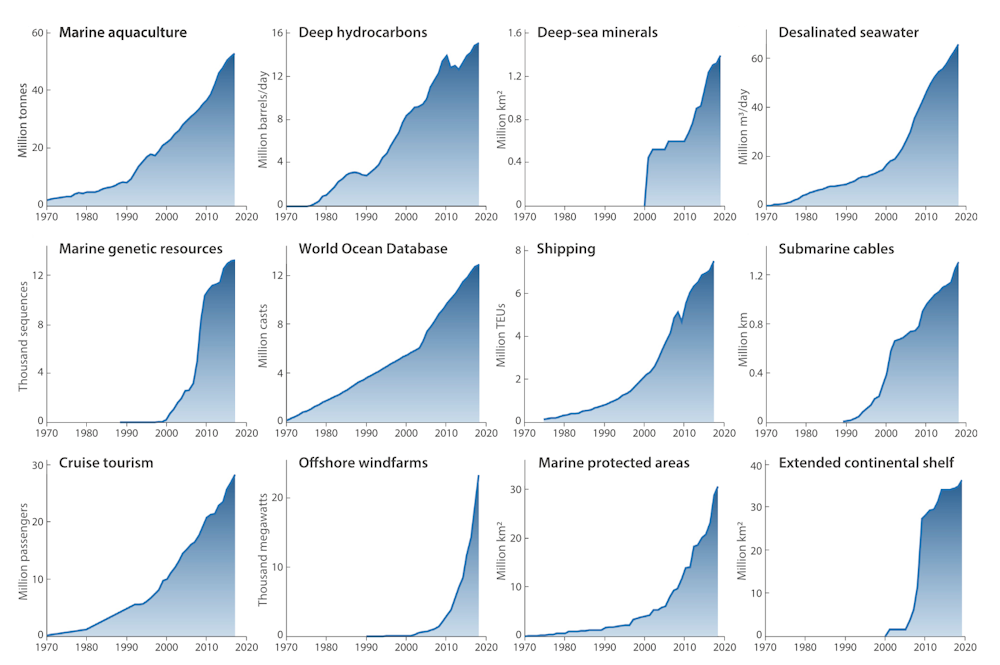
Blue Acceleration: our dash for ocean resources mirrors what we’ve already done to the land. Robert Blasiak, The Conversation. Jan. 24, 2020.


Pie: Net Zero


Wednesday, October 16, 2019

What Extinction Rebellion is Getting Wrong.

What Extinction Rebellion is Getting Wrong. Tim Watkins, Consciousness of Sheep. Oct. 16, 2019.

In many ways, this month’s Extinction Rebellion protests – which have brought city centres around the world to a standstill – are to be welcomed and supported; not least because they have made a huge contribution to raising public awareness of what they call the “climate emergency” (or what I call the climate component of our “predicament”). 

As Polly Toynbee at the Guardian reports:

“For those who doubt the effect of last April’s XR protests, Ben Page of Ipsos Mori says: ‘In our polls in 2013, 59% said the planet was ‘heading for disaster’. This year it’s gone up to 78%.” He reckons Greta Thunberg, the school strikes and XR action played their part. What packs an extra punch is that London is just one of 60 global cities engaged in ‘uprising’ at the same time’…”

The broader question, however, is whether raising awareness is the most critical issue at the moment. Clearly the leaders of Extinction Rebellion believe that it is; since they are prepared to face jail – and to encourage thousands of others to risk jail – in order to push public awareness that extra 10 per cent or so higher than it is now. The trouble is that when four-fifths of the population already say they agree with you that there is a climate emergency, any further effort is going to meet with severely diminishing returns. The final fifth of the population are the ones who will deny the climate is changing even as they are sat on top of the last British mountain not to be engulfed by the rising seas. Trying to win them around is futile. It is on a par with getting four-fifths of the population to oppose racism, but then to claim that you must keep protesting because we haven’t won the Ku Klux Klan over yet.

The climate change-denying section of the press, as expected, have alleged that the overwhelmingly white and middle class composition of the protestors is evidence that the entire movement is little more than the snow-flaky whining of an over-privileged affluent class. There may be something to this in that, given the British police force’s track record when it comes to arresting members of racial minorities, it may be best to put affluent white people at the front of the protests. Indeed, in the planning of the latest round of protests, this is exactly what Extinction Rebellion has done; by selecting those protestors who are least likely to have their lives impacted by an arrest and a criminal record, and then providing them with legal training a and support. The broader criticism is invalid, however. The 78 percent support for action on climate change suggests that there are many more people – I am one of them – who for various reasons – in my case, limited mobility – would like to protest but cannot.

The more damaging right wing critique, however, is mentioned by Toynbee:

“Never mind the science: what free-market obsessives like [Douglas} Murray can’t bear is that solving the climate crisis requires state and international action. He would rather boil to oblivion, faithful to his free-market creed, than see the planet saved by means he regards as statist or even socialist… Murray accuses XR of wanting to ‘engineer the complete destruction of the global economic system’…”

Toynbee is, of course, among the techno-utopian faithful who are wedded to the fantasy of the UK Labour Party’s version of a Green New Deal which will supposedly come to humanity’s rescue if only enough people are prepared to sign up to it. But the reason journalists like Toynbee, Labour politicians and many – if not most – of the Extinction Rebellion protestors believe this (or some variant of it) is largely due to the failings of an education system that left most educated people with no grounding in the sciences.

This gets to the heart of the problem with Extinction Rebellion’s current stance. They call on government to declare something called a “climate emergency” – which, of course, governments are happy to do because it is a meaningless and vacuous declaration. The assumption behind it, however, is the entirely erroneous belief that solutions to our current predicament are still in the gift of governments that have proved incapable of negotiating relatively simple trade deals, of overseeing railways, of running a welfare and pensions service, or more recently, of even keeping the country’s lights on… indeed, in the case of the current UK government, even the Christmas party has been cancelled because they couldn’t find a brewery to host it.

However, while we can – and should – laugh at the political class (don’t get me started on the lunatics on both sides of the aisle on the other side of the Atlantic) in reality, their scope for action is limited by the scale of the crisis that has been unfolding since the banking system crashed in 2008. And Murray is correct here. The neoliberal economic system introduced by Thatcher and Reagan, and set in stone by Clinton and Blair, was deliberately designed to remove national politicians from positions of power over the system. The national economies of the post-war years, with their controls on capital and their focus on full-employment were swept away. In their place is a global economy presided over by a technocracy within global institutions like the G20, the IMF and the World Bank; and – crucially – enforced by a series of secret supranational courts. The mandate that these institutions are bound to follow is that nothing – not national interests or attempts at sustainability – is permitted to get in the way of trade. Unless we tear down what Murray calls “the global economic system,” we can do nothing to prevent it from continuing to undermine life on Earth – and thereby bring about its own end anyway.

This brings us to Extinction Rebellion’s second demand – that governments (collectively, since they would have to dismantle the global trade system) must implement reforms to reduce greenhouse gas emissions to net zero by 2025. This is where the science parts company with the campaigners.

Firstly, there is no net zero because humans have failed to figure out a viable means of capturing and sequestering carbon dioxide for the several centuries that would be required after we ceased burning fossil fuels to restore the climate to something akin to conditions today. At this point, no doubt, some readers will object that trees and soils are natural carbon sinks; and so we might plant more trees and restore more soils. The question, however, is which trees and soils, and to what end? Few trees live beyond a century (especially when some idiot comes along and harvests them to use as “green” biofuel). And when a tree dies and falls to the floor, it dumps all of the carbon back into the atmosphere. Similar problems affect attempts at soil restoration since any further use will unlock the carbon stored there.

There is, you will be pleased to know, one natural process that can sequester and lock up all of the carbon that we have dumped into the atmosphere in the course of the last three centuries. It involves a warmer and wetter climate washing nutrients off the land and out to sea; where plankton and algae blooms can flourish and multiply; giving off noxious hydrogen sulphide – which causes “red tide events” – as a by-product. As these microscopic plants die, they sink to the ocean floor where, along with the carcasses of any marine creature that happened into the oxygen-starved red waters beneath the surface, they gradually decompose into a glutinous mud. Over time, layers and layers of this hydrocarbon-rich mud will pile up. And over centuries it will be subsumed beneath the Earth’s crust, where it will be heated and compressed beneath an impervious layer of rock that prevents it from leaking to the surface. With the carbon sequestered in this way, over millions of years the climate will cool once more.

My more alert readers will be aware that the process that I just described is the one in which the fossil fuels that we have been burning for the past 300 years were created in the first place. As far as I am aware, it is the only process currently known that can lock up large volumes of carbon dioxide for the geological time period required to repair the damage that we have already done.

There is, then, no means of offsetting carbon – the idea of “net zero” is little more than an accounting/public relations device designed to give the impression that corporations are environmentally-friendly when, in truth, any corporate economic activity at this point is merely adding to the damage already inflicted. As I once explained: getting someone to buy meat for me may make my shopping basket look like it belongs to a vegan; but that doesn’t change the fact that I eat meat… it is the same with “green” energy.

There is enough carbon dioxide in the atmosphere already to raise the temperature above 3 degrees over pre-industrial levels; so that even if we ceased burning fossil fuels today, it is highly unlikely that the global economy and a population approaching 8 billion can survive the devastation. Indeed, those at the more pessimistic end of the spectrum argue that we will be lucky if there are any humans at all on Earth by 2030. But even knowing that the current debate is between those who think things are about to get very, very bad and those who think they are about to become fatal will not be enough to prevent humanity from continuing to pump greenhouse gases into the atmosphere.

The reason is simple, the only way in which we can support a global population that is at least eight times the sustainable level is to use fossil-powered industrial agriculture on a global scale. And while switching the diet to lower the volume of cow belches will make an insignificant difference, the fact remains that fossil-powered global plant farming is still a major source of greenhouse gases. Nor do we dare dispense with the fossil-powered global supply chains that have saved the largest part of humanity from the kind of famines that were commonplace just a few decades ago. Growing excess food in favourable regions and transporting it to less favourable ones has always been the means by which humans combated famine. The only difference today is that we do it on a global scale; meaning that disruption in any one supply chain can rapidly undermine the entire system.

At this point, of course, the techo-utopian journalists, politicians and protestors will complain that I am ignoring renewable energy and the fourth industrial revolution. Once again, the reason for this objection is largely a product of an education system that is not fit for purpose. In a recent article on the Peak Prosperity website, scientist Chris Martenson refers to the sheer scale of the task that would be involved just in substituting (i.e. ignoring all of the technical engineering challenges involved) the quantity of energy we get from fossil fuels with renewable energy:
“Suppose we agree on the goal to entirely replace fossil fuel energy by 2050. (We’re going to have to do it by some point, because oil, coal and natural gas are all depleting finite resources.) 
“With 2050 as a starting point we can run some simple math. 
“We start by converting the three main fossil fuels – coal, oil and natural gas – into a common unit: the “millions of tons of oil equivalent” or Mtoe.
“A million tons of oil = 1 Mtoe, obviously. And there’s an amount of coal, if burned that has the same energy as 1 Mtoe. Ditto for natural gas. If we add up all of the fossil fuels burned in a given year, then we can express that as a single number in the many thousands of Mtoe. 
“Roger Pilke has run the math for us in his recent article in Forbes: 
‘In 2018 the world consumed 11,743 Mtoe in the form of coal, natural gas and petroleum. The combustion of these fossil fuels resulted in 33.7 billion tonnes of carbon dioxide emissions. In order for those emissions to reach net-zero, we will have to replace about 12,000 Mtoe of energy consumption expected for 2019’… 
“So, what would it take to replace those 12,000 Mtoe with alternative fuels by 2050?
“Pilke answers that for us: 
Another useful number to know is that there are 11,051 days left until January 1, 2050. 
To achieve net-zero carbon dioxide emissions globally by 2050 thus requires the deployment of >1 Mtoe of carbon-free energy consumption (~12,000 Mtoe/11,051 days) every day, starting tomorrow and continuing for the next 30+ years…
“But that’s only half of the story. 
“We’d also have to decommission and retire an equivalent 1 Mtoe amount of still-functioning fossil fuel property, plant and equipment. Do you have any idea how much money and embedded capital is contained in all the world’s current energy infrastructure — including our cars and homes — that’s built around fossil fuel use? 
“Somehow, the world would have to replace the equivalent of the energy contained within 2.4 Ultra Massive crude ships. Every. Single. Day. For 11,000 days straight, without missing a single day. A 7,000 mile long cargo train of ultra massive ships retired at the rate of 2.4 per day for the next 30 years…
What would that take? Again from Pilke: 
So the math here is simple: to achieve net-zero carbon dioxide emissions by 2050, the world would need to deploy 3 [brand new] nuclear plants worth of carbon-free energy every two days, starting tomorrow and continuing to 2050. At the same time, a nuclear plant’s worth of fossil fuels would need to be decommissioned every day, starting tomorrow and continuing to 2050.
I’ve found that some people don’t like the use of a nuclear power plant as a measuring stick. So we can substitute wind energy as a measuring stick. Net-zero carbon dioxide by 2050 would require the deployment of ~1500 wind turbines (2.5 MW) over ~300 square miles, every day starting tomorrow and continuing to 2050.”

It has taken a Herculean effort in the developed western states just to deploy a relatively small number of wind turbines and solar panels into our electricity generation mix. The idea that we are going to replace the far larger fossil fuel consumption in transport, building temperature control, industry and agriculture is no more than magic thinking. As Martenson concludes:

“Given the math, human tendencies, and the issues pertaining to time, scale and cost, the current green energy movement currently is little more than hot air. It’s just not going to happen in time. 
“We’re nowhere close to being able to build out the massive energy projects required. The equivalent of 3 nuclear plants every two days for the next 30 years? That’s a total pipe dream.
“We lack the political will, the cultural readiness, the proper narrative. Even the appropriate resources. 
“Beyond those concerns, nearly everything about how we heat, move, cool and manufacture the components of our modern lives will have to be refashioned (and possibly jettisoned) as part of that project.”

This is where the charge of hypocrisy that is often levelled against Extinction Rebellion hits home. It is doubtful that more than a handful of the protestors is prepared to make even a fraction of the lifestyle changes that would be involved just to lower the rate at which we are dumping greenhouse gases into the atmosphere. Certainly some will be prepared to give up flying, stop eating meat, use a refillable water bottles and put on an extra layer rather than turn the heating up. Mobile phones are a different matter – even though the data centres on which they depend are among the most polluting buildings on Earth. Few, one suspects, will be prepared to take the radical actions such as giving up the right to have children in favour of the birth licensing system that a rapid shift to a zero-carbon economy implies.

This is where Extinction Rebellion’s third demand – that the emergency is too serious to be political, and must be handed over to a citizen’s assembly – is simply naïve. Everything that we do is political. I am, for example, fully prepared to support and vote for the radical changes that would dismantle, de-grow and disintegrate the current global economic system. I am prepared to forgo the hi-tech health system that has kept me alive for the last decade; even though its end is likely to result in my own premature death. I am NOT, however, prepared to make that sacrifice while others continue to have large families, drive cars, fly and use mobile phones. Nor am I prepared to go without food in order to pay the excessive cost of a non-renewable renewable energy-harvesting infrastructure while the government continues to dole out billions of pounds to parasitic corporate welfare outfits that do little good for any of us. I am not alone in this, as the recent Australian election, the Yellow vest movement in France, and even a proportion of Trump, Sanders, Corbyn and Brexit voters will attest – we simply will not be able to construct an economic lifeboat to save even a proportion of us as we de-grow our population and economy to something more sustainable if we persist in allowing a small minority to “own” more than half of the world’s “wealth” even as a growing majority struggles to put food on the table.

In the end, Extinction Rebellion is facing the same dilemma that has plagued the environmental movement from the start:
  • Should it spell out the enormous effort and sacrifice involved in changing course – and thereby risk alienating the majority of those who need to be won over? Or;
  • Should it pretend – despite all the evidence to the contrary – that a few windmills and solar panels will allow us to continue growing our planet-destroying economy without even pausing to draw a breath.

My fear is that – like the various green parties around the world – this latest manifestation of environmentalism will take the second option so as not to scare the horses. And if those at the gloomier end of the spectrum are correct and that we only have 10 years left, this may not be such a bad thing; after all, they say that dying in your sleep is far preferable than consciously looking death in the face. Either way, one can count on one hand the number of protest movements that have achieved the change they wanted to bring about. The enormity of the predicament does not change this fact. 

The sad reality is that we are all prisoners of the very system that is killing us; dependent upon it for the food, water, clothing and shelter that sustain us even as it destroys the habitat we depend upon. We could end it tomorrow if only the majority of us chose to stop playing the game; but the sacrifice is too great… and few of us are prepared to take the hit while others continue to get a free pass.

And so, while I salute those who have taken to the streets this month (my son is among them and I am proud that he is standing up for what he believes in) I would also caution them that the changes that are coming are not the ones they want; still less the ones the leaders of their movement are pretending they can have. 

Our current civilisation can be compared to the last moments of the Titanic – holed below the waterline and destined to sink into a watery grave. Most of those who are protesting are merely akin to the frightened passengers begging a Captain and crew to respond to a situation that they have already lost control of. The sensible few among the protestors will look to those who are assembling the lifeboats. But the majority – whether they believe the emergency is real or not – will soon meet their tragic end. And protesting icebergs and reckless Captains will do nothing to save them – or us – now!

Saturday, May 18, 2019

Consciousness of Sheep

Not so good news. Tim Watkins. Apr. 1, 2019.


Protesters today intend bringing central London to a standstill by blockading several major arterial roads into the capital. For once, this has nothing to do with Brexit. Instead, it concerns the increasingly urgent call for government to “do something” about climate change. Exactly what that “something” is that must be done is a little less clear, since current environmental concerns are almost always pared down to concern about the carbon dioxide emitted by cars and power stations. Although how exactly this relates to the mass die-off of species resulting from industrial agriculture and deforestation, or growing oceanic dead zones and plastic islands, is far from clear.

Protesting environmental concerns involves a high degree of denial and self-deception; as it is based on two gross errors. The first is the irrational belief that governments have the means to respond to the predicament we find ourselves in. As a corrective to this, just look at the dog’s breakfast that the current British government has managed to make out of what is a simple (by comparison) trade negotiation. Anyone who seriously thinks these clowns are going to do anything positive (save for by accident) for the environment is displaying almost clinical levels of delusion. The second error is in believing the often unspoken conspiracy theory that insists that the only thing standing between us and the promised zero-carbon future is corrupt politicians and their corporate backers, who insist on putting the needs of the fossil fuel industry ahead of life on planet earth.
To maintain these deceits, a large volume of propaganda must be put out in order to prove that the zero-carbon future is possible if only the politicians would act in the way the people want. So it is that we are treated to a barrage of media stories claiming that this town, city, country or industry runs entirely on “green” energy (don’t mention carbon offsetting). Indeed, left to their own devices, we are told, the green energy industry is already well on the way to building the zero-carbon future we asked for; we just need the politicians to pull their fingers out and we could easily get there in just a few years’ time. For example, Joshua S Hill at Green Technica tells us that:

“Renewable energy sources now account for around a third of all global power capacity, according to new figures published this week by the International Renewable Energy Agency, which revealed 171 gigawatts (GW) of new renewable capacity was installed in 2018… 
“This brings total renewable energy generation capacity up to a whopping 2,351 GW as of the end of 2018, accounting for around a third of the globe’s total installed electricity capacity. Hydropower remains the largest renewable energy source based on installed capacity, with 1,172 GW, followed by wind energy with 564 GW and solar power with 480 GW.”

Stories like these play into the fantasy that we are well on our way to reversing climate change, and that all we need now is some “green new deal” mobilisation to replace the final two-thirds of our energy capacity with non-renewable renewable energy-harvesting technologies to finish the job. If only it was that simple.

Notice the apparently innocuous word “capacity.” This is perhaps the least important information about electricity. Far more important is the amount that is actually generated. The US Energy Information Administration explains the difference:

“Electricity generation capacity is the maximum electric output an electricity generator can produce under specific conditions. Nameplate generator capacity is determined by the generator’s manufacturer and indicates the maximum output of electricity a generator can produce without exceeding design thermal limits…. 
“Electricity generation is the amount of electricity a generator produces over a specific period of time. For example, a generator with 1 megawatt (MW) capacity that operates at that capacity consistently for one hour will produce 1 megawatthour (MWh) of electricity. If the generator operates at only half that capacity for one hour, it will produce 0.5 MWh of electricity… 
“Capacity factor of electricity generation is a measure (expressed as a percent) of how often an electricity generator operates during a specific period of time using a ratio of the actual output to the maximum possible output during that time period.”

In terms of understanding where we are and where we are heading, “electricity generation” is far more important than “capacity”; which only tells us how wind, wave, tide and solar technologies would perform if it were possible (it isn’t) for them to generate electricity all day (and night) every day. Put simply, if you cannot turn on your lights, operate your business or recharge your electric car, because there is no electricity, it is little comfort to learn that on a good day the grid is capable of supplying more electricity than you might need. From a planning point of view, knowing the capacity factor for various generating technologies matters because it gives an insight into how efficient they are. A nuclear or fossil fuel power plant that runs more or less continuously for more than 60 years is likely to require far fewer inputs and far less land area than, say, vast solar farms (which have to be replaced every 10-20 years) that can only generate electricity when the sun is shining.

So where do non-renewable renewable energy-harvesting technologies stand when it comes to electricity generation? According to the latest BP Statistical Review of World Energy, in 2017 human civilisation generated 25551.3 Terawatt hours (TW/h) of electricity. Of this:
  • Non-renewable renewable energy-harvesting technologies provided 2151.5 TW/h (8.4%)
  • Nuclear provided 2635.6 TW/h (10.3%)
  • Hydroelectric dams provided 4059.9 TW/h (15.9%)
  • Fossil fuels provided 16521.7 TW/h (64.7%).

What this tells us is that far more non-renewable renewable energy-harvesting capacity has to be installed than the electricity that it can actually generate – it has a low capacity factor. Indeed, Hill’s “around a third” figure includes the much larger capacity of hydroelectric dams (which have environmental issues of their own) for which there is little scope for further installation. Only by adding in nuclear power can we get to a third of electricity generation from low-carbon sources.

Even this, however, misleads us when it comes to environmental impacts. The implicit assumption is that non-renewable renewable energy-harvesting technologies are still valuable despite their inefficiency because they are replacing fossil fuels. But this is not why countries like the UK, Saudi Arabia and (for insane reasons) Germany have been deploying them. In the first two cases, the deployment of non-renewable renewable energy-harvesting technologies is primarily to maximise the amount of fossil fuels available for export. In Germany’s case, renewables that might otherwise have weaned the economy off coal were deployed instead as a replacement for nuclear; leaving the economy overly-dependent upon often dirty (lignite) brown coal; and forcing them to turn to Russian gas as a future substitute for coal. These states are not, however, where most of the world’s largely fossil fuelled industrial processes take place. Asia accounts for the majority of global industry, and Asian economies use non-renewable renewable energy-harvesting technologies to supplement fossil fuels rather than to replace them; although Hill does not clarify this when he tells us that:

“Specifically, solar energy dominated in 2018, installing an impressive 94 GW… Asia continued to lead the way with 64 GW — accounting for around 70% of the global expansion last year — thanks to dominant performances from China, India, Japan, and South Korea.”

While, of course, electricity generated from wind, wave, sunlight and tide is energy that might otherwise have come from fossil fuels, the impact should not be exaggerated. According to the 2019 edition of the BP Energy Outlook, in 2017:
  • Non-renewable renewable energy-harvesting technologies provided 4 percent of global primary energy
  • Nuclear provided 4 percent
  • Hydroelectric 7 percent
  • Gas 23 percent
  • Coal 28 percent
  • Oil 34 percent.

Just our additional energy demand since 2015 has been sufficient to account for all of the non-renewable renewable energy-harvesting technologies deployed to date. That is, if we had simply accepted 2015 levels of consumption, we need not have deployed these technologies at all. And, of course, if we had stabilized our energy consumption a couple of decades ago we could have left the bulk of the fossil fuels we now consume in the ground:Source: Global carbon emissions 2007-17

What is really at issue here is that – to quote the late George H.W. Bush – “The American way of life is not up for negotiation.” That is, we can have any energy transformation we like, so long as it does not involve any limitation on our continued exploitation and consumption of the planet we live on. The too-big-too-fail banks must have permanent economic growth and that, in turn, means that we have no choice other than to keep growing our energy consumption.

The trouble is that infinite growth on a finite planet is impossible. Worse still, as the energy return on investment (aka Net Energy) declines, the increased energy and monetary cost of energy production causes the energy and monetary value available to the wider (non-energy) economy to decline. In the first two decades of the century, this has caused an intractable financial crisis coupled to a massive decline in prosperity across the developed economy (resulting in the collapse in consumption of the “retail apocalypse”) which is beginning to generate political instability. In the 2020s the crisis is set to worsen as the energy cost of producing a whole range of mineral resources raises their market price above that which can be sustained in the developed states (where most of the consumption occurs). The result – whether we like it or not – is that we face a more or less sharp drop in consumption in the next couple of decades.

This raises questions about the purpose to which we deploy non-renewable renewable-energy harvesting technologies. For several decades, people in the green movement have engaged in private arguments about whether they should spell out the likely localised and de-materialised economies that giving up or running out of accessible fossil fuels necessarily entails. Since this would be politically toxic, most have chosen to promote the lie that humanity can simply replace coal, gas and oil with some combination of wind, wave, tide and sunlight without economic growth even needing to pause for breath. This, in turn, has allowed our young people to believe that intransigence is the only thing preventing our political leaders from de-carbonising our economies.

Exactly what our politicians are told about our predicament is a matter of conjecture. Most, I suspect, are as clueless as the population at large. Nevertheless the permanent civil services across the planet have produced a raft of reports into the full spectrum of the catastrophe facing us, from the damage we are doing to the environment to the rapidly depleting stocks of key mineral resources and productive agricultural land, and the more imminent collapse in the global financial system. And the more they become aware of this predicament, the more they realise just exactly what the word “unsustainable” actually means. One way or another, six out of every seven humans alive today is going to have to go – either by a planned de-growth or via a more or less rapid collapse of our (largely fossil-fuelled) interconnected global life support systems.

With this in mind, there is something truly immoral about perpetuating the myth that we can maintain business as usual simply by swapping non-renewable renewable-energy harvesting technologies for fossil fuels. This is because maintaining the myth results in precisely the kind of misallocation that we already witnessed in those states that are using renewable electricity to bolster fossil fuel production and consumption. The more we keep doing this, the harder the crash is going to be when one or other critical component (finance, energy or resources) is no longer widely available.

There is a place for renewable energy in our future; just not the one we were promised. As we are forced to re-localise and de-grow both our economies and our total population, the use of non-renewable renewable-energy harvesting technologies to maintain critical infrastructure such as health systems, water treatment and sewage disposal, and some key agricultural and industrial processes would make the transition less deadly. More likely, however, is that we will find the technologies we need to prevent the combination of war, famine and pestilence that otherwise awaits us will have been squandered on powering oil wells, coal mines, electric car chargers, computer datacentres and cryptocurrencies (none of which are edible by the way).

At this stage, all one can say to the climate protestors and to the “green” media that encourage them is, “be careful what you wish for… it might just come true!”


Situating the appreciation. Tim Watkins, May 16, 2019. 

Sir Angus Deaton is the latest apostolic legate of the econometric priesthood to be given the unenviable task of coming up with a cause and a cure for income inequality and its socio-political consequences without challenging the underlying disease. The motivation for appointing Deaton – a Nobel laureate economics professor at Princeton in the USA – to head up a five-year review into the impact of inequality on the democratic process, comes from the unexpected votes three years ago that resulted in Brexit in the UK and the election of Donald Trump in the USA. In the years since, political discontent with established parties and politicians has swept across the world; resulting in the rise of right wing “strongmen” like Modi in India, Bolsonaro in Brazil, Orban in Hungary and Salvini in Italy. In an interview with the Guardian, Deaton explained:

“There’s a real question about whether democratic capitalism is working, when it’s only working for part of the population.
“There are things where Britain is still doing a lot better [than the US]. What we have to do is to make sure the UK is inoculated from some of the horrors that have happened in the US.”
There is ambiguity in this. When Deaton talks about “horrors” is he talking about the mountain of human faeces building up on the streets of San Francisco, the return of Victorian diseases like typhus and the growing opiate death toll among America’s poor; or is he merely echoing privileged progressive howling over the election of Trump and the accompanying meltdown in the Democrat party? If the former, then there is little to celebrate in the UK, where work no longer pays; where slavery has returned – more of less openly – on our high streets; where millions of families depend on emergency food parcels to stave off starvation; where two homeless people a day die in shop doorways; and where the United Nations has condemned our welfare system as a crime against humanity. Only on the political front – and only by accident – the economic policies put forward by Corbyn and McDonnell in 2017 saved Britain from a majority Tory government that would have rushed headlong into a no-deal Brexit, followed by a massive assault on what remains of our rights and environmental legislation.
The Brexit vote itself owes a great deal to economic inequality. Ex-industrial areas that “ought” to have been in favour of the European Union – or at least the Social Chapter workers’ rights – voted by a large margin to leave. However, the error made by the liberal media has been to focus solely on the callous attacks on living standards perpetrated by Cameron and his Bullingdon Club public schoolboy chums between 2010 and 2016. This is to misunderstand the slow motion economic crisis that has been devouring western societies since the early 1970s.
To be clear, different governments might have adopted milder policies that might have mitigated much of what we can now witness openly on our streets. Cameron did not have to cut taxes and handout lavish corporate welfare to the already wealthy while driving the most vulnerable into penury. On the other side of the Atlantic, Obama could have jailed a few bankers and regulated the rest instead of inviting them to run his administration. But they chose not to; and thereby exacerbated a crisis that has been decades in the making.
Like most baby boomer economists, Deaton’s understanding of how the economy is meant to work is shaped by the unprecedented and never to be repeated 1953-1973 boom brought about by the post-war switch from coal- to oil-based economies. It was the massive explosion of wealth in the western economies during this period that gave rise to the period of (relative) industrial and political peace as, for the only time in modern history, the workers’ share of productivity increased. With prosperity rising, the bitter industrial battles of the 1920s and the depression and political extremism of the 1930s appeared to have been laid to rest. Unfortunately, and despite the economics textbooks, it was a blip. American deficit spending on the Vietnam War together with a slump in oil production brought about the end of the Bretton Woods monetary system and inflicted inflation upon America’s trading partners.
Neoliberalism was the western elite’s response to the crises of the 1970s. Conservative governments under Thatcher and Reagan set about dismantling the economic dimension of the post-war settlement (the series of social democratic reforms introduced to prevent a repeat of the 1929 banking crash, the 1930s depression and the rise of political extremism). Both blamed “greedy workers” for “paying themselves more than they could afford” for a crisis that, in reality, was the result of declining net energy – as more energy had to be expended on producing energy, less was available to power the much larger non-energy sectors of the economy. As the energy cost of energy continued to rise, so standards of living began to fall. The perennial question ever since has been, who will be the losers?
Neoliberalism’s first act was the creation of an underclass – what we know today as the “precariat” – a section of the population whose poverty would both crush inflation and serve to hold down the wages of the wider working class. Its second – almost unconscious – act was to embark on the financialisation of the economy by handing over control of the money supply to private banks. Instead of governments printing new currency and distributing it via public spending on pensions, benefits and public services, banks would create new currency when they made loans to those – mostly wealthy households and corporations – considered “credit worthy.”
In his interview with the BBC’s Today Programme, Deaton touches on one of the consequences of financialisation – what he refers to as “rent seeking.” Deaton gives the example of drug companies lobbying government to allow them to jack up the price of medicines. That is, no new research or production occurs; they are merely using their access to the political system to enrich themselves at everyone else’s expense. This, however, is the natural consequence of handing over the money supply to the banks… it is not a flaw, it is a design feature. The reason that businesses – and, indeed, banks themselves – used to have to be concerned with the health of the wider community and of the nation as a whole was precisely because widespread economic and social health provided the only guarantee that they could secure the additional money required to continue to grow. In a financialised system in contrast, access to new currency requires only that a new loan be taken out; while profit requires only that a business squeeze as much out of its customers, suppliers and the environment as it can to pay back the loan with interest.
This gave rise to the third act of neoliberalism. Since workforce, community and nation no longer mattered, it was far easier to profit by offshoring business activities to areas of the world that permitted child labour; paid low wages; allowed horrendous working conditions; and showed little or no concern for the environment. Free collective bargaining might have benefitted workers when they only had their fellow countrymen and women to compete against; but western workers soon found themselves having to compete with impoverished Africans and Asians if they were to keep their jobs… a futile task for many; and devastating for whole swathes of the ex-industrial regions.
As I pointed out in a recent post about Ebbw Vale in the South Wales valleys, under Thatcher in the valleys alone, tens of thousands of high-paying manual jobs were shipped overseas; devastating communities and leaving families trapped in perpetual poverty. Those who could get out – whether through education or by commuting – did so, leaving the community starved of the very knowledge and skills that might, just, have made a difference. And even the education ladder – the treasured neoliberal solution to poverty – was to be pulled up by Thatcher and her successors via the abolition of grants and the introduction of fees and student loans.
Throughout the Thatcher years (1979-1990) the Labour opposition had sought a route back to power that would reverse at least the harshest of the economic reforms. With Britain entering into the debt-based binge that ended so disastrously in 2008, however, there was little public support for policies that might plunge the country back into the crises of the 1970s. It was in this climate that the Clinton Democrats and Blair’s New Labour chose a route back to power that involved throwing the working class under the bus and adopting and building upon the economic policies of neoliberalism. As one of the architects of New Labour put it, they were “intensely relaxed about people getting filthy rich so long as they paid their taxes.” As the Dark Lord himself put it:
“Post-war Britain has seen two big changes. First, and partly as a result of reforming Labour governments, there are many more healthy, wealthy and well-educated people than before. In addition, employment has switched from traditional manufacturing industries to a more white-collar, service-based economy. The inevitable result has been that class identity has fragmented.
“Only about a third of the population now regard themselves as ‘working-class’. Of course it is possible still to analyse Britain in terms of a strict Marxist definition of class: but it is not very helpful to our understanding of how the country thinks and votes. In fact, of that third, many are likely not to be ‘working’ at all: these are the unemployed, pensioners, single parents – in other words, the poor.”

In exchange for adopting and institutionalising the economic pole of neoliberalism, Clinton and Blair imposed an enhanced version of the social reforms of the 1960s. As the author of the Flipchart Fairytales blog points out:
“Even during the Thatcher period, when economic policies shifted to the right, the liberal policies initiated during the 1960s, and the social changes that went with them, continued apace. Conservative politicians may have railed against ‘political correctness’ but they didn’t do much about it. Racist and sexist language that would have passed unremarked in 1979 was considered unacceptable by the time John Major left office. Corporal punishment in schools was abolished under Margaret Thatcher and, while there was much tough talk on immigration, her government did little to change the existing laws. The Conservatives even shied away from illiberal legislation that would have been overwhelmingly popular, such as the re-introduction of capital punishment. Voters might have thought they were voting for socially conservative policies but what they got was economic liberalism.”

If Tony Blair’s adoption of economic liberalism – symbolised by the adoption of the Private Finance Initiative which brought the private sector into the heart of government and public services – marked the point at which the right won the economic war, then it was David Cameron’s successful steering of same sex marriage onto the statute book that marked the point when the left won the social war.
The problem for neoliberalism was that it depended upon ensuring that the losers – those who need economic rather than social justice – never become the majority of the electorate. This was doable so long as the banks could keep churning out mountains of debt-based electronic currency backed by nothing more than the false promises of the bankers themselves. But when the real world imposed itself, in the shape of peak production of conventional oil in 2005, the resulting price spike which saw oil rise above $140 per barrel was sufficient to drive sub-prime mortgage borrowers into arrears. And when, in 2006, the central banks began to raise interest rates in an attempt to lower inflation, they made the banking collapse of 2007-8 inevitable. The subsequent recession, from which wages and living standards have yet to (and probably never will) recover, tipped sufficient new households into or on the edge of the precariat, that neoliberalism lost its electoral majority.
Cameron’s defeat in 2016 was a massive wake up call. As Matthew Goodwin explained in an article for Quillette:
“The referendum marked the first occasion in Britain’s history when the culturally liberal middle-class, which orbits London and the university towns, had lost. Until this point, the advocates of double liberalism—a globalized economy accompanied by a highly liberal immigration policy—had gotten all they had wanted. Business got a continuing influx of mass cheap labour that fed a consumption-driven growth model that not only removed incentives for investing in training but exacerbated divides between the high and low-skilled. The liberal middle-class got economic benefits alongside Polish cleaners and membership of the dominant value set but became increasingly detached from the ‘left behind.’”

The election of Donald Trump just five months later demonstrated that this was anything but a small setback or a local difficulty. Unfortunately, most unthinking neoliberals responded in the very worst way possible. While a few sought to understand the coalition of forces that had produced the result, most simply tried to ignore what had happened. The Brexit referendum, we were told, “was only advisory.” The Leave campaigners, they explained, “had lied.” The people, they argued, “didn’t understand what they had voted for.” In the UK, neoliberals turned to the courts in an attempt to strike down the referendum result while in the USA they turned to conspiracy theories and attempts to overturn the Constitution to evict Trump from the White House.
Only a few thinkers within the affluent class regarded Brexit and Trump as the democratic choice of the growing precariat. Some at least sought to understand the social and economic forces that had produced the result with a view to developing the green new deals, circular economies and fourth industrial revolutions that we are beginning to see emerging as the proposed means of maintaining neoliberal privilege while sending the unwashed masses back to sleep.
Writing in the Guardian, Aditya Chakrabortty sets out neoliberalism’s current predicament:
“Brexit proved our economy is broken, but our leaders still have no clue how to fix it…
“It ultimately comes down to this: decades of privatisation, hammering unions and chucking billions at the housing market while stripping the welfare state has effectively ended any semblance of a national, redistributive economy in which a child born in Sunderland can expect to have similar life chances to one born in Surrey. Yet politicians remain fixated on mechanisms that no longer work adequately for those who actually depend on the economy. They obsess over GDP growth when the benefits of that are unequally shared between classes and regions. They boast about job creation when wages are still on the floor.
“Most of all, they brag about London, the one undoubted gleaming success of the British economic model. ‘A pound spent in Croydon is of far more value to the country than a pound spent in Strathclyde,’ to quote Boris Johnson, the Conservative party’s last surviving greyback. But that is to ignore how London itself is rapidly becoming unlivable for many Londoners.”

Chakrabortty sees the symptoms, but neither understands the disease nor offers a cure. This, very likely, is where Deaton comes in. A safe pair of hands to give the masses the impression that something is being done (whether anyone can afford to wait the five years of the investigation is a moot point) while most likely turning to failed neoliberal prescriptions for increased access to university courses that have already outlived their worth, and for minimum wages set so high that they help drive people into the faux self-employment of an exploitative gig economy.
It is highly unlikely, however, that Deaton will prove capable of escaping his academic silo long enough to understand the growing net energy crisis that has rendered further business as usual unsustainable. There isn’t going to be a “fourth industrial revolution” because there is not enough of planet earth left for neoliberal capitalism to rape. Green new deals based on even more debt-based currency spirited into existence from the ether will fail for much the same reason. Rather like the more short-lived quantitative easing and below-inflation interest rate policy, neoliberalism itself was a response to the net energy crisis. And just like those policies, it could only ever be a temporary fix because as soon as the Asian and African people it sought to exploit began to engage in western-style consumption, they would accelerate the crisis.
The economy is failing precisely because it is unsustainable. Growth was only ever a product of rising energy per capita; and since the 1970s, western per capita energy has been in decline. Debt and developing world exploitation kept the game going for a couple of decades – but only at the expense of destroying the living standards of the western working class. In these circumstances, huge blinkers are required in order to fail to see why Cameron telling people that leaving the EU would be bad for the economy, or Clinton telling voters that “America is already great” was bound to end in tears.
In asking Deaton to inquire as to why “capitalist democracy” is failing, the Institute of Fiscal Studies is effectively situating its own appreciation of the crisis. The appreciation is false simply because there is nothing wrong with capitalist democracy… it is doing precisely what we would expect it to do in the face of financialisation and shrinking net energy: it is concentrating wealth in the hands of a tiny elite while impoverishing an ever larger section of the western population (whose continued spending it depends upon to remain solvent). By 2016 the process had reached the point where sufficient numbers were either in or teetering on the edge of the precariat that the electoral balance shifted in favour of anyone regarded as an “outsider” and deemed to be opposed to the prevailing system.
Initially, socially conservative parties of the right have been the beneficiaries of the backlash. However, the growth in support for Britain’s Labour opposition together with recent electoral victories for the left in Spain demonstrate that the rise of the right is not a done deal. Policies such as nationalising transport and utilities, limiting and taxing the income and wealth of the rich, setting higher minimum wages, and limiting the pay of corporate CEOs are at least as popular as socially conservative policies to tighten immigration controls and to impose tougher sentences on criminals.
We can only wait for Deaton to report in 2024 – assuming (and this is far from certain) that we still have a functioning economy by then – to see whether he proves capable of correctly diagnosing the underlying net energy disease or whether, like some wild west snake oil salesman, he trots out the same worn neoliberal prescription for more student loans to fund more useless university courses that – in true cargo cult fashion – continue to fail to generate the high-skilled/high-paid jobs that three decades of centre right politicians promised.

Check Also

Homelessness in the UK

Britain as Venezuela

A country paralysed by political crisis; people unable to access the food they need; healthcare …