Showing posts with label links. Show all posts

Sunday, September 13, 2020

Climate Links Sept 2020

‘Green’ billionaires behind professional activist network that led suppression of ‘Planet of the Humans’ documentary. Max Blumenthal. GrayZone.  Sept. 7, 2020.

The Michael Moore-produced ‘Planet of the Humans’ faced a coordinated suppression campaign led by professional climate activists backed by the same ‘green’ billionaires, Wall Street investors, industry insiders and family foundations skewered in the film.

... Yet according to Josh Fox, the most vehement opponent of “Planet of the Humans,” the planet-saving capacity of solar and other supposedly clean forms of energy was so well-established it was beyond debate.

“The premise of the film is renewable energy doesn’t work and is dependent on fossil fuels. And that is patently ridiculous,” Fox remarked to me. “And the reason why I got into this is because I had young environmentalists – young people who are steadfast campaigners – calling me in the middle of the night, freaking out, [telling me] ‘I can’t believe this!’ And I looked at them and I said, ‘Well, there’s a reason why you can’t believe this; it’s because it’s not true.'”

But was the presentation of renewable energy sources in “Planet of the Humans” actually false? Ecological economist William Rees has claimed that “despite rapid growth in wind and solar generation, the green energy transition is not really happening.” That might be because it is chasing energy growth instead of curtailing it. Rees pointed out that the surge in global demand for electricity last year “exceeded the total output of the world’s entire 30-year accumulation of solar power installations.”

Are there not reasonable grounds then to be concerned about the practicality of a full transition to renewables, especially in a hyper-capitalist, growth-obsessed economy like that of the United States?

A September 2018 scientific study delivered some conclusions that contradicted the confident claims of renewables advocates. A research team measured solar thermal plants currently in operation around the world and found that they are dependent on the “intensive use of materials,” which is code for heavily mined minerals.
... 
Even mainstream environmentalists acknowledge that rising reliance on renewable energy “means a lot of dirty mining” to extract the minerals required for electric batteries and solar cells. This prospect has sparked excitement within the mining industry, with the editor of Mining.com, Frik Els, dubbing Green New Deal spokeswomen Rep. Alexandria Ocasio-Cortez and Greta Thunberg “mining’s unlikely heroines.”

“Going all in on the green economy and decarbonisation requires siding with the greens against fossil fuels,” Els informed fellow mining industry insiders. “It means selling global mining as the solution to climate change because mining metals is the only path to green energy and green transport.”
... 
The 2050 transition goal: real science or a murky crystal ball?

In his piece hammering “Planet of the Humans” in The Nation, Fox touted “the proliferation of 100 percent renewable energy plans put forward by Stanford University Professor Mark Jacobson” as one of the most important pieces of evidence refuting the film’s grim narrative.

Jacobson’s study, according to National Geographic, was “a foundation stone” of the Green New Deal proposal put forward by Democratic Sen. Ed Markey and Rep. Alexandria Ocasio-Cortez. It was also central to the energy plan advanced by the presidential campaigns of Sen. Bernie Sanders, who co-authored an op-ed with Jacobson that called for a full transition to “clean” energy by 2050.

Jacobson, like Ingraffea, is an environmental engineer and political partner of Fox. The Stanford professor helped Fox found the environmental advocacy organization the Solutions Project, alongside actor Mark Ruffalo and the banker and former Tesla executive Marco Krapels in 2011. (More on this group later.)

Besides his working relationship with Jacobson, Fox failed to acknowledge that the professor’s all-renewables projection was strongly challenged by 21 leading energy scientists in the prestigious Proceedings of the National Academy of Sciences journal. The scientists concluded Jacobson’s paper was rife with “invalid modeling tools, contained modeling errors, and made implausible and inadequately supported assumptions.”

A survey of the debate by Scientific American scoffed at Jacobson’s remarkable assumption “that U.S. hydroelectric dams could add turbines and transformers to produce 1,300 gigawatts of electricity instantaneously… or the equivalent of about 1000 large nuclear or coal power plants running at full power.”
... 
Missing from nearly all of the takedowns was the documentary’s scathing critique of the corruption of environmental politics by billionaires and elite family foundations.

“The conversation our critics really didn’t want to have was about the last one-third of the film,” Zehner remarked, “which dealt with the influence of billionaires and money in the environmental movement, and the divestment sham.”

...

 It was a classic case of greenwashing, in which corporate behemoths burnished their reputation among progressives by embracing cosmetic reforms that did little to challenge their bottom lines.

...

For raising questions about the efficacy and environmental cost of renewable projects like these, and proposing an explicitly anti-capitalist solution to the corporate destruction of the planet, the makers of “Planet of the Humans” were steamrolled by a network of professional climate activists, billionaire investors and industry insiders.

Now, with the Biden campaign promising a new flood of renewable subsidies and tax breaks under the auspices of a “clean” energy plan, the public remains in the dark about what it is signing up for. Even if the ambitious agenda fails to deliver any substantial environmental good, it promises a growing class of green investors another opportunity to do well.

Wednesday, February 12, 2020

Climate Links Feb. 2020

* first published Feb. 12; updated with new additions as of Feb. 24-26 *

* It's time to say goodbye to our most ambitious climate target ever. Matt Reynolds, wired. Feb. 21, 2020.
For the last four years, avoiding 1.5 degrees of warming has been at the top of the climate agenda. But the goal is already out of reach. Where do we go next?


The Planet Is Screwed, Says Bank That Screwed the Planet. Kate Aronoff, New Republic. Feb. 25, 2020.
A report from two economists at JP Morgan Chase pushes back against traditional economic wisdom on climate change.

* Alaska’s Marine Ecosystem Is Changing ‘Decades Too Early’ Due to Climate Crisis. Jordan Davidson, EcoWatch. Feb. 26, 2020.


Climate Change Predictions Have Suddenly Gone Catastrophic. This Is Why. Maddie Bender, Vice. Feb. 7, 2020.
The latest climate models have unexpectedly started to predict nightmarish warming scenarios. Now, scientists are scrambling to understand why, and if they can be trusted.
Ceppi and his co-authors compared models from the two most recent generations of guidelines based on climate sensitivity, a metric that describes the amount of surface warming a doubling in CO2 emissions would produce. Their study was published last month in the journal Geophysical Research Letters.

While the previous generation of climate models predicted on average a climate sensitivity of 3.3 Kelvin, the authors found that the most recent models average a climate sensitivity of 3.9 K. Additionally, the ranges of climate sensitivity produced by these models grew, from between 2.1 and 4.7 K to between 1.8 and 5.6 K.

Mark Zelinka, the first author of the study, said in an email that the only dramatic change between the two generations of models was how climate warming due to cloud cover had been incorporated. He explained that clouds reflect some sunlight that hits them, and as the planet warms from CO2 emissions, cloud cover will decrease. This in turn causes a positive feedback loop and further warms the climate.

Ceppi added that clouds also have their own greenhouse effects and can act as a blanket in the same way as greenhouse gases. The strength of this property depends on how high a cloud is, adding another layer of complexity that has only recently been incorporated into models.

Permafrost is thawing so fast it’s gouging holes in the Arctic. World Economic Forum. Feb. 14, 2020.
  1. Abrupt melting of the permafrost layer is leading to erosion, landslides and craters in the Arctic landscape.
  2. As the permafrost melts, greenhouse gases are released into the environment.
  3. Current climate change forecasts may underestimate the emissions from permafrost because they only take into account gradual thawing of the ice layer.

Are economists globally understating or overstating the cost of climate change? Nassim Khadem, abc.net.au. Feb. 5, 2020.


The Challenging Arithmetic of Climate Action. Michael Spence, Project Syndicate. Feb. 12, 2020.
All strategies to mitigate climate change have distributive implications that cannot be overlooked. If left unaddressed, such implications will fuel persistent headwinds to progress on the climate change and sustainability agenda.

Stop blaming population growth for climate change. The real culprit is wealth inequality. Heather Alberro, Scroll.in. Feb. 7, 2020.
Consumption by the world’s richest 10% makes up half of the planet’s consumption-based CO₂ emissions.


The potential climate consequences of China's Belt and Roads Initiative. Jan Ellen Spiegel, Yale Climate Connections. Feb. 17, 2020.
The enormous infrastructure development effort could lock in heat-trapping greenhouse emissions for decades.


Is Your Favorite News Source Shilling for Big Oil? Amy Westervelt, The Nation. Feb. 12, 2020.
Some media companies are creating, not just running, misleading climate ads.


Existential Dread: We Need to Talk About our Feelings. James Magnus-Johnston, CASSE. Feb. 12, 2020.

Sunday, January 26, 2020

Climate Links: January 2020 #2

Why action on climate change gets stuck and what to do about it. Matthew Hoffmann (Professor of Political Science and Co-Director Environmental Governance Lab, University of Toronto) & Steven Bernstein (Professor of Political Science and Co-Director of the Environmental Governance Lab, University of Toronto). The Conversation. Jan. 16, 2020.
Work crews descended on 12 commuter parking lots in Toronto in late November 2018, and headed to the electric vehicle (EV) charging stations. Their work came on the heels of an IPCC report that warned of dire environmental, economic and health consequences in the absence of any serious momentum toward decarbonization by 2030.

But the crews were not adding to the two charging stations installed in each parking lot in 2013. They came to remove them.

This erasure of one provincial government’s climate project by its successor was only the tip of the melting iceberg. The steady unravelling of climate policy began when the newly elected Conservative government cancelled the provincial cap and trade system and renewable energy contracts from Ontario’s feed-in-tariff system. It also removed subsidies for electric vehicles (up to $14,000 per vehicle under the previous government).

Despite being sold as cost-cutting, some of the reversals have been expensive. Cancelling 750 renewable-energy projects, for instance, cost $231 million.

It is tempting to view this unwinding through the lens of the polarized politics plaguing many western democracies. That misses the bigger picture.

Our research on more than two dozen climate initiatives around the world — from the community level to the global scale — revealed that the Ontario story is depressingly familiar. There is no lack of climate initiatives — our case studies are only a small cross-section of thousands. Rather, the problem is that these initiatives tend to get started, make some progress and then get stuck or even regress.

Dependence on fossil energy means it is difficult for a new policy or technology in isolation to catalyze breakthrough changes. Part of the story is the pushback they generate, as happened in Ontario, from political and economic interests that mobilize opposition.

But overt resistance is not the only obstacle to change. Changing one thing often runs into the powerful inertia of related policies, technologies, interests and patterns of behaviour.

The Science is settled, the Politics not so much. Tim Watkins, The Consciousness of Sheep. Jan. 27, 2020.
In the decades since the Kyoto Protocol was signed, the proportion of fossil fuels in the global energy mix shrank from 87 percent to 86 percent – and given China’s infamous lack of transparency, even this reduction has to be taken with a pinch of salt.  Over the same period, non-renewable renewable energy-harvesting technologies (excepting hydroelectric) have grown from 1 percent to just under 4 percent; despite a Herculean effort to install them.  If the aim were merely to replace our current fossil fuel consumption, we would need install 1,500 windfarms each covering 300 square miles every day between now and 2050.  Alternatively, we might opt for nuclear power; in which case we would need to install two 1GW nuclear power stations every three days between now and 2050 (it currently takes around a decade to build just one).  And, of course, the need is not just to stop adding carbon dioxide to the atmosphere – we have to somehow permanently remove it.  Planting trees – even trillions of them (which would involve massive additional fossil fuel use) – would barely scratch the surface; and would likely turn out to be just another corporate welfare scam to funnel money to wealthy landowners.

Cutting energy use is the only non-fossil fuelled means of tackling the issue; but nobody in a position of power is talking about that.  For good reason; the 2008 crash, the collapse of the Soviet Union and the two oil shocks in the 1970s are the only times in modern history that global carbon emissions have decreased.  Even this level of economic and social disruption barely dented the human carbon footprint.  To meaningfully lower carbon emissions would require an economic slowdown on a par with the impact of the fourteenth century Black Death in Europe; and even then, the planet would continue to warm because the blanket of greenhouse gases now surrounding us prevent sufficient solar energy from radiating back into space.

Once, however, the rich realise that even retreating to their bunkers in New Zealand will not save them from the calamity that is racing to meet us; an entirely different – and far less “green” – set of proposals is likely to emerge.  I don’t doubt that sooner or later the global rich will turn to geoengineering in a last ditch effort to curb global warming while reaching for a plethora of experimental nuclear technologies in a desperate attempt to offset the coming decline in fossil fuel production.  Whether it will work is anybody’s guess; but it is worth remembering that all of the problems we face today are the result of solutions that we put in place in the past.


Why Tourism Should Die—and Why It Won’t. Chuck Thompson, New Republic. Jan. 24, 2020.
"Sustainable" travel is an oxymoron.

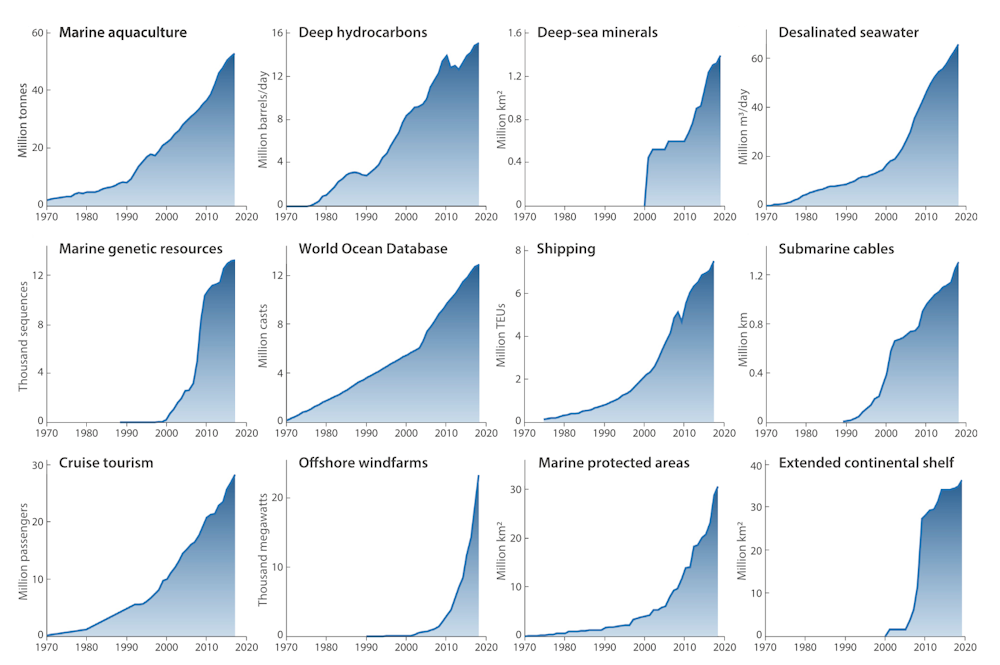
Blue Acceleration: our dash for ocean resources mirrors what we’ve already done to the land. Robert Blasiak, The Conversation. Jan. 24, 2020.


Pie: Net Zero


Sunday, January 12, 2020

Climate Links: January 2020

Goals in Paris Agreement Might Be Out of Reach. Nature World News. Jan. 21, 2020.
Causes of Higher Climate Sensitivity in CMIP6 Models. Mark D. Zelinka et al, AGU pubs. Jan. 3, 2020.
Abstract 
Equilibrium climate sensitivity, the global surface temperature response to CO urn:x-wiley:grl:media:grl60047:grl60047-math-0001 doubling, has been persistently uncertain. Recent consensus places it likely within 1.5–4.5 K. Global climate models (GCMs), which attempt to represent all relevant physical processes, provide the most direct means of estimating climate sensitivity via CO urn:x-wiley:grl:media:grl60047:grl60047-math-0002 quadrupling experiments. Here we show that the closely related effective climate sensitivity has increased substantially in Coupled Model Intercomparison Project phase 6 (CMIP6), with values spanning 1.8–5.6 K across 27 GCMs and exceeding 4.5 K in 10 of them. This (statistically insignificant) increase is primarily due to stronger positive cloud feedbacks from decreasing extratropical low cloud coverage and albedo. Both of these are tied to the physical representation of clouds which in CMIP6 models lead to weaker responses of extratropical low cloud cover and water content to unforced variations in surface temperature. Establishing the plausibility of these higher sensitivity models is imperative given their implied societal ramifications. 
Plain Language Summary
The severity of climate change is closely related to how much the Earth warms in response to greenhouse gas increases. Here we find that the temperature response to an abrupt quadrupling of atmospheric carbon dioxide has increased substantially in the latest generation of global climate models. This is primarily because low cloud water content and coverage decrease more strongly with global warming, causing enhanced planetary absorption of sunlight—an amplifying feedback that ultimately results in more warming. Differences in the physical representation of clouds in models drive this enhanced sensitivity relative to the previous generation of models. It is crucial to establish whether the latest models, which presumably represent the climate system better than their predecessors, are also providing a more realistic picture of future climate warming.

Carbon dioxide emissions continue to grow amidst slowly emerging climate policies. Glen Peters et al, Nature. Jan. 2020.
A failure to recognize the factors behind continued emissions growth could limit the world’s ability to shift to a pathway consistent with 1.5 °C or 2 °C of global warming. Continued support for low-carbon technologies needs to be combined with policies directed at phasing out the use of fossil fuels.


Timelapse Maps: Stunning Overviews Of Our Changing Planet. via visual capitalist.


Commentary: Climate change is remaking the world. Andrew E. Dessler, San Antonio Express-News. Jan. 21, 2020.
behind paywall, so also available here.


Oil and gas emissions are reversing progress from coal’s decline. Naveena Sadasivam, grist. Jan 8, 2020.
Schaeffer cautioned that the numbers projected by the EIP are most likely underestimates. For one, the report only tallies emissions from the largest facilities that are required to secure permits under the Clean Air Act. “There are thousands of smaller [facilities] that aren’t picked up in our numbers — compressor stations, tank batteries, big storage terminals, gas processors, and so on,” Schaeffer said.

There are also signs that companies are underreporting emissions data. As oil and gas producers run out of pipeline capacity to transport fossil fuels from drilling sites to refineries and markets, they’re increasingly burning it off into the air in a process called flaring. Companies operating in the Permian Basin reported flaring about 1.37 million tons of natural gas in 2017, but independent satellite analyses by environmental groups and research firms indicate the actual number is about double that. Similarly, emissions from accidents — like the massive 2016 Aliso Canyon leak in southern California — and other malfunctions and maintenance activities are either not reported or are undercounted, the report noted.

2019 in climate science: A continued warming trend and 'bleak' research. Dana Nuccitelli, Yale Climate Connections. Jan. 7, 2020.


Bad Planet. John Davis, counterpunch. Jan. 2, 2020.
Australia is an island continent composed of a vast treeless desert edged with a fringe of heavily urbanized temperate bush where the fierce heat of the land is moderated by onshore ocean breezes from the Pacific to the East and the Indian Ocean to the West. Now, areas of this temperate fringe are aflame as hot desert winds fan bush fires amidst a record series of early-summer heat waves. A world audience watches in horror as news reaches them framed in terms of houses destroyed, lives lost, koalas scorched and kookaburras that no longer sing in the oppressive heat. Greta tweets, “Not even catastrophes like these seem to bring any political action. How is this possible?”
But it is indeed possible, probable, and arguably even inevitable because the climate crisis, née global warming, is embedded in a mostly white, liberal, humanist civilization whose peoples, at least since the middle of the fifteenth century, have privileged the appropriation of land, labor and geological resources over an ecological accommodation of the rest of the planet. It is this ideology, rooted in capital accumulation, that now manifests as extreme weather events. Their remediation requires not just political action, but an almost unimaginable civilizational reboot. We refuse to make this leap because making it threatens the accustomed terms of our existence.

Lessons from Australia’s Bushfires: We Need More Science, Less Rhetoric. Claire Lehmann, Quillette. Jan. 8, 2020.


If words make worlds, then we urgently need to tell a new story about the climate crisis. Here is one vision of what it could look and feel like to radically, collectively take action.
In 2030, we ended the climate emergency. Here’s how. Eric Holthaus, The Correspondent. Jan. 8, 2020.
... A big part of why this crisis has spun into an emergency is that there has been too much of a focus on numbers: In a series of widely read essays, Bill McKibben has written about this kind of terrifying climate math.– 1.5C,  350 parts per million,  12 years  – and not enough attention on collective stories of a better world.

Still, the most important number is easy to remember: zero.  Get to zero emissions globally as quickly as possible. Zero is revolutionary.

There are an infinite number of possible paths ahead of us, and what follows is just one of them, gathered with the help of friends from around the world.

This is a story about our journey to 2030 – a vision of what it could look and feel like if we finally, radically, collectively act to build a world we want to live in.

The economics of extinction: a reason for rebellion. Jem Bendell and Rabbi Jeffrey Newman. Jan. 7, 2020.
What would a sane society do, knowing that one of its luxury food supplies was being exhausted? Consume less perhaps? Or grow more? Japan, knowing that the Bluefin tuna is going extinct, does neither. Bluefish tuna make the most profit for fishermen the nearer they are to extinction, as their rarity endows all the more status on their consumers.

Some might think that is a quirky Japanese behaviour or an anomaly of economics, but actually the free-market system in which individuals compete for profit is resplendent with such stupidities. How else could the investment in fracking or tar sands be explained? Or the way Brazil is consuming the lungs of the Earth to pay back its debts. Or the way industry externalises the cost of processing much of its waste, poisoning the Earth and its future consumers?

The logic that leads to these flaws has long been understood, and there have been waves of visceral protest as the ideology of markets became more entrenched. It is two decades since we were shutting down city centres hosting WTO and World Bank conferences; and almost a decade since Occupy camps squatted in the sacred places of decadent high finance. This time our issue is more than economic justice – it is the way governments are standing by as the global house we live in is burning down. We now see clearer than ever how a stupid financial system is driving an environmental breakdown and mass extinction which will undermine our very civilisation.

Omnicide: Who is responsible for the gravest of all crimes? Danielle Celermajer, ABC. Jan. 3, 2020.
As the full extent of the devastation of the Holocaust became apparent, a Polish Jew whose entire family had been killed, Raphael Lemkin, came to realise that there was no word for the distinctive crime that had been committed: the murder of a people. His life work became finding a word to name the crime and then convincing the world to use it and condemn it: genocide. Today, not only has genocide become a dreadful part of our lexicon. We recognise it as perhaps the gravest of all crimes. 
During these first days of the third decade of the twenty-first century, as we watch humans, animals, trees, insects, fungi, ecosystems, forests, rivers (and on and on) being killed, we find ourselves without a word to name what is happening. True, in recent years, environmentalists have coined the term ecocide, the killing of ecosystems — but this is something more. This is the killing of everything. Omnicide.

Wednesday, January 8, 2020

2019 in climate science

2019 in climate science: A continued warming trend and 'bleak' research. Dana Nuccitelli, Yale Climate Connections. Jan. 7, 2020.

The last six years have been the six hottest globally ever recorded by humans.

2014 had been the hottest year up to that point, until the record was shattered in 2015, and again in 2016 thanks to a monster El Niño event. El Niños bring hot water up to the ocean surface where it warms the temperature of the surface air that most directly influences and interests humanity. Next came 2017, the second-hottest year recorded by humans, but far and away the hottest that wasn’t influenced by an El Niño event. And then 2018, the fourth-hottest overall, but by far the hottest year on record that was cooled by a La Niña event.

And now 2019, warmed by a moderate El Niño event and as such not as hot as 2016 with its monster El Niño; but it was nevertheless the second-hottest year on record, and quite possibly the second-hottest in the history of human civilization.

As global warming has continued, so too has the volume of peer-reviewed reports and studies published by climate scientists documenting its accelerating impacts. Here are some of the most influential climate change research papers published in calendar 2019.


United Nations IPCC reports

The U.N. Intergovernmental Panel on Climate Change published two special reports in 2019, one documenting climate change impacts on land and food security, the other on the oceans and ice. Both reports warned that the risks of severe climate change impacts will grow as global temperatures warm beyond the 1.5 and 2 degrees Celsius (2.7 and 3.6 degrees Fahrenheit) targets set in the 2015 Paris climate agreement. Food security will become increasingly threatened, as will important marine species and ecosystems like coral reefs. Melting ice sheets will continue to accelerate sea-level rise, and permafrost, once-but-no-longer-permanently frozen, will release increasing amounts of previously trapped carbon into the atmosphere as it thaws. Those are but a few of the growing climate change threats documented in the IPCC special reports, which were widely characterized as being “bleak.”

A report produced by the United Nations Environment Programme (UNEP) in November 2019 also documented that countries’ planned fossil fuel extraction efforts will far overshoot the Paris climate targets. While global fossil fuel production and associated carbon emissions must peak and begin to fall within a few years to meet those goals, countries instead plan to continue increasing fossil fuel extraction through the year 2040, which would be consistent with a pathway of more than 3 degrees C (5.4 degrees F) hotter than pre-industrial temperatures by the end of the century. This report highlighted an important disconnect between countries’ goals to curb global warming and their plans to continue extracting ever-more fossil fuels.

Scientists are becoming increasingly concerned and outspoken about this disconnect. In November, more than 11,000 scientists signed a letter published in the journal BioScience declaring “clearly and unequivocally that planet Earth is facing a climate emergency.”

According to Altmetric, which tracks which scientific research most captures the public’s interest each year, the UNEP report was the fourth-most influential scientific paper published in 2019, with coverage in 527 news outlets and 8,290 tweets.


Studies on the climate of the ‘Common Era’

Climate scientists’ best global temperature reconstructions cover the past 2,000 years, a period also known as the “Common Era.” Several studies investigating the details of temperature changes over the Common Era were published in 2019.

In July, the journal Nature published a study that looked for significant natural climate change events during that period, such as the Medieval Warm Period (approximately the years 950 to 1250) and the Little Ice Age (approximately 1300 to 1850). The authors reported that they “find no evidence for preindustrial globally coherent cold and warm epochs … the warmest period of the past two millennia occurred during the twentieth century for more than 98% of the globe. This provides strong evidence that anthropogenic global warming is not only unparalleled in terms of absolute temperatures, but also unprecedented in spatial consistency within the context of the past 2,000 years.”

According to Altmetric, that Nature report was the 28th-most influential scientific paper of 2019, with coverage in 264 news outlets and 1,930 tweets.

The Past Global Changes consortium of more than 5,000 scientists from some 125 countries published its newest reconstruction of global temperatures over the Common Era in Nature Geoscience in July. That group similarly concluded, “The largest warming trends at timescales of 20 years and longer occur during the second half of the twentieth century, highlighting the unusual character of the warming in recent decades.”

A study published in Quaternary Science Reviews in March 2019 sought to determine whether the arrival of Europeans in the Americas in 1492 and the subsequent large-scale massacres of native populations (an estimated 56 million deaths by 1600, shrinking the indigenous population 90%) had a detectable influence on the global climate. Forests re-grew on land previously altered by humans, which the authors estimated led to “5 ppm CO2 additional uptake into the land surface in the 1500s compared to the 1400s … The Great Dying of the Indigenous Peoples of the Americas resulted in a human-driven global impact on the Earth System in the two centuries prior to the Industrial Revolution.”

According to Altmetric, the Quaternary Science Reviews study was the 46th-most influential scientific paper of 2019, with coverage in 101 news outlets and 4,141 tweets.


Research in 2019 on coral reefs

Coral reefs are among the most diverse ecosystems in the world and a critical source of food and habitat for about 25% of the ocean’s fish. They’re also among the species and ecosystems most vulnerable to the changing climate, and thus are the subject of much scientific research.

Researchers published a study in Nature Climate Change exploring the resilience of Great Barrier Reef corals that had survived an extreme hot year in 2016 only to be hard-hit again by extreme heat the following year. The results offered a rare source of encouragement, finding that corals that survived 2016 without bleaching were also more resistant to bleaching in 2017.

According to Altmetric, that study was the 14th-most influential scientific paper of 2019, with coverage in 47 news outlets and 6,228 tweets celebrating the good news.

The 22nd-most influential paper, with coverage in 98 news outlets with 4,812 tweets, however, painted a bleaker picture for the Great Barrier Reef. Published in Nature in April, authors of the study found that larval recruitment (the settlement of fish and coral larvae necessary for a healthy ecosystem) declined 89% in 2018 after those two extreme hot years. This study received a boost of media attention in November, when in a Nature Communications study, scientists used underwater speakers to replicate the sounds of healthy coral reefs. They found that twice as many fish arrived and stayed as in areas where no sound was played. This finding provides some hope that coral reef ecosystem recovery could be accelerated – if the reefs aren’t continually battered year after year by extreme heat.


The year’s major findings on flora and fauna

Land species also were the subject of several influential papers published in 2019. One published in Science in July estimated the number of trees that could be planted and the amount of carbon they could pull out of the atmosphere. “Ecosystems could support an additional 0.9 billion hectares of continuous forest. This would represent a greater than 25% increase in forested area, including more than 200 gigatonnes of additional carbon at maturity.” Those numbers would represent a removal of about one-third of cumulative human carbon emissions through current times, and 20 years’ worth at the current rate of about 10 billion tons of carbon per year. However, some scientific groups disputed the accuracy of these estimates, which also rely on foresting every available hectare of land. Nevertheless, the study was Altmetric’s 9th-most influential of 2019, with coverage in 330 news outlets and 6,518 tweets.

Two 2019 studies finding alarming rates of species extinctions were also high on Altmetric’s list. One published in Biological Conservation in April found “dramatic rates of decline that may lead to the extinction of 40% of the world’s insect species over the next few decades” as a result of various human factors including climate change, which “is particularly important in tropical regions.” This study was Altmetric’s 13th-most influential of the year, with coverage in 251 news outlets and 4,679 tweets.

In the second study, published in Science in October, researchers surveyed bird species and found “a net loss approaching three billion birds, or 29% of 1970 abundance” as a result of “habitat loss, agricultural intensification, coastal disturbance, and direct anthropogenic mortality, all exacerbated by climate change.” That study was Altmetric’s 34th-most influential paper, with coverage in 259 news outlets and 1,465 tweets.

These studies are consistent with the “bleak” notion that Earth is currently on a path to its sixth mass extinction event. (An upcoming post at this site will look in depth at major 2019 research reports addressing wildlife and climate change.)


The past year’s major findings on melting ice

Several high-profile papers in 2019 also addressed the accelerating melting of ice and its implications. One, published in Science Advances in June, found that since 2001, Himalayan glaciers have been losing ice at a rate twice as fast as they had in the prior 25 years. Those glaciers provide an important source of water for billions of people in China, India, Pakistan, and several other countries in the region. The paper was Altmetric’s 65th-most influential, with coverage in 294 news outlets and 414 tweets.

A January study published in the Proceedings of the National Academy of Sciences found that over the past decade, Antarctica has been losing ice at a rate six times faster than during the 1980s. And another paper published in PNAS in June asking experts about future sea-level rise projections found that because of accelerating ice sheet declines, a rise of more than two meters (about six feet) by the year 2100 remains within the realm of possibility. Those were the 86th- and 70th-most influential papers of 2019, respectively.

Overall, the second-hottest year was, sadly but perhaps unsurprisingly, full of bleak news in climate science research. Climate scientists’ findings and reports increasingly raise the alarm of a “climate emergency” or “climate crisis” – terms that many in the mainstream media began to use regularly in 2019 without feeling the need to qualify or use quotes. Because of climate scientists’ increasingly concerning research findings and language, climate crisis is becoming more widely accepted and used as the norm.

Wednesday, January 1, 2020

Climate Links: The Decade That Was

The Year and the Decade in Weather and Climate: A Meta-Lookback. Bob Henson. Dec. 31, 2019

My Top 10 Ten List Climate Crisis Event List For The 2010s. Guy Walton, GuyOnClimate. Dec. 28, 2019.

This Was the Decade We Knew We Were Right. Kate Marvel, Scientific American. Dec. 30, 2019.
Everything is connected, and everything is changing

The Top 10 Weather and Climate Stories of 2019. Jeff Masters, Eye of the Storm, SciAm. Jan. 3, 2020.
Near-record Arctic melting, a bountiful but deadly monsoon and three highly destructive tropical cyclones highlight the earth’s second warmest year on record

We broke down the last decade of climate change in 7 charts. Clayton Aldern and Emily Pontecorvo, Grist. Dec 31, 2019.

A line chart showing rising CO2 emissions between 2010 and 2019

A line chart showing the percent change in U.S. primary energy produced by source between 2010 and 2019

Sunday, October 27, 2019

Climate Links - Oct. 2019 #2

‘We really need to wake up quickly’: Al Gore warns of a looming food crisis caused by climate change. Amanda Little, WashPo. Oct. 22, 2019.
Some 40 panelists, most of them farmers and scientists, took the stage to discuss topics from healthy soil to carbon sequestration, but the main event was Gore's slide show, delivered with his characteristic mix of bravado and humility, detailing the impacts of climate change on food systems worldwide. 
"This is in Georgia; a heat wave cooked these apples before they could be harvested," he said, issuing forth rapid-fire examples alongside bone-chilling images and video. "This is the Australia wine region that's going to be untenable. . . . Rice yields in 80 percent of Japan have declined due to the rising temperatures. . . . In nearby Murfreesboro, Tenn., we'll see a quarter decline in soybean yields within the next 30 years." 
Gore spent the better part of 90 minutes detailing the pressures of drought, heat, flooding, superstorms, "rain bombs," invasive insects, fungi and bacterial blight on food producers. "We may be approaching a threshold beyond which the agriculture that we've always known cannot support human civilization as we know it," he declared in a low growl. "That's something we need to avoid." 
Alice Waters, who Gore said catalyzed his interest in food and who had volunteered to cook the vegetarian lunches served to attendees (using local, seasonal and organic ingredients, natch), said the presentation was bittersweet: "I am deeply depressed. But on the other hand, the solution seems so, so unbelievably transformational. . . . We can restore the health of the planet while also restoring the health of people and communities." 
Naomi Starkman, editor-in-chief of ­Civil Eats, which covers news on sustainable agriculture, was similarly fraught: "Gore spoke with such devastating and fierce clarity, connecting the dots between the ways agriculture is implicated in and impacted by the climate crisis. But it also felt like a hopeful moment wherein agriculture, and farmers in particular, are taking a front-and-central place in solving one of the most urgent issues of our time." 
Mark Bittman, the former New York Times food columnist, was more circumspect: "There are ways in which the conversation here isn't quite realistic. Regenerative agriculture is not about increased yield, it's about producing more of the right food in the right ways. ... But kudos to Al Gore for taking it on. There's no more important conversation to have."


Extinction Rebellion and the Birth of a New Climate Politics. David Wallace-Wells, NYMag. Oct. 15, 2019.

Not that long ago, you could count on the world’s Establishment institutions to give you a comforting if mistaken assessment of the risk of climate change. You could choose to see those demanding radical action to take hold of global warming as, by definition, extremists. And you could be reassured by the fact that none of the planet’s most powerful “responsible” parties were really freaking out much about the state of the crisis. 
Somewhat all of a sudden, that is no longer the case. Very much no longer the case. 
... 
One striking feature of these movements is that, unlike even recent bursts of environmental activism, their rhetoric is, with few exceptions, not out of line with the chorus of scientific consensus, which grows increasingly panicked by the day. A report published by the IMF this month summarizes that new consensus this way:  “There is growing agreement between economists and scientists that the tail risks are material and the risk of catastrophic and irreversible disaster is rising, implying potentially infinite costs of unmitigated climate change, including, in the extreme, human extinction.” This is the IMF, for Christ’s sake. 
When alarmist rhetoric and Establishment wisdom have collapsed into each other, what role is there for protest? It may be less about shifting the Overton window and more about simply insisting that those in power operate as though they believe what they say, rather than retreat into an already-familiar climate hypocrisy (declaring a climate emergency and then immediately approving a new oil pipeline, as Justin Trudeau, for instance, has done).


We Broke the World. Roy Scranton. The Baffler. Sept 2019.
Facing the fact of extinction. 
... 
It should be pointed out that neither the IPBES nor mainstream science supports the conclusion that we face near-term human extinction as a result of ecological collapse or global warming. The business-as-usual scenarios established by the IPBES and IPCC predict a hellish and chaotic future that will with high probability destabilize modern human civilization and likely lead to immense human suffering and death. Significant uncertainty surrounds even these scenarios, however, since contemporary scientists don’t have a good idea of what happens on short time scales with shocks to the global ecosystem as powerful as those we have triggered. Observed changes regularly exceed those predicted by current models: for instance, a recent study reported Arctic permafrost melting “exceeding modeled future thaw depths for 2090 under IPCC RCP 4.5,” that is, seventy years earlier than expected. 
The paleoclimate record can show us what happens in general when the global climate and environment undergoes abrupt transformation, which is often mass extinction, but the record lacks the precision to tell us exactly how abrupt. As geologist Marcia Bjornerud writes in her book Timefulness, discussing the Paleocene-Eocene Thermal Maximum (PETM), a period when the earth was up to 8 degrees Celsius warmer than today and which provides the nearest geological analogue to the climate we might eventually expect from global warming: “The sedimentary record of the PETM, with a resolution no better than a few millennia, does not allow us to distinguish between an essentially instantaneous release of carbon from a belching ocean and a longer-term (1,000-year) combustion of coal or peat.” Looking at observed changes in the earth’s geological record gives us only a fuzzy picture of how and how fast the earth’s biosphere and climate undergo rapid transformation. Climatic and geological changes like those which caused the End-Permian extinction, to take another example, including the release of enormous amounts of CO2 into the atmosphere, could have taken thousands of years, or they could have happened much more quickly, perhaps over centuries or even decades. The End-Permian saw up to 96 percent of marine life and up to 70 percent of terrestrial life on earth wiped out. It is thus conceivable that devastating the biosphere as we have and dumping as much carbon into the atmosphere as we have could initiate strong enough positive feedbacks to rapidly heat the earth beyond the point where it could sustain human life within a century or two, but the science is not yet telling us that we’re all going to die from climate change in the near term. 


U.S. Military Could Collapse Within 20 Years Due to Climate Change, Report Commissioned By Pentagon Says. Nafeez Ahmed, vice.com. Oct. 24, 2019.
The report says a combination of global starvation, war, disease, drought, and a fragile power grid could have cascading, devastating effects. 
According to a new U.S. Army report, Americans could face a horrifically grim future from climate change involving blackouts, disease, thirst, starvation and war. The study found that the US military itself might also collapse. This could all happen over the next two decades, the report notes. 
The senior US government officials who wrote the report are from several key agencies including the Army, Defense Intelligence Agency, and NASA. The study called on the Pentagon to urgently prepare for the possibility that domestic power, water, and food systems might collapse due to the impacts of climate change as we near mid-century.
...  
The report paints a frightening portrait of a country falling apart over the next 20 years due to the impacts of climate change on “natural systems such as oceans, lakes, rivers, ground water, reefs, and forests.” 
Current infrastructure in the US, the report says, is woefully underprepared: “Most of the critical infrastructures identified by the Department of Homeland Security are not built to withstand these altered conditions.” 
Some 80 percent of US agricultural exports and 78 percent of imports are water-borne. This means that episodes of flooding due to climate change could leave lasting damage to shipping infrastructure, posing “a major threat to US lives and communities, the US economy and global food security,” the report notes. 
At particular risk is the US national power grid, which could shut down due to “the stressors of a changing climate,” especially changing rainfall levels.
... 
The US Army report shows that California’s power outage could be a taste of things to come, laying out a truly dystopian scenario of what would happen if the national power grid was brought down by climate change. One particularly harrowing paragraph lists off the consequences bluntly:
“If the power grid infrastructure were to collapse, the United States would experience significant:
  • Loss of perishable foods and medications
  • Loss of water and wastewater distribution systems
  • Loss of heating/air conditioning and electrical lighting systems
  • Loss of computer, telephone, and communications systems (including airline flights, satellite networks and GPS services)
  • Loss of public transportation systems
  • Loss of fuel distribution systems and fuel pipelines
  • Loss of all electrical systems that do not have back-up power”

full report here:
Implications of Climate Change for the U.S. Army. United States Army War College.

Wednesday, October 2, 2019

Climate Links - October 2019 #1

If you're keeping track, planet earth had the hottest June ever recorded, the hottest July, the 2nd-hottest August, and now the hottest September. Please join the fight for a livable future.

Bill McKibben. Twitter.

Global Climate Emergency: after COP24, climate science, urgency, and the threat to humanity. Barry Gills and Jamie Morgan, via TandFonline. Sep. 24, 2019.

We live in a time of Climate Emergency. Nevertheless, our collective actions do not yet approximate a real understanding nor fully appropriate actions. We are not yet acting as if we are facing an urgent and life threatening Emergency. What does ‘Climate Emergency’ actually mean? According to David Attenborough:
It may sound frightening, but the scientific evidence is that if we have not taken dramatic action within the next decade, we could face irreversible damage to the natural world and the collapse of our societies.    (Attenborough, Our Planet)
History is written later, but the future is written now. Perhaps the central message of contemporary climate sciences consists in the realization that the entire planet is deeply interconnected. There are no isolated ecosystems. There are no ecosystems that are safe from the effects of climate change. All life on this planet is profoundly interrelated. What happens in one area of the globe has far reaching, but as yet insufficiently understood, effects upon and consequences for even far distant regions. . . .

In other words, the present Global Climate Emergency demands a profound historical transformation of our civilization. We have not only been pouring greenhouse gases (GHGs) into the atmosphere; we have been collectively exceeding the regenerative capacity of the earth’s natural resources and ecological systems. Earth Overshoot Day, the day in the annual cycle when humanity’s demands for resources exceeds the capacity for regeneration of those resources, has advanced by two whole months over the past twenty years. This year Earth Overshoot Day took place on 29 July 2019. It now requires the equivalent of 1.75 planets to sustain us. Humanity is damaging the whole system upon which our lives, and that of all other species depends.


'I would like people to panic’ – Top scientist unveils equation showing world in climate emergency. Joanna Roberts, Horizon. Sep. 24, 2019.

A new equation showing that the world is ‘deep in a climate emergency’ was unveiled on 24 September by Professor Hans Joachim Schellnhuber, one of the world’s leading authorities on climate change, who said that people still don’t want to see the truth about the state we’re in.

‘Based on sober scientific analysis, we are deeply within a climate emergency state but people are not aware of it,’ he told Horizon on the sidelines of the European Research and Innovation Days event in Brussels, Belgium. ‘We don’t want to see the truth. As Greta Thunberg would say, I would like people to panic and take action according to the state of emergency we are in.’


Interview: Vaclav Smil: ‘Growth must end. Our economist friends don’t seem to realise that’. Jonathan Watts, the Guardian. Sep 21, 2019.

The scientist and author on his latest book – an epic, multidisciplinary analysis of growth – and why humanity’s endless expansion must stop.


The Delusion and Danger of Infinite Economic Growth. Christopher Jones, The New Republic. Oct. 1, 2019.
How economists came to ignore the natural world.
 “Fairytales of eternal economic growth.” That’s how climate activist Greta Thunberg depicted the dominant mindset at the United Nations last week. “How dare you,” she said, admonishing them for “empty words” instead of concrete actions to preserve the planet.
She’s right. One of the reasons nations fail to address climate change is the belief that we can have infinite economic growth independent of ecosystem sustainability. Extreme weather events, melting arctic ice, and species extinction expose the lie that growth can forever be prioritized over planetary boundaries.

It wasn’t always this way. The fairytale of infinite growth—which so many today accept as unquestioned fact—is relatively recent. Economists have only begun to model never-ending growth over the last 75 years. Before that, they had ignored the topic for a century. And before that, they had believed in limits. If more people saw the idea of infinite growth as a departure from the history of economics rather than a timeless law of nature, perhaps they’d be readier to reimagine the links between the environment and the economy.

In 1950, the economics profession had surprisingly little to say about growth. That year, the American Economic Association (AEA) asked Moses Abramovitz to write a state-of-the-field essay on economic growth. He quickly discovered a problem: There was no field to review.

The founding fathers of economics shared a belief that growth was finite, and that the reason for limits lay in the natural world.

Yes, John Maynard Keynes had offered a theory of stagnation, demonstrating the need for government spending to stimulate an economy mired in recession, and Austrian political economist Joseph Schumpeter had studied creative destruction, highlighting the importance of entrepreneurs and innovation. Wesley Mitchell, founder of the National Bureau of Economic Research, had looked at business cycles and others had analyzed monetary forces. But no one had put it all together in a theory of growth. Modern work was “fragmentary” and had “remained on the periphery of economics,” Abramovitz explained to AEA members. Development economist W. Arthur Lewis agreed, noting in 1955 that “no comprehensive treatment of [economic growth] has been published for about a century.”

It was an interesting turn for a field originally quite interested in growth, but convinced it was bounded. The founding fathers of economics—luminaries including Adam Smith, David Ricardo, and John Stuart Mill—shared a belief that growth was finite, and that the reason for limits lay in the natural world.


Why are economists letting down the world on climate change? Andrew Oswald and Nicholas Stern, voxeu. September 17, 2019.
Action on climate change is arguably the greatest challenge for public policy of our times. But despite economic forces being the major driver of the carbon dioxide problem, this column argues that economists have so far been too silent on the subject. For example, the Quarterly Journal of Economics, the most-cited journal in economics, has never published an article on climate change. Good economics can and should play a fundamental role in guiding the policy framework that will influence investment decisions in the coming years, so it is important that the profession dramatically increases its work now.


Out of Time: Listening to the climate’s clock. Astra Taylor, Lapham's Quarterly.
Twelve years, or so the scientists told us in 2018, which means now we are down to eleven. That’s how long we have to pull back from the brink of climate catastrophe by constraining global warming to a maximum of 1.5 degrees Celsius. Eleven years to prevent the annihilation of coral reefs, greater melting of the permafrost, and species apocalypse, along with the most dire consequences for human civilization as we know it. Food shortages, forest fires, droughts and monsoons, intensified war and conflict, billions of refugees—we have barely begun to conceive of the range of dystopian futures looming on the horizon. 
One person who looks squarely and prophetically at the potential ramifications of climate change and insists on a response is Greta Thunberg, the sixteen-year-old Swedish environmentalist who launched a global wave of youth climate strikes. In April 2019 she gave a tour de force address in the British Parliament, invoking not just her peers who were regularly missing class to protest government inaction but those yet to be born. “I speak on behalf of future generations,” Thunberg said. “Many of you appear concerned that we are wasting valuable lesson time, but I assure you we will go back to school the moment you start listening to science and give us a future.” 
Thunberg accepts what many influential adults seem unable to face: the inevitability of change. Change is coming, either in the form of adaptation or annihilation; we can respond proactively or reactively to this discomfiting fact. Perhaps she can accept this because she is so young. Eleven years, a little over a decade, is the time for a human infant to become a preteen and for a preteen to become a young adult. For Thunberg, eleven years is more than two-thirds of her life, a veritable expanse that, projected forward, will involve crossing the threshold from adolescence to the first stage of maturity. Yet for a relatively contented middle-aged or elderly adult, eleven years isn’t as substantial—not quite the blink of an eye but a continuation of the present, a deeper dive into one’s golden years. At a certain point, stasis is the goal, to ward off decline. But decline awaits us all—as the economist John Maynard Keynes bluntly put it, “In the long run we are all dead.” Everyone’s time on earth must come to an end. The question is, What do we do with such knowledge?

Can We Still Dodge the Progress Trap? Ronald Wright, TheTyee.ca. Sep. 20, 2019.
Author of 2004’s ‘A Short History of Progress’ issues a progress report.


Waiting for the Next Panic. John Michael Greer, Ecosophia. Oct. 2, 2019.
... Those of us who expected the shale oil boom to turn into a bubble and then a bust were wrong. We were wrong because we forgot the first law of petroleum: when it comes to oil, politics always trumps economics. Access to petroleum is so crucial for industrial nations, and especially for extremely wasteful industrial nations such as the United States and Canada, that all other factors get to sit in the waiting room when decisions about petroleum are made. That’s why Canadian PM Justin Trudeau, for all his environmental rhetoric, has backed a petroleum pipeline meant to get Canadian crude from the tar sands to the Pacific coast. He knows perfectly well that when push comes to shove, Canadian voters love to give the environment lip service but don’t want environmental protections to affect their lifestyles, which is why Canada is one of the only countries on Earth that uses more energy per capita than the United States.

That’s also why shale oil producers have continued to drill and pump away in blithe disregard for the fact that in terms of strict economics, their activities don’t make enough money to keep them from going broke. It doesn’t matter, because the US government sees to it that a steady stream of cheap credit makes up the difference.  Having another seven million more barrels of oil per day is important enough to the US economy that gimmicking the money system to cover it is a small price to pay, and so an unspoken bipartisan consensus supports the necessary gimmicks. That was the point that we missed back in the day, and I missed it as much as anyone.

Unpacking Extinction Rebellion — Part III: The Fourth Industrial Revolution. Kim Hill, Damn The Matrix. Sept. 26, 2019.
Part I of this series investigated the corporate interests and fossil fuel companies behind the rebellion’s goal for net-zero emissions. In Part II we looked at XR’s goals, tactics and proposed solutions to the climate crisis, which are all serving capital at the expense of the natural world. In Part III, we dive in to the history of the climate movement, the tactics being used by the elites to co-opt activist movements into supporting corporate agendas, and what those agendas entail. 
This article is largely a synthesis of the extensive research of Cory Morningstar into the manipulations of the climate movement by corporations and nonprofits, which is well worth reading, at Wrong Kind of Green, to get a deeper understanding of the actors involved and their elaborate marketing strategies

The Global Climate Strikes: No, This Was Not Co-Optation. This Was and Is PR. A Brief Timeline. Cory Morningstar, Wrong Kind of Green. Oct. 6, 2019.

TAKE AWAY POINTS

We dance to the tune of our oppressors

“The ruling class exists, it’s not a conspiracy theory. They operate as a class, too. They share the same values, the same sensibility and in Europe and North America they are white. They act in accordance with their interests, which are very largely identical. The failure to understand this is the single greatest problem and defect in left discourse today.”
— John Steppling

  • Climate change is real – but capitalism is the crisis.
  • The structure of the system is working exactly as it is designed to. The NPIC exists to insulate the current power structures and capital itself.
  • Economic growth is sacrosanct – to those in power, and those it serves. Economic growth trumps all priorities including life itself.
  • The Thunberg campaign belongs to the ruling class, not to the people.
  • A decade of social engineering (“together”) has effectively erased class analysis, which is a massive blow, and even a betrayal, to the working class and peasantry.
  • The West is under the rule of a corporatocracy, therefore voting is a massive distraction and spectacle that will never solve or mitigate our ecological crisis.
  • The same system that created the crisis will not and cannot now rectify the crises. The same people that protected and defended this system will do anything and exploit anyone to keep it intact.
  • The NGOs comprising the NPIC must be isolated, shamed and abandoned. The exact methods they use against radical activists and radical grassroots groups. Without the support of the people, they lose all power and influence (and then funding).
  • A litmus test must be placed on all organizations that claim to fight for ecological and social justice: They must be united in opposition to imperialism/colonialism, militarism, white supremacy and patriarchy – all leading drivers of climate change and ecological devastation.
  • Capitalism will destroy everything in its path. Either we kill capitalism, or capitalism will kill us.


315 billion-tonne iceberg breaks off Antarctica. Jonathan Amos, BBC. Sep. 30, 2019.
The Amery Ice Shelf in Antarctica has just produced its biggest iceberg in more than 50 years. The calved block covers 1,636 sq km in area
but, not to worry:
The Scripps researcher stressed that there was no link between this event and climate change. Satellite data since the 1990s has shown that Amery is roughly in balance with its surroundings, despite experiencing strong surface melt in summer. 
"While there is much to be concerned about in Antarctica, there is no cause for alarm yet for this particular ice shelf," Prof Fricker added.


Sunday, June 30, 2019

Feature Reference Article: 200 & 1 essentials

200 and 1 Essentials to Navigate the Doomosphere Map... for the Novice (and the Obsessed!) The Apocalypsi Library at the End of the World. Doom For dummies. Gail Zawacki.


Surely you can't have failed to notice the bellicose headlines warning of various and sundry paths that lead inexorably to Apocalypse Soon? Perhaps you want to know more, but just don't have time to sort it all out? Maybe you can't decide what is worse - disappearing bees, bats and frogs; rising seas or lowered sperm counts... droughts, floods, hailstorms, tornadoes, hurricanes, earthquakes and tsunamis; exorbitant prices; or just ordinary pollution (and lots of it)?

Welcome and rejoice, doomer fans and neophytes too, you have found the most capacious and concise virtual map of converging catastrophes ever devised - a dynamically current compendium... because YOU can add to it!

Don't be mad about redundancies, or annoyed about omissions, or perplexed by non sequiturs. It's a BIG subject, and it is presented unfinished (because it will never be finished, until the grid goes down). Contribute, don't - whine. And do it soon, before the lights go out for good and this list is lost forever!


Hope
~ George Frederic Watts, 1886

Now that you've started to suspect that humanity is FUBAR (f*cked up beyond all repair) don't be intimidated! This, as a public service, is your official guide to the avalanche of resources, links, citations, quotes and insider terminology you'll need to for quick access in order to fully comprehend the epic dimensions of our imminent demented end.

At last, with a minimum of effort and no research on your part, you can impress your friends when you display your in-depth familiarity with immortal quotes, your dazzling facility with doomer intellectual history, cheesy movies, profoundly dreary books, and egomaniacal pontificaters... PLUS the scientific basis for Doom - once they too, finally, start to wake the hell up!

Coming to terms with the inevitability of planetary ecosystem collapse, and the inescapable verity that it has been caused by humanity's barbaric rampage through nature, can be a challenge. Accepting the human propensity for terminal overshoot is usually shunned as too dismal, but for those who seek truth, it is essential. This compilation explores the reasons our degenerate species is incapable of intelligent choices that might have spared us from compulsively unraveling the fabric of life on our home, Earth... as elucidated by the greatest thinkers (and plenty of the lesser), who expound on the topic.

And cheer up. It may be the beginning of the end, but of all times in human history, you have the privilege and dumb luck to be situated here as the converging catastrophes jostle for pre-eminence, where from your vantage of ringside seats at the finish line, most likely you will see which prevails. Unless there's a tie.


There are several categories that delineate our path to destruction - yes, that Apocalypsi in the title is plural... but oh, none of them include survivalists/gun lovers/truthers/haters.... Because. They are stupid. And none of them include state surveillance and fascism - because George Orwell and Aldous Huxley and Noam Chomsky and a bunch of guys from the Stalin reign covered that ages ago - nor do we include the threat (certainty?) of WWIII or a nuclear holocaust, because those potentials are merely the consequence of terminal overshoot. And we don't worry about AI either, because we are all going to be dead before robots get smart enough to self-replicate.

Ready??


1. The #1 indispensable symbol:


...it's an hourglass shape, because...time has run out - get it???


7 major scourges of Doom (and why their adherents squabble over the scraps rather than accomplish anything useful together whatsoever).


1. Peak Oil (rarely recognizes peak anything else, generally fixated on doomsteading)

2. Ecosystem Collapse (an ecological perspective about pollution, whole systems destruction)

3. Climate Change (yes, it's real, it's caused by humans, and it's an existential threat)

4. Overpopulation (no, the world doesn't need your offspring because you're "special")

5. Habitat Destruction (deforestation, mining, fracking, drilling, paving, etc)

6. Economic - (includes debt Ponzi schemes and inequality, social justice issues)

7. The death of the Oceans (from agricultural runoff, warming, overfishing and acidification)


Here's why none of the activists, scientists, and followers of these disparate but interconnected sources of potential doom can work together - Everyone who discovers that we are on an unstoppable trend towards global collapse becomes instantly enamored of two overpowering, egotistical (and often remunerative) convictions... first, they are sure they have defined the precise problem (which usually has to do with how they came about to notice) and second, they are sure they, and they alone, know the solution (ditto). Nobody will ever cooperate to fix the problems, because their ego won't let them. Plus ça change, as they say in France!!


Nomenclature and acronyms in the Doomer lexicography you'll need to know if you don't want to drown in alien, perplexing terminology

1. The Anthropocene - a new geological epoch following the Holocene, in which human activity now influences global systems... and another more alarming related concept, the Anthropozic, a major new era in which human activity dominates natural processes. Some say the Anthropocene began with the Industrial Revolution, the smart money puts it back to the extinction of the megafauna... or maybe thediscovery of fire.

2. TEOTWAWKI - The End of the World As We Know It... a bit passé, goes back to Y2K but still a good shorthand reference to what is going to happen when Ayn Rand acolytes have their heads explode

3. NTE, NTHE - Near Term Extinction; for extra pizzazz, Near Term Human Extinction

4. CliFi - a genre of fiction based on climate change, see an interview with Dan Bloom on the emerging canon, much more listed on the fiction page

4. Energy slaves - the amount of work performed for us by fossil fuels, converted to the human equivalent of effort - 22 billion, by one estimate

5. VHEMT - Voluntary Human Extinction Movement - "may we live long and die out" - so far no members have volunteered to go first

6. BAU - Business As Usual... generally used in the context of, we are screwed if we continue

7. MPP - Maximum Power Principle

8. Hospice - Where you are now, you just don't know it


Zdzisław Beksiński

9. Doomstead - The well-stocked hideaway where silly people think they can escape the zombie hordes

10. Positive/amplifying feedback - effects that dwarf the initial forcing of CO2, making climate change non-linear and rapid - such as the albedo effect...

11. Albedo effect - reflective ice melts, which leads to dark water that absorbs more radiation, that causes more warming, which results in more melting, etc etc.

12. Peak Oil - NO - Not when it runs out, but rather, the point where EROEI becomes unprofitable - soon, in other words...(but not soon enough to save us from catastrophic climate change)

13. EROEI - Energy Return on Energy Invested... how much it costs to extract energy compared to how much energy is obtained

14. HIPPO - Habitat loss, population, pollution, overshoot... adds up to a whole lotta trouble

15. Hubbert's Curve - graphs the inevitable decline of resources, originally for oil wells

16. Seneca Cliff - a graph showing that things go downhill much faster than they went up

"It would be some consolation for the feebleness of our selves and our works if all things should perish as slowly as they come into being; but as it is, increases are of sluggish growth, but the way to ruin is rapid." Lucius Anneaus Seneca, Letters to Lucilius, n. 91


17. The Tragedy of the Commons - scenario formulated by economist Garrett Hardin in which individual short-term interest depletes common resources. Call it a Law.

"Each man is locked into a system that compels him to increase his herd without limit -- in a world that is limited. Ruin is the destination toward which all men rush, each pursuing his own best interest in a society that believes in the freedom of the commons. Freedom in a commons brings ruin to all."


Banksy


18. Fermi Paradox - Q: Where are the Aliens? A: Just when they approached the technological ability to communicate or travel in space, they went extinct... just as we are about to. Article ~ Why Habitable Exoplanets are Bad News for Humanity's Future


19. Dystopia - an imaginary place or time that is horrible, often following collapse when the state has become fascist or totalitarian and the environment is ruined. Or maybe a real place and time.

20. Apocalyptic Anxiety [also known as PRE-traumatic stress syndrome]: "The destruction of human civilization would also terminate the historical process—the sense of human history stretching along from the distant past to an open future—through which we make sense out of our individual existences. I want to call the horror that announces such a possibility apocalyptic anxiety. Apocalyptic anxiety anticipates the collapse of all meaningfulness."~ Robert D. Stolorow, Ph.D.

21. Dunbar's Number - with more than 150 members of a tribe, people lose the ability to empathize so... they start killing each other, why not? For a most entertaining explanation read the Cracked.com article "What is the Monkeysphere?"

22. Jevon's Paradox - (aka the rebound effect) is the observation that increasing energy efficiency ultimately leads, not to conservation, but to more use.

23. Apocaloptimist - A person (or organization) that makes a powerful case that Armageddon is nigh, but posits unsubstantiated hope that human ingenuity will solve the problems in time. NOTE: despite being categorized as Doomers, virtually every single person in this Encyclopedia is an overt or covert apocaloptimist (with one or two exceptions) who are either selling snake oil, or they believe their own BS - but primarily, for the simple reason that true doomers are rarely read and NEVER published. So the distinctions are broad and suspect. (There are also other self-explanatory distinctions, such as Apocalopportunist and Apocaloptimystic.)

24. Hopium - arguably coined by Lonewolf back in 2000 on the Survival Acres forum, designating that deranged condition in which a person is deluded into thinking humanity will survive omnicide.

25. Greenwashing - When corporations collaborate with "green" activist groups to market their products as sustainable. Some greenwashing is wishful thinking... but usually it is contemptibly unscrupulous.

26. Faustian Bargain - as described by The Agonist:

"Humanity is doubling down on its Faustian climate bargain by pumping up fossil fuel particulate and nitrogen pollution... Humans have been pumping both greenhouse gases (mainly CO2) and aerosols (fine particles) into the atmosphere for more than a century. The CO2 accumulates steadily, staying in the climate system for millennia, with a continuously increasing warming effect. Aerosols have a cooling effect (by reducing solar heating of the ground) that depends on the rate that we pump aerosols into the air, because they fall out after about five days... Reduction of the net human-made climate forcing by aerosols has been described as a “Faustian bargain” because the aerosols constitute deleterious particulate air pollution. Reduction of the net climate forcing by half will continue only if we allow air pollution to build up to greater and greater amounts. More likely, humanity will demand and achieve a reduction of particulate air pollution, whereupon, because the CO2 from fossil fuel burning remains in the surface climate system for millennia, the “devil’s payment” will be extracted from humanity via increased global warming."


The Vision of Faust ~ Luis Ricardo Falero, 1878


27. Trifuckta - As in, the race to see which of the three predominant converging catastrophes will be the first trigger total collapse and doom - Energy (peak oil, coal and gas), Environment (pollution, overpopulation and climate), and Economy (over-extraction, income inequality and poverty, financial ponzi scheme, corruption). As stated by the Curator, aren't we lucky to have ringside seats at the finish line?

28. Methane, get used to it - a much more potent greenhouse gas than CO2... and there is lots of it locked up (or at least, it HAS BEEN locked up) in the permafrost and under the oceans in clathrates, see The Giant Methane Monster Lurking with the ludicrous suggestion at the end - The time for a carbon tax is now! [haha!]


Will we look back on this hole in Siberia as the beginning of the end?

29. WooWoo - Any type of spiritualism that enables the devout to think that there is an alternative to total, incipient annihilation... closely related to Hopium. Woofuckery is when an apocaloptimist makes a convincing case for doom, and then slips some WooWoo hopium in at the end, to make you feel better.


14 Distinguished Cassandras from the past, whose warnings we shouldn't have ignored - but did! Because people are selfish, greedy egomaniacs. (...altho we love them anyway, honest!)


1. When man interferes with the Tao

the sky becomes filthy,

the earth becomes depleted,

the equilibrium crumbles,

creatures become extinct.

~ Lao Tzu, Tao Te Ching, 500 BCE, appx


2. "When the last tree has been cut down, the last river has been polluted, and the last fish has been caught, only then do you realize that money can't buy everything." ~ Native American Proverb


3. Thomas Malthus ~


"The power of population is so superior to the power in the earth to produce subsistence for man, that premature death must in some shape or other visit the human race." - An Essay on The Principle of Population, First Edition 1798


4. Thomas Hobbes , English philosopher 1588-1679 and author of Leviathan. He famously said that in the absence of rule of a monarch, the original, natural condition of humanity was to live in perpetual warre - "the war of every man against every man." The lives of men were destined thus to be "solitary, poor, nasty, brutish and short." He also noted "...in the first place, I put forth a general inclination of all mankind a perpetual and restless desire of power after power, that ceaseth only in death." Although this might not quite be true, it is probably more accurate a portrayal than that of Rousseau (1712 - 1778) who posited that "nothing could be more gentle" than the "Noble Savage" whilst at peace in primitive circumstances (when he wasn't raiding the neighboring village, bludgeoning a rival and kidnapping his wife).


5. Fairfield Osborne, author of Our Plundered Planet, 1948

"The tide of the Earth's population is rising, the reservoir of the earth’s living resources is falling. Technologists may outdo themselves in the creation of artificial substitutes for natural subsistence, and new areas, such as those in tropical or subtropical regions, may be adapted to human use, but even such recourses or developments cannot be expected to offset the present terrific attack upon the natural life-giving elements of the earth. There is only one solution: Man must recognize the necessity of cooperating with nature. He must temper his demands and use and conserve the natural living resources of this earth in a manner that alone can provide for the continuation of his civilization. The final answer is to be found only through comprehension of the enduring processes of nature. The time for defiance is at an end."


6. Rachel Carson, author of Silent Spring, 1962

“Why should we tolerate a diet of weak poisons, a home in insipid surroundings, a circle of acquaintances who are not quite our enemies, the noise of motors with just enough relief to prevent insanity? Who would want to live in a world which is just not quite fatal?”


7. E.F. Shumacher, author of Small is Beautiful, 1973

“An attitude to life which seeks fulfilment in the single-minded pursuit of wealth - in short, materialism - does not fit into this world, because it contains within itself no limiting principle, while the environment in which it is placed is strictly limited.”


8. Wendell Berry, author of The Unsettling of America, 1974

“When despair for the world grows in me and I wake in the night at the least sound in fear of what my life and my children's lives may be, I go and lie down where the wood drake rests in his beauty on the water, and the great heron feeds. I come into the peace of wild things who do not tax their lives with forethought of grief.”


9. Aldo Leopold, author of A Fierce Green Fire -

I am glad I will not be young in a future without wilderness.” and “One of the penalties of an ecological education is that one lives alone in a world of wounds. Much of the damage inflicted on land is quite invisible to laymen. An ecologist must either harden his shell and make believe that the consequences of science are none of his business, or he must be the doctor who sees the marks of death in a community that believes itself well and does not want to be told otherwise.” ~ A Sand County Almanac


10. Edward Abbey, author of The Monkey Wrench Gang "Growth for the sake of growth is the ideology of the cancer cell."


11. Jacques Cousteau - once an avid sports fisherman, Jacques was horrified when he saw the degraded condition in the Mediterranean Sea after a long absence, and devoted the rest of his life to conservation "Water and air, the two essential fluids on which all life depends, have become global garbage cans."


12. Isaac Asimov - Professor of Biochemistry, author of many books of science fiction. From the transcription of a lecture in 1974, The Future of Humanity: "People are stupid… We wouldn't be in the mess we're in if that weren't so. Because believe me, we're in a mess. Now, it isn't very difficult to see that we're in a mess, or even to see years ago that we were in a mess.... There are always people who think that all we have to do, after all is abandoned, all this foolish technology that we've made ourselves slave to, and go back like our ancestors and live close to the soil with the good things of nature. That would be great if we could do it. If we could go back to the way it was before World War II, technologically, we could support all the people that lived on Earth before World War II. The catch is that in these last thirty years one billion and a half people have been added to the population of the Earth. And we have been feeding them largely because of all these things that we have done in these last thirty years, the good weather, the fertilizers, and the pesticides, and the irrigation, and the green revolution, and all the rest of it. If we abandon that, we also have to abandon a billion and a half people; and there are going to be very few volunteers for the job.... There is no need to decide whether the population will be lowered or not. It will, it will!

... The only thing mankind has to decide is whether to let it be done in the old inhumane method that nature has always used, or to invent a new humane method of our own. That is the only choice that faces us; whether to lower the population catastrophically by a raised death rate, or to lower it humanely by a lowered birth rate. And we all make the choice. And I have a suspicion that we won't make the right choice, which is the tragedy of humanity right now."


13. Carl Sagan, The Demon-Haunted World: Science as a Candle in the Dark, 1997 - "We have also arranged things so that almost no one understands science and technology. This is a prescription for disaster. We might get away with it for a while, but sooner or later this combustible mixture of ignorance and power is going to blow up in our faces."


1 Closest Corollary to our Situation (other than a petri dish):

St. Matthew Island reindeer! - And thank you for being sentient creatures that illustrate overpopulation so we don't have to always be compared to bacteria. For a complete but quick story of the scientific research, read this.


View full comic depiction


A Parable for Humanity? Cartoonist Stuart McMillen reflects on "the fragile basis of our prosperity":

Brought to paradise, the reindeer herd soared to an unsustainable number and then crashed. The irony is that the seemingly ‘perfect’ conditions of St Matthew Island (abundant food, no predators) were the very seeds of the reindeer’s demise... A non-scientific criticism of the comic is the ‘humans aren’t reindeer’ argument. I don’t think this argument debunks the comic. Yes, the human mind is capable of reason beyond any other creature on Earth. Yes, we have had a remarkable history of technological inventions. But these facts aren’t Get Out of Jail Free cards. Despite our creativity, despite our inventions, our success remains based on unsustainable habits and non-renewable resources. Humans aren’t reindeer for sure, but it’s dishonest for critics to ignore the fragile basis of our prosperity.


source


6 most poignant essays about extinction


1. Learning to Die in the Anthropocene (New York Times) ~ Roy Scranton

"The human psyche naturally rebels against the idea of its end. Likewise, civilizations have throughout history marched blindly toward disaster, because humans are wired to believe that tomorrow will be much like today — it is unnatural for us to think that this way of life, this present moment, this order of things is not stable and permanent. Across the world today, our actions testify to our belief that we can go on like this forever, burning oil, poisoning the seas, killing off other species, pumping carbon into the air, ignoring the ominous silence of our coal mine canaries in favor of the unending robotic tweets of our new digital imaginarium. Yet the reality of global climate change is going to keep intruding on our fantasies of perpetual growth, permanent innovation and endless energy, just as the reality of mortality shocks our casual faith in permanence."

"The biggest problem climate change poses isn’t how the Department of Defense should plan for resource wars, or how we should put up sea walls to protect Alphabet City, or when we should evacuate Hoboken. It won’t be addressed by buying a Prius, signing a treaty, or turning off the air-conditioning. The biggest problem we face is a philosophical one: understanding that this civilization is already dead. The sooner we confront this problem, and the sooner we realize there’s nothing we can do to save ourselves, the sooner we can get down to the hard work of adapting, with mortal humility, to our new reality."


2. Paul Kingsnorth ~ Confessions of a Recovering Environmentalist published in Orion Magazine - A bit too precious, perhaps, but still a jewel with rare purity.

"I look out across the moonlit Lake District ranges, and it’s as clear as the night air that what used to come in regular waves, pounding like the sea, comes now only in flashes, out of the corner of my eyes, like a lighthouse in a storm. Perhaps it’s the way the world has changed. There are more cars on the roads now, more satellites in the sky. The footpaths up the fells are like stone motorways, there are turbines on the moors, and the farmers are being edged out by south-country refugees like me, trying to escape but bringing with us the things we flee from."

(Also, part of a protracted exchange with Wen Stephenson about hope v. defeatism.)


3. Christy Rodgers, The Bellwethers, published November 2013 ~


"Sometimes I stand at my back door in the twilight, with the noise of the television a senile murmur in the background, and wait, and listen. I know I am listening for the faint sound of a distant crash, a kind of final sound reverberating through layers of time, to tell me that a vast and seemingly monolithic absurdity, an old empire of illusion, has collapsed under its own weight and is crumbling back into life. And I know I will never hear it, because that isn’t the way it works, but still, for a little while as the day is ending, I listen, and I wait."


4. The Irreconcilable Acceptance of Near Term Extinction ~ Daniel Drumright, published at Nature Bats Last, an essay which has engendered countless discussions on and off the web, about suicide as a legitimate response to extinction when collapse gets underway - everything from whether to discuss it at all... and how best to do it.


Benjamin the Donkey's limerick in response:

A year ago Daniel came;

Made our cares up till then appear tame:

NTE, well defined,

Blew everyone’s mind,

And since then we’ve not been the same.


5. At Love in a Time of Cataclysm, by JP Greenhouse - Okay, Doomers, Let's March


Hope in the Prison of Despair - Evelyn de Morgan


6. (blush) if you count mine, published July 2014 in OpEdNews - In a Fine Frenzy - the universal dance of delusion, and the paucity of hope

"There is a man who lives on the other side of my village (it is said) who one day, setting out for errands, inadvertently ran over his child as he backed out of the driveway. Ever since I heard this tragic tale, I have thought I can imagine the moment that, thunderstruck with horror and frozen in disbelief, he gazed upon that little mangled body. I think I know the ferocious dread that overcame him when first he realized that the car of which he was so proudly enamored - that quintessential symbol of success, the pinnacle of modern technology and shiny avatar of individual freedom - was the very same mighty instrument of folly that had literally crushed the one thing most important to him - his progeny, his future.

I suffer his tumultuous and inconsolable grief because that is how I greet every new day since abruptly I came to understand that the splendid, intricate, exquisitely entwined tapestry of life is unraveling."


From 2018/2019, a Newly Emerging Gaggle of *Celebrity Apocalypsists*™ - expect many more as the masses panic and seek soothing gurus!


1. David Wallace Wells infuriated the scientific community with his article in New York magazine, "The Uninhabitable Earth" and continues with further writings to annoy the optimists, as self-anointed bringer of environmental doom. To read him you would never know it was already a hot topic, for years, amongst the alarmists.

2. Jem Bendell self-published a paper in 2018 (Deep Adaptation) that had been rejected by a journal as too doomy, and he quickly became a darling of the newly-terrified awoken with mushrooming videos, articles, and interviews. He also offers seminars in exotic locations to help the people cope with never being able to have nice things again, never ever ever.

3. The Extinction Rebellion movement, while having some admirable ambitions, seems oblivious to the irony that when teenage spokesperson Greta says she wants her generation's hopes and dreams back, those hopes and dreams aren't possible to fulfill - because, unless the hopes and dreams include 6.6 billion fewer people, it's all based on burning fuel. Also, encouraging celebrities to fly to London to disrupt traffic accomplishes little other than opening ER to ridicule with accusations of hypocritical elitism.


43 (count 'em!) contemporary Doomsayers - their books and blogs and scariest quotes (lots more here)


1. E.O.Wilson, Professor Emeritus in Entomology for the Department of Organismic and Evolutionary Biology at Harvard University, the Father of Sociobiology ~ 

"The one process now going on that will take millions of years to correct is the loss of genetic and species diversity by the destruction of natural habitats. This is the folly our descendants are least likely to forgive us."

2. Al Bartlett, Professor Emeritus in Physics and population control crusader, author of The Essential Exponential for the Future of our Planet ~ 


"Unfortunately, both smart growth and dumb growth destroy the environment. The only difference is that smart growth destroys the environment with good taste. It's like buying a ticket on the Titanic, if you're smart you go first class. But the outcome is the same... the boat still sinks."...from a 2009 interview where he explains why technology cannot save us.

3. Herman E. Daly (born 1938) is ecological economist and professor who was Senior Economist in the Environment Department of the World Bank. He was a co-founder and associate editor of the journal, Ecological Economics ~

 "There is something fundamentally wrong in treating the Earth as if it were a business in liquidation." and "...as the economy grows, it displaces, it encroaches upon the biosphere, and this is the fundamental cost of economic growth. It's what you give up when you expand. You give up what used to be there."

4. David Attenborough, British nature broadcaster best known for the BBC Life On Earth series ~ 

 "We are a plague on the earth...Either we limit our population growth or the natural world will do it for us."

5. Joseph Tainter, anthropologist and author of The Collapse of Complex Societies - "Complex societies collapse through the complexity that created them."

6. Ernst Mayr - a leading evolutionary biologist who wrote "Systematics and the Origin of Species". See a thoughtful examination here.

7. Jared Diamond, Collapse...and

8. Ronald Wright, A Short History of Progress  ~

Make it easy on yourself, just read:

9. Dave Pollard's brilliant review of the two writers ~

"While Diamond suggests the errors of excess and foolishness that led to previous collapses were unwitting, and well-intentioned, Wright describes human society-building as steeped in violence, genocide and savagery, and demonstrates that evolutionary success of human cultures has been proportional to their readiness and willingness to exterminate or subjugate ‘competitors’ (plants, animals, other human cultures and members of their own culture) with deliberate, zealous and ruthless barbarity. The consequence is that human evolution has self-selected for savagery and bred compassion out of the gene pool, and has consistently provided the most ruthless members of our society (psychopaths, megalomaniacs, war-mongers and power-crazies) the method, the motive and the opportunity to seize control and establish rigid and vicious hierarchies that entrench and reinforce extreme inequality, hold power by the threat of violence (sacrificing subordinates in wars and in prisons to keep others in line) and anchoring their authority by claims of divine right."


10. Paul Ehrlich, professor and author (with his wife Anne) of The Population Bomb, published 1968.

11. Club of Rome, international thinktank that commissioned the Limits to Growth report published in 1972, garnering instant condemnation and shocked disbelief. The computer models were meant to portray trends, not exact predictions for timing but still... pay particularly close attention to that black line below. Dennis and Donatella Meadows, Jørgen Randers, and William W. Behrens III. A 2004 update confirms the general gloomy prospects expounded upon in the original.


13. A 2012 Scientific American update on the Limits to Growth model - Apocalypse Soon - Has Civilization Passed the Environmental Point of No Return? - answers that rhetorical question in the first paragraph: "Remember how Wile E. Coyote, in his obsessive pursuit of the Road Runner, would fall off a cliff? The hapless predator ran straight out off the edge, stopped in midair as only an animated character could, looked beneath him in an eye-popping moment of truth, and plummeted straight down into a puff of dust. Splat!"

14. Fred Pearce, author of the terrifying book, With Speed and Violence. Paleoclimate beats the pants off models...but then he went over to the dark side and went all optimistic - see this smackdown of his puerile recanting.

15. Reg Morrison, Australian environmentalist and author of The Spirit in the Gene - Humanity's Proud Illusion and the Laws of Nature which deftly and persuasively makes the case for the evolutionarily determined human propensity for overshoot, read a free summary and online excerpts.

16. Tyrone Hayes, UC Berkeley professor of Integrative Biology who has taken a huge amount of industry criticism for presenting the terrifying facts about atrazine altering hormones, recounted in a New Yorker Magazine article.

17. Paul Hawken, environmentalist and entrepreneur ~ 

"The problem that confronts us is that every living system in the biosphere is in decline and the rate of decline is accelerating. There isn't one peer-reviewed scientific article that's been published in the last 20 years that contradicts that statement. Living systems are coral reefs. They're our climatic stability, forest cover, the oceans themselves, aquifers, water, the conditions of the soil, biodiversity. They go on and on as they get more specific. But the fact is, there isn't one living system that is stable or is improving. And those living systems provide the basis for all life."

18. Elizabeth Kolbert, author, "Field Notes From a Catastrophe" and "The Sixth Extinction - an Unnatural History", staff writer at The New Yorker...see her on The Daily Show because hey, extinction is funny!

19. Chris Martenson, selling his "Crash Course", maintains the website Peak Prosperity

20. Gail Tverberg aka Gail the Actuary - maintains the blog Our Finite World, with a primary focus on peak oil and economics. Ms. Tverberg has the reassuring, non-threatening demeanor of that aunt from Ohio you rarely see, or perhaps a rather prim librarian, which conceals a laser vorpal sword that demolishes the most cherished economic illusions. She does kind of miss the terminal nature of climate change already baked in the cake, because she thinks peak oil will stave off the worst projected emissions scenarios by the IPCC - but don't let that stop your from following her analysis. Latest advice: "Pray".

21. Peter Ward, author of several books including Under a Green Sky, and The Medea Hypothesis: Is Life on Earth Ultimately Self-Destructive, paleontologist at the University of Washington - HuffPo Interview 2011

"My view of life on Earth is that it's a huge board game, and every species has but one goal: To take over the planet. And every species that could, would, if it got the chance. So we're just doing what evolution has pounded into us: Produce as many of yourselves as you can. Make sure that, as you produce, you aren't threatened in your production, and co-opt all the planet's resources. Kill any competitors and spread to every place that you possibly can. We're doing all of that. We get the prize, ironically, because of the brains that we have."

22. George Monbiot, who writes on the environment for the UK Guardian. His best post ever, titled Destroyer of Worlds, covered the 3 day workshop in March 2014 presenting research about the extinction of the megafauna that conclusively demolished the fairy tale that humans weren't behind it...his next best is The Kink in the Human Brain (except it's no "kink" it's JUST US).

23. William R. Catton, Sociologist, author of Overshoot and a second book, Bottleneck: Humanity’s Impending Impasse.
One review sums them up with a quote from George Mobus: 
"In the sequel [to Overshoot], Bottleneck: Humanity’s Impending Impasse, [Catton] drops the part about we can evade the worst. The subtitle says it all. Now he concludes that it is already too late to mend our ways and somehow avoid the collapse of civilization."

24. Guy McPherson - maintains Nature Bats Last, the originator of NTHE meme, beloved by his readers - a lanky personable renegade professor emeritus, a voluntary exile full of regret...who might be mistaken as an intellectual frat boy if it weren't for his soulful sorrow and sincere kindness. Find all his books, posts, videos and most vitally important, his "climate change summary and update" at his website.

25. John Gray, author of Straw Dogs: Thoughts on Humans and Other Animals ~

“...humankind's presence on Earth is nothing but a cancer...” and ... “The destruction of the natural world is not the result of global capitalism, industrialisation, “Western civilisation” or any flaw in human institutions. It is a consequence of the evolutionary success of an exceptionally rapacious primate. Throughout all of history and prehistory, human advance has coincided with ecological devastation.”


26. Jay Hanson (in 2019, now deceased, RIP) - cantankerous Hawaiian, produced the encyclopedic DieOff.org and more recently published a condensed update and summary at "The Loop" ~

"Since natural selection occurs under thermodynamic laws, individual and group behaviors are biased by the MPP to generate maximum power, which requires over-reproduction and/or over-consumption of resources[4] whenever system constraints allow it. Individuals and families will form social groups to generate more power by degrading more energy. Differential power generation and accumulation result in a hierarchical group structure.

Overshoot eventually leads to decreasing power attainable for the group with lower-ranking members suffering first. Low-rank members will form subgroups and coalitions to demand a greater share of power from higher-ranking individuals who will resist by forming their own coalitions to maintain it. Meanwhile, social conflict will intensify as available power continues to fall.

Eventually, members of the weakest group (high or low rank) are forced to “disperse.”[5] Those members of the weak group who do not disperse are killed,[6] enslaved, or in modern times imprisoned. By most estimates, 10 to 20 percent of Stone-Age people died at the hands of other humans. The process of overshoot, followed by forced dispersal, may be seen as a sort of repetitive pumping action—a collective behavioral loop—that drove humans into every inhabitable niche."

27. Alice Friedemann - a stunningly shrewd, savvy lady who knows all about peak oil, and cooking multi-grain, nourishing snacks with long shelf life - see her book Crunch! and her blog Energy Skeptic, and her many book reviews such as this one, about The Race For What's Left: the Global Scramble for the World's Last Resources.


28. Desdemona Despair - a discerning selection of horrendous contemporary news you won't want to miss!


29. The Daily Impact - subscribe for unparalleled weekly analysis of the latest absurd disaster

30. Ugo Bardi - blogger at Cassandra's Legacy, now known as Resource Crisis- started out with a peak oil perspective, but woke up to climate change. See an excerpt from his recent book here.

31. Richard Duncan, who formulated the Olduvai Theory, from wiki: "The Olduvai theory holds that the ratio of world energy production per capita, which he denotes by the metric e, would begin to decline around 2007 as the extraction rates of fossil fuels fall increasingly behind demand, causing catastrophic social and economic collapse, starting with massive electrical blackouts worldwide. He suggests that humans would eventually revert to a stone-age style of living after the majority of the world's population dies off over the coming century."

32. Paul Chefurka - Buddhist, writer, describes the MPP and why it matters at his blog.

33. Carolyn Baker - a self-designated "life coach" providing a service that will no doubt be much in demand, helping doomers who feel they are in hospice. New-Agey book titles such as Sacred Demise, Collapsing Consciously, - terrific July 2014 interview with Abby Martin on the book she co-authored, Extinction Dialogs; Living with Death in Mind, read her blog here. Also hosts the weekly show The Lifeboat Hour.

34. Tenney Naumer - curates climate science and news at ClimateChangePsychology

35. DOTE - Decline of the Empire... Dave Cohen, a peak oil veteran, is cynical with a special dose of bitterness only Pittsburgh can produce. An incisive commenter with unparalleled savagely misanthropic gallows humor, and a notorious temper. Check out the archives, and follow - but comment with caution. From possibly his best post on delusional optimism and free will: "If free will is largely an illusion, if much of human cognition consists of post-hoc rationalizations, we bump up against the idea of hard limits on human behavior, an idea which makes humans very, very uncomfortable, so uncomfortable, in fact, that nearly all such suggestions are immediately rejected, when they are considered at all." Don't miss Part II, now published!

36. Collapse of Industrial Civilization - XRay Mike is a skilled writer with a talent for interweaving doom with gloom from diverse sources - but the "blame it on the capitalists!!" theme gets tedious considering humanity started trashing the planet - and each other - long before capitalism emerged. Read the blog here.

37. Global Risk Report - Assimilation of all the bad headline news in a great format

38. Survival Acres (no longer in 2019 defunct, check the archives - one of the most outrageously honest, blunt original doomers on the web and still one of the best)

39. Derrick Jensen, author of numerous books and magazine articles about how bad civilization is (Endgame, The Culture of Make Believe, A Language Older Than Words), see them all at his website. Advocates violent resistance for others but not himself, and admits he is totally dependent upon industrial civilization. The main problem is he doesn't seem to understand that without any restraints imposed by civilization, humans will completely trash what remains of the natural world. Granted, they're doing that anyway.

40. Climate Emergency Institute - a website with a worthy assortment of links - but complete lack of awareness of any other problems than climate. Habitat destruction? Overpopulation? What's that??

41. WeirdWeather - Facebook group run by a tattooed single mom with astonishing dedication and irascible passion, who provides an unending parade of the craziest and most terrifying weather events around the world. You'll want her updates every day.

42. Eric R. Pianka should be ranked much higher on the list but he has only recently come back into the news (and my laggard attention) because of his brave and controversial 2004 acceptance speech encapsulated as The Vanishing Book of Life on Earth, in which he mentioned Ebola. If you read no other link here at the Library, read that one.

43. The youtube series "Collapse Chronicles" is hosted by Sam Mitchell,a long-time prolific producer of timely topics, and a skilled interviewer of fellow collapsitarians. Here's a link to his conversation with me, natch! But you should subscribe and listen to all his ruminations and ramblings, they are great.


8 Nerds and Geeks We Love


1. Jennifer Francis, Rutgers - in the vanguard of those willing to stick her neck out and say yes, Virginia, climate change IS causing extreme weather! Watch her explain the jetstream.

2. Naomi Oreskes, historian of science at Harvard - a powerhouse who exposed the history of denialism and the interconnections from tobacco to climate in "Merchants of Doubt", co-authored fictionalized version of The Collapse of Western Civilization: A View From The Future.

3. Joe Romm - A physicist, and author of Hell and High Water - a hardheaded scientist who nevertheless harbors a belief that rhetoric will matter. Originator of the Climate Progress blog, where he still takes pleasure in demolishing deniers, to the delight of his fans.

4. Sylvia Earle - Champion of the oceans, in her own words see the film, Mission Blue

5. Richard Alley - Professor at Penn State, expert in glaciology. You gotta love his maniacal laugh! How else to stare down extinction? One of many interviews on youtube is Abrupt Climate Change.

6. Climate Code Red - an Australian website where David Spratt and Philip Sutton tell it like it is for the most part without any sugar coating (at least, compared to all the other information about climate change). Their eponymous book published in 2008 is subtitled "The Case For Emergency Action". Needless to say, no emergency action has been taken in the interim. Don't miss the Dangerous Climate Change: Myths and Reality report.

7 & 8. Kevin Anderson and Alice Bows - climate scientists who ACTUALLY gave up flying because it's, um, unsustainable...you can read about their work in a Grist article Freaked Out Climate Scientists and don't miss the followup story, The Brutal Logic of Climate Change Mitigation.

9. The Climate Science Rapid Response Team founded by John Abraham, Professor at St. Thomas, slayer of climate deniers, along with colleague Scott Mandia. A group effort by 160 volunteers scientists to help media outlets and policy makers sort out fact from fiction on those rare occasions when they are in the mood to do so.

10. Dennis Meadows - one of the authors of the 1972 Limits to Growth - whose current prognosis for civilization is even more dire and imminent. See a recent post about his position Collapse is Inevitable here.

11. Michael Mann - he's cute when he gets mad, see his book The Hockey Stick and the Climate Wars - Dispatches from the Front Lines. Dragged out of the Ivory Tower of Academia for committing the unforgivable sin of creating the iconic hockey stick, he has turned into a steady and committed spokesman for reason... even if he almost kinda but couldn't QUITE admit it's too late, in Earth Will Cross the Climate Danger Threshold by 2036

12. Peter Sinclair, host of ClimateDenialCrockOfTheWeek videos...sharpest debunker on the web. Clever, watchable short videos enabling the non-scientist to understand how puerile the denier claims are.

13. All the folks at SkepticalScience - rigorous debunking of pesky deniers and clearinghouse for climate change information by a large cooperative team of mostly apocaloptimists (at least in public).

14. Prince Charles - Climate change sceptics are 'headless chickens'   

 "As you may possibly have noticed from time to time, I have tended to make a habit of sticking my head above the parapet and generally getting it shot off for pointing out what has always been blindingly obvious to me.

"Perhaps it has been too uncomfortable for those with vested interests to acknowledge, but we have spent the best part of the past century enthusiastically testing the world to utter destruction; not looking closely enough at the long-term impact our actions will have."


1 hoard of worthwhile sources of information. Think there is a sinister plot for mainstream media to hide the truth from you? There is!! Even NPR has been a corporate cheerleader for years. This is a list of journalists, video news and radio shows, podcasts and periodicals worth following - (even though they, too, mostly pander to the idea that we can fix the unfixable).


RadioEcoShock, Alex Smith has the best people on his show, here is his interview with David Korowicz on "Rapid Collapse"

DeSmogBlog

UK Guardian Environment Section

Betsy Greenberg

KMO

Democracy Today

Al Jazeera

HuffingtonPost (occasionally)

Grist

Utne

Yes!

Orion

The Nation

Treehugger

Edge.org

The Lifeboat Hour

CounterPunch

Common Dreams

Truthout

Waging Nonviolence

EarthFirst

Utne


22 Apocaloptimists - the Prophets (and some profiters) of doom - devoted to explaining that we're screwed - and then pretend there is salvation [this is actually practically everyone else on the doomsayer list too - but some deserve special mention]


1. James Lovelock, author, The Vanishing Face of Gaia who once said "Man is a tribal carnivore, not a gentle gardener." He has since recanted his worst predictions making him probably the most famous case of "going emeritus". See his website, and an interview.


Gaia


2. Real Climate, a blog written by traditionally no-drama "reticent" climate scientists. It's a matter of some speculation how long it will be before they notice their hair is on fire. This was the introduction to the June open forum: "June is the month when the Arctic Sea Ice outlook gets going, when the EPA releases its rules on power plant CO2 emissions, and when, hopefully, commenters can get back to actually having constructive and respectful conversations about climate science (and not nuclear energy, impending apocalypsi (pl) or how terrible everyone else is). Thanks."

3. Mark Lynas, author, Six Degrees: Our Future on a Hotter Planet - How he could write this terrifying assessment in 2007 and still think there is any surviving it remains a mystery. Like others who have recanted early dire predictions, it appears he scared the wits out of himself. Great example of how a purely climate-oriented activist misses the big picture with his advocacy of nuclear power and GMO crops.

4. Richard Heinberg - Senior Fellow-in-Residence of the Post Carbon Institute, prolific writer and lecturer about the energy and environmental crises, website and interview onRadioEcoshock "What to do While Your Waiting for the Crash" - an excellent recent article in Resilience.

5. Nafeez Ahmed - UK Guardian writerwho specializes in sophisticated, comprehensive warnings about the colossal wreck we are making; and how we can fix it.

6. David Suzuki, the father of Canadian environmentalism, and also, one of many environmental luminaries who has four or more children (you'd be surprised!). A recent interview with him that chronicles the inexcusably virulent smears against him (everyone knows that Canada is now a petrostate that has shifted firmly to the dark side) says that, despite his sense that environmentalism has failed: "Some of his compatriots believe it’s already too late to save our species. Suzuki is more optimistic. Nature, if given the chance, will be more forgiving than we deserve, he says. All humans have to do is start paying attention to the flashing warning signs." Isn't it nice to know that's "all we have to do"!

7. "One can see from space how the human race has changed the earth. Nearly all of the available land has been cleared for agriculture or urban development. The polar ice caps are shrinking and the desert areas are increasing. At night the earth is no longer dark, but lit up. All this is evidence that human exploitation of the planet is reaching a critical limit, but human demands and expectations are ever increasing." —Stephen Hawking, cosmologist. So let's go colonize another planet and ruin that one, too!

8. Bill McKibben - author of countless books and articles who founded probably the largest climate activist movement in the world, 350.org...a number that is now ironic to say the least since we permanently exceeded 400 ppb in 2014 - and there's no viable plan to lower it. But still he exhorts his followers to march and wave signs (in properly "serious" attire, no hippy tree-hugger garb, thank you) and sign petitions and whine about divesting from fossil fuel companies. Yeah, that'll work.

9. Clive Hamilton, excellent writer, truculently optimistic, check out his book Requiem for a Species and this misguided article, The New Environmentalism Will Lead Us To Disaster, in which his admirable zeal to expose the "pragmatists" leads him to miss the worldwide significance of megafauna extinction as elucidated in this study (okay that is getting a bit arcane but here is an excerpt anyway):

DEFAUNATION IN THE ANTHROPOCENE

“So profound is this problem that we have applied the term “defaunation” to describe it. This recent pulse of animal loss, hereafter referred to as the Anthropocene defaunation, is not only a conspicuous consequence of human impacts on the planet but also a primary driver of global environmental change in its own right. In comparison, we highlight the profound ecological impacts of the much more limited extinctions, predominantly of larger vertebrates, that occurred during the end of the last ice Age. These extinctions altered ecosystem processes and disturbance regimes at continental scales, triggering cascades of extinction thought to still reverberate today.”

10. Chris Hedges - a veteran reporter who takes courageous stances and writes brilliantly from perilous locations, author of War is a Force That Gives Us Meaning. He has a tendency to preach, but oh what sermons he publishes weekly in Truthdig!


Source: Inside a reader's kitchen cupboard


11. Citizens Climate Lobby - a rather sad but determined group with chapters in the US that seem to retain faith that working within the political process will be successful in thwarting disaster. Quaint.

12. Robert Scribbler - prolific and cleverly eloquent compiler of the latest doomy news but still insists there is a way to evade the worst. Follow his blog here.

13. Arctic News and other blogs hosted by Sam Carana, who predicts extinction without geoegineering. Of course, geoengineering won't do a thing for overshoot, but whatever.

14. Arctic Methane Emergency Group - AMEG - warns of abrupt climate change and runaway warming once the Arctic is ice-free in summer - 2015?

15. John Michael Greer, aka The Archdruid (no, he actually calls HIMSELF that) - a peak oil wizard (yes, he actually believes in magic) who would love to sell you some salvation. DON'T visit his blog unless you are prepared to genuflect. oh wait did I forget to put the link? darn...

16. Dmitry Orlov - a blogger (ClubOrlov) and author (Five States of Collapse; Communities That Abide) who extrapolates the future from the collapse of the Soviet Union - he seems to have barely comprehended that political episode is nothing but a blip on the horizon compared to global ecosystem collapse. Okay for the humor if you can ignore the spitefulness.


17. Doomstead Diner - despite the name, which must be just for giggles, the main author (RE) is convinced living in Alaska puts him out of reach of the zombie hordes. Podcasts and forums here.

18. Nate Hagens - peak oiler who thinks climate change is exaggerated and holds out hope that humans will change, even though his website is named The Monkey Trap "...we humans have never known and been aware scientifically about ourselves and our natural world the way we are now– there are emergent properties bubbling up at the intersection of our morality and our knowledge. Things might look dark, but there is always a chance for benign and fantastic trajectories for the future – and the odds increase slightly with every person that acknowledges this truth."

[That of course would assume humans possess free will, which, contrary to popular opinion, we do not.]

Contrary evidence notwithstanding, Nate illustrates his conviction that we can escape the monkey trap with the following cartoons because, we're not monkeys! So we must be smarter!


He writes: "The beliefs in powerlessness, futility, and nihilism are powerful ones. They are nearly as powerful as denial of scientific facts in rationalizing personal inaction. Ergo, deciding to spend all of ones time finding personal peace and dancing around a campfire wearing a badger mask accomplishes as much for the future we care about as a full-on life of fossil fueled smorgasboard, imo. Nothing. Our situation calls for dignity, integrity, creativity and probably some discomfort....What we do, what we think, and how we live our lives matters." 

Sure it matters - to us. It matters not a whit to Mother Nature though.


19. Naomi Klein - author of The Shock Doctrine and soon to be released This Changes Everything; capitalism vs. the climate. Another enterprising apocaloptimist in a crowded field - in fact, she advocates a collapse of capitalism and growth - but had a baby because it signifies "hope". Good luck baby.


See a devastating critique of her fuzzy thinking by Elizabeth Kolbert, from the NYRB 12/14.


[Starting to see a pattern among the apocaloptimists? By blaming capitalism and focusing on just one problem, whether it's peak oil or the staggering economy or climate change, they leave open an escape hatch when in fact, each is but ONE symptom of overshoot among others (pollution, ocean acidification, habitat destruction, logging, and pollution, pollution, pollution) that are also existential threats to life on earth. Well, I guess you can't very well point a finger at the real driver of the coming collapse - OVERPOPULATION and OVERCONSUMPTION - and continue to fly, or have babies, without revealing that you think it is poor people who should stay poor, or are having too many babies - not you! because you can afford a plane ticket and Montessori school, with the proceeds from your bestselling book.]


20. Noam Chomsky - Professor at MIT, author of many books ripping "American Exceptionalism". From an interview with Hedges "If Mayr was right, we are at the tail end of a binge, accelerated by the Industrial Revolution, that is about to drive us over a cliff environmentally and economically. A looming breakdown, in Chomsky’s eyes, offers us opportunity as well as danger. He has warned repeatedly that if we are to adapt and survive we must overthrow the corporate power elite through mass movements and return power to autonomous collectives that are focused on sustaining communities rather than exploiting them. Appealing to the established institutions and mechanisms of power will not work." June 15 2014

21. James Kunstler, collapsitarian author, and blogger at Clusterf*ck Nation with a primary focus on the unsustainability of modern suburban living arrangements, often avoided by people of the feminist persuasion for exhibiting a slightly misogynist flare in his fiction. See for example this review of his most recent novel, World Made By Bigots.

22. George Mobus - an academic who suspects we are dancing off a cliff but posits that we will overcome our more destructive tendencies, somehow, by evolving our minds (?), blogs at Question Everything.


9 idiotic conspiracy theories to assiduously ignore - DON'T GO THERE! We refuse to even provide links to this hysterical junk.

1. Chemtrailers, otherwise known as "TrailerTrash" (okay okay we relent -here is everything you need to know about chemtrails...and cats...)

2. HAARP

3. Second Coming

4. New World Order/Agenda 21 - Especially the revolting anti-Semites

5. Illuminati - ditto

6. Invisible Planet Nibiru - aka Planetards

7. Magnetic Poles Flipping - SO WHAT?

8. Fukushima radiation is killing everything

9. Cell phone towers are destroying life on earth


7 in the Rogues' Gallery of Deniers, Dissemblers, Equivocators and promoters of dangerously false solutions


Source


1. Just about any politician, with special opprobrium towards the leaders of the US, Australia, Canada and the UK


2. Any climate denier, especially the slick ones...like Bjørn Lomborg as described in a Scientific American article that PRAISES the false choices he presents! BARF!...and those that are educated enough to know better, like physicist Happer of Princeton, who compared CO2 bashing to Jewish victims of the Nazi's (did he hafta?). There are too many dumb ones to mention - Cliff Mass, Anthony Watts, etc etc.


3. Eco-pragmatists such as environmental scientist Erle Ellis


4. The Heartland Institute, funded by fossil fuels corporations and anyone who speaks there, see their list of 2014 speakers. They are all putzes and should be shunned.


5. Their Canadian equivalent, Friends of Science - Canada


6. Any climate equivocator - mainly, Andy Revkin, from his NYT blog ghetto DotEarth. Read Clive Hamilton's essay wherein he takes Revkin and his fellow "eco-pragmatists" to the woodshed for a good thrashing. Throw in Judith Curry, too.


7. Advocates of geoengineering and nuclear power. We're looking at you, Ken Caldeira and Peter Wadhams. They don't get it!!! It's not just the temperature, or even mostly the temperature, so geoengineering is just a distraction, and a really scary one at that.


1 Book on Philosophy and The End


See the Amazon description.


22 funniest, snarkiest most relentlessly Gallows Humor doomer comedians and cartoons and sites (you will die laughing!)


1. For the first Earth Day:


2. Astonishingly well-done cartoon video, Runaway Train

from the maker:
“The metaphor of this film is that, whether you notice the jeopardy or not, everybody is trapped on this track, and we’re all going to the same place,’ Barker explains. ‘I’m a bit of a Cassandra. I’m always feeling like I’m looking around and seeing this really apparent jeopardy. But a lot of people I know [have] that kind of disbelief that anything can shake their normal day-to-day life,’ he says. ‘I keep thinking, ‘Man, we’re doomed.’”


3. Cartoon video from Steve Cutts, simply titled Man - quite possibly the BEST summation ever of human barbarity, and no self-respecting doomer has a complete portfolio without it.


4. Bizarro.com


5. Two immortal George Carlin routines - It's a big club and you ain't in it and The earth will be fine, it's the humans that are in trouble


6. Doug Stanhope ~ Abortion is Green


7. Apocadocs - humoring the end One Quip at a Time


8. Meet the Percapitas essay by Tim Murry


9. Amusing new age word toy (The Bullshit Generator) that simplifies ridiculing people who blather like this dude.


10. Juice Rap News - Australian comedic team with endearing cynicism and dorky costumes. Try The War on Terra - described as: "It's 2013 and the world did not end by meteorite or by Mayan calendar. But fear not: we might just be able to get the job done ourselves. Join Robert Foster as he sets out to discover where Civilisation™ is making the fastest progress towards annihilation. In this edition of the Civilisation Report, Robert learns about Australia and Canada - two oft-neglected pioneers of peace, progress and prosperity - in conversation with our antipodean colonial correspondent Ken Oathcarn and his Canuck counterpart, Fagin Heighbard. Dear viewers, consider this a fair warning that in terms of language and affront to the dominant culture this could get fucking messy."


11. Henry Phillips - mournful, droll, and sick: What Do You Want Me To Do About It? Or try Baked Spaghetti


12. The Onion online magazine - satire so slick that, in the tradition of Swift'sModest Proposal, idiots often become outraged thinking it's real (see Poe's Law) - sample: Scientists, "Look, One-Third of Human Population has to die for civilization to be sustainable, So How Do We Want To Do This?"


13.


14. The End of the World in under two minutes - old but choice.


15. Bill Hicks, stand-up comedian - "If you're in advertising, kill yourself"


17.


18. Monty Python skits - on denialism, This Parrot is Dead, on delusional optimism, Always Look on the Bright Side, on injustice and exploitation, Constitutional Peasants


19. Lee Camp - subscribe to his Moment of Clarity


20. The Coffee Table Book of Doom ~ Steven Appleby and Art Lester


21. To his everlasting mortification (except he knows no shame) Monkton punked on The Hamster Wheel


22. Robert Mankoff, The New Yorker


15 best worst #doomcandy fiction movies/novels (some are both) that will ruin your plans for the future, forever


1. George Orwell's 1984 (See John Pilger's essay The Return of George Orwell)


2. Dr. Strangelove, Or: How I Learned to Stop Worrying and Love the Bomb (see review at The New Yorker)


3. Ishmael, philosophical novel by Daniel Quinn, from wiki: "It examines the mythological thinking at the heart of modern civilization, its effect on ethics, and how this relates to sustainability and societal collapse on the global scale. The novel uses a style of Socratic dialogue to deconstruct the notion that humans are the pinnacle of biological evolution. It posits that anthropocentrism and several other widely-accepted modern ideas are actually cultural myths and that global civilization is enacting these myths with catastrophic consequences." from CultureChange: "Daniel Quinn’s 1992 novel Ishmael is that modern industrialized people do not know how to live. Humans have long been cut off from the contingencies of nature, first as a consequence of discovering the wholly unnatural skill of growing reliable food supplies in one place, and later as a side effect of learning how to manufacture wholly unnatural objects and environments. The resulting alienation from nature and from our ancestors’ nature-adapted ways of life left us clueless and susceptible to being sold ideas about how people should live, usually by the most audacious psychopath in the group." WTF? How can the skill of growing reliable food supplies in one place be "unnatural"?


4. Inferno, by Dan Brown, wiki entry


5. Lars Von Trier's dark family drama - Melancholia

Justine: The earth is evil. We don't need to grieve for it.

Claire: What?

Justine: Nobody will miss it.


6. Children of Men

"Everything is a mythical, cosmic battle between faith and chance."

"Ok, the Human Project gives this great, big dinner for all the scientists and sages in the world. They're tossing around theories about the ultimate mystery: why are all the women infertile? Why can't we make babies anymore? So, some say it's genetic experiments, gamma rays, pollution, same ol', same ol'. So, anyway, in the corner, this Englishman's sitting, he hasn't said a word, he's just tuckin' in his dinner. So, they decide to ask him, they say, "Well, why do you think we can't make babies anymore?" And he looks up at 'em, he's chewin' on this great big wing and he says "I haven't the faintest idea," he said, "but this stork is quite tasty isn't he?"


7. Everything Matters


8. The Matrix


9. The Road, Cormac McCarthy (also a movie)

“He walked out in the gray light and stood and he saw for a brief moment the absolute truth of the world. The cold relentless circling of the intestate earth. Darkness implacable. The blind dogs of the sun in their running. The crushing black vacuum of the universe. And somewhere two hunted animals trembling like ground-foxes in their cover. Borrowed time and borrowed world and borrowed eyes with which to sorrow it.”

also see review with the following quote -

"There's no such thing as life without bloodshed," McCarthy says philosophically. "I think the notion that the species can be improved in some way, that everyone could live in harmony, is a really dangerous idea. Those who are afflicted with this notion are the first ones to give up their souls, their freedom. Your desire that it be that way will enslave you and make your life vacuous."


10. Tribulation: A Novel of the Near Future, by Thomas A. Lewis, Amazon link


11. Dr. Suess, The Lorax

“Unless someone like you cares a whole awful lot,

Nothing is going to get better. It's not.”


12. Wall-E...a robot tries to clean up earth after humans desert it, Youtube


13. On the Beach, Nevil Shute

"I suppose I haven't got any imagination," said Peter thoughtfully. It's—it's the end of the world. I've never had to imagine anything like that before."


14. The Bay - Famous rich Hollywood movie director Barry Levinson learned to his horror that pollution from chicken farms is causing a dead zone right outside his own luxurious vacation home on the Chesapeake - imagine - and so he made a fictional movie to warn everyone of...radiation.


15. Margaret Atwood, author of numerous books including The Blind Assassin:

“If you knew what was going to happen, if you knew everything that was going to happen next—if you knew in advance the consequences of your own actions—you'd be doomed. You'd be ruined as God. You'd be a stone. You'd never eat or drink or laugh or get out of bed in the morning. You'd never love anyone, ever again. You'd never dare to.”


16. The Lacuna, Barbara Kingsolver

“This is what it means to be alone: everyone is connected to everyone else, their bodies are a bright liquid life flowing around you, sharing a single heart that drives them to move all together. If the shark comes they will all escape, and leave you to be eaten.”


17. Stand on Zanzibar, John Brunner

“True, you’re not a slave. You’re worse off than that by a long, long way. You’re a predatory beast shut up in a cage of which the bars aren’t fixed, solid objects you can gnaw at or in despair batter against with your head until you get punch-drunk and stop worrying. No, those bars are the competing members of your own species, at least as cunning as you on average, forever shifting around so you can’t pin them down, liable to get in your way without the least warning, disorienting your personal environment until you want to grab a gun or an axe and turn mucker.”


18. Snowpiercer, see this laudatory review Snowpiercer: at Last, A Fun Dystopian Sci-Fi Epic

"O dystopia, you have o’erwhelmed our imaginations, transformed our cinemas into charnel houses, our movies into nihilistic dirges. We drink in your ecocatastrophes, your post-apocalyptic death matches, your blood-soaked chasms between haves and have-nots. Now, at last, comes a fun dystopian sci-fi epic — a splattery shambles with a fat dose of social satire and barely a lick of sense. It’s Bong Joon-ho’s Snowpiercer, which must be seen to be disbelieved."


Apocalyptic Visual Art (artists seem especially prone to be steeped in doomerism, we are not sure why. Maybe because they can see?Anyway...there is SO MUCH art, just go here for pictures!)


Destruction of Sodom and Gomorrah ~ John Martin, 1852

review of the Tate exhibition


Starr Ockenga


23 documentaries of doom (there are SO MANY and more every day, but these are essential viewing)


1. Everything You Need to Know [in under 15 minutes!] About Mass Extinction, Sea Level Rise and Amplification


2. Thom Hartmann's production of Last Hours ~

“The film Last Hours describes a science-based climate scenario where a tipping point to runaway climate change is triggered by massive releases of frozen methane. Methane, a powerful greenhouse gas, has already started to percolate into the open seas and atmosphere from methane hydrate deposits beneath melting arctic ice, from the warming northern-hemisphere tundra, and from worldwide continental-shelf undersea methane pools.” [A brave start but Hartmann has since folded like a whimpering baby. Where's the sequel you promised, Thom??]


3. The 11th Hour - Leonardo DiCaprio's 2007 production about climate change and species extinction, interviews many experts and finds, according to one critic, that "Thankfully for audiences, "11th Hour" is not without hope." A fawning Vanity Fair review, extolling the heroism of DiCaprio complete with iconic Fannie Leibowitz portrait, gushes: "We're at a point in our history, with 6.4 billion of us, that we have to imagine what it would be like to redesign design itself, see design as the first signal of human intention, and realize that we need new intentions for our future where materials are seen as things that are highly valuable and need to go in closed cycles—what we call cradle to cradle, instead of cradle to grave." Wait what?? 6.4B...and were are now at 7 billion?? Doesn't that mean we're at the 12th hour? 'nuf said


4. Gasland I & II - these two films by Josh Fox, featuring Josh Fox, are emblematic of the fractured environmental movement, which is often propelled by NIMBY's - Not In My Back Yard (but fine in yours) - see also this article about a mountaintop coal removal protest action.


5. The Sixth Mass Extinction - Call of Life...absolutely worth watching


6. Years of Living Dangerously -television series


7. Jeremy Jackson's - Ocean Apocalypse lecture to the Naval Academy


8. DamNation - a film about how dams, whether for water supply or hydropower, are like demons. Beautiful, evocatively filmed


9. Acid Test - Sigourney Weaver narrates this superb documentary on ocean acidification...makes up for watching Alien while pregnant with first daughter...


10. Global Dimming - BBC documentary, about the "insidious soup" in our atmosphere


11. Trashed - We Buy It We Bury It We Burn It - documentary with Jeremy Irons


12. Are we smarter than yeast? Video explains the exponential function - absolutely essential to understand our predicament!


13. VICE - Greenland melting - short and devastating


14. Dave Roberts of Grist makes good on a dare in this TED talk - Climate Change is Simple


15. Any and all of several dolphin/whaling exposés from Ric O'Barry - start with The Cove

and Lolita the Killer Whale (available in parts on Youtube). Heartbreaking.


16. Sea of Slaughter - Farley Mowat's film based on his even more searing book. You will never look at humans as benign again. Have your finger on the pause button - excruciating but must see.


17. The End of the Line - overfishing disrupts the entire food chain with horrific results


18. Blackfish - Seaworld trainer Dawn Brancheau attacked and killed by captive orca, Tilikum. This film has forever tarnished the reputation of water parks for their captivity of sea mammals.


19. The Disappearing Male - whoops!!!


20. Chasing Ice - nothing here to argue with, that's why deniers won't watch it.


21. An Inconvenient Truth - the classic that jolted (some of) the public out of complacency, and the rest into naked, mouth-breathing Al Gore hatred. Almost quaint now.


22. Cowspiracy...The Sustainability Secret exposes the big greenwashing organizations - Sierra Club, Natural Resources Defense Council, Climate Reality Project, Oceana, Amazon Watch, Surfrider Foundation, 350.org and Rainforest Action Network


23. Countdown to Extinction video by Bicyclopolis


Oliver Jeffers


8 redundant greenwashing enterprises who won't tell us how bad it really is - and a couple that call them out

1. The Nature Conservancy - see Green Is Good, an exposé in The New Yorker...What can you expect from a group that chooses as its leader a former partner from Goldman Sachs, Mark Tercek - whose share when the firm went public was $30m, who with his wife and four children has taken so many “nature trips” to places like Belize and the Galápagos Islands that their travel agency used their family photo on a brochure, who as head of TNC makes nearly $700k/year...and counts Cargill Dow - by some measures the largest privately owned company in the world with the possible, debatable exception of Koch Industries - DuPont and Georgia Pacific and Coca-Cola among its sponsors and partners, giving them an annual budget of $600m? Can we say power corrupts?


2. Lester Brown, author, The World on the Edge: How to Prevent Environmental and Economic Collapse


3. NRDC


4. Sierra Club


5. WWF - World Wildlife Fund


6. 350.org


7. Rainforest Action Network - carbon offsets, greenwashing, sustainable tourism, certification for lumber


8. FaceBook group - GWFOTD - that calls itself the Global Warming Fact of the Day. Known by doomers who have been ejected as "Global Warming Fact of Yesterday".


9. Wrong Kind of Green website, takes no prisoners when it comes to calling out greenwashing efforts- see this post for example - The Inside Story of How Greenpeace Built a Corporate Spanking Machine to Turn the Fortune 500 Into Climate Heroes and also The Art of Annihilation, especially the multipart series, Bill McKibben's Divestment Tour, Brought to You by Wall Street.


10. Climate Justice Ecology Project, CJEP website also takes greenwashing to task, see for example the post On Bill McKibben's 'Call to Arms' for the New York Climate Summit


10 Activist Heroes [not complete doomers, probably, or they wouldn't be activists! but you gotta admire them]


1. Judi Bari - a genuine, bonafide martyr to trees - see a post about herhere.


2. Tim DeChristopher, who served jail time for bidding up mining rights on land in an illegal BAL auction


3. Alexandra Morton, a biologist protecting salmon in British Columbia,her blog


3. Tim Hermach, founder and director, since 1988 Native Forest Council


4. Rhett Butler of Mongabay, who has been tirelessly campaigning to save tropical biodiversity


5. James Hansen, scientist and author of the book Storms of my Grandchildren - vilified by deniers and colleagues alike for going further and earlier on climate dangers, and taking a political stance. He has retired from Columbia to be a full-time activist. See his article assessing Dangerous Climate Change.


6. Paul Watson, captain of the Sea Shepherd, saving whales for decades - give his facebook page a like!


8. Center for Biological Diversity - "sue the bastards!" - from their page on extinction:

The current mass extinction differs from all others in being driven by a single species rather than a planetary or galactic physical process. When the human race —Homo sapiens sapiens — migrated out of Africa to the Middle East 90,000 years ago, to Europe and Australia 40,000 years ago, to North America 12,500 years ago, and to the Caribbean 8,000 years ago, waves of extinction soon followed. The colonization-followed-by-extinction pattern can be seen as recently as 2,000 years ago, when humans colonized Madagascar and quickly drove elephant birds, hippos, and large lemurs extinct.


Check out their #CrowdedPlanet campaign.


9. Occupy Wall Street - at least they tried. As I heard Ralph Nadar remark of the movement, "Anytime you feel a pulse, it's a good thing."


10. Squirrel, and ALL the tree-sitters and protesters at RAMPS - Radical Action for Mountain Peoples Survival - as representatives for the countless local groups and indigenous groups risking liberty and even life to halt mountaintop removal, fracking, whaling, dams, tarsands, logging, mining and pipelines.


10 Doomiest Academic/Government/News Publications (the list is endless and growing)


1. Professor Pimm's paper on the 6th mass extinction, with species disappearing a rate not seen for at least 65 million years. Oh, and we're causing it. - Reuters interview video

"Current rates of extinction are about 1000 times the background rate of extinction. These are higher than previously estimated and likely still underestimated. Future rates will depend on many factors and are poised to increase." See articles including the UK Telegraph - Creepy crawlies decline as human population soars; UCSB release - Catastrophic Animal Loss; and PhysOrg -Invertebrate Numbers Nearly Halve as Human Population Doubles.


2. Stanford News, August 2013 -

"Not only is the planet undergoing one of the largest climate changes in the past 65 million years, Stanford climate scientists Noah Diffenbaugh and Chris Field report that it's on pace to occur at a rate 10 times faster than any change in that period. Without intervention, this extreme pace could lead to a 5-6 degree Celsius spike in annual temperatures by the end of the century."


4. Union of Concerned Scientists paper warning that we are on track for well beyond 2 degrees - The Climate Policy Narrative for a Dangerously Warming World, March 2014


5. Anthony Barnosky, tipping points, LA Times article


6. Nine Boundaries report published in 2009 by Johan Rockström, et al, in collaboration with many international scientists, establishes nine critical thresholds that must not be breached by humanity. Once these tipping points have been passed, humanity risks triggering irreversible and abrupt environmental change. At the time, three of them were considered already violated on a planetary scale - climate change, biodiversity loss, and the biogeochemical flow boundary.


7. UK Guardian article about study modeling likelihood of irreversible civilization collapse


8. NYTimes article about a June 2014 study reporting that Antarctic ice is in unstoppable, irreversible melt and this August study that the ice sheet there and in Greenland are melting at the fastest rate ever recorded. Ho hum Sea Level Rise...


9. The Brink of Mass extinction, article in Truthout by Dahr Jamail (and there are many others!)


10. the methane problem - See Seven Facts You Need to Know about the Arctic and visit the Global Methane Tracking blog


1 most popular drinking game among doomers


Every time a scientist is *surprised* that empirical changes are faster and worse than models predicted!


8 Surefire cures for faith in a technological fix


1. Ozzie Zehner, author of the book, Green Illusions, terrific interview with ace reporter Steve Horn of Truthout explains it all succinctly.

"The modern environmental movement has rolled over to become an outlet for loggers, energy firms and car companies to plug into. It is now primarily a social media platform for consumerism, growth and energy production - an institutionalized philanderer of green illusions. If you need evidence, just go to any climate rally and you'll see a strip mall of stands for green products, green jobs and green energy. These will do nothing to solve the crisis we face, which is not an energy crisis but rather a crisis of consumption."


2. Professor Tim Garrett in an interview at Radio EcoShock describes why more energy produced translated into more energy used, and not conservation.

ENERGY = WEALTH = INFLATION + RUINED ATMOSPHERE


3. Article, What's Wrong With Renewable Energy


4. Article, the Myth of Renewable Energy


5. Alice Friedemann's EnergySkeptic post Energy Overview. Oil is butter-fried-steak wrapped in bacon. Alternative Energy is lettuce. In spite of the fact that she gets one rather sinister thing slightly wrong, this is a broad and accurate assessment of peak oil. (This is what she gets wrong: "There’s a bright side. The end of the oil age means the end of climate change. The odds are very good we won’t drive ourselves and millions of other species extinct." The end of the age of oil most emphatically does NOT mean the end of climate change. The emissions already released are DWARFED by the natural amplifying feedbacks that have already begun, and are irreversible.)


6. The Downside of Solar Energy, article from LowTech Magazine via SeeMoreRocks


7. MMP - Maximum Power Principle as first articulated by Howard Odom
"Maximum power theory and the proposal for additional laws of thermodynamics/energetics...

In a controversial move, Odum, together with Richard Pinkerton (at the time physicist at the University of Florida), was motivated by Alfred J. Lotka's articles on the energetics of evolution, and subsequently proposed the theory that natural systems tend to operate at an efficiency that produces the maximum power output, not the maximum efficiency.[33] This theory in turn motivated Odum to propose maximum power as a fundamental thermodynamic law.
Environment, Power, and Society ... intended to explain basic concepts of ecology using Odum's energy language. ... It presented a cogent argument for the limits of industrial growth. Circuit diagrams were skillfully used to illustrate the dependence of agricultural ecosystems and industrial societies upon fossil fuel subsidies ... Voting, public opinion, taxes, even revolution and war could be expressed in the language of energy circuits."


8. Techno-Fix: Why Technology Won’t Save Us or the Environment ~ Michael and Joyce Huesemann, New Society Publishers, 2011.


12 Online and Facebook and Real Life support and activist groups [pathetically few, unfortunately]


1. Transition Town Network - too bad there are only 477 in the world


2. Peaceful Uprising


3. Deep Green Resistance - Members typing from laptops call for the dismantling of industrial civilization in order to preserve biodiversity (they seem not to have noticed that all 425 nuclear power plants will promptly melt down). Their leader is Derrick Jensen, author of End Game. The blame is placed solely on civilization, as if people weren't violent long before, see http://www.theguardian.com/science/2014/jul/14/13000-year-old-skeletons-war-dead-british-museum and the book, War Before Civilization


4. Dark Mountain Project - UK literary and artistic baby co-founded by Paul Kingsnorth of "Walking Away from Environmentalism" fame, with Dougald Hine. Americans are way too stupid to have a coalition like this where they use multiple syllables.


5. Stop Making Babies FaceBook Group


6. NTHESG - Face Book group , full name Near Term Human Extinction Support Group. No talk of potential solutions allowed; stick a fork in it, we're done.


6a. Extinction Radio, weekly broadcast since 2015 - check the archives


7. The Panic Room - an unlisted FB group, [email witsendnj at yahoo dot com to request membership] - sample comment from a member: "Aliens, upon visiting the dead earth in 2159, were looking about for the cause of the mass extinction. They were puzzled that such an advanced species such as humans went extinct, so they began searching for clues as to why. After months of combing through dying cities and libraries, and many places, they found a trail that seemed to point to something called "Hopium". After more digging, they found it was the delusional belief that you are outside the laws of nature and can overcome anything because you are so intelligent. They wasted no time in getting back on their ship and getting the hell off earth before they were infected with this horrible Hopium addiction, and upon returning to their home planet, they gravely warned their fellow comrades about this Hopium and what it did to another planet...."


8. Doomer Party 2016, FaceBook group


9. The Club of Assholes - Destroying the Myth of Infinite Growth - FaceBook group, gleefully presided over by a curmudgeonly Canadian farmer


10. Church of Euthanasia (motto: Save the Planet, Kill Yourself), lecture by A. Kent MacDougall, "Humans as Cancer" can be read here


11. VHEMT - Voluntary Human Extinction Movement, on Facebook


12. Whistling in the Dark FaceBook Group - extinction for parents, mostly


1 - and also the only -Limericist of Doom - Benjamin the Donkey

Wait what - you don't know who Benjamin the Donkey is? SHAME ON YOU - go back and reread Animal Farm - and recall Benjamin's surly but true rumination about the aftermath of a revolution: "Life would go on as it had always gone on — that is, badly." Hardcopy print edition of collected verse, available from Amazon for a measly $4.00.

sample:

We’d be smart to shut our damn yaps

And keep this doom stuff under wraps:

If we kept it hush-hush,

We might put off the rush

To inevitable collapse.


1 most obscure, darkest Diva of Doom (yours truly, the Curator)

Blogging at Wit's End with a guest post at Greg Laden's Science Blog -Whispers of the Ghosting Trees...and if that doesn't scare the wits out of you, you're not looking at the forest!


Apocalyptic music and youtube videos - [like visual artists, musicians seem to be far more attuned to the apocalypse than the general population and so this category - from opera to rock'n'roll - also is for too voluminous to even attempt a partial list here so, see the library page for much more], but top contenders have to be...


1. Michael Jackson's Earth

2. Joni Mitchell's Woodstock

3. World Party - Ship of Fools

4. XTC - Dear God