Showing posts with label degrowth. Show all posts

Saturday, February 27, 2021

Blair Fix: Radically Progressive Degrowth: Reducing Resource Use by Eliminating Inequality

Radically Progressive Degrowth: Reducing Resource Use by Eliminating Inequality. Blair Fix, Economics from the Top Down. Feb. 26, 2021.


Pity the billionaires. High in the towers on Billionaires’ Row, life is hard. The pencil-thin buildings groan as they sway in the wind, keeping penthouse dwellers up at night. Water pipes break, ruining posh décor. And elevators are unreliable, interrupting billionaires’ highly productive lives. So reads Stefanos Chen’s recent piece about the pitfalls of sky-high living.

Chen admits (thankfully) that “the plight of billionaires won’t garner much sympathy.” He is correct. As I read Chen’s piece, I shed no tears. Instead, I was fantasizing about an alternative world, one in which the super-rich would be problem free … because they wouldn’t exist.

Imagining this world without billionaires got me thinking about degrowth. In a world without billionaires, the ridiculous towers on Billionaire’s Row (below) wouldn’t exist. And that means the stupendous amounts of energy required to build these towers could have been spent on something else … or not spent at all. In short, ridding the world of billionaires sounds like a great policy for reducing resource consumption (a.k.a. ‘degrowth’).Pencil-thin towers on Billionaire’s Row, Manhattan. Source: Wikipedia.

In the real world, billionaires continue to multiply. But suppose they didn’t. Imagine instead that we taxed billionaires out of existence. Then we taxed millionaires out of existence. And we kept going until we harmonized all incomes down to what the bottom half of society now lives on. How much would this rich-ridding scheme reduce our consumption of resources?

I call this thought experiment ‘radically progressive degrowth’. It’s about reducing resource consumption not by lowering everyone’s standard of living, but by taxing the rich out of existence. It’s politically unthinkable, yes. But as I will show, getting rid of the rich could lead to significant degrowth.


Degrowth immiseration?


The idea of degrowth is not popular among mainstream economists. And it’s not hard to see why. For a century, economists have been both the cheerleaders of economic growth and the soothsayers who claim to know how best to achieve it. So the idea that we should do without growth — and instead degrow the economy — is viewed as heresy. Economist John Voorheis recently summarized this opposition succinctly. The problem with degrowth, he argues, is that it “requires the immiseration of the median voter in the developed world”.

At first glance, Voorheis’ claim seems solid. Degrowth requires that rich countries reduce their per capita resource consumption. And that means lowering the material standard of living of the ‘average person’. Sounds like ‘immiseration’, right?

Not necessarily.

What’s missing here is that there are different ways to bring down an average. You can do so by reducing consumption across the board. But you can also bring down the average by reducing consumption at the top. This latter possibility doesn’t involve ‘immiseration’. A better word would be ‘liberation’.


Let them eat cake


Upon hearing that starving French peasants had no bread, Marie Antoinette supposedly remarked: “Let them eat cake”.1 The phrase reflects a disturbing fact about elites. During times of crisis, it rarely occurs to elites that they are the main cause of strife.2

To drive this point home, let’s imagine a hypothetical feudal society that has a problem with over-consumption. The society consists of a king and 100 peasants. Every winter, the peasants harvest wood to heat their modest homes. Each peasant gets 1 cord of wood. (A cord is a stack of wood about 8 feet wide, 4 feet deep, and 4 feet high.)3 To heat his enormous castle, the king gets 100 cords of wood.

If you do the math, you find that this society consumes about 2 cords of wood per person:
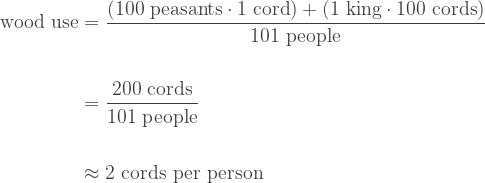

Now, imagine that this wood comes from a nearby forest that can sustainably support a maximum of 1 cord per person (per year). Things seem fine … at first. But after many years of harvest, the peasants realize that the forest is disappearing. To stave off disaster, they need to halve their wood use. How?

“I have the answer!” says the king. “We shall tighten our belts. Everyone must cut their wood use in half!”

The king returns to his castle and celebrates his ‘fair’ decision. Meanwhile, there is ferment among the peasants. It’s a ‘let-them-eat-cake’ moment. The problem is that the king’s decree requires that each peasant survive on a half cord of wood. That, the peasants realize, is a recipe for ‘immiseration’. And so the peasants devise a plan of their own. Rather than halve their use of wood, the peasants decide to get rid of the king.

And with that, the problem is solved. The peasants get the wood they need, while per capita consumption gets halved. The math:


This parable of insurrection illustrates a basic principle of degrowth. Achieving degrowth is a recipe for ‘immiseration’ only if we hold existing patterns of distribution constant. But if we redistribute resources (by eliminating the rich), those at the bottom need not suffer. This is ‘radically progressive degrowth’.

(Some clarification. No, I am not advocating that we execute rich people. I am supposing that we eliminate their command of resource flows.)


How inequality drives resource consumption


Let’s return to our feudal king and his peasants (pre-insurrection). Each peasant consumes only 1 cord of wood. Yet because the king consumes such a stupendous amount (100 cords), the society’s per capita wood use is roughly double that of each peasant. What’s happening here is that inequality is driving up resource use.

Figure 1 illustrates this principle. Here I imagine that our feudal king starts at peasant-levels of wood consumption (1 cord). But over time, he ramps up his wood use to astronomical levels — all the while peasant consumption remains the same. As the king’s habits grow more gluttonous (labelled on the blue curve), they pull up the average level of wood use (vertical axis). The king’s gluttonous consumption also drives growing inequality (horizontal axis).
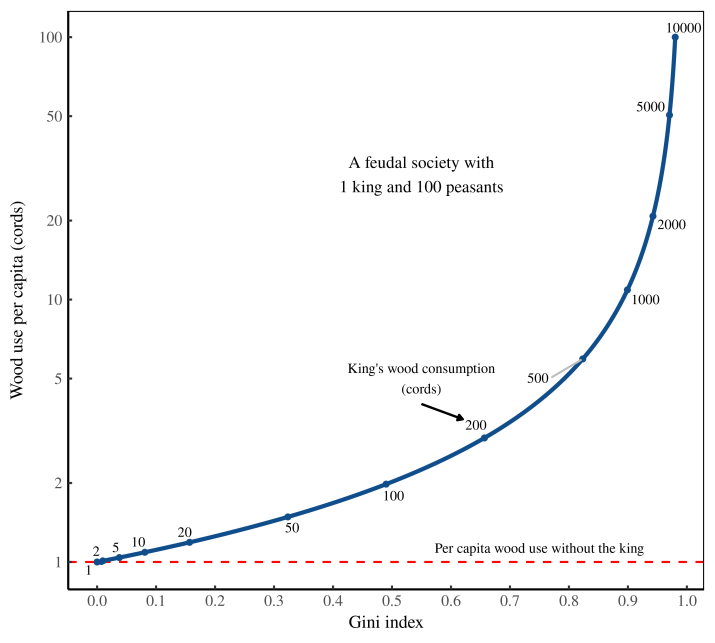
Figure 1: How inequality drives resource use. I plot here wood use per capita in a hypothetical society consisting of 1 king and 100 peasants. The peasants each consume 1 cord of wood. The blue line shows what happens to per capita consumption (vertical axis) as the king ramps up his use of wood (labeled along the curve). The horizontal axis shows the resulting wood-use inequality, as measured by the Gini index.


The point of this feudal thought experiment is to illustrate how inequality can drive up resource use. The gluttony of elites (here, the king) pulls up the average level of consumption from what it would be if the elites did not exist.

From this principle comes a corollary that is equally simple yet far more provocative. One way to lower average resource use is to get rid of elites.


The land of the free


The United States proclaims itself ‘the land of the free’ — a perennial nod to its freedom from monarchical rule. In recent years, though, the slogan has come to evoke a different type of ‘freedom’: the freedom for the rich to get richer.4

Figure 2 shows how this newfound ‘freedom’ has played out. Since 1970, income inequality — measured here using the Gini index — has exploded. In modern America, the rich have gotten richer. (And the poor … well never mind them.) Importantly, this rich-get-richer dynamic has been a bipartisan affair. Inequality rose under Republican and Democratic administrations alike.

Figure 2: Income inequality in the United States. I’ve plotted here the Gini index of US income inequality since 1962. Shaded regions show the tenure of US presidents. [Sources and methods]


Thanks in large part to the work of Thomas Piketty, many people know about the recent rise of US inequality. What is less well-known, though, is the structure of this shift. Figure 3 shows this structure in its entirety. It’s scandalous … once you understand what’s going on.

I’ve plotted, in Figure 3, the distribution of US income in 1970 (red curve) and in 2012 (blue curve). I’ve chosen these years because they represent the minimum and maximum (respectively) of modern US inequality. You can easily spot the difference between the two curves. But to understand what this difference means takes some explaining.

Figure 3: How the US distribution of income has changed since 1970. I plot here the probability density of US income in 1970 and 2012. I have normalized incomes so that the average income of the bottom half of Americans equals 1. Note the log scales on both axes. [Sources and methods]


Let’s first talk about the axes in Figure 3. The horizontal axis shows income. But rather than plot the dollar value of income, I’ve plotted its relative value. I have taken the bottom half of Americans and defined their average income to be 1. That’s the grey vertical line. I’ve then measured everyone’s income relative to this value. (Example: a value of 100 on the x-axis indicates an income that is 100 times the average of the bottom half of Americans.) The vertical axis in Figure 3 shows the relative number of people with the given income. The higher the value, the more people with the corresponding income.

Next let’s talk scales. Both the vertical and horizontal axes in Figure 3 use a logarithmic scale. That means tick marks correspond to factors of 10. The reason I’ve used double-log scales is that this highlights top incomes. The very rich appear in the right tail of the distribution. Their incomes are so large (hundreds of times the average) that we can only see them when we plot income on a log scale. Likewise, extremely rich individuals are so rare that we can see them only when we plot their relative numbers on a log scale.

Now that we’ve got the mechanics out of the way, let’s discuss what Figure 3 tells us about the growth of US inequality. We’ll start with what has not changed.

To see what did not change between 1970 and 2012, look at where the red and blue curves (in Figure 3) overlap. You can see that this overlap happens when incomes are close to or below 1. Now, remember that by definition, the average income of the bottom half of Americans equals 1. So the fact that the curves overlap around income = 1 doesn’t indicate that the dollar value of incomes has remained fixed. (It hasn’t.) Rather, the overlap tells us that in relative terms, the distribution of low incomes has remained stable.

The same is not true for top earners, whose incomes have exploded. To see this explosion, turn your attention to the right tails in Figure 3. (To save you from scrolling, I’ve reproduced Fig. 3 below.) The right tails tell us about the relative number of rich people in each respective year.Figure 3: How the US distribution of income has changed since 1970. I plot here the probability density of US income in 1970 and 2012. I have normalized incomes so that the average income of the bottom half of Americans equals 1. Note the log scales on both axes. [Sources and methods]


Since 1970, the American rich have gotten richer. Here’s how to read this fact from the chart. At every point in the right tail of the distributions, the 2012 curve (blue) is above the 1970 curve (red). This tells us that today, there are far more extremely rich Americans than there were 5 decades ago. In 1970, few people had incomes that exceeded 100 times the bottom-half average. Today there are plenty such people. In fact, we can now find Americans whose income exceeds 1000 times the bottom-half average.

This is the scandal implicit in Figure 3. Yes, it takes some technical chops to understand what’s going on. But now that you do, I hope this rich-get-richer story is seared in your memory.


The rich drive up the average income


Let’s return to Figure 3, but turn our attention now to the dashed vertical lines. The grey line is the average income of the bottom half of Americans — equal to 1 by definition. The red vertical line shows the average income of all Americans in 1970. Note that this average is higher than 1. That’s because the top half of Americans earn more than the bottom half, so they pull up the average. The blue vertical line shows the average income of all Americans in 2012. It seems that since 1970, the average income has grown.

I’m anticipating some misunderstanding here, so let me preemptively clarify. No, the increase in average income is not due to economic growth. It is also not due to inflation. The jump in average American income (between 1970 and 2012) is due to growing inequality. The average American income has been pulled up by the rich getting richer.

More clarification. The growth of average income (in Figure 3) is not some absolute feature of the world. It is a counterfactual thought experiment. It’s what happens when we imagine a world in which the average income of the bottom half of Americans didn’t change.

Given this assumption, I find that from 1970 to 2012, the average of all incomes rose by 70% … purely because the rich got richer. Figure 4 shows my estimate. On the horizontal axis I plot US income inequality, measured using the Gini index. On the vertical axis I plot the average US income— defined so that the bottom half of Americans have a mean income of 1.
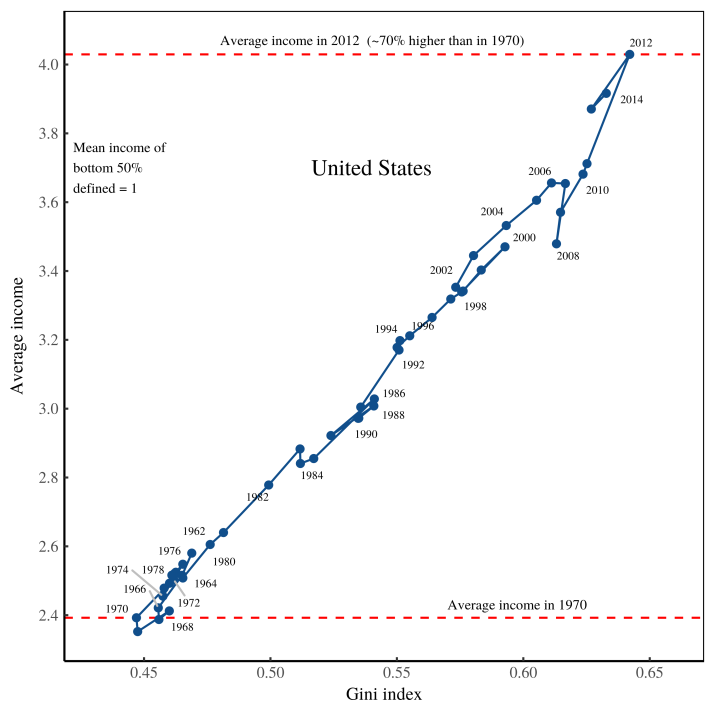
Figure 4: Growing inequality pulled up the average American income. The horizontal axis shows income inequality, measured using the Gini index. The vertical axis shows the average American income, defined so that the mean income of the bottom-half of Americans equals 1. [Sources and methods]


To interpret Figure 4, it may help to return to our hypothetical feudal society, consisting of a king and his peasants. Recall that as we dialed up the resource use of the king, inequality rose, as did per capita consumption. (See Figure 1.) Something similar happens in the US, as shown in Figure 4. Except in the US, it’s not a single person who’s grown richer — it’s a whole class of people. Still, the principle remains the same. Inequality pulls up the average income.

This rich-get-richer effect, you’ll note, is not small. Given my assumptions, I estimate that between 1970 and 2012, the average American income grew by about 70% … purely due to increasing inequality.


Radically progressive degrowth


We’re now ready to return to the idea of ‘radically progressive degrowth’. Recall that this is a reduction in resource use achieved by lowering inequality. The idea sounds far-fetched … until we do the math.

Let’s set the stage. Imagine a future version of the United States in which income inequality has been eliminated. It’s an America without billionaires or millionaires. In this future, every US citizen earns exactly what the bottom half of Americans earns (on average) today. With this scenario in mind, we ask ourselves — how much would per capita resource use drop?

To answer this question definitively, we’d have to complete the experiment. But doing so, you can probably see, would take a revolution. Fortunately, there’s an easier way to see how radically progressive degrowth might play out. We can do the experiment on paper.

In fact, I’ve already done so. In Figure 4, I found that the average income of all Americans is roughly 4 times that of the bottom half of Americans. This implies that if we downward harmonized everyone’s income to the bottom-half average, per capita income would drop by a factor of 4.

Yes, we are talking here about reducing income (not resources). But there’s good reason to suspect that an income reduction would translate into resource degrowth. The reason is simple. At the national level, per capita income correlates strongly with resource use.5 So if our four-fold drop in income translates into a similar drop in resource use, we’re talking about factor-four degrowth. That’s huge.

Now the caveats. Having considered this scenario of radically progressive degrowth, you probably realize that it’s not going to happen. No human society has ever eradicated inequality completely. So the point of this radical scenario is not to envision the degrowth that is plausible … it is to estimate the upper limits of what is possible. On that front, it is conceivable that by eradicating inequality, the US could decrease its resource use by a factor of 4.

Having made this upper estimate, let’s turn now to a scenario that is more plausible. Instead of ‘radically progressive degrowth’, let’s look at merely ‘progressive degrowth’. I’ll define ‘progressive degrowth’ as the degrowth that can be achieved by returning inequality to levels seen a few decades ago.

Imagine a counterfactual world in which Bernie Sanders won the 2016 election. He institutes an ambitious plan to reduce inequality back to 1970 levels. And he guarantees that the average income of the bottom half of Americans will not change. Billionaires protest. But there is an upswell of popular support, and the Sanders plan proceeds. Now here is the question: how much degrowth would this plan achieve?

We can get a rough estimate by returning to Figure 4. Between 1970 and 2012, the average American income grew by 70%, purely due to rising inequality. The upshot is that if we role back this inequality (in the way I have outlined), per capita income would fall by the same amount. If that translates to a similar drop in resource use, we are talking about achieving significant degrowth … just by returning inequality to 1970 levels.


The big picture


The United States is not the only country where inequality pulls up the average income. The phenomenon is ubiquitous. To illustrate this fact, Figure 5 shows the trend across all countries in the World Inequality Database. On the horizontal axis, I plot income inequality (measured by the Gini index). On the vertical axis, I plot average income (defined so that the mean income of the bottom half of earners in a country equals 1).

Figure 5: How inequality pulls up the average income in different countries. The horizontal axis shows income inequality (within countries), measured using the Gini index. The vertical axis shows average income (in a country), defined so that the mean income of the bottom-half of earners equals 1. [Sources and methods]


Let’s start at the bottom end of inequality. As I have defined it here, a society with no inequality would have an average income of 1. Since there is always some inequality, real-world societies never reach this point. But a few come close. In 1984, communist Hungary had a Gini index of 0.13. In that year, the average income of all Hungarians was 1.2 — a mere 20% above what it would be with no inequality. Other communist countries (of that era) are in the same vicinity.

In these countries where inequality is low, the average income isn’t much above what it would be with no inequality. The consequence is that reducing inequality will produce little degrowth. The upshot, however, is that the low-inequality observations (in Figure 5) are mostly ghosts of the past. In communist Hungary, inequality was exceedingly low. But in the capitalist Hungary of today, there is far greater inequality. The same holds true for most former communist states. With the collapse of communism came the rise of inequality. That means there is now more room for achieving degrowth by reducing inequality.

Let’s turn now to the upper range of inequality (i.e. where the Gini index is greater than 0.7). Here we see that by eliminating inequality, staggering degrowth is possible. In Kuwait, for instance, if all incomes were harmonized to what the bottom-half of Kuwaitis currently earn (on average), per capita income would drop by a factor of 10. Other Arab countries (Saudi Arabia, Qatar, Oman, United Arab Emirates) could achieve similar reductions. If this income decrease translated into an in-kind drop in resource use, it would amount to astonishing degrowth.

It’s interesting that it is oil-rich Arab states that could achieve monumental degrowth by mitigating inequality. These states, you’ll note, are the real-world equivalent of my feudal kingdom. They are ruled by despotic monarchs with astounding wealth.6 Get rid of these despots, the evidence suggests, and you could achieve significant degrowth … just like in my feudal parable.

Moving on, note that just because a country could reduce its average income by mitigating inequality, it does not follow that it should. The principle of degrowth is that rich countries should degrow their consumption. Poor countries, on the other hand, deserve to increase their resource use.

On that front, Figure 5 shows that there are many impoverished nations that have significant inequality, and could therefore reduce their resource consumption by mitigating inequality. But doing so goes against the philosophy of degrowth. In these poor countries, the appropriate course of action is to turn our reasoning on its head. We hold average income constant, and then ask — if we eliminate inequality, how much could we pull up up the income of the bottom half of society?

The answer is shocking. In countries like Sierra Leone, Lesotho and Botswana, it’s something like ten-fold. Let me say that again. By eliminating inequality, it’s conceivable that we could increase the income of the bottom half of these societies by a factor of 10 … all without changing per capita resource use.


A model of radically progressive degrowth


The empirical data in Figure 5 speaks for itself. If you live in a rich country with rampant inequality, know that there is likely significant degrowth to be had by eliminating this inequality (assuming you downward harmonize top incomes).

As a scientist, however, I like to go a step beyond the empirical data and build a model. (We scientists love a good equation that predicts reality.) On that front, have a look at Figure 6. I’ve reproduced here the empirical data from Figure 5 — the trend between inequality and average income. But I now show that a simple model can predict the international trend.

Figure 6: Modeling radically progressive degrowth. The horizontal axis shows income inequality (within countries), measured using the Gini index. Blue points are empirical data, reproduced from Fig. 5. The vertical axis shows average income (in a country), defined so that the mean income of the bottom-half of earners equals 1. The dashed red lines show the trend produced by ramping up inequality in a lognormal distribution (left) and power-law distribution (right). [Sources and methods]


The model consists of two theoretical distributions — a lognormal distribution and a power law distribution. To create the model, I adjust the parameters in these theoretical distributions, thereby ramping inequality up or down. What results are the two dashed red lines in Figure 6. The left line is produced by ramping up/down inequality in a lognormal distribution, the right line by ramping up/down inequality in a power-law distribution. You can see that the vast majority of the real-world data sits between these two curves.

What does this model tell us? It suggests that while the causes of income inequality are maddeningly complex, the results are shockingly simple. When inequality increases, the average income predictably grows.


A vanishing act


I can hear many of you saying: “The data is interesting. But what I really want to know is — how do we achieve radically progressive degrowth?”

The scientific answer is that we don’t really know, since no society has ever tried it. Still, we can speculate. On that front, the mathematics of my thought experiment are clear about what needs to happen to bring down average income. These mathematics are also shocking.

My thought experiment involves progressive income redistribution, but in a way that is different than we usually picture. We usually think of progressive redistribution as a Robin-Hood affair. We ‘take from the rich and give to the poor’. In my thought experiment, there is a Robin-Hood element. Some of the income of the rich goes to the poor. However, most of the rich’s income must simply disappear.

The most visceral way to frame this redistribution is to think of the Joker’s antics in the The Dark Knight. He steals millions from Gotham banks … and then burns the money. Fortunately, this incendiary policy (pun intended) is not the only way to make income disappear. Today, only a tiny fraction of money circulates as paper cash. The vast majority of money circulates as electronic digits, which makes destroying it less shocking. Gasoline is not required.

The reality is that governments create and destroy money every day to little fanfare. That’s because when a currency-sovereign government spends, it creates money. When the government taxes, it destroys money. It’s that simple. The net creation/destruction of money therefore depends on the government’s finances. When the government runs a deficit, money is created. When the government runs a surplus, money is destroyed.

With this dynamic in mind, here’s a fiscal policy for radically progressive degrowth. First, the government must adopt a radical tax scheme. I’m talking negative taxes for the poor, and something like a 99% tax on the incomes of the very rich. The effect of this policy will be a massive cash flow into government coffers. The next step is for government to not spend this money. As a result, the incomes of the rich will be downward harmonized (to some desired baseline). If all goes as planned, resource use should decrease.

Having laid out this fiscal policy, I’ll admit that no government (to my knowledge) has ever tried it. And it’s not hard to see why. When you take money out of a capitalist economy, you create a crisis. The result is degrowth … but we don’t call it that. We call it a recession, or a depression.

So here is the reality. Radically reducing inequality could lead to significant degrowth. But in a capitalist economy, it would be a disaster. It’s up to us to create a social system in which radically progressive degrowth is not a crisis.

Sunday, January 17, 2021

Blair Fix on moving to a non-growth world

Living the good life in a non-growth world: Investigating the role of hierarchy. Blair Fix. Jan. 5, 2021.


This is the first of two essays written for (and supported by) the Seoul Platform for Initiating Discourses on an Equitable and Resilient Society. These essays investigate the role that hierarchy plays in driving inequality and unsustainability. This piece introduces the facts of hierarchy. The second (long-form) essay will look at how these facts relate to ‘living the good life in a non-growth world’.


Sustainability or bust

For the past 200 years, humanity has conducted an unintended experiment. The (tacit) research question is this: how much of the Earth’s resources can one species consume? We have yet to find out the answer … nor do we want to.

By nearly all indicators, humanity is doing immense damage to the biosphere. We are using non-renewable resources at a feverish pace [1]. We may be causing the Earth’s sixth mass extinction [2]. And perhaps most alarmingly, we are changing the climate in a way that could put civilization at risk [3]. It is time, then, for our unintended experiment to stop. Instead of plumbing the depths of unsustainability, we must do the opposite. Humanity must become sustainable. The question is, how?

In one sense, the answer is simple. Our impact on the environment is a function of two things: (1) how many people there are; and (2) the amount of resources each person consumes [4]. Becoming sustainable is therefore easy in principle. It requires reducing the human population and reducing resource consumption per person. And yet beneath this simple formula is a web of complexity (and confusion). Here, I will ignore population reduction (which is itself controversial). I will focus on achieving sustainability by reducing per capita resource use.

Mainstream discussions of sustainability tend to focus on efficiency [5,6]. If we can use resources more efficiently, the thinking goes, we will lessen our environmental impact. The problem, though, is that there is little evidence that this is true. Our energy conversion technologies, for instance, have been getting more efficient for two centuries [7]. Yet this greater efficiency has not caused us to consume fewer energy resources. Instead, we are using more than ever. In fact, it may be that efficiency is a primary driver of resource consumption. The reason is simple: more efficient technology tends to lower costs, which then makes resources cheaper. And so we consume more of them [8].

Outside the mainstream, more emphasis is put on directly reducing resource use by consuming less. This thinking goes by many names, but here I will refer to it as ‘degrowth’. The idea is that instead of pursuing economic growth, we should learn how to live with less. We should voluntarily ‘degrow’ the economy [9,10].

My view is that degrowth is the only sound option for becoming sustainable. I will leave aside the question of how much we need to degrow. Instead, I will focus on how we can consume less while creating a society that is equitable and just.


The human need for equity

A sustainable future need not be equitable. That is because our impact on the Earth is a function of the average resource use per person. To the Earth, it doesn’t matter if we use resources equitably, or if one person consumes almost everything and the rest of us starve. It does, however, matter to humans.

There is little that is so toxic to human welfare as rampant inequality. When inequality increases, human well-being gets worse [1113]. This is perhaps one of the most robust findings of the last few decades of social science. In the landscape of neoliberal politics, it is a finding that is surprising. But in the landscape of human evolution, it is not. Humans are a social species. As such, our welfare is inseparable from our relations with others. If these relations are unequal, those at the bottom do worse — regardless of their absolute standard of living. This is not a quirk, but rather a feature we share with other primates [14]. Among social animals, relationships matter.

Assuming we want an equitable society, how can we achieve it while consuming less? Because voluntary degrowth remains largely untested, there are no definitive answers. But I think there are hints. What I will explore, in this essay, is how resource use and equity both relate to hierarchy.

Hierarchy — the ranking of individuals — is part of most social species [1419]. Humans, however, take this form of organization to a new level. We are unique among animals in having developed an explicit chain of command in which power flows from superior to subordinates. This chain of command allows large human groups to function cohesively in a way that no animal group can [20]. But hierarchical organization comes at a cost. Hierarchy concentrates power, and that leads to despotism and inequality. Less intuitively, hierarchy also appears to be energy intensive. As we organize in larger hierarchies, we tend to consume more energy.

In this introductory essay, I will focus on the facts of hierarchy. I will show how hierarchy relates to energy use and to inequality. In the long-form essay to follow, I will explore how these facts pertain to ‘living the good life in a non-growth world’.


Energizing hierarchy1

That humans organize in hierarchy is a fact that should surprise no one. Our working lives are dominated by taking and giving orders [22]. What many people do not know, however, is that hierarchy has a direction — towards more of it.

This trend is recent. Only in the last two centuries has hierarchy grown significantly. While the exact reasons for this growth remain poorly understood, what we can say (with reasonable certainty) is that hierarchy is connected to energy.

I will make the case for this energy-hierarchy connection using indirect evidence. (I do so because direct data for the growth of hierarchy does not yet exist.) The first strand of evidence comes from institution size. As energy use increases, institutions tend to become larger. Figure 1 shows the trend for business firms. In the main panel, each dot represents a country. I have plotted the country’s average firm size (measured in terms of the number of employees) on the vertical axis, and energy use per capita on the horizontal axis. The trend is clear: as countries use more energy, firms tend to get larger.

Figure 1: As countries use more energy, firms get larger. The main panel shows how average firm size (within countries) changes with energy use per capita. Color indicates a country’s energy quartile. I have labelled countries using alpha-3 codes. The inset plot shows the firm size distribution within each respective energy quartile. [Sources and methods].


What we cannot tell, by looking at averages, is how this firm growth happens. It could be that the average grows because most firms get slightly larger. It turns out, however, that this is not what happens. As energy use increases, most firms remain small. Instead, average firm size grows because a few large firms get larger still.

We can see this trend in the inset panel in Figure 1. Here I plot the size distribution of firms across countries, grouped by energy quartile. (In the main plot, I have used color to indicate each quartile.) The horizontal axis shows firms size, while the vertical axis shows the portion of firms that are the corresponding size. What is important here are two things. First, most firms are small — and this remains so regardless of energy use. Second, what changes with energy is the number of large firms. More energy means more large firms. It is a rich-get-richer dynamic. Most firms stay small, but a few large ones grow larger still.

Similar trends hold for government. As countries use more energy, government tends to grow larger. For a thorough review of the energy-institution-size evidence, see [23].

The firm-size evidence hints that hierarchy grows with energy use. Here is the reasoning. From our working lives, we know that firms are hierarchically organized. Therefore, as firms grow larger, it follows that hierarchy increases. This, I believe, is sound logic. But is there evidence that it is true?

Figure 2 shows one strand of evidence that confirms our reasoning. Here, I look at the how the managers’ share of employment relates to energy use. The idea is that the relative number of managers provides a window into the amount of hierarchy in a society. The reason is simple: a manager’s job is to command others. It is a job that, without hierarchy, could not exist. So the growth of managers is indirect evidence for the growth of hierarchy.

Figure 2: As countries use more energy, the relative number of managers increases. Each line represents the path through time of a country. The black line is the smoothed trend across all countries. I have labelled select countries with their alpha-3 codes. [Sources and methods].


What Figure 2 shows is that the relative number of managers tends to grow with energy use. Note, however, that the energy-manager trend is nonlinear. As energy use increases, the relative number of managers grows rapidly at first, but then plateaus.

This non-linear trend, it turns out, is exactly what we expect if hierarchy grows with energy use. The reason has to do with a basic feature of hierarchical organization. In a hierarchy, the number of ranks tends to grow with the logarithm of group size [24]. When a hierarchy is small, adding more members quickly adds more ranks, and hence, more managers. But as the group continues to grow, new ranks are added less rapidly. So the growth of managers slows. Eventually, the hierarchy becomes so large that the portion of people in top ranks becomes constant. The relative number of managers stops growing.

When we formalize this model, it produces the trend shown in Figure 3. Here, black points are the empirical data (the same as in Fig. 2). The rainbow is the model prediction, where color indicates the span of control (how many subordinates each superior controls in a hierarchy). The inset panel shows how the best-fit model compares to the empirical trend. The fit is excellent. The model therefore suggests that managers become more common (as energy use increases) because hierarchy is growing. (See [25] for details about the model.)

Figure 3: A model of the growth of managers. Black points are empirical observations for energy use and the relative number of managers (the same data as in Figure 2). Colored points represent the model results. Color indicates the span of control in the model — the number subordinates controlled by each superior. The inset panel shows how the best-fit model relates to the empirical trend across all countries. [Sources and methods].


To summarize, there is strong (but indirect) evidence that as energy use increases, hierarchy grows. This fact has many implications for sustainability, which I will discuss in the long-form version of this essay. But for now, let’s move on to another feature of hierarchy — its role in driving inequality.


Hierarchical inequality

The fact that humans organize in hierarchies is, in some ways, unsurprising. The social scientist Herbert Simon thought that hierarchy was a fundamental part of all complex systems [26]. Here was his reasoning.

Hierarchy, Simon noted, allows a complex system to be built from simpler components. Cells, for instance, are built from organelles. And multi-cellular organisms, in turn, are built from cells. This hierarchical organization, Simon thought, is how blind evolution can build complex systems. It does so from the bottom up using trial and error.

Hierarchy is also important, Simon proposed, because it centralizes control. The human body, for instance, is not composed of a mass of autonomous cells. Instead, cells surrender their autonomy to the central nervous system — the body’s command center. The advantage is that this hierarchical organization allows complicated behavior like running — something that would be unthinkable if each cell in the body acted independently. But there is one big disadvantage to this concentration of power — despotism.

True, we do not usually think of cells as being despotic. But that is because multicellular organisms have evolved ways to suppress the selfish tendencies of individual cells [27,28]. So unless there is pathology, we never see brain cells using their control over the body for selfish gain.

Among humans, things are different. Like the cells of the body, humans use hierarchy to organize. But unlike our cells, individual humans retain a healthy dose of selfishness. And so when given the chance, individuals inevitably use their hierarchical power to enrich themselves. The result is that hierarchy is a double-edged sword. It is a potent tool for organization. But it is also a pathological tool for despotism and inequality [29].

The evidence for hierarchical inequality is quite straightforward. Within hierarchies, access to resources (i.e. income) tends to grow with control over subordinates. The more subordinates you have, the greater your relative income. Figure 4 shows the evidence. I plot here relative income in a hierarchy against something I call ‘hierarchical power’ — a shorthand for control over subordinates. I define hierarchical power as:
hierarchical power = number of subordinates + 1
The idea here is that everyone starts with a hierarchical power of 1, indicating that they have control over themselves. As you accumulate subordinates, your hierarchical power increases. And, as Figure 4 indicates, so does your income.

Figure 4: Inside hierarchies, relative income grows with hierarchical power. I plot here the relation between relative income (within a hierarchy) and hierarchical power (the number of subordinates + 1). In case-study firms and the US military, I measure income relative to the lowest hierarchical rank. For CEOs, I measure income relative to the firm average. [Sources and methods].

In Figure 4, I plot three different sources of data. Red points come from six case studies of firm hierarchy [30]. Blue points represent the US military (over the last decade). For both the military and case-study firms, each point represents the average income and hierarchical power of a given rank. Green points represent a sample of US CEOs. Each point is an individual CEO [31].

Across a variety of different institutions, it seems that relative income grows with hierarchical power. This suggests that hierarchy is a key driver of inequality [32]. Exactly how hierarchy creates inequality, however, remains poorly understood. In the long-form essay to follow, I will speculate about some of the mechanisms at work.


The sustainable good life

A common thread among degrowth thinkers is that sustainability requires an end to corporate globalism and a transition to community localism. The evidence reviewed here lends credence to this view. The growth of large corporations seems to go hand in hand with using more energy. It makes sense, then, that a reversal towards smaller institutions would help us consume less energy. It is not clear, however, which causes which. Would degrowth energy policy automatically lead to smaller institutions? Or should we focus on making smaller institutions, with energy reduction coming as a side effect? I will investigate these questions in the long-form essay to follow.

And what about inequality? It is tempting to think that if we pursue community localism, inequality will naturally go away. The reasoning is that smaller institutions will have less hierarchy, and hence, less inequality. Unfortunately, this reasoning turns out to be false. The problem (which I will explore in the long-form essay to follow) is that hierarchy is fundamentally non-linear. This means that shrinking large hierarchies has almost no effect on inequality … until the hierarchy has become very small. Pursuing small-scale localism, then, will likely not guarantee equity. Instead, we will need explicit policies for reigning in hierarchical despotism. I will explore these ideas more in the next instalment.


Sunday, May 31, 2020

William Rees on Planet of the Humans

Crossroads for Planet of the Humans. William Rees. May 27, 2020.

“It stands to reason…”

Who hasn’t heard this expression in everyday conversation? Humans tend to think of themselves as rational beings, and many people sincerely believe they are being reasonable all the time.

However, human reason invariably operates in a straitjacket. Even the most elevated of human thought is constrained by life experience and the unquantifiable set of beliefs and values, as well as facts and assumptions, that every individual acquires by growing up in a particular cultural environment. Life experience determines a person’s perception of reality. Unsurprisingly, people are most comfortable when the universe unfolds in harmony with their culturally preset notion of how things ought to be.

Of course, in complex societies there are many potential versions of “truth” on any particular subject. “Reality”—or rather, our socially-constructed perception of reality—comes in many guises.

Herein lies potential chaos. It starts when a line of thought taken for granted by a group of people who share the same cultural narrative is disputed by another group who observe a different set of beliefs, values, and assumptions.

Consider the dilemma of modernity. Propelled by fossil fuels, our increasingly global techno-industrial (mainly capitalist) society has generated unprecedented material prosperity for hundreds of millions of people. This extraordinary progress leads us to believe an endless energy bounty will support the ten billion humans expected on the planet by mid- to late century. The catch is that this same success is already well on the way to depleting and polluting the seas, denuding the continents of forests, displacing the world’s wildlife, and triggering climate change.

This is not a problem according to the cultural mainstream. Radiating self-confidence and buoyed by unquestioned past material success, the political and corporate leadership seem confident that human ingenuity (our greatest resource) will prevail. They argue that we have already found economically viable renewable substitutes for fossil fuels such as biomass, wind turbines, and solar photo-voltaic arrays. These alternatives should enable economic growth to continue indefinitely, bringing the affluence needed to “fix” the ecosphere. The big environmental NGOs have climbed on board for pushing the techno-fix narrative, and most citizens are only too happy to go along for the business-as-usual ride.

Not everyone is jumping on the pro-growth bandwagon, however. A surge of scientists and citizens has written a competing narrative. This renegade group reasons that wind and solar technologies are quantitatively insufficient to power modern society, contribute to ecological destruction, and are heavily subsidized by fossil fuels and not really renewable. To them, the only reasonable “solution” to the ongoing climate and eco-catastrophe, difficult as it may be to achieve, is adapting to much lower levels of energy and material consumption, sharing existing income/wealth, and learning to live within the biophysical means of nature.

This new movement has been growing steadily and waiting to catch fire politically. While there has been a deepening discussion about the impacts of the economy on the environment, there has also been a significant lack of media coverage about it. That was, however, until a few weeks ago, when one documentary ignited the argument against economic growth: Planet of the Humans.

The Gibbs/Moore production has ignited a conflagration of competing worldviews unparalleled by any debate about alternative energy sources in the history of the environmental movement. As a human ecologist, I’ll admit up front that I am in the renegade camp, but I am not blinded to certain weaknesses in Gibbs’ take on our dilemma. This film contains many pros and cons when framing the conversation of environmental protection. Let’s explore what Planet provided.

The Underbelly of Environmental Organizations

Planet of the Humans does a great service in eroding faith in renewable energy, particularly the travesty of broad-scale biomass energy. It achieved less than it could in undermining wind and solar power. This is a shame since the loudest screams of “foul” come from wind/solar advocates, and there are plenty of recent analyses and data which the film could have drawn on to cut them off. It’s an ironic weakness, because the films critics are most adamant about how “dated” the wind/solar information is. Yes, it’s dated, but on both sides of the argument about whether wind/solar is capable of replacing fossil fuels at the current size of economy.

The film also succeeds in skewering several environmental organizations and popular heroes in the process. Though it’s difficult to watch the hypocrisy of environmental champions unveiled, investigating into these advocacy groups is important and necessary. For instance, Gibbs reveals the large and mainstream environmental organizations are highly dependent on the corporate sector for their financing, either directly or indirectly. This certainly compromises what they can say about the (corporate) values of society and helps to explain why so many environmental NGOs support capital-intensive (i.e., profit-oriented) approaches to energy supply and climate change—e.g., electric cars, solar photovoltaics, wind turbines, carbon capture and storage, etc. These organizations make us think they are saving the planet by introducing “green” tech; yet they are supporting—and enjoying the support of—the corporate giants that contribute to destroying the earth. Even the Green New Deal is a false-promise approach that suggests all we have to do is invest in techno-fixes to continue on our growth-bound path.

A Better Refute Against Renewables Replacing Fossil Fuels

As noted above, up-to-date data are important, and accurate data even more so. Planet of the Humans relies excessively on old research and off-the-cuff comments from interviewees. Gibbs/Moore could have better supported their case by referencing current issues with “green” technology, including extended net energy analysis from mine-shaft through operation, as well as the decommissioning of commercial wind turbine and solar installations.

However, Gibbs does bring a critical question to light: Are renewables effectively displacing fossil fuels?

Let’s look first at the case of Germany, a leader in green energy investment. According to Clean Energy Wire, while wind and solar make a significant contribution to German electricity production (21 percent and 8 percent respectively) these two sources supply a mere 5 percent of German primary energy consumption (3.5 percent and 1.5 percent, respectively). Biomass—largely green trees as Gibbs pointed out—supplies a full 7.6 percent. Meanwhile, fossil fuels still account for about 78 percent of primary consumption, and carbon emissions have been more or less plateaued for a decade. (Yes, carbon emissions did drop in Germany in 2019, by about 6 percent, but 2019 also marked a sharp slump in German GDP growth, especially in the industrial sector). All this despite hundreds of billions invested in wind and solar energy. Furthermore, keep in mind that wind and solar require full backup power, either domestic or imported. (Note this well: It is a common error to conflate electricity generated with total energy demand/consumption. The former is typically only about 20 percent of the latter.)

Then there’s the global picture to consider. According to BP Statistical Review of World Energy 2019, in 2018, fossil fuels supplied 11,743.6 Mtoe (million tonnes of oil equivalent) or 85 percent of the world’s primary energy, while non-hydro renewables (mostly commercial biomass, wind, and solar) contributed only 561.3 Mtoe (4 percent).

Are renewables catching up? While the contribution of non-hydro renewables to global primary consumption has expanded by 437 Mtoe since 2008 (16 percent per year), consumption of fossil fuels increased by about 1,750 Mtoe (about 1.5 percent/yr) in the same period. This marginal increase is over three times the total supplied by non-hydro renewables in 2018. This same year, consumption of non-hydro renewables increased by 71.1 Mtoe (14.5 percent), but fossil fuels were up by 276.3 Mtoe (2.4 percent).

Bottom line? Starting from a much larger base, the pre-pandemic annual absolute growth in fossil fuel production/consumption continues to outpace that of renewables, especially non-hydro-renewables, by a wide margin, despite the higher relative growth rate of renewables. Nothing suggests this will change while economic growth remains the goal, especially since new technology requires economic growth based on current levels of technology.

Bountiful Energy Could Do More Harm Than Good

Gibbs underplays (and the subsequent criticism I have seen entirely misses) a critical point: Even if renewables were “the answer”—i.e., even if our techno-industrial, capitalist growth succeeds in contriving any cheap, plentiful substitute for fossil fuels—it would be catastrophic. Without a sea change in expansionist values and our anthropocentric approach to the natural world, humans will simply use the energy bounty to complete their dismemberment of Earth. (Planet’s horrific sequences of stranded orangutans—their habitats destroyed for palm oil and sugar cane for “green energy”—is perhaps the most illustrative example of this potential destruction.)

In short, it’s really beside the point whether “100 percent renewable energy” is possible because any techno-fix would be disastrous given the prevailing cultural narrative and macroeconomic goals.

The Bottom Line

Planet of the Humans is far from inaccurate in undermining today’s overconfidence in renewables and mainstream environmental NGOs but is arguably a bit unfair to some individuals. Gibbs engages people on both sides of a complicated issue, selectively goring some. Wherever one stands on the issue of sustainable energy, though, Planet of the Humans is proving to be a deeply moving and motivating production.

And now there is a complicating—but possibly complementary—factor. The COVID-19 pandemic provides an unscheduled opportunity to rethink our energy and economic futures. The real planet of humans is at a crossroads: Pre-pandemic trends will not simply resume as if nothing had happened.

Homo sapiens is an allegedly rational species. Virtually everyone agrees that we must avoid an ecosystem collapse and reverse global warming. We also recognize that if civilization is to persist, we must have energy sources. So, what is the solution that balances these two issues?

CASSE’s push for the steady state economy is certainly one of the most rational answers to that question. It really ”stands to reason” that we need an economy that fits on the planet, using a reasonable amount of energy from renewable sources and with processes that don’t destroy our ecosystems. Reducing energy use to that reasonable amount surely entails real (not just political) degrowth. Degrowth toward a steady state economy” summarizes the solution quite well.

Friday, September 20, 2019

Feature Reference Article #18: Tech won't solve our unsustainability problems; we need to redesign the economy

What Negative Interest Rates Mean and What We Should Do. Ian Welsh. Aug. 21, 2019.

Alright, so Germany has now introduced a zero interest bond. That means, given inflation, people will get back less effective money than they started with.

At this point, outside the US, the average interest rate is negative.

As Stoller pointed out, that means that people with money can’t figure out anything productive to do with it which will make a profit.

That means that capitalists and banks, including central banks, have failed. It is their function, in a capitalist society, to allocate resources. Money represents resources: people, stuff, and land.

Now if we lived in a utopia, with no real problems, this would make sense, but we don’t. There are tons of real problems which need solving, lots of money floating around, and other capacity indicators show there are people and resources which are not being used, or which could be redeployed.

So capitalism is failing to do what it’s supposed to do, and so are capitalists
.

The correct action in a situation like this is to get that money working. The government could borrow it massively, and do what needs to be done. It could (and I would suggest this is the better option) tax it away, and then spend it.

If capitalists absolutely insist on private enterprise doing the work, then they should massively raise taxes on any income or capital gains not used productively, and not count less productive things like loans–they should stipulate that the money must be invested into business activity. They should make stock option grants, stock buy-backs, and all similar activities intended to allow cash-outs impossible. They should get rid of private equity; just make it illegal. Almost all of its activity destroys viable business to create a pay day for a few people.

Heck, you should do away with all those things anyway.

People are very confused about profit. Profit is mostly socially constructed. It is not an independent variable. Taxes, laws, and regulations determine what is profitable and what isn’t. Billions of subsidies, tax breaks, and favorable land deals make extraction industries profitable, for example. Banks get to print money. Media companies like Disney rely on characters and ideas which, in the past, they would long have lost control over. Companies are allowed to pollute for free, to use vast amounts of water for nominal prices, and so on.

Meanwhile, a vast array of regulations and nickel and dime costs makes it impossible for small business to compete. Try starting a bank. Yeah, good luck with that.

This, too, is by design. Before Reagan, regulations were set up to make small businesses easier to start and keep running.

The point is that if investors can’t find anything in which to invest, government has failed to tweak profits correctly. You shouldn’t get rich in land speculation unless you’re building stuff that should be built. You should get rich in alternative energy, but mostly you don’t. You should get rich in making homes that are healthy and energy neutral, but instead we keep building unhealthy and environmentally-degrading housing.

You should make money rebuilding infrastructure, or building high speed trains, or reducing carbon, or reforesting, or making fish and phytoplankton stocks recover.

Yet, you don’t, so these things which need to be done in order to, like, avoid a few billion deaths, don’t get done.

That’s government failure.


Capitalism does not work without effective government control, if it is the dominant economic mode in a society.

So. We have lots of stuff that needs to be done. We have lots of resources and money which aren’t doing those things and, indeed, resources and money which apparently can’t find anything to do

Only a moron can’t look at those facts and know what to do.


Oh, and the 2008/9 bailouts made this situation far, far worse than it should have been. This endless printing of money is only to keep the useless rich afloat when they serve no useful, productive function. They are actually counterproductive, as they are actively stopping productive activity from happening.

Tax them. Stop propping them up and let incompetents die. Destroy, utterly, those members of the ruling class who are actively destructive, like Private Equity. Alter the rules so that productive activity is profitable, and while you’re doing all that, just have governments do the most important stuff themselves, with negative real interest rate loans.

None of this isn’t obvious to anyone who pays any attention.

Yet we don’t do it, because governments have been captured by failed rich people.

Normal. But not acceptable when the cost of inaction could be billions of dead people.


A globalised solar-powered future is wholly unrealistic – and our economy is the reason why. Alf Hornborg, The Conversation. Sept. 6, 2019.

Over the past two centuries, millions of dedicated people – revolutionaries, activists, politicians, and theorists – have been unable to curb the disastrous and increasingly globalised trajectory of economic polarisation and ecological degradation. This is perhaps because we are utterly trapped in flawed ways of thinking about technology and economy – as the current discourse on climate change shows.

Rising greenhouse gas emissions are not just generating climate change. They are giving more and more of us climate anxiety. Doomsday scenarios are capturing the headlines at an accelerating rate. Scientists from all over the world tell us that emissions in ten years must be half of what they were ten years ago, or we face apocalypse. School children like Greta Thunberg and activist movements like Extinction Rebellion are demanding that we panic. And rightly so. But what should we do to avoid disaster?

Most scientists, politicians, and business leaders tend to put their hope in technological progress. Regardless of ideology, there is a widespread expectation that new technologies will replace fossil fuels by harnessing renewable energy such as solar and wind. Many also trust that there will be technologies for removing carbon dioxide from the atmosphere and for “geoengineering” the Earth’s climate. The common denominator in these visions is the faith that we can save modern civilisation if we shift to new technologies. But “technology” is not a magic wand. It requires a lot of money, which means claims on labour and resources from other areas. We tend to forget this crucial fact.

I would argue that the way we take conventional “all-purpose” money for granted is the main reason why we have not understood how advanced technologies are dependent on the appropriation of labour and resources from elsewhere. In making it possible to exchange almost anything – human time, gadgets, ecosystems, whatever – for anything else on the market, people are constantly looking for the best deals, which ultimately means promoting the lowest wages and the cheapest resources in the global South.

It is the [il]logic of money that has created the utterly unsustainable and growth-hungry global society that exists today. To get our globalised economy to respect natural limits, we must set limits to what can be exchanged. Unfortunately, it seems increasingly probable that we shall have to experience something closer to disaster – such as a semi-global harvest failure – before we are prepared to seriously question how money and markets are currently designed.

Green growth?

Take the ultimate issue we are facing: whether our modern, global, and growing economy can be powered by renewable energy. Among most champions of sustainability, such as advocates of a Green New Deal, there is an unshakeable conviction that the problem of climate change can be solved by engineers.

What generally divides ideological positions is not the faith in technology as such, but which technical solutions to choose, and whether they will require major political change. Those who remain sceptical to the promises of technology – such as advocates of radical downshifting or degrowth – tend to be marginalised from politics and the media. So far, any politician who seriously advocates degrowth is not likely to have a future in politics.

Mainstream optimism about technology is often referred to as ecomodernism. The Ecomodernist Manifesto, a concise statement of this approach published in 2015, asks us to embrace technological progress, which will give us “a good, or even great, Anthropocene”. It argues that the progress of technology has “decoupled” us from the natural world and should be allowed to continue to do so in order to allow the “rewilding” of nature. The growth of cities, industrial agriculture, and nuclear power, it claims, illustrate such decoupling. As if these phenomena did not have ecological footprints beyond their own boundaries.

Meanwhile, calls for a Green New Deal have been voiced for more than a decade, but in February 2019 it took the form of a resolution to the American House of Representatives. Central to its vision is a large-scale shift to renewable energy sources and massive investments in new infrastructure. This would enable further growth of the economy, it is argued.


Rethinking technology

So the general consensus seems to be that the problem of climate change is just a question of replacing one energy technology with another. But a historical view reveals that the very idea of technology is inextricably intertwined with capital accumulation, unequal exchange and the idea of all-purpose money. And as such, it is not as easy to redesign as we like to think. Shifting the main energy technology is not just a matter of replacing infrastructure – it means transforming the economic world order.

In the 19th century, the industrial revolution gave us the notion that technological progress is simply human ingenuity applied to nature, and that it has nothing to do with the structure of world society. This is the mirror image of the economists’ illusion, that growth has nothing to do with nature and so does not need to reckon with natural limits. Rather than seeing that both technology and economy span the nature-society divide, engineering is thought of as dealing only with nature and economics as dealing only with society.

The steam engine, for instance, is simply considered an ingenious invention for harnessing the chemical energy of coal. I am not denying that this is the case, but steam technology in early industrial Britain was also contingent on capital accumulated on global markets. The steam-driven factories in Manchester would never have been built without the triangular Atlantic trade in slaves, raw cotton, and cotton textiles. Steam technology was not just a matter of ingenious engineering applied to nature – like all complex technology, it was also crucially dependent on global relations of exchange.

This dependence of technology on global social relations is not just a matter of money. In quite a physical sense, the viability of the steam engine relied on the flows of human labour energy and other resources that had been invested in cotton fibre from South Carolina, in the US, coal from Wales and iron from Sweden. Modern technology, then, is a product of the metabolism of world society, not simply the result of uncovering “facts” of nature.

The illusion that we have suffered from since the industrial revolution is that technological change is simply a matter of engineering knowledge, regardless of the patterns of global material flows. This is particularly problematic in that it makes us blind to how such flows tend to be highly uneven.

This is not just true of the days of the British Empire. To this day, technologically advanced areas of the world are net importers of the resources that have been used as inputs in producing their technologies and other commodities, such as land, labour, materials, and energy. Technological progress and capital accumulation are two sides of the same coin. But the material asymmetries in world trade are invisible to mainstream economists, who focus exclusively on flows of money.

Ironically, this understanding of technology is not even recognised in Marxist theory, although it claims to be both materialist and committed to social justice. Marxist theory and politics tend toward what opponents refer to as a Promethean faith in technological progress. Its concern with justice focuses on the emancipation of the industrial worker, rather than on the global flows of resources that are embodied in the industrial machine.

This Marxist faith in the magic of technology occasionally takes extreme forms, as in the case of the biologist David Schwartzman, who does not hesitate to predict future human colonisation of the galaxy and Aaron Bastani, who anticipates mining asteroids. In his remarkable book Fully Automated Luxury Communism: A Manifesto, Bastani repeats a widespread claim about the cheapness of solar power that shows how deluded most of us are by the idea of technology.

Nature, he writes, “provides us with virtually free, limitless energy”. This was a frequently voiced conviction already in 1964, when the chemist Farrington Daniels proclaimed that the “most plentiful and cheapest energy is ours for the taking”. More than 50 years later, the dream persists.

The realities

Electricity globally represents about 19% of total energy use – the other major energy drains being transports and industry. In 2017, only 0.7% of global energy use derived from solar power and 1.9% from wind, while 85% relied on fossil fuels. As much as 90% of world energy use derives from fossil sources, and this share is actually increasing. So why is the long-anticipated transition to renewable energy not materialising?

One highly contested issue is the land requirements for harnessing renewable energy. Energy experts like David MacKay and Vaclav Smil have estimated that the “power density” – the watts of energy that can be harnessed per unit of land area – of renewable energy sources is so much lower than that of fossil fuels that to replace fossil with renewable energy would require vastly greater land areas for capturing energy.

In part because of this issue, visions of large-scale solar power projects have long referred to the good use to which they could put unproductive areas like the Sahara desert. But doubts about profitability have discouraged investments. A decade ago, for example, there was much talk about Desertec, a €400 billion project that crumbled as the major investors pulled out, one by one.

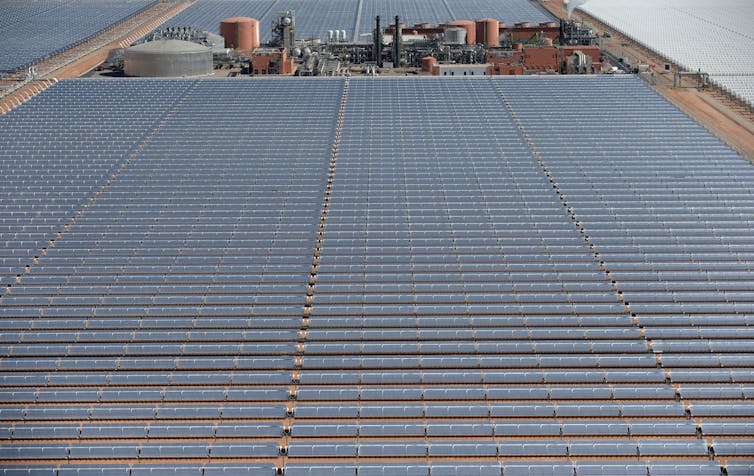
Today the world’s largest solar energy project is Ouarzazate Solar Power Station in Morocco. It covers about 25 square kilometres and has cost around US$9 billion to build. It is designed to provide around a million people with electricity, which means that another 35 such projects – that is, US$315 billion of investments – would be required merely to cater to the population of Morocco. We tend not to see that the enormous investments of capital needed for such massive infrastructural projects represent claims on resources elsewhere – they have huge footprints beyond our field of vision.

Ouarzazate Solar Power Station (OSPS), one of the largest solar plants in the world. EPA/STR

Also, we must consider whether solar is really carbon free. As Smil has shown for wind turbines and Storm van Leeuwen for nuclear power, the production, installation, and maintenance of any technological infrastructure remains critically dependent on fossil energy. Of course, it is easy to retort that until the transition has been made, solar panels are going to have to be produced by burning fossil fuels. But even if 100% of our electricity were renewable, it would not be able to propel global transports or cover the production of steel and cement for urban-industrial infrastructure.

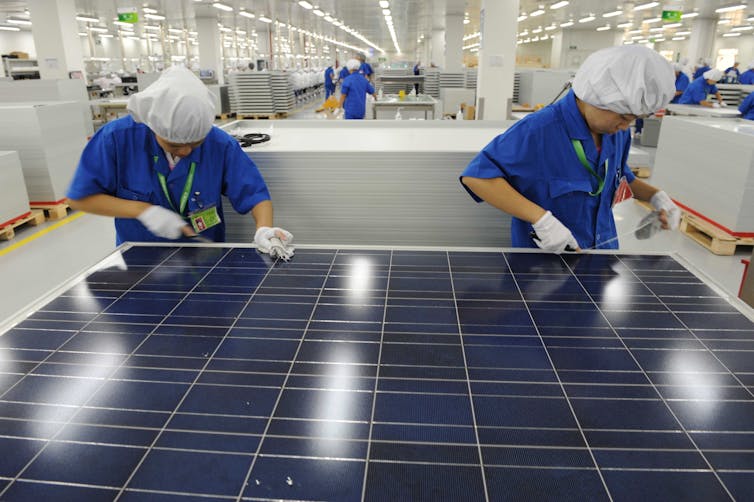
And given the fact that the cheapening of solar panels in recent years to a significant extent is the result of shifting manufacture to Asia, we must ask ourselves whether European and American efforts to become sustainable should really be based on the global exploitation of low-wage labour, scarce resources and abused landscapes elsewhere.

Workers in a factory of a Chinese solar panel maker in Hangzhou. EPA/STR


Collecting carbon

Solar power is not displacing fossil energy, only adding to it. And the pace of expansion of renewable energy capacity has stalled – it was about the same in 2018 as in 2017. Meanwhile, our global combustion of fossil fuels continues to rise, as do our carbon emissions. Because this trend seems unstoppable, many hope to see extensive use of technologies for capturing and removing the carbon from the emissions of power plants and factories.

Carbon Capture and Storage (CCS) remains an essential component of the 2016 Paris Agreement on climate change. But to envisage such technologies as economically accessible at a global scale is clearly unrealistic.

To collect the atoms of carbon dispersed by the global combustion of fossil fuels would be as energy-demanding and economically unfeasible as it would be to try to collect the molecules of rubber from car tires that are continuously being dispersed in the atmosphere by road friction.

The late economist Nicholas Georgescu-Roegen used this example to show that economic processes inevitably lead to entropy – that is, an increase in physical disorder and loss of productive potential. In not grasping the implications of this fact, we continue to imagine some miraculous new technology that will reverse the Law of Entropy.

Economic “value” is a cultural idea. An implication of the Law of Entropy is that productive potential in nature – the force of energy or the quality of materials – is systematically lost as value is being produced. This perspective turns our economic worldview upside down. Value is measured in money, and money shapes the way we think about value. Economists are right in that value should be defined in terms of human preferences, rather than inputs of labour or resources, but the result is that the more value we produce, the more inexpensive labour, energy and other resources are required. To curb the relentless growth of value – at the expense of the biosphere and the global poor – we must create an economy that can restrain itself.

The evils of capitalism


Much of the discussion on climate change suggests that we are on a battlefield, confronting evil people who want to obstruct our path to an ecological civilisation. But the concept of capitalism tends to mystify how we are all caught in a game defined by the logic of our own constructions – as if there was an abstract “system” and its morally despicable proponents to blame. Rather than see the very design of the money game as the real antagonist, our call to arms tends to be directed at the players who have had best luck with the dice.

I would instead argue that the ultimate obstruction is not a question of human morality but of our common faith in what Marx called “money fetishism”. We collectively delegate responsibility for our future to a mindless human invention – what Karl Polanyi called all-purpose money, the peculiar idea that anything can be exchanged for anything else. The aggregate logic of this relatively recent idea is precisely what is usually called “capitalism”. It defines the strategies of corporations, politicians, and citizens alike.

All want their money assets to grow. The logic of the global money game obviously does not provide enough incentives to invest in renewables. It generates greed, obscene and rising inequalities, violence, and environmental degradation, including climate change. But mainstream economics appears to have more faith in setting this logic free than ever. Given the way the economy is now organised, it does not see an alternative to obeying the logic of the globalised market.

It’s the rules which are the issue – not those who win. Theera Disayarat/Shutterstock.com


The only way to change the game is to redesign its most basic rules. To attribute climate change to an abstract system called capitalism – but without challenging the idea of all-purpose money – is to deny our own agency. The “system” is perpetuated every time we buy our groceries, regardless of whether we are radical activists or climate change deniers. It is difficult to identify culprits if we are all players in the same game. In agreeing to the rules, we have limited our potential collective agency. We have become the tools and servants of our own creation – all-purpose money.

Despite good intentions, it is not clear what Thunberg, Extinction Rebellion and the rest of the climate movement are demanding should be done. Like most of us, they want to stop the emissions of greenhouse gases, but seem to believe that such an energy transition is compatible with money, globalised markets, and modern civilisation.

Is our goal to overthrow “the capitalist mode of production”? If so, how do we go about doing that? Should we blame the politicians for not confronting capitalism and the inertia of all-purpose money? Or – which should follow automatically – should we blame the voters? Should we blame ourselves for not electing politicians that are sincere enough to advocate reducing our mobility and levels of consumption?

Many believe that with the right technologies we would not have to reduce our mobility or energy consumption – and that the global economy could still grow. But to me that is an illusion. It suggests that we have not yet grasped what “technology” is. Electric cars and many other “green” devices may seem reassuring but are often revealed to be insidious strategies for displacing work and environmental loads beyond our horizon – to unhealthy, low-wage labour in mines in Congo and Inner Mongolia. They look sustainable and fair to their affluent users but perpetuate a myopic worldview that goes back to the invention of the steam engine. I have called this delusion machine fetishism.

Not the guilt free option many assume them to be. Smile Fight/Shutterstock.com


Redesigning the global money game

So the first thing we should redesign are the economic ideas that brought fossil-fueled technology into existence and continue to perpetuate it. “Capitalism” ultimately refers to the artefact or idea of all-purpose money, which most of us take for granted as being something about which we do not have a choice. But we do, and this must be recognised.

Since the 19th century, all-purpose money has obscured the unequal resource flows of colonialism by making them seem reciprocal: money has served as a veil that mystifies exploitation by representing it as fair exchange. Economists today reproduce this 19th-century mystification, using a vocabulary that has proven useless in challenging global problems of justice and sustainability. The policies designed to protect the environment and promote global justice have not curbed the insidious logic of all-purpose money – which is to increase environmental degradation as well as economic inequalities.

In order to see that all-purpose money is indeed the fundamental problem, we need to see that there are alternative ways of designing money and markets. Like the rules in a board game, they are human constructions and can, in principle, be redesigned. In order to accomplish economic “degrowth” and curb the treadmill of capital accumulation, we must transform the systemic logic of money itself.

National authorities might establish a complementary currency, alongside regular money, that is distributed as a universal basic income but that can only be used to buy goods and services that are produced within a given radius from the point of purchase. This is not “local money” in the sense of LETS or the Bristol Pound – which in effect do nothing to impede the expansion of the global market – but a genuine spanner in the wheel of globalisation. With local money you can buy goods produced on the other side of the planet, as long as you buy it in a local store. What I am suggesting is special money that can only be used to buy goods produced locally.

Locally produced goods. Alison Hancock/Shutterstock.com

This would help decrease demand for global transports – a major source of greenhouse gas emissions – while increasing local diversity and resilience and encouraging community integration. It would no longer make low wages and lax environmental legislation competitive advantages in world trade, as is currently the case.

Immunising local communities and ecosystems from the logic of globalised capital flows may be the only feasible way of creating a truly “post-capitalist” society that respects planetary boundaries and does not generate deepening global injustices.

Re-localising the bulk of the economy in this way does not mean that communities won’t need electricity, for example, to run hospitals, computers and households. But it would dismantle most of the global, fossil-fuelled infrastructure for transporting people, groceries and other commodities around the planet.

This means decoupling human subsistence from fossil energy and re-embedding humans in their landscapes and communities. In completely changing market structures of demand, such a shift would not require anyone – corporations, politicians, or citizens – to choose between fossil and solar energy, as two comparable options with different profit margins.

To return to the example of Morocco, solar power will obviously have an important role to play in generating indispensable electricity, but to imagine that it will be able to provide anything near current levels of per capita energy use in the global North is wholly unrealistic. A transition to solar energy should not simply be about replacing fossil fuels, but about reorganising the global economy.

Solar power will no doubt be a vital component of humanity’s future, but not as long as we allow the logic of the world market to make it profitable to transport essential goods halfway around the world. The current blind faith in technology will not save us. For the planet to stand any chance, the global economy must be redesigned. The problem is more fundamental than capitalism or the emphasis on growth: it is money itself, and how money is related to technology.

Climate change and the other horrors of the Anthropocene don’t just tell us to stop using fossil fuels – they tell us that globalisation itself is unsustainable.


Alf Hornborg is Professor of Human Ecology, Lund University.

Read more: Lithium is finite – but clean technology relies on such non-renewable resources


Why degrowth is the only responsible way forward: A reduction of economic activity is necessary and just – and can lead to human flourishing. Joël Foramitti, Marula Tsagkari, Christos Zografos, openDemocracy. Sept 19, 2019.

To sustain the natural basis of our life, we must slow down. We have to reduce the amount of extraction, pollution, and waste throughout our economy. This implies less production, less consumption, and probably also less work.

The responsibility to do so must lie mainly on the rich, who currently enjoy a disproportionate share of our resources. But we should also do things differently, as much of today's economic activity is of little benefit to human wellbeing. Imagine what could be if we organized democratically to produce what we actually need, distributed those resources fairly, and shared them in common. This, in a nutshell, is the vision of degrowth: a good life for all within planetary boundaries. And while this might seem utopian, there are already concrete policy ideas to start such a transformation.

...

All this means that it is hard to see a way around a reduction of economic activity. Of course it is theoretically possible that we could grow and produce more within our limits if technology improves. But so far this hasn’t happened, there is little to show that it will, and as long as it doesn’t, we need a practical plan. The logic of eco-modernism – to blindly bet on future innovation – has already caused us to delay action for more than thirty years, and there is simply no time left. We need to act now, and within our current technological means.

...

many degrowth proponents are excited about a comprehensive ecological reform, and have contributed to the recently proposed Green New Deal for Europe. There are also economic models that examine how a post-growth economy would work in detail (see here or here), although more work is needed on that end.

...

Essentially, the riches of the wealthy part of the world are based on the exploitation of both nature and people in poorer countries.

...

 All we can do is distribute our resources fairly and try to produce what is needed within natural limits. Technological innovation can help us with that. But, as argued above, its potential is uncertain. This is why degrowth envisions a type of human flourishing that does not depend on better technology, although it includes innovation.

...

But what if it is not enough? What if what we want is not ecologically feasible to produce? In that case, the desires that capitalism has convinced us that we have are simply not compatible with the planet that we live on. The objective should then be to focus on what we actually need – to find more sustainable ways of reaching for a good life.

...

But what if it is the most basic needs that we cannot cover? A recent study has found that this might be a possibility. In that case, Phillips is right that the dilemma in front of us is difficult. However, this alone does not make the technological innovation at the scale he imagines possible, even if it would be necessary. Degrowth proponents believe that there is a lot of potential for social innovation that could improve our wellbeing and sustainability at the same time. Many people in rich countries currently live with unnecessary excess (while many of them lack basic needs at the same time). There is a lot of low-hanging fruit to pick, so to say, before we can declare that there is not enough to satisfy everyone’s basic needs with a sustainable amount of energy and resources.

...

Both degrowth and socialism center around the idea of sharing. Based on the same fundamental values, we could have much more interesting debates about what is truly important. We don’t need growth to reach a good life for all. What we do need is a genuinely democratic and radical transformation of our economy.