Showing posts with label BECCS. Show all posts

Friday, April 23, 2021

Climate scientists: concept of net zero is a dangerous trap

Climate scientists: concept of net zero is a dangerous trap. James Dyke, Robert Watson, Wolfgang Knorr.  April 22,2021.


Sometimes realisation comes in a blinding flash. Blurred outlines snap into shape and suddenly it all makes sense. Underneath such revelations is typically a much slower-dawning process. Doubts at the back of the mind grow. The sense of confusion that things cannot be made to fit together increases until something clicks. Or perhaps snaps.

Collectively we three authors of this article must have spent more than 80 years thinking about climate change. Why has it taken us so long to speak out about the obvious dangers of the concept of net zero? In our defence, the premise of net zero is deceptively simple – and we admit that it deceived us.

The threats of climate change are the direct result of there being too much carbon dioxide in the atmosphere. So it follows that we must stop emitting more and even remove some of it. This idea is central to the world’s current plan to avoid catastrophe. In fact, there are many suggestions as to how to actually do this, from mass tree planting, to high tech direct air capture devices that suck out carbon dioxide from the air.


Read more: There aren’t enough trees in the world to offset society’s carbon emissions – and there never will be


The current consensus is that if we deploy these and other so-called “carbon dioxide removal” techniques at the same time as reducing our burning of fossil fuels, we can more rapidly halt global warming. Hopefully around the middle of this century we will achieve “net zero”. This is the point at which any residual emissions of greenhouse gases are balanced by technologies removing them from the atmosphere.

This is a great idea, in principle. Unfortunately, in practice it helps perpetuate a belief in technological salvation and diminishes the sense of urgency surrounding the need to curb emissions now.

We have arrived at the painful realisation that the idea of net zero has licensed a recklessly cavalier “burn now, pay later” approach which has seen carbon emissions continue to soar. It has also hastened the destruction of the natural world by increasing deforestation today, and greatly increases the risk of further devastation in the future.

To understand how this has happened, how humanity has gambled its civilisation on no more than promises of future solutions, we must return to the late 1980s, when climate change broke out onto the international stage.


Steps towards net zero

On June 22 1988, James Hansen was the administrator of Nasa’s Goddard Institute for Space Studies, a prestigious appointment but someone largely unknown outside of academia.

By the afternoon of the 23rd he was well on the way to becoming the world’s most famous climate scientist. This was as a direct result of his testimony to the US congress, when he forensically presented the evidence that the Earth’s climate was warming and that humans were the primary cause: “The greenhouse effect has been detected, and it is changing our climate now.”

If we had acted on Hanson’s testimony at the time, we would have been able to decarbonise our societies at a rate of around 2% a year in order to give us about a two-in-three chance of limiting warming to no more than 1.5°C. It would have been a huge challenge, but the main task at that time would have been to simply stop the accelerating use of fossil fuels while fairly sharing out future emissions.
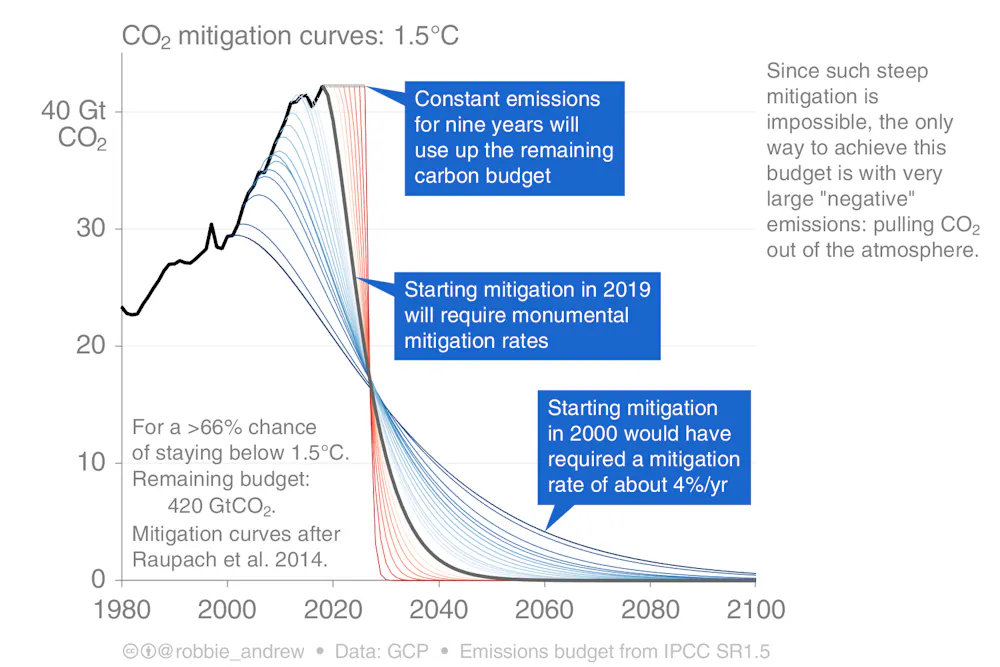


Graph demonstrating how fast mitigation has to happen to keep to 1.5℃. © Robbie Andrew,


Four years later, there were glimmers of hope that this would be possible. During the 1992 Earth Summit in Rio, all nations agreed to stabilise concentrations of greenhouse gases to ensure that they did not produce dangerous interference with the climate. The 1997 Kyoto Summit attempted to start to put that goal into practice. But as the years passed, the initial task of keeping us safe became increasingly harder given the continual increase in fossil fuel use.

It was around that time that the first computer models linking greenhouse gas emissions to impacts on different sectors of the economy were developed. These hybrid climate-economic models are known as Integrated Assessment Models. They allowed modellers to link economic activity to the climate by, for example, exploring how changes in investments and technology could lead to changes in greenhouse gas emissions.

They seemed like a miracle: you could try out policies on a computer screen before implementing them, saving humanity costly experimentation. They rapidly emerged to become key guidance for climate policy. A primacy they maintain to this day.

Unfortunately, they also removed the need for deep critical thinking. Such models represent society as a web of idealised, emotionless buyers and sellers and thus ignore complex social and political realities, or even the impacts of climate change itself. Their implicit promise is that market-based approaches will always work. This meant that discussions about policies were limited to those most convenient to politicians: incremental changes to legislation and taxes.

Around the time they were first developed, efforts were being made to secure US action on the climate by allowing it to count carbon sinks of the country’s forests. The US argued that if it managed its forests well, it would be able to store a large amount of carbon in trees and soil which should be subtracted from its obligations to limit the burning of coal, oil and gas. In the end, the US largely got its way. Ironically, the concessions were all in vain, since the US senate never ratified the agreement

Postulating a future with more trees could in effect offset the burning of coal, oil and gas now. As models could easily churn out numbers that saw atmospheric carbon dioxide go as low as one wanted, ever more sophisticated scenarios could be explored which reduced the perceived urgency to reduce fossil fuel use. By including carbon sinks in climate-economic models, a Pandora’s box had been opened.

It’s here we find the genesis of today’s net zero policies.


That said, most attention in the mid-1990s was focused on increasing energy efficiency and energy switching (such as the UK’s move from coal to gas) and the potential of nuclear energy to deliver large amounts of carbon-free electricity. The hope was that such innovations would quickly reverse increases in fossil fuel emissions.

But by around the turn of the new millennium it was clear that such hopes were unfounded. Given their core assumption of incremental change, it was becoming more and more difficult for economic-climate models to find viable pathways to avoid dangerous climate change. In response, the models began to include more and more examples of carbon capture and storage, a technology that could remove the carbon dioxide from coal-fired power stations and then store the captured carbon deep underground indefinitely.

This had been shown to be possible in principle: compressed carbon dioxide had been separated from fossil gas and then injected underground in a number of projects since the 1970s. These Enhanced Oil Recovery schemes were designed to force gases into oil wells in order to push oil towards drilling rigs and so allow more to be recovered – oil that would later be burnt, releasing even more carbon dioxide into the atmosphere.

Carbon capture and storage offered the twist that instead of using the carbon dioxide to extract more oil, the gas would instead be left underground and removed from the atmosphere. This promised breakthrough technology would allow climate friendly coal and so the continued use of this fossil fuel. But long before the world would witness any such schemes, the hypothetical process had been included in climate-economic models. In the end, the mere prospect of carbon capture and storage gave policy makers a way out of making the much needed cuts to greenhouse gas emissions.


The rise of net zero

When the international climate change community convened in Copenhagen in 2009 it was clear that carbon capture and storage was not going to be sufficient for two reasons.

First, it still did not exist. There were no carbon capture and storage facilities in operation on any coal fired power station and no prospect the technology was going to have any impact on rising emissions from increased coal use in the foreseeable future.

The biggest barrier to implementation was essentially cost. The motivation to burn vast amounts of coal is to generate relatively cheap electricity. Retrofitting carbon scrubbers on existing power stations, building the infrastructure to pipe captured carbon, and developing suitable geological storage sites required huge sums of money. Consequently the only application of carbon capture in actual operation then – and now – is to use the trapped gas in enhanced oil recovery schemes. Beyond a single demonstrator, there has never been any capture of carbon dioxide from a coal fired power station chimney with that captured carbon then being stored underground.

Just as important, by 2009 it was becoming increasingly clear that it would not be possible to make even the gradual reductions that policy makers demanded. That was the case even if carbon capture and storage was up and running. The amount of carbon dioxide that was being pumped into the air each year meant humanity was rapidly running out of time.

With hopes for a solution to the climate crisis fading again, another magic bullet was required. A technology was needed not only to slow down the increasing concentrations of carbon dioxide in the atmosphere, but actually reverse it. In response, the climate-economic modelling community – already able to include plant-based carbon sinks and geological carbon storage in their models – increasingly adopted the “solution” of combining the two.

So it was that Bioenergy Carbon Capture and Storage, or BECCS, rapidly emerged as the new saviour technology. By burning “replaceable” biomass such as wood, crops, and agricultural waste instead of coal in power stations, and then capturing the carbon dioxide from the power station chimney and storing it underground, BECCS could produce electricity at the same time as removing carbon dioxide from the atmosphere. That’s because as biomass such as trees grow, they suck in carbon dioxide from the atmosphere. By planting trees and other bioenergy crops and storing carbon dioxide released when they are burnt, more carbon could be removed from the atmosphere.

With this new solution in hand the international community regrouped from repeated failures to mount another attempt at reining in our dangerous interference with the climate. The scene was set for the crucial 2015 climate conference in Paris.


A Parisian false dawn

As its general secretary brought the 21st United Nations conference on climate change to an end, a great roar issued from the crowd. People leaped to their feet, strangers embraced, tears welled up in eyes bloodshot from lack of sleep.

The emotions on display on December 13, 2015 were not just for the cameras. After weeks of gruelling high-level negotiations in Paris a breakthrough had finally been achieved. Against all expectations, after decades of false starts and failures, the international community had finally agreed to do what it took to limit global warming to well below 2°C, preferably to 1.5°C, compared to pre-industrial levels.

The Paris Agreement was a stunning victory for those most at risk from climate change. Rich industrialised nations will be increasingly impacted as global temperatures rise. But it’s the low lying island states such as the Maldives and the Marshall Islands that are at imminent existential risk. As a later UN special report made clear, if the Paris Agreement was unable to limit global warming to 1.5°C, the number of lives lost to more intense storms, fires, heatwaves, famines and floods would significantly increase.

But dig a little deeper and you could find another emotion lurking within delegates on December 13. Doubt. We struggle to name any climate scientist who at that time thought the Paris Agreement was feasible. We have since been told by some scientists that the Paris Agreement was “of course important for climate justice but unworkable” and “a complete shock, no one thought limiting to 1.5°C was possible”. Rather than being able to limit warming to 1.5°C, a senior academic involved in the IPCC concluded we were heading beyond 3°C by the end of this century.

Instead of confront our doubts, we scientists decided to construct ever more elaborate fantasy worlds in which we would be safe. The price to pay for our cowardice: having to keep our mouths shut about the ever growing absurdity of the required planetary-scale carbon dioxide removal.


Taking centre stage was BECCS because at the time this was the only way climate-economic models could find scenarios that would be consistent with the Paris Agreement. Rather than stabilise, global emissions of carbon dioxide had increased some 60% since 1992.

Alas, BECCS, just like all the previous solutions, was too good to be true.

Across the scenarios produced by the Intergovernmental Panel on Climate Change (IPCC) with a 66% or better chance of limiting temperature increase to 1.5°C, BECCS would need to remove 12 billion tonnes of carbon dioxide each year. BECCS at this scale would require massive planting schemes for trees and bioenergy crops.

The Earth certainly needs more trees. Humanity has cut down some three trillion since we first started farming some 13,000 years ago. But rather than allow ecosystems to recover from human impacts and forests to regrow, BECCS generally refers to dedicated industrial-scale plantations regularly harvested for bioenergy rather than carbon stored away in forest trunks, roots and soils.

Currently, the two most efficient biofuels are sugarcane for bioethanol and palm oil for biodiesel – both grown in the tropics. Endless rows of such fast growing monoculture trees or other bioenergy crops harvested at frequent intervals devastate biodiversity.

It has been estimated that BECCS would demand between 0.4 and 1.2 billion hectares of land. That’s 25% to 80% of all the land currently under cultivation. How will that be achieved at the same time as feeding 8-10 billion people around the middle of the century or without destroying native vegetation and biodiversity?


Read more: Carbon capture on power stations burning woodchips is not the green gamechanger many think it is


Growing billions of trees would consume vast amounts of water – in some places where people are already thirsty. Increasing forest cover in higher latitudes can have an overall warming effect because replacing grassland or fields with forests means the land surface becomes darker. This darker land absorbs more energy from the Sun and so temperatures rise. Focusing on developing vast plantations in poorer tropical nations comes with real risks of people being driven off their lands.

And it is often forgotten that trees and the land in general already soak up and store away vast amounts of carbon through what is called the natural terrestrial carbon sink. Interfering with it could both disrupt the sink and lead to double accounting.


As these impacts are becoming better understood, the sense of optimism around BECCS has diminished.


Pipe dreams


Given the dawning realisation of how difficult Paris would be in the light of ever rising emissions and limited potential of BECCS, a new buzzword emerged in policy circles: the “overshoot scenario. Temperatures would be allowed to go beyond 1.5°C in the near term, but then be brought down with a range of carbon dioxide removal by the end of the century. This means that net zero actually means carbon negative. Within a few decades, we will need to transform our civilisation from one that currently pumps out 40 billion tons of carbon dioxide into the atmosphere each year, to one that produces a net removal of tens of billions.

Mass tree planting, for bioenergy or as an attempt at offsetting, had been the latest attempt to stall cuts in fossil fuel use. But the ever-increasing need for carbon removal was calling for more. This is why the idea of direct air capture, now being touted by some as the most promising technology out there, has taken hold. It is generally more benign to ecosystems because it requires significantly less land to operate than BECCS, including the land needed to power them using wind or solar panels.

Unfortunately, it is widely believed that direct air capture, because of its exorbitant costs and energy demand, if it ever becomes feasible to be deployed at scale, will not be able to compete with BECCS with its voracious appetite for prime agricultural land.

It should now be getting clear where the journey is heading. As the mirage of each magical technical solution disappears, another equally unworkable alternative pops up to take its place. The next is already on the horizon – and it’s even more ghastly. Once we realise net zero will not happen in time or even at all, geoengineering – the deliberate and large scale intervention in the Earth’s climate system – will probably be invoked as the solution to limit temperature increases.

One of the most researched geoengineering ideas is solar radiation management – the injection of millions of tons of sulphuric acid into the stratosphere that will reflect some of the Sun’s energy away from the Earth. It is a wild idea, but some academics and politicians are deadly serious, despite significant risks. The US National Academies of Sciences, for example, has recommended allocating up to US$200 million over the next five years to explore how geoengineering could be deployed and regulated. Funding and research in this area is sure to significantly increase.


Difficult truths

In principle there is nothing wrong or dangerous about carbon dioxide removal proposals. In fact developing ways of reducing concentrations of carbon dioxide can feel tremendously exciting. You are using science and engineering to save humanity from disaster. What you are doing is important. There is also the realisation that carbon removal will be needed to mop up some of the emissions from sectors such as aviation and cement production. So there will be some small role for a number of different carbon dioxide removal approaches.

The problems come when it is assumed that these can be deployed at vast scale. This effectively serves as a blank cheque for the continued burning of fossil fuels and the acceleration of habitat destruction.

Carbon reduction technologies and geoengineering should be seen as a sort of ejector seat that could propel humanity away from rapid and catastrophic environmental change. Just like an ejector seat in a jet aircraft, it should only be used as the very last resort. However, policymakers and businesses appear to be entirely serious about deploying highly speculative technologies as a way to land our civilisation at a sustainable destination. In fact, these are no more than fairy tales.

The only way to keep humanity safe is the immediate and sustained radical cuts to greenhouse gas emissions in a socially just way.

Academics typically see themselves as servants to society. Indeed, many are employed as civil servants. Those working at the climate science and policy interface desperately wrestle with an increasingly difficult problem. Similarly, those that champion net zero as a way of breaking through barriers holding back effective action on the climate also work with the very best of intentions.

The tragedy is that their collective efforts were never able to mount an effective challenge to a climate policy process that would only allow a narrow range of scenarios to be explored.

Most academics feel distinctly uncomfortable stepping over the invisible line that separates their day job from wider social and political concerns. There are genuine fears that being seen as advocates for or against particular issues could threaten their perceived independence. Scientists are one of the most trusted professions. Trust is very hard to build and easy to destroy.


But there is another invisible line, the one that separates maintaining academic integrity and self-censorship. As scientists, we are taught to be sceptical, to subject hypotheses to rigorous tests and interrogation. But when it comes to perhaps the greatest challenge humanity faces, we often show a dangerous lack of critical analysis.

In private, scientists express significant scepticism about the Paris Agreement, BECCS, offsetting, geoengineering and net zero. Apart from some notable exceptions, in public we quietly go about our work, apply for funding, publish papers and teach. The path to disastrous climate change is paved with feasibility studies and impact assessments.

Rather than acknowledge the seriousness of our situation, we instead continue to participate in the fantasy of net zero. What will we do when reality bites? What will we say to our friends and loved ones about our failure to speak out now?

The time has come to voice our fears and be honest with wider society. Current net zero policies will not keep warming to within 1.5°C because they were never intended to. They were and still are driven by a need to protect business as usual, not the climate. If we want to keep people safe then large and sustained cuts to carbon emissions need to happen now. That is the very simple acid test that must be applied to all climate policies. The time for wishful thinking is over.

Monday, February 17, 2020

have I mentioned... its too late for 2

The Paris Agreement set an unrealistic target for global warming. Now what? Shannon Osaka, grist. Feb 12, 2020.

It’s been a rallying cry for activists and a key talking point for diplomats. For decades now, 2 degrees Celsius (3.6 degrees Fahrenheit) of global warming has been viewed as a “do not cross” line in climate policy, a temperature at which cataclysmic and potentially permanent damage to the planet would take hold.

Countries that signed on to the 2015 Paris Agreement vowed to keep global warming “well below” 2 degrees Celsius of warming since the Industrial Revolution. National policies and international agreements are evaluated for how well they can help meet this target. There’s a general sense that if the world’s governments work fast enough and hard enough, we can still avoid the worst.

But what if that goal was not as realistic as many have assumed?

“In no way should 2 degrees — from a scientific perspective — be seen as a safe target,” said Peter Frumhoff, chief climate scientist at the Union of Concerned Scientists.

According to Frumhoff, 15 to 20 years ago climate scientists thought that 2 degrees of warming would avoid catastrophic climate change. “Our understanding of climate risks was that 2 degrees C would be a reasonably safe and achievable target.”

Over time, however, more updated research — most recently the special report by the UN’s Intergovernmental Panel on Climate Change — indicated that 1.5 degrees C is a safer, more scientifically robust, target. (Scary sidenote: We have already warmed by approximately 1 degree Celsius since pre-industrial times. Whoops.)

But even though activists and some governments have pushed for more stringent targets, 2 degrees has stuck. The Paris Agreement commits to “pursue efforts” to hold warming to 1.5 degrees, but 2 degrees has emerged as a kind of middle ground between countries feuding over climate change.

The problem is, neither goal is currently possible without the massive, massive deployment of technologies that don’t exist yet. Yes, we’ll have to improve renewable energy sources, like wind and solar, and build better batteries to store it all. But the possibility of reaching that 2-degree target by reducing emissions alone has shrunk to essentially zero.

At this point, it requires substantial investment into and development of so-called “negative emissions” technologies to suck carbon dioxide out of the atmosphere. Carbon dioxide emissions would need to reach net-zero by mid-century; which means we would need to start developing the technology, er, now.

We only have a limited amount of carbon left to burn, so little that even with extraordinarily steep reductions in energy use and a rapid scale-up of renewables, keeping warming to 2 degrees isn’t possible. Unless there were somehow a way to turn back the clock and undo some of what the largest emitters have done.

That’s where so-called negative emissions come in. In 2014, the UN Intergovernmental Panel on Climate Change released a new assessment on the state of the climate. This report included something surprising; scientists and modelers still thought 2 degrees was possible. But they had to introduce a new variable.

The 2014 report included something new — a “huge reliance on bioenergy with carbon capture and storage,” said David Victor, a professor of international relations at University of California San Diego.

Six years later, bioenergy with carbon capture and storage remains relatively untested (though there’s recent cause for optimism). It involves growing crops, burning them for fuel, capturing the subsequent emissions and storing them deep underground. As of last year, there are only five examples of the technology worldwide, none operating at a large scale. The most recent UN report says we would need a lot of it to hit the 2-degree target.

How much? Experts estimate it would take about 500 million hectares of land — an area 1.5 times the size of India.

“From a modeling point of view, the reason we see so much carbon capture and storage is because models see the existing energy system, and they see this incredible heroic goal,” Victor said. “So they move all the chips on the board into these deep reduction technologies: carbon capture and storage, bioenergy with carbon capture and storage … and they do all that because they can’t solve the equation. They literally can’t get there from here.”

Essentially, since reaching the 2-degree limit based on mitigation alone is impossible, modelers have to assume that we will somehow remove emissions from the atmosphere later.

Some experts have criticized the use of negative emissions in modeling. According to Oliver Geden, head of the German Institute for International and Security Affairs, negative emissions technologies have mostly been used to mask failures of international action — the modeling form of kicking the can down the road. Negative emissions, Geden argues that it allow us to imagine that 2 degrees is possible, even as it becomes increasingly out of reach.

Victor agrees. “We need to grapple with the reality that we’re not going to meet the goals that we’ve talked about,” he said. The 2 degrees goal is probably out of reach; the flip side is, the worst-case climate scenario is probably not in the cards, either.

This doesn’t mean negative emissions shouldn’t be part of the picture. But experts say it does mean that policymakers and negotiators should be more transparent that the goal they have been working toward requires the adoption of technology at a scale that simply doesn’t exist yet.

Wednesday, October 10, 2018

Topic: BECCS, Carbon Capture and Storage; DAC; CDR

Climate policy advice is being undermined by value-laden choices over risky mitigation strategies, warn Dominic Lenzi and colleagues.

Sucking carbon out of the air won’t solve climate change. David Roberts, vox. Jun. 14, 2018.


Bioenergy with Carbon Capture and Storage Approaches for Carbon Dioxide Removal and Reliable Sequestration. Proceedings of a Workshop—in Brief. National Academy. 2018.
Bioenergy with carbon capture and storage (BECCS) is a technology that integrates biomass conversion to heat, electricity, or liquid or gas fuels with carbon capture and sequestration. BECCS could provide a significant portion of the global energy supply if deployed to its theoretical maximum feasible amount. The future role of BECCS is a subject that divides researchers as estimates of potential future biomass supply vary widely due to differences in approaches used to consider factors such as population development, consumption patterns (e.g., diet), economic and technological development, climate change, and societal priorities concerning conservation versus production objectives. Nevertheless, many integrated assessment models use large-scale deployment of BECCS in scenarios that limit climate change to below 2°C. 
On October 23, 2017, the National Academies of Sciences, Engineering, and Medicine convened a third meeting in Irvine, California, to explore the state of knowledge and research needs related to the potential of BECCS as a CDR approach. Invited speakers gave an overview of biomass production pathways and capacities, implications of various feedstocks, advanced conversion technologies, and capture and storage strategies. Presenters at the workshop also discussed cross-cutting issues that include life cycle impacts of large-scale BECCS deployment, policies and incentives for the implementation of these approaches, and social acceptability barriers. The workshop was preceded by an introductory webinar on October 16, 2017, where invited speakers provided a primer on the prospects of BECCS for negative emissions capacity; the capacity for biomass to meet stationary generation and transportation fuel needs; and the status, challenges, and costs of implemented bioenergy and biofuels. This publication summarizes the presentations and discussions from both the webinar and workshop.


The Need for Carbon Removal. Holly Jean Buck, Jacobin. July 24, 2018.
Massive removal of carbon from the atmosphere — also known as negative emissions, carbon drawdown, or regeneration — could be a cornerstone of either dystopian or radically utopian futures. Some of the dystopian ones are well known: vast conversion of land to plantations for biofuels with carbon capture and storage, displacing people from the land, destroying habitats, and spiking food prices. 
But given what we know about climate change in 2018, it’s not enough to protest against dystopian versions of carbon removal. Too much warming is already locked in. We need a radically utopian way of removing carbon
If we buy into thinking of carbon removal technologies as substitutes for reducing carbon output, then industrial interests have already won: they have set the narrative and the framing, where carbon capture exists so that they can continue to emit. But we should demand more from these technologies. 
Industrial carbon capture technologies could instead be used as an extension of decarbonization — mitigation to get us to zero, and carbon removal going a step further to take emissions negative and address some of the climate impacts already being felt. 
It won’t be easy. But climate science suggests it’s a challenge the Left must take up. 
Carbon Removal 
Climate change has already warmed the planet over 1°C relative to pre-industrial levels. Paradoxically, cleaning up the air pollution that’s currently masking some of the global warming in the pipeline would raise temperatures another 0.5 to 1.1 degrees. 
This means that if we waved a magic wand and suddenly (1) stopped using fossil fuels, and (2) cleaned up air pollution, we would already be breaching 1.5°C — the amount of warming that most climate advocates have argued for. 
The carbon budget is not an exact science, but it seems we are hovering at the point where 1.5°C of warming is locked in by what has already been emitted. Put differently, the most recent scientific evidence suggests we have zero to five years before every additional ton of carbon dioxide emitted would need to be compensated by a ton of negative emissions to stay below 1.5°C. 
In fact, the scenarios used in the fifth Intergovernmental Panel on Climate Change (IPCC) report rely on massive amounts of negative emissions to curb warming to 1.5°C, primarily via a method known as bioenergy with carbon capture and storage (BECCS). This led a team of modelers to try and see what it would take to achieve 1.5° without BECCS. 
Even a scenario where renewables, electrification, and energy efficiency were aggressively pursued — and 80 percent of meat and eggs were replaced with cultivated meat, flying was reduced, and tumble dryers were eliminated — could not eliminate the need for carbon removal. This scenario still required about four hundred billion tons (Gt) of carbon dioxide removed via reforestation. Reforestation sounds great and green, but it also has the potential to result in dispossession, conflict over land access, and worsened livelihoods for smallholders. 
What about achieving a slightly less ambitious goal of 2°C? Two and 1.5 degrees might not sound all that different, but they are. The difference is one that threatens entire unique coral ecosystems, the homes of five million people (including entire countries), and high increases in the frequencies of extreme events. 
Rapid mitigation could still curb warming to 2°C without the use of negative emissions technologies. But that window is closing fast. If near-term emissions reductions follow the trajectory laid out in the commitments nations made under the Paris agreement, by 2030, 2°C scenarios will also depend upon negative emissions
That is, in the next decade, we would have to vastly exceed the Paris promises to not depend upon negative emissions. 
We aren’t even making much progress towards these Paris targets, which if achieved would still produce 3°C of warming — an amount widely agreed to lead to massive disruptions. This is why negative emissions have become such a useful device for the models. 
By the end of the century, scenarios for 1.5°C or 2°C envision pulling out ten billion tons (10Gt) per year. For comparison, current levels of emissions are around forty billion tons of CO2 per year. So 1.5°C means not just zeroing out those forty billion tons, but then working to extract another ten billion on top of that to be net-negative. This would require scaling up current carbon capture and sequestration efforts a thousand-fold. 
Negative emissions help maintain the narrative that although time is running short, we can still stop catastrophic global warming if we act now. Once we understand that this inventive arithmetic has been employed to “solve” for 1.5, what do we do? 
Assuming there will be a complete about-face that puts us on a course towards 100 percent renewables, massive lifestyle changes, and drastic land use change for afforesting millions of hectares in the tropics within the next ten years strikes me as not only magical thinking, but thinking that puts many at risk of great suffering. 
Alternately, accepting that the earth will warm more than 1.5°C means accepting the loss of the world’s coral reefs and the half billion people relying on them, as well as other harms to communities living on the front lines of climate change. 
So we need to ask: is there a form of massive carbon removal that could be put towards socially just ends, pulling carbon out of the atmosphere as a form of collective social good? Can it work as an outgrowth of energy democracy? For if such a collection of technologies, practices, and institutions can exist, we should try to build it. 
Notably, carbon removal at what I’ll call climate-significant scale should not be thought of as a magic wand to wipe carbon away either. For one thing, it will not compensate exactly for emissions. The ocean, for example, currently takes up close to half of the carbon humans emit, and it’s possible that if carbon was removed at a large scale from the atmosphere, the oceans would then give off carbon, perhaps replacing half of the carbon that had been removed. 
The prospect of carbon removal is fraught with complexity, and even peril — all of which we have to talk about. 
The Necessity of Geological Sequestration 
The best way to remove carbon immediately is through “natural climate solutions,” which employ nature’s processes to store carbon in ecosystems. Sequestering carbon in soil, restoring forests and planting new ones, and protecting wetlands can store carbon. These can forestall some amount of warming, in addition to other benefits for both humans and the environment. 
Yet while it seems intuitive to simply let nature take up the carbon, carbon was put into the atmosphere unnaturally, and the available scientific evidence suggests ecosystem-based solutions simply don’t scale well enough to contend with the sheer amount of carbon that has been dumped into the atmosphere
Pursued vigorously, reforestation and soil carbon sequestration could each remove a few gigatons per year — for a while. After a few decades, a forest planted to remove carbon reaches a plateau where it becomes saturated and can’t remove any additional carbon, like a bathtub filling up, at which point the already-absorbed carbon must simply be held indefinitely. 
Similarly, a farm that has transitioned to regenerative practices to store more carbon in the soil can only remove additional carbon for a few decades. Moreover, forests can be ravaged by epidemics or fires, resulting in the sudden release of their stored carbon, which means they are vulnerable to global warming itself. 
So while these projects can do important work in the near future, we also need to supplement these one-off, land-based carbon removal projects with systems that can continuously remove carbon and store it reliably over centuries — that is to say, with industrial carbon capture with geological sequestration. We need to build systems that capture carbon emissions from sources like power plants or factories, or even from ambient air, and transport it to underground reservoirs where it can be stored. 
There are major technical and social obstacles to this. But these industrial systems for geological storage, used together and sequentially with natural carbon removal, could help ease the path to a climate-stable world. 
Carbon capture and storage (CCS) technology is not a new technology....


Can we remove a trillion tons of carbon from the atmosphere?  Nick Breeze, Ecologist. May 3, 2018.
'Remove', 'sequester', 'lock-up'. Call it how you like, but to stabilise our climate and surpass the Paris Agreement, we really need to be thinking about storing hundreds of billions of tonnes of carbon. I don’t think anybody on Earth can visualise what numbers like these really look like. Yet, our future depends on us lowering the quantity of greenhouse gases in the atmosphere to safe levels before, so-called self-amplifying feedbacks take over - if they haven’t already. 
There is a clue emerging as to how we might accomplish such a feat - in the image of the Blue Marble NASA image of Earth. Namely that over 70 percent of the planet is ocean and the fate of life on Earth is intrinsically tied to that of the oceans. 
Currently - and it is no secret - the oceans are in a terminal decline, acidifying, heating, losing their biomass and, the worse bit, flipping from carbon sink to carbon source. Fish stocks are also depleted, as ocean ecosystems fall under the sad blanket of degradation. But what if, by a process of biomimicry, we could reverse these processes and restore the life in the oceans?


Guest post: Why BECCS might not produce ‘negative’ emissions after all. Dr. Anna Harper, Carbon Brief. Aug. 14, 2018.
Model scenarios that limit warming to 1.5C or 2C typically rely on large amounts of “negative emissions” to extract CO2 from the atmosphere and store it on land, underground or in the oceans. 
Bioenergy crops with carbon capture and storage (BECCS) is, perhaps, the most prominent of the various negative emissions techniques. There are many attractive features, since this technology would provide energy – thus reducing our need for fossil fuels – and remove CO2 from the atmosphere at the same time. 
However, the full carbon-cycle impacts of large-scale deployment of BECCS are not well studied. And, before now, no studies have looked at these impacts specifically for a scenario that could meet the 1.5C target. 
In our new study, published in Nature Communications, my colleagues and I find that expansion of bioenergy in order to meet the 1.5C limit could cause net losses in carbon from the land surface. Instead, we find that protecting and expanding forests could be more effective options for meeting the Paris Agreement.


Guest post: Six key policy challenges to achieving ‘negative emissions’ with BECCS. Dr. Clara Gough, Dr. Sarah Mander, Dr. Naomi Vaughan of Tyndall Centre for Climate Change Research, via Carbon Brief. Aug. 28, 2018.

scientific journal article here:
Challenges to the use of BECCS as a keystone technology in pursuit of 1.5⁰C. Dr. Gough et al, Journal of Global Sustainability. 2018.
Non-technical summaryBiomass energy with carbon capture and storage (BECCS) is represented in many integrated assessment models as a keystone technology in delivering the Paris Agreement on climate change. This paper explores six key challenges in relation to large scale BECCS deployment and considers ways to address these challenges. Research needs to consider how BECCS fits in the context of other mitigation approaches, how it can be accommodated within existing policy drivers and goals, identify where it fits within the wider socioeconomic landscape, and ensure that genuine net negative emissions can be delivered on a global scale.


Bioenergy carbon capture: climate snake oil or the 1.5-degree panacea? Paul Behrens, RenewEconomy. Oct. 23, 2018.


Carbon Capture’s Global Investment Would Have Been Better Spent On Wind & Solar. Michael Barnard, CleanTechnica. Apr. 21, 2019.
CCS is a rounding error in global warming mitigation. It’s hard to see how it could possibly be more. And it brings into stark relief the unfortunate reality that the IPCC depends far too much on carbon capture and sequestration approaches in terms of dealing with global warming.
Air Carbon Capture’s Scale Problem: 1.1 Astrodomes For A Ton Of CO2. Michael Barnard, CleanTechnica. Mar. 14, 2019.

Chevron’s Fig Leaf Part 1: Carbon Engineering Burns Natural Gas To Capture Carbon From The Air. Michael Barnard, CleanTechnica. Mar. 14, 2019.
The total CO2 load for the energy required for capture, processing, compression, storage, distribution and sequestration is almost certain to be greater than the CO2 removed from the atmosphere. 
This isn’t a one-article drive-by, but a five-piece assessment. 
  • The first piece summarizes the technology and the challenges, and does a bottoms-up assessment to give context for what Carbon Engineering is actually doing. 
  • The second piece steps through Carbon Engineering’s actual solution in detail. 
  • The third piece returns to the insurmountable problem of scale and deals with the sheer volume of air that must be moved and the scale of machinery they have designed for the purpose. 
  • The fourth article looks at the market for air carbon capture CO2 and assesses why three fossil fuel majors might be interested. 
  • The final article addresses the key person behind this technology and the expert opinions of third parties such as Dr. Mark Jacobson of Stanford.

No path to climate stability without carbon dioxide removal. Walter Reid, Thomson Reuters. Aug. 24, 2018.
As hard as it is to reduce greenhouse gas emissions, an even bigger challenge lies ahead: We now need to remove much of what we’ve already added to the atmosphere. 
The math of climate change is simple and stark. To keep warming below 1.5 degrees Celsius, we can only emit another 600 Gigatons of carbon dioxide into the atmosphere. [ed: and this assumes that our carbon budget has been accurately calculated, which has been based on risk assessments that assume a 50% probability of not meeting our goals, and have been predicated on climate models that leave out factors that are not well-understood, including many amplifying/positive feedback effects; and, as we know, climate scientists have consistently and persistently been surprised by climate impacts and effects being observed much sooner than they had predicted.]
At current rates, this will take 14 years. [ed: as noted above, our true carbon budget, if it had been calculated accurately, including the impact of amplifying feedbacks, and excluding the assumption of future CDR, and allowing for only a tiny possibility (say 1%) of failure, has already likely been exhausted.] As a result, almost all scientific analyses assume large amounts of carbon dioxide begin to be removed from the atmosphere in the next decade, and by the second half of the century we must remove much more than we emit.
How much carbon dioxide are we talking about? Think of all the greenhouse gas emissions that will be emitted from all the cars, power plants, factories, and deforestation over the next 20 years. By 2100, we will need to take about that same amount out of the atmosphere. 
Here is the rub: We don’t know how to do carbon dioxide removal at that scale.
The one proven low-cost technology that we can turn to is the tree. Reforestation is, hands down, the best and most cost-effective approach to carbon dioxide removal. In addition to benefiting the climate, it also slows soil erosion, and often can increase water supplies, restore biodiversity, and provide economic benefits. But we have many competing uses for land – especially as the world population continues its growth towards eight billion people and incomes rise. Even the most promising reforestation scenarios don’t meet the full need for carbon removal. 
There are other promising but costlier approaches in early stages of development. “Direct Air Capture” relies on large fans blowing air through huge devices to capture carbon dioxide. Other strategies include weatherization of rocks and changing agricultural practices to store carbon in soils, which can also improve agricultural productivity. 
For carbon dioxide removal to grow at the pace needed, serious action must be taken now to create demand and to drive down the cost of new technologies. 
Luckily, some progress is already being made. Efforts to promote reforestation, for example, began in 2011 with the “Bonn Challenge,” which led to commitments from 47 national and subnational governments to restore nearly 400 million acres of land. Earlier this summer Sweden declared that it will be carbon neutral (with any emissions offset by carbon dioxide removal) by 2045 and carbon negative after that. 
But much more is needed. Meeting the goals of the Paris Climate Agreement will require gigaton-scale carbon dioxide removal. 
Just as actions to reduce carbon dioxide emissions were first catalyzed when governments and companies announced commitments to reduce emissions to the atmosphere, it is now time for leaders to announce specific, time-bound commitments to remove carbon dioxide from the atmosphere. These goals could be ratcheted up as technologies develop and costs drop. Investments in reforestation or enhanced soil carbon storage could be used to deliver on the commitments, as could procurement policies that create incentives to use carbon dioxide derived from direct air capture. Governments could also mandate that companies emitting greenhouse gases purchase “credits” that would pay for carbon dioxide removal with a technology like direct air capture. 
Since most of these strategies need further development quickly, there is also a vital role for mission investors and philanthropists to promote appropriate policies and identify ways to bring new technology to scale. 
While challenge is daunting, the opportunities are just as real. Markets already exist for carbon dioxide removal in the case of reforestation, and the market for carbon dioxide removal will grow dramatically in the coming decades. 
Next month, leaders from around the world will gather for the Global Climate Action Summit in San Francisco. The opportunity is ripe for governments and businesses to seize the leadership mantle by being among the first to commit to removing carbon dioxide from the atmosphere. Reducing emissions alone will not secure a stable climate and avoid the worst impacts of climate change. Now is the time to recognize that carbon dioxide removal is a central strategy in the fight against climate change.

Wednesday, August 8, 2018

Roadmap for Rapid Decarbonization. Rockstrom et al

A roadmap for rapid decarbonization. Johan Rockström, Hans Joachim Schellnhuber et al. Science. Mar. 24, 2017. PDF available here.

Summary
Although the Paris Agreement's goals (1) are aligned with science (2) and can, in principle, be technically and economically achieved (3), alarming inconsistencies remain between science-based targets and national commitments. Despite progress during the 2016 Marrakech climate negotiations, long-term goals can be trumped by political short-termism. Following the Agreement, which became international law earlier than expected, several countries published mid-century decarbonization strategies, with more due soon. Model-based decarbonization assessments (4) and scenarios often struggle to capture transformative change and the dynamics associated with it: disruption, innovation, and nonlinear change in human behavior. For example, in just 2 years, China's coal use swung from 3.7% growth in 2013 to a decline of 3.7% in 2015 (5). To harness these dynamics and to calibrate for short-term realpolitik, we propose framing the decarbonization challenge in terms of a global decadal roadmap based on a simple heuristic—a “carbon law”—of halving gross anthropogenic carbon-dioxide (CO2) emissions every decade. Complemented by immediately instigated, scalable carbon removal and efforts to ramp down land-use CO2emissions, this can lead to net-zero emissions around mid-century, a path necessary to limit warming to well below 2°C.

The Paris goal translates into a finite planetary carbon budget: a 50% chance [ed: don't we want a 95 or 99% chance? what's our budget for that?] of limiting warming to 1.5°C by 2100 and a >66% probability of meeting the 2°C target imply that global CO2 emissions peak no later than 2020, and gross emissions decline from ∼40 gigatons (metric) of carbon dioxide (GtCO2)/year in 2020, to ∼24 by 2030, ∼14 by 2040, and ∼5 by 2050 (3) (see the figure, top). Risks could be further reduced by moderately increasing ambition to halve emissions every decade (see the figure, bottom right). Following such a global carbon law means at least limiting cumulative total CO2 emissions from 2017 until the end of the century to ∼700 GtCO2, which allows for a small but essential contingency (∼125 GtCO2 less compared with total CO2 emissions in the pathway in the figure, top) for risks of biosphere carbon feedbacks (6) or delay in ramping up CO2-removal technologies.

A carbon law applies to all sectors and countries at all scales and encourages bold action in the short term. It means, for example, doubling of zero-carbon shares in the energy system every 5 to 7 years, a rate consistent with the trajectory of the past decade (see the figure, bottom left). All sectors (e.g., agriculture, construction, finance, manufacturing, transport) need comparable transformation pathways. In addition, in the absence of viable alternatives, the world must aim at rapidly scaling up CO2 removal by technical means from zero to at least 0.5 GtCO2/year by 2030, 2.5 by 2040, and 5 by 2050. CO2 emissions from land-use must decrease along a nonlinear trajectory from 4 GtCO2/year in 2010, to 2 by 2030, 1 by 2040, and 0 by 2050 (see the figure, bottom right). The endgame is for cumulative CO2 emissions since 2017 to be brought back from around 700 GtCO2 to below 200 GtCO2 by the end of the century (see the figure, top) and atmospheric CO2 concentrations to return to 380 ppm by 2100 (currently at 400 ppm). [ed: we should be aiming for 280, as per Schellnhuber, i.e. the level before we started anthropogenic global warming... or at least 350]

Roadmaps are planning instruments, linking shorter-term targets to longer-term goals. They help align actors and organizations to instigate technological and institutional breakthroughs to meet a collective challenge. An explicit carbon roadmap for halving anthropogenic emissions every decade, co-designed by and for all industry sectors, could help promote disruptive, nonlinear technological advances toward a zero-emissions world. The key to such a carbon law will be a dual strategy that pushes renewables and other zero-emissions technologies up the creation and dissemination trajectory, while simultaneously pulling fossil-based value propositions from the market. Thus, the transformation unfolds at a pace governed by novel schemes rather than by inertia imposed by incumbent technologies (see the figure, bottom left).

We sketch out a broad decadal decarbonization narrative in four dimensions—innovation, institutions, infrastructures, and investment—to provide evidence of feasibility and depth of transformation for economies to stay on a carbon-law trajectory. The narrative provides no guarantees but identifies crucial steps, grounded in published scenarios combined with expert judgment. Each step has two parts: actions for rapid near-term emissions reductions, and actions for systemic and long-term impact, creating the basis for the next steps. Such a narrative, specifically designed with decadal targets and incentives, could provide key elements for national and international climate strategies.


2017–2020: No-Brainers

Annual emissions from fossil fuels must start falling by 2020. Well-proven (and ideally income-neutral) policy instruments such as carbon tax schemes, cap-and-trade systems, feed-in tariffs, and quota approaches should roll out at wide scale. Even these will be challenging in the emerging global political climate. The European Union emissions-trading scheme requires kick-starting through an appropriate floor price (>$50/metric ton CO2).


A global carbon law and roadmap to make Paris goals a reality


(Top) A deep decarbonization scenario scientifically consistent with the Paris Agreement (3) and its associated carbon fluxes as computed with a simple carbon cycle and climate model (13). The “carbon law” scenario of halving emissions every decade is marginally more ambitious than the scenario presented. Meeting the Paris Agreement goals will require bending the global curve of CO2 emissions by 2020 and reaching net-zero emissions by 2050. It furthermore depends on rising anthropogenic carbon sinks, from bioenergy carbon capture and storage (BECCS) engineering (yellow) and land use (orange), as well as sustained natural sinks, to stabilize global temperatures. This scenario is broadly consistent with a 75% probability of limiting warming to below 2°C; a median temperature increase of 1.5°C by 2100; estimated peak median temperature increase of 1.7°C; a 50% probability of limiting warming to below 1.5°C by 2100; and CO2 concentrations of 380 ppm in 2100. See supplementary materials (SM). (Bottom left) Nonlinear renewable energy expansion trajectories based on 2005–2015 global trends (13). Keeping the historical doubling times of around 5.5 years constant in the next three decades would yield full decarbonization (blue area) in the entire energy sector by ∼2040, with coal use ending around 2030–2035 and oil use, 2040–2045. Calculations, based on (5), are detailed in SM. (Bottom right) Decadal staircase following a global carbon law of halving emissions every decade, a complementary fall in land-use emissions, plus ramping up CO2 removal technologies.


GRAPHIC: N. CARY/SCIENCE


The United Nations Framework Convention on Climate Change (UNFCCC) should transform into a vanguard forum where nations, businesses, nongovernmental organizations, and scientific communities meet to refine the roadmap. It is evident that the current national commitments under the Paris Agreement must be strongly enhanced at the first ratcheting-up cycle in 2018 to 2020.

Fossil-fuel subsidies, currently $500 billion to $600 billion per annum, must be eliminated by 2020, not 2025 as agreed by the Group of Seven (G7) nations in 2016. An immediate moratorium on investment in new unabated coal-based energy would minimize future stranded assets. China's greenhouse gas (GHG) output must continue to decrease over the coming years, through aggressive funding of renewables, by abandoning coal expansion, and by closing mines. The richer coal-intensive countries must spearhead the coal exit, and countries like India and Indonesia must follow suit.

By 2020, all cities and major corporations in the industrialized world should have decarbonization strategies in place. The 49 countries already committed to be carbon neutral by 2050 should have expanded to >100 countries by that time, and implementation should be under way. The gravest risk is that emerging economies, such as South Africa, are driven down the conventional growth path by sheer inertia. International efforts must incentivize low-carbon development as a priority.

Food production contributes to >10% of global GHG emissions (4) and weakens natural carbon sinks yet has vast potential for biological carbon removal. Innovative financial mechanisms are needed to incentivize carbon management in the food system. Agro-industries, farms, and civil society should develop a worldwide strategy for sustainable food systems to drive healthier, low-meat diets (7) and reduce food waste (8). Health and sustainability co-benefits—such as obesity and disease abatement, pollution reduction, and ecosystems preservation—should spur action.


2020–2030: Herculean Efforts

Economies must implement the no-brainer mitigation measures plus the first wave of smart and disruptive action. Improving energy efficiency alone would reduce emissions 40 to 50% by around 2030 in many domestic and industrial cases (9).

In the 2020s, carbon pricing across the world must expand to cover all GHG emissions, starting at $50 per metric ton at least and exceeding $400 per ton by mid-century. By the end of that decade, coal will be about to exit the global energy mix, cities like Copenhagen and Hamburg will be fossil-fuel free, and cap-and-trade regimes should be firmly established across national and regional economic zones along with adequate carbon taxes on air transport and shipping. Countries should follow Norway, Germany, and the Netherlands and announce the phase-out of internal combustion engines in new cars by 2030 at the latest. Decarbonizing long-distance transport will be key, through renewable fuels, electrification, and replacing shorter-haul air traffic by rapid rail. These commitments will signal that the conventional model of reinvesting fossil-fuel revenues into exploration is obsolete.

Public and private investment in research and development (R&D) for climate solutions should increase by an order of magnitude between now and 2030. Substantial resources must be directed toward more efficient modes of industrial production; battery-life extension and improved energy storage solutions; schemes that greatly reduce the cost of carbon capture and storage (CCS) within 10 years; alternative aircraft propulsion systems; super-smart power grids; and sustainable urbanization everywhere.

We need urgent research to ascertain the resilience of remaining biosphere carbon sinks (10). Strong financial impetus must be provided for afforestation of degraded land and for establishment of no-regret approaches to net removal of CO2 from the atmosphere—such as the combination of second- and third-generation bioenergy with CCS (BECCS) or direct air CCS (DACCS). Trials of sustainable sequestration schemes of the order of 100 to 500 MtCO2/year should be well under way to resolve deployment issues relating to food security, biodiversity preservation, indigenous rights, and societal acceptance.


2030–2040: Many Breakthroughs

By 2040, oil will be about to exit the global energy mix. Several vanguard countries (such as Norway, Denmark, and Sweden) should have completed electrification of all sectors and be entirely emissions-free or close to it. Internal combustion engines for personal transport will have become rare on roads worldwide. Aircraft fuel should be entirely carbon neutral. Synthesized fuels, bio-methane, and hydrogen are established alternatives.

After 2030, all building construction must be carbon-neutral or carbon-negative. The construction industry must either use emissions-free concrete and steel or replace those materials with zero- or negative-emissions substances such as wood, stone, and carbon fiber.

BECCS schemes totalling 1 to 2 GtCO2/year would roll out, and R&D should focus on doubling the annual rate of CO2 removal. We can expect that polycentric power grids using supraconductive cables will start supplying energy in developing countries, and radical new energy generation solutions will enter the market.

Promising financial mechanisms to foster investments in necessary breakthroughs include sovereign wealth funds designed for transformation; effective international corporation tax regimes (11); and inheritance reforms that account for historical wealth generated by fossil fuels without compensation of externalities (12).


2040–2050: Revise, Reinforce

Building on successes and learning from failures of previous stages, certain mitigation strategies will be abandoned and others refined and amplified. All major European countries become close to net-zero carbon states early in the 2040s; market dynamics push North and South America and most of Asia and Africa to this goal by the end of the decade. Natural gas still provides some backup energy, but CCS ensures its carbon footprint is limited. Modular nuclear reactors may contribute to the energy mix in places.

By 2050, the world will have reached net-zero CO2 emissions, with a global economy powered by carbon-free energy and fed from carbon-sequestering sustainable agriculture. Meanwhile, BECCS schemes have been scaled up and draw down >5 GtCO2/year. Alternatively, concerns may rule out such scale-up. Only deep emission reductions during 2020–2030 can enable BECCS to be scaled back or abandoned, while efforts to increase energy efficiency and DACCS continue.


Stability and Resilience

We cannot predict where civilization will be mid-century, but a decadal staircase based on a carbon law, if adopted broadly, may provide essential economic boundary conditions to make a zero-emissions future an inevitability rather than wishful thinking. The very nature of disruptive progress requires revising the narrative of a detailed roadmap every 2 years, correcting near-term targets to reach the ultimate goal by evolutionary management.

Although signs are positive that the world is on track to rapidly transform to a net-zero–emissions global economy, contagion dynamics cut both ways. If political signals do not support a rapid transition, for example, by a failure to implement worldwide financial and regulatory reform that places a cost on carbon, then it is difficult to imagine keeping warming at “well below 2°C.” However, the scale of momentum toward clean energy in the past decade suggests that it would seem foolish to try to halt the trend, given the growing evidence that decarbonization can be a major pro-growth strategy.

In global governance, climate stabilization must be placed on par with economic development, human rights, democracy, and peace. The design and implementation of the carbon roadmap should therefore take center stage at the UN Security Council, as these quintessential objectives increasingly interact, influencing the stability and resilience of societies and the Earth system.

Saturday, March 31, 2018

Climate Fantasy

The Paris Climate Accords Are Looking More and More Like Fantasy. David Wallace-Wells, NY Mag. Mar. 25, 2018.

Remember Paris? It was not even two years ago that the celebrated climate accords were signed — defining two degrees of global warming as a must-meet target and rallying all the world’s nations to meet it — and the returns are already dispiritingly grim.

This week, the International Energy Agency announced that carbon emissions grew 1.7 percent in 2017, after an ambiguous couple of years optimists hoped represented a leveling off, or peak; instead, we’re climbing again. Even before the new spike, not a single major industrial nation was on track to fulfill the commitments it made in the Paris treaty. To keep the planet under two degrees of warming — a level that was, not all that long ago, defined as the threshold of climate catastrophe — all signatory nations have to match or better those commitments. There are 195 signatories, of which only the following are considered even “in range” of their Paris targets: Morocco, Gambia, Bhutan, Costa Rica, Ethiopia, India, and the Philippines. This puts Donald Trump’s commitment to withdraw from the treaty in a useful perspective; in fact, his spite may ultimately prove perversely productive, since the evacuation of American leadership on climate seems to have mobilized China, eager to claim the mantle and far more consequential to the future of the planet because of its size and relative poverty, to adopt a much more aggressive posture toward climate. Of course those renewed Chinese commitments are, at this point, just rhetorical, too.

But this winter has brought even worse news than the abject failure of Paris compliance, in the form of a raft of distressing papers about what beyond compliance is required to stay below two degrees. Were each of those 195 countries to suddenly shape up, dramatically cutting back on fossil fuels to bring emissions in line with targets, that would still be not nearly enough to hit even Paris’s quite scary target. We don’t just need to draw down fossil fuels to stay below two degrees; doing so also requires “negative emissions” — extracting carbon from the atmosphere, essentially buying back some amount of existing fossil-fuel pollution through a combination of technological and agricultural tools. As Chelsea Harvey, among others, has pointed out, in 2014, the U.N. Intergovernmental Panel on Climate Change — now somewhat outdated, but still more or less the gold-standard single source for big-picture perspective — presented more than 100 modeled scenarios that would keep global temperatures below two degrees of warming. Nearly all of them relied on negative emissions. These tools come in two forms: technologies that would suck carbon out of the air (called CCS, for carbon capture and storage) and new approaches to forestry and agriculture that would do the same, in a slightly more old-fashioned way (bioenergy carbon capture and storage, or BECCS).

According to these recent papers, both are something close to fantasy: at best, uneconomical and entirely untested at scale, and, at worst, wholly inadequate to the job being asked of them. A new report of the European Academies’ Science Advisory Council found that negative-emissions technologies have “limited realistic potential” to even slow the increase in concentration of greenhouse gasses in the atmosphere — let alone meaningfully reduce that concentration. A letter in Nature Climate Change described the forestry and agricultural technologies, as imagined, “difficult to reconcile with planetary boundaries” — that is, it would impose such devastating costs in terms of forest cover, biodiversity, agriculture, and fresh water that doing so “might undermine the stability and resilience of the earth system,” lead author Vera Heck writes.

To keep us on track for Paris, BECCS “would require plantations covering two to three times the size of India — a third of the planet’s arable land,” Jason Hickell has calculated — and more than double that which is presently used to produce all the world’s agriculture. “Not only would this make it impossible to feed the world’s population, it would also be an ecological disaster.” Staying within those boundaries, and sparing the planet from those self-inflicted disasters, would mean deploying BECCS at such a small scale it could only offset, at best, one percent of annual emissions. Which means, all told, that the pathway to two degrees is getting so slim you can hardly see it; at present, it depends on emissions commitments literally no nation is keeping and technologies no one has seen work, and which many scientists now believe cannot possibly work. This is not good.

How not good? Another new paper sketches in horrifying detail what this failure would mean, though its findings are smuggled in under cover of rhetorical optimism. In the new issue of Nature Climate Change, a team lead by Drew Shindell tried to quantify the suffering that would be avoided if the planet were kept below 1.5 degrees of warming, rather than two degrees — in other words, how much additional suffering would result from that additional half-degree of warming. Their answer: 150 million more people would die from air pollution alone in a two-degree-warmer world than in a 1.5-degree-warmer one.

Numbers that large can be hard to grasp, but 150 million is the equivalent of 25 Holocausts. It is five times the size of the death toll of the Great Leap Forward — the largest non-military death toll humanity has ever produced. It is three times the greatest death toll of any kind: World War II. The paper’s math is speculative, of course, and there will surely be those who take issue with its methodology. But it also looks at deaths solely from air pollution — not from heat waves, drought, agricultural failure, pandemic disease, hurricanes and extreme weather, climate conflict, and more. And the paper reaches that figure, 150 million, only for a world that is two degrees warmer, when everything we are seeing now tells us that two degrees, always an optimistic target, is becoming more and more of a long shot.

That is all to say, it is a virtual certainty that we will inflict, thanks to climate change, the equivalent of 25 Holocausts on the world. Or rather, thanks only to the air pollution associated with climate change. We are almost sure to break two degrees of warming, and those numbers do not reflect any of the other — quite considerable — effects of climate change. So 25 Holocausts is our absolute best-case outcome; the likely suffering will be considerably higher still. “We are locking in place a scale of suffering that has no precedent in our history,” David Roberts wrote on Twitter. “Imagine the horror we would feel if we valued human life like we claim to.”

This kind of indifference is, unfortunately, nothing new when it comes to climate. In 1997, the Kyoto Protocol extended the 1992 U.N. Framework Convention on Climate Change into a binding international treaty, committing all nations to reduce greenhouse gas emissions to “a level that would prevent dangerous anthropogenic interference with the climate system.” You don’t hear much about Kyoto anymore, despite its landmark status, because it was completely ineffective; the 20 years that followed the treaty produced more carbon emissions than the 20 years that preceded it, and brought us where we are today, in dire straits. In 2003, Ken Caldeira calculated that the world would need to add about a nuclear power plant’s worth of clean-energy capacity every day between 2000 and 2050 to avoid catastrophic climate change — 1,100 megawatts of clean power capacity every 24 hours. At the moment, 15 years on and in the midst of what we keep hearing described as a green-energy revolution, we are adding about 151 — barely 10 percent. Paris is very quickly starting to look like Kyoto.

Sunday, December 31, 2017

Climate Links: December 2017

Globe had its third warmest year to date and fifth warmest November on record. National Centers for Environmental Information, NOAA. Dec. 18, 2017.


The dirty secret of the world's plan to avert climate disaster. Abby Rabinowitz and Amanda Simson, Wired. Dec. 10, 2017.

The UN report envisions 116 scenarios in which global temperatures are prevented from rising more than 2°C. In 101 of them, that goal is accomplished by sucking massive amounts of carbon dioxide from the atmosphere—a concept called “negative emissions”—chiefly via BECCS. And in these scenarios to prevent planetary disaster, this would need to happen by midcentury, or even as soon as 2020. Like a pharmaceutical warning label, one footnote warned that such “methods may carry side effects and long-term consequences on a global scale.”

Indeed, following the scenarios’ assumptions, just growing the crops needed to fuel those BECCS plants would require a landmass one to two times the size of India, climate researchers Kevin Anderson and Glen Peters wrote. The energy BECCS was supposed to supply is on par with all of the coal-fired power plants in the world. In other words, the models were calling for an energy revolution—one that was somehow supposed to occur well within millennials’ lifetimes.

Today that vast future sector of the economy amounts to one working project in the world: a repurposed corn ethanol plant in Decatur, Illinois. Which raises a question: Has the world come to rely on an imaginary technology to save it?

...  
The plausibility of the Paris Climate Agreement’s goals rested on what was lurking in the UN report’s fine print: massive negative emissions achieved primarily through BECCS—an unproven concept to put it mildly. How did BECCS get into the models?
... 
In a scathing letter in 2015, [Kevin] Anderson accused scientists of using negative emissions to sanitize their research for policymakers, calling them a “deux ex machina.” Fellow critics argued that the integrated assessment models had become a political device to make the 2°C goal seem more plausible than it was.

Oliver Geden, who heads the EU division of the German Institute for International and Security Affairs, raised the alarm in the popular press. In a New York Times op-ed during the conference, he called negative emissions “magical thinking”—a concept, he says, meant to keep the “story” of 2°C, the longtime goal of international climate negotiations, alive.
... 
It can be explained in part by the fact that BECCS is a conceptual tool, not an actual technology that anyone in the engineering world ... is championing.
... 
“The most important of the IPCC’s projections is that we’re screwed unless we can figure out how to take CO2 out of the atmosphere, because we haven’t acted fast enough,” she [Emily McGlynn] says. “I think that’s the most important part of the story.”
Still, negative emissions are not mentioned in the Paris Climate Agreement or a part of formal international climate negotiations. As Peters and Geden recently pointed out, no country mentions BECCS in its official plan to cut emissions in line with Paris’s 2°C goal, and only a dozen mention carbon capture and storage. Politicians are decidedly not crafting elaborate BECCS plans, with supply chains spanning continents and carbon accounting spanning decades. So even if negative emissions of any kind turns out to be feasible technically and economically, it’s hard to see how we can achieve it on a global scale in a scant 13 or even three years, as some scenarios require.

Looking at BECCS and direct air capture as case studies, it’s particularly clear that there’s only so fast you can act, and that modelers, engineers, politicians, and the rest of us must face up to the necessity of negative emissions together.

The Meaty Side of Climate Change. Shefali Sharma, Project Syndicate. Dec. 19, 2017.

Last year, three of the world’s largest meat companies – JBS, Cargill, and Tyson Foods – emitted more greenhouse gases than France, and nearly as much as some big oil companies. And yet, while energy giants like Exxon and Shell have drawn fire for their role in fueling climate change, the corporate meat and dairy industries have largely avoided scrutiny. If we are to avert environmental disaster, this double standard must change.
... 
One consequence, among many, is that livestock production now accounts for nearly 15% of global greenhouse-gas emissions. That is a bigger share than the world’s entire transportation sector. Moreover, much of the growth in meat and dairy production in the coming decades is expected to come from the industrial model. If this growth conforms to the pace projected by the UN Food and Agriculture Organization, our ability to keep temperatures from rising to apocalyptic levels will be severely undermined.


In 2017, climate change vanished from a ridiculous number of government websites. Rebecca Leber and Megan Jula, Grist. Dec 29, 2017.


Top Ten Global Weather/Climate Events of 2017: A Year of Landfalls and Firestorms. Dr. Jeff Masters, Weather Underground. Dec. 29, 2017.


Climate Change 2017: What Happened and What It Means. Bruce Melton, Truthout. Dec. 30, 2017.