Showing posts with label Tom Murphy. Show all posts

Monday, October 7, 2024

Murphy, doing the math

Your Order, Please? Murphy, Do the Math. Oct. 8, 2024.


This may come as a surprise, but people are capable of holding unsupported notions…unexamined beliefs and expectations. A common default assumption—often quite reasonable—is that conditions will continue in a fashion that is recognizably similar to the way they have been during one’s lifetime. Suggestions to the contrary tend to be met with suspicion—or even hostility in the case that the suggested outcome is less than rosy.

What if we presented possible options for future human developments—let’s say human population as a solid example—and pretend it’s a menu from which we get to choose. What outcome would most people see as the desired goal? What would make them happy, or satisfied? Which population curve below do you think most would select?

I present the following options:


A: Indefinite exponential rise. This implies no biophysical limits, ultimately demanding expansion to space (as if possible).

B: Moderation into a linear rising state, allowing continued growth but not in crazy-pants fashion.

C: Logistic leveling: no drama: we found our place and aimed right for it with no corrections—like it was meant to be and we knew what we were doing all along.

D: Peak and modest decline to some medium and stable value, indicating a slight boo-boo (overshoot) in our trajectory.

E: Peak and substantial fall to a vastly smaller population before stabilizing. In this case, we had it dramatically wrong in a massive overshoot.

F: A post-peak crash to zero (i.e., extinction; could be due to ecological collapse, nuclear annihilation, sex robots, or classic evolutionary failure of our species).

Now picture yourself and a bunch of others sitting around a table at a restaurant holding this menu and trying to decide on the future. What are you having?


Process of Elimination?

Ha! I tricked you all! I would claim it’s not an open choice! It will be no surprise that I rule out option A. Exponentials fail, and juvenile space fantasies aren’t coming to the rescue. Even then, good luck maintaining an exponential against the cruel realities of expansive space! “I’m sorry sir, the kitchen informs me that this option is not available (and never has been).”

Option B also ignores biophysical limits, in that growth of any form is not a long-term realistic prospect, even if not disastrously exponential. Also unavailable from the kitchen.

I suspect many people in our society would pick option C. Looks tasty. This is the dream scenario: we figure out how to live on the planet and smoothly cruise into stability without any obvious sacrifice, then hold it there indefinitely as human civilization flourishes. Except: the scale of today’s activity on the planet far exceeds the community of life’s capacity to survive. Not only would the sixth mass extinction stay on track, but we have zero realistic all-things-considered plans for maintaining high-throughput modernity at the ten-billion person scale. From agriculture to energy to materials (upon which which energy conversion depends), we don’t know how this could possibly work for centuries or millennia. There’s no credible plan. Another note is that real populations seldom follow the no-drama logistic curve. Treat it as a fantasy, and try to ignore the appeal. You’re probably beginning to dislike this restaurant, for its lack of actual choice.

Option D is the first to acknowledge overshoot. I suspect the chef will get a smattering of orders from this category, just like the gluten-free, dairy-free “pizza” that’s on the menu for the rare bird who needs to go that way. This option admits defeat, of sorts. It acknowledges that we’ve gone too far already and need to dial things back in order to carry on. In spirit, I am on board. But if our current attack on the planet is at the level of rapidly initiating a sixth mass extinction, is a factor-of-two moderation nearly enough to tip the scales? “I’ll check with the kitchen—I’m uncertain whether this dish is available today.”

Option E is qualitatively similar to Option D, but quantitatively differs in that the ultimate steady-state level is vastly lower than the peak. This is not a small factor-of-two correction, but an order-of-magnitude or more. It’s the shoe leather option on the menu. Why would anyone ever pick this one? Well, if the other items are truly unavailable… This might be the only way to survive, by the dictates of evolution, ecology, and biophysics. The kitchen can probably oblige and rustle something up. Why is the chef now walking around bare-footed? Serving suggestion: goes down better with ketchup.

Option F is implicitly on the menu, folks. Dismayed by the lack of acceptable choices, we could refuse to order any of the unsavory options, insist on “living large,” and consequently end up starving ourselves in pointless protest.


Grade Analogy

I also like a grade parallel here. Students might desire an A or B, but can live with a C as a passing grade. D is effectively failure, and F is unambiguous failure. That leaves E: an obscure grade that is off our radar (outside Hogwarts). But we need to think out of the box here and accept that we are heading toward uncharted territory, for which we do not yet have set associations. If my choices are E or F, I might as well try this E-thing, which might turn out to exceed expectations.


Happiness?

This post was motivated by a discussion I had with a sharp friend about the path of humanity. I was making the point, unsurprisingly, that modernity is a temporary aberration that will not be ecologically supported for very long. He rejected the idea of any future path that had even a whiff of hunter-gatherer lifestyles, adding something to this effect:

Look: all you have to know to appreciate that human life was miserable in the distant past is that population was held down by external factors. Life was tough [nasty, brutish, short was the gist].

This is very illuminating. When I responded: “Ah, so the only mode of existence compatible with human happiness is unbounded, exponential growth?” it was immediately clear to him the pile he had just stepped in.

But this is the crux of the matter, and worthy of serious consideration. If the only way for humans to be happy (not miserable) is in a world without limits…well then we’ve come to the wrong shop, folks. If defiance of biophysical reality is necessary for us to be the transcendent, liberated former-animals we think ourselves to be, then I’ve got some bad news. Pinocchio will never be a real boy. Translation: our artificial construct of modernity will never have a permanent, integrated place within an ecological context.


Back to the Menu

Now let’s return to our menu. When presented in this way, I think logic circuits kick in so that most people—I hope—would recognize option A (indefinite exponential growth) as not being possible (otherwise it might seem the happiest choice). Once in this mindset, option B might also be apparent as untenable, and that’s certainly progress. If I am correct to suspect that option C would be most popular, aren’t we back to the “miserable” state of imposed limits?

I think the difference is that to most people, the target steady-state population is our choice—not nature’s choice—in which we have two kids on average, medically-enabled longevity, technological goodies, and opera. This is the “arrived” notion: under our control. What seems to be objectionable is when ecological realities are dictating the terms. Two things: first, ecological realities probably remove option C as being unsupportable to begin with; second, even option C is ultimately limited by biophysical reality, in that births are still constrained (restricted, independent of happiness/desire) and deaths still motor on. Population trajectories are all about biophysical realities of birth and death, so that any steady solution goes hand-in-hand with limits on the biophysical front. To maintain steady state, increasing longevity would have to be accompanied by a reduction in births. We can’t just do whatever we want.

I’ll make one other point with regard to my friend’s “misery” statement. It implies that every other species on the planet—constrained as they are by external factors beyond their control—must lead miserable lives, and that happiness rests on control. What a depressing mindset to hold about our glorious planet of life! I reject the notion that squirrels are miserable, or that early humans were miserable—and frightened—much of the time (see next week’s post). I take that attitude to be projection of our own unfamiliarity and fear over the prospect of losing the infantilizing influence of modernity. I have enough respect for early humans to believe that they faced challenges with grit and equanimity, while finding it within themselves to laugh, joke, tease, sing, and dance.


Overall Lesson

The point of this exercise is that not every drawing we could slap on paper is biophysically, ecologically supportable. In fact, the vast majority are not. It is probably approximately true that the area under the curve—above a certain threshold of sustainable population—is limited, as excess/overshoot leads to accumulating ecological damage, and an initially-healthy Earth can only take so much. This precludes, for instance, the pleasant notion of an arbitrarily gradual decline toward sustainable levels. Gotta keep the area below the breaking point. We can’t just do anything we wish. Does that lack of control commit us to misery? Careful: this is a tantrum-free zone.

Even in a deterministic mindset, where the ultimate answer is inevitable, the result is utterly unpredictable to us. Options E and F, for instance, both seem to be on the table, and I would rather that our species survives beyond the modernity episode than execute its extinction as a result of clinging to the colossal mistake of modernity for too long.

That means, if option F is to be avoided, steps must be taken to set us on the path of option E. Efforts in that direction come with no guarantees, but failure to make the attempt is far less likely to end up there.

Monday, March 4, 2024

Assorted Musings on Collapse

******* The #1 Reason I Became A Doomer. Alan Urban, Collapse Musings. Jan. 16, 2024.
We're not doomed because of climate change, resource depletion, or biodiversity loss. We're doomed because human nature made those things inevitable.

There are many reasons I became a doomer.

Climate change is accelerating and governments aren’t taking it seriously. The sixth mass extinction event is well underway and most people don’t care. Fossil fuels and other crucial resources are running out and most people don’t even know. Pollution in the form of microplastics and forever chemicals are rapidly accumulating in our bodies, lowering sperm counts and causing all sorts of health problems.

And all that is because of overshoot. We’ve already exceeded the carrying capacity of the planet, so it’s only a matter of time before the global population comes crashing down. But overshoot isn’t the main reason I became a doomer. In fact, I became a doomer about a year before I knew what overshoot means.

The main reason I became a doomer is because I realized that the challenge we’re facing is so monumentally large and complicated that humans are incapable of overcoming it. 

This idea upsets some people. They say things like, “What about World War II? Look at how the U.S. mobilized the entire nation to help defeat the Axis powers.”

Yea, after they were attacked and only because they had a clear enemy. This time, we can’t simply declare fossil fuels the enemy and stop using them overnight. Doing that would cause civilization to collapse, anyway.

Besides, fossil fuels aren’t the only problem. As I’ve explained before, we would still be headed for collapse even if there were no climate change or pollution because we’re completely dependent on finite resources (forests, aquifers, fossil fuels, rare-earth minerals, etc.) that will mostly be gone in a matter of decades.

Even after learning all this, people still say things like, “What about the Montreal Protocol? Look at how the entire world came together, created an agreement to protect the ozone layer, and followed through.”

Yea, but there’s a big difference between phasing out CFCs and giving up a source of energy that provides 80% of the world’s power, not to mention plastic, fertilizer, and thousands of other products. Even if we could quit fossil fuels, we would just tear up the world’s remaining ecosystems in search of rare-earth metals and other resources.

Despite the enormity of the polycrisis, people still say things like, “We’ll find a way. Look at everything humans have accomplished over the last two centuries: automobiles, airplanes, telephones, computers, and modern medicine.”

Yea, but only because of fossil fuels. Humans have been about as intelligent as we are today for at least 100,000 years, but we only just now managed to invent all these things. Have you ever wondered why?

It’s because starting about 250 years ago, we harnessed a source of energy that, at the time, was practically limitless. We used this energy to build the modern world, but now we have to somehow maintain the modern world while transitioning away from this source of energy. So-called renewables and battery technologies can’t replace everything fossil fuels do for us, and even if they could, we’re already out of time.

To be clear, I’m not saying humans aren’t intelligent enough to deal with the polycrisis. I believe that if everyone on the planet became collapse-aware and committed to saving the human race and as much of the natural world as possible, we could actually pull it off. The population would still decline due to overshoot, but we could turn the decline into a glide instead of a crash.

The problem isn’t a lack of intelligence. Rather, the problem is both psychological and sociological. Humans are incapable of overcoming the polycrisis because they tend to ignore or deny facts that make them uncomfortable. ...........................

Once you realize that humans have a tendency to deny death, the world starts to make a lot more sense. It explains why so many people believe there’s an afterlife despite a total lack of evidence. It also explains why people deny climate change is real despite the fact that there are decades of evidence and countless studies by thousands of climate scientists from all around the world.

In order to acknowledge that climate change (or peak oil, the sixth mass extinction, etc.) is real, you also have to acknowledge that your lifestyle is contributing to the destruction of the planet and the early death of millions (if not billions) of people. It means that everything the human race has achieved over the last two centuries was all for naught—that all we’ve done is destroy our home and ourselves.

This is a hard pill to swallow for people who believe humans are special. If you believe God created humans and put us here for some divine purpose, it’s hard to accept that we’ve behaved no better than bacteria consuming a piece of fruit. It feels much better to deny the science and continue living like you always have.

So we continue on without changing our ways. ..............

Even those who acknowledge that climate change is real tend to deny the reality of the situation. Recently, I read an article in The Guardian called I thought most of us were going to die from the climate crisis. I was wrong. It’s a case study that perfectly exemplifies the human penchant for denial. ...........

Another reason she’s optimistic is because “low-carbon technologies are becoming cost-competitive.” True, but has she ever thought about how we get the materials for those “low-carbon technologies”?

We use diesel to mine and transport the metals. We use coal or natural gas to produce the cement. We use oil to create the plastic. Until all of these things are made without fossil fuels, these new technologies aren’t exactly “low-carbon.”

To get off of fossil fuels, every fossil fuel power plant and internal combustion engine in the entire world has to be replaced by windmills, solar panels, electric vehicles, and more batteries than you can imagine so we can have power when it’s not windy or sunny.

It would take an unbelievable amount of fossil fuels to achieve this. Meanwhile, we’re already committed to 2°C of warming, after which we’ll start triggering irreversible tipping points. As I said before, we’re already out of time. ..........

Later, she offers another reason for hope when she says, “the world has already passed the peak of per capita emissions. It happened a decade ago. Most people are unaware of this.”

That’s great, but global emissions are still rising. It doesn’t matter if per capita emissions are going down if overall emissions are still going up. But Ritchie is “optimistic we can peak global emissions in the 2020s.”

She could be right about that, but just because our emissions stop rising doesn’t mean the concentration of CO2 in the atmosphere stops rising, too. As our emissions go down, the amount of CO2 in the atmosphere will keep going up, only at a slower rate.

She goes on to explain how thanks to improvements in technology and energy efficiency, her carbon footprint is less than half that of her grandparents’ at her age. Maybe so, but there are also three times as many people in the world today, so we’re still burning more fossil fuels than ever before. ........

Even if everyone in the world lowered their carbon footprint to zero and we stopped emissions overnight, the CO2 that’s already in the atmosphere would keep warming the planet until the Earth reaches a new energy balance.

According to James Hansen, one of the most highly-respected climate scientists in the world, the amount of CO2 already in the atmosphere would lead to 10°C of warming over the next few centuries, and as much as 6 or 7°C in one century. And that doesn’t include future emissions. 

There’s something else that would happen if we stopped emissions overnight: Global temperatures would spike. Few people know this, but a small percentage of sunlight is blocked by pollution (especially aerosols) from fossil fuels. Thanks to this pollution, the planet is about .. cooler than it otherwise would be. .........

I don’t mean to attack Hannah Ritchie. I’m sure she’s a great person, and I think she truly believes what she’s saying, but that’s the problem. She was so terrified of climate breakdown that she convinced herself there’s still hope. She simply couldn’t handle the horrifying reality that billions of people are going to die an early death, so she found a way to deny it.

And now she’s telling people that we can maintain modern civilization and stop climate change. That we can have our cake and eat it too. By doing this, she’s only making things worse. Books and articles like hers make it easier for people to deny reality and continue their carbon-based lifestyles without feeling guilty or afraid.

If climate change had a simple fix—like the Montreal Protocol—we would have done it already. But there is no fix for climate change. At best, we could slow it down, but that would require most people to drastically lower their standard of living—something like a permanent Great Depression. And since that is unthinkable, people deny the truth and tell themselves everything will be okay. 

That’s why I became a doomer. I realized that people are unwilling to make the changes necessary to avoid collapse, so they deny reality and cling to false hope. For decades, scientists have been warning us that we have to act as soon as possible, yet all we’ve done is the bare minimum. I don’t see any signs of that changing.

Humans simply didn’t evolve to handle a situation like this, and now there is research confirming it. According to a study by the University of Maine, certain features of human evolution could be stopping us from solving environmental problems. Researchers looked at how sustainable human systems emerged in the past, and they found two patterns:

Sustainable systems emerge only after groups have failed to maintain their resources. But today, if we don’t learn our lesson until after we’ve exhausted our resources, it will be too late. We won’t have the option to relocate to a new area because climate change and resource depletion are happening everywhere.

Systems of environmental protection tend to address problems within societies, not between societies. To slow down climate change, we would need worldwide regulatory, economic, and social systems. Without that, individual countries and regions will focus on their own problems and could even go to war with their neighbors for resources.

As the lead author, Tim Waring, said, "This means global challenges like climate change are much harder to solve than previously considered…It's not just that they are the hardest thing our species has ever done. They absolutely are. The bigger problem is that central features in human evolution are likely working against our ability to solve them.”


Inexhaustible Flows? Tom Murphy, Do The Math. Feb. 20, 2024.

I recently came across a statement to the effect that once we transition away from fossil fuels to renewable energy like solar, wind, and hydro, we would essentially be home free for the long run—tapping into inexhaustible flows. It is a very pleasant notion, to be sure, and one that I believe is relatively common among enthusiasts for renewable energy.

Naturally, I am concerned by the question of: what magnificent things would we do with everlasting copious energy? As an excellent guide, we can ask what amazing things have we done with the recent bolus of energy from fossil fuels? Well, in the course of pursuing material affluence, we have eliminated 85% of primeval forest, made new deserts, created numerous oceanic dead zones, drained swamps, lost whole ecosystems, almost squashed the remaining wild land mammals, and initiated a sixth mass extinction with extinction rates perhaps thousands of times higher than their background levels—all without the help of CO2 and climate change (which indeed adds to the list of ills). These trends are still accelerating. Yay for humans, who can now (temporarily) live in greater comfort and numbers than at any time in history!

But the direction I want to take in this post is on the narrower (and ultimately less important) technical side. All the renewable energy technologies rely on non-renewable materials. Therefore, inexhaustible flows are beside the point. It’s like saying that fossil fuel energy is not practically limited by available oxygen for combustion, so we can enjoy fossil fuels indefinitely. Or that D–T fusion has billions of years of deuterium available, when there’s no naturally-occurring tritium (thus reliant on limited lithium supply). In a multi-part system, the limiting factor is, well, the limiting factor. Sure, into the far future the sun will shine, the wind will blow, and rain will fall. But capturing those flows to make electricity will require physical stuff: all the more material for such diffuse flows. If that stuff is not itself of renewable origin, then oops. The best guarantee of renewability is being part of natural regeneration (i.e., of biological origin). If solar panels, wires, inverters, and batteries were made of wood and the like: alright, then. ..........


Telling the Truth About Our Future. Art Berman. Feb. 27, 2024.

............................... How many EROI analysts can even explain what I just wrote or know how to find that information? Yet they proclaim with troubling certitude that there is an emerging consensus that fossil fuels have a lower EROI than renewables.

Delannoy and his co-authors do not mean to be misleading. They think they are telling the truth and that’s the problem. True believers are willing to go to any length to convince us of their truth. They believe it so strongly that they cannot be objective.

The sad truth is that a renewable energy transition is imaginary. ................

Society is in a terrible predicament. Papers like Delannoy’s give false hope that there is a renewable pathway that can save us from climate change. But climate change is just the tip of the iceberg.

Over-consumption of all energy is destroying earth’s ecosystem—the true basis of wealth that forms the foundation for human prosperity. This includes the destruction of forests, the genocide of the animal kingdom, the pollution of land, rivers and seas, the acidification of the oceans, and loss of fisheries and coral reefs.

Focusing on climate change alone is a narrow view. Carbon dioxide is just one of the pollutants contaminating the environment. The growth of the human enterprise enabled by excess energy use threatens everything. Substituting renewable for fossil energy will make that problem even worse.

We are well beyond a soft landing for the planet. There are no moderate pathways forward. Pretending that there are is counter-productive. A radical reduction in all energy consumption is the only solution.

The problem is that it’s not the solution that we like but it’s time to start telling the truth about our future.


***** #271: “Peak almost everything”, part one. Tim Morgan, Surplus Energy Economics. Feb 26, 2024.

WORSENING STRESSES IN AN INFLECTING ECONOMY

As almost everyone must have noticed by now, economic and broader affairs are in a strange state of uneasy limbo. The economy certainly hasn’t ‘collapsed’, as some pundits have long been predicting, but neither is it growing, in any meaningful sense.

Conditions are characterised by worsening hardship and widening inequality, and this, compounded by suspicion and mistrust, is making itself felt in increasingly fractious domestic politics. A disturbing feedback loop ties internal political discontent into the stresses of dysfunctional international relations.

There’s a growing feeling that ‘things aren’t working’, and that the continuing affluence of a minority is in striking contrast with the deteriorating economic circumstances (and worsening insecurity) of the majority.

One can almost sense a collective holding of breath as we wait to see ‘what happens next’.

I cannot escape a conviction that very few people really understand that what we’re experiencing now isn’t some kind of temporary economic stasis, but the cusp of a fundamental change for which societies are not prepared.

Accordingly, the aim here is to use the SEEDS model to make sense of this unquiet calm, and to provide some insights into what actually does ‘happen next’.

In summary, hardship and stress at the level of the micro – that is, of the household and the individual – are about to extend into disorder at the level of the macro. We’re heading very rapidly into “peak almost everything”.

The qualifying “almost” is necessary, and we need to know how we can best navigate the turbulence that is now about to commence. We need to work out which activities – which sources of income, employment, revenue, profit and value – are likely to buck the generalised trend of disorderly decline.

The two-stage inflexion

Stated at its simplest, growth in material economic prosperity has long been decelerating towards a point at which the economy as a whole inflects from expansion into contraction. .........

Our best recourse is to objective analysis of economic and financial fundamentals.

Properly defined, the economy is a system for the supply of material products and services to society.

Thus seen, the economy is an energy system, not a financial one. Nothing that has any economic value at all can be provided without the use of energy. Money has no intrinsic worth, but commands value only as an “exercisable claim” on the output of the material economy. We know that the large and complex economy of today has been built on an abundance of low-cost energy sourced from oil, natural gas and coal.

The factor which does most to determine economic prosperity is the material cost of energy supply. If delivering 100 units of energy requires using the equivalent of 99 units in order to make it available, the game is scarcely worth the candle.

If, on the other hand, 100 energy units can be delivered at a cost of only 1 energy unit, this activity is immensely productive of economic value.

Energy is never ‘free’, but comes at a cost measurable in terms of the proportion of accessed energy needed to create and sustain the infrastructure required for energy supply. This cost is known here as the Energy Cost of Energy, abbreviated ECoE.

Globally, trend ECoEs reached their low point in the quarter-century after the Second World War, explaining the super-rapid economic growth enjoyed in that period.

Since then, ECoEs have trended upwards because of the depletion of fossil fuel resources. Oil, gas and coal remain abundant, but have been getting progressively costlier to access. Renewables, with their lesser energy densities, cannot take us back to a halcyon age of ultra-cheap energy.

Being unable – or unwilling – to face the implications of rising ECoEs, we’ve long been playing a game of “let’s pretend” with the economy. Because GDP is a measure of financial transactions – and not of material economic value – we can create a simulacrum of “growth” by pouring ever-increasing amounts of liquidity into the system.

Nobody needed credit deregulation, QE or sub-zero real interest rates in the 1945-70 period, because low ECoEs were driving the economy along, ‘very nicely, thank you’, without recourse to financial manipulation. Only as the economy has decelerated have we adopted various forms of monetary gimmickry in order to pretend that the illogical promise of ‘infinite economic growth on a finite planet’ remains a valid expectation.

Using the concepts of two economies, energy-determined prosperity and money as claim, SEEDS models the trajectories of financial and material economic trends. As can be seen in Fig. 2, ECoEs have been rising relentlessly, and surplus (ex-cost) energy supply has been decelerating towards contraction. Per capita surplus energy has inflected into decline, and prosperity per capita has taken on a downwards trajectory.

Accompanying this, financial stresses have been worsening. Debt has massively outgrown reported GDP as credit expansion has been deployed to create purely cosmetic “growth” (Fig. 3A). It required annual borrowing of more than 11% of GDP to sustain illusory “growth” at a supposed average of 3.5% (3B) over the past twenty years. Broader liabilities have exploded (3C), and the state of disequilibrium between the financial system and the underlying material economy has become extreme (3D).

When we apply the extent of disequilibrium stress pictured in Fig. 3D to the quantum of exposure shown in Fig. 3C, the end result – a massive and disorderly financial correction – becomes a foregone conclusion.

With the exception of the stress measure illustrated in 3D, we don’t need access to the SEEDS system to work out that this ‘bigger-than-the-GFC correction’ cannot long be delayed, and will happen at the moment when the delusory promise of perpetual economic growth loses the last shreds of its credibility. .................

All of these processes are going to change the balance of forces in civil society, such that politics becomes ever more unpredictable.

A point that cannot be emphasised too strongly is that economic deterioration, with all of its attendant stresses, is moving from the predicted to the experienced.

Some discretionary sectors are already contracting. Politics is already becoming dysfunctional. The hardship being presented officially as a temporary problem is, in reality, a foretaste of the shape of things to come – or, perhaps more aptly, the shape of things to go.


What is Latent Heat of Fusion? Erik Michaels, Problems, Predicaments and Technology. Feb. 28, 2024.

Imagine my surprise last week when I read Tom Murphy's article after publishing my own and discovering that there was a common theme to both. Tom often writes about the unsustainability of our behaviors and civilization, but to describe common beliefs of many of the cornucopian-type thinking that so many people have today struck me as funny being it was so coincidental. Isn't it ironic that biological life has figured out how to tap into inexhaustible flows of energy and this is essentially sustainable but technology use (and our dependence upon it) doesn't even come close? A similar article from The Honest Sorcerer also tells the same story.

Perhaps what I often find incomprehensible is how people come to these stances of hopium regarding emerging qualities of collapse and thinking that we are embarking on some sort of beautiful, sustainable journey to the future. Of course, it becomes rather obvious over time that most of these people simply haven't widened their perspective to include all aspects of ecological overshoot and collapse - their perspectives are limited to their own specialty within their own field of study and the silo they seem to be stuck in acts as an echo chamber. ....................... 

Last week, I posted some information about what is commonly called "forever chemicals" to point out the existential issue of pollution loading. This was initially pointed out more than 50 years ago in the Limits to Growth study as shown in this video which I have posted before several times. My purpose last week was to demonstrate how symptom predicaments of overshoot are combining and interacting as threat multipliers not only to civilization, but to our very existence as a species. As usual, a new study came out that proves that this issue is worse than originally thought due to symptom predicaments of climate change spreading these toxins further afield due to extreme weather events and wildlife contaminated with the toxins moving around and further contaminating water and soil. Almost every week, regardless of what topic I write about, I find new information a week or two later proving how the situation is even worse than what I originally wrote about, just like in this particular issue. .............

Two paragraphs up, I posted an article about the AMOC (Atlantic Meridional Overturning Circulation) which delineates some scary thoughts. What I didn't point out there is what I again want to bring to the forefront (I've brought this topic up before (a long time ago), but these things have a tendency to be forgotten). The beginning of this article reviews some of the same information from last week and expands on that theme; but along the same lines of thinking, I want to bring up something most people are not aware of or have forgotten. This is the latent heat of fusion, the topic of today's picture at the top. I was introduced to this by the fact that 80 calories of heat will melt one gram of ice (at 0 degrees Celsius) so that it becomes water (phase change) and then that same amount of heat applied to the water will raise the temperature of that water to 80 degrees Celsius. Think about how the biosphere is losing its cryosphere and what that means for the world's air conditioning system. These exponential changes are now baked into the system through both oceanic thermal inertia and the lag effect. Climate change, the symptom predicament of overshoot, is irreversible on human timescales. 

I needed to get through all the above material to get to this point that today is the absolute best day of the rest of your life.

I don't want to sound grim or bring inconvenient truths to the forefront, but denying the existence of this knowledge makes no sense. Essentially, this is what most people want you to do - deny the existence and implication of these facts. While it is true (and I have repeatedly said this time and again) that we don't know precisely what will happen and when it will happen, certain events are inevitable and it is only a question of when, not if. Collapse of industrial civilization is built in, as it is self-terminating. Once this occurs, the loss of a large portion of the aerosol masking effect (global dimming) will also be lost and global warming will once again suddenly increase, similar to what has taken place over the last several years due to the loss of aerosols produced from the marine shipping industry. Despite reducing particulate matter in the atmosphere, the IMO 2020 rules have had mixed results as this article points out. Once again, something labeled as a "solution" has unexpected results. My point is not to simply ridicule ideas that many people think of as solutions or proper responses; one still needs to respond in an appropriate fashion and certain ideas (like degrowth) are the only appropriate responses available. However, just because these ideas have been brought around to the forefront of society does NOT mean that they will solve the predicament of overshoot or prevent civilization from crashing. Taken together with the inevitable outcomes of climate change and energy and resource decline (both symptom predicaments of overshoot) multiplying each other's effects, these hard facts point out that conditions will never be better than they are right now. 

This is why it is so important to embrace and be grateful for what we have right now and to Live Now!

Monday, December 19, 2022

Murphy's Simple Story

The Simple Story of Civilization. Tom Murphy. Dec. 19, 2022
(go to tom's site via the link above in order to access all the links from his work)


The stories we fashion about ourselves are heavily influenced by our short life spans during an age of unprecedented complexity. We humans, it would seem, are unfathomably complicated creatures who defy simple “just-so” characterizations. Animals, or humans tens of thousands of years ago are fair game for simple stories, but not so for transcendent modern humans.

Two major problems I have with this attitude are that 1) we are animals, and 2) we have exactly the same hardware (albeit with slightly smaller brains) as we had 100,000 years ago.

So allow me to pull back from our present age of baffling complexity to outline a simple story covering the broad sweep of the human saga. The result may be a little startling, and, for a number of readers, sure to be rejected by cultural antibodies as “not applicable” (see also my views of our civilization as a cult).


Story Timeline

In order to make comprehensible the vast tract of human time on this planet—itself 5,000 times shorter than the age of the universe—I will compare the 2.5–3 million year presence of humans (genus Homo) on Earth to a 75 year human lifespan: a span that we can grasp intuitively. On this scale, we get the following analogous periods:
  1. First 70 years: various species of humans evolve and coexist (sustainably) on the planet;
  2. Last 5 years: the age of Homo Sapiens (about 200,000 yr; mostly sustainably);
  3. Last 15 weeks: the age of civilization (agriculture; then cities) (10,000 yr);
  4. Last 4 days: the age of science (400 yr);
  5. Last 36 hours: the age of fossil fuels (150 yr of increasingly significant use);
  6. Last 12 hours: the age of rapid global ecological devastation (50 yr).

On this lifetime scale, agriculture is a recent, unexpected hobby we picked up, and one that is still pretty new to us in the scheme of things. Or maybe we can compare it to a gateway drug that radically changed our behavior, values, attitudes, and expectations (gave us the munchies?). Or maybe it’s like the rapid onset of a mental disorder. In any case, our friends and relatives would be pretty alarmed by this uncharacteristic change toward the end of a long life.


In the last four days, we took our hobby to a whole new level. Agriculture is about control of at least part of nature. Science put that control on steroids. Maybe it’s like cocaine following the gateway drug. It gave us a mechanism by which to learn from controlled experiments and then exercise (imperfect, problematic) control over an expanding set of domains. It “amped” things up.

In the last day or so, we found an even more potent enabler. Let’s see…I’ve already used steroids for the previous step, so what would steroids on steroids be? Fossil fuels equipped us with superpowers to carry out our scientifically-guided ambitions to previously-unimaginable new levels. I seem to recall from the “scare” films in my youth that drugs like PCP can make us think we have superpowers so we’re prone to jump out of a window, convinced we can fly. Similarly, the superpowers granted by this short-lived finite resource have tricked us into thinking that these powers are an intrinsic human quality: owing to our big brains, not the substance. Beguiled by this false flattery, we tell ourselves that nothing can stop our boundless juggernaut of innovation!


In this altered state, we find ourselves on a destructive rampage, as evidenced by the severe toll on habitats and biodiversity: about 85% of primary forest is gone; vertebrate populations have declined by about 70% on average since 1970; and now 96% of mammal mass on the planet is embodied in humans and our livestock. The dots are not difficult to connect. The combination of methods and substances available to us have allowed explosive exploitation of resources on a global scale. A paltry and decreasing amount of habitat—increasingly fragmented—remains. The healthy, biodiverse regions are disappearing fast.

So, reflect on how you would react to a 75-year-old relative who went on a euphoric bender as extreme and damaging as the one in this story. It’s as if this otherwise stable and (mostly) harmless person spiraled into manic behavior so quickly as to leave us stunned. It’s as jarring as a crash; like slamming into a brick wall. We might even suspect an alien baby gestating in our relative’s stomach cavity, so outlandish is their behavior. For the safety of your relative and all those around them, you’d probably want them sedated and strapped to a bed in a hospital for observation. Ironically, our recent “hobby” obsession with control has left us spiraling out of control.

The backdrop, or fabric of your entire existence—the few hours for which you’ve been alive on our scale—seems entirely normal to you, but the whole point of this post is that it’s really just not.


No Facile Solution

This condition seems unlikely to be solved by technology. Wouldn’t we say that technology is a primary ingredient of the illness? Cleverness and an illusion of control got us here, and they are not our best tools for extracting ourselves from the mess.

I have written other pieces about the foundational flaws in our growth trajectory on a finite planet; about the idiotically narrow construct of money (Box 19.1 in textbook), and how decisions based on money will be bad ones (if it makes economic sense, it almost certainly batters the ecosystem). I have posted about the cognitive distortion produced by fossil fuels, and the tragic fallacy of building an enormous human population on the back of a finite resource that threatens a devastating population crash when its availability inevitably declines. The real, ultimate value is in biodiversity and ecosystem health, which suggests de-emphasizing the primacy of humans and becoming subordinate partners on the planet rather than its self-appointed and ultimately inept overlords presiding over the demise of our transitory empire.

But stepping back and using our temporal framework as a mental guide, we are justified in asking whether our path of civilization is wrong at its very roots. That might seem extreme, but we are indeed at an extreme nexus in the history of our planet. I didn’t start out thinking this way (as the long evolution of this blog series attests). I mean, I knew our growth path could not last, and that fossil fuel substitution would be harder than many appreciated, but I never entertained the idea that civilization itself was a bad idea. It is not eagerly that I tread these waters.

The surprisingly recent gateway experiment of agriculture led—in a causally-connected way—to surplus, storage, permanent settlements, accumulation of material possessions, hierarchy, standing armies, property rights (the laughable conceit that we own the land!), patriarchy and monotheism, subjugation of humans and animals, soil degradation, habitat destruction, extinction rates far above normal, and all the rest. A bad trip—all for the sake of controlled food production and storage, the lack of which did not prevent humans from living sustainably for millions of years. Likewise, wild animals in healthy ecosystems don’t appear to live in constant misery: they’ve got it figured out in a way that works and is stable. We don’t look at a bird chirping and flitting through the trees and react in horror at the pitiful state it must find itself in, lacking the means to control its environment. Why should we look at pre-agricultural humans and imagine horrific misery, as many are inclined to do?

Since our civilization is not built on a foundation of sustainable principles, it is no surprise that we find it now to be utterly unsustainable. Unsustainable means certain failure, by the way. Thus, our civilization was custom-built for failure. Congratulations. The unfolding story just transpires over enough life spans that it all seems gradual to us as individuals, and therefore does not feel pressing or inevitable based on our narrow direct experience. In hindsight, I suspect it will be forehead-slapping obvious—to the point of making us look rather dull-witted.

I like flight analogies here. A rock is not designed on the aerodynamic principles of sustainable (indefinite, level) flight. A rock can nonetheless become airborne, follow a graceful and exhilarating arc through the air, but then certainly plummet back to Earth. Likewise, our civilization—also not founded on principles of sustainability—can soar upward for a time (during our inheritance spending spree) and seem like great fun—giving its paying passengers tremendous satisfaction for a time. Patiently waiting for us is Earth and planetary limits.

An important aside is that this condition is not intrinsic to the human animal. Most of our life on this planet has not been characterized by a smash-and-grab rampage. That’s our new trick for the last 15 weeks, recently perfected and at fever pitch. Dazzling! We can learn other tricks—take up new hobbies that don’t wreck our lives and those of our loved ones (i.e., other species): slow, thoughtful hobbies rather than this frenetic one.


Can’t We Just…?

You might be thinking: well okay, maybe we’ve overhsot a bit and need to dial things back…but surely (Shirley?) we can hold on to something we would recognize as civilization—I mean, come-on! Well, truthfully, I don’t know if it’s possible to preserve civilization—and neither does anyone else! To state the obvious: wanting civilization to continue is not enough without biophysical backing. I suspect that for most people who assume a continuation and even expansion into space, their examination is paper thin—not based on a careful consideration of biophysical limits, but more a matter of uncritical and fantastical extrapolation based on an admittedly head-spinning recent binge…I mean history.

My reasonable doubt is semi-quantitative. We have consumed a sizable fraction of our non-renewable inheritance (mineral concentrations, fossil fuels, etc.) on the time scale of a century. Even at a tenth the current scale (itself a terrifying prospect to many), we might slow the draw-down to give us another 1,000 years or so—another few weeks in our life span analogy. Aggressive recycling and more resources than I credit might stretch things for 10,000 years (translating to a few months). Keep in mind, this is already in the context of a substantially and deliberately dialed-down human footprint, lacking any precedent. Note that 10,000 years is still very short in the scheme of things and signals that we may well be nearer the end of civilization than the beginning. The doctor is saying: we have—at best—a few weeks or months to live unless we make a radical change in our lifestyle and practices. At this rate, it’s more likely mere days. If we heed the advice and make a major course correction, be prepared for the detox experience to be unpleasant, but necessary.

I’m not interested in fantastical or magical thinking. The suggestion—against mounting evidence to the contrary—that we could (or should) maintain the architecture for this ecologically devastating mode of living for any significant duration strikes me as simply wishful and also heartbreaking. I’d like to get beyond that and be hard-nosed about what can really happen, subject to planetary limits: most importantly, preserving habitat and biodiversity.


But Big Brains?

A common reaction is: can’t we use our big brains to solve this problem? Extending civilization for even another 1,000 years will surely give us time to think of something, our faith tells us. What if that “something” is the realization that civilization is inherently unsustainable and must be replaced with alternate, simpler (but richly meaningful) approaches to life on Earth? Maybe we can use our brains to save ourselves some time, agony, and further devastation by reaching this conclusion sooner.

Implicit in the leading question above is usually the notion of a technological solution. My viewpoint has become that technology is not the right tool to solve a predicament caused by a technological approach. But yes, we can (and should) use our big brains. It’s just that the task at hand is to figure out how to adopt a whole new way of living on this planet and how to dismantle civilization in a way that is least destructive to biodiversity and to humans. We need to relinquish our hubristic (and illusory) grip on control and our naive ambition of total mastery. We fall into the trap of thinking: “if we just learn a little more, we’ll finally have it.” But it’s never enough, and never can be. We have barely scratched the surface of understanding the machinery of Earth’s ecosystems, and it’s a fool’s quest to imagine we can achieve the requisite omniscience to maintain a successful reign—especially as the biophysical clock ticks more and more urgently.

What we need to learn instead is how to live with the long-term constraints of the natural world as it is presented to us—not take it upon ourselves to shape it to our unrealistic wants and whims, which is a proposition certain to fail. It’s about responding and adapting in an attitude of humility, not solving, mastering, exerting, defining, and dictating. Our brains are nowhere near big enough to pull off complete wizardry over nature, but maybe they are big enough to make this leap of intentional humility. We’ve been there before. I hope we still have what it takes.


Priorities for Success

It is in this context that the push to transition to renewable energy is misguided, in my view. The implicit aim is to preserve civilization in essentially its current glorious state by keeping it fueled to carry on in the least disruptive way. Disruptive to what? Economic concerns? Civilization is proving to be frighteningly disruptive to the natural world. In prioritizing a preservation of civilization, we are elevating this ephemeral, artificial construct above biodiversity and a healthy ecosystem: a prescription for certain failure. It’s doubling down on the wrong thing: propping up and accelerating the machine that’s eating the planet alive. Barreling forward on renewable energy is the last thing Earth’s critters would vote for, and would be considered one of the more disruptive decisions we could make.

Granted, any sustainable future must by definition utilize renewable energy in the broadest sense, as humans did until very recently. The current practice is the anomaly. I can’t rule out the notion that photovoltaic panels might play a role in the far future. But dependence on mined materials makes this gizmo less likely to fit into a truly long-term scheme. My inclination is to not sweat projections at that level. If we get the foundation right, the rest will follow as it may.

Any path to success must start on a sound ecological foundation, whatever the field of concern: economics, politics, belief systems, human rights, science, engineering, and the rest. Is that the first chapter/lecture in any of these fields? Of course not, but it ought to be. Otherwise we are teaching a blind path to failure. Think of it this way: what would you trade (technology, comforts, materials, even relationships) for all the (non-human) animals/life on Earth? Probably nothing, upon realizing that we ourselves can’t live without a functioning (healthy) ecosystem, and that we are just one of ten million species. Okay. Then we need to act like it. Make biodiversity and ecological health the highest priority and work within the resulting constraints. All decisions should start with the question: “would this action help or harm the (larger, and ultimately more important) non-human world?”


Post-Script: Recent Influences


As my posting history reveals, I have been on a journey of expanded thinking about the nature of our predicament, moving beyond the initial phase of quantitative assessment of energy (during which I was still in the mindset of a tech-driven solution space), into deeper questions of what we’re all about and why we do the things we do. In the summer of 2022, after several recommendations over the years, I finally sat down to read Ishmael, a novel by Daniel Quinn. I was simultaneously impressed by how familiar the logic already was to me and by the degree to which it sharpened my ability to separate successful approaches from (ultimately) unsuccessful ones. I followed this up by the two other installments in the series (The Story of B and My Ishmael) and Quinn’s non-fiction framing work, Beyond Civilization. I have valued them all, and view them as helping to crystalize the path I was already walking down. I wouldn’t call myself a faithful adherent—accepting all arguments/premises—but a largely-resonant admirer of the worth of these important works. Check your library and give it a try!

More recently, I read An Inconvenient Apocalypse by Wes Jackson and Robert Jensen. This work also deeply resonated as a careful, deliberate, sober, thoughtful, and insightful approach to how we deal with the predicament of civilization. It’s not a go-to resource for making the case that we’re in deep trouble, although it plucks some of those chords. Mostly, it reflects on our reactions and choices in this moment, and offers valuable food for thought for those who already sense that this deal is going sideways. My small-town library had a copy, to my surprise and delight.

Other voices are starting to broadcast what I think is an accurate message. I already posted last year praising David Attenborough’s powerful conclusion. In the last few weeks, articles in The Intercept (amazing!) and New York Times made the case for biodiversity and ecosystem health above secondary concerns like climate change and the usual technological “solutions” proffered in response. Although, I have to complain that the NYT article contained one of those paragraphs almost always accompanying warnings about an animal’s endangerment: what potential benefits those animals have to humans, including the ever-present dangling of a possible key to some medical cure. It drives me crazy that we are so transactional as to require direct benefit to us to justify another animal’s existence.

To echo a provocative sentiment others have used to great effect: What good is a Honduran white bat, you ask? Well, what good are you? How have humans, or you personally, (on balance, or in net terms) helped the planet’s wild species or overall ecosystem health? Are you more valuable, or less valuable to sustaining biodiversity than the bat, the newt, or even the mosquito? Yeah, that hard truth stings me, too.

Monday, December 20, 2021

Tom Murphy, Not Brainwashed

My Brainwashing. Tom Murphy, Do The Math. Dec. 20, 2021.


People rarely recognize or admit that they have been brainwashed. Perhaps the term brainwashed is too extreme, in which case manipulated or fooled may be substituted.

An insightful quote from Mark Twain says:

It is easier to fool people than it is to convince them that they have been fooled.

What often happens, in fact, is that people on opposite sides of an issue suspect (or are convinced) that the other side has been brainwashed. Sometimes one side is more justified in the charge than the other, in which case the brainwashed victims effectively assert a sort of projected symmetry that rings false.

Bi-directional allegations of brainwashing show up in the context of COVID: masks provide a clear means of identifying either those (masked individuals) who have been fooled into controlled submission to believe that the pandemic is real and deadly vs. those (unmasked fighters for freedom) who have been sadly misled to think it’s all a hoax and in so doing endanger us all. Each side may feel anger or pity toward the other. Climate change is similar: its denial has become an article of faith for the brainwashed non-believers, who accuse the gullible believers of being brainwashed by self-serving scientists vying for funding, power, or something (cake, maybe?).

To either side, it seems inconceivable that someone could deny the truths that are so obvious to them. For me, an uptick in total deaths closely matching reports of COVID deaths is pretty convincing, and it is hard for me to make out why anyone in power would want to wreck the economy and could somehow convince countries around the world to overlook a competitive advantage and follow suit. It boggles the mind. Likewise, I can see how climate change threatens powerful interests like the fossil fuel industry and even perhaps capitalism writ large—via the imposition of unwelcome limits on what we can do. But I have a much harder time understanding the bizarre allegations of scientists rolling in dough by hopping on the climate change bandwagon. That’s not how it works, people.

In this post, I will provide an example of how I evaluate the question of whether I have been brainwashed in the case of climate change, contrasting the way my knowledge is “received” to that of the opposition.


Precipitating Event

This post was motivated by someone in the financial world noticing my textbook, thinking well of it, and writing a piece that began with an extended quote from Appendix D.6:
So here’s the thing. The first species smart enough to exploit fossil fuels will do so with reckless abandon. Evolution did not skip steps and create a wise being—despite the fact that the sapiens in our species name means wise (self-assigned flattery). A wise being would recognize early on the damage inherent in profligate use of fossil fuels and would have refrained from unfettered exploitation. Not only is climate change a problem, but building an entire civilization dependent on a finite energy resource and also enabling a widespread degradation of natural ecosystems seems like an amateur blunder.
The piece got picked up and published at Zero Hedge, where I made the mistake of scanning the comments. I was appalled, and depressed at the sampling of humanity that we hope will act rationally to avoid the worst fate. It gave me an instant appreciation for the high quality, thoughtful comments posted to Do the Math. Granted, I don’t agree with all commenters, and do reject the occasional vacuous or vitriolic entry. But the Zero Hedge comments were dominated by empty posturing. A common refrain followed the formula:
I stopped reading as soon as I saw climate change.
and
Who pays these people to keep writing this BS about climate change?
The former showed up so often that I took it as a learned reaction to signal one’s virtue as a denier: an expression and re-validation of tribal identity. The latter made me laugh, on the basis that my book is offered for free, and actually required me to pay for some permissions, ISBN numbers, etc. I also am abandoning a well-funded research career in astrophysics to do this more important work on planetary limits. In academia, by the way, how much grant funding I receive does not determine my salary, so the often-assumed personal gain incentive is not as direct as is imagined. In any case, I am walking away from any known or likely prospect of research funding. So there! I’ll bet that in the eyes of those who think I am grievously wrong, this choice just makes me the saddest sack: duped into believing a big lie and doing the exact opposite of profiting from it. Stupid, squared!

Ironically, climate change was not even the main point of the quoted message, as it seldom is for me. Yet it’s a third rail that made some readers’ eyes bug out, hair stand on end, ears vent steam, and brains shut out the possibility of absorbing anything else in the article.


My Programming on Climate Change

So let me unpack how I became brainwashed to believe that climate change is anthropogenic, and is responsible for rising global temperatures.

Climate change for me is not as much a matter of belief as it is personal investigation and scientific understanding. Like many or most scientists, I see myself as a skeptic, not a follower. Presumably my out-of-the-mainstream message that our entire system and set of values are pointing us toward self-inflicted ruin, or the fact that my primary astrophysics endeavor was to test whether General Relativity is really correct (it seems to be so far), should give credence to this assertion. As a social animal, it can be hard to adopt an isolating, minority view within a department focused on very different matters.

Is climate change a belief for me? I suppose everything in my head could be described at some (pointless?) philosophical level as a belief. I believe the earth is round. True, I have personally measured its radius myself in various validating ways. I believe that air is made of molecules, themselves composed of atoms, even though I have never seen an atom in my direct experience. I believe that light is carried by photons (okay, I have seen/measured individual photons in my lab, and sent them on round-trip journeys to the moon). Any time I have had an opportunity to check some “known” piece of physics/chemistry for myself, I have come out satisfied that the textbooks are not lying to me. I haven’t checked everything: I’m just one person. But myriad other scientists are just like me, and have checked the things I haven’t—over and over, around the world, for decades and even centuries. Believe me, if a scientist has an opportunity to effect the rewriting of standard textbook material, they’ll jump on it—such is the glory of changing a paradigm. Nobel prizes tend to go to those who have made such a revolutionary impact on knowledge and understanding. I think what I’m saying is that scientists—almost by definition—are better described as explorers than as sheep.

But let’s get to climate change, and why for me it’s not entirely “received wisdom” but checks out through my own independent explorations.

First, I am convinced that methane (natural gas) molecules are formed by one carbon and four hydrogen atoms. I cannot claim direct evidence, but understand the process by which such things are determined—having performed similar experiments in chemistry labs to elucidate ratios of atoms in compounds (it also makes sense in terms of shared electrons and number of bonds). Likewise, I trust that oil is composed of hydrocarbon chains: a backbone of carbon atoms and two hydrogen atoms for each carbon, plus one more at each end. If you’re not on board with me at this point, I can’t decide whether to admire your hairshirt-level scientific empiricism or to shake my head at a lost cause.

The next step is easy: once understanding the composition of fossil fuels, it is almost literally childs’ play to introduce diatomic oxygen molecules from air and then rearrange the “balls-on-sticks” models of the molecules into new arrangements that leave CO2 and H2O—carbon dioxide and water. Together with the masses of the constituents (I understand several angles of verifying this, from both chemistry and nuclear physics), it is straightforward to understand that the resulting carbon dioxide mass is roughly three times the mass of the hydrocarbon input—much of the mass coming from the oxygen molecules.

Many years back, I independently checked my understanding—as scientists are prone to do—of the observed CO2 build-up in the atmosphere by estimating how much I would expect it to rise per year based on reported knowledge of global annual fossil fuel consumption, and also the total post-industrial CO2 rise to date based on cumulative fossil fuel use (later conveyed in a Do the Math blog post). The result was actually twice as high as the observed rise, upon which I learned (or “discovered” for myself) that half of the emitted CO2 is absorbed by the ocean/ground. But even leaving this wrinkle aside, it was very powerful to realize that anthropogenic CO2 emission has no problem accounting for enough CO2 to explain the observed rise: we need not look elsewhere for the source.

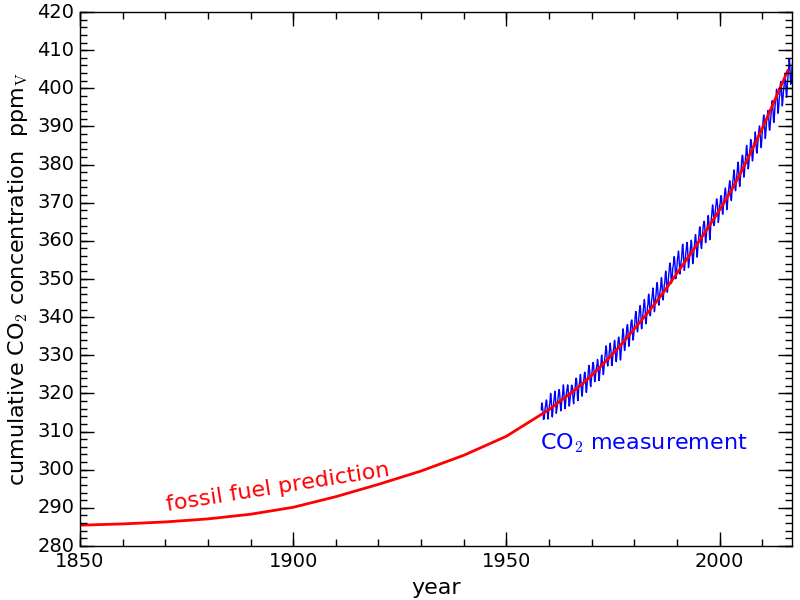
I took this to a new level in preparing my textbook, deciding to produce a “prediction” graph of CO2 emission over time using as inputs only historical fossil fuel records and knowledge of the chemistry. I overlaid the prediction on the measured CO2 from Mauna Kea (the Keeling curve) to just see how well they agreed. The result, reproduced below, made my jaw drop. I mean, I knew it would be decent, having crudely verified annual increase and cumulative increase before. But seeing the entire shape line up gave me a mic-drop moment. I didn’t do anything to force it to be so good!


Predicted CO2 rise from fossil fuel use (red) atop measured CO2 (blue).

No one gave me this plot. I didn’t find it somewhere. I don’t recall ever having seen one like it. I was curious, and went exploring to see what I would find. I wrote the Python program from scratch that read and parsed the historical fossil fuel data file, performed the chemistry calculations, and generated the graph (see text for details). I feel like I own this result in a way that I never would if somebody just showed it to me. I know what went into it, and why I can trust it.

The final step is an understanding of heat transfer and radiative transport in the atmosphere—both of which I have enough personal context to comfortably assess and understand (believe?). Radiative heat transfer is dear to my heart, and I have made loads of personal measurements/confirmations of how this process works. I have thoroughly explored my world using a thermal-infrared camera, performing supporting calculations; dealt with cryogenics in which radiative heat transfer is an enemy that must be well understood/quantified; validated planetary surface temperatures based on this phenomenon; and obtained countless spectra of stars and galaxies that emit radiative power. No talking head can undo all that personal experience. Also, like all astronomers, my observations have been constrained by atmospheric transmission windows, and I know what happens when I try or hope to get infrared light through the atmosphere at absorbed wavelengths. Those absorption features are real and limit the wavelengths I could observe. It’s not just words in a textbook, for me, but direct experiences at observatories where I have (not) seen the blocked wavelengths with my own tools. Incidentally, my gold-standard reference for describing radiative transport in the atmosphere is by Pierrehumbert in a short article in Physics Today.

Given an understanding of how infrared radiation interacts with atmospheric constituents, I can perform calculations of expected heating from trapped solar input that reasonably match observations and climate science. It all becomes rather transparent and personally accessible.


Epistemology


I should be careful throwing around words I rarely use (physics does not often concern itself with lofty language), but I think this one fits: how we know what we know. I have given an account of my background understanding of climate change. It would be fascinating to get a comparably explicit account from one of the Zero Hedge deniers. I suspect many of them would not operate on that plane, and may not even see the value in such a challenge. But if someone did try to articulate their opposition, what themes would emerge?

Most would present second-hand wisdom: repeating what (select) others had said. Even though I am doing some of that as well (though less selective, concerning chemical composition of octane; historical fossil fuel use; absorption spectrum of the atmosphere), the pieces I rely upon are more foundational and not (really) in dispute. I would call these “facts,” but even that word gets called into question by philosopher-deniers. I might also expect to see plenty of distracting anecdotes, anomalies, and even scientific literature waved around that pokes holes in certain temperature records or the like. In enormous, heterogeneous data sets, some data will inevitably have systematic errors or point to unresolved anomalies at the margins. Sometimes those little wrinkles turn out to be profoundly impactful, but scientists are weighing the totality of evidence, careful not to cherry-pick, always seeking the underlying truth. In the case of climate change denial, the flow seems to be from ideology to evidence/anecdote rather than the other way around. It’s not objective science, at that point.

I don’t have to be cryptic about where one might find a climate change viewpoint opposed to my own: right-wing outlets really thump this stuff. The issue has become politicized, so that a proper citizen of the right-hand tribe should adopt and parrot what they are told from their own trusted sources about climate change. It is easy to imagine the almost inevitable projection: that such a person would assume the left-hand side—teeming with dirty hippies and scientists—is similarly educated/inculcated and just parroting what their side tells them. Brainwashing accusations fly in both directions.

But I hope I have provided a window into the asymmetry of the situation. I stand to gain nothing from climate change being real. In fact, I think we all stand to lose a great deal as a result. Like many scientists, I don’t subscribe to the ideology of climate change because of some handed-down strategy, but because I see its straightforward plausibility flowing out of a solid foundation of directly-experienced physical reality. I don’t give a fig about what Al Gore says just because Al Gore says it. But when so many people—including myself—have independently arrived at the same inconvenient truth based on observation and physical reality, that’s a powerful outcome.

As a result, it is easier for me to accept the veracity of scientific outcomes than it is for me to embrace proclamations from other domains. I know something about the process. While not every scientific publication stands up to the inevitable scrutiny of the scientific community (especially if appearing in the sensational-leaning journal Nature, as we often joke), I have some basis for trusting that experts in the field will pick it apart if they can. Surviving results are strong, indeed. The fact that it’s not a blind trust in science is what makes science trustworthy at all.


On Who’s Authority?


One last comment is that academics who actually use the term “epistemology” on a daily basis often concern themselves with the question of authority. In philosophy, for instance, the body of work has come entirely from the words of people (authorities)—whose names we remember, and whose pictures will be in textbooks (why the picture of a bearded fellow has any relevance, I’ll never know—maybe the beard certifies authority?). When coupled with a political predilection toward authoritarianism, one can see how a statement of some right-wing ideology (e.g., about climate change or COVID) from an authority figure might be taken for truth.

Science, on the other hand, receives its “authority” from nature itself—not from people. The findings are repeatable and testable by experimenters, with or without beards. We would still understand electromagnetism without Maxwell (bearded), or relativity without Einstein (no beard). These bright but happenstance people were in the right place at the right time to be the first to stumble on these emergent truths, but they did not create those truths—much as continents and islands would be just as well known today without Columbus or Magellan having ever been born. The individual is incidental, and authority is irrelevant. This ties to my last post on the primacy of physical constructs over artificial human ones. It’s not all about humans, people!


Brainwashing, Perfected


I must say that part of me admires the clever and effective manipulation that right-wing media outlets have perfected. Rather than studying political science, international relations, and history, politicos on the right often study marketing, psychology, and communications. The recipe that hooks the audience is to hammer the messages:
  1. The condescending elitists on the other side think you’re dumb.
  2. We know that you’re smart (wink; we’re experts at lying).
  3. In fact, we can trust you to understand the following insight that the elitists will label as conspiratorial: you will know it (in your bones) to be true, being as smart as you are.
  4. Only we can be trusted to tell the truth: don’t bother even looking at the pack of lies in all the the “lamestream” media outlets, even if they are all oddly and independently consistent with each other (see: conspiracy!).
How brilliant is that? The Soviet propagandists would be proud. The targeted victims/viewers don’t stand a chance against this psychological Jiu Jitsu. They feel belonging, validation, purpose, and—well—smart. Who doesn’t like feeling smart? Having established this bad-faith trust, the outlets can peddle any narrative they want. As long as it has some “truthy” hooks, it will not be questioned. Now, what will they do with this power? Good things, surely.

Sunday, May 23, 2021

Why Tom Murphy Worries About Collapse

Why Worry About Collapse? Tom Murphy, Do the Math. May 18, 2021.


The first thing I should say is that the word collapse freaks me out. I don’t use it often, for fear of sounding like an unhinged alarmist. Surely, respectable scientists should want nothing to do with it.

The second thing is that I don’t harbor any secret pleasure in imagining catastrophic failure of the human endeavor. It depresses me, frightens me, angers me, frustrates me, confuses me, and makes my wife crabby.

What keeps pulling me back to it—despite my innate repulsion—is not only credible elements of risk that I will get to in this post, but also that I think it’s too important to tolerate our natural tendency to hide from the prospect. Ironically, doing so only raises the odds of that ill fate: mitigation requires direct acknowledgment. Failure to speak openly and honestly about the less-than-remote possibility of collapse is not in our best interest, ultimately.

So let’s grit our teeth and confront the collapse monster. What conditions make it at once likely and off most people’s radars?

It is a heavy lift for one blog post to do a complete job in motivating collapse as a realistic outcome of the human enterprise. Any one argument can be picked at, but the totality should be considered. This is a long post, so buckle up.


[Added after posting] An early comment helpfully pointed out that I failed to define collapse. For the purposes of this post, we can think of collapse as a drastic and probably chaotic reduction in energy and resource use per person, the result looking primitive by today’s standards. Population may plummet through famine or other disruption. What remains might not maintain much of our present technology, and in the worst cases lose much of our accumulated science/knowledge. I am not talking about extinction of our species or necessarily reversion to hunter-gatherer lifestyles (thought that’s certainly on the table). Most would see this trajectory as a colossal failure of the enterprise.


To Those Who Won’t Have Any of It


First, if like many you find yourself resisting the idea of collapse—even before getting into the details—ask yourself why. Is it because you somehow know it won’t happen? Have you thought through how society organizes itself to confront global resource limits and to cope for thousands of years on natural flows? Have you identified a scheme for—and transition path to—global cooperation and governance that protects substantial areas of wilderness on land and sea for countless generations? Have you thought of a compelling reason why humans would abruptly stop competing and exploiting resources as quickly as possible, or stop striving to accumulate more possessions and luxuries for themselves? Does it seem obvious that humans will—for the first time en masse—adopt an attitude that nature is at least as important as ourselves, and deserves top priority?

If you think these questions are totally missing the mark, then what’s behind the disconnect? Do you dismiss the idea of resource limits? Does Earth seem so vast that human presence cannot possibly ruin whole ecosystems? Do you challenge the notion that nature is important and a necessary life-support system that should be kept intact? Have we transcended evolution or our physical underpinnings? Are we using the same physics? Or are you simply unconcerned with humanity’s fate after you’re gone, so that collapse of civilization and loss of science/knowledge within a few hundred years is no biggie?

It’s also possible that you simply have not thought deeply about it, performed calculations, or considered long enough spans of time. Is it then a preference, a hunch, a reaction—perhaps based on abhorrence of the idea? What can you really say, when it comes down to it, that definitively settles the case that we’re safe from collapse? Are we safe enough, in fact, that even a serious discussion is wasteful or itself more dangerous than any intrinsic threat?

It may be that pride in our accomplishments has swollen into an unshakable faith that human ingenuity trumps natural limits.

The appeal and origin of this notion is completely understandable and forgivable in light of the incredible developments of the last few centuries. It is easy to get carried away in awe of human achievement, overlooking the fact that the recent amazing past has been fueled by our spending a one-time inheritance as fast as humanly possible. Humans always have been amazing creatures, and always will be. What sets the last few centuries apart is the speed with which we’ve consumed Earth’s finite stocks.

In order to have a constructive conversation about collapse, we must set aside what we want to be true and try to detach from the enormity of the prospect in favor of a cool analysis. Just as fearing and denying our own death will not prevent its ultimate arrival, similar evasive reactions will not decide our fate on the question of collapse. In fact, they may act to secure a catastrophe. Only by breathing deeply and accepting that collapse is a legitimate possible outcome, and one that many current elements are directing us toward, can we justify any confidence in averting such an end. So collapse, unlike death, is not inevitable unless we fail to take the prospect seriously.


Do I Think Collapse is Coming?

Before getting to the main event, I should clear the air on the question of whether I am a “collapsist,” if that’s a word (spell-checker is saying no). My simplest answer is: I am decidedly anti-collapse, and am optimistically and perhaps irrationally motivated to do whatever it takes to prevent such a catastrophe from materializing. But I see the risk as being real enough and scary enough that I’ll take sober acknowledgement of the possibility over careless dismissal any day.

So my decision is to communicate the risk of collapse as perhaps the best way to ultimately dispel my concerns. Nothing would give me greater joy than for heightened awareness and consequent mitigation efforts to prove my worries to be wrong. Dismissal, sadly, plays right into my worst fears. Thus, until I see global efforts explicitly aimed at mitigating the collapse-prone elements detailed below, I am afraid that my fundamentally conservative core requires a default position that collapse is the most likely outcome: assume the risk real, so that it may be prevented.


Elements Promoting Collapse

What follows are separate but not always independent points of consideration. The goal is to hold all these in mind simultaneously. As a builder of scientific instruments, I have become accustomed to respecting a handful of different constraints and objectives all at once in order to forge a compromise path in developing a device that works and delivers useful data. Forgetting any one of several dozen—sometimes interacting—constraints can lead to a failed instrument. What follows is a bit like that for me: a swirling collection of important elements, none of which may be ignored. Ask yourself as you go along which of the 21 points/perspectives are firmly planted in the public consciousness as an obvious matter enjoying broad agreement.


1. Civilization (cities, agriculture) is about 10,000 old. If we want to believe that civilization is in its infancy and not near its end (i.e., if we are to reject the notion of collapse), then we should be thinking about thriving on timescales of 10,000 years or longer. Even a collapse within 1,000 years would probably be regarded by nearly everyone as an undesirable failure of humanity.

2. The growth trajectory is manifestly impossible to continue for centuries more. In physical terms, continuing energy growth at about 2% per year results in Earth reaching boiling temperatures in 400 years—not due to CO2 but just the sheer thermodynamics of waste heat. In mineral resources, maintaining a similar growth rate would have us mining materials at a pace 10,000 times the current pace in 400 years. How much accessible copper is even around? Have we not scooped out the easy resources—the low-hanging fruit? Indefinite growth in any physical measure is incompatible with a finite planet bearing a finite inheritance and a finite carrying capacity. For a resource that we have used 10% of, for instance, any rate of extraction greater than 0.0002% per year is unsustainable. Exponentials are cruel beasts, and cannot persist for long in a physical system.

3. Holding steady is hard, too. Since growth is an absurd short-lived anomaly, what about leveling out in population, resource use per capita, and adopting a steady-state economy? The problem here is that the rate at which we are depleting one-time resources today is unsustainable. We’re simply spending our bank account without paying attention to the balance and without any source of additional income. Most clearly, forests and wild spaces are down by a factor of two in the last 60 years, and will be gone within 60 years at current rates of depletion. Before even getting to steady state conditions, inevitable near-term increases in population together with sought-after increases in standards of living around the world spell an even shorter lifetime for critical habitats. Meanwhile, fisheries are failing in domino fashion; aquifers are being depleted at rates alarmingly higher than replacement; soils are degrading and arable land is lost; fertilizer depends on a finite resources; habitat loss is resulting in species extinctions far in excess of natural rates. Even the plunder of mineral resources in the seemingly infinite crust is getting harder, only a fleeting century or so into our spree. Sustaining present levels for even a few more centuries is a dubious (i.e., unsubstantiated) proposition. It is practically absurd to imagine sustaining present practices for 10,000 years. Humans simply have not yet demonstrated an ability to maintain a technological society without utter reliance on grossly unsustainable inheritance spending.

4. Climate change is accelerating and causing disruption in many sectors, threatening to end the stability of the Holocene that coincides with all of human civilization. Oceans are acidifying and corals are giving up the ghost, the ripple effects from which could be catastrophic for the broader set of oceanic ecosystems. Changes are faster than evolution can track in terms of seasonal timing or adapting to new climate conditions. Plants do not easily migrate, and animals are often cut off by development to remain captive in disconnected islands of increasingly hostile habitat. It is very hard to predict the degree to which these changes could result in large scale ecosystem collapses and thereby pose an existential threat to our own survival. Even if we stopped emitting CO2 today—an absurdly unrealistic conjecture—the damage mounts as Earth’s oceans continue to warm and more ice melts, while the planet slowly coasts toward a new equilibrium bringing unknown hardships.

5. Renewable Energy is harder than fossil energy. Wind and solar installations are taking off, right? A look at Figure 7.8 in the textbook shows these two rocketing upward globally over the last several years. But the scale is still very small, and at the recent impressive rate of expansion would still take over 100 years to replace current (enormous) energy appetites. Also, beware of the fact that we go for the low-hanging fruit first, giving a distorted sense of broader suitability. Some folks at UC San Diego are evaluating ways to retire the campus’ methane-burning infrastructure for electricity, heating, and cooling—ideally generating and storing all its own renewable energy via solar. It’s very hard—both practically and economically. UCSD is an affluent land-rich campus in an affluent, progressive state in an affluent country; free of the political rancor typical of state and national governance; benefiting from guidance and leadership by sage academics rather than elected politicians; situated in a sunny and mild location; and not even trying to solve the thornier problems of transportation, shipping, or manufacturing. Yet it seems extremely unlikely that we can pull it off. If transitioning away from fossil fuels is prohibitive for UCSD, then who, exactly, could we expect to succeed in making a clean break to fossil-free renewable energy?

6. The Limits to Growth work was an early eye-opener that robust and ubiquitous dynamical modes like delayed negative feedback create conditions for overshoot and collapse. The contortions they had to execute in order to prevent a 21st century collapse illustrated just how “baked in” collapse could be. While no model should be interpreted literally, neither should we dismiss the top-level findings and the inherent warning that—at first blush—we run a serious risk of collapse. So far, our trajectory is still consistent with their nominal model case. The jury is still out, and I don’t like what the sneak peek implies.

7. We face an energy trap (Section 18.3 of the textbook), in that the ease and cheapness of fossil fuels will likely delay large-scale migration to renewable energy until declining availability of fossil energy forces our hand. But then we learn that a massive build-out of renewable technologies (panels, turbines, concrete, installation) takes a tremendous amount of energy that can’t be conjured (financed) like money. Redirecting diminishing energy flows into a new infrastructure results in available energy declining even more rapidly as a result, for the few decades it takes to accomplish a transition. Such a “voluntary” energy decline is politically difficult to initiate and maintain, which may bind us to a path toward reduced capacity and resource scarcity. Successful navigation, in other words, requires decade-scale sacrifices for a better “far” future outcome—not something we are particularly talented at accepting.

8. Resource wars seem likely, wasting an enormous amount of energy and resources on destructive, not constructive ends. As Earth’s inheritance of fossil energy and other material resources are plundered around the globe, the process will be geographically uneven in terms of where supply and demand exist. Figure 8.11 in the textbook illustrates this for oil: the largest consumers are not the ones possessing the largest reserves. Humankind’s historical predilection for war suggests a likelihood for forceful acquisition of critical supplies by powerful nations lacking adequate domestic resources. Other prosperous but resource-poor nations may object and decide to fight for access. Otherwise the aggressor, capturing vast supplies, becomes an unrivaled and literal superpower for the foreseeable future. Success requires global cooperation to protect ecosystems that know no political boundaries. Earth is an island in space, so we need an island mentality to survive: we’re all in this together. Past and present global relations, however, are better described by the word competition than by cooperation.

9. Earth has never in its history had to contend with 8 billion fire apes, intelligent enough to have leveraged power by exploiting and burning one-time resources. We now operate outside the bounds and protections of evolution: in breach of contract
, without a map to success. What could possibly convince us that this fireworks show—which has not even come close to standing the test of time—can maintain anything like its current resource impact for the long haul? Humans have demonstrated convincingly that we can live in a primitive state for hundreds of thousands of years. Our present mode is a few-century flash, supported almost entirely by inheritance-spending. Arguing that we have found a new normal is a precarious position that I would not be eager to defend. Parties end. Fireworks shows end. Why would our flash be any different? It’s not just guesswork: what other outcome could result from rapid resource exploitation on a finite planet?

10. Are we problem solvers, or problem creators? Make a list of global problems we have created. The list might include: climate change; fossil fuel dependency; staggering inequality; habitat and species loss; desertification and salt build-up in agricultural lands—to name a few. Now make a list of global-scale problems we have solved. The ozone hole? Not convincingly, but at least holding steady now. Hunger? Energy? Pollution? Waste? Happiness? Population? Stabilized wilderness? I am not pretending that the human endeavor is devoid of improvements, like sanitation, health care, and tolerance (all to do with treating ourselves better, notice). But does it seem like global problems are fewer in number today than 100 years ago, or the reverse? A root problem is our sense that we are the dominant species on the planet and justified in prioritizing our needs over those of other elements of nature. Yet, a partnership is the only way to make it work long-term.

11. We’re the worst judges. We were all born during a fossil-fueled fireworks show unlike anything that ever happened on this planet. Given all the threads that argue for the temporary nature of this inheritance spending spree, we should at least seriously question default assumptions that tomorrow will be “bigger” than today. Having been born during the fireworks show, it is no surprise that we are collectively unable to appreciate what “normal” on this planet really looks like. People are either oblivious to the danger, or unable to discern credible concerns from specious alarmism.

12. People want stuff. We’re like ravens: “shiny” stuff appeals. Ultimate success means a truly sustainable lifestyle, which could well be materially poorer than today’s life, depending on population. How would we mitigate intrinsic individual desires to acquire more stuff (and power)? It may be a fundamental incompatibility in that evolution prepares self-motivated organisms looking out for their own prosperity. If a species develops “unfair” power advantages that were not part of the evolutionary script, the result may be destined to end poorly as that species uses its discovered power to damage ecosystems beyond repair—ultimately only harming themselves.

13. Most of what we do today promotes failure, not success. Given that long term success requires a humble partnership with the life support machine we call the biosphere, most activities today serve to hack it down rather then preserve or build it back up. Economic constructs like the discount rate explicitly devalue the future, which points us in the direction of maximal exploitation for short-term gain—to the obvious detriment of nature and thus our own life support. In other words, we let financial decisions drive the planet, and that system is not based on values and principles that promote long term sustainability (a.k.a. success). We should not be surprised if that train—whose engine is often explicitly counterproductive to ecosystem health—fails to deliver a viable future.

14. We’re attracted to the amazing. The unquestioned narrative of our time is of endless and accelerating technological breakthroughs. Since this seems to have been the case for several generations, it is considered to be a constant of the human condition. But how could we be so easily fooled? It is not that hard to see the error in the story by imagining a person living around 1900 suddenly transported to 1960, while another from 1960 is popped into 2020. Which person sees more unrecognizable “magic” all around? Cars, planes, radios, televisions, computers, nuclear power, all manner of household appliances like refrigerators and washing machines came into widespread use across the first interval. But what would the 1960 person be confused by? Microwave ovens would be new. Computers and phones advanced impressively, but not beyond recognition. A citizen of 1960 would correctly guess that the rectangle held to your cheek is a dumb-looking phone whose wire has been replaced by radio communication: not magic. So are we really accelerating? Is the next 60 years going to bring back the magic, or is that phase mostly done now? Challenge your assumptions. Snap out of the maladaptive stories we tell ourselves.

15. One of those stories is that we’re just great. Human intelligence has paved the way for many very impressive accomplishments—no doubt. It is easy to be inspired—as I am—by some of our capstone achievements. But this breeds a certain self-congratulatory faith in human capabilities, and a hubristic sense that we can outsmart nature and “do nature” better than even it does. Consider that our perception is skewed by having witnessed the easy half of modern history. As we expanded from 1 billion to 8 billion people on the planet, we executed an unprecedented smash-and-grab of earth’s resources—largely unconstrained and even rewarded for the speed and efficiency with which we could carry it out. We devised political and economic systems to maximize material gain (almost always translating to a loss on nature’s side of the books, by the way). How will we fare when the fortunes reverse: when demand outstrips supply? Let’s not pat ourselves on the back just yet. Any fool can spend down the inheritance in an extravagant party. The real test is getting over the hangover and buckling down to a real job for the duration. So far, it’s been child’s play.

16. Space fantasies are alluringly alarming. They’re like reverse mortgages, attracting rafts of seemingly sane individuals, lured by Tom Selleck’s moustache. It’s a trap, people! As exciting as it is to think about, fueling imagination in an otherwise “boring” reality, it’s simply impractical to a degree that entertainment fails to convey. Space ambitions promote collapse in three ways. First, it’s an enormously intense mis-allocation of precious resources that just dig our hole deeper for no meaningful reward other than stoking fantasies. Second, promoting space as a viable escape hatch from earthly woes is a form of denial that defeats what might otherwise be an appropriate “immune system” response to the threat of collapse (thus, akin to an auto-immune disease). Finally, it may serve as a window into irrational human responses to real challenges. If we’re so easily misled in this domain, how can we have confidence that we’ll approach other aspects of collapse threats soberly and realistically?

17. Show me, don’t theorize. A key bottleneck is that many people have a hard time accepting a challenge to the prevailing narrative, when the view out the window looks fine. (This relates to personality types, discussed in Section 18.1 of the textbook.) To discuss global collapse of civilization is by definition discussing the unprecedented. That’s hard to swallow. History is of limited use. Direct experience offers little value. Getting one’s head around it requires a mode of thinking and synthesizing that is hard and unfamiliar to many. Going against prevailing attitudes and persistent narratives is even harder. As social animals, we take cues from those around us. It’s hard for many to stick their necks out and be different. It’s isolating. Honestly, without the language of math and science, I can’t imagine I would ever find enough conviction to buck the norms. But these tools are invaluable in poking into the future, where history runs out. Few individuals are equipped with well-honed tools of this sort, though.

18. We tend to avoid blame. It is impossible to entertain the idea of collapse without connecting the fact that your own actions as a member of society are contributing: that you are partly responsible. That’s a heavy load to bear, and it torments me personally. A tempting way out is to deny the likelihood of any such collapse—which turns out to be pretty easy to do.

19. We’ve been conditioned to ignore. From stories of Chicken Little (“The Sky is Falling”) to the Boy Who Cried Wolf (recall, the wolf did come, though), we are taught to ignore ever-present prognosticators of doom. A long time ago, I asked a friend why he would not at least turn the car onto a new path if a road sign said “cliff ahead.” His response was that he’s seen the same sign all his life and it hasn’t been true yet. Years later, I finally have a retort: but now it’s scientists who are holding up the sign.

20. Dangerous Denial. Perhaps the most heart-wrenching of my concerns over potential collapse—already mentioned a few times in this post—is the degree to which the notion is too unpopular or radical to discuss, for many. Because of this tendency, many have not honestly confronted the possibility and run through considerations like the ones outlined above. And, of course, failing to acknowledge the possibility is one of the surest ways to fall victim to this fate. It’s a self-unfulfilling prophecy: the very act of “predicting” it won’t happen is the thing that makes it most likely to happen. I would much rather that we are all talking about collapse and devising explicit global strategies to avoid that outcome. The core goal of most people warning of collapse is to be proven wrong, ultimately.

21. If we don’t heed these concerns, it seems the likely outcome is overshoot; collapse; failure. Even if we did collectively get serious about a bold new trajectory, it’s still far from easy. So what, exactly, would stop us from overshoot, over-spending the inheritance, and damaging ecosystems beyond their ability to recover? Related to the previous point, it seems unlikely that we would stop by accident or dumb luck, but only out of awareness and recognition. Please forgive me if the current global political climate does not inspire confidence.


Remember, any of these elements in isolation may not commit us to collapse, per se. But we don’t get to choose one element at a time—whack-a-mole style—or call for a timeout: they all operate simultaneously, and nature will not be a forgiving referee or listen to our howling protests of “no fair.” Hold it all in your head, if you can. Then do something about it!


Conflicting Views

I have been grappling with these sets of concerns for a long while now, and keep looking for ways to stop worrying. The arguments I typically hear downplaying the threat often amount to steadfast faith in humanity (amazingly effective spenders of the inheritance that we are) to prevail over any challenge. I hear much less in the way of specific reasons why the suite of fundamental elements can be ignored or are wrong. The arguments usually aren’t on that plane, and thus to me lack substance.

One potentially revealing tendency I have witnessed is that those arguing against the likelihood of collapse will accuse the ones warning of the danger as wanting collapse, or at least eager to believe in collapse. My head explodes with multiple simultaneous thoughts. First, I can’t speak for everyone, but my sense is that the motivation behind even engaging in this unpopular conversation is to promote avoidance of collapse. If you believe collapse is likely and actually want that outcome, the best way to promote an ultimate crash is to keep quiet about it. Hey, maybe the collapse dismissers actually secretly want collapse and are trying to divert any attention away from our crash-bound trajectory. Just kidding, but it’s fun to turn the tables.

Second, that’s not how this stuff works. Practicing scientists don’t first decide what they want to be true and then make the experiment fit. That’s soooo middle-school science fair. But it may be a window into the motivation behind collapse dismissers. Perhaps the fact that they don’t want collapse to manifest (who the hell does?!) becomes the foundation of their resistance. Then, having some awareness of that motivation in themselves, they may naturally assume (project) that anyone arguing the opposite must therefore want the opposite, deplorable outcome.

Third, a feedback dynamic can arise that would make it seem like the person warning of collapse might be emotionally invested in being proven right, and it goes like this. The idea of collapse is proffered. A strong opposition freaks the profferrer out because if we can’t acknowledge collapse as a viable possibility, it’s that much scarier and likely. So the arguments escalate and take on a desperate tenor. It would be easy to confuse the unspoken, underlying emotional reaction of “why don’t you see this as a problem?” and/or “your denial is exactly why this is an existential problem” as “I desperately want to be right about this.” How would you know the difference? If the exchange becomes antagonistic enough (a human specialty), it is not an uncommon reaction for the collapse-warner to spitefully want the disastrous scenario to play out just to witness the collapse-dismisser suffer with the rest of us and finally admit in their ruin that they didn’t have the answers. Oh, the look on their face! I told you so! That’s an unfortunate personal thing, not a genuine desire to see humanity go down in flames. But to the recipient of the ill-wisher, it can all look the same: this cat wants collapse.

One way to probe underlying sentiments of the person warning of collapse (I’m being careful not to say pro-collapse person, because such a misnomer is sort-of the whole point) is to say: “Hmm, I see why you are concerned. That would be a very bad outcome indeed. What do you think we should do to prevent it?” My prediction is that the person relaxes, visibly relieved, and starts talking in earnest about the elements and barriers to be addressed. Then you know where their heart lies. Or you may encounter something closer to depression if the person has little hope left that collapse can still be avoided and laments the seemingly inevitable loss. Just consider, though: they may be right! How can you claim to know the answer any better than they do?

On the other hand, maybe the individuals dismissing concerns of collapse are right. Smart people may be able to imagine some form of success, but the question is less about how it could go in someone’s mind than about how it will go in the human free-for-all in which we find ourselves. Granted, we’ve got a lot riding on this, and virtually no one wants to see collapse. So we’ll fight tooth and nail to prevent a crash if it becomes a clear and present danger, and maybe if we’re lucky it’s not too late when the risk becomes apparent. My concern is that the tactics we use may be reasonably effective at delaying the result for several years at a time, commensurate with political terms. No one wants collapse on their watch. But kicking the can down the road is not a plan, just a delay.


Avoiding the Worst

The structural transformations that would be necessary to truly put off collapse indefinitely are enormous, and will not happen without first openly acknowledging that collapse is the likely result of inaction (i.e., of business as usual).

We would have to transform economies to stop or reverse growth, assess and adopt practices geared for long-term sustainability, prioritize nature over ourselves in deciding what activities are tolerated, and establish a global cooperative to live within our means for generation after generation. Since this will likely involve leaving “goodies” on the shelves, within easy reach but protected from exploitation, it is unclear whether we can even get there and maintain such an unprecedented level of self-control for thousands of years.

All the while, individual action should not be discounted. If feeling overwhelmed by the enormous challenge, forget about saving the planet and bring peace of mind to yourself by living more responsibly as a part of nature. Maybe others will notice and follow. Transformation won’t happen without change at the individual level. Chapter 20 of the textbook offers some (limited) guidance. I am also enjoying a book by Peter Kalmus called Being the Change that aligns quite well with my own perspective.

Until movement on such transformations becomes evident at individual and global scales, I will continue to worry about the real threat of collapse. We’ll have plenty of notice if the world gets serious, as the first step is widespread, open, honest communication. Thus, at present, we would appear to be in no danger of preventing collapse. Indeed, we are just now collapsing across the finish line of this marathon post. Just breathe.