Showing posts with label critical thinking. Show all posts

Tuesday, June 9, 2020

Rationality, Critical Thinking, Behavioural Psychology

Are evidence-based decisions impossible in politics? David Moscrop, OpenDemocracy. Nov. 24, 2019.
Human psychology and institutional incentives are powerful barriers to truth and reason, but both can be addressed.
Better political decisions are possible. Given the challenges we face now and those we’ll come to face in the future, good decisions are also essential. To make such decisions, we must address both the psychological and structural barriers that impede rational, truth-based politics among politicians and the general public.
Better decisions will require data and evidence. They’ll also require an environment buttressed by institutions that support and incentivize the use of these things. As challenging as these transformations may be, we can at least be encouraged by the fact that the best research and experience is showing us ways forward.


Of 2 Minds: How Fast and Slow Thinking Shape Perception and Choice [Excerpt]. Daniel Kahneman, SciAm. June 15, 2012.
In psychologist Daniel Kahneman's recent book, he reveals the dual systems of your brain, their pitfalls and their power


Critical Thinking. Stanford Encyclopedia of Philosophy

The rationality of science, critical thinking, and science education. Harvey Siegel. 1989.


Behavioural Investing: A Practitioner's Guide to Applying Behavioural Finance. Book by James Montier in PDF. 2007.

The Little Book of Behavioural Investing. How not to be your own worst enemy. Book by James Montier in PDF. 2010.

Saturday, November 16, 2019

Changing Minds is Hard

originally posted Oct 2018; updated Nov 2019

Why Changing Somebody’s Mind, or Yours, Is Hard to Do. David Ropeik, Psychology Today. July 13, 2010.

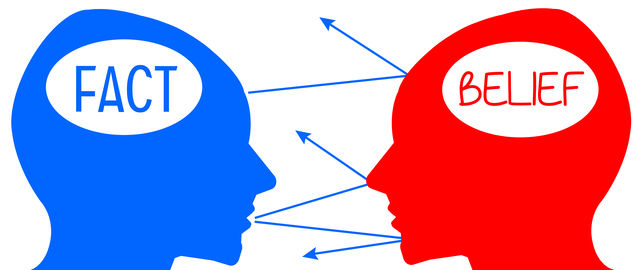
There are a lot of psychological terms for the fact that people don't like to change their minds; "motivated reasoning", "confirmation bias", "cognitive dissonance". But you don't need academic semantics to know that trying to get somebody to see things your way is tough if they go into the argument with another point of view. You argue the facts, as thoughtfully and non-confrontationally as you can, but the facts don't seem to get you anywhere. The wall of the other person's opinion doesn't move. They don't seem to WANT it to move. 
What's going on there? Why do people so tenaciously stick to the views they've already formed? Shouldn't a cognitive mind be open to evidence...to the facts...to reason? Well, that's hopeful but naïve, and ignores a vast amount of social science evidence that has shown that facts, by themselves, are meaningless. They are ones and zeroes to your mental computer, raw blank data that only take on meaning when run through the software of your feelings. Melissa Finucane and Paul Slovic and others call this "The Affect Heuristic" , the subconscious process of taking information and processing it through our feelings and instincts and life circumstances and experiences...anything that gives the facts valence - meaning...which turns raw meaningless data into our judgments and views and opinions. 
Okay, but why do we cling to our views so tenaciously after they are formed? Interesting clues come from two areas of study... self-affirmation, and Cultural Cognition. Both areas suggest that we cling to our views because the walls of our opinions are like battlements that keep the good guys inside (us) safe from the enemy without (all those dopes with different opinions than ours). Quite literally, our views and opinions may help protect us, keep us safe, literally help us survive. Small wonder then that we fight so hard to keep those walls strong and tall. 
Self-affirmation conditioning studies find that if, before you start to try to change somebody's mind, you first ask them to remember something that gave them a positive view of themselves, they're more likely to be open to facts and to change their opinions. People who feel good about themselves are more likely to be open-minded! (That's far more simplistic than any academic would ever put it!) One study, in press, was done back in 2008 and asked people about withdrawing troops from Iraq. Most Republicans at the time thought the troops should stay. Two separate groups of Republicans were shown statistics about the dramatic reduction of violence in Iraq following the "surge" in American troops. One group was asked to do a self-affirmation activity (they were asked to remember a time when they felt good about themselves by living up to a moral value they held). The other group was just shown the violence statistics, with no self-affirmation. Then both groups were asked whether the dramatic reduction in violence in Iraq was a reason to withdraw U.S. troops. The Republicans who did the self-affirmation activity, the folks who were primed to feel good about themselves, were more likely to change their minds and say that the reduction in violence in Iraq was a reason to begin pulling out of Iraq. The group that had not done the self-affirmation remained adamant that the troops should stay. 
Cultural Cognition is the theory that we shape our opinions to conform to the views of the groups with which we most strongly identify. That does two things. It creates solidarity in the group, which increases the chances that our group's views will prevail in society (e.g. our party is in power). And it strengthens the group's acceptance of us as members in good standing. (Like the lithmus test some conservative Republicans have proposed that candidates must pass, making sure their views conform to conservative doctrine before those candidates get party support.) 
Strengthening the group, helping it win dominance, and having the group accept us, matters. A lot. Humans are social animals. We depend on our groups, our tribes, literally for our survival. When our group's views prevail, and our group accepts us, our survival chances go up. So the Cultural Cognition motivation to conform our opinions to those of the groups/tribes with which we identify is powerful. And it would be consistent with that interpretation that the more threatened we feel, by economic uncertainty, or threats of terrorism, or environmental doom and gloom, the more we circle the wagons of our opinions to keep the tribe together and keep ourselves safe... and the more fierce grow the inflexible "Culture War" polarities that impede compromise and progress. The self-affirmation research seems to support this. It appears that the less threatened we feel, the more flexible our opinions are likely to be. 
So the next time you want to have a truly open-minded conversation on a contentious topic with someone who disagrees with you, don't launch right into the facts. Ask them to tell you about some wonderful thing they did, or success they had, or positive feedback they got for something. And try to remember something like that about yourself. Then you might actually have a conversation, instead of the argument you're headed for instead. 
The psychology of risk perception referred to above is described in detail in David Ropeik's new book, How Risky Is It, Really? Why Our Fears Don't Match the Facts.


What Actually Is a Belief? And Why Is It So Hard to Change? Ralph Lewis, Psychology Today. Oct. 7, 2018.

Beliefs evolved as energy saving shortcuts. Restructuring them is costly.

“For some of our most important beliefs, we have no evidence at all, except that people we love and trust hold these beliefs. Considering how little we know, the confidence we have in our beliefs is preposterous—and it is also essential.”2002 Nobel Laureate Daniel Kahneman 1


Source: Alain Lacroix/Dreamstime

Beliefs are a slippery concept. What actually are they? Philosophy has long struggled to define them.2 In this post-truth and ideologically polarized world, we need a better understanding of beliefs. As a psychiatrist, my job frequently involves identifying distorted beliefs, understanding how they formed, and helping people to learn to be more skeptical of their own beliefs. 
Let’s consider a helpful evolutionary framework for making more coherent sense of what beliefs really are, and why mistaken beliefs can sometimes be so hard to change. Then we’ll talk about how to gain a more accurate grasp of reality, and how, ultimately, to advance society. 
Beliefs as energy saving shortcuts in modeling and predicting the environment 
Beliefs are our brain’s way of making sense of and navigating our complex world. They are mental representations of the ways our brains expect things in our environment to behave, and how things should be related to each other—the patterns our brain expects the world to conform to. Beliefs are templates for efficient learning and are often essential for survival. 
The brain is an energy-expensive organ, so it had to evolve energy-conserving efficiencies. As a prediction machine, it must take shortcuts for pattern recognition as it processes the vast amounts of information received from the environment by its sense organ outgrowths. Beliefs allow the brain to distill complex information, enabling it to quickly categorize and evaluate information and to jump to conclusions. For example, beliefs are often concerned with understanding the causes of things: If ‘b’ closely followed ‘a’, then ‘a’ might be assumed to have been the cause of ‘b’. 
These shortcuts to interpreting and predicting our world often involve connecting dots and filling in gaps, making extrapolations and assumptions based on incomplete information and based on similarity to previously recognized patterns. In jumping to conclusions, our brains have a preference for familiar conclusions over unfamiliar ones. Thus, our brains are prone to error, sometimes seeing patterns where there are none. This may or may not be subsequently identified and corrected by error-detection mechanisms. It’s a trade-off between efficiency and accuracy
In its need for economy and efficiency of energy consumption, the default tendency of the brain is to fit new information into its existing framework for understanding the world, rather than repeatedly reconstructing that framework from scratch.

Seeing is believing 
It seems likely that the processes in the brain involved in abstract belief formation evolved from simpler processes involved in interpreting sensory perception
Since we experience the external world entirely through our senses, we find it hard to accept that these perceptions are sometimes subjectively distorted and that they are not necessarily reliable experiences of objective reality. People tend to trust their physical senses and to believe their perceptions even when they are hallucinating and no matter how bizarre their perceptual distortions. People will layer explanations on top of their perception of reality to explain away contradictions. 
We give our subjective experience too much credence, and so too our beliefs. We will more readily explain away evidence that contradicts our cherished belief by expanding and elaborating that belief with additional layers of distorted explanation, rather than abandoning it or fundamentally restructuring it. 
Homeostasis – maintaining stability 
Primitive nervous systems evolved in simple organisms in part to serve the function of homeostasis—a dynamic physiological state of equilibrium or stability, a steady state of internal conditions. Homeostasis is structured around a natural resistance to change, following the same principle as a thermostat.

The lower, primitive parts of our human brains maintain homeostasis of breathing, heart rate, blood pressure, temperature, energy balance (via appetite) and a variety of endocrine processes. So too, beliefs preserve a kind of cognitive homeostasis—a stable, familiar approach to processing information about our world. 
We should expect that the homeostatic function that defined primitive brains would likely have been preserved as an organizing principle in the evolution of more complex brains. Certainly, complex brains are geared toward reacting, learning and adapting, but just like primitive brain functions, these adaptations are ultimately in the service of maintaining homeostasis in an ever-changing environment. 
Radically restructuring our belief system and creating a new worldview engages parts of the brain involved in higher reasoning processes and computation, and is consequently more effortful, time- and energy-consuming. The brain often cannot afford such an investment. This would explain why, when we experience cognitive dissonance, it is easier to resolve this discomfort by doubling down on our existing belief system—ignoring or explaining away the challenging, contradictory information
A consistent sense of self, and personal investment in one’s beliefs 
Another important factor accounting for resistance to changing our beliefs is the way our beliefs are so often intertwined with how we define ourselves as people—our self-concept. Indeed, beliefs are associated with a part of the brain integrally involved in self-representation—the ventromedial prefrontal cortex.3 We want to feel that we are consistent, with our behavior aligning with our beliefs. We constantly try to rationalize our own actions and beliefs, and try to preserve a consistent self-image. It’s embarrassing and quite often costly in a variety of ways to admit that we are fundamentally wrong.

In many cases, people have a lot invested personally in their belief system. They may have staked their reputation on a particular belief. Not infrequently, people structure their whole lives around a belief. And this investment may go far beyond a sense of self, extending to large material and financial investments or a life’s career. A change of belief for such a person would obviously involve a monumental upheaval and may entail intolerable personal losses. 
No wonder it’s so hard to change our cherished and entrenched beliefs. 
The social dimension of belief 
A lot of our belief framework is learned at an early age from parents and other adult authority figures. Many human beliefs are the cumulative products of millennia of human culture. Children are strongly predisposed to believe their parents, and, as adults, we are inclined to believe authorities. 
It's not surprising that our brains have evolved to more readily believe things told to us than to be skeptical. This makes evolutionary sense as a strategy for efficient learning from parents, and as a social, tribal species it promotes group cohesion. 
People can be swayed by persuasive individuals or compelling ideas to override and reject their previously received authority. Sometimes, this is rational. But sometimes, it is not—people are susceptible to influence by charismatic ideologues and by social movements. Especially when these offer new attachments and new self-identities imbued with more powerful affiliation, validation, esteem and sense of purpose than the individual previously had in their life. 
Science and the excitement of proving ourselves wrong 
Science values the changing of minds through disproving previously held beliefs and challenging received authority with new evidence. This is in sharp contrast to faith (not just religious faith). Faith is far more natural and intuitive to the human brain than is science. Science requires training. It is a disciplined method that tries to systematically overcome or bypass our intuitions and cognitive biases and follow the evidence regardless of our prior beliefs, expectations, preferences or personal investment. 
The increasing application of the scientific method in the last four centuries ushered in unprecedented, accelerating progress in humanity’s quest to understand the nature of reality and vast improvements in quality of life. Discovering just how mistaken we collectively were about so many things has been the key to sensational societal progress.4 
Imagine if each of us as individuals could cultivate a scientific attitude of rigorous critical thinking and curiosity in our personal lives, and could experience an exhilarated feeling of discovery whenever we find we have been wrong about something important. Perhaps it’s time to stop talking admiringly about faith and belief as if these were virtues.
Faith is based on belief without evidence, whereas science is based on evidence without belief.

References

1. Daniel Kahneman, Thinking, Fast and Slow, New York: Farrar, Straus and Giroux, 2011, p. 209.

2. See for example Schwitzgebel, Eric, "Belief", The Stanford Encyclopedia of Philosophy (Summer 2015 Edition), Edward N. Zalta (ed.), https://plato.stanford.edu/archives/sum2015/entries/belief/

3. Harris, S., et al., The neural correlates of religious and nonreligious belief. PLoS One, 2009. 4(10): p. e0007272; Harris, S., S.A. Sheth, and M.S. Cohen, Functional neuroimaging of belief, disbelief, and uncertainty. Ann Neurol, 2008. 63(2): p. 141-7. The ventromedial prefrontal cortex is also involved in emotional associations, reward, and goal-driven behavior. [CLICK 'MORE' TO VIEW FOOTNOTE 4]

4. Democracy also loosely employs the scientific method of conjecture and criticism. Each election platform is an hypothesis, each elected government an experiment, subjected to the peer review process of a free press and the next election. The combination of science and democracy has been the key to human progress. To be sure, this progress has not been smooth or without calamitous derailments in modern history. But the overall trend over time has been definitively and spectacularly positive, and it is indisputably the most successful system humans have invented to date.


Reason Won’t Save Us. Robert Burton, Nautilus. Oct. 17, 2019.
It’s time to accept the limits of how we think.
In wondering what can be done to steer civilization away from the abyss, I confess to being increasingly puzzled by the central enigma of contemporary cognitive psychology: To what degree are we consciously capable of changing our minds?
... 
aliens would be equally befuddled by watching political debates on climate change or universal healthcare. They would observe humans ignoring data that strongly warn of impending catastrophic consequences for their species, apparently preferring and even enjoying conflict, anger, self-righteous indignation, and a wide variety of self-defeating behaviors. They would quickly conclude what most of us also suspect but often fail to acknowledge: Though our genes follow the laws of natural selection to optimize survival of the species, as individuals we are not necessarily similarly inclined.
... 
There is no compelling evidence to suggest that public debate on virtually any subject can ever be resolved through reason. We migrate toward what we feel is best.
... 
If this argument sounds harsh or offensive, so is watching present day failure of discourse between those with differing points of view, yet persisting with the unrealistic hope that we could do better if we tried harder, thought more deeply, had better educations, and could overcome innate and acquired biases. 
If we are to address gathering existential threats, we need to begin the arduous multigenerational task of acknowledging that we are decision-making organisms rather than uniquely self-conscious and willfully rational. Just as we are slowly stripping away pop psychology to better understand the biological roots of mental illnesses such as schizophrenia, stepping back from assigning blame and pride to conscious reasoning might allow us a self-image that reunites us with the rest of the natural world as opposed to declaring ourselves as unique. Only if we can see that our thoughts are the product of myriad factors beyond our conscious control, can we hope to figure out how to develop the necessary subliminal skills to successfully address the world’s most urgent problems.


Sunday, September 1, 2019

Propaganda and the American Myth

Empire in Decline - Propaganda and the American Myth. Cognitive Dissonance. Aug. 31, 2019.

“Oh, what a tangled web we weave, when first we practice to deceive…ourselves.” - With apologies to Sir Walter Scott.


If only life was as neat and orderly as my ancient history text book showed it to be. There it was on glossy paper, spread out across several sets of adjoining pages, maps of the ancient and modern world. Sometimes there were time lines top and bottom, along with countries helpfully outlined and identified. Underneath their modern English names were one or two older names in smaller stylized script, often including exact beginning and end dates. I remember one in particular caught my eye. “The United States of America” followed by the year 1776. But with no end date indicated, it looked like unfinished business to me. You’ve got to love those historians and their precise dates.

Of course, in reality there are no exact dates for the birth and death of city/states, other than in the historian’s mind. Children continue to be born, the old still die, and life goes on under ever changing circumstances. But you are rarely informed of the subjective nature of historical events when you’re young and impressionable, so they’re presented in the history books as cold hard facts. The last thing the reigning Imperial Empire wants is to appear uncertain about prior eons, epochs and echoes in time.

Long before we begin to read and comprehend on our own, we’re presented with the illusion of a specific beginning and end to everything, often accompanied with very clear lines of demarcation. This concept is continuously reinforced through our daily indoctrination via carefully scripted news stories, including political and social opinion presented as ironclad fact care of our modern corporate media saturated existence. Naturally, critical thinking is strictly optional and effectively discouraged.

Mix in a healthy dose of hard-core science, where you learn very early there are correct and incorrect answers to all your questions, and the pattern of modern social myth making emerges. Of course, all the important ‘correct’ answers are held for public safekeeping by our cultural high priests and authority figures, be they academic, governmental, corporate, scientific or religious. Lest you forget, cultural icons, heroes and authorities must always be revered and deferred to, so leave the difficult thinking to them.

Maybe now’s a good time to remember that most history books are written, and re-written, by those very same keepers of the public mythology. What we believe as a culture, sometimes called our public myth, is usually determined by those whose pockets are the deepest and most powerful, not by those who are the wisest and most knowledgeable.

Have you ever read a story or book written by the survivors of the vanquished, the so-called losers? I have, a number of times, and it’s usually very enlightening to see the world from the other side of the bloody divide. In their hands, our cultural myths are not treated with the same loving care and respect we afford them, nor should they be. But of course, they must be lying because they have an ax to grind.

Revisionist history is how those in power politely describe the writings of the marginalized and defeated, roadkill crushed and mangled by the leviathan in the head long rush of conquering empire. The public myth informs us the losers can do nothing but taut the victorious with their lies. Ignore them and they’ll fade away. Besides, the winners never lie about the facts, though we’re told there’s plenty of room for differences of opinion. And just about everything can be reduced to an opinion if you’re looking to malign and obscure.

Of course, one of the duties of the Empire’s leadership and servile sycophants is to distort the written record so it conforms to the public myth. This is the principle reason why recently retired or replaced holders of powerful governmental, corporate and military positions are handed (large) advances to write their memoirs and recollections. That, and to reward them with large legal payoffs for a job well done. While they are often declared ‘best sellers’ by the compliant mainstream media, it is not uncommon to find these books sitting in the remainder bin six months later selling for nickels on the dollar.

These sacred tomes of divine wisdom are quickly embraced by other propagandists as the truth, the whole truth and nothing but the truth, so help their Gods of propaganda. Once in their hands, the book’s cherry-picked facts, fiction and opinion-masquerading-as-fact are quickly woven into the fabric of the public myth as unimpeachable supporting documentation. Thus, another turn of the propaganda cycle is complete and ready for public dissemination and indoctrination.

Napoleon Bonaparte is alleged to have declared history as little more than a set of lies agreed upon. His assessment is not that far from the ‘truth’ from my point of view.


Belief vs. Knowing

We all possess extremely complex belief systems and world views. How they develop and evolve is greatly influenced by external information sources we rarely question or challenge. After all, these sources are our cultural authority figures, the experts, professionals and intelligentsia that form our cultural propaganda delivery and support system. These sources cannot be seriously questioned, particularly from within, without being declared a heretic. Just look at how non-conforming individuals, web sites, YouTube channels, Facebook pages and Twitter accounts are treated as an example of how heresy is handled these days.

While we may not pay much attention to mainstream media playing in the background, our unconscious mind is absorbing it all, raw and unfiltered. This information feeds into, and broadly supports, our world view with little conscious thought or scrutiny. Regardless of whether it is ‘news’, game shows, sports or soap operas, ultimately it is all programming. This is the reason why constant repetition is so vitally important to both effective propaganda and commercial advertising. It must be true since it is repeated so often, a self-confirming conclusion all positive feedback loops share. Our mind absorbs and retains everything, even when we do not consciously look or listen.

It’s shocking to realize how seldom we change our basic beliefs or understanding when confronted with critical new information that normally would propel reassessment and modification. Instead, we bend or ignore input to fit our established world view. Economist John Maynard Keynes once said “When the facts change, I change my opinion. What do you do, sir?” Sadly, most people don’t subscribe to this logical practice. Instead, confirmation bias, the desire to maintain our cognitive continuity (aka our worldview) and outright denial are some of the tools we use to manage and manipulate information to our liking.

And rest assured, there are plenty of governmental, religious, corporate and wealthy individuals and entities ready and willing to help us accomplish this through deliberate and targeted propaganda. The most common personal warning sign we may be sipping from the ‘wrong’ information straw is the emotional pain of cognitive dissonance, usually inflamed when new information is in conflict with our long established and dearly held beliefs and world view. We usually avoid this pain entirely by only watching or listening to sources of information we are in agreement with.

Rarely do we push through this emotional pain to reappraise our inventory of previously established ‘truths’ for validity or relevance. It’s so much easier to discard ugly deviations or cherry pick information that confirms our preferred vision, rather than conduct a top to bottom review that is called for when the facts change. Intellectual laziness is the polite term for this phenomenon. I think a more honest explanation is deliberate and mostly conscious denial.

However, even when I’m alert for and aware of this cognitive phenomenon, I’m still surprised how often I indulge. It’s frightening to recognize how deeply conditioned we are in the art of self-deception. The truth truly does hurts when it’s in conflict with what we believe we know. So, we employ the most powerful pain killer known to man, that of denial and self-deceit.

It’s extremely difficult to reject popular opinion and strike out on our own independent path. Group think is indoctrinated into us from birth and socially rewarded at every turn. It is emotionally safer and much more comfortable if we stay huddled near the center of the pack. The result is herd mentality in all its glory, corralled by the public myth of which we are complicit and dutiful keepers.

I often say all writers are essentially propagandists and this applies to myself as well. I’m using this forum to present information in the most compelling manner possible to make my case. In effect I’m feeding you my point of view to build a train of thought leading directly to my preferred conclusion. This is not necessarily good or bad, but simply a tool or technique of persuasion which can be used for all sorts of purposes and outcomes. Obviously, it can be used to educate or to subjugate, but either way the recipient is an active (and often willing) participant.


Check Your Premise

The most effective propaganda is one whose basic premise is slipped by the target so smoothly it is never recognized for what it truly is. Once the premise is planted and accepted, the hard work is done and the implanted meme can now be leveraged and expanded upon from there. The concept is the same regardless of whether one is teaching basic math before moving on to geometry or the virtues of ‘democracy’, which is then used as a legitimizing façade for a ruling oligarchy or corpocracy.

What’s that you say? You’re too smart to let the wool be pulled over your eyes? That you can discern truth from lies and would eventually figure it out given enough time and inclination? Honestly ask yourself, how much time and effort would you put into thoroughly examining something you already believe to be true? Most would deem it a major waste of their time and not give it another thought. Given the choice between the pleasure of confirming our beliefs and the pain of confronting them, we cognitively caged humans are quite predictable.

Most people perceive complex information as bundles of facts compiled into conclusions and truths, most of which we believe we have originated in part or in whole. We have all witnessed another person take something they heard, saw or read, then modify and embrace it before declaring it their original idea or creation. This cognitive grooming and assimilation occurs so seamlessly and naturally that many ‘honestly’ believe they came up with it on their own and would be highly insulted if we challenged their supposition.

Rarely do we recognize that many of the truths we hold as impeccable are based upon long lines of previously assimilated information provided by others and embraced as our own. If at any point some of this information is proven false or misleading, the entire sequence is suspect along with our own impeccable truth. Consider a long string of numbers to be added together. Make a mistake at any point in the line and the final sum, or ‘truth’, is incorrect to some degree or another.

How we view our world is based upon many preconceived notions and beliefs. Change just one small piece we previously thought correct and everything changes to some extent, no matter how small. Change two or three and suddenly we have a crisis of confidence and a cognitive dissonance. Yet when we feel that pain, how often do we reboot and re-examine everything? And why would we re-examine what we ‘know’ to be correct, particularly when most everyone else in our section of the herd remains in agreement? Peer pressure and conditioning are hard to resist, even in the privacy of our own head.

“We are never deceived; we deceive ourselves.” – Johann Wolfgang von Goethe


Deadly Debt

My basic premise, and the basis for this article, is that the American Empire is in decline. From my point of view, it’s become readily apparent the so called “American Experiment” has peaked and is now deteriorating. While I can’t produce an exact date for this change, it doesn’t diminish my argument in the least. I’d be hard pressed to give you the specific date for the decline of the Roman Empire, but clearly it followed the same trajectory. Did Rome’s downward spiral start when the capital was moved to Constantinople in 330 AD or when Rome was sacked by the Visigoths in 410 AD? It matters little at this point, except to the propagandists and historians.

Actually, I would argue that while a succession of Empires has come and gone, the culture of human exploitation and destruction we call civilization has grown exponentially in efficiency and lethality over the last several hundred years. We Americans now stand proudly at the pinnacle of the insanity, picking up where the Greeks, Romans, Asians and Europeans left off. I’ll leave that thought for another day, but I think you get the picture.

America as a social and financial entity ceased to function with any semblance of efficacy or fairness decades ago. This reversal in trajectory is the primary reason behind the massive increase in financial engineering used to paper over fundamental socioeconomic problems and extract the last of the profits. To argue over this or that detail is to be in denial of the obvious. In fact, I consider the official bickering over these details as a deliberate attempt to distort and distract while the final looting and rape occurs.

Negative interest rates, now common in Europe and Japan (and coming soon to the US) are a perfect example of the financial wheels coming off the socioeconomic cart. When all incentive for prudence, precaution and personal responsibility are explicitly discouraged, even penalized, the decline and fall of civil society is a foregone conclusion. For example, prudence in the form of saving money is discouraged with near zero interest paid on any sums saved, while the use of ever more debt is encouraged with zero down and zero interest rates charged on the amount borrowed. Negative interest rates will only serve to fan the flames of the already raging fire.

Can you imagine the consumer feeding frenzy negative interest rates will ignite when a manufacturer of (for example) automobiles or trucks informs you they will pay you 1%, 2% or more of the outstanding balance on the ‘loan’ each year just to buy their vehicles? You would wind up paying less than the amount you borrowed. Of course, this isn’t really free money since the manufacturer will simply jack up the original price to compensate themselves and their finance partners for paying you to buy from them. Imagine the inflationary spiral this will create.

The unofficial socioeconomic policy is to delay the inevitable as long as possible, while promising the plebs ‘the authorities’ are on it and all will be well. Just fork over more money, power and control and everything will be right as rain. Unfortunately, perverse financial, cultural and political incentives dictate it’s in practically no one’s best interest to confront systemic socioeconomic issues and arrest the fall simply because great pain will come long before any gain is ever realized.

Those who already possess substantial wealth demand they not only maintain it, but expand it. This elite group controls ninety five percent of the global wealth and ninety-nine percent of the political power, but at best represents one percent of the global population. The entire middle class, decimated by decades of inflation without a corresponding increase in wages, desperately clings to what little they have remaining. Ultimately, for the vast majority, as it now stands this is a losing battle. So, we dither, delay and deny while remaining drunk on cheap credit and consumer pleasures.

And then there are the poor, aka the expendables, globally the largest group by far, powerless in every sense of the word and focused solely on day to day survival. With the middle class increasingly squeezed lower into their already tight quarters, the only place left for them is further down and out.

Those who can, won’t. Those who might, deny. Those who can’t, suffer.


Plausible Deniability and False Hope
Using so-called “experts” to push misleading information and outright propaganda along with other targeted psychological operations, our leaders are pushed, prodded, threatened and empowered by the elite one percent to outright lie about economic conditions both here in America and globally. The rest of the first and second world nations follow suit for their own political survival and personal economic enrichment.

They disseminate lies, half-truths and fake news; not because they expect them to withstand close scrutiny, but rather to enable those who wish to believe the lie a plausible excuse to do so while daring those who don’t to contest their power to do and say as they please. Remember our conditioning; when in doubt, defer to authority and suspend disbelief. This is quite similar to ‘gaslighting’, a form of psychological manipulation in which a person or entity seeks to sow seeds of doubt in a targeted individual or in members of a targeted group, making them question their own memory, perception, and even their sanity.

A classic sales technique is the assumed consent close. Rather than directly ask you to purchase the new car, it is assumed you will purchase. The sales person goes in for the kill by asking closing questions. “Do you prefer the red four door we first looked at or the blue convertible with the leather interior? What is the maximum monthly payment you are comfortable with? Will one or both of you be applying for credit? Do you want the satellite navigation registration in your name or your husbands? May I have the keys to your car so we can determine your trade-in value?” You’d be surprised how many new automobiles, rooms of household furniture, whole life insurance, investment packages and pieces of expensive jewelry are sold in this manner.

Something similar to this technique is used by the mass media to sell us things we already want to buy. Only they aren’t selling the death of America, but rather America’s supposed remarkable resilience and miraculous comeback from near financial death in 2008, a blatant falsehood people only now are beginning to recognize. We’re being sold false hope with outright lies and opinion disguised as factual news and official declarations.

False hope binds us to impossible situations and debilitating conditions.

As long as we believe there is residual value in keeping America on life support, meaning we believe our personal financial situation hasn’t deteriorated significantly enough to push the panic button, we will continue to support this mess rather than clear the smoking debris, remove the leadership and much of the autocracy and start over again. As long as those in power can at least partially shield the majority from major financial reverberations and dislocations, meaning “We the People” slowly degrade rather than explode, we will take a path that best preserves our own personal interests.

As Mrs. Cog likes to say, it’s a recession when it crashes into someone else and a depression when is crashes into you and me. As long as we can defer to authority and demand someone else do something about ‘it’ while also maintaining our own status quo, we will do nothing to confront our fundamental socioeconomic problems. Throughout ancient and modern history, this is the usual path taken by the majority until it is far too late to do much more than sweep up the pieces and bemoan the loss of several generations to devastating financial, social and political distress. Because the nation’s wealth was looted long before the fall, there is little capital and resources to work with in order to rebuild. Thus, the reason for the loss of several generations.

This is the primary purpose of the constant propaganda messaging, to assure those who wish to remain safely within their fox holes (after all, ignorance is bliss) that they can indeed remain hidden in their fox holes. Desperate people do desperate things. The puppet masters do everything in their power to convince people it is best to duck and cower rather than stand up and push back. This is their leverage, as it has been for thousands of years of global history. Those who rule keep the population confused, divided and afraid (and lately, sick) but not so much that doing so reduces our productivity, thereby diminishing their power and wealth.


Wolves Among the Sheep

And the truly frightening realization, something I suspect most of us know deep down in our hearts but don’t actually acknowledge, is that the majority of people in positions of power and/or wealth are either sociopaths or harbor strong sociopath tendencies. Which means they do not think in terms of civic duty and public service, but rather about personal gain and ever more power. As conditions continue to deteriorate, less and less sane and well-meaning people will be willing to step up and attempt to lead, creating an even larger power vacuum the sociopaths are more than willing to fill.

Those who claim “They would never do that” are hopelessly and dangerously deluded, mesmerized by the great American myth or just hopelessly deep in denial. For crying out loud, of course they’d do ‘that’, just as you and I are capable of doing just about anything when subjected to great stress and pressure. The difference is that in the grand scope of things, whatever we might do would harm mostly ourselves and maybe those nearest to us, while ‘they’ can and will harm thousands, if not hundreds of thousands, to maintain their status quo and position of power.

We don’t wish to face the stark reality we as a nation are in way over our heads. As long as we are not forced to look too closely at the terrible condition this country is in and where it’s headed, we are all too willing to do our part and avoid critical thinking. Like an old bull unknowingly led to slaughter because he thinks he’s off to mount the next cow, we’re desperately trying to keep alive the magical American myth of life, liberty and the pursuit of happiness while shielding our eyes from the rotting corpse it is rapidly becoming.

That assessment is probably too harsh for the average American’s sensibilities. But let’s ask ourselves a few questions in an effort to discover the truth, or at least something approaching the truth as we know it. First, let me be clear on something before I get flamed for my harsh tongue. I’m not America bashing in the least; I am America myth bashing. The American myth of exceptionalism is enabling our self-destruction as we stand idly by, applauding and supporting the mythical facade our leaders and media display 24/7.

As long as we cling to the hope that all America needs is a tune up and some minor repairs, we’re condemned to a long and painful death spiral. We’re being told exactly what we want to hear because we’re desperate to hear it. To claim otherwise is to lie to ourselves and to each other.

America is crumbling from the foundation up, and yet all we talk about is a fresh paint job and a new screen door (both bought on credit) while handing our grandchildren a bill they’ll never be able to pay. The only way we can live with this lie, while handing suffocating debt to our own future family members, is to deny it’s even happening.

The big lie, one we must continue to tell ourselves, has taken on a life of its own and is consuming everyone and everything in its path. We are addicted to our own public myth. And to sustain the lie we must ignore the truth or face the cognitive consequences, a fate worse than death for a nation incapable of telling itself the truth.

The only way to break through the lie is to go back through decades of propaganda and myth and recognize these lies and our core self-deceit. Since this is too painful, both individually and as a society, we distort reality as quickly as we change channels or YouTube streams. Can you say cute cat videos?

It’s not just our leaders who are corrupt, but us as well. We all know something is seriously wrong, even if we don’t know precisely what is broken or how to fix it. And yet there we are, whistling through the graveyard under the guise of minding our own business…. as if America is none of our business. We think “Just leave me alone and let me live my life in peace” without acknowledging that doing so perpetuates the very system that is slowing suffocating us.

Contrary to popular belief, the fish doesn’t rot from the head down, but rather from everywhere and all at the same time. We comfort ourselves by saying it’s our leaders who lie to us, but the only way a long-term confidence game can succeed is for the ‘victim’ to fully participate. No one forces the victim to be conned… at least not yet.

The conman’s baited hook is the great America myth; you work hard, keep your nose clean, live a good life and retire sitting pretty. While some of the baby boomers are actually living the dream all the way to the end, this is occurring less and less these days and the future looks particularly bleak. Have you noticed how many elderly folks are working at McDonalds and Walmart? Do you ever wonder why this is?


Petulant Children

We have become cowardly, unwilling to commit to the difficult path of setting aside even a minimum of today’s self-gratification in order to assure our grandchildren a functioning society to live and prosper in tomorrow. This is the ultimate act of selfishness, compounded by the fact we self-righteously declare we’ve been hijacked by our leaders. The sad fact is our leaders are doing exactly what we want them to do, to continue perpetuating the lie while telling us it’s the truth.

“Daddy, tell me everything is going to be OK.”

“Everything’s going to be just fine honey bunny.”

“I love you daddy.”

Did we really think we could put our country’s toys, tools and war machines on the national charge card and not worry about the bill, just because some politicians said we could? What are we, 5-year old children, pointing our finger elsewhere when asked who broke the mirror? Even if we personally follow the path of fiscal prudence, we all swim in the same piranha-infested swamp. Therefore, as infuriating as it may be for some to read the following, we all share some responsibility, however small, for the present state of affairs. The only question now is, what do we do about it? Citizenship is about individual responsibility to ourselves and to our fellow citizen, something we’ve been avoiding for quite a while now; at least since we started collectively calling ourselves consumers.

Endless propaganda is used to lull us into a drugged stupor so we don’t dwell on what we’re doing to our children’s children. American flags wave in the background as chiseled men and sultry women expound on how wonderful we are for loving this great nation of ours. The great American love story, brought to you daily via TV and streaming soap operas. This is where the bad guys always loose, men are virile and women sexual objects to lust after. Watch closely children, this is the American dream.

And why wouldn’t we love America the myth? It’s everything we are told we want without the pain of actually creating and maintaining it. Nationalism is our unifying religion, an increasingly fatal addiction to our public myth that enables us to fiddle while America burns. Alas, the carnival ride is breaking down with increasing frequency. More drugs over here doctor, the patient is waking up.

Desperate for relief, we seek refuge with fellow like-minded herd dwelling walking wounded, a perceived safe haven inside occupied territory for the psychically-damaged and emotionally-demoralized, in the deluded belief hiding is an effective emotional pain reliever. Surrounded by lies and deceit, we are indoctrinated to such an extent we still speak the language of defeat and denial without even realizing it. One cannot become clean immersed in filthy shared bathwater, just less dirty than the one behind us and dirtier than the one in front.

So how do we deal with this, and what does this have to do with you and me specifically? After all, aren’t we all just ‘victims’ in a long line of walking wounded, exhausted from moving in and out of various stages of loss and grief? One moment we’re angry with zombie friends, family and neighbors, imploring them to wake up and see the insanity. The next we’re filled with self-righteous indignation as another patsy’s head is placed on the public pike, sated temporarily by the public flogging and bloodletting.

In my opinion we have no choice but to start at the beginning. While we must speak truth to power, first and foremost we must speak truth to ourselves, to talk openly and honestly about what has happened and where we are going. A significant component of the seduction of denial is the avoidance of personal responsibility. This must stop, thus my declaration we are all responsible for this mess. I have no doubt America can stop its decline, but the process begins with you and me, not they and them. Contrary to popular opinion political leaders do not lead, but rather follow the strongest stench coming from the biggest wallet.


Step One….

How do we as individuals tackle this seemingly huge and insurmountable problem? As a former financial planner and stock broker who still runs personal money, I try to use a modified version of my own trading rules in my personal life. They are as follows.

One; know ourselves, particularly our strengths and weaknesses. This is admittedly much easier said than done, simply because the disassembly (and reassembly) of our interlocking myths, beliefs and illusions is NOT a one-time event, but rather a long and laborious process. One or two particular insights or kernels of awareness are not sufficient to reveal the huge tangled mess. In fact, to believe it is a one-and-done event is actually more destructive than doing nothing, since we change very little about ourselves yet believe we have. Similar to Russian nesting dolls, where several more a hidden inside the first, the rabbit hole runs deep.

Two; understand this is far more about perspective than it is about facts, truth or knowledge, three words often used interchangeably and incorrectly. Facts are rarely more than pieces of information which may or may not be correct, truth is almost entirely based upon a point of view often (but not always) derived from arranging facts in a particular order. And knowledge is the inner awareness and acceptance that facts and truth are little more than moving parts in a general consensus reality. Meaning two people can use the same set of facts, yet claim different truths based upon those facts, while a third person, relying upon a large body of knowledge, understands facts and truth are at best subjective and at worst enslaving.

Three; always consider the possibility there is far more to learn about a subject (and ourselves) than we are aware of. The art of propaganda and manipulation is the leveraging of our own biases and assumptions, of nudging and sliding us one way or another. We dismiss the notion we are influenced by these forces because we believe we would recognize them when we see or hear them. Nothing could be further from the truth. Look intently, critically and repeatedly for gaps and weakness in our thinking, especially if we believe nothing is wrong with our thinking. I force myself to read/watch/listen to information I think is contrary to my settled opinions, and I’m always amazed to discover something new-to-me every time I do so.

Four; from time to time, mentally clear our minds from the 10,000 daily distractions that bombard us via every glowing screen we own…or more accurately, every glowing screen that owns us. Yes, I understand this is nearly impossible since so much of our necessary daily activity requires screen interaction. I still manage personal money, which means I must remain plugged in nearly all the time. The weekends are less hectic and afford better opportunities to at least attempt some decoupling from the matrix. Audio books concerning deep dive subjects we’ve always wanted to explore are a perfect alternative to the jibber-jabber intrusions of daily life and can be listened to while doing chores, driving and so on.

Five; trust our instincts and inner knowing more so than our heart and mind. My most shocking early revelation was that my mind lies to me and my heart (emotion) confuses and deceives me. This is not surprising since a lifetime of conditioning and programming instructs us to believe knowledge, truth and wisdom are found externally and only from official sources and authorities. This deliberately narrowed point of view has dulled, if not completely switched off, any intuitive connection we might have with our inner knowing self.

Since we are never taught to consult, let alone trust, our inner knowing, we have all been successfully subjugated to one degree or another by external forces. Worse, we consider this ‘condition’ to be completely natural and normal. Because our cognitive box is the only reality we’ve ever known, it is nearly impossible to ‘think’ outside of it. The more firmly we are chained to the existing reality, the more difficult it is to imagine any other. Therefore, we must attempt to disconnect as completely and often as we can.

These practices slowly develop (re-awaken might be more accurate) a clear-eyed view and a deeper understanding of ourselves, our fellow man and the real world, not as we wish to see it, but as it really is. Unfortunately, we still engage in wishful thinking way too often, constantly pushing the hope ‘dope’ button for increasingly meager superficial rewards. Considering the direction our world is headed, it’s going to be more difficult to think clearly unless we begin to make personal changes now. Old habits die hard because we desperately cling to them for emotional support. Understanding why we do this will go a long way to helping us jettison our old baggage. Even if we are trapped on the crazy train to hell, just because we can’t get off doesn’t mean we must fully participate in the insanity.


08-31-2019

Cognitive Dissonance

Saturday, February 2, 2019

Cognitive Dissonance

Perhaps It’s Time to Believe the Impossible
Cognitive Dissonance


"Alice laughed: "There's no use trying," she said; "one can't believe impossible things." "I daresay you haven't had much practice," said the Queen. "When I was younger, I always did it for half an hour a day. Why, sometimes I've believed as many as six impossible things before breakfast." - Alice in Wonderland.


It is often said, usually by those who wish to “educate”, control and manipulate us, that we are defined by what we believe. I submit it’s the other way around. We are defined, or more accurately confined, by what we disbelieve and think impossible, or at a minimum, improbable.

Once we consign something to the impossible, unbelievable, farfetched, unlikely, preposterous and unreal cognitive file, rarely, if ever, do we fish it back out of the garbage bin for reassessment and reconsideration. And why would we do so since it clearly belonged there to begin with, otherwise we never would have discarded it in the first place.

That right there is a perfect example of circular logic and emotionally comforting thinking.

From the point in time when non-religious standardized thinking was institutionalized, more commonly known as the scientific revolution of the 16th and 17th centuries, we have been conditioned to believe everything and anything can (eventually) be cataloged, quantified, qualified and confirmed…or denied. More importantly, the scientific method insists “real” truth can only be verified by way of uniform methods that produce repeatable results.

When dancing on the fringe, this mindset requires the use of measuring instruments not yet invented or even conceived of when pushing the boundaries of accepted thought and “reality”. If one disbelieves something, or at best thinks it highly improbable, what real incentive does that person, entity or institution have to pursue that line of thought. The answer, of course, is little to none. This leaves cutting edge explorations to those who are both brave enough to swim against the consensus belief system while also somehow funding those explorations.

This hardening of the cognitive arteries extends far beyond scientific principals and findings. And from my own personal point of view, it’s just another form of collective cultural corruption designed to maintain the status quo for all involved, including every single person alive today. If we are conditioned to believe, we are conditioned to disbelieve as well. And eventually we will fight to remain safely within the cerebral confines of our sheltered minds.

For example, everyone in their right mind knows 2 + 2 = 4. This is a self-evident fact that can easily be proven. Just count the fingers on your hands if you wish to be affirmed in your thinking. But the mathematical tool we use to “count” those fingers is Base 10, which makes perfect sense because we all have ten fingers and ten toes, therefore counting via Base 10 is perfectly normal and natural. Though I might argue Base 5 would also make sense.

But believing 2 + 2 = 4 to be an irrefutable fact completely closes the intellectual door to using any other tool with which to count. For example, if we were to count using Base 3, then 2 + 2 would equal 11, only in this case “11” in Base 3 converts to “4” in Base 10. So, in a sense, 11 = 4 when the proper parameters and perspective are understood.

Of course, in the interest of clear and concise communication, it makes perfect sense for everyone to employ the same “language” (in this case Base 10) when “speaking” in mathematical terms. But 2 + 2 = 4 only applies when counting in Base 10 and is not “truth” in all senses of the word. Because we are trained to think in binary absolutes, of either right or wrong, because we are told 2 + 2 = 4 is empirical truth, the whole truth and nothing but the truth, our minds of shuttered of any and all other perspectives and realities.

Very little, if anything, of what we purport to “know” is learned firsthand through direct experience or inquiry. Nearly all we believe we know is taught to us by those who were also first taught what they believe they “know”. Meaning the present-day consensus reality is a shared “illusion” of unknown validity and is mostly based upon self-interested circular logic and self-reinforcing confirmation.

I think; therefore, I am…I think. Besides, my fellow insane asylum inmate tells me I am, therefore I must be real because I can clearly see she is real; therefore, she is thee and I am me.

When we are told (by experts and authorities who obviously “know” more than we do) that one person, place or thing is true and correct, all other explanations, versions, concepts and alternative realities become essentially immaterial, moot and thereby inherently and irrefutably wrong. While we are assured there are a billion paths to nirvana, like a rigged casino game, all outcomes are preordained to end within the cognitive corral of consensus reality.

To think, let alone act, outside the norm is heresy at best and social/career suicide at worst. While we will all excuse an occasional dalliance with perceived nonsensical thinking if properly buttressed with laughter and “just joking” disclaimers, those who dare dance with the dark sided of unchaperoned thought and action are scorned, shunned and isolated.

Such is the way of the hive mind.

Born into the hive mind, raised inside a self-reinforcing and self-affirming insanity, “educated” by those similarly afflicted and then mixed into the general population safely ensconced within the insane asylum, are we really surprised the consensus reality dominants our thoughts, speech, thinking and actions? So complete is the illusion, so confining the cognitive box, it becomes nearly impossible to escape the chains that bind. And why would we even try?

For thousands of years the prevailing belief was/is that humans are doomed to be nothing more than…well, human. That we are slaves to the human “condition”, with no hope of escape unless we subject ourselves to the will of others, be it God, Emperor, King or President. How convenient, at least for those who benefit from the controlling belief system by setting the narrative memes, that we are told the only way out is to dig deeper in. Are we really so brainwashed that we truly believe more conformity, compliance, cooperation and concession is the path to personal happiness, awareness and enlightenment?

For those who drink deeply of the hypnotic and narcissistic elixir so readily available as the price of admission, the answer is unequivocally yes. But others, in ever increasing numbers, are beginning to question reality as presented in ways large and small. Some are chipping away at political and religious dogmas and ideologies, asking basic questions of heretofore previously unchallenged fundamental “truths”. Others are traveling deeper down the rabbit hole and discovering there are more than just one or two layers to the deception.

But for those who wish to begin, a basic question presents. How does one break from the consensus reality when the only tools available are designed to circle us back into its domain? Or as I like to say, how does one gain sanity when the only perspective we have is insane?

The fundamental premise one must begin with is simple; humans are not naturally insane and the present-day consensus reality is not the only reality, just the oppressively dominant one. Therefore, our so-called human condition is artificially induced via conditioning, repetition and affirmation. This means the present consensus reality can be changed, if for now only on a personal level. In fact, our “own” reality is the only reality we can possibly change in our severely degraded cognitive state.

The key is to view the problem as one would/should view recovery from an addiction. For that is what we are, horribly addicted to a reality that is poisonous at best and terminal at worst. The first step in any recovery is acknowledging our condition, taking personal responsibility for our situation and recognizing we (alone if necessary) must push against the tide and enact fundamental changes in everything we do, think and say.

No big deal…right?

Instead of perceiving the task as impossible, meaning not believable, it helps to embody a few concepts. Breaking from the consensus reality is a long process, not a onetime event. Reversing a lifetime of rote conditioning and addictive behavior is difficult work that will consume the rest of our lives. There is no finish line to cross, if for no other reason than short of becoming a Buddhist monk and withdrawing to an isolated mountain top monastery, we are constantly assaulted by the consensus reality even as we attempt to understand it, then create and enter an alternative one.

But this doesn’t mean things will not get better. Far from it in fact. As with any new learning, experience builds as the basics are mastered and repeatedly practiced. How does one eat the proverbial elephant? One bite at a time is the only answer to this seemingly impossible elephantine task.

How does one think outside the box when the parameters of the box are the only way we know how to think? To start, question everything, especially our own personal belief system. This doesn’t mean all beliefs must be jettisoned simply because there are flaws embedded within. Our belief system acts as a stabilizer in an increasingly insane world. To merely cut loose is the cognitive equivalent of cutting our engines and letting the hurricane smash our boat upon the rocky shore just because we no longer trust the engine.

Strategic reassessment is necessary in order to avoid an existential crisis of epic proportions. Cognitive confusion and emotional breakdowns are not pretty. The object is to get better without getting significantly worse during our awakening, so baby steps are in order throughout the process. Progress, not perfection, is the standing order at all times.

I try to employ several techniques in order to become familiar and practiced with thinking and living outside the consensus. Or more accurately, exploring the frayed edges where the controlling memes lose their effectiveness. I started relatively late in life, a substantial impediment for much unlearning must take place to make room for alternative concepts and considerations. On the other hand, with age comes wisdom and a clearer understanding of the various tricks and cons used over and over again to keep the herd corralled.

One method is to create an alter ego with which I practice becoming someone I wish to be, but presently am not. Many people today have already created alter egos on various social media platforms, either in their own name or concealed behind a fictitious character or alternative name. The problem is they often use the alter ego to say (and sometimes do) things they wouldn’t ordinarily say or do if directly exposed to others. Since this behavior is encouraged within the insane asylum of modern-day consensus reality because it is unhealthy and destructive, those who do so are headed deeper into the insanity.

My Cognitive Dissonance alter ego is a perfect example of my desire to practice that which I am not, but wish to be. And after a decade of practicing, I am closer than I was last week, month or year. The goal is not to become “Cognitive Dissonance”, for “he” is not me and I am not “him”, but to emulate those qualities I continuously imbue within the Cognitive Dissonance alter ego. Forward progress, not perfection, are my own personal marching orders.

The odd thing is this. By practicing the now possible as demonstrated by my alter ego, by devouring that elephant one bite at a time, the seemingly impossible soon becomes merely improbable, then impracticable, then very difficult, then problematic and soon enough actually possible. Managing personal expectations in order to gain perspective, rather than to self-deceive so we may apply temporarily soothing emotional and intellectual balms, is critical to forward progress.

This requires absolute personal accountability (I am solely responsible for all that I am and no one makes me do anything I don’t wish to do) self-honesty (all lies, at their root, begin with self-deception) and constant self (re)evaluation (the first signpost encountered is never the last).

But we need to do more if we are to begin to break consensus reality spell. And make no mistake about it, the hold it has upon us has all the characteristics of a spell cast upon us by powerful witches, overlords and demons. It is so commanding, in fact, that we know of no other way to live, work, speak and think. It is “reality” after all.

Michael Corleone said in ‘The Godfather Part 3’, “Just when I thought I was out, they pull me back in.” While we would all like to believe it is “they” who pull us back into the consensus reality, often it is the other way around. While the overall beat of the narrative drum is set by powerful political, financial, military, corporate, religious and now social media entities, at least for now our cushy cages aren’t locked from the outside.

Endlessly conditioned via the carrot and the stick, nearly all of us tend to pull our cage doors shut and padlock them from inside. The tendency for the frightened or inflexible mind to seek closed cages and equally closed minds is well known and thoroughly documented. One of the ways we do this is to seek out and “consume” only information (notice I did not say “truth” or “facts”) which confirm our beliefs and cognitive bias.

To help combat my deeply ingrained bias I force myself to read (consume) things that are contrary to my perspective and point of view. This doesn’t necessarily mean just politics, though that is presently the favored method the meme makers use to divide and control, but also science, education, religion and so on. The primary purpose is not to change my mind, though that is sometimes the outcome, but simply to exercise my perceptive filters and expose them to the knowledge there is more than one perspective with which to view the insanity.

Essentially, I am attempting to pull myself out of a rut even if the result is simply to get stuck in the one next to it. I am exercising my imagination and creativity, my tolerance to disbelieve things I want to believe and to believe things I wish to disbelieve and don’t wish to challenge. I am exploring possibilities, not fact, truth or settled opinion. The value derived is in the process, not the immediate result.

But that still leaves the problem of speaking, and thereby thinking, in consensus reality words, concepts and beliefs. It is extremely difficult to think outside the box when the terms and concepts used to (critically) think require remaining safely within the box. In many respects we don’t know what we don’t know mostly because the unknown has not been described using new terms which introduce new imagined concepts. It’s sort of a chicken and egg thing. Which came first?

Regardless of what we do, think or say, we must first visualize or imagine “it” before the “reality” of what we are now doing, thinking or saying can be created. In practice, nearly all of the basic building blocks of the consensus reality are pre-formed and rapidly accessed by our minds, then combined to create a reality that closely conforms to the consensus. While we may believe we are being creative, the vast majority of imagination is “pre-imagined”. That, essentially, is what I mean when I speak of the consensus reality.

For example, we don’t actually “imagine” a chair, despite the fact there are millions of different designs and our “thought” or “idea” might incorporate slightly different elements. The word “chair” is already established in the consensus lexicon. And the word, when summoned from memory, recalls already imagined design elements, aka already experienced pre-imagined reality. While the element style may vary from region to region, basically it is a device made of sturdy material with four supports and a seat, often a back and sometimes arm rests.

There is little to no substantial creative thought required to conjure up the consensus reality, precisely the reason we are firmly cemented within this reality.

I often say I have no original thought, just original composition and arrangement of old concepts and ideas. I simply lack the capacity to plow new ground in my present state of conditioned cognitive paralysis. But there are people out there who do possess the imaginative capacity to venture off the beaten path to some degree or another. In a broad category sense, they are the artists of the world. More narrowly they are authors, in particular those who write fiction and specifically those who write science fiction.

While general fiction writers are most definitely creative, for the most part they are simply more fully utilizing consensus reality concepts and beliefs in more creative ways. But by no means am I denigrating fiction authors, just as I do not denigrate myself for saying I have no original ideas, only original composition. And there are certainly fiction genres, such as horror (Steven King et al.) or fantasy (Alice in Wonderland, Harry Potter etc.) which compel the reader to push the boundaries of consensus reality.

For me though, I find science fiction (and to a much lesser extent science fantasy) forces the mind to not only think, but imagine outside the box. Even though the science fiction author has already created the concepts while writing the story, because many of the concepts fall outside our consensus reality, we are forced to go beyond our known reality and visualize what we are reading as new or altered reality. Often, we must go where we have never gone before.

While the list of excellent science fiction, both old and new, is long and varied, I tend to seek out authors who force me out of my comfort zone by focusing not just on futuristic machines, by thought, concepts, language and thinking. While I prefer audio books, which allow me to listen while doing mundane chores, physical books work just fine.

For example,

The Three-Body Problem Trilogy by Cixin Liu and translated from Chinese. An excellent study in how alien memes and narratives are created, propagated and assimilated while set in China’s Cultural Revolution perspective.

Rosewater by new author Tade Thompson, who explores how the integration of an alien entity changes everything. Set in Nigeria, this alone brings a fresh perspective to western cultural points of view.

The Dispatcher by John Scalzi, a delightfully interesting story about how life works when death doesn’t.

Stranger in a Strange Land by Robert A Heinlein, a classic that still resonates today for its eye opening perspective on ingrained cultural beliefs when “groked” from an alien point of view.

Again, the purpose of this activity is to exercise our mind and imagination, to push beyond our conditioned comfort zone, to teach our mind, body and soul the invisible fence line is just an illusion we are conditioned to believe is real. It’s sort of a “fake it until you make it” exercise, adding unfamiliar experiences to the mix that help create memories, which in turn begins to supplant conditioned cognitive reflex. Do it often enough and it enters long term memory from which the consensus reality is retrieved and realized.

The above are just a few suggestions on ways we can begin to pull out the deep roots of consensus reality perception and commence to create our own alternative reality. The key is to understand one simple idea. We are deeply immersed inside an all consuming and very convincing consensus reality. As Albert Einstein once said, “Reality is merely an illusion, albeit a very persistent one”. To expect we can escape after performing a few Jedi mind tricks is naïve and self-delusional.

The one item not outlined above is probably the most important facet of this practice. If we remain as deeply immersed in the consensus reality as we presently are, no amount of expended effort in the opposite direction is going to move us very far off the starting line. When standing under a waterfall, a garden hose isn’t going to make much of a difference. We must begin to withdraw physically, mentally and emotionally from the hustle and bustle of everyday life inside the matrix of insanity.

For most this is the most difficult part of the journey. Many won’t even try, preferring the insanity they know to the unfamiliar and frightening reality of personal responsibility and sacrifice that can lead to greater self-understanding and enlightenment. To walk away, or even just distance ourselves from the hive mind, is to experience self-imposed isolation and a rejection of much of the external affirmation we have been conditioned to believe we need. It takes courage and perseverance to be contrary to the herd for any substantial period of time.

This is why I said earlier we cannot discard all our anchors at once, regardless of their flaws and entanglements. For to do so mostly assuredly will destabilize us to the point where we are falling back faster than we are moving forward. Two steps back with each step forward is not the way out, but deeper in.  Whatever we do to begin the withdrawal process, the most critical aspect is to move toward a goal with purpose and intelligence rather than run from ourselves in fear and haste.

Perhaps it’s time to begin to believe the impossible.


Saturday, December 29, 2018

Richard Heinberg

first posted Jul. 2017; updated Dec. 2018.

The Big Picture, Richard Heinberg, Post Carbon Institute. Dec. 19, 2018.


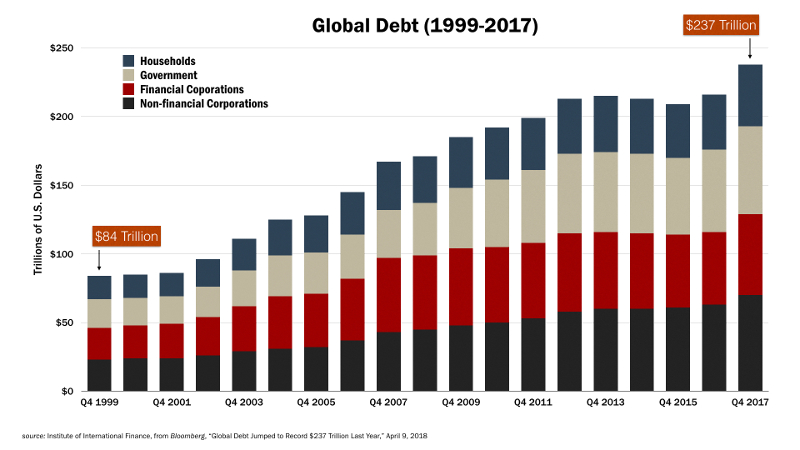
Humanity has a lot of problems these days. Climate change, increasing economic inequality, crashing biodiversity, political polarization, and a global debt bubble are just a few of our worries. None of these trends can continue indefinitely without leading to a serious failure of our civilization’s ability to maintain itself. Taken together, these metastasizing problems suggest we are headed toward some kind of historic discontinuity.

Serious discontinuities tend to disrupt the timelines of all complex societies (another name for civilizations—that is, societies with cities, writing, money, and full-time division of labor). The ancient Roman, Egyptian, and Mayan civilizations all collapsed. Archaeologists, historians, and systems thinkers have spent decades seeking an explanation for this pattern of failure—a general unified theory of civilizational collapse, if you will. One of the most promising concepts that could serve as the basis for such a theory comes from resilience science, a branch of ecology(the study of the relationship between organisms and their environments).


Why Civilizations Collapse: The Adaptive Cycle

Ecosystems have been observed almost universally to repeatedly pass through four phases of the adaptive cycle: exploitation, conservation, release, and reorganization. Imagine, for example, a Ponderosa pine forest. Following a disturbance such as a fire (in which stored carbon is released into the environment), hardy and adaptable “pioneer” species of plants and small animals fill in open niches and reproduce rapidly.

This reorganization phase of the cycle soon transitions to an exploitation phase, in which those species that can take advantage of relationships with other species start to dominate. These relationships make the system more stable, but at the expense of diversity.

During the conservation phase, resources like nutrients, water, and sunlight are so taken up by the dominant species that the system as a whole eventually loses its flexibility to deal with changing conditions. These trends lead to a point where the system is susceptible to a crash—a release phase. Many trees die, dispersing their nutrients, opening the forest canopy to let more light in, and providing habitat for shrubs and small animals. The cycle starts over.

Civilizations do roughly the same thing. In their early days, complex societies are populated with generalist pioneers (people who do lots of things reasonably well) living in an environment with abundant resources ready to be exploited. These people develop tools to enable them to exploit their resources more effectively. Division of labor and trade with increasingly distant regions also aids in more thorough resource exploitation. Trading and administrative centers, i.e., cities, appear and grow. Money is increasingly used to facilitate trade, while debt enables a transfer of consumption from the future to the present. Specialists in violence, armed with improved weaponry, conquer surrounding peoples.

Complexity (more kinds of tools, more social classes, more specialization) solves problems and enables accumulation of wealth, leading to a conservation phase during which an empire is built and great achievements are made in the arts and sciences. However, as time goes on, the costs of complexity accumulate and the resilience of the society declines. Tax burdens become unbearable, natural resources become depleted, environments become polluted, and conquered peoples become restless. At its height, each civilization appears stable and invincible. Yet it is just at this moment of triumph that it is vulnerable to external enemies and internal discord. Debt can no longer be repaid. Conquered peoples revolt. A natural disaster breaks open the façade of stability and control.

Collapse often comes swiftly, leaving ruin in its wake. But at least some of the components that made the civilization great (including tools and elements of practical knowledge) persist, and the natural environment has opportunity to regenerate and recover, eventually enabling reorganization and a new exploitation phase—that is, the rise of yet another civilization.


Energy Is Everything

Global industrial civilization shows significant signs of being in its conservation phase. Our accomplishments are mind-boggling, but our systems are overstretched, and problems (including climate change, inequality, and political dysfunction) are accumulating and worsening.
However, our civilization is different from any of its predecessors. Unlike the ancient Romans, Greeks, Egyptians, Shang Dynasty Chinese, Incas, Aztecs, and Mayans, we have built a civilization that is global in scope. We have invented modes of transportation and communication previously unimaginable. Thanks to advances in public health and agriculture, the total human population has grown to many times its size when Roman armies marched across North Africa, Europe, and Britain. Have we perhaps outgrown the adaptive cycle and escaped natural checks to perpetual expansion?


In order to answer the question, we must first inquire why modern civilization has been so successful. The rise of technology, including advances in metallurgy and engineering, certainly played a part. These provided better ways of obtaining and harnessing energy. But it’s the rapid shift in qualities and quantities of energy available to us that really made the difference.

Previously, people derived their energy from annual plant growth (food and firewood), and manipulated their environment using human and animal muscle power. These energy sources were inherently limited. But, starting in the 19th century, new technologies enabled us to access and harness the energy of fossil fuels. And fossil fuels—coal, oil, and natural gas—were able to provide energy in amounts far surpassing previous energy sources.

Energy is everything. All terrestrial ecosystems and all human societies are essentially machines for using (and dissipating) solar energy that has been collected and concentrated through photosynthesis. We like to think that money makes the world go ’round, but it is actually energy that enables us to do anything at all—from merely getting up in the morning to launching a space station. And having lots of energy available cheaply can enable us to do a great deal.

Fossil fuels represent tens of millions of years’ worth of stored ancient sunlight. They are energy-dense, portable, and storable sources of power. Accessing them changed nearly everything about human existence. They were uniquely transformative in that they enabled higher rates of harvesting and using all other resources—via tractors, bulldozers, powered mining equipment, chainsaws, motorized fishing trawlers, and more.

Take just one example. In all previous agrarian civilizations, roughly three-quarters of the population had to farm in order to supply a food surplus to support the other 25 percent—who lived as aristocrats, traders, soldiers, artisans, and so on. Fossil fuels enabled the industrialization and automation of agriculture, as well as longer-distance distribution chains.

Harvesting corn by hand (left) versus harvesting by machine (right). Image sources: The Harvest Cradle by John Linnell, Public Domain (left). Deer Harvester by Wesley Hetrick, Creative Commons Non-Commercial 2.0 Generic License (right).

Today only one or two percent of the U.S. population need to farm full-time in order to supply everyone else with food. The industrialization of food systems has freed up nearly all of the former peasant class to move to cities and take up jobs in manufacturing, marketing, finance, advertising, management, sales, and so on. Thus urbanization and the dramatic expansion of the middle class during the 20th century were almost entirely attributable to fossil fuels.

But fossil fuels have been a bargain with the devil: these are depleting, non-renewable resources, and burning them produces carbon dioxide and other greenhouse gases, changing the climate and the chemistry of the world’s oceans. These are not small problems. Climate change by itself is far and away the most serious pollution dilemma any human society has ever faced, and could lead to crashing ecosystems, failing food systems, and widespread forced human migration.

Replacing fossil fuels with other energy sources is possible in principle, but doing so fully would require massive investment, not just for building solar panels, wind turbines, or nuclear reactors (there are some other serious problems with this latter option), but also for the retooling of manufacturing, transportation, buildings, and food systems to run on electricity instead of solid, liquid, or gaseous fuels. An energy transition is needed, but it’s not happening at even nearly the pace that would be required in order to forestall catastrophic climate change or to prevent economic decline resulting from the depletion of the world’s highest quality oil, coal, and gas resources. Industrial society’s failure to make this energy transition is no doubt due not just to well-funded opposition by the fossil fuel industry, but also to the enormous technical challenge posed, and to the failure of policy makers to champion and implement the carbon taxes and alternative energy subsidies that would be needed.

And so we accelerate toward ecological and economic ruin.


Why It’s So Hard to See that We’re Headed for the Biggest Crash Ever

This is fairly typical of what happens toward the end of the conservation phase of every civilization’s adaptive cycle. Each problem that arises, taken by itself, is usually solvable—at least in principle. But, as problems accumulate, leaders who are accustomed to (and benefit from) the status quo grow increasingly reluctant to undertake the changes to systems and procedures that would be required in order to address worrisome trends. And as those trends are ignored, the level of effort and discomfort needed to reverse them soars. Once solving problems requires too much perceived sacrifice, the only realistic ways to deal with them are to deny their existence or to blame others for them. Blame has the advantages of enabling leaders to look as though they’re actually doing something, and of winning loyalty from their followers. But it does nothing to actually stave off snowballing crises.

It’s easy enough to see how elites could lose touch with reality and miss signals of impending collapse. But why would everyone else follow suit? Recent discoveries in neuroscience help explain why it’s hard for most of us to grasp that we’re on an unsustainable path.

We humans have an understandable innate tendency, when making decisions, to give more weight to present threats and opportunities than to future ones. This is called discounting the future—and it makes it hard to sacrifice now to overcome an enormous future risk such as climate change. The immediate reward of vacationing in another country, for example, is likely to overwhelm our concern about the greenhouse gas footprint of our airline flight. Multiply that future-discounting tendency in one instance by the billions of individual decisions with climate repercussions and you can see why it’s difficult to actually reduce our total greenhouse gas emissions.

We humans are also wired to respond to novelty—to notice anything in our environment that is out of place or unexpected and that might signal a potential threat or reward. Most types of reward increase the level of the neurotransmitter dopamine within the brain. Experiments have found that if an animal’s dopamine receptor genes are removed, it explores less and takes fewer risks—and without some exploration and risk taking, individuals have reduced chances of survival. But the human brain’s dopamine reward system, which evolved to serve this practical function, can be hijacked by addictive substances and behaviors. This is especially problematic in a culture full of novel stimuli specifically designed to attract our interest—such as the hundreds of advertising messages the average child sees each day. We have become addicted to stimuli that our culture has multiplied and refined specifically for the purpose of grabbing our attention (for fun and profit) to such a degree that we barely notice long-term trends that are as threatening as a charging rhino.

The power holders in society incentivize smart people below them in rank and wealth to normalize the unsustainable, deny impending consequences, and distract one and all from worsening contradictions. Economists who claim that economic growth can continue forever on a finite planet win Nobel Prizes. Politicians who argue that climate change is a hoax attract big campaign contributions. Pundits and entrepreneurs advance along their career paths by asserting that society can grow its way out of climate change and resource depletion traps through “decoupling” (service economies, it is claimed, can expand in perpetuity without requiring additional energy or physical resources). Technology mavens win fame and glory by informing us that artificial intelligence, 3D printing, or Blockchain will usher in the “singularity,” at which point no one will have to work and all human needs and desires can be satisfied by self-reproducing machines.

Denial comes in shades, some of them quite benign. Many thoughtful and informed people acknowledge the threats of climate change, species extinctions, soil depletion, and so on, and insist that we can overcome these threats if we just try harder. They are often on the right track when they propose changes. Elect different, more responsible politicians. Donate to environmental nonprofit organizations. Drive an electric car. Put solar panels on our roofs. Start solar co-ops or regional non-profit utility companies that aim to source all electricity from renewable sources. Eat organic food. Shop at local farmers markets. These are all actions that move society in the right direction (that is, away from the brink of failure)—but in small increments. Perhaps people can be motivated to undertake such efforts through the belief that a smooth transition and a happy future are possible, and that renewable energy will create plentiful jobs and lead to a perpetually growing green economy. There is no point in discouraging such beliefs and their related actions; quite the contrary: they should, if anything, be encouraged. Such practical efforts, however motivated or rationalized, could help moderate collapse, even if they can’t prevent it (a point we’ll return to below). But an element of denial persists nonetheless—denial, that is, of the reality that the overall trajectory of modern industrial society is beyond our control, and that it leads inexorably toward overshoot and collapse.


What to Do?

All of the above may help us better understand why the world seems to be running off the rails. But the implications are horrific. If all this is true, then we now face more-or-less inevitable economic, social, political, and ecological calamity. And since industrial civilization is now global, and human population levels are multiples higher than in any previous century, this calamity could occur on a scale never seen before. Although no one can possibly predict at this point just how complete and awful collapse might actually be, even human extinction is conceivable (though no one can say with any confidence that it is likely, much less inevitable).

This is more than a fragile human psyche can bear. One’s own mortality is hard enough to contemplate. A school of psychology (“terror management theory”) proposes that many of our cultural institutions and practices (religion, values of national identity) exist at least in part to help us deal with the intolerable knowledge of our inevitable personal demise. How much harder must it be to acknowledge signs of the imminent passing of one’s entire way of life, and the extreme disruption of familiar ecosystems? It is therefore no wonder that so many of us opt for denial and distraction.

There’s no question that collapse is a scary word. When we hear it, we tend to think immediately of images from movies like Mad Max and The Road. We assume collapse means a sudden and complete dissolution of everything meaningful. Our reasoning shuts down. But this is just when we need it most.

In reality, there are degrees of collapse, and history shows that the process has usually taken decades and sometimes centuries to unfold, often in stair-steps punctuated by periods of partial recovery. Further, it may be possible to intervene in collapse to improve outcomes—for ourselves, our communities, our species, and thousands of other species. After the collapse of the Roman Empire, medieval Irish monks may have “saved civilization” by memorizing and transcribing ancient texts. Could we, with planning and motivation, do as much and more?

”Desolation” by Thomas Cole (1836), the fourth of a five-part series called The Course of Empire. Public Domain.

Many of the things we could do toward this end are already being done in order to avert climate change and other converging crises. Again, people who voluntarily reduce energy usage, eat locally grown organic food, make the effort to get to know their neighbors, get off the consumer treadmill, reduce their debt, help protect local biodiversity by planting species that feed or shelter native pollinators, use biochar in their gardens, support political candidates who prioritize addressing the sustainability crisis, and contribute to environmental, population, and human rights organizations are all helping moderate the impending collapse and ensure that there will be more survivors. We could do more. Acting together, we could start to re-green the planet; begin to incorporate captured carbon not only in soils, but in nearly everything we make, including concrete, paper, and plastics; and design a new economic system based on mutual aid rather than competition, debt, and perpetual growth. All of these efforts make sense with or without the knowledge that civilization is nearing its sell-by date. How we describe the goals of these efforts—whether as ways of improving people’s lives, as ways to save the planet, as fulfilling the evolutionary potential of our species, as contributing to a general spiritual awakening, or as ways of moderating an inevitable civilizational crash—is relatively unimportant.

However, the Big Picture (an understanding of the adaptive cycle, the role of energy, and our overshoot predicament) adds both a sense of urgency, and also a new set of priorities that are currently being neglected. For example, when civilizations collapse, culturally significant knowledge is typically lost. It’s probably inevitable that we will lose a great deal of our shared knowledge during the coming centuries. Much of this information is trivial anyway (will our distant descendants really suffer from not having the ability to watch archived episodes of Let’s Make a Deal or Storage Wars?). Yet people across the globe now use fragile storage media—computer and server hard drives—to store everything from music to books to instruction manuals. In the event that the world’s electricity grids could no longer be maintained, we would miss more than comfort and convenience; we could lose science, higher mathematics, and history.

It’s not only the dominant industrial culture that is vulnerable to information loss. Indigenous cultures that have survived for millennia are being rapidly eroded by the forces of globalization, resulting in the extinction of region-specific knowledge that could help future humans live sustainably.

Upon whom does the responsibility fall to curate, safeguard, and reproduce all this knowledge, if not those who understand its peril?


Act Where You Are: Community Resilience

We at Post Carbon Institute (PCI) have been aware of the Big Picture since the founding of the organization 15 years ago. We’ve been privileged to meet, and draw upon the insights of, some of the pioneering ecologists of the 1960s, ’70s, and ’80s who laid the basis of our current understanding of resilience science, systems thinking, climate change, resource depletion, and much more. And we’ve strived to convey that understanding to a younger generation of thinkers and activists.

Throughout this time, we have continually grappled with the question, “What plan for action makes the most sense in the context of the Big Picture, given our meager organizational resources?”

After protracted discussion, we’ve hit upon a four-fold strategy.

Encourage resilience building at the community level.

Resilience is the capacity of a system to encounter disruption and still maintain its basic structure and functions. When it is in its conservation phase, a system’s resilience is typically at its lowest level throughout the entire adaptive cycle. If it is possible at this point to build resilience into the human social system, and ecological systems, then the approaching release phase of the cycle may be more moderate and less intense.

Why undertake resilience building in communities, rather than attempting to do so at the national or international level? It’s because the community is the most available and effective level of scale at which to intervene in human systems. National action is difficult these days, and not only in the United States: discussions about nearly everything quickly become politicized, polarized, and contested. It’s at the community level where we most directly interact with the people and institutions that make up our society. It’s where we’re most affected by the decisions society makes: what jobs are available to us, what infrastructure is available for our use, and what policies exist that limit or empower us. And critically, it’s where the majority of us who do not wield major political or economic power can most directly affect society, as voters, neighbors, entrepreneurs, volunteers, shoppers, activists, and elected officials.

PCI has supported Transition Initiatives since its inception as one useful, locally replicable, and adaptable model for community resilience building.

Leave good ideas lying around.

Naomi Klein, in her book The Shock Doctrine, quotes economist Milton Friedman, who wrote:
“Only a crisis—actual or perceived—produces real change. When that crisis occurs, the actions that are taken depend on the ideas that are lying around. That, I believe, is our basic function: to develop alternatives to existing policies, to keep them alive and available until the politically impossible becomes the politically inevitable.”

Friedman and other neoliberal economists have used this “shock doctrine” for decades to undermine regional economies, national governments, and indigenous cultures in order to further the project of corporate-led economic globalization. Klein’s point is that the key to taking advantage of crises is having effective system-changing plans waiting in the wings for the ripe moment. And that’s a strategy that makes sense as society as a whole teeters on the brink of an immensely disruptive shift.

What ideas and skills need to be lying around as industrial civilization crumbles? One collection of ideas and skills that’s already handily packaged and awaiting adoption is permaculture—a set of design tools for living created by ecologists back in the 1970s who understood that industrial civilization would eventually reach its limits. Another set consists of consensus group decision-making skills. The list could go on at some length.

Target innovators and early adopters.

Back in the 1960s, Everett Rogers, a professor of communications, contributed the theory of the Diffusion of Innovations, which describes how, why, and at what rate new ideas, social innovations, and technology spread throughout culture. The key to the theory is his identification of different types of individuals in the population, in terms of how they relate to the development and adoption of something new: innovators, early adopters, early majority, late majority, and laggards.

Innovators are important, but the success of their efforts depends on diffusion of the innovation among early adopters, who tend to be few in number but exceptionally influential in the general population.

At PCI, we have decided to focus our communications on early adopters.

Help people grasp the Big Picture.

Discussions about the vulnerability of civilization to collapse are not for everyone. Some of us are too psychologically fragile. All of us need a break occasionally, and time to feel and process the emotions that contemplating the Big Picture inevitably evokes. But for those able to take in the information and still function, the Big Picture offers helpful perspective. It confirms what many of us already intuitively know. And it provides a context for strategic action.

Pro-Social, Nonpartisan

I’m frequently asked if I have hope for the future. My usual reply is along these lines: hope is not just an expectation of better times ahead; it is an active attitude, a determination to achieve the best possible outcome regardless of the challenges one is facing. PCI Fellow David Orr summed this up best when he wrote, “Hope is a verb with its sleeves rolled up.”

However, if that’s as far as the discussion goes, merely redefining “hope” may seem facile and unsatisfying. The questioner wants and needs reasonable grounds for believing that an outcome is possible that is something other than horrific. There is indeed evidence along these lines, and it should not be ignored.

Steven Pinker, in his book The Better Angels of Our Nature, argues that we humans are becoming more peaceful and cooperative. Now, it could be argued that any decline in violence during the past few decades can be seen as yet another indication that civilization is in a conservation phase of the adaptive cycle: we have attained a balance of power, facilitated by the wealth flowing ultimately from fossil fuels; perhaps violence is simply being held in abeyance until the dam breaks and we head into the release phase of the cycle. Nevertheless, evolution is real, and for humans it occurs more rapidly via culture than through genes. It is entirely possible, therefore, that we humans are rapidly evolving to live more peacefully in larger groups.

Earlier I explained how the findings of neuroscience help us understand why so many of us turn to denial and distraction in the face of terrible threats to civilization’s survival. Neuroscience also offers good news: it teaches us that cooperative impulses are rooted deep in our evolutionary past, just like competitive ones. Self-restraint and empathy for others are partly learned behaviors, acquired and developed in the same way as our capacity for language. We inherit both selfishness and the capacity for altruism, but culture generally nudges us more in the direction of the latter, as parents are traditionally encouraged to teach their children to share and not to be wasteful or arrogant.

Disaster research informs us that, in the early phases of crisis, people typically respond with extraordinary degrees of cooperation and self-sacrifice (I witnessed this in the immediate aftermath of wildfires in my community of Santa Rosa, California). But if privation persists, they may turn toward blame and competition for scarce resources.

All of this suggests that the one thing that is most likely to influence how our communities get through the coming meta-crisis is the quality of relationships among members. A great deal depends on whether we exhibit pro-social attitudes and responses, while discouraging blame and panic. Those of us working to build community resilience need to avoid partisan frames and loaded words, and appeal to shared values. Everyone must understand that we’re all in this together. The Big Picture can help here, if it aids people in grasping that the collapse of civilization is not any one group’s fault. It is only by pulling together that we can hope to salvage and protect what is most intrinsically valuable about our world, and perhaps even improve lives over the long term.

Hard times are in store. But that doesn’t mean there’s nothing we can do. Each day of relative normalcy that remains is an occasion for thankfulness and an opportunity for action.


Our Bonus Decade. Richard Heinberg, Post Carbon Institute. Oct. 30, 2018.

“The sense of security more frequently springs from habit than from conviction, and for this reason it often subsists after such a change in the conditions as might have been expected to suggest alarm. The lapse of time during which a given event has not happened, is, in this logic of habit, constantly alleged as a reason why the event should never happen, even when the lapse of time is precisely the added condition which makes the event imminent.”
–George Eliot, Silas Marner

It’s been ten years since the Global Financial Crisis (GFC) of 2008. Print, online, and broadcast news media have dutifully featured articles and programs commemorating the crisis, wherein commentators mull why it happened, what we learned from it, and what we failed to learn. Nearly all of these articles and programs have adopted the perspective of conventional economic theory, in which the global economy is seen as an inherently stable system that experiences an occasional market crash as a result of greed, bad policies, or “irrational exuberance” (to use Alan Greenspan’s memorable phrase). From this perspective, recovery from the GFC was certainly to be expected, even though it could have been impeded by poor decisions.

Some of us have a different view. From our minority perspective, the global economy as currently configured is inherently not just unstable, but unsustainable. The economy depends on perpetual growth of GDP, whereas we live upon a finite planet on which the compounded growth of any material process or quantity inevitably leads to a crash. The economy requires ever-increasing energy supplies, mostly from fossil fuels, whereas coal, oil, and natural gas are nonrenewable, depleting, and climate-changing resources. And the economy, rather than being circular, like ecosystems (where waste from one component is food for another, so all elements are continually recycled), is instead linear (proceeding from resource extraction to waste disposal), even though our planet has limited resources and finite waste sinks.

In the minority view of those who understand that there are limits to growth, the GFC (or something like it) was entirely to be expected, since whatever cannot be sustained must, by definition, eventually stop. Indeed, the crash requires less of an explanation than the recovery that followed. Instead of skidding into a prolonged and deepening depression, the global economy—at least as measured conventionally—has, in the past years, scaled new heights. In the US, the stock market is up, unemployment is down, and GDP is humming along nicely. Most other nations have also seen a recovery, after a fashion at least. We have enjoyed ten years of reprieve from crisis and decline. How was this achieved? What does it mean?

Let’s take a look back, through the lens of the minority view, at this most unusual decade.

Where We Were

The years leading up to 2008 saw (among other things, of course) soaring interest in the notion of peak oil. Many peak oil analysts were industry experts who studied depletion rates, production decline rates in existing oil wells and oilfields, and rates of oil discovery. They reached their conclusions by analyzing the available data using charts, equations, and graphs; and by extrapolating future production rates for oilfields and countries. They generally agreed that the rate of world oil production would hit a maximum sometime between 2005 and 2020, and decline thereafter.

However, some peak oilers were ecologists (I was among this group). Informed by the 1972 computer scenario study The Limits to Growth (LTG), these observers and commentators understood that many of Earth’s resources (not just fossil fuels) are being used at unsustainable rates. The “standard run” LTG scenario featured peaks and declines in world industrial output, food production, and population, all in the first half of the twenty-first century. The peak oil ecologists therefore saw the imminent decline in world petroleum output as a likely trigger event in the larger process of society’s environmental overshoot and collapse.

The two groups shared an understanding that oil is the lifeblood of modern industrial civilization. Petroleum is central to transport and agriculture; without it, supply chains and most food production would quickly grind to a halt. Moreover, there is a close historic relationship between oil consumption and GDP growth. Thus, peakists reasoned, when world oil production starts its inevitable down-glide, the growth phase of industrial civilization will be over.


In the years leading up to 2005, the rate of increase in world conventional crude oil production slowed; then output growth stopped altogether and oil prices started rising. By July 2008 the West Texas Intermediate (WTI) crude benchmark oil price briefly hit an all-time, inflation-adjusted high of $147 per barrel. High oil prices starve the economy of consumer spending. And, due to subprime mortgages, collateralized debt obligations, and other factors, the economy was set for a spill in any case. Within weeks, the foundations of the financial industry were giving way. Stock prices were tumbling and companies were going bankrupt by the dozen. Most of the US auto industry teetered on the brink of insolvency. The news media were filled with commentary about the possible demise of capitalism itself.

In sum, the financial crash of 2008 looked to some of us like not just another stock market “correction,” but the end of a brief and blisteringly manic phase of civilized human existence. It was confirmation that our diagnosis (that fossil-fueled industrialism was unsustainable even over the short term) and prognosis (that the peak in world oil production would trigger the inevitable collapse of oil-based civilization) were both correct.

Our expectation at that point was that oil production would decline, energy prices would rise, and the economy would shrink in fits and starts. Living standards would crumble. It would then be up to world leaders to decide how to respond—either with resource wars, or with a near-complete redesign of systems and institutions to minimize reliance on fossil fuels and growth.

But we were wrong.

Back From Death’s Door

Instead there was a recovery, in both world oil output growth and in overall economic activity. How so?

It turned out that most peakists had been unaware of a so-called revolution waiting to be unleashed in the American oil and gas industry. Although world conventional crude oil production (subtracting natural gas liquids and bitumen) remained flatlined roughly at the 2005 level, new sources of unconventional oil began opening up in the United States, especially in North Dakota and south Texas. Small-to-medium-sized companies began drilling tens of thousands of twisty wells deep into source rock, fracturing that rock with millions of gallons of water and chemicals, and then propping open newly formed cracks with tons of fine sand. These techniques released oil trapped in the “tight” rocks. It was an expensive process that came with significant environmental, health, and social costs; but, by 2015, five million barrels per day of “light tight oil” (LTO) were supplementing world liquid fuel supplies.


This development profoundly shifted the entire global energy narrative. Pundits began touting the prospect of US energy independence. Peak oil suddenly seemed a mistaken and antiquated idea.

Moreover, while fracking was revolutionizing the oil and gas industry, debt was resuscitating the financial system. Viewing the deflationary GFC as a mortal threat, central banks in late 2008 began deploying extraordinary measures that included quantitative easing and near-zero interest rates. At the same time, governments dramatically increased their rates of deficit spending. The hope of both central bankers and government policy makers was to use the infusion of debt to revive an economy that was otherwise on the brink of dissolution. The gambit worked: by 2010, US and world GDP were once again growing.

It turned out that the fracking revolution and the central bank debt free-for-all were closely linked. Fracking was so expensive that only wells in the best locations had any chance of making money for operators, even with high oil prices. But companies had bought leases to a lot of inferior acreage. Their only realistic paths to success were to make slick (if misleading) presentations to gullible investors, and to borrow more and more money at low interest rates to fund operations and pay dividends. In fact, the fracking business resembled a pyramid scheme, with most companies seeing negative free cash flow year after year, even as they drilled their best prospective sites.

In 2013, we at Post Carbon Institute (PCI) began publishing a series of reports about shale gas and tight oil (authored by geoscientist David Hughes), based on proprietary well-level drilling information. These reports documented the high geographic variability of drilling prospects (with only relatively small “sweet spots” offering the possibility of profit); and rapid per-well production declines, necessitating very high rates of drilling in order to grow or even maintain overall production levels. Given the speed at which sweet spots were becoming crowded with wells, it appeared to us that the time window during which shale gas and tight oil could provide such high rates of fuel production would be relatively brief, and that an overall decline in US oil and gas production would likely resume with a vengeance in the decade starting in 2020. These conclusions flew in the face of official forecasts showing high rates of production through 2050. However, our confidence in our methodology was bolstered as individual shale gas and tight oil producing regions began, one by one, to tip over into decline.

In sum, without low-interest Federal Reserve policies the fracking boom might never have been possible. For the world as a whole, a steady decline in energy resource quality has been hidden by massive borrowing. Indeed, since the GFC, overall global debt has grown at over twice the rate of GDP growth. Humanity consumes now, with the promise of paying later. But in this instance “later” will likely never come: the massive public and private debt that has been run up over the past few decades, and especially since the GFC, is too vast ever to be repaid (it’s being called “the everything bubble”). Instead, as repayments fall behind, banks will eventually be forced to cease further lending, triggering a deflationary spiral of defaults. If the fracking bubble hasn’t burst by that time for purely geological reasons, lack of further low-interest financing will provide the coup-de-grace.


While low-interest debt managed to fund a brief energy reprieve and to forestall overall financial collapse, it couldn’t paper over a deepening sense of malaise among much of the public. Income growth for US wage earners had been stagnant since the early 1980s; then, during the 2008-2018 decade, wage earners in the lowest percentiles continued to coast or even lost ground while high-income households saw dramatic improvements. This was partly a result of the way governments and central banks had structured their bailouts, with most of the freshly minted cash going to investors and financial institutions. This lopsidedness in the economic rebound was mirrored in many other countries. A recent US tax cut that was targeted almost exclusively at high-income households (with another similar cut apparently on the way) is only exacerbating the trend toward higher inequality. And economic inequality is fomenting widespread dissatisfaction with both the economic system and the political system. None of the bankers who contributed to the GFC via shady investment schemes went to jail, and a lot of people are unhappy about that, too.

Further, there was no “recovery” at all for the global climate during the past decade; quite the opposite. As humanity burned more fossil fuels and spewed more carbon dioxide into the atmosphere, the scale of climate impacts grew. Hurricanes, typhoons, droughts, and wildfires fed deepening poverty and, in some instances (e.g., Syria), simmering conflicts. Growing tides of refugees began migrating away from areas of crisis and toward regions of relative safety.

At the same time, technological trends drove further wedges among social groups: while automation helped tamp down wage growth, the pervasive use of social media inflamed political polarization. An expanding far-right political fringe in turn fed anti-immigrant and anti-refugee populism, and sought to exploit the disgruntlement of left-behind wage earners. All of this culminated in the ascendancy of Donald Trump as US president, joining fellow authoritarians in Russia, China, the Philippines, Hungary, Poland, and elsewhere. Globally, political systems have been destabilized to a degree not seen in decades.

Altogether, this was a deceptive, uneven, and unsettling “recovery.”

How We Used Our Bonus Decade

As already mentioned, humanity didn’t get a bonus decade with regard to climate change. While building millions of solar panels and thousands of wind turbines, we also increased our burn rate for oil, natural gas, and coal (global coal consumption maxed out in 2014 and has fallen a little since then, though it’s still above the 2008 rate). That’s because, as George Monbiot puts it, “while economic growth continues we will never give up our fossil fuels habit.” And policy makers are not willing to give up growth.

Here’s a thought experiment: If there had been no recovery (that is, if GDP had continued to plummet as it was doing in 2009), and if, as a result, demand for fossil fuels had cratered, there would no doubt have been a lot of human misery (which there may be anyway ultimately, just delayed), but there also would have been less long-term impact on the global climate and on ecosystems. As it was, atmospheric greenhouse gas concentrations rose, as did the average global temperature, with devastating effect on oceans, forests, and biodiversity.

At PCI, we spent the past decade adapting our message to shifting realities. We gave a lot of thought to the transition to a post-growth economic regime, resulting in my book, The End of Growth. We also spent many hours pondering societal strategies for surviving overshoot, and came to much the same conclusion as some of our colleagues who’ve been working on these issues for decades (including Dennis Meadows, co-author of The Limits to Growth): that is, with impacts on the way, building societal resilience has to be a top priority. We determined that it’s at the community scale that resilience-building efforts are likely to be most successful and most readily undertaken. Determined to help build community resilience, we co-published a three-book series of Community Resilience Guides, as well as the Community Resilience Reader;we also produced the “Think Resilience” video series.

We analyzed the prospects for US shale gas and tight oil production via David Hughes’s series of reports mentioned above (also in my book Snake Oil), and we assessed the prospects for a transition to renewable energy in a book, Our Renewable Future, I coauthored with PCI Fellow David Fridley. In that book, we concluded that while an energy transition is necessary and inevitable, transformations in virtual every aspect of modern society will need to be undertaken and economic growth has to be curtailed in order for it to happen. We at PCI did other things as well (including producing additional videos, books, and reports), but these are some of the highlights.

I’m proud of what we were able to accomplish with the participation of our followers, fellows, staff, and funders. But, I’m sorry to say, our efforts had limited reach. Our books and reports got little mainstream media attention. And while some communities have adopted resilience as a planning goal, and Transition and other initiatives have promoted resilience thinking through grassroots citizen networks, most towns and cities are still woefully ill-prepared for what’s coming.

I’ve titled this essay “Our Bonus Decade” because the past ten years were an unexpected (by us peakists, anyway) extra—like a bonus added to a paycheck. But bonus is a borrowed Latin word meaning “good.” In retrospect, whatever good we humans derived from the last ten years of reprieve may ultimately be outweighed by the bad effects of our collective failure to change course. During those ten years we emitted more carbon into the atmosphere than in any previous decade. We depleted more of Earth’s resources than in any previous decade. And humanity did next-to-nothing to reconfigure its dominant economic and financial systems. In short, we (that is, the big We—though not all equally) used our extra time about as foolishly as could be imagined.

Where We Stand Now

As discussed above, US tight oil and shale gas output growth can’t be expected to continue much longer. LTO production in the rest of the world never really took off and is unlikely to do so because conditions in other countries are not as conducive as they are in US (where land owners often also own rights to minerals beneath the soil). At the same time, conventional crude oil, whose global production rate has been on a plateau for the past decade, may finally be set to decline due to a paucity of new discoveries.

At the same time, the burden of debt that was shouldered during the past decade is becoming unbearable. US federal government borrowing has soared despite “robust” economic conditions, and interest payments on debt will soon exceed military spending. China’s debts have quadrupled during the decade, its annual GDP growth rate is quickly slowing, its oil production rate is peaking, and the energy profitability of its energy sector as a whole is declining fast.

But that’s not all that’s happening. Let’s step back and summarize:

(1) We peak oil analysts had assumed that energy resource depletion would be the immediate trigger for societal collapse.


(2) However, climate change is turning out to be a far greater threat than we depletionists had thought fifteen or twenty years ago, when the peak oil discussion was just getting underway. The impacts of warming atmosphere and oceans are appearing at a frightening and furious pace, and climate feedbacks could make future warming non-linear and perhaps even unsurvivable. At this point one has to wonder whether the mythic image of hell is a collective-unconscious premonition of global climate change.

(3) Ten years ago we learned that debt cycles and debt bubbles are a significant related factor potentially leading to, or hastening, civilizational collapse.

(4) Now we are all getting a rapid education in the ways inequality can lead to political polarization and social instability.


As a shorthand way of speaking about these four related factors, we at PCI have begun speaking of the “E4 crisis” (energy, environment, economy, and equity). It’s no longer helpful to focus on one factor to the exclusion of the others; it’s far more informative to look for ways in which all four are interacting in real time.

Our bonus round of economic growth and relative normalcy will assuredly end at some point due to the combined action of these factors. I don’t know when the dam will burst. Nor do I know for certain whether there will be yet another fake “recovery” afterward—the next one perhaps being even weaker and more unequally experienced than the current one. And I’m not about to offer a definitive forecast for the timing of the global oil peak: one can imagine a scenario in which governments and central banks again print immense amounts of money in order to keep drillers and frackers busy. Only two things can I say with confidence: the big trends all add up to overshoot, crisis, and decline; and building personal and community resilience remains the best strategy in response.


Systems Thinking, Critical Thinking, and Personal Resilience. Richard Heinberg, Post Carbon Institute.  May 24, 2018.

As a writer focused on the global sustainability crisis, I’m often asked how to deal with the stress of knowing—knowing, that is, that we humans have severely overshot Earth’s long-term carrying capacity, making a collapse of both civilization and Earth’s ecological systems likely; knowing that we are depleting Earth’s resources (including fossil fuels and minerals) and clogging its waste sinks (like the atmosphere’s and oceans’ ability to absorb CO2); knowing that the decades of rapid economic growth that characterized the late 20th and early 21st centuries are ending, and that further massive interventions by central banks and governments can’t do more than buy us a little bit more time of relative stability; knowing that technology (even renewable energy technology) won’t save our fundamentally unsustainable way of life.

In the years I’ve spent investigating these predicaments, I’ve been fortunate to meet experts who have delved deeply into specific issues—the biodiversity crisis, the population crisis, the climate crisis, the resource depletion crisis, the debt crisis, the plastic waste crisis, and on and on. In my admittedly partial judgment, some of the smartest people I’ve met happen also to be among the more pessimistic. (One apparently smart expert I haven’t had opportunity to meet yet is 86-year-old social scientist Mayer Hillman, the subject of this recent article in The Guardian.)

In discussing climate change and all our other eco-social predicaments, how does one distinguish accurate information from statements intended to elicit either false hope or needless capitulation to immediate and utter doom? And, in cases where pessimistic outlooks do seem securely rooted in evidence, how does one psychologically come to terms with the information?

Systems Thinking

First, if you want to have an accurate picture of the world, it’s vital to pay attention to the connections between things. That means thinking in systems. Evidence of failure to think in systems is all around us, and there is no better example than the field of economics, which treats the environment as simply a pile of resources to be plundered rather than as the living and necessary context in which the economy is grounded. No healthy ecosystems, no economy. This single crucial failure of economic theory has made it far more difficult for most people, and especially businesspeople and policy makers, to understand our sustainability dilemma or do much about it.

Unsurprisingly, perhaps, the field in which systems thinking is most highly developed is ecology—the study of the relationships between organisms and their environments. Since it is a study of relationships rather than things in isolation, ecology is inherently systems-oriented.

Systems thinking has a pre-history in indigenous thought (Mitákuye Oyás’iŋ, or “All are related,” is a common phrase in the Lakota language). But as a formal scientific pursuit it emerged only during the latter part of the twentieth century. Previously, Western scientists often assumed that they could understand systems just by analyzing their parts; however, it gradually became clear—in practical fields from medicine to wildlife management to business management—that this often led to unintended consequences.

In medicine, it is understood that treating diseases by managing symptoms is not as desirable as treating the disease itself; that’s partly because symptomatic treatment with pharmaceuticals can produce side effects that can be as distressing as the original disease symptoms. Take a pill and you may feel better for a while, but you may soon have to deal with a whole new slew of aches, rashes, sleep problems, mood swings, or digestive ailments. Further, truly curing a disease often involves addressing exposure to environmental toxins; or lifestyle choices including poor nutrition, smoking, lack of exercise, or job-related repetitive stress injuries—all of which are systemic issues that require treating the whole person and their environment, not just the symptoms, or even just the disease in isolation.

In order to address systemic problems we need to understand what systems are, and how to intervene in them most effectively.

All systems have:
  • Boundaries, which are semi-permeable separations between the inside and outside of systems;
  • Inputs of energy, information, and materials;
  • Outputs, including work of various kinds, as well as waste heat and waste materials;
  • Flows to and from the environment;
  • Stocks of useful nutrients, resources, and other materials; and
  • Feedbacks, of which there are two kinds: balancing or negative, like a thermostat; and self-reinforcing or positive, which is the proverbial vicious circle. Systems need balancing feedback loops to remain stable and can be destabilized or even destroyed by self-reinforcing feedback loops.
The human body is a system that is itself composed of systems, and the body exists within larger social and ecological systems; the same could be said of a city or a nation or a company. A brick wall, in contrast, doesn’t have the characteristics of a system: it may have a boundary, but there are few if any meaningful ongoing inputs and outputs, information flows, or feedbacks.

The global climate is a system, and climate change is therefore a systemic problem. Some non-systems thinkers have proposed solving climate change by putting chemicals in the Earth’s atmosphere to manage solar radiation. Because this solution addresses only part of the systemic problem, it is likely to have many unintended consequences. Systems thinking would suggest very different approaches—such as reducing fossil fuel consumption while capturing and storing atmospheric carbon in replanted forests and regenerated topsoil. These approaches recognize the role of inputs (such as fossil fuels), outputs (like carbon dioxide), and feedbacks (including the balancing feedback provided by soil carbon flows).


In some cases, a systemic approach to addressing climate change could have dramatic side benefits: regenerative agriculture would not just sequester carbon in the soil, it would also make our food system more sustainable while preserving biodiversity. Interventions based in systems thinking often tend to solve many problems at once.

Donella Meadows, who was one of the great systems thinkers of the past few decades, left us a brilliant essay titled Leverage Points: Places to Intervene in a System.” There are places within every complex system where “a small shift in one thing can produce big changes in everything.” Meadows suggested that these leverage points have a hierarchy of effectiveness. She said that the most powerful interventions in a system address its goals, rules, and mindsets, rather than parameters and numbers—things like subsidies and taxes. This has powerful implications for addressing climate change, because it suggests that subsidizing renewable energy or taxing carbon is a fairly weak way of inducing systemic change. If we really want to address a deeply rooted, systemic problem like climate change, we may need to look at our society’s most fundamental paradigms—like, for example, the assumption that we must have continual economic growth.

We intuitively know that systems are more than the sum of their parts. But digging deeper into the insights of systems theory—going beyond the basics—can pay great dividends both in our understanding of the world, and in our strategic effectiveness at making positive change happen. A terrific resource in this regard is Meadows’s book Thinking in Systems.


In addition to imparting general understanding about the nature of systems, the book teaches readers how to interpret and make system dynamics diagrams—to which I was first exposed in 1972 in that cornerstone of systems literature, The Limits to Growth. One of the virtues of system dynamics diagrams is that they can aid in the creation of computerized system models— several extremely useful examples of which appear on the website www.ClimateInteractive.org. It features two tools: C-ROADS and En-ROADS, system dynamics models that enable the user to see the potential impact of various climate and energy policies. Tweak the variables and watch the outcomes.

Systems thinking often tends to lead to a more pessimistic view of our ecological crisis than thinking that focuses on one thing at a time, because it reveals the shortcomings of widely touted techno-fixes. But if there are truly useful strategies to be found, systems thinking will reveal them.


Critical Thinking

Human thought is rooted partly in words, partly in emotions, and partly in the body states (whether you feel alert, sleepy, hungry, agitated, etc.) that may accompany or give rise to emotions; another way of saying this is that our thought processes are partly conscious but mostly unconscious. In our conscious lives we are immersed in a soup of language, which often simply expresses judgments, intuitions, and observations that emerge from unconscious thought. But thought that’s expressed in language has great potential. Using language (including mathematics), we can assess the validity of statements about the world, then build upon proven statements until we ultimately achieve comprehensive scientific understandings and the capacity to manipulate reality in new ways (to build a bridge, for example, or land a probe on a distant asteroid, or update an app).

Of course, language can be powerful in another way. Some of us use language to persuade, confuse, or mislead others so as to gain social or economic power. Appeals to unconscious prejudices, including peer group-think, are frequently employed to sway the masses. The best protection against being the subject of verbal manipulation is the ability to use language to distinguish logic from illogic, truth from untruth. Critical thinking helps us separate information from propaganda. It can help us think more clearly and productively.

One way to approach critical thinking is through the study of logic—including formal logic (which builds conclusions almost mathematically, using syllogisms), informal logic (which also considers content, context, and delivery), and fuzzy logic (which recognizes that many qualities are subjective or matters of degree). Most of our daily thinking consists of informal and fuzzy logic.

The study of formal logic starts with learning the difference between deductive reasoning (which proceeds from a general principle to a special case, sometimes referred to as “top-down reasoning”) and inductive reasoning (which makes broad generalizations from specific observations, also called “bottom-up reasoning”).

Both deductive and inductive forms of reasoning can be misapplied. One might deduce from the general rule “human history is a grand narrative of progress” that therefore humanity will successfully deal with the ecological challenges of the 21st century and emerge smarter, wealthier, and more virtuous than ever. Here the problem is that the general rule is laden with value judgments and subject to many exceptions (such as the collapse of various historical civilizations). Inductive reasoning is even more perilous, because there is always the danger that specific observations, from which one is drawing general conclusions, are incomplete or even misleading (economic growth has occurred in most years since World War II; therefore, economic growth is normal and can be expected to continue, with occasional brief setbacks, forever).

While learning the rules of formal logic can help in honing one’s critical thinking, it’s just as useful to familiarize oneself with logical fallacies—which include circular reasoning, name-calling, hasty generalization, stereotyping, the either-or fallacy, and appeal to the bandwagon. These days, that’s a fair description of much of the content on social media. Learn to spot these fallacies in political discourse; but, better yet, learn to catch yourself using them.


My favorite book on logic and its fallacies is Lean Logic by the late David Fleming, a British economist-philosopher who cofounded what eventually became the Green Party in the UK, and who originated the idea of Tradable Energy Quotas. There’s no simple way to sum up Fleming’s book, which is organized as a dictionary. Among many other things, it explores a wide range of logical fallacies—especially as they relate to our sustainability crises—and does so in a way that’s playful, artful, and insightful.

One of my favorite sections of the book is a four-page collection of ways to cheat at an argument. Here are just a few of the entries, chosen mostly at random:
Absence. Stop listening.

Abstraction. Keep the discussion at the level of high-flown generality.

Anger. Present it as proof of how right you are.

Blame. Assume that the problem is solved when you have found someone to blame.

Bullshit. Talk at length about nothing.

Causes. Assume that an event which follows another event was therefore caused by it.

Evil motive. Explain away the other side’s argument by the brilliance of your insight about their real intentions.

False premise. Start with nonsense. Build on it with meticulous accuracy and brilliance.

Old hat. Dismiss an argument on the grounds that you have disregarded it before.
Critical thinking should not necessarily elevate reason above intuition. Remember: most thought is unconscious and emotion-driven—and will continue to be, no matter how rigorously we analyze our verbal and mathematical expressions of thought. Just as we seek coherence and consistency in our conscious logic, we should seek to develop emotional intelligence if we hope to contribute to a society based on truth and conviviality. Lean Logic reveals on almost every page its author’s commitment to this deeper concept of critical thinking. Here’s one illustrative entry:
Reasons, The Fallacy of. The fallacy that, because a person can give no reasons, or only apparently poor reasons, her conclusion can be dismissed as wrong. But, on the contrary, it may be right: her thinking may have the distinction of being complex, intelligent and systems-literate, but she may not yet have worked out how to make it sufficiently clear and robust to objections to survive in an argument.

As politics becomes more tribal, critical thinking skills become ever more important if you want to understand what’s really going on and prevent yourself from becoming collateral damage in the war of words.


Personal Resilience

Let’s return to the premise of this essay. Suppose you’ve applied systems thinking and critical thinking to the information available to you about the status of the global ecosystem and have come to the conclusion that we are—to use a technical phrase—in deep shit. You want to be effective at helping minimize risk and damage to ecosystems, humanity, yourself, and those close to you. To achieve this, one of the first things you will need to do is learn to maintain and use your newfound knowledge without becoming paralyzed or psychologically injured by it.

Knowledge of impending global crisis can cause what’s been calledpre-traumatic stress disorder.” As with other disorders, success in coping or recovery can be enhanced through developing personal or psychological resilience. Fortunately, psychological resilience is a subject that is increasingly the subject of research.

Some people bounce back from adversity relatively easily, while others seem to fall apart. The reason doesn’t seem to have much to do with being more of an optimist than a pessimist. Research has shown that resilient people realistically assess risks and threats; studies suggest that in some ways pessimists can have the advantage. What seems to distinguish resilient people is their use of successful coping techniques to balance negative emotions with positive ones, and to maintain an underlying sense of competence and assurance.

Researchers have isolated four factors that appear critical to personal psychological resilience:
  1. The ability to make realistic plans and to take the steps necessary to follow through with them;
  2. A positive self-concept and confidence in one’s strengths and abilities;
  3. Communication and problem-solving skills; and
  4. The ability to manage strong impulses and feelings.
An important question: To what degree is psychological resilience based on inherited or innate brain chemistry, or childhood experiences, versus learned skills? We each have a brain chemistry that is determined partly by genetic makeup and partly by early life experience. Some people enjoy a naturally calm disposition, while others have a hair-trigger and are easily angered or discouraged. In seeking to develop psychological resilience, it’s important to recognize and deal with your personal predispositions. For example, if you find that you are easily depressed, then it may not be a good idea to spend hours each day glued to a computer, closely following the unraveling of global ecological and social systems. Don’t beat yourself up for getting depressed; just learn to recognize your strengths and limits, and take care of yourself.

Nevertheless, research suggests that, regardless of your baseline temperament, you can make yourself more psychologically resilient through practice. The American Psychological Association suggests “10 Ways to Build Resilience,” which are:
  1. Maintain good relationships with close family members, friends and others.
  2. Avoid seeing crises or stressful events as unbearable problems.
  3. Accept circumstances that cannot be changed.
  4. Develop realistic goals and move towards them.
  5. Take decisive actions in adverse situations.
  6. Look for opportunities of self-discovery after a struggle with loss.
  7. Develop self-confidence.
  8. Keep a long-term perspective and consider the stressful event in a broader context.
  9. Maintain a hopeful outlook, expecting good things and visualizing what is wished.
  10. Take care of your mind and body, exercise regularly, and pay attention to your needs and feelings.
These recommendations are easier said than done. Learning new behaviors, especially ones that entail changing habitual emotional responses to trigger events, can be difficult. The most effective way to do so is to find a way to associate a neurotransmitter reward with the information or behavior being learned. For example, if you are just beginning an exercise regimen, continually challenge yourself to make incremental improvements that are just barely within your reach. This activates the dopamine reward circuits in your brain.

Psychological resilience may also entail learning to deal with grief. Awareness of species extinctions, habitat destruction, and the peril to human beings from climate change naturally evokes grief, and unexpressed grief can make us numb, depressed, and ineffective. It’s helpful therefore to find a safe and supportive environment in which to acknowledge and express our grief. Joanna Macy, in her “work that reconnects,” has for many years been hosting events that provide a safe and supportive environment for grief work.

Personal resilience extends beyond the psychological realm; developing it should also include identifying and learning practical skills (such as gardening, small engine maintenance, plumbing, cooking, natural building, primitive technology, and wilderness survival skills). Knowing practically how to take care of yourself improves your psychological state, as well as making you more resilient in physical terms.

Further, your personal resilience will be greatly enhanced as you work with others who are also blessed (or burdened) with knowledge of our collective overshoot predicament. For many years we at PCI have been assisting in the formation of ongoing communities of reflection and practice such as Transition Initiatives. If that strategy makes sense to you, but you don’t have a Transition group close by, you might take the Think Resilience course and then host a discussion group in your school, home, or public library.

Systems thinking, critical thinking, and personal resilience building don’t, by themselves, directly change the world. However, they can support our ability and efforts to make change. The key, of course, is to apply whatever abilities we have—in community resilience building, ecological restoration, or efforts to resist the destruction of nature and the exploitation of human beings. As we remain open to learning, action presents opportunities for still more learning, in the form of what systems thinkers would call balancing feedback. We test what we think we know, and discover new things about the world and ourselves. It’s a life-long process.

Even if we do all we can, there is no guarantee that problems will be solved, extinctions prevented, collapse forestalled. But paralysis only guarantees the very worst outcome. In the words of the Bhagavad Gita, “The wise should work, without attachment to results, for the welfare of the world.” Act from love with the best understanding you have, and always seek to improve your understanding. It’s all that any of us can do.


Are we doomed? Richard Heinberg, Post Carbon Institute. July 27, 2017.

My most recent essay, in which I discussed a highly publicized controversy over the efficacy of plans for a comprehensive transition to an all-renewable energy future, garnered some strong responses. “If you are right,” one Facebook commenter opined, “we are doomed. Fortunately you are not right.” (The commenter didn’t explain why.) What had I said to provoke an expectation of cataclysmic oblivion? Simply that there is probably no technically and financially feasible energy pathway to enable those of us in highly industrialized countries to maintain current levels of energy usage very far into the future.

My piece happened to be published right around the same time New York Magazine released a controversial article titled “The Uninhabitable Earth,” in which author David Wallace Wells portrayed a dire future if the most pessimistic climate change models turn to reality. “It is, I promise, worse than you think,” wrote Wells. “If your anxiety about global warming is dominated by fears of sea-level rise, you are barely scratching the surface of what terrors are possible, even within the lifetime of a teenager today.” Wells’s article drew rebukes from—of all people—climate scientists, who pointed out a few factual errors, but also insisted that scaring the public just doesn’t help. “Importantly, fear does not motivate,” responded Michael Mann with Susan Joy Hassol and Tom Toles, “and appealing to it is often counter-productive as it tends to distance people from the problem, leading them to disengage, doubt and even dismiss it.”

It’s true: apocalyptic warnings don’t move most people. Or, rather, they move most people away from the source of discomfort, so they simply tune out. But it’s also true that people feel a sense of deep, unacknowledged unease when they are fed “solutions” that they instinctively know are false or insufficient.

Others came to Wells’s defense. Margaret Klein Salamon, a clinical psychologist and founder of the climate action group The Climate Mobilization, which advocates for starting a “World War II-scale” emergency mobilization to convert from fossil fuels, writes, “it is OK, indeed imperative, to tell the whole, frightening story. . . . [I]t’s the job of those of us trying to protect humanity and restore a safe climate to tell the truth about the climate crisis and help people process and channel their own feelings—not to preemptively try to manage and constrain those feelings.”

So: Are we doomed if we can’t maintain current and growing energy levels? And are we doomed anyway due to now-inevitable impacts of climate change?

First, the good news. With regard to energy, we should keep in mind the fact that today’s Americans use roughly twice as much per capita as their great-grandparents did in 1925. While people in that era enjoyed less mobility and fewer options for entertainment and communication than we do today, they nevertheless managed to survive and even thrive. And we now have the ability to provide many services (such as lighting) far more efficiently, so it should be possible to reduce per-capita energy usage dramatically while still maintaining a lifestyle that would be considered more than satisfactory by members of previous generations and by people in many parts of the world today. And reducing energy usage would make a whole raft of problems—climate change, resource depletion, the challenge of transitioning to renewable energy sources—much easier to solve.

The main good news with regard to climate change that I can point to (as I did in an essay posted in June) is that economically recoverable fossil fuel reserves are consistent only with lower-emissions climate change scenarios. As BP and other credible sources for coal, oil, and natural gas reserves figures show, and as more and more researchers are pointing out, the worst-case climate scenarios associated with “business as usual” levels of carbon emissions are in fact unrealistic.

Now, the bad news. While we could live perfectly well with less energy, that’s not what the managers of our economy want. They want growth. Our entire economy is structured to require constant, compounded growth of GDP, and for all practical purposes raising the GDP means using more energy. While fringe economists and environmentalists have for years been proposing ways to back away from our growth addiction (for example, by using alternative economic indices such as Gross National Happiness), none of these proposals has been put into widespread effect. As things now stand, if growth falters the economy crashes.

There’s bad climate news as well: even with current levels of atmospheric greenhouse gases, we’re seeing unacceptable and worsening impacts—raging fires, soaring heat levels, and melting icecaps. And there are hints that self-reinforcing feedbacks may be kicking in: an example is the release of large amounts of methane from thawing tundra and oceanic hydrates, which could lead to a short-term but steep spike in warming. Also, no one is sure if current metrics of climate sensitivity (used to estimate the response of the global climate system to a given level of forcing) are accurate, or whether the climate is actually more sensitive than we have assumed. There’s some worrisome evidence the latter is case.

But let’s step back a bit. If we’re interested in signs of impending global crisis, there’s no need to stop with just these two global challenges. The world is losing 25 billion tons of topsoil a year due to current industrial agricultural practices; if we don’t deal with that issue, civilization will still crash even if we do manage to ace our energy and climate test. Humanity is also over-using fresh water: ancient aquifers are depleting, while other water sources are being polluted. If we don’t deal with our water crisis, we still crash. Species are going extinct at a thousand times the pre-industrial rate; if we don’t deal with the biodiversity dilemma, we still crash. Then there are social and economic problems that could cause nations to crumble even if we manage to protect the environment; this threat category includes the menaces of over-reliance on debt and increasing economic inequality.

If we attack each of these problems piecemeal with technological fixes (for example, with desalination technology to solve the water crisis or geo-engineering to stabilize the climate) we may still crash because our techno-fixes are likely to have unintended consequences, as all technological interventions do. Anyway, the likelihood of successfully identifying and deploying all the needed fixes in time is vanishingly small.

Many problems are converging at once because society is a complex system, and the challenges we have been discussing are aspects of a systemic crisis. A useful way to frame an integrated understanding of the 21st century survival challenge is this: we humans have overshot Earth’s long-term carrying capacity for our species. We’ve been able to do this due to a temporary subsidy of cheap, bountiful energy from fossil fuels, which enabled us to stretch nature’s limits and to support a far larger overall population than would otherwise be possible. But now we are starting to see supply constraints for those fuels, just as the side effects of burning enormous amounts of coal, oil, and natural gas are also coming into view. Meanwhile, using cheap energy to expand resource-extractive and waste-generating economic processes is leading to biodiversity loss; the depletion of soil, water, and minerals; and environmental pollution of many kinds. Just decarbonizing energy, while necessary, doesn’t adequately deal with systemic overshoot. Only a reduction of population and overall resource consumption, along with a rapid reduction in our reliance on fossil fuels and a redesign of industrial systems, can do that.

Economic inequality is a systemic problem too. As we’ve grown our economy, those who were in position to invest in industrial expansion or to loan money to others have reaped the majority of the rewards, while those who got by through selling their time and labor (or whose common cultural heritage was simply appropriated by industrialists) have fallen behind. There’s no technological fix for inequality; dealing with it will require redesigning our economic system and redistributing wealth. Those in wealthy nations would, on average, have to adjust their living standards downward.

Now, can we do all of this without a crash? Probably not. Indeed, many economists would regard the medicine (population reduction, a decline in per-capita energy use, and economic redistribution) as worse than whatever aspects of the disease they are willing to acknowledge. Environmentalists and human rights advocates would disagree. Which is to say, there’s really no way out. Whether we stick with business as usual, or attempt a dramatic multi-pronged intervention, our current “normal” way of life is toast.

Accepting that a crash is more or less inevitable is a big step, psychologically speaking. I call this toxic knowledge: one cannot “un-know” that the current world system hangs by a thread, and this understanding can lead to depression.

In some ways, the systemic crisis we face is analogous to the individual existential crisis of life and death, which we each have to confront eventually. Some willfully ignore their own mortality for as long as possible; others grasp at a belief in the afterlife. Still others seek to create meaning and purpose by making a positive difference in the lives of those around them with whatever time they have. Such efforts don’t alter the inevitability of death; however, contributing to one’s community appears to enhance well-being in many ways beyond that of merely prolonging life.

But is a crash the same as doom?

Not necessarily. Our best hope at this point would seem to be a controlled crash that enables partial recovery at a lower level of population and resource use, and that therefore doesn’t lead to complete and utter oblivion (human extinction or close to it). Among those who understand the systemic nature of our problems, the controlled crash option is the subject of what may be the most interesting and important conversation that’s taking place on the planet just now. But only informed people who have gotten over denial and self-delusion are part of it.

This discussion started in the 1970s, though I wasn’t part of it then; I joined a couple of decades later. There is no formal membership; the conversation takes place through and among a patchwork of small organizations and scattered individuals. They don’t all know each other and there is no secret handshake. Some have publicly adopted the stance that a global crash is inevitable; most soft-pedal that message on their organizational websites but are privately plenty worried. During the course of the conversation so far, two (not mutually exclusive) strategies have emerged.

The first strategy envisions convincing the managers and power holders of the world to invest in a no-regrets insurance plan. Some systems thinkers who understand our linked global crises are offering to come up with a back-pocket checklist for policy makers, for moments when financial or environmental crisis hits: how, under such circumstances, might the managerial elite be able to prevent, say, a stock market crash from triggering food, energy, and social crises as well? A set of back-up plans wouldn’t require detailed knowledge of when or how crisis will erupt. It wouldn’t even require much of a systemic understanding of global overshoot. It would simply require willingness on the part of societal power holders to agree that there are real or potential threats to global order, and to accept the offer of help. At the moment, those pursuing this strategy are working mostly covertly, for reasons that are not hard to discern. [MW: anticipating the benevolence of TPTB (the powers that be) who screwed things up, once the time comes, to do the right thing, the moral thing, the ethical thing, would be to anticipate a zebra to change its stripes, a leopard to change its spots, AND that the leopard won't try to eat the zebra; fat chance. TPTB will be busy trying to save their own asses, and only their own asses.]

The second strategy consists of working within communities to build more societal resilience from the ground up. It is easier to get traction with friends and neighbors than with global power holders, and it’s within communities that political decisions are made closest to where the impact is felt. My own organization, Post Carbon Institute, has chosen to pursue this strategy via a series of books, the Community Resilience Guides; the “Think Resilience” video series; and our forthcoming compendium, The Community Resilience Reader. Rob Hopkins, who originated the Transition Towns movement, has been perhaps the most public, eloquent, and upbeat proponent of the local resilience strategy, but there are countless others scattered across the globe.

Somehow, the work of resilience building (whether top-down or bottom-up) must focus not just on maintaining supplies of food, water, energy, and other basic necessities, but also on sustaining social cohesion—a culture of understanding, tolerance, and inquiry—during times of great stress. While it’s true that people tend to pull together in remarkable ways during wars and natural disasters, sustained hard times can lead to scapegoating and worse.

Most people are not party to the conversation, not aware that it is happening, and unaware even that such a conversation is warranted. Among those who are worried about the state of the world, most are content to pursue or support efforts to keep crises from occurring by working via political parties, religious organizations, or non-profit advocacy orgs on issues such as climate change, food security, and economic inequality. There is also a small but rapidly growing segment of society that feels disempowered as the era of economic growth wanes, and that views society’s power holders as evil and corrupt. [MW: well, duh! Tobacco companies knew for decades that their product was addictive and life-threatening, but did all they could to lie lie lie and sell sell sell. Energy companies knew for decades that CO2 in the atmosphere would act as a greenhouse gas and cook the climate, but they too did all they could to lie lie lie and dig dig dig and drill drill drill and sell sell sell. Were Dick Cheney and Donald Rumsfeld and Paul Wolfowitz not evil and corrupt? How about Madeline Albright? Hilary Clinton? Victoria Nuland? Samantha Power? Barrack Obama? How many governments need to get toppled by US interventionism and how many countries bombed to smithereens before its safe to acknowledge that power holders truly are evil and corrupt?!] These dispossessed—whether followers of ISIS or Infowars—would prefer to “shake things up,” even to the point of bringing society to destruction, rather than suffer the continuation of the status quo. Unfortunately, this last group may have the easiest path of all.

By comparison, the number of those involved in the conversation is exceedingly small, countable probably in the hundreds of thousands, certainly not millions. Can we succeed? It depends on how one defines “success”—as the ability to maintain, for a little longer, an inherently unsustainable global industrial system? Or as the practical reduction in likely suffering on the part of the survivors of the eventual crash? A related query one often hears after environmental lectures is, Are we doing enough? If “Enough” means “enough to avert a system crash,” then the answer is no: it’s unlikely that anyone can deliver that outcome now. The question should be, What can we do—not to save a way of life that is unsalvageable, but to make a difference to the people and other species in harm’s way?

This is not a conversation about the long-term trajectory of human cultural evolution, though that’s an interesting subject for speculation. Assuming there are survivors, what will human society look like following the crises ensuing from climate change and the end of fossil fuels and capitalism? David Fleming’s Surviving the Future and John Michael Greer’s The Ecotechnic Future offer useful thoughts in this regard. My own view is that it’s hard for us to envision what comes next because our imaginations are bounded by the reality we have known. What awaits will likely be as far removed from from modern industrial urban life as Iron-Age agrarian empires were from hunting-and-gathering bands. We are approaching one of history’s great discontinuities. The best we can do under the circumstances is to get our priorities and values straight (protect the vulnerable, preserve the best of what we have collectively achieved, and live a life that’s worthy) and put one foot in front of the other.

The conversation I’m pointing to here is about fairly short-term actions. And it doesn’t lend itself to building a big movement. For that, you need villains to blame and promises of revived national or tribal glory. For those engaged in the conversation, there’s only hard work and the satisfaction of honestly facing our predicament with an attitude of curiosity, engagement, and compassion. For us, threats of doom or promises of utopia are distractions or cop-outs.

Only those drawn to the conversation by temperament and education are likely to take it up. Advertising may not work. But having a few more hands on deck, and a few more resources to work with, can only help.


Controversy explodes overvrenewabke energy.

A heated debate in the pages of one of the country’s most renowned scientific journals has gained national attention. The debate is over whether a combination of wind, solar, and hydroelectricity could fully power the U.S. But both sides of the debate are completely missing half of the equation.

In a series of papers published over the last few years, Mark Jacobson of Stanford University (along with co-authors) has offered a series of transition plans for achieving a 100 percent wind-solar-hydro energy economy. These include comprehensive blueprints for the United States, for each individual state, and for the world as a whole. His message is clear: such a transition is not only possible, it’s affordable—cheaper, in fact, than maintaining the current fossil fueled system. There is no technical or economic barrier to an all-renewable future—only a political one, resulting from the enormous influence of fossil fuel companies on Congress and the White House. Jacobson’s plans have been touted by celebrities (Leonardo DiCaprio and Mark Ruffalo) and at least one prominent politician (Bernie Sanders).

However, during the past two years a group of scientists unconvinced by Jacobson’s arguments has labored to craft a critical review of his plans, and to get it published in the same journal that printed Jacobson’s own most-cited paper. They voice a concern that the growing popularity of Jacobson’s plans could lead to critical mistakes in policy making and investment choices. The lead author, Christopher Clack, and his 20 co-authors, attack Jacobson’s assumptions and highlight what they call serious modeling errors. Much of their criticism has to do with Jacobson’s ways of getting around solar and wind power’s most notorious drawback—its intermittency. Jacobson says we can deal with cloudy and windless days by storing energy in the forms of underground heat and hydrogen. Clack et al. point out that doing so on the scale Jacobson is proposing is unprecedented (therefore, we really don’t know if it can be done), and also argue that Jacobson made crucial errors in estimating how much storage would be needed and how much it would cost.

The stakes in this controversy are high enough that the New York Times and other mainstream media have reported on it. One pro-renewables scientist friend of mine despairs not just because of bad press about solar and wind power, but also because the reputation of science itself is taking a beating. If these renowned energy experts can’t agree on whether solar and wind power are capable of powering the future, then what are the implications for the credibility of climate science?

Jacobson and colleagues have published what can only be called a take-no-prisoners rebuttal to Clack et al. In it, they declare that, “The premise and all error claims by Clack et al. . . . about Jacobson et al. . . . are demonstrably false.” In a separate article, Jacobson has dismissed Clack and his co-authors as “nuclear and fossil fuel supporters,” though it’s clear that neither side in this debate is anti-renewables.

However, Clack et al. have issued their own line-by-line response to Jacobson’s line-by-line rebuttal, and it’s fairly devastating.

This is probably a good place to point out that David Fridley, staff scientist in the energy analysis program at Lawrence Berkeley National Laboratories, and I recently published a book, Our Renewable Future, exploring a hypothetical transition to a 100 percent wind-and-solar energy economy. While we don’t say so in the book, we were compelled to write it partly because of our misgivings about Mark Jacobson’s widely publicized plans. We did not attack those plans directly, as Clack et al. have done, but sought instead to provide a more nuanced and realistic view of what a transition to all-renewable energy would involve.

Our exploration of the subject revealed that source intermittency is indeed a serious problem, and solving it becomes more expensive and technically challenging as solar-wind generation approaches 100 percent of all electricity produced. A further challenge is that solar and wind yield electricity, but 80 percent of final energy is currently used in other forms—mostly as liquid and gaseous fuels. Therefore the energy transition will entail enormous changes in the ways we use energy, and some of those changes will be technically difficult and expensive.

Our core realization was that scale is the biggest transition hurdle. This has implications that both Jacobson et al., and Clack et al. largely ignore. Jacobson’s plan, for example, envisions building 100,000 times more hydrogen production capacity than exists today. And the plan’s assumed hydro expansion would require 100 times the flow of the Mississippi River. If, instead, the United States were to aim for an energy system, say, a tenth the size of its current one, then the transition would be far easier to fund and design.

When we start our transition planning by assuming that future Americans will use as much energy as we do now (or even more of it in the case of economic growth), then we have set up conditions that are nearly impossible to design for. And crucially, that conclusion still holds if we add nuclear power (which is expensive and risky) or fossil fuels (which are rapidly depleting) to the mix. The only realistic energy future that David Fridley and I were able to envision is one in which people in currently industrialized countries use far less energy per capita, use it much more efficiently, and use it when it’s available rather than demanding 24/7/365 energy services. That would mean not doing a lot of things we are currently doing (e.g., traveling in commercial aircraft), doing them on a much smaller scale (e.g., getting used to living in smaller spaces and buying fewer consumer products—and ones built to be endlessly repaired), or doing them very differently (e.g., constructing buildings and roads with local natural materials).

If powerdown—that is, focusing at least as much on the demand side of the energy equation as on the supply side—were combined with a deliberate and humanely guided policy of population decline, there would be abundant beneficial side effects. The climate change crisis would be far easier to tackle, as would ongoing loss of biodiversity and the depletion of resources such as fresh water, topsoil, and minerals.

Jacobson has not embraced a powerdown pathway, possibly because he assumes it would not appeal to film stars and politicians. Clack et al. do not discuss it either, mostly because their task at hand is simply to demolish Jacobson. But powerdown, the pathway about which it is seemingly not permissible for serious people to speak, is what we should all be talking about. That’s because it is the most realistic way to get to a sustainable, happy future.