Showing posts with label Orlov. Show all posts

Thursday, February 28, 2019

War and Empire Links: February 2019

Why Must Venezuela Be Destroyed? Dmitri Orlov, Information Clearing House. Feb. 1, 2019.
Last week Trump, his VP Mike Pence, US State Dept. director Mike Pompeo and Trump’s national security advisor John Bolton, plus a bunch of Central American countries that are pretty much US colonies and don’t have foreign policies of their own, synchronously announced that Venezuela has a new president: a virtual non-entity named Juan Guaidó, who was never even a candidate for that office, but who was sorta-kinda trained for this job in the US. Guaidó appeared at a rally in Caracas, flanked by a tiny claque of highly compensated sycophants. He looked very frightened as he self-appointed himself president of Venezuela and set about discharging his presidential duties by immediately going into hiding. 
His whereabouts remained unknown until much later, when he surfaced at a press conference, at which he gave a wishy-washy non-answer to the question of whether he had been pressured to declare himself president or had done so of his own volition. There is much to this story that is at once tragic and comic, so let’s take it apart piece by piece. Then we’ll move on to answering the question of Why Venezuela must be destroyed (from the US establishment’s perspective).

Venezuela: Let’s Cut to the Chase. Pepe Escobar via The Saker. Feb. 4, 2019.


Venezuela: The US’s 68th Regime Change Disaster. Medea Benjamin and Nicolas J. S. Davies, AntiWar.com. Feb. 6, 2019.


How Chrystia Freeland Organized Donald Trump’s Coup in Venezuela. Eric Zeusse, Strategic Culture Foundation. Feb. 7, 2019.
This is how ‘democracy’ now functions. It’s not democracy — it is fascism. The euphemisms for it are “neoliberalism” and “neoconservatism.”

Regardless of whether or not the Trump-Freeland-Luna program for Venezuela succeeds, democracy and human rights won’t be advanced by it; but, if it succeeds, the fortunes of US-and-allied billionaires will be. It’s part of their global privatization program.

Canada needs a history lesson. Andrew Mitrovica. Jan. 28, 2019.
Let's remember the time when Charles de Gaulle meddled in our affairs, the way we today meddle in Venezuela's.


Apparently, Canada's prime minister and foreign minister require a short, instructive history lesson in light of their fulsome, almost giddy, support for the attempted coup d'etat unfolding in Venezuela. 
It's not at all surprising that Justin Trudeau and Chrystia Freeland have conveniently forgotten when, several decades ago, top Canadian politicians - including Trudeau's late father, Pierre - were livid after a foreign head of state stuck his big, signature nose into Canada's tricky, delicate business, as they go about sticking their pretty, petite noses into Venezuela's tricky, delicate business. 
This amnesia is, of course, de rigueur among Western political dilettantes whose diplomatic modus operandi still reflects a grating, colonial-like attitude that dictates to "developing" countries - there's one set of international rules for us, and quite another set for you. So, take heed, rather than suffer the potentially brutish consequences.

While Venezuela and its fractured people rest dangerously on the precipice, Trudeau and Freeland - a pair of so-called liberals - have elected to stand literally shoulder-to-shoulderwith renowned "populists" like Donald Trump and Brazil's new president, Jair Bolsonaro, as they prop up their youthful marionette, Juan Guaido, as the country's "interim" president. 
Now, while it's plain that scores of Venezuelans back Guaido, millions more want the imperious Yankees and Canucks to pack up their sanctimonious lectures about liberty, democracy and human rights and go home. 
Watching Trudeau and Freeland scoff at the right of Venezuelans to determine the political destiny of their own country without the familiar "regime change" subterfuge and rhetoric oozing from Washington, DC and Ottawa, I was reminded of another indelible scene when an apoplectic Canada declared former French president, Charles de Gaulle, in effect, persona non grata for attempting to split the fragile country in two.

Your Complete Guide to the N.Y. Times’ Support of U.S.-Backed Coups in Latin America. Adam H. Johnson, TruthDig. Jan. 29, 2019.


If Every Debate About US Interventionism Was About Godzilla Instead. Caitlin Johnstone. Feb. 25, 2019.
Person A: Wow, things are looking really bad in Venezuela right now.

Person B: Yeah.

Person A: All that poverty and unrest!

Person B: I know, it’s terrible.

Person A: You know what we should do?

Person B: Please don’t say send in Godzilla.

Person A: What? Why not??

Person B: Because he always makes things worse! You know that! Every time we send in Godzilla to try and solve problems in the world, he just ends up trampling all over the city, knocking down buildings and killing thousands of people with his atomic heat beam.

Person A: Maybe this time would be different though!

Person B: Why in God’s name would this time be different?? You said it would be different in Iraq, in Libya, in Syria. What happened there?

Person A: He trampled all over the cities, knocked down the buildings and killed people with his atomic heat beam.

Person B: Exactly! So what makes you think sending in Godzilla would be any different this time?

Person A: Well we can’t just do nothing!

Person B: Dude, doing nothing would be infinitely better than sending in Godzilla to do the thing he literally always does.

Person A: Hey, inaction has consequences too you know! You probably don’t even talk to Venezuelans. My brother’s co-worker’s dentist is Venezuelan, and he says a Godzilla rampage is just what they need. You should listen to Venezuelans.

Person B: No matter how many Venezuelans I talk to, it will still be an indisputable fact that Godzilla rampages are always disastrous and always make things worse.

Person A: Why are you such a Maduro apologist?

Person B: What?!? I’m not a Maduro apologist! This has nothing to do with Maduro. I just remember what Godzilla is and the things he always does when we summon him up from the bottom of the sea to try and solve problems.

Person A: Look, I understand that Godzilla has made a mess of things in the past, that doesn’t mean you have to go around supporting Maduro.

Person B: I don’t support Maduro! Why do you always do this?? With Iraq you called me a Saddam apologist, with Libya you called me a Gaddafi supporter, with Syria I was an Assadist, and all I’m saying is that Godzilla is a giant nuclear monster that destroys everything in its path!

Person A: So I guess you just don’t care about the people of Venezuela then.

Person B: Of course I care about the people of Venezuela! That’s why I don’t want them to be trampled to death beneath the feet of a destructive nuclear behemoth!

Person A: Yeah but Venezuela is in dire straits right now. It’s not like sending in Godzilla could make things any worse.

Person B: Sending in Godzilla can definitely make things worse! Are you kidding me?? Have you seen Libya lately?

Person A: Oh, right, everything was so perfect in Libya before we sent in Godzilla to kill Gaddafi, I forgot. It was a perfect utopian paradise!

Person B: Nobody’s saying Libya was perfect under Gaddafi, but it was a hell of a lot better before Godzilla went on a chaotic rampage trampling and burning everything in sight. Now it’s a lawless humanitarian disaster!

Person A: You’re just a Godzilla-hating, Maduro-loving socialist.

Person B: This isn’t about socialism. It’s an established fact that sending in Godzilla literally always makes things worse and literally never makes things better. The only reason you keep shifting between straw man arguments and ad hominem attacks is because you know you’ve got no case. All you can do is keep calling me a Maduro supporter, saying I don’t care about the Venezuelan people, and saying it’s because I love socialism, when you know damn well I’m telling it like it is. Honestly, what do you think happens when we send in Godzilla again? Do you think he’s just going to be a cuddly wuddly nice guy all of a sudden and start solving problems with surgical precision?

Person A: Uhh… maybe?

Person B: He won’t! He never will! You keep hoping it will be different and it never, ever is! How do you keep making this same stupid mistake over and over again??

Person A: Well the TV told me this time it’s different.

Person B: They tell you that every time! It’s a narrative advanced by Godzilla rampage profiteers!

Person A: Hey, maybe it won’t even come to that. Maybe Mothra can sort of gently blow Maduro out?

Person B: Mothra hurts civilians too!

Person A: Nuh-uh. Her wind gusts are laser-targeted to solely affect Maduro and Venezuelan oligarchs.

Person B: That’s not even true! Anyway what happens when Mothra starts killing civilians?

Person A: Nothing a bit of Godzilla couldn’t fix.

Person B: Of course. Awesome. Excuse me, I need to go slam my head in the car door.


Kashmir, not Korea, is the world's most dangerous border. India and Pakistan rattle their nuclear sabres. Eric Margolis. Feb. 23, 2019.


Years of Warnings, Then Death and Disaster. How the Navy failed its sailors. Robert Faturechi, Megan Rose and T. Christian Miller. ProPublica. Feb. 7, 2019.


The End of Our World Order Is Imminent. Alfred McCoy, The Nation. Feb. 28, 2019.
At least 200 empires have risen and fallen over the course of history, and the United States will be no exception.
Doomsday Clock. Skip Kaltenheuser, via nakedcapitalism. Feb. 2, 2019.
Tick Tock. The good folks at the Bulletin of Atomic Scientists have returned to wind their Doomsday Clock. Last Thursday at the National Press Club a group of well-credentialed speakers, including former California Governor Jerry Brown and former Secretary of Defense William Perry, underscored the organization’s warning that we have established residence in “the new abnormal.” Watch the press conference and supportive videos here. 
The Doomsday Clock was set last year at a two-minutes until midnight, (midnight being the endgame), and there it now remains. There’s little comfort to be had in standing on what University of Chicago astrophysicist Robert Rosner characterized as a precipice we’d best quickly leap back from. Bulletin president and CEO Rachel Bronson stressed that the clock remaining where it is, the closest it has been to world catastrophe, is not stability, but “a stark warning to leaders and citizens around the world.” 
William Perry said the organization views our current situation as precarious as it was in 1953, in the gloom of the Cold War while the Korean War still raged. Jerry Brown said, “The blindness and stupidity of the politicians and their consultants is truly shocking in the face of nuclear catastrophe and danger….the business of everyday politics blinds people to the risk, we’re playing Russian Roulette with humanity,” with the danger of an incident that will kill millions if not igniting a conflict that will kill billions.


Saturday, October 13, 2018

Orlov

The Truthers and the Fakers. Sep. 4, 2018.
Can truth be said to exist? Most of us certainly like to think that it does, and, furthermore, that we actually know something about it. We tend to prioritize knowledge over ignorance, and bridle at the idea that some of what we consider to be knowledge may be false rather than true. This seems justified: compared to false knowledge, it is certainly true that ignorance is bliss. But there are few avenues of escape that are open to us when we are confronted with the notion that most of what we know for sure “just ain’t so.” 
The most common avenue of escape, and also the least valid, is to indulge in a bit of ad hominem fallacy by claiming that the challenge to your treasured certainties is the wrong kind of challenge because it comes from the wrong sort of person. For example, these days, it doesn’t take much to run afoul of certain people, and to get them to label you as a “fascist racist misogynist homophobe.” Nor does it take much to cause certain other people to label you a “libtard.” And both of these groups would be only too happy to declare you to be “Putin’s troll” the moment you try to say anything vaguely positive about Russia. 
And the most valid avenue of escape is some sort of public trial. The least assailable of these are held in academic contexts, in the hard sciences, because natural laws are not amenable to political or social pressure. Courts of law, on the other hand, can be good or bad in battling false knowledge, depending on the political environment in which they operate, but all of them are at least forced to maintain appearances of adhering to the truth by following various rules that exclude hearsay, anecdotal evidence or evidence invalidated by a broken chain of custody. The recent trial in California, which concluded that Monsanto’s Roundup is indeed a carcinogen (no doubt causing Capt. Obvious to do a little happy dance) is a hopeful sign that some sort of justice can be served even in the face of relentless political pressure. 
And what’s worse than any court at all, with one exception, is the court of public opinion. How many reputations and careers have been ruined in the course of the recent sexual harassment hysteria, where self-declared victims lobbed accusations unsubstantiated by any evidence? Such “trials” are on par with those held by the Inquisition: if the witch drowns, she wasn’t a witch, sorry, too bad; if she floats, she is obviously a witch and is then burned at the stake.

... 
there is a larger context to consider, which is that of late in many instances the pursuit of truth has become rather beside the point. Numerous recent developments have made opinion all-important and actual knowledge of provable facts borderline irrelevant. These include: 
• Social and political alienation and polarization, driven by increasing wealth inequality and enforced diversity
• The automatic segregation and voluntary siloing of people in social media, which has made it fashionable for people to avoid being exposed to opinions that differ from theirs, to the point where some have started to take offense whenever this happens
• Plummeting educational standards where independent reasoning abilities are no longer even taught and where the rewards go to those who are able to regurgitate knowledge they have accepted unquestioningly.
• The slow agony of traditional print and broadcast media where rigorous fact-checking was once considered absolutely necessary but no longer is, and where now the overarching concern is to run stories that sell advertising
• The rise of blogging, where a few validated facts are easily drowned in a sea of opinion, where what is accepted as real is determined through a popularity contest, and where a typical response to public disagreement is “go get your own blog.” 
The endpoint of this process is now in sight: as a basis of reality, truth matters not at all. Reality still exists, but as an artificial construct, and is fractured, with different versions of reality tightly targeted to specific audiences that are receptive to one set of opinions and narratives while being easily outraged by all others. In such circumstances, appeals to truth-based knowledge start to seem quixotic—or even a matter of casting pearls before swine. 
... 
This may be disconcerting to some people, because inquiring minds want to know the truth, even if what drives them is idle curiosity. Besides, walking around after realizing that you’ve been lied to by people you were taught to trust, and that you are surrounded by trusting fools who believe such an obviously fake story to be true, is rather disheartening. 

Great, Britain! Sep. 6, 2018.
The Brits have just provided my previous article, The Truthers and The Fakers, with a tidy little case study: the very next day after I published it Theresa May’s government stepped into its role as one of the world’s premier Fakers and unleashed the next installment of fake news on the Skripal poisoning. We can use this as training material in learning how to spot and discard fakes. 
The fake story that May has been pushing is that it is “highly likely” that the Kremlin ordered a hit on the former British spy Sergei Skripal (and his daughter) using a “Russian-made” chemical weapon called “Novichok.” In turn, from what we already knew, it is highly likely that this story is a complete and utter fake. As I explained in the previous article, it is not our job to establish what really happened. We would be unable to do so with any degree of certainty without gaining access to state secrets. But we don’t need to; all we need to do is establish with a reasonable degree of certainty that the British government’s story is a foolishly, incompetently concocted fabrication. Doing so will then allow us to properly classify the British press, which repeats this nonsense as fact, and the British public, which accepts it unquestioningly at face value. Then we can drop the erroneous appellation “great”—because great nations don’t act so stupidly.
First, applying the usual investigative technique of identifying means, motive and opportunity, we find that the Russian government had none of them while Theresa May’s government had all of them. 
Means: Russia had given up its chemical weapons, submitted to international inspections and no longer has a chemical weapons program, while Britain, along with the US, has been ignoring its treaty obligations. It has not given up its chemical weapons, has not submitted to international inspections and maintains a chemical weapons program at Porton Down, a few miles from where the poisonings took place. Experts at Porton Down claim to have identified the chemical agent that was supposedly used, and this implies that they had some of it on hand. 
Motive: Russia had handed Skripal over to Britain in a spy swap a few years ago and had no reason to pursue him. Gratuitously causing an international scandal right before the World Cup was to be held in Russia would have been considered a career-ending move for any Russian official. On the other hand, Theresa May’s government badly needed a distraction from its disastrous Brexit negotiations, flagging support and other woes and would have been eager to please its masters in Washington by staging a provocation against Russia. 
Opportunity: The poisoning took place on British soil, down the street from a British chemical weapons facility, and the person poisoned was living under the watchful eye of British special services. Clearly, the British had ample opportunity; whether the Russians had any at all remains to be shown. 
Thus, applying the now traditional British legal standard of “highly likely,” it seems highly likely that that the Kremlin had nothing to do with it. But this still leaves open the question of what precisely it was that the Kremlin had nothing to do with because it is highly likely that what the British government claims to have happened didn’t happen.
....


Terrorism of the Absurd. Sep. 14, 2018.
In recent months the governments of Syria and Russia have stood accused by the US and the UK governments of carrying out attacks using chemical weapons and have found themselves in a rather challenging situation. The charges against them are nothing short of absurd. It is very difficult, often impossible, to formulate a rational response to an absurd accusation beyond pointing out its obvious absurdity. But that’s usually not at all helpful because the contemporary Western political actors who revel in absurdity eschew the neoclassical principle of verisimilitude and ignore rational, reasoned arguments as uninteresting. This is a calculated choice: most of their audience is too bored, ill-informed and impatient to form opinions based on facts and logic but responds well to various kinds of conditioning.

Sunday, August 19, 2018

War and Empire Links: August 2018

The American Sea of Deception. Paul Street, Truthdig. Aug. 5, 2018.
Keeping up with Trump’s erroneous and duplicitous statements is exhausting work, hazardous to one’s own sanity. Just as depressing as Trump’s serial fabrication and invention is the apparent willingness of tens of millions of ostensibly decent and honest ordinary Americans to tolerate, dismiss or even believe the endless stream of nonsense and bullshit.

Still, if much of the populace has become inured to presidential lying and misstatement, it’s hardly all the current president’s fault. 
Deception and misstatement are “as American as Cherry Pie” (to quote H. Rap Brown on violence)—though here perhaps I should say “as American as George Washington’s childhood cherry tree fable.” 
While we’ve never seen anything on Trump’s psychotic scale, the problem of U.S. presidential deception goes way back in American history.
...

I recently asked a dozen or so online associates and friends for their top five nominations under the category of the Big Lies of Our Time in the United States. We came up with fully 50 great national fairy tales and untruths (one for each U.S. state). Here are my nominations for the Top 10 Big National Lies:
1. We live in a democracy.... 
2. Capitalism is about democracy...

8. Growth is good....

9. We have an independent and mainstream media...

10. The U.S. is a force for good and peace in the world...


American Society Would Collapse If It Weren’t for These 8 Myths. Lee Camp, truthdig. July 25, 2018.

Our society should’ve collapsed by now. You know that, right?

No society should function with this level of inequality (with the possible exception of one of those prison planets in a “Star Wars” movie). Sixty-three percent of Americans can’t afford a $500 emergency. Yet Amazon head Jeff Bezos is now worth a record $141 billion. He could literally end world hunger for multiple years and still have more money left over than he could ever spend on himself.

Worldwide, one in 10 people only make $2 a day. Do you know how long it would take one of those people to make the same amount as Jeff Bezos has? 193 million years. (If they only buy single-ply toilet paper.) Put simply, you cannot comprehend the level of inequality in our current world or even just our nation.

So … shouldn’t there be riots in the streets every day? Shouldn’t it all be collapsing? Look outside. The streets aren’t on fire. No one is running naked and screaming (usually). Does it look like everyone’s going to work at gunpoint? No. We’re all choosing to continue on like this.

Why?

Well, it comes down to the myths we’ve been sold. Myths that are ingrained in our social programming from birth, deeply entrenched, like an impacted wisdom tooth. These myths are accepted and basically never questioned.

I’m going to cover eight of them. There are more than eight. There are probably hundreds. But I’m going to cover eight because (A) no one reads a column titled “Hundreds of Myths of American Society,” (B) these are the most important ones and (C) we all have other shit to do.

Myth No. 8—We have a democracy.

If you think we still have a democracy or a democratic republic, ask yourself this: When was the last time Congress did something that the people of America supported that did not align with corporate interests? … You probably can’t do it. It’s like trying to think of something that rhymes with “orange.” You feel like an answer exists but then slowly realize it doesn’t. Even the Carter Center and former President Jimmy Carter believe that America has been transformed into an oligarchy: A small, corrupt elite control the country with almost no input from the people. The rulers need the myth that we’re a democracy to give us the illusion of control.

Myth No. 7—We have an accountable and legitimate voting system.

Gerrymandering, voter purging, data mining, broken exit polling, push polling, superdelegates, electoral votes, black-box machines, voter ID suppression, provisional ballots, super PACs, dark money, third parties banished from the debates and two corporate parties that stand for the same goddamn pile of fetid crap!

What part of this sounds like a legitimate election system?

No, we have what a large Harvard study called the worst election system in the Western world. Have you ever seen where a parent has a toddler in a car seat, and the toddler has a tiny, brightly colored toy steering wheel so he can feel like he’s driving the car? That’s what our election system is—a toy steering wheel. Not connected to anything. We all sit here like infants, excitedly shouting, “I’m steeeeering!”

And I know it’s counterintuitive, but that’s why you have to vote. We have to vote in such numbers that we beat out what’s stolen through our ridiculous rigged system.

Myth No. 6—We have an independent media that keeps the rulers accountable.

Our media outlets are funded by weapons contractors, big pharma, big banks, big oil and big, fat hard-on pills. (Sorry to go hard on hard-on pills, but we can’t get anything resembling hard news because it’s funded by dicks.) The corporate media’s jobs are to rally for war, cheer for Wall Street and froth at the mouth for consumerism. It’s their mission to actually fortify belief in the myths I’m telling you about right now. Anybody who steps outside that paradigm is treated like they’re standing on a playground wearing nothing but a trench coat.

Myth No. 5—We have an independent judiciary.

The criminal justice system has become a weapon wielded by the corporate state. This is how bankers can foreclose on millions of homes illegally and see no jail time, but activists often serve jail time for nonviolent civil disobedience. Chris Hedges recently noted, “The most basic constitutional rights … have been erased for many. … Our judicial system, as Ralph Nader has pointed out, has legalized secret law, secret courts, secret evidence, secret budgets and secret prisons in the name of national security.”

If you’re not part of the monied class, you’re pressured into releasing what few rights you have left. According to The New York Times, “97 percent of federal cases and 94 percent of state cases end in plea bargains, with defendants pleading guilty in exchange for a lesser sentence.”

That’s the name of the game. Pressure people of color and poor people to just take the plea deal because they don’t have a million dollars to spend on a lawyer. (At least not one who doesn’t advertise on beer coasters.)

Myth No. 4—The police are here to protect you. They’re your friends.

That’s funny. I don’t recall my friend pressuring me into sex to get out of a speeding ticket. (Which is essentially still legal in 32 states.)

The police in our country are primarily designed to do two things: protect the property of the rich and perpetrate the completely immoral war on drugs—which by definition is a war on our own people.

We lock up more people than any other country on earth. Meaning the land of the free is the largest prison state in the world. So all these droopy-faced politicians and rabid-talking heads telling you how awful China is on human rights or Iran or North Korea—none of them match the numbers of people locked up right here under Lady Liberty’s skirt.

Myth No. 3—Buying will make you happy.

This myth is put forward mainly by the floods of advertising we take in but also by our social engineering. Most of us feel a tenacious emptiness, an alienation deep down behind our surface emotions (for a while I thought it was gas). That uneasiness is because most of us are flushing away our lives at jobs we hate before going home to seclusion boxes called houses or apartments. We then flip on the TV to watch reality shows about people who have it worse than we do (which we all find hilarious).

If we’re lucky, we’ll make enough money during the week to afford enough beer on the weekend to help it all make sense. (I find it takes at least four beers for everything to add up.) But that doesn’t truly bring us fulfillment. So what now? Well, the ads say buying will do it. Try to smother the depression and desperation under a blanket of flat-screen TVs, purses and Jet Skis. Nowdoes your life have meaning? No? Well, maybe you have to drive that Jet Ski a little faster! Crank it up until your bathing suit flies off and you’ll feel alive!

The dark truth is that we have to believe the myth that consuming is the answer or else we won’t keep running around the wheel. And if we aren’t running around the wheel, then we start thinking, start asking questions. Those questions are not good for the ruling elite, who enjoy a society based on the daily exploitation of 99 percent of us.

Myth No. 2—If you work hard, things will get better.

According to Deloitte’s Shift Index survey: “80% of people are dissatisfied with their jobs” and “[t]he average person spends 90,000 hours at work over their lifetime.” That’s about one-seventh of your life—and most of it is during your most productive years.

Ask yourself what we’re working for. To make money? For what? Almost none of us are doing jobs for survival anymore. Once upon a time, jobs boiled down to:

I plant the food—> I eat the food—> If I don’t plant food = I die.

But nowadays, if you work at a café—will someone die if they don’t get their super-caf-mocha-frap-almond-piss-latte? I kinda doubt they’ll keel over from a blueberry scone deficiency.

If you work at Macy’s, will customers perish if they don’t get those boxer briefs with the sweat-absorbent-ass fabric? I doubt it. And if they do die from that, then their problems were far greater than you could’ve known. So that means we’re all working to make other people rich because we have a society in which we have to work. Technological advancements can do most everything that truly must get done.

So if we wanted to, we could get rid of most work and have tens of thousands of more hours to enjoy our lives. But we’re not doing that at all. And no one’s allowed to ask these questions—not on your mainstream airwaves at least. Even a half-step like universal basic income is barely discussed because it doesn’t compute with our cultural programming.

Scientists say it’s quite possible artificial intelligence will take away all human jobs in 120 years. I think they know that will happen because bots will take the jobs and then realize that 80 percent of them don’t need to be done! The bots will take over and then say, “Stop it. … Stop spending a seventh of your life folding shirts at Banana Republic.”

One day, we will build monuments to the bot that told us to enjoy our lives and … leave the shirts wrinkly.

And this leads me to the largest myth of our American society.

Myth No. 1—You are free.

And I’m not talking about the millions locked up in our prisons. I’m talking about you and me. If you think you’re free, try running around with your nipples out, ladies. Guys, take a dump on the street and see how free you are.

I understand there are certain restrictions on freedom we actually desire to have in our society—maybe you’re not crazy about everyone leaving a Stanley Steamer in the middle of your walk to work. But a lot of our lack of freedom is not something you would vote for if given the chance.

Try building a fire in a parking lot to keep warm in the winter.

Try sleeping in your car for more than a few hours without being harassed by police.

Try maintaining your privacy for a week without a single email, web search or location data set collected by the NSA and the telecoms.

Try signing up for the military because you need college money and then one day just walking off the base, going, “Yeah, I was bored. Thought I would just not do this anymore.”

Try explaining to Kentucky Fried Chicken that while you don’t have the green pieces of paper they want in exchange for the mashed potatoes, you do have some pictures you’ve drawn on a napkin to give them instead.

Try running for president as a third-party candidate. (Jill Stein was shackled and chained to a chair by police during one of the debates.)

Try using the restroom at Starbucks without buying something … while black.

We are less free than a dog on a leash. We live in one of the hardest-working, most unequal societies on the planet with more billionaires than ever.

Meanwhile, Americans supply 94 percent of the paid blood used worldwide. And it’s almost exclusively coming from very poor people. This abusive vampire system is literally sucking the blood from the poor. Does that sound like a free decision they made? Or does that sound like something people do after immense economic force crushes down around them? (One could argue that sperm donation takes a little less convincing.)

Point is, in order to enforce this illogical, immoral system, the corrupt rulers—most of the time—don’t need guns and tear gas to keep the exploitation mechanisms humming along. All they need are some good, solid bullshit myths for us all to buy into, hook, line and sinker. Some fairy tales for adults.

It’s time to wake up.


Britain Prepares for War Against Russia. Brian Cloighley, Strategic Culture Foundation. Aug. 26, 2018.
Unfortunately, as we see from the bizarre headline quoted above, claiming absurdly that “Putin's armed forces ratchet up pressure on the Royal Navy,” there is a strong propaganda movement aimed at convincing British taxpayers that by suffering spoliation of their standard of living they are helping to defend their country against an alleged enemy who is intent on... doing what, exactly?

...

In 36 years wearing the uniform of Her Majesty the Queen I heard some stupid things said by officers of all three services, and indeed said a few myself. But in all my time I never heard such a preposterous and barmy public utterance as that load of drivel.

A milestone in Afghanistan. Richard Faustian, Rand Paul Institute for Peace and Prosperity. Aug. 17, 2018.
Sometime late next year, possibly as early as September, news crews will gather in Afghanistan for a unique event: To interview an American serviceman or woman who was not born when the war they are fighting began. He or she will not remember 9/11, and will have grown up with the wars in Afghanistan and Iraq as background noise. 
No doubt also a senior commander will be on hand to pronounce that the war against the Taliban is making progress, the same pronouncements the young recruit will have seen on TV all his or her life.


Sanctions, Sanctions, Sanctions – The Final Demise Of The Dollar Hegemony? Peter Koenig, Saker blog. Aug. 17, 2018.
Sanctions left and sanctions right. Financial mostly, taxes, tariffs, visas, travel bans – confiscation of foreign assets, import and export prohibitions and limitations; and also punishing those who do not respect sanctions dished out by Trump, alias the US of A, against friends of their enemies. 
The absurdity seems endless and escalating – exponentially, as if there was a deadline to collapse the world. Looks like a last-ditch effort to bring down international trade in favor of — what? – Make America Great Again? – Prepare for US mid-term elections? – Rally the people behind an illusion? – Or what? 
All looks arbitrary and destructive. All is of course totally illegal by any international law or, forget law, which is not respected anyway by the empire and its vassals, but not even by human moral standards. Sanctions are destructive. They are interfering in other countries sovereignty.They are made to punish countries, nations, that refuse to bend to a world dictatorship.

Looks like everybody accepts this new economic warfare as the new normal. Nobody objects. And the United Nations, the body created to maintain Peace, to protect our globe from other wars, to uphold human rights – this very body is silent – out of fear? Out of fear that it might be ‘sanctioned’ into oblivion by the dying empire? – Why cannot the vast majority of countries – often it is a ratio of 191 to 2 (Israel and the US) – reign-in the criminals? 
...

Imagine Russia – more sanctions were just imposed for alleged and totally unproven (to the contrary: disproven) Russian poisoning of four UK citizens with the deadly nerve agent, Novichok – and for not admitting it. This is a total farce, a flagrant lie, that has become so ridiculous, most thinking people, even in the UK, just laugh about it. Yet, Trump and his minions in Europe and many parts of the world succumb to this lie – and out of fear of being sanctions, they also sanction Russia. What has the world become? – Hitler’s Propaganda Minister, Joseph Goebbels, would be proud for having taught the important lesson to the liars of the universe: “Let me control the media, and I will turn any nation into a herd of Pigs”.

In a recent interview with PressTV I was asked, why does the US not adhere to any of their internationally or bilaterally concluded treaties or agreements? – Good question. – Washington is breaking all the rules, agreements, accords, treaties, is not adhering to any international law or even moral standard, simply because following such standards would mean giving up world supremacy. 
...

What is really transpiring is that Washington is isolating itself, that the uni-polar world is moving towards a multipolar world, one that increasingly disregards and disrespects the United States, despises her bullying and warmongering – killing and shedding misery over hundreds of millions of people, most of them defenseless children, women and elderly, by direct military force or by proxy-led conflicts – Yemen is just one recent examples, causing endless human suffering to people who have never done any harm to their neighbors, let alone to Americans. Who could have any respect left for such a nation, called the United States of America, for the people behind such lying monsters?

This behavior by the dying empire is driving allies and friends into the opposite camp – to the east, where the future lays, away from a globalized One-World-Order, towards a healthy and more equal multi-polar world.


Seymour Hersh and the Death of Journalism. James Bovard via The American Conservative. Aug. 18, 2018.
He won a Pulitzer for My Lai and cracked Abu Ghraib wide open. But this reporter is still a lonely breed.
When people are comforted by government lies, trafficking the truth becomes hellishly difficult. Disclosing damning facts is especially tricky when editors en masse lose their spines. These are some of the takeaways from legendary Seymour Hersh’s riveting new memoir, Reporter.

Censoring Alex Jones. Dmitry Orlov. Aug. 15, 2018.

This Week Showed Internet Censorship Is As Much A Threat To The Left As The Right. Danielle Ryan via zerohedge. Aug. 17, 2018.

The mind of the mass media: Email exchange between myself and a leading Washington Post foreign policy reporter. William Blum, AER. Aug. 17, 2018.

To Survive The Midterms With Your Mental Health Intact, Turn Off The "News" & Social Media Now. Charles Hugh Smith, via zerohedge. Aug. 17, 2018.
If you want to preserve your sanity and avoid unhappy derangement, turn off all corporate and social media from now to Thanksgiving. 
Since elections are extremely profitable for traditional media / social media corporations, your sanity will gleefully be sacrificed in the upcoming election--if you are gullible enough to watch the "news" and tune into social media. Elections are extremely profitable because candidates spend scads of cash on media adverts. 
The greater the discord and derangement, the higher the media profits. The more outraged you let yourself become, the more time you spend online, generating insane profits for the corporations that own whatever platforms you're addicted to.

The Three Headed Monster. James Howard Kunstler, clusterfuck nation. Aug. 17, 2018.
The faction that used to be the Democratic party can be described with some precision these days as a three-headed monster driving the nation toward danger, darkness, and incoherence. Anyone interested in defending what remains of the sane center of American politics take heed: 
The first head is the one infected with the toxic shock of losing the 2016 election. The illness took hold during the campaign that year when the bureaucracy under President Obama sent its lymphocytes and microphages in the “intel community” — especially the leadership of the FBI — to attack the perceived disease that the election of Donald Trump represented. The “doctors” of this Deep State diagnosed the condition as “Russian collusion.” An overdue second opinion by doctors outside the Deep State adduced later that the malady was actually an auto-immune disease. 
The agents actually threatening the health of the state came from the intel community itself: Mr. Brennan, Mr. Clapper, Mr. Comey, Mr. Strzok, Mr. McCabe, Mr. Ohr, Ms. Yates. Ms. Page, et. al. who colluded with pathogens in the DNC, the Hillary campaign, and the British intel service to chew up and spit out Mr. Trump as expeditiously as possible. With the disease now revealed by hard evidence, the chief surgeon called into the case, Robert Mueller, is left looking ridiculous — and perhaps subject to malpractice charges — for trying to remove an appendix-like organ called the Manifort from the body politic instead of attending to the cancerous mess all around him. Meanwhile, the Deep State can’t stop running its mouth — The New York Times, CNN, WashPo, et al — in an evermore hysterical reaction to the truth of the matter: the Deep State itself colluded with Russia (and perhaps hates itself for it, a sure recipe for mental illness). 
The second head of this monster is a matrix of sinister interests seeking to incite conflict with Russia in order to support arms manufacturers, black box “security” companies, congressmen-on-the-take, and an army of obscenely-rewarded Washington lobbyists in concert with the military and a rabid neocon intellectual think-tank camp wishing to replay the cold war and perhaps even turn up the temperature with some nuclear fire. They are apparently in deep confab with the first head and its Russia collusion storyline. Note all the current talk about Russia already meddling in the 2018 midterm election, a full-fledged pathogenic hallucination. 
This second head functions by way of a displacement-projection dynamic. We hold war games on the Russian border and accuse them of “aggression.” We engineer and pay for a coup against the elected government of Ukraine, and accuse Russia of aggression. We bust up one nation after another in Middle East and complain indignantly when Russia acts to keep Syria from becoming the latest failed state. We disrupt the Russian economy with sanctions, and the Russian banking system with a cut-off of SWIFT international currency clearing privileges, and accuse them of aggression. This mode of behavior used to be known as “poking the bear,” a foolish and hazardous endeavor. The sane center never would have stood for this arrant recklessness. The world community is not fooled, though. More and more, they recognize the USA as a national borderline personality, capable of any monstrous act.
The third head of this monster is the one aflame with identity politics. ...


Why US Imperialism Loves Afghan Quagmire. Finian Cunningham, Strategic Culture Foundation. Aug. 28, 2018.

Longest war in US history... 6 years longer than Vietnam... why it will go on and on and on


40 innocent children killed on a bus in Yemen.

Our ally.

Our missile.

Our crime.


Craig Murray Rages At Britain's "Gangster State". Craig Murray via zerohedge. Aug. 22, 2018.
It appears to me in this sense it is fair to call Britain a gangster state. It has contracted out the exercise of state violence, including in some instances to the point of death, against prisoners and immigration detainees to companies including G4S, who exercise that violence purely for the making of profit from it. It is a great moral abomination that violence should be exercised against humans for profit – and it should be clear that in even in most “humane” conditions the deprivation of physical liberty of any person is an extreme and chronic exercise of violence against them. I do not deny the necessity of such action on occasion to protect others, but that the state shares out its monopoly of violence, so that business interests with which the political class are closely associated can turn a profit, is a matter of extreme moral repugnance.


All sanctions against Russia are based on lies. Eric Zeusse, Strategic Culture Foundation. Aug. 17, 2018.
All of the sanctions (economic, diplomatic, and otherwise) against Russia are based on clearly demonstrable intentional falsehoods; and the sanctions which were announced on August 8th are just the latest example of this consistent tragic fact - a fact which will be proven here, with links to the evidence, so that anyone who reads here can easily see that all of these sanctions are founded on lies against Russia.

Thursday, May 17, 2018

Closing the Collapse Gap: Dmitry Orlov

CLOSING THE ‘COLLAPSE GAP’: THE USSR WAS BETTER PREPARED FOR COLLAPSE THAN THE US. Dmitry Orlov, Resilence.org. originally published by Energy Bulletin. Dec. 4, 2006.


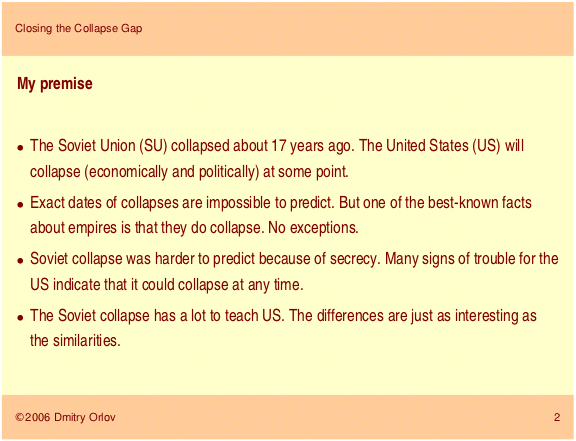
Good evening, ladies and gentlemen. I am not an expert or a scholar or an activist. I am more of an eye-witness. I watched the Soviet Union collapse, and I have tried to put my observations into a concise message. I will leave it up to you to decide just how urgent a message it is.

My talk tonight is about the lack of collapse-preparedness here in the United States. I will compare it with the situation in the Soviet Union, prior to its collapse. The rhetorical device I am going to use is the “Collapse Gap” – to go along with the Nuclear Gap, and the Space Gap, and various other superpower gaps that were fashionable during the Cold War.


Slide [2] The subject of economic collapse is generally a sad one. But I am an optimistic, cheerful sort of person, and I believe that, with a bit of preparation, such events can be taken in stride. As you can probably surmise, I am actually rather keen on observing economic collapses. Perhaps when I am really old, all collapses will start looking the same to me, but I am not at that point yet.

And this next one certainly has me intrigued. From what I’ve seen and read, it seems that there is a fair chance that the U.S. economy will collapse sometime within the foreseeable future. It also would seem that we won’t be particularly well-prepared for it. As things stand, the U.S. economy is poised to perform something like a disappearing act. And so I am eager to put my observations of the Soviet collapse to good use.


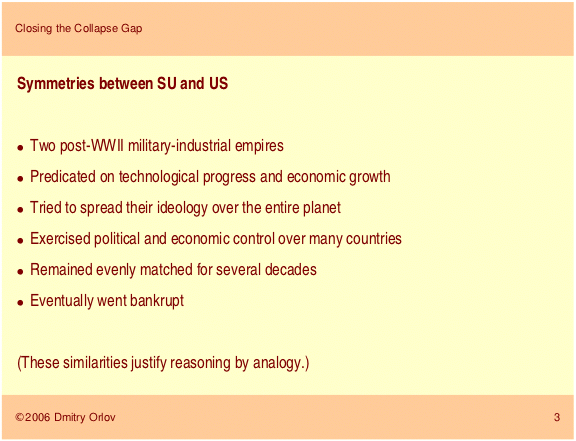
Slide [3] I anticipate that some people will react rather badly to having their country compared to the USSR. I would like to assure you that the Soviet people would have reacted similarly, had the United States collapsed first. Feelings aside, here are two 20th century superpowers, who wanted more or less the same things – things like technological progress, economic growth, full employment, and world domination – but they disagreed about the methods. And they obtained similar results – each had a good run, intimidated the whole planet, and kept the other scared. Each eventually went bankrupt.


Slide [4] The USA and the USSR were evenly matched in many categories, but let me just mention four.

The Soviet manned space program is alive and well under Russian management, and now offers first-ever space charters. The Americans have been hitching rides on the Soyuz while their remaining spaceships sit in the shop.

The arms race has not produced a clear winner, and that is excellent news, because Mutual Assured Destruction remains in effect. Russia still has more nuclear warheads than the US, and has supersonic cruise missile technology that can penetrate any missile shield, especially a nonexistent one.

The Jails Race once showed the Soviets with a decisive lead, thanks to their innovative GULAG program. But they gradually fell behind, and in the end the Jails Race has been won by the Americans, with the highest percentage of people in jail ever.

The Hated Evil Empire Race is also finally being won by the Americans. It’s easy now that they don’t have anyone to compete against.


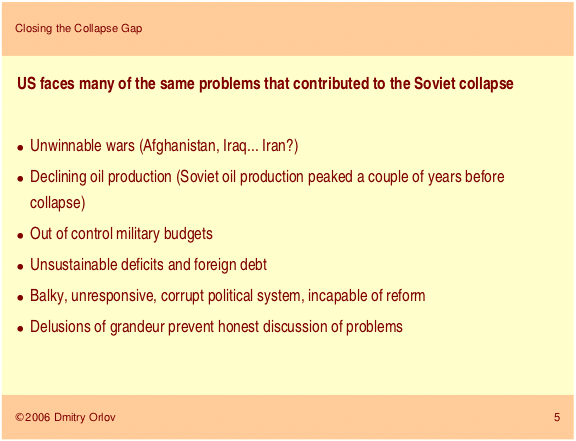
Slide [5] Continuing with our list of superpower similarities, many of the problems that sunk the Soviet Union are now endangering the United States as well. Such as a huge, well-equipped, very expensive military, with no clear mission, bogged down in fighting Muslim insurgents. Such as energy shortfalls linked to peaking oil production. Such as a persistently unfavorable trade balance, resulting in runaway foreign debt. Add to that a delusional self-image, an inflexible ideology, and an unresponsive political system.


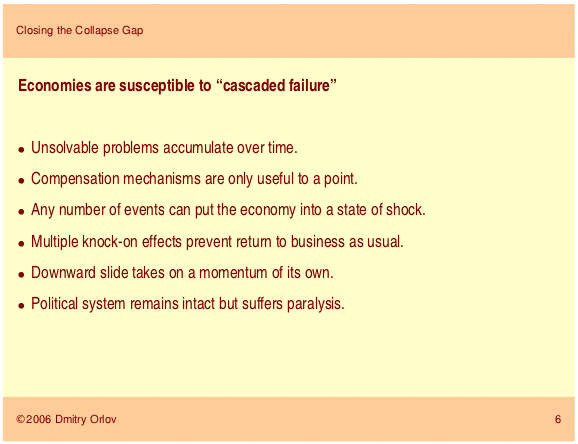
Slide [6] An economic collapse is amazing to observe, and very interesting if described accurately and in detail. A general description tends to fall short of the mark, but let me try. An economic arrangement can continue for quite some time after it becomes untenable, through sheer inertia. But at some point a tide of broken promises and invalidated assumptions sweeps it all out to sea. One such untenable arrangement rests on the notion that it is possible to perpetually borrow more and more money from abroad, to pay for more and more energy imports, while the price of these imports continues to double every few years. Free money with which to buy energy equals free energy, and free energy does not occur in nature. This must therefore be a transient condition. When the flow of energy snaps back toward equilibrium, much of the US economy will be forced to shut down.


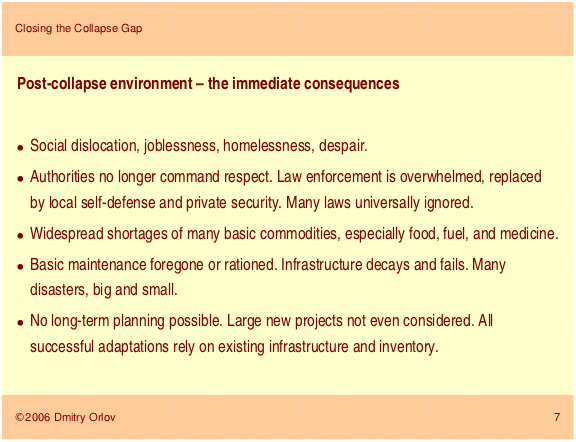
Slide [7] I’ve described what happened to Russia in some detail in one of my articles, which is available on SurvivingPeakOil.com. I don’t see why what happens to the United States should be entirely dissimilar, at least in general terms. The specifics will be different, and we will get to them in a moment. We should certainly expect shortages of fuel, food, medicine, and countless consumer items, outages of electricity, gas, and water, breakdowns in transportation systems and other infrastructure, hyperinflation, widespread shutdowns and mass layoffs, along with a lot of despair, confusion, violence, and lawlessness. We definitely should not expect any grand rescue plans, innovative technology programs, or miracles of social cohesion.


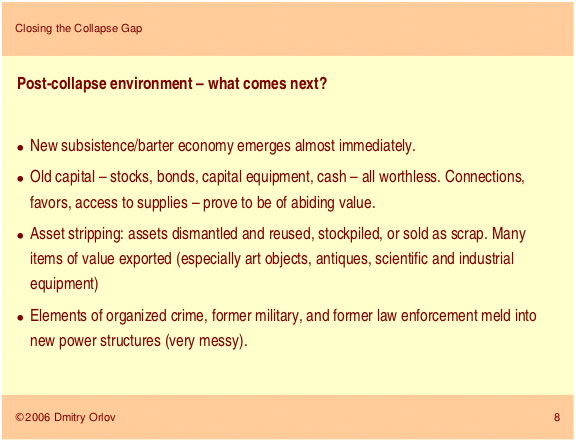
Slide [8] When faced with such developments, some people are quick to realize what it is they have to do to survive, and start doing these things, generally without anyone’s permission. A sort of economy emerges, completely informal, and often semi-criminal. It revolves around liquidating, and recycling, the remains of the old economy. It is based on direct access to resources, and the threat of force, rather than ownership or legal authority. People who have a problem with this way of doing things, quickly find themselves out of the game.

These are the generalities. Now let’s look at some specifics.


Slide [9] One important element of collapse-preparedness is making sure that you don’t need a functioning economy to keep a roof over your head. In the Soviet Union, all housing belonged to the government, which made it available directly to the people. Since all housing was also built by the government, it was only built in places that the government could service using public transportation. After the collapse, almost everyone managed to keep their place.

In the United States, very few people own their place of residence free and clear, and even they need an income to pay real estate taxes. People without an income face homelessness. When the economy collapses, very few people will continue to have an income, so homelessness will become rampant. Add to that the car-dependent nature of most suburbs, and what you will get is mass migrations of homeless people toward city centers.


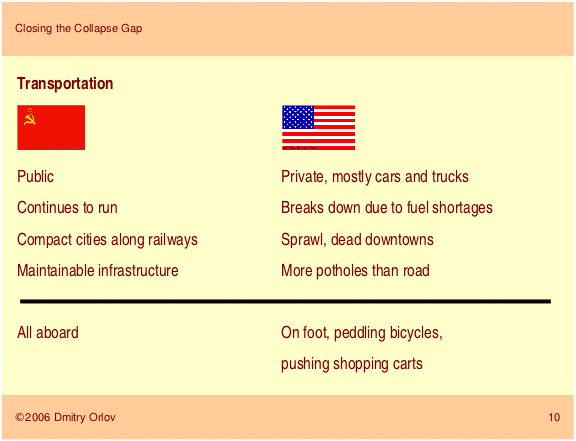
Slide [10] Soviet public transportation was more or less all there was, but there was plenty of it. There were also a few private cars, but so few that gasoline rationing and shortages were mostly inconsequential. All of this public infrastructure was designed to be almost infinitely maintainable, and continued to run even as the rest of the economy collapsed.

The population of the United States is almost entirely car-dependent, and relies on markets that control oil import, refining, and distribution. They also rely on continuous public investment in road construction and repair. The cars themselves require a steady stream of imported parts, and are not designed to last very long. When these intricately interconnected systems stop functioning, much of the population will find itself stranded.


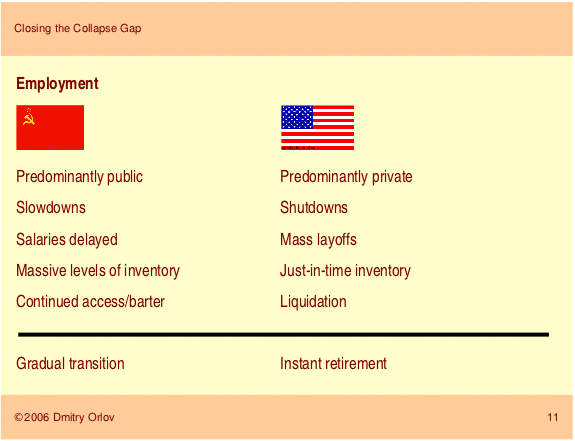
Slide [11] Economic collapse affects public sector employment almost as much as private sector employment, eventually. Because government bureaucracies tend to be slow to act, they collapse more slowly. Also, because state-owned enterprises tend to be inefficient, and stockpile inventory, there is plenty of it left over, for the employees to take home, and use in barter. Most Soviet employment was in the public sector, and this gave people some time to think of what to do next.

Private enterprises tend to be much more efficient at many things. Such laying off their people, shutting their doors, and liquidating their assets. Since most employment in the United States is in the private sector, we should expect the transition to permanent unemployment to be quite abrupt for most people.


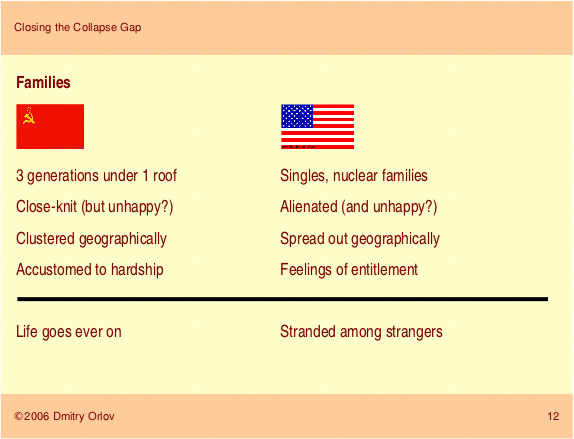
Slide [12] When confronting hardship, people usually fall back on their families for support. The Soviet Union experienced chronic housing shortages, which often resulted in three generations living together under one roof. This didn’t make them happy, but at least they were used to each other. The usual expectation was that they would stick it out together, come what may.

In the United States, families tend to be atomized, spread out over several states. They sometimes have trouble tolerating each other when they come together for Thanksgiving, or Christmas, even during the best of times. They might find it difficult to get along, in bad times. There is already too much loneliness in this country, and I doubt that economic collapse will cure it.


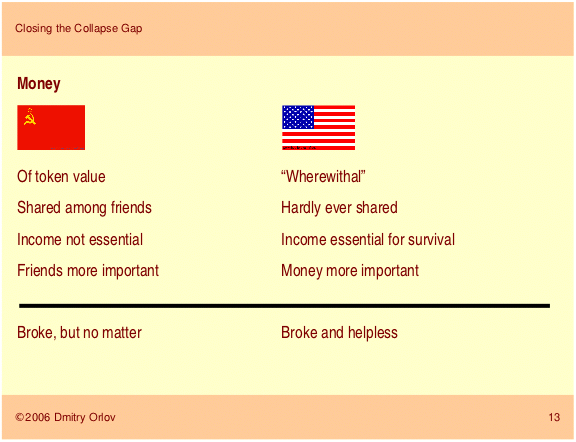
Slide [13] To keep evil at bay, Americans require money. In an economic collapse, there is usually hyperinflation, which wipes out savings. There is also rampant unemployment, which wipes out incomes. The result is a population that is largely penniless.

In the Soviet Union, very little could be obtained for money. It was treated as tokens rather than as wealth, and was shared among friends. Many things – housing and transportation among them – were either free or almost free.


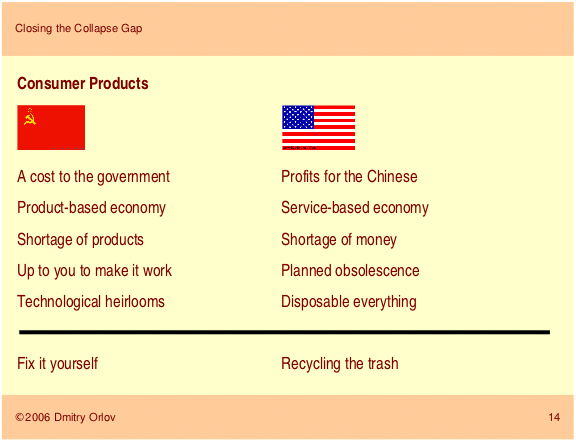
Slide [14] Soviet consumer products were always an object of derision – refrigerators that kept the house warm – and the food, and so on. You’d be lucky if you got one at all, and it would be up to you to make it work once you got it home. But once you got it to work, it would become a priceless family heirloom, handed down from generation to generation, sturdy, and almost infinitely maintainable.

In the United States, you often hear that something “is not worth fixing.” This is enough to make a Russian see red. I once heard of an elderly Russian who became irate when a hardware store in Boston wouldn’t sell him replacement bedsprings: “People are throwing away perfectly good mattresses, how am I supposed to fix them?”

Economic collapse tends to shut down both local production and imports, and so it is vitally important that anything you own wears out slowly, and that you can fix it yourself if it breaks. Soviet-made stuff generally wore incredibly hard. The Chinese-made stuff you can get around here – much less so.


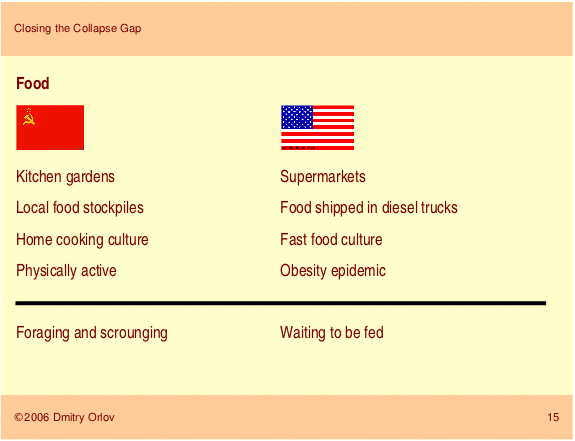
Slide [15] The Soviet agricultural sector was notoriously inefficient. Many people grew and gathered their own food even in relatively prosperous times. There were food warehouses in every city, stocked according to a government allocation scheme. There were very few restaurants, and most families cooked and ate at home. Shopping was rather labor-intensive, and involved carrying heavy loads. Sometimes it resembled hunting – stalking that elusive piece of meat lurking behind some store counter. So the people were well-prepared for what came next.

In the United States, most people get their food from a supermarket, which is supplied from far away using refrigerated diesel trucks. Many people don’t even bother to shop and just eat fast food. When people do cook, they rarely cook from scratch. This is all very unhealthy, and the effect on the nation’s girth, is visible, clear across the parking lot. A lot of the people, who just waddle to and from their cars, seem unprepared for what comes next. If they suddenly had to start living like the Russians, they would blow out their knees.


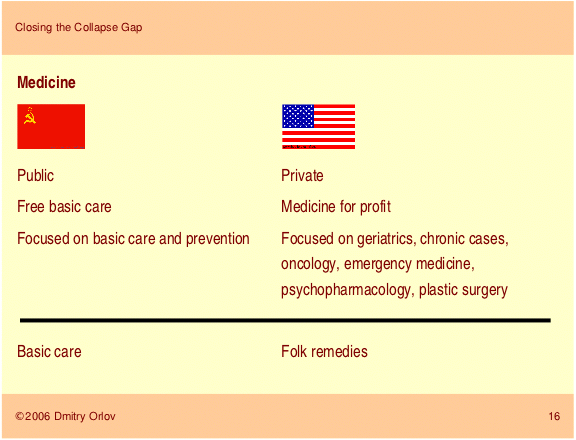
Slide [16] The Soviet government threw resources at immunization programs, infectious disease control, and basic care. It directly operated a system of state-owned clinics, hospitals, and sanatoriums. People with fatal ailments or chronic conditions often had reason to complain, and had to pay for private care – if they had the money.

In the United States, medicine is for profit. People seems to think nothing of this fact. There are really very few fields of endeavor to which Americans would deny the profit motive. The problem is, once the economy is removed, so is the profit, along with the services it once helped to motivate.


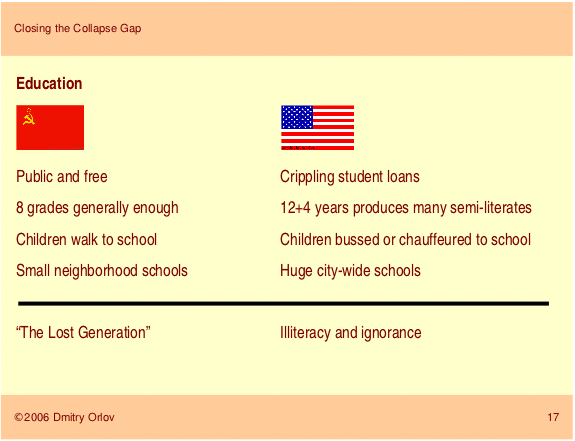
Slide [17] The Soviet education system was generally quite excellent. It produced an overwhelmingly literate population and many great specialists. The education was free at all levels, but higher education sometimes paid a stipend, and often provided room and board. The educational system held together quite well after the economy collapsed. The problem was that the graduates had no jobs to look forward to upon graduation. Many of them lost their way.

The higher education system in the United States is good at many things – government and industrial research, team sports, vocational training… Primary and secondary education fails to achieve in 12 years what Soviet schools generally achieved in 8. The massive scale and expense of maintaining these institutions is likely to prove too much for the post-collapse environment. Illiteracy is already a problem in the United States, and we should expect it to get a lot worse.


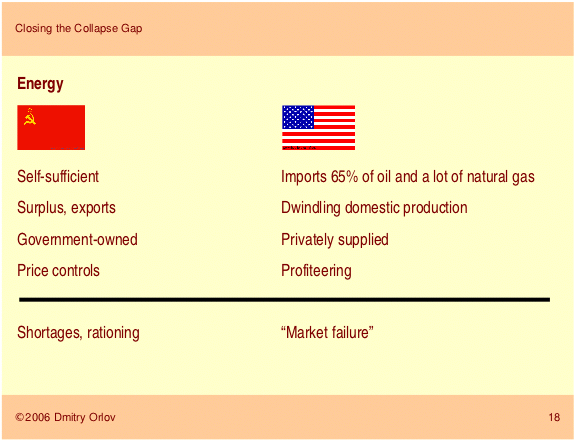
Slide [18] The Soviet Union did not need to import energy. The production and distribution system faltered, but never collapsed. Price controls kept the lights on even as hyperinflation raged.

The term “market failure” seems to fit the energy situation in the United States. Free markets develop some pernicious characteristics when there are shortages of key commodities. During World War II, the United States government understood this, and successfully rationed many things, from gasoline to bicycle parts. But that was a long time ago. Since then, the inviolability of free markets has become an article of faith.


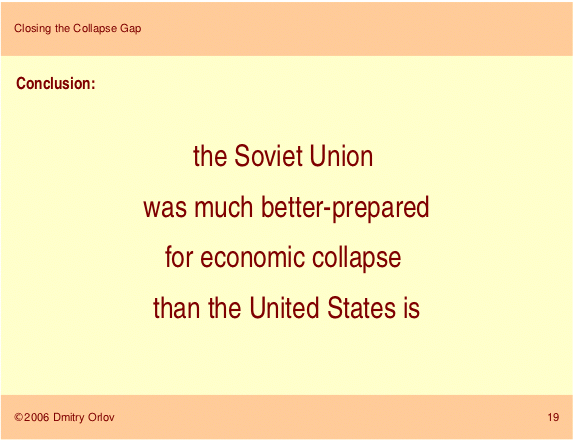
Slide [19] My conclusion is that the Soviet Union was much better-prepared for economic collapse than the United States is.

I have left out two important superpower asymmetries, because they don’t have anything to do with collapse-preparedness. Some countries are simply luckier than others. But I will mention them, for the sake of completeness.

In terms of racial and ethnic composition, the United States resembles Yugoslavia more than it resembles Russia, so we shouldn’t expect it to be as peaceful as Russia was, following the collapse. Ethnically mixed societies are fragile and have a tendency to explode.

In terms of religion, the Soviet Union was relatively free of apocalyptic doomsday cults. Very few people there wished for a planet-sized atomic fireball to herald the second coming of their savior. This was indeed a blessing.


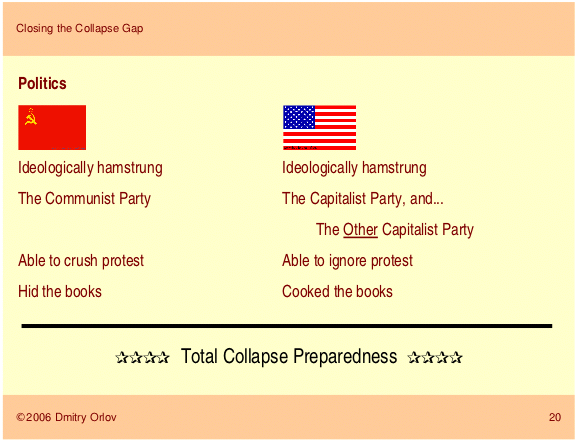
Slide [20] One area in which I cannot discern any Collapse Gap is national politics. The ideologies may be different, but the blind adherence to them couldn’t be more similar.

It is certainly more fun to watch two Capitalist parties go at each other than just having the one Communist party to vote for. The things they fight over in public are generally symbolic little tokens of social policy, chosen for ease of public posturing. The Communist party offered just one bitter pill. The two Capitalist parties offer a choice of two placebos. The latest innovation is the photo finish election, where each party buys 50% of the vote, and the result is pulled out of statistical noise, like a rabbit out of a hat.

The American way of dealing with dissent and with protest is certainly more advanced: why imprison dissidents when you can just let them shout into the wind to their heart’s content?

The American approach to bookkeeping is more subtle and nuanced than the Soviet. Why make a state secret of some statistic, when you can just distort it, in obscure ways? Here’s a simple example: inflation is “controlled” by substituting hamburger for steak, in order to minimize increases to Social Security payments.


Slide [21] Many people expend a lot of energy protesting against their irresponsible, unresponsive government. It seems like a terrible waste of time, considering how ineffectual their protests are. Is it enough of a consolation for them to be able to read about their efforts in the foreign press? I think that they would feel better if they tuned out the politicians, the way the politicians tune them out. It’s as easy as turning off the television set. If they try it, they will probably observe that nothing about their lives has changed, nothing at all, except maybe their mood has improved. They might also find that they have more time and energy to devote to more important things.


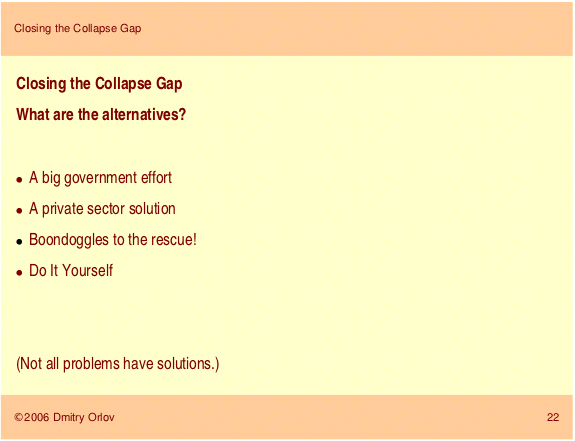
Slide [22] I will now sketch out some approaches, realistic and otherwise, to closing the Collapse Gap. My little list of approaches might seem a bit glib, but keep in mind that this is a very difficult problem. In fact, it’s important to keep in mind that not all problems have solutions. I can promise you that we will not solve this problem tonight. What I will try to do is to shed some light on it from several angles.


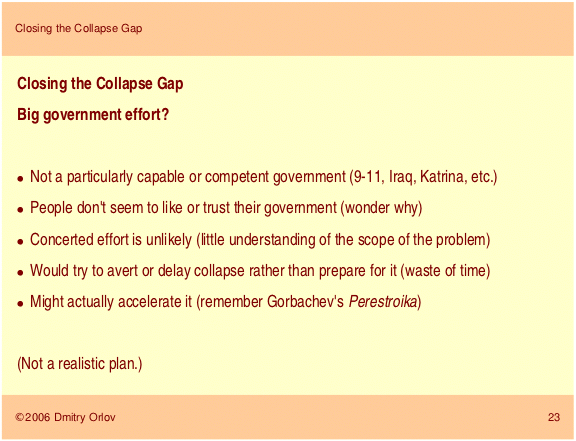
Slide [23] Many people rail against the unresponsiveness and irresponsibility of the government. They often say things like “What is needed is…” plus the name of some big, successful government project from the glorious past – the Marshall Plan, the Manhattan Project, the Apollo program. But there is nothing in the history books about a government preparing for collapse. Gorbachev’s “Perestroika” is an example of a government trying to avert or delay collapse. It probably helped speed it along.


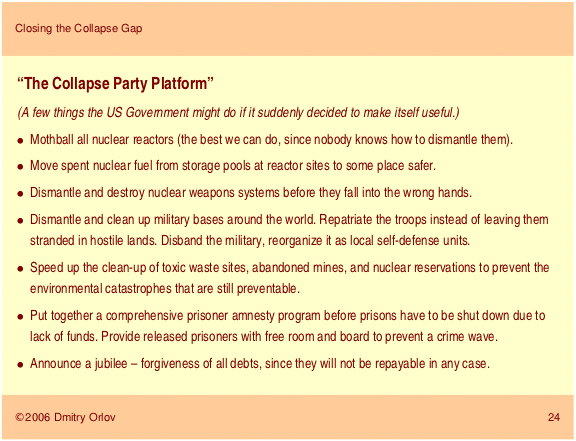
Slide [24] There are some things that I would like the government to take care of in preparation for collapse. I am particularly concerned about all the radioactive and toxic installations, stockpiles, and dumps. Future generations are unlikely to able to control them, especially if global warming puts them underwater. There is enough of this muck sitting around to kill off most of us. I am also worried about soldiers getting stranded overseas – abandoning one’s soldiers is among the most shameful things a country can do. Overseas military bases should be dismantled, and the troops repatriated. I’d like to see the huge prison population whittled away in a controlled manner, ahead of time, instead of in a chaotic general amnesty. Lastly, I think that this farce with debts that will never be repaid, has gone on long enough. Wiping the slate clean will give society time to readjust. So, you see, I am not asking for any miracles. Although, if any of these things do get done, I would consider it a miracle.


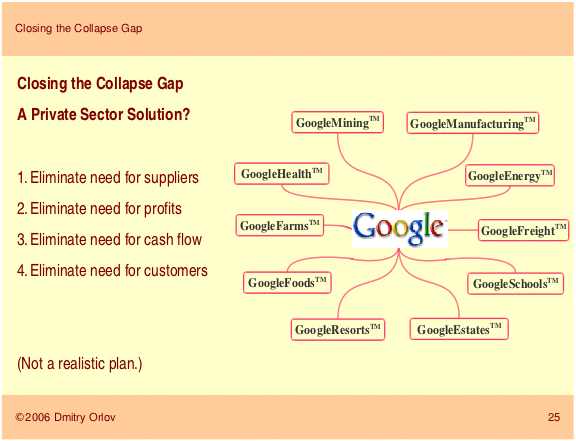
Slide [25] A private sector solution is not impossible; just very, very unlikely. Certain Soviet state enterprises were basically states within states. They controlled what amounted to an entire economic system, and could go on even without the larger economy. They kept to this arrangement even after they were privatized. They drove Western management consultants mad, with their endless kindergartens, retirement homes, laundries, and free clinics. These weren’t part of their core competency, you see. They needed to divest and to streamline their operations. The Western management gurus overlooked the most important thing: the core competency of these enterprises lay in their ability to survive economic collapse. Maybe the young geniuses at Google can wrap their heads around this one, but I doubt that their stockholders will.


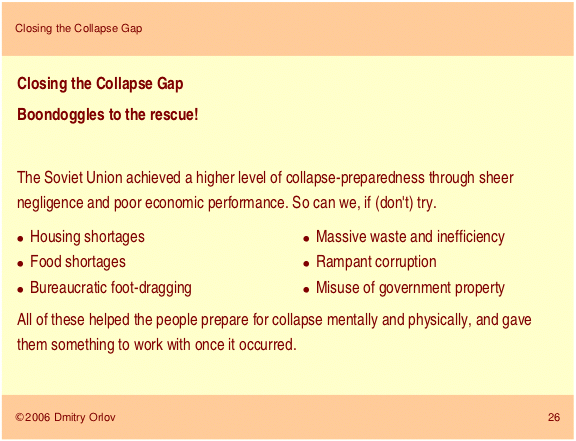
Slide [26] It’s important to understand that the Soviet Union achieved collapse-preparedness inadvertently, and not because of the success of some crash program. Economic collapse has a way of turning economic negatives into positives. The last thing we want is a perfectly functioning, growing, prosperous economy that suddenly collapses one day, and leaves everybody in the lurch. It is not necessary for us to embrace the tenets of command economy and central planning to match the Soviet lackluster performance in this area. We have our own methods, that are working almost as well. I call them “boondoggles.” They are solutions to problems that cause more problems than they solve.

Just look around you, and you will see boondoggles sprouting up everywhere, in every field of endeavor: we have military boondoggles like Iraq, financial boondoggles like the doomed retirement system, medical boondoggles like private health insurance, legal boondoggles like the intellectual property system. The combined weight of all these boondoggles is slowly but surely pushing us all down. If it pushes us down far enough, then economic collapse, when it arrives, will be like falling out of a ground floor window. We just have to help this process along, or at least not interfere with it. So if somebody comes to you and says “I want to make a boondoggle that runs on hydrogen” – by all means encourage him! It’s not as good as a boondoggle that burns money directly, but it’s a step in the right direction.


Slide [27] Certain types of mainstream economic behavior are not prudent on a personal level, and are also counterproductive to bridging the Collapse Gap. Any behavior that might result in continued economic growth and prosperity is counterproductive: the higher you jump, the harder you land. It is traumatic to go from having a big retirement fund to having no retirement fund because of a market crash. It is also traumatic to go from a high income to little or no income. If, on top of that, you have kept yourself incredibly busy, and suddenly have nothing to do, then you will really be in rough shape.

Economic collapse is about the worst possible time for someone to suffer a nervous breakdown, yet this is what often happens. The people who are most at risk psychologically are successful middle-aged men. When their career is suddenly over, their savings are gone, and their property worthless, much of their sense of self-worth is gone as well. They tend to drink themselves to death and commit suicide in disproportionate numbers. Since they tend to be the most experienced and capable people, this is a staggering loss to society.

If the economy, and your place within it, is really important to you, you will be really hurt when it goes away. You can cultivate an attitude of studied indifference, but it has to be more than just a conceit. You have to develop the lifestyle and the habits and the physical stamina to back it up. It takes a lot of creativity and effort to put together a fulfilling existence on the margins of society. After the collapse, these margins may turn out to be some of the best places to live.


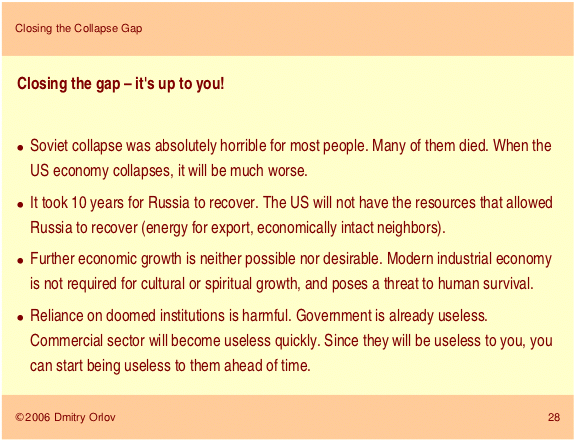
Slide [28] I hope that I didn’t make it sound as if the Soviet collapse was a walk in the park, because it was really quite awful in many ways. The point that I do want to stress is that when this economy collapses, it is bound to be much worse. Another point I would like to stress is that collapse here is likely to be permanent. The factors that allowed Russia and the other former Soviet republics to recover are not present here.

In spite of all this, I believe that in every age and circumstance, people can sometimes find not just a means and a reason to survive, but enlightenment, fulfillment, and freedom. If we can find them even after the economy collapses, then why not start looking for them now?

Saturday, March 31, 2018

The Incomparable Dmitry Orlov

As I've said before, Dmitry Orlov explains the world like no-one else can. 
Support him by reading his work at Patreon.
Here are a few of his somewhat out-of-date posts, to incentivize you to do so.

Sanctions, Schmantions! Dmitry Orlov. Jan. 16, 2018.

Whatever pagan deity happens to be in charge of weather this winter seems to be playing a joke on the Americans. You don’t believe in global warming? Fine, why don’t we have Muscovites enjoy the rare sight of pussy willows in bloom in January while letting you freeze? The result has been brutal. Not only have the very low temperatures, in a region where some people seem to believe that a baseball cap qualifies as winter headgear, exacerbated an already very bad flu season (the standard flu vaccine is only 10% effective against this year’s strain) but they have caused natural gas prices to spike up to $6.4 per cubic meter, testing a four-year-old record and breaking above the price in Asia.

The Russians do believe in global warming. It has opened up Arctic sea lanes to year-round navigation, supported by Russia’s new icebreaker fleet. They provide shortcuts to world’s sea freight while getting around strategic chokepoints such as the Straits of Malacca, the Suez Canal and the Straits of Gibraltar. The Russians have also taken advantage of the warming Arctic to open the region to oil and gas exploration and production. Late last year the ambitious new Yamal liquefied natural gas project opened to great fanfare. An entire new city was built above the Arctic circle. Putin himself flew in and gave the order to start pumping. A new fleet of ice-capable LNG tankers is being readied to take the gas to customers anywhere in the world.

Back in 2012 I wrote that there really isn’t a global natural gas market. Well, now there is! (But everything else I wrote then pretty much still stands.) In the meantime, the US went all-in on fracking—an expensive and environmentally damaging technique for exploiting the marginal hydrocarbons present in shale. This scheme has resulted in temporarily increased oil and gas volumes and in astronomical levels of indebtedness for the companies involved, which are now locked into a Ponzi scheme scenario, fighting for their lives while continuing to produce at a loss. But the temporarily increased volumes have allowed the Americans to dream that they will be able to become purveyors of natural gas to Europe and beyond, squeezing out Russia’s Gazprom. To this end, in the middle of last year the Trump administration imposed a set of sanctions designed to stop Russia from growing its share of the European gas market (which currently stands at 40%) to great consternation from Germany, Austria and others, which see no benefit to being forced to buy expensive, unreliable American gas.

At the time, I didn’t think that this scheme would work, and now it turns out that I was right. Not only are US gas deliveries to Europe turning out to be something of a joke, but the very first tanker load of LNG from Russia’s Yamal project is going to… Boston, due to arrive at the gasification plant in Everett on January 22. Apparently, the Trump administration is happy to let the Europeans shiver in the dark, deprived of access to Russian gas, but as far as the US itself is concerned—sanctions, shmanctions! The embarrassing fact that this episode pretty much puts paid to the idea that US LNG exports could compete with the world’s largest gas producer Gazprom can easily be dealt with by… refusing to talk about Russian gas imports and instead talking about importing people from “sh*thole countries.”

But is this a singular event, caused by record-breaking cold temperatures, or a sign of things to come? I believe that it is the way of the future. For one thing, the sanctions regime isn’t holding. The US is not the only “exceptional nation” as far as breaking its own sanctions: the British, when faced with gas shortages, have also chosen to ignore them, eager to become Yamal’s new customers. After such a ludicrous performance, why should anyone, anywhere in the world, take the US administration’s pronouncements seriously? At this point, the Americans themselves will probably prefer to keep quiet about anyone violating their sanctions, for fear of being laughed out of court. After all, there are far easier ways to dominate the news cycle; for instance, simply by saying something that gives people the excuse to act offended.

But while the Americans are keeping busy by acting offended, there is another, much bigger issue looming on the horizon. Do you think that Peak Oil is dead? Oh, then how about Global Warming?… The fact is, 2017 was nothing short of disastrous as far as oil and gas exploration. Geologists were only able to find replacement for 11% of the hydrocarbons that were produced over the course of the year. This is the worst result ever! Nothing of this sort has happened since the 1940s, when the world was too busy fighting a world war to engage in oil and gas exploration. What this means for energy prices is anyone’s guess: as I explained in this article, the conflict between prices higher than consumers can afford but lower than production costs will bankrupt both consumers and producers, but not all of them and not at the same time. But what is certain is that if this long-term trend continues (and why wouldn’t it?) serious oil and gas production shortfalls will start to occur within a decade.

What is particularly notable about this dismal result is that it is not in the least upsetting to the Russians. This is because most of the newly discovered oil and gas is in Russia. Over the course of last year, Russia was able to grow its oil reserves by a billion tonnes, 350 million of which can be produced without investing in new technology. In comparison, last year Russia produced 560 million tonnes. Thus, depending on its level of technology investment, Russia has either broken even or gotten ahead in terms of its ability to maintain and increase its oil production. A similar situation obtains with regard to natural gas: over last year, Russia was able to grow its reserves by 1.5 trillion cubic meters. This positive trend is likely to continue, because when it comes to exploring its vast reserves in the rapidly warming Arctic, Russia is just getting started.

Ever since the 2014 coup in the Ukraine, which was followed by the imposition of anti-Russian sanctions, there has been a great deal of thought given to what it would take for these various sanctions to be lifted. And now it seems that we have the answer: all it takes is a cold spell. The UK and the US are good examples, but here is an even better one: cold weather has caused the Ukrainian government to lift its sanctions against Russia’s Yuzhtrans and to resume importing Russian anthracite. The Ukraine is a sort of mini-me to America’s Dr. Evil, who tells it that its job is to hate Russia, and so it does its best with its own anti-Russian sanctions, all the “alternative facts” you can eat and ridiculous hate speech. But freezing to death in the dark would be more than it bargained for, and so it buys Russian nuclear fuel, and now Russian coal too.

But that is now; in the coming years, as hydrocarbon reserves outside of Russia are draw down, production shortfalls will become common and markets will break. Then governments throughout much of the world, perhaps even including the US, will come to the realization that they simply can’t get by without Russian energy. Eager to keep the lights on and the pipes from bursting, they will recognize that it is in their own interests to curb their Russophobia, go light on the anti-Russian rhetoric, either lift or simply ignore the sanctions, and simply try to make the best deal with Russia that they can.


Competitive Lying. Dmitry Orlov. Feb. 15, 2018.

No one has ever claimed that it is upstanding, sportsmanlike behavior to tell lies. Outside of some very special occupations—spy, special agent, etc.—lying is almost always a manifestation of failure. Even in its relatively innocuous forms, such as braggadocio and puffery, showboating and grandstanding, it is a poor substitute for having a favorable truth to tell. Then there are the various types of dissimulation, misdirection, concealment and omission; whether motivated by the wish to spare someone’s feelings or to avoid a scandal, the decision to lie is rarely a happy one. Finally, there are those who produce and circulate false and misleading information. When society functions normally, such people are caught, sooner or later, their reputations are ruined, their careers are terminated and the damage they caused is repaired. In a normally functioning society, enough of its members have a solid grasp of facts, are able to reason logically, and have sufficient faith in journalistic and other professional ethics, in the impartiality of public officials, and in the scientific method, to allow them to believe that truth does exist and that they are capable of obtaining it.

But such normal, stolid, matter-of-fact forms of social behavior seem a bit boring, perhaps even fuddy-duddyish, and are unlikely to hold the attention of modern smartphone-addicted whipper-snappers. Wouldn’t it be a lot more popular, modern and fun if the manufacturing of lies for financial and political gain become an accepted form of public behavior?

What if lying become incentivized to the point where it turned into a national sport? Who needs journalistic and professional ethics when less then a third of Americans polled say that they trust the national media? Why should public officials remain impartial when everybody knows that the vast majority of politically engaged Americans have formed two camps that openly hate and want to subvert each other? And who needs the scientific method and other forms of objective inquiry based on empirical evidence when we can rely on rumors circulated on social media as the ultimate arbiter of truth—because of “the wisdom of crowds” or some such?

And here is the most provocative question of all: what we are already living in such a world? How would we know if that were the case? We certainly shouldn’t attempt to base our assessment on anything as unreliable as “known facts” or on our personal notions of what is true: if our world has indeed shifted into the mode of competitive lying, then there would be multiple sets of alternative facts floating about, all of them fake to one extent or another, and choosing one set over another could be regarded as a matter of personal prejudice. Do you see the basic contradiction? The old methods of epistemological exploration would no longer apply to the new world of competitive lying. Therefore, we need to find a new method with which to ascertain whether the world we currently inhabit is the old one of indisputable truths, or the new one of competing lies.

I would like to suggest that we need to stop looking at specifics and instead look at general, systemic behaviors. In the old world of epistemological exploration, theories and narratives are found invalid and dismissed when evidence is discovered that contradicts them. This is because an invalid theory or narrative is not seen as valuable; it is a mere encumbrance, and possibly an embarrassment. But in the new world of competitive lying, theories and narratives are neither valid nor invalid. You may think that the “flat earth” nonsense circulated on Facebook is preposterous, but it’s still popular with some people (I’ll explain later why that is) and therefore it persists. Lies are no longer defective merchandise to be dumped; they are now stock in trade or an investment, endowed with valuable properties such as audience share and brand loyalty. Therefore, whenever some facts come to the surface that contradict one’s favored theory or narrative, the response is not to reexamine but to produce a flood of “alternative facts” (obtained, preferably, from some secret source, so that their provenance cannot be questioned) and to put some extra effort into making one’s theory or narrative stick.

In the old world, to be successful is to formulate theories and create narratives that are commonly regarded as true. This is how the edifice of the one and only consensual reality inhabited by all of the rational, sane people who are intelligent enough to understand them is built, brick by brick, leaving outside all of the irrational, insane, ignorant and stupid people (who may be numerous but who are successfully prevented from having much of an effect on society). But in the new world of competitive lying, success is defined as one’s ability to make one’s lies stick. And the best way to make one’s lies stick is, of course, by lying about them.

So much for theory; now, let’s look at a few examples. All of these mention Russia, because my privileged position behind the one way mirror that prevents Americans from seeing much of anything that goes on outside their own borders happens to be inside Russia.

1. While acting as Obama’s Secretary of State, Hillary Clinton colluded with Russians as part of a corrupt scheme to give Russian interests a large share of the uranium market in the US. When she then ran for president, her campaign saw this collusion as a major potential problem, and hatched a plan to accuse the Trump campaign of colluding with the Russians instead, to draw attention away from Clinton. To this end, her campaign purchased a fabricated dossier (the Steele dossier) which smeared Trump. This dossier was then used by the FBI to obtain warrants to spy on the Trump campaign, and to also appoint Mueller as a special investigator, to look for signs of collusion. If we were in the old world, such evidence would quickly undermine the “Trump colluded with the Russians” narrative. But in the new world of competitive lying it goes merrily on because, facts be damned, is so darn popular with people who hate Trump!

2. A certain character by the name of Rodchenkov once ran Russia’s anti-doping agency—until he and his sister got caught selling forbidden drugs to athletes. He avoided jail because he was diagnosed with schizophrenia and had attempted suicide. Later he ran away to the US and became an FBI informant, spinning a tale about Russian state-sponsored doping program. Based on his evidence, numerous Russian athletes were (temporarily) stripped of their Olympic medals and (temporarily) banned for life from participating in the Olympics. These decisions were overturned due to lack of evidence. The International Olympic Committee chairman Thomas Bach then publicly deplored this decision—because lack of evidence is not a good reason to overturn a decision? Another IOC representative then gave an interview in which he defended the decision to not allow Russian athletes who are known to be clean to compete in the Winter Olympics in South Korea by saying that lack of proof of their guilt does not mean that they are innocent; they may still be suspicious, he said—because they are Russian? In the old world where the rules of evidence apply, such developments would be devastatingly embarrassing to the IOC, disqualifying many officials from their positions. But in the new world of competitive lying the “Russian doping” narrative still commands a considerable mindshare (among the most heavily doped population on the planet, one might add) and is being kept alive.

3. There is a certain country in the world that spends a huge amount of money on its military. Its military claims to be able to do a great many things, and to be able to train and equip other militaries to do a great many things. But the preponderance of evidence is that all of them are only capable of doing exactly one thing: drop bombs. Whatever else they try to do, they always fail. That military is the in the US. Just recently it obliterated two major cities: Mosul and Raqqa now lay in ruins. These are just two of the latest examples, but there are plenty of others. The US has dropped bombs on numerous countries—North Korea, Vietnam, Cambodia, Laos, Serbia/Kosovo, Iraq, Afghanistan… probably more bombs than all other nations combined, including two nuclear ones on Japan—and based on all of this evidence it is impossible not to conclude that all that bombing is ineffective in achieving peace on terms the US would like. The rest of the world knows this extremely well, and knows that there is exactly one defense technology that’s needed in order to completely block and paralyze the US military: area denial technology that includes electronic warfare and air defense systems which Russia is happy to supply. (Having a nuclear deterrent helps too, and North Korea knows this.) The Americans know that they are facing complete military impotence and, as a Hail Mary pass, are getting ready to spend tens of billions of dollars they don’t have on tactical nuclear weapons, based on the faulty assumption that a nuclear attack can be anything other than suicidal. This evidence, overwhelming though it is, is blocked out by a massive façade of spit-polished, patriotic-sounding barefaced lies. These lies will go on being forcefully thrust on the population until the US, along with its military, collapses in national bankruptcy.

These are just three examples; there is a multitude of others. But they should be enough to sketch out the broad outline of this brave new world of competitive lying. The overall method is as follows: fabricate some fake facts; use them to concoct a narrative, or a theory (or both); then push it as hard as you can. When confronted with evidence that contradicts it, spew forth as many new fake facts as needed to drown it out. If you manage to make your lies stick, you win (for the time being). Of course, denying reality is never a good long-term strategy, but if you keep repeating to yourself that “in the long run, we’re all dead” (which is also a lie) then it sort of works in the short term.

One problem is that even in the brave new world there may be some curmudgeonly people who remain sticklers for facts. These people are clearly behind the times and unfashionable, but they can still ruin the fun for everyone else. This is where flat-earthers, climate change denialists, people who believe that Jesus rode a dinosaur and other deluded yahoos are most helpful: they exist in order to prove that facts don’t matter. Instead of being quashed, they are amplified and empowered. They always win because any serious person who tries to argue with them ends up looking ridiculous—for arguing with imbeciles.

This situation may look hopeless, but don’t despair! The epidemic of competitive lying hasn’t engulfed the entire planet yet. Yes, it has pretty much swept over the US and Canada, and a large part of Western Europe seems to be in a bad way as well, but there remain large parts of the world where lying is still a sin and where irrational, insane, ignorant and stupid people are being successfully prevented from having much of an effect on society.


The world needs more Orlov.


Make Russia Great Again, Through Negligence. Dmitry Orlov. Feb. 20, 2018.

After a year and a half of silence accompanied by much media noise, the Mueller investigation into Trump the Terrible’s collusion with the Russians (and their lord and master the Dread Pirate Putin) in order to steal the election from innocent young Hillary “twinkle-toes” Clinton, Mueller finally laid an egg. He indicted 13 Russians for identity theft and wire fraud. He alleges that they bought some stolen personal info (Social Security numbers, names, birth dates, etc.) on the internet, used these to set up PayPal and Facebook accounts, and then used these to buy Facebook ads in an effort to undermine the American people’s faith in the wholesome goodness of their democracy.

There is no evidence that anyone in the Trump campaign or administration knew that this was happening. There is no evidence that any of the 13 Russians had anything to do with Putin or the Russian government. There is no evidence that anything they did had any measurable effect on the outcome of the election.

There is, however, ample evidence that this indictment will go nowhere.

There is a difference between being indicted and being convicted: a convicted person is proven guilty; an indicted person is protected by the presumption of innocence until convicted. To be convicted in a criminal trial, a person has to be physically present before the court because one has the right to face one’s accusers. A trial held in absentia is automatically a kangaroo court. The 13 Russians are Russian nationals residing in Russia. According to the Russian constitution, Russian citizens cannot be extradited to stand trial in a foreign court, and it seems exceedingly unlikely that they will face criminal charges in Russia based on Mueller’s indictment. Therefore, these 13 Russians have to be presumed innocent—forever.

It’s still possible that one of these Russians will at some point travel abroad, get snatched and shipped off to the US to stand trial, and be convicted of money laundering, identity theft and wire fraud. But the charge of working to undermine the American people’s faith in the wholesome goodness of their democracy would be rather hard to prove, mostly because there isn’t much of it to be found these days. The accusation is a lot like accusing somebody of despoiling an outhouse by crapping in it, along with everyone else, but the outhouse in question had a sign on its door that read “No Russians!” and the 13 Russians just ignored it and crapped in it anyway.

The reason the Outhouse of American Democracy is posted “No Russians!” is because Russia is the enemy. There aren’t any compelling reasons why it should be the enemy, and treating it as such is incredibly foolish and dangerous, but that’s beside the point. Painting Russia as the enemy serves a psychological need rather than a rational one: Americans desperately need some entity onto which they can project their own faults. The US is progressing toward a fascist police state; therefore, Russia is said to be a horrible dictatorship run by Putin. The US traditionally meddles in elections around the world, including Russia; therefore, the Russians are said to meddle in US elections. The US is the most aggressive country on the planet, occupying and bombing dozens of countries; therefore, the Russians are accused of “aggression.” And so on…

If (for whatever stupid reason) Russia is indeed America’s enemy, it stands to reason that the Americans would want to make it weaker rather than stronger. Working to strengthen one’s enemy seems like a poor strategy. And yet that is what has been happening: the last two US administrations—Obama’s and Trump’s—both have been steadfastly aiding and abetting Russia’s rise to greatness. Aiding and abetting the enemy is bad enough by itself, but it would also appear that they have been doing so unwittingly. Thus, if Mueller really had the health and beauty of American democracy in his heart, he would have indicted both the Obama and the Trump administrations for aiding and abetting the enemy through gross negligence. Here is how the indictment would read:

1. The Obama administration falsely accused the government of Syria of carrying out an attack using chemical weapons near Damascus on August 21, 2013 in order to find an excuse to attack and invade Syria. Chemical weapons were in fact used in that incident, but not by the forces controlled by the Syrian government. Since the Syrian government had no interest in either using chemical weapons or in maintaining its chemical weapons stockpile, this gave Russia an opening to negotiate an international deal under which Syria surrendered its entire stockpile of chemical weapons, which were destroyed, and international inspectors subsequently certified Syria as being free of them. This incident showed Russia to be a trustworthy partner, able to peacefully resolve crises through negotiation, raising its stature in the world, and the US to be a rogue state willing to use any means, including the use of chemical weapons against civilians, in order to justify its illegal use of force. Following in Obama’s footsteps, the Trump administration, soon after assuming office, used similar unverified accusations of a Syrian chemical weapons attack to ineffectually bomb a Syrian airbase using Tomahawk missiles.

2. In February 2014 the Obama administration organized and carried out a bloody coup in Kiev, staging a massacre using foreign mercenaries, falsely accusing the Ukraine’s constitutional government of carrying it out, overthrowing it, and installing a puppet regime managed by the CIA and the US State Department. The nature of this regime, which is comprised of oligarchs and criminals allied with neo-Nazi groups, and which has elevated to the status of national heroes certain perpetrators of genocide against Jews, Poles and others during World War II, has been kept hidden from the public in the US. But because Russia and the Ukraine are not ethnically, linguistically, culturally or religiously distinct, and have existed as a single entity through most of their history, most Russians understood what had happened. The chaos and mayhem that followed the putsch gave the Russian government an opening to hold a referendum in Crimea, which was briefly joined to the Ukraine, but which had been part of Russia since 1783, and to re-annex the territory. It also led to armed rebellion in eastern Ukraine and the formation of two de facto independent republics there, making the Ukraine into a semi-defunct state that does not control its own territory. All of these developments led to a tremendous surge of patriotic feeling among Russians, who felt proud of being able to reclaim what they saw as rightfully theirs and felt threatened by seeing the Ukraine once again fall to the fascists. True to form, the Trump administration has continued Obama’s this policy of Making Russia Great Again by providing the Ukrainian military with lethal weapons and advice.

3. Although the Russian annexation of Crimea, based on an overwhelming victory in a popular referendum and a great showing of public support, was impeccably legal in upholding the Crimea’s right to self-determination (unlike NATO previous annexation of Kosovo), the Obama administration saw it fit to impose economic sanctions on Russia in retribution. These sanctions, together with Russia’s counter-sanctions on food exports from the EU, have finally provided the impetus for Russia to break with the past pattern of exporting gas and oil and importing just about everything else, and to embrace the strategy of import replacement. This has allowed Russia to become self-sufficient in many areas, such as oil and gas exploration and production technology, agriculture and many other areas. Although Russia experienced a period of considerable economic difficulty which saw the purchasing power of the population dwindle substantially, Russia’s economy has survived. The popularity of the national leadership did not suffer because most Russians now understand what they are fighting for and, given the barrage of negative news from the Ukraine, who their enemy is, and what would happen to them if they were to show weakness.

4. Although the Trump administration has mostly followed in Obama’s footsteps in Making Russia Great Again, the most recent round of anti-Russian sanctions, which the Trump administration did not impose but only announced, as required by an act of Congress, was inadvertently an act of pure genius. What Trump’s flunkies did was take the Kremlin directory and the Forbes list of Russia’s wealthiest individuals, and put them together into a single list of people. If these sanctions were actually imposed rather than merely threatened, those having any dealings with the individuals on this list would suffer legal repercussions. The brilliance of this plan is in two parts. First, there have been some differences of orientation among the members of the Kremlin administration: some were more US-oriented than others. What this list did was make them look foolish in their hopes of ever appeasing the US. Before, the US had a few lukewarm champions inside the Kremlin; now it has zero. Second, Russia has had a problem with wealthy individuals moving their capital abroad, to Switzerland, to various offshore tax havens, and most notably to the United States, which is the money laundering capital of the world. But now Trump has threatened them with wealth confiscation. At the same time, the Russian government has extended a tax amnesty for those wishing to repatriate their capital. As a result, a flood of money is now reentering the Russian economy, giving it a major boost.

Once you put it all together, the charge against the last two US administrations for Making Russia Great Again by aiding and abetting it, unwittingly and through gross negligence, becomes compelling. There is, of course, no chance at all that anybody will be put on trial for it, but that may not be necessary. As shown by the #MeToo movement, it is no longer necessary in contemporary America to prove a crime; a mere allegation is now sufficient to end careers and to ruin reputations. You can play this game too: of each US policy or initiative announced against Russia, ask yourself: How is it going to help Make Russia Great Again? Because it probably will.


Better Nukes for a Safer Planet. Dmitry Orlov, Club Orlov. March 6, 2018.

A lot of people seem to have lost the thread when it comes to nuclear weapons. They think that nuclear weapons are like other weapons, and are designed to be used in war. But this is pure mental inertia. According to all the evidence available, nuclear weapons are anti-weapons, designed to prevent weapons, nuclear or otherwise, from being used. In essence, if used correctly, nuclear weapons are war suppression devices. Of course, if used incorrectly, they pose a grave risk to all life on Earth. There are other risks to all life on Earth as well, such as runaway global warming from unconstrained burning of hydrocarbons; perhaps we need to invent a weapon or two to prevent that as well.

Some people feel that the mere existence of nuclear weapons guarantees that they will be used as various nuclear-armed countries find themselves financially, economically and politically in extremis. As “proof” of this, they trot out the dramaturgical principle of Chekhov’s Gun. Anton Chekhov wrote: “Если вы говорите в первой главе, что на стене висит ружье, во второй или третьей главе оно должно непременно выстрелить. А если не будет стрелять, не должно и висеть.»” [“If you say in Act I that there is a gun hanging on the wall, then it is a must that in Act II or III it be fired. And if it won’t be fired, it shouldn’t have been hung there in the first place.”]

And if you point out that we are talking about military strategy and geopolitics, not theater, they then quote Shakespeare’s “All the world's a stage, And all the men and women merely players; They have their exits and their entrances…” and believe that it is QED. Now, I happen to agree wholeheartedly with Chekhov, when it comes to dramaturgy, and I agree with the Bard as well, provided we define “the world” as “the world of theater,” from which the worlds of geopolitics and nuclear physics are both dramatically different.

Let me explain it in terms that a drama major would understand. If there is a nuclear bomb hanging on the wall in Act I, then, chances are, it will still be hanging on that wall during the final curtain call. In the meantime, no matter how many other weapons are present on stage during the play, you can be sure that none of them would be used. Or maybe they will be, but then the entire audience would be dead, in which case you should definitely ask for your money back because this was billed as a family-friendly show.

Back in the real world, it is hard to argue that nukes haven’t been useful as deterrents against both conventional and nuclear war. When the Americans dropped nuclear bombs on Hiroshima and Nagasaki, they only did this because they could do so with complete impunity. Had Japan, or an ally of Japan, possessed nuclear weapons at the time, these attacks would not have taken place. There is a considerable body of opinion that the Americans didn’t nuke Japan in order to secure a victory (the Japanese would have surrendered regardless) but to send a message to Joseph Stalin. Stalin got the message, and Soviet scientists and engineers got cracking.

There was an uncomfortable period, before the USSR successfully tested their first atomic bomb, when the Americans were seriously planning to destroy all major Soviet cities using a nuclear strike, but they set these plans aside because they calculated that they didn’t have enough nukes at the time to keep the Red Army from conquering all of Western Europe in retaliation. But in August 29, 1949, when the USSR tested its first atomic bomb, these plans were set aside—not quite permanently, it would later turn out—because even a singular nuclear detonation as a result of a Soviet response to an American first strike, wiping out, say, New York or Washington, would have been too high a price to pay for destroying Russia.

Since then—continuously except for a period between 2002 and two days ago—the ability of nuclear weapons to deter military aggression has remained unquestioned. There were some challenges along the way, but they were dealt with. The Americans saw it fit to threaten the USSR by placing nuclear missiles in Turkey; in response, the USSR placed nuclear missiles in Cuba. The Americans didn’t think that was fair, and the result was the Cuban Missile Crisis. Eventually the Americans were prevailed upon to stand down in Turkey, and the Soviets stood down in Cuba. Another threat to the deterrent power of nuclear weapons was the development of anti-ballistic weapons that could shoot down nuclear-tipped missiles (just the ballistic ones; more on that later). But this was widely recognized to be a bad thing, and a major breakthrough came in 1972, when the USA and the USSR signed the Anti-Ballistic Missile Treaty.

Over this entire period, the principle that kept the peace was Mutual Assured Destruction: neither side would provoke the other to the point of launching a nuclear strike, because such a move was guaranteed to be suicidal. The two sides were reduced to fighting a series of proxy wars in various countries around the world, which were so much the worse for it, but there was no danger of these proxy conflicts erupting into a full-scale nuclear conflagration.

In the meantime, everybody tried to oppose nuclear proliferation, preventing more countries from obtaining access to nuclear weapons technology—with limited success. The cases where these efforts failed testify to the effective deterrent value of nuclear weapons. Saddam Hussein of Iraq didn’t have any “weapons of mass destruction” and ended up hung. Muammar Qaddafi of Libya voluntarily gave up his nuclear program, and ended up tortured to death.

But Pakistan managed to acquire nuclear weapons, and as a result its relations with its traditional nemesis India have become much more polite and cooperative, to the point that in June of 2017 both became full members of Shanghai Cooperation Organization, along with China, Russia and other Eurasian nations. And then North Korea has made some breakthroughs with regard to nuclear bombs and ballistic missiles, and as a result of that the US has been reduced to posturing and futile threats against it while South Korea has expressed some newfound respect for its northern neighbor and is now seeking rapprochement.

In 2002 the prospect of continued nuclear deterrence suffered a major setback when the US pulled out of the ABM treaty. Russia protested this move, and promised an asymmetrical response. American officials ignored this protest, incorrectly thinking that Russia was finished as a nuclear power. Since then, the Americans spent prodigious amounts of money—well into the trillions of dollars—building a ballistic missile defense system. Their goal was simple: make it possible to launch a first strike on Russia, destroying much of its nuclear arsenal; then use the new American ABM systems to destroy whatever Russia does manage to launch in response. On February 2, 2018 the Americans decided that they were ready, and issued a Nuclear Posture Review in which they explicitly reserved the right to use nuclear weapons to prevent Russia from using its nuclear deterrent.

And then, two days ago, all of that came to a happy end when Vladimir Putin gave a speech in which he unveiled several new weapons systems that completely negate the value of US missile defense shield—among other things. That was the response the Russians promised to deliver when the US pulled out of the ABM treaty in 2002. Now, 16 years later, they are done. Russia has rearmed with new weapons that have rendered the ABM treaty entirely irrelevant.

The ABM treaty was about ballistic missiles—ones that are propelled by rockets that boost the missile to close to escape velocity. After that the missile follows a ballistic trajectory—just like an artillery shell or a bullet. That makes its path easy to calculate and the missile easy to intercept. The US missile defense systems rely on the ability to see the missile on radar, calculate its position, direction and velocity, and to launch a missile in response in such a way that the two trajectories intersect. When they cross, the interceptor missile is detonated, knocking out the attacking missile.

None of the new Russian weapons follow ballistic trajectories. The new Sarmat is an ICBM minus the “B”—it maneuvers throughout its flight path and can fly through the atmosphere rather than popping up above it. It has a short boost phase, making it difficult to intercept after launch. It has the range to fly arbitrary paths around the planet—over the south pole, for instance—to reach any point on Earth. And it carries multiple maneuverable hypersonic nuclear-armed reentry vehicles which no existing or planned missile defense system can intercept.

Among other new weapons unveiled two days ago was a nuclear-powered cruise missile which has virtually unlimited range and a nuclear-powered drone submarine which can descend to much larger depths than any existing submarine and moves faster than any existing vessel. There was also a mobile laser cannon in the show, of which very little is known, but they are likely to come in handy when it comes to frying military satellites. All of these are based on physical principles that have never been used before. All of these have passed testing and are going into production; one of them is already being used on active combat duty in the Russian armed forces.

The Russians are now duly proud of their scientists, engineers and soldiers. Their country is safe again; Americans have been stopped in their tracks, their new Nuclear Posture now looking like a severe case of lordosis. This sort of pride is more important than it would seem. Advanced nuclear weapons systems are a bit like secondary sexual characteristics of animals: like the peacock’s tail or the deer’s antlers or the lion’s mane, they are indicative of the health and vigor of a specimen that has plenty of spare energy to expend on showy accessories.

In order to be able to field a hypersonic nuclear-powered cruise missile with unlimited range, a country has to have a healthy scientific community, lots of high-powered engineers, a highly trained professional military and a competent security establishment that can keep the whole thing secret, along with an industrial economy powerful and diverse enough to supply all of the necessary materials, processes and components with zero reliance on imports. Now that the arms race is over, this new confidence and competence can be turned to civilian purposes.

So far, the Western reaction to Putin’s speech has closely followed the illogic of dreams which Sigmund Freud explained using the following joke:

1. I never borrowed a kettle from you
2. I returned it to you unbroken
3. It was already broken when I borrowed it from you.

A more common example is a child’s excuse for not having done her homework: I lost it; my dog ate it; I didn’t know it was assigned.

In this case, Western commentators have offered us the following:

1. There are no such weapons; Putin is bluffing
2. These weapons exist but they don’t really work
3. These weapons work and this is the beginning of a new nuclear arms race

Taking these one at a time:

1. Putin is not known to bluff; he is known for doing exactly what he says he will do. He announced that Russia will deliver an asymmetric response to the US pulling out of the ABM treaty; and now it has.

2. These weapons are a continuation of developments that already existed in the USSR 30 years ago but had been mothballed until 2002. What has changed since then was the development of new materials, which make it possible to build vehicles that fly at above Mach 10, with their skin heating up to 2000ºC, and, of course, dramatic improvements in microelectronics, communications and artificial intelligence. Putin’s statement that the new weapons systems are going into production is an order: they are going into production.

3. Most of Putin’s speech wasn’t about military matters at all. It was about such things as pay increases, roads, hospitals and clinics, kindergartens, nurseries, boosting retirements, providing housing to young families, streamlining the regulation of small businesses, etc. That is the focus of the Russian government for the next six years: dramatically improving the standard of living of the population. The military problem has already been resolved, the arms race has been won, and Russia’s defense budget is being reduced, not increased.

Another line of thought in the West was that Putin unveiled these new weapons, which have been in development for 16 years at least, as part of his reelection campaign (the vote is on March 18). This is absurd. Putin is assured of victory because the vast majority of Russians approve of his leadership. The elections have been about jockeying for a second place position between the Liberal Democrats, led by the old war horse Vladimir Zhirinovsky, and the Communists, who have nominated a non-communist oligarch businessman Pavel Grudinin, who has promptly disqualified himself by failing to disclose foreign bank accounts and other improprieties and now appears to have gone into hiding. Thus, the Communists, who were previously slated for second place, have burned themselves down and Zhirinovsky will probably come in second. If Americans don’t like Putin, then they definitely wouldn’t like Zhirinovsky. Putin is practical and ambivalent about “our Western partners,” as he likes to call them. Zhirinovsky, on the other hand, is rather revenge-minded, and seems to want to inflict pain on them.

At the same time, there is now a committee, composed of very serious-looking men and women, who are charged with monitoring and thwarting American meddling in Russian politics. It seems unlikely that the CIA, the US State Department and the usual culprits will be able to get away with much in Russia. The age of color revolutions is over, and the regime change train has sailed… all the way back to Washington, where Trump stands a chance of getting dethroned Ukrainian-style.

Another way to look at the Western reaction to Russia’s new weapons is using Elizabeth Kübler-Ross’s stages of grief. We already saw denial (Putin is bluffing; weapons don't work) and the start of anger (new arms race). We should expect a bit more anger before moving on to bargaining (you can have the Ukraine if you stop building Sarmat). Once the response comes back (“You broke the Ukraine; you pay to get it fixed”) we move on to depression (“The Russians just don’t love us any more!”) and, finally, acceptance. Once the stage of acceptance is reached, here is what the Americans can usefully do in response to Russia’s new weapons systems.


First of all, Americans can scrap their ABM systems because they are now useless. Russia’s Defense Minister Sergei Shoigu had this to say about it: «То, что сегодня создаётся в Польше и Румынии, создаётся на Аляске и предполагается к созданию в Южной Корее и Японии — этот "зонтик" противоракетной обороны, получается, "дырявый". И не знаю, зачем за такие деньги теперь этот "зонтик" им приобретать.» [“What is being built in Poland and Romania, and in Alaska, and is planned in South Korea and Japan—this missile defense ‘umbrella’—turns out to be riddled with holes. I don’t know why they should now buy this ‘umbrella’ for so much money.”]

Secondly, Americans can scrap their aircraft carrier fleet. All it’s useful now for now is threatening defenseless nations, but there are much cheaper ways to threaten defenseless nations. If Americans are still planning to use them to dominate sea lanes and control world trade, then the existence of hypersonic cruise missiles with unlimited range and drone submarines that can lurk at great ocean depths for years make the world’s oceans off-limits for American navy’s battle groups in the event of any major (non-nuclear) escalation because now Russia can destroy them from an arbitrary distance without putting any of their assets or personnel at risk.

Lastly, Americans can pull out of NATO, which has now been shown to be completely useless, dismantle their thousand military bases around the world, and repatriate the troops stationed there. It’s not as if, in light of these new developments, American security guarantees are going to be worth much to anyone, and America’s “allies” will be quick to realize that. As far as Russian security guarantees, there is a lot on offer: unlike the US, which is increasingly seen as a rogue state—and an ineffectual and blundering one at that—Russia has been scrupulous in adhering to its international agreements and international law. In developing and deploying its new weapons systems, Russia has not violated any international agreements, treaties or laws. And Russia has no aggressive plans towards anyone except terrorists. As Putin put it during his speech, «Мы ни на кого не собираемся нападать и что-то отнимать. У нас у самих всё есть.» [“We are not planning to attack anyone or take over anywhere. We have everything we need.”]

I hope that the US doesn’t plan to attack anyone either, because, given its recent history, this won’t work. Threatening the whole planet and forcing it to use the US dollar in international trade (and destroying countries, such as Iraq and Libya, when they refuse); running huge trade deficits with virtually the entire world and forcing reserve banks around the world to buy up US government debt; leveraging that debt to run up colossal budget deficits (now around a trillion dollars a year); and robbing the entire planet by printing money and spending it on various corrupt schemes—that, my friends, has been America’s business plan since around the 1970s. And it is unraveling before our eyes.

I have the audacity to hope that the dismantling of the American Empire will proceed as copacetically as the dismantling of the Soviet Empire did. (This is not to say that it won’t be humiliating or impoverishing, or that it won’t be accompanied by a huge increase in morbidity and mortality.) One of my greatest fears over the past decade was that Russia wouldn’t take the US and NATO seriously enough and just try to wait them out. After all, what is there to really to fear from a nation that has over a 100 trillion dollars in unfunded entitlements, that’s full of opioid addicts, with 100 million working-age people permanently out of work, with decrepit infrastructure and poisoned national politics? And as far as NATO, there is, of course, Germany, which is busy rewriting “Deutschland, Deutschland, über alles” to be gender-neutral. What are they supposed to do next? March on Moscow under a rainbow banner and hope that the Russians die laughing? Oh, and there’s also NATO’s largest Eurasian asset, Turkey, which is currently busy slaughtering America’s Kurdish assets in Northern Syria.

But simply waiting them out would have been a gamble, because in its death throes the American Empire could have lashed out in unpredictable ways. I am glad that Russia chose not to gamble with its national security. Now that the US has been safely checkmated using the new Russian weapons systems, I feel that the world is in a much better place. If you like peace, then it seems like your best option is to also like nukes—the best ones possible, ones against which no deterrent exists, and wielded by peaceful, law-abiding nations that have no evil designs on the rest of the planet.


This one is recent, so I wouldn't normally post it, but it is freely available at ClubOrlov.

Killing Diplomacy. Dmitry Orlov, ClubOrlov. March 27, 2018.

There is the famous aphorism by Karl von Clausewitz: “War is the continuation of politics by other means.” This may be true, in many cases, but it is rarely a happy outcome. Not everybody likes politics, but when given a choice between politics and war, most sane people will readily choose politics, which, even when brimming with vitriol and riddled with corruption, normally remains sublethal. In relations between countries, politics is known as diplomacy, and it is a formal art that relies on a specific set of instruments to keep countries out of war. These include maintaining channels of communication to build trust and respect, exercises to seek common ground, and efforts to define win-win scenarios to which all sides would eagerly agree, including instruments for enforcing agreements.

Diplomacy is a professional endeavor, much like medicine, engineering and law, and requires a similarly high level of specialized education. Unlike these other professions, the successful exercise of diplomacy demands much greater attention to questions of demeanor: a diplomat must be affable, personable, approachable, decorous, scrupulous, levelheaded… in a word, diplomatic. Of course, in order to maintain good, healthy relations with a country, it is also essential that a diplomat fluently speak its language, understand its culture and know its history. Especially important is a very detailed knowledge of the history of a country’s diplomatic relations with one’s own country, for the sake of maintaining continuity, which in turn makes it possible to build on what has been achieved previously. Complete knowledge of all treaties, conventions and agreements previously entered into is, obviously, a must.

Sane people will choose politics over war, and sane (that is, competently governed) nations will choose diplomacy over belligerence and confrontation. An exception is those nations that cannot hope to ever win the game of diplomacy due to an acute shortage of competent diplomats. They are likely to strike out in frustration, undermining the very international institutions that are designed to keep them out of trouble. It then falls upon their more competent counterparts in other nations to talk them off the ledge. This may not always be possible, especially if the incompetents in question can’t be made to appreciate the risks they are taking in blindly striking out against their diplomatic counterparts.

If we look around in search of such incompetently governed nations, two examples readily present themselves: the United States and the United Kingdom. It is rather challenging to identify the last moment in history when the US had a Secretary of State that was truly competent. To be safe, let’s set it as January 20, 1977, the day Henry Kissinger stepped down from his post.

Since then, US diplomatic history has been, to one extent or another, a history of fantastic blunders. For example, as far back as 1990 US Ambassador to Iraq April Glaspie told Saddam Hussein, “[W]e have no opinion on the Arab-Arab conflicts, like your border disagreement with Kuwait,” in effect giving the green light to the Iraqi invasion of Kuwait and setting off the cascade of events that has led to the current sad state of affairs in the region. Another highlight was Hillary Clinton, whose only credentials had to do with a sort of fake noblesse, stemming from her marriage to a former president, and who used her position as Secretary of State to enrich herself using a variety of corrupt schemes.

Among the lower ranks of the diplomatic corps, most ambassadorships went to people with no diplomatic education or experience, whose only qualifications had to do with electoral fundraising on behalf of whoever happened to occupy the White House and other partisan political considerations. Few of these people are able to enter into a meaningful dialogue with their counterparts. Most are barely able to read a programmatic statement of policy from a piece of paper handed them by a staffer.

In the meantime, the UK establishment has been gradually decrepitating in its own inimitable post-imperial fashion. Its special relationship with the US has meant that it had no reason to maintain an independent foreign policy, always playing second fiddle to Washington. It has remained as a US-occupied territory ever since World War II, just like Germany, and, deprived of its full measure of sovereignty, could allow its international organs to slowly atrophy from disuse. The benefit of this arrangement is that it has allowed the collapse of the British Empire to proceed in slow motion—the slowest and longest collapse in the long history of empires.

What little competence there was left gradually drained away in the course of the UK’s temporary dalliance with the European Union, due to end next year, during which most of the rest of UK’s sovereignty was signed away by treaty, and most questions of international governance were relinquished to unelected bureaucrats in Brussels. And now, at the end of this long process of degeneration and decay, we have in the person of the Foreign Minister a clown by the name of Boris Johnson. His equally incompetent boss Theresa May recently saw it fit to very loudly and publicly violate the terms of the Chemical Weapons Convention to which the UK is a signatory.

To recap, Theresa May claimed that a certain Russian-cum-British spy living in the UK was killed using a nerve agent made in Russia, and gave Russia 24 hours to explain this situation to her satisfaction. Russia is likewise a signatory to the Chemical Weapons Convention (CWC), and had destroyed all 39,967 metric tons of its chemical weapons by September 27, 2017. On that occasion, The Director-General of the Organization for the Prohibition of Chemical Weapons (OPCW), Ambassador Ahmet Üzümcü, stated: “The completion of the verified destruction of Russia's chemical weapons programme is a major milestone in the achievement of the goals of the Chemical Weapons Convention. I congratulate Russia and I commend all of their experts who were involved for their professionalism and dedication.” The US is yet to destroy its stockpiles, preferring to squander trillions on useless ballistic defense systems instead of living up to its obligations under the Chemical Weapons Convention.

Here is precisely what Theresa May did wrong. Under the terms of the CWC, the UK was obligated to provide Russia with a sample of the nerve agent used, along with all related evidence uncovered in the course of the investigation. After that, the treaty gives Russia 10 days to respond. Instead, May provided no evidence, and gave Russia 24 hours to respond. When Russia formally requested to see the evidence, this request was refused. We can only guess at why she refused, but one reasonable supposition is that there is no evidence, because:

• May claimed that the nerve agent was Novichok, developed in the USSR. In order to identify it, the UK experts had to have had a sample of it. Since neither the USSR, nor Russia, have ever been known to export it, we should assume that it was synthesized within the UK. The formula and the list of precursors are in the public domain, published by the scientist who developed Novichok, who has since moved to the US. Thus, British scientists working at Porton Down could have synthesized it themselves. In any case, it is not possible to determine in what country a given sample of the substance was synthesized, and the claim that it came from Russia is not provable.

• It was claimed that the victims—Mr. Skripal and his daugher—were poisoned with Novichok while at a restaurant. Yet how could this have been done? The agent in question is so powerful that a liter of it released into the atmosphere over London would kill most of its population. Breaking a vial of it open over a plate of food would kill the murderer along with everyone inside the restaurant. Anything it touched would be stained yellow, and many of those in the vicinity would have complained of a very unusual, acrid smell. Those poisoned would be instantaneously paralyzed and dead within minutes, not strolling over to a park bench where they were found. The entire town would have been evacuated, and the restaurant would have to be encased in a concrete sarcophagus by workers in space suits and destroyed with high heat. None of this has happened.

• In view of the above, it seems unlikely that any of what has been described in the UK media and by May’s government has actually taken place. An alternative assumption, and one we should be ready to fully test, is that all of this is a work of fiction. No pictures of the two victims have been provided. One of them—Skripal’s daughter—is a citizen of the Russian Federation, and yet the British have refused to provide consular access to her. And now it has emerged that the entire scenario, including the Novichok nerve gas, was cribbed from a US/UK television drama “Strike Back.” If so, this was certainly efficient; why invent when you can simply plagiarize.

• This is only one (and not even the last) in a series of murders and assumed but dubious suicides on former and current Russian nationals on UK soil that share certain characteristics, such the use of exotic substances as the means, no discernible motive, no credible investigation, and an immediate, concerted effort to pin the blame on Russia. You would be on safe ground if you assumed that anyone who pretends to know what exactly happened here is in fact lying. As to what might motivate such lying—that’s a question for psychiatrists to take up.

In considering all of the above, healthy skepticism is called for. All we have so far is an alleged double murder, no motive, doubtful means, over 140 million suspects (anyone who’s Russian?), and public statements that amount to political theater. As far as repercussions, there is very little that the UK government can do to Russia. They kicked out a few dozen Russian diplomats (and Russia will no doubt reciprocate); the Royal Family won’t be attempting the World Cup in Russia this summer (not a great loss, to be sure); there are also some vague threats that don’t amount to anything.

But that’s not what’s important. For the sake of the whole world, (former) great powers, especially nuclear ones, such as the US and the UK, should be governed with a modicum of competence, and this show of incompetence is most worrying. The destruction of public institutions in the US and the UK has been long in the making and probably can’t be undone. But the least we can do is refuse to accept at face value what appear to be blatant fabrications and provocations, demand compliance with international law, and keep asking questions until we obtain answers.