Showing posts with label Rockstrom. Show all posts

Tuesday, December 8, 2020

Climate Links: December 2020

‘Collapse of civilisation is the most likely outcome’: top climate scientists. Voice of Action. Dec. 6, 2020.
The world’s most eminent climate scientists and biologists believe we’re headed for the collapse of civilisation, and it may already be too late to change course.
Australia’s top climate scientist says “we are already deep into the trajectory towards collapse” of civilisation, which may now be inevitable because 9 of the 15 known global climate tipping points that regulate the state of the planet have been activated.

Australian National University emeritus professor Will Steffen told Voice of Action that there was already a chance we have triggered a “global tipping cascade” that would take us to a less habitable “Hothouse Earth” climate, regardless of whether we reduced emissions.

Steffen says it would take 30 years at best (more likely 40-60 years) to transition to net zero emissions, but when it comes to tipping points such as Arctic sea ice we could have already run out of time.

Evidence shows we will also lose control of the tipping points for the Amazon rainforest, the West Antarctic ice sheet, and the Greenland ice sheet in much less time than it’s going to take us to get to net zero emissions, Steffen says.

Given the momentum in both the Earth and human systems, and the growing difference between the ‘reaction time’ needed to steer humanity towards a more sustainable future, and the ‘intervention time’ left to avert a range of catastrophes in both the physical climate system (e.g., melting of Arctic sea ice) and the biosphere (e.g., loss of the Great Barrier Reef), we are already deep into the trajectory towards collapse,” said Steffen.

“That is, the intervention time we have left has, in many cases, shrunk to levels that are shorter than the time it would take to transition to a more sustainable system.

“The fact that many of the features of the Earth System that are being damaged or lost constitute ‘tipping points’ that could well link to form a ‘tipping cascade’ raises the ultimate question: Have we already lost control of the system? Is collapse now inevitable?”

This is not a unique view – leading Stanford University biologists, who were first to reveal that we are already experiencing the sixth mass extinction on Earth, released new research this week showing species extinctions are accelerating in an unprecedented manner, which may be a tipping point for the collapse of human civilisation.

Also in the past week research emerged showing the world’s major food baskets will experience more extreme droughts than previously forecast, with southern Australia among the worst hit globally.

Steffen used the metaphor of the Titanic in one of his recent talks to describe how we may cross tipping points faster than the time it would take us to react to get our impact on the climate under control.

“If the Titanic realises that it’s in trouble and it has about 5km that it needs to slow and steer the ship, but it’s only 3km away from the iceberg, it’s already doomed,” he said.
 
‘This is an existential threat to civilization’

Steffen, along with some of the world’s most eminent climate scientists, laid out our predicament in the starkest possible terms in a piece for the journal Nature at the end of last year.

They found that 9 of the 15 known Earth tipping elements that regulate the state of the planet had been activated, and there was now scientific support for declaring a state of planetary emergency. These tipping points can trigger abrupt carbon release back into the atmosphere, such as the release of carbon dioxide and methane caused by the irreversible thawing of the Arctic permafrost.

“If damaging tipping cascades can occur and a global tipping point cannot be ruled out, then this is an existential threat to civilization,” they wrote.

“No amount of economic cost–benefit analysis is going to help us. We need to change our approach to the climate problem.

“The evidence from tipping points alone suggests that we are in a state of planetary emergency: both the risk and urgency of the situation are acute.”

Steffen is also the lead author of the heavily cited 2018 paper, Trajectories of the Earth System in the Anthropocene, where he found that “even if the Paris Accord target of a 1.5°C to 2°C rise in temperature is met, we cannot exclude the risk that a cascade of feedbacks could push the Earth System irreversibly onto a ‘Hothouse Earth’ pathway.”

Steffen is a global authority on the subject of tipping points, which are prone to sudden shifts if they get pushed hard enough by a changing climate, and could take the trajectory of the system out of human control. Further warming would become self-sustaining due to system feedbacks and their mutual interaction.

Steffen describes it like a row of dominos and his concern is we are already at the point of no return, knocking over the first couple of dominos which could lead to a cascade knocking over the whole row.

“Some of these we think are vulnerable in the temperature range we’re entering into now,” said Steffen.

“If we get those starting to tip we could get the whole row of dominos tipping and take us to a much hotter climate even if we get our emissions down.”

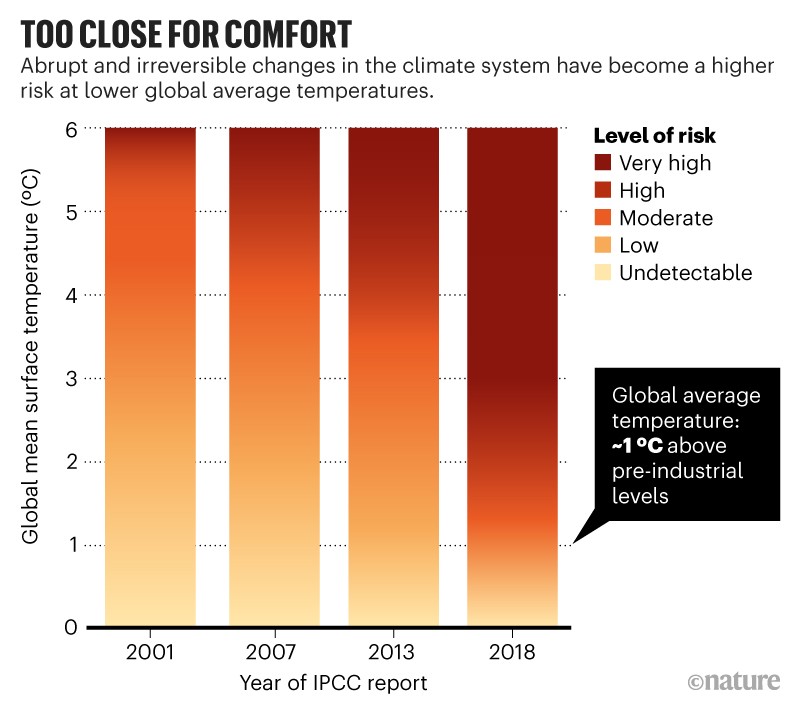
Even the notoriously conservative United Nations Intergovernmental Panel on Climate Change (IPCC) has found that already with the 1.1°C of warming we have had to date, there was a moderate risk of tipping some of these – and the risk increased as the temperatures increased.

Steffen believes we are committed to at least a 1.5°C temperature rise given the momentum in the economic and climate system, but we still have a shot at staying under 2°C with urgent action. 
+4°C world would support < 1 billion people

Professor Hans Joachim Schellnhuber, director emeritus and founder of the Potsdam Institute for Climate Impact Research, believes if we go much above 2°C we will quickly get to 4°C anyway because of the tipping points and feedbacks, which would spell the end of human civilisation.

Johan Rockström, the head of one of Europe’s leading research institutes, warned in 2019 that in a 4°C-warmer world it would be “difficult to see how we could accommodate a billion people or even half of that … There will be a rich minority of people who survive with modern lifestyles, no doubt, but it will be a turbulent, conflict-ridden world”.

Schellnhuber, one of the world’s leading authorities on climate change, said that if we continue down the present path “there is a very big risk that we will just end our civilisation. The human species will survive somehow but we will destroy almost everything we have built up over the last two thousand years.”

Schellnhuber said in a recent interview that the IPCC report stating we could stay below 1.5°C of warming was “slightly dishonest” because it relies on immense negative emissions (pulling CO2 out of the air) which was not viable at global scale. He said 1.5°C was no longer achievable but it was still possible to stay under 2°C with massive changes to society. [mw: immediately... or yesterday / yesteryear]

If we don’t bend the emissions curve down substantially before 2030 then keeping temperatures under 2°C becomes unavoidable. The “carbon law” published in the journal Science in 2017 found that, to hold warming below 2°C, emissions would need to be cut in half between 2020 and 2030.

Steffen told Voice of Action that the three main challenges to humanity – climate change, the degradation of the biosphere and the growing inequalities between and among countries – were “just different facets of the same fundamental problem”.

This problem was the “neoliberal economic system” that spread across the world through globalisation, underpinning “high production high consumption lifestyles” and a “religion built not around eternal life but around eternal growth”.

It is becoming abundantly clear that (i) this system is incompatible with a well-functioning Earth System at the planetary level; (ii) this system is eroding human- and societal-well being, even in the wealthiest countries, and (iii) collapse is the most likely outcome of the present trajectory of the current system, as prophetically modelled in 1972 in the Limits to Growth work,” Steffen told Voice of Action. 
Eternal growth is not possible

The Limits to Growth model released by the Club of Rome in 1972 looked at the interplay between food production, industry, population, non-renewable resources and pollution.

The basic findings were that you can’t grow the system indefinitely as you will cause environmental and resource issues that will ultimately cause the whole global system to collapse (ABC’s This Day Tonight program covered it here). At the time of the model’s release it accurately reproduced the historical data from 1900 to 1970.

A 2008 study by Graham Turner, then a senior CSIRO research scientist, used three decades of real-world historical data to conclude that the Limits to Growth model’s predictions were coming to pass: “30 years of historical data compare favourably with key features of a business-as-usual [BAU] scenario called the ‘standard run’ scenario, which results in collapse of the global system midway through the 21st century.”

Turner ran updated figures through the model again in 2012 for another peer-reviewed paper, and again in 2014 when he had joined the University of Melbourne’s Sustainable Society Institute.

“Data from the forty years or so since the LTG study was completed indicates that the world is closely tracking the BAU scenario,” Turner concluded in the 2014 paper.

“It is notable that there does not appear to be other economy-environment models that have demonstrated such comprehensive and long-term data agreement.”

Turner semi-retired in 2015 but runs a small organic market garden on a rural property in the NSW south coast’s Bega Valley.

He and his wife grow most of their own food and live off grid powered by a solar energy system. Turner said this saved him during last summer’s catastrophic bushfires as his power stayed online but most people in the area lost power for weeks.

Turner has continued tracking the data as best as possible since his last official report in 2014, and last year he helped a Harvard masters student update the data for their thesis.

Turner told Voice of Action that under his modelling the business as usual scenario “ends up resulting in a global collapse from about now through the next decade or so”.

It was difficult to predict a timeline but Turner said he believed “there’s an extremely strong case that we may be in the early stages of a collapse right at the moment”.

Vested interests and corrupt politicians combined with a population happy to deny problems overwhelm those that are trying to promulgate truth and facts,” said Turner. 
‘By 2030 we’ll know what path we’ve taken’

Steffen told Voice of Action that it’s “highly likely that by 2030 we’ll know what pathway we’ve taken”, “the pathway towards sustainability or the current pathway towards likely collapse”.

“I think the ‘fork in the road’ will come in this decade, probably not a single point in time but as a series of events,” said Steffen. [mw: based on past warnings from climate scientists what have been unheeded decade after decade, we have already past the point of the fork in the road time and time again]

Steffen told Voice of Action he believes collapse “will likely not come as a dramatic global collapse, but rather as overall deterioration in many features of life, with regional collapses occurring here and there”.

“For example, it appears that the USA is entering a long period of decline in many aspect of its society, with a potential for a more rapid collapse in the coming decade,” said Steffen.

Samuel Alexander, a lecturer with the University of Melbourne and research fellow at the Melbourne Sustainable Society Institute, told Voice of Action that the coming collapse would not be a single black or white event.

“With respect to civilisations, what is more likely is that we have entered a stage of what JM Greer calls ‘catabolic collapse’ – where we face decades of ongoing crises, as the existing mode of civilisation deteriorates, but then recovers as governments and civil society tries to respond, and fix things, and keep things going for a bit longer,” said Alexander.

Capitalism is quite good at dodging bullets and escaping temporary challenges to its legitimacy and viability. But its condition, I feel is terminal.

Alexander, who studies the economic, political and cultural challenges of living on a full planet in an age of limits, believes the future will be “post-growth / post capitalist / post-industrial in some form”.

“The future will like arrive in part by design and in part by disaster. Our challenge is to try to constitute the future through planning and community action, not have the future constitute us,” said Alexander.

Alexander said that it would never be “too late” to act sensibly as whether we’re trying to avoid or manage collapse there is lots of work to be done (“a 3 degree future is better than a 4 degree future”).

Steffen believes the current US mass uprisings are not a sign of collapse but one of “growing instability”.

Alexander said it was a sign of “steam building up within a closed system”. Without bold grassroots and political action we were “likely to see explosions of civil unrest increasingly as things continue to deteriorate”.

“As economies deteriorate and as inequalities deepen, more people get disenfranchised, incentivising resistance and sadly sometimes making people look for scapegoats to blame for new or intensifying hardships (e.g. the so-called alt-right),” said Alexander. 
Funding dried up after inconvenient truths

When Turner joined CSIRO in the early 2000s the organisation was working on the Australian Stocks and Flows Framework – a model of the economy using physical things rather than dollars.

The work was funded by the Department of Immigration but Turner says the reports – the last of which was done in 2010 – were buried because the conclusions did not support high population growth.

The research found the economic benefits in terms of wealth per person would be outweighed by social ills including the impact on quality of life and the environment from resource use and pollution. The reports warned there would be nil net flow to the Darling River, loss of habitat and animal and plant species, traffic congestion, city water deficits and reduced biodiversity due to polluted creeks.

Turner’s findings went against the neoliberal orthodoxies as they challenged the notion of infinite growth on a finite planet. He said he and others pursuing similar research in “stocks and flows” models of the economy “found it harder and harder to get work funded”.

It is no wonder then that the latest Breakthrough National Centre for Climate Restoration report found “there is no literature that synthesises the large scale impacts that climate change could have on Australia’s economy, and no reliable snapshot of Australia’s economic vulnerability to future climate warming in a regional and global context”.

Steffen said he hadn’t received any political pressure over his work “but I probably haven’t attacked the growth/capitalism paradigm as directly as Graham [Turner] has”. He says he has not hesitated to note the incompatibility of the neoliberal economic system with a stable Earth system in his talks.

It seems obvious that very fundamental changes are required, all the way down to core values – what do we really value in life?,” said Steffen.

Turner said the “absolutely immense changes” required to deliver a sustainable future were just “too hard for the vast majority of people to contemplate”.

“You’d have to halve the birth rate, you’d have to have net zero immigration, you’d have to go totally renewable energy and double efficiencies in every sector of the economy, and the really key thing is you’d have to reduce the working week over time so that it would become half of what it is,” said Turner.

“But that would also mean that people wouldn’t have the same level of income and it goes hand in hand with reducing household consumption by half. And unless you do all of those things, you don’t achieve a steady state, sustainable future, and if you leave some things out you’ve got to go even harder at the others.”

Turner believes it would be possible to provide for everyone’s needs in a sustainable way but we would have to live a 1950s or 1960s-style lifestyle with limits such as one car and TV per household. We wouldn’t be living in caves and we’d still have technology but the rate of change would be a lot slower.

“I think if we all manage to live a simpler and arguably more fulfilling life then it would be possible still with some technological advances to have a sustainable future, but it would seem that it’s more likely … that we are headed towards or perhaps on the cusp of a sort of global collapse,” Turner told Voice of Action.

Turner said he fears that the public at large won’t take the problem seriously enough and demand change until they’re “actually losing their jobs or losing their life or seeing their children directly suffer”. 
‘Potentially infinite costs of climate change’

The political discourse is about getting back to growth, supported by taxpayer-subsidised fossil fuels, but evidence shows that even if the government was committed to renewable energy, “green growth” is just not possible at a global scale.

A 2019 IMF Working Paper notes a growing agreement between economists and scientists “that risk of catastrophic and irreversible disaster is rising, implying potentially infinite costs of unmitigated climate change, including, in the extreme, human extinction”.

The Australian-based Breakthrough National Centre for Climate Restoration has spent years publishing reports warning that the science shows we are headed for civilisational collapse. They stress there is no further carbon budget today for a realistic chance of staying below 2°C, so there can be no further fossil fuel expansion.

The Breakthrough reports have been critical of the scientific community – including the IPCC – for underplaying the full risks of climate change particularly the tipping points and existential risk. Its latest report, Fatal Calculations, takes aim at economists for failing to adequately account for costs of inaction in their models, which in turn has been used by politicians to delay action.

“Despite the escalating climate disasters globally, not least our bushfires, this preoccupation with the cost of action — and a blind eye turned to overwhelming future damage — remains the dominant thinking within politics, business and finance,” the Breakthrough report found.

“Because climate change is now an existential threat to human society, risk management and the calculation of potential future damages must pay disproportionate attention to the high-end, extreme possibilities, rather than focus on middle-of-the-spectrum probabilities.”

In a discussion paper released in May, titled COVID-19 climate lessons, Breakthrough draws parallels between climate change and the lack of preparedness for the pandemic.

The world is sleepwalking towards disaster. The UN climate science and policymaking institutions are not fit-for-purpose and have never examined or reported on the existential risks,” the paper reads.

“There are no national or global processes to ensure that such risk assessments are undertaken and are efficacious. The World Economic Forum reports on high-end global risks, including climate disruption, once a year and then everybody goes back to ignoring the real risks.”

Human activity is causing temperature rises beyond the envelope of natural variability that the biosphere is built to support. Steffen said there’s only been two times in the last 100 million years that we have seen a spike in temperature like this, the first was when the dinosaurs were wiped out 65 million years ago and the second was another mass extinction event 56 million years ago.

The last time atmospheric carbon dioxide emissions were at the current level was during the early-to-mid Pliocene 3–4 million years ago, when temperatures were around 3°C warmer than the late 19th century, and sea levels were around 25 metres higher. 
Government failing to meet the challenge

Despite recent bushfires which burnt 35 million hectares, caused 445 excess deaths from smoke and incinerated 1 billion animals – doubling Australia’s annual CO2 emissions in the process – the government is refusing to commit to even modest emissions reduction targets and is pushing a “gas-fired recovery”.

It has emerged this week that the government was warned about the likelihood of severe bushfires but failed to do enough to prepare. Fire chiefs were also gagged from talking about climate change.

The Great Barrier Reef this year was hit with its third mass bleaching event in 5 years.

The Australian government, beholden to the fossil fuel industry and with no corruption watchdog to keep it in check, continues to resist pressure to increase its climate change commitment. Australia will not even be able to meet its Paris targets without an accounting loophole – targets which themselves are inadequate to prevent collapse.

It’s not just climate change that is leading us to collapse but also the fact that nature is declining globally at rates unprecedented in human history.

Around 1 million animal and plant species are now threatened with extinction, many within decades. As Steffen notes, the web of life on Earth is getting smaller and increasingly frayed.

Humans thoroughly dominate the land biosphere making up 32% of all terrestrial biomass followed by around 65% in domesticated animals, leaving less than 3% of vertebrate wildlife.

There has also been what’s called “The Great Acceleration”, whereby human population and economic growth is accelerating leading to accelerating use of resources like water and energy. This has also led to exponential growth in: greenhouse gas emissions, ocean acidification, ozone depletion, surface temperatures, marine fish capture, terrestrial biosphere degradation, tropical forest lost and domesticated land.

Many countries, including parts of Australia, are running out of water and having to truck in bottled water. It is predicted that 1.8 billion people will be living in water-scarce regions by 2025.

Steffen says net zero emissions by 2050 would be “too late” and the only thing that will save us are radical solutions committing to:
  • No new fossil fuel developments of any kind from now
  • A 50% reduction in greenhouse gas emissions by 2030 and 100% renewable energy 
  • Reaching net zero emissions by 2040
Steffen says it’s much, much cheaper not to use fossil fuels in the first place than to try to capture the CO2 after the fact, as you’re “fighting the second law of thermodynamics when you’re trying to recapture CO2”.

Turner believes the Corporations Act should be rewritten “so that corporations don’t have more legal rights than people, and are not compelled to make a profit for shareholders”. 
‘We’re possibly gone already’

Associate Professor Anitra Nelson, honorary principal fellow at the University of Melbourne’s Melbourne Sustainable Society Institute, advocates for “de-growth” policies which would reduce global consumption and production to sustainable levels. She says we’re currently consuming resources as if there were four Earths and if we don’t change fast we will face conditions that we can’t survive under.

“On the current trajectory we’re possibly gone already, and if we’re not, unless we act very quickly and in very serious ways we just can’t get back into a kind of balance with nature,” Nelson told Voice of Action.

I do actually think we’re already into the collapse and it’s just likely to get worse and more quickly worse as we go.[mw: few who truly think this will actually publicly admit it; it's just too hard psychologically to do so, especially as it inevitably is met with resistance and backlash of one form or another, including social ostracism]

Nelson said we have to wholesale change how we live on this planet and that includes discussions about population control (such as restrictions on the number of kids people have) and even maximum income limits.

Nelson said we also need to get rid of capitalism as fundamentally that economic system could not survive without growth.

Instead of firms competing in a global market we need to be “localising economies” so that “basically people are producing locally for local needs and only basic needs”. This would involve having “autonomous communities” with “substantive and direct democracy” and consensus decision making.

Tim Buckley, director of energy finance studies at the Institute for Energy Economics and Financial Analysis (IEEFA), told Voice of Action that our economic model “will have to change or collapse” as “we are reaching the limits to growth”. The health and social costs were increasingly evident and “we are getting to [mw: at / beyond] the point where it can’t be avoided”.

“I think global capitalism is realising that the parasitical nature that has emerged (where the top 1% own the vast majority of the world’s wealth), can only be sustained for so long,” said Buckley.

“If they kill the host (the bottom 99% of the people), their position in absolute terms is worse off, even if they own all the wealth, the total pie will shrink, and they are most impacted. So in order to protect their ‘elite’ position, they will allow changes to make the model more sustainable, so they can remain the top 1%, but sharing a little more to make the model more sustainable.” [mw: the covid-inspired Great Reset?]

Buckley is more optimistic than most in that he believes the world’s financial elites will reorganise the global economy to become sustainable out of self preservation.

“The economics of renewables make this economically sensible. It is not about saving the poor of the world. It is about an economic reality – solar is killing coal fired power plant investments. Technology and economics win, not environmentalism.”


Tim Garrett, physicist/professor of atmospheric sciences who hypothesised that civilization is effectively a heat engine whose power is expressed in the form of economic growth, admits that we will never decarbonize. Collapse of Industrial Civilization. Dec. 6, 2020.

It’s rather jarring to see an expert like Tim Garrett, whose work I have followed for many years, come out and say so bluntly that we will not do the steps needed to save ourselves.
...
The reality that humans are causing the climate to warm, with catastrophic consequences, demands radical government intervention in the market as well as collective action on an unprecedented scale. This has been known for decades and those catastrophic consequences are now coming to fruition, yet we remain a carbon-based, growth-oriented civilization.


The Impact of Evolutionary Pressures on Economic Narratives.  Carey W. King, CASSE. Dec. 9, 2020. 
We cannot fully understand a proponent (or detractor) of the fossil or renewable energy narratives without also contemplating their position within the economic narratives. At one end of the spectrum is technological optimism and perpetual GDP growth, and at the other end is technological realism and the need for a steady state economy or even degrowth toward a steady state economy. 
... 
Biophysical economic models with realistic dynamics, finite resource constraints, and a direct representation of natural resource flows among parts of the economy (including the original model used within the original Limits to Growth book from 1972) have proven more capable of representing long-term trends of the economy, such as population and energy consumption, than have the conventional economic growth models that rely on equilibrium principles and either exogenous or endogenous “technological change” without directly accounting for flows of biological and physical resources


Market-based solutions to climate change have failed to deliver. David G. Viktor and David Dollar, Brookings. Dec. 21, 2020.


Much of the U.S. Could Be Uninhabitable by 2050. via nakedcapitalism. Dec. 1, 2020.


Wednesday, November 27, 2019

We've been blithely betting against them for 30 years

Climate tipping points — too risky to bet against

The growing threat of abrupt and irreversible climate changes must compel political and economic action on emissions.

Timothy M. Lenton, Johan Rockström, Owen Gaffney, Stefan Rahmstorf, Katherine Richardson, Will Steffen & Hans Joachim Schellnhuber. Nature. November 27, 2019.


Politicians, economists and even some natural scientists have tended to assume that tipping points1 in the Earth system — such as the loss of the Amazon rainforest or the West Antarctic ice sheet — are of low probability and little understood. Yet evidence is mounting that these events could be more likely than was thought, have high impacts and are interconnected across different biophysical systems, potentially committing the world to long-term irreversible changes.


Here we summarize evidence on the threat of exceeding tipping points, identify knowledge gaps and suggest how these should be plugged. We explore the effects of such large-scale changes, how quickly they might unfold and whether we still have any control over them.


In our view, the consideration of tipping points helps to define that we are in a climate emergency and strengthens this year’s chorus of calls for urgent climate action — from schoolchildren to scientists, cities and countries.


The Intergovernmental Panel on Climate Change (IPCC) introduced the idea of tipping points two decades ago. At that time, these ‘large-scale discontinuities’ in the climate system were considered likely only if global warming exceeded 5 °C above pre-industrial levels. Information summarized in the two most recent IPCC Special Reports (published in 2018 and in September this year)2,3 suggests that tipping points could be exceeded even between 1 and 2 °C of warming (see ‘Too close for comfort’).


Source: IPCC


If current national pledges to reduce greenhouse-gas emissions are implemented — and that’s a big ‘if’ — they are likely to result in at least 3 °C of global warming. This is despite the goal of the 2015 Paris agreement to limit warming to well below 2 °C. Some economists, assuming that climate tipping points are of very low probability (even if they would be catastrophic), have suggested that 3 °C warming is optimal from a cost–benefit perspective. However, if tipping points are looking more likely, then the ‘optimal policy’ recommendation of simple cost–benefit climate-economy models4 aligns with those of the recent IPCC report2. In other words, warming must be limited to 1.5 °C. This requires an emergency response.


Ice collapse


We think that several cryosphere tipping points are dangerously close, but mitigating greenhouse-gas emissions could still slow down the inevitable accumulation of impacts and help us to adapt.


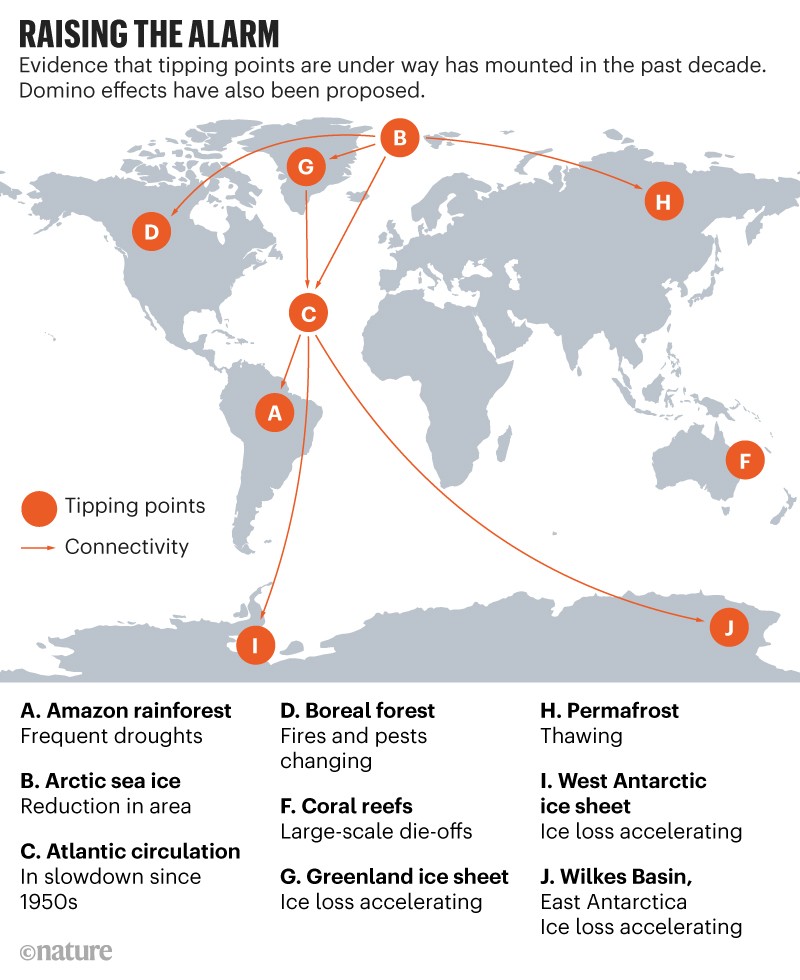
Research in the past decade has shown that the Amundsen Sea embayment of West Antarctica might have passed a tipping point3: the ‘grounding line’ where ice, ocean and bedrock meet is retreating irreversibly. A model study shows5 that when this sector collapses, it could destabilize the rest of the West Antarctic ice sheet like toppling dominoes — leading to about 3 metres of sea-level rise on a timescale of centuries to millennia. Palaeo-evidence shows that such widespread collapse of the West Antarctic ice sheet has occurred repeatedly in the past.


The latest data show that part of the East Antarctic ice sheet — the Wilkes Basin — might be similarly unstable3. Modelling work suggests that it could add another 3–4 m to sea level on timescales beyond a century.


The Greenland ice sheet is melting at an accelerating rate3. It could add a further 7 m to sea level over thousands of years if it passes a particular threshold. Beyond that, as the elevation of the ice sheet lowers, it melts further, exposing the surface to ever-warmer air. Models suggest that the Greenland ice sheet could be doomed at 1.5 °C of warming3, which could happen as soon as 2030.


Thus, we might already have committed future generations to living with sea-level rises of around 10 m over thousands of years3. But that timescale is still under our control. The rate of melting depends on the magnitude of warming above the tipping point. At 1.5 °C, it could take 10,000 years to unfold3; above 2 °C it could take less than 1,000 years6. Researchers need more observational data to establish whether ice sheets are reaching a tipping point, and require better models constrained by past and present data to resolve how soon and how fast the ice sheets could collapse.


Whatever those data show, action must be taken to slow sea-level rise. This will aid adaptation, including the eventual resettling of large, low-lying population centres.


A further key impetus to limit warming to 1.5 °C is that other tipping points could be triggered at low levels of global warming. The latest IPCC models projected a cluster of abrupt shifts7 between 1.5 °C and 2 °C, several of which involve sea ice. This ice is already shrinking rapidly in the Arctic, indicating that, at 2 °C of warming, the region has a 10–35% chance3 of becoming largely ice-free in summer.


Biosphere boundaries

Climate change and other human activities risk triggering biosphere tipping points across a range of ecosystems and scales (see ‘Raising the alarm’).


Source: T. M. Lenton et al.


Ocean heatwaves have led to mass coral bleaching and to the loss of half of the shallow-water corals on Australia’s Great Barrier Reef. A staggering 99% of tropical corals are projected2 to be lost if global average temperature rises by 2 °C, owing to interactions between warming, ocean acidification and pollution. This would represent a profound loss of marine biodiversity and human livelihoods.


As well as undermining our life-support system, biosphere tipping points can trigger abrupt carbon release back to the atmosphere. This can amplify climate change and reduce remaining emission budgets.


Deforestation and climate change are destabilizing the Amazon — the world’s largest rainforest, which is home to one in ten known species. Estimates of where an Amazon tipping point could lie range from 40% deforestation to just 20% forest-cover loss8. About 17% has been lost since 1970. The rate of deforestation varies with changes in policy. Finding the tipping point requires models that include deforestation and climate change as interacting drivers, and that incorporate fire and climate feedbacks as interacting tipping mechanisms across scales.


With the Arctic warming at least twice as quickly as the global average, the boreal forest in the subarctic is increasingly vulnerable. Already, warming has triggered large-scale insect disturbances and an increase in fires that have led to dieback of North American boreal forests, potentially turning some regions from a carbon sink to a carbon source9. Permafrost across the Arctic is beginning to irreversibly thaw and release carbon dioxide and methane — a greenhouse gas that is around 30 times more potent than CO2 over a 100-year period.


Researchers need to improve their understanding of these observed changes in major ecosystems, as well as where future tipping points might lie. Existing carbon stores and potential releases of CO2 and methane need better quantification.


The world’s remaining emissions budget for a 50:50 chance of staying within 1.5 °C of warming is only about 500 gigatonnes (Gt) of CO2. Permafrost emissions could take an estimated 20% (100 Gt CO2) off this budget10, and that’s without including methane from deep permafrost or undersea hydrates. If forests are close to tipping points, Amazon dieback could release another 90 Gt CO2 and boreal forests a further 110 Gt CO211. With global total CO2 emissions still at more than 40 Gt per year, the remaining budget could be all but erased already.


Bleached corals on a reef near the island of Moorea in French Polynesia in the South Pacific.Credit: Alexis Rosenfeld/Getty


Global cascade


In our view, the clearest emergency would be if we were approaching a global cascade of tipping points that led to a new, less habitable, ‘hothouse’ climate state11. Interactions could happen through ocean and atmospheric circulation or through feedbacks that increase greenhouse-gas levels and global temperature. Alternatively, strong cloud feedbacks could cause a global tipping point12,13.


We argue that cascading effects might be common. Research last year14 analysed 30 types of regime shift spanning physical climate and ecological systems, from collapse of the West Antarctic ice sheet to a switch from rainforest to savanna. This indicated that exceeding tipping points in one system can increase the risk of crossing them in others. Such links were found for 45% of possible interactions14.


In our view, examples are starting to be observed. For example, Arctic sea-ice loss is amplifying regional warming, and Arctic warming and Greenland melting are driving an influx of fresh water into the North Atlantic. This could have contributed to a 15% slowdown15 since the mid-twentieth century of the Atlantic Meridional Overturning Circulation (AMOC) , a key part of global heat and salt transport by the ocean3. Rapid melting of the Greenland ice sheet and further slowdown of the AMOC could destabilize the West African monsoon, triggering drought in Africa’s Sahel region. A slowdown in the AMOC could also dry the Amazon, disrupt the East Asian monsoon and cause heat to build up in the Southern Ocean, which could accelerate Antarctic ice loss.


The palaeo-record shows global tipping, such as the entry into ice-age cycles 2.6 million years ago and their switch in amplitude and frequency around one million years ago, which models are only just capable of simulating. Regional tipping occurred repeatedly within and at the end of the last ice age, between 80,000 and 10,000 years ago (the Dansgaard–Oeschger and Heinrich events). Although this is not directly applicable to the present interglacial period, it highlights that the Earth system has been unstable across multiple timescales before, under relatively weak forcing caused by changes in Earth’s orbit. Now we are strongly forcing the system, with atmospheric CO2 concentration and global temperature increasing at rates that are an order of magnitude higher than those during the most recent deglaciation.


Atmospheric CO2 is already at levels last seen around four million years ago, in the Pliocene epoch. It is rapidly heading towards levels last seen some 50 million years ago — in the Eocene — when temperatures were up to 14 °C higher than they were in pre-industrial times. It is challenging for climate models to simulate such past ‘hothouse’ Earth states. One possible explanation is that the models have been missing a key tipping point: a cloud-resolving model published this year suggests that the abrupt break-up of stratocumulus cloud above about 1,200 parts per million of CO2 could have resulted in roughly 8 °C of global warming12.


Some early results from the latest climate models — run for the IPCC’s sixth assessment report, due in 2021 — indicate a much larger climate sensitivity (defined as the temperature response to doubling of atmospheric CO2) than in previous models. Many more results are pending and further investigation is required, but to us, these preliminary results hint that a global tipping point is possible.


To address these issues, we need models that capture a richer suite of couplings and feedbacks in the Earth system, and we need more data — present and past — and better ways to use them. Improving the ability of models to capture known past abrupt climate changes and ‘hothouse’ climate states should increase confidence in their ability to forecast these.


Some scientists counter that the possibility of global tipping remains highly speculative. It is our position that, given its huge impact and irreversible nature, any serious risk assessment must consider the evidence, however limited our understanding might still be. To err on the side of danger is not a responsible option.


If damaging tipping cascades can occur and a global tipping point cannot be ruled out, then this is an existential threat to civilization. No amount of economic cost–benefit analysis is going to help us. We need to change our approach to the climate problem.


Act now


In our view, the evidence from tipping points alone suggests that we are in a state of planetary emergency: both the risk and urgency of the situation are acute (see ‘Emergency: do the maths’).


EMERGENCY: DO THE MATHS

We define emergency (E) as the product of risk and urgency. Risk (R) is defined by insurers as probability (p) multiplied by damage (D). Urgency (U) is defined in emergency situations as reaction time to an alert (Ď„) divided by the intervention time left to avoid a bad outcome (T). Thus:
E = R × U = p × D × Ď„ / T
The situation is an emergency if both risk and urgency are high. If reaction time is longer than the intervention time left (Ď„ / T > 1), we have lost control.

We argue that the intervention time left to prevent tipping could already have shrunk towards zero, whereas the reaction time to achieve net zero emissions is 30 years at best. Hence we might already have lost control of whether tipping happens. A saving grace is that the rate at which damage accumulates from tipping — and hence the risk posed — could still be under our control to some extent.


The stability and resilience of our planet is in peril. International action — not just words — must reflect this.


Friday, December 14, 2018

10 New Insights in Climate Science 2018

The Earth League and Future Earth submit statement to UNFCCC at COP24

10 New Insights Poster.jpg

Dec. 10, 2018.

Many impacts of human-induced climate change, from drought and heat waves to Antarctic ice melting, are coming earlier than expected. Extreme events, such as recent fires in North America and floods across Asia, can with increased certainty be linked to global warming. Halving global emissions over the next decade is technically achievable and would save the world billions of dollars, say scientists in a new statement to coincide with the UN annual climate talks in Katowice, Poland.

Their warning comes as global emissions are projected to rise for a second consecutive year to a new historical high after three stable years.

“Emissions must peak by 2020. The world cannot allow climate extremes to unfold and increase the risks of violating the planetary boundaries when all the solutions to solve this challenge are here in front of us,” said Professor Johan Rockstrom, Designated Director of the Potsdam Institute for Climate Impact Research, Co-Chair of Future Earth and Chair of the Earth League, the organisations that produced the statement.

“Our analysis of the most recent research shows that a global transition to clean energy is affordable, achievable, and already underway,” says Future Earth Executive Director Amy Luers. “But to avoid catastrophe, we must ratchet up the pace and move beyond energy. The research shows clearly that we must cut emissions by half across all economic sectors in the next decade, to have a chance of avoiding the worst impacts of the climate crisis.”

The statement, “10 New Insights in Climate Science,” will be presented at the United Nations Framework Convention on Climate Change 24th Conference of the Parties, 10 December, and distributed to negotiators in Katowice. It is published by Future Earth and the Earth League, two major international organizations representing networks of global sustainability scientists, and summarizes recent Earth-system science, policy, public health and economic research.


Wednesday, August 8, 2018

Roadmap for Rapid Decarbonization. Rockstrom et al

A roadmap for rapid decarbonization. Johan Rockström, Hans Joachim Schellnhuber et al. Science. Mar. 24, 2017. PDF available here.

Summary
Although the Paris Agreement's goals (1) are aligned with science (2) and can, in principle, be technically and economically achieved (3), alarming inconsistencies remain between science-based targets and national commitments. Despite progress during the 2016 Marrakech climate negotiations, long-term goals can be trumped by political short-termism. Following the Agreement, which became international law earlier than expected, several countries published mid-century decarbonization strategies, with more due soon. Model-based decarbonization assessments (4) and scenarios often struggle to capture transformative change and the dynamics associated with it: disruption, innovation, and nonlinear change in human behavior. For example, in just 2 years, China's coal use swung from 3.7% growth in 2013 to a decline of 3.7% in 2015 (5). To harness these dynamics and to calibrate for short-term realpolitik, we propose framing the decarbonization challenge in terms of a global decadal roadmap based on a simple heuristic—a “carbon law”—of halving gross anthropogenic carbon-dioxide (CO2) emissions every decade. Complemented by immediately instigated, scalable carbon removal and efforts to ramp down land-use CO2emissions, this can lead to net-zero emissions around mid-century, a path necessary to limit warming to well below 2°C.

The Paris goal translates into a finite planetary carbon budget: a 50% chance [ed: don't we want a 95 or 99% chance? what's our budget for that?] of limiting warming to 1.5°C by 2100 and a >66% probability of meeting the 2°C target imply that global CO2 emissions peak no later than 2020, and gross emissions decline from ∼40 gigatons (metric) of carbon dioxide (GtCO2)/year in 2020, to ∼24 by 2030, ∼14 by 2040, and ∼5 by 2050 (3) (see the figure, top). Risks could be further reduced by moderately increasing ambition to halve emissions every decade (see the figure, bottom right). Following such a global carbon law means at least limiting cumulative total CO2 emissions from 2017 until the end of the century to ∼700 GtCO2, which allows for a small but essential contingency (∼125 GtCO2 less compared with total CO2 emissions in the pathway in the figure, top) for risks of biosphere carbon feedbacks (6) or delay in ramping up CO2-removal technologies.

A carbon law applies to all sectors and countries at all scales and encourages bold action in the short term. It means, for example, doubling of zero-carbon shares in the energy system every 5 to 7 years, a rate consistent with the trajectory of the past decade (see the figure, bottom left). All sectors (e.g., agriculture, construction, finance, manufacturing, transport) need comparable transformation pathways. In addition, in the absence of viable alternatives, the world must aim at rapidly scaling up CO2 removal by technical means from zero to at least 0.5 GtCO2/year by 2030, 2.5 by 2040, and 5 by 2050. CO2 emissions from land-use must decrease along a nonlinear trajectory from 4 GtCO2/year in 2010, to 2 by 2030, 1 by 2040, and 0 by 2050 (see the figure, bottom right). The endgame is for cumulative CO2 emissions since 2017 to be brought back from around 700 GtCO2 to below 200 GtCO2 by the end of the century (see the figure, top) and atmospheric CO2 concentrations to return to 380 ppm by 2100 (currently at 400 ppm). [ed: we should be aiming for 280, as per Schellnhuber, i.e. the level before we started anthropogenic global warming... or at least 350]

Roadmaps are planning instruments, linking shorter-term targets to longer-term goals. They help align actors and organizations to instigate technological and institutional breakthroughs to meet a collective challenge. An explicit carbon roadmap for halving anthropogenic emissions every decade, co-designed by and for all industry sectors, could help promote disruptive, nonlinear technological advances toward a zero-emissions world. The key to such a carbon law will be a dual strategy that pushes renewables and other zero-emissions technologies up the creation and dissemination trajectory, while simultaneously pulling fossil-based value propositions from the market. Thus, the transformation unfolds at a pace governed by novel schemes rather than by inertia imposed by incumbent technologies (see the figure, bottom left).

We sketch out a broad decadal decarbonization narrative in four dimensions—innovation, institutions, infrastructures, and investment—to provide evidence of feasibility and depth of transformation for economies to stay on a carbon-law trajectory. The narrative provides no guarantees but identifies crucial steps, grounded in published scenarios combined with expert judgment. Each step has two parts: actions for rapid near-term emissions reductions, and actions for systemic and long-term impact, creating the basis for the next steps. Such a narrative, specifically designed with decadal targets and incentives, could provide key elements for national and international climate strategies.


2017–2020: No-Brainers

Annual emissions from fossil fuels must start falling by 2020. Well-proven (and ideally income-neutral) policy instruments such as carbon tax schemes, cap-and-trade systems, feed-in tariffs, and quota approaches should roll out at wide scale. Even these will be challenging in the emerging global political climate. The European Union emissions-trading scheme requires kick-starting through an appropriate floor price (>$50/metric ton CO2).


A global carbon law and roadmap to make Paris goals a reality


(Top) A deep decarbonization scenario scientifically consistent with the Paris Agreement (3) and its associated carbon fluxes as computed with a simple carbon cycle and climate model (13). The “carbon law” scenario of halving emissions every decade is marginally more ambitious than the scenario presented. Meeting the Paris Agreement goals will require bending the global curve of CO2 emissions by 2020 and reaching net-zero emissions by 2050. It furthermore depends on rising anthropogenic carbon sinks, from bioenergy carbon capture and storage (BECCS) engineering (yellow) and land use (orange), as well as sustained natural sinks, to stabilize global temperatures. This scenario is broadly consistent with a 75% probability of limiting warming to below 2°C; a median temperature increase of 1.5°C by 2100; estimated peak median temperature increase of 1.7°C; a 50% probability of limiting warming to below 1.5°C by 2100; and CO2 concentrations of 380 ppm in 2100. See supplementary materials (SM). (Bottom left) Nonlinear renewable energy expansion trajectories based on 2005–2015 global trends (13). Keeping the historical doubling times of around 5.5 years constant in the next three decades would yield full decarbonization (blue area) in the entire energy sector by ∼2040, with coal use ending around 2030–2035 and oil use, 2040–2045. Calculations, based on (5), are detailed in SM. (Bottom right) Decadal staircase following a global carbon law of halving emissions every decade, a complementary fall in land-use emissions, plus ramping up CO2 removal technologies.


GRAPHIC: N. CARY/SCIENCE


The United Nations Framework Convention on Climate Change (UNFCCC) should transform into a vanguard forum where nations, businesses, nongovernmental organizations, and scientific communities meet to refine the roadmap. It is evident that the current national commitments under the Paris Agreement must be strongly enhanced at the first ratcheting-up cycle in 2018 to 2020.

Fossil-fuel subsidies, currently $500 billion to $600 billion per annum, must be eliminated by 2020, not 2025 as agreed by the Group of Seven (G7) nations in 2016. An immediate moratorium on investment in new unabated coal-based energy would minimize future stranded assets. China's greenhouse gas (GHG) output must continue to decrease over the coming years, through aggressive funding of renewables, by abandoning coal expansion, and by closing mines. The richer coal-intensive countries must spearhead the coal exit, and countries like India and Indonesia must follow suit.

By 2020, all cities and major corporations in the industrialized world should have decarbonization strategies in place. The 49 countries already committed to be carbon neutral by 2050 should have expanded to >100 countries by that time, and implementation should be under way. The gravest risk is that emerging economies, such as South Africa, are driven down the conventional growth path by sheer inertia. International efforts must incentivize low-carbon development as a priority.

Food production contributes to >10% of global GHG emissions (4) and weakens natural carbon sinks yet has vast potential for biological carbon removal. Innovative financial mechanisms are needed to incentivize carbon management in the food system. Agro-industries, farms, and civil society should develop a worldwide strategy for sustainable food systems to drive healthier, low-meat diets (7) and reduce food waste (8). Health and sustainability co-benefits—such as obesity and disease abatement, pollution reduction, and ecosystems preservation—should spur action.


2020–2030: Herculean Efforts

Economies must implement the no-brainer mitigation measures plus the first wave of smart and disruptive action. Improving energy efficiency alone would reduce emissions 40 to 50% by around 2030 in many domestic and industrial cases (9).

In the 2020s, carbon pricing across the world must expand to cover all GHG emissions, starting at $50 per metric ton at least and exceeding $400 per ton by mid-century. By the end of that decade, coal will be about to exit the global energy mix, cities like Copenhagen and Hamburg will be fossil-fuel free, and cap-and-trade regimes should be firmly established across national and regional economic zones along with adequate carbon taxes on air transport and shipping. Countries should follow Norway, Germany, and the Netherlands and announce the phase-out of internal combustion engines in new cars by 2030 at the latest. Decarbonizing long-distance transport will be key, through renewable fuels, electrification, and replacing shorter-haul air traffic by rapid rail. These commitments will signal that the conventional model of reinvesting fossil-fuel revenues into exploration is obsolete.

Public and private investment in research and development (R&D) for climate solutions should increase by an order of magnitude between now and 2030. Substantial resources must be directed toward more efficient modes of industrial production; battery-life extension and improved energy storage solutions; schemes that greatly reduce the cost of carbon capture and storage (CCS) within 10 years; alternative aircraft propulsion systems; super-smart power grids; and sustainable urbanization everywhere.

We need urgent research to ascertain the resilience of remaining biosphere carbon sinks (10). Strong financial impetus must be provided for afforestation of degraded land and for establishment of no-regret approaches to net removal of CO2 from the atmosphere—such as the combination of second- and third-generation bioenergy with CCS (BECCS) or direct air CCS (DACCS). Trials of sustainable sequestration schemes of the order of 100 to 500 MtCO2/year should be well under way to resolve deployment issues relating to food security, biodiversity preservation, indigenous rights, and societal acceptance.


2030–2040: Many Breakthroughs

By 2040, oil will be about to exit the global energy mix. Several vanguard countries (such as Norway, Denmark, and Sweden) should have completed electrification of all sectors and be entirely emissions-free or close to it. Internal combustion engines for personal transport will have become rare on roads worldwide. Aircraft fuel should be entirely carbon neutral. Synthesized fuels, bio-methane, and hydrogen are established alternatives.

After 2030, all building construction must be carbon-neutral or carbon-negative. The construction industry must either use emissions-free concrete and steel or replace those materials with zero- or negative-emissions substances such as wood, stone, and carbon fiber.

BECCS schemes totalling 1 to 2 GtCO2/year would roll out, and R&D should focus on doubling the annual rate of CO2 removal. We can expect that polycentric power grids using supraconductive cables will start supplying energy in developing countries, and radical new energy generation solutions will enter the market.

Promising financial mechanisms to foster investments in necessary breakthroughs include sovereign wealth funds designed for transformation; effective international corporation tax regimes (11); and inheritance reforms that account for historical wealth generated by fossil fuels without compensation of externalities (12).


2040–2050: Revise, Reinforce

Building on successes and learning from failures of previous stages, certain mitigation strategies will be abandoned and others refined and amplified. All major European countries become close to net-zero carbon states early in the 2040s; market dynamics push North and South America and most of Asia and Africa to this goal by the end of the decade. Natural gas still provides some backup energy, but CCS ensures its carbon footprint is limited. Modular nuclear reactors may contribute to the energy mix in places.

By 2050, the world will have reached net-zero CO2 emissions, with a global economy powered by carbon-free energy and fed from carbon-sequestering sustainable agriculture. Meanwhile, BECCS schemes have been scaled up and draw down >5 GtCO2/year. Alternatively, concerns may rule out such scale-up. Only deep emission reductions during 2020–2030 can enable BECCS to be scaled back or abandoned, while efforts to increase energy efficiency and DACCS continue.


Stability and Resilience

We cannot predict where civilization will be mid-century, but a decadal staircase based on a carbon law, if adopted broadly, may provide essential economic boundary conditions to make a zero-emissions future an inevitability rather than wishful thinking. The very nature of disruptive progress requires revising the narrative of a detailed roadmap every 2 years, correcting near-term targets to reach the ultimate goal by evolutionary management.

Although signs are positive that the world is on track to rapidly transform to a net-zero–emissions global economy, contagion dynamics cut both ways. If political signals do not support a rapid transition, for example, by a failure to implement worldwide financial and regulatory reform that places a cost on carbon, then it is difficult to imagine keeping warming at “well below 2°C.” However, the scale of momentum toward clean energy in the past decade suggests that it would seem foolish to try to halt the trend, given the growing evidence that decarbonization can be a major pro-growth strategy.

In global governance, climate stabilization must be placed on par with economic development, human rights, democracy, and peace. The design and implementation of the carbon roadmap should therefore take center stage at the UN Security Council, as these quintessential objectives increasingly interact, influencing the stability and resilience of societies and the Earth system.

Tuesday, August 7, 2018

Trajectories of the Earth System in the Anthropocene. Steffen, Rockstrom, et al

Trajectories of the Earth System in the Anthropocene. Will Steffen, Johan Rockström, Timoth Lenton, Hans Joachim Schellnhuber, et al., PNAS. Aug. 6, 2018.

Abstract 
We explore the risk that self-reinforcing feedbacks could push the Earth System toward a planetary threshold that, if crossed, could prevent stabilization of the climate at intermediate temperature rises and cause continued warming on a “Hothouse Earth” pathway even as human emissions are reduced. Crossing the threshold would lead to a much higher global average temperature than any interglacial in the past 1.2 million years and to sea levels significantly higher than at any time in the Holocene. We examine the evidence that such a threshold might exist and where it might be. If the threshold is crossed, the resulting trajectory would likely cause serious disruptions to ecosystems, society, and economies. Collective human action is required to steer the Earth System away from a potential threshold and stabilize it in a habitable interglacial-like state. Such action entails stewardship of the entire Earth System—biosphere, climate, and societies—and could include decarbonization of the global economy, enhancement of biosphere carbon sinks, behavioral changes, technological innovations, new governance arrangements, and transformed social values.


A schematic illustration of possible future pathways of the climate against the background of the typical glacial–interglacial cycles (Lower Left). The interglacial state of the Earth System is at the top of the glacial–interglacial cycle, while the glacial state is at the bottom. Sea level follows temperature change relatively slowly through thermal expansion and the melting of glaciers and ice caps. The horizontal line in the middle of the figure represents the preindustrial temperature level, and the current position of the Earth System is shown by the small sphere on the red line close to the divergence between the Stabilized Earth and Hothouse Earth pathways. The proposed planetary threshold at ∼2 °C above the preindustrial level is also shown. The letters along the Stabilized Earth/Hothouse Earth pathways represent four time periods in Earth’s recent past that may give insights into positions along these pathways (SI Appendix): A, Mid-Holocene; B, Eemian; C, Mid-Pliocene; and D, Mid-Miocene. Their positions on the pathway are approximate only. Their temperature ranges relative to preindustrial are given in SI Appendix, Table S1.


Stability landscape showing the pathway of the Earth System out of the Holocene and thus, out of the glacial–interglacial limit cycle to its present position in the hotter Anthropocene. The fork in the road in Fig. 1 is shown here as the two divergent pathways of the Earth System in the future (broken arrows). Currently, the Earth System is on a Hothouse Earth pathway driven by human emissions of greenhouse gases and biosphere degradation toward a planetary threshold at ∼2 °C (horizontal broken line at 2 °C in Fig. 1), beyond which the system follows an essentially irreversible pathway driven by intrinsic biogeophysical feedbacks. The other pathway leads to Stabilized Earth, a pathway of Earth System stewardship guided by human-created feedbacks to a quasistable, human-maintained basin of attraction. “Stability” (vertical axis) is defined here as the inverse of the potential energy of the system. Systems in a highly stable state (deep valley) have low potential energy, and considerable energy is required to move them out of this stable state. Systems in an unstable state (top of a hill) have high potential energy, and they require only a little additional energy to push them off the hill and down toward a valley of lower potential energy.

Global map of potential tipping cascades. The individual tipping elements are color- coded according to estimated thresholds in global average surface temperature (tipping points) (1234). Arrows show the potential interactions among the tipping elements based on expert elicitation that could generate cascades. Note that, although the risk for tipping (loss of) the East Antarctic Ice Sheet is proposed at >5 °C, some marine-based sectors in East Antarctica may be vulnerable at lower temperatures (3538).
... 
Conclusion 
Our analysis suggests that the Earth System may be approaching a planetary threshold that could lock in a continuing rapid pathway toward much hotter conditions—Hothouse Earth. This pathway would be propelled by strong, intrinsic, biogeophysical feedbacks difficult to influence by human actions, a pathway that could not be reversed, steered, or substantially slowed. 
Where such a threshold might be is uncertain, but it could be only decades ahead at a temperature rise of ∼2.0 °C above preindustrial, and thus, it could be within the range of the Paris Accord temperature targets. 
The impacts of a Hothouse Earth pathway on human societies would likely be massive, sometimes abrupt, and undoubtedly disruptive. 
Avoiding this threshold by creating a Stabilized Earth pathway can only be achieved and maintained by a coordinated, deliberate effort by human societies to manage our relationship with the rest of the Earth System, recognizing that humanity is an integral, interacting component of the system. Humanity is now facing the need for critical decisions and actions that could influence our future for centuries, if not millennia.


reviewed by Ian Angus. Aug. 12, 2018.


Scientific papers don’t often make front page news, but this one certainly did. 
On August 6, the UK Guardian declared that a “Domino-effect of climate events could move Earth into a ‘hothouse’ state.” The New York Times warned of a “World at risk of heading towards irreversible ‘hothouse’ state.” Sky News said that “Earth is 1°C away from hothouse state that threatens the future of humanity.” 
The basis for those excited headlines was an article with the distinctly unexciting title “Trajectories of the Earth System in the Anthropocene,” published in the Proceedings of the National Academy of Sciences. Normally, PNAS articles can only be read by those who pay high subscription fees, but interest in this one ran so high that after one day the publisher removed the paywall, making it accessible to all. 
For once — rarely for a climate change story — the mainstream media was right to focus attention on this paper. The authors, a virtual who’s who of the world’s most respected experts on the Anthropocene and Earth System Science, make a major contribution to our understanding of the planetary emergency. They extend the discussion of global warming beyond the usual narrow focus on greenhouse emissions, incorporating the complex cycles and feedbacks that shape the entire Earth System. 
This is global warming in the context of the Anthropocene, the epoch they define as “the beginning of a very rapid human-driven trajectory of the Earth System away from the glacial-interglacial limit cycle, toward new, hotter climatic conditions and a profoundly different biosphere.” 
(It’s important to note that, contrary to charges that Anthropocene science blames humanity in general for environmental problems, this paper explicitly recognizes “that different societies around the world have contributed differently and unequally to pressures on the Earth System and will have varied capabilities to alter future trajectories,” and that “the wealthiest one billion people produce 60% of GHGs [Greenhouse Gases] whereas the poorest three billion produce only 5%.”) 
Tipping points and planetary thresholds 
With a few exceptions, scientific discussion of climate change has tended to focus on how warm the world will get at various CO2 concentration levels, or on what conditions may be like if a given temperature is reached, or on how to slow or stop greenhouse gas emissions. Other Earth System processes are played down or omitted entirely. 
The authors of this paper, in contrast, argue that “feedback processes within the Earth System coupled with direct human degradation of the biosphere may play a more important role than normally assumed.” In that context they ask four questions. 
  1. “Is there a planetary threshold in the trajectory of the Earth System that, if crossed, could prevent stabilization in a range of intermediate temperature rises?”
  2. “Given our understanding of geophysical and biosphere feedbacks intrinsic to the Earth System, where might such a threshold be?”
  3. “If a threshold is crossed, what are the implications, especially for the wellbeing of human societies?” 
  4. “What human actions could create a pathway that would steer the Earth System away from the potential threshold and toward the maintenance of interglacial-like conditions?” 
The long-term evolution of the Earth System is influenced by a multitude of cycles and feedbacks that weaken or amplify climate changes, by controlling the movement of matter and energy in the oceans, soil, and atmosphere. As the Earth warms, positive (amplifying) feedbacks are becoming stronger: the authors identify ten that have global impacts and that could be radically accelerated by relatively small temperature increases, including thawing permafrost, release of ocean floor methane hydrates, weakened land and oceanic CO2absorption, increasing bacterial respiration in the oceans, dieback of Amazon and/or boreal forests, reduced northern snow cover, loss of Arctic and/or Antarctic sea ice, and melting of polar ice sheets. 
Any one of these could substantially accelerate global warming, and if one passes a tipping point, it may trigger a “tipping cascade,” permanently accelerating others. 
... 
The authors do not say that Hothouse Earth is inevitable, or that any of these tipping points and cascades are certain to happen at any particular time or speed: the extreme complexity of the Earth System makes such predictions impossible. However, the evidence of past climate shifts indicates any of them could occur at temperatures and CO2 concentrations that are likely to be reached in this century if business as usual continues — and some could occur before 2040. 
“Current rates of human-driven changes far exceed the rates of change driven by geophysical or biosphere forces that have altered the Earth System trajectory in the past; even abrupt geophysical events do not approach current rates of human-driven change. 
… 
In terms of their influence on the carbon cycle and climate, the human-driven changes of the Anthropocene are beginning to match or exceed the rates of change that drove past, relatively sudden mass extinction events, and are essentially irreversible.” 
Continuing business as usual c[w]ould lock us into a trajectory for Hothouse Earth, and the point of no return, beyond which stabilization will be impossible, may be reached when the average global temperature rises to 2.0°C above the pre-industrial level. In fact, “even if the Paris Accord target of a 1.5°C to 2.0°C rise in temperature is met, we cannot exclude the risk that a cascade of feedbacks could push the Earth System irreversibly onto a ‘Hothouse Earth’ pathway. 
Maybe we’ll get lucky, but don’t bet on it. 
... 

However, the authors argue, there is still time to shift to an “Alternative Stabilized Earth Pathway,” but only if radical changes are made in society’s relationship with the rest of the Earth System
“The Stabilized Earth pathway could be conceptualized as a regime of the Earth System in which humanity plays an active planetary stewardship role in maintaining a state intermediate between the glacial-interglacial limit cycle of the Late Quaternary and a Hothouse Earth. … We emphasize that Stabilized Earth is not an intrinsic state of the Earth System but rather, one in which humanity commits to a pathway of ongoing management of its relationship with the rest of the Earth System.” 
They stress that getting to Stabilized Earth will involve taking “a turbulent road of rapid and profound changes and uncertainties … that challenge the resilience of human societies,” and that even then, it will not return to Holocene conditions. “Stabilized Earth will likely be warmer than any other time over the last 800,000 years at least (that is, warmer than at any other time in which fully modern humans have existed).” 
We are, in short, at a fork in the road. “Social and technological trends and decisions occurring over the next decade or two could significantly influence the trajectory of the Earth System for tens to hundreds of thousands of years.” 
What is to be done? 
In addressing the fourth question — what can be done to stabilize the Earth System? — the authors challenge the incremental reformism of liberal greens and most environmental NGOs. They point out that “the present dominant socioeconomic system … is based on high-carbon economic growth and exploitative resource use,” and that attempts to reform it have been unsuccessful. 
Incremental linear changes to the present socioeconomic system are not enough to stabilize the Earth System. Widespread, rapid, and fundamental transformations will likely be required to reduce the risk of crossing the threshold and locking in the Hothouse Earth pathway. 
… 
“The contemporary way of guiding development founded on theories, tools, and beliefs of gradual or incremental change, with a focus on economy efficiency, will likely not be adequate to cope with this trajectory. 
… 
“To avoid crossing a planetary threshold … a deep transformation based on a fundamental reorientation of human values, equity, behavior, institutions, economies, and technologies is required.” 
Although stated in very general terms, these points have deeply radical implications. These Earth System scientists have clearly concluded only system change can stop climate change. This reconfirms the argument I have made before, that “the possibility of a powerful science-based challenge to the present social order is opening before us.”[5]
However, the real test of any policy framework for climate change is in the concrete actions it advocates, and that is the weakest part of this paper. 
The authors say that achieving a Stabilized Earth would require “deep cuts in greenhouse gas emissions, protection and enhancement of biosphere carbon sinks, efforts to remove CO2 from the atmosphere, possibly solar radiation management, and adaptation to unavoidable impacts of the warming already occurring,” but they offer no plan for implementing such measures. A table in the “Supporting Information” identifies seventeen “Human actions that could steer the Earth System onto a ‘Stabilized Earth’,” but it is not a program for action. For example, it includes “Replacement of fossil fuels with low or zero emission energy sources” as a goal, but is silent on actually reducing emissions by concrete measures such as shutting down coal-fired generators, banning fracking and tar sands mining, and blocking pipeline construction. 
A “deep transformation” will not be achieved without breaking the power of the fossil fuel industry, so it is disappointing that there is not even a nod in that direction in this important paper. 
On the other hand, it is encouraging that although their list includes some forms of geoengineering, they point out that ocean fertilization has uncertain effects and may cause dead zones, that bio-energy with carbon capture and storage (BECSS) is not economically feasible and would compete with food production, and that blocking solar radiation “entails very large risks of destabilization or degradation of several key processes in the Earth System.” There is no support here for blind ecomodernist faith in technological silver bullets. 
Early in the paper, the authors say that answering their four questions “requires a deep integration of knowledge from biogeophysical Earth System science with that from the social sciences and humanities on the development and functioning of human societies.” 
The absence of a concrete program for change suggests the integration with social sciences and humanities is still more wish than reality, and their list of references indicates that integration hasn’t gone beyond consulting a few academic papers. 
In fairness, the authors describe their paper as an “initial analysis” that needs to be strengthened by “more in-depth, quantitative Earth System analysis and modeling studies.” As they move forward, I hope their research will extend beyond liberal sociology and economics, and consider the concrete programs advanced in such books as This Changes Everything by Naomi Klein, Red-Green Revolution by Victor Wallis, and Creating an Ecological Society by Fred Magdoff and Chris Williams. Earth System Science and an ecosocialist program would be a powerful combination! 
+ + + + + + 
“Trajectories of the Earth System in the Anthropocene” is a powerful and convincing argument for rapid and radical action. Its weaknesses should not distract us from recognizing it as an important contribution that should inform all serious efforts to understand and respond to the global crisis. By firmly placing climate change in the context of the Anthropocene and Earth System Science, it breaks from the dominant view that global warming is a linear process that can be solved by market reforms. Incremental measures like carbon pricing cannot address the systemic problems that are relentlessly driving Earth’s temperature upward. 
If an irrevocable trajectory to Hothouse Earth is even possible — and this paper shows that it is — then decisive counter-measures must be at the top of the agenda for everyone who is concerned about humanity’s future.


"Hothouse Earth" Co-Author: the problem is neoliberal economics. Kate Aronoff, The Intercept. Aug. 14, 2018.
By shifting to a “wartime footing” to drive a rapid shift toward renewable energy and electrification, humanity can still avoid the apocalyptic future laid out in the much-discussed “hothouse earth” paper, a lead author of the paper told The Intercept. One of the biggest barriers to averting catastrophe, he said, has more to do with economics than science.
...

Asked what could be done to prevent a hothouse earth scenario, co-author Will Steffen told The Intercept that the “obvious thing we have to do is to get greenhouse gas emissions down as fast as we can. That means that has to be the primary target of policy and economics. You have got to get away from the so-called neoliberal economics.” Instead, he suggests something “more like wartime footing” to roll out renewable energy and dramatically reimagine sectors like transportation and agriculture “at very fast rates.”

...

“We need to immediately stop deforestation of the Amazon rainforest and other tropical forests, and start reforesting them. That means a U-turn in terms of how we operate the world’s economic systems,” Steffen told me via Skype. “The only way you’re going to change that is if you actually change value systems, perhaps even changing the way political systems operate and so on. The social scientists in our group have said this really is a fundamental change in human societies we need to have if we’re going to solve this problem.”
...

For high-emitting countries like the U.S., Steffen says the first step to avoiding planetary apocalypse is basically self-evident: “absolutely no new fossil fuel developments. None. That means no new coal mines, no new oil wells, no new gas fields, no new unconventional gas fracking. Nothing new. Second, you need to have a rapid phase-out plan for existing fossil fuels,” starting with coal, he says. 
Many of the solutions to climate change, Steffen and his co-authors argue, already exist and are starting to work; the appendix to their paper lists out several such measures. “It’s not that the solutions aren’t there. It’s that we don’t have the economic and policy setting right to really ramp those up,” he said. The main constraints on action are “our value systems, politics, and legal systems,” Steffen told me, adding that taking climate change seriously also means taking “a completely different view of economics, going away from viewing the natural world as resources to viewing it as an essential piece of our life support system that needs to be maintained and enhanced. 
“I think you simply have to go right back to the fundamental science of who we are, the planet we evolved into, how that planet operates and what’s happening to it,” Steffen maintains, “and that will tell you immediately that so-called neoliberal economics is radically wrong in terms of how it views the rest of the world.”