Showing posts with label Hagens. Show all posts

Monday, November 30, 2020

Climate Links: November 2020

There is no time to lose. Arctic News. Nov. 25, 2020.

Carbon dioxide levels continue at record levels, despite COVID-19 lockdown, the WMO reports. The increase in carbon dioxide from 2018 to 2019 was larger than that observed from 2017 to 2018 and larger than the average annual growth rate over the last decade.

The rise has continued in 2020. The lockdown did cut emissions of many pollutants and greenhouse gases, but any impact on carbon dioxide levels - the result of cumulative past and current emissions - is in fact no bigger than the normal year to year fluctuations. 

“Carbon dioxide remains in the atmosphere for centuries and in the ocean for even longer. The last time the Earth experienced a comparable concentration of CO₂ was 3-5 million years ago, when the temperature was 2-3°C warmer and sea level was 10-20 meters higher than now. But there weren’t 7.7 billion inhabitants,” said WMO Secretary-General Professor Petteri Taalas.


Accelerated global warming and stadial cooling events: IPCC oversights regarding future climate trends. Andrew Glikson, via Arctic News. Nov. 16, 2020.

The linear nature of global warming projections by the IPCC (2014) Assessment Report (AR5) (Figure 1) appears to take little account of stadial cooling events, such as have followed peak temperature rises in previous interglacial stages. The linear trends appear to take only limited account of amplifying positive feedback effects of the warming from land and ocean. A number of factors cast doubt on IPCC climate change projections to 2100 AD and 2300 AD, including:


However, global temperature measurements for 2015-2020 indicate accelerated warming due to both the greenhouse effect reinforced by a solar radiation maximum (Hansen and Sato 2020) (Figure 2).

The weakening of the northern Jet stream, due to polar warming and thus reduced longitudinal temperature contrasts, allows penetration of warm air masses into the polar region and consequent fires (Figure 3). The clash between tropical and polar air and water masses (Figure 3A) leads to regional storminess and contrasting climate change trajectories in different parts of the Earth, in particular along land-ocean boundaries and island chains.

The weakening of the jet stream and migration of climate zones constitute manifestations of an evolving Earth’s energy imbalance¹, namely a decrease in reflection of solar radiation from Earth to space and thereby global warming. Earth retained 0.6 Watt/m² during 2005-2010 and 0.87 Watt/m² during 2010-2020 (Hansen and Sato 2020), primarily due to a rise in greenhouse gases but also due to a solar radiation peak. During 2015-2020 global warming rates exceeded the 1970-2015 warming rate of 0.18°C/per decade, a deviation greater than climate variability. Hansen and Sato (2020) conclude the accelerated warming is caused by an increasing global climate forcing, specifically by the role of atmospheric aerosols.

....

The consequences for future climate change trends include:
  • Further expansion of the tropical climate zones and a polar-ward shift of intermediate climate zones, leading to encroachment of subtropical deserts over fertile Mediterranean zones.
  • Spates of regional to continent-scale fires, including in Brazil, Siberia, California, around the Mediterranean, Australia.
  • A weakened undulating jet stream (Figure 3) allowing penetration of and clashes between warm and cold air and water masses, with ensuing storms.
  • In Australia the prolonged drought, low vegetation moisture, high temperatures and warm winds emanating from the northern Indian Ocean and from the inland, rendering large parts of the continent tinder dry and creating severe fire weather subject to ignition by lightning.
  • The delayed melting of the large ice sheets due to hysteresis², would be followed by sea level rise to Pliocene levels, ~25 meters above pre-industrial levels, once sea level reaches equilibrium with temperature of 2 to 3 degrees Celsius or higher, changing the geography of the continents.


Abstract
The risk of points-of-no-return, which, once surpassed lock the world into new dynamics, have been discussed for decades. Recently, there have been warnings that some of these tipping points are coming closer and are too dangerous to be disregarded. In this paper we report that in the ESCIMO climate model the world is already past a point-of-no-return for global warming. In ESCIMO we observe self-sustained melting of the permafrost for hundreds of years, even if global society stops all emissions of man-made GHGs immediately. We encourage other model builders to explore our discovery in their (bigger) models, and report on their findings. The melting (in ESCIMO) is the result of a continuing self-sustained rise in the global temperature. This warming is the combined effect of three physical processes: (1) declining surface albedo (driven by melting of the Arctic ice cover), (2) increasing amounts of water vapour in the atmosphere (driven by higher temperatures), and (3) changes in the concentrations of the GHG in the atmosphere (driven by the absorption of CO2 in biomass and oceans, and emission of carbon (CH4 and CO2) from melting permafrost). This self-sustained, in the sense of no further GHG emissions, melting process (in ESCIMO) is a causally determined, physical process that evolves over time. It starts with the man-made warming up to the 1950s, leading to a rise in the amount of water vapour in the atmosphere-further lifting the temperature, causing increasing release of carbon from melting permafrost, and simultaneously a decline in the surface albedo as the ice and snow covers melts. To stop the self-sustained warming in ESCIMO, enormous amounts of CO2 have to be extracted from the atmosphere.


No Matter Who Wins. Nate Hagens. Nov. 1, 2020.

Modern elections—despite their social and political importance—have become more like sporting events than referendums around ideas. We so intensely identify with our partisan tribe, that we focus on the slogans, the rooting against the ‘other guy’ and other us-vs-them dynamics, and often lose sight of the issues, the context, and how ‘winning’ for our country (and world) might actually be influenced by our choices.

We are inherently tribal, after all. Of all of our inherited ancestral heuristics, defending our (historically small) tribe and ostracizing/rooting against the other tribe is one of the strongest human universals. In fact, perhaps humans’ best quality – cooperation and collaboration – was a byproduct of the strong unity born out of common threats, accessing surplus, and tribal warfare. We cooperate – for the good of our group – and for tens/hundreds of thousands of years, this meant survival.

Fast forward to November 2020, USA and the four year inflection point where half the country is rooting for Joe Biden and the other half (roughly) for Donald Trump – in our minds we know this election is an important guidepost for our collective future, but we approach this week with similar temperament and behavior as a Packer/Viking pre-game tailgate.

We are now in the liminal space between our nation’s long history and uncertain future. Facts and expertise matter less by the day. Emotions and tribal affiliations rivet our attention on the ‘cars’ instead of focusing at the road ahead of us. Later this week 50% of our population will be elated and the other 50% will be angry. And most of both camps will be variously: righteous, anxious and uncertain, and perhaps violent. This, along with the various trivia of Democrat and Republican victories and defeats will be the hyper-focus of our media. But below, in no particular order, is a look at some of the critical guideposts of the next 4 years along the winding road of our collective future that – as colleagues, citizens and neighbors in the United States of America, we’ll have to navigate with each other – no matter who wins the election.


COVID 19- Spilling into 2021

As I wrote in March, the ‘cure’ (lockdowns) for COVID would be worse than the disease in aggregate impact. Though death rates were perhaps overblown, the virulence -and ‘long COVID complications’ were not. Various vaccines and treatments and protocols will be developed but the worst months may still be ahead of us. This virus may or may not ultimately have a cure, but either way COVID has permanently redirected the vascular system of the human superorganism, explained below. No matter who wins the election, the Coronavirus will still be with us. And we’ll have to respond in creative ways.


V vs K

Economies tanked in the 2nd quarter and – on the backs of stimulus and central bank support – roared back in Q3. Through July 31, 2020 -when direct stimulus ran out – the US government was responsible for fully 25% of our national wages. While the professional class (and tech companies) are experiencing a sharp V recovery, many hourly workers, small businesses, retail, leisure, transportation, restaurants are seriously struggling. Many people are hanging on via donations and loans from friends and family and ‘food insecurity’ is becoming widespread. The conventional thinking is that in either a Democratic or Republican ‘sweep’, considerably more stimulus (aka borrowing from future to consume today) will arrive. If, there is e.g. a Biden win and the Senate stays Republican, continued government stabilization of the economic patient will be in jeopardy, and many systemic risks ensue.

But headline GDP statistics aside, the pandemic has widened already large disparities between the haves and have nots. The COVID recession is the most unequal one in US history. As we recover – or don’t – distribution of resources within our population is going to be a critical issue – (more on this below). At some point if the have nots have nothing, they may be forced to take from the haves – or do without. No matter who wins the election we are going to have to find ways to support the weak, the vulnerable and the unemployed. And I expect these will number in the 10s of millions.


Ideology, Memes and Icebergs

If you haven’t been asleep, traveling or drugged these past few years, you’re aware there is a growing movement pointing out the racial, social and economic injustices of our current system. This is in large part because there are considerable racial, social and economic injustices in our current system. But fairness was never the objective built into our cultural goals or institutions – we optimize for (economic) efficiency, not fairness, nor for resilience. The situation is this: various demographics now quite vocally (and reasonably) want a larger share of the economic pie, but the pie itself is about to shrink, which is something few are aware of – and don’t like to hear/think about.

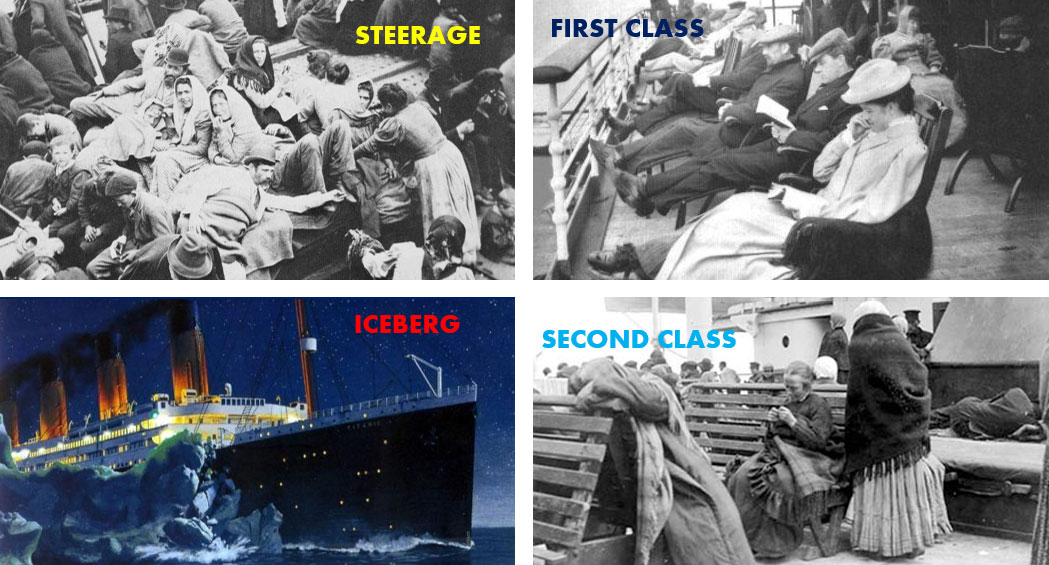
Let’s unpack this using an overused analogy – the Titanic. On the Titanic were 3 classes of passengers – First Class, Second Class and Steerage (or 3rd Class). You can imagine the conversations, hopes, dreams and concerns of the various people on that ship over a century ago. And, history tells us that the tragedy did not befall each class equally – 39% of 1st class passengers perished, 58% of 2nd class and 76% of steerage passengers drowned. The same demographics exist today and are probably having similar conversations within and between groups, focused on maintaining status, moving up in class, or demanding better conditions.

And then there is someone like me – shouting (to all 3 classes) that we just hit an iceberg and need to use science, discourse, reason and planning to find the best solution to navigating evacuation, lifeboats and a new course. You can imagine the reaction – indeed you see it in the news and in your town hall meetings. The ‘first class passengers’ publicly decry that there is no iceberg that technology would never allow the ship to hit an iceberg let alone sink (but privately they are looking to ‘lifeboats’ aka gated communities and the like). The second class passengers are scrambling like mad to ingratiate themselves to the first class passengers to get crumbs of surplus lest they slip into steerage. And the steerage passengers – a full 50%+ of American society today have 2 common responses: 1) “Ok sure there may be an iceberg, but we need to solve our more immediate concerns like our current unacceptable living/working conditions, because we’ll drown from those before any freaking iceberg” (they have valid points) or 2) “Ya right, an iceberg -that is just another story by elites and governments telling us what we have to do and taking away our rights and freedoms”. The difference now (vs on the actual Titanic) is that the steerage class (economically) houses both the far left and the far right, effectively creating additional ‘iceberg’ conditions within the ship itself. The people in ‘steerage’ can’t easily process that in addition to their current challenges, society ALSO has hit an iceberg (see below).

The point here is that the narratives (and religions) that make people feel good are often not based on reality. Which makes discussing, planning and responding to ‘the iceberg of the 2020s’ a very difficult task. The key will be to acknowledge the moral failings of our economic and cultural past while simultaneously acknowledging and planning the lifeboat situation. That’s a difficult thing for a human mind to do.

No matter who wins the election we will be faced with multiple non-overlapping memes and explanations for the upheaval that is coming. Our plight is biophysical (biology and physics) in nature but will be blamed on class, race, politics, and ideology. Navigating this is going to be exceedingly difficult. A new captain can change the morale and surround himself by great minds to make the best civic decisions, but he/she cannot change the fact that our economy and culture has hit an iceberg.


The Zombies are Coming

The central bank purchases and guarantees of various offerings of debt has turned the financial system into a digital Rube Goldberg machine. One of the externalities is that – while the economy was suffering from an exogenous shock from COVID – public companies used the FED bond guarantees to raise cheap debt. For instance, Boeing – a company who arguably will come out of the COVID crisis with worse business prospects due to less demand for planes – nearly doubled its long term debt because it could do so at low rates (the bonds being guaranteed by the FED). This means Boeing – and many other companies – will emerge from this crisis with both lower revenues and higher debt loads, putting them at risk of becoming ‘zombies’. Zombie companies are those whose profits are not enough to pay their interest payments – and they need to take on even more debt (or get direct aid from governments) to stay solvent.

Yes – it’s true stock markets are near all time highs. But this too is a distribution (and expectation) problem. Going into Q3 earnings, the five largest S&P 500 stocks (AAPL, MSFT, AMZN, GOOGL, FB) were expected to grow 3Q sales and EPS by +13% and +1% while the other 495 stocks in SP500 are expected to have a -5% revenue drop and a -24% drop in EPS.

Some great companies. Lots of zombies. No matter who wins this election, we (and the rest of developed world) are going to face a large and growing number of bankrupt and insolvent companies. Stimulus will help – and is critically necessary – but isn’t a long-term solution. And, as the government takes on more and more of this burden, it too risks zombification.


A Cul-de-Sac – and Full of Cans
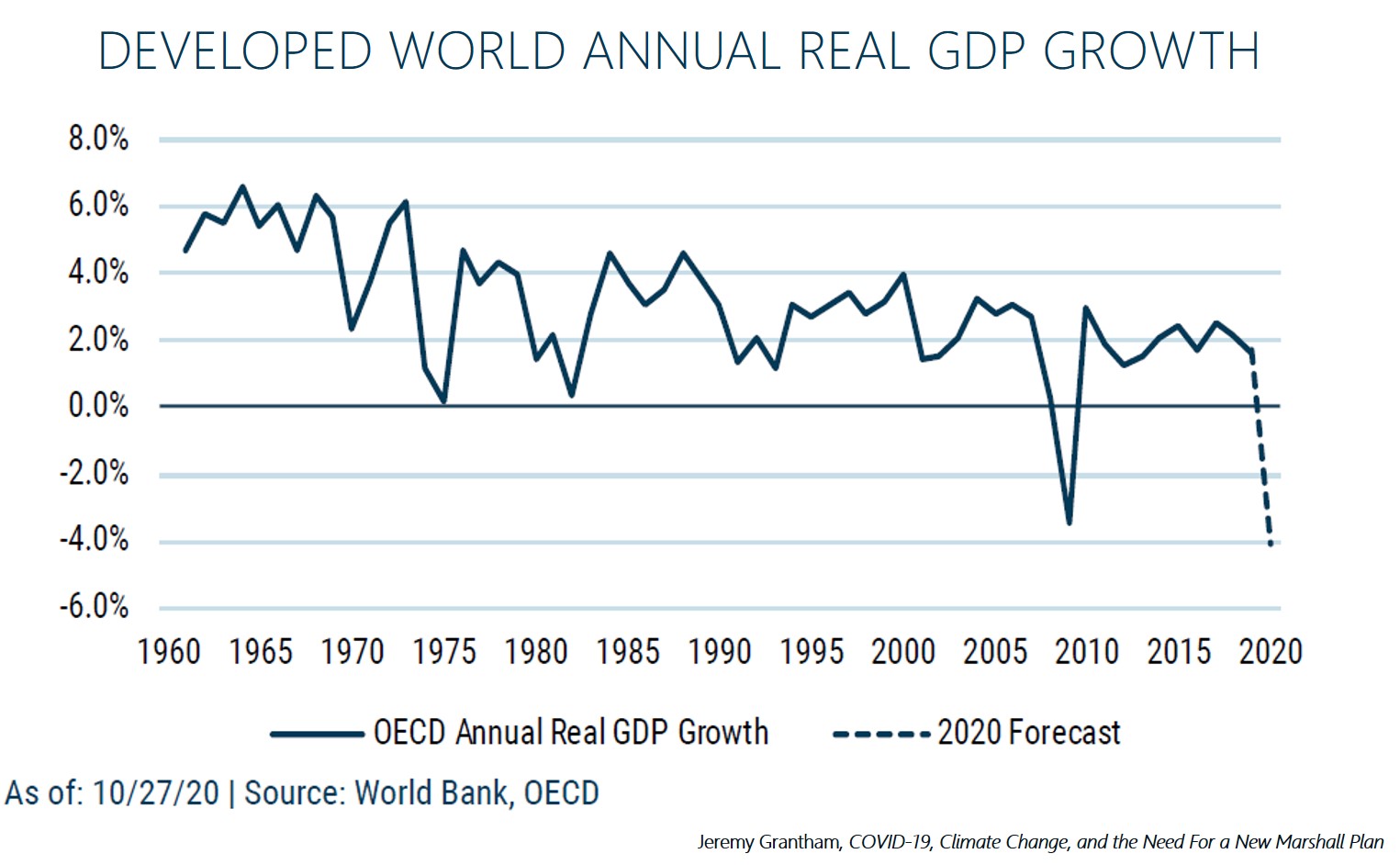


At year end 2019 we were still recovering from the Great Recession -the ‘temporary’ measures initiated in 2008 – artificially low interest rates, too big to fail guarantees, Quantitative Easing, explosion of government debt, expansion of central bank balance sheets, etc. are still in effect a dozen years later. Even with all this, productivity gains have been tiny – and a fraction of earlier decades.

Now, in addition to all this, governments are adding fiscal stimulus – because they must. The little green man behind the curtain – (currently Jerome Powell) is a very capable and good person but he is not superman. The institution he oversees - the Federal Reserve – is using a giant, and mostly invisible, magic wand to beam what we might’ve consumed in 2030 or 2040 forward to 2020 (in the process leaving less available in 2030 and 2040). Modern Monetary Theory tells us deficits don’t matter – but from a biophysical lens they do – when we create money, we do not create the energy and materials needed to pay it back, so adding more and more debt becomes less productive over time – and has limits, both for companies, for nations, and for economic systems.

What happens when either the government decides to stop stimulus (hard to imagine) or the bond market says ‘no mas’ via higher rates? What is the plan by either the Left or the Right (or anyone) for when QE and stimulus combined cannot plug the economic hole for people and businesses? My opinion is that this question will be answered before 2025 – and the answer will be a drop in GDP akin to the 1930s. Yes, more debt and creative stimulus/infrastructure spending will forestall this for a while, but we will soon face a situation when we can no longer kick the can of growing GDP again to the future. COVID is but a foreshadowing. Money isn’t reality – it’s a marker for the things that matter: built, social, natural and human capital. No matter who wins the election we have a 50+ year physical/financial bill that’s coming due.


Our Basement Larder, is -Unbeknown to Most – Going Bare
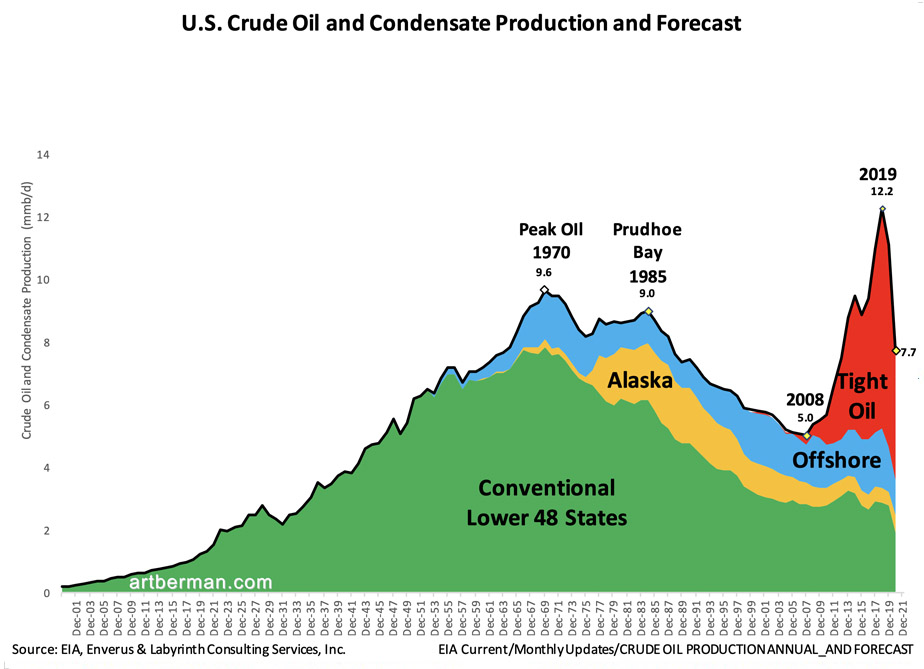


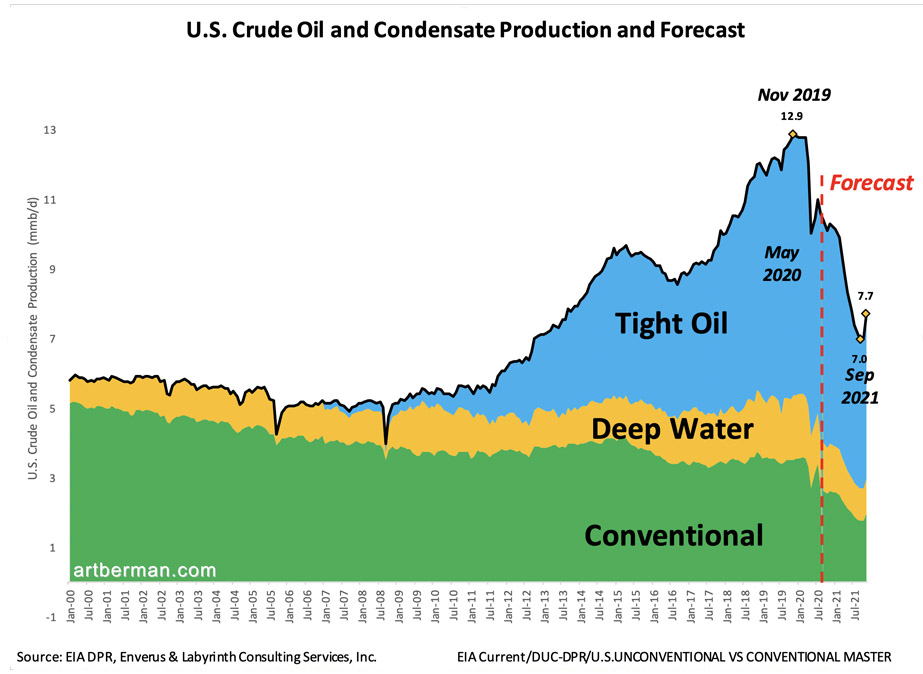
(Charts from Labyrinth Consulting. Assumptions: EIA & Enverus data through August 2020. Sept and Oct guided by EIA tight oil estimates plus Labyrinth estimates for OCS & conventional. Nov 2020 thru Nov 2021 calibrated speculation using to-date tight oil rig count and production correlation extrapolating 2020 ratio average for deep water & conventional production.)


If you took a poll and asked people what the single biggest casualty was from the pandemic, very few people would respond with ‘oil’. But no matter who wins the election, US oil production, including shale oil, is about to fall off a cliff, with massive consequences for society. For the setup of our modern way of life, oil is effectively our hemoglobin – and the COVID arrow hit at the heart of the industry as market prices are far below what it costs to extract oil from the ground. Yet this is all invisible to most people as the media (and economics departments) still conflate price with cost and cost with value. We were in bad shape BEFORE Covid-19 and now the Red Queen (drilling faster and faster just to maintain static production) has stepped off the treadmill for 6+months – meaning the large underlying decline rates of existing fields are not being offset much by new drilling. Worse, most of the recent decline in production is because wells have been shut in. Many of these will never be brought back on line because they cannot meet basic operating expenses and production taxes at current oil prices. In aggregate, US production is so far down -2.28 mmbpd from a 2019 monthly average high of of 12.86 mmbpd. Assuming rig counts and prices stay roughly where they are (and with no stimulus they may get worse), this implies a level of about 7 mmbpd by late summer 2021 – nearly a 50% drop. Globally, the reduction in travel, leisure and transport due to COVID effectively squeezed upstream investment- we are down to 72.8 mb of crude and condensate from 84.6 in November 2018, -which date is highly likely to be the all time peak in global production. Note: this will likely never be recognized as such because there will always be a non-biophysical reason articulated as to why we aren’t getting more oil. E.g. ‘the chinese’ or ‘the environmentalists’ or ‘the war’.)

To label this geologic phenomenon as ‘peak demand for oil’ is the economic equivalent of saying the reindeer on St Matthew Island faced ‘peak demand for lichen’. Oil is the lifeblood of our (current) economy -peak demand for oil also likely means peak growth for economies (unless massive efficiencies and fuel switching occur very fast). We probably won’t notice any lack of oil for many years because affordability by citizens will likely decline faster than oil itself (unless massive stimulus and central bank bazookas arrive). Regardless an accelerated retiring of the fossil armies that do most of our work, and create and deliver our modern smorgasbord of goods and services is now on the horizon.

(Note: I think the graph from my friend Art may be a bit pessimistic, but maybe not. We face a biophysical gauntlet where the price citizens can afford is getting lower and lower and the price energy companies need is higher and higher. If governments guarantee high prices to oil companies, or there are other incentives, production might be higher than indicated here – but here is a glaring statistic – if we were to stop drilling in USA entirely we would lose around 40% of our entire oil production in 1 year – we have to keep investing/drilling in more difficult and costly spots to avoid such a decline. (the 1 year decline rates are: Texas 40%, ND is 52%, Oklahoma 50%, GOM/deepwater 32% New Mexico 45% – these 5 regions are 80% of US production).

This is not remotely being discussed in our culture.

No matter who wins the election, US oil production has peaked – again - and this time including the tight oil provinces – from the ‘source rock’. This will have….large long term consequences, whether one is left, right or libertarian.


Complexity


Increasingly I think it’s neither oil nor finance, nor social disruption that is our core risk but declining returns to complexity

Historian Joseph Tainter famously studied how ancient civilizations declined due to the inability of resources/productivity to keep pace with complexity. In today’s world, this can be seen in myriad ways, from the unemployment software in US States being written in COBOL and FORTRAN, to APIs for majority of our medicines made in India and China, to the paint for a Ford truck only made in Fukushima, Japan.

It’s not something we think about, but we all are part of a complex global supply chain. On the way up, using the concept of ‘comparative advantage’ our society outsourced various manufacturing to countries of the lowest cost production – which in many cases meant locations in Asia with cheap labor. COVID gave us a glimpse of the dangerous underbelly of those decades old decisions: almost 200 drugs currently listed as in short supply by FDA, 6 month wait for bicycles, heavy equipment delays etc. This is a separate issue from short term kinks in the supply chain for e.g. ammunition, canned goods, and toilet paper etc. This issue goes to the embedded fragility of a global system based on growth by perpetually relying on import substitution models of production.

No matter who wins the election, with the geopolitical context that is COVID 19 on financial steroids, making sure that important things are made domestically (or regionally) may become an important question.


Other Energy
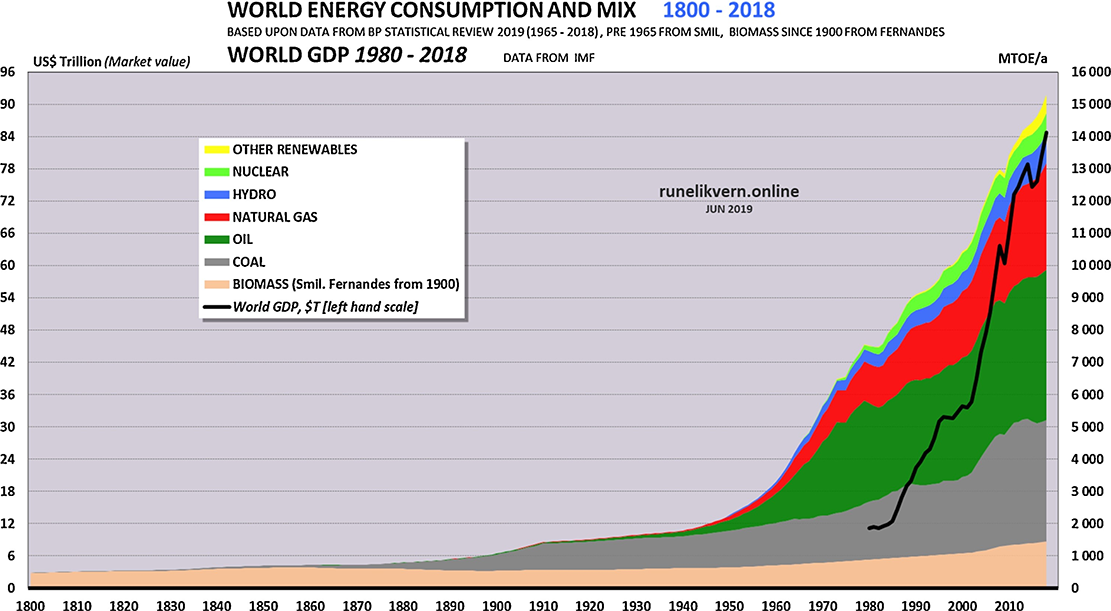


Humans – during periods of growth – and contraction – self-organize around energy. Oil is central but our entire energy balance sheet is going to be a critical issue in the coming decade. Under a Biden win, various Green New Deal proposals will lead to a massive increase in scale for renewable energy. In many ways this is good news, because it will be good for GDP, it will create jobs, and grow our supply of low carbon energy. But the key problem with what’s coming is the goal is ‘lower carbon energy’ not ‘systemically addressing human futures’. 

Briefly: 1) renewable energy isn’t renewable, it’s rebuildable and requires vast amounts of non-energy materials, minerals and land 2) only ~20% of (current) energy mix is electricity which is the type of energy produced from most renewables 3) the higher % of RE in our mix the more important back up (NG and coal) will become – and the US is facing an impending gas shortage as US drilling has plummeted. (the largest growth component of supply was the associated gas from tight oil production), 4) the cost of RE isn’t merely adding some solar panels or wind turbines but the full system cost of integrating RE into the grid which will be higher than consumers currently pay, which will weigh on a fragile economy 5) all RE blueprints expect a LARGER economy in the future when (see above) most realistic scenarios using systemic analysis (finance, politics, biophysical inputs) point to a smaller economy.

Still, renewables are our only hope – they are mature, robust and inexpensive vis-à-vis even a decade ago. The problem will be how to ‘increase renewables to a smaller and more complex system’. No matter who wins the election, we will have to face a more complex and less dependable energy future.


Meaning and Well-being


One of the silver linings (if you will) of the pandemic is that now a great number of people are personally aware that US GDP/ 330 million does not represent how well we are doing as individuals or as a nation. The constant media reminders that the SP500 and Dow Jones just made all-time highs is incongruous with most peoples real lived experience (and most of whom have zero money in the stock market). Whether one understands or agrees with the risks of climate change, energy depletion or limits to growth, tens of millions of people are now hungry for living a decent life with access to basic needs, while doing something good and meaningful. The coming decades – by definition but also by desire – are going to be more about well-being than they are about growing our consumption of stuff.

No matter who wins the election, our nation needs to embark on a deep conversation about what our cultural goal is – we are going to need complementary metrics to the econometric measures quantifying how much energy we burned. What is all this energy for is a question that should be part of our national discourse.


Protecting Heaven


Lost in the discussions of Republicans vs Democrats, stimulus, PPP, COVID statistics, stock market gyrations and geopolitics is perhaps the most important story of all – the state of Earth’s ecosystems and the ~10 million species we share the planet with. They are ‘downstream’ of our elections and financial/economic systems, but none of them have a vote.

I have concluded that natural systems and species futures – for better or worse – are linked to human futures – we have to ‘bend not break’ to have the best outcome for (most) Earth Systems (other than perhaps oceans and very remote species). I believe humans are not any better or worse than we were 100 years, 1000 years or 100,000 years ago – there are just more of us so our impact is (much) larger and each and every one of us consuming much more resources than our ancestors did. Humans are good at heart but we are biological organisms following cultural goals that have expiry dates. We have arrived at a ‘species level’ juncture and need to use systems science, reason, discourse, and leadership to navigate a glide path to intact futures.

No matter who wins the election, the state of the natural world needs to be included in our plans and discussions. Unfortunately, it first needs to be included in our values.


Joy, Living, and Goals


The Great Depression, unless you lived in a big city, mostly happened in slow motion. Similarly, unless we’re very unlucky, the events of the coming decade will unfold gradually. We have to take it upon ourselves to civically engage, but also find time to enjoy and appreciate our lives – being alive at this amazing and perilous time.

We all have ‘conditional’ goals, those which rely on something external to us to change in order to succeed. Many of those goals will not get met because external conditions prevent them – perhaps the ‘guy who we didn’t vote for’ winning the election. The key is to also find “unconditional” goals – those which we ourselves can be 100% responsible for. That way we can feel more empowered to reach those goals, which many times can influence the conditional goals in positive ways. Growing food, spending time with your neighbors, learning a new (useful to the future) skill, mutual aid, etc. The key for all of us – is to meet the future halfway.

No matter who wins the election, life, and the opportunity for joy, impact, and meaning will exist, perhaps even more so.


The 2020 Election and beyond


So, dear reader and fellow countrymen/women, go vote. But voting is merely the beginning of our civic duty. Our country will be shaped by how we citizens respond to the challenges ahead of us as much (or more) than it will by which party wins the election. What am I rooting for? Rationality, science, civility, discourse, which opens up other potential pathways. Our culture is capable of much more than guns, germs and steel or being an energy dissipating superorganism.

People who practice common decency and respect are by far the majority in our (and other) countries. When matched with perseverance, common goals and prioritizing social capital and relationships, we might just happen upon the glide path to decent futures. There are 10s of millions of Americans craving having their basic needs met and just doing some good with their lives – they just don’t yet have a roadmap and convening place. Could such a thing be the emergent result of the 2020 election?

Society right now is dancing – and fighting on the roof of an A-frame with the winds blowing hard and a storm shooting lightning at our heads. We need to keep dancing (less fighting) while we climb down to more stable ground.

No matter who wins the election this week we are on the cusp of major change which will require both top-down and bottom up interventions and cultural emergence. I hope you can play a role.


The objective economy, part one. Tim Morgan, Surplus Energy Economics. Nov. 12, 2020


Saturday, March 2, 2019

Nate Hagens Video Series

2019

1. Energy Blindness

2. Energy Surplus

3. Energy Benefits

4.  Energy Scale

5. Energy Impacts

6. Energy Primacy Part 1

7. Energy Primacy Part 2

8.  Energy Primacy Part 3

9. Energy Primacy Part 4

10. Energy Primacy Part 5

11. Energy Remoteness

12. Energy Depletion

13. Energy Fungibility

14. Energy Transitions

15. Energy and Happiness

16. Energy and Our Future


Other videos by Hagens

2009: Energy Resources and Human Demand on a Full Planet.
Part 1
Part 2
Part 3
Part 4
Part 5
Part 6

2011: We're not facing a shortage of energy but a longage of expectations.

2012: The End of Growth

2013: What if the future is real?

2014: Limits to Growth: Where we are and what to do about it

2015: Energy, credit and the end of growth.

2016: A bird's eye view of the future.

2017: Blindspots and Superheroes

2018: Where are we going?

Thursday, November 30, 2017

Feature Reference Articles #9: Nate Hagens on GDP and Energy Slaves

GDP, Jobs, and Fossil LargesseNate Hagens & DJ White, EarthTrust. via Resilience.org. Nov. 30, 2017.
Working drafts copyright ©2010-2017 NJ Hagens & DJ White, EarthTrust 
Ecological economist Nate Hagens and earth-advocate DJ White (of Earthtrust.org) are collaborating on a synthesis paradigm to inform and engage on the converging crises of “peak everything”, with a working project title Bottleneck Foundation. The “remedial reality” part of the paradigm has been taught by Nate for the last 3 years as an honors’ college course at the University of Minnesota, “Reality 101 – A Survey of the Human Predicament’ . The essay below is an excerpt of what is becoming a large (~1,000 pages) body of work, with an objective to be an educational platform for college students worldwide. When finished, it will be paired with a next-phase set of materials – code name R201 – on how to use this knowledge to more effectively achieve change in the human world.


First, some review of relevant points:

BASIC

1. Fossil carbon compounds are incredibly energy dense, as their formation and processing was done by geologic forces over deep time. One barrel of oil contains about 1700 kWh of work potential. Compared to an average human work day where 0.6kWh is generated, one barrel of oil, currently costing under than $50 to global citizens, contains about 10.5 years of human labor equivalence (4.5 years after conversion losses).

2. As such, these ‘fossil slaves’ are thousands of times cheaper than human labor. Applying large amounts of these ‘workers’ to tasks humans used to do manually or with animals has generated a gargantuan invisible labor force subsidizing humanity – building the scale and complexity of our industry, complexity, population, wages, profits, etc.

3. GDP - what nations aspire to - is a measure of finished goods and services generated in an economy. It is strongly correlated with energy use, and given that almost 90% of our primary energy use is fossil fuels, with their combustion. 'Burning stuff' (measuring how much primary energy is consumed) is a reasonable first approximation for GDP globally.

4. Regionally and nationally this relationship can decouple if the ‘heavy lifting’ of industrialization is done elsewhere, and the goods (and embodied energy) imported. (e.g. China). The relationship between global energy use (which is ~87% fossil fuel based) and GDP remains tightly linked.

ADVANCED

5. The common political mantra that higher GDP creates social benefits by lifting all boats has become suspect since [at least] the 2008 recession and ‘recovery.’ For the first time in the history of the USA, we now have more bartenders and waitresses than manufacturing jobs. In order to maximize dollar profits, it often makes more sense for corporations to mechanize and hire ‘fossil slaves’ than to hire ‘real workers.’ Real income peaked in the USA around 1970 for the bottom 50% of wage earners.

6. GDP only measures the 'goods' and doesn’t measure the 'bads' (externalities, social malaise, extinctions, pollution). Actually, natural disasters like oil spills and hurricanes are ostensibly great for GDP** because we have to build and burn more stuff to replace the damaged areas. (**Note, only to a point – once a country – e.g. Haiti or the Philippines - cannot afford to replace what was lost, then natural disasters become a sharp negative to GDP as infrastructure underpinning future GDP is lost and can’t be rebuilt)

7. On an ‘empty planet,’ pursuing GDP in order to gainfully employ people (and distribute money so they could buy needs and wants) seemed to make sense. However, on an ecologically full planet pursuing GDP with no other long-term plan is using up precious natural capital stocks just to maintain momentum and provide people brain-pleasing neurotransmitters.

8. There are numerous alternative measures to GDP that incorporate well-being and happiness and subtract environmental ills. But it won’t be easy to switch objectives from GDP to e.g. G.P.I. (Genuine Progress or Happiness) because the present creditors will expect to be paid back in real GDP ($) rather than happiness certificates. Still, over time, strict metrics of success based on consumption alone are likely to change.

9. There will likely be a growing disparity between ‘jobs’ (occupations that provide income and contribute to the global human heat engine) and ‘work’ (those tasks that need to be accomplished by individuals and society to procure and maintain basic needs). However, at 2015 USA wage rates, moving from $20 per barrel (the long-run average cost for oil), to $150 per barrel, the army of energy slaves declines from 22,000 per barrel to under 3,000 – meaning the economy shrinks and therefore much more work needs to be accomplished via efficiency improvements, real humans, or making do with less.

10. Our institutions and financial systems are based on expectations of continued GDP growth perpetually into the future. No serious government or institution entity forecasts the end of growth this century (at least not publicly).

_______________________________________________________________


Okay. Let’s unpack all of this a bit.

Often in the news today, you'll hear people talking about job growth and job creation like it's a good thing. Everybody wants a good job, right? The more jobs we have to do, the better off we are!

Yet if you kick open an anthill or a beehive, the insects will not be grateful for the sudden boost in job creation, and they will effectively utilize the cross-species language of biting and stinging to inform you of this opinion. From this we may infer that insects don't understand economics.

Alternately, it could it be that ants - having honed their behaviors for 130 million years and having attained a total biomass we have only recently (and temporarily) matched - might be in tune with some deep realities about jobs, energy, and the embodied cost of building complexity.

Since this is Reality 101, let’s ask some basic questions. What ARE jobs, really? How do they relate to energy and wealth? How do we keep track of whether we’re richer or poorer? We all kinda feel like we know. And (as a general rule) whenever “we kinda feel that we know” is the case, we should probably take a closer look.

To do so, we’ll first need to add a few things to our story about ants. We need to revisit our invisible energy slaves, discover what “freaks out” capuchin monkeys, and think about what wealth actually is.


Energy Slaves again

As you recall - and as we’ll discuss in greater detail as the course goes on - every American has over 500 invisible energy slaves working 24/7 for them. That is, the labor equivalent of 500 human workers, 24/7, every day of the year, mostly derived from burning fossil carbon and hydrocarbons.

Every American thus has a veritable army of invisible servants, which is why even those below the official poverty line live, for the most part, lives far more comfortable and lavish with respect to energy and stuff than kings and queens of old (but obviously not as high in social status). Being long dead and pulled from the ground - and thus a bit zombie-esque - these energy slaves don’t complain, don’t sleep, and don’t need to be fed. However, as we are increasingly learning, they do inhale, exhale, and leave behind waste. Since they’re invisible, we don’t think about these fossil helpers any more than we think about nitrogen (which happens to be 78% of what we breathe in, but hey, it’s just “there”, so why think about it?) Same with our 500 energy helpers. The extent we think about them is when we fill up at the pump or pay our electric bill – and then only as an outlay of our limited dollars.

We use the “slave” metaphor because it’s really a very good one, despite its pejorative label. Energy slaves do exactly the sort of things that human slaves and domestic animals previously did: things that fulfilled their masters’ needs and whims. And they do them faster. And cheaper. Indeed, it probably wasn’t a big coincidence that the world (and the USA) got around to freeing most of its human slaves only once industrialization started offering cheaper fossil-slave replacements.

The things we value are created with a combination of human and energy-slave work combined with natural capital (minerals and ores, soils and forests, etc.). There are huge amounts of embedded energy in the creation and operation of something like an iPad and the infrastructure which makes it work. When we tap our screen to view a kittycat picture, the image is pulled from a furiously spinning hard drive which may be halfway around the planet, propelled by some fossil slaves, and routed through data centers which are likewise fueled. The internet uses over a tenth of the world’s electricity - that’s a lot of energy slaves. The infrastructure itself has taken decades to build, and requires constantly increasing energy to maintain. But we don’t think much about that either.

So the internet is infrastructure we have invested energy in, just like a built anthill has been invested in with ant labor. If the internet (or an anthill) was destroyed and needed to be rebuilt, that situation would certainly create jobs. But it would also require a lot of energy, raw materials and work. Ants don’t have energy slaves, so they don’t want more work to do. They are dealing with finite energy inputs in their ecosystem. If more energy (ant-labor) is devoted to rebuilding the anthill, less energy is then left to care for the larvae, forage for food, and defend the hive.


Energy slaves don’t care either way about job creation. (Being zombies and all). But why do we?

Everybody wants a good job.

Remember this, because it’ll come up again and again in Reality101: evolution works with what it’s got. It’s a stepwise process, and each step is based on what was available in the step before. This is true both for biological and social evolution. That’s why there are no animals on the Serengeti with wheels: there’s no viable path to evolve wheels from feet, because even if there was a way of designing animals that had wheels, there are no viable intermediate stages. Hold that thought…

Now in times past, a human’s career, their societal function, was largely about their own individual labor and skills. A blacksmith worked with metal. A cooper made barrels. A shoemaker made shoes. Others made furniture, cloth, or other valuable commodities. Farmers created food. Preachers preached. Others did simpler labor like digging ditches or cutting down trees. The relative value of their labor was roughly set by how much other humans valued the end product of such labor, so a skilled blacksmith might be able to trade his services for more status and better accommodations than a ditch digger. Thus, it became an integral part of human culture that the products of some work were considered more valuable than others. It became a mark of social status and pride to have such a career. Hold that thought too, we’ll be coming right back to it.


Cue the Screaming Monkeys.

“Equal Pay for Equal Work” is currently the slogan for those opposed to sexual discrimination, which is usually characterized by women getting paid less than men. And it’s a sentiment which has deep roots in the ape and even simian mind.

If you give capuchin monkeys the “job” of doing a nonsense task in exchange for a reward, they will happily do it all day long as long as they keep getting a reward - cucumber slices. But if a capuchin sees the monkey in the next cage get a (better tasting so higher value) grape while it still gets a cucumber slice, it’ll go ape, throwing the cucumber slice in the face of the experimenter in a rage. It gets the same cucumber slice it has been happy to work for before, but it no longer wants it, because it no longer feels fair in comparison to its cage mate’s effort and reward. Instead, it wants the experimenter and the other monkey to be punished for this inequity (we watched this video of Frans de Waals experiment in class).

Think for a moment how central this monkey reaction is to the human world around you. We’ll come back to it later in the course, and will refer to the term “capuchin fairness” because a similar mechanism turns out to be behind a great deal of human behavior. We’re outraged at the notion of somebody getting more reward than we do for doing the same thing. Indeed, many large-scale human institutions now stress perceived fairness of process over quality of end results. (A prominent example might be the US Congress). Moreover, this monkey-business also reiterates the concept of relative wealth being more important to a monkey mind (and a human mind, it turns out) than absolute wealth, which is kind of nuts, but that’s monkeys for you.

It turns out that our brains are simultaneously trying to optimize two different, and somewhat incompatible pursuits, both of which have deep evolutionary roots in our social species. One is energy gathering and wealth creation: obtaining food, procuring clothing and shelter – basically optimal foraging theory applied to the human biological organism. The other is equitable social distribution and transparency of process. A tribe of hunter-gatherers needed to cooperate as a mini super-organism to get food and defend territory and stand together against competitors. But within the tribe, an individual’s success depended on it getting a reasonable share of what the tribe had. We’re descended from tribe-members who insisted on at least their fair share, as is every living capuchin, so it’s not surprising it’s such a strong feeling. But when both of these instincts are operating simultaneously, in an era where our species happened upon a buried treasure of fossil pixie dust, some interesting practices emerged…


Ok. Ants. Monkeys. Energy Slaves. So where did “jobs” come from?

A funny thing happened on the way to the Anthropocene. To an ever-increasing degree over the last two centuries, wealth has been created more by fossil slaves than by human labor, significantly more - and it’s at its all-time peak about now. (you’ll have the information to derive this yourself by the end of this course).

If you don’t believe that, try hiring a bunch of people to push you and your SUV around hundreds of miles per week with their own muscles and see what it costs you, and then see how little it costs you to buy the same work in a tank of gasoline. In fact, the vast majority of the tasks and stuff that used to be done by human labor is now done by fossil slaves and the infrastructure they have enabled. The slaves have also made shipping nearly free, so any actual human labor we need can also be hired in the cheapest places on earth (under essentially slave labor conditions), and shipped to us by planes, trains, ships and trucks for next to nothing. So rather than buying furniture from local artisans, we make local firms compete with furniture made halfway across the world which is cheaply shipped to a local store. To a good first approximation, the USA doesn’t make anything anymore (well, movies…).

We have amassed a huge amount of wealth, even if much of it is dumb stuff like plastic toys and salad shooters and things that quickly break. There are so many things we think we want, so we get them. We eat salads with fresh veggies which may be grown 5000 miles away and air-flown to our stores by energy slaves running the planes, refrigerators, trucks, and stores. The average dinner travels over 1400 miles to get to your plate in USA.

We increasingly buy disposable everything - used once and tossed away. Most everything is short-life these days; when your authors were young if you bought a fan, you expected it to last 20+ years. Now if it lasts 2-3 before you toss it, that’s about par for the course. Planned obsolescence exists because it’s “good for GDP.” A new dishwasher now lasts 6-8 years when it used to last 12-16, because they now have integrated cheaper electronics that fail. Our GDP has become tethered to rapid product-replacement cycles keyed to our short attention spans and our enjoyment at buying new things. This creates “jobs” for car salesmen, advertising executives, etc., but has tilted the scales in favor of “useless GDP” rather than real societal utility. We know how to make things with high quality that last, but due to time bias and the financialization of the human experience, such an objective is relatively unimportant in our current culture. Many people get a new phone every 18 months with their cell plan, and perfectly functional ones wind up in the landfills.

But how should we distribute the largesse of the energy slaves? Does everyone get equal shares? Do we take the total number of dollars (which is the way we count such things) created by energy-slave work and divide them equally among the population?

Heavens no. We haven’t even acknowledged that the energy slaves are responsible. Rather, with a bit of help from opportunism, social evolution co-opted the pre-existing “work for pay” concept into an uneven distribution system that “felt” fair.

These days there are a lot of jobs in the USA, which keep us very busy not making much of anything of long term value. We do advertising, hairstyling, consulting, writing, and a lot of supervising of the things our fossil slaves do. We don’t care all that much what we’re doing as long as we feel we’re getting paid at least as well for the same task as the other capuchins – er... people - around us, and that with our compensation we can buy things that give us pleasing brain-reward experiences. These days in this culture, a “good job” is defined by how much it pays, not by what it accomplishes. Many people would consider it an optimum situation, a great job, to sit in a room for 40 hours per week and make $100,000 per year, just pulling a lever the way a capuchin does for a cucumber slice. You know they would (would you? Think about it. Now think about how that compares to the career you’re currently planning).

And that’s where the perceived equality is: the equality of inconvenience. The 40-hour work week is a social threshold of inconvenience endured, which is now what we keep primary social track of rather than the productive output of a person’s activity. In 1930 John Maynard Keynes predicted that wealth would increase 600% in the next century (which is only 15 years away) and because of this wealth, people would only need to work 15 hours per week. He was right about our wealth increase, but paradoxically, we are working longer hours than ever! Because socially, everyone who isn’t a criminal is supposed to have a job and endure roughly equivalent inconvenience. Any segment of society which went to a 15-hour work week would be treated as mooching freeloaders, and be pelted by cucumber slices and worse.

In a society in which we’re all basically idle royalty being catered to by fossil slaves, why do we place such a value on “jobs”? Well, partly because it’s how the allocation mechanism evolved, but there also exists considerable resentment against those who don’t work. Think of the vitriol with which people talk about “freeloaders” on society who don’t work a 40-hour week and who take food stamps. The fact is, that most of us are freeloaders when it comes down to it, but if we endure 40 hours of inconvenience per week, we meet the social criteria of having earned our banana pellets even if what we’re doing is stupid and useless, and realized to be stupid and useless. Indeed, a job that’s stupid and useless but pays a lot is highly prized.

So “jobs” per se aren’t intrinsically useful at all, which is why ants don’t want more of them. They’re mostly a co-opted, socially-evolved mechanism for wealth distribution and are very little about societal wealth creation. And they function to keep us busy and distract us from huge wealth disparity. We’re too busy making sure our co-workers don’t get grapes to do something as radical as call out and lynch the bankers. Keeping a population distracted may well be necessary to hold a modern nation together.

And since most of our wealth comes from invisible, mute slaves we don’t even think about, it isn’t clear to us that what we’re actually doing in current economies is distributing the wealth they create.

That means we can now have wild disparities in pay, as long as it “feels like” others are doing something qualitatively different. The amount paid to a Wall Street vice president is hugely greater than that paid to a college professor, which in turn is greater than that paid to an environmental campaigner. This has pretty much nothing to do with the relative worth of each function to society, and everything to do with how well-connected such jobs are to the flow of energy-slave-created wealth. Yet if higher pay is received by someone in another “tribe” who we don’t directly interact with, we don’t feel the urge to scream and throw our paycheck. We just wish we had a “better” job.

If we reflect on the possibility that we have en-masse simply accepted the premise that the job is somehow paid what it’s worth, we arrive at some disturbing conclusions. Is a teacher, farmer, or fireman really of less value to society than a real-estate flipper? The amounts paid for jobs have been allowed to float freely, detached from actual societal value as the degree of political connectedness of those with such jobs varies. The vast majority of our wealth comes from primary natural capital in tandem with fossil slaves and from the fruit of empire; jobs are mostly an ad-hoc mechanism for distributing this wealth unequally in a way which effectively conveys the illusion of egalitarian process.

For now, are most of us just idle princes and princesses in a fossil-slave kingdom, none of us really at huge risk, and mostly doing things which have little net value? And what happens when our fossil slaves grow wings and fly away into the atmosphere? What will the princes and princesses do then?


That’s just Gross.

This leads us to the story of how we keep track of our wealth and productivity and success. How DO we keep track of that collective wealth anyways?

Well for real wealth, mostly we don’t. The value of a healthy ecosystem, clean air, seas full of fish, fresh drinkable water… love, joy, happiness and fulfillment… all these things our market system considers to be of essentially zero value. Armadillos, dolphins, hummingbirds, rainforests… you get the idea.

But our economists have a metric called “gross domestic product” GDP which is what our society uses to roughly keep track of our ‘success’. It represents the dollar value of all finished goods and services produced in a time period (typically, a year) within a nation’s borders. Since that other stuff-- you know, the natural world-- doesn’t consist of finished goods and services, it isn’t counted (now if you kill the hummingbirds and make them into ornaments for hats, or turn armadillos into ashtrays, they then can be added to GDP because they’re now products which are “finished”!).

The fact that parts of the environment which have been “finished” are considered more valuable than parts which are “unfinished” is one way in which GDP sets a fairly screwy default value in our current world. It’s a tacit societal value system: anything without a transacted money value isn’t part of GDP. So a nation which chops down all its trees to sell to another country for firewood has a better GDP than one which leaves its trees standing. It’s a funny way to figure wealth, but it’s what we’ve got. And oh, by the way, we’re betting everything on it.

GDP is based on money transaction (money is, roughly speaking, a claim on future energy), and since most current wealth is created by our fossil energy slaves, GDP is directly tied to the energy burned by society. Indeed, it has recently been shown that GDP is tied to fossil fuel energy, and thus CO2, in a way which may be described very simply by treating human society as essentially a giant heat engine. In other words, a very simple model which treats human civilization as an essentially mindless consumptive system - a thermodynamic amoeba in search of energy - suffices to match the GDP with the quantity of energy burned.

And over the last 100 years, our burning of energy, and thus our world GDP, has gone through the roof. The number of dollars representing the wealth created from the burning has also increased, and exponentially so in the last 50 years, and since the 2008 crisis, even faster.

It may be reasonable to reflect that during this same period, sometimes called The Great Acceleration, the planet has been largely laid to waste, a mass extinction has accelerated, the seas have been depopulated of most fish, and the systems which sustain large complex life on earth have been progressively compromised. Yet we continue to grow the scale of the heat engine to accomplish the primary objective of the modern human economy: to maximize dollars and jobs.

Bear in mind that what we’re doing - if we get right down to it - is converting trillions of watts of fossil-slave energy into a few watts of pleasing stimulation inside our brains. (alternately: tiny amounts of brain-reward chemicals) And the side-effect of this process is all around us. Mountains of waste, acidified oceans, altered climates, pollution, mass extinctions, and mischief. Here we use “mischief” as the general term for things humans do en-route to pleasing themselves, which may include building racetracks, using disposable diapers, making wastebaskets out of elephant feet, overbuilding fishing fleets, throwing out our electronics every two years to replace them with new ones, etc. It doesn’t “feel like” waste at the time. But if you ask someone in 200 years what percent of fossil magic was wasted, they will likely say “all of it,” because not much useful fossil fuel (or anything previously built with it) will likely remain.

The ubiquity of fossil slavery during our lifetimes has caused us to conflate wants and needs. Most of what we “feel like” we need these days is nothing we evolved to need. Consumerism is driven largely by social competitiveness. Most capuchins – er…, people - find it more important to have a bigger house than their neighbors, than to have an even bigger house in a neighborhood where it’s the smallest one. Relative wealth - it’s not just for monkeys (we and the monkeys like fairness, but it feels more fair if we’ve got stuff at least as good as the people we interact with).

And this signalling of status is important socially and sexually. A lot of the things we feel we need are just for show.

And do you remember the “hedonic ratchet” effect from earlier discussions on bias, heuristics, fallacies and delusion? To get the same mental stimulation we got yesterday, we require the expectations of ever-increasing reward. That means more money and more energy slaves. Or at least the expectation of same.

Happiness is not correlated with wealth beyond having the basics of life covered. Most of the things which actually make us happy, joyful, and fulfilled are in our virtual mental worlds, and not in the physical world at all. A Filipino may have only a small percent of the number of energy slaves as an American, but be every bit as happy, and surveys have shown that to be true. It’s quite possible to be “poor” and happy. Equally, it’s quite possible to be rich and miserable. Our brains are even primed for it, seemingly.


So where does this leave us?

Well, you already know that our amoeba-like heat-engine of an economy is wrecking the earth, acidifying the seas, melting the polar caps, causing what could become the greatest mass extinction in 65 million years, and throwing our future into doubt.
But at least we have our good ol’ energy slaves to continue creating GDP. Right?

Well…

Thing is, the energy slaves will soon be going away forever. In the last 30 years we’ve burned a third of all fossil energy that has been used since it was discovered thousands of years ago. Since your authors have been alive, humans have used more energy than in the entire 200,000 year history of homo sapiens.

We are just now passing through the all-time peak of liquid hydrocarbon availability, which is the chief driver of our economies due to its special attributes.

Each year, basically from now on, most of us will have fewer fossil energy slaves marching behind us. You’d think this wouldn’t make much difference, right? Since they’re invisible anyhow? But in fact it’ll make a great deal of difference, because we’re heading back into times – either gradually or suddenly, but inexorably - in which human labor makes up an increasing percentage of the total energy we have available. One day human (and perhaps animal) labor will again be the majority of the work done in human societies – just like it is in an anthill.

And this will happen in the context of a more used-up natural world. Rather than being able to catch dinner by throwing a hook in the nearby ocean, the nearest healthy schools of fish may be ten thousand miles away in Antarctica, and hard to get to without dirt-cheap energy slaves to make giant refrigerated ships to pursue and move them around for us. The copper mines will be mostly used up. The inorganic phosphate deposits we used to make fertilizer, mostly gone. And so on.

Or rather than “gone,” let’s use the more accurate term energetically remote. That is, there will still be loads of “stuff” underground, but it won’t be the very pure ores of yesteryear. It’ll be stuff that requires digging up a huge amount of rock for a tiny amount of whatever we’re after. Because (remember the Easter candy story) we always use the best stuff first. Yet we’ll be going after worse and worse ore with fewer and fewer slaves. And the heavy breathing of the fossil slaves will have pulled our seas and climate back towards conditions in which they were born - a hellish primordial world of toxicity.

This all raises the question - or at least should - of whether it might not be a good idea to set the fossil slaves free and let them rest, since they’re going away soon anyhow and when they do we will really need a livable planet. They don’t need jobs, and we don’t need dollars for happiness. Yet this flies in the face of capuchin entitlement and evolved mechanisms for brain reward, which – in effect - take our current societal arrangements for granted. As our fossil slaves eventually retire – childless –we might have to rediscover the difference between jobs and work, just like the ants.


On GDP, Stone Heads and Babies


“Can you think of any problem in any area of human endeavor on any scale, from microscopic to global, whose long-term solution is in any demonstrable way aided, assisted, or advanced by further increases in population, locally, nationally, or globally?” Al Bartlett


So other than using up non-renewable resources and degrading the natural world, what other consequences can there be when maximizing GDP is our plan for the future?

Well, for one thing, it can lead us to really screwy societal choices.


For instance in the infamous Easter Island culture, there was an organizing belief in belief that all food, resources, and other good things came from their dead ancestors, and that the way to make your dead ancestors happy was to build giant statues for them. This was actually not that different an organizing concept from GDP, in that both exhibit a near-hallucinatory level of disconnect from physical reality and ecology.

As ecological changes on Easter island worsened due to rats cutting into food supplies, it “made sense” to vastly ramp up the production of giant stone statues, making them ever-bigger (and hence presumably more pleasing to the dead ancestors... “too big to fail”, perhaps...). This was a colossal undertaking for a stone-age people using human muscle power, and required a lot of wood for rollers and leverage. So they cut the trees down, which caused erosion to begin washing away their productive farmland.

The worse things got, the harder they worked making stone giants. The final generation of stone giants never left the quarries - they were too big to move. As a part of this process, eventually the last large tree was cut down, which made sense based on their organizing beliefs, but was in retrospect not a good plan. It not only meant their fertile soil washed away, but meant they could no longer make boats to go fishing. So they starved, fought, and suffered a lot as their populations crashed.

For the Easter Islanders, erecting these stone monuments was an example of “jobs” masquerading as “work” - basically tasks done for social-obligation reasons that did not provide actual biological or group-fitness benefits. (do you think there may be modern-day equivalents?)

Today it’s easy to joke about these islanders and their “giant stone heads” as a high point in the history of human doofus-ness. Yet our adherence to GDP is a similarly skewed metric, equally detached from the realities of ecology, from human happiness, and from the potential for future generations with decent life quality. On a much larger scale, we too are eroding farmland (which these days is largely a dead medium used to hold the seeds in place and receive industrially-produced fertilizer and pesticides), destroying the ability to get fish (by wiping out fisheries), and, because of our numbers, mucking things up to a degree the Easter Islanders never reached.

We’ve already mentioned that - due to being blind to the energy slaves who do nearly everything for us - we now tend to conflate “jobs” with “work”, where “jobs” are just a social distribution mechanism for energy-slave largesse - an entitlement entwined with social status - and “work” is what is necessary to temporarily improves an individual, tribe, nation, or species’ circumstances.

We’ve also noted that we have folded “planned obsolescence” into most built consumer devices, so they break more quickly and require replacement, tuning their life-cycle to human whims and brain rewards rather than to real utility. Mostly we don’t really even want or expect gadgets to last as long as they used to; as long as we can afford it, we want the newer, cooler, stuff. And advertising helps keep our culture primed for it.

The fact is, we have designed a social system that requires growth. Money – really a claim on future energy and resources – comes into existence irrespective of whether such future energy and resources will be available. Each year we need growth in a household/city/state/nation/world to service and pay off monetary loans that were created previously. No serious government or institutional body has plans for anything other than continued growth into the future. Growth requires resource access and affordability but starts first with population.

So, right as our energy slaves are about to start going away forever, leaving 7-10 billion humans without the things they have come to take for granted, our nations have decided the answer is to make more babies! Yep, to raise GDP you need more demand for toys, diapers, teachers, etc… more jobs, because more jobs means more transactions which means more GDP! More GDP means “growth” so growth is good! China has just reversed its 1-child policy, which prevented massive starvations and slowed the horrendous assault on China’s environment. Many other nations, such as Japan, Germany, and Sweden, are now offering bonuses for getting pregnant. In Denmark advertising firms are encouraging couples to have more babies for the good of the economy via sexy commercials.

Paradoxically, as traditional drivers of GDP growth – development of virgin land, credit expansion, low cost fossil fuels, and groundbreaking innovation- wane in their impact, there may be renewed incentives proposed not to shrink our population as ecology would advise, but instead to grow it! Currently we are having (as a species) over 120 million babies per year. This works out to over 335,000 human babies born every day – compared to a total extant population of all the other Great Apes (bonobos, chimpanzees and gorillas) of about ~200,000! Since ‘demand” is considered a quasi-magical force in current economic theory, babies are considered to be good for business (yet children brought into the world now for GDP reasons will face some real challenges in their lives. Nate and DJ decided not to do that for a host of reasons).


China is building massive empty cities now. No kidding. Cities with nobody in them, ready to be moved into by the bonus babies to grow GDP. That’s edging perilously close to building giant stone heads.

When you get right down to Reality101 and the intermediate human future, this is actually worse than building giant stone heads, because stone heads don’t suffer, reproduce, or require further degradation of the ecology to provide for. In many real ways, the world and human species would be far better off if we immediately moved from GDP to “giant stone heads” as a metric for success (and say, doesn’t that imply to you that we might even do better than giant stone heads, if we put our minds to it?).

GDP sets a money value on everything in the natural world and in human experience, and the most important things are currently valued at or near “zero.” Yet as we’ve seen, GDP is currently tied to the work of fossil slaves, who will be gradually flying away. There’s no way, even in principle, for “growth” such as we’ve recently seen to continue indefinitely, and considerable data points to it ending quite soon. GDP will begin a long decline because it’s tied to finite realities in the physical world.

The good news, of course, is that GDP is an insane metric for success, just as “giant stone heads” was (though to give the Easter islanders their just due, at the time they had no evidence their belief was nuts, while in 2016 we have demonstrable proof that the conclusions of neoclassical economics are refuted by basic science). If we decide that we value happiness, quality of life, and a healthy planet with uncounted thousands of human generations left, we could in principle jettison GDP and do things differently.

It won’t be easy, only necessary. It’ll be easier to fail than succeed, for the societal inertia of a raging amoeba hungry for growth is a hard thing to change. Nothing much depends upon it other than the human destiny and the fate of complex life on the planet.

Learn to see the giant stone heads around you, and think about them.