Showing posts with label scientists. Show all posts

Friday, April 23, 2021

Climate scientists: concept of net zero is a dangerous trap

Climate scientists: concept of net zero is a dangerous trap. James Dyke, Robert Watson, Wolfgang Knorr.  April 22,2021.


Sometimes realisation comes in a blinding flash. Blurred outlines snap into shape and suddenly it all makes sense. Underneath such revelations is typically a much slower-dawning process. Doubts at the back of the mind grow. The sense of confusion that things cannot be made to fit together increases until something clicks. Or perhaps snaps.

Collectively we three authors of this article must have spent more than 80 years thinking about climate change. Why has it taken us so long to speak out about the obvious dangers of the concept of net zero? In our defence, the premise of net zero is deceptively simple – and we admit that it deceived us.

The threats of climate change are the direct result of there being too much carbon dioxide in the atmosphere. So it follows that we must stop emitting more and even remove some of it. This idea is central to the world’s current plan to avoid catastrophe. In fact, there are many suggestions as to how to actually do this, from mass tree planting, to high tech direct air capture devices that suck out carbon dioxide from the air.


Read more: There aren’t enough trees in the world to offset society’s carbon emissions – and there never will be


The current consensus is that if we deploy these and other so-called “carbon dioxide removal” techniques at the same time as reducing our burning of fossil fuels, we can more rapidly halt global warming. Hopefully around the middle of this century we will achieve “net zero”. This is the point at which any residual emissions of greenhouse gases are balanced by technologies removing them from the atmosphere.

This is a great idea, in principle. Unfortunately, in practice it helps perpetuate a belief in technological salvation and diminishes the sense of urgency surrounding the need to curb emissions now.

We have arrived at the painful realisation that the idea of net zero has licensed a recklessly cavalier “burn now, pay later” approach which has seen carbon emissions continue to soar. It has also hastened the destruction of the natural world by increasing deforestation today, and greatly increases the risk of further devastation in the future.

To understand how this has happened, how humanity has gambled its civilisation on no more than promises of future solutions, we must return to the late 1980s, when climate change broke out onto the international stage.


Steps towards net zero

On June 22 1988, James Hansen was the administrator of Nasa’s Goddard Institute for Space Studies, a prestigious appointment but someone largely unknown outside of academia.

By the afternoon of the 23rd he was well on the way to becoming the world’s most famous climate scientist. This was as a direct result of his testimony to the US congress, when he forensically presented the evidence that the Earth’s climate was warming and that humans were the primary cause: “The greenhouse effect has been detected, and it is changing our climate now.”

If we had acted on Hanson’s testimony at the time, we would have been able to decarbonise our societies at a rate of around 2% a year in order to give us about a two-in-three chance of limiting warming to no more than 1.5°C. It would have been a huge challenge, but the main task at that time would have been to simply stop the accelerating use of fossil fuels while fairly sharing out future emissions.
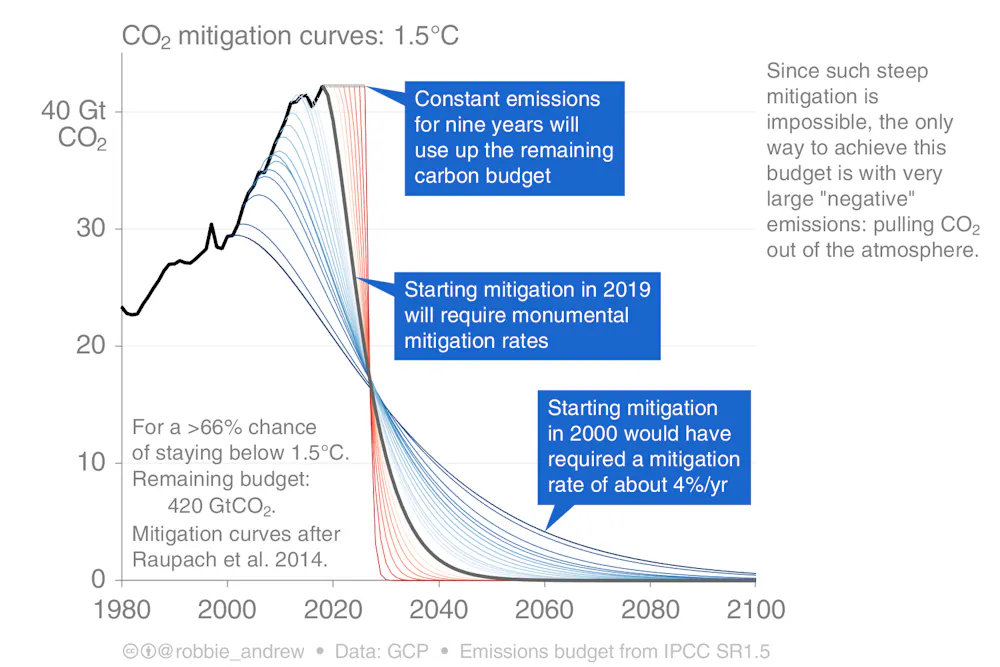


Graph demonstrating how fast mitigation has to happen to keep to 1.5℃. © Robbie Andrew,


Four years later, there were glimmers of hope that this would be possible. During the 1992 Earth Summit in Rio, all nations agreed to stabilise concentrations of greenhouse gases to ensure that they did not produce dangerous interference with the climate. The 1997 Kyoto Summit attempted to start to put that goal into practice. But as the years passed, the initial task of keeping us safe became increasingly harder given the continual increase in fossil fuel use.

It was around that time that the first computer models linking greenhouse gas emissions to impacts on different sectors of the economy were developed. These hybrid climate-economic models are known as Integrated Assessment Models. They allowed modellers to link economic activity to the climate by, for example, exploring how changes in investments and technology could lead to changes in greenhouse gas emissions.

They seemed like a miracle: you could try out policies on a computer screen before implementing them, saving humanity costly experimentation. They rapidly emerged to become key guidance for climate policy. A primacy they maintain to this day.

Unfortunately, they also removed the need for deep critical thinking. Such models represent society as a web of idealised, emotionless buyers and sellers and thus ignore complex social and political realities, or even the impacts of climate change itself. Their implicit promise is that market-based approaches will always work. This meant that discussions about policies were limited to those most convenient to politicians: incremental changes to legislation and taxes.

Around the time they were first developed, efforts were being made to secure US action on the climate by allowing it to count carbon sinks of the country’s forests. The US argued that if it managed its forests well, it would be able to store a large amount of carbon in trees and soil which should be subtracted from its obligations to limit the burning of coal, oil and gas. In the end, the US largely got its way. Ironically, the concessions were all in vain, since the US senate never ratified the agreement

Postulating a future with more trees could in effect offset the burning of coal, oil and gas now. As models could easily churn out numbers that saw atmospheric carbon dioxide go as low as one wanted, ever more sophisticated scenarios could be explored which reduced the perceived urgency to reduce fossil fuel use. By including carbon sinks in climate-economic models, a Pandora’s box had been opened.

It’s here we find the genesis of today’s net zero policies.


That said, most attention in the mid-1990s was focused on increasing energy efficiency and energy switching (such as the UK’s move from coal to gas) and the potential of nuclear energy to deliver large amounts of carbon-free electricity. The hope was that such innovations would quickly reverse increases in fossil fuel emissions.

But by around the turn of the new millennium it was clear that such hopes were unfounded. Given their core assumption of incremental change, it was becoming more and more difficult for economic-climate models to find viable pathways to avoid dangerous climate change. In response, the models began to include more and more examples of carbon capture and storage, a technology that could remove the carbon dioxide from coal-fired power stations and then store the captured carbon deep underground indefinitely.

This had been shown to be possible in principle: compressed carbon dioxide had been separated from fossil gas and then injected underground in a number of projects since the 1970s. These Enhanced Oil Recovery schemes were designed to force gases into oil wells in order to push oil towards drilling rigs and so allow more to be recovered – oil that would later be burnt, releasing even more carbon dioxide into the atmosphere.

Carbon capture and storage offered the twist that instead of using the carbon dioxide to extract more oil, the gas would instead be left underground and removed from the atmosphere. This promised breakthrough technology would allow climate friendly coal and so the continued use of this fossil fuel. But long before the world would witness any such schemes, the hypothetical process had been included in climate-economic models. In the end, the mere prospect of carbon capture and storage gave policy makers a way out of making the much needed cuts to greenhouse gas emissions.


The rise of net zero

When the international climate change community convened in Copenhagen in 2009 it was clear that carbon capture and storage was not going to be sufficient for two reasons.

First, it still did not exist. There were no carbon capture and storage facilities in operation on any coal fired power station and no prospect the technology was going to have any impact on rising emissions from increased coal use in the foreseeable future.

The biggest barrier to implementation was essentially cost. The motivation to burn vast amounts of coal is to generate relatively cheap electricity. Retrofitting carbon scrubbers on existing power stations, building the infrastructure to pipe captured carbon, and developing suitable geological storage sites required huge sums of money. Consequently the only application of carbon capture in actual operation then – and now – is to use the trapped gas in enhanced oil recovery schemes. Beyond a single demonstrator, there has never been any capture of carbon dioxide from a coal fired power station chimney with that captured carbon then being stored underground.

Just as important, by 2009 it was becoming increasingly clear that it would not be possible to make even the gradual reductions that policy makers demanded. That was the case even if carbon capture and storage was up and running. The amount of carbon dioxide that was being pumped into the air each year meant humanity was rapidly running out of time.

With hopes for a solution to the climate crisis fading again, another magic bullet was required. A technology was needed not only to slow down the increasing concentrations of carbon dioxide in the atmosphere, but actually reverse it. In response, the climate-economic modelling community – already able to include plant-based carbon sinks and geological carbon storage in their models – increasingly adopted the “solution” of combining the two.

So it was that Bioenergy Carbon Capture and Storage, or BECCS, rapidly emerged as the new saviour technology. By burning “replaceable” biomass such as wood, crops, and agricultural waste instead of coal in power stations, and then capturing the carbon dioxide from the power station chimney and storing it underground, BECCS could produce electricity at the same time as removing carbon dioxide from the atmosphere. That’s because as biomass such as trees grow, they suck in carbon dioxide from the atmosphere. By planting trees and other bioenergy crops and storing carbon dioxide released when they are burnt, more carbon could be removed from the atmosphere.

With this new solution in hand the international community regrouped from repeated failures to mount another attempt at reining in our dangerous interference with the climate. The scene was set for the crucial 2015 climate conference in Paris.


A Parisian false dawn

As its general secretary brought the 21st United Nations conference on climate change to an end, a great roar issued from the crowd. People leaped to their feet, strangers embraced, tears welled up in eyes bloodshot from lack of sleep.

The emotions on display on December 13, 2015 were not just for the cameras. After weeks of gruelling high-level negotiations in Paris a breakthrough had finally been achieved. Against all expectations, after decades of false starts and failures, the international community had finally agreed to do what it took to limit global warming to well below 2°C, preferably to 1.5°C, compared to pre-industrial levels.

The Paris Agreement was a stunning victory for those most at risk from climate change. Rich industrialised nations will be increasingly impacted as global temperatures rise. But it’s the low lying island states such as the Maldives and the Marshall Islands that are at imminent existential risk. As a later UN special report made clear, if the Paris Agreement was unable to limit global warming to 1.5°C, the number of lives lost to more intense storms, fires, heatwaves, famines and floods would significantly increase.

But dig a little deeper and you could find another emotion lurking within delegates on December 13. Doubt. We struggle to name any climate scientist who at that time thought the Paris Agreement was feasible. We have since been told by some scientists that the Paris Agreement was “of course important for climate justice but unworkable” and “a complete shock, no one thought limiting to 1.5°C was possible”. Rather than being able to limit warming to 1.5°C, a senior academic involved in the IPCC concluded we were heading beyond 3°C by the end of this century.

Instead of confront our doubts, we scientists decided to construct ever more elaborate fantasy worlds in which we would be safe. The price to pay for our cowardice: having to keep our mouths shut about the ever growing absurdity of the required planetary-scale carbon dioxide removal.


Taking centre stage was BECCS because at the time this was the only way climate-economic models could find scenarios that would be consistent with the Paris Agreement. Rather than stabilise, global emissions of carbon dioxide had increased some 60% since 1992.

Alas, BECCS, just like all the previous solutions, was too good to be true.

Across the scenarios produced by the Intergovernmental Panel on Climate Change (IPCC) with a 66% or better chance of limiting temperature increase to 1.5°C, BECCS would need to remove 12 billion tonnes of carbon dioxide each year. BECCS at this scale would require massive planting schemes for trees and bioenergy crops.

The Earth certainly needs more trees. Humanity has cut down some three trillion since we first started farming some 13,000 years ago. But rather than allow ecosystems to recover from human impacts and forests to regrow, BECCS generally refers to dedicated industrial-scale plantations regularly harvested for bioenergy rather than carbon stored away in forest trunks, roots and soils.

Currently, the two most efficient biofuels are sugarcane for bioethanol and palm oil for biodiesel – both grown in the tropics. Endless rows of such fast growing monoculture trees or other bioenergy crops harvested at frequent intervals devastate biodiversity.

It has been estimated that BECCS would demand between 0.4 and 1.2 billion hectares of land. That’s 25% to 80% of all the land currently under cultivation. How will that be achieved at the same time as feeding 8-10 billion people around the middle of the century or without destroying native vegetation and biodiversity?


Read more: Carbon capture on power stations burning woodchips is not the green gamechanger many think it is


Growing billions of trees would consume vast amounts of water – in some places where people are already thirsty. Increasing forest cover in higher latitudes can have an overall warming effect because replacing grassland or fields with forests means the land surface becomes darker. This darker land absorbs more energy from the Sun and so temperatures rise. Focusing on developing vast plantations in poorer tropical nations comes with real risks of people being driven off their lands.

And it is often forgotten that trees and the land in general already soak up and store away vast amounts of carbon through what is called the natural terrestrial carbon sink. Interfering with it could both disrupt the sink and lead to double accounting.


As these impacts are becoming better understood, the sense of optimism around BECCS has diminished.


Pipe dreams


Given the dawning realisation of how difficult Paris would be in the light of ever rising emissions and limited potential of BECCS, a new buzzword emerged in policy circles: the “overshoot scenario. Temperatures would be allowed to go beyond 1.5°C in the near term, but then be brought down with a range of carbon dioxide removal by the end of the century. This means that net zero actually means carbon negative. Within a few decades, we will need to transform our civilisation from one that currently pumps out 40 billion tons of carbon dioxide into the atmosphere each year, to one that produces a net removal of tens of billions.

Mass tree planting, for bioenergy or as an attempt at offsetting, had been the latest attempt to stall cuts in fossil fuel use. But the ever-increasing need for carbon removal was calling for more. This is why the idea of direct air capture, now being touted by some as the most promising technology out there, has taken hold. It is generally more benign to ecosystems because it requires significantly less land to operate than BECCS, including the land needed to power them using wind or solar panels.

Unfortunately, it is widely believed that direct air capture, because of its exorbitant costs and energy demand, if it ever becomes feasible to be deployed at scale, will not be able to compete with BECCS with its voracious appetite for prime agricultural land.

It should now be getting clear where the journey is heading. As the mirage of each magical technical solution disappears, another equally unworkable alternative pops up to take its place. The next is already on the horizon – and it’s even more ghastly. Once we realise net zero will not happen in time or even at all, geoengineering – the deliberate and large scale intervention in the Earth’s climate system – will probably be invoked as the solution to limit temperature increases.

One of the most researched geoengineering ideas is solar radiation management – the injection of millions of tons of sulphuric acid into the stratosphere that will reflect some of the Sun’s energy away from the Earth. It is a wild idea, but some academics and politicians are deadly serious, despite significant risks. The US National Academies of Sciences, for example, has recommended allocating up to US$200 million over the next five years to explore how geoengineering could be deployed and regulated. Funding and research in this area is sure to significantly increase.


Difficult truths

In principle there is nothing wrong or dangerous about carbon dioxide removal proposals. In fact developing ways of reducing concentrations of carbon dioxide can feel tremendously exciting. You are using science and engineering to save humanity from disaster. What you are doing is important. There is also the realisation that carbon removal will be needed to mop up some of the emissions from sectors such as aviation and cement production. So there will be some small role for a number of different carbon dioxide removal approaches.

The problems come when it is assumed that these can be deployed at vast scale. This effectively serves as a blank cheque for the continued burning of fossil fuels and the acceleration of habitat destruction.

Carbon reduction technologies and geoengineering should be seen as a sort of ejector seat that could propel humanity away from rapid and catastrophic environmental change. Just like an ejector seat in a jet aircraft, it should only be used as the very last resort. However, policymakers and businesses appear to be entirely serious about deploying highly speculative technologies as a way to land our civilisation at a sustainable destination. In fact, these are no more than fairy tales.

The only way to keep humanity safe is the immediate and sustained radical cuts to greenhouse gas emissions in a socially just way.

Academics typically see themselves as servants to society. Indeed, many are employed as civil servants. Those working at the climate science and policy interface desperately wrestle with an increasingly difficult problem. Similarly, those that champion net zero as a way of breaking through barriers holding back effective action on the climate also work with the very best of intentions.

The tragedy is that their collective efforts were never able to mount an effective challenge to a climate policy process that would only allow a narrow range of scenarios to be explored.

Most academics feel distinctly uncomfortable stepping over the invisible line that separates their day job from wider social and political concerns. There are genuine fears that being seen as advocates for or against particular issues could threaten their perceived independence. Scientists are one of the most trusted professions. Trust is very hard to build and easy to destroy.


But there is another invisible line, the one that separates maintaining academic integrity and self-censorship. As scientists, we are taught to be sceptical, to subject hypotheses to rigorous tests and interrogation. But when it comes to perhaps the greatest challenge humanity faces, we often show a dangerous lack of critical analysis.

In private, scientists express significant scepticism about the Paris Agreement, BECCS, offsetting, geoengineering and net zero. Apart from some notable exceptions, in public we quietly go about our work, apply for funding, publish papers and teach. The path to disastrous climate change is paved with feasibility studies and impact assessments.

Rather than acknowledge the seriousness of our situation, we instead continue to participate in the fantasy of net zero. What will we do when reality bites? What will we say to our friends and loved ones about our failure to speak out now?

The time has come to voice our fears and be honest with wider society. Current net zero policies will not keep warming to within 1.5°C because they were never intended to. They were and still are driven by a need to protect business as usual, not the climate. If we want to keep people safe then large and sustained cuts to carbon emissions need to happen now. That is the very simple acid test that must be applied to all climate policies. The time for wishful thinking is over.

Saturday, January 11, 2020

Glikson: Planetary arson and amplifying feedbacks

Planetary arson and amplifying feedbacks: No alternative to CO2 drawdown. Andrew Glikson, Earth and climate scientist, Australian National University. Dec. 26, 2019.

No one knows how to impose 1.5 or 2.0 degrees Celsius limits on the mean global temperature, unless drawdown / carbon sequestration of atmospheric CO₂ is attempted, nor are drawdown methods normally discussed in most political or economic forums. According to Kevin Drum (2019), “Meeting the climate goals of the Paris Agreement is going to be nearly impossible without removing carbon dioxide from the atmosphere”.

The release of some 910 billion tons of carbon dioxide is leading human society, indeed much of nature, to an existential impasse. The widest chasm has developed between what climate science is indicating and between climate policies and negotiations controlled by governments, politicians, economists and journalists—none of whom fully comprehends, or is telling the whole truth about, the full consequences of the current trend in the atmosphere-ocean-land system.

The evidence for future projections, as understood by climate scientists, has been largely put to one side, mainly because it is economically and politically “inconvenient” or is frightening. Reports from the Madrid climate COP-25 Conference suggest negotiations, focusing on emission reductions, are overlooking the evidence that at the current concentration of CO₂, which have reached 412 ppm and 496 ppm-equivalent (when the CO₂-equivalents of methane and nitrous oxide are included), amplifying feedbacks from land and ocean are pushing temperatures further upwards. This is driven by the replacement of sea ice and land ice and snow surfaces by open water surfaces, by methane leaks, desiccated vegetation, fires and reduced CO₂ absorption by warming oceans. Given the long atmospheric residence time of CO₂ (Solomon et al. 2009, Eby et al. 2009) and the short life span of aerosols, attempts at CO₂ drawdown are essential if complete devastation of the biosphere is to be avoided.


Figure 1. (A) 1990-2019 Global growth of CO₂ emissions (gigaton);
(B) 1960-2019 Annual fossil CO₂ emissions from coal, oil, natural gas and cement (gigaton).
From: CSIRO News Release


The prevailing political and economic focus in international climate projects, conferences and advisory councils is concerned with (a) limits on, or a decrease of, carbon emissions from power generation, industry, agriculture, transport and other sources; (b) limits on the current rise in global temperatures to +1.5 degrees Celsius, and a maximum of +2.0 degrees Celsius, above mean pre-industrial (pre-1750) temperatures.

However, no one knows how to impose these limits unless drawdown/sequestration of atmospheric CO₂ is attempted, nor are drawdown methods normally discussed in most forums.


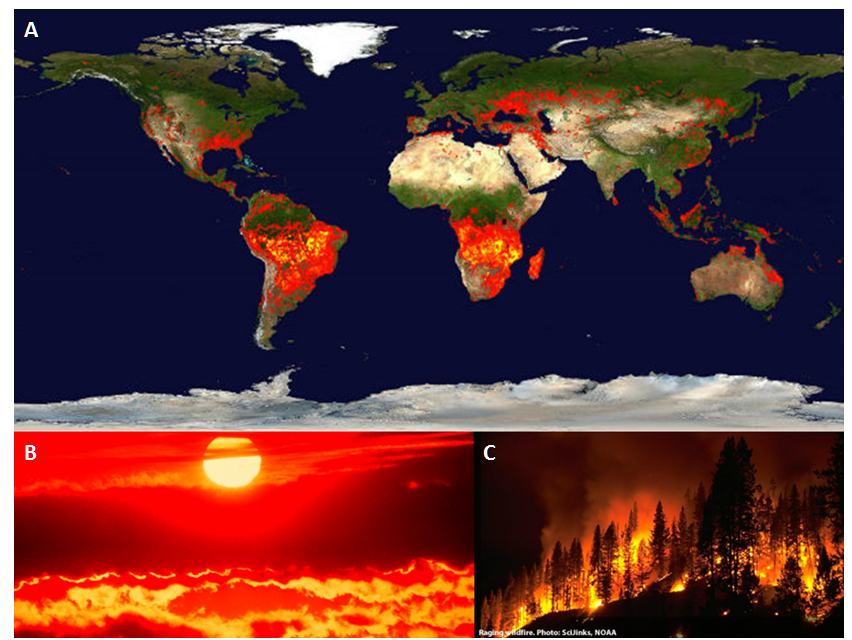
Figure 2. (A) Distribution of global fires (NASA);
(B) Fire storms over the southwest USA;
(C) Pine forest fire California.


At the present the concentration of greenhouse gases of just under-500 ppm CO₂-equivalent is activating amplifying feedbacks of greenhouse gases from land, oceans and melting ice sheets, namely further warming:

  1. An increase in evaporation due to warming of land and oceans leads to further warming due to the greenhouse effect of water vapor but also to increased cloudiness which retards warming. The water vapor factor, significant in the tropics, is somewhat less important in the dry subtropical zones and relatively minor in the Polar Regions (Figure 3).
  2. The melting of ice sheets, reducing reflective (high-albedo) ice and snow surfaces, and concomitant opening of open water surfaces (heat absorbing low-albedo) is generating a powerful positive (warming) feedback. Hudson (2011) estimates the rise in warming due to total removal of Arctic summer sea ice as approximately +1.0 degrees Celsius.
  3. The release of methane from melting permafrost and bubbling of methane hydrates from the oceans has already raised atmospheric methane levels from about 800 to 1863 parts per billion which, given the radiative forcing of methane of X25< times, renders methane highly significant.
  4. As the oceans warm they become less capable of taking up carbon dioxide. As a result, more of our carbon pollution will stay in the atmosphere, exacerbating global warming. 
  5. As tropical and subtropical climate zones overtake temperate Mediterranean-type climate zones, desiccated and burnt vegetation release copious amounts of carbon dioxide to the atmosphere. For example the current bushfires in Australia have already emitted 250 million tonnes of CO₂, almost half of country's annual emissions in 2018.

Figure 3. Total water vapor that can precipitate, as observed by
the Atmospheric Infrared Sounder (AIRS) on NASA's Aqua satellite.
With rising global temperatures and further encroachment of subtropical climate zones desertification and warming can only become more severe.


Abrupt reductions in emissions may be insufficient to stem global warming, unless accompanied by sequestration of greenhouse gases from the atmosphere, recommended as below 350 ppm CO₂.
According to Hansen et al. (2008) carbon sequestration in soil (the biochar method) has significant potential, applying pyrolysis of residues of crops, forestry and animal waste. Biochar helps soil retain nutrients and fertilizers, reducing release of greenhouse gases such as N₂O. Replacing slash-and-burn agriculture with a slash-and-char method and the use of agricultural and forestry wastes for biochar production could provide a CO₂ drawdown of ~8 ppm or more in half a century.

Stabilization and cooling of the climate could include two principle approaches (Table 1): (a) solar shielding, and (b) CO₂ drawdown/sequestration. However, solar shielding by injected aerosols or water vapor is bound to be transient, requiring constant replenishment.

Table 1. Solar shielding and atmospheric CO₂ sequestration methods.

Method
Supposed advantages
Problems
SO2 injections
Relatively cheap and rapid application
Short atmospheric residence time; ocean acidification; retardation of precipitation and of monsoons
Space satellite-mounted sunshades/mirrors
Rapid application. No direct effect on ocean chemistry
Longer space residence time. Does not mitigate ocean acidification by CO2 emissions.
Streaming of air through basalt and serpentine
(Figure 4)
CO2 capture by Ca and Mg carbonates
In operation on a limited scale in Iceland. Significant potential 
Soil carbon burial/biochar
Effective means of controlling the carbon cycle (plants+ soil exchange more than 100 GtC/year with the atmosphere) 
Requires a collaborative international effort by millions of farmers. Significant potential
CO2 capture by seaweeds 
An effective method applied in South Korea 
Decay of seaweeds releases CO₂ to ocean water. Significant potential
Ocean iron filing fertilization enhancing phytoplankton
CO2 sequestration
Phytoplankton residues would release CO2 back to the ocean water and atmosphere.
Ocean pipe system for vertical circulation of cold water to enhance CO2 sequestration
CO2 sequestration
Further warming would render such measure transient.
“Sodium trees” – pipe systems of liquid NaOH sequestering CO2 to sodium carbonate Na2CO3, followed by separation and burial of CO2.
CO2 sequestration, estimated by Hansen et al. (2008) at a cost of ~$200/ton CO₂ where the cost of removing 50 ppm of CO₂ is ~$20 trillion.
Unproven efficiency; need for CO2 burial; $trillions expense, though no more than the military expenses since WWII.


Figure 4. Iceland: The streaming of CO₂-containing air and of water through
basaltic rocks and CO₂-capture as carbonate minerals.

The big question is how effective are the above methods in reducing CO₂ levels on a global scale, at the very least to balance emissions, currently 36.8 billion tons CO₂ per year. Whereas each of the methods outlined in Table 1 has advantages and disadvantages, it is hard to see an alternative way of cooling the atmosphere and oceans than a combination of several of the more promising methods. Budgets on a scale of military spending ($1.7 trillion in 2017) are required in an attempt to slow down the current trend across climate tipping points. The choice humanity is facing is whether to spend resources on this scale on wars or on defense from the climate calamity.

Time is running out.

Sunday, December 15, 2019

The portent of runaway greenhouse warming

The portent of runaway greenhouse warming. Andrew Glikson, Earth and climate scientist, Australian National University. Dec. 11, 2019.


Figure 1. Relations between CO₂ levels in the atmosphere and mass extinctions of genera.
Data cited from D. Royer et al. (2002), from G. Keller (2016) and P. Wignall et al. (2002).
Carbon, the essential element underpinning photosynthesis and life, is transformed into toxic substances in the remnants of plants and organisms buried in sediments. Once released to the atmosphere in the form of CO₂, CO and methane, in large quantities these gases become lethal and have been responsible for mass extinctions of species (Fig. 1).


Figure 2. Potential heating, Carana (2019)

Given amplifying feedbacks from land and oceans triggered by rising temperatures, the concept of an upper limit of warming determined by limitation on carbon emissions alone is unlikely, since, under a rising high greenhouse gas concentration, amplifying feedbacks triggered by methane release, bushfires, warming oceans and loss of reflectivity of melting ice, temperatures would keep rising. As an example, findings show that warmer ocean water is melting hydrates and releasing methane into the sediment and waters off the coast of Washington state, at levels that reach the same amount of methane from the Deepwater Horizon blowout. Carana (2019) finds a potential for abrupt warming of 18°C or 32.4°F (Fig. 2).

Attempts at CO₂ drawdown (sequestration), if urgently applied on a global scale, may conceivably be able to slow down further warming. This article refers to natural methane reservoirs and human-induced methane emissions, indicating that, once temperatures supersede a critical level, a further rise in methane release would result regardless of restrictions of emissions.

According to Kelley (2003) a planetary “runaway greenhouse event” may be triggered when a planet overheats due to absorption of more solar energy than it can give off to retain equilibrium. As a result, the oceans may boil filling its atmosphere with steam, which leaves the planet uninhabitable, as Venus is now. Planetary geologists think there is good evidence that Venus was the victim of a runaway greenhouse effect which turned the planet into the boiling hell we see today. According to Hansen (2010): “If we burn all fossil fuels, the forcing will be at least comparable to that of the PETM, but it will have been introduced at least ten times faster. [. .] The warming ocean can be expected to affect methane hydrate stability at a rate that could exceed that in the PETM, where the rate of change was driven by the speed of the methane hydrate climate feedback, not by the nearly instantaneous introduction of all fossil fuel carbon.” In a critical review of the theory of runaway greenhouse warming, Goldblatt and Watson (2012) state: “We cannot therefore completely rule out the possibility that human actions might cause a transition, if not to full runaway, then at least to a much warmer climate state than the present one.”

The concentration of fossil carbon deposits in the form of coal, oil, natural gas, coal seam gas, permafrost methane, ice clathrates, shale oil, and oil sands, once released to the atmosphere in large quantities, generates powerful feedbacks from land, ocean, atmosphere and cryosphere. This includes further release of greenhouse gases, warming oceans, loss of reflectivity of melting ice, and bushfires, pushing temperatures further upward. With carbon dioxide concentrations rising at a rate of 2–3 parts per million (ppm) per year (October 2018: 406.00 ppm; October 2019: 408.53 ppm) and the Earth heating-up by 0.98°C since 1951-1980, the ultimate consequences of this trend belong to the unthinkable.

Through 2012, total accumulated emissions are estimated to have reached 384 GtC, with an annual amount of 43.1 billion tonnes of carbon dioxide expected to be added in 2019.

A 2016 IPCC analysis found that no more than 275 GtC of the world’s reserves of fossil fuels of 746 GtC could be emitted, if the global temperature rise is to be restricted to 2°C above pre-industrial temperatures, an impossible target since amplifying carbon feedbacks would push temperatures upwards.

According to Heede and Oreskes (2016), global reserves of oil (~171 GtC), natural gas (~95) and coal (479 GtC) add up to a total of 746 GtC. Hansen et al. (2013) estimates that recoverable fossil fuel reserves include ~120 GtC gas, ~80 GtC oil, >10,000 GtC coal, >2000 GtC unconventional gas, and ~700 GtC unconventional oil, adding up to a total of ~13,000 GtC (Fig. 3).


Figure 4. Vulnerable carbon pools. (A) Land: Permafrost ~900 GtC; High-latitude peatlands ~400 GtC;
Tropical peatlands ~100 GtC; Vegetation subject to fire and/or deforestation ~650 GtC;
(B) Oceans: Methane hydrates ~10,000 GtC; Solubility pump ~2700 GtC; Biological pump ~3300 GtC;
Total (A) + (B): ~18,050 GtC (Canadell 2007

The amount of unstable methane deposits in permafrost and methane hydrates (clathrates) in ocean sediments is of a similar order of magnitude as the amount of fossil fuel reserves. Vulnerable carbon pools include methane hydrates in sediments (~10,000 GtC), solubility and biological pump (~6000 GtC), permafrost methane (~900 GtC), and peatlands and vulnerable vegetation (~1150 GtC), adding up to a total of ~18,050 GtC (Fig. 4).

Unoxidized metastable deposits of methane and methane hydrates, accumulated during the Pleistocene glacial-interglacial cycles and vulnerable to temperature rise, are already leaking as indicated by atmospheric concentrations which have risen from 1988 (~1700 ppb CH₄) to 2019 (~1860 ppb CH₄) at a rate of ~5.2 ppb/year, a rise of more than 4 ppm CO₂-equivalent at GWP25xCO₂ or 24 ppm CO₂-e at GWP150xCO₂.


Meinshausen et al. (2011) estimated global-mean surface temperature increases, applying a climate sensitivity of 3°C per doubling of CO₂, resulting by 2100 in a temperature rise of between 1.5°C to 4.5°C relative to pre-industrial levels. By 2300, under constant emissions, CO₂ concentrations would rise to ~2000 ppm, methane to 3.5 ppm and nitrous oxide to 0.52 ppm (Fig. 5). Amplifying feedbacks are taken into account, but the effects of tipping points and of cold ice-melt pools formed in the oceans near Greenland and Antarctica ice sheets are unclear.

Given the estimated total of exploitable hydrocarbon resources (~13.000 GtC) and of vulnerable carbon pools (~18,050 GtC), the amount released under different future climate conditions is subject to estimates:

Assuming mean global temperature of +2°C (above pre-industrial), with allowance made for the masking effects of sulphur aerosols, the combustion of ~2% of the fossil fuel reserves (13,000 GtC), i.e. ~260 GtC, would raise CO₂ concentration by ~130 ppm (100 GtC = 50 ppm CO₂) (Fig. 3). Combustion of ~5% of the fossil fuel reserve would raise CO₂ concentration by ~325 ppm.
Under +2°C above pre-industrial, release of CO₂ from fires and other feedback effects such as melting of permafrost and release of methane would raise atmospheric carbon by at least 1 percent of vulnerable carbon pools (~18,050 GtC). 

The flow of ice melt water from Greenland and Antarctica into the oceans would create large regions of cold water capable of absorption of atmospheric CO₂. Hansen (2010) concludes: “if we burn all reserves of oil, gas, and coal, there's a substantial chance that we will initiate the runaway greenhouse. If we also burn the tar sands and tar shale, I believe the Venus syndrome [runaway greenhouse warming] is a dead certainty”. Stephen Hawking (2017) appears to agree with Hansen’s warning, stating: “if the US pulls out of the Paris climate agreement it may lead to runaway global warming, eventually turning Earth's atmosphere into something resembling Venus”. Goldblatt and Watson (2012) wrote: “The ultimate climate emergency is a ‘runaway greenhouse’: a hot and water-vapor-rich atmosphere limits the emission of thermal radiation to space, causing runaway warming … This would evaporate the entire ocean and exterminate all planetary life … We cannot therefore completely rule out the possibility that human actions might cause a transition, if not to full runaway, then at least to a much warmer climate state than the present one … However, our understanding of the dynamics, thermodynamics, radiative transfer and cloud physics of hot and steamy atmospheres is weak.”

An analysis by Carana (2013) suggests that accelerated release of methane from permafrost and methane hydrates (clathrates) could trigger runaway global warming (Fig. 6). A polynomial trend for the Arctic shows temperature anomalies of +4°C by 2020, +7°C by 2030 and +11°C by 2040, threatening major feedbacks, further albedo changes and methane releases leading to global temperature anomalies of 20°C+ by 2050.


Figure 6. A polynomial 2 trend line points at global temperature anomalies (Carana 2013). A polynomial function is a function such as a quadratic, a cubic, a quartic, and so on, involving only non-negative integer powers of x.

The magnitude of the runaway greenhouse effect that now threatens to eventuate becomes evident when looking at the geological record. For example, the 55 million years-old PETM event (Paleocene-Eocene Thermal Maximum), lasting for about 100,000 years, driven by CO₂ levels as hugh as 1700 ppm, does not appear to have triggered a runaway greenhouse process. The PETM is attributed to ¹³C-depleted methane (Zeebe et al. 2009), reaching 5 - 8°C and leading to a mass extinction of 35-50% of benthic foraminifera. By sharp contrast, the current Anthropocene hyperthermal event, commencing with the industrial age and re-accelerating since about 1975, constitutes a temporally abrupt development exceeding the rate of geological hyperthermal events (Fig. 7), a rate which does not allow biological adaptation and thereby enhances a mass extinction of species (Barnosky et al. 2011).


Figure 7. A comparison of Cenozoic CO₂ rise rates and temperature rise rates,
highlighting the extreme rise rates in the Anthropocene. From an earlier post.


As Australia burns, the IPCC maintains there is time left to consume a carbon budget and to keep handing out offsets and carbon credits; at the 25th meeting of the Conference of the Parties to the United Nations Convention on Climate Change in Madrid, Australia is seeking to use "carry-over credits" to meet its pledged emissions reductions.


Links

• The RCP greenhouse gas concentrations and their extensions from 1765 to 2300, by Malte Meinshausen et al. (2011)
https://link.springer.com/article/10.1007/s10584-011-0156-z

• Contributions to accelerating atmospheric CO₂ growth from economic activity, carbon intensity, and efficiency of natural sinks, by J. Canadell et al. (2007)
https://www.pnas.org/content/104/47/18866

• Planetary ‘Runaway Greenhouse’ Climates More Easily Triggered than Previously Thought, by Peter Kelley (2013)
https://scitechdaily.com/planetary-runaway-greenhouse-climates-more-easily-triggered-than-previously-thought

• How Likely Is a Runaway Greenhouse Effect on Earth? MIT Technology Review (2012)
https://www.technologyreview.com/s/426608/how-likely-is-a-runaway-greenhouse-effect-on-earth/

• Storms of my grandchildren: the truth about the coming climate catastrophe and our last chance to save humanity, by James Hansen (2010)
https://www.bloomsbury.com/us/storms-of-my-grandchildren-9781608195022

• The runaway greenhouse: implications for future climate change, geoengineering and planetary atmospheres, by Colin Goldblatt and Andrew Watson (2012)
https://royalsocietypublishing.org/doi/full/10.1098/rsta.2012.0004

• Low simulated radiation limit for runaway greenhouse climates, by Colin Goldblatt, et al. (2013)
https://www.nature.com/articles/ngeo1892

• Assessing “Dangerous Climate Change”: Required Reduction of Carbon Emissions to Protect Young People, Future Generations and Nature, by James Hansen et al. (2013)
https://journals.plos.org/plosone/article?id=10.1371/journal.pone.0081648

• Towards the Sixth Assessment Report of the Intergovernmental Panel on Climate Change (IPCC), by Valérie Masson-Delmotte, Panmao Zhai, Wilfran Moufouma-Okia, Anna Pirani, Jan Fuglestvedt
https://wg1.ipcc.ch/presentations/201612_Fuglestvedt_AGU_IPCC.pdf

• Global Carbon Project, Carbon Budget 2019, press release
https://www.globalcarbonproject.org/carbonbudget/19/files/Norway_CICERO_GCB2019.pdf

• Potential emissions of CO₂ and methane from proved reserves of fossil fuels: An alternative analysis, by Richard Heede and Naomi Oreskes
https://www.sciencedirect.com/science/article/pii/S0959378015300637

• A rise of 18°C or 32.4°F by 2026?
https://arctic-news.blogspot.com/2019/02/a-rise-of-18c-or-324f-by-2026.html

• Arctic Methane Impact
https://arctic-news.blogspot.com/2013/11/arctic-methane-impact.html

• A record CO2 rise rate since the KT dinosaur extinction 66 million years ago
http://arctic-news.blogspot.com/2019/11/a-record-co2-rise-rate-since-kt-dinosaur-extinction-66-million-years-ago.html

• Another link between CO2 and mass extinctions of species, by Andrew Glikson
https://theconversation.com/another-link-between-co2-and-mass-extinctions-of-species-12906


Thursday, November 28, 2019

A crazy experiment

Dire future etched in the past: CO2 at 3-million year-old levels. Patrick Galey and Marlowe Hood, Phys.org. Apr. 5, 2019.


The last time there was so much CO2 in Earth's atmosphere, ice caps virtually disappeared
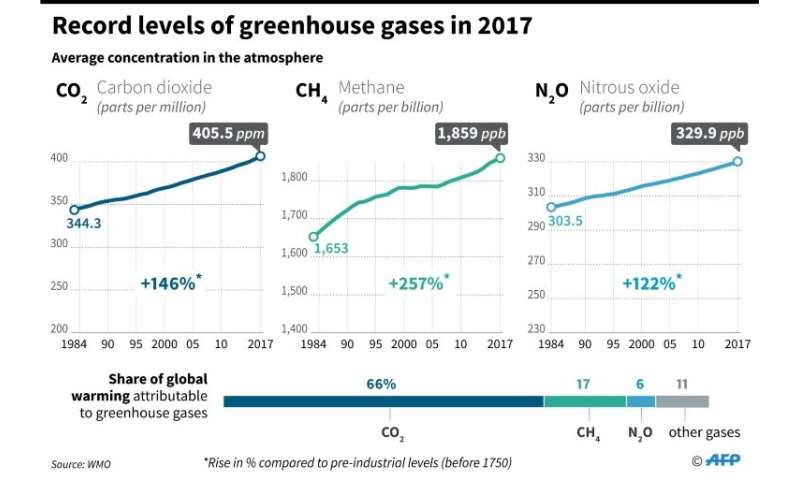

Planet-warming carbon dioxide in Earth's atmosphere—at its highest level in three million years—is poised to lock in dramatic temperature and sea level rises over a timescale of centuries, scientists warned this week.

The last time that CO2 hit 400 parts per million (ppm) Greenland was ice free and trees grew at the edge of Antarctica.

It was long thought that today's greenhouse gas levels were no greater than those 800,000 years ago, during a period of cyclical planetary warming and cooling that would have likely continued but for manmade emissions.

But analyses of ice cores and ocean sediments in the coldest place on Earth have now revealed that 400 ppm was last surpassed three million years ago during the Late Pliocene, when temperatures were several degrees Celsius higher, and oceans at least 15 metres deeper.

At the same time, state-of-the-art climate modelling by experts at the Potsdam Institute for Climate Impact Research (PIK) have correlated directly with the CO2 levels found in these Antarctic samples.

"The Late Pliocene is relatively close to us in terms of CO2 levels," Matteo Willeit, PIK member and lead study author, told AFP.

"Our models suggest that there were no glacial cycles—there were no big ice sheets in the northern hemisphere. CO2 was too high and the climate was too warm to allow big ice sheets to grow."

Nations in 2015 struck the landmark Paris deal on climate change, promising to curb greenhouse gas emissions and limit temperature rises to "well below" 2 Celsius (3.6 Fahrenheit).

Yet 2017 saw emissions levels unsurpassed in human history, and climate experts warn that time has all but run out to drastically slash fossil fuel use and avert runaway global warming.


Seas 15-20 metres higher

Scientists gathered this week in London for a conference on the Pliocene epoch, and highlighted the lessons to be learned today embedded in its ancient ice and sediment samples.


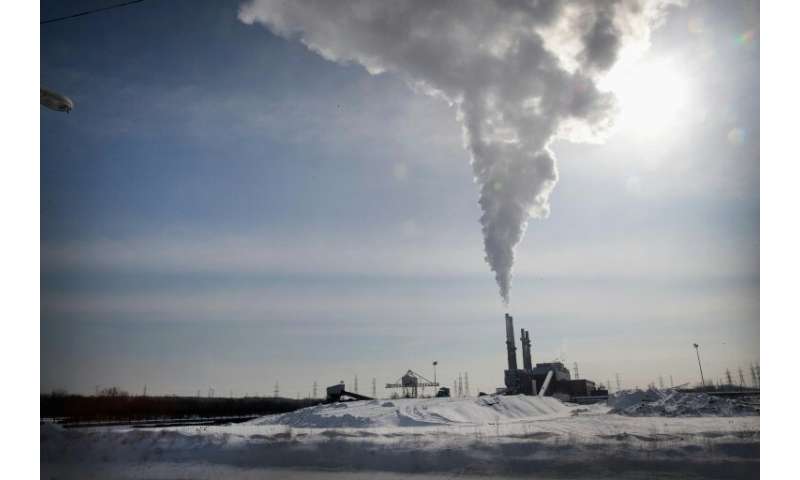
Change in levels of CO2, methane and nitrous oxide in the atmosphere since 1984
"The headline news is that temperatures were 3-4 degrees higher globally than they are today, and sea levels were 15-20 metres (50-65 feet) higher," Martin Siegert, professor of geoscience at Imperial College London, told reporters.

With just 1C of warming so far, Earth is already dealing with floods, droughts and superstorms made worse by rising seas.

Siegert said that 400 ppm didn't mean that the severity of Pliocene sea-level rises was imminent. But unless humans figure a way to suck CO2 out of the air on a massive scale, severe impacts are inevitable, sooner or later.

"There's a lag," he explained. "If you turn on the oven at home and set it to 200C, it doesn't reach that (level) immediately. It's the same for climate."

Siegert said glaciologists, based on current CO2 concentrations, expect between 50 centimetres and one metre of sea-level rise this century.

"It would be difficult for it to be much more than that because it takes time to melt," he added.

"But it doesn't stop at 2100—it keeps going."


Rocketing pace of CO2

In October, the UN concluded that greenhouse gas emissions must decline by about half within 12 years to preserve a chance of capping global warming at 1.5C, the level needed to avoid severe climate impacts.

But despite these and earlier warnings, CO2 emissions from fossil fuel use, construction, aviation and agribusiness continue to rise, and are currently on track to heat up the planet 4C by century's end.

Even without additional carbon pollution, the outlook remains bleak.

Manmade emissions on the other hand have added some 120 ppm of CO2 in a little over a century and a half

"If we stay at 400 ppm, we stay on the course to a Pliocene-like climate," said Tina van De Flierdt, a professor of isotope geochemistry at Imperial.

She warned that under similar conditions to the present day, the Pliocene saw the disappearance of the Greenland ice sheet—which today holds enough frozen water to raise sea levels by some seven metres worldwide.

"The West Antarctica ice sheet holds about 5 metres—that was probably gone," she added.

As is happening today, Earth's poles warmed far quicker than the rest of the planet during the Pliocene, earlier research has shown, including a study in Nature Climate Change.

During earlier periods, Earth has seen sustained concentrations of carbon dioxide was even higher than 400 ppm, but it took millions of years for those increases to occur.

Manmade greenhouse gas emissions, on the other hand, have boosted CO2 levels by more than 40 percent in a little over 150 years.


'A crazy experiment'

At 412 ppm and rising, experts said temperature rises of 3-4C are likely now locked in.

So what happened to Earth the last time CO2 was so prevalent?

It was captured in the trees, plants, animals and minerals alive at the time and buried underground when they died.

"And what we've been doing for the last 150 years is digging it all up and putting it back into the atmosphere," said Siegert.

"It's like a crazy experiment: 'Let's take that CO2 that took 100 million years to be sequestrated and put it back—instantly, on a geological timescale—in the atmosphere and see what happens'".

Wednesday, November 27, 2019

We've been blithely betting against them for 30 years

Climate tipping points — too risky to bet against

The growing threat of abrupt and irreversible climate changes must compel political and economic action on emissions.

Timothy M. Lenton, Johan Rockström, Owen Gaffney, Stefan Rahmstorf, Katherine Richardson, Will Steffen & Hans Joachim Schellnhuber. Nature. November 27, 2019.


Politicians, economists and even some natural scientists have tended to assume that tipping points1 in the Earth system — such as the loss of the Amazon rainforest or the West Antarctic ice sheet — are of low probability and little understood. Yet evidence is mounting that these events could be more likely than was thought, have high impacts and are interconnected across different biophysical systems, potentially committing the world to long-term irreversible changes.


Here we summarize evidence on the threat of exceeding tipping points, identify knowledge gaps and suggest how these should be plugged. We explore the effects of such large-scale changes, how quickly they might unfold and whether we still have any control over them.


In our view, the consideration of tipping points helps to define that we are in a climate emergency and strengthens this year’s chorus of calls for urgent climate action — from schoolchildren to scientists, cities and countries.


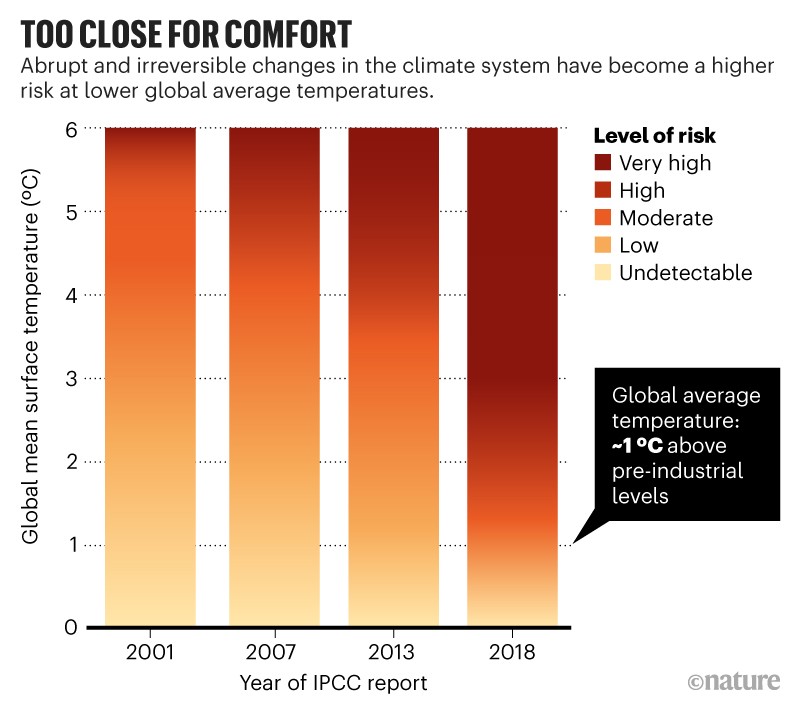
The Intergovernmental Panel on Climate Change (IPCC) introduced the idea of tipping points two decades ago. At that time, these ‘large-scale discontinuities’ in the climate system were considered likely only if global warming exceeded 5 °C above pre-industrial levels. Information summarized in the two most recent IPCC Special Reports (published in 2018 and in September this year)2,3 suggests that tipping points could be exceeded even between 1 and 2 °C of warming (see ‘Too close for comfort’).


Source: IPCC


If current national pledges to reduce greenhouse-gas emissions are implemented — and that’s a big ‘if’ — they are likely to result in at least 3 °C of global warming. This is despite the goal of the 2015 Paris agreement to limit warming to well below 2 °C. Some economists, assuming that climate tipping points are of very low probability (even if they would be catastrophic), have suggested that 3 °C warming is optimal from a cost–benefit perspective. However, if tipping points are looking more likely, then the ‘optimal policy’ recommendation of simple cost–benefit climate-economy models4 aligns with those of the recent IPCC report2. In other words, warming must be limited to 1.5 °C. This requires an emergency response.


Ice collapse


We think that several cryosphere tipping points are dangerously close, but mitigating greenhouse-gas emissions could still slow down the inevitable accumulation of impacts and help us to adapt.


Research in the past decade has shown that the Amundsen Sea embayment of West Antarctica might have passed a tipping point3: the ‘grounding line’ where ice, ocean and bedrock meet is retreating irreversibly. A model study shows5 that when this sector collapses, it could destabilize the rest of the West Antarctic ice sheet like toppling dominoes — leading to about 3 metres of sea-level rise on a timescale of centuries to millennia. Palaeo-evidence shows that such widespread collapse of the West Antarctic ice sheet has occurred repeatedly in the past.


The latest data show that part of the East Antarctic ice sheet — the Wilkes Basin — might be similarly unstable3. Modelling work suggests that it could add another 3–4 m to sea level on timescales beyond a century.


The Greenland ice sheet is melting at an accelerating rate3. It could add a further 7 m to sea level over thousands of years if it passes a particular threshold. Beyond that, as the elevation of the ice sheet lowers, it melts further, exposing the surface to ever-warmer air. Models suggest that the Greenland ice sheet could be doomed at 1.5 °C of warming3, which could happen as soon as 2030.


Thus, we might already have committed future generations to living with sea-level rises of around 10 m over thousands of years3. But that timescale is still under our control. The rate of melting depends on the magnitude of warming above the tipping point. At 1.5 °C, it could take 10,000 years to unfold3; above 2 °C it could take less than 1,000 years6. Researchers need more observational data to establish whether ice sheets are reaching a tipping point, and require better models constrained by past and present data to resolve how soon and how fast the ice sheets could collapse.


Whatever those data show, action must be taken to slow sea-level rise. This will aid adaptation, including the eventual resettling of large, low-lying population centres.


A further key impetus to limit warming to 1.5 °C is that other tipping points could be triggered at low levels of global warming. The latest IPCC models projected a cluster of abrupt shifts7 between 1.5 °C and 2 °C, several of which involve sea ice. This ice is already shrinking rapidly in the Arctic, indicating that, at 2 °C of warming, the region has a 10–35% chance3 of becoming largely ice-free in summer.


Biosphere boundaries

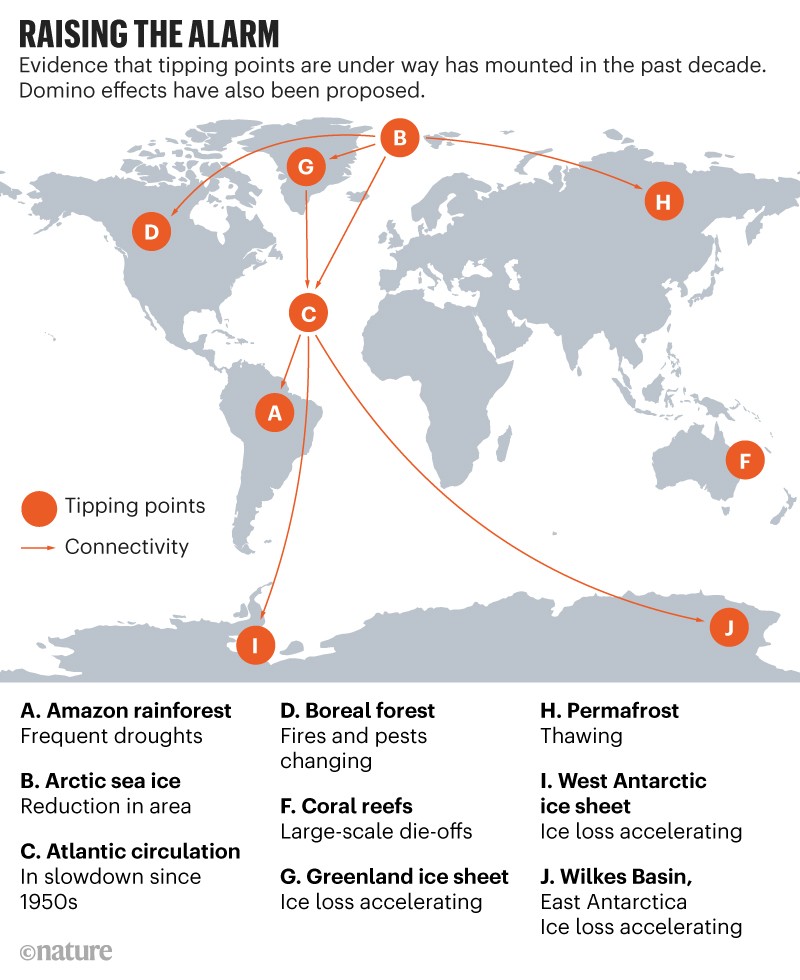
Climate change and other human activities risk triggering biosphere tipping points across a range of ecosystems and scales (see ‘Raising the alarm’).


Source: T. M. Lenton et al.


Ocean heatwaves have led to mass coral bleaching and to the loss of half of the shallow-water corals on Australia’s Great Barrier Reef. A staggering 99% of tropical corals are projected2 to be lost if global average temperature rises by 2 °C, owing to interactions between warming, ocean acidification and pollution. This would represent a profound loss of marine biodiversity and human livelihoods.


As well as undermining our life-support system, biosphere tipping points can trigger abrupt carbon release back to the atmosphere. This can amplify climate change and reduce remaining emission budgets.


Deforestation and climate change are destabilizing the Amazon — the world’s largest rainforest, which is home to one in ten known species. Estimates of where an Amazon tipping point could lie range from 40% deforestation to just 20% forest-cover loss8. About 17% has been lost since 1970. The rate of deforestation varies with changes in policy. Finding the tipping point requires models that include deforestation and climate change as interacting drivers, and that incorporate fire and climate feedbacks as interacting tipping mechanisms across scales.


With the Arctic warming at least twice as quickly as the global average, the boreal forest in the subarctic is increasingly vulnerable. Already, warming has triggered large-scale insect disturbances and an increase in fires that have led to dieback of North American boreal forests, potentially turning some regions from a carbon sink to a carbon source9. Permafrost across the Arctic is beginning to irreversibly thaw and release carbon dioxide and methane — a greenhouse gas that is around 30 times more potent than CO2 over a 100-year period.


Researchers need to improve their understanding of these observed changes in major ecosystems, as well as where future tipping points might lie. Existing carbon stores and potential releases of CO2 and methane need better quantification.


The world’s remaining emissions budget for a 50:50 chance of staying within 1.5 °C of warming is only about 500 gigatonnes (Gt) of CO2. Permafrost emissions could take an estimated 20% (100 Gt CO2) off this budget10, and that’s without including methane from deep permafrost or undersea hydrates. If forests are close to tipping points, Amazon dieback could release another 90 Gt CO2 and boreal forests a further 110 Gt CO211. With global total CO2 emissions still at more than 40 Gt per year, the remaining budget could be all but erased already.


Bleached corals on a reef near the island of Moorea in French Polynesia in the South Pacific.Credit: Alexis Rosenfeld/Getty


Global cascade


In our view, the clearest emergency would be if we were approaching a global cascade of tipping points that led to a new, less habitable, ‘hothouse’ climate state11. Interactions could happen through ocean and atmospheric circulation or through feedbacks that increase greenhouse-gas levels and global temperature. Alternatively, strong cloud feedbacks could cause a global tipping point12,13.


We argue that cascading effects might be common. Research last year14 analysed 30 types of regime shift spanning physical climate and ecological systems, from collapse of the West Antarctic ice sheet to a switch from rainforest to savanna. This indicated that exceeding tipping points in one system can increase the risk of crossing them in others. Such links were found for 45% of possible interactions14.


In our view, examples are starting to be observed. For example, Arctic sea-ice loss is amplifying regional warming, and Arctic warming and Greenland melting are driving an influx of fresh water into the North Atlantic. This could have contributed to a 15% slowdown15 since the mid-twentieth century of the Atlantic Meridional Overturning Circulation (AMOC) , a key part of global heat and salt transport by the ocean3. Rapid melting of the Greenland ice sheet and further slowdown of the AMOC could destabilize the West African monsoon, triggering drought in Africa’s Sahel region. A slowdown in the AMOC could also dry the Amazon, disrupt the East Asian monsoon and cause heat to build up in the Southern Ocean, which could accelerate Antarctic ice loss.


The palaeo-record shows global tipping, such as the entry into ice-age cycles 2.6 million years ago and their switch in amplitude and frequency around one million years ago, which models are only just capable of simulating. Regional tipping occurred repeatedly within and at the end of the last ice age, between 80,000 and 10,000 years ago (the Dansgaard–Oeschger and Heinrich events). Although this is not directly applicable to the present interglacial period, it highlights that the Earth system has been unstable across multiple timescales before, under relatively weak forcing caused by changes in Earth’s orbit. Now we are strongly forcing the system, with atmospheric CO2 concentration and global temperature increasing at rates that are an order of magnitude higher than those during the most recent deglaciation.


Atmospheric CO2 is already at levels last seen around four million years ago, in the Pliocene epoch. It is rapidly heading towards levels last seen some 50 million years ago — in the Eocene — when temperatures were up to 14 °C higher than they were in pre-industrial times. It is challenging for climate models to simulate such past ‘hothouse’ Earth states. One possible explanation is that the models have been missing a key tipping point: a cloud-resolving model published this year suggests that the abrupt break-up of stratocumulus cloud above about 1,200 parts per million of CO2 could have resulted in roughly 8 °C of global warming12.


Some early results from the latest climate models — run for the IPCC’s sixth assessment report, due in 2021 — indicate a much larger climate sensitivity (defined as the temperature response to doubling of atmospheric CO2) than in previous models. Many more results are pending and further investigation is required, but to us, these preliminary results hint that a global tipping point is possible.


To address these issues, we need models that capture a richer suite of couplings and feedbacks in the Earth system, and we need more data — present and past — and better ways to use them. Improving the ability of models to capture known past abrupt climate changes and ‘hothouse’ climate states should increase confidence in their ability to forecast these.


Some scientists counter that the possibility of global tipping remains highly speculative. It is our position that, given its huge impact and irreversible nature, any serious risk assessment must consider the evidence, however limited our understanding might still be. To err on the side of danger is not a responsible option.


If damaging tipping cascades can occur and a global tipping point cannot be ruled out, then this is an existential threat to civilization. No amount of economic cost–benefit analysis is going to help us. We need to change our approach to the climate problem.


Act now


In our view, the evidence from tipping points alone suggests that we are in a state of planetary emergency: both the risk and urgency of the situation are acute (see ‘Emergency: do the maths’).


EMERGENCY: DO THE MATHS

We define emergency (E) as the product of risk and urgency. Risk (R) is defined by insurers as probability (p) multiplied by damage (D). Urgency (U) is defined in emergency situations as reaction time to an alert (Ï„) divided by the intervention time left to avoid a bad outcome (T). Thus:
E = R × U = p × D × Ï„ / T
The situation is an emergency if both risk and urgency are high. If reaction time is longer than the intervention time left (Ï„ / T > 1), we have lost control.

We argue that the intervention time left to prevent tipping could already have shrunk towards zero, whereas the reaction time to achieve net zero emissions is 30 years at best. Hence we might already have lost control of whether tipping happens. A saving grace is that the rate at which damage accumulates from tipping — and hence the risk posed — could still be under our control to some extent.


The stability and resilience of our planet is in peril. International action — not just words — must reflect this.