Showing posts with label police state. Show all posts

Sunday, June 14, 2020

Some more non-conformist views... from thoughtful black male scholars

introduction from Jerry Coyne at his blog, Why Evolution is True:
Although John McWhorter, a professor of English and linguistics at Columbia University, is also a contributing editor at The Atlantic, his new essay on police violence was not published there. Rather, it’s in Quillette. Given that in length, style, and quality (it’s very well written and makes cogent points) it would be suitable for The Atlantic, I’m guessing that he didn’t even try to publish it there. That’s because it makes an argument that is politically uncongenial to The Atlantic and to much of the Left: that perhaps the claim that black men get shot by police at a rate higher than their frequency in the population is not a function of police racism, but of a greater frequency of interactions between blacks and police due to a higher crime rate in black communities. 
This idea is heterodox, contrarian, and is suitable for Quillette. But no mainstream Leftist media would ever touch it, even though it might contain some truth. It’s not ideologically acceptable to say that while there are some racist cops, the difference in the relative frequency of blacks versus whites killed by cops could be due to a higher crime rate among black males and in the black community, perhaps itself a function of poverty that breeds crime. This is a valid hypothesis, but it taboo for most of us to discuss. As black men, however people like McWhorter and Glenn Lourycan say this without fear of being deemed “racists”. 
Read for yourself:

Racist Police Violence Reconsidered. John McWhorter, Quillette. June 11, 2020.
Tony Timpa was 32 years old when he died at the hands of the Dallas police in August 2016. He suffered from mental health difficulties and was unarmed. He wasn’t resisting arrest. He had called the cops from a parking lot while intoxicated because he thought he might be a danger to himself. By the time law enforcement arrived, he had already been handcuffed by the security guards of a store nearby. Even so, the police officers made him lie face down on the grass, and one of them pressed a knee into his back. He remained in this position for 13 minutes until he suffocated. During the harrowing recording of his final moments, he can be heard pleading for his life. A grand jury indictment of the officers involved was overturned.
Not many people have seen this video, however, and that may have something to do with the fact that Timpa was white. During the protests and agonizing discussions about police brutality that have followed the death of George Floyd under remarkably similar circumstances, it is too seldom acknowledged that white men are regularly killed by the cops as well, and that occasionally the cops responsible are black (as it happens, one of the Dallas police officers at the scene of Timpa’s death was an African American). There seems to be a widespread assumption that, under similar circumstances, white cops kill black people but not white people, and that this disparity is either the product of naked racism or underlying racist bias that emerges under pressure. Plenty of evidence indicates, however, that racism is less important to understanding police behavior than is commonly supposed. 
Timpa was, of course, just one case and might be dismissed as an anomaly. On the other hand, we are told that what happened to George Floyd is what happens to black people “all the time.” But because the killing of black suspects by white police officers receives more media attention and elicits more outrage, such instances leave us vulnerable to the availability heuristic—a cognitive bias that leads us to form judgements about the prevalence of phenomena based on the readiness with which we can recall examples. Had Tony Timpa been black, we would all likely know his name by now. Had George Floyd been white, his name would likely be a footnote, briefly reported in Minneapolis local news and quickly forgotten. In fact, white people are victims of police mistreatment “all the time” too. And just as the Timpa case tragically parallels the Floyd one, there are countless episodes paralleling those we hear about involving black people.

In 2014, John Crawford, black, was shot dead by police while waving a BB gun. In 2016, Daniel Shaver, white, was waving a pellet gun out of motel window and suffered the same fate. In 2015, officer Michael Slager shot Walter Scott, black, in the back and killed him as he was running to evade a traffic ticket; the following year, Andrew Thomas, white, was shot in the neck by a police officer and killed as he climbed out of the SUV he had crashed trying to evade arrest. In 2015, Sam DuBose, black, was shot dead as he tried to escape a traffic summons in his car; the same year, Michael Parker, white, was shot dead in the same way while trying escape a ticket for a moving violation. In 2016, Philando Castile, black, was shot dead in his car by a cop as he reached under his waistband for his license and registration during a traffic stop; the same year, Dylan Noble, white, was shot dead under almost identical circumstances. Also in 2016, Alton Sterling, black, was shot dead in front of a convenience store as he was being detained for unruly conduct; the same year, Brandon Stanley, white, was shot dead in a convenience store for trying to avoid a warrant. 
So, the perception that the police regularly kill black people under circumstances in which white people would be merely disciplined is in fact a misperception. White people vastly outnumber black people in America, so it should be no surprise that more white people die at the hands of the cops each year than black people. According to a database of fatal police shootings maintained by the Washington Post since 2015, 1,003 people in a population of 328 million were shot by police nationwide in 2019. 405 of those victims were white and 250 were black (of the remaining cases, 163 were Hispanic, 41 are listed as “other,” and 144 as “unknown”). 309 white victims (76.2 percent) were carrying either a gun or a knife, while 199 black victims (79.6 percent) were similarly armed. It is also worth bearing in mind that while police shootings are sometimes perceived to be abuses per se, an analysis of the Post‘s 2015 data by Kimberly Kindy and Kennedy Elliott reminded readers that:
In three-quarters of the fatal shootings, police were under attack or defending someone who was. The officers were often lauded as heroes… 28 percent of those who died were shooting at officers or someone else. Sixteen percent were attacking with other weapons or physical force, and 31 percent were pointing a gun. 
Nevertheless, it remains true that black people are killed at a rate disproportionate to their percentage of the population. Does this decisively demonstrate racial bias or murderous animus on the part of American law enforcement? Blacks represent about 13 percent of the US population but about a quarter of victims in cop killings. Whites constitute about 62 percent of the population but only half of those killed by the police. With slight fluctuations, these trends have been broadly consistent. 
 
However, these figures are not necessarily evidence of police racism. According to the Washington Post‘s database, over 95 percent of the people fatally shot by police officers in 2019 were male, and no serious-minded person argues that this is evidence of systemic misandry. So what, then, accounts for the disproportionate representation of black men among those killed by cops?

The socioeconomic gap between blacks and whites is doubtless an important contributing factor. Police are called to poor neighborhoods more often, so poverty makes someone more likely to encounter law enforcement. From the 1970s through the 1990s, many conservatives argued that too many black people were on welfare. Liberals and progressives replied that, firstly, more white people were on welfare and that, secondly and more importantly, a greater proportion of the black population is on welfare because a greater proportion of black people are mired in poverty. In this context, former Washington Post journalist Wesley Lowery observed that black people are about two-and-a-half times more likely to be killed by cops than their representation in the population would predict. Today, the percentage of black people living in poverty is about two-and-a-half times that of whites (22 percent and nine percent, respectively, in 2018). 
This disparity in poverty rates means black people are also disproportionately represented in rates of violent crime. Poverty can lead to dangerous survival choices that include lucrative criminal activity. Furthermore, outstanding warrants can cause suspects to flee law enforcement when stopped for other trivial infractions. This disparity cannot explain every fatal police shooting, including some of the most notorious examples, such as the shootings of Tamir Rice and Philando Castile. Nevertheless, the tragedy remains: Higher aggregate crime rates lead to more encounters with police officers overall which increases the likelihood that a proportion of those encounters will get out of hand. 
Entrenched socioeconomic disparities should concern us all, and are as intolerable as cop murders. But the idea that the police murder out of racist animus is much less clear than we are often led to suppose. 
This is not to say that race has nothing to do with policing issues in America. Black people are disproportionately more likely to be pulled over for drug searches, a disparity that, interestingly, disappears after dusk when officers cannot easily identify the race of a driver. Black people are also more likely to be verbally abused by police during interactions. Contrary to his expectations, Harvard economist Roland Fryer has found that while white men are actually more likely to be killed by cops, black people are more likely to be handcuffed, pushed against the wall, and treated with weapons drawn. Blacks are still somewhat more likely than whites to suffer physical and verbal abuse from the cops even when the behavior of the suspect is taken into account. Findings like these contribute to a general sense that cops treat black people as an enemy. 
Racist bias may well play a role in these statistical discrepancies in treatment. Certainly, this perception was as central to the protests in Ferguson, Missouri as the shooting of Michael Brown. If, upon close examination, that turns out to be the case, then this must obviously be addressed. The acrid relationship with police is among the main reasons that so many black people feel like aliens in their own nation. If a new generation of black people could grow up without the sense that the cops are their enemy, America would turn a corner on race and finally break its holding pattern. 
Police officers are too often overarmed, undertrained, and low on empathy. Some police officers are surely racist and act like it. But it does not follow that white cops routinely kill black people in tense situations out of racist animus. This scenario may seem plausible—I believed it until only a few years ago. But there are times when facts are counterintuitive, and it is important to get the facts right and to analyze them with clear eyes and a clear mind (the enlightening work of criminologist and ex-cop Peter Moskos is helpful in this regard). Rhetoric has a way of straying from reality, and to get where we all want to go, it is reality that we must address.


Dear profs X, Y, Z

I am one of your colleagues at the University of California, Berkeley. I have met you both personally but do not know you closely, and am contacting you anonymously, with apologies. I am worried that writing this email publicly might lead to me losing my job, and likely all future jobs in my field.

In your recent departmental emails you mentioned our pledge to diversity, but I am increasingly alarmed by the absence of diversity of opinion on the topic of the recent protests and our community response to them.

In the extended links and resources you provided, I could not find a single instance of substantial counter-argument or alternative narrative to explain the under-representation of black individuals in academia or their over-representation in the criminal justice system. The explanation provided in your documentation, to the near exclusion of all others, is univariate: the problems of the black community are caused by whites, or, when whites are not physically present, by the infiltration of white supremacy and white systemic racism into American brains, souls, and institutions.

Many cogent objections to this thesis have been raised by sober voices, including from within the black community itself, such as Thomas Sowell and Wilfred Reilly. These people are not racists or 'Uncle Toms'. They are intelligent scholars who reject a narrative that strips black people of agency and systematically externalizes the problems of the black community onto outsiders. Their view is entirely absent from the departmental and UCB-wide communiques.

The claim that the difficulties that the black community faces are entirely causally explained by exogenous factors in the form of white systemic racism, white supremacy, and other forms of white discrimination remains a problematic hypothesis that should be vigorously challenged by historians. Instead, it is being treated as an axiomatic and actionable truth without serious consideration of its profound flaws, or its worrying implication of total black impotence. This hypothesis is transforming our institution and our culture, without any space for dissent outside of a tightly policed, narrow discourse.

A counternarrative exists. If you have time, please consider examining some of the documents I attach at the end of this email. Overwhelmingly, the reasoning provided by BLM and allies is either primarily anecdotal (as in the case with the bulk of Ta-Nehisi Coates' undeniably moving article) or it is transparently motivated. As an example of the latter problem, consider the proportion of black incarcerated Americans. This proportion is often used to characterize the criminal justice system as anti-black. However, if we use the precise same methodology, we would have to conclude that the criminal justice system is even more anti-male than it is anti-black.

Would we characterize criminal justice as a systemically misandrist conspiracy against innocent American men? I hope you see that this type of reasoning is flawed, and requires a significant suspension of our rational faculties. Black people are not incarcerated at higher rates than their involvement in violent crime would predict. This fact has been demonstrated multiple times across multiple jurisdictions in multiple countries.

And yet, I see my department uncritically reproducing a narrative that diminishes black agency in favor of a white-centric explanation that appeals to the department's apparent desire to shoulder the 'white man's burden' and to promote a narrative of white guilt.

If we claim that the criminal justice system is white-supremacist, why is it that Asian Americans, Indian Americans, and Nigerian Americans are incarcerated at vastly lower rates than white Americans? This is a funny sort of white supremacy. Even Jewish Americans are incarcerated less than gentile whites. I think it's fair to say that your average white supremacist disapproves of Jews. And yet, these alleged white supremacists incarcerate gentiles at vastly higher rates than Jews. None of this is addressed in your literature. None of this is explained, beyond hand-waving and ad hominems. "Those are racist dogwhistles". "The model minority myth is white supremacist". "Only fascists talk about black-on-black crime", ad nauseam.

These types of statements do not amount to counterarguments: they are simply arbitrary offensive classifications, intended to silence and oppress discourse. Any serious historian will recognize these for the silencing orthodoxy tactics they are, common to suppressive regimes, doctrines, and religions throughout time and space. They are intended to crush real diversity and permanently exile the culture of robust criticism from our department.

Increasingly, we are being called upon to comply and subscribe to BLM's problematic view of history, and the department is being presented as unified on the matter. In particular, ethnic minorities are being aggressively marshaled into a single position. Any apparent unity is surely a function of the fact that dissent could almost certainly lead to expulsion or cancellation for those of us in a precarious position, which is no small number.

I personally don't dare speak out against the BLM narrative, and with this barrage of alleged unity being mass-produced by the administration, tenured professoriat, the UC administration, corporate America, and the media, the punishment for dissent is a clear danger at a time of widespread economic vulnerability. I am certain that if my name were attached to this email, I would lose my job and all future jobs, even though I believe in and can justify every word I type.

The vast majority of violence visited on the black community is committed by black people. There are virtually no marches for these invisible victims, no public silences, no heartfelt letters from the UC regents, deans, and departmental heads. The message is clear: Black lives only matter when whites take them. Black violence is expected and insoluble, while white violence requires explanation and demands solution. Please look into your hearts and see how monstrously bigoted this formulation truly is.

No discussion is permitted for nonblack victims of black violence, who proportionally outnumber black victims of nonblack violence. This is especially bitter in the Bay Area, where Asian victimization by black assailants has reached epidemic proportions, to the point that the SF police chief has advised Asians to stop hanging good-luck charms on their doors, as this attracts the attention of (overwhelmingly black) home invaders. Home invaders like George Floyd. For this actual, lived, physically experienced reality of violence in the USA, there are no marches, no tearful emails from departmental heads, no support from McDonald's and Wal-Mart. For the History department, our silence is not a mere abrogation of our duty to shed light on the truth: it is a rejection of it.

The claim that black intraracial violence is the product of redlining, slavery, and other injustices is a largely historical claim. It is for historians, therefore, to explain why Japanese internment or the massacre of European Jewry hasn't led to equivalent rates of dysfunction and low SES performance among Japanese and Jewish Americans respectively. Arab Americans have been viciously demonized since 9/11, as have Chinese Americans more recently. However, both groups outperform white Americans on nearly all SES indices - as do Nigerian Americans, who incidentally have black skin. It is for historians to point out and discuss these anomalies. However, no real discussion is possible in the current climate at our department. The explanation is provided to us, disagreement with it is racist, and the job of historians is to further explore additional ways in which the explanation is additionally correct. This is a mockery of the historical profession.

Most troublingly, our department appears to have been entirely captured by the interests of the Democratic National Convention, and the Democratic Party more broadly. To explain what I mean, consider what happens if you choose to donate to Black Lives Matter, an organization UCB History has explicitly promoted in its recent mailers. All donations to the official BLM website are immediately redirected to ActBlue Charities, an organization primarily concerned with bankrolling election campaigns for Democrat candidates. Donating to BLM today is to indirectly donate to Joe Biden's 2020 campaign. This is grotesque given the fact that the American cities with the worst rates of black-on-black violence and police-on-black violence are overwhelmingly Democrat-run. Minneapolis itself has been entirely in the hands of Democrats for over five decades; the 'systemic racism' there was built by successive Democrat administrations.

The patronizing and condescending attitudes of Democrat leaders towards the black community, exemplified by nearly every Biden statement on the black race, all but guarantee a perpetual state of misery, resentment, poverty, and the attendant grievance politics which are simultaneously annihilating American political discourse and black lives. And yet, donating to BLM is bankrolling the election campaigns of men like Mayor Frey, who saw their cities devolve into violence. This is a grotesque capture of a good-faith movement for necessary police reform, and of our department, by a political party. Even worse, there are virtually no avenues for dissent in academic circles. I refuse to serve the Party, and so should you.

The total alliance of major corporations involved in human exploitation with BLM should be a warning flag to us, and yet this damning evidence goes unnoticed, purposefully ignored, or perversely celebrated. We are the useful idiots of the wealthiest classes, carrying water for Jeff Bezos and other actual, real, modern-day slavers. Starbucks, an organisation using literal black slaves in its coffee plantation suppliers, is in favor of BLM. Sony, an organisation using cobalt mined by yet more literal black slaves, many of whom are children, is in favor of BLM. And so, apparently, are we. The absence of counter-narrative enables this obscenity. Fiat lux, indeed.

There also exists a large constituency of what can only be called 'race hustlers': hucksters of all colors who benefit from stoking the fires of racial conflict to secure administrative jobs, charity management positions, academic jobs and advancement, or personal political entrepreneurship.

Given the direction our history department appears to be taking far from any commitment to truth, we can regard ourselves as a formative training institution for this brand of snake-oil salespeople. Their activities are corrosive, demolishing any hope at harmonious racial coexistence in our nation and colonizing our political and institutional life. Many of their voices are unironically segregationist.

MLK would likely be called an Uncle Tom if he spoke on our campus today. We are training leaders who intend, explicitly, to destroy one of the only truly successful ethnically diverse societies in modern history. As the PRC, an ethnonationalist and aggressively racially chauvinist national polity with null immigration and no concept of jus solis increasingly presents itself as the global political alternative to the US, I ask you: Is this wise? Are we really doing the right thing?

As a final point, our university and department has made multiple statements celebrating and eulogizing George Floyd. Floyd was a multiple felon who once held a pregnant black woman at gunpoint. He broke into her home with a gang of men and pointed a gun at her pregnant stomach. He terrorized the women in his community. He sired and abandoned multiple children, playing no part in their support or upbringing, failing one of the most basic tests of decency for a human being. He was a drug-addict and sometime drug-dealer, a swindler who preyed upon his honest and hard-working neighbors.

And yet, the regents of UC and the historians of the UCB History department are celebrating this violent criminal, elevating his name to virtual sainthood. A man who hurt women. A man who hurt black women. With the full collaboration of the UCB history department, corporate America, most mainstream media outlets, and some of the wealthiest and most privileged opinion-shaping elites of the USA, he has become a culture hero, buried in a golden casket, his (recognized) family showered with gifts and praise. Americans are being socially pressured into kneeling for this violent, abusive misogynist. A generation of black men are being coerced into identifying with George Floyd, the absolute worst specimen of our race and species.

I'm ashamed of my department. I would say that I'm ashamed of both of you, but perhaps you agree with me, and are simply afraid, as I am, of the backlash of speaking the truth. It's hard to know what kneeling means, when you have to kneel to keep your job.

It shouldn't affect the strength of my argument above, but for the record, I write as a person of color. My family have been personally victimized by men like Floyd. We are aware of the condescending depredations of the Democrat party against our race. The humiliating assumption that we are too stupid to do STEM, that we need special help and lower requirements to get ahead in life, is richly familiar to us. I sometimes wonder if it wouldn't be easier to deal with open fascists, who at least would be straightforward in calling me a subhuman, and who are unlikely to share my race.

The ever-present soft bigotry of low expectations and the permanent claim that the solutions to the plight of my people rest exclusively on the goodwill of whites rather than on our own hard work is psychologically devastating. No other group in America is systematically demoralized in this way by its alleged allies. A whole generation of black children are being taught that only by begging and weeping and screaming will they get handouts from guilt-ridden whites.

No message will more surely devastate their futures, especially if whites run out of guilt, or indeed if America runs out of whites. If this had been done to Japanese Americans, or Jewish Americans, or Chinese Americans, then Chinatown and Japantown would surely be no different to the roughest parts of Baltimore and East St. Louis today. The History department of UCB is now an integral institutional promulgator of a destructive and denigrating fallacy about the black race.

I hope you appreciate the frustration behind this message. I do not support BLM. I do not support the Democrat grievance agenda and the Party's uncontested capture of our department. I do not support the Party co-opting my race, as Biden recently did in his disturbing interview, claiming that voting Democrat and being black are isomorphic. I condemn the manner of George Floyd's death and join you in calling for greater police accountability and police reform. However, I will not pretend that George Floyd was anything other than a violent misogynist, a brutal man who met a predictably brutal end.

I also want to protect the practice of history. Cleo is no grovelling handmaiden to politicians and corporations. Like us, she is free.

 

Sunday, June 7, 2020

Black Lives Absolutely Matter; Facts Also Matter; And Agendas Matter

There is no doubt that racism is a continuing problem.
There is no doubt that there are racist cops.
There is no doubt that black Americans have been victims of police brutality.

There is no doubt that white Americans have been victims of police brutality.
There is no doubt that there are psychopathic cops.
There is no doubt that psychopathy in American policing is a continuing problem.


Liberal Media Bias

Manipulative Media

Police Brutality and Black-on-Black Crime


What the data say about police shootings. Lynne Peeples, Nature. Sept. 4, 2019.
How do racial biases play into deadly encounters with the police? Researchers wrestle with incomplete data to reach answers.

On Tuesday 6 August, the police shot and killed a schoolteacher outside his home in Shaler Township, Pennsylvania. He had reportedly pointed a gun at the officers. In Grants Pass, Oregon, that same day, a 39-year-old man was shot and killed after an altercation with police in the state police office. And in Henderson, Nevada, that evening, an officer shot and injured a 15-year-old suspected of robbing a convenience store. The boy reportedly had an object in his hand that the police later confirmed was not a deadly weapon.

In the United States, police officers fatally shoot about three people per day on average, a number that’s close to the yearly totals for other wealthy nations. But data on these deadly encounters have been hard to come by.

A pair of high-profile killings of unarmed black men by the police pushed this reality into the headlines in summer 2014. Waves of public protests broke out after the fatal shooting of Michael Brown in Ferguson, Missouri, and the death by chokehold of Eric Garner in New York City.

Those cases and others raised questions about the extent to which racial biases — either implicit associations or outright racism — contribute to the use of lethal force by the police across the United States. And yet there was no source of comprehensive information to investigate the issue. Five years later, newspapers, enterprising individuals and the federal government have launched ambitious data-collection projects to fill the gaps and improve transparency and accountability over how police officers exercise their right to use deadly force.

“It is this awesome power that they have that no other profession has,” says Justin Nix, a criminologist at the University of Nebraska Omaha. “Let’s keep track of it.”

Social scientists and public-health researchers have begun to dig into these records and have produced more than 50 publications so far — up from a trickle of papers on the topic before 2015. They are mining the new numbers to address pressing questions, such as whether the police are disproportionately quick to shoot black civilians and those from other minority groups. But methods and interpretations vary greatly. A pair of high-profile papers published in the past few weeks1,2 come to seemingly opposite conclusions about the role of racial biases.

Scientists are now debating which incidents to track — from deadly shootings to all interactions with the public — and which details matter most, such as whether the victim was armed or had had previous contact with the police. They are also looking for the best way to compare activities across jurisdictions and account for misreporting. “It’s really contentious because there’s no clearly right answer,” says Seth Stoughton at the University of South Carolina in Columbia, a former police officer who now studies the regulation of law enforcement.

Although the databases are still imperfect, they make it clear that police officers’ use of lethal force is much more common than previously thought, and that it varies significantly across the country, including the two locations where Brown and Garner lost their lives. St Louis (of which Ferguson is a suburb) has one of the highest rates of police shooting civilians per capita in the United States, whereas New York City consistently has one of the lowest, according to one database. Deciphering what practices and policies drive such differences could identify opportunities to reduce the number of shootings and deaths for both civilians and police officers, scientists say.

“We need to standardize definitions and start counting,” says Stoughton. “As the old saying goes, ‘What gets measured, gets managed.’”

Spotlight on a blind spot

In December 2014, spurred by unrest in the wake of Ferguson, then-US president, Barack Obama, created a task force to investigate policing practices. The group issued a report five months later, highlighting a need for “expanded research and data collection” (see go.nature.com/2kqoddk). The data historically collected by the federal government on fatal shootings were sorely lacking. Almost two years later, the US Federal Bureau of Investigation (FBI) responded with a pilot project to create an online national database of fatal and non-fatal use of force by law-enforcement officers. The FBI director at the time, James Comey, called the lack of comprehensive national data “unacceptable” and “embarrassing”.

Full data collection started this year. But outsiders had already begun to gather the data in the interests of informing the public. The database considered to be the most complete is maintained by The Washington Post. In 2015, the newspaper began collecting information on fatal shootings from local news reports, public records and social media. Its records indicate that police officers shoot and kill around 1,000 civilians each year — about twice the number previously counted by the FBI.

Recognizing that ‘lethal force’ does not always involve a gun and doesn’t always result in death, two other media organizations expanded on this approach. In 2015 and 2016, UK newspaper The Guardian combined its original reporting with crowdsourced information to record all fatal encounters with the police in the United States, and found around 1,100 civilian deaths per year. Online news site VICE News obtained data on both fatal and non-fatal shootings from the country’s 50 largest local police departments, finding that for every person shot and killed between 2010 and 2016, officers shot at two more people who survived. Extrapolating from that, the actual number of civilians shot by the police each year is likely to be upwards of 3,000.

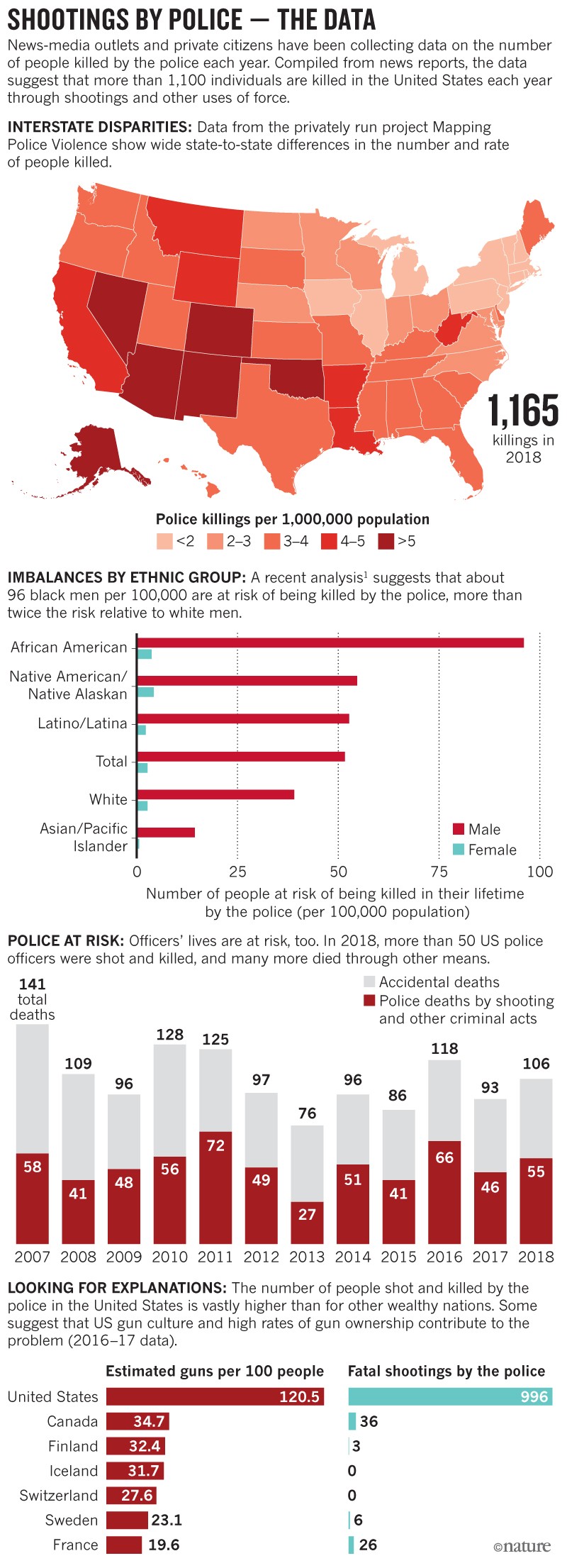
Unofficial national databases have also popped up outside the major news organizations. Two small-scale private efforts, Fatal Encounters and Mapping Police Violence, aggregate and verify information from other databases with added details gleaned from social media, obituaries, criminal-records databases and police reports (see ‘Shootings by police — the data’).


Sources: Map: Mapping Police Violence; Ethnic imbalance: ref. 1; Police deaths: FBI LEOKA report 2018

The results paint a picture of definite disparity when it comes to race and police shootings. Although more white people are shot in total, people from minority ethnic groups are shot at higher rates by population. One paper published in August found that a black man is 2.5 times more likely than a white man to be killed by the police during his lifetime1. The difference, albeit smaller, is also there for women. But the authors did not make any conclusions regarding racial bias of police officers, in part because not everyone has an equal chance of coming into contact with the police. Crime rates and policing practices differ across communities, as do the historical legacies that influence them. Aggressive policing over time can increase local levels of violence and contact with the police, says Frank Edwards, a sociologist at Rutgers University in Newark, New Jersey, and an author on the paper. “This is inherently a multilevel problem,” he says.

Researchers have used various approaches to try to determine the best benchmarks for the data, such as looking at the arrest rates where the shootings occurred or factoring in the context of encounters that end in a shooting. Did the suspect have a weapon? Were officers or another civilian being threatened? In a 2017 study3, for example, Nix determined that black people fatally shot by the police were twice as likely as white people to be unarmed. Those findings align with many studies published since 2015 suggesting that racial biases do influence police shootings.

Some research runs counter to this conclusion. This July, authors of a study that pulled information from The Washington Post and The Guardian databases, as well as directly from police departments, said they found no evidence of biases against black or Hispanic people2. In addition to factoring in the crime rates of the communities where the shootings happened, the authors looked at the race of the officers involved.

Several scientists have taken issue with their methods, however. To sidestep some of the questions about encounter rates, the study authors started from the pool of people shot by the police and then calculated the chance that they were of a certain race. Jonathan Mummolo, a political scientist at Princeton University, New Jersey, argues that the real question to ask in order to detect racial bias is the reverse: does a citizen of a certain race face a greater chance of getting shot by the police? And answering this question requires knowing, or at least reasonably approximating, that elusive encounter rate.

The national-scale databases are inherently messy, in part as a result of disparate definitions of the ‘use of force’, as well as different police protocols and reporting requirements. Other studies have avoided some of these inconsistencies by focusing on local data.

A 2017 study of data collected from the Dallas Police Department in Texas indicated that although race was not a significant factor in decisions to pull the trigger, Dallas officers were more likely to draw their firearms on minority suspects4.

The Dallas Police Department declined to comment on the study but highlighted its officer-education efforts, including in areas of cultural diversity and implicit bias, as well as its deployment of body cameras, which many agencies have adopted as a way to improve transparency.

Some researchers say it’s important to shift the discussion to examine when — rather than whether — racial bias factors into the use of deadly force. Does it come into play when a department decides which neighbourhoods to police most heavily? Or is it when an officer first lays eyes on a civilian, or is it when they make that split-second decision to pull the trigger? Andrew Wheeler, a criminologist at the University of Texas at Dallas, says that national-level databases should at least include all levels of use of force — down to the drawing of a weapon — in order to answer questions and create change. “Collecting data in and of itself is a good mechanism to hold police agencies accountable,” he says.

Counting on the Feds

In January, after more than three years of pilot development, the FBI unveiled its official National Use-of-Force Data Collection, which covers dozens of variables including fatal and non-fatal injuries incurred through a variety of police encounters. The database, according to the FBI, aims to inform dialogue by filling the information gap. But data submission is entirely voluntary. And no data are yet available for outside review.

Nix and others doubt that all of the more than 18,000 police agencies in the United States will voluntarily report incidents. But Darrel Stephens, a retired police chief and the interim executive director of the Major Cities Chiefs Association, is more optimistic. Growing public pressure will force agencies to participate, he says. At the same time, he adds, the increased scrutiny since Ferguson has also come at a cost. In a 2017 national survey by the Pew Research Center, 76% of police officers reported that they had become more reluctant to use force when it is appropriate. Police officers, too, face risks. An average of around 50 officers are shot and killed by civilians every year.

In other wealthy nations, where accurate tracking of shootings is generally a given, officials tend to have fewer deaths of both civilians and officers to count. Terry Goldsworthy, a criminologist at Bond University in Queensland, Australia, highlights one potential explanation for the difference: a stark contrast in the attitude towards and availability of guns. “Generally, when a police officer pulls up to a car in Australia, they don’t expect someone to be armed,” he says.

Australia keeps a tally of its approximately five civilian deaths at the hands of the police per year, using a central government database. Similarly, in the United Kingdom, an independent inquiry is initiated every time a police officer is involved in a shooting.

To encourage US law-enforcement agencies to report use-of-force information, Stoughton, who has published widely on deadly force, says officials should consider making federal grants conditional on whether departments submit use-of-force data to national collections. But he recognizes the challenges. “We’re not talking about anything that is practically difficult,” he says. “This is something that is politically difficult.”

Researchers, meanwhile, aren’t going to wait around for the FBI. Some are refining methods to better analyse the imperfect data they have; others are continually trying to improve the information collected so far. Academics are expanding the Fatal Encounters database and filling in holes, for example, by adding police-department demographics and the location of the nearest emergency department, as well as using surname and demographic information to guess at the race of someone where it isn’t identified. “I don’t think we’ve closed the book on any of this,” says Mummolo. “We’re just beginning.”


Is 'Reverse Racism' Among Police Real? Brentin Mock. Feb. 8, 2017.
Criminologists have debated for decades whether police carry racial biases into their work—particularly the kind that leads them to kill African Americans at disproportionate rates. Much of the research in this arena suggests that yes, on balance, police officers of all races do tend to perceive African Americans as more threatening than whites. The much-revered University of California Berkeley criminology professor Paul Takagi wrote as early as 1974 that “the police have one trigger finger for whites and another for blacks,” in the Journal of Crime and Scholarly Justice.
However, a few recent studies upended the conventional wisdom on this by pointing to evidence that police might be more hesitant to use deadly force against black suspects, as opposed to white suspects. Such studies leveled up the stakes around the so-called “Ferguson Effect”: Not only were cops scaling back their policing to avoid potential public scrutiny, as this effect supposes, but they’re now being more racist towards white people, these new studies allege. 
The sheer volume of news stories over the last few years showing police using force against African Americans—both armed and unarmed—certainly suggest otherwise. After all, those stories are what propelled the Black Lives Matter movement, which continues to push for more awareness about police violence. Those stories also prompted a group of researchers to dig a little deeper into the question of whether police are biased against minorities. In a report released today, “A Bird’s Eye View of Civilians Killed by Police in 2015,” criminal justice scholars from the University of Louisville and the University of South Carolina found an interesting way to ascertain how racial discrimination might play a role in police violence.
...
Another study, conducted by Harvard sociologist Roland Fryer last year, had similar findings. After examining over 1,300 police shootings in some of the nation’s largest cities, he found no evidence that police were more likely to shoot black suspects over whites. Wrote Fryer in the conclusion to his report: “It is plausible that racial differences in lower level uses of force are simply a distraction and movements such as Black Lives Matter should seek solutions within their own communities rather than changing the behaviors of police and other external forces.”


The Truth Behind Racial Disparities in Fatal Police Shootings. Joseph Cesario, MSU. July 22, 2019.
“Until now, there’s never been a systematic, nationwide study to determine the characteristics of police involved in fatal officer-involved shootings,” said Joseph Cesario, co-author and professor of psychology at MSU. “There are so many examples of people saying that when black citizens are shot by police, it’s white officers shooting them. In fact, our findings show no support that black citizens are more likely to be shot by white officers." 
“We found that the race of the officer doesn’t matter when it comes to predicting whether black or white citizens are shot," Cesario said. "If anything, black citizens are more likely to have been shot by black officers, but this is because black officers are drawn from the same population that they police. So, the more black citizens there are in a community, the more black police officers there are.”
... “Many people ask whether black or white citizens are more likely to be shot and why. We found that violent crime rates are the driving force behind fatal shootings,” Cesario said. “Our data show that the rate of crime by each racial group correlates with the likelihood of citizens from that racial group being shot. If you live in a county that has a lot of white people committing crimes, white people are more likely to be shot. If you live in a county that has a lot of black people committing crimes, black people are more likely to be shot. It is the best predictor we have of fatal police shootings.”
... There’s also something to be said for what the victims were doing when the cops shot them. Cesario points out that, “The vast majority—between 90 percent and 95 percent—of the civilians shot by officers were actively attacking police or other citizens when they were shot”—and that there were more white civilians who were committing such attacks when police killed them than were African Americans. In fact, white people were more likely to be armed when police killed them, as Cesario’s study acknowledges—“if anything, [we] found anti-White disparities when controlling for race-specific crime,” reads the study.

The Myth of Systemic Police Racism. Heather MacDonald. WSJ. June 2, 2020.
Hold officers accountable who use excessive force. But there’s no evidence of widespread racial bias.
The charge of systemic police bias was wrong during the Obama years and remains so today. However sickening the video of Floyd’s arrest, it isn’t representative of the 375 million annual contacts that police officers have with civilians. A solid body of evidence finds no structural bias in the criminal-justice system with regard to arrests, prosecution or sentencing. Crime and suspect behavior, not race, determine most police actions.
In 2019 police officers fatally shot 1,004 people, most of whom were armed or otherwise dangerous. African-Americans were about a quarter of those killed by cops last year (235), a ratio that has remained stable since 2015. That share of black victims is less than what the black crime rate would predict, since police shootings are a function of how often officers encounter armed and violent suspects. In 2018, the latest year for which such data have been published, African-Americans made up 53% of known homicide offenders in the U.S. and commit about 60% of robberies, though they are 13% of the population. 
The police fatally shot nine unarmed blacks and 19 unarmed whites in 2019, according to a Washington Post database, down from 38 and 32, respectively, in 2015. 
... 
This past weekend, 80 Chicagoans were shot in drive-by shootings, 21 fatally, the victims overwhelmingly black. Police shootings are not the reason that blacks die of homicide at eight times the rate of whites and Hispanics combined; criminal violence is.


Abstract
Recent high-profile incidents reignited the conversation about psychopathic traits in police officers. Psychopathy is characterized by multiple variants: primary and secondary psychopathy. There is limited research examining psychopathy in populations that may exhibit adaptive psychopathic traits. This study used model-based cluster analyses of high psychopathy scorers to investigate psychopathic subtypes in an urban police sample. Relative to the primary subtype, the secondary group displayed higher levels of Self-Centered Impulsivity, trait anxiety, covert narcissism, borderline personality disorder traits, substance use, psychiatric treatment, and aggression. These findings support the concept of successful psychopathy and the existence of psychopathy profiles in police officers, providing a useful look at how successful psychopathy may manifest as well as implications for the criminal justice system and police departments.


Psychopathic cops can be more dangerous than criminals. They are responsible for police brutality, unjustified shootings, false testimony, and many other forms of police misconduct. 
Every year, dozens of people who were convicted based on a cop's testimony, are released from prison because they were innocent. In three out of four homicide exonerations, official misconduct is a factor. 
Thousands of Americans have died at the hands of cops in suspicious circumstances. This kind of behaviors are, more often than not, the work of a psychopath. 
What is a Psychopath? 
One of the problems with psychopaths is that they are incapable of remorse. 
For Jon Ronson, author of The Psychopath Test, “Psychopathy is probably the most pleasant-feeling of all the mental disorders... All of the things that keep you good, morally good, are painful things: guilt, remorse, empathy.” For neuroscientist James Fallon, author of The Psychopath Inside, “Psychopaths can work very quickly, and can have an apparent IQ higher than it really is, because they’re not inhibited by moral concerns.” 
Psychopaths have cognitive empathy, they can understand what others are feeling, but they lack the ability to feel it, which is known as emotional empathy. “This all gives certain psychopaths a great advantage, because they can understand what you’re thinking, it’s just that they don’t care, so they can use you against yourself,” Fallon explains. 
In fact, research has shown that psychopaths are extremely adept at identifying vulnerability. 
Psychopaths Often Become Cops 
What happens when a person like that, someone who has zero concern for our feelings, is handed a gun and put in a position of power? 
An encounter with a psychopath in a police uniform can be a life hazard. That's why it is so important to be able to detect them. When you are in front of a psychopath, behaviors need to be altered, because normal social behaviors can trigger unexpected responses.
Research has shown that Police Officer is one of the top 10 professions chosen by psychopaths, ranking at number 7. 
As I wrote in my book - California: State of Collusion, “Power, such as we give to law enforcement, prosecutors and judges, actually attracts psychopathic personalities who want to exert violent dominance under the color of authority. Innocent people can be subjected to a power trip police encounter, can be arrested by a megalomaniacal cop, jailed by a sadist, prosecuted by a manipulative Machiavellian and judged by a sociopath on an ego trip.”

The George Floyd Protests – 20 unanswered questions

As the situation deterioates all across the nation, we need to stop and ask how we got here
Violence, looting and riots won’t solve any of the political problems in America, but will cause more. So why are they being encouraged? 
As this gets published, curfews are being introduced all across the country, national guard units are on high alert, and the media continue to pump out alarmist stories stoking the conflict. 
Who will benefit from this chaos?


The Minneapolis Putsch. CJ Hopkins. The Off-Guardian. June 1, 2020.
Things couldn’t be going better for the Resistance if they had scripted it themselves.

Actually, they did kind of script it themselves. Not the murder of poor George Floyd, of course. Racist police have been murdering Black people for as long as there have been racist police. No, the Resistance didn’t manufacture racism.

They just spent the majority of the last four years creating and promoting an official narrative which casts most Americans as “white supremacists” who literally elected Hitler president, and who want to turn the country into a racist dictatorship.

According to this official narrative, which has been relentlessly disseminated by the corporate media, the neoliberal intelligentsia, the culture industry, and countless hysterical, Trump-hating loonies, the Russians put Donald Trump in office with those DNC emails they never hacked and some division-sowing Facebook ads that supposedly hypnotized Black Americans into refusing to come out and vote for Clinton. Putin purportedly ordered this personally, as part of his plot to “destroy democracy.”

The plan was always for President Hitler to embolden his white-supremacist followers into launching the “RaHoWa,” or the “Boogaloo,” after which Trump would declare martial law, dissolve the legislature, and pronounce himself Führer. Then they would start rounding up and murdering the Jews, and the Blacks, and Mexicans, and other minorities, according to this twisted liberal fantasy.

I’ve been covering the roll-out and dissemination of this official narrative since 2016, and have documented much of it in my essays, so I won’t reiterate all that here. Let’s just say, I’m not exaggerating, much.

After four years of more or less constant conditioning, millions of Americans believe this fairy tale, despite the fact that there is absolutely zero evidence whatsoever to support it. Which is not exactly a mystery or anything. It would be rather surprising if they didn’t believe it. We’re talking about the most formidable official propaganda machine in the history of official propaganda machines.

And now the propaganda is paying off. The protesting and rioting that typically follows the murder of an unarmed Black person by the cops has mushroomed into “an international uprising” cheered on by the corporate media, corporations, and the liberal establishment, who don’t normally tend to support such uprisings, but they’ve all had a sudden change of heart, or spiritual or political awakening, and are down for some serious property damage, and looting, and preventative self-defense, if that’s what it takes to bring about justice, and to restore America to the peaceful, prosperous, non-white-supremacist paradise it was until the Russians put Donald Trump in office.

In any event, the Resistance media have now dropped their breathless coverage of the non-existent Corona-Holocaust to breathlessly cover the “revolution.”

...

Look, I’m not saying the neoliberal Resistance orchestrated or staged these riots, or “denying the agency” of the folks in the streets. Whatever else is happening out there, a lot of very angry Black people are taking their frustration out on the cops, and on anyone and anything else that represents racism and injustice to them.

This happens in America from time to time. America is still a racist society.
Most African-Americans are descended from slaves. Legal racial discrimination was not abolished until the 1960s, which isn’t that long ago in historical terms.

...

So I have no illusions about racism in America. But I’m not really talking about racism in America. I’m talking about how racism in America has been cynically instrumentalized, not by the Russians, but by the so-called Resistance, in order to delegitimize Trump and, more importantly, everyone who voted for him, as a bunch of white supremacists and racists.

...

OK, and this is where I have to restate (for the benefit of my partisan readers) that I’m not a fan of Donald Trump, and that I think he’s a narcissistic ass clown, and a glorified con man, and … blah blah blah, because so many people have been so polarized by insane propaganda and mass hysteria that they can’t even read or think anymore, and so just scan whatever articles they encounter to see whose “side” the author is on and then mindlessly celebrate or excoriate it.

If you’re doing that, let me help you out … whichever side you’re on, I’m not on it.

I realize that’s extremely difficult for a lot of folks to comprehend these days, which is part of the point I’ve been trying to make. I’ll try again, as plainly as I can.

America is still a racist country, but America is no more racist today than it was when Barack Obama was president. A lot of American police are brutal, but no more brutal than when Obama was president. America didn’t radically change the day Donald Trump was sworn into office.

All that has changed is the official narrative. And it will change back as soon as Trump is gone and the ruling classes have no further use for it.

And that will be the end of the War on Populism, and we will switch back to the War on Terror, or maybe the Brave New Pathologized Normal … or whatever Orwellian official narrative the folks at GloboCap have in store for us.

Seven Reasons Why Police Are Disliked. Randall Collins, The Sociological Eye. June 5, 2020.
[7] Racism among police. Some cops are racists. How many are there, and what kind of racists they are, needs better analysis. What kind? There is a difference between white supremacists of the pre-1960s period; stereotyping racists who think most black people are potential criminals; situational racists who react to black people in confrontational situations with fear and hostility; casual racists who make jokes. These aren’t insoluble questions; if ethnographers followed people around in everyday life and observed what they talked about and how they behaved in different situations, we would have a good picture.  And there still remains the further question, does one or another degree of racism explain when police violence happens? 
My estimate is that racism among police is less important a factor than the social conflicts and situational stresses outlined in points [1-6]. To put it another way, if we got rid of racist attitudes, but left [1-6] in place, how much would police violence be reduced? Very little, I would predict. 
What can be done? And how likely is it to have effects? ...


Number of people shot to death by the police in the United States from 2017 to 2020, by race. Statista.


Rush to Judgment. Norman Mailer. 1966.