Critique of Climate Feedback fact checking exercise of an article by the writer Jonathan Franzen in the New Yorker, published September 8, 2019, by leading climate scientists Wolfgang Knorr and Will Steffen.
Fact Checking the Climate Crisis: Franzen vs. Facebook on False News
Last year, the writer Jonathan Franzen, not known for mincing his words, took up an opportunity offered by the New Yorker to bring his very own perspective to the debate about the impending climate crisis. The headline read: What If We Stopped Pretending? The climate apocalypse is coming. To prepare for it, we need to admit that we can’t prevent it.
You would think that this was just another opinion piece on the climate catastrophe, this time by a writer from whom you would not expect new insights about the climate system, but maybe some other truths related to the general human predicament. If you happened to be a social media user, however, you might be in for some surprise. On February 15th, the moderators of the Facebook group Positive Deep Adaptation received a “partly false information” warning about Franzen’s New Yorker article having been posted in their group. The warning explicitly referred to an article by the fact checking site Climate Feedback (see image 1). Following considerable political pressure, fact checkers are now routinely used by social media sites to prevent the spread of “false news”. Sanctions for repeat offenders include reducing visibility for the group or site, or removing the ability to earn income.
This gives Climate Feedback’s verdict considerable weight. In this article, we will review the fact checking exercise itself, in order to see if the matter has been handled with the necessary care and level of responsibility. According to their web site Climate Feedback is a worldwide network of scientists sorting fact from fiction in climate change media coverage. As senior climate scientists, our goal is to help readers know which news to trust.
Fact checking the fact checkers
The first thing we noticed was that from the headline and the information below it, it was not possible to tell the exact claim that was being assessed. While the headline read “2°C is not known to be a ‘point of no return’, as Jonathan Franzen claims”, the actual claim by Franzen stated further down was “The consensus among scientists and policy-makers is that we’ll pass this point of no return if the global mean temperature rises by more than two degrees Celsius.” What was left out is some text that in the original article follows immediately after and is therefore an integral part of the claim made by Franzen: “(maybe a little more, but also maybe a little less)”. The verdict: incorrect.
There is an important distinction here: is the claim being reviewed that there is a consensus – which Climate Feedback easily refute because none of the scientist reviewers seems to subscribe to this supposed consensus – or is it rather about the existence of a supposed “point of no return”? In the following, we will discuss both possibilities.
Contrary to the claim by Climate Feedback, and the entire point made by the last reviewer, Marcus Fontela, there is indeed a scientific basis for Franzen’s article, even though he vastly overrates the degree of consensus or the level of scientific understanding of such a hypothesis.
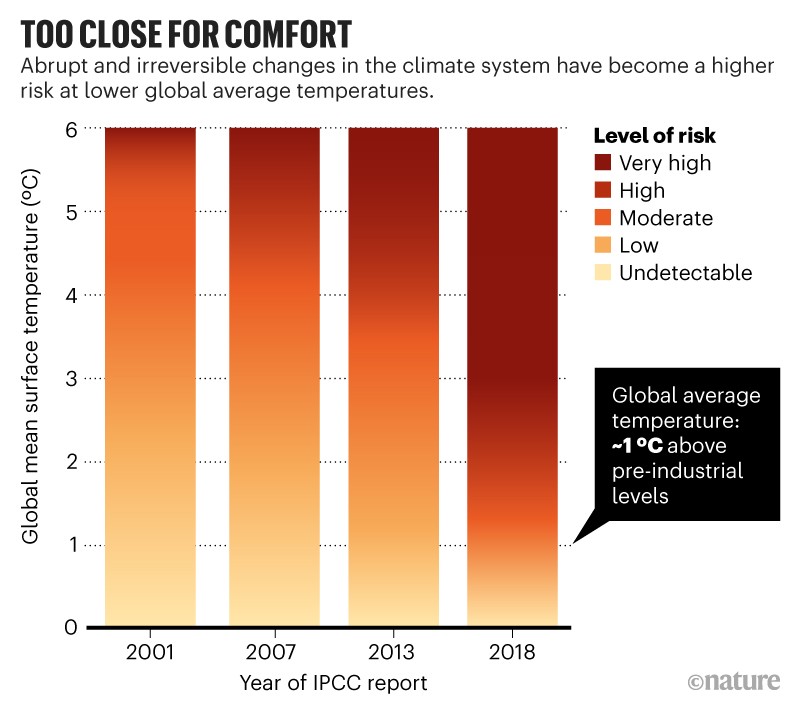
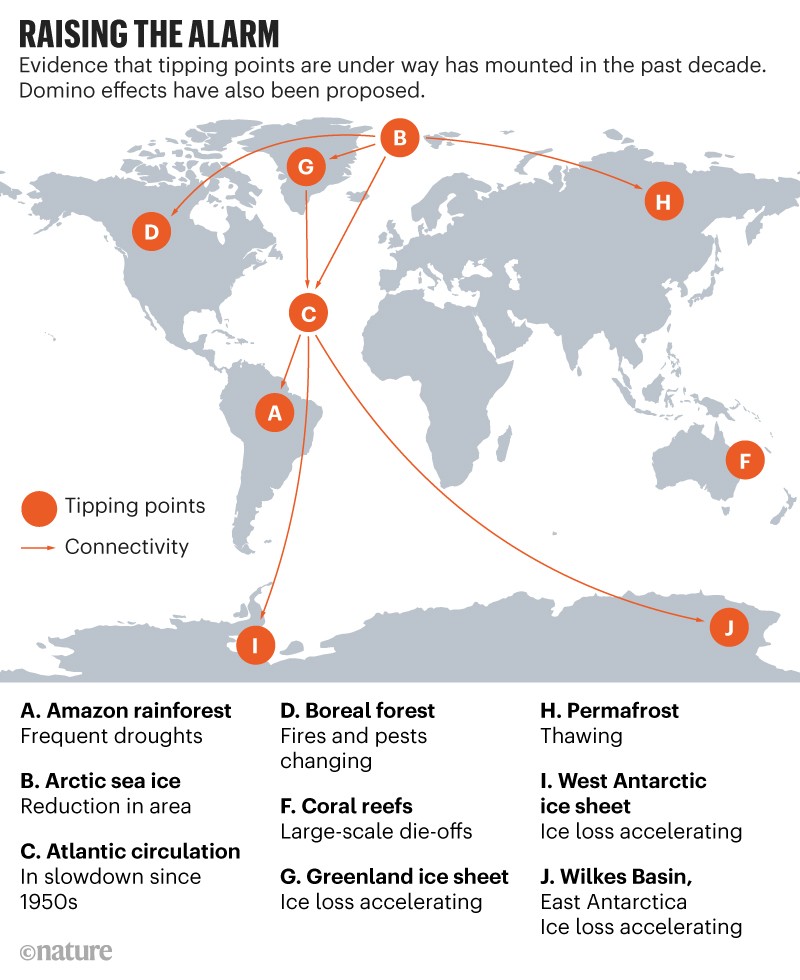
All scientist reviewers – except for one who did not provide references at all – referred to an article led by one of us: Steffen and co-workers (2018) Trajectories of the Earth System in the Anthropocene1. It appears that the reviewers correctly identified the source of Franzen’s “point of no return”. The article in question hypothesizes the existence of mutually reinforcing tipping points, or positive feedback mechanisms, in the earth’s climate system. It does not provide definite proof of the existence of such a “tipping cascade”, nor does it say they will all suddenly happen when 2°C of warming is reached, but rather sketches out a plausible scenario. It also provides estimates for the degree of warming required for tipping to be triggered. “Tipping” here means irreversible changes that a return to a lower degree of warming will not be able to stop – or “point of no return”. According to our understanding, the following tipping elements might be affected at 2°C of warming:
- West Antarctic Ice Sheet – likely tipped (i.e. irreversibly on the pathway to eventual collapse)2
- Coral reefs – likely tipped (wide-spread destruction from heat stress and ocean acidification)
- Arctic sea ice cover – likely tipped (irreversible situation arises from increasing heat provided by the darker ocean surface as summer ice disappears)4
- Amazon rainforest - likely tipped taking into account current rates of human deforestation (i.e. the loss of forest itself decreases regional precipitation rates, thus increasing the overall reduction in rainfall, further influenced by a weakening AMOC – see next point)5,6
- Atlantic meridional overturning circulation (AMOC, the ocean current that brings warm waters to western Europe) – probably not tipped, but significantly weakened7
- Permafrost carbon stores – probably not tipped, but significant carbon emissions.3
Another point of potential confusion is that the reviewers do not provide a clear definition of what they believe was meant by “point of no return”. They only suggest that Franzen was talking about a sharp boundary at 2°C warming, for example Patrick Brown: “[...] There was never a scientific consensus that 2.0°C represented some well-defined bright line where impacts suddenly became much worse or feedbacks suddenly became completely self-perpetuating.” Franzen does indeed talk about one point being crossed, but it is not clear if he means a sharp and clearly defined boundary, or rather that somewhere around 2°C a tipping cascade will be triggered. And if a tipping cascade exists, then it will be triggered at a single point, so by definition there would have to be a clearly defined point of transition. It is only questionable if it could be characterised simply by degrees of warming. We must also note that Brown’s 2.0°C “bright line” is a rhetorical ploy designed to ridicule the author’s scientific understanding, where Franzen in fact concedes that his “point” may not be reached at exactly 2°C.
A charge repeated by several reviewers is that Franzen does not understand how climate models work. In fact, Amber Kerr and Charles Koven seem to base their criticism entirely on modelling results. This must be a clear misunderstanding: neither does the New Yorker article refer anywhere to computer modelling, nor has it ever been claimed that it was possible to reliably model tipping cascades. Instead, it is the reviewers who display a remarkable lack of apprehension for the limitations of modelling. For example when Amber Kerr writes: “He says that ‘As a non-scientist, I do my own kind of modelling,’ but he seems to be unaware that scientists have already carried out many qualitative and quantitative climate risk assessments, using policy changes and human behavior as variables.” But even the supporters of such models stress their limitations, while others argue that they are entirely unsuitable for the job.
The most serious criticism brought forwards by the reviewers is that of Franzen’s fatalism, when he claims “that additional warming over 2°C doesn’t matter” (Amber Kerr). This is a criticism we share. We note, however, that Franzen's apparent misinterpretation of the science is based on a gross overstatement of scientific certainty, which is interesting given the reviewers’ own faith in modelling results. As climate scientists having worked with and developed computer models we rather share Franzen’s pessimism about what models can achieve. For very similar reasons, other scientists who have worked specifically on the possibility of catastrophic climate change have based their conclusions mostly on evidence from past climates, using only minimal modelling9.
The most balanced and objective review, in our opinion, is the one by Alexis Berg, whose main point is the speculative nature of the tipping cascade scenario. He is also more honest and cautious when referring to modeling (italics included by the authors): “Climate model simulations, for instance, which do include some of these feedbacks, do not suggest runaway climate change beyond 2°C.” It is true that the article by Steffen and co-workers is “intended to highlight [...] the high side of the risk distribution”. Franzen seems indeed to have ignored that he has based his whole essay on a hypothesis that was just that – a hypothesis and a warning of what could happen if we continue on the current path.
One more important question that the reviewers, and possibly Climate Feedback in general, should address is whether statements that are inherently about the future can even be fact checked. It is true that the review mostly talks about our current understanding of the climate system. But the event this refers to is in the future. We have therefore no way of empirically either proving or refuting the hypothesis of a discontinuity in the climate system. Hence the repeated reference of the reviewers to model results. What they don’t seem to realise, however, is that models are themselves nothing else than codified hypotheses.
Our recommendation
We believe that this New Yorker article – classified as a “cultural commentary” – should never have been fact checked in the first place. Other authors should of course be free to criticise it, as they have done repeatedly. But at the very least Climate Feedbacks should have clearly stated that the fact checking exercise does not concern the possibility of a tipping cascade being triggered – which can be neither proven nor refuted – but only the level of scientific consensus. For such cases, Climate Feedbacks’ methods provide for a set of well-defined categories that should be stated in the details section of the overall verdict:
Overstates scientific confidence: Presents a conclusion as conclusive while the hypothesis is still being investigated and there remains genuine scientific uncertainty about it.
This overall verdict is itself incorrect, or at least seriously misleading. Scientists have indeed identified the likelihood of such a point of no return, even though it is unlikely the point exists at a sharply defined temperature threshold. Identification does not imply there to be a definite, or even a strong scientific proof. And the overall presentation of the verdict is itself misleading for several reasons: it blatantly omits the final part of the sentence being criticised where the author concedes that he does not believe in a definite threshold value, the rhetorical use of “2.0°C”, the reference to climate models and the claim the author does not understand them, while creating the impression the reviewers don’t understand them either, and the lack of understanding that it is not possible to fact check assertions about the future.
In fact, if one is to “fact check” statements about the future, then the criterion for judgment should be whether there is enough credible evidence – be it from paleo studies, observational evidence, modelling results or, more appropriately, a synthesis of all such types of information – to make a well-reasoned case that the statement represents a plausible future. In other words, when dealing with future risks and events in general, the emphasis should be on whether or not the statement presents a plausible risk assessment rather than a “scientific fact”.
The elephant in the room
What most scientists commenting on his piece did not seem to have noticed is the value of Franzen’s article in naming the elephant in the room: that while emissions keep on rising inexorably, no political action even remotely strong enough to address the problem can be seen anywhere on the horizon. Let us listen to his words here:
As a non-scientist, I do my own kind of modelling. I run various future scenarios through my brain, apply the constraints of human psychology and political reality, take note of the relentless rise in global energy consumption [...], and count the scenarios in which collective action averts catastrophe. [...]
Vast sums of government money must be spent without wasting it and without lining the wrong pockets. Here it’s useful to recall the Kafkaesque joke of the European Union’s biofuel mandate, which served to accelerate the deforestation of Indonesia for palm-oil plantations, and the American subsidy of ethanol fuel, which turned out to benefit no one but corn farmers.
Anyone with even the faintest inkling of today’s political reality will agree that it is irrelevant whether we can still prevent major disruptions of the climate system in theory10, when the heads of state of the largest economy and of the country home to the largest tract of rainforest are outspoken climate change deniers. Needless to say, the so-called integrated assessment models used by the IPCC to run various scenarios contain no concept whatsoever of politics.
Fact checking and difficult truths
Our own view of the situation is somewhat different from Fanzen’s – it does not matter at precisely which level of warming tipping points will be reached, but it does matter how much planetary heating we will generate. As long as there is enough carbon11 contained in fossil-fuel reserves to triple even the current already high amounts of atmospheric CO2, and with no mechanism in sight that could guarantee us an end to fossil-fuel extraction, sooner or later the degree of global heating will reach a critical threshold that leads to major disruptions to human society. The question of whether it is already too late is not one that depends so much on the climate system, but on the ability of human society to rapidly change course. Most scientists, policy makers and even activists seem to tend towards optimism. Franzen disagrees, and we believe scientists should at least listen.
Difficult truths are always hard to deal with, especially when they concern one’s own and all of humanity’s survival. Even if there was a sliver of truth in Franzen’s message, it would be a cause for great concern and anxiety. Since no scientist so far has said what Franzen does here, that it might not only be time to panic, but already too late, the predictable reaction of professional climate researchers has been almost universally negative. Someone known for his provocative writing style was treading on their turf!
We believe that fact checking is not a helpful approach to improve the debate about the climate crisis. It is not helpful when we need to confront a difficult truth that many, including scientists, find difficult to accept. It is also not helpful, because it supports a mistaken view of the sciences as being foremost about hard facts, and not about interpretation, debate, truth seeking and philosophical attitudes. And even more importantly – as George Marshall has amply demonstrated in his book “Don’t Even Talk about It” – opinions in the climate debate are very rarely swayed by facts. But users of social media have the right to know the position of the scientific community with respect to assertions made on matters of climate science. A much more helpful approach would be to offer this view in the form of reviews, critiques or other forms of essay, as it is done traditionally in the print media. Rather than being sent warnings with a threat of sanctions for repeat-offenders, publishers on social media could be required in certain cases to provide a suitable link so that the reader is helped to form his own opinion. In the case of the Franzen article, a simple disclaimer that his view of the climate system is seen as a low-probability but plausible scenario would surely have been appreciated. The climate crisis requires us to build bridges and not to exclude certain groups from the debate.
Publisher's notes:
On February 20th 2020 the "false news" warning is no longer showing on the admin panel of Positive Deep Adaptation facebook group. We will send this article to Facebook, Climate Feedback and the New Yorker for information and advice.
An interview with the co-author of this article, climate scientist Dr Wolfgang Knorr, goes in to more detail about how climate scientists might often mislead audiences through typical modes of communication. An article by IFLAS founder explores the extent to which assumptions about social psychology underpin the motivations and arguments of scientists and activists to criticise people for publically considering the implications of worst case scenarios.
Co-author of this article, climate scientist Dr Will Steffen recently called for more research, dialogue and action on the possibilities of societal breakdown or collapse due to climate impacts.
Last year IFLAS released a compendium of recent research that indicates the worst case scenarios for societal disruption from climate change are now increasingly likely. This was produced by Professor Jem Bendell, the initiator of the deep adaptation framework to climate change response. To discuss the issues arising from this article and issue, consider the Narratives and Messaging group on the Deep Adaptation Forum.
References
1 Steffen, W., J. Rockström, K. Richardson, T. M. Lenton, C. Folke, D. Liverman, C. P. Summerhayes, A. D. Barnosky, S. E. Cornell, and M. Crucifix (2018), Trajectories of the Earth System in the Anthropocene, Proceedings of the National Academy of Sciences, 115(33), 8252-8259. (link)
2 IPCC Special Report on the Ocean and Cryosphere in a Changing Climate (IPCC, 2019). (link)
3 IPCC Special Report on Global Warming of 1.5°C (IPCC, 2018). (link)
4 Drijfhout, S., S. Bathiany, C. Beaulieu, V. Brovkin, M. Claussen, C. Huntingford, M. Scheffer, G. Sgubin, and D. Swingedouw (2015), Catalogue of abrupt shifts in Intergovernmental Panel on Climate Change climate models, Proceedings of the National Academy of Sciences, 112(43), E5777-E5786. (link)
5Lovejoy, T. E. A., and C. Nobre (2018), Amazon tipping point, Science Advances, 4(2), eaat2340. (link)
6 Brayshaw, D. J., T. Woollings, and M. Vellinga (2009), Tropical and extratropical responses of the North Atlantic atmospheric circulation to a sustained weakening of the MOC, J. Clim., 22(11), 3146-3155. (link)
7 Caesar, L., S. Rahmstorf, A. Robinson, G. Feulner, and V. Saba (2018), Observed fingerprint of a weakening Atlantic Ocean overturning circulation, Nature, 556(7700), 191-196. (link)
8 Lenton, T. M., J. Rockström, O. Gaffney, S. Rahmstorf, K. Richardson, W. Steffen, and H. J. Schellnhuber (2019), Climate tipping points—too risky to bet against, Nature, 575, 592-595. (link)
9 Hansen, J., M. Sato, G. Russell, and P. Kharecha (2013), Climate sensitivity, sea level and atmospheric carbon dioxide, Philosophical Transactions of the Royal Society A, 371, 20120294. (link)
10 Anderson, K. (2015). Duality in climate science. Nature Geoscience, 8, 898-900. (link)
11 Global Energy Assessment (2012), International Institute for Applied Systems Analysis, Laxenburg, Austria. (link)
1 Steffen, W., J. Rockström, K. Richardson, T. M. Lenton, C. Folke, D. Liverman, C. P. Summerhayes, A. D. Barnosky, S. E. Cornell, and M. Crucifix (2018), Trajectories of the Earth System in the Anthropocene, Proceedings of the National Academy of Sciences, 115(33), 8252-8259. (link)
2 IPCC Special Report on the Ocean and Cryosphere in a Changing Climate (IPCC, 2019). (link)
3 IPCC Special Report on Global Warming of 1.5°C (IPCC, 2018). (link)
4 Drijfhout, S., S. Bathiany, C. Beaulieu, V. Brovkin, M. Claussen, C. Huntingford, M. Scheffer, G. Sgubin, and D. Swingedouw (2015), Catalogue of abrupt shifts in Intergovernmental Panel on Climate Change climate models, Proceedings of the National Academy of Sciences, 112(43), E5777-E5786. (link)
5Lovejoy, T. E. A., and C. Nobre (2018), Amazon tipping point, Science Advances, 4(2), eaat2340. (link)
6 Brayshaw, D. J., T. Woollings, and M. Vellinga (2009), Tropical and extratropical responses of the North Atlantic atmospheric circulation to a sustained weakening of the MOC, J. Clim., 22(11), 3146-3155. (link)
7 Caesar, L., S. Rahmstorf, A. Robinson, G. Feulner, and V. Saba (2018), Observed fingerprint of a weakening Atlantic Ocean overturning circulation, Nature, 556(7700), 191-196. (link)
8 Lenton, T. M., J. Rockström, O. Gaffney, S. Rahmstorf, K. Richardson, W. Steffen, and H. J. Schellnhuber (2019), Climate tipping points—too risky to bet against, Nature, 575, 592-595. (link)
9 Hansen, J., M. Sato, G. Russell, and P. Kharecha (2013), Climate sensitivity, sea level and atmospheric carbon dioxide, Philosophical Transactions of the Royal Society A, 371, 20120294. (link)
10 Anderson, K. (2015). Duality in climate science. Nature Geoscience, 8, 898-900. (link)
11 Global Energy Assessment (2012), International Institute for Applied Systems Analysis, Laxenburg, Austria. (link)