Showing posts with label Monbiot. Show all posts

Monday, May 20, 2019

Climate Links: May 2019

** updated May 22, 2019; * May 20

** In the Hands of Angry Gods. Ed Simon, The Baffler. May 22, 2019.
The case for hell on earth
And we abolish the idea of hell at the very moment when it could be the most pertinent to us. An ironic reality in an era where the world becomes seemingly more hellish, when humanity has developed the ability to enact a type of burning punishment upon the earth itself. Journalist David Wallace-Wells in his terrifying new book about climate change The Uninhabitable Earth: Life After Warming writes that “it is much, much worse, than you think.” Wallace-Wells goes onto describe how anthropogenic warming will result in a twenty-first century that sees coastal cities destroyed and refugees forced to migrate for survival, that will see famines across formerly verdant farm lands and the development of new epidemics that will kill millions, which will see wars fought over fresh water and wildfires scorching the wilderness. Climate change implies not just ecological collapse, but societal, political, and moral collapse as well. The science has been clear for over a generation, our reliance on fossil fuels has been hastening an industrial apocalypse of our own invention. Wallace-Wells is critical of what he describes as the “eerily banal language of climatology,” where the purposefully sober, logical, and rational arguments of empirical science have unintentionally helped to obscure the full extent of what some studying climate change now refer to as our coming “century of hell.” 

* George Clooney releases PSA against climate change “dumbf**kery”. Melissa Locker, Fast Company. May 8, 2019.
Clooney noted that science has given “unprecedented knowledge of the natural world from subatomic particles to the majesty of space.” Tragically, though, that knowledge is threatened by “an epidemic of dumbf**ing idiots” saying “dumbf**king things.” 
Unfortunately, according to Clooney, “dumbf***ery is highly contagious, affecting the minds of even the most stable geniuses,” leading people to deny climate change, not vaccinate their kids, and not believe in dinosaurs. Now, that “rampant dumbf***ery” threatens “our health, our security and now our planet.”

* Because 'The House Is on Fire,' Naomi Klein Takes Centrism-Obsessed Media to Task for Failed Climate Coverage. Eoin Higgins, CommonDreams. May 1, 2019.

"You can't leave it all to the markets."


* Humanity Is About to Kill 1 Million Species in a Globe-Spanning Murder-Suicide. Eric Levitz, NY Mag. May 6, 2019.
[MW: most headlines captured just the sentiments of the first 9/10ths of this headline, but its the final word of the headline that's crucial.]


* Traditional Economics Has Absolutely Screwed Us. Mitchell Anderson, TheTyee.ca. May 9, 2019.
UN’s biodiversity crisis report screams for new ways of natural accounting.
"Conventional capitalism is failing because it considers the services provided by nature such as oxygen and food production as free and limitless. Only an economist could fail to see how a collapsing biosphere might be bad for business."

* A War Reporter Covers "The End of Ice" -- and it will change the way you think about climate catastrophe. Elise Swain, The Intercept. May 4 2019.
“A willingness to live without hope allows me to accept the heartbreaking truth of our situation, however calamitous it is. Grieving for what is happening to the planet also now brings me gratitude for the smallest, most mundane things,” Jamail explains. “I have found that it’s possible to reach a place of acceptance and inner peace, while enduring the grief and suffering that are inevitable as the biosphere declines.” 
“The End of Ice” readers won’t find calls for technology-based solutions, politicians, mitigating emissions, or the Green New Deal to save us. 
“This global capitalist experiment, this experiment of industrialization and burning fossil fuels rampantly is an utter, abject failure,” Jamail told The Intercept.

end_of_ice_final-1556894251


415.26 parts per million: CO2 levels hit historic high. Patrick Galey, AFP. May 13, 2019.
Scientists in the United States have detected the highest levels of planet-warming carbon dioxide in Earth's atmosphere since records began, sounding new alarm over the relentless rise of man-made greenhouse gas emissions. 
The Mauna Loa Observatory in Hawaii, which has tracked atmospheric CO2 levels since the late 1950s, on Saturday morning detected 415.26 parts per million (ppm). 
It was also the first time on record that the observatory measured a daily baseline above 415 ppm. 
The last time Earth's atmosphere contained this much CO2 was more than three million years ago, when global sea levels were several metres higher and parts of Antarctica were blanketed in forest.


Climate Stasis: German Failure on the Road to a Renewable Future. By Frank Dohmen, Alexander Jung, Stefan Schultz and Gerald Traufetter, Spiegel Online. May 13, 2019.
In 2011, German Chancellor Angela Merkel announced the country was turning away from nuclear energy in favor of a renewable future. Since then, however, progress has been limited. Berlin has wasted billions of euros and resistance is mounting.


Gray whales starving, washing up dead in startling numbers along SF coast. Peter Fimrite, SanFran Chronicle. May 11, 2019.


Why rapid extinction of plant, animal species matters. Daryl Choo, Today Online. May 12, 2019.
Human activities are putting a million species worldwide at risk of extinction, threatening ecosystems that people around the world depend on for survival, a United Nations (UN) assessment has found. 
The 1,500-page report, compiled by more than a hundred international experts, is the most comprehensive assessment on biodiversity and ecosystems yet.


The problem is capitalism. George Monbiot. April 30, 2019.

It is a weapon pointed at the living world. We urgently need to develop a new system.  
For most of my adult life, I’ve railed against “corporate capitalism”, “consumer capitalism” and “crony capitalism”. It took me a long time to see that the problem is not the adjective, but the noun. 
While some people have rejected capitalism gladly and swiftly, I’ve done so slowly and reluctantly. Part of the reason was that I could see no clear alternative: unlike some anti-capitalists, I have never been an enthusiast for state communism. I was also inhibited by its religious status. To say “capitalism is failing” in the 21st century is like saying “God is dead” in the 19th. It is secular blasphemy. It requires a degree of self-confidence I did not possess. 
But as I’ve grown older, I’ve come to recognise two things. First, that it is the system, rather than any variant of the system, which drives us inexorably towards disaster. Second, that you do not have to produce a definitive alternative to say that capitalism is failing. The statement stands in its own right. But it also demands another, and different, effort to develop a new system. 
Capitalism’s failures arise from two of its defining elements. 
The first is perpetual growth. Economic growth is the aggregate effect of the quest to accumulate capital and extract profit. Capitalism collapses without growth, yet perpetual growth on a finite planet leads inexorably to environmental calamity. 
Those who defend capitalism argue that, as consumption switches from goods to services, economic growth can be decoupled from the use of material resources. Last week, a paper in the journal New Political Economy by Jason Hickel and Giorgos Kallis examined this premise. They found that while some relative decoupling took place in the 20th century (material resource consumption grew, but not as quickly as economic growth), in the 21st there has been a re-coupling: rising resource consumption has so far matched or exceeded the rate of economic growth. The absolute decoupling needed to avert environmental catastrophe (a reduction in material resource use) has never been achieved, and appears impossible while economic growth continues. Green growth is an illusion. 

A system based on perpetual growth cannot function without peripheries and externalities. There must always be an extraction zone, from which materials are taken without full payment, and a disposal zone, where costs are dumped in the form of waste and pollution. As the scale of economic activity increases, until capitalism affects everything from the atmosphere to the deep ocean floor, the entire planet becomes a sacrifice zone: we all inhabit the periphery of the profit-making machine.

This drives us towards cataclysm on such a scale that most people have no means of imagining it. The threatened collapse of our life support systems is bigger by far than war, famine, pestilence or economic crisis, though it is likely to incorporate all four. 
Societies can recover from these apocalyptic events, but not from the loss of soil, an abundant biosphere and a habitable climate. 
The second defining element is the bizarre assumption that a person is entitled to as great a share of the world’s natural wealth as their money can buy. This seizure of common goods causes three further dislocations. First, the scramble for exclusive control of non-reproducible assets, which implies either violence or legislative truncations of other people’s rights. Second, the immiseration of other people by an economy based on looting across both space and time. Third, the translation of economic power into political power, as control over essential resources leads to control over the social relations that surround them.

In the New York Times on Sunday, the Nobel economist Joseph Stiglitz sought to distinguish between good capitalism, that he called “wealth creation”, and bad capitalism, that he called “wealth grabbing” (extracting rent). I understand his distinction, but from the environmental point of view, wealth creation is wealth grabbing. Economic growth, intrinsically linked to the increasing use of material resources, means seizing natural wealth from both living systems and future generations. 
To point to such problems is to invite a barrage of accusations, many of which are based on this premise: capitalism has rescued hundreds of millions of people from poverty – now you want to impoverish them again. It is true that capitalism, and the economic growth it drives, has radically improved the prosperity of vast numbers of people, while simultaneously destroying the prosperity of many others: those whose land, labour and resources were seized to fuel growth elsewhere. Much of the wealth of the rich nations was – and is – built on slavery and colonial expropriation.

Like coal, capitalism has brought many benefits. But, like coal, it now causes more harm than good. Just as we have found means of generating useful energy that are better and less damaging than coal, so we need to find means of generating human wellbeing that are better and less damaging than capitalism. 
There is no going back: the alternative to capitalism is neither feudalism nor state communism. Soviet communism had more in common with capitalism than the advocates of either system would care to admit. Both systems are (or were) obsessed with generating economic growth. Both are willing to inflict astonishing levels of harm in pursuit of this and other ends. Both promised a future in which we would need to work for only a few hours a week, but instead demand endless, brutal labour. Both are dehumanising. Both are absolutist, insisting that theirs and theirs alone is the one true God. 
So what does a better system look like? I don’t have a complete answer, and I don’t believe any one person does. But I think I see a rough framework emerging. Part of it is provided by the ecological civilisation proposed by Jeremy Lent, one of the greatest thinkers of our age. Other elements come from Kate Raworth’s doughnut economics and the environmental thinking of Naomi Klein, Amitav Ghosh, Angaangaq Angakkorsuaq, Raj Patel and Bill McKibben. Part of the answer lies in the notion of “private sufficiency, public luxury”. Another part arises from the creation of a new conception of justice, based on this simple principle: every generation, everywhere shall have an equal right to the enjoyment of natural wealth. 
I believe our task is to identify the best proposals from many different thinkers and shape them into a coherent alternative. Because no economic system is only an economic system, but intrudes into every aspect of our lives, we need many minds from various disciplines – economic, environmental, political, cultural, social and logistical – working collaboratively to create a better way of organising ourselves, that meets our needs without destroying our home.

Our choice comes down to this. Do we stop life to allow capitalism to continue, or stop capitalism to allow life to continue?

One million species at risk of extinction, ... + One. Ian Welsh. May 6, 2019.

So you’ve probably seen all the articles about the UN report which finds that one million species are at risk of extinction, out of the 8.7 million species we believe exist. 
That’s more than 10%. 
The key thing that tends not to be emphasized in this is that ecosystems are chains, or complex webs of interactions. The death of insects, for example (remember when driving caused bug splat? I can’t remember the last time I saw that), will revebrate through the entire web, starting with birds. 
These interactions are complicated and we do not understand them well at all. 
There is a non trivial risk that the algae which are the major oxygen producers in the Oceans will die, for example. They produce 70 to 80% of our oxygen. 
If that happens, humanity will go extinct, along with a lot more than 1 million other species. 
Our actions are insanity. Absolute insanity. We are destroying the web of life which makes our own existence possible. 
We have no escape. We cannot even make biospheres (enclosed environments) work. Without that we cannot try to keep even a small population alive in the collapse (not that that would be anything but a catastrophe anyway.) 
But that we can’t make even a simple enclosed environment which can support human life work is the point. We are playing with systems we don’t understand. We are committing mass genocide of other life forms. 
And there is a better than even chance that it will be a million, or millions, +1. 
We do not exist separate from the web of beings who make life on Earth possible.

Say Goodbye To Permafrost (And Civilization?) Ian Welsh. May 13, 2019.

So, atmospheric concentrations of CO2 in the atmosphere are now higher than they have ever been since homo sapiens has existed. 
Meanwhile, on Russia’s arctic coast, which is permafrost, the temperature is 29C, 84F. 
That means the permafrost is melting. 
Since we continue to pump greenhouse gasses out, since every scenario includes more significant warning, I will state again: we are not going to avoid permafrost melting. 
Permafrost holds vast amounts of methane. Methane is, short term, a far more potent greenhouse gas than CO2. 
This will likely then lead to methane releases from arctic seas. It will lead to faster melting of glaciers and polar and antarctic ice. As oceans warm, they will expand further, leading to sea level rises.
Increased temperatures will lead to even more extreme weather events such as category 6 hurricanes. 
We will see changes in weather patterns and so on. 
But the key point is that we are about to hit, and there is no actual possibility of avoiding, the accelerator, almost certainly leading to exponential uncontrolled increases in climate change. 
We are, for all practical purposes, past the point of no return. We will lose our coastal cities, for example, the only question is when. The glaciers and snowcap in most of the world will go away, leading to many rivers drying up. 
Etc, etc… 
Climate change is not a question, it is a certainty, and the question is not will it be bad, but “how bad?” 
The answer is almost certainly, “very, very bad.”


Deceptive sustainability: Cognitive bias in people's judgment of the benefits of CO2 emission cuts.
Mattias Holmgren et al, Journal of Environmental Psychology. 2019.

Abstract

People's beliefs in the actions necessary to reduce anthropogenic carbon dioxide (CO2) emissions are important to public policy acceptability. The current paper addressed beliefs concerning how periods of small emission cuts contribute to the total CO2 concentration in the atmosphere, by asking participants to rate the atmospheric CO2 concentration for various time periods and emission rates. The participants thought that a time period with higher emission rates combined with a period of lower emission rates generates less atmospheric CO2 in total, compared to the period with high emission rates alone – demonstrating a negative footprint illusion (Study 1). The participants appeared to base their CO2 estimates on the average, rather than on the accumulated sum, of the two periods' emissions – i.e. an averaging bias (Study 2). Moreover, the effect was robust to the wordings of the problem presented to the participants (Study 3). Together, these studies suggest that the averaging bias makes people exaggerate the benefits of small emission cuts. The averaging bias could make people willing to accept policies that reduce emission rates although insufficiently to alleviate global warming.
Introduction 
Anthropogenic climate change (Figueres et al., 2017, Hansen et al., 2005, IPCC, 2014, Oreskes, 2004) has already raised sea levels (Solomon, 2007), increased global mean temperature (Houghton, 1996) and caused extreme weather events (Meehl et al., 2000), and the consequences risk being even more dramatic in the future. To mitigate global warming and climate change by reducing anthropogenic greenhouse gas (GHG) emissions is thus one of the most important steps to a sustainable future. However, unless corporate and political opinions reinforce necessary national and international regulations of GHG emissions (Zhao, 2017), this will hardly be possible. Because public opinion influences the direction of corporate and political opinion, people's ability to understand and accept the forces behind global warming is essential to take into consideration. 
People tend to mentally account for climate change as an object, instead of a process characterized by temporal totality and inertia (Chen, 2011). A consequence of this mental construal is that the stock-flow relationship of CO2 accumulation in the atmosphere (the “inflow” via anthropogenic CO2emissions, and the “outflow” via natural CO2 absorption; Newell, Kary, Moore, & Gonzalez, 2016, p. 138) becomes difficult to grasp (e.g., Chen, 2011). For example, people tend to mistakenly believe that it is possible to stabilize atmospheric CO2 by keeping the anthropogenic emissions at current rates (Sterman & Booth Sweeney, 2007). The fundamental limitation of people's mental model of global warming is one of the underlying reasons for the erroneous beliefs individuals have about the relationship between the stock of CO2 in the atmosphere, the inflow via anthropogenic CO2 emissions, and the outflow via natural CO2 absorption. The belief that the CO2 concentration can stabilize by keeping CO2 emissions at current rates fails to take the process of accumulation into consideration. Maintenance of current emission rates in fact result in a continuous accumulation of CO2 in the atmosphere, as long as the emission rates are higher than absorption rates. This insufficient understanding of climate change may be one reason for people's reluctance to take costly and immediate actions to respond to climate change, as people's understanding and perception of climate change, its mechanisms and consequences appears to be one factor that drives climate action and behavioral responses to this phenomenon (Gifford, 2011). 
People's views of climate change and global warming are affected by biases and are easily influenced by extraneous information (Schuldt, Konrath, & Schwarz, 2011). For example, people are more likely to believe in global warming on hot days (Zaval, Keenan, Johnson, & Weber, 2014); they respond differently to the threats of climate change depending on perceived distance to the problem (Ejelöv, Hansla, Bergquist, & Nilsson, 2018); and people tend to think that “environmentally friendly” objects can compensate for more harmful ones (a negative footprint illusion; Holmgren et al., 2018a, Holmgren et al., 2018b). This paper extends research on the negative footprint illusion by exploring it in the context of people's beliefs regarding benefits of small emission cuts. 
People tend to think that ‘climate friendly’ behaviors can compensate for less friendly behaviors (Kaklamanou et al., 2015, Sörqvist and Langeborg, 2019). For example, a common idea is that “I recycle - therefore I can take my car to work”. One possible explanation of these beliefs is that people try to find a balance between good and bad deeds (Sachdeva, Iliev, & Medin, 2009). In other words, people tend to use moral licensing (e.g., Mazar & Zhong, 2010), in which they believe that they can license themselves to act immorally after establishing moral credentials. This manifests in relationships between higher fuel efficiency and increased driving distance (Matiaske, Menges, & Spiess, 2012). Similarly, decreased water use due to a water saving campaign, is related to increased electricity usage (Tiefenbeck, Staake, Roth, & Sachs, 2013); and electric car owners generally feel less obliged to act environmental friendly compared to conventional car owners (Klöckner, Nayum, & Mehmetoglu, 2013).

The idea that ‘environmentally friendly’ or ‘climate friendly’ behaviors can compensate for less friendly behaviors is sometimes applied to ‘friendly’ and ‘harmful’ objects as well. For example, people tend to think that a hamburger combined with an organic apple has a smaller carbon footprint than the hamburger alone (Gorissen & Weijters, 2016), and even experts intuitively think that a set of conventional and “green” buildings are less harmful to the environment compared to the conventional buildings alone (Holmgren, Andersson, & Sörqvist, 2018a). In general terms, when ‘environmentally friendly’ items are added to a category of ‘regular’ items, people tend to think that the environmental impact of the category decreases (Holmgren et al., 2018a). This effect is called the negative footprint illusion and is associated with people failing to take into consideration the simple fact that A + B must necessarily be larger than, or equal to, A. The illusion seems to arise because people base their estimates on the average of the items in the set rather than on their sum, i.e. an average bias (Holmgren et al., 2018a). Because people tend to think that “environmentally friendly” objects can compensate for more harmful ones, the estimated environmental impact become the average of the environmental impact of the objects rather than on their aggregated sum (Fig. 1). It should also be mentioned that the illusion has been shown to arise in both between-participants (Gorissen and Weijters, 2016, Holmgren et al., 2018a, Kim and Schuldt, 2018) and within-participants experimental designs (Holmgren, Kabanshi, Marsh, & Sörqvist, 2018b).

....

11. Conclusions 
Heuristics and systematic biases of the human mind lead to misconceptions about climate change and global warming. We need to develop more effective educational approaches to overcome the barrier of human cognition in order to avoid wicked outcomes in solving environmental problems. Campaigns and consumer information based solely on scientific rationales seem quite ineffective (Stoknes, 2015). For one thing, policy makers, planners and climate-change researchers need to package the message of global warming in more effective ways. As shown here, insights developed within the subject area of environmental psychology have much to offer in this context. What might seem to be logical policy interventions may in fact be quite deceptive interferences for achieving sustainability. Hence, strengthened legislations about information concerning emission cuts and ‘environmentally friendly’ choices could be a necessary tool to overcome the influence that the averaging bias seems to have in people's thinking about the benefits of emission cuts.


Terrawatch: snowball Earth – when glaciers reached the tropics. Kate Ravilious, Guardian. Apr. 30, 2019.
Rock deposits show there have been many times when the planet has been covered in ice

Wednesday, October 31, 2018

Climate Links: October 2018 #2

Oh, shit!
Time to get serious about climate change... global beer supply at risk!
Decreases in global beer supply due to extreme drought and heat. Wei Xie et al, Nature.


If I stop eating meat, will it really help climate change? Asian correspondent. Oct. 26, 2018.Perhaps treat meat as just a condiment?
(Hat tip Yves Smith.. for the link and the condiment suggestion)


Humanity has wiped out 60% of animal populations since 1970, report finds. Damian Carrington, Guardian. Oct. 30, 2018.
The huge loss is a tragedy in itself but also threatens the survival of civilisation, say the world’s leading scientists
“We are rapidly running out of time,” said Prof Johan Rockström, a global sustainability expert at the Potsdam Institute for Climate Impact Research in Germany. “Only by addressing both ecosystems and climate do we stand a chance of safeguarding a stable planet for humanity’s future on Earth.”
... 
Wildlife and the ecosystems are vital to human life, said Prof Bob Watson, one of the world’s most eminent environmental scientists and currently chair of an intergovernmental panel on biodiversity that said in March that the destruction of nature is as dangerous as climate change.
... 
“there is this direct link between the food system and the depletion of wildlife,” said Barrett. Eating less meat is an essential part of reversing losses, he said.


How Feedback Loops Are Driving Runaway Climate Change. Dahr Jamail, truthout. Oct. 1, 2018.
Wadhams .. noted that the change of albedo (a measure of reflection of solar radiation) due to the loss of sea ice and snowline retreat across the Arctic “is sufficient to add 50 percent to the warming effect of CO2 emissions alone.”


MW: notwithstanding the fact that the neoliberal form of so-called capitalism, under the likes of Clinton/Bush/Obama, etc. (and their contemporaries around the world), already made catastrophic climate change inevitable ... and thus that the tilt towards more fascist forms of government is just the icing on the cake...  this is still worth a read: 

Why Catastrophic Climate Change is Probably Inevitable Now. Udair Haque, e&co. Oct. 10, 2018.
How Capitalism Torched the Planet by Imploding Into Fascism
The reality is: we’re probably not going to make it. It’s highly dubious at this juncture that humanity is going to win the fight against climate change. 
Yet that is for a very unexpected — yet perfectly predictable — reason: the sudden explosion in global fascism — which in turn is a consequence of capitalism having failed as a model of global order. If, when, Brazil elects a neo-fascist who plans to raze and sell off the Amazon — the world’s lungs — then how do you suppose the fight against warming will be won? It will be set back by decades — decades…we don’t have. America’s newest Supreme Court justice is already striking down environmental laws — in his first few days in office — but he will be on the bench for life…beside a President who hasn’t just decimated the EPA, but stacked it with the kind of delusional simpletons who think global warming is a hoax. Again, the world is set by back by decades…it doesn’t have. Do you see my point yet? Let me make it razor sharp. ...


Global Warming Is Real. The Threat Is Real. Ecocide Is On The Horizon. Paul Craig Roberts. Oct. 26, 2018.
The tobacco companies’ response to the US Surgeon General’s report in 1964 linking smoking to lung cancer was countered by the tobacco companies setting up propaganda organizations to create a controversy by generating doubt over the link. This strategy staved off the inevitable for more than two decades. 
The same tactic is being used by the carbon energy companies against the independent climate scientists who have established that the climate is warming as a result of CO2 emissions. After a certain amount of warming, feedback mechanisms come into play that accelerate the warming. For example, as CO2 emissions raise temperatures, permafrost begins melting releasing methane, a greenhouse gas that speeds the warming. 
Another example of feedback is the loss of sea ice and snow cover on land. Ice and snow reflect the sun’s heat, but the dark surface of the ocean and land absorb the heat, resulting in a further rise in temperature. 
The greenhouse gases around the planet trap heat radiation. The oceans, which cover about 75% of the planet, have enormous heat capacity and can soak up a lot of energy. Being very deep, they take a long time to heat up. As the oceans absorb the heat, it takes decades for the atmosphere to heat up. This “climate lag” delays the full impact of global warming. 
As temperatures rise, the feedback mechanisms come into play and the planet arrives at tipping points at which things spin out of control. Once that happens, it is too late to control carbon emissions. The release of methane and nitrous oxide, the acidification of the oceans, the destruction of rain forests—which turns them from their service as carbon sinks into net carbon sources—work together to destroy the oceans and coral reefs as a source of food, to deplete water resources, and to raise temperatures beyond those at which life can exist. 
It is important to understand that global warming is not a theory. It is observable fact. It is documented. The measurements are made. The numbers are actual measurements, not predictions from a model. If CO2 emissions are not controlled in time, there is no way to avoid the consequences. 
It is important to understand that we are talking about whether planet Earth will be able to sustain life in the near future. 
It is important to understand that mass bleaching of the Great Barrier Reef is already occurring, that CO2 is rising as a percentage of the atmosphere, that the acidification of the oceans is increasing. 
These are facts. 
It is also important to understand that unlike the hired guns of the carbon energy industry, independent climate scientists have no material interest in misrepresenting the facts. 
It is important to understand that the National Oceanic and Atmospheric Administration is not a fake news organization. Neither is NASA. Neither is the Intergovernmental Panel on Climate Change. 
It is important to understand that glaciers have melted away, that the Greenland ice shelf is rapidly shrinking, that ships now move year round through the Artic ice. 
The carbon energy industry has put out all manner of disinformation and conspiracy theories about the independent scientists. They are said to be part of a plot to install global government, as part of a plot to reduce the human population, as part of a plot to reduce living standards for the mass of humanity to primitive levels so that the one percent can have even more, and so on. 
If you want to gain an understanding of climate science and to discover that there is much more to the ecocide threat than you are aware of, and if you want to see the hard, documented evidence, read the just published book, Unprecedented Crime: Climate Science Denial and Game Changers for Survival(Clarity Press, 2018) by Dr. Peter D. Carter and Elizabeth Woodworth, with a foreword by Dr. James E. Hansen. The authors write: “Since the United Nations Paris conference in late 2015, climate change indicators have escalated so quickly that an emergency response is imperative if civilization is to avoid breakdown and eventual collapse.” The authors provide the hard and extensive evidence in a science appendix titled “Evidence of the Climate Emergency.”


Rebelling against extinction. George Monbiot. Oct. 19, 2018.

As for the economic elite, as the consequences of their own greed and self-interest emerge, they seek, like the Roman oligarchs fleeing the collapse of the Western Empire, only to secure their survival against the indignant mob. An essay by the visionary author Douglas Rushkoff this summer, documenting his discussion with some of the world’s richest people, reveals that their most pressing concern is to find a safe refuge from climate breakdown, economic and societal collapse. Should they move to New Zealand or Alaska? How will they pay their security guards once money is worthless? Could they upload their minds onto supercomputers? Survival Condo, the company turning former missile silos in Kansas into fortified bunkers, has so far sold every completed unit. 
Trust, the Edelman Corporation observes, “is now the deciding factor in whether a society can function.” Unfortunately, our mistrust is fully justified. Those who have destroyed belief in governments exploit its collapse, railing against a liberal elite (by which they mean people still engaged in public service) while working for the real and illiberal elite. As the political economist Will Davies points out, “sovereignty” is used as a code for rejecting the very notion of governing as “a complex, modern, fact-based set of activities that requires technical expertise and permanent officials.” 
Nowhere is the gulf between public and private interests more obvious than in governments’ response to the climate crisis. 
... 
These people are not serving the nation. They are serving each other. 
In Germany, the government that claimed to be undergoing a great green energy transition instead pours public money into the coal industry, and deploys an army of police to evict protesters from an ancient forest to clear it for a lignite mine. On behalf of both polluting power companies and the car industry, it has sabotaged the EU’s attempt to improve its carbon emissions target. Before she was re-elected, I argued that Angela Merkel was the world’s leading eco-vandal. She might also be the world’s most effective spin doctor: she can mislead, cheat and destroy, and people still call her Mutti. Since then, she has done all she can to retain her position as the leading planetary delinquent. That she has now slipped to third place shows only that the collapse of the public service ethos has become a global phenomenon. 
Other governments shamelessly flaunt their service to private interests, as they evade censure by owning their corruption. 
... 
In Australia, the new Prime Minister, Scott Morrison, has turned coal burning into a sacred doctrine.

... 
If Jair Bolsonaro takes office in Brazil, their gleeful annihilation on behalf of private interests will seem mild by comparison. He claims that climate breakdown is a fable invented by a “globalist conspiracy”, and seeks to withdraw from the Paris Agreement, abolish the environment ministry, put the congressional beef caucus (representing the murderous and destructive ranching industry) in charge of agriculture, open the Amazon Basin for clearance and dismantle almost all environmental and indigenous protections. 
With the exception of Costa Rica’s, no government has the policies required to prevent more than 2°C of global warming, let alone 1.5°. ...
As the vast Brazilian rainforest steadily dwindles, so do our chances of limiting global warming to 1.5 degrees Celsius. And with the possible election of Jair Bolsonaro, the so-called “Trump of the Tropics” and far-right frontrunner in the Brazilian presidential election, a crucial part of the planet’s carbon emission-curbing toolkit might be in jeopardy.

What’s Another Way to Say ‘We’re F-cked’? Jeff Goodell, Rolling Stone. Oct. 12, 2018.


Revealing the Dark Side of Wind Power. Mark Buchanan, Bloomberg. Oct. 4, 2018.
Surprising new research suggests harvesting cleaner energy may have serious consequences for the environment.


Billionaires Are the Leading Cause of Climate Change. Luke Darby, GQ. Oct. 11, 2018.


Who cares what old people think about climate change? J.R. Hennessy, The Outline. Oct. 11, 2018.
If you won’t live to see the worst of it, kindly shut up.

Trudeau on back foot as frustration builds over PM's climate strategy. Leyland Cecco, Guardian. Oct. 10, 2018.
Several provinces unhappy with PM’s national carbon tax, while green groups oppose government investment in fossil fuels

Huge reduction in meat-eating ‘essential’ to avoid climate breakdown. Damian Carrington, Guardian. Oct. 10, 2018.
Major study also finds huge changes to farming are needed to avoid destroying Earth’s ability to feed its population


Save the Climate, Eat Less Red Meat. Jessica Fanzo and Shreya Das, Bloomberg. Oct. 31, 2018.
Dietary change could substantially reduce greenhouse gases.


Nature will need up to five million years to fill the gaps caused by man-made mass extinctions, study finds. Chris Baynes, The Independent. Oct. 16, 2018.

also covered here:
Humanity’s ongoing annihilation of wildlife is cutting down the tree of life, including the branch we are sitting on, according to a stark new analysis. Damian Carrington, Guardian. Oct. 15, 2018.

and:
'Hyperalarming' study shows massive insect loss. Ben Guarino, WashPo. Oct. 15, 2018.


State of the climate: New record ocean heat content and a growing El Niño. Zeke Hausfather, Carbon Brief. Oct. 23, 2018.
Ocean heat content (OHC) set a new record in the first half of 2018, with more warmth in the oceans than at any time since OHC records began in 1940. 
That’s one of the headlines from Carbon Brief’s latest “state of the climate” report, a quarterly series on global climate data that now includes temperatures, ocean heat, sea levels, greenhouse gas concentrations, climate model performance and polar ice.

Bioenergy carbon capture: climate snake oil or the 1.5-degree panacea? Paul Behrens, RenewEconomy. Oct. 23, 2018.


Nobel Prizes in Economics, Awarded and Withheld. Peter Dorman, EconoSpeak. Oct. 8, 2018.

Most of the commentary today on the decision to award Nobel prizes in economics to William Nordhaus and Paul Romer has focused on the recipients. I want to talk about the nonrecipient whose nonprize is perhaps the most important statement by the Riksbank, the Swedish central bank that decides who should be recognized each year for their work in economics “in memory of Alfred Nobel”.

Nordhaus was widely expected to be a winner for his work on the economics of climate change. For decades he has assembled and tweaked a model called DICE (Dynamic Integrated Climate-Economy), that melds computable general equilibrium theory from economics and equations from the various strands of climate science. His goal has been to estimate the “optimal” amount of climate change, where the marginal cost of abating it equals the marginal cost of undergoing it. From this comes an optimal carbon price, the “social cost of carbon”, which should be implemented now and allowed to rise over time at the rate of interest. In his first published work using DICE, from the early 1990s, he recommended a carbon tax of $5 a tonne of CO2, inching slowly upward until peaking at $20 in 2085. His “optimal” policy was expected to result in an atmospheric concentration of CO2 of over 1400 ppm (parts per million) at the end of this planning horizon, yielding global warming in excess of 3º C. (Nordhaus, 1992)

Over time Nordhaus has become slightly more concerned with the potential economic costs of climate change but also more sanguine about the prospects for decarbonized economic growth, even in the absence of policy. In his latest work he advocates a carbon tax of $31 per tonne in 2015, increasing at 3% per year over the following century. This too would result in more than 3º warming. To give a sense of how modest his suggestion is, consider that, in the same paper, Nordhaus calculates that the most efficient carbon tax to limit warming to 2.5º is between $107-184 per tonne depending on assumptions. The target of the Paris Accord is 2º, and most scientists consider this an upper bound for the amount of warming we should permit.

What do these “optimal” tax numbers mean? Based on the carbon content of gas, each $1 carbon tax translates into a one cent tax on a gallon of gas at the pump. If we adopted Nordhaus’ suggestion for carbon pricing, the result would be minuscule compared to the year-to-year fluctuations in energy prices due to other causes. In other words, while his prize is being trumpeted as a statement from the Swedish bankers on the importance of climate change, in fact he is a key spokesman for the position, rejected by nearly all climate scientists, that the problem is modest and can be solved by easy-to-digest, nearly imperceptible adjustments to energy prices. If we go down his road we face a significant risk of a climate apocalypse.

But Nordhaus is not the only climate economist on the block. In fact, he has been locked in debate for many years with Harvard’s Martin Weitzman. Weitzman rejects the entire social-cost-of-carbon approach on the grounds that rational policy should be based on the insurance principle of avoiding worst-case outcomes. His “dismal theorem” demonstrates that, under reasonable assumptions, the likelihood of tail events does not fall as rapidly as their degree of catastrophe increases, so their expected cost rises without limit—and this applies to climate scenarios. (I explain this graphically here.) Not surprisingly, Weitzman’s work is often invoked by those who, like me, believe much more aggressive action is needed to limit carbon emissions.

It also happens that Weitzman is a giant in the field of environmental economics quite apart from his particular contribution to the climate debate. He did the original work on environmental policy under uncertainty and has contributed significantly to other areas of economic theory. (His analysis of the uncertainty problem is explained here.) Even if the greenhouse effect never existed he would be a candidate for a top prize.

Because of this, whenever economists speculated on who would win the econ Nobel, the Nordhaus scenario was always couched as Nordhaus-Weitzman. (For a recent example, see Tyler Cowen, who adds Partha Dasgupta, here.) It seemed logical to pair a go-slow climate guy with a go-fast one. But as it happened, Nordaus was paired not with Weitzman but Paul M. Romer for the latter’s work on endogenous growth theory. I won’t take up Romer’s contribution here, but what is interesting is that the Riksbank committee chose to yoke together two economists whose work is only loosely related. I can’t recall any forecaster ever predicting a joint prize for them, no matter how much commentators have scrambled to justify it after the fact.

The reality is this is a nonprize for Weitzman, an attempt to dismiss his approach to combating climate change, even though his position is far closer to the scientific mainstream than Nordhaus’. An example of the enlistment of the uncritical media in this enterprise is today’s New York Times, where Binyamin Appelbaum writes:
Mr. Nordhaus also was honored for his role in developing a model that allows economists to analyze the costs of climate change. His work undergirds a new United Nations report on the dangers of climate change, released Monday in South Korea.
Wrong. The work Nordhaus pioneered in the social cost of carbon is mentioned only twice in the IPCC report, a box in Chapter 2 and another in Chapter 3. The reason it appears only in boxes is that, while the authors of the report wanted to include this work in the interest of being comprehensive, it plays no role in any of their substantive conclusions. And how could it? The report is about the dangers of even just 1.5º of warming, less than the conventional 2º target, and far less than the 3+º Nordhaus is comfortable with. Damages are expressed primarily in terms of uninhabitable land and climate refugees, agricultural failure and food security, and similarly nonmonetary outcomes, not the utility-from-consumption metric on which Nordhaus’ work rests.

The Nordhaus/Romer combo is so artificial and unconvincing it’s hard to avoid the impression that the prize not given to Weitzman is as important as the one given to Nordhaus. This is a clear political statement about how to deal with climate change and how not to deal with it. The Riksbank has spoken: it wants a gradual approach to carbon, one that makes as few economic demands as possible.


A Not-So-Nobel Prize for Growth Economists. Brian Czech, CASSE. Oct. 15, 2018
In 1991 Nordhaus uttered one of the most iconic sentences in the history of unsustainability: “Agriculture, the part of the economy that is sensitive to climate change, accounts for just 3% of national output. That means that there is no way to get a very large effect on the US economy” (Science, September 14, 1991, p. 1206).  Think about that. He must have set a graveyard’s worth of classical economists (Adam Smith, David Ricardo, John Stuart Mill…) to rolling. They’d be rolling in laughter if the folly of Nordhaus wasn’t so dangerous.
... 
For [Romer], all that mattered was capital and labor; he said nothing about land, natural resources, or the environment. ... For Romer, it was as if ideas alone [R&D] could overcome water shortages, biodiversity loss, mineral depletion, soil erosion, pollution, and climate change. As if ideas could be perpetually borne out of human minds struggling in a degrading environment, a warming climate, and an imperiled agricultural base (not to mention a crowded, noisy, and stressed out society). Romer was like a cook thinking up recipes with no idea where the ingredients would come from.


A Few Things You Probably Didn't Know About William Nordhaus, Winner of the Nobel Prize in Economics. Ugo Bardi, Cassandra's Legacy. Oct. 14, 2018.
The strong non-linearity of the behavior of complex systems -- including the global economy -- is nearly impossible to understand for people trained in economics. William Nordhaus, the recent Nobel prize winner in economics, is no exception to the rule. In this post, I'll report how, at the beginning of his career, Nordhaus criticized "The Limits to Growth", showing in the process that he had understood nothing of the way complex systems work.

After having been awarded the Nobel prize in economics of this year, William Nordhaus has been often presented as some sort of an ecologist (see, e.g. this article on Forbes). Surely, Nordhaus' work on climate has merit and he is one of the leading world economists who recognize the importance of the problem and who propose remedies for it. On the other hand, Nordhaus' approach on climate can be criticized. Nordhaus tend to see the problem in terms of costs and solvable just by means of modest changes, for instance by means of a carbon tax. This has led him to clash rather heavily with another economist, Nicholas Stern, who sees the problem in more dramatic terms.

Nordhaus' approach to climate change mitigation highlights a general problem with how economists tend to tackle complex systems: their training makes them tend to see changes as smooth and gradual. But real-world systems, normally, do what they damn please, including crashing down in what we call the Seneca Effect.

On this point, let me tell you a little story of how Nordhaus started his career at Yale by an all-out attack against system dynamics, the method used to prepare the 1972 study "The Limits to Growth," showing in the process that he had understood nothing on the way complex systems work.
... 
Nordhaus just didn't understand Forrester's ideas and methods, claiming over and over that standard economics was a better tool to describe the world system. He couldn't understand -- just as most modern economists can't -- that standard economics doesn't account for the kind of oscillations -- including crashes - which are observed in history and that system dynamics describes very well. This is an especially serious limitation when dealing with the earth's climate, which is a complex system subjected to abrupt changes and tipping points: here Nordhaus' approach is not only wrong but outright dangerous because it leads decision makers to a false sensation of safety and control which, in reality, we don't have.


The Nordhaus Racket: How to use capitalization to minimize the cost of climate change and win a ‘Nobel’ for ‘sustainable growth’. Shimshon Bichler and Jonathan Nitzan, Real-World Economics Review. Nov. 5, 2018.
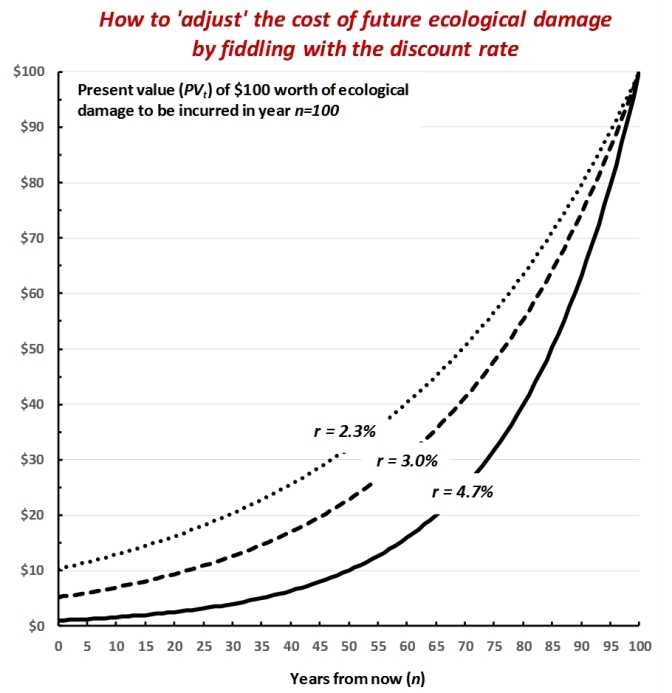
Fiddling with the discount rate 
To illustrate, consider the following example. Suppose Nordhaus wants to cut the estimated PVt of climate change costs incurred 100 years from now by 50% below the scientific consensus. One way of doing so is to convince his readers that, 100 years from now, Ct+n will be half as large as most scientists think. But that won’t be easy. After all, Nordhaus is no climate scientist, he is a mere economist, and it would be a tall order, even for a future Economics Nobel Laureate, to argue that the climatological consensus is 50% off the mark. 
But there is a much easier route, and that is to fiddle with the discount rate (r). The enclosed chart shows how the same $100 worth of climate damage incurred 100 years from now (rightmost point on the horizontal axis, where n=100) changes as we get closer to the present (leftmost point, where n=0). Each line shows the changing present value under a different discount rate, with lower/higher discount rates causing smaller/greater reductions in present value. 


Now, suppose the conventional discount rate is 2.3% (dotted series). With this discount rate, today’s present value (PV0) of $100 worth of climate cost incurred one hundred years from now (n=100) is approximately $10. But there is nothing to prevent Nordhaus from using a different rate. A slightly higher rate of 3% (dashed series), for example, will cause today’s present value to drop by one half, to a mere $5, give or take. And Nordhaus doesn’t have to stop there. He can go the Full Monty, push the discount rate up to 4.7% (solid series), and reduce the present value to a paltry $1. Blessed are the wonders of compound interest. 
The nice thing about these discount-rate ‘adjustments’ is that, unlike the commotion stirred by debates over the actual cost of climate change, here there are no messy quarrels with scientists, no raised eyebrows from journalists and no outcries from the cheated public. Only contented politicians and delighted capitalists. 
And that is exactly the route chosen by William D. Nordhaus. 
Leveraging the capitalization ritual 
In his 2007 ‘Review of the Stern Review on the Economics of Climate Change’, he mocked Lord Nicolas Stern’s assumption of a low discount rate of 1.4%, suggesting we should instead discount the future by his favourite rate of 6%. 
And that mockery succeeded wonderfully. By leveraging the capitalization ritual in the name of profit and glory, Nordhaus managed to not only help investors minimize the apparent cost of climate change, but also win the Economics Nobel Prize as the white knight of nothing less than . . . ‘sustainable global economic growth’! Who says you can’t eat your cake and have it too?


ExxonMobil CEO Depressed After Realizing Earth Could End Before They Finish Extracting All the Oil. The Onion. Oct. 10, 2018.


Time travel with Galileo. Leanne  Ogasawara. 3QD. Oct. 15, 2018
Who in the world wants to travel forward in time? Is there any evidence whatsoever that things are going to become more interesting in the future? 
I would argue that every indication suggests that not only is our world going to get hotter, more barbaric and unjust–but as if that isn’t bad enough, conversations and romance will continue to decline precipitously. Evidence is surely on my side, right? Clinking my glass with my fork to get their attention, I patiently tried explaining what the future has in store: 
“Temperatures will rise,” I said, as their eyes glazed over. “And as people begin to jostle for resources, the elite class (I looked at them accusingly) will begin hunkering down in comfortable enclaves, while the vast global majority suffers outside.” 
I then painted a picture of what I imagined to be a dark version of today’s gated communities. “These enclaves for the wealthy will be like medieval castles. But whereas medieval castles served as a defense against 16th century artillery, the cities of the future will be fortresses for better control of scarce resources.”

Tuesday, April 19, 2016

Feature Reference Articles #2

"If you do not change direction, you may end up where you are heading." 
Lao Tzu

Life is about to get much worse. David Zetland, Aguanomics. Mar 29, 2016.

These results are far more pessimistic than anything the IPCC has put out for three reasons. First, the IPCC operates by consensus, meaning that the most conservative estimates are used. Second, IPCC data and models are in "uncharted territory," so it is not easy to decide if natural systems are going to retard or reinforce man-made trends. Finally, the law of averages means that hundreds of co-authors will tend to agree on a business as usual, linear path of change, rather than the new normal, exponential path that Hansen et al. predict.

On a planet 4C hotter, all we can prepare for is extinction. Oliver Tickell, Guardian. August 11, 2008.
We need to get prepared for four degrees of global warming, Bob Watson told the Guardian last week. At first sight this looks like wise counsel from the climate science adviser to Defra. But the idea that we could adapt to a 4C rise is absurd and dangerous. Global warming on this scale would be a catastrophe that would mean, in the immortal words that Chief Seattle probably never spoke, "the end of living and the beginning of survival" for humankind. Or perhaps the beginning of our extinction.

The collapse of the polar ice caps would become inevitable, bringing long-term sea level rises of 70-80 metres. All the world's coastal plains would be lost, complete with ports, cities, transport and industrial infrastructure, and much of the world's most productive farmland. The world's geography would be transformed much as it was at the end of the last ice age, when sea levels rose by about 120 metres to create the Channel, the North Sea and Cardigan Bay out of dry land. Weather would become extreme and unpredictable, with more frequent and severe droughts, floods and hurricanes. The Earth's carrying capacity would be hugely reduced. Billions would undoubtedly die.

Watson's call was supported by the government's former chief scientific adviser, Sir David King, who warned that "if we get to a four-degree rise it is quite possible that we would begin to see a runaway increase". This is a remarkable understatement. The climate system is already experiencing significant feedbacks, notably the summer melting of the Arctic sea ice. The more the ice melts, the more sunshine is absorbed by the sea, and the more the Arctic warms. And as the Arctic warms, the release of billions of tonnes of methane – a greenhouse gas 70 times stronger than carbon dioxide over 20 years – captured under melting permafrost is already under way.

To see how far this process could go, look 55.5m years to the Palaeocene-Eocene Thermal Maximum, when a global temperature increase of 6C coincided with the release of about 5,000 gigatonnes of carbon into the atmosphere, both as CO2 and as methane from bogs and seabed sediments. Lush subtropical forests grew in polar regions, and sea levels rose to 100m higher than today. It appears that an initial warming pulse triggered other warming processes. Many scientists warn that this historical event may be analogous to the present: the warming caused by human emissions could propel us towards a similar hothouse Earth. ...

What we’re doing to the Earth has no parallel in 66 million years, scientists say. Chris Mooney, Washington Post. Mar 21, 2016.

“If anthropogenic emissions rates have no analogue in Earth’s recent history, then unforeseeable future responses of the climate system are possible,” the authors write.
... 
... not only have we only begun to see the changes that will result from current warming, but there may be other changes that lack any ancient parallel, because of the current rate of change. “Given that the current rate of carbon release is unprecedented throughout the Cenozoic, we have effectively entered an era of a no-analogue state, which represents a fundamental challenge to constraining future climate projections,” the study concludes.

Humans to Go Extinct in Three, Two—  Ian Welsh. Jun 23, 2015.

This is the point where a sane species would be in a controlled panic. 
Which brings us to Laudato Si. The obvious issue with Luadato Si is Pope Francis sticking to current church doctrine against birth control. It is incontrovertible that every person has a carrying load for the planet. 
But Francis makes a great number of good points, starting with the fact that we are vastly wasteful. It is not that we have necessarily surpassed the Earth’s carrying capacity in theory (only in fact). Half the food in America, for example, is wasted. Suburbs are vastly wasteful. Lawns are idiocy. Most of our buildings use far more energy than they need to. Improved agricultural methods can produce up to ten times as much produce on the same amount of land, for less water. Urban indoor agriculture using LEDs is showing great promise. Centralized manufacturing, which requires concentrated power which cannot yet be provided by renewables could be decentralized even with out current tech, and within fifteen years or so we could radically decentralize it. 
And so on.  There are more good ideas than one could possibly list. These ideas would allow us to support our current population on much less land and allow the environment to renew itself. We could massively reduce carbon output at the same time, stop overfishing the seas, and everyone would still be fed, have a place to live, and so on. Yes, most suburbs would be a thing of the past, but the question of “suburbs” vs. “human survival” shouldn’t be a hard one. 
All of this would probably not be enough. 
Yeah, sorry. 
We’ve left it too late. The issue is the carbon and other hothouse gases already in the environment. They are so high that we will see release of methane from the arctic, both land and sea. This has already begun. It will continue. Even entirely stopping carbon tomorrow (which is impossible) likely wouldn’t be enough. Cutting carbon by half would definitely not be enough. 
We needed to be acting back in the 1980s when climate change science first became overwhelmingly likely to be true. 
We didn’t. An alien species studying our extinction, should it come to that, will only be able to conclude we did it to ourselves. 
What I’m seeing is that we are on the wrong side of a self-reinforcing cycle. 
We’re going to need geo-engineering. It’s messy and we’ll probably screw it up, but we don’t have much choice left. 
Because there is a chance that even doing everything right, we’ll still go extinct...

It's not climate change -- it's everything change. Margaret Atwood, medium. Jul 27, 2015.

...top warning signs... the transformation of the oceans. Not only are these being harmed by the warming of their waters, in itself a huge affector of climate. There is also the increased acidification due to CO2 absorption, the ever-increasing amount of oil-based plastic trash and toxic pollutants that human beings are pouring into the seas, and the overfishing and destruction of marine ecosystems and spawning grounds by bottom-dragging trawlers. Most lethal to us — and affected by warming, acidification, toxins, and dying marine ecosystems — would be the destruction of the bluegreen marine algae that created our present oxygen-rich atmosphere 2.45 billion years ago, and that continue to make the majority of the oxygen we breathe. If the algae die, that would put an end to us, as we would gasp to death like fish out of water... 
desire to deny these things or sweep them under the carpet so business can go on as usual, leaving the young folks and future generations to deal with the mess and chaos that will result from a changed climate, and then pay the bill. Because there will be a bill: the cost will be high, not only in money but in human lives. The laws of chemistry and physics are unrelenting, and they don’t give second chances. In fact, that bill is already coming due... 
There are many other effects, from species extinction to the spread of diseases to a decline in overall food production, but the main point is that these effects are not happening in some dim, distant future. They are happening now....
Can we change our energy system? Can we change it fast enough to avoid being destroyed by it? Are we clever enough to come up with some viable plans? Do we have the political will to carry out such plans? Are we capable of thinking about longer-term issues, or, like the lobster in a pot full of water that’s being brought slowly to the boil, will we fail to realize the danger we’re in until it’s too late?

The False Promise of Climate Adaptation. Thomas Homer-Dixon, Globe and Mail. Dec 7, 2015.
As the world warms, adaptation becomes a fool’s paradise

Scientific evidence from around the world has been accumulating relentlessly, and this evidence points to a clear conclusion: climate change is real, humans are causing it, and it’s an enormous threat. In response, the skeptics have fallen back to another argument, which goes like this: Despite nearly 30 years of climate policies and gabfests, the world’s carbon emissions are still soaring. This trend won’t stop for decades, because global energy systems can’t be changed fast. If we do try to cut emissions sharply, they say, the result will be economic calamity. In any case, warming’s impacts won’t be nearly as serious as alarmists suggest. So the sensible plan is to adapt. 
This argument starts with a truth, adds a dose of fatalism and two falsehoods, and then mixes in wishful thinking to produce an utterly misguided and shortsighted conclusion. 
It’s true that efforts to cut carbon emissions have failed dismally. There’s now virtually no chance that warming will be capped at two degrees Celsius, which is the aspirational target of climate negotiators. We’re currently heading for three degrees of warming and quite possibly four or more.

Paris plan is impressive – but why peddle fantasies with unreachable targets? Thomas Homer-Dixon, The Globe and Mail. Dec 14, 2015.

Indeed, in coming centuries the Paris Agreement on climate change will likely be seen as one of the most significant international documents in history, up there with the Peace of Westphalia, the Bretton Woods agreements and the Universal Declaration of Human Rights. 
At long last, almost all the world’s countries have explicitly acknowledged that global warming is a staggering threat to our well-being and have laid out a plan – albeit, at best, a partial one – to respond to this threat. But the hard work is only beginning. 
Just how hard isn’t widely grasped. The magnitude of the challenge has been hidden partly by the Paris Agreement’s sunny aspirations and partly by technicalities known only to specialists.

Paris COP21: the worst deal in the history of global climate negotiations. C.J. Polychroniou,  OpenDemocracy. Dec. 16, 2015.

... What did world leaders do instead at the Paris climate change conference which was held from 30 November to 12 December 2015? They came up with an agreement which easily qualifies as the worst deal in the history of global climate negotiations. They drafted a pact which relies purely on voluntary action, thus representing a major step backwards from the Kyoto Protocol which imposes carbon emission limits on the parties that adopted and ratified the treaty. They produced a plan to keep rising temperatures at bay -- at a maximum of 1.5 celsius -- without providing financial assistance to poor nations so they can develop clean energy systems. Worse, they kicked the can down the road by not demanding any action until 2020.

However, accustomed to manipulating public opinion, world leaders sought to create a state of euphoria about the outcome of the Paris climate talks by using not merely hyperbolic language but even outright lies. President Obama hailed the pact as a development signifying “a turning point for the world,” while French Foreign Minister Laurent Fabius described it as "legally binding." It is up to each one of us individually to decide which of the two leaders committed a greater insult to human intelligence.

As expected, the initial reaction on the part of the mainstream news industry was in strict adherence to the spirit of the statements made by leaders like Obama and others, describing the agreement as a deal representing, “the best chance to save the planet." 
The Paris COP21 climate agreement is simply hot air. We are no closer to averting a catastrophic climate change scenario than we were before the start of the Paris talks. In fact, the Paris agreement ensures that the problem of climate change remains unchecked. For it is the height of political hypocrisy to believe that the planet can be saved through a voluntary agreement among nations to reduce emissions and keep global warming at bay.  
A voluntary agreement has no teeth by default. Moreover, it is certain that nations like India, concerned as they are about poverty and development, are not going to accept any climate change deal without some type of financial compensation. This was surely the connotation behind the use of the term "climate justice" used by India's Prime Minister Modi. And, sure enough, there is nothing in the Paris treaty about mandatory payments to poor nations so they can help reduce emissions by adopting clean energy technologies themselves. 
The fact of the matter is that as long as poverty and unemployment remain severe problems for many countries around the world, let alone the existence of powerful interests represented by a fossil fuel-driven global economy, the struggle against climate change will naturally take a back seat. This is simply a fact, which some members and organizations of the environmental community refuse to acknowledge or accept.

The dynamics of national political culture also play a key role in our ability to avert or not a catastrophic climate change scenario. Indeed, a key reason as to why the Paris climate change negotiations shifted away from mandatory, top-down targets on carbon emissions output and adopted instead a voluntary approach to the climate change challenge is because a legally binding treaty that needed ratification by governments back home would have reduced substantially the chances of reaching any kind of an agreement. This is certainly the case for one of the world's biggest polluters, i.e., the United States. Any treaty on climate change that made its way to Capitol Hill would have been shredded into pieces by the Republican-controlled Congress. This is why Obama can claim the Paris COP21 agreement as a "turning point for the world" -- that is, because the deal does not have to go to the US Congress. 
As time goes by and the euphoria about the Paris agreement evaporates, it is certain that more and more people will realize that the political compromise made in Paris over mandatory emissions comes at a great cost. Our ability to control rising temperatures caused by carbon dioxide accumulated in the air has been greatly hindered. 
But there is more. As the latest Intergovernmental Panel on Climate Change report points out, carbon emission cuts are not enough any more to slow down global warming. According to IPCC, we are headed with certainty towards an increase in temperatures by three degrees Celsius by 2100. Using complex mathematical models of the world's climate system tested against past climate data, scientists have concluded that three degrees of warming would spell an "environmental catastrophe" of uncontrolled consequences.


Climate: 7 questions on 2 degrees. John D. Sutter, CNN. Apr 24, 2015.

Humans never have lived on a planet that's 2 degrees Celsius (3.6 Fahrenheit) warmer than it was before we started burning fossil fuels, in the late 1800s, and climate experts say we risk fundamentally changing life on this planet if we do cross that 2-degree mark. 
"This is gambling with the planet," said Gernot Wagner, the lead senior economist at the Environmental Defense Fund and co-author of the book "Climate Shock." 
1. Where did the idea for 2 degrees come from?
One guy, it turns out. William Nordhaus, an economist at Yale.
Nordhaus, 73, proposed the 2-degree threshold in a 1977 (1977!) paper titled "Economic Growth and Climate: The Carbon Dioxide Problem." 
... 
2. How did 2 degrees become the international standard?
Science has continued to raise red flags about 2 degrees of warming. And that work has led policy experts to conclude that a 2-degree world is something none of us should want. 
"You need a judgment call for these things," said Carlo Jaeger, chair of the Global Climate Forum, who has written on the history of 2 degrees Celsius. "And this 2-degree thing was a judgment call that happened at the interface of science and policy."

James Lovelock: 'enjoy life while you can: in 20 years global warming will hit the fan'. James Lovelock. Guardian. Mar 1, 2008.

More alarming even than his apocalyptic climate predictions is his utter certainty that almost everything we're trying to do about it is wrong. On the day we meet, the Daily Mail has launched a campaign to rid Britain of plastic shopping bags. The initiative sits comfortably within the current canon of eco ideas, next to ethical consumption, carbon offsetting, recycling and so on - all of which are premised on the calculation that individual lifestyle adjustments can still save the planet. This is, Lovelock says, a deluded fantasy. Most of the things we have been told to do might make us feel better, but they won't make any difference. Global warming has passed the tipping point, and catastrophe is unstoppable.
...
This is all delivered with an air of benign wonder at the intractable stupidity of people. "I see it with everybody. People just want to go on doing what they're doing. They want business as usual. They say, 'Oh yes, there's going to be a problem up ahead,' but they don't want to change anything." 
Lovelock believes global warming is now irreversible, and that nothing can prevent large parts of the planet becoming too hot to inhabit, or sinking underwater, resulting in mass migration, famine and epidemics. Britain is going to become a lifeboat for refugees from mainland Europe, so instead of wasting our time on wind turbines we need to start planning how to survive. To Lovelock, the logic is clear. The sustainability brigade are insane to think we can save ourselves by going back to nature; our only chance of survival will come not from less technology, but more.

A geophysiologist's thoughts on geoengineering. James Lovelock, Philosophical Transactions of the Royal Society. Nov. 13, 2008.

Abstract

The Earth is now recognized as a self-regulating system that includes a reactive biosphere; the system maintains a long-term steady-state climate and surface chemical composition favourable for life. We are perturbing the steady state by changing the land surface from mainly forests to farm land and by adding greenhouse gases and aerosol pollutants to the air. We appear to have exceeded the natural capacity to counter our perturbation and consequently the system is changing to a new and as yet unknown but probably adverse state. I suggest here that we regard the Earth as a physiological system and consider amelioration techniques, geoengineering, as comparable to nineteenth century medicine.
... 
Whatever we do is likely to lead to death on a scale that makes all previous wars, famines and disasters small. To continue business as usual will probably kill most of us during the century. Is there any reason to believe that fully implementing Bali, with sustainable development and the full use of renewable energy, would kill less? We have to consider seriously that, as with nineteenth century medicine, the best option is often kind words and pain killers but otherwise do nothing and let Nature take its course. 
... 
Had we heeded Malthus’s warning and kept the human population to less than one billion, we would not now be facing a torrid future. Whether or not we go for Bali or use geoengineering, the planet is likely, massively and cruelly, to cull us, in the same merciless way that we have eliminated so many species by changing their environment into one where survival is difficult.


New finding shows climate change can happen in a geological instant. Phys.org. Oct 7, 2013.

In a new paper in the Proceedings of the National Academy of Sciences, Morgan Schaller and James Wright contend that following a doubling in carbon dioxide levels, the surface of the ocean turned acidic over a period of weeks or months and global temperatures rose by 5 degrees centigrade – all in the space of about 13 years. Scientists previously thought this process happened over 10,000 years.

Encyclical Letter: Laudato Si’. On Care for Our Common Home. Pope Francis. May 24, 2015.

Science and Politics Clash as Humanity Nears Climate Change Tipping Point. Greg M. Schwartz, EcoWatch. Mar 13, 2016.

Beyond 450: Why the IEA’s “Climate Scenario” Falls Short. Greg Muttitt. Oil Change International. Apr 6, 2016.

Breaking the tragedy of the horizon - climate change and financial stability. Speech by Mark Carney. Sep 29, 2015.


The Real Climate Censorship. George Monbiot. Apr. 10, 2007.

The drafting of reports by the world’s pre-eminent group of climate scientists is an odd process. For many months scientists contributing to the Intergovernmental Panel on Climate Change tussle over the evidence. Nothing gets published unless it achieves consensus. This means that the panel’s reports are extremely conservative – even timid. It also means that they are as trustworthy as a scientific document can be. 
Then, when all is settled among the scientists, the politicians sweep in and seek to excise from the summaries anything which threatens their interests. While the US government has traditionally been the scientists’ chief opponent, this time the assault was led by Saudi Arabia, supported by China and Russia. 
The scientists fight back, but they always have to make some concessions. The report released on Friday, for example, was shorn of the warning that “North America is expected to experience locally severe economic damage, plus substantial ecosystem, social and cultural disruption from climate change related events”. David Wasdell, an accredited reviewer for the panel, claims that the summary of the science the IPCC published in February was purged of most of its references to “positive feedbacks”: climate change accelerating itself

This Changes Nothing: The Paris Agreement to Ignore Reality. Clive Splash. Apr. 11, 2016.

Abstract 
At the 21st session of the Conference of the Parties to the United Nations Framework Convention on Climate Change held in Paris, France, 30 November to 11 December 2015, an Agreement was reached by the international community including 195 countries. The Agreement has been hailed, by participants and the media, as a major turning point for policy in the struggle to address human-induced climate change. The following is a short critical commentary in which I briefly explain why the Paris Agreement changes nothing. I highlight how the Agreement has been reached by removing almost all substantive issues concerning the causes of human-induced climate change and offers no firm plans of action. Instead of substantive cuts in greenhouse gas (GHG) emissions, as soon as possible, the intentions of the parties promise escalation of damages and treat worst-case scenarios as an acceptable 50:50 chance. The Paris Agreement signifies commitment to sustained industrial growth, risk management over disaster prevention, and future inventions and technology as saviour. The primary commitment of the international community is to maintain the current social and economic system. The result is denial that tackling GHG emissions is incompatible with sustained economic growth. The reality is that Nation States and international corporations are engaged in an unremitting and ongoing expansion of fossil fuel energy exploration, extraction and combustion, and the construction of related infrastructure for production and consumption. The targets and promises of the Paris Agreement bear no relationship to biophysical or social and economic reality.

Exposé | The 2º Death Dance – The 1º Cover-up. Cory Morningstar. Dec 10, 2010.

The Origins of 2ºC – Neoclassical Economist Bill Nordhaus 
The 2ºC temperature rise “target,” which is the only limit in the text of the ‘noted’ Copenhagen Accord, may well be one of the least understood cover-ups in history. The first suggestion to use 2° Celsius as a critical temperature limit for climate policy was not made by an esteemed climate scientist. Rather it was made by well-known neoclassical economist, W.D. Nordhaus, in a discussion paper of the prestigious Cowles Foundation. 
In 1977 Nordhaus stated: “If there were global temperatures more than 2 or 3° above the current average temperature, this would take the climate outside of the range of observations which have been made over the last several hundred thousand years.”
This temperature increase is in fact well outside of the natural limits of the past 10,000 years during which agriculture and civilization developed. It is also higher than has existed over the past couple of million years.

“A rich man’s cat may drink the milk that a poor boy needs to remain healthy. Does this happen because the market is failing? Not at all, for the market mechanism is doing its job – putting goods in the hands of those that have the dollar votes.” 
The author of the ice cold quote above is none other than our neoclassical economist and Yale University Professor Bill Nordhaus (Nordhaus and Samuelson, 2005), originator of the now infamous 2ºC threshold target that has come to dominate climate discussions and to dismiss all sensibilities as our Earth spins toward a terrifying, irreversible apocalypse. 
Today, this 2ºC target, largely defined as the maximum allowable warming to avoid dangerous anthropogenic interference in the climate has replaced an almost unknown 1ºC target highlighted in the 1990 UN AGGG (United Nations Advisory Group on Greenhouse Gases) report when climate change as a global issue was widely unknown. 
Nordhaus has been one of the most influential economists involved in climate change models and construction of emissions scenarios for well over 30 years, having developed one of the earliest economic models to evaluate climate change policy. He has steadfastly opposed the drastic reductions in greenhouse gases emissions necessary for averting global catastrophe, “arguing instead for a slow process of emissions reduction, on the grounds that it would be more economically justifiable.”

The Origins of 1ºC – United Nations 1990

In 1986, three international bodies, the World Meteorological Organisation (WMO), the United Nations Environment Programme (UNEP) and the International Council of Scientific Unions (ICSU), who had co-sponsored the Villach Conference in 1985, formed the Advisory Group on Greenhouse Gases (AGGG), a small international committee with responsibility for assessing the available scientific information about the increase of greenhouse gases in the atmosphere and the likely impact. 
In 1990 the AGGG calculated what level of climate change our planet could tolerate, also referred to as “environmental limits.” These levels and limits were summarized in the document, “Responding to Climate Change: Tools For Policy Development,” published by the Stockholm Environment Institute. 
The targets and indicators set limits to rates and total amounts of temperature rise and sea level rise, on the basis of known behaviour of ecosystems. The AGGG report identified these limits in order to “protect both ecosystems as well as human systems.” The report states that the objective is: “stabilization of greenhouse gas concentrations in the atmosphere at a level that would prevent dangerous anthropogenic [human made] interference with the climate system.” 
It adds: “Such a level should be achieved within a timeframe sufficient to allow ecosystems to adapt naturally to climate change, to ensure that food production is not threatened and to enable economic development to proceed in a sustainable manner.” 
Thus the report requires limits to both the total amount of change and the rate of change.
Further, they warned that a global temperature increase “beyond 1 degree C may elicit rapid, unpredictable and non-linear responses that could lead to extensive ecosystem damage.” A temperature increase of 2ºC was viewed as “an upper limit beyond which the risks of grave damage to ecosystems, and of non-linear responses, are expected to increase rapidly.” [For “non-linear,” read “runaway global climate change.”]
... 
Psychotic Delusion
In an address titled “Economic Issues in Designing a Global Agreement on Global Warming” presented by Nordhaus to the Copenhagen Conference on Climate Science (10-12 March 2009), Nordhaus argues that it is not legitimate to try to second guess the market, going so far as to propose that people may “come to love the altered landscape of the warmer world.” It is most revealing that the world’s foremost scientists on climate change who understand the terrifying risks we now face due to lack of action invited one the most influential voices calling for caution and moderation to give a keynote address. 
Nordhaus uses his own magical economical model to spit out the very best apocalyptic scenario he would like our governments to adopt – one, in Nordhaus’s skewed view, that strengthens the economy. If the world does nothing, Nordhaus believes, we will reach a temperature increase of 3.1ºC by 2100 (a gross underestimate by most standards) and 5.3ºC by 2200. Instead, he suggests, the world should choose to spend what allows the temperature to rise by 2.6ºC by 2100, increasing to 3.5ºC by 2200 (keep in mind that any temperature increase will eventually double for future generations due to the inertia of the climate system). He presents this scenario delusion, which supports atmospheric concentrations rising to approximately 700 ppm, despite the fact that scientists claim such temperature increases will be catastrophic beyond measure. Hans Joachim Schellnhuber, director of the Potsdam Institute for Climate Impact Research states “Our survival would very much depend on how well we were able to draw down carbon dioxide to 280 ppm”.

Capitalism in Wonderland. Brett Clark, John Bellamy Foster and Richard York, Monthly Review.

In a recent essay, “Economics Needs a Scientific Revolution,” in one of the leading scientific journals, Nature, physicist Jean-Philippe Bouchaud, a researcher for an investment management company, asked rhetorically, “What is the flagship achievement of economics?” Bouchaud’s answer: “Only its recurrent inability to predict and avert crises.” Although his discussion is focused on the current worldwide financial crisis, his comment applies equally well to mainstream economic approaches to the environment—where, for example, ancient forests are seen as non-performing assets to be liquidated, and clean air and water are luxury goods for the affluent to purchase at their discretion. The field of economics in the United States has long been dominated by thinkers who unquestioningly accept the capitalist status quo and, accordingly, value the natural world only in terms of how much short-term profit can be generated by its exploitation. As a result, the inability of received economics to cope with or even perceive the global ecological crisis is alarming in its scope and implications. 
Bouchaud penetratingly observes, “The supposed omniscience and perfect efficacy of a free market stems from economic work done in the 1950s and 1960s, which with hindsight looks more like propaganda against communism than plausible science.” The capitalist ideology that undergirds economics in the United States has led the profession to be detached from reality, rendering it incapable of understanding many of the crises the world faces.

350 is the wrong target: put the science first. David Spratt, Climate Code Red. Jan 22, 2009.

Hans Joachim Schellnhuber, head of the Potsdam Institute and climate adviser to German Chancellor and the EU, who likewise is one of Europe’s leading climate scientists. On 15 September 2008, David Adam reported:

Professor John Schellnhuber, director of the Potsdam Institute for Climate Impact Research in Germany, told the Guardian that only a return to pre-industrial levels of CO2 would be enough to guarantee a safe future for the planet... He said even a small increase in temperature could trigger one of several climatic tipping points, such as methane released from melting permafrost, and bring much more severe global warming. ‘It is a very sweeping argument, but nobody can say for sure that 330ppm is safe,’ he said. ‘Perhaps it will not matter whether we have 270ppm or 320ppm, but operating well outside the [historic] realm of carbon dioxide concentrations is risky as long as we have not fully understood the relevant feedback mechanisms. 
So 350 ppm is the wrong target because 350 ppm CO2 cannot restore the Arctic ice to its full extent. The people who run 350.org probably now recognise that, because their language is changing. One of their slides used to say: “We need to be here: 350”, it now says “we need to be lower than: 350ppm”. McKibben now talks about 350 ppm as being “the upper limit”, and in a recent radio interview said pre-industrial levels might be the only safe zone. But it’s too late to advocate targets that are only a signpost towards the target we really need to get to. 
Sorry, Bill and the crew at 350.org, you’re wrong about 350 being our campaign target for 2009 and the lead-up to Copenhagen. The most important number of earth is 300. That’s what Hansen is saying, that’s what Schellnhuber is saying. There’s no point campaigning on an inadequate target. We only get one chance at this, and advocating targets that will still fail to fully solve the problem is the most de-mobilising action we can take. 
Target 300 puts the science first.

Arctic Sea Ice - Methane Release - Planetary Emergency. Arctic Methane Emergency Group. Dec 4, 2014.

AMEG’s Declaration

Governments must get a grip on a situation which IPCC, the Intergovernmental Panel on Climate Change, has ignored. A strategy of mitigation and adaptation is doomed to fail. It will be impossible to adapt to the worst consequences of global warming, as IPCC suggests.

The Arctic must be cooled, ASAP, to prevent the sea ice disappearing with disastrous global consequences 
...
Current situation and gross omissions from IPCC 
The IPCC WG1, WG2 and WG3 assessment reports (AR5) make no mention of the downward trend in sea ice volume, and rely on models which fail to properly capture the processes of warming and melting. Furthermore they fail to mention the strong evidence that Arctic warming is already a driver of climate change in the Northern Hemisphere, compounding the effects of global warming.

Arctic warming and sea ice retreat is already having a serious impact on climate change across the Northern Hemisphere, which is affecting food production, food prices and food security. The latest WG2 report claims that the Arctic sea ice will be subject to ‘very high risks with an additional warming of 2 degrees C’. In fact, the September sea ice volume is already down 75% with a trend to zero by September 2016, suggests that the Arctic is heading for complete meltdown, which would be a planetary catastrophe. The loss of Arctic ecosystems and the climate implications of ice disappearance are in fact acute risks NOW as both ice and ice-dependent species are set to disappear within a matter of years.

These are catastrophic omissions. AR5 is supposed to provide the best analysis of the state of the planet and its future climate, on which governments can base policy for protection of citizens. These omissions are leading governments into a false sense of security about the future of our planet.

The only clear policy deduction from AR5 concerns the reduction of CO2 emissions by keeping within a carbon budget. Reductions alone have no chance of preventing catastrophes arising from Arctic meltdown. Intervention to cool the Arctic is an absolute requirement to prevent such catastrophes. There is no realistic alternative.

The concept of a carbon budget, espoused in AR5, hides the short-term consequences of various powerful feedback processes which get zero or scant attention in AR5. In particular, snow and sea ice albedo feedback seems to be totally ignored in the budget. And the mounting concentration of methane in the atmosphere is ignored. The real truth is that the carbon budget has already been spent. WG3’s limit of 450 ppm for CO2 equivalent has already been passed, even without taking into account albedo loss.

Governments must also address ocean acidification, whose threat has also been ignored in AR5. There is no alternative but to start a major campaign for CO2 removal (CDR). The latest WG3 assessment report suggests CDR as a possibility for offsetting emissions, but only in so far as for keeping within their carbon budgets of 450ppm CO2e and above, which would have catastrophic consequences for humanity, even without all the other overlooked positive feedbacks described above. CDR must be adopted, being the only possibility in order to stop the existing contribution to global warming of CO2 and ocean acidification.

Meanwhile there is the threat of Arctic methane emissions to burst above the gigaton level, totally ignored in AR5. And the AR5 projections of sea level rise are hopelessly optimistic if the sea ice disappears as rapidly as the trend indicates.