Showing posts with label climate change economics. Show all posts

Wednesday, September 9, 2020

Keen re Nobel-winning economic garbage

Nobel prize-winning economics of climate change is misleading and dangerous – here’s why. Steve Keen, The Conversation. Sept. 9, 2020.

While climate scientists warn that climate change could be catastrophic, economists such as 2018 Nobel prize winner William Nordhaus assert that it will be nowhere near as damaging. In a 2018 paper published after he was awarded the prize, Nordhaus claimed that 3°C of warming would reduce global GDP by just 2.1%, compared to what it would be in the total absence of climate change. Even a 6°C increase in global temperature, he claimed, would reduce GDP by just 8.5%.

If you find reassurance in those mild estimates of damage, be warned. In a newly published paper, I have demonstrated that the data on which these estimates are based relies upon seriously flawed assumptions.

Nordhaus’s celebrated work, which, according to the Nobel committee, has “brought us considerably closer to answering the question of how we can achieve sustained and sustainable global economic growth”, gives governments a reason to give climate change a low priority.

His estimates imply that the costs of addressing climate change exceed the benefits until global warming reaches 4°C, and that a mild carbon tax will be sufficient to stabilise temperatures at this level at an overall cost of less than 4% of GDP in 120 year’s time. Unfortunately, these numbers are based on empirical estimates that are not merely wrong, but irrelevant.

Nordhaus (and about 20 like-minded economists) used two main methods to derive sanguine estimates of the economic consequences of climate change: the “enumerative method” and the “statistical method”. But my research shows neither stand up to scrutiny.

The ‘enumerative method’

In the enumerative method, to quote neoclassical climate change economist Richard Tol, “estimates of the ‘physical effects’ of climate change are obtained one by one from natural science papers … and added up”.

This sounds reasonable, until you realise that the way this method has been deployed ignores industries that account for 87% of GDP, on the assumption that they “are undertaken in carefully controlled environments that will not be directly affected by climate change”.

Nordhaus’s list of industries that he assumed would be unaffected includes all manufacturing, underground mining, transportation, communication, finance, insurance and non-coastal real estate, retail and wholesale trade, and government services. It is everything that is not directly exposed to the elements: effectively, everything that happens indoors or underground. Two decades after Nordhaus first made this assumption in 1991, the economics section of the IPCC Report repeated it:
Economic activities such as agriculture, forestry, fisheries, and mining are exposed to the weather and thus vulnerable to climate change. Other economic activities, such as manufacturing and services, largely take place in controlled environments and are not really exposed to climate change.
This is mistaking the weather for the climate. Climate change will affect all industries. It could turn fertile regions into deserts, force farms – and the cities they support – to move faster than topsoil can develop, create storms that can blow down those “carefully controlled environments”, and firestorms that burn them to the ground.

It could force us to eliminate the use of fossil fuels before we have sufficient renewable energy in place. The output of those “carefully controlled environments” will fall in concert with the decline in available energy. The assumption that anything done indoors will be unaffected by climate change is absurd. And if this is wrong, then so are the conclusions based upon it.

The same applies to the “statistical method”. As I explained in a previous article, this method assumes that the relationship between temperature and GDP today could be used to predict what will happen as the whole planet’s climate changes. But while temperature isn’t a particularly important factor in economic output today, climate change will do much more than simply raise individual countries’ temperature by a few degrees – the disruption it will cause is enormous.

The damage function

Nonetheless, these optimistic estimates were used to calibrate Nordhaus’s so-called “damage function”, a simple equation that predicts a small and smooth fall in GDP from a given rise in temperature. But climate change will not be a smooth process: there will be tipping points.

Nordhaus justified using a smooth equation by incorrectly claiming that climate scientists, including Tim Lenton from the University of Exeter, had concluded that there were “no critical tipping elements with a time horizon less than 300 years until global temperatures have increased by at least 3°C”. In fact, Lenton and his colleagues identified Arctic summer sea ice as a critical tipping point that was likely to be triggered in the next decade or two by changes of between 0.5°C and 2°C:
We conclude that the greatest (and clearest) threat is to the Arctic with summer sea-ice loss likely to occur long before (and potentially contribute to) GIS [Greenland ice sheet] melt.
The reason these mistakes are so significant is that, despite the flawed assumptions on which it is based, this work has been taken seriously by politicians, as Nordhaus’s Nobel prize recognises. To these policymakers, a prediction of future levels of GDP is far easier to understand than unfamiliar concepts like the viability of the ecosystem. They have been misled by comforting numbers that bear no relation to what climate change will, in fact, do to our economies.


The appallingly bad neoclassical economics of climate change. Steve Keen. Sept. 1, 2020. TandFOnline. PDF available

Abstract
Forecasts by economists of the economic damage from climate change have been notably sanguine, compared to warnings by scientists about damage to the biosphere. This is because economists made their own predictions of damages, using three spurious methods: assuming that about 90% of GDP will be unaffected by climate change, because it happens indoors; using the relationship between temperature and GDP today as a proxy for the impact of global warming over time; and using surveys that diluted extreme warnings from scientists with optimistic expectations from economists. Nordhaus has misrepresented the scientific literature to justify the using a smooth function to describe the damage to GDP from climate change. Correcting for these errors makes it feasible that the economic damages from climate change are at least an order of magnitude worse than forecast by economists, and may be so great as to threaten the survival of human civilization.

Tuesday, November 12, 2019

Economics, like science, will progress theoretically and methodologically, or else disappear with humans themselves, “one funeral at a time”

from Ikonoklast, in comments re
Economists like Krugman, Wren-Lewis or Stiglitz are nothing but die-hard defenders of mainstream economics. Lars Syll, Real World Economics Review Blog. July 22, 2019.

Ikonoklast:

The new minds of young people will be open to the new empirical evidence.

The methodological ideology of conventional economics will be destroyed by its failure in the current and ongoing collisions of its recommendations and applications with real systems. This is already happening as Herman Daly illustrates in his paper “Growthism: Its Ecological, Economic and Ethical Limits.”

In turn economics, like science, will progress theoretically and methodologically, or else disappear with humans themselves, “one funeral at a time” as not only current conventional economists die but as millions to hundreds of millions or even billions of other humans die due to ecological and civilizational collapse. The latter catastrophic possibility is what people seldom want to think about. Certainly, we should strive to avoid that outcome if we can. The genuine and imminent fear of ruin and death will certainly motivate people in a new way. Old theories about endless growth economics free from natural limits will be scorned. Those who persist with promulgating such theories will find a metaphorical academic or political “tarring and feathering” could be the mildest of the things that could happen to them.

The current generation of conventional economists will all have to go, by natural senescence and death, into dissolution and their ideas must and will go with them. Currently, science and logic cannot quite yet win the ideological and power war of political economy, at least not against mature devotees of that ideology. These devotees, who are so heavily intellectually and financially invested that they cannot change their minds, will simply have to pass away. Natural processes will achieve that.

However, science and logic do matter for the new minds of young people who are coming up and can be educated in new thinking. With no inherent intellectual investment nor motivated thinking in favor of the current physically and logically refuted ideology ad political economy, they will be open to the new empirical evidence which is constantly arriving even now. Then real change will become possible. People like Lars Syll are torch-bearers of new truths and will be fully vindicated in the long term.

Saturday, November 2, 2019

Global Warming, Market Opportunity

Global Warming, Market Opportunity. Troy Vettese, Boston Review. Oct. 8, 2019.

On the lure of climate entrepreneurism


In 2001 the economist George Reisman gave the annual Ludwig von Mises Memorial Lecture entitled “Environmentalism in the Light of Mises and Menger” at Auburn University in Alabama. A protégé of Mises—a leading Austrian School economist—he provided a telling early indication of how neoliberals understood atmospheric politics.

Speaking with a forked tongue, Reisman discussed hypothetical responses to climate change in the same breath that he denied that there was proof for ozone depletion and global warming. He began with the proposition that both were best seen as “equivalent” to “acts of nature” because they were “not being caused by the actions of individual human beings,” but rather by “the combined effect of the actions of several billion people”—in other words, by industrial capitalism. In this formulation he crystallizes a central feature of the neoliberal imagination, the conceit that the market is less a social institution than a force of nature.

Reisman then rules out a state response to the crisis, appealing to Mises’s “enormous spirit of individualism,” according to which “only individuals think and only individuals act.” Since no one individual or firm is solely responsible for degrading the environment, he reasons, no individual should be “punished” by “government controls.” The “appropriate response,” instead, is for individuals to “deal with nature to their own maximum individual advantage”—while respecting private property, of course—even though vast swathes of the Earth might become “uninhabitable.” Catastrophe on such a scale would be “too great a problem for government bureaucrats to handle. . . . But it would certainly not be too great a problem for tens and hundreds of millions of free, thinking individuals living under capitalism to solve.”

Over the last two decades the neoliberal framework has evolved far beyond this sketch. As the heterodox economist Philip Mirowski explains in Never Let a Serious Crisis Go to Waste (2013), neoliberal efforts to defeat the movement to confront climate change now form a robust set of interlocking policies. The first line of defense is denial, and a great deal of money has been spent on that front. The total sums are difficult to calculate given how the operation is shrouded in secrecy, but between 2003 and 2010 conservative foundations certainly directed more than half a billion dollars to organizations dedicated to climate denial. Since the Paris agreement of 2015, Big Oil alone has spent a billion dollars fighting climate change legislation.

Then there are the flawed cap-and-trade programs that have done very little to restrict emissions (consider the EU’s feckless Emissions Trading System). And in the end, all these policies appear to be no more than stopgaps meant to buy time until the permanent solution, geoengineering. In Mirowski’s estimation, this set of technologies, especially solar radiation management, is “the final neoliberal fallback” because it “derives from the core neoliberal doctrine that entrepreneurs, unleashed to exploit acts of creative destruction, will eventually innovate market solutions to address dire economic problems.” In the face of this concerted neoliberal strategy of delay and deflection, the environmental movement has thus far failed to implement a cohesive framework for action, offering instead only a patchwork of reactive, piecemeal policies, such as blocking certain fossil fuel infrastructure or championing cap-and-trade (as in the unsuccessful 2009 Waxman-Markey bill).

It is not as if there has been a drought of environmentally minded scholarship. Indeed, the last decade has seen a deluge of new works in this genre. Timothy Mitchell’s Carbon Democracy (2011) makes a creative and influential argument that links labor history to different energy regimes. In a more Marxist and historical vein, Andreas Malm examines the first energy transition from water-power to coal during the 1830s in Fossil Capital (2016) to argue that capitalists have long used fossil fuels as weapons in the history of class struggle. While renewable energy sources restrict production temporally and geographically, fossil fuels offer no such constraint leaving capital free to pack up and leave should workers grow unruly. To see the nefarious origins and contemporary implications of geoengineering, one can turn to Clive Hamilton’s Earthmasters (2013) or the report by the Heinrich Böll Foundation (a close affiliate of the German Green Party), The Big Bad Fix: The Case Against Geoengineering (2017).

This scholarship has achieved real results, enriching our understanding of the way previous energy transitions were predicated on the dynamics of class struggle and the materiality of the energy systems themselves. We now have a better idea of the history of geoengineering and what it will likely mean for the future. Yet these works represent only the start of intellectual work in these areas. Environmental history lacks an overarching, consensus narrative for the last two centuries, and the environmental movement still does not have a plan for what to do when things get rough. 

Two recent books—Simon Pirani’s Burning Up and Holly Jean Buck’s After Geoengineering—hint, though, that the movement is at last starting to offer strategic thinking commensurate with the crisis at hand. They reveal how the environmental movement must thoroughly understand neoliberalism to avoid underestimating it as an adversary—or, worse, falling for its charms.


As a researcher at the Oxford Institute for Energy Studies, Pirani might sound like yet another energy analyst, but what sets him apart is his approach, for there aren’t many dyed-in-the-wool Marxists in this line of work. A former member of the Trotskyist Workers Revolutionary Party, Pirani has traded on his close acquaintance with Russia to have a second career studying its methane industry. He has also worked as a journalist and penned books on the Russian revolution and contemporary politics during the Putin era. Burning Up represents the convergence of his parallel professions: it is a history of fossil fuels couched in a Marxist armature. To explain his aim for the book, he quotes the economic historian Adam Tooze, who in 2016 called for “a history that shows how consumption and production became tied together in an expanding feedback loop of ever greater economic and material scope.” Pirani hopes “this book is a step on that path,” but he is too modest. He has written an ambitious history of fossil fuels.

Burning Up is a dense technical treatise of a sprawling subject, but one can tease out a few overarching themes. Most prominent is the contrast between planned and market-based energy systems. Planning offers certain efficiencies, and nowhere is this clearer than cogeneration, which Pirani analyzes in great detail. Rather than letting “waste” heat from industrial production simply dissipate, for example, cogeneration systems pipe it to neighboring buildings.

This technique increases energy efficiency dramatically to 58 percent, compared to the 37 percent achieved by conventional electrical production. In some cases cogenerations systems can even reach 80 percent efficiency. In 1975 cogeneration accounted for 42 percent of urban heating in the Soviet Union and slightly less in Scandinavia, but only 4 percent in the United States. U.S. electricity firms saw cogeneration as a threat to their bottom line, so they refused to give factories access to the grid. After the collapse of communism in Eastern Europe, cogeneration networks were left to rot as privatization separated electrical and heating markets.

The efficiency of cogeneration is so impressive that one can find praise for it even in the pages of the neoliberal periodical, the Journal of Political Economy. In Marshall Goldman's essay “Externalities and the Race for Economic Growth in the USSR” (1972), which otherwise excoriated the Soviets for their environmental record, he acknowledged that cogeneration infrastructure was an exceptional success of “planned policy for conservation” that had no counterpart in the United States.

In a similar ode to the virtues of planning, Pirani demonstrates that only the state has proven able to achieve electrification in the countryside. The Soviet Union and especially China have exemplary records in this regard and quickly achieved high rates of penetration despite the countries’ low per capita wealth. The unique success of the Chinese state is apparent in comparison to India, as the two started out with electrical industries of similar scope when they achieved independence in the late 1940s. Now, however, only one million Chinese citizens are without power, compared to 237 million Indians (and that number is likely an underestimate), after the privatization schemes of the 1990s did little to help the poor.

In both rich and poor countries, the private sector has had a poor record in rural electrification because most households are simply too poor and dispersed to be worth any firm’s bother. Entrepreneurs such as Samuel Insull of Chicago, the public utilities magnate, preferred urban clients as the foundation of their private electrical empires. Despite the great wealth of the United States, only 10 percent of rural households were hooked up to the grid during the 1920s. It was only when Insull’s tangle of holding companies collapsed during the Great Depression—forcing him to flee the country in disgrace—that the state finally stepped in. The Rural Electrification Agency during the so-called Second New Deal in the latter half of the 1930s supported small co-operatives and behemoths such as the Tennessee Valley Authority to complete the task that the private sector had barely begun.

The exception to the urban/rural divide could be found in countries dedicated to extractive industries. South Africa’s mining firms created their own ambitious electrical infrastructure to dig deeper mines and sift through uprooted mountains for flecks of gold. By 1920 South African mining firms were able to generate as much electricity as London, Birmingham, and Sheffield combined, but this did not alter capitalism’s poor record of providing electricity to the poor; the homes of the miners remained unconnected to this state-of-the-art network. As Pirani observes, “the Orlando power station [in Soweto], commissioned in 1943, supplied the mines but not the township around it: pylons from it, dwarfing un-electrifed shacks beneath, became symbolic.”

Where planning can ensure equal access to energy systems, private firms not only serve only those who can pay, but also encourage profitable profligate consumption. A century ago, Pirani notes, “air conditioning manufacturers battled furiously with engineers, and New York state regulators, who argued that schools would serve their pupils’ health better with fresh air from open windows than conditioned air.” The car industry was perhaps the worst example in terms of promoting waste for private gain. Pirani quotes a lobbyist from 1939 who identified city-dwellers who “refuse to own cars” as “the greatest untapped field of potential customers” and declared that “cities must be remade” and that road builders should “dream of gashing our way ruthlessly through built-up sections of over-crowded cities.”

The car companies’ conspiracy against public transportation is now well known, thanks especially to Barry Commoner’s description of it in The Poverty of Power (1976), but Pirani recounts in excruciating detail how firms bought out streetcar companies, ripped up tracks, and demanded contracts with local transit companies to prohibit the purchase of electric vehicles. The result has been a new breed of cities of an unprecedented scale. Comparing Atlanta to Barcelona, two cities of similar populations, Pirani discovers that “the greatest distance between two points in Atlanta’s city area is 137 km, compared to 37 km in Barcelona; the proportion of trips made on foot is 20 percent in Barcelona; in Atlanta it is too small to be recorded.”

Although the examples of cogeneration, rural electrification, and pedestrian-friendly city planning seem to hint at a stark dichotomy between the state and the market, in some industries there has been a close embrace. This is most manifest in the case of the car industry, especially in the United States. In addition to the eye-watering sums of direct state subsidies to fossil fuel firms, ranging from tax breaks to free government research, another “gigantic stimulation” has been “road transport subsidies, usually in the form of government support for building roads and parking spaces in preference to the transport infrastructure.”

It is not just that such infrastructure is rarely included in the tally of fossil fuel subsidies; this problem is so under-researched that the full scale of such corporate welfare is unknown. The Eastern Bloc again was an exception, with its well-developed public transportation systems and low car density, but they have embarked on the U.S. route since the 1990s. More than any other commodity, cars prove Pirani’s assertion that when individuals consume fossil fuels, “they do so in the context of social and economic systems over which they may have little control,” and that “production and consumption in the global economy have a symbiotic relationship, determined ultimately by relations of wealth and power in the economy.”

In addition to the imperative of pursuing and trapping customers, energy systems are distorted by capital’s drive to reduce labor costs. De-skilling workers and mechanizing production can lead to an extraordinary waste of resources. A recent study from the University of Cambridge found that steel and aluminum producers used sheet metal when less energy-intensive materials would have sufficed (e.g., bars, beams, or wire) because of an effort to reduce labor inputs. Astonishingly, “the researchers concluded the total potential energy savings from ‘practically achievable design changes’ to the most energy-hungry technological system—building design, vehicles and industrial systems—amounted to 73 percent of global primary energy use.” Such practices extend to the fossil fuel industry itself. Coal mining, for instance, has largely shifted from subterranean manual labor to mechanized strip-mining operations, leading to astonishing productivity gains (“in the USA, from 1 tonne per work shift in 1900 to 3.5 tonnes per labor hour in 2003”). The waste in this case is the extreme damage to local environments, from decapitated mountains to mountains of slag.

One of the greatest strengths of Burning Up is its global perspective. Certain dates in the history of climate change science may be familiar to U.S. readers, such as 1958, when Charles Keeling began measuring CO2 particulates from the Mauna Loa Observatory, or 1988, when James Hansen testified in Congress during a heat wave. Pirani, however, stresses the importance of other milestones, including the extraction of 400,000-year-old ice cores from the Soviet’s Vostok base in Antarctica in the 1990s, as well as the meeting in the Austrian town of Villach in 1985, when the UN Environmental Program, the World Meteorological Organization, and the International Council of Scientific Unions warned the world of the threat of global warming. Throughout Burning Up, Pirani conscientiously extends his comparative history of fossil fuels to nations of the Global South such as Nigeria, South Africa, India, and Brazil.

One can quibble with a few points of his interpretation. Although the Soviet Union provides insights into the virtues of planning an energy-system, it would have been helpful if Pirani had delved deeper into the flaws of that model too. He could have drawn on the work of Robert Allen, the polymathic economic historian, who argued that Soviet energy use per unit of GDP was double the OECD rate because of wastefulness in heavy industry. Also, Pirani attributes the economic crisis of the 1970s to powerful unions who squeezed profit rates, but this cannot explain why the high rates of economic growth of the Trente Glorieuse never returned to rich countries even after labor movements had been crushed. Robert Brenner argues in The Economics of Global Turbulence (1998) that the roots of the “Long Downturn” lie instead in the over-capitalization of the manufacturing sector due to the entrance of new competitors such as West Germany and Japan in the 1960s and China in the 2000s. Furthermore, it is odd for Pirani to endorse the ecological economics of Herman Daly. It makes little sense for a Marxist to argue—as Daly does—that economic growth is an “ideology,” as if profit is a matter of opinion rather than a structural necessity for capitalist social reproduction. Moreover, Daly espouses a strange blend of Malthusian and neoliberal solutions, such as a cap-and-trade program for the right to have children. Pirani, who makes his distaste for neoliberalism and Malthusianism evident enough, should look for inspiration elsewhere.

Overall, though, Burning Up is to be heartily recommended as both rich in detail and capacious in scope. The environmental movement has been in need of a book like this for some time.


For her part, Holly Jean Buck reduces the problem of climate change to a matter of watts per square meter. The sun’s rays on average warm the earth about 180 W/m2, but over the last three centuries carbon pollution has increased this by 2.29 W/m2. Solar geoengineering, Buck says, is just “an effort to change this math.” In fact, existing aerosol pollution already masks the full extent of global warming by perhaps as much as a degree centigrade—things could be much worse than we think! Solar radiation management (SRM)—technologies for reflecting sunlight back into space before it warms the planet—would turn this accident into policy. SRM is not the only way to geoengineer the planet, though, and After Geoengineering guides the reader through the latest research on an array of options to tinker with the global thermostat.

Like Pirani, Buck has an atypical resume for an energy specialist, having been a creative writing teacher, a “geospatial technician,” and a foreign affairs analyst before writing her dissertation on environmental technologies at Cornell University. One can discern the imprint of all these experiences in the book, especially in the way it intersperses slivers of science fiction set in exotic locales between technical chapters on the latest developments in geoengineering. The purpose of these sections is to allow the reader to imagine what a geoengineered future might look like.

Moreover, Buck attempts to articulate a vision of geoengineering consistent with other progressive aims. As she explains, there is an “abyss” between optimists who lack “historical awareness of how technology has developed in and through contexts that are often exploitative, unequal and even violent” and pessimists who have a “deep understanding of colonialism, imperialism, and the historical evolution of capitalism” but reject technical solutions to climate change. Precariously, she tries to straddle the abyss, to reconcile geoengineering with justice. While sympathetic to groups such as Sunrise and Extinction Rebellion, she criticizes the “cognitive gap between the demand for [carbon] drawdown and the scale of industrial acuity required to accomplish it,” and thus After Geoengineering is meant to present a more hard-nosed account than what one usually finds in the Green New Deal corpus.

When debates over geoengineering took off in the 1990s, carbon capture and sequestration (CCS) technologies were discussed in the same breath as the more audacious intervention of SRM. In the following decade the two were prized apart to escape SRM’s bad press, and a major PR effort was undertaken by fossil fuel firms and states alike to tout CCS’s benefits. Tellingly, a major shift occurred when the United States and Saudi Arabia prompted the International Panel on Climate Change (IPCC) to produce a special report on the technology in 2005. Governments and firms promised to spend billions on CCS research and infrastructure, but little of it has materialized. CCS was simply uncompetitive without a high carbon price (i.e., $200 per tonne) as an equalizer. The coup de grace for “clean coal” came when cheap fracked methane flooded markets near the end of the noughties. For a while MIT’s Institute for the Study of CCS compiled a list of “Cancelled and Inactive Projects,” but the institute itself closed down in 2016. After Geoengineering signals a return to the status quo ante by coupling CCS with SRM. One wonders whether it is with the intent to make SRM seem innocuous by associating it with the less ambitious CCS.

At times, the sheer strangeness of geoengineering makes it hard to distinguish the real from the sci-fi in After Geoengineering. Buck giddily surveys one real-world efficiency-optimizing solution after another. One project funded by the U.S. military aims to grow seaweed—to be used as food and livestock feed (seaweed-fed cows belch less methane), or burned as bioenergy—with automated submarine elevators that bring kelp up to the surface during the day for sunlight and then plunge them to the nutrient-rich ocean depths at night. “Drone submarines,” Buck explains, “would tow these kelp farms to new waters, communicating with harvesters by satellite, which would save labor costs.” If seaweed bioenergy were paired with CCS to become a BECCS project—Bio-Energy with Carbon Capture and Storage, the new darling of the IPCC—it could also reduce atmospheric carbon (by trapping it in kelp biomass).

Just as a lot of kelp will have to be burnt to make a dint in the stores of atmospheric carbon, the sheer scale of so-called “enhanced weathering”—another project Buck considers—is simply Olympian. Weathering, a part of the carbon cycle, is a natural form of carbon sequestration. Carbon dioxide in the atmosphere interacts with water to form carbonic acid, which then falls with to the earth in rain, dissolving exposed rock. The process releases compounds that flow to the oceans, where they are converted into carbon-containing rocks such as limestone buried at the bottom of the sea. Scientists have devised a way to enhance this natural process a thousandfold: rocks are dug up, crushed (to increase the surface area exposed to rain), and then dispersed on cropland or forests, or dumped into the sea.

To make any significant impact, though, such enhanced weathering would need to become a massive industry in its own right. Mountains kilometers tall, Buck acknowledges, would have to be dug up, crushed, scattered, and disposed of every year. She laments that there are few “obvious champions” for the technology, but it does quite closely fit the expertise of the mining industry. The De Beers Group, which still digs up mountains, has shown considerable interest in the idea; it could get some carbon credits for all that rock it exposes.

Surprisingly, Buck is less open-minded about large-scale afforestation and reforestation. Planting new trees or letting old forests recover is safe, low-tech, and could be implemented immediately. In the long-run it could sequester gigatonnes of carbon. It would require a lot of land, though, some of which would inevitably include large swathes of pasture (because that is the greatest single category of land-use). It would thus pit activists and planners against the livestock industry and, if successfully implemented, require billions of people to reduce how much meat and dairy they eat.

Though it figures in some of the emissions mitigation pathways studied in the IPCC's recent report Global Warming of 1.5 ºC, Buck paints a mostly negative picture, pointing to some studies that suggest boreal forests, in particular, may do more harm than good. She also characterizes the scheme as a “social project” because it requires “defanging” the powerful meat and dairy industry and “cultural and behavioral change” to get people to eat less meat. Rather than reflecting on the advantages of rewilding and reversing the damage done by deforestation—as made brutally clear by the recent fires in the Amazon rainforest—she accepts the hypothesis that “earth’s lands are full and used,” and saves her enthusiasm for other solutions.

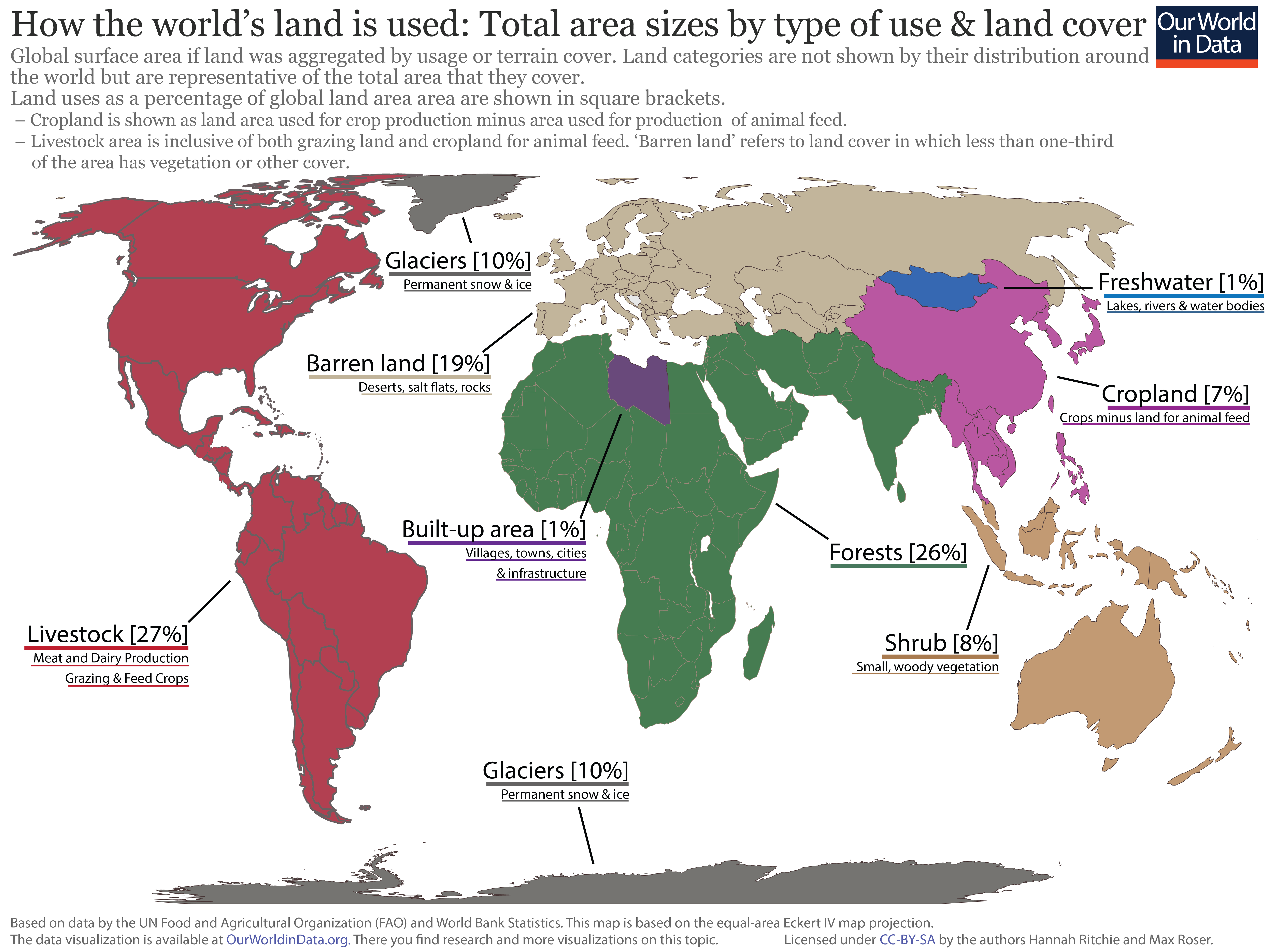
But given that the meat and dairy industry take up just over a quarter of the earth’s land surface—some four billion hectares—while contributing only a puny percentage of GDP, any truly committed effort to combat climate change must take it seriously. Changing eating habits is vastly easier than rebuilding cities and transportation infrastructure, let alone finding a sustainable way to make cement or smelt steel. Yet, Buck simply can’t imagine a meatless society, for even in her science fiction the characters eat chicken and tuna. She seems to have forgotten that the crew members of Star Trek are vegans.

As for geoengineering, Buck contends that environmentalists who reject it out of hand are indulging in an “aesthetic luxury” (and eating meat is…?). She does go to great lengths to stress how concern for climate workers, ecosystems, and global justice must be priorities for any geoengineering effort. But she also applauds a meeting in Beijing in 2017, a sort of geoengineering Bandung Conference, where Chinese scientists invited colleagues from the Global South to work on an algorithm that could be used to operate a SRM program. She fails to anticipate that to many readers, perhaps the only thing more terrifying than SRM is SRM operated by AI—a true Skynet.

In Buck’s vision, “solar geoengineering would be done by states or not at all,” but this seems to be wishful thinking. One can easily imagine a corporation or a billionaire acting as a climate change vigilante. SRM is cheap, after all. For only a few hundred million dollars a year a company such as ExxonMobil could protect its billions in assets. (Geoengineers have discussed among themselves the so-called “Greenfinger,” a James Bond–esque villain who goes rogue.) And once SRM starts, we are stuck with it. As Buck notes, “most stratospheric aerosol scenarios last 200 years . . . and there’s probably no deployment scenario that’s less than a hundred years.” Even with workers’ rights and an international team of coders, geoengineering would mark a defeat for the environmental movement.

Despite engaging these critiques, Buck remains wedded to the idea, perhaps because of her fascination with the entrepreneurial scene surrounding it. “The socially conscious entrepreneur will play a vital role in the near term,” she declares. She is keen on Nori, a blockchain marketplace based on buying and trading of sequestered carbon—or as it describes itself, “a scalable incentive system to measure and verify soil carbon.” Buck hopes that such voluntary markets would eventually lead to compulsory ones. Perhaps. But despite her enthusiasm, it is hard to see how Nori would succeed where government cap-and-trade programs failed, for at least the latter had a cap.

Another valiant entrepreneur in Buck’s story is Russ George, who headed the carbon-trading start-up Planktos in the 2000s and organized the first geoengineering experiment in 2012 when he dumped iron filings into the ocean to actuate a bloom of phytoplankton. This was meant to feed the salmon in British Columbian waters and sequester carbon. Alas, it did not work and George’s offices were raided by the Canadian government in 2013 because of the illegality of the experiment. George’s client, the Haida Salmon Restoration Corporation, fired him and complained that he had lied about his qualifications (an episode omitted from After Geoengineering). Nonetheless, Buck praises George as one of the entrepreneurs who are “rolling up their sleeves and playing around and doing.”

In the end, it is this allure of action and results that leads Buck to the market for environmental salvation. For her, entrepreneurs are “visionary” and “disruptive,” leading the way out of the current impasse in climatic politics. They are the ones getting things done—in her vision, the only ones who could. She warns progressives that entrepreneurs are the “wrong focus of critique.” Buck does warn that “zombified neoliberal capitalism” could fail to implement the needed technologies and that “workers and voters” might need to take matters upon themselves. But the entrepreneur earns more of her esteem than the scientist, who in her telling is a mere bureaucrat in a “big institutional laboratory.” Paraphrasing one of her interview subjects, Buck uncritically conveys the argument that “we are closing out an era that focused on scientific monitoring and scientific discovery. . . . now, we’re in an era of solution building, where entrepreneurs are needed to take a shot, to fail, to try things.” This encapsulates the neoliberalization of science as Mirowski lampoons it in his study Science-Mart: Privatizing American Science (2011):
Hierarchies are a temporary stopgap, the efficiency experts warn, but can never usurp the greatest information processor known to humanity: the Market. . . . If you really believe that academic kingpins in their ivy cocoons can efficiently run the scientific enterprise, then think again. The final destination of market reform is to let commercial considerations modularize, standardize, and spin off almost every aspect of the process of scientific research, and consequently erase all boundaries between professional and wage labor. No human being, and especially no scientist, can comprehend the dispersed complexity of knowledge better than the market itself.

At the horizon of climate catastrophe, the science-market dichotomy is collapsing from both ends; entrepreneurs not only have tried to replace scientists, but scientists have become entrepreneurs. David Keith, a prominent climate physicist at Harvard University, also runs the startup Carbon Engineering. As Mirowski noted in Never Let A Serious Crisis Go to Waste, it was not the environmental movement that prevented a planned geoengineering experiment in 2012, led by a consortium of UK universities. The SPICE project—Stratospheric Particle Injection for Climate Engineering—was cancelled after it was revealed that two scientists had patented the technology beforehand without telling their collaborators. Global warming is a dire emergency, but it is also an opportunity to make a killing.


This brings us back to Reisman—his dark future of Mad Max capitalists blazing the trail forward in a heating world. (Incidentally, one of his latest books has the winning and all-caps title: MARXISM/SOCIALISM, A SOCIOPATHIC PHILOSOPHY CONCEIVED IN GROSS ERROR AND IGNORANCE, CULMINATING IN ECONOMIC CHAOS, ENSLAVEMENT, TERROR, AND MASS MURDER: A CONTRIBUTION TO ITS DEATH.) In this picture the entrepreneurs are our Kulturträger, carrying with them our hopes for civilization’s survival.

As both Burning Up and After Geoengineering make clear, we need a history of fossil fuels and a clear program to deal with the climate crisis. But we also need to understand neoliberal environmental thought so that we may inoculate ourselves against its enduring power. Like Pirani, whose account of economic growth holds out the promise of central planning as a solution, Buck believes that capitalists can be convinced to act responsibly. “Investors aren’t aware that carbon budgets exist, or what they mean for high-emission companies,” she writes, optimistically—as if all we must do is inform them. “We need to create comprehensible accounts of the risks to investors,” she concludes. But capitalists know very well what their interests are. That is why they are winning.

Although Pirani is not as impressed by the whiz-bang of geoengineering as Buck is, he displays remarkably little interest in understanding the enemy. He dismisses neoliberal philosophy as little more than warmed-up arguments from Adam Smith and relies on David Harvey’s argument that neoliberalism is just crass class warfare.

But neoliberals are much more sophisticated than that, in part because theirs is less an economic theory than a totalizing epistemology. For all their trenchant analyses, critics of neoliberalism have enjoyed little success in dismantling the popular appeal of its central axiom—that market will always collect and process more information than any other institution, especially the state. Yet there is now very little time to devise a popular new metaphysics of political economy, let alone an effective response to global warming. As we scramble to preempt the death of the Great Barrier Reef or the collapse of the West Antarctic ice sheet, the geoengineers and the entrepreneurs will be there, waiting for us to beg for their help.

Monday, July 1, 2019

Climate Change Economics Stupidity / Madness / Insanity

subtitle: the stupidity / madness / insanity of the likes of Nordhaus and Tol makes me Insanely Mad!

The mythical economic data on climate change (1): Nordhaus’s 1994 survey of “experts”. Steve Keen. June 30, 2019.


As part of my critique of mainstream economics work on climate change, I'm going through each of the 14 data points that Nordhaus used to fit his damage function to "data" in the manual to his DICE program {Nordhaus, 2013 #5673}. These came from a survey paper by Tol in 2009: "The Economic Effects of Climate Change" {Tol, 2009 #5683}. Nordhaus later revised his function, given errors he belatedly spotted in Tol's table {Nordhaus, 2017 #5584}, but there were many errors he didn't see that I'll cover first before turning to his 2017 paper. The paper in question here is: 
Nordhaus, W. (1994). "Expert Opinion on Climate Change." American Scientist 82(1): pp. 45–51
For context, Figure 1 shows Tol's table, highlighting the numbers he gave for this paper (which are erroneous), while Figure 2 shows all the numbers Nordhaus used, with this pair—a 3 Kelvin (K) increase in temperature, and a 4.8% fall in GDP)—highlighted. 
...

 
Aside from the not surprising finding of great dissension, the opinions of experts revealed major differences among disciplines, particularly between mainstream economists and natural scientists…" (45. Emphasis added) 
This is emphasised in the descriptive text for the figure that highlights the whole paper:
Figure 1. Will greenhouse warming lead to fruitless plains or fruited paradise? Experts on global change are deeply divided on this question. At one extreme, the author's survey shows, are mainstream economists who view the prospect of greenhouse warming with little concern, confident that human societies will adapt handily to such changes. At the other extreme, natural scientists worry about major and irreversible impacts unpredictable extreme events, such as shifting ocean currents or migrating monsoons. Which picture more closely depicts the future reality cannot now be predicted. (pp. 46-47. Emphasis added)
... 
What this shows is that mainstream economists are generally climate change trivializers— not that they know anything meaningful about the magnitude of disruption to the globe's ecological and economic systems that will result from climate change.  The 30-times difference in expectations of serious disruption from climate change between scientists and economists  should have been the takeaway from this survey, not the average of the expectations of damage.


Bjorn Lomborg, The Gullible Environmentalist. Steve Keen. June 10, 2019.


Writing in the New York Post last week, Bjorn Lomberg argued against calling climate change "catastrophic", and quoted a United Nations report which alleged that global warming will have only a trivial effect on global GDP over the next half century. As he put it, the total impact of global warming by 2070 will be no worse than a single recession, 
...
The definitive overview of these studies (there were 20 studies as of 2014, when the report was published) is provided by the leading co-author of the chapter Lomborg cites, Richard Tol (Tol 2009; Tol 2018). All of them are studies by economists, and as is well-known, economists are fond of making what they call "simplifying assumptions". 
Of all the assumptions behind these studies, my favourite—if that is the right word—is what Tol describes as "the statistical approach", which "assumes that the observed variation of economic activity with climate over space holds over time as well" (Tol 2009, p. 32)
In Tol's words, what this means is that these economists performed "some sort of regressions of variations of an economic quantity over space on climate variations over space" (Tol 2018, p. 1), and found a weak, nonlinear relationship between GDP today and temperature today. They then used these results as a proxy for the impact of the increase in temperature from global warming on GDP.
...

Nonetheless, that's what they used this data to do. Nordhaus, for example, asserted that global GDP would fall by 1% if global temperature rose by 3°C (Nordhaus 2006, p. 3517, Table 2)—and this became one of the data points in the IPCC graph of temperature versus damage to GDP (see Figure 2). But all he was entitled to assert was that if one location (say, Chicago) has a 3°C higher average temperature than another (say, Copenhagen), then it is likely to have a 1% lower GDP. 
The absurdity of using relationships between temperature and GDP by location to predict what will happen to GDP from global warming is more obvious in an earlier IPCC report, written by a related group of economists to those who wrote the 2014 report. Chapter 6 of the IPCC report Climate Change 1995: Economic and Social Dimensions of Climate Change, entitled "The Social Costs of Climate Change: Greenhouse Damage and the Benefits of Control", states that: 
Most models assume a nonlinear (convex) damage temperature relationship, resulting in damages of 6% or higher for 10°C warming. (Pearce, Cline et al. 1995, p. 183) 
It could be quite valid to say that statistically, a location whose average temperature today is 10°C higher than some other location is likely to have a GDP that is 6% lower. 
But to say that a 10°C rise in global temperature will only reduce global GDP by 6%? That is madness. A 10°C rise would ultimately melt all of Earth's glaciers, inundate the world's coastal cities, and drastically alter the climate of the planet. The last time the planet was that much warmer was over 50 million years before humans evolved: the planet would be unrecognizable. You simply can't extrapolate from conditions in our current world to one that is 10°C hotter. A model that estimates a mere 6% fall in GDP as a result of that increase in temperature is an absurd model.
...

So should you have faith in the IPCC's prediction that climate change will reduce GDP by less than 2% over the next fifty years? Only if you can trust the "simplifying assumptions" made by the economists who wrote that part of the IPCC report. 
The actual climate scientists who write other parts of the IPCC report certainly don't trust the economists. They can't say so in the IPCC report itself, because of the consensus rules that determine what the IPCC can and can't publish. But they are certainly saying so in their own academic papers. A recent paper by 16 climate scientists advised strongly against the methods that economists use to decide whether we should take action against climate change:
Current rates of change of important features of the Earth System already match or exceed those of abrupt geophysical events in the past (SI Appendix). With these trends likely to continue for the next several decades at least, the contemporary way of guiding development founded on theories, tools, and beliefs of gradual or incremental change, with a focus on economy efficiency, will likely not be adequate to cope with this trajectory. (Steffen, Rockström et al. 2018, p. 8257. Emphasis added)
Rather than being blasé about the impact of a 10°C increase in global temperatures, these scientists are worried that even a 2°C increase will trigger feedback effects in the climate that we will be powerless to reverse:
Our analysis suggests that the Earth System may be approaching a planetary threshold that could lock in a continuing rapid pathway toward much hotter conditions—Hothouse Earth. This pathway would be propelled by strong, intrinsic, biogeophysical feedbacks difficult to influence by human actions, a pathway that could not be reversed, steered, or substantially slowed. Where such a threshold might be is uncertain, but it could be only decades ahead at a temperature rise of ~2.0 °C above preindustrial, and thus, it could be within the range of the Paris Accord temperature targets. (Steffen, Rockström et al. 2018, p. 8257. Emphasis added)
They therefore argue that we should do everything possible to avoid a 2°C increase in global temperatures:
Precisely where a potential planetary threshold might be is uncertain. We suggest 2 °C because of the risk that a 2 °C warming could activate important tipping elements, raising the temperature further to activate other tipping elements in a domino-like cascade that could take the Earth System to even higher temperatures (Tipping Cascades). (Steffen, Rockström et al. 2018, p. 8254)
With global temperature already 1°C above pre-industrial levels, we're already half-way to the threshold that climate scientists warn could lead to catastrophic change to the biosphere, and therefore dramatic damage to the economy as well. So don't trust what a tiny cabal of mainstream economists tell you about climate change. Don't be gullible like Bjorn Lomborg. We only have decades left to avoid a catastrophe that, as usual, economists cannot see coming.


An extraordinary Twitter Exchange with Richard Tol. Keen. June 21, 2019.

I had an extraordinary Twitter Exchange with Richard Tol over the last few days. I've written this post to preserve that exchange in case, at a future date, Tol decides to delete his tweets. They provide a superb window into the thinking that lies behind mainstream economic modelling of climate change, and why this has led to humanity dangerously delaying taking action against climate change.

By the way, do please read the Wikipedia entry I linked to above, firstly because it gives a pretty realistic picture of Tol's position on climate change—which aligns him with the "Skeptical Environmentalist" Bjorn Lomborg—and secondly because it is under dispute because it was substantially edited by Tol himself! That's an enormous faux pas which, characteristically, Tol is incapable of appreciating. Here's the Talk page on his entry:

Figure 1: The discussion of Tol's Wikipedia page in which he acknowledges that he wrote much of it himself


For those who don't know, Tol is one of the leading economists working on climate change. He is the author of the FUND "Integrated Assessment Model" (IAM) which is one of the key models used by the IPCC (Intergovernmental Panel on Climate Change) to assess the economic impacts of climate change.

Tol has also been an author of the economic impact sections of the IPCC Reports, especially the 1995 report {Bruce, 1996 #5707} in which the following observation was made:
Most estimates are for equilibrium climate change associated with a doubling of the preindustrial C02 equivalent concentration of all greenhouse gases. Best-guess central estimates of global damage, including nonmarket impacts, are in the order of 1.5=2.0% of world GNP for 2xCO, concentrations and equilibrium climate change. This means that if a doubling of C02 occurred now, it would impose this much damage on the world economy now… 
Most models assume a nonlinear (convex) damage temperature relationship, resulting in damages of 6% or higher for 10°C warming. {Pearce, 1995 #5716, p. 183}


Figure 2: The authors of the 1995 assessment, including Tol


What? A 10°C increase in the average global temperature would reduce global GDP by a mere 6%? How on Earth did they come up with that figure? Even those who claim that the Sun is actually causing the rise in temperature, or that the temperature is actually falling, should see red with this claim. Humanity has never existed in, let alone experienced, a planet with that temperature. How on Earth would such a drastic change in temperature make such a tiny difference to GDP?

As the italicized section of the previous quote makes clear ("if a doubling of C02 occurred now, it would impose this much damage on the world economy now"), this is not the result of applying a high discount rate to future enormous damages: this is the actual estimate they made of how much lower GDP would be in a world with a 10°C higher average temperature (relative to pre-industrial levels), relative to one in which the global temperature was no different to pre-Industrial levels.

The reason, as I realised about two weeks ago when I read Tol's article "The economic effects of climate change", is that they are using data on GDP and temperature today across the globe (and primarily, across the USA) as a proxy for what will happen when global temperatures rise:
Mendelsohn assumes that the observed variation of economic activity with climate over space holds over time as well; and uses climate models to estimate the future effect of climate change… Like Mendelsohn, Nordhaus and Maddison rely exclusively on observations, assuming that "climate" is reflected in incomes and expenditures—and that the spatial pattern holds over time. {Tol, 2009 #5683, p. 32}
These regressions show a weak quadratic relationship between temperature and GDP today, which is why the "damage functions" in Nordhaus's DICE model is a simple quadratic with a tiny coefficient. Nordhaus assumes that the decrease in GDP that will result from a change in temperature relative to pre-industrial levels is the change in temperature squared, multiplied by 0.00227 (or 0.227%):
The parameter used in the model was an equation with a parameter of 0.227 percent loss in global income per degrees Celsius squared with no linear term. This leads to a damage of 2.0 percent of income at 3°C, and 7.9 percent of global income at a global temperature rise of 6°C. {Nordhaus, 2018 #5691, p. 345}.
I was simply gobsmacked when I realised that this was the basis of the benign predictions of the impact of climate change on the economy that the IPCC parrots. I had thought that the cause would be something disputable, like different levels of discounting, or complicated, like the impact of the assumptions of the underlying Ramsey growth model (a foundation that all IAMs share with the RBC and DSGE models that #Irony did such an excellent job of warning about the Great Recession before it happened). But instead it was this mind-numbingly stupid assumption.

In case that isn't obvious to you, here's a little illustration using the opposite phenomenon—global cooling. The assumption that these "climate economists" made works both ways: if today's temperature:GDP relationships can be used to predict the impact of global warming, they can also be used to predict what would happen with global cooling. That actually helps to put a handle on how monstrously stupid this assumption is, because while temperatures that many degrees above current levels haven't been experienced for millions of years, temperatures 4 degrees below pre-industrial levels were experienced by our ancestors as little as 20,000 years ago.

Figure 3: Representation of estimated global temperatures from 500 million years ago till now


This visualisation by the Zurich University of Applied Sciences shows the extent of glaciers at the Ice Age peak 21,000 years ago—when the average global temperature was 9°C, versus the 14.4°C average today, and the 13.7°C pre-Industrial level.

Figure 4: The Earth during the last Ice Age 21,000 years ago. Click here to see a time-lapse visualisation


So all of Canada, most of Europe, and a fair slab of the USA would be under glacial ice, if temperatures fell 5.4°C—or 4.7°C relative to pre-Industrial levels. How much does Nordhaus's damage function reckon that GDP would fall, relative to a world that remained at today's temperature?

There would be a 6.4% fall in GDP.

Let's unpack that a bit. I'm sure Tol would dive in with a caveat here, that such a change would take centuries, and we'd have plenty of time to adapt—he made precisely the same case in reverse in our exchange over global warming. Sure, fine. But the concept underlying these "damage functions" is that they tell you what GDP would be in two different worlds: one where humans didn't have to cope with temperature change at all, and GDP grew with today's human wealth unaffected, and one where we do have to adapt to temperature change.

So let's imagine two Earths, identical in all respects today and with identical technology in the future as well (because these Neoclassical models assume technology improves at an exogenously given rate, and is unaltered by climate change).

In the former world, all of today's factories, houses, cities and indeed nation states can just continue. Resources are devoted to creating new capital via investment, but zero resources have to be devoted to moving technology from one place to another, or to replacing infrastructure.

In the latter world, with glaciers taking over such trifling human settlements as New York, Chicago, Minneapolis and Toronto, those cities would have to abandoned, along with all the factories that produce output there today, and either moved or rebuild closer to the Equator. The descendants of today's roughly 150 million residents (37 million Canadians and about 100 million Americans) would have to move south too—maybe to Mexico, which I'm sure would be happy to accommodate them (pardon me, but I simply can't maintain an academic straight face as I dissect this nonsense).

Figure 5: Zooming in to focus on North America


Imagine the scale of destruction of existing infrastructure that has taken two centuries to construct. Try to imagine the resources that would need to be devoted to shifting existing resources, or, more commonly, replacing resources that could not be shifted, and had to be abandoned to the advancing ice.

Imagine, just to make it a fair contest, that we had 500 years to do it—in line with the length of time that Tol thinks it would take for sea levels to rise 6 metres under global warming.

Do you really think that, after 500 years, the economy of the global cooling Earth would be just 6.4% smaller than the constant temperature Earth?

Of course not. So much of the Global Cooling Earth's resources would need to be devoted to rebuilding, moving, resettling, etc., that there's no way it would suffer just a 6.4% fall in GDP relative to its climate-change-free twin. A huge proportion of its resources would have to be devoted to replacing the infrastructure destroyed by the glaciers. It would be lucky to have any resources left to expand output.

These niceties are completely ignored by Tol, Nordhaus et al. with their crazy assumption that climate:GDP correlations today can be used to predict what will happen as global climate changes over time.

So though Tol, Nordhaus and friends have produced numerous seemingly scientific mathematical models of climate change and economics, they ignore the fact that such huge changes in climate will destroy much of the existing resources of the global economy, and require a huge proportion of our productive capacity to be devoted, not to expanding output, but to replacing capacity destroyed by climate change.

They are not scientists in any sense of the word, but fantasists who simply believe that the magic ingredient they describe as "the incredible adaptability of human economies" {Nordhaus, 1994 #5699, p. 48} will overcome any problems. All their models tell us is that they have faith—and a faith that bears no relation to the actual way in which capitalist economies function, nor to the threats that global warming will pose to the ecosphere as well as the economy.

As I note in the exchange with Tol, they are not climate change deniers, but climate change trivializers. Had they not poked their noses into this issue, human societies could well have started managing their impact upon the biosphere shortly after the Limits to Growth {Meadows, 1972 #4784} study was published in 1972. Instead, thanks to them unjustifiably undermining the credibility of that report, we have lost half a century of adaptation. Their attempts to eulogise capitalism may end up leading to its destruction.

So much for the prelude. Below are links to Tol's tweets, as well as images of the exchanges in case Tol later deletes his tweets when it proves expedient to do so. After all, if he's willing to edit his own Wikipedia page, it wouldn't be surprising if he removed potentially incriminating tweets as well.

https://twitter.com/RichardTol/status/1140513746571464705?s=20

https://twitter.com/RichardTol/status/1140523232782671873?s=20


https://twitter.com/RichardTol/status/1140536347293310977?s=20


https://twitter.com/RichardTol/status/1140584301307793409?s=20

Key Tweet: see next section https://twitter.com/RichardTol/status/1140591420144869381?s=20


https://twitter.com/RichardTol/status/1140618253384998914?s=20


https://twitter.com/RichardTol/status/1140620174363627520?s=20

https://twitter.com/RichardTol/status/1140621628012924929?s=20

https://twitter.com/RichardTol/status/1140623105322377216?s=20

https://twitter.com/RichardTol/status/1140625044688838656?s=20

https://twitter.com/RichardTol/status/1140627214632988676?s=20


https://twitter.com/RichardTol/status/1140628124679454720?s=20

https://twitter.com/RichardTol/status/1140632103463333892?s=20

https://twitter.com/RichardTol/status/1140632795968081920?s=20

https://twitter.com/RichardTol/status/1140633320755257344?s=20

https://twitter.com/RichardTol/status/1140633723853004802?s=20


https://twitter.com/RichardTol/status/1140640237724590080?s=20

https://twitter.com/RichardTol/status/1140684964087947264?s=20


Follow on from key tweet

https://twitter.com/RichardTol/status/1140591420144869381?s=20

https://twitter.com/RichardTol/status/1140669525081415680?s=20

https://twitter.com/RichardTol/status/1140591756964192256?s=20

https://twitter.com/RichardTol/status/1140928458853421057?s=20


https://twitter.com/RichardTol/status/1141285166951936000?s=20

https://twitter.com/RichardTol/status/1140618253384998914?s=20

https://twitter.com/RichardTol/status/1140620174363627520?s=20


https://twitter.com/RichardTol/status/1140621628012924929?s=20

https://twitter.com/RichardTol/status/1140623105322377216?s=20

https://twitter.com/RichardTol/status/1141050873809899521?s=20


https://twitter.com/RichardTol/status/1141585185575702528?s=20

https://twitter.com/RichardTol/status/1141591925432213506?s=20

https://twitter.com/RichardTol/status/1141596267522547717?s=20


https://twitter.com/RichardTol/status/1141601347210502144?s=20

https://twitter.com/RichardTol/status/1141629791172476928?s=20


https://twitter.com/RichardTol/status/1141753535513714688?s=20

https://twitter.com/RichardTol/status/1141776842967388161?s=20


https://twitter.com/RichardTol/status/1141683256640921600?s=20


https://twitter.com/RichardTol/status/1141688413436948480?s=20


Bruce, J. P., H. Lee, et al. (1996). Climate Change 1995: Economic and Social Dimensions of Climate Change, Intergovernmental Panel on Climate Change.

Meadows, D. H., J. Randers, et al. (1972). The limits to growth. New York, Signet.

Nordhaus, W. (1994). "Expert Opinion on Climate Change." American Scientist 82(1): 45–51.

Nordhaus, W. (2018). "Projections and Uncertainties about Climate Change in an Era of Minimal Climate Policies." American Economic Journal: Economic Policy 10(3): 333–360.

Pearce, D. W., W. R. Cline, et al. (1995). The Social Costs of Climate Change: Greenhouse Damage and the Benefits of Control. Climate Change 1995: Economic and Social Dimensions of Climate Change. Contribution of Working Group III to the Second Assessment Report of the Intergovernmental Panel on Climate Change. Cambridge, UK, Intergovernmental Panel on Climate Change: 183-224.

Tol, R. S. J. (2009). "The Economic Effects of Climate Change." The Journal of Economic Perspectives 23(2): 29–51.

TolTweetsTrivializingClimateChange201906.pdf


from comments


Justin Wood:
The cavernous ignorance in saying a current 10K temp difference between Alaska and Maryland means 10K global surface temp increase is all totally fine is truly staggering. You fail first-year climate science students for this sort of nonsense.

The increase in energy retained by the Earth-atmosphere system at a 10K rise is gargantuan. As someone points out in that thread, the superstorms, flooding, droughts, disease vectors, and who knows what other catastrophes we'd unleash would wipe out much of the species. And that's not even accounting for the max wet-bulb temperature humans can physically survive in (hint: much of the planet would be unsurvivable).

Words fail.


James Hutchinson:
10 C increase in global average temperature, we will just move indoors!?! This is the level of thinking from a respected economist, what a moron.  How did he get his piece of paper from an actual university?  How does he even tie his own shoelaces without trying to use magic?   I'm not sure economics can be saved at this point. 
Prof Steve Keen:
It can't, in my opinion. These intelligent morons have it in an intellectual strangehold, and they literally won't let go even if the environment starts going to Hell. I think the only option is to shut economics programs down and use the staff as 1st year mathematics tutors, which most of them could be capable of. But get rid of the bloody discipline. They're supposed to analyze capitalism, and instead they'll be the death of it.


Wouter Verlinden:
haha, that Toll guy is really bizar. 

"it is possible to imagine a scenario in which climate change does cause violent conflict"... "There are three reasons to assume that this is unlikely"..." Second, drought is only a real problem for the poor"...."Poor and exhausted people are unlikely to take up arms, and if they do, they are probably not very effective. "

It's really there. In writing. 
https://web.archive.org/web/20110719103630/http://www.mi.uni-hamburg.de/fileadmin/fnu-files/publication/tol/RM8133.pdf

Ok, only poor people will die. That's not really important. And if they start fighting, they will be so hungry, they can't put up a decent fight.

Alrighty then.  ¯\_(ツ)_/¯


Tuesday, May 14, 2019

Steve Keen on Nordhaus (Playing with DICE; Shocked Disbelief)

Climate Change and the Nobel Prize in Economics: The Age of Rebellion. Steve Keen. May 4, 2019.

Economists are not your friends

Rebellion is in the air. On November 17 of last year, the "Gilets Jaunes" movement spontaneously erupted in France, in reaction to a planned tax on diesel fuel. Over 300,000 people took part in demonstrations across France, with actions ranging from blocking roundabouts to vandalizing banks, shops and luxury vehicles. As I write these words, the movement is still holding demonstrations across France every Saturday.

Almost as spontaneously, a youth movement calling itself Extinction Rebellion came into being in the UK, and held its first "Rebellion Day" on the same day that the Gilets Jaunes first shook France. This initial action, which blocked London's five main bridges, was much smaller and lower key than the Gilets Jaunes protests, but by April 2019, non-violent civil disobedience protests brought large sections of London to a halt, and resulted in the arrest of over 1,000 demonstrators.

These movements are superficially diametrically opposed: one was provoked by measures to address climate change, the other is demanding action on climate change. However, they are united by one key detail. The policy action that the Gilets Jaunes oppose, and the policy inaction that Extinction Rebellion deride, are both the products of economists—and most specifically, the economist who was awarded the Nobel Prize in Economics for his work on Climate Change, William Nordhaus.

The Gilets Jaunes rebellion was sparked by the proposed introduction of a carbon tax on diesel fuel—and this is precisely the method that Nordhaus and most economists recommend to use to combat Climate Change.

Extinction Rebellion was sparked by the failure of policymakers to do anything substantive to prevent Climate Change, and are demanding policies that would cause net CO2 emissions to fall to zero by 2025:
Government must act now to halt biodiversity loss and reduce greenhouse gas emissions to net zero by 2025… 
The truth is that the climate and ecological emergency poses an unprecedented existential threat to humanity and all life on Earth. 
Rapid, unprecedented changes to many aspects of human life – energy use and supply, transport, farming and food supply, and so on – are now needed to avert global climate and ecological catastrophe. 
Globally governments have been unwilling to tackle a problem of this magnitude. In 2015, the UN Paris Agreement on Climate Change was signed by world leaders to limit global warming to 2°C above pre-industrial levels. However, scientific evidence now tells us that our leaders have not taken enough action and we are still on a path to reach 3-4°C, which will be catastrophic to all life on Earth. (https://rebellion.earth/the-truth/demands/, May 3rd 2019)
Nordhaus agrees that man-made Climate Change is happening—he is not a "Climate Change Denialist". However, his research actually encourages policymakers not to take the action that Extinction Rebellion demands, or anything like it. He instead recommends managing Global Warming so that the Earth's temperature will stabilize at 4 degrees above pre-industrial levels in the mid-22nd century
Figure 1: Slide 6 in Nordhaus's 2018 Nobel Prize Lecture (annotated) 


Nordhaus also argued that the policy Extinction Rebellion recommends, of restrict Global Warming to 1.5 degrees—even if it is done over the next century, rather than the next six years as Extinction Rebellion demands—would cost the global economy more than 50 trillion US dollars, while yielding benefits of well under US$5 trillion.

Figure 2:Slide 7 in Nordhaus's 2018 Nobel Prize Lecture 


How is it possible that the optimal temperature for the planet is 4 degrees above pre-industrial levels—and that damages from that level of warming would amount to under 10% of global GDP—when it would also be "catastrophic to all life on Earth"? How is it possible that Global Warming of 1.5 degrees would reduce global GDP by a few trillion US dollars—less than 5% of what it would have been in the absence of Global Warming—while the policies to achieve that limit, even if executed over a century rather than just five years, would cost over ten times as much? 
It isn't. Instead, either Extinction Rebellion's claims are vastly overblown, or Nordhaus's estimates of the economic damages from Global Warming drastically understate the dangers. 
Both are possible, of course. But categorically, Nordhaus's estimates of the potential economic damage from Global Warming are nonsense. They are also one of the key reasons why policymakers have not taken the threat seriously. If Extinction Rebellion is going to make policymakers take Climate Change seriously, then one of their first targets must be Nordhaus and his DICE model.

To be continued...


Playing DICE with Life on Earth: Nordhaus’s Damage Function. Steve Keen. May 11, 2019.

In the first installment in this series (above), I noted the contrast between the urgency that Extinction Rebellion sees about limiting global warming to no more than 1.5 degrees, and Nordhaus's conclusion that the gap between the benefits of mitigating global warming and the costs is maximized at a 4 degree increase in global temperature. In this post, I delve into DICE itself.

DICE stands for "Dynamic Integrated model of Climate and the Economy". It's the mathematical model from which Nordhaus derives the results noted in the previous figures.

DICE is based on the Neoclassical long term growth model devised by the mathematical prodigy Frank Ramsey in 1928 {Ramsey, 1928 #5029}. This is the same foundation as the mainstream RBC ("Real Business Cycle") and DSGE ("Dynamic Stochastic General Equilibrium") macroeconomic models that completely failed to anticipate the 2008 Global Financial Crisis.

That its macroeconomic cousins fared so badly at their chosen task is cause enough for concern. These models were intended to forecast short-term economic growth, and were completely wrong about the immediate economic future, to disastrous effect. That should at least raise some concerns. Was this failure just because the underlying technology was never meant to handle short-term economic dynamics? Or is the underlying Neoclassical growth model itself simply a poor model of reality?

This is a serious issue that I'll take up in later chapters. However, the features that Nordhaus has added to model Climate Change are far worse than the inadequate foundation on which it was built.

DICE's major additions to the standard model are:
  1. A "damage function" that relates the increase in average global temperature to a decline in GDP. This is the source of the "Future damages" estimates shown in Figure 2 (in the previous post); 
  2. An "abatement function" that calculates the cost of reducing global temperature rise over what would happen if nothing were done to tackle Climate Change. This is the source of "Present abatement" estimates shown in Figure 2; and
  3. Equations to relate GDP growth to the increase in CO2 levels in the atmosphere, along with the impact of that increased CO2 on the average global temperature.
Many critics have focused upon the high discount rate that Nordhaus chose to apply calculate the value to existing generations of reducing future Global Warming. But by far the most egregious fallacy in Nordhaus's model is its Damage Function.

Nordhaus's Damage Function is the first substantive graphic in the DICE manual, and one look at it (see Figure 8) should give anyone—even Climate Change Deniers (CCDs)—cause for concern. Even if Anthropogenic Global Warming were a myth, even if the temperature rise was being caused by the Sun, would it really be true that a 5 degree increase in the average temperature of the globe would only reduce global GDP by 5 percent?

Figure 3: Nordhaus's Damage Function, showing the estimated reduction in GDP for an increase in global mean temperature


This is not, as is sometimes believed, the result of Nordhaus applying a high discount rate to the impact of climate change in the distant future. This instead is his estimate of how much lower global GDP would be in the future—say, 130 years from now—compared to what it would have been, if temperatures had instead remained at pre-industrial levels. Given the urgency that characterises the Global Warming debate, this is, on the face of it, an extremely benign view of the impact of an increase in the global average temperature on GDP.

He reiterated this benign view in a 2017 paper, "Revisiting the social cost of carbon" {Nordhaus, 2017 #5559}:
Including all factors, the final estimate is that the damages are 2.1% of global income at a 3 °C warming, and 8.5% of income at a 6 °C warming. {Nordhaus, 2017 #5559, p. 1519}
If the predictions of Nordhaus's Damage Function were true, then everyone—including Climate Change Believers (CCBs)—should just relax. An 8.5 percent fall in GDP is twice as bad as the "Great Recession", as Americans call the 2008 crisis, which reduced real GDP by 4.2% peak to trough. But that happened in just under two years, so the annual decline in GDP was a very noticeable 2%. The 8.5% decline that Nordhaus predicts from a 6 degree increase in average global temperature (here CCDs will have to pretend that AGW is real) would take 130 years if nothing were done to attenuate Climate Change, according to Nordhaus's model (see Figure 1). Spread over more than a century, that 8.5% fall would mean a decline in GDP growth of less than 0.1% per year. At the accuracy with which change in GDP is measured, that's little better than rounding error. We should all just sit back and enjoy the extra warmth.

Except those in New York, London, Sydney, Cape Town, Los Angeles, San Francisco, and numerous other coastal cities of course, because they be too busy moving to higher ground: 6 degrees is well above the threshold at which all of Greenland and the Antarctic will melt completely (even if it's the Sun's fault, rather than AGW). That will take much more than a century of course, but a planetary temperature rise of 6 degrees will doom any city less than 70 metres above sea level. They will all have to be relocated and rebuilt.

Human settlements closer to the Equator that are well above sea level will be safe from rising sea waters, but they will also be on the move: a 6 degree increase in temperature will make many of them unliveable. The obvious suspects—the Middle East and Northern Africa—would see average summer temperatures of over 40 degrees in their major cities, and much of their countryside. Moving them, or emigrating from them, would be essential for survival (see Figure 4 and Figure 5).

So all this human movement, and all this city rebuilding, plus everything else that a 6 degree rise in temperature (however it was caused) would trigger, will only reduce global GDP by 8.5%? This claim fails what Robert Solow appropriately christened "the smell test" {Solow, 2010 #5078, p. 12}: if an economic model returns a prediction like this, it has to be … fill in your favourite expletive here.

Figure 4: Cities in Africa whose average summer temperatures today exceed 34 degrees for at least one month


Figure 5: Cities in Asia/Middle East whose average summer temperatures today exceed 34 degrees for at least one month


It doesn't take long to find the sources of [expletive deleted] in Nordhaus's model. There are several, but the most egregious of all is the mathematical form of his "Damage Function". 
Mostly Harmless 
With all the obvious complexities and uncertainties in the whole issue of how climate interacts with the economy and vice versa, Nordhaus chose to use the second-simplest relationship possible between two variables: a quadratic. He simply assumes that the relationship between change in global temperature (relative to the level in 1900) and reduction in GDP is a function of the temperature difference squared:
"The current version assumes that damages are a quadratic function of temperature change" {Nordhaus, 2013 #5673, p. 11}
His estimate of the damages to GDP from an increase in temperature over pre-industrial levels is shown in Equation
and Figure 6.


Figure 6: The parameters for Nordhaus's estimate of damage from temperature change in the code for his DICE model


One property of a quadratic is that there are no discontinuities, and therefore no points at which the relationship implied by the function simply breaks down. In the context of modelling climate change, using a quadratic for the relationship between an increase in global temperature and the economy implies that there are no temperature levels that set off catastrophic breakdown in the economy by triggering fundamental qualitative shifts in the climate—such as melting the icecaps, stopping the Gulf Stream, or turning El Nino from a temporary phenomenon into a permanent one. Nordhaus acknowledges this in the same sentence, and justifies the absence of such a feature in his Damage Function by an appeal to a survey of actual climate scientists about whether there are tipping points in the climate:
The current version assumes that damages are a quadratic function of temperature change and does not include sharp thresholds or tipping points, but this is consistent with the survey by Lenton et al. (2008)." {Nordhaus, 2013 #5673, p. 11}
So climate scientists concurred that there are no "sharp thresholds or tipping points" in the climate—or at least, in the relationship between temperature increase and the economy? I wanted to see evidence of that. I expected a detailed exposition of this research, since this assertion is crucial to Nordhaus's choice of a simple quadratic to model economic damages from climate change.

I was disappointed. Not only was there no further explanation, there was no reference for Lenton in his bibliography either. Fortunately, the paper (Lenton, T. M., H. Held, et al. (2008). "Tipping elements in the Earth's climate system." Proceedings of the National Academy of Sciences 105(6): 1786-1793) can be found online {Lenton, 2008 #5678}. Since this paper played a key role in Nordhaus's justification of his simple damage equation, I decided to check it very carefully—something Nordhaus himself quite obviously did not do.

There is one sentence in this paper, and only one sentence (in the paper's third paragraph), which could be construed to support Nordhaus's interpretation that the absence of "sharp thresholds or tipping points" in his Damage Function is "consistent with the survey by Lenton". It is the statement that:
Many of the systems we consider do not yet have convincingly established tipping points. {Lenton, 2008 #5678, p. 1786}
However, the point of the paper was to try to quantify those tipping points—not to argue that they don't exist! The very next sentence makes this obvious:

Nevertheless, increasing political demand to define and justify binding temperature targets, as well as wider societal interest in nonlinear climate changes, makes it timely to review potential tipping elements in the climate system under anthropogenic forcing. {Lenton, 2008 #5678, p. 1786}

The remainder of the paragraph confirms that the purpose of the survey was to provide what was currently missing (" convincingly established tipping points"), not to decide whether tipping points exist or not and conclude in the negative:
To this end, we organized a workshop entitled ''Tipping Points in the Earth System'' at the British Embassy, Berlin, which brought together 36 leading experts, and we conducted an expert elicitation that involved 52 members of the international scientific community. Here we combine a critical review of the literature with the results of the workshop to compile a short list of potential policy-relevant future tipping elements in the climate system. Results from the expert elicitation are used to rank a subset of these tipping elements in terms of their sensitivity to global warming and the associated uncertainty. {Lenton, 2008 #5678, p. 1786. Emphasis added}
Far from justifying the absence of "tipping points" in any model of the relationship between the economy and global warming, the paper asserts that tipping points exist, and pretending that they don't exist, via "smooth projections of global change", could, rather than providing a sensible guide to policy, lull society "into a false sense of security":
Society may be lulled into a false sense of security by smooth projections of global change. Our synthesis of present knowledge suggests that a variety of tipping elements could reach their critical point within this century under anthropogenic climate change. The greatest threats are tipping the Arctic sea-ice and the Greenland ice sheet, and at least five other elements could surprise us by exhibiting a nearby tipping point. This knowledge should influence climate policy… {Lenton, 2008 #5678, p. 1792. Emphasis added}
The survey restricted itself to large components of the Earth's biosphere, with tipping points that could occur in this century, and whose effects would be felt within this millennium:
We consider ''components'' of the Earth system that are associated with a specific region (or collection of regions) of the globe and are at least subcontinental in scale (length scale of order 1,000 km)… we focus on the consequences of decisions enacted within this century that trigger a qualitative change within this millennium, and we exclude tipping elements whose fate is decided after 2100 {Lenton, 2008 #5678, pp. 1786-87}.
Figure 7: The systems with tipping points considered in Lenton's survey

Contrary to Nordhaus's claim that Lenton's work supported the exclusion of tipping points from his Damage Function, Lenton's survey concluded that there were two tipping points that had a high probability of being triggered this century (Arctic sea ice and Greenland's ice sheet), and five more that might be triggered:
Our synthesis of present knowledge suggests that a variety of tipping elements could reach their critical point within this century under anthropogenic climate change. The greatest threats are tipping the Arctic sea-ice and the Greenland ice sheet, and at least five other elements could surprise us by exhibiting a nearby tipping point. {Lenton, 2008 #5678, pp. 1792. Emphasis added.}
So the very reference that Nordhaus uses to justify not having a tipping point in his Damage Function establishes that his Damage Function should have a tipping point.

Nordhaus does at least express a caveat or three about the simplistic, and clearly unjustified function he used for his model:
I would note an important warning about the functional form in equation (5) when using for large temperature increases. The damage function has been calibrated for damage estimates in the range of 0 to 3 °C. In reality, estimates of damage functions are virtually non-existent for temperature increases above 3 °C. Note also that the functional form in (5), which puts the damage ratio in the denominator, is designed to ensure that damages do not exceed 100% of output, and this limits the usefulness of this approach for catastrophic climate change. The damage function needs to be examined carefully or re-specified in cases of higher warming or catastrophic damages. {Nordhaus, 2013 #5673, p. 11}
Paraphrasing this, "if there aren't tipping points in the global climate, then you can use my model to guide policy; but if there are, you're on your own". That's about as useful as a car without a steering wheel. It will work fine if you're on a straight road, but if the road bends, you're dead. And Climate Change is the ultimate "long and windy road".

That might sound harsh—and it is. But justifiably so. We use models to guide us in situations that we have not yet encountered, or in which we have made policy mistakes in the past. It is no defence of a model to say—after the catastrophe that it said couldn't happen did happen—that it was only designed for situations in which catastrophes didn't occur. Ironically, that is precisely the defence that Ben Bernanke made of mainstream macroeconomic models after the 2008 financial crisis:
Although economists have much to learn from this crisis, as I will discuss, I think that calls for a radical reworking of the field go too far… Economic models are useful only in the context for which they are designed. Most of the time, including during recessions, serious financial instability is not an issue. The standard models were designed for these non-crisis periods, and they have proven quite useful in that context. {Bernanke, 2010 #1474}
That is a fob-off, not a justification for models that only work during "non-crisis periods". A model that only applies in conditions where it is not needed, when you don't have an alternative when it is needed, is worse than useless. It, as Lenton's paper stated, lulls you "into a false sense of security", which evaporates catastrophically when the actual catastrophe strikes.

With macroeconomics itself, such useless models let the world walk blindfolded into the biggest economic crisis since the Great Depression. However painful that crisis was, it will be nothing on the ecological and economy calamities that will occur if any of the tipping points noted by the "the survey by Lenton" are actually triggered.

This can easily be illustrated by replacing Nordhaus's quadratic with a very similar one that does have tipping points: a "rational function". This is a fraction with one polynomial divided by another. Since Nordhaus's function is just a square of the (difference in) temperature, the required function has a constant times temperature to the third power on the numerator, and a linear function of temperature on the denominator.

For the denominator, since even Nordhaus predicts that "business as usual" would lead to a 4 degree increase in temperature by 2100 (see his "base" plot in Figure 1), and Lenton's survey says the projected temperature increase this century could trigger at least two planetary tipping points, it's reasonable to use 4 degrees as the tipping point temperature.

The only problem left is to choose a value for the constant multiplying the cube of the temperature increase on the numerator. I've set it so that this function and Nordhaus's return the same level of damage for the only real data point we have: the 1 degree increase in temperature over pre-industrial levels that we have already experienced. Since Nordhaus's latest DICE model uses a value of 0.00236 for the constant, the constant in this rational function has the value of minus three times Nordhaus's coefficient. The damage equation with a tipping point is thus:


This makes an enormous difference to the implied damage to GDP from rising temperature levels. Contrary to Nordhaus's assertion that caution is needed "when using [his model] for large temperature increases", his model is unreliable for temperatures that are well within the levels on which he has made pronouncements about what global warming will do to GDP. Even at just a 1.5 degree increase—the level that Extinction Rebellion wants politicians to set as a maximum—the estimate of damages are almost twice Nordhaus's estimate (see Table 1)

Table 1: Damages from a 4-degree tipping point versus Nordhaus's quadratic function


At higher temperatures, but ones which are still well within the range over which Nordhaus deigns to make predictions, the disparity is even more marked. The 4-degree tipping point estimate of damage is 2.7% of GDP for a 2 degree rise—three times Nordhaus's estimate. At 3 degrees, damages are 8 times as high. At 4 degrees, the ratio doesn't matter, because the tipping point function says there would be no economy—versus Nordhaus's prediction of a mere 3.6% decline over what it would have been in the absence of any change in temperature.

Figure 8: Nordhaus' Damage Function versus one based on a 4-degree tipping point function


This alone is enough to reject outright Nordhaus's assurances about the manageability of climate change. Nordhaus has put the world into a Dirty Harry movie gone bad: having advised policymakers that a simple and low tax on carbon is a Magnum 44 for shooting climate change, they scoff at the danger, telling climate change "'Do you feel lucky, punk?". In reality, climate change is armed with a howitzer, and the policy Nordhaus recommends—letting the global temperature reach levels 4 degrees above pre-industrial levels—would unleash that howitzer.

But what about the data to which Nordhaus fitted his inappropriate function? Doesn't that imply that 4 degrees isn't so dangerous?

To be continued…


Sitting here in shocked disbelief. May 15, 2019.

As you know, I'm working on a book on Nordhaus and climate change. Having firstly covered how different Nordhaus's (and all the so-called "Integrated Assessment Models") quantitative predictions of the damages from climate change are to the urgency expressed by protest groups like Extinction Rebellion, then the nonsense function Nordhaus used to fit empirical estimates of the damages from climate change, I'm now looking at those estimates themselves. 
I never thought I'd feel physically shocked by the crap (pardon moi, but there's no better word--well, there is, but it's even cruder and more pejorative) that Neoclassical economists do, but here I am. 
Nordhaus got his "data" for his function-fitting exercise from a 2009 survey by Richard Tol--another Neoclassical economist. Though Nordhaus makes critical comments about Tol's work, it's still the basis of the dots he used to indicate damages to GDP against rises in global temperature. 
I'm now reading Tol's survey, and the one thing I'll give  him is that he's honest about the weaknesses of the work. But the sensible thing to do, given how utterly devastating those weaknesses are, would be to not have used them in the first place: go and find something else, use some other methodology, or just STFU! 
I'll be putting this all out in a publicly available blog post, hopefully by early next week. But I just have to share how this stuff is making me feel right now. It's far, far worse than when I was reading Bernanke and others reassuring comments about how great their models predicted that the year 2008 was going to be, when I knew that we were on the brink of the most serious credit crunch since the Great Depression. 
That was "just" a serious economic crisis. This is the future of human civilization, and possibly of the current web of life on Earth (so long as we avoid a Venus-style effect, another will evolve in the scenario Global Warming will generate, but it will be nothing like what we know now). That Neoclassical economists can be so cavalier about this topic makes them not merely bad for the health of the economy, but a serious threat to the existence of humanity
To give you a taste of why I'm feeling this way, below are some excerpts from Tol's 2009 paper, on which Nordhaus relied for his "Data". 
The studies can be roughly divided into two groups: Nordhaus and Mendelsohn are colleagues and collaborators at Yale University; at University College of London, Fankhauser, Maddison, and I all worked with David Pearce and one another, while Rehdanz was a student of Maddison and mine. (30) [Anyone for group-think?]
Mendelsohn’s work ...can be called the statistical approach. It is based on direct estimates of the welfare impacts, using observed variations (across space within a single country) in prices and expenditures to discern the effect of climate. Mendelsohn assumes that the observed variation of economic activity with climate over space holds over time as well; and uses climate models to estimate the future effect of climate change. (32) 
A first area of agreement between these studies is that the welfare effect of a doubling of the atmospheric concentration of greenhouse gas emissions on the current economy is relatively small—a few percentage points of GDP. (33) 
More recent studies—triggered by Mendelsohn, Nordhaus, and Shaw (1994)—include some provision for agents to alter their behavior in response to climate change. However, more recent studies also tend to assume that agents have perfect foresight about climate change, and have the flexibility and appropriate incentives to respond.  (36) 
it is quite possible that the estimates are not independent, as there are only a relatively small number of studies, based on similar data, by authors who know each other well. (37) [Group-think again] 
The studies listed in Table 1 all use willingness to pay as the basis for valuation of environmental services, as recommended by Arrow, Solow, Portney, Leamer, Radner, and Schuman (1993). (39) 
Third, although the number of researchers who published marginal damage cost estimates is larger than the number of researchers who published total impact estimates, it is still a reasonably small and close-knit community who may be subject to group-think, peer pressure, and self-censoring. (43)  [Group-think again]  
Group-think indeed! At least he admits it. But only someone like me who reads the references on which Nordhaus's comforting reassurance is based would know that its foundation is the group-think of a group of which he is the most prominent member. 
My speed of reading this crap is definitely being affected by the disgust I feel that humanity's future is being gambled with by this mob.