Showing posts with label Steffen. Show all posts

Sunday, February 12, 2023

R.I.P. Will Steffen

Will Steffen’s crucial climate ideas on “Hothouse Earth”, tipping cascades and non-linearity. David Spratt, Climate Code Red. Feb. 1, 2023.

(go to Spratt's article at Climate Code Red for active links)


The eminent Australian climate scientist, and former Labor government advisor and head of climate at ANU, Will Steffen, who died early this week from complications following cancer surgery, will be remembered for some of the big, crucial ideas he and his collaborators contributed to the understanding of the Earth System, particularly planetary boundaries, climate tipping point vulnerabilities and cascades, risk and nonlinearity, and the “Hothouse Earth” scenario.

Particularly in the last few years, Steffen was very clear and forthright in communicating the threat and the dynamics of the climate system, and the trajectory towards collapse:
"Given the momentum in both the Earth and human systems, and the growing difference between the ‘reaction time’ needed to steer humanity towards a more sustainable future, and the ‘intervention time’ left to avert a range of catastrophes in both the physical climate system (e.g., melting of Arctic sea ice) and the biosphere (e.g., loss of the Great Barrier Reef), we are already deep into the trajectory towards collapse … That is, the intervention time we have left has, in many cases, shrunk to levels that are shorter than the time it would take to transition to a more sustainable system.”
More recently, Steffen and others asked:
“Could anthropogenic climate change result in worldwide societal collapse or even eventual human extinction? At present, this is a dangerously underexplored topic. Yet there are ample reasons to suspect that climate change could result in a global catastrophe.”
And in a recent book chapter, "The Earth System, the Great Acceleration and the Anthropocene", he recognised that climate change was already dangerous:
"It is clear from observations of climate change-related impacts in Australia alone – the massive bushfires of the 2019–2020 Black Summer; the third mass bleaching of the Great Barrier Reef in only 5 years; and long-term cool-season drying of the country’s southeast agricultural zone – that even a 1.1 °C temperature rise has put us into a dangerous level of climate change.”
Steffen was the key scientific climate advisor to the 2007-2013 Australian Labor government. In that role I often disagreed with his political advocacy, and told him so. Will’s advocacy stuck pretty rigidly to the 2°C, 450-ppm-CO2 goal that was de rigueur in global and national policy-making circles in those days, even as the science was already clear that it was a dangerous goal, and Jim Hansen had persuasively outlined the case for a goal of under 350 ppm, which had been adopted around the world by some more progressive parts of the climate movement.

But Steffen was far from alone amongst scientists around the world who become jammed between politics and science, in the struggle for balance between research knowledge and wanting, or sounding, to be politically relevant to governments either in denial or unwilling to grasp the size of the task.

At the same time, Steffen was keenly aware in 2008 that “the scientific community is underestimating the speed at which the climate is changing”, warning that the world's sea levels could rise by up to four metres by the end of the century.

And whilst Ross Garnaut’s 2008 report for Labor on climate change had contemplated the 450 ppm and 550 ppm goals (with short-term warming of around 2°C and 3°C respectively), Steffen in a 2009 report for the climate change department had recognised that 550 ppm (a doubling of the pre-industrial CO2 level) could lead to 6°C of warming:
“... when ice extent is treated not as a forcing but as a climate system response, so that both fast and slow feedbacks are included, the climate sensitivity approximately doubles (Hansen et al. 2008). Therefore, the eventual temperature rise in response to a doubling of CO2 is at least 3C and likely up to 6C, depending on the behaviour of the slow feedbacks.”
Many scientists and collaborators have already expressed their sorrow at the death of Will Steffen and paid tribute to his legacy, for example here and here and here.

Steffen’s passing is a great loss to climate understanding and advocacy in Australia, and to the research community at a global level. I will remember his work particularly for publications over the last fifteen years that dealt with system-level analysis of climate change, boundaries, risks and dynamics. In no particular order, some key papers and contributions in which he was either lead author or a co-author include the following:


1. “Climate tipping points — too risky to bet against” (2020)


Authored by Timothy Lenton, Johan Rockström, Owen Gaffney, Stefan Rahmstorf, Katherine Richardson, Will Steffen and Hans Joachim Schellnhuber, this paper was the first peer-reviewed paper (to my knowledge) to recognise the climate emergency as constituted by existential risks: “We are in a climate emergency… this is an existential threat to civilization” and “the evidence from tipping points alone suggests that we are in a state of planetary emergency: both the risk and urgency of the situation are acute”.

The paper pointed to “biosphere tipping points which can trigger abrupt carbon release back to the atmosphere.. Permafrost across the Arctic is beginning to irreversibly thaw and release carbon dioxide and methane… the boreal forest in the subarctic is increasingly vulnerable.”

The authors said that:
“the clearest emergency would be if we were approaching a global cascade of tipping points that led to a new, less habitable, ‘hothouse’ climate state. Interactions could happen through ocean and atmospheric circulation or through feedbacks that increase greenhouse-gas levels and global temperature. Alternatively, strong cloud feedbacks could cause a global tipping point. We argue that cascading effects might be common. Research last year analysed 30 types of regime shift spanning physical climate and ecological systems... This indicated that exceeding tipping points in one system can increase the risk of crossing them in others. Such links were found for 45% of possible interactions. In our view, examples are starting to be observed.”
The conclusion to be drawn from all of this is that the threat, the risks, are overwhelming. And it is a slap to conventional economic modelling of climate risks, when they write that:
“If damaging tipping cascades can occur and a global tipping point cannot be ruled out, then this is an existential threat to civilization. No amount of economic cost–benefit analysis is going to help us. We need to change our approach to the climate problem.”

2. “Trajectories of the Earth System in the Anthropocene” (2018)

With Steffen as lead author, this paper known colloquially as the “Hothouse Earth” paper, and one that captured the public imagination, was downloaded 270,000 times in just the first few days after publication.

A “Hothouse Earth” scenario is described, in which system feedbacks and their mutual interaction could drive the Earth System climate to a point of no return, whereby further warming would become self-sustaining (without further human perturbations). This “Hothouse Earth” planetary threshold could exist at a temperature rise as low as 2°C, possibly even in the 1.5°C-2°C range.

Steffen also said that: “even if the Paris Accord target of a 1.5°C to 2.0°C rise in temperature is met, we cannot exclude the risk that a cascade of feedbacks could push the Earth System irreversibly onto a ‘Hothouse Earth’ pathway.”

In other words, even 1.5°C of warming could be so dangerous that further warming would become self-sustaining; a warning seemingly ignored by policymakers and most advocates.


3. Climate Endgame: Exploring catastrophic climate change scenarios (2022)


This paper published last year by ten authors, including Steffen, cannot be underestimated in bringing together a high-level analysis of the need for climate research to focus on the worse-case high-end possibilities:
  • “Prudent risk management requires consideration of bad-to-worst-case scenarios.” We know that temperature rise has “fat tails”: low-probability, high-impact extreme outcomes. Large uncertainties about dangerous surprises “are reasons to prioritize rather than neglect them.” Thus “a thorough risk assessment would need to consider how risks spread, interact, amplify, and are aggravated by human responses”.
  • “Climate damages are likely to be nonlinear” and result in an even larger risk tail. There are feedbacks in the carbon cycle and potential tipping points that could generate high greenhouse concentrations that are often missing from models.” There are even more uncertain feedbacks, which, in a very worst case, might amplify to an irreversible transition into a “Hothouse Earth” state [including] “recent simulations suggest that stratocumulus cloud decks might abruptly be lost at CO2 concentrations that could be approached by the end of the century, causing an additional ∼8 °C global warming. Large uncertainties about dangerous surprises are reasons to prioritize rather than neglect them.”
  • Feedbacks and future warming: Declining emissions does not rule out … extreme climate change [due to] feedbacks in the carbon cycle and potential tipping points that could generate high greenhouse concentrations that are often missing from models. Examples include Arctic permafrost thawing that releases methane and CO2 , carbon loss due to intense droughts and fires in the Amazon, and the apparent slowing of dampening feedbacks such as natural carbon sink capacity. These are likely to not be proportional to warming… instead, abrupt and/or irreversible changes may be triggered at a temperature threshold. Particularly worrying is a “tipping cascade” in which multiple tipping elements interact in such a way that tipping one threshold increases the likelihood of tipping another.

4. "A safe operating space for humanity" (2009)

Led by John Rockstrom and Will Steffen, with 27 others (including Hansen and Schellnhuber), this landmark paper proposed that a safe level of atmospheric carbon dioxide should not exceed 350 ppm:
"We propose that human changes to atmospheric CO2 concentrations should not exceed 350 parts per million by volume, and that radiative forcing should not exceed 1 watt per square metre above pre-industrial levels. Transgressing these boundaries will increase the risk of irreversible climate change, such as the loss of major ice sheets, accelerated sea-level rise and abrupt shifts in forest and agricultural systems. Current CO2 concentration stands at 387 p.p.m.v. and the change in radiative forcing is 1.5 watts per square metre. There are at least three reasons for our proposed climate boundary. First, current climate models may significantly underestimate the severity of long-term climate change for a given concentration of greenhouse gases. Most models suggest that a doubling in atmospheric CO2 concentration will lead to a global temperature rise of about 3°C (with a probable uncertainty range of 2–4.5°C) once the climate has regained equilibrium. But these models do not include long-term reinforcing feedback processes that further warm the climate, such as decreases in the surface area of ice cover or changes in the distribution of vegetation. If these slow feedbacks are included, doubling CO2 levels gives an eventual temperature increase of 6°C (with a probable uncertainty range of 4–8°C). This would threaten the ecological life-support systems that have developed in the late Quaternary environment, and would severely challenge the viability of contemporary human societies."

5. “Human impacts on planetary boundaries amplified by Earth system interactions” (2020)


In this paper, Lade, Steffen et al surveyed and provisionally quantified interactions between the Earth system processes represented by the planetary boundaries and investigated their consequences for sustainability governance and identified a dense network of interactions between the planetary boundaries. The resulting cascades and feedbacks predominantly amplify human impacts on the Earth system and thereby shrink the safe operating space for future human impacts on the Earth system. The three key findings for policymakers were:
  • Interactions are crucial to understanding the planetary boundaries and humanity’s impacts upon them. For example, biophysically-mediated interactions have almost doubled direct human impacts on the planetary boundaries.
  • Most interactions we found were amplifying, meaning that impacts on one planetary boundary lead to increased impacts on other planetary boundaries. Cascading of human actions through multiple components of the Earth system complicates governance of the Earth system. On the other hand, these interactions offer substantial scope for synergies: if impacts on one planetary boundary are decreased, impacts on other planetary boundaries may also lessen.
  • Interactions between planetary boundaries lead to trade-offs between the boundaries. For example, interactions between agricultural activity and carbon emissions mean that high levels of both cannot be maintained. On the other hand, these trade-offs offer humanity some freedom in choosing how to navigate to a safe operating space.

6. Model limitations


Will Steffen was clear about the limitations of models and a quantification fetish when dealing with hard-to-project non-linear change and “Hothouse Earth” possibilities, for example in this Guardian article from 2018:
“I think the dominant linear, deterministic framework for assessing climate change is flawed, especially at higher levels of temperature rise. So, yes, model projections using models that don’t include these processes indeed become less useful at higher temperature levels. Or, as my co-author John Schellnhuber says, we are making a big mistake when we think we can ‘park’ the Earth System at any given temperature rise – say 2°C – and expect it to stay there”.
“Even at the current level of warming of about 1°C above pre-industrial, we may have already crossed a tipping point for one of the feedback processes (Arctic summer sea ice), and we see instabilities in others – permafrost melting, Amazon forest dieback, boreal forest dieback and weakening of land and ocean physiological carbon sinks. And we emphasise that these processes are not linear and often have built-in feedback processes that generate tipping point behaviour. For example, for melting permafrost, the chemical process that decomposes the peat generates heat itself, which leads to further melting and so on.”
This is important because so much policymaking has been based on a goal of climate getting towards 2°C and then assuming that could become stable, when in fact the paleoclimate history suggest that 2°C is not a point of system stability, but a signpost on the road to a much hotter 3–4°C outcome.

And with William Knorr in The Conversation, Steffen warned that due to model limitations, we will not know exactly how the climate crisis will unfold until it’s too late.

Finally, Steffen’s capacity to communicate clearly and succinctly is well encapsulated in an interview with The Intercept when he said getting greenhouse gas emissions down fast has to be “the primary target of policy and economics” with something “like wartime footing”.

That sounded to me like a very short, effective description of the climate emergency.

Tuesday, December 8, 2020

Climate Links: December 2020

‘Collapse of civilisation is the most likely outcome’: top climate scientists. Voice of Action. Dec. 6, 2020.
The world’s most eminent climate scientists and biologists believe we’re headed for the collapse of civilisation, and it may already be too late to change course.
Australia’s top climate scientist says “we are already deep into the trajectory towards collapse” of civilisation, which may now be inevitable because 9 of the 15 known global climate tipping points that regulate the state of the planet have been activated.

Australian National University emeritus professor Will Steffen told Voice of Action that there was already a chance we have triggered a “global tipping cascade” that would take us to a less habitable “Hothouse Earth” climate, regardless of whether we reduced emissions.

Steffen says it would take 30 years at best (more likely 40-60 years) to transition to net zero emissions, but when it comes to tipping points such as Arctic sea ice we could have already run out of time.

Evidence shows we will also lose control of the tipping points for the Amazon rainforest, the West Antarctic ice sheet, and the Greenland ice sheet in much less time than it’s going to take us to get to net zero emissions, Steffen says.

“Given the momentum in both the Earth and human systems, and the growing difference between the ‘reaction time’ needed to steer humanity towards a more sustainable future, and the ‘intervention time’ left to avert a range of catastrophes in both the physical climate system (e.g., melting of Arctic sea ice) and the biosphere (e.g., loss of the Great Barrier Reef), we are already deep into the trajectory towards collapse,” said Steffen.

“That is, the intervention time we have left has, in many cases, shrunk to levels that are shorter than the time it would take to transition to a more sustainable system.

“The fact that many of the features of the Earth System that are being damaged or lost constitute ‘tipping points’ that could well link to form a ‘tipping cascade’ raises the ultimate question: Have we already lost control of the system? Is collapse now inevitable?”

This is not a unique view – leading Stanford University biologists, who were first to reveal that we are already experiencing the sixth mass extinction on Earth, released new research this week showing species extinctions are accelerating in an unprecedented manner, which may be a tipping point for the collapse of human civilisation.

Also in the past week research emerged showing the world’s major food baskets will experience more extreme droughts than previously forecast, with southern Australia among the worst hit globally.

Steffen used the metaphor of the Titanic in one of his recent talks to describe how we may cross tipping points faster than the time it would take us to react to get our impact on the climate under control.

“If the Titanic realises that it’s in trouble and it has about 5km that it needs to slow and steer the ship, but it’s only 3km away from the iceberg, it’s already doomed,” he said.
 
‘This is an existential threat to civilization’

Steffen, along with some of the world’s most eminent climate scientists, laid out our predicament in the starkest possible terms in a piece for the journal Nature at the end of last year.

They found that 9 of the 15 known Earth tipping elements that regulate the state of the planet had been activated, and there was now scientific support for declaring a state of planetary emergency. These tipping points can trigger abrupt carbon release back into the atmosphere, such as the release of carbon dioxide and methane caused by the irreversible thawing of the Arctic permafrost.

“If damaging tipping cascades can occur and a global tipping point cannot be ruled out, then this is an existential threat to civilization,” they wrote.

“No amount of economic cost–benefit analysis is going to help us. We need to change our approach to the climate problem.

“The evidence from tipping points alone suggests that we are in a state of planetary emergency: both the risk and urgency of the situation are acute.”

Steffen is also the lead author of the heavily cited 2018 paper, Trajectories of the Earth System in the Anthropocene, where he found that “even if the Paris Accord target of a 1.5°C to 2°C rise in temperature is met, we cannot exclude the risk that a cascade of feedbacks could push the Earth System irreversibly onto a ‘Hothouse Earth’ pathway.”

Steffen is a global authority on the subject of tipping points, which are prone to sudden shifts if they get pushed hard enough by a changing climate, and could take the trajectory of the system out of human control. Further warming would become self-sustaining due to system feedbacks and their mutual interaction.

Steffen describes it like a row of dominos and his concern is we are already at the point of no return, knocking over the first couple of dominos which could lead to a cascade knocking over the whole row.

“Some of these we think are vulnerable in the temperature range we’re entering into now,” said Steffen.

“If we get those starting to tip we could get the whole row of dominos tipping and take us to a much hotter climate even if we get our emissions down.”

Even the notoriously conservative United Nations Intergovernmental Panel on Climate Change (IPCC) has found that already with the 1.1°C of warming we have had to date, there was a moderate risk of tipping some of these – and the risk increased as the temperatures increased.

Steffen believes we are committed to at least a 1.5°C temperature rise given the momentum in the economic and climate system, but we still have a shot at staying under 2°C with urgent action. 
+4°C world would support < 1 billion people

Professor Hans Joachim Schellnhuber, director emeritus and founder of the Potsdam Institute for Climate Impact Research, believes if we go much above 2°C we will quickly get to 4°C anyway because of the tipping points and feedbacks, which would spell the end of human civilisation.

Johan Rockström, the head of one of Europe’s leading research institutes, warned in 2019 that in a 4°C-warmer world it would be “difficult to see how we could accommodate a billion people or even half of that … There will be a rich minority of people who survive with modern lifestyles, no doubt, but it will be a turbulent, conflict-ridden world”.

Schellnhuber, one of the world’s leading authorities on climate change, said that if we continue down the present path “there is a very big risk that we will just end our civilisation. The human species will survive somehow but we will destroy almost everything we have built up over the last two thousand years.”

Schellnhuber said in a recent interview that the IPCC report stating we could stay below 1.5°C of warming was “slightly dishonest” because it relies on immense negative emissions (pulling CO2 out of the air) which was not viable at global scale. He said 1.5°C was no longer achievable but it was still possible to stay under 2°C with massive changes to society. [mw: immediately... or yesterday / yesteryear]

If we don’t bend the emissions curve down substantially before 2030 then keeping temperatures under 2°C becomes unavoidable. The “carbon law” published in the journal Science in 2017 found that, to hold warming below 2°C, emissions would need to be cut in half between 2020 and 2030.

Steffen told Voice of Action that the three main challenges to humanity – climate change, the degradation of the biosphere and the growing inequalities between and among countries – were “just different facets of the same fundamental problem”.

This problem was the “neoliberal economic system” that spread across the world through globalisation, underpinning “high production high consumption lifestyles” and a “religion built not around eternal life but around eternal growth”.

“It is becoming abundantly clear that (i) this system is incompatible with a well-functioning Earth System at the planetary level; (ii) this system is eroding human- and societal-well being, even in the wealthiest countries, and (iii) collapse is the most likely outcome of the present trajectory of the current system, as prophetically modelled in 1972 in the Limits to Growth work,” Steffen told Voice of Action. 
Eternal growth is not possible

The Limits to Growth model released by the Club of Rome in 1972 looked at the interplay between food production, industry, population, non-renewable resources and pollution.

The basic findings were that you can’t grow the system indefinitely as you will cause environmental and resource issues that will ultimately cause the whole global system to collapse (ABC’s This Day Tonight program covered it here). At the time of the model’s release it accurately reproduced the historical data from 1900 to 1970.

A 2008 study by Graham Turner, then a senior CSIRO research scientist, used three decades of real-world historical data to conclude that the Limits to Growth model’s predictions were coming to pass: “30 years of historical data compare favourably with key features of a business-as-usual [BAU] scenario called the ‘standard run’ scenario, which results in collapse of the global system midway through the 21st century.”

Turner ran updated figures through the model again in 2012 for another peer-reviewed paper, and again in 2014 when he had joined the University of Melbourne’s Sustainable Society Institute.

“Data from the forty years or so since the LTG study was completed indicates that the world is closely tracking the BAU scenario,” Turner concluded in the 2014 paper.

“It is notable that there does not appear to be other economy-environment models that have demonstrated such comprehensive and long-term data agreement.”

Turner semi-retired in 2015 but runs a small organic market garden on a rural property in the NSW south coast’s Bega Valley.

He and his wife grow most of their own food and live off grid powered by a solar energy system. Turner said this saved him during last summer’s catastrophic bushfires as his power stayed online but most people in the area lost power for weeks.

Turner has continued tracking the data as best as possible since his last official report in 2014, and last year he helped a Harvard masters student update the data for their thesis.

Turner told Voice of Action that under his modelling the business as usual scenario “ends up resulting in a global collapse from about now through the next decade or so”.

It was difficult to predict a timeline but Turner said he believed “there’s an extremely strong case that we may be in the early stages of a collapse right at the moment”.

“Vested interests and corrupt politicians combined with a population happy to deny problems overwhelm those that are trying to promulgate truth and facts,” said Turner. 
‘By 2030 we’ll know what path we’ve taken’

Steffen told Voice of Action that it’s “highly likely that by 2030 we’ll know what pathway we’ve taken”, “the pathway towards sustainability or the current pathway towards likely collapse”.

“I think the ‘fork in the road’ will come in this decade, probably not a single point in time but as a series of events,” said Steffen. [mw: based on past warnings from climate scientists what have been unheeded decade after decade, we have already past the point of the fork in the road time and time again]

Steffen told Voice of Action he believes collapse “will likely not come as a dramatic global collapse, but rather as overall deterioration in many features of life, with regional collapses occurring here and there”.

“For example, it appears that the USA is entering a long period of decline in many aspect of its society, with a potential for a more rapid collapse in the coming decade,” said Steffen.

Samuel Alexander, a lecturer with the University of Melbourne and research fellow at the Melbourne Sustainable Society Institute, told Voice of Action that the coming collapse would not be a single black or white event.

“With respect to civilisations, what is more likely is that we have entered a stage of what JM Greer calls ‘catabolic collapse’ – where we face decades of ongoing crises, as the existing mode of civilisation deteriorates, but then recovers as governments and civil society tries to respond, and fix things, and keep things going for a bit longer,” said Alexander.

“Capitalism is quite good at dodging bullets and escaping temporary challenges to its legitimacy and viability. But its condition, I feel is terminal.”

Alexander, who studies the economic, political and cultural challenges of living on a full planet in an age of limits, believes the future will be “post-growth / post capitalist / post-industrial in some form”.

“The future will like arrive in part by design and in part by disaster. Our challenge is to try to constitute the future through planning and community action, not have the future constitute us,” said Alexander.

Alexander said that it would never be “too late” to act sensibly as whether we’re trying to avoid or manage collapse there is lots of work to be done (“a 3 degree future is better than a 4 degree future”).

Steffen believes the current US mass uprisings are not a sign of collapse but one of “growing instability”.

Alexander said it was a sign of “steam building up within a closed system”. Without bold grassroots and political action we were “likely to see explosions of civil unrest increasingly as things continue to deteriorate”.

“As economies deteriorate and as inequalities deepen, more people get disenfranchised, incentivising resistance and sadly sometimes making people look for scapegoats to blame for new or intensifying hardships (e.g. the so-called alt-right),” said Alexander. 
Funding dried up after inconvenient truths

When Turner joined CSIRO in the early 2000s the organisation was working on the Australian Stocks and Flows Framework – a model of the economy using physical things rather than dollars.

The work was funded by the Department of Immigration but Turner says the reports – the last of which was done in 2010 – were buried because the conclusions did not support high population growth.

The research found the economic benefits in terms of wealth per person would be outweighed by social ills including the impact on quality of life and the environment from resource use and pollution. The reports warned there would be nil net flow to the Darling River, loss of habitat and animal and plant species, traffic congestion, city water deficits and reduced biodiversity due to polluted creeks.

Turner’s findings went against the neoliberal orthodoxies as they challenged the notion of infinite growth on a finite planet. He said he and others pursuing similar research in “stocks and flows” models of the economy “found it harder and harder to get work funded”.

It is no wonder then that the latest Breakthrough National Centre for Climate Restoration report found “there is no literature that synthesises the large scale impacts that climate change could have on Australia’s economy, and no reliable snapshot of Australia’s economic vulnerability to future climate warming in a regional and global context”.

Steffen said he hadn’t received any political pressure over his work “but I probably haven’t attacked the growth/capitalism paradigm as directly as Graham [Turner] has”. He says he has not hesitated to note the incompatibility of the neoliberal economic system with a stable Earth system in his talks.

“It seems obvious that very fundamental changes are required, all the way down to core values – what do we really value in life?,” said Steffen.

Turner said the “absolutely immense changes” required to deliver a sustainable future were just “too hard for the vast majority of people to contemplate”.

“You’d have to halve the birth rate, you’d have to have net zero immigration, you’d have to go totally renewable energy and double efficiencies in every sector of the economy, and the really key thing is you’d have to reduce the working week over time so that it would become half of what it is,” said Turner.

“But that would also mean that people wouldn’t have the same level of income and it goes hand in hand with reducing household consumption by half. And unless you do all of those things, you don’t achieve a steady state, sustainable future, and if you leave some things out you’ve got to go even harder at the others.”

Turner believes it would be possible to provide for everyone’s needs in a sustainable way but we would have to live a 1950s or 1960s-style lifestyle with limits such as one car and TV per household. We wouldn’t be living in caves and we’d still have technology but the rate of change would be a lot slower.

“I think if we all manage to live a simpler and arguably more fulfilling life then it would be possible still with some technological advances to have a sustainable future, but it would seem that it’s more likely … that we are headed towards or perhaps on the cusp of a sort of global collapse,” Turner told Voice of Action.

Turner said he fears that the public at large won’t take the problem seriously enough and demand change until they’re “actually losing their jobs or losing their life or seeing their children directly suffer”. 
‘Potentially infinite costs of climate change’

The political discourse is about getting back to growth, supported by taxpayer-subsidised fossil fuels, but evidence shows that even if the government was committed to renewable energy, “green growth” is just not possible at a global scale.

A 2019 IMF Working Paper notes a growing agreement between economists and scientists “that risk of catastrophic and irreversible disaster is rising, implying potentially infinite costs of unmitigated climate change, including, in the extreme, human extinction”.

The Australian-based Breakthrough National Centre for Climate Restoration has spent years publishing reports warning that the science shows we are headed for civilisational collapse. They stress there is no further carbon budget today for a realistic chance of staying below 2°C, so there can be no further fossil fuel expansion.

The Breakthrough reports have been critical of the scientific community – including the IPCC – for underplaying the full risks of climate change particularly the tipping points and existential risk. Its latest report, Fatal Calculations, takes aim at economists for failing to adequately account for costs of inaction in their models, which in turn has been used by politicians to delay action.

“Despite the escalating climate disasters globally, not least our bushfires, this preoccupation with the cost of action — and a blind eye turned to overwhelming future damage — remains the dominant thinking within politics, business and finance,” the Breakthrough report found.

“Because climate change is now an existential threat to human society, risk management and the calculation of potential future damages must pay disproportionate attention to the high-end, extreme possibilities, rather than focus on middle-of-the-spectrum probabilities.”

In a discussion paper released in May, titled COVID-19 climate lessons, Breakthrough draws parallels between climate change and the lack of preparedness for the pandemic.

“The world is sleepwalking towards disaster. The UN climate science and policymaking institutions are not fit-for-purpose and have never examined or reported on the existential risks,” the paper reads.

“There are no national or global processes to ensure that such risk assessments are undertaken and are efficacious. The World Economic Forum reports on high-end global risks, including climate disruption, once a year and then everybody goes back to ignoring the real risks.”

Human activity is causing temperature rises beyond the envelope of natural variability that the biosphere is built to support. Steffen said there’s only been two times in the last 100 million years that we have seen a spike in temperature like this, the first was when the dinosaurs were wiped out 65 million years ago and the second was another mass extinction event 56 million years ago.

The last time atmospheric carbon dioxide emissions were at the current level was during the early-to-mid Pliocene 3–4 million years ago, when temperatures were around 3°C warmer than the late 19th century, and sea levels were around 25 metres higher. 
Government failing to meet the challenge

Despite recent bushfires which burnt 35 million hectares, caused 445 excess deaths from smoke and incinerated 1 billion animals – doubling Australia’s annual CO2 emissions in the process – the government is refusing to commit to even modest emissions reduction targets and is pushing a “gas-fired recovery”.

It has emerged this week that the government was warned about the likelihood of severe bushfires but failed to do enough to prepare. Fire chiefs were also gagged from talking about climate change.

The Great Barrier Reef this year was hit with its third mass bleaching event in 5 years.

The Australian government, beholden to the fossil fuel industry and with no corruption watchdog to keep it in check, continues to resist pressure to increase its climate change commitment. Australia will not even be able to meet its Paris targets without an accounting loophole – targets which themselves are inadequate to prevent collapse.

It’s not just climate change that is leading us to collapse but also the fact that nature is declining globally at rates unprecedented in human history.

Around 1 million animal and plant species are now threatened with extinction, many within decades. As Steffen notes, the web of life on Earth is getting smaller and increasingly frayed.

Humans thoroughly dominate the land biosphere making up 32% of all terrestrial biomass followed by around 65% in domesticated animals, leaving less than 3% of vertebrate wildlife.

There has also been what’s called “The Great Acceleration”, whereby human population and economic growth is accelerating leading to accelerating use of resources like water and energy. This has also led to exponential growth in: greenhouse gas emissions, ocean acidification, ozone depletion, surface temperatures, marine fish capture, terrestrial biosphere degradation, tropical forest lost and domesticated land.

Many countries, including parts of Australia, are running out of water and having to truck in bottled water. It is predicted that 1.8 billion people will be living in water-scarce regions by 2025.

Steffen says net zero emissions by 2050 would be “too late” and the only thing that will save us are radical solutions committing to:
  • No new fossil fuel developments of any kind from now
  • A 50% reduction in greenhouse gas emissions by 2030 and 100% renewable energy 
  • Reaching net zero emissions by 2040
Steffen says it’s much, much cheaper not to use fossil fuels in the first place than to try to capture the CO2 after the fact, as you’re “fighting the second law of thermodynamics when you’re trying to recapture CO2”.

Turner believes the Corporations Act should be rewritten “so that corporations don’t have more legal rights than people, and are not compelled to make a profit for shareholders”. 
‘We’re possibly gone already’

Associate Professor Anitra Nelson, honorary principal fellow at the University of Melbourne’s Melbourne Sustainable Society Institute, advocates for “de-growth” policies which would reduce global consumption and production to sustainable levels. She says we’re currently consuming resources as if there were four Earths and if we don’t change fast we will face conditions that we can’t survive under.

“On the current trajectory we’re possibly gone already, and if we’re not, unless we act very quickly and in very serious ways we just can’t get back into a kind of balance with nature,” Nelson told Voice of Action.

“I do actually think we’re already into the collapse and it’s just likely to get worse and more quickly worse as we go.” [mw: few who truly think this will actually publicly admit it; it's just too hard psychologically to do so, especially as it inevitably is met with resistance and backlash of one form or another, including social ostracism]

Nelson said we have to wholesale change how we live on this planet and that includes discussions about population control (such as restrictions on the number of kids people have) and even maximum income limits.

Nelson said we also need to get rid of capitalism as fundamentally that economic system could not survive without growth.

Instead of firms competing in a global market we need to be “localising economies” so that “basically people are producing locally for local needs and only basic needs”. This would involve having “autonomous communities” with “substantive and direct democracy” and consensus decision making.

Tim Buckley, director of energy finance studies at the Institute for Energy Economics and Financial Analysis (IEEFA), told Voice of Action that our economic model “will have to change or collapse” as “we are reaching the limits to growth”. The health and social costs were increasingly evident and “we are getting to [mw: at / beyond] the point where it can’t be avoided”.

“I think global capitalism is realising that the parasitical nature that has emerged (where the top 1% own the vast majority of the world’s wealth), can only be sustained for so long,” said Buckley.

“If they kill the host (the bottom 99% of the people), their position in absolute terms is worse off, even if they own all the wealth, the total pie will shrink, and they are most impacted. So in order to protect their ‘elite’ position, they will allow changes to make the model more sustainable, so they can remain the top 1%, but sharing a little more to make the model more sustainable.” [mw: the covid-inspired Great Reset?]

Buckley is more optimistic than most in that he believes the world’s financial elites will reorganise the global economy to become sustainable out of self preservation.

“The economics of renewables make this economically sensible. It is not about saving the poor of the world. It is about an economic reality – solar is killing coal fired power plant investments. Technology and economics win, not environmentalism.”


Tim Garrett, physicist/professor of atmospheric sciences who hypothesised that civilization is effectively a heat engine whose power is expressed in the form of economic growth, admits that we will never decarbonize. Collapse of Industrial Civilization. Dec. 6, 2020.

It’s rather jarring to see an expert like Tim Garrett, whose work I have followed for many years, come out and say so bluntly that we will not do the steps needed to save ourselves.
...
The reality that humans are causing the climate to warm, with catastrophic consequences, demands radical government intervention in the market as well as collective action on an unprecedented scale. This has been known for decades and those catastrophic consequences are now coming to fruition, yet we remain a carbon-based, growth-oriented civilization.


The Impact of Evolutionary Pressures on Economic Narratives.  Carey W. King, CASSE. Dec. 9, 2020. 
We cannot fully understand a proponent (or detractor) of the fossil or renewable energy narratives without also contemplating their position within the economic narratives. At one end of the spectrum is technological optimism and perpetual GDP growth, and at the other end is technological realism and the need for a steady state economy or even degrowth toward a steady state economy. 
... 
Biophysical economic models with realistic dynamics, finite resource constraints, and a direct representation of natural resource flows among parts of the economy (including the original model used within the original Limits to Growth book from 1972) have proven more capable of representing long-term trends of the economy, such as population and energy consumption, than have the conventional economic growth models that rely on equilibrium principles and either exogenous or endogenous “technological change” without directly accounting for flows of biological and physical resources


Market-based solutions to climate change have failed to deliver. David G. Viktor and David Dollar, Brookings. Dec. 21, 2020.


Much of the U.S. Could Be Uninhabitable by 2050. via nakedcapitalism. Dec. 1, 2020.


Thursday, July 9, 2020

Climate Scientists Steffen and Knorr defend Franzen's position

Fact Checking the Climate Crisis: Franzen vs. Facebook on False New. Wolfgang Knorr and Will Steffen. Feb. 19, 2020.

Critique of Climate Feedback fact checking exercise of an article by the writer Jonathan Franzen in the New Yorker, published September 8, 2019, by leading climate scientists Wolfgang Knorr and Will Steffen. 

Fact Checking the Climate Crisis: Franzen vs. Facebook on False News

Last year, the writer Jonathan Franzen, not known for mincing his words, took up an opportunity offered by the New Yorker to bring his very own perspective to the debate about the impending climate crisis. The headline read: What If We Stopped Pretending? The climate apocalypse is coming. To prepare for it, we need to admit that we can’t prevent it.

You would think that this was just another opinion piece on the climate catastrophe, this time by a writer from whom you would not expect new insights about the climate system, but maybe some other truths related to the general human predicament. If you happened to be a social media user, however, you might be in for some surprise. On February 15th, the moderators of the Facebook group Positive Deep Adaptation received a “partly false information” warning about Franzen’s New Yorker article having been posted in their group. The warning explicitly referred to an article by the fact checking site Climate Feedback (see image 1). Following considerable political pressure, fact checkers are now routinely used by social media sites to prevent the spread of “false news”. Sanctions for repeat offenders include reducing visibility for the group or site, or removing the ability to earn income.

This gives Climate Feedback’s verdict considerable weight. In this article, we will review the fact checking exercise itself, in order to see if the matter has been handled with the necessary care and level of responsibility. According to their web site Climate Feedback is a worldwide network of scientists sorting fact from fiction in climate change media coverage. As senior climate scientists, our goal is to help readers know which news to trust.

Fact checking the fact checkers

The first thing we noticed was that from the headline and the information below it, it was not possible to tell the exact claim that was being assessed. While the headline read “2°C is not known to be a ‘point of no return’, as Jonathan Franzen claims”, the actual claim by Franzen stated further down was “The consensus among scientists and policy-makers is that we’ll pass this point of no return if the global mean temperature rises by more than two degrees Celsius.” What was left out is some text that in the original article follows immediately after and is therefore an integral part of the claim made by Franzen: “(maybe a little more, but also maybe a little less)”. The verdict: incorrect.

There is an important distinction here: is the claim being reviewed that there is a consensus – which Climate Feedback easily refute because none of the scientist reviewers seems to subscribe to this supposed consensus – or is it rather about the existence of a supposed “point of no return”? In the following, we will discuss both possibilities.

Contrary to the claim by Climate Feedback, and the entire point made by the last reviewer, Marcus Fontela, there is indeed a scientific basis for Franzen’s article, even though he vastly overrates the degree of consensus or the level of scientific understanding of such a hypothesis.

All scientist reviewers – except for one who did not provide references at all – referred to an article led by one of us: Steffen and co-workers (2018) Trajectories of the Earth System in the Anthropocene1. It appears that the reviewers correctly identified the source of Franzen’s “point of no return”. The article in question hypothesizes the existence of mutually reinforcing tipping points, or positive feedback mechanisms, in the earth’s climate system. It does not provide definite proof of the existence of such a “tipping cascade”, nor does it say they will all suddenly happen when 2°C of warming is reached, but rather sketches out a plausible scenario. It also provides estimates for the degree of warming required for tipping to be triggered. “Tipping” here means irreversible changes that a return to a lower degree of warming will not be able to stop – or “point of no return”. According to our understanding, the following tipping elements might be affected at 2°C of warming:
  1. West Antarctic Ice Sheet – likely tipped (i.e. irreversibly on the pathway to eventual collapse)2
  2. Coral reefs – likely tipped (wide-spread destruction from heat stress and ocean acidification)
  3. Arctic sea ice cover – likely tipped (irreversible situation arises from increasing heat provided by the darker ocean surface as summer ice disappears)4
  4. Amazon rainforest - likely tipped taking into account current rates of human deforestation (i.e. the loss of forest itself decreases regional precipitation rates, thus increasing the overall reduction in rainfall, further influenced by a weakening AMOC – see next point)5,6
  5. Atlantic meridional overturning circulation (AMOC, the ocean current that brings warm waters to western Europe) – probably not tipped, but significantly weakened7
  6. Permafrost carbon stores – probably not tipped, but significant carbon emissions.3
The Special Report on 1.5°C Warming3 by the Intergovernmental Panel on Climate Change (IPCC) also backs up Franzen’s claim – to some degree. The IPCC assessed the probability of “large-scale singular events” at 2°C of warming and gave a rating of "moderate to high" (Summary for Policymakers, Figure 2). And a recent commentary in the journal Nature by Tim Lenton and co-workers8 shows evidence that some of those tipping elements may have already been activated.

Another point of potential confusion is that the reviewers do not provide a clear definition of what they believe was meant by “point of no return”. They only suggest that Franzen was talking about a sharp boundary at 2°C warming, for example Patrick Brown: “[...] There was never a scientific consensus that 2.0°C represented some well-defined bright line where impacts suddenly became much worse or feedbacks suddenly became completely self-perpetuating.” Franzen does indeed talk about one point being crossed, but it is not clear if he means a sharp and clearly defined boundary, or rather that somewhere around 2°C a tipping cascade will be triggered. And if a tipping cascade exists, then it will be triggered at a single point, so by definition there would have to be a clearly defined point of transition. It is only questionable if it could be characterised simply by degrees of warming. We must also note that Brown’s 2.0°C “bright line” is a rhetorical ploy designed to ridicule the author’s scientific understanding, where Franzen in fact concedes that his “point” may not be reached at exactly 2°C.

A charge repeated by several reviewers is that Franzen does not understand how climate models work. In fact, Amber Kerr and Charles Koven seem to base their criticism entirely on modelling results. This must be a clear misunderstanding: neither does the New Yorker article refer anywhere to computer modelling, nor has it ever been claimed that it was possible to reliably model tipping cascades. Instead, it is the reviewers who display a remarkable lack of apprehension for the limitations of modelling. For example when Amber Kerr writes: “He says that ‘As a non-scientist, I do my own kind of modelling,’ but he seems to be unaware that scientists have already carried out many qualitative and quantitative climate risk assessments, using policy changes and human behavior as variables.” But even the supporters of such models stress their limitations, while others argue that they are entirely unsuitable for the job. 

The most serious criticism brought forwards by the reviewers is that of Franzen’s fatalism, when he claims “that additional warming over 2°C doesn’t matter” (Amber Kerr). This is a criticism we share. We note, however, that Franzen's apparent misinterpretation of the science is based on a gross overstatement of scientific certainty, which is interesting given the reviewers’ own faith in modelling results. As climate scientists having worked with and developed computer models we rather share Franzen’s pessimism about what models can achieve. For very similar reasons, other scientists who have worked specifically on the possibility of catastrophic climate change have based their conclusions mostly on evidence from past climates, using only minimal modelling9.

The most balanced and objective review, in our opinion, is the one by Alexis Berg, whose main point is the speculative nature of the tipping cascade scenario. He is also more honest and cautious when referring to modeling (italics included by the authors): “Climate model simulations, for instance, which do include some of these feedbacks, do not suggest runaway climate change beyond 2°C.” It is true that the article by Steffen and co-workers is “intended to highlight [...] the high side of the risk distribution”. Franzen seems indeed to have ignored that he has based his whole essay on a hypothesis that was just that – a hypothesis and a warning of what could happen if we continue on the current path.

One more important question that the reviewers, and possibly Climate Feedback in general, should address is whether statements that are inherently about the future can even be fact checked. It is true that the review mostly talks about our current understanding of the climate system. But the event this refers to is in the future. We have therefore no way of empirically either proving or refuting the hypothesis of a discontinuity in the climate system. Hence the repeated reference of the reviewers to model results. What they don’t seem to realise, however, is that models are themselves nothing else than codified hypotheses.

Our recommendation

We believe that this New Yorker article – classified as a “cultural commentary” – should never have been fact checked in the first place. Other authors should of course be free to criticise it, as they have done repeatedly. But at the very least Climate Feedbacks should have clearly stated that the fact checking exercise does not concern the possibility of a tipping cascade being triggered – which can be neither proven nor refuted – but only the level of scientific consensus. For such cases, Climate Feedbacks’ methods provide for a set of well-defined categories that should be stated in the details section of the overall verdict:
Overstates scientific confidence: Presents a conclusion as conclusive while the hypothesis is still being investigated and there remains genuine scientific uncertainty about it.
We would have agreed with such a verdict. Instead, the details provided characterise Franzen’s article as “Misleading: While positive feedbacks exist that amplify temperature changes, scientists have not identified a ‘point of no return’ at 2°C.” 

This overall verdict is itself incorrect, or at least seriously misleading. Scientists have indeed identified the likelihood of such a point of no return, even though it is unlikely the point exists at a sharply defined temperature threshold. Identification does not imply there to be a definite, or even a strong scientific proof. And the overall presentation of the verdict is itself misleading for several reasons: it blatantly omits the final part of the sentence being criticised where the author concedes that he does not believe in a definite threshold value, the rhetorical use of “2.0°C”, the reference to climate models and the claim the author does not understand them, while creating the impression the reviewers don’t understand them either, and the lack of understanding that it is not possible to fact check assertions about the future.

In fact, if one is to “fact check” statements about the future, then the criterion for judgment should be whether there is enough credible evidence – be it from paleo studies, observational evidence, modelling results or, more appropriately, a synthesis of all such types of information – to make a well-reasoned case that the statement represents a plausible future. In other words, when dealing with future risks and events in general, the emphasis should be on whether or not the statement presents a plausible risk assessment rather than a “scientific fact”.

The elephant in the room

What most scientists commenting on his piece did not seem to have noticed is the value of Franzen’s article in naming the elephant in the room: that while emissions keep on rising inexorably, no political action even remotely strong enough to address the problem can be seen anywhere on the horizon. Let us listen to his words here:
As a non-scientist, I do my own kind of modelling. I run various future scenarios through my brain, apply the constraints of human psychology and political reality, take note of the relentless rise in global energy consumption [...], and count the scenarios in which collective action averts catastrophe. [...]
Vast sums of government money must be spent without wasting it and without lining the wrong pockets. Here it’s useful to recall the Kafkaesque joke of the European Union’s biofuel mandate, which served to accelerate the deforestation of Indonesia for palm-oil plantations, and the American subsidy of ethanol fuel, which turned out to benefit no one but corn farmers.
Anyone with even the faintest inkling of today’s political reality will agree that it is irrelevant whether we can still prevent major disruptions of the climate system in theory10, when the heads of state of the largest economy and of the country home to the largest tract of rainforest are outspoken climate change deniers. Needless to say, the so-called integrated assessment models used by the IPCC to run various scenarios contain no concept whatsoever of politics.

Fact checking and difficult truths

Our own view of the situation is somewhat different from Fanzen’s – it does not matter at precisely which level of warming tipping points will be reached, but it does matter how much planetary heating we will generate. As long as there is enough carbon11 contained in fossil-fuel reserves to triple even the current already high amounts of atmospheric CO2, and with no mechanism in sight that could guarantee us an end to fossil-fuel extraction, sooner or later the degree of global heating will reach a critical threshold that leads to major disruptions to human society. The question of whether it is already too late is not one that depends so much on the climate system, but on the ability of human society to rapidly change course. Most scientists, policy makers and even activists seem to tend towards optimism. Franzen disagrees, and we believe scientists should at least listen. 

Difficult truths are always hard to deal with, especially when they concern one’s own and all of humanity’s survival. Even if there was a sliver of truth in Franzen’s message, it would be a cause for great concern and anxiety. Since no scientist so far has said what Franzen does here, that it might not only be time to panic, but already too late, the predictable reaction of professional climate researchers has been almost universally negative. Someone known for his provocative writing style was treading on their turf!

We believe that fact checking is not a helpful approach to improve the debate about the climate crisis. It is not helpful when we need to confront a difficult truth that many, including scientists, find difficult to accept. It is also not helpful, because it supports a mistaken view of the sciences as being foremost about hard facts, and not about interpretation, debate, truth seeking and philosophical attitudes. And even more importantly – as George Marshall has amply demonstrated in his book “Don’t Even Talk about It” – opinions in the climate debate are very rarely swayed by facts. But users of social media have the right to know the position of the scientific community with respect to assertions made on matters of climate science. A much more helpful approach would be to offer this view in the form of reviews, critiques or other forms of essay, as it is done traditionally in the print media. Rather than being sent warnings with a threat of sanctions for repeat-offenders, publishers on social media could be required in certain cases to provide a suitable link so that the reader is helped to form his own opinion. In the case of the Franzen article, a simple disclaimer that his view of the climate system is seen as a low-probability but plausible scenario would surely have been appreciated. The climate crisis requires us to build bridges and not to exclude certain groups from the debate. 


Publisher's notes: 

On February 20th 2020 the "false news" warning is no longer showing on the admin panel of Positive Deep Adaptation facebook group. We will send this article to Facebook, Climate Feedback and the New Yorker for information and advice. 

An interview with the co-author of this article, climate scientist Dr Wolfgang Knorr, goes in to more detail about how climate scientists might often mislead audiences through typical modes of communication. An article by IFLAS founder explores the extent to which assumptions about social psychology underpin the motivations and arguments of scientists and activists to criticise people for publically considering the implications of worst case scenarios. 

Co-author of this article, climate scientist Dr Will Steffen recently called for more research, dialogue and action on the possibilities of societal breakdown or collapse due to climate impacts. 

Last year IFLAS released a compendium of recent research that indicates the worst case scenarios for societal disruption from climate change are now increasingly likely. This was produced by Professor Jem Bendell, the initiator of the deep adaptation framework to climate change response. To discuss the issues arising from this article and issue, consider the Narratives and Messaging group on the Deep Adaptation Forum.


References
1 Steffen, W., J. Rockström, K. Richardson, T. M. Lenton, C. Folke, D. Liverman, C. P. Summerhayes, A. D. Barnosky, S. E. Cornell, and M. Crucifix (2018), Trajectories of the Earth System in the Anthropocene, Proceedings of the National Academy of Sciences, 115(33), 8252-8259. (link)
2 IPCC Special Report on the Ocean and Cryosphere in a Changing Climate (IPCC, 2019). (link)
3 IPCC Special Report on Global Warming of 1.5°C (IPCC, 2018). (link)
4 Drijfhout, S., S. Bathiany, C. Beaulieu, V. Brovkin, M. Claussen, C. Huntingford, M. Scheffer, G. Sgubin, and D. Swingedouw (2015), Catalogue of abrupt shifts in Intergovernmental Panel on Climate Change climate models, Proceedings of the National Academy of Sciences, 112(43), E5777-E5786. (link)
5Lovejoy, T. E. A., and C. Nobre (2018), Amazon tipping point, Science Advances, 4(2), eaat2340. (link)
6 Brayshaw, D. J., T. Woollings, and M. Vellinga (2009), Tropical and extratropical responses of the North Atlantic atmospheric circulation to a sustained weakening of the MOC, J. Clim., 22(11), 3146-3155. (link)
7 Caesar, L., S. Rahmstorf, A. Robinson, G. Feulner, and V. Saba (2018), Observed fingerprint of a weakening Atlantic Ocean overturning circulation, Nature, 556(7700), 191-196. (link)
8 Lenton, T. M., J. Rockström, O. Gaffney, S. Rahmstorf, K. Richardson, W. Steffen, and H. J. Schellnhuber (2019), Climate tipping points—too risky to bet against, Nature, 575, 592-595. (link)
9 Hansen, J., M. Sato, G. Russell, and P. Kharecha (2013), Climate sensitivity, sea level and atmospheric carbon dioxide, Philosophical Transactions of the Royal Society A, 371, 20120294. (link)
10 Anderson, K. (2015). Duality in climate science. Nature Geoscience, 8, 898-900. (link)
11 Global Energy Assessment (2012), International Institute for Applied Systems Analysis, Laxenburg, Austria. (link)

Wednesday, November 27, 2019

We've been blithely betting against them for 30 years

Climate tipping points — too risky to bet against

The growing threat of abrupt and irreversible climate changes must compel political and economic action on emissions.

Timothy M. Lenton, Johan Rockström, Owen Gaffney, Stefan Rahmstorf, Katherine Richardson, Will Steffen & Hans Joachim Schellnhuber. Nature. November 27, 2019.


Politicians, economists and even some natural scientists have tended to assume that tipping points1 in the Earth system — such as the loss of the Amazon rainforest or the West Antarctic ice sheet — are of low probability and little understood. Yet evidence is mounting that these events could be more likely than was thought, have high impacts and are interconnected across different biophysical systems, potentially committing the world to long-term irreversible changes.


Here we summarize evidence on the threat of exceeding tipping points, identify knowledge gaps and suggest how these should be plugged. We explore the effects of such large-scale changes, how quickly they might unfold and whether we still have any control over them.


In our view, the consideration of tipping points helps to define that we are in a climate emergency and strengthens this year’s chorus of calls for urgent climate action — from schoolchildren to scientists, cities and countries.


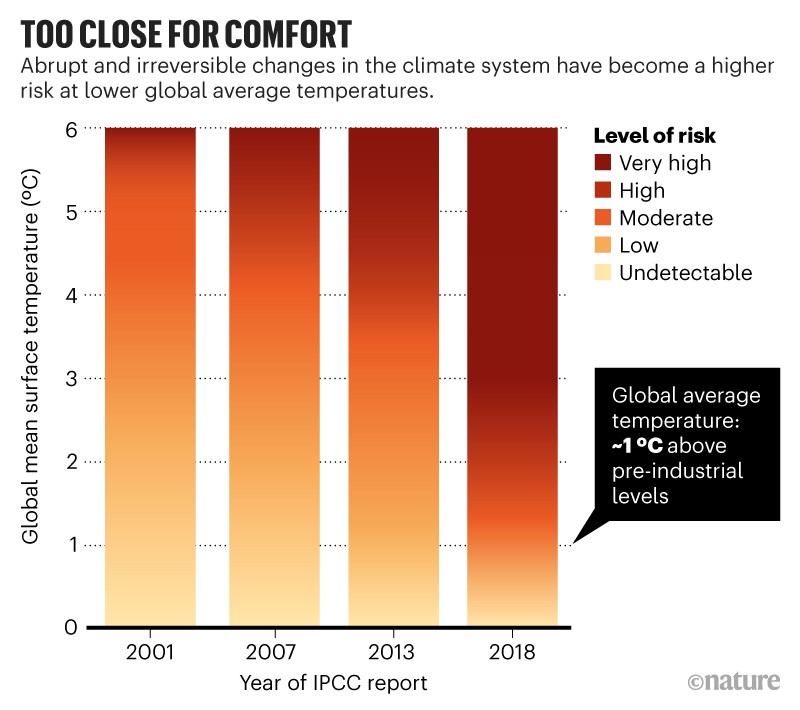
The Intergovernmental Panel on Climate Change (IPCC) introduced the idea of tipping points two decades ago. At that time, these ‘large-scale discontinuities’ in the climate system were considered likely only if global warming exceeded 5 °C above pre-industrial levels. Information summarized in the two most recent IPCC Special Reports (published in 2018 and in September this year)2,3 suggests that tipping points could be exceeded even between 1 and 2 °C of warming (see ‘Too close for comfort’).


Source: IPCC


If current national pledges to reduce greenhouse-gas emissions are implemented — and that’s a big ‘if’ — they are likely to result in at least 3 °C of global warming. This is despite the goal of the 2015 Paris agreement to limit warming to well below 2 °C. Some economists, assuming that climate tipping points are of very low probability (even if they would be catastrophic), have suggested that 3 °C warming is optimal from a cost–benefit perspective. However, if tipping points are looking more likely, then the ‘optimal policy’ recommendation of simple cost–benefit climate-economy models4 aligns with those of the recent IPCC report2. In other words, warming must be limited to 1.5 °C. This requires an emergency response.


Ice collapse


We think that several cryosphere tipping points are dangerously close, but mitigating greenhouse-gas emissions could still slow down the inevitable accumulation of impacts and help us to adapt.


Research in the past decade has shown that the Amundsen Sea embayment of West Antarctica might have passed a tipping point3: the ‘grounding line’ where ice, ocean and bedrock meet is retreating irreversibly. A model study shows5 that when this sector collapses, it could destabilize the rest of the West Antarctic ice sheet like toppling dominoes — leading to about 3 metres of sea-level rise on a timescale of centuries to millennia. Palaeo-evidence shows that such widespread collapse of the West Antarctic ice sheet has occurred repeatedly in the past.


The latest data show that part of the East Antarctic ice sheet — the Wilkes Basin — might be similarly unstable3. Modelling work suggests that it could add another 3–4 m to sea level on timescales beyond a century.


The Greenland ice sheet is melting at an accelerating rate3. It could add a further 7 m to sea level over thousands of years if it passes a particular threshold. Beyond that, as the elevation of the ice sheet lowers, it melts further, exposing the surface to ever-warmer air. Models suggest that the Greenland ice sheet could be doomed at 1.5 °C of warming3, which could happen as soon as 2030.


Thus, we might already have committed future generations to living with sea-level rises of around 10 m over thousands of years3. But that timescale is still under our control. The rate of melting depends on the magnitude of warming above the tipping point. At 1.5 °C, it could take 10,000 years to unfold3; above 2 °C it could take less than 1,000 years6. Researchers need more observational data to establish whether ice sheets are reaching a tipping point, and require better models constrained by past and present data to resolve how soon and how fast the ice sheets could collapse.


Whatever those data show, action must be taken to slow sea-level rise. This will aid adaptation, including the eventual resettling of large, low-lying population centres.


A further key impetus to limit warming to 1.5 °C is that other tipping points could be triggered at low levels of global warming. The latest IPCC models projected a cluster of abrupt shifts7 between 1.5 °C and 2 °C, several of which involve sea ice. This ice is already shrinking rapidly in the Arctic, indicating that, at 2 °C of warming, the region has a 10–35% chance3 of becoming largely ice-free in summer.


Biosphere boundaries

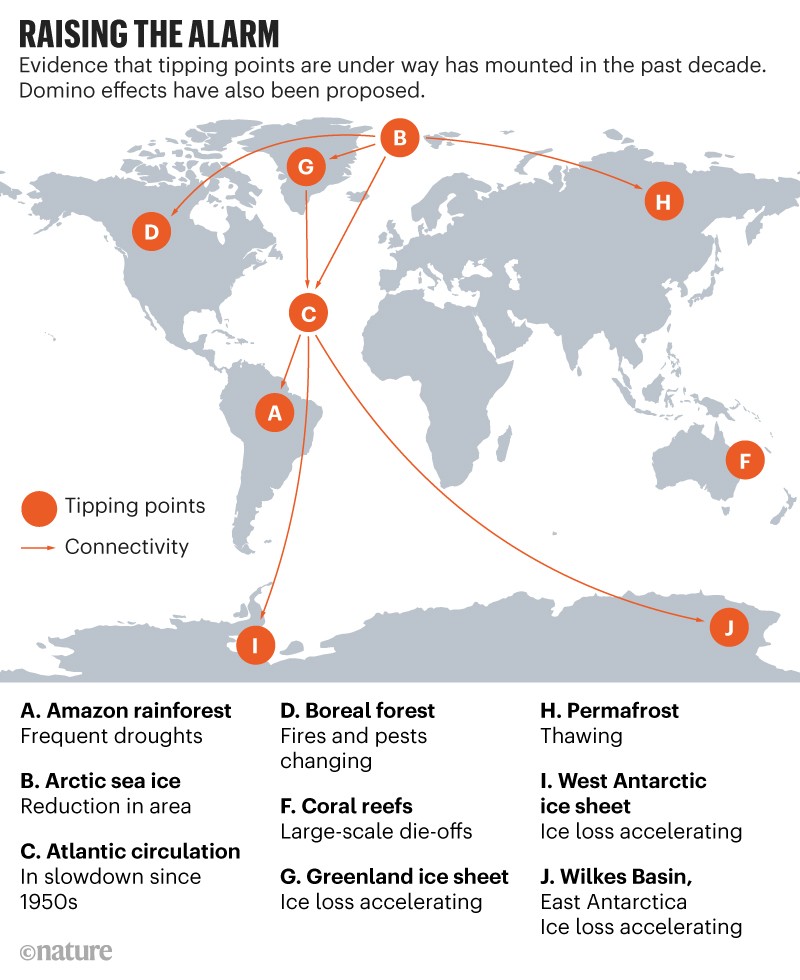
Climate change and other human activities risk triggering biosphere tipping points across a range of ecosystems and scales (see ‘Raising the alarm’).


Source: T. M. Lenton et al.


Ocean heatwaves have led to mass coral bleaching and to the loss of half of the shallow-water corals on Australia’s Great Barrier Reef. A staggering 99% of tropical corals are projected2 to be lost if global average temperature rises by 2 °C, owing to interactions between warming, ocean acidification and pollution. This would represent a profound loss of marine biodiversity and human livelihoods.


As well as undermining our life-support system, biosphere tipping points can trigger abrupt carbon release back to the atmosphere. This can amplify climate change and reduce remaining emission budgets.


Deforestation and climate change are destabilizing the Amazon — the world’s largest rainforest, which is home to one in ten known species. Estimates of where an Amazon tipping point could lie range from 40% deforestation to just 20% forest-cover loss8. About 17% has been lost since 1970. The rate of deforestation varies with changes in policy. Finding the tipping point requires models that include deforestation and climate change as interacting drivers, and that incorporate fire and climate feedbacks as interacting tipping mechanisms across scales.


With the Arctic warming at least twice as quickly as the global average, the boreal forest in the subarctic is increasingly vulnerable. Already, warming has triggered large-scale insect disturbances and an increase in fires that have led to dieback of North American boreal forests, potentially turning some regions from a carbon sink to a carbon source9. Permafrost across the Arctic is beginning to irreversibly thaw and release carbon dioxide and methane — a greenhouse gas that is around 30 times more potent than CO2 over a 100-year period.


Researchers need to improve their understanding of these observed changes in major ecosystems, as well as where future tipping points might lie. Existing carbon stores and potential releases of CO2 and methane need better quantification.


The world’s remaining emissions budget for a 50:50 chance of staying within 1.5 °C of warming is only about 500 gigatonnes (Gt) of CO2. Permafrost emissions could take an estimated 20% (100 Gt CO2) off this budget10, and that’s without including methane from deep permafrost or undersea hydrates. If forests are close to tipping points, Amazon dieback could release another 90 Gt CO2 and boreal forests a further 110 Gt CO211. With global total CO2 emissions still at more than 40 Gt per year, the remaining budget could be all but erased already.


Bleached corals on a reef near the island of Moorea in French Polynesia in the South Pacific.Credit: Alexis Rosenfeld/Getty


Global cascade


In our view, the clearest emergency would be if we were approaching a global cascade of tipping points that led to a new, less habitable, ‘hothouse’ climate state11. Interactions could happen through ocean and atmospheric circulation or through feedbacks that increase greenhouse-gas levels and global temperature. Alternatively, strong cloud feedbacks could cause a global tipping point12,13.


We argue that cascading effects might be common. Research last year14 analysed 30 types of regime shift spanning physical climate and ecological systems, from collapse of the West Antarctic ice sheet to a switch from rainforest to savanna. This indicated that exceeding tipping points in one system can increase the risk of crossing them in others. Such links were found for 45% of possible interactions14.


In our view, examples are starting to be observed. For example, Arctic sea-ice loss is amplifying regional warming, and Arctic warming and Greenland melting are driving an influx of fresh water into the North Atlantic. This could have contributed to a 15% slowdown15 since the mid-twentieth century of the Atlantic Meridional Overturning Circulation (AMOC) , a key part of global heat and salt transport by the ocean3. Rapid melting of the Greenland ice sheet and further slowdown of the AMOC could destabilize the West African monsoon, triggering drought in Africa’s Sahel region. A slowdown in the AMOC could also dry the Amazon, disrupt the East Asian monsoon and cause heat to build up in the Southern Ocean, which could accelerate Antarctic ice loss.


The palaeo-record shows global tipping, such as the entry into ice-age cycles 2.6 million years ago and their switch in amplitude and frequency around one million years ago, which models are only just capable of simulating. Regional tipping occurred repeatedly within and at the end of the last ice age, between 80,000 and 10,000 years ago (the Dansgaard–Oeschger and Heinrich events). Although this is not directly applicable to the present interglacial period, it highlights that the Earth system has been unstable across multiple timescales before, under relatively weak forcing caused by changes in Earth’s orbit. Now we are strongly forcing the system, with atmospheric CO2 concentration and global temperature increasing at rates that are an order of magnitude higher than those during the most recent deglaciation.


Atmospheric CO2 is already at levels last seen around four million years ago, in the Pliocene epoch. It is rapidly heading towards levels last seen some 50 million years ago — in the Eocene — when temperatures were up to 14 °C higher than they were in pre-industrial times. It is challenging for climate models to simulate such past ‘hothouse’ Earth states. One possible explanation is that the models have been missing a key tipping point: a cloud-resolving model published this year suggests that the abrupt break-up of stratocumulus cloud above about 1,200 parts per million of CO2 could have resulted in roughly 8 °C of global warming12.


Some early results from the latest climate models — run for the IPCC’s sixth assessment report, due in 2021 — indicate a much larger climate sensitivity (defined as the temperature response to doubling of atmospheric CO2) than in previous models. Many more results are pending and further investigation is required, but to us, these preliminary results hint that a global tipping point is possible.


To address these issues, we need models that capture a richer suite of couplings and feedbacks in the Earth system, and we need more data — present and past — and better ways to use them. Improving the ability of models to capture known past abrupt climate changes and ‘hothouse’ climate states should increase confidence in their ability to forecast these.


Some scientists counter that the possibility of global tipping remains highly speculative. It is our position that, given its huge impact and irreversible nature, any serious risk assessment must consider the evidence, however limited our understanding might still be. To err on the side of danger is not a responsible option.


If damaging tipping cascades can occur and a global tipping point cannot be ruled out, then this is an existential threat to civilization. No amount of economic cost–benefit analysis is going to help us. We need to change our approach to the climate problem.


Act now


In our view, the evidence from tipping points alone suggests that we are in a state of planetary emergency: both the risk and urgency of the situation are acute (see ‘Emergency: do the maths’).


EMERGENCY: DO THE MATHS

We define emergency (E) as the product of risk and urgency. Risk (R) is defined by insurers as probability (p) multiplied by damage (D). Urgency (U) is defined in emergency situations as reaction time to an alert (Ď„) divided by the intervention time left to avoid a bad outcome (T). Thus:
E = R × U = p × D × Ď„ / T
The situation is an emergency if both risk and urgency are high. If reaction time is longer than the intervention time left (Ď„ / T > 1), we have lost control.

We argue that the intervention time left to prevent tipping could already have shrunk towards zero, whereas the reaction time to achieve net zero emissions is 30 years at best. Hence we might already have lost control of whether tipping happens. A saving grace is that the rate at which damage accumulates from tipping — and hence the risk posed — could still be under our control to some extent.


The stability and resilience of our planet is in peril. International action — not just words — must reflect this.