Ending North Korea Fear. Ian Welsh, Aug. 9, 2017.
So, Trump and Korea have everyone in a tizzy about the possibility of nuclear war. The international community has another set of sanctions going forward, which look like they will close off much of the remaining N. Korean trade, and North Korea is saying nasty things and testing nasty weapons.
Perhaps it’s time to regularize relationships?
It seems to be forgotten that no peace treaty ever ended the Korean war. The North Koreans are scared spitless of West, and let us be frank, not without reason. The fates of Libya and Iraq bear heavy on their mind, to mention two recent events.
People without nukes, whom the West/US doesn’t like, tend to do badly.
The North Koreans have long said that they want a peace treaty. Perhaps one could be arranged for serious agreements to scrap or limit long range nuclear weapons. Scrapping would be a hard sell, because after Qaddafi scrapped his, he got invaded, but some serious limits ought to be possible.
I know this flies against the current mood, but sanctions have been tried now for 60 years and haven’t worked, and the threat keeps getting worse and worse.
Perhaps try something else?
Stop The Bluster - North Korea Is A Nuclear Weapon State. Moon of Alabama. Aug. 9, 2017.
The Washington Post headlined today: Trump threatens ‘fire and fury’ in response to North Korean threats
Just another Trump bluster, I thought. Such are no longer a reason to read a story. But what are those "North Korean threats" he "responded" to? I had not seen any of those. Diving into the story I found :
President Trump used his harshest language yet to warn North Korea on Tuesday that it will be “met with fire and fury and frankly power, the likes of which this world has never seen before,” if it does not stop threatening the United States.
It was not immediately clear what Trump was responding to.
The Washington Post needs to fire its headline writer. Why assert that Trump responded to "threats" when there were none? Why assert a reason when you have no fucking clue why he did what he did?
A different shabby site claims that the base for Trump's played-up nonsense was a WaPo piece published the day before:
On July 4th the DPRK launched its first Intercontinental Ballistic Missile. A second test was successfully launched on July 29 under realistic operational conditions. The DPRK successfully tested nuclear devices at least five times - including a hydrogen device with potentially megatons of explosive power. It has enough nuclear material for some 40-60 weapons. All DPRK claims about progress in its missile and nuke programs have, sooner or later, been proven as truthful. There was and is no reason to doubt its March 2016 assertion.
North Korea is for all practical purposes a nuclear weapon state with the ability to deliver nukes onto the continental United States.
This is not news. Talk about "fire and fury" or an ultimatum to North Korea or of preemptive strikes is all nonsense. Nothing the U.S. can do to North Korea can prevent a response that would nuke and destroy Washington DC or some other U.S. city.
North Korea has good reasons to want nukes and the U.S. missed all chances to remove those reasons. It is way too late to lament about that.
Why North Korea Needs Nukes - And How To End That. Moon of Alabama. Apr. 14, 2017.
Media say,
the U.S. may
or may not
kill a number of North Koreans
for this or that
or no reason
but call North Korea
'the volatile and unpredictable regime'
Now consider what the U.S. media don't tell you about Korea:
How Bio-Weapons Led To Torture ... And North Korean Nukes. MoA. Apr. 27, 2017.
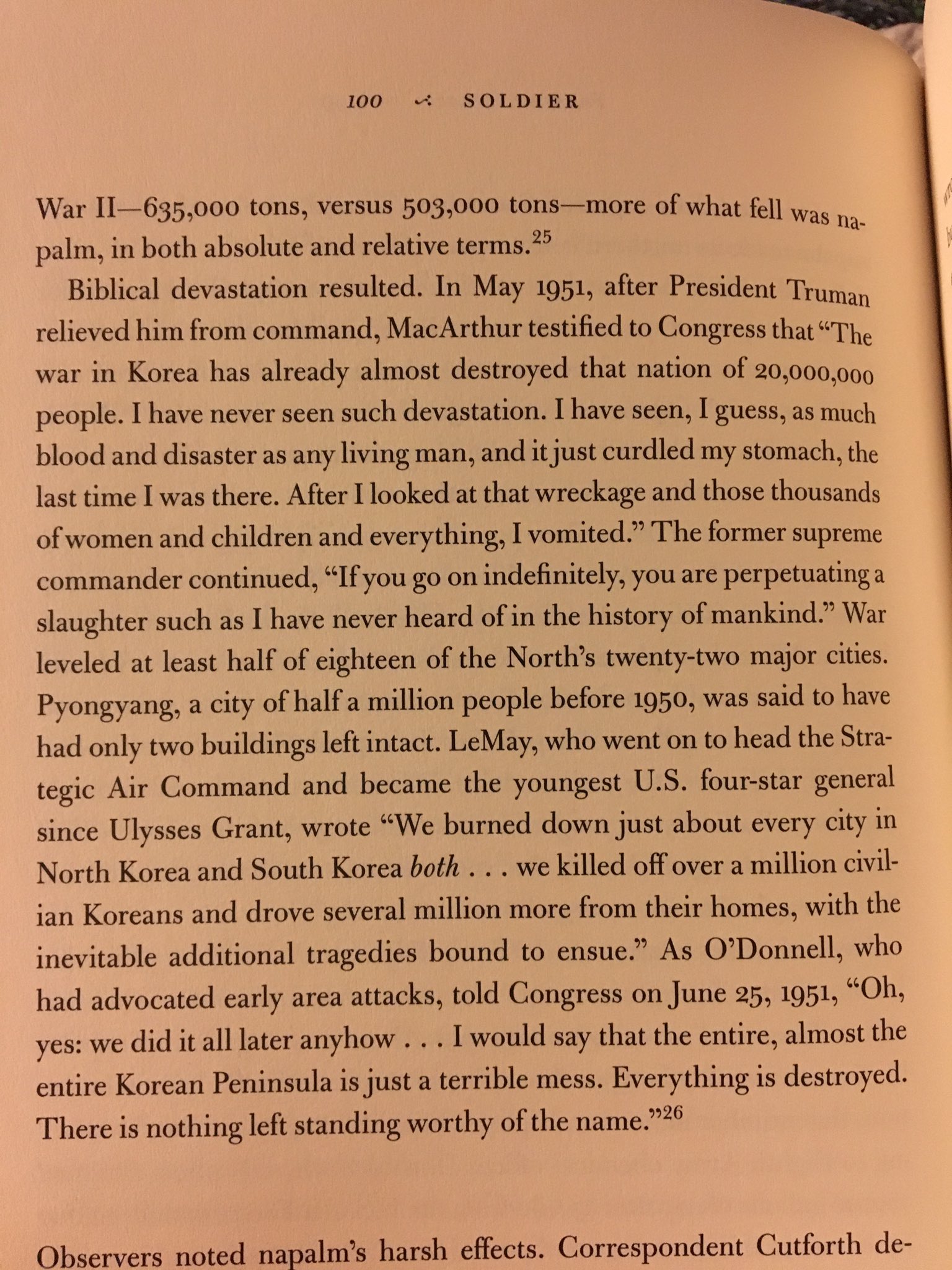
In Why North Korea Needs Nukes - And How To End That we pointed to the utter destruction the U.S. and its allies waged in the war on Korea on all parts of the country. That North Korea seeks "weapons of mass destruction" is quite understandable when one takes into account the hundreds of thousands tons of napalm used against it. But even Napalm and the criminal destruction of North Korean dams were not the worst depravation the U.S. applied. Biological warfare agents, primarily anthrax, were dropped over North Korea and China and killed civilians. The U.S./UN command denied such use and covered it up. One consequence of that cover up was the development of torture methods in the U.S. SERE pilot training programs and their later proliferation into criminal abuses in Guantanamo, Abu Graibh and elsewhere. An important piece of evidence of this trail was recently and for the first time re-published on the web
In the 1950s war on Korea heavy air to air fights were waged near the Chinese border which led to significant losses of airplane on both sides especially along the MiG Alley:
USAF pilots nicknamed April 12, 1951 "Black Thursday", after 30 MiG-15s attacked three squadrons of B-29 bombers (36 planes) escorted by approximately 100 F-80s and F-84s. The MiGs were fast enough to engage the B-29s and extend away from their escorts. Three B-29s were shot down and seven more were damaged, with no casualties on the communist side.
On "Black Thursday" and other occasions U.S. bomber pilots were captured. Some of them admitted to have dropped biological weapons over China and northern Korea. Their confessions were published in writing and publicized on Korean, Chinese and Russian radio.
The U.S. (UN) command under U.S. General MacArthur denied any use of biological warfare agents. It claimed that the downed pilots were tortured to give false confessions.
Since World War II the U.S. Airforce and Navy had established training courses in Survival, Evasion, Resistance and Escape (SERE) for pilots that might be captured by enemies. During these courses interrogations were staged to provide realistic training. After the Korea War anti-torture training was added. Torture of "prisoners" was "simulated" with the trainees. Decades later, during the war of terror and on Iraq, the CIA hired two psychologists as "behavioral science consultants" from the SERE training staff to teach its agents how to use torture on prisoners. The absolutely inhuman and dangerous methods those SERE "experts" devised proliferated to the U.S. military which, together with the CIA, used them on alleged enemy combatants in Abu Ghraib, Guantanamo and other places.
According to the Senate Armed Services Committee Report (pdf) on U.S. torturing of prisoners at Abu Ghraib, Guantanamo and CIA black sites, SERE techniques originated in Chinese Communist methods in the Korean War employed to extract false confessions from captured U.S. personal.
(During the 1960s the CIA itself developed additional "scientific" torture methods and published them in the KUBARK Counterintelligence Interrogation and Human Resource Exploitation Training Manual. U.S. personal as well as several south American militia were trained in and used these abusive and illegal methods.)
The torture training at the SERE schools and the abuses were all based on a big lie.
The U.S. had used biological weapons in the Korea war. It also used chemical weapons and suppressed investigations into it. Its pilots dropped bombs with biological warfare agents over China and Korea. Theirs were not false confessions extracted by Chinese Communist methods. The captured U.S. pilots were telling the truth.
The SERE torture resistance training and its abuse are based on the bigger lie about the non-use of biological agents in the war on Korea.
(The Geneva Protocol of 1925 generally prohibited the use of biological agents but the specific Biological and Toxin Weapons Convention was only developed and signed in 1972.)
The U.S. and UK developed extensive biological warfare programs during World War II but those weapons were not put to use in the European theater. The Japanese used biological weapons, with mixed success, in China and elsewhere. At the end of World War II the Japanese biological warfare Unit 731 was taken over by the U.S. military:
During and after the war on Korea the Chinese government alleged the use of biological weapons on Korean and Chinese civilians by the U.S. The U.S. denied. A commission was called upon to investigate:
Report of the International Scientific Commission for the Investigation of the Facts Concerning Bacterial Warfare in Korea and China. - pdf
But there is a serious defect in U.S. foreign policy when people who work in that field believe their own side's propaganda instead of obtaining a realistic reading which necessarily must include facts and some understanding of the viewpoint of the other side.
This anti-DPRK Resolution was unanimously approved by all 15 members of the UNSC, including North Korea’s only allies, China and Russia. They may have had their own strategic and selfish reasons for their lack of solidarity, for not vetoing the Resolution and instead proposing diplomatic measures – or else. Diplomatic measures which might have called to reason Washington and the Pentagon hawks, as well as stopped Trump’s monstrous warmongering, shouting nuclear threats from his golf club in Bedminster, N.J., “They will be met with fire and fury like the world has never seen.” Russia and China could have proposed a counter Resolution seeking dialogue and forcing Washington to stop its belligerence. – They didn’t. And that’s sad.
It is an outright shame to what extent literally the entire world is bending over backwards to please Washington – and, as always, its dark and deep state handlers that pull the strings on the White House puppets. Have we become a world of vassals to a dying empire?
The same military aggressors led by Washington, more than 60 years ago have destroyed North Korea to rubble, decimating its then population of 10 million by a third. The US has never allowed the signing of a Peace Agreement. Instead the Democratic People’s Republic of Korea (DPRK) under a shaky armistice pact was and is permanently threatened by Washington’s huge military bases in South Korea and Japan with fleets of war planes and vessels. The DPRK’s airspace is frequently invaded by US bombers; military maneuvers by the US armed forces with Japan and South Korea are repeated intimidations on the peaceful lives of the North Korean people. A 250 km long strictly enforced Military Demarcation Line at the 38th parallel north is keeping Korean families separated for more than three generation.
What the Kim-Jong-un regime is showing the world is nothing more than its readiness to defend the DPRK’s achievements of a marvelously rebuilt country with full social benefits of free education and health services for more than 25 million people. The nuclear deterrent is no danger to anyone, not Japan, not its Southern brother, and least the United States. And Trump knows damn well. His ‘fire and fury’boasting is nothing more than sabre rattling, showmanship, as it pertains to a golfing multi-billionaire psychopath, who is dreaming of running a thanks-goodness faltering empire. He wouldn’t dare touching North Korea, because then, he would face the fire and fury of DPRK’s allies, Russia and China, despite their unfortunate UNSC vote.
The UN sanctions, if observed, would reduce North Korea’s annual export earnings by a third, i.e. by an estimated US$ 1 billion. It might plunge the country, already isolated by the west’s previous sanctions into extreme hardship and famine. Although it is unlikely that China, with whom North Korea deals for 90% of its external trade, would adhere to such sanctions, it is nevertheless an unfair threat.
—–
Let’s look for a moment at the legality of the UN Sanctions Resolution in a broader context – in a context that the world’s populace has either never known or easily forgets.
The legality of UN imposed economic sanctions is highly questionable in most cases, and particularly in the case of North Korea, as they may affect Human Rights, or more specifically the civilian’s economic, social and cultural rights (ESCR), as adverse collateral effects may lead to a humanitarian emergency, i.e. the shortage of certain goods and services essential for the guarantee of basic standards of living(Gebs, Robin. “Humanitarian Safeguards in Economic Sanctions Regimes: A Call for Automatic Suspension Clauses, Periodic Monitoring, and Follow-Up Assessment of Long-Term Effects”. The Harvard Human Rights Journal 18 (2005), p. 173).
In the case of North Korea, such sanctions are outright farcical, if not illegal, since the main aggressor is not and has never been the DPRK, but the United States.
It would, however, never occur to any nation on this lovely planet to introduce a sanctions regime on the US of A through the foremost Peace and Security body of the United Nations. – And why not? – Because they are all afraid of US retaliations. Though, Russia and China and the block of the Shanghai Cooperation Organization (SCO) that already comprises half of the world’s population and controls one third of the globes economic output – and is clearly in the process of fully detaching themselves from the US-dollar hegemony – they should no longer fear retaliations – should they?
North Korea nuclear crisis: Putin warns of planetary catastrophe. Justin McCurry and Tom Phillips, The Guardian. Sep. 5, 2017.
As Kim Jong-un reportedly prepares further missile launch, Russian president says further sanctions would be ‘useless’
Green Beret Warns: “Skepticism Will Vanish When The Power Suddenly Fails Across the United States”. Jeremiah Johnson, SHTFplan.com. Sep. 4, 2017.
A Murderous History of Korea. Bruce Cumings, London Review of Books. May 18, 2017.
So, Trump and Korea have everyone in a tizzy about the possibility of nuclear war. The international community has another set of sanctions going forward, which look like they will close off much of the remaining N. Korean trade, and North Korea is saying nasty things and testing nasty weapons.
Perhaps it’s time to regularize relationships?
It seems to be forgotten that no peace treaty ever ended the Korean war. The North Koreans are scared spitless of West, and let us be frank, not without reason. The fates of Libya and Iraq bear heavy on their mind, to mention two recent events.
People without nukes, whom the West/US doesn’t like, tend to do badly.
The North Koreans have long said that they want a peace treaty. Perhaps one could be arranged for serious agreements to scrap or limit long range nuclear weapons. Scrapping would be a hard sell, because after Qaddafi scrapped his, he got invaded, but some serious limits ought to be possible.
I know this flies against the current mood, but sanctions have been tried now for 60 years and haven’t worked, and the threat keeps getting worse and worse.
Perhaps try something else?
Stop The Bluster - North Korea Is A Nuclear Weapon State. Moon of Alabama. Aug. 9, 2017.
The Washington Post headlined today: Trump threatens ‘fire and fury’ in response to North Korean threats
Just another Trump bluster, I thought. Such are no longer a reason to read a story. But what are those "North Korean threats" he "responded" to? I had not seen any of those. Diving into the story I found :
President Trump used his harshest language yet to warn North Korea on Tuesday that it will be “met with fire and fury and frankly power, the likes of which this world has never seen before,” if it does not stop threatening the United States.
It was not immediately clear what Trump was responding to.
The Washington Post needs to fire its headline writer. Why assert that Trump responded to "threats" when there were none? Why assert a reason when you have no fucking clue why he did what he did?
A different shabby site claims that the base for Trump's played-up nonsense was a WaPo piece published the day before:
The president was responding to a report in the Washington Post that, according to a confidential U.S. intelligence assessment presented late last month, the North Korean regime has “successfully produced a miniaturized nuclear warhead that can fit inside its missiles.”That report was again just bluster. The DPRK (North Korea) had announced a miniaturized nuclear device in March 2016. It even published pictures of it.
On July 4th the DPRK launched its first Intercontinental Ballistic Missile. A second test was successfully launched on July 29 under realistic operational conditions. The DPRK successfully tested nuclear devices at least five times - including a hydrogen device with potentially megatons of explosive power. It has enough nuclear material for some 40-60 weapons. All DPRK claims about progress in its missile and nuke programs have, sooner or later, been proven as truthful. There was and is no reason to doubt its March 2016 assertion.
North Korea is for all practical purposes a nuclear weapon state with the ability to deliver nukes onto the continental United States.
This is not news. Talk about "fire and fury" or an ultimatum to North Korea or of preemptive strikes is all nonsense. Nothing the U.S. can do to North Korea can prevent a response that would nuke and destroy Washington DC or some other U.S. city.
North Korea has good reasons to want nukes and the U.S. missed all chances to remove those reasons. It is way too late to lament about that.
Why North Korea Needs Nukes - And How To End That. Moon of Alabama. Apr. 14, 2017.
Media say,
the U.S. may
or may not
kill a number of North Koreans
for this or that
or no reason
but call North Korea
'the volatile and unpredictable regime'
Now consider what the U.S. media don't tell you about Korea:
BEIJING, March 8 (Xinhua) -- China proposed "double suspension" to defuse the looming crisis on the Korean Peninsula, Chinese Foreign Minister Wang Yi said Wednesday.
"As a first step, the Democratic People's Republic of Korea (DPRK) may suspend its nuclear and missile activities in exchange for the suspension of large-scale U.S.-Republic of Korea (ROK) military exercises," Wang told a press conference on the sidelines of the annual session of the National People's Congress.
...
Wang said the nuclear issue on the Korean Peninsula is mainly between the DPRK and the United States, but China, as a next-door neighbor with a lips-and-teeth relationship with the Peninsula, is indispensable to the resolution of the issue.
FM Wang, 'the lips', undoubtedly transmitted an authorized message from North Korea: "The offer is (still) on the table and China supports it."
North Korea has made the very same offer in January 2015. The Obama administration rejected it. North Korea repeated the offer in April 2016 and the Obama administration rejected it again. This March the Chinese government conveyed and supported the long-standing North Korean offer. The U.S. government, now under the Trump administration, immediately rejected it again. The offer, made and rejected three years in a row, is sensible. Its rejection only led to a bigger nuclear arsenal and to more missiles with longer reach that will eventually be able to reach the United States.
North Korea is understandably nervous each and every time the U.S. and South Korea launch their very large yearly maneuvers and openly train for invading North Korea and for killing its government and people. The maneuvers have large negative impacts on North Korea's economy.
North Korea justifies its nuclear program as the economically optimal way to respond to these maneuvers.
Each time the U.S. and South Korea launch their very large maneuvers, the North Korean conscription army (1.2 million strong) has to go into a high state of defense readiness. Large maneuvers are a classic starting point for military attacks. The U.S.-South Korean maneuvers are (intentionally) held during the planting (April/May) or harvesting (August) season for rice when North Korea needs each and every hand in its few arable areas. Only 17% of the northern landmass is usable for agriculture and the climate in not favorable. The cropping season is short. Seeding and harvesting days require peak labor.
The southern maneuvers directly threaten the nutritional self-sufficiency of North Korea. In the later 1990s they were one of the reasons behind a severe famine. (Lack of hydrocarbons and fertilizer due to sanctions as well as a too rigid economic system were other main reasons.)
Its nuclear deterrent allows North Korea to reduce its conventional military readiness especially during the all important agricultural seasons. Labor withheld from the fields and elsewhere out of military necessity can go back to work. This is now the official North Korean policy known as 'byungjin'. (Byungjin started informally in the mid 2000nds after U.S. President Bush tuned up his hostile policy towards North Korea - Chronology of U.S.-North Korean Nuclear and Missile Diplomacy)
A guaranteed end of the yearly U.S. maneuvers would allow North Korea to lower its conventional defenses without relying on nukes. The link between the U.S. maneuvers and the nuclear deterrent North Korea is making in its repeated offer is a direct and logical connection.
The North Korean head of state Kim Jong-un has officially announced a no-first-use policy for its nuclear capabilities:
After decades of emphasizing military strength under his father, Korea is moving toward Kim's “byongjin” — a two-pronged approach aimed at enhancing nuclear might while improving living conditions.
The byongjin strategy, despised by the Obama administration, has been successful:
What are the sources of [North Korea's economic] growth? One explanation might be that less is now spent on the conventional military sector, while nuclear development at this stage is cheaper—it may only cost 2 to 3 percent of GNP, according to some estimates. Theoretically, byungjin is more “economy friendly” than the previous “songun” or military-first policy which supposedly concentrated resources on the military.
To understand why North Korea fears U.S. aggressiveness consider the utter devastation caused mostly by the U.S. during the Korea War:
"As a first step, the Democratic People's Republic of Korea (DPRK) may suspend its nuclear and missile activities in exchange for the suspension of large-scale U.S.-Republic of Korea (ROK) military exercises," Wang told a press conference on the sidelines of the annual session of the National People's Congress.
...
Wang said the nuclear issue on the Korean Peninsula is mainly between the DPRK and the United States, but China, as a next-door neighbor with a lips-and-teeth relationship with the Peninsula, is indispensable to the resolution of the issue.
FM Wang, 'the lips', undoubtedly transmitted an authorized message from North Korea: "The offer is (still) on the table and China supports it."
North Korea has made the very same offer in January 2015. The Obama administration rejected it. North Korea repeated the offer in April 2016 and the Obama administration rejected it again. This March the Chinese government conveyed and supported the long-standing North Korean offer. The U.S. government, now under the Trump administration, immediately rejected it again. The offer, made and rejected three years in a row, is sensible. Its rejection only led to a bigger nuclear arsenal and to more missiles with longer reach that will eventually be able to reach the United States.
North Korea is understandably nervous each and every time the U.S. and South Korea launch their very large yearly maneuvers and openly train for invading North Korea and for killing its government and people. The maneuvers have large negative impacts on North Korea's economy.
North Korea justifies its nuclear program as the economically optimal way to respond to these maneuvers.
Each time the U.S. and South Korea launch their very large maneuvers, the North Korean conscription army (1.2 million strong) has to go into a high state of defense readiness. Large maneuvers are a classic starting point for military attacks. The U.S.-South Korean maneuvers are (intentionally) held during the planting (April/May) or harvesting (August) season for rice when North Korea needs each and every hand in its few arable areas. Only 17% of the northern landmass is usable for agriculture and the climate in not favorable. The cropping season is short. Seeding and harvesting days require peak labor.
The southern maneuvers directly threaten the nutritional self-sufficiency of North Korea. In the later 1990s they were one of the reasons behind a severe famine. (Lack of hydrocarbons and fertilizer due to sanctions as well as a too rigid economic system were other main reasons.)
Its nuclear deterrent allows North Korea to reduce its conventional military readiness especially during the all important agricultural seasons. Labor withheld from the fields and elsewhere out of military necessity can go back to work. This is now the official North Korean policy known as 'byungjin'. (Byungjin started informally in the mid 2000nds after U.S. President Bush tuned up his hostile policy towards North Korea - Chronology of U.S.-North Korean Nuclear and Missile Diplomacy)
A guaranteed end of the yearly U.S. maneuvers would allow North Korea to lower its conventional defenses without relying on nukes. The link between the U.S. maneuvers and the nuclear deterrent North Korea is making in its repeated offer is a direct and logical connection.
The North Korean head of state Kim Jong-un has officially announced a no-first-use policy for its nuclear capabilities:
"As a responsible nuclear weapons state, our republic will not use a nuclear weapon unless its sovereignty is encroached upon by any aggressive hostile forces with nukes," Kim told the Workers' Party of Korea congress in Pyongyang. Kim added that the North "will faithfully fulfill its obligation for non-proliferation and strive for the global denuclearization."During the congress, as elsewhere, Kim Jong Un also emphasized (transcript, pdf, v. slow) the above described connection between nuclear armament and economic development. Summarized:
After decades of emphasizing military strength under his father, Korea is moving toward Kim's “byongjin” — a two-pronged approach aimed at enhancing nuclear might while improving living conditions.
The byongjin strategy, despised by the Obama administration, has been successful:
What are the sources of [North Korea's economic] growth? One explanation might be that less is now spent on the conventional military sector, while nuclear development at this stage is cheaper—it may only cost 2 to 3 percent of GNP, according to some estimates. Theoretically, byungjin is more “economy friendly” than the previous “songun” or military-first policy which supposedly concentrated resources on the military.
To understand why North Korea fears U.S. aggressiveness consider the utter devastation caused mostly by the U.S. during the Korea War:
Imperial Japan occupied Korea from 1905 to 1945 and tried to assimilate it. A nominal communist resistance under Kim Il-sung and others fought against the Japanese occupation. After the Japanese WWII surrender in 1945 the U.S. controlled and occupied the mostly agricultural parts of Korea below the arbitrarily chosen 38th parallel line. The allied Soviet Union controlled the industrialized part above the line. They had agreed on a short trusteeship of a united and independent country. In the upcoming cold war the U.S. retracted on the agreement and in 1948 installed a South Korean proxy dictatorship under Syngman Rhee. This manifested an artificial border the Koreans had not asked for and did not want. The communists still commanded a strong and seasoned resistance movement in the south and hoped to reunite the country. The Korea War ensued. It utterly destroyed the country. All of Korea was severely effected but especially the industrialized north which lost about a third of its population and all of its reasonably well developed infrastructure - roads, factories and nearly all of its cities.
Every Korean family was affected. Ancestor worship is deeply embedded in the Korean psyche and its collectivist culture. No one has forgotten the near genocide and no one in Korea, north or south, wants to repeat the experience.
The country would reunite if China and the U.S. (and Russia) could agree upon its neutrality. That will not happen anytime soon. But the continued danger of an "accidental" war in Korea would be much diminished if the U.S. would accept the North Korean offer - an end to aggressive behavior like threatening maneuvers against the north, in exchange for a verified stop of the northern nuclear and missile programs. North Korea has to insist on this condition out of sheer economic necessity.
The U.S. government and the "western" media hide the rationality of the northern offer behind the propaganda phantasm of "the volatile and unpredictable regime".
But it is not Korea, neither north nor south, that is the "volatile and unpredictable" entity here.
Update:
Yesterday's Day of the Sun / Juche 105 (the 105th birth anniversary of Kim Il-sung) parade in Pyongyang went along without a hitch and without interference from the U.S. side.
Several new types of missile carrying Transporter-Erector-Launcher vehicles (TELs) were shown. The three hour TV transmission is available here. The military equipment display starts around 2h14m; the nuclear capable carriers are seen from 2h20m onward.
An early-impression remark from The Diplomat: North Korea's 2017 Military Parade Was a Big Deal. Here Are the Major Takeaways
Even though Pyongyang withheld from testing this weekend amid rumors of possible retaliation by the United States, North Korea is still looking to improve its missile know-how. Moreover, the long-dreaded ICBM flight test also might not be too far off now. Given the ever-growing number of TELs — both wheeled and tracked — North Korea may soon field nuclear forces amply large that a conventional U.S.-South Korea first strike may find it impossible to fully disarm Pyongyang of a nuclear retaliatory capability. That would give the North Korean regime what it’s always sought with its nuclear and ballistic missile program: an absolute guarantee against coercive removal.The "absolute guarantee against coercive removal" would, in consequence, allow for much smaller conventional forces and less resources spend on the military. This again will enable faster economic development for the people in North Korea. The byongjin strategy will have reached its aim.
How Bio-Weapons Led To Torture ... And North Korean Nukes. MoA. Apr. 27, 2017.
In Why North Korea Needs Nukes - And How To End That we pointed to the utter destruction the U.S. and its allies waged in the war on Korea on all parts of the country. That North Korea seeks "weapons of mass destruction" is quite understandable when one takes into account the hundreds of thousands tons of napalm used against it. But even Napalm and the criminal destruction of North Korean dams were not the worst depravation the U.S. applied. Biological warfare agents, primarily anthrax, were dropped over North Korea and China and killed civilians. The U.S./UN command denied such use and covered it up. One consequence of that cover up was the development of torture methods in the U.S. SERE pilot training programs and their later proliferation into criminal abuses in Guantanamo, Abu Graibh and elsewhere. An important piece of evidence of this trail was recently and for the first time re-published on the web
In the 1950s war on Korea heavy air to air fights were waged near the Chinese border which led to significant losses of airplane on both sides especially along the MiG Alley:
USAF pilots nicknamed April 12, 1951 "Black Thursday", after 30 MiG-15s attacked three squadrons of B-29 bombers (36 planes) escorted by approximately 100 F-80s and F-84s. The MiGs were fast enough to engage the B-29s and extend away from their escorts. Three B-29s were shot down and seven more were damaged, with no casualties on the communist side.
On "Black Thursday" and other occasions U.S. bomber pilots were captured. Some of them admitted to have dropped biological weapons over China and northern Korea. Their confessions were published in writing and publicized on Korean, Chinese and Russian radio.
The U.S. (UN) command under U.S. General MacArthur denied any use of biological warfare agents. It claimed that the downed pilots were tortured to give false confessions.
Since World War II the U.S. Airforce and Navy had established training courses in Survival, Evasion, Resistance and Escape (SERE) for pilots that might be captured by enemies. During these courses interrogations were staged to provide realistic training. After the Korea War anti-torture training was added. Torture of "prisoners" was "simulated" with the trainees. Decades later, during the war of terror and on Iraq, the CIA hired two psychologists as "behavioral science consultants" from the SERE training staff to teach its agents how to use torture on prisoners. The absolutely inhuman and dangerous methods those SERE "experts" devised proliferated to the U.S. military which, together with the CIA, used them on alleged enemy combatants in Abu Ghraib, Guantanamo and other places.
According to the Senate Armed Services Committee Report (pdf) on U.S. torturing of prisoners at Abu Ghraib, Guantanamo and CIA black sites, SERE techniques originated in Chinese Communist methods in the Korean War employed to extract false confessions from captured U.S. personal.
(During the 1960s the CIA itself developed additional "scientific" torture methods and published them in the KUBARK Counterintelligence Interrogation and Human Resource Exploitation Training Manual. U.S. personal as well as several south American militia were trained in and used these abusive and illegal methods.)
The torture training at the SERE schools and the abuses were all based on a big lie.
The U.S. had used biological weapons in the Korea war. It also used chemical weapons and suppressed investigations into it. Its pilots dropped bombs with biological warfare agents over China and Korea. Theirs were not false confessions extracted by Chinese Communist methods. The captured U.S. pilots were telling the truth.
The SERE torture resistance training and its abuse are based on the bigger lie about the non-use of biological agents in the war on Korea.
(The Geneva Protocol of 1925 generally prohibited the use of biological agents but the specific Biological and Toxin Weapons Convention was only developed and signed in 1972.)
The U.S. and UK developed extensive biological warfare programs during World War II but those weapons were not put to use in the European theater. The Japanese used biological weapons, with mixed success, in China and elsewhere. At the end of World War II the Japanese biological warfare Unit 731 was taken over by the U.S. military:
[General] MacArthur struck a deal with Japanese informants—he secretly granted immunity to the physicians of Unit 731, including their leader, in exchange for providing America, but not the other wartime allies, with their research on biological warfare and data from human experimentation. American occupation authorities monitored the activities of former unit members, including reading and censoring their mail. The U.S. believed that the research data was valuable.
During and after the war on Korea the Chinese government alleged the use of biological weapons on Korean and Chinese civilians by the U.S. The U.S. denied. A commission was called upon to investigate:
To convince the world of the truth of their claims, the North Koreans and Chinese, sponsored a purported independent commission, using the auspices of the World Peace Council, gathering together a number of leftist scientists from around the world. Most surprisingly, this commission, which came to be known as the International Scientific Commission, or ISC, was headed by one of the foremost British scientists of his time, Sir Joseph Needham. The ISC travelled to China and North Korea in the summer of 1952 and by the end of the year produced a report that corroborated the Chinese and North Korean claims that the U.S. had used biological weapons in an experimental fashion on civilian populations.For a long time the commission's report and its appendices with the witness statements were suppressed and not available online. Jefferey Kay, a psychologist and author living in northern California, dug them up and recently published them (recommended) on the web for the first time. You can read them here:
Report of the International Scientific Commission for the Investigation of the Facts Concerning Bacterial Warfare in Korea and China. - pdf
Appendixes AA and BB concerning claims of air attacks against various villages in Northeastern China in the Spring of 1952. - pdf
Sir Joseph Needham was blacklisted by the U.S. during the McCarthy anti-communist campaign.
Needham's investigations have since been confirmed by other scholars investigating the general case:
It is the purpose of this article to consider the validity of these [U.S. military denials] in light of the research which we conducted in preparing our recent book, The United States and Biological Warfare: secrets of the Early Cold War and Korea. In that book we conclude that the United States engaged in large-scale field tests of biological weapons against the Asian countries and with some additional evidence we continue to believe that is the case.
General MacArthur, one of the foremost war criminals ever, covered up the war crimes of the Japanese and especially of Unit 731. He took care to integrate the Japanese biological weapon experience into the U.S. military resources. Under his command biological agents were then used against Korean and and Chinese civilians and military units. When his pilots confessed, he denied all such reports and alleged "brainwashing" through torture by the Chinese. This again led to torture "simulations" in U.S. SERE training from which recent U.S. torture in Iraq, Afghanistan and elsewhere derived.
U.S. media and the public have a general amnesia whenever it comes to U.S. war crimes - no matter how recent. The Senate report on CIA torture in Iraq and elsewhere is still suppressed. But U.S. war crimes do not end. Whenever "threatened" with compromise, the U.S. tends to seeks the belligerent way. As Noam Chomsky reiterates in relation to the current campaign for another war on Korea:
Considering the historical record of the United States of committing and covering up war-crimes as well as its general belligerence, North Korea and other nations are probably well advised to stick to their nuclear and missile programs.
Foreign Policy Blindness And North Korea. MoA. Apr. 15, 2009.
Matt Dupuis blogs at FP Watch and currently also at World Politics Review.
About North Korea's decision to kick out IAEA inspectors and to restart its nuclear programs he asks:
What is Motivating Pyongyang This Week?:
Simple questions, deserve simple answers: North Korea believe in Pacta sunt servanda, the U.S. does not.
North Korea needs primary energy, i.e. oil, and is willing to make deals to get some. It sticks to such deals but only as long as the other party adheres to those too.
In all three examples given in Dupuis question it was NOT North Korea that "later reversed course so defiantly" but the U.S. that broke spirit and letter of the deals it had made.
1. Agreed framework:
2. Moratorium on ballistic missiles:
3. Six Party Talks:
Dupuis' question is quite typical for general U.S. public views of foreign policy issues: very one-sided and blind towards its own faults.
Sir Joseph Needham was blacklisted by the U.S. during the McCarthy anti-communist campaign.
Needham's investigations have since been confirmed by other scholars investigating the general case:
It is the purpose of this article to consider the validity of these [U.S. military denials] in light of the research which we conducted in preparing our recent book, The United States and Biological Warfare: secrets of the Early Cold War and Korea. In that book we conclude that the United States engaged in large-scale field tests of biological weapons against the Asian countries and with some additional evidence we continue to believe that is the case.
General MacArthur, one of the foremost war criminals ever, covered up the war crimes of the Japanese and especially of Unit 731. He took care to integrate the Japanese biological weapon experience into the U.S. military resources. Under his command biological agents were then used against Korean and and Chinese civilians and military units. When his pilots confessed, he denied all such reports and alleged "brainwashing" through torture by the Chinese. This again led to torture "simulations" in U.S. SERE training from which recent U.S. torture in Iraq, Afghanistan and elsewhere derived.
U.S. media and the public have a general amnesia whenever it comes to U.S. war crimes - no matter how recent. The Senate report on CIA torture in Iraq and elsewhere is still suppressed. But U.S. war crimes do not end. Whenever "threatened" with compromise, the U.S. tends to seeks the belligerent way. As Noam Chomsky reiterates in relation to the current campaign for another war on Korea:
[V]ery strikingly [..] there’s one lesson that you discover when you carefully look at the historical record. What I just described about North Korea is pretty typical. Over and over again, there are possibilities of diplomacy and negotiation, which might not succeed—you can’t be sure if you don’t try them—but which look pretty promising, which are abandoned, dismissed, literally without comment, in favor of increased force and violence.For an example see this influential sitting U.S. Senator who argues for "preemptive" strikes against North Korea's missile program without any regard for the people who's life would be destroyed by them:
“It would be bad for the Korean Peninsula. It would be bad for China. It would be bad for Japan, be bad for South Korea. It would be the end of North Korea. But what it would not do is hit America and the only way it could ever come to America is with a missile.”
Considering the historical record of the United States of committing and covering up war-crimes as well as its general belligerence, North Korea and other nations are probably well advised to stick to their nuclear and missile programs.
Foreign Policy Blindness And North Korea. MoA. Apr. 15, 2009.
Matt Dupuis blogs at FP Watch and currently also at World Politics Review.
About North Korea's decision to kick out IAEA inspectors and to restart its nuclear programs he asks:
What is Motivating Pyongyang This Week?:
I'm speculating, but maybe North Korea knew its launch would prompt the US to turn to the UNSC for retaliatory action, which it could then use as a pretext to jettison the Six-Party Talks and related accords it was no longer interested in adhering to. If that's the case, it raises larger questions about Pyongyang's motivations, specifically why they have periodically agreed to cap or halt illicit weapons programs (as it did under the 1994 Agreed Framework, the moratorium on ballistic missiles in the late 1990s, and the more recent accords under the Six-Party Talks) but later reversed course so defiantly.(bold added)
Simple questions, deserve simple answers: North Korea believe in Pacta sunt servanda, the U.S. does not.
North Korea needs primary energy, i.e. oil, and is willing to make deals to get some. It sticks to such deals but only as long as the other party adheres to those too.
In all three examples given in Dupuis question it was NOT North Korea that "later reversed course so defiantly" but the U.S. that broke spirit and letter of the deals it had made.
1. Agreed framework:
The objective of the agreement was the freezing and replacement of North Korea's indigenous nuclear power plant program with more nuclear proliferation resistant light water reactor power plants, North Korea promised to included oil shipments from the U.S.The oil shipments were late, the replacement reactor the U.S. had promised was never build and trade sanctions that should have been lifted were kept in place. As the U.S. showed no intention to seriously stick to the deal, North Korea walked away from it.
2. Moratorium on ballistic missiles:
- Sept. 13, 1999: North pledges to freeze long-range missile tests.
- Sept. 17, 1999: President Bill Clinton agrees to first major easing of economic sanctions against North Korea since Korean War's end in 1953.
- June 2001: North Korea warns it will reconsider missile test moratorium if Washington doesn't resume contacts aimed at normalizing relations.
- July 2001: U.S. State Department reports North Korea is developing long-range missile.
3. Six Party Talks:
Five rounds of talks from 2003 to 2007 produced little net progress until the third phase of the fifth round of talks, when North Korea agreed to shut down its nuclear facilities in exchange for fuel aid and steps towards the normalization of relations with the United States and Japan.Steps towards normalization by the U.S. were not taken. The fuel aid was stopped in December 2008 as 'response' by the U.S. to North Korea not accepting additional conditions the U.S. tried to add unilaterally:
North Korea has complained that the United States has not made good on its promise to remove North Korea from a list of state sponsors of terrorism, as President Bush announced in June that he was prepared to do, and instead has made new demands. One of those would require North Korea to accept a strict and intrusive verification system before the United States would carry out reciprocal steps.As many other countries North Korea had hoped for that a new Democratic U.S. president and congress would take a different course than the ever deal-breaking Republicans. The recent legally unjustified issue of a U.S. instigated letter by the UN Security Council president on a NoKo 'satellite launch' has made it clear to them that there is no change in U.S. policies. Unless those change there is then obviously no point for it to continue talks over deals the U.S. obviously does not intend to follow through.
Dupuis' question is quite typical for general U.S. public views of foreign policy issues: very one-sided and blind towards its own faults.
But there is a serious defect in U.S. foreign policy when people who work in that field believe their own side's propaganda instead of obtaining a realistic reading which necessarily must include facts and some understanding of the viewpoint of the other side.
North Korea – Killer Sanctions Imposed by the Foremost Institution of Peace and Justice – the UN Security Council
by Peter Koenig, the Vineyard of the Saker, 9 August, 2017
As reported by CNN,
“The United Nations Security Council on Saturday [5 August 2017] passed a resolution imposing new sanctions on North Korea for its continued intercontinental ballistic missile (ICBM) testing and violations of UN resolutions.
With 15 votes in favor, Resolution 2371 was passed unanimously.
The resolution targets North Korea’s primary exports, including coal, iron, iron ore, lead, lead ore and seafood. The sanctions also target other revenue streams, such as banks and joint ventures with foreign companies.”
Resolution 2371 was imposed – by whom else? – the United States of America, the chief aggressor of the universe; the exceptional rogue nation that is never punished, never sanctioned by the very Peace Body, the UN Security Council (UNSC), for the millions of war deaths and drone murders caused by illicit and hegemonic wars, by proxies or by its own killing machine around the globe within the last 70 years – or more.
This anti-DPRK Resolution was unanimously approved by all 15 members of the UNSC, including North Korea’s only allies, China and Russia. They may have had their own strategic and selfish reasons for their lack of solidarity, for not vetoing the Resolution and instead proposing diplomatic measures – or else. Diplomatic measures which might have called to reason Washington and the Pentagon hawks, as well as stopped Trump’s monstrous warmongering, shouting nuclear threats from his golf club in Bedminster, N.J., “They will be met with fire and fury like the world has never seen.” Russia and China could have proposed a counter Resolution seeking dialogue and forcing Washington to stop its belligerence. – They didn’t. And that’s sad.
It is an outright shame to what extent literally the entire world is bending over backwards to please Washington – and, as always, its dark and deep state handlers that pull the strings on the White House puppets. Have we become a world of vassals to a dying empire?
The same military aggressors led by Washington, more than 60 years ago have destroyed North Korea to rubble, decimating its then population of 10 million by a third. The US has never allowed the signing of a Peace Agreement. Instead the Democratic People’s Republic of Korea (DPRK) under a shaky armistice pact was and is permanently threatened by Washington’s huge military bases in South Korea and Japan with fleets of war planes and vessels. The DPRK’s airspace is frequently invaded by US bombers; military maneuvers by the US armed forces with Japan and South Korea are repeated intimidations on the peaceful lives of the North Korean people. A 250 km long strictly enforced Military Demarcation Line at the 38th parallel north is keeping Korean families separated for more than three generation.
What the Kim-Jong-un regime is showing the world is nothing more than its readiness to defend the DPRK’s achievements of a marvelously rebuilt country with full social benefits of free education and health services for more than 25 million people. The nuclear deterrent is no danger to anyone, not Japan, not its Southern brother, and least the United States. And Trump knows damn well. His ‘fire and fury’boasting is nothing more than sabre rattling, showmanship, as it pertains to a golfing multi-billionaire psychopath, who is dreaming of running a thanks-goodness faltering empire. He wouldn’t dare touching North Korea, because then, he would face the fire and fury of DPRK’s allies, Russia and China, despite their unfortunate UNSC vote.
The UN sanctions, if observed, would reduce North Korea’s annual export earnings by a third, i.e. by an estimated US$ 1 billion. It might plunge the country, already isolated by the west’s previous sanctions into extreme hardship and famine. Although it is unlikely that China, with whom North Korea deals for 90% of its external trade, would adhere to such sanctions, it is nevertheless an unfair threat.
—–
Let’s look for a moment at the legality of the UN Sanctions Resolution in a broader context – in a context that the world’s populace has either never known or easily forgets.
Chapter VII of the United Nations Charter addresses Actions with Respect to Threats to the Peace, Breaches of the Peace, and Acts of Aggression.
These actions are governed by specifically Articles 39, 40, 41 and 42 of Chapter VII:
Article 39
The Security Council shall determine the existence of any threat to the peace, breach of the peace, or act of aggression and shall make recommendations, or decide what measures shall be taken in accordance with Articles 41 and 42, to maintain or restore international peace and security.
Article 40
In order to prevent an aggravation of the situation, the Security Council may, before making the recommendations or deciding upon the measures provided for in Article 39, call upon the parties concerned to comply with such provisional measures as it deems necessary or desirable. Such provisional measures shall be without prejudice to the rights, claims, or position of the parties concerned. The Security Council shall duly take account of failure to comply with such provisional measures.
Article 41
The Security Council may decide what measures not involving the use of armed force are to be employed to give effect to its decisions, and it may call upon the Members of the United Nations to apply such measures. These may include complete or partial interruption of economic relations and of rail, sea, air, postal, telegraphic, radio, and other means of communication, and the severance of diplomatic relations.
Article 42
Should the Security Council consider that measures provided for in Article 41 would be inadequate or have proved to be inadequate, it may take such action by air, sea, or land forces as may be necessary to maintain or restore international peace and security. Such action may include demonstrations, blockade, and other operations by air, sea, or land forces of Members of the United Nations.
Bilaterally imposed economic sanctions, the main staple of the United States slapped around the globe at will and at any nation that doesn’t lick her boots, are totally illegal and in breach of any international law.
The legality of UN imposed economic sanctions is highly questionable in most cases, and particularly in the case of North Korea, as they may affect Human Rights, or more specifically the civilian’s economic, social and cultural rights (ESCR), as adverse collateral effects may lead to a humanitarian emergency, i.e. the shortage of certain goods and services essential for the guarantee of basic standards of living(Gebs, Robin. “Humanitarian Safeguards in Economic Sanctions Regimes: A Call for Automatic Suspension Clauses, Periodic Monitoring, and Follow-Up Assessment of Long-Term Effects”. The Harvard Human Rights Journal 18 (2005), p. 173).
In the case of North Korea, such sanctions are outright farcical, if not illegal, since the main aggressor is not and has never been the DPRK, but the United States.
It would, however, never occur to any nation on this lovely planet to introduce a sanctions regime on the US of A through the foremost Peace and Security body of the United Nations. – And why not? – Because they are all afraid of US retaliations. Though, Russia and China and the block of the Shanghai Cooperation Organization (SCO) that already comprises half of the world’s population and controls one third of the globes economic output – and is clearly in the process of fully detaching themselves from the US-dollar hegemony – they should no longer fear retaliations – should they?
It is mind-boggling, how the world, the league of nation as it were, has been brainwashed to the core accepting almost without exceptions and questions Washington’s atrocities, crimes on humanity, indiscriminate killings of tens of millions of people around the world, the most vicious human rights abuse recent history has ever known, without blinking an eye. At the same time, this ‘solidary’ league of nations is ready to strangle a small brave nation, North Korea, that is merely testing its capacity of self-defense facing constant illegal threats from the world’s aggressor in-chief, the United States of America.
Peter Koenig is an economist and geopolitical analyst. He is also a former World Bank staff and worked extensively around the world in the fields of environment and water resources. He lectures at universities in the US, Europe and South America. He writes regularly for Global Research, ICH, RT, Sputnik, PressTV, The 4th Media (China), TeleSUR, The Vineyard of The Saker Blog, and other internet sites. He is the author of Implosion – An Economic Thriller about War, Environmental Destruction and Corporate Greed – fiction based on facts and on 30 years of World Bank experience around the globe. He is also a co-author of The World Order and Revolution! – Essays from the Resistance.
North Korea health care system. Prof. Michael Chossudovsky. Global Research.
North Korean government, according to the Western media is said to be oppressing and impoverishing its population.
Here in the USA we have medicare, all our kids are educated, we are all literate, and “we want to live in America”.
And in the DPRK, the health system sucks, they don’t have schools and hospital beds, they are all a bunch of illiterates,
You would not want to live there!
Beneath the mountain of media disinformation, there is more than meets the eye. Despite sanctions and military threats, not to mention the failed intent of “respectable” human rights organizations (including Amnesty International) to distort the facts, North Korea’s “health system is the envy of the developing world” according to the Director General of the World Health Organization:
“WHO director-general Margaret Chan said the country had “no lack of doctors and nurses”.
North Korea nuclear crisis: Putin warns of planetary catastrophe. Justin McCurry and Tom Phillips, The Guardian. Sep. 5, 2017.
As Kim Jong-un reportedly prepares further missile launch, Russian president says further sanctions would be ‘useless’
The Russian president, Vladimir Putin, has warned that the escalating North Korean crisis could cause a “planetary catastrophe” and huge loss of life, and described US proposals for further sanctions on Pyongyang as “useless”.
“Ramping up military hysteria in such conditions is senseless; it’s a dead end,” he told reporters in China. “It could lead to a global, planetary catastrophe and a huge loss of human life. There is no other way to solve the North Korean nuclear issue, save that of peaceful dialogue.”
On Sunday, North Korea carried out its sixth and by far its most powerful nuclear test to date. The underground blast triggered a magnitude-6.3 earthquake and was more powerful than the bombs dropped by the US on Hiroshima and Nagasaki during the second world war.
Putin was attending the Brics summit, bringing together the leaders of Brazil, Russia, India, China and South Africa. Speaking on Tuesday, the final day of the summit in Xiamen, China, he said Russia condemned North Korea’s provocations but said further sanctions would be useless and ineffective, describing the measures as a “road to nowhere”.
Foreign interventions in Iraq and Libya had convinced the North Korean leader, Kim Jong-un, that he needed nuclear weapons to survive, Putin said.
“We all remember what happened with Iraq and Saddam Hussein. His children were killed, I think his grandson was shot, the whole country was destroyed and Saddam Hussein was hanged ... We all know how this happened and people in North Korea remember well what happened in Iraq.
“They will eat grass but will not stop their [nuclear] programme as long as they do not feel safe.”
A US bid for the United Nations security council to vote on 11 September on new sanctions is “a little premature,” Vassily Nebenzia, Russia’s UN ambassador, said on Tuesday. Russia is a permanent member of the security council and has veto power.
The US’s top diplomat acknowledged that more sanctions on North Korea are unlikely to change its behaviour, but insisted that they would cut off funding for its ballistic missile and nuclear programmes.
“Do we think more sanctions are going to work on North Korea? Not necessarily,” Nikki Haley, the US ambassador to the UN, told a thinktank in Washington. “But what does it do? It cuts off the revenue that allows them to build ballistic missiles.”
Diplomats have said the security council could consider banning North Korean textile exports, banishing its national airline and stopping supplies of oil to the government and military. Other measures could include preventing North Koreans from working abroad and adding top officials to a blacklist aiming at imposing asset freezes and travel bans.
China accounted for 92% of North Korea’s trade in 2016, according to South Korea’s government. China’s foreign ministry said on Tuesday it would take part in security council discussions in “a responsible and constructive manner”.
But China is likely to block any measure that could cause instability and topple the regime of Kim Jong-un, sparking a refugee crisis and potentially allowing tens of thousands of South Korean and US troops to move north as far as the Chinese border.
German chancellor Angela Merkel and Japanese prime minister Shinzo Abe spoke by telephone on Tuesday and agreed that sanctions against Pyongyang should be stepped up.
The row over further sanctions came as South Korea refused to rule out redeploying US tactical nuclear weapons on its territory – a move that could seriously harm efforts to ease tensions as signs emerged that Pyongyang was preparing to launch another intercontinental ballistic missile (ICBM) on or around 9 September, when it celebrates its founding day.
Seoul has routinely dismissed the option of basing US nuclear weapons on South Korean soil for the first time since the 1990s, but the country’s defence minister, Song Young-moo, said “all available military options” were being considered to address the growing threat from North Korean missiles.
Kim Hyun-wook, a professor at the Korea National Diplomatic Academy in Seoul, said: “No one in South Korea is seriously proposing that the US reintroduce strategic assets [such as nuclear weapons]. That’s something they might discuss further down the line, but there are no plans for that to happen right now.”
But calls have also been growing in South Korea for the country to develop a nuclear deterrent independent of the US.
On Tuesday, South Korean warships conducted live-fire drills, with further exercises planned this week. “If the enemy launches a provocation above water or under water, we will immediately hit back to bury them at sea,” said Capt Choi Young-chan, commander of the 13th Maritime Battle Group.
The drills came hours after Donald Trump and his South Korean counterpart, Moon Jae-in, agreed “in principle” to remove restrictions on the size of Seoul’s missile warheads and approved a deal to sell it “many billions of dollars’” worth of US military weapons and equipment.
Washington appears to have moved to ease South Korean doubts about US commitment to its security after Trump openly accused its east Asian ally of “appeasing” Pyongyang by holding out for a negotiated solution to its nuclear and ballistic missile programmes.
Speaking to a nuclear disarmament conference on Tuesday, North Korea’s ambassador to the United Nations in Geneva, described Pyongyang’s nuclear test as a “gift package” for the US.
“The recent self-defence measures by my country, DPRK, are a gift package addressed to none other than the US,” said Han Tae Song. “The US will receive more ‘gift packages’ from my country as long as its relies on reckless provocations and futile attempts to put pressure on the DPRK,” he added without elaborating.
North Korea has been observed moving what appeared to be a long-range missile towards its west coast, according to South Korea’s Asia Business Daily. The newspaper claimed the missile had been transported towards the launch site overnight on Monday to avoid surveillance.
South Korea’s defence ministry said it was unable to confirm the report, although ministry officials told parliament on Monday the Pyongyang regime was preparing to launch more missiles.
On Monday, the US ambassador to the UN, Nikki Haley, accused North Korea of “begging for war”, adding that the time had come for the security council to impose “the strongest possible” sanctions after Sunday’s test of what Pyongyang claimed was a hydrogen bomb that could be loaded on to an ICBM.
Green Beret Warns: “Skepticism Will Vanish When The Power Suddenly Fails Across the United States”. Jeremiah Johnson, SHTFplan.com. Sep. 4, 2017.
The news-twisters and politicos still only begrudgingly admit what recognized experts have been jumping up and down to warn the public about for years, namely this:
- That North Korea does indeed possess nuclear weapons
- North Korea does have ICBM’s capable of delivering a nuclear warhead
- North Korea possesses the technology and the ability to deploy an EMP (Electromagnetic Pulse) weapon
- Submarine-Launched Ballistic Missiles (SLBM’s) are in North Korea’s arsenal
- Two satellites (Kwangmyongsang-3 and Kwangmyongsang-4) are currently orbiting the earth, and each satellite passes over the United States several times per day
- The possibility exists that the satellites are carrying/have been fitted with an EMP weapon
- The central focus of North Korea’s strategic doctrine regarding nuclear war is geared toward an EMP strike
A Murderous History of Korea. Bruce Cumings, London Review of Books. May 18, 2017.
In the West, treatment of North Korea is one-sided and ahistorical. No one even gets the names straight. During Abe’s Florida visit, Trump referred to him as ‘Prime Minister Shinzo’. On 29 April, Ana Navarro, a prominent commentator on CNN, said: ‘Little boy Un is a maniac.’ The demonisation of North Korea transcends party lines, drawing on a host of subliminal racist and Orientalist imagery; no one is willing to accept that North Koreans may have valid reasons for not accepting the American definition of reality. Their rejection of the American worldview – generally perceived as indifference, even insolence in the face of overwhelming US power – makes North Korea appear irrational, impossible to control, and therefore fundamentally dangerous.
But if American commentators and politicians are ignorant of Korea’s history, they ought at least to be aware of their own. US involvement in Korea began towards the end of the Second World War, when State Department planners feared that Soviet soldiers, who were entering the northern part of the peninsula, would bring with them as many as thirty thousand Korean guerrillas who had been fighting the Japanese in north-east China. They began to consider a full military occupation that would assure America had the strongest voice in postwar Korean affairs. It might be a short occupation or, as a briefing paper put it, it might be one of ‘considerable duration’; the main point was that no other power should have a role in Korea such that ‘the proportionate strength of the US’ would be reduced to ‘a point where its effectiveness would be weakened’. Congress and the American people knew nothing about this. Several of the planners were Japanophiles who had never challenged Japan’s colonial claims in Korea and now hoped to reconstruct a peaceable and amenable postwar Japan. They worried that a Soviet occupation of Korea would thwart that goal and harm the postwar security of the Pacific. Following this logic, on the day after Nagasaki was obliterated, John J. McCloy of the War Department asked Dean Rusk and a colleague to go into a spare office and think about how to divide Korea. They chose the 38th parallel, and three weeks later 25,000 American combat troops entered southern Korea to establish a military government.
...
In short, the Republic of Korea [i.e. South Korea] was one of the bloodiest dictatorships of the early Cold War period.
...
South Korea’s stable democracy and vibrant economy from 1988 onwards seem to have overridden any need to acknowledge the previous forty years of history, during which the North could reasonably claim that its own autocracy was necessary to counter military rule in Seoul. It’s only in the present context that the North looks at best like a walking anachronism, at worst like a vicious tyranny. For 25 years now the world has been treated to scaremongering about North Korean nuclear weapons, but hardly anyone points out that it was the US that introduced nuclear weapons into the Korean peninsula, in 1958; hundreds were kept there until a worldwide pullback of tactical nukes occurred under George H.W. Bush. But every US administration since 1991 has challenged North Korea with frequent flights of nuclear-capable bombers in South Korean airspace, and any day of the week an Ohio-class submarine could demolish the North in a few hours. Today there are 28,000 US troops stationed in Korea, perpetuating an unwinnable stand-off with the nuclear-capable North. The occupation did indeed turn out to be one of ‘considerable duration’, but it’s also the result of a colossal strategic failure, now entering its eighth decade.
...
It isn’t clear that North Korea can actually fit a nuclear warhead to any of its missiles – but if it happened, and if it was fired in anger, the country would immediately be turned into what Colin Powell memorably called ‘a charcoal briquette’.
But then, as General Powell well knew, we had already turned North Korea into a charcoal briquette. The filmmaker Chris Marker visited the country in 1957, four years after US carpet-bombing ended, and wrote: ‘Extermination passed over this land. Who could count what burned with the houses? … When a country is split in two by an artificial border and irreconcilable propaganda is exercised on each side, it’s naive to ask where the war comes from: the border is the war.’ Having recognised the primary truth of that war, one still alien to the American telling of it (even though Americans drew the border)
UNDERCOVER IN NORTH KOREA: “ALL PATHS LEAD TO CATASTROPHE”. Jon Schwarz, The Intercept. Sep. 4, 2017.


