Saturday, November 24, 2018

Mad World by Jim Quinm

It's A Mad, Mad World. Jim Quinn via The Burning Platform blog. Nov 24, 2018.

And I find it kinda funny, I find it kinda sad
The dreams in which I’m dying are the best I’ve ever had
I find it hard to tell you, I find it hard to take
When people run in circles it’s a very very
Mad world, mad world

The haunting Gary Jules version of the Tears for Fears’ Mad World speaks to me in these tumultuous mad times. It must speak to many others, as the music video has been viewed over 132 million times. The melancholy video is shot from the top of an urban school building in a decaying decrepit bleak neighborhood with school children creating various figures on the concrete pavement below. The camera pans slowly to Gary Jules singing on the rooftop and captures the concrete jungle of non-descript architecture, identical office towers, gray cookie cutter apartment complexes, and a world devoid of joy and vibrancy.

The song was influenced by Arthur Janov’s theories in his book The Primal Scream. The chorus above about his “dreams of dying were the best he ever had” is representative of letting go of this mad world and being free of the monotony and release from the insanity of this world

Our ego fools us into thinking the madness of this world is actually normal. Day after day we live lives of quiet desperation. Despite all evidence our world is spinning out of control and the madness of the crowds is visible in financial markets, housing markets, politics, social justice, and social media, the level of normalcy bias among the populace has reached astounding levels, as we desperately try to convince ourselves everything will be alright.

But it won’t.


The opiate of the masses is not just religion, but the propaganda, misinformation, lies and technological distractions designed by the invisible government ruling class to provide the masses with pleasant illusions about their country, society, and material situation. If the masses were to wake up and realize they are being manipulated, oppressed, and corralled like sheep, revolution would sweep the land. People are being driven mad by an overwhelming feeling of cognitive dissonance.

The mental masturbation required by a vast swath of the population who see the evidence of decline, created by excessive use of debt and systematic corruption of government, finance, and the media, has created a society of mentally stressed zombies. They know things aren’t right, but to admit the truth would shatter their delusions and require them to act. It’s easier to self-medicate with drugs, alcohol and losing themselves in their technological fantasy world of social media. They would rather believe comforting lies than deal with uncomfortable truth. They go along with the lies because to do otherwise would produce tremendous mental discomfort.


All around me are familiar faces
Worn out places, worn out faces
Bright and early for their daily races
Going nowhere, going nowhere
Their tears are filling up their glasses
No expression, no expression
Hide my head, I want to drown my sorrow
No tomorrow, no tomorrow

The lyrics can be interpreted differently by different people, but the lyrics above paint a clear panorama of our mad world for me. We are running in circles, getting up early every morning, following the same routine, dutifully going to our work cubicles, seeing the same people, doing the same thing, and pretending it matters, for a paycheck worth less each day. We do this because we are trained like animals to believe buying shit we don’t need on credit is the way to get ahead in life.

Materialism, consumerism, greed, and keeping up with the Joneses has been embedded in our brains through years of government school indoctrination and media propaganda. Very few people succeed in getting ahead. They are just running on a hamster wheel and going nowhere. This is why there is so much depression, anger, and misplaced priorities in our lives.

Walking along a street in any crumbling urban area in this country you see miserable faces staring blankly as they trudge through their lives on the road to nowhere or wasting time absorbed by trivialities and bullshit emanating from their iGadgets. The lives of so many are a meaningless march of misery and mindless repetition of daily chores. There is an overwhelming cloud of sadness permeating the lives of the masses as our repulsive culture, built on fulfilling desires, consumerism, selfishness and greed, ultimately results in delusional, disappointed and desperate human beings.

This dysfunctional culture has resulted in soaring levels of suicide, drug overdoses, depression, and the formation of mentally unstable people who periodically go on shooting rampages for no foreseeable reason. Turn on the 24 hour news and try not realizing the world has gone mad.


Children waiting for the day, they feel good
Happy birthday, happy birthday
Made to feel the way that every child should
Sit and listen, sit and listen
Went to school and I was very nervous
No one knew me, no one knew me
Hello teacher, tell me what’s my lesson
Look right through me, look right through me

Our society did not become so ludicrous, misguided and defective overnight. It has been decades in the making. And it can be attributed to the purposeful effort by those in control of the government in destroying our educational system and replacing it with a social indoctrination system. Children are no longer taught how to think, but how to feel. Children are being raised by the state as nothing more than cogs in the machine.

The family unit has self-destructed as millions of children are raised in fatherless households, broken households, or dysfunctional households. They are not taught how to act and think by loving parents at home, so they are easily susceptible to the social justice dogma jammed down their throats by low IQ government robots inhabiting the classrooms of our public schools. As Frank Zappa pointed out years ago, you need to educate yourself and not let government schools rot your mind. We didn’t heed his advice.

“Drop out of school before your mind rots from exposure to our mediocre educational system. Forget about the Senior Prom and go to the library and educate yourself if you’ve got any guts. Some of you like Pep rallies and plastic robots who tell you what to read.” ― Frank Zappa

Children who question authority or do not act in a subservient manner are immediately diagnosed with ADD and drugged into submission. The public-school system doesn’t want high performers, critical thinkers or anyone questioning their government mandated orthodoxy. The ruling class (aka Deep State) wants controllable, malleable, non-thinking automatons to do the menial low paying jobs, buy cheap foreign crap with their credit cards, and be dependent upon the state for their miserable existence. George Carlin figured it out many years ago:


“They want obedient workers. People who are just smart enough to run the machines and do the paperwork, and just dumb enough to passably accept all these increasingly shittier jobs with the lower pay, the longer hours, the reduced benefits, the end of overtime, and the vanishing pension that disappears the minute you go to collect it. It’s a big club. And you ain’t in it. You and I are not in the big club. By the way, it’s the same big club they use to beat you over the head with all day long when they tell you what to believe. All day long, beating you over the in their media telling you what to believe — what to think — and what to buy. The table is tilted, folks. The game is rigged. And nobody seems to notice. Nobody seems to care.”

Unhappy, drugged up, deluded children, who have been treated like a number, grow up to be unhappy, overly medicated, easily manipulated adults, creating the mad world we are experiencing. Children are waiting for the day they will feel good – like their birthday – but the day will never come. They grow up and do as they are told – going into massive debt to get a worthless college education – learning how to be offended – graduating as special snowflakes seeking safe spaces. After being protected and propagandized during their entire youth they are entirely unprepared for the real world of low wages, menial labor, and thinking for themselves. Multiple generations have experienced this despicable process, implemented by those in power.

They enter adulthood just as their keepers desire – enslaved in debt, dependent upon the mass media to tell them how to think – and dependent upon the state for their health and welfare. They don’t know how to think critically as their technological toys and endless absorption of trivialities on social media platforms makes them dumber by the minute. Frank Zappa understood the danger of mass media 45 years ago with his song “I’m the Slime”.

He realized the government and mega-corporations used TV as a tool for their propaganda, molding the minds of our youth, manipulating them into conforming to the ideas, opinions, habits and tastes desired by those pulling the strings of society. Zappa had no idea how much more control the corporate fascists could seize once the internet and social media proliferated around the world. Combining the power of the surveillance state with the devious underhanded methods of Google, Facebook and Twitter has created a social concentration camp with government armed guards and social justice warrior corporations providing the propaganda.


“I’m vile and perverted.
I’m obsessed and deranged.
I’ve existed for years but very little has changed.
I’m the tool of the government and industry too.
For I’m destined to rule and regulate you.
You may think I’m pernicious, but you can’t look away.
I’ll make you think I’m delicious with the stuff that I say.
I’m the best you can get… have you guessed me yet?
I’m the slime oozing out of your TV set….” ― Frank Zappa


The detrimental impact of social media has been documented in a recent study at an Ivy League university. Those who reduced their usage of social media saw a significant decrease in depression and loneliness. The data proved spending hours per day on Facebook, Instagram, Twitter and other social media is damaging to the mental health of college students.

Social media is nothing more than virtue signaling and peacocking by people trying to pump up their own egos. The incessant narcissism broadcast by the “beautiful” people results in others comparing their lives to these shallow egocentric elitists. When normal people spend their days comparing their plain lives to the fake awesome lives of strutting egomaniacs, they become depressed and unhappy with their own lives.

Until people put down their gadgets, spend time living in the real world with real people and stop idolizing shallow faux icons, they will become even more mentally unstable. This seems unlikely, as young children are handed tech gadgets while they are still in their designer cribs. The masses will never willingly put down their addictive devices and deal with real issues in a real way.

Until this selfie society undergoes a drastic reversion to reality, likely spurred by a debt implosion and civil or global conflict, people will continue to mindlessly wander the earth staring down at their smart phones, getting dumber by the minute. This madness will stop when daily survival becomes more important than Kanye and Trump’s latest tweet. Until people are more concerned with where they are going to obtain their next meal than the number of likes they are getting from posting a picture of their latest trendy restaurant meal, the madness will continue.


If you think the general public and our youth are acting madly, the supposedly brilliant Ivy League educated financial minds are saying “hold my beer”. The Intellectual Yet Idiot central banker academic puppets of Wall Street have done what they do best – blow bubbles and create madness in the markets. Their debt creation (aka money printing) since the crisis they created in 2008, due to their easy money/no regulation policies, has created the largest debt bubble in world history.

When you create the biggest bubble in history you will ultimately have biggest bust in history. They created the Dot.com bubble and the housing bubble in the space of eight years. They have triple downed and created a stock, bond and real estate (aka Everything Bubble) bubbles. It boggles my mind watching the feckless financial world go mad, believing they’ve made billions based on their investing prowess when it has clearly been handed to them by recklessly incompetent corrupt central bankers and government apparatchiks.


As Charles MacKay found throughout history, men go mad in herds, and will only regain their sanity individually based upon their ability to grasp reality when it clubs them over the head with a baseball bat. The recklessness of the highly educated is built upon a false belief they are smarter than markets and have rigged the system in a way that insures they will never lose.

The arrogance and hubris of these delusional masters of the universe during their mad pursuit of riches always leads to their downfall. These are truly mad times when millions of people can fix their minds on provably ridiculous conspiracy theories of Russians throwing a presidential election to the candidate of their choice. So many people are so easily convinced of the most ridiculous ideas (aka socialism works), that folly has become the national sport. This level of idiocracy will surely end badly for this nation.


“In reading The History of Nations, we find that, like individuals, they have their whims and their peculiarities, their seasons of excitement and recklessness, when they care not what they do. We find that whole communities suddenly fix their minds upon one object and go mad in its pursuit; that millions of people become simultaneously impressed with one delusion, and run after it, till their attention is caught by some new folly more captivating than the first.” ― Charles MacKay, Extraordinary Popular Delusions and the Madness of Crowds

As a born skeptic, I feel uncomfortable living in this land of delusions, illusions and confusions. I don’t fit in. I don’t want to fit in. Does that make me abnormal or normal? I don’t want to be part of any team. I will not blindly cheer for Democrats or Republicans. I intensely dislike the worldviews and ideas of Obama, McCain, Romney, and Clinton. I have found Trump to be endlessly entertaining and agree with his pushback on the press, the GOP, and left wing open border lunatics. The only politicians I’ve ever had any real respect for were from the Paul family.

I’m all for lower taxes, but Trump’s tax cuts for mega-corporations and the rich did little for the plight of the average American, while allowing corporations to buy back billions of their stock at market highs to keep the market bubble inflating. Cutting taxes while drastically increasing government spending nine years into an economic recovery is pure lunacy. Trump created a one year reprieve on the recession with this debt financed adrenaline injection, making this Potemkin economy appear strong, when in fact it is on the verge of collapse.

Driving deficits past the trillion dollar level at this point in the economic cycle is a recipe for disaster, but talking heads on the TV screen act like it is perfectly normal. Keeping real interest rates below zero nine years into a supposed economic recovery is insane, but the intellectual yet idiot central bankers and their criminal banking cartel owners, who profit from this insidious policy, act as if this is normal. It’s not normal. It’s about as abnormal as you can possibly get.

This madness and abnormality is clear to me. I can’t understand why it isn’t clear to others. Am I mad? Am I the one who is abnormal? How can so many millions of people be oblivious to the facts and reality of our situation? They just seem to sleepwalk through life believing what they are told, thinking the way their keepers want them to think, doing what they are told to do, not questioning authority figures, and fulfilling their infinite appetite for distractions with their technological gadgets. As Huxley predicted in the late 1950s, the fact people have adjusted to this profoundly abnormal society is a measure of their mental sickness. Being normal today is considered abnormal.


“The real hopeless victims of mental illness are to be found among those who appear to be most normal. “Many of them are normal because they are so well adjusted to our mode of existence, because their human voice has been silenced so early in their lives, that they do not even struggle or suffer or develop symptoms as the neurotic does.” They are normal not in what may be called the absolute sense of the word; they are normal only in relation to a profoundly abnormal society. Their perfect adjustment to that abnormal society is a measure of their mental sickness. These millions of abnormally normal people, living without fuss in a society to which, if they were fully human beings, they ought not to be adjusted.” ― Aldous Huxley, Brave New World Revisited

I refuse to accept the ideology perpetuated by the Deep State and their collaborators in the media, financial industry, academia and corporate board rooms. I would rather be estranged from the general population than sacrifice my integrity by adapting my thinking to a pathology of lies, delusions, and denial. I already feel like an outcast among family and friends. Meeting old friends for drinks and seeing how they have been brainwashed by the media and political class is depressing.

Sometimes I’ve doubted my own sanity when watching the stock market soar, year after year, to the most overvalued level in history. Shouldn’t I have gone along with the crowd and ignored facts and reality? Groupthink has enriched millions of lemmings. But, I’m a stubborn bastard and will never go along with the crowd. I believe my facts are right and expect to watch millions of lemmings get slaughtered over the next year or so. It’s already begun, but they are too brainwashed and will be paralyzed as their faux wealth evaporates once again.

I feel I’ve psychologically and emotionally suffered from being a sane man in an insane world.
I’ve been alienated and shunned, but I’ve retained my dignity and self-respect. I’ve got my family and preserve my ability to think critically, question everything, and refuse to go along with the crowd. It’s a sometimes lonely position, but I’ve made this decision with my eyes wide open and a willingness to accept the consequences.

I will not adapt myself to a sick society where vices are considered virtues, lies are considered truth, feeling overrides thinking, fiction passes for fact, enemies are created to instill fear, and insanity is considered sane. It’s a mad mad world, but I choose not be overcome by the madness. What is your choice?


“The fact that millions of people share the same vices does not make these vices virtues, the fact that they share so many errors does not make the errors to be truths, and the fact that millions of people share the same form of mental pathology does not make these people sane.” ― Erich Fromm, The Sane Society


Wednesday, November 14, 2018

No More

No More. Norman Pagett, Medium. Aug. 26, 2018.

Our existence is predicated on the conversion of one energy form into another. In the process of doing that, we give ourselves employment and wages


Whether engaging in trafficking human beings, or ferrying vast quantities of oil around, the intent has always been the same, to get rich by that conversion process. To make it work, the process must run faster year on year.

That is the basis of the society we live in. It is all we (collectively) have and do. We might fantasise about a lifestyle that consumes less, but we cannot remain prosperous by taking in each other’s washing and mending each other’s shoes.

If every fuelpump and oilbarrel since oil went into commercial production in 1859, had had OIL KILLS PLANETS printed on it in letters a foot high, we would still have burned the stuff as fast as possible, with or without Rockefeller’s help. We may see him as the epitome of greed, but we’ve all shared in it, willingly and eagerly, even though the wars it spawned killed millions and destroyed the planet we live on.

Wailing weeping and handwringing now will not rectify the mess we’re in, neither will we stop burning oil, despite exhortations from those of learned bent to “do something’ — -aimed and governments as well ourselves. That ‘something must be done’ is engaging in wish politics, together with a liberal dash of wish economics and wish science.

Oil consumption is not like smoking, with health warnings printed on packets.

Smoking is a lifestyle choice.

Oil is the choice of life or death. Except that we don’t have a choice. We must now consume oil to stay alive.

We have pulled off the neat trick of converting petroleum into food, (to quote prof. Albert Bartlett.)

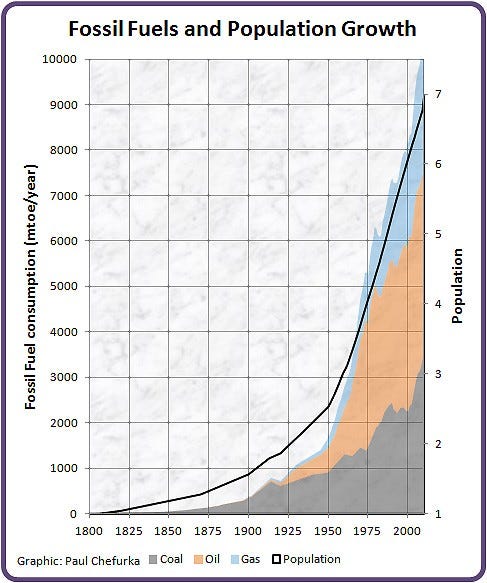
That has put 7.4 billion people on the planet, 6 billion of whom would not be here without hydrocarbon support.

Remove hydrocarbon fuels, and those 6 billion don’t have a future.

1 Bn people are at starvation level now. We are on course to reach 9 or 10 bn by 2050.


Common sense says that we cannot sustain that number, so something has got to happen within the next 30 years to stop it. This is going to be our ultimate holocaust.

Our lines of growth are promised to climb towards infinity, despite living on a finite planet.

And thinking oneself into a utopian future of renewable energy systems is not going to prevent it. Windfarms and solar panels deliver electricity. Without our (hydrocarbon based) infrastructure, electricity is of very little use, and cannot sustain civilization in any sense that we know it.

Doubters should imagine electric cars running on unmade roads. Or making a single lightbulb. We are headed back to the ‘naked light’ society from whence we came only a few generations back.

We are perhaps expecting to have a future where we will be only mildly inconvenienced by changed (energy) circumstance — -where ‘they’ will fix things. Or to extend the fantasy into the surreal, that some ‘new technology’ will be developed to allow business as usual.

We must get real here. Your future, my future is dependent on that business as usual supporting us through a healthy lifespan and into secure old age.

We are all complicit in the madness, everyone demanded (and is demanding) that oil should make princes of us all; governments of whatever stripe have had no choice but to concede to everyone’s demands.

Trump has offered what might be the final straw to clutch at, promising to ‘make America great again’, in denial that it was cheap energy that provided that greatness, (such as it was) in the first place.

And having no other straw to clutch at, millions reach out in desperation.

But of course, we are navigating through the rear view mirror of history, where we see that the faster we burned oil, the richer we got. It seemed to good to be true, which it was. We called everything ‘GDP’, as though the act of work delivered infinity prosperity; when in fact GDP and ‘growth’ were exclusively a result of consuming fossil fuels.

But our leaders still offer that future.

Whether saint or charlatan, they can offer no other.

There is no other.


We might agree that ‘things must change’. They will of course change, but not in ways of our choosing. I can offer the certainty that humankind has never collectively changed unless forced to do so.

That change has invariably been unpleasant, and driven by (short lived) dictators intent on tribal supremacy.

Homo sapiens has existed for 100,000 generations, give or take. Those countless generations have had one overriding factor, that of homicidal intent, driven by the genetic force of survival. That drive has brought us to where we are now. We have perhaps a single generation left in which we might alter our destructive habits.

Can we manage that?

I’d like to believe it to be possible, but oil driven resource wars of the past 100 years would suggest otherwise.

Book Review: Designing Climate Solutions

Designing Climate Solutions — Book Review. Carolyn Fortuna, CleanTechnica. Nov 14. 2018.


Some people take a college course in climate change policy. I read a new book that outlines which energy policies can put us on the path to a low-carbon future. Designing Climate Solutions: A Policy Guide for Low-Carbon Energy combines the latest research and analysis on low-carbon energy solutions from electric vehicles to renewable energy. It is a primer that identifies which specific policies, applied to the top 20 most-emitting countries, can have the largest potential impact to reduce emissions. The book, with clear and jargon-free explanations of policy changes and fiscal implications, outlines long-term goals, price-finding mechanisms, and small sets of actions that can achieve market goals. It is a must-read.


Designing Climate Solutions (November, 2018) offers policy design principles to ensure that future climate and energy policy maximizes greenhouse gas (GHG) reductions and economic efficiency. The book (and accompanying website) is intended as a resource by policymakers, advocates, philanthropists, and others in the climate and energy community as a guide to where to focus efforts and how to ensure that policy is designed to maximize success. Part I of the book provides readers with a roadmap for understanding which countries, sectors, and sources produce the greatest amount of GHG emissions. Part II of the book explores each of the emission-reducing policies, including detailed information on the policy and its goals, when to apply each policy, the key policy design principles that make that policy effective, and case studies of good and bad applications of that policy.


The Necessity of Reaching the 2 Degree Celsius Limit


The scope, scale, and irreversibility of climate change — and the irreducible mathematics of carbon accumulation — together mean that swift action to abate greenhouse gas emission is imperative. There are 3 consequences of global temperature shifts:
  • Increase in the frequency of extreme temperature and weather events, which makes previously rare extreme temperatures more frequent 
  • Irreversibility of warming on reasonable timescales, which, once a quantity of greenhouse gas is emitted, will begin cycling out of the system as various natural cycles pull it out of the atmosphere 
  • Danger of triggering natural feedback loops that cause additional warming, as, although anthropogenic (human-caused) emissions may be the initial catalyst in warming the globe, Earth’s natural systems can exacerbate this impact, understood as a vicious cycle 

The authors of Designing Climate Solutions, Hal Harvey with Robbie Orvis and Jeffrey Rissman, argue that we must act as soon as possible to reduce emissions. First, most energy-consuming assets — buildings, power plants industrial facilities — have a turnover rate of decades or more, so that we lock in a higher level of warming with each piece of new equipment we adopt or install. Second, because warming is a function of the total amount of carbon dioxide in the atmosphere, delayed action on emission reductions makes it far harder to achieve the same concentration of CO2 in the future.


Reasons for Hope in Designing Climate Solutions


But the authors do not perseverate on notes of doom and gloom. Instead, they say that there is ample technology to put the world on a low-carbon trajectory. Costs for wind and solar power have plunged, propelling their growth around the world. Innovation in energy efficiency continues, with well-constructed buildings using a fraction of the energy of older buildings thanks to advances in lights, windows, insulation, and heating and cooling systems. Decades of energy policy examples have highlighted which policies are most effective in reducing carbon emissions and energy use. From city ordinances to international treaties, politicians are “lining up” to put strong policies into action — at the international level, 189 countries have submitted emissions targets, and such commitments over nearly 99% of the world’s emissions. Consumers, too, are shifting their behavior to reduce their carbon footprint, with households installing solar panels or opting into green power programs, buying energy efficient appliances, and driving EVs.

The authors acknowledge that, while development in low-emission technologies is providing an array of options for emission abatement, policymakers need to help push these technologies into the marketplace with smart policies that quantify each major source of GHG emissions.


  • Step #1 — Identifying the Sources of GHG Emissions around the World: Nearly 75% of global GHG emissions are generated by just 20 countries. Emissions from energy combustion and industrial processes (including agriculture and waste) are the primary sources of GHG emissions, comprising more than 93%.
  • Step #2 — A Straightforward Roadmap for Reducing Energy-Related Emissions: We need to implement policies that reduce emissions in the electricity, industry, transportation, and building sectors in the top 20 emitting countries. To do so, a suite of policies which fall into 4 broad types is the lowest-cost way to drive down GHG emissions.


4 Policy Types to Support Designing Climate Solutions


  • Performance Standards improve new equipment and help capture savings that economic signals cannot, because of market barriers. These quantitative targets at the device, fuel, or sector level specify levels of performance businesses or equipment must achieve — for example, fuel economy standards for vehicles or particulate emissions standards for coal-powered plants. They increase the availability of price-competitive efficient and low-carbon technologies and spur the innovation essential to long-term decarbonization. Performance standards also serve as market guidelines that encourage competition to produce least-cost solutions and are particularly necessary when price is not an effective inducement.
  • Economic Signals can be highly efficient and encourage the uptake of more efficient equipment driven by performance standards. Two of the most common economic signals governments use to promote decarbonization are economic incentives for clean energy, and taxes on carbon. Generally, economic incentives should decrease over time while carbon taxes should increase over time. When possible, the endpoint or goal of an economic incentive should be selected and explicitly specified. If a long-term goal is publicly specified, this helps businesses understand policymakers’ intentions and make plans with the benefit of having this endpoint in mind. Economic incentives for clean energy should be based on the amount of clean energy that is generated and used, not on the amount of capacity built, or money invested to purchase or install clean energy infrastructure. This ensures that the incentive is only paid when these resources are used — and actually playing an active role in decarbonization. Economic signals are best put into place as far upstream as possible, where sophisticated upstream actors will adjust to the signals, resulting in accelerated decarbonization. This improves the ease of regulation (it is much easier to regulate 500 companies than 1 million consumers) while making sure the incentive is carried through to the whole value chain.
  • Support for Research and Development (R&D) brings to light new technologies that can accelerate and complete global decarbonization. Continued and broadened support for R&D is an essential component of remaining below the two-degree warming target and can lower the cost of future emission abatement by decreasing the costs of low-carbon technologies. To help guide funding priorities, the government should involve the private sector, which can bring crucial expertise regarding the technologies, markets, scalability, and technical challenges associated with early-stage technologies. Bringing this experience to bear on funding decisions can help ensure that government R&D dollars are spent wisely. An efficient way for the government to fund and support R&D is to concentrate funding on a specific topic in more focused, granular institutions, possibly co-located with one another. This allows researchers working on similar technologies to share information and work together while avoiding the inefficiencies that can arise from spreading funding for similar research across many different institutions. Ideally, companies and government-owned research facilities will have a large pool of researchers to draw on with strong backgrounds in science, technology, engineering, and mathematics (STEM). To attract this talent, policymakers can establish top-quality education programs and ensure immigration laws allow companies to hire STEM talent from other countries.
  • Enabling Policies tend to lower transaction costs, improve information, and streamline decision making. Supportive of and secondary to the 3 previous types of policies, these lower the costs of performance standards and economic signals by pushing new technologies to market and lowering the costs of existing technologies by removing deployment market barriers.

A Suite of Policies is Essential for Designing Climate Change Solutions


Policymakers have many types of policies at their disposal to limit global warming to the 2-degree Celsius target. Policies with large potential abatement and long lead times that deliver economic savings should be prioritized first. Initial policy action must be followed with sector-specific performance standards, carbon pricing, and R&D-supporting policies to help lower abatement costs and provide additional compliance options. Other considerations like political feasibility must also be considered.


Part I of Designing Climate Solutions offers the suite of policies available and helps with strategies for identifying the most effective options and principles for designing successful policy programs.
  • Chapter One: Putting Us on Track to a Low-Carbon Future — This chapter discusses how much effort is needed, the types of reductions and emissions pathways that are need in order to avoid the worst parts of climate change, and ideas about where to focus. 
  • Chapter Two: Energy Policy Design — 4 types of essential energy policy and how they reinforce and interact with one another comprise the essence of this chapter. 
  • Chapter Three: How to Prioritize Policies for Emission Reduction — Which policies can effectively work together in a portfolio to drive down GHG emissions? This chapter lays out a framework for identifying these policies and provides insight into how to prioritize policies for reducing emissions. 

Part II explores these policies in depth. Each chapter includes information on how each policy works, when to use the policy, the policy design principles most applicable and how they can be implemented, and case studies of good and bad implementation of the policy.
  • Chapter Four: Renewable Portfolio Standards and Feed-In Tariffs — These topics are considered because their roles in promoting renewable energy are similar: each policy creates a compensation mechanism for renewable energy generation and drives renewable energy growth. However, a feed-in tariff is price-based, while a renewable portfolio standard is target-based. 
  • Chapter Five: Complementary Power Sector Policies — This chapter outlines that, even under the best possible policy design for renewable portfolio standards or feed-in tariffs, a more holistic approach is needed to ensure the transition is affordable, increases prosperity, maintains reliability, and expands service to unserved customers. 
  • Chapter Six: Vehicle Performance Standards — Designed well, stronger vehicle performance standards can achieve about 3% of cumulative global emissions needed to meet the 2-degree Celsius target. 
  • Chapter Seven: Vehicle and Fuel Fees and Feebates — Along with performance standards, fees of fuel and inefficient new vehicles are among the best policies for reducing emissions from on-road vehicles, which make up 71% of emissions from the global transportation sector. 
  • Chapter Eight: Electric Vehicle Policies — Vehicle electrification policies can contribute at least 1% of cumulative emission reductions to meet a 2-degree target through 2050. 
  • Chapter Nine: Urban Mobility Policies — Smart policies to enable alternative forms of urban mobility and reduce the number of vehicles on the roads can improve the quality of life with dramatically cutting transportation sector emissions. 
  • Chapter Ten: Building Codes and Appliance Standards — Residential and commercial buildings are major energy consumers, accounting for roughly 20% of delivered energy use and more than 50% of electricity worldwide. 
  • Chapter Eleven: Industrial Energy Efficiency — Industry plays a central role in the world’s economy and is responsible for more than 40% of world energy consumption, more than any other sector. Industrial energy efficiency policies can achieve at least 16% of the GHG reductions needed to hit the 2-degree target. 
  • Chapter Twelve: Industrial Process Emission Policies — Industrial process emissions reflect all the non-energy ways in which industrial production results in the release of GHG into the atmosphere. Part of the challenge in reducing process emissions is the diversity of ways in which the emissions are generation. Measures to reduce process emissions often must be specific to each type of process. 
  • Chapter Thirteen: Carbon Pricing — Carbon pricing is a critical tool for reducing emissions and should cover all sectors of the economy. The impact of carbon pricing depends on its design and on the price. The authors’ modeling of a carbon price set at the social cost of carbon suggest it can deliver at least 26% of the emission reductions necessary to meet the 2-degree Celsius target. 
  • Chapter Fourteen: Research and Development Policies — This chapter describes a handful of best practices that can help energy technologies advance all the way from the laboratory to the marketplace. This work is built on experience in the field, collaboration with government, reviews of a dozen studies, and many interviews with experts from the private sector, academia, and national labs. 
  • Chapter Fifteen: Policies for a Post 2050 World — This chapter considers technologies that may be necessary in the long term (after 2050) to achieve the emission reductions required by a future with less than 2 degrees of warming and policies and adapt to climate change. Policies to accelerate technologies that may not currently be ready for widespread deployment must begin now, the authors say, so that they will be sufficiently mature by the time they are needed. 

Final Thoughts


Designing Climate Solutions: A Policy Guide for Low-Carbon Energy is an accessible guide that should be on every person’s resource shelf. It offers concise information and pathways for the necessary transition to a low-carbon society. Because the book moves fluidly within argumentation, data, and practical applications, it allows multiple audiences to consider policies that can introduce climate change action in all our communities. The authors’ focus on quantitative analysis, at first glance, seems reductive to a strict economic lens. But the various case studies through the book bring the policy recommendations back to the human — which becomes a descriptive method that continues to examine and also make relevant analogies to familiar cityscapes and scenarios.

Sunday, November 11, 2018

Un-Denial

Un-denial Manifesto: Energy and Denial. Nov. 12, 2015. Rob Mielcarski, un-denial. 


This is the story of the two most important things that enabled the success and possible demise of humans: energy and denial.

Simple single cell (prokaryotic) life emerges as a gradual and predictable transition from geochemistry to biochemistry, in the presence of rock, water, CO2, and energy, all of which are found within alkaline hydrothermal vents on geologically active planets, of which there are 40 billion in our galaxy alone, and probably a similar number in each of the other 100 billion galaxies.

Simple life like bacteria and archaea is therefore probably common throughout the universe. Strong evidence for this is that prokaryotes appeared 4 billion years ago, as soon as the earth cooled down enough to support life, and never once winked out despite many calamities throughout geologic history.

LUCA (the Last Universal Common Ancestor), and all life that followed, is chemiosmotic, meaning that it powers itself with an unintuitive mechanism that pumps protons across a membrane. This strange proton pump makes sense in the light of its hydrothermal vent origins. For a sense of the scale of life’s energy, consider that the human body pumps a staggering 10**21 protons per second of life.

The transition to, and existence of, complex multicellular life, like plants and animals, is much less predictable and certain. All of the complex life on earth has a common eukaryote ancestor, and it appears this ancestor emerged only once on Earth about 2 billion years ago. This is a vital but rarely acknowledged singularity in biology.

The eukaryote cell was created by a rare endosymbiosis (merging) of prokaryotes (simple cells) somewhat analogous to a freak accident. The resulting LECA (Last Eukaryotic Common Ancestor), having 2 genomes that needed to cooperate and evolve in harmony, was probably fragile, sickly, and vulnerable to extinction which forced it to evolve many unusual characteristics common to complex life such as the nucleus, sex, two sexes, programmed cell death, germline-soma distinction, and trade-offs between fitness and fertility, adaptability and disease, and ageing and death.

As the endosymbiont (cell within the cell) evolved into mitochondria (energy powerhouses), eukaryotes were able to break through the energy per gene barrier that constrained the morphological complexity of bacteria and archaea for 2 billion years. Suddenly there was enough energy to power the evolution of complex structure, multi-cellular life, a symphony of fungi, plants and animals, and one single hominid with an extended theory of mind that took over the planet.

The magnificent and varied life we enjoy on Earth may not be unique in the universe, but is probably very rare, and our existence and ability to understand and discuss the origin of this life, is extraordinarily rare and precious.

Life at its core is chemical reactions that consume energy to replicate themselves. There is a minimum quantity of energy required to sustain life. This subsistence energy supports growth to sexual maturity, finding and winning a mate, reproducing, and feeding the offspring. It also includes the energy for shelter and clothing to create a hospitable environment for the chemical reactions to operate, energy to power the muscles used to evade or fight threats, and energy for the cells to repair damage from sickness or injury.

All of this subsistence energy must come from the surplus left after using energy to gather, hunt, grow, steal, or purchase energy. In other words, life must obtain more food than the food it takes to obtain food. Otherwise it dies. For example, if a coyote burns 2 rabbits worth of energy to capture 1 rabbit then it will die. If on the other hand, a coyote burns 1 rabbit of energy to capture 2 rabbits then it might be able to produce offspring that survive to repeat the achievement. Similarly, an ape that sells life insurance and uses its wages to buy food must be employed by a life insurance company that makes a profit. Without a profit the ape will lose its job and ability to buy food. Profit is an energy surplus.

Energy is required to produce anything and everything. For example, your coffee mug required diesel-powered machines to dig up and transport clay to a factory that used natural gas-fired furnaces to fuse the clay into a durable ceramic container that was then transported by a diesel-powered ship and diesel-powered trucks to a store that you drove to in a gasoline-powered car and purchased with wages your earned from a company that generated a profit by using energy to create something worth more energy. Money is a token we can exchange for real things. Therefore money is a claim on energy.

If a species finds a way to capture more energy than is required to subsist, then its probability of survival and population increases. Additional surplus energy is first used by life to increase fertility and decrease mortality. This makes intuitive sense because the chemical reactions at the core of life are replicators that replicate until some resource shortage constrains them. The most important resource, by far, is energy because with sufficient energy many other resource shortages can be overcome. For example, a well fed coyote can range farther to find water, and an ape can use natural gas generated steam to extract oil from sand.

Until recently all species obtained their energy from the current flow of sunlight (e.g. grass) or the recent flow of sunlight (e.g. wood). As an aside, a few species use instead chemical energy from geothermal processes but I will not discuss this since the ideas are analogous. An ape that eats a cow uses current solar energy via the photosynthetic grass eaten by the cow to produce flesh, and recent solar energy via the wood used to predigest (cook) the meat.

The sun shines at a relatively constant intensity and the earth is a fixed size at a relatively constant distance from the sun. Therefore the available sunlight on earth is finite and fairly constant. If one species captures more energy it must come at the expense of a different species. This tension is the driving force behind evolution.

The competition for finite resources as governed by the laws of evolution has created many amazing variations of life. For example, trees that grow tall to capture more sunlight than its neighbors, cheetahs that run faster than their prey, giraffes that eat high leaves, and birds that migrate with the seasons. One species emerged with a unique capability to out-compete all other species for available sunlight, and then used this same capability to break through the sunlight barrier.

About 100,000 years ago there were several intelligent social species of hominids spread around the world, all with about the same brain size and power. For some period of time, perhaps several million years, these species bumped up against evolving an extended theory of mind, which would have been advantageous for these social species because it enhances cooperation by enabling an individual to understand the minds of other individuals. Each time an individual was born with a mutation for an extended theory of mind they would have observed, through the normal course of daily activities like hunting and childbirth, other individuals being killed or injured, and therefore would have come to understand their own mortality. All animals have a very useful inherited behavior that causes them to fear and avoid injury, and therefore mortality awareness caused fear, depression, and risk avoidance, which reduced their reproductive fitness, and so the mutation for an extended theory of mind did not fix in the gene pool.

Then one day, through random chance, a member of one tribe in east Africa was born with a mutation for an extended theory of mind plus denial of reality. The two independently maladaptive behaviors, when improbably combined, became highly adaptive. The genes from that individual became fixed in her tribe and the resulting improvement to the tribe’s ability to communicate and cooperate increased the success of the tribe.

Having broken through the mortality barrier, it now became advantageous and probable for natural selection to evolve a larger and more powerful brain with complex symbolic language, planning and analytic skills, and increased memory capacity. An additional fortuitous side effect of denial of reality was the optimism bias it created which the intelligent species used to advance technology, hunt dangerous animals, wage war, and explore new continents.

This new species that emerged from a small tribe of hominids, that we now call human, and that is sometimes referred to as the chosen people, used its new abilities to out compete all other hominid species.

The mutation for denial of reality, which was essential for dampening the inherited fear of injury and death, caused each new human tribe to create life after death stories which served to define, unite, govern, and entertain the tribe. Thousands of different stories, which we now call religions, were created by thousands of tribes, with their one and only common feature being, due to its genetic foundation, a life after death subplot.

Over this same period of time, and probably even longer, there were other intelligent social species like chimpanzees, dolphins, elephants, and crows that were bumping up against the mortality barrier to evolving an extended theory of mind. Some of these species achieved partial theory of mind as demonstrated, for example, by behavior consistent with mourning their dead and revenge, however because of the improbability of mutating an extended theory of mind simultaneous with denial of reality, these species never evolved brains similar to humans.

The enlarging human brain soon became constrained by the size of the birth canal and associated pregnancy health risks. Because of the strong fitness advantage a larger brain provided, evolution found a clever way to work around the birth canal constraint by delivering babies with undeveloped brains. Therefore, as humans became smarter, parents were required to care for their offspring for a longer period before they became independent and able to breed. This led to other behavioral and cultural changes, such as pair bonding, and religions with stories that discouraged adultery.

The humans used their intelligence and social skills to develop technologies to capture a larger share of solar energy. Examples of these technologies include mastery of fire for cooking, heating, and land clearing; domestication of animals initially for protection and hunting assistance and later for transportation, agricultural labor, and sources of food; metal for weapons and tools; projectile weapons for extending its lethal range; replacement of indigenous plants with cultivated food plants; redirection and storage of water; methods and vehicles for migrating to all available continents and islands; shelter and clothing to survive in all climates; architectural structures for defense; and written language to store and transmit the technologies.

The human population increased rapidly and spread to all continents. Large prey went extinct everywhere shortly after the arrival of humans, except in Africa, where the large animals co-evolved with early humans. All of the humans’ close relatives were out-competed and went extinct. Human civilizations like the Egyptians, Romans, Mound Builders, and Mayans, experienced cycles of growth, overshoot, and collapse as they bumped up against the barrier imposed by finite solar energy.

Then, 200 years ago, humans used their intelligence to discover a new technology that fundamentally changed the rules. Humans learned how to exploit a new source of energy to augment finite sunlight. This energy is ancient buried biomass commonly called fossil energy. Unlike sunlight that is constrained to the real-time flow from the sun, fossil energy accumulated over millions of years and therefore acts as a giant solar energy battery. Now humans could not only exploit current solar energy (e.g. grass) and recent solar energy (e.g. wood) but also ancient solar energy (e.g. coal, oil, natural gas).

Because energy is the master resource that can be used to extract other resources, including more energy, fossil energy created a positive-feedback-driven 200 year period of explosive population, wealth, and technology growth. With surplus energy available to replace human labor with machines such as tractors and combines, fewer humans were required to work on subsistence activities and more humans could specialize in a wide variety of scientific, engineering, and cultural domains.

Food production was increased through the use of natural gas derived nitrogen fertilizer, oil based pesticides, diesel-powered tractors, combines, and irrigation, and diesel-powered trucks, trains, and ships to deliver it. More food enabled the population to increase from 1 billion to 7 billion. New technologies that used the surplus fossil energy improved the quality of human life such as housing, drinking water, sanitation, medical and dental care, communications, transportation, labor-saving machines, and entertainment. Humans used the surplus fossil energy to make amazing advances in science and technology including traveling to the moon and understanding the origin of life and its respiration, replication, and photosynthesizing chemical reactions, and invented light-speed digital networked communications technology to share and discuss this understanding with other members of the species anywhere on the planet.

Some side effects of the new technologies also reduced the quality of life for some humans. These included health problems caused by pollution and the new abundance of delicious but unhealthy foods such as sugar that were evolutionarily scarce.

Almost all other species, except those cultivated or domesticated by humans, and those that piggyback on the success of humans, like rats, suffered from the success of humans. The rate of species extinction increased to unprecedented levels. Rather than using fossil energy to replace sunlight energy, thereby freeing some energy for other species, humans used fossil energy to add to the solar energy they already commanded, and most wild species declined. Fast and powerful fishing boats capable of scooping and scraping all life from the ocean anywhere on the planet are one of many examples.

The purpose of the universe, if it can be said to have a purpose, is to increase entropy. The universe abhors an energy gradient and life is its best invention for degrading energy gradients. Humans are the champions of life at degrading energy, and from this perspective, may be the universe’s pinnacle of invention.

Conflict between tribes is a persistent feature of human history with periods of calm and periods of extreme violence. The inherited denial of reality enables a high level of violence without the temper of empathy because tribes with different gods are viewed as lesser humans. For example, one large civilized tribe exterminated millions of “inferior” humans using gas chambers. Another large civilized tribe routinely kills innocents labeled as terrorists with automated drones to protect sources of fossil energy while telling itself it is spreading democracy.

There are three dark clouds looming over human success.

First, climate change and pollution.

The use of fossil energy releases CO2 into the atmosphere which acts as a blanket to trap solar energy which increases the temperature of the planet. Human released CO2 has already increased the earth’s temperature by about 1 degree resulting in many problems including droughts, storms, ice loss, and sea level rise. The CO2 already released by humans guarantees another 1 degree of rise, even if all fossil energy emissions were stopped today. It is now clear that the 2 degree limit agreed by many countries is not a safe target and is in fact very dangerous for civilization. Worse still, probable future human emissions will cause a 4-6 degree rise which raises the possibility of human extinction.

Sea level rise predictions from melting ice on Greenland and the Antarctic increase with each new study. At least a meter of sea level rise by the end of the century is now probable and subsequent predictions are expected to worsen. This is a significant problem because much important land for agriculture and cities is near sea level. There will be heartbreaking refugee migrations, starvation from decreased food production, and loss of capital property this century.

CO2 also acidifies the ocean which harms many species such as shellfish and corals, both of which are in sharp decline. Another large and widely unrecognized problem is that byproducts of fossil energy combustion create ozone which harms plants and trees. There is evidence that trees are in global decline. This should concern humans for many obvious reasons. One not so obvious reason is that planting trees is one of the few things humans can do that might succeed in removing CO2 from the atmosphere. If trees are being killed by the same activity that puts CO2 in the air then this strategy will not work.

Climate change is a wicked problem. A rising temperature creates other self-reinforcing feedback loops such as ice loss and methane release which act to further increase the temperature. At some point these feedback loops may dominate over human influences thus eliminating any ability for humans to affect the outcome. No one knows for sure, but we may be near or passed this tipping point.

Choosing to act on climate change in a meaningful way will also create new problems. Wealth is proportional to energy consumption. More specifically, $1 US adjusted for inflation to 1990 equals about 10 mW of energy. Over 90% of our energy comes from fossil energy. Therefore any meaningful reduction in CO2 emissions must shrink the economy, and because we have a debt backed fractional reserve monetary system with a large and rising quantity of outstanding debt, a meaningful reduction in CO2 emissions will probably cause an economic depression, at best. Thus a political platform promising to actually do something about climate change is unlikely to be elected, or re-elected.

Furthermore, a decline in economic activity will result in a rapid reduction of aerosols that currently mask some UV radiation resulting in a warming impulse of about 0.5 degrees thus making climate change worse in the short-term.

Second, finite and non-substitutable fossil energy.

The fossil energy that supports 7 billion humans is finite and rapidly depleting. The easy low cost oil is gone. The oil that remains, while substantial, is expensive, and becoming more expensive to find and extract. Each year it takes more energy to produce the same quantity of energy.

The fossil energy that remains is also dirtier and creates more pollution and CO2.

As the cost of energy goes up, the amount of energy society can afford to leverage productivity goes down. Thus productivity and incomes are falling at the same time that the cost of producing energy is increasing. This is the root cause of the worldwide economic problems that began in 2008 and persist today.

The price of energy required for energy companies to produce the quantity of energy necessary to maintain our current standard of living is now higher than society can afford. We have masked this problem with near zero interest rates and a huge increase in debt. These are temporary "solutions" that will soon be overridden by the laws of thermodynamics and mathematics, and will most likely end with an economic depression more painful than that had we chosen to take our medicine in 2008.

Think of a coyote forced, because rabbits are becoming faster, to burn 2 rabbits worth of energy to catch 1 rabbit. Even though there are plenty of rabbits, the coyote is in serious trouble. The coyote could switch his diet to mice (solar & wind energy) but then he’d have to burn 3 mice of energy to catch 1 mouse. The coyote is able to lead a fairly normal life for a while because he burns fat (debt) that he built up in previous good years. The coyote knows it could make do with less food if it quit fighting, played slower games, and had fewer pups, but prefers not to change its lifestyle. Over time, the coyote becomes weak and sick, and then decides to change, but no longer has the strength to catch even mice.

Any system in nature, including human civilization, is sustainable only if it survives on the interest generated by the capital of the system. For example, bison on prairie is a sustainable system surviving on the interest generated by sunlight, soil, and rainfall. Replacing the bison and grass with wheat fertilized with natural gas generated nitrogen and irrigated with diesel pumped non-renewable aquifers converts the capital (soil, aquifer, and fossil energy) into income (calories).

Debt at near zero interest rate is a means of converting capital into income. Our recent increase in debt can therefore be viewed as energy that would otherwise have been available to future generations. We are aggressively impoverishing our grandchildren (and other species) in an attempt to maintain our current privileged lifestyles.

Depleting fossil energy is a wicked problem. A law of thermodynamics states that energy cannot be created. The battery we have been relying on is running low and will take millions of years to recharge, and may never recharge unless the planet’s biological and geological processes realign in the necessary and fortuitous configuration that created fossil energy the first time.

Renewable energies such as wind and solar do not have the density, scalability, or storability necessary to replace the fossil energy humans currently depend on. Most importantly, we do not have a viable alternative to the diesel that powers our critical life support network of trucks, trains, ships, tractors, combines, and mining machines. If trucks stop running, for any reason, all of civilization will be in immediate and extreme danger.

Renewable energies cannot stand on their own without fossil energy to create, install, and maintain their materials and infrastructure. For example, wind turbines use large quantities of concrete, steel, and copper that cannot be made without fossil energy. Renewables are at best fossil energy extenders. At worst they accelerate economic growth and burn up the remaining fossil energy faster to capture some wind or solar energy with equipment that will wear out in less than 50 years when there will be little or no fossil energy needed to replace the equipment.

Nuclear energy has the required density and scalability but lacks the storability necessary to replace vital diesel discussed above. In addition, current nuclear technologies rely on non-renewable and possibly peaked uranium fuel, plus non-renewable fossil energy for infrastructure, materials, transportation, construction, and maintenance. Future nuclear technologies might address these shortcomings but are many years and trillions of dollars away from deployment. Finally, and perhaps most importantly, the combined threats of climate change, fossil energy depletion, and limits to growth caused economic instability, make it a very dangerous bet that we will be able to properly govern and maintain nuclear facilities in the future.

Third, denial of reality.

Humans succeeded as a species due in large part to their evolved denial of reality. This behavior is now a disadvantage because it prevents the majority of humans from recognizing and acting on climate change and fossil energy depletion. It is noteworthy that there is not one senior leader in any country on any continent that has publicly communicated an understanding of what is going on and what we should be doing at this time, even after leaving office. Likewise, all groups including climate scientists, climate deniers, fossil energy experts, renewable energy experts, environmentalists, capitalists, socialists, communists, conservatives, liberals, Christians, Muslims, Scientologists, you name it, everyone is in denial about human overshoot. This is of course what we should expect given the genetic basis for denial. But it is nevertheless a concern.

The human brain, the God it believes in, and the overshoot it enabled and denies, all resulted from the same improbable genetic adaptation that occurred about 100,000 years ago.

What should we do?

There are no painless solutions to our predicament. The problems are wicked and politically intractable:
  • problems are complex and difficult to understand;
  • there are no easy or short-term solutions;
  • solutions that improve the long-term are likely to worsen the short-term;
  • solutions usually conflict with evolved human behavior;
  • some problems are out of our control.
We are in a severe state of overshoot which guarantees some form of bottleneck and collapse. Our aim should be to slow the descent and prepare a softer landing zone.

Despite the depletion of fossil energy we still have a lot more surplus energy than is required for subsistence. Remaining surplus energy should be redirected from activities that have no future such as air travel, automobiles, military, and advanced technology; and towards infrastructure and skills that will be required in a simpler low energy world such as local food production, resilient water supplies, and energy conservation.

Policies should be implemented to reduce the population as quickly and humanely as possible. Paraphrasing Albert Bartlett, there is no problem on the planet that does not improve with fewer people.

After the inevitable economic reset, a new monetary system will be required, preferably an energy-backed full-reserve system, as we move into a long-term energy constrained contracting economy. Wealth redistribution and rationing policies should be developed in anticipation of their need.

Citizens should be proactively educated on the root causes of our problems to avoid inappropriate blame and wars which will only worsen the situation by accelerating the depletion of non-renewable resources.

What will we do?

Evolved denial of reality will probably continue to block any constructive discussion or proactive action. When a crisis forces action we will probably blame the wrong actors. Our responses are not likely to be rational or optimal. Expect chaos.

A few people have broken through inherited denial. So it is possible. But scaling this to the majority will be a challenge.

The singular emergence of human intelligence, and its ability to write and read this paragraph, evolved in a gene controlled machine with an unusually powerful computer, that was created by an improbable simultaneous double mutation for an extended theory of mind with denial of reality, and whose complexity was enabled by the increased energy per gene provided by mitochondria, that resulted from an accidental endosymbiosis of two cells, powered by an unintuitive chemiosmotic proton pump, that pumps 10**21 protons per second to maintain human life, that originated in an alkaline hydrothermal vent, on 1 of 40 billion planets, in 1 of 100 billion galaxies, and that planet had an improbable store of photosynthesis and geology generated fossil energy, that the species leveraged to understand and appreciate, the peak of what may be possible in the universe, before it vanished, because it denied the consequences of its success.


BONUS #1:

FAVORITE QUOTES


For explaining why humans are odd
To Varki and Brower we applaud
A great mystery they solved
With denial we evolved
And created the Higgs, overshoot, and God

Denial not only makes us believe in god, it is god, because denial created us, and denial may destroy us.

The human brain, the God it believes in, and the overshoot it enabled and denies, all resulted from the same improbable genetic adaptation that occurred about 100,000 years ago.

Denial is the reality that must be most aggressively denied to avoid collapsing the house of cards that keeps us functioning.

The most amazing thing about human overshoot is that we do not discuss it.

You know you are in trouble when reduced CO2 emissions from an economic collapse caused by low-cost oil depletion is not sufficient to prevent civilization collapse from climate change caused by previously emitted CO2.

Our only choices are do we want to fall from a higher elevation later, or climb down from a lower elevation sooner?

Things that can’t continue usually stop too late.

Truth is like poetry and most people hate poetry.

All 7 billion of us owe our existence to a six-inch layer of topsoil and the fact it rains; 6 billion of us also owe our existence to nitrogen created by Haber-Bosch from natural gas.

Each time history repeats itself, the price goes up.

Thermodynamics, expressed through genetics, creates beings incapable of not maximizing energy consumption.

Denial is evolution’s method for permitting intelligence to coexist with our (Maximum Power Principle) decision makers.

While it digs its own grave, all the mind can do is entertain fantasies and create excuses.

It is remarkable that a brain emerged from a cloud of hydrogen and figured out the laws of physics that governed, and possibly made inevitable, its own creation and destruction.

We have met the oblivious and they are us.


BONUS #2:

ACKNOWLEDGEMENTS
(MW: I've enlarged the authors who have been formative to my understanding as well)

Ajit Varki and Danny Brower
What fascinates me most about our predicament is that we do not acknowledge or discuss it, let alone plan or act appropriately. Ajit Varki and Danny Brower have proposed a theory that explains the existence and uniqueness of humans, and their denial of reality. I’m a huge fan and frequently feel like I’m the only person in the world that appreciates the significance of their theory which I rank as important as Darwin’s. This site exists because of their book.

Tim Garrett
Tim Garrett is a physicist and lone voice that explains the economy with the laws of thermodynamics. Thermodynamics is, for those who do not know, the closest thing to bedrock that science has. Garrett’s papers form the foundation of every thought I have about the economy and climate change. Garrett has not yet been recognized by the scientific community and I fear may never be recognized due to our inherited denial, but I know he is important, thank you.

Nick Lane
Nick Lane is my favorite science writer. He has a knack for identifying and explaining the most profoundly important and interesting aspects of biology and life. If you would like to develop a deep appreciation for how fortunate we are to be alive there is no better place to start than reading his books. I wrote a review of his most recent book here.

Richard Dawkins
Richard Dawkins is a biologist with a brilliant mind. I read Dawkins’ famous book The Selfish Gene many years ago and it had a profound influence on my understanding of life. I’ve since read most of his other excellent books. Dawkins is a leader of the atheist community and he helped to reinforce my beliefs. Dawkins tends to focus on the logic and facts associated with religion. As I’ve aged I now prefer to view religion through the lens of inherited behavior.

Chris Martenson
Chris Martenson has a PhD in neurotoxicology and is an ex-senior executive who after becoming aware of our predicament changed his lifestyle and produced a high quality video series titled “The Crash Course”. It’s free and is an excellent place to begin learning about what is actually going on in the world.

David J.C. MacKay
David J.C. MacKay is a physicist and senior government advisor who wrote a book titled “Sustainable Energy – without the hot air”. Anyone who believes we can switch to renewable energy without a dramatic change to our lifestyle should start here. The book is available for free. David died in April 2016 and I wrote a eulogy here.

Tom Murphy
Tom Murphy is a brilliant physicist who after learning of peak oil went searching for solutions and documented his investigations in a series of excellent essays. After concluding that there is no solution to business as usual he went mostly quiet but his archive is very impressive for those seeking an understanding of energy.

There are a few other key people who I respect and owe much to. You’ll see some of them in my Resources and Blogroll lists and I’ll post links to their work from time to time.


BONUS #3

Background

I belong to a small tribe of people interested in human overshoot.

We try to integrate evolution, behavior, thermodynamics, ecology, history, and economics into an understanding of what is going on and what might be ahead.

Unlike other larger tribes that focus on one aspect of overshoot such as climate change, species extinction, fisheries collapse, deforestation, tree die-off, nitrogen imbalance, pollution, soil loss, aquifer depletion, resource depletion, peak oil, or unsafe debt to GDP, my tribe focuses on the system of problems, their underlying causes, and possible paths forward.

After studying and (I think) understanding our predicament, I became fascinated with the fact that society does not acknowledge or discuss, let alone plan or act, in an honest and meaningful way, on any of our larger problems, despite some threats being imminent.

After observing many intelligent people and organizations come to wrong conclusions, and after attempting to educate friends and family, I concluded that the absence of useful discussion and action is not caused by a lack of knowledge or intelligence. Most people actively and aggressively deny the existence and causes of the problems. They do not want a deeper understanding.

My fascination with denial grew with my awareness of it. On the one hand, our problems are huge and obvious, like an elephant in your living room. On the other hand, denial is widespread across all countries, cultures, religions, political parties, and education levels. This led me to conclude that denial must have a genetic component.

As an aside, my fascination with denial started at an early age as an atheist when I struggled to understand how anyone could deny what seemed an obvious conclusion about religions. Or how societies are admired rather than criticized for investing all of their surplus wealth in structures like pyramids to communicate with their gods.

Along the way I met some smart people who had explored human behavior and they pointed to many known behaviors that partially explain our destructiveness and the denial thereof such as optimism bias, god belief, rationalizing, creeping normality, steep discounting (preferring the present over the future), maximum power principal (maximizing resource capture), novelty seeking (dopamine response), status seeking, inability to understand exponential math or probabilities, tragedy of the commons, tribal warfare calculus, etc.

But I was not convinced. The denial I saw was so strong and so pervasive I felt there had to be a better explanation.

Then I stumbled on a book published in 2013 titled Denial: Self-Deception, False Beliefs, and the Origins of the Human Mind” by Ajit Varki and Danny Brower. They propose that a mutation for denying reality is what enabled the evolution of the brain that makes us human. A short version of the theory by me is here, a longer version by the authors is here, and a video version is here.

A light went on and I became genuinely excited. Perhaps like the people who first read Darwin’s book might have felt.

I read the book a few more times and then tried to find people in my tribe interested in reading and discussing the book. After failing to persuade a single person to read it, which I sometimes speculate may be more evidence of denial, in this case denial of denial, I gave up and formed a smaller sub-tribe of one and started scribbling thoughts and collecting information of interest to me.

Eventually I accumulated some material and tired of being alone so I decided to flip the switch on my blog from private to public in the hope of meeting a few like-minded people for companionship and discussion of a revolutionary new theory.

Themes

Here are the themes and tones of this site.

For the reasons explained above, I highlight examples of denial and discuss Varki’s theory throughout.

I’m a student and admirer of Tim Garrett’s work to explain our economy with the laws of thermodynamics and to model the relationship between wealth, energy, and climate change. Everything I think and write about is underpinned by Garrett. I don’t see Garrett’s work discussed a lot elsewhere, and I don’t think you can have a useful and honest discussion about climate change or the economy without understanding his work.

I’m a student and admirer of Steve Keen for his work in explaining the importance of debt and how it works in our economy. I don’t think I can add to the body of knowledge here, but I do think my description of money and debt may be a fresh and helpful variation on a much discussed topic.

You might from time to time find a little scientific “spirituality” here in that I am an amateur student of evolution and that combined with my engineer’s understanding of fossil energy, and my belief in Ajit Varki and Danny Brower’s theory on denial, leads me to conclude we are experiencing something very special in the universe. Perhaps even the peak of what is possible.

It’s easy to become angry about overshoot and our denial of it. I know I was angry in the early days of my awareness. Denial often looks like ignorance or sloth or selfishness. But if Ajit Varki and Danny Brower’s theory (which for brevity I will from now on call “Varki’s theory”) is correct, denial is not a character flaw. Denial is what makes us human. Understanding this muted my anger.

In this light I try to avoid blame or criticism. If they creep in from time to time I’m sorry, it’s hard not to get angry when denial causes us to do evil or stupid things like putting our children at risk, and causing a great extinction of other species.

You won’t find rants against capitalism, bankers, politicians, Monsanto, or fossil energy companies, although I sometimes write about why they behave the way they do. The only group in society that I detest is economists because they have so much influence on overshoot and destroying the planet, and because their schools and professional organizations allow them to ignore the scientific method and factors that really matter to the economy like thermodynamics and debt. Many of my colleague engineers are no doubt in denial about some things but our schools and professional organizations prevent us from denying gravity or the danger of high voltage electricity. The “profession” of economics doesn’t care about reality. It is a disgrace and should be abolished from universities.

I believe that a lot of what is going on is governed by the laws of evolution and thermodynamics and much, but not all, is out of our control. I try to focus on those things within our control.

Time is valuable. I read a lot and it drives me crazy when someone uses 10,000 words to describe a 100 word idea. I strive to use the fewest possible words to explain an idea or opinion.

I value a high signal to noise ratio. I try to only post things by myself and others that are important and of high quality. I will from time to time prune the site to correct my errors.

I want this site to evolve into a useful library of information. One of my hobbies has made me expert at organizing computer data and I intend to keep things organized and easy to locate.

War and Empire Links: Remembrance Day Edition

The Best Way To Honor War Veterans Is To Stop Creating Them. Caitlin Johnstone. Nov. 10, 2018.
The US will be celebrating Veterans Day tomorrow, and many a striped flag shall be waved. The social currency of esteem will be used to elevate those who have served in the US military, thereby ensuring future generations of recruits to be thrown into the gears of the globe-spanning war machine. 
Veterans Day is not a holiday to honor the men and women who have dutifully protected their country. The youngest Americans who arguably defended their nation from a real threat to its shores are in their nineties, and soon there won’t be any of them left. Every single person who has served in the US military since the end of the second World War has protected nothing other than the agendas of global hegemony, resource control and war profiteering. They have not been fighting and dying for freedom and democracy, they have been fighting and dying for imperialism, Raytheon profit margins, and crude oil.
I just said something you’re not supposed to say. People have dedicated many years of their lives to the service of the US military; they’ve given their limbs to it, they’ve suffered horrific brain damage for it, they’ve given their very lives to it. Families have been ripped apart by the violence that has been inflicted upon members of the US Armed Forces; you’re not supposed to let them hear you say that their loved one was destroyed because some sociopathic nerds somewhere in Washington decided that it would give America an advantage over potential economic rivals to control a particular stretch of Middle Eastern dirt. But it is true, and if we don’t start acknowledging that truth lives are going to keep getting thrown into the gears of the machine for the power and profit of a few depraved oligarchs. So I’m going to keep saying it.
Last week I saw the hashtag #SaluteToService trending on Twitter. Apparently the NFL had a deal going where every time someone tweeted that hashtag they’d throw a few
bucks at some veteran’s charity. Which sounds sweet, until you consider three things:
  1. The NFL’s ten wealthiest team owners are worth a combined $61 billion.
  2. The NFL has taken millions of dollars from the Pentagon for displays of patriotism on the field, including for the policy of bringing all players out for the national anthem every game starting in 2009 (which led to Colin Kaepernick’s demonstrations and the obscene backlash against him). 
  3. VETERANS SHOULD NOT HAVE TO RELY ON FUCKING CHARITY.
Seriously, how is “charity for veterans” a thing, and how are people not extremely weirded out by it? How is it that you can go out and get your limbs blown off for slave wages after watching your friends die and innocent civilians perish, come home, and have to rely on charity to get by? How is it that you can risk life and limb killing and suffering irreparable psychological trauma for some plutocrat’s agendas, plunge into poverty when you come home, and then see the same plutocrat labeled a “philanthropist” because he threw a few tax-deductible dollars at a charity that gave you a decent prosthetic leg? 
Taking care of veterans should be factored into the budget of every act of military aggression. If a government can’t make sure its veterans are housed, healthy and happy in a dignified way for the rest of their lives, it has no business marching human beings into harm’s way. The fact that you see veterans on the street of any large US city and people who fought in wars having to beg “charities” for a quality mechanical wheelchair shows you just how much of a pathetic joke this Veterans Day song and dance has always been. 
They’ll send you to mainline violence and trauma into your mind and body for the power and profit of the oligarchic rulers of the US-centralized empire, but it’s okay because everyone gets a long weekend where they’re told to thank you for your service. Bullshit.
Veterans Day, like so very, very much in American culture, is a propaganda construct designed to lubricate the funneling of human lives into the chamber of a gigantic gun. It glorifies evil, stupid, meaningless acts of mass murder to ensure that there will always be recruits who are willing to continue perpetrating it, and to ensure that the US public doesn’t wake up to the fact that its government’s insanely bloated military budget is being used to unleash unspeakable horrors upon the earth. 
The only way to honor veterans, really, truly honor them, is to help end war and make sure no more lives are put into a position where they are on the giving or receiving end of evil, stupid, meaningless violence. The way to do that is to publicly, loudly and repeatedly make it clear that you do not consent to the global terrorism being perpetrated in your name. These bastards work so hard conducting propaganda to manufacture your consent for endless warmongering because they need that consent. So don’t give it to them.


Better Late Than Never. John Andrews, Dissident Voice. Nov. 1, 2018,
Although white poppies have been around for almost as long as the red ones as a symbol of remembrance a surprisingly large number of people know nothing about what they stand for. To put it in a nutshell, white poppies promote peace, red poppies help promote Permanent War. 
Arguably the most cynical lie that was told to the horribly betrayed young men who were butchered in the killing fields of Europe just over a hundred years ago, in order to persuade them to become lambs for slaughter, was that they would be fighting the “war to end all war”. If it was true, it would indeed have been worth dying for, but it wasn’t. It was a lie. Britain and the US, the last global empire and the current one, never made any effort to stop wars. The so-called peace treaty that concluded WW1 guaranteed WW2 would happen. Further evidence is obvious: apart from being the two biggest arms-makers on the planet, Britain and the US never stopped sending their armed forces to distant countries to kill people who, certainly after WW2, have been mostly rag-tag freedom fighters, defeated conscripts and defenceless civilians. 
The best way anyone can commemorate those terribly wasted young lives from WW1 is to remember what they believed they were fighting for, and to demand that our great trusted leaders respect them by doing what they said they would do – stop fighting wars. 
... 
Added to the sheer inexcusable immorality of war, which has always been the case, we now have the fact that it’s also illegal – a relatively new concept. Therefore almost every military action that Britain and the US have engaged in over the last three or four decades, at least, have not only been immoral, they’ve also been illegal. 
...

Whilst some sort of moral justification for war is always manufactured, to sell it to the 99%, morality is never the main reason for war. The main reason wars are fought is for loot, and to feed the parasites of war – the bankers, arms dealers, generals and “intelligence” agencies. This is as true today as it’s always been. When the phoney compassion of corrupt politicians and lying news providers is stripped away, we always discover that the real reason some war was fought was to make the super-rich and powerful even richer and more powerful.

...

The real cynicism of Remembrance Day is the brainwashing that accompanies it. We’re conditioned to see dead and wounded soldiers as heroes, instead of tragic victims treacherously betrayed by their own trusted leaders. WW1 was supposed to be the war to end all war. It’s about time we started demanding the realisation of that cause. Better late than never.


On Veterans’ Day, Remember the Lies That Filled Military Cemeteries. James Bovard, Mises Institute. Nov. 11, 2018.
Politicians will be heartily applauded for saluting American’s soldiers today. But if citizens had better memories, elected officials would instead be fleeing tar and feathers. Politicians have a long record of betraying the veterans they valorize.

...

The best way to honor veterans is to cancel politicians’ prerogative to send troops abroad to fight on any and every pretext. And one of the best steps towards that goal is to remember the lies for which soldiers died.


Lest We Forget. The Conciousness of Sheep.  Nov. 7, 2018.

Thursday, November 1, 2018

Topic: Carbon Pricing and Carbon Tax

originally published April 2016; most recently updated July Nov. 201819. 


“Our government has heard loud and clear that Canadians care about standing up for our environment and our livelihoods. Carbon pricing is an effective tool to do just that – to reduce emissions and stimulate investments in green infrastructure and innovation. Thanks to early action by Canadian provinces, more than 85 percent of Canadians live in jurisdictions with existing or planned carbon pricing. We will continue to work with our provincial and territorial partners to develop a more coordinated, pan-Canadian approach to climate change and carbon pricing, – so that our children and grandchildren can inherit a Canada more prosperous and sustainable than the one we know today.”
PM Justin Trudeau. Apr 21, 2016.


Canada passed a carbon tax that will give most Canadians more money. Dana Nuccitelli, Guardian. Oct. 26, 2018.
Last week, Prime Minister Justin Trudeau announced that under the Greenhouse Gas Pollution Pricing Act, Canada will implement a revenue-neutral carbon tax starting in 2019, fulfilling a campaign pledge he made in 2015
The federal carbon pollution price will start low at $20 per ton in 2019, rising at $10 per ton per year until reaching $50 per ton in 2022. The carbon tax will stay at that level unless the legislation is revisited and revised. 
This is a somewhat modest carbon tax – after all, the social cost of carbon is many times higher – but it’s a higher carbon price than has been implemented in most countries. Moreover, a carbon tax doesn’t necessarily have to reflect the social cost of carbon. The question is whether it will be sufficiently high to meet the country’s climate targets. ...


Why carbon taxes would be the ultimate energy game changer. Henry Hewitt, via naked capitalism. Aug. 3, 2015.

Climate tipping requires precautionary accumulation of capital and an additional price for carbon emissions. Rick van der Ploeg, Aart de Zeeuw, voxeu. Jul 31, 2014.

Carbon pricing leadership: vision statement. Apr 21, 2016.

Carbon pricing leadership.

This controversial carbon proposal could be the key to success for the world’s new climate agreement. Washington Post. Apr 22, 2016.
The idea of carbon pricing has long been touted by economists as an effective tool for lowering emissions and combating climate change, and it’s increasingly gaining the support of business and political leaders as well... 
Still, the idea has been slow to catch on with many political leaders — particularly in the U.S., where talk of carbon taxes has been highly controversial. California remains the only state with any pricing scheme in effect (a cap-and-trade system)... 
Currently, only about 12 percent of global emissions are already covered by carbon pricing schemes. The new goal would expand this coverage to 25 percent by 2020 and, most ambitiously, 50 percent within the next decade.
Most of the current 12 percent comes from just a few places... mainly the emissions trading schemes in the European Union and California... Other programs include a trading scheme in Quebec and a carbon tax in British Columbia. 
Carbon Pricing Becomes a Cause for the World Bank and I.M.F. New York Times. Apr 23, 2016.
Any policy that drives up the cost of fossil fuels can be expected to generate intense opposition. In the United States, voters — especially in the depleted middle class — are leery of the economic pain, and political groups funded by the billionaire brothers Charles G. and David H. Koch stand in the way. 
“It’s frustrating to watch unelected bureaucrats like the World Bank and other institutions try to leverage their power to force elected leaders to take actions that harm their citizens,” said Tim Phillips, the president of Americans for Prosperity, a Koch-backed advocacy group.
A global coalition mapping and motivating decarbonization. The Guardian. Apr 26, 2016.


study:
Overcoming public resistance to carbon taxes. Carattini, Carvalho, via Wiley Online. June 2018,
Abstract

Carbon taxes represent a cost‐effective way to steer the economy toward a greener future. In the real world, their application has however been limited. In this paper, we address one of the main obstacles to carbon taxes: public opposition. We identify drivers of and barriers to public support, and, under the form of stylized facts, provide general lessons on the acceptability of carbon taxes. We derive our lessons from a growing literature, as well as from a combination of policy “failures” and “successes.” Based on our stylized facts, we formulate a set of suggestions concerning the design of carbon taxes. We consider the use of trial periods, tax escalators, environmental earmarking, lump‐sum transfers, tax rebates, and advanced communication strategies, among others. This paper contributes to the policy debate about carbon taxes, hopefully leading to more success stories and fewer policy failures.

Carbon pricing and deep decarbonization. Endre Tvinnereima and Michael Mehling, Journal of Energy Policy. 2018.
Highlights
  • Reaching agreed climate targets requires zero net greenhouse gas emissions.
  • Experts recommend prices on greenhouse gas emissions for efficiency reasons.
  • Emission prices constrain emissions but have not to date led to deep reductions.
  • It is therefore necessary to acknowledge the role of broader policy portfolios.
Abstract

Experts frequently point to carbon pricing as the most cost-effective tool for reducing greenhouse gas emissions. Empirical studies show that carbon pricing can successfully incentivise incremental emissions reductions. But meeting temperature targets within defined timelines as agreed under the Paris Agreement requires more than incremental improvements: it requires achieving net zero emissions within a few decades. To date, there is little evidence that carbon pricing has produced deep emission reductions, even at high prices. While much steeper carbon prices may deliver greater abatement, political economy constraints render their feasibility doubtful. An approach with multiple instruments, including technology mandates and targeted support for innovation, is indispensable to avoid path dependencies and lock-in of long-lived, high-carbon assets. We argue that carbon pricing serves several important purposes in such an instrument mix, but also that the global commitment to deep decarbonisation requires acknowledging the vital role of instruments other than carbon pricing.


The Business Case for Carbon Pricing. Julia Pyper, GreenTechMedia. Oct. 3, 2018.
audio interview

Special Issue on EMF 32 Study on U.S. Carbon Tax Scenarios; Guest Editors: A. A. Fawcett, J. McFarland, A. C. Morris and J. P. Weyant. Climate Change Economics. Volume 9, Issue 1. Feb. 2018. Open Access

in every policy scenario, in every model, the U.S. economy continues to grow at or near its long-term average baseline rate, deviating from reference growth by no more than about 0.1% points. We find robust evidence that even the most ambitious carbon tax is consistent with long-term positive economic growth, near baseline rates, not even counting the growth benefits of a less-disrupted climate or lower ambient air pollution
... 
carbon price scenarios lead to significant reductions in CO2 emissions, with the vast majority of the reductions occurring in the electricity sector and disproportionately through reductions in coal … Expected economic costs (not accounting for any of the benefits of GHG and conventional pollutant mitigation), in terms of either GDP or welfare, are modest


The 5 most important questions about carbon taxes, answered. David Roberts, vox. July 23, 2018.
A carbon tax can lower emissions, but it needs to be pretty damn high. 
Here are the top five questions advocates, policymakers, and informed citizens should be asking about a carbon tax:
  1. Can it reduce greenhouse gas emissions?
  2. What economic sectors will it hit hardest?
  3. What overall effect will it have on the US economy?
  4. Will it be fair and equitable?
  5. Will it be enough to address climate change?
Let’s walk through what the research shows, one answer at a time.

Carbon Taxes and Carbon Pricing Are Not Solutions to the Climate Crisis. Richard Murphy via nakedcapitalism. Nov. 6, 2019.