Sunday, September 22, 2019

Yes, the climate crisis may wipe out 6 Billion people

Yes, the Climate Crisis May Wipe out Six Billion People. Creator of the ‘ecological footprint’ on life and death in a world 4 C hotter. William E. Rees, TheTyee.ca. Sep. 18, 2019.


Carbon emissions may continue to rise, the polar ice caps may continue to melt, crop yields may continue to decline, the world’s forests may continue to burn, coastal cities may continue to sink under rising seas and droughts may continue to wipe out fertile farmlands, but the messiahs of hope assure us that all will be right in the end. Only it won’t.— Chris Hedges


One thing the climate crisis underscores is that Homo sapiens are not primarily a rational species. When forced to make important decisions, particularly decisions affecting our economic security or socio-political status, primitive instinct and raw emotion tend to take the upper hand.

This is not a good thing if the fate of society is at stake. Take “hope” for example. For good evolutionary reasons, humans naturally tend to be hopeful in times of stress. So gently comforting is this word, that some even endow their daughters with its name. But hope can be enervating, flat out debilitating, when it merges with mere wishful thinking — when we hope, for example, that technology alone can save us from climate change.

As novelist Jonathan Franzen asks: “If your hope for the future depends on a wildly optimistic scenario, what will you do 10 years from now, when the scenario becomes unworkable even in theory?”

We needn’t bother Roger Hallam with this question. He can scarcely be held up as a “messiah of hope.” Quite the contrary. Hallam, a co-founder of Extinction Rebellion, has been desperately warning of societal collapse for years.

But on Aug. 15, in a memorable session of the BBC’s HardTalk, Hallam irritated multiple cultural nerves by claiming, on the basis of “hard science,” that six billion people will die as a result of climate change in coming decades.

More specifically, our ruling elites’ inaction and lies on climate change will lead to climate turmoil, mass starvation and general societal collapse in this century. Normally unflappable HardTalk host, Stephen Sackur, just couldn’t wrap his mind around Hallam’s unyielding assertions.

Sackur is no solitary skeptic. UC Davis research scientist Amber Kerr dismisses Hallam outright. The idea that six billion people are doomed to die by 2100 “is simply not correct. No mainstream prediction indicates anywhere near this level of climate-change-induced human mortality, for any reason.”

Similarly, Ken Caldeira, senior scientist, Carnegie Institution, points out, “There is no analysis of likely climate damage that has been published in the quality peer-reviewed literature that would indicate that there is any substantial likelihood that climate change could cause the starvation of six billion people by the end of this century.”

One key to understanding these scientists’ rejections is their language. They assert that there is “no mainstream prediction” nor analysis in the “peer reviewed literature” that climate change will precipitate such catastrophic human mortality.

But keep in mind that scientists are reluctant, for professional reasons, to go far beyond the immediate data in formal publication. Moreover, organizations like the United Nations, including even its Intergovernmental Panel on Climate Change, are so dominated by economists’ concerns and bent by political considerations that extraneous noise obscures the scientific signal.

Prominent climate scientist Hans Joachim Schellnhuber, director emeritus of Germany’s Potsdam Institute for Climate Impact Research, argues that, in these circumstances “a trend towards ‘erring on the side of least drama’ has emerged” and “when the issue is the survival of civilization is at stake, conventional means of analysis may become useless.”

Exploring this argument, policy analysts David Spratt and Ian Dunlop conclude, “Climate policymaking for years has been cognitively dissonant, ‘a flagrant violation of reality.’ So it is unsurprising that there is a lack of understanding amongst the public and elites of the full measure of the climate challenge.”

It seems that in mainstream scientific publications and official reports, the truth about climate change and the fate of civilization may be buried deeply between the lines.

Fortunately, there are other contexts in which experts are not quite so reticent and whose assertions echo Roger Hallam’s. As much as a decade ago a climate symposium organized to discuss the implications of a 4 C warmer world concluded, “Less than a billion people will survive.” Here Schellnhuber is quoted as saying: “At 4 C Earth’s... carrying capacity estimates are below 1 billion people.” His words were echoed by professor Kevin Anderson of the U.K.’s Tyndall Centre for Climate Change: “Only about 10 per cent of the planet’s population would survive at 4 C.”

Similarly, in May of this year, Johan Rockström, current director of the Potsdam Institute opined that in a 4 C warmer world: “It’s difficult to see how we could accommodate a billion people or even half of that.... There will be a rich minority of people who survive with modern lifestyles, no doubt, but it will be a turbulent, conflict-ridden world.” Meanwhile, greenhouse gas concentrations are still increasing.

Keep in mind that a global temperature increase averaging 4 C means land temperatures would be 5.5 to 6 C warmer away from the coasts. Much of the tropics would be too hot for humans and many densely populated parts of the temperate zone would be desertified. A 4 C warmer world map suggests that as much as half the planet would become uninhabitable. (A ‘4 C world’ assumes business-as-usual or no new climate policies in coming decades. Note, however, that known and unknown ‘feedback’ mechanisms could make 4 C possible, even with new politically acceptable policies in place.)

In a recent review of this debate and related evidence, David Spratt asks (and answers): “So did Roger Hallam ‘go too far’? Not at all, there is serious research and eminent voices in support of his statements. The gross error in all of this are all those who cannot countenance this conversation.”


Making forbidden calculations

Which begs the question of whether “all those” would countenance any uncomfortable conversation. Population has long been a forbidden topic despite being at the root of the ecological crisis. Where might a discussion of population ecology lead and would its conclusions be any more politically acceptable?

1. We can begin by gaining some insight into the startling implications of exponential growth. When something is growing exponentially, it has a constant doubling time. For example, a population growing at two per cent a year will double every 35 years. Interestingly, the increase that occurs during any doubling period will be greater than the sum of the increases experienced in all previous doublings.

As the figure below shows, it took 200,000 years for the human population to reach its first billion in the early 1800s. In other words, population growth was essentially negligible for 99.95 of human history. But when sustained exponential growth kicked in, it took just 200 years — 1/1000th as much time — for the population to top 7.5 billion early in this century! The recent two centuries of population growth generates this classic hockey stick curve. At most, just 10 of 10,000 generations of modern humans have experienced this unprecedented human explosion. Chart by Jonathan von Ofenheim.

2. This population explosion could not have occurred without abundant cheap energy, particularly fossil fuels. Obviously other factors are involved, but energy is essential for humans to produce the food and acquire all the other resources needed to grow both populations and the economy. While human numbers were increasing by a factor of seven, energy consumption grew by a factor of 25 and real gross world product ballooned 100-fold.

3. Because of sometimes super-exponential growth, half of all the fossil energy and many other essential resources ever used have been consumed in just the past 30-35 years. Look no further to explain why human-induced climate change has suddenly become so urgent.

4. The pace of change is unprecedented — the recent spurt of population, economic and consumption growth that people today consider to be the normactually represents the single most anomalous period in human history.

5. Meantime, Earth hasn’t grown at all — on the contrary, natural life-support has arguably contracted. Global ecological deterioration indicates that the human enterprise has ‘overshot’ long-term carrying capacity. We are currently growing the human population and economy by liquidating once-abundant stocks of so-called ‘natural capital’ and by over-filling natural waste sinks.

Humanity is literally converting the ecosphere into human bodies, prodigious quantities of cultural artifacts, and vastly larger volumes of entropic waste. (That’s what tropical deforestation, fisheries collapses, plummeting biodiversity, ocean pollution, climate change, etc. are all about.)

Corollaries: We will not long be able to maintain even the present population at current average material standards. And, population growth toward 10 billion will accelerate the depletion of essential bioresources and the destruction of life-support functions upon which civilization depends.

6. The recent history of human population dynamics resembles the ‘boom-bust’ cycle of any other species introduced to a new habitat with abundant resources and no predators, therefore little negative feedback. (The real-life example of reindeer herds can be found here.)

The population expands rapidly (exponentially), until it depletes essential resources and pollutes its habitat. Negative feedback (overcrowding, disease, starvation, resource scarcity/competition/conflict) then reasserts itself and the population crashes to a level at or below theoretical carrying capacity (it may go locally extinct).The ‘boom-bust’ population cycle. Note the resemblance of the human population growth curve in Fig. 1 to the exponential ‘boom’ phase of the cycle. The world community can still choose to influence the speed and depth of the coming bust phase. Source of graph:Biology: Life on Earth, 8th ed., Fig. 26-3.
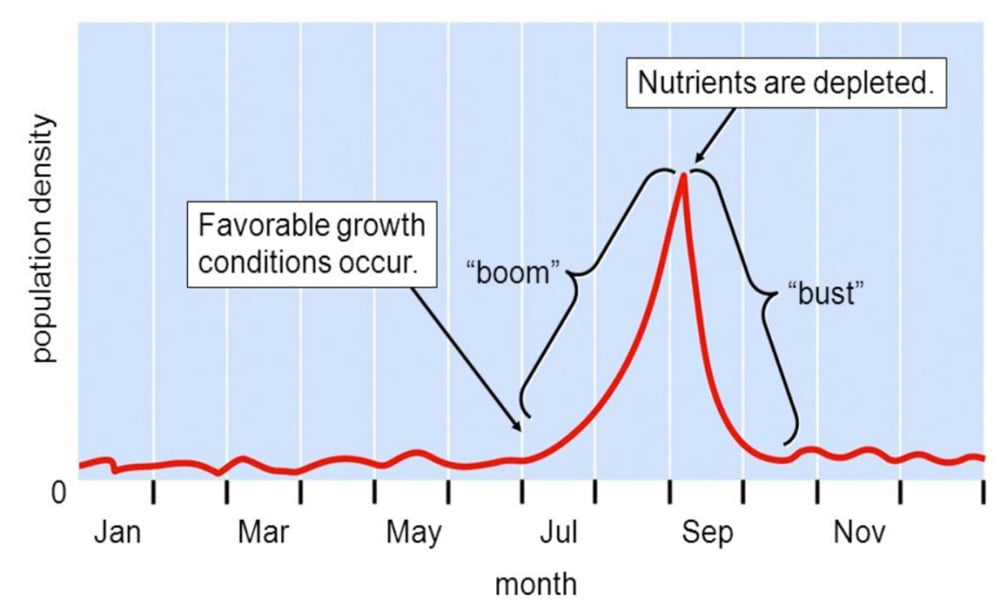
7. Some species populations, in simple habitats, cycle repeatedly through boom and bust phases.The height of the boom is called the ‘plague phase’ of such cycles.

8. Hypothesis: Homo sapiens are currently approaching the peak of the plague phase of a one-off global population cycle and will crash because of depleted resources, habitat deterioration and psycho-social feedback, including possible war over remaining ‘assets,’ sometime in this century. (“But wait,” I hear you protest. “Humans are not just any other species. We’re smarter; we can plan ahead; we just won’t let this happen!” Perhaps, but what is the evidence so far that our leaders even recognize the problem?)

9. The crash may be triggered or exacerbated by the depletion or abandonment of economic stocks of fossil fuels. As noted above, modern civilization is a product of, and dependent on, accessible abundant energy. (At present there are no viable alternatives to fossil fuels. Even if we do develop equivalent substitutes for fossil fuel they will, at best, merely delay the crash).

10. The long-term human carrying capacity of Earth — after ecosystems have recovered from the current plague — is probably one to three billion people, depending on technology and material standards of living. (Estimates vary from fewer than a billion to a truly ludicrous trillion.)

11. Getting there would mean five to nine billion fewer people on the planet. This is where we end up after a recovery following either controlled descent or chaotic crash.

Making the looming disaster an election issue

The first thing to take from this analysis is that we are once again playing in Roger Hallam’s death-toll ballpark. But a more important point is that climate change is not the only existential threat confronting modern society. Indeed, we could initiate any number of conversations that end with the self-induced implosion of civilization and the loss of 50 per cent or even 90 per cent of humanity.

And that places the global community in a particularly embarrassing predicament. Homo sapiens, that self-proclaimed most-intelligent-of-species, is facing a genuine, unprecedented, hydra-like ecological crisis, yet its political leaders, economic elites and sundry other messiahs of hope will not countenance a serious conversation about of any of its ghoulish heads.

Climate change is perhaps the most aggressively visible head, yet despite decades of high-level talks — 33 in all — and several international agreements to turn things around, atmospheric CO2 and other GHG concentrations have more than doubled to over 37 billion tonnes and, with other GHG concentrations, are still rising at record rates.

In these circumstances, the only certainty is that the longer we deny reality and delay concerted action, the steeper and deeper the crash is likely to be.

So, where does this leave us? Jonathan Franzen has a suggestion: “You can keep on hoping that catastrophe is preventable.... Or you can accept that disaster is coming, and begin to rethink what it means to have hope.”

Certainly hope is sterile if unaccompanied by vigorous action that reflects looming reality.

This is an election year in Canada. Ask your candidates — sitting MPs in particular — just how much time they have spent contemplating these issues or debating them in caucus.

What is their party’s plan for the coming great unravelling?

War and Empire Links Sept 2019

Our Invisible Government. Chris Hedges, Truthdig. Sept. 16, 2019.
There are two forms of government in the United States. There is the visible government—the White House, Congress, the courts, state legislatures and governorships—and the invisible government, or deep state, where anonymous technocrats, intelligence operatives, generals, bankers, corporations and lobbyists manage foreign and domestic policy regardless of which political party holds a majority. 
The most powerful and important organs in the invisible government are the nation’s bloated and unaccountable intelligence agencies. They are the vanguard of the invisible government. They oversee a vast “black world,” tasked with maintaining the invisible government’s lock on power. They spy on and smear domestic and foreign critics, fix elections, bribe, extort, torture, assassinate and flood the airwaves with “black propaganda.” They are impervious to the chaos and human destruction they leave in their wake. Disasters, social upheavals, economic collapses, massive suffering, death and rabid anti-American blowback have grown out of the invisible government’s overthrow of democratically elected governments in Iran, Guatemala and Chile and the wars it fostered in Vietnam, Afghanistan, Iraq, Libya and Syria. The United States and the rest of the globe would be far safer if our self-styled shadow warriors ... were made accountable to the public and the rule of law.

Why Does Chris Hedges Hedge His Bets? (Revealing While Concealing the Invisible Government's Conspiracies.) Edward Curtin. Sept. 21, 2019.
Revelations about the machinations of the so-called “deep state’s” conspiracies often conceal deeper truths that go unmentioned. This is quite common, whether it is done intentionally or not. 
Sometimes it is intentional and is directed by the intelligence agencies themselves or their accomplices in the media, who operate a vast propaganda network.  In that case, it is because the secret rulers have been caught doing some evil deed, and, not being able to fully deny it, they admit to part of it while concealing deeper secrets.
... 
News in today’s world appears as a pointillistic canvas of thousands of disconnected dots impossible to connect unless one has the desire, time, determination, and ability to connect the points through research, which most people do not have.  “As a result,” writes Jacques Ellul in his classic study, Propaganda, “he finds himself in a kind of kaleidoscope in which thousands of unconnected images follow each other rapidly” and “his attention is continually diverted to new matters, new centers of interest, and is dissipated on a thousand things, which disappear from one day to the next.”
... 
Hedges tells us all this and rightly condemns it as “the moral squalor” and “criminality” that it is. 
... 
This also is very true.  All these truths can make you forget what’s not true and what’s missing in his article. 
But something is missing, and some wording is quite odd and factually false. 
... 
He omits mentioning the Clinton administration’s dismantling wars against Yugoslavia, including 78 days of non-stop bombing of Serbia in 1999 that killed thousands of innocent people in the name of “humanitarian intervention,” wars he covered for the New York Times, the paper he has come to castigate  and the paper that has a long history of doing the CIA’s bidding. 
... 
He says the invisible deep state “failed to foresee…the 9/11 attacks or the absence of Iraqi weapons of mass destruction.”  This is factually wrong and quite absurd, as is well documented.  They simply lied about these matters ex post facto.  He suggests such failures were due to “ineptitude,” a coy word used by numerous other writers who find reasons to deny intentionality to the “deep state.” 
He therefore is implying that the attacks of September 11, 2001, a subject that he has consistently failed to address over the years even while he has written in detail about so much else, did not involve America’s “invisible government forces.”  
... 
He is a very well-read man, who is constantly quoting from scholars about various important issues.  His books are chock full of such quotations and references.  But you will look in vain for references to the brilliant, scholarly work of such writers on these assassinations, the attacks of September 11, 2001, and the CIA’s criminal and morally repugnant activities as James Douglass, David Talbot, David Ray Griffin, William Pepper, Graeme MacQueen, Lisa Pease, and so many others.  Is it possible that he has never read their books when he has read so much else?  If so, why? 
As I said before, Chris Hedges, who has a passionate but mild-mannered style, is not alone in his disregard of these key matters. Other celebrity names on the left have been especially guilty of the same approach: Noam Chomsky, Howard Zinn, and Alexander Cockburn, to name just a few (Zinn and Cockburn are dead).  They have avoided these issues as if they were toxic.  Nor would they logically explain why.  The few times they did respond to those who criticized them for this, it was usually through a dismissive wave of the hand or name calling, a tactic such as the CIA developed with the term “conspiracy theory.”


How Important Is The Drone Attack On The Saudi Oil Field? Ian Welsh. Sep. 16, 2019.

US Defends Your Freedom By Using Troops As Saudi Oil Security Guards. Caitlin Johnstone. Sept. 22, 2019.

If you’ve been lying awake at night terrified that the Pentagon might not send additional troops and armaments to defend oil corporations in Saudi Arabia and the United Arab Emirates, I’ve got some great news for you.

In response to an attack on Saudi Aramco oil infrastructure for which Houthi rebels in Yemen have taken credit, the US government has responded in the only possible rational way: by blaming Iran and deploying troops to act as security guards for Middle Eastern oil companies.

“In response to the kingdom’s request, the president has approved the deployment of U.S. forces, which will be defensive in nature and primarily focused on air and missile defense,” Defense Secretary Mark Esper informed the press yesterday. “We will also work to accelerate the delivery of military equipment to the kingdom of Saudi Arabia and the UAE to enhance their ability to defend themselves.”

So you can breathe easy, my friend. Freedom and democracy are safe once more.

JUST IN: Pentagon to will deploy additional troops and military equipment to Saudi Arabia: "In response to the Kingdom's request, the president has approved the deployment of U.S. forces, which will be defensive in nature and primarily focused on air and missile defense." pic.twitter.com/qORbgWHoeP
— ABC News Politics (@ABCPolitics) September 20, 2019

A lot of delusional, unpatriotic democracy haters like to argue that the US military doesn’t actually defend the freedom of the American people, and that it isn’t really used to defend freedom at all, and that it isn’t even really used to defend any rules-based international order as sometimes claimed, and that even to use the word “defend” to describe anything the US military does is inaccurate since it is consistently on the attacking and aggressing side of any given conflict, and that actually the US military functions as nothing other than a blunt object wielded by the rich and powerful for the advancement of plutocratic interests and the geostrategic dominance of opaque and unaccountable government agencies, and that it can in fact be accurately said that the only difference between the US military and any other band of armed thugs is funding…

I forget where I was going with this.

Ah, yes. Defending your freedoms. If sending a platoon of Paul Blarts to act as mall security for foreign oil corporations isn’t enough to get you saluting every American flag flying over every McDonald’s you see, then you should know that the US military’s freedom fighting doesn’t end at mere corporate asset protection.

They’re also defending your freedom by killing Afghan farmers in their sleep.

A U.S drone strike just slaughtered 30 civillian farmers in Afghanistan. You probably didn’t hear about it.https://t.co/tbSMwTiPEG
— Public Citizen (@Public_Citizen) September 19, 2019

Why did the armed forces of the United States kill dozens of civilian farmers in Afghanistan while they rested in the field after a hard day’s work? That’s a good question. But an even better question is, what were those Afghan farmers doing lying on top of your freedom?

Obviously the compassionate US military would never dream of killing non-combatants under any circumstances whatsoever, but the unfortunate fact of the matter is that you can’t make an omelet without cracking a few civilians. Those dead farmers were collateral damage, caught in the crossfire of a a life-or-death struggle for freedom and democracy in a nation that surely has something to do with defending those things somehow. It is certainly a loss that civilians perish in this way on a regular basis in Afghanistan, but that’s a small price to pay for everything we’ve gained as a result of that eighteen-year occupation, such as [research what’s been gained and put here in second draft].

Yes, whether they’re defending Saudi Aramco profit margins, bombing field laborers, encircling the planet with hundreds of military bases, stockpiling nuclear weapons, funneling weapons to extremist militias, toppling governments, destabilizing large regions, inflicting siege warfare upon civilians via starvation sanctions, or just generally dominating the entire world using the carrot of military alliance and the stick of military retribution, you can rest assured that the US military is giving your freedoms the best protection that petrodollars and war profiteering can buy.


Novelty Joke PM From Fake Country Meets With Trump, Silent On Assange. CaitOz. Sept. 21, 2019.


The Madness of James Mattis. Maj. Danny Sjursen, TruthDig. Sep. 8, 2019.

The wildly unpopular, if not forbidden-to-be-uttered, truth is that Mattis, while an admittedly decorated Marine and a military strategist, was an abject failure. Despite being hailed as a “warrior monk,” he was and remains a conventional interventionist figure—prisoner to the tired old militarist ideas of the necessity for U.S. military forward deployment, counterinsurgency in Afghanistan, and the perpetual need to balance or “contain” Russia and China. His career-long defense of America’s post-9/11 engagements should be the first sentence of his obituary.

None of these egregious errors in judgment have derailed Mattis’ career, of course. Can-do attitudes and compulsive optimism form the bedrock of today’s military culture, if not American society at large. Indeed, it was the general’s all-too-familiar view of the “War on Terror” that likely endeared him to successive promotion boards. As he notes in his own op-ed, “Institutions get the behaviors they reward.”

But Mattis and his entire generation of military leadership ultimately did a great disservice to their subordinates and the American people once they reached four-star rank. When given an (often absurd) mission by administration officials—be they Bush neoconservatives or Obama liberals—these generals and admirals offered “how” rather than “if” responses. Cultishly eager to please, they failed to tell their frequently ill-informed superiors that perhaps a proposed conflict couldn’t be won, at least with the resources available or at an acceptable human cost.


US Army Smashes Recruitment Goals By Preying On Hopeless Millennials With Student Debt. Zerohedge. Sep 22, 2019.

Saturday, September 21, 2019

Topic: Green New Deal

ONLY A GREEN NEW DEAL CAN DOUSE THE FIRES OF ECO-FASCISM. Naomi Klein, The Intercept. September 16 2019.


The Green New Deal: A Fight for Our Lives. Naomi Klein, New York Review of Books. Sept. 17, 2019.


Only a Global Green New Deal Can Save the Planet. And Bernie Sanders has a plan for that. Tom Athanasiou, The Nation. Sept. 17, 2019
But the true genius of Sanders’s Green New Deal—its secret weapon for achieving the massive emissions cuts he promises—has gone unnoticed by mainstream news organizations and even most climate activists. He clearly recognizes that eliminating greenhouse gas emissions by 2030, as some climate activists have demanded, is all but impossible in an economy as enormous and energy intensive as the United States’—at least without paralyzing transportation systems, endangering food supplies, and otherwise triggering a social backlash. But rather than just endorse the 2030 deadline anyway, as some activists insist, or pretend that the science is negotiable, as most politicians do, Sanders has found a credible way around the dilemma. 
... 
What makes the Sanders plan special is that he accepts the hard scientific truth that steep emissions cuts are essential but he makes such cuts feasible by refusing to limit his vision on how to achieve them. Rather, he adds another hard truth: If humanity is to stabilize the global climate system, rich nations must do their fair share by going beyond domestic action and providing support for emissions reductions in poorer countries. Sanders is the first major American political figure to face the reality and scale of this necessity.

The Hope of the Green New Deal. Roger Blanchard, Resilience. Sept. 25, 2019.
One individual who is more realistic about what needs to be done – but will not be done – to reduce CO2 emissions is the prominent climate scientist Kevin Anderson. Approximately 6 years ago he stated that the world had to reduce CO2 emissions by 10%/year starting immediately to prevent a worst-case scenario in terms of warming. He was very likely right about that, but at the time I stated the world would not do what he said needed to be done.  As it has turned out, CO2 emissions have increased since then not decreased.

Kevin is now stating that we have to fundamentally change the way we live.  Specifically we need to get away from a materialist lifestyle.  The problem is that in the U.S., and much of the world now, we have a hedonic lifestyle which most Americans worship.  Thus, we have lots of magical thinking when it comes to addressing the global warming issue and we prefer to kick the can down the road and test the worst-case scenario.

To be clear, those who deny the conclusions of climate science are partaking in magical thinking because the science is overwhelming.  As well, those who believe that renewables will largely or wholly replace fossil fuels are partaking in magical thinking because it’s based upon nothing more than naïve optimism.  The fundamental problem we face is that there are too many people consuming too much fossil fuels and producing too much CO2.  Either we will correct the problem or nature will correct the problem.


A Serious Green New Deal Would Take Up One-Third of the Economy—Are We Ready for That? Yves Smith, nakedcapitalism. Feb. 2, 2019.
I have to confess to being not keen about various Green New Deal proposals. They feed the idea that we can largely preserve our lifestyles and still make a big enough reduction in greenhouse gas output soon enough to ward off catastrophic outcomes. 
There are in my mind, three fallacies here:

1. The fastest and most effective way to reduce greenhouse gas output is radical conservation. The urgency of the challenge means this approach needs to be top of the list. Every year more of status quo or not much different is more greenhouse gases pumped into the atmosphere. No one is proposing that we even take measures of the sort imposed in the oil crisis, like lowering speed limits and requiring businesses to set their thermostats to 67 in the winter and 77 in the summer. If we were serious, we’d have to be willing to bankrupt the airlines by forcing 90% reductions in flight levels and outlaw private jets.

2. Building green infrastructure has an energy cost, and those costs are seldom incorporated (like the greenhouse gas cost of mining and delivering materials for production of various inputs). They are also not factoring in that some of the materials that are important in current “green” technologies don’t exist in sufficient quantity to satisfy anticipated needs (Jack Lifton has written extensively about lithium). And some materials are costly in environmental terms. See, for example: 
Critical minerals scarcity could threaten renewable energy future. Stanford
We may face a huge shortage of essential raw materials stiffling green energy if governments don’t step up their game ZME Science
 3. While Green New Deal approaches would be valuable in conjunction with radical conservation, they aren’t sufficient on their own, if nothing else because they will take too long to be implemented when time is of the essence. And they have a tendency to perpetuate the idea that there will be no or little sacrifice needed in cutting carbon output levels.
People accepted rationing and other forms of sacrifice at times of war. I’d take the Green New Deal people a lot more seriously if they firmly opposed US military activity as a source of greenhouse gases and also opposed non-essential, energy costly technology planned obsolescence schemes like 5G.


let's declare war on climate change:  “What You Need To Know About The $22 Trillion National Debt”: The Alternative SHORT Interview. Eric Tymoigne. Feb. 17, 2019.


Jobs, the Environment, and a Planet in Crisis. Unions vs. Environmentalists or Unions and Environmentalists?  Aviva Chomsky, via TomDispatch. Aug. 6, 2019.

When it comes to heat, extreme weather, wildfires, and melting glaciers, the planet is now in what the media increasingly refers to as “record” territory, as climate change’s momentum outpaces predictions. In such a situation, in a country whose president and administration seem hell-bent on doing everything they conceivably can to make matters worse, the Green New Deal (GND) seems to offer at least a modest opening to a path forward.

You know, the resolution introduced this February in the House of Representatives by Alexandria Ocasio-Cortez (D-NY) and Edward Markey (D-MA). Unsurprisingly, the proposal has been roundly attacked by the right. But it’s stirred up some controversy on the left as well. You might imagine that labor unions and environmental organizations would be wholeheartedly for a massive federal investment in good jobs and a just transition away from fossil fuels. But does organized labor actually support or oppose the Green New Deal? What about environmental organizations? If you’re not even sure how to answer such questions, you’re not alone.

That 14-page resolution calls for “a new national, social, industrial, and economic mobilization on a scale not seen since World War II and the New Deal era.” Its purpose: to reduce U.S. carbon emissions to net zero within a decade, while guaranteeing significant numbers of new jobs and social welfare to American workers. Read it and you’ll find that it actually attempts to overcome historical divisions between the American labor and environmental movements by linking a call for good jobs and worker protection to obvious and much-needed environmental goals.

In the process, the GND proposal goes impressively far beyond the modest goals of the Paris Climate Accords and other international agreements. It supports specific, enforceable targets for bringing climate change under control, while drawing clear connections between social, labor, and environmental rights. Acknowledging in blunt terms the urgency of making systemic change on a rapidly warming planet, it calls for the kind of national mobilization Americans haven’t experienced since the end of the Second World War. Described that way, it sounds like something both the labor and environmental movements would naturally support without a second thought. There is, however, both a history of mistrust and real disagreement over issues, which both movements are now grappling with. And the media is doing its part by exaggerating labor’s opposition to the proposal, while ignoring what environmental organizations have to say.

One Green New Deal controversy focuses on the future role of fossil fuels in that plan. A number of environmental organizations believe that such energy sources have no place in our future, that they need to stay in the ground, period. They cite climate science and the urgent need to move rapidly and drastically to eliminate carbon emissions as the basis for such a conclusion. As it happens, the Green New Deal avoids directly challenging the fossil-fuel industry. In fact, it doesn’t even use the term “fossil fuels.”

From another perspective, some unions hope that new technologies like carbon capture, utilization, and storage (CCUS) will make those fuels more efficient and far cleaner. If the addition of carbon to the atmosphere could be reduced significantly or offset in some fashion, while humanity still burned natural gas, oil, or even coal, they say, jobs in those sectors could be preserved. And the unions have other concerns as well. They tend, for instance, to look skeptically on the GND’s promises of a “just transition” for displaced fossil-fuel workers like coal miners, given the devastation that has fallen on workers and their communities when industries have shut down in the past. They also fear that, without accompanying trade protections, polluting industries will simply export their emissions rather than reduce them.

Being more of a statement of purpose than an elaborated plan, the Green New Deal is short on both detail and answers when it comes to such issues. The actual roadmap to achieving its goals, the proposal states, “must be developed through transparent and inclusive consultation, collaboration, and partnership with frontline and vulnerable communities, labor unions, worker cooperatives, civil society groups, academia, and businesses.” Both unions and environmental organizations are already mobilizing to make sure their voices are part of the process.

The right wing was quick to mockingly publicize the Green New Deal not just as thoroughly unrealistic but as utterly un-American. ...

yup, because what's truly American is all that's wrong with our unsustainable civilization.

Is There An Upper Limit On Human Self-Deceptive Bullshit? Dave Cohen, Deline of the Empire. Feb. 7, 2019.

So, even a non-binding resolution expressing humanity's positive but delusional hopes and fantasies is unlikely to make it through the U.S. Congress.

Climate Links: Sept 2019

World 'gravely' unprepared for effects of climate crisis – report. Damian Carrington, Guardian. Sept. 10, 2019.

Trillions of dollars needed to avoid ‘climate apartheid’ but this is less than cost of inaction

Join the Global Call to #AdaptOurWorld. Global Commission on Adaptation.
Climate change is upon us and its impacts are getting more severe. We must adapt. 
World leaders from the Global Commission on Adaptation are calling on governments, businesses and local community leaders to take urgent action to advance climate adaptation solutions.

ONLY A GREEN NEW DEAL CAN DOUSE THE FIRES OF ECO-FASCISM. Naomi Klein, The Intercept. September 16 2019.


Only a Global Green New Deal Can Save the Planet. And Bernie Sanders has a plan for that. Tom Athanasiou, The Nation. Sept. 17, 2019
But the true genius of Sanders’s Green New Deal—its secret weapon for achieving the massive emissions cuts he promises—has gone unnoticed by mainstream news organizations and even most climate activists. He clearly recognizes that eliminating greenhouse gas emissions by 2030, as some climate activists have demanded, is all but impossible in an economy as enormous and energy intensive as the United States’—at least without paralyzing transportation systems, endangering food supplies, and otherwise triggering a social backlash. But rather than just endorse the 2030 deadline anyway, as some activists insist, or pretend that the science is negotiable, as most politicians do, Sanders has found a credible way around the dilemma. 
... 
What makes the Sanders plan special is that he accepts the hard scientific truth that steep emissions cuts are essential but he makes such cuts feasible by refusing to limit his vision on how to achieve them. Rather, he adds another hard truth: If humanity is to stabilize the global climate system, rich nations must do their fair share by going beyond domestic action and providing support for emissions reductions in poorer countries. Sanders is the first major American political figure to face the reality and scale of this necessity.

The Prospect of an Elizabeth Warren Nomination Should Be Very Worrying. Nathan J. Robinson, Current Affairs. Sept. 23, 2019.
The differences between Warren and Sanders are critically important…
... Let’s just forget Bernie, a relic of 2016, and all settle on Warren. 
Why, then, does the prospect of a Warren nomination make me deeply worried? What is it that makes me instinctively feel it would be a very bad idea? Why does it feel to me like there’s something so wrong about the “airtight argument” that’s difficult to articulate?  
...  
Personally, I feel that the difference between Sanders and Warren is gigantic, and that it could have substantial consequences for the future of the world. 
... 
But I think I know what I’m fearing. I fear this is going to be Obama all over again. 
...  
Perhaps I would feel less troubled if I really felt like I could trust Elizabeth Warren. 
...  
She has done so many things that make me suspect she won’t follow through on her radical rhetoric, or will shift to the center in a general election, or won’t be willing to fight as hard as necessary.


What If We Stopped Pretending?  Jonathan Franzen, The New Yorker. September 8, 2019.
The climate apocalypse is coming. To prepare for it, we need to admit that we can’t prevent it.

Don’t bet on the UN to fix climate change – it’s failed for 30 years. Marc Hudson, The Conversation. September 20, 2019.
... amid the hype, it’s worth putting this UN summit in context against the history of 30 years of such international meetings. Is it a vain hope for 197 countries to agree on any meaningful climate action at all, especially when it involves so much money and power? 
Scientists knew from the late 1950s that carbon dioxide was building up and that this could be a problem. By the late 1970s, they knew it would be – it was just a question of when. By 1985, at a workshop of scientists in Villach, Austria, the answer became “sooner than we thought”.

Money Is the Oxygen on Which the Fire of Global Warming Burns. Bill McKibben, The New Yorker. Sept. 17, 2019.
What if the banking, asset-management, and insurance industries moved away from fossil fuels?


Amazon Employees Are Walking Out Over the Company's Huge Carbon Footprint. Lauren Kaori Gurley, vice. Sep 9, 2019.
Nearly 1,000 employees have pledged to walk out September 20 to demand the company go to zero emissions by 2030.

What It’s Like Living in One of the Hottest Cities on Earth—Where It May Soon Be Uninhabitable. Aryn Baker, TIME. September 12, 2019.


World 'losing battle against deforestation'. Mark Kinver, BBC. Sept. 12, 2019.


Climate change: Electrical industry's 'dirty secret' boosts warming. Matt McGrath, BBC. Sep. 13, 2019.


WAR ON THE WORLD. Industrialized Militaries Are a Bigger Part of the Climate Emergency Than You Know. Muraza Hussain, The Intercept. Sept. 15, 2019.


Meat is Murder. But you know that already. Mark Bittman, NYT. Sep. 17  2019.

Book review of:
WE ARE THE WEATHER
Saving the Planet Begins at Breakfast
By Jonathan Safran Foer


Documentary “Blowout” Follows Climate Cost of Oil Boom from Fracking to Exports. Jerri-Lynn Scofield, nakedcapitalism. Sep. 22, 2019.

Timely reminder that Trump didn’t create the climate crisis – although he’s certainly making it worse. As the RNN touts this interview, “ [t]he new film follows the U.S. oil supply chain, covering health, climate and environmental justice impacts. And it points to the president who was central to creating the current reality: Barack Obama.”


And They Made a Desert: 80 to 90% Drop in Nutrients in Food. Ian Welsh. Sept. 17, 2019.
The Industrial Era has been the Era of Locusts. We think we’re rich, but most of what has been happening is that we’re consuming resources far faster than they can be replaced. Meanwhile, we’re poisoning ourselves and the earth; shattering ecosystems which we do not know how to repair (or even understand), and altering Earth’s climate cycle ... 
This is crazed behaviour. This is the behaviour of children who have no self-control at all. Even when we know what we are doing is destructive, we keep doing it..
The super-optimists are fools. Yes, it is possible we’ll get out of this, but it’s not possible if we keep telling ourselves that the hole we’ve dug is no big deal.


Divining Comedy. Wen Stephenson, The Baffler. Sept. 5, 2019.

Amitav Ghosh’s new novel is set amid climate disaster—yet it steers toward the mythic and the comic

Amitav Ghosh: I must say, when I started writing Gun Island, it did sometimes seem to me that it was unwise to create a challenge of that kind for myself. I can’t say that it cramped me or worried me in any way, but as you know very well, once one starts thinking about this climate stuff, it just permeates everything; you can’t get away from it. It’s just so completely all around you.

...

AG: You see, one of the things which is so problematic about the world, which is again unraveling, is this idea of time as a progression. You know, that time is always taking you toward, as Obama used to say, “the right side of history.” Whereas anyone who looks at the climate stuff knows that, no, that’s the one thing that you can’t say. And so what do you substitute for that? It has to be some sort of cyclical idea of time, and disaster, catastrophe. That’s a part of it, if you like.

...

AG: I think one very important aspect of it would be simply to acknowledge how wrong we’ve been about everything. Just that. That we acknowledge that the dominant ideas and culture of our time have been wrong about everything.

WS: Everything?

AG: Almost everything, I would say.

...

AG: Until just last year, I’d say, 2018. But even now you have prominent Democrats saying this can’t be the main issue. It can be recognized as an issue, but there are bigger issues.

WS: Right. And yet, when one really comes to grips with the climate science, one realizes that to be serious about climate is to be radical.

AG: That’s right.

WS: In fact, even revolutionary. But until very recently, the left has been almost completely absent on climate change. It’s almost as though the implications of climate science are too radical, even for radicals. What do you make of that?

AG: I think it’s very important. It’s absolutely true that the left—and you’re talking about the American left, but I can tell you that in India, the left never even took local environmental questions seriously. Even after the Bhopal tragedy.

WS: But I feel like we have to ask ourselves, do any of us really take climate politics seriously? It’s easy for me to say, so-and-so isn’t serious because they’re not radical enough. But am I radical enough? I mean, our survival is at stake. A rational response would be a truly revolutionary politics, when we consider what is actually happening, and the amount of time we have to deal with it.

...

AG: I must say, I find Greta Thunberg and Extinction Rebellion incredibly invigorating.

WS: And yet they’re only an extension of the kind of activism we’ve already seen. It’s not truly radical. It’s not revolutionary.

AG: Let me just say, I feel a lot of sympathy, especially for the people you wrote about in your book, and these young activists, my heart goes out to them. But you know, the thing that I can’t forget, because of the part of the world that I’m from, and that I think a lot of people involved in this often forget, is that this is not in the hands of the West anymore. This is going to be decided in Asia, and Africa.

WS: Absolutely. Although, if the United States and Europe were to embark on a crash program to decarbonize their economies by 2050, that would have some effect on the trajectory that China and India take.

AG: It would. But look, America’s addiction to fossil fuel energy isn’t just technological. It’s strategic. It’s through energy that America controls global strategy. If renewables could be adopted at scale, the whole strategic calculus of the world would be completely upended.

WS: Again, it’s unthinkable, right? But revolution is very often unthinkable to those in the historical moment in which it occurs. There are people right now who are absolutely certain that there’s nothing to be done, that it’s over, that all is lost, that we’re doomed. But, actually, there’s a lot of uncertainty still. We don’t know the future. We don’t know what is still possible. The human element, the political and social part, is highly uncertain. We actually don’t know.

AG: Absolutely. We don’t know.

WS: And how one responds to that uncertainty is everything.

AG: That’s right. It’s how bad it will be. This is what it’s about

Friday, September 20, 2019

McKibben: Money Is the Oxygen on Which the Fire of Global Warming Burns

Money Is the Oxygen on Which the Fire of Global Warming Burns. Bill McKibben, The New Yorker. Sept. 17, 2019.

What if the banking, asset-management, and insurance industries moved away from fossil fuels?


I'm skilled at eluding the fetal crouch of despair — because I’ve been working on climate change for thirty years, I’ve learned to parcel out my angst, to keep my distress under control. But, in the past few months, I’ve more often found myself awake at night with true fear-for-your-kids anguish. This spring, we set another high mark for carbon dioxide in the atmosphere: four hundred and fifteen parts per million, higher than it has been in many millions of years. The summer began with the hottest June ever recorded, and then July became the hottest month ever recorded. The United Kingdom, France, and Germany, which have some of the world’s oldest weather records, all hit new high temperatures, and then the heat moved north, until most of Greenland was melting and immense Siberian wildfires were sending great clouds of carbon skyward. At the beginning of September, Hurricane Dorian stalled above the Bahamas, where it unleashed what one meteorologist called “the longest siege of violent, destructive weather ever observed” on our planet. The scientific warnings of three decades ago are the deadly heat advisories and flash-flood alerts of the present, and, as for the future, we have hard deadlines. Last fall, the world’s climate scientists said that, if we are to meet the goals we set in the 2015 Paris climate accord—which would still raise the mercury fifty per cent higher than it has already climbed—we’ll essentially need to cut our use of fossil fuels in half by 2030 and eliminate them altogether by mid-century. In a world of Trumps and Putins and Bolsonaros and the fossil-fuel companies that back them, that seems nearly impossible. It’s not technologically impossible: in the past decade, the world’s engineers have dropped the price of solar and wind power by ninety and seventy per cent, respectively. But we’re moving far too slowly to exploit the opening for rapid change that this feat of engineering offers. Hence the 2 a.m. dread.

There’s good news, too: as the crisis grows more obvious, far more people are joining in the fight. In the year since the scientists imposed that deadline, we’ve seen the rise of the Green New Deal, the cheeky exploits of Extinction Rebellion, and the global spread of the school strikes started by the Swedish teen-ager Greta Thunberg. It seems that there are finally enough people to make an impact. The question is, what levers can we pull that might possibly create change within the time that we need it to happen?

Some of us have begun to change our own lives, pledging to fly less and to eat lower on the food chain. But, whatever our intentions, we’re each of us currently locked into burning a fair amount of fossil fuel: if there’s no train that goes to your destination, you can’t take it. Others—actually, often the same people—are working to elect greener candidates, lobbying to pass legislation, litigating cases headed for the Supreme Court, or going to jail to block the construction of pipelines.

These are all important efforts, but we need to do more, for the simple reason that they may not pay off fast enough. Climate change is a timed test, one of the first that our civilization has faced, and with each scientific report the window narrows. By contrast, cultural change—what we eat, how we live—often comes generationally. Political change usually involves slow compromise, and that’s in a working system, not a dysfunctional gridlock such as the one we now have in Washington. And, since we face a planetary crisis, cultural and political change would have to happen in every other major country, too.

But what if there were an additional lever to pull, one that could work both quickly and globally? One possibility relies on the idea that political leaders are not the only powerful actors on the planet—that those who hold most of the money also have enormous power, and that their power could be exercised in a matter of months or even hours, not years or decades. I suspect that the key to disrupting the flow of carbon into the atmosphere may lie in disrupting the flow of money to coal and oil and gas.

Following the money isn’t a new idea. Seven years ago, 350.org (the climate campaign that I co-founded, a decade ago, and still serve as a senior adviser) helped launch a global movement to persuade the managers of college endowments, pension funds, and other large pots of money to sell their stock in fossil-fuel companies. It has become the largest such campaign in history: funds worth more than eleven trillion dollars have divested some or all of their fossil-fuel holdings. And it has been effective: when Peabody Energy, the largest American coal company, filed for bankruptcy, in 2016, it cited divestment as one of the pressures weighing on its business, and, this year, Shell called divestment a “material adverse effect” on its performance. The divestment campaign has brought home the starkest fact of the global-warming era: that the industry has in its reserves five times as much carbon as the scientific consensus thinks we can safely burn. The pressure has helped cost the industry much of its social license; one religious institution after another has divested from oil and gas, and Pope Francis has summoned industry executives to the Vatican to tell them that they must leave carbon underground. But this, too, seems to be happening in too-slow motion. The fossil-fuel industry may be going down, but it’s going down fighting. Which makes sense, because it’s the fossil-fuel industry—it really only knows how to do one thing.

So now consider extending the logic of the divestment fight one ring out, from the fossil-fuel companies to the financial system that supports them. Consider a bank like, say, JPMorgan Chase, which is America’s largest bank and the world’s most valuable by market capitalization. In the three years since the end of the Paris climate talks, Chase has reportedly committed a hundred and ninety-six billion dollars in financing for the fossil-fuel industry, much of it to fund extreme new ventures: ultra-deep-sea drilling, Arctic oil extraction, and so on. In each of those years, ExxonMobil, by contrast, spent less than three billion dollars on exploration, research, and development. A hundred and ninety-six billion dollars is larger than the market value of BP; it dwarfs that of the coal companies or the frackers. By this measure, Jamie Dimon, the C.E.O. of JPMorgan Chase, is an oil, coal, and gas baron almost without peer.

But here’s the thing: fossil-fuel financing accounts for only about seven per cent of Chase’s lending and underwriting. The bank lends to everyone else, too—to people who build bowling alleys and beach houses and breweries. And, if the world were to switch decisively to solar and wind power, Chase would lend to renewable-energy companies, too. Indeed, it already does, though on a much smaller scale. (A spokesperson for Chase said that the bank has committed to facilitate two hundred billion dollars in “clean” financing by 2025, but did not specify where the money will go. The bank also pointed out that it has installed 2,570 solar panels at branches in California and New Jersey.) The same is true of the asset-management and insurance industries: without them, the fossil-fuel companies would almost literally run out of gas, but BlackRock and Chubb could survive without their business. It’s possible to imagine these industries, given that the world is now in existential danger, quickly jettisoning their fossil-fuel business. It’s not easy to imagine—capitalism is not noted for surrendering sources of revenue. But, then, the Arctic ice sheet is not noted for melting.

The last minutes of a football game are different from the rest; if you are far enough behind, you dispense with caution. Since gaining a few yards cannot help you, you resort to more desperate, lower-percentage plays. You heave the ball and you hope, and, every once in a while, you win. So a small group of activists has begun probing the financial industry, looking for chances to toss the kind of Hail Mary pass that could yet win this game. The odds are definitely long, but just talking with these groups has begun to lift my despair.

Banking

Around the turn of the century, a California-based environmental group called Rainforest Action Network (RAN) was trying to figure out how to slow down the deforestation of the Amazon. It found that Citigroup, then the largest bank on earth, was lending to many of the projects that cut down trees for pastureland, and so it ran a campaign that featured celebrities cutting up their Citi credit cards. Eventually, Citigroup joined with other banks to set up the Equator Principles, which the participants call a “risk management framework” designed to limit the most devastating lending.

At some point in the campaign, RAN started paying twenty-four thousand dollars annually to rent a Bloomberg terminal, the financial-information monitor that sits on any broker’s desk, allowing her to track stock prices, bond issues, and deals of every type. “Our Bloomberg rep is always flabbergasted when he visits us,” Alison Kirsch, a climate-and-energy researcher with RAN, told me. “Essentially, we use it backwards.” The terminal will spit out the current league tables, which rank loan volume: showing, for example, which banks are lending the most money to railroad builders or to copper miners—or to fossil-fuel companies. “The banks all want to be at the top of those tables,” Kirsch said. “It’s how they keep score.” But RAN turns the tables upside down. Every year, after six months of detailed analysis, it publishes a thick report called “Banking on Climate Change,” which ranks the financial giants according to how much damage they’re doing.

This year’s edition, the tenth, shows Chase in the lead, as usual, followed by Wells Fargo, Citi, and Bank of America. Two Japanese banks and the British giant Barclays are also among the top ten, but it’s mostly a North American club—three Canadian banks round out the list. And the trend is remarkable: in the three years since the signing of the Paris climate accord, which was designed to help the world shift away from fossil fuels, the banks’ lending to the industry has increased every year, and much of the money goes toward the most extreme forms of energy development. 
In the lead-up to the Paris talks, a team of scientists published a big paper in Nature that listed the planet’s most catastrophic deposits of hydrocarbons, the ones that should be left in the ground at all costs. It included Arctic oil and the tar-sands sludge found in northern Alberta; Chase has aggressively funded the extraction of both. According to RAN, the bank’s largest single energy-sector client is TC Energy (until recently known as Transcanada), which is trying to build the Keystone XL pipeline, which would stretch from the tar sands to the Gulf of Mexico—a project that President Obama rejected and that the NASA scientist James Hansen said would be the start of a “game over” scenario for the climate. (Chase would not comment.) Jason Opeña Disterhoft, RAN’s senior campaigner, told me, “It’s a climate moment. We’re in a process, as a society, of naming the actors most responsible for driving the climate crisis, and banks are absolutely on that list. And Chase—they’re No. 1 with a bullet, right at the top of the list of who should be held accountable.”
So what would happen if, tomorrow, Chase announced that it was going to phase out lending to the fossil-fuel industry—probably first by restricting loans for particular projects, and then by ending general corporate lending and banning the underwriting of new debt and equity for fossil-fuel companies? “Wells Fargo and Citi would follow within days,” according to Tim Buckley, a former managing director at Citi, who now serves as the director of energy-finance studies for Australasia at the Institute for Energy Economics and Financial Analysis (I.E.E.F.A.), a Cleveland-based nonprofit research group. In fact, “they’d look to go one step further, so as to pretend they weren’t really sheep. And this would have global ramifications—the music would stop, very suddenly.” Wall Street, Buckley said, “can be very deaf to warnings for years, but the financial-market lemmings will suddenly act in unison” once the biggest players send a signal. Everyone knows that the fossil-fuel era will come to an end sooner or later; a giant bank pulling back would send an unmistakable signal that it will be sooner. The biggest oil companies might still be able to self-finance their continuing operations, but “the pure-play frackers will find finance impossible,” Buckley said. “Coal-dependent rail carriers and port owners and coal-mine contracting firms will all be hit.”

Done badly, this halt could wreak chaos: the governor of the Bank of England, Mark Carney, warned four years ago that the “stranded assets”—the coal, gas, and oil that need to be left underground—amount to a twenty-trillion-dollar “carbon bubble” that far exceeds the housing bubble that sparked the 2008 financial conflagration. Carney has been diligently trying to deflate the bubble ever since, in hopes of avoiding another crisis. That’s why it might make sense for Chase and the others to first announce that they were ending loans for the expansion of the fossil-fuel industry, while continuing to extend credit for ongoing operations. “If Chase does what we’re asking for and other banks follow,” Alison Kirsch said, “the impacts of that social signal would be significant immediately, while the economic impacts from transitioning off of fossil fuels would happen over time.”

And it must be said that, even if bursting this bubble did short-term damage to the economy, that damage would pale next to the kind of wreckage forecast for the planet if the fossil-fuel industry continues on its current path for another decade. Even in economic terms, twenty trillion dollars is paltry compared with the sums that experts now think unabated global warming would consume. At the moment, the planet is on track to warm more than three degrees Celsius by century’s end, which one recent study found would do five hundred and fifty-one trillion dollars in damage. That’s more money than currently exists on the planet.

Is there any chance that Chase might halt its fossil-fuel lending? Perhaps not. The bank grew into a global giant under the leadership of David Rockefeller, the grandson of John D. Rockefeller, who established the country’s original oil fortune, by founding the Standard Oil Company, one of whose successor companies is ExxonMobil. For many years, the Chase board’s lead director has been Lee Raymond, who served as the C.E.O. of Exxon during the years when it was working hardest to cast doubt on the reality of global warming. (In 1997, Raymond gave an infamous speech, in Beijing, in which he claimed that the planet was probably cooling, and that, in any event, it was “highly unlikely that the temperature in the middle of the next century will be affected whether policies are enacted now or twenty years from now.”) However, in 2016, the Rockefeller Family Fund announced that it would divest from fossil fuels, singling out Exxon’s conduct as being “morally reprehensible” and adding that “we must keep most of the already discovered reserves in the ground if there is any hope for human and natural ecosystems to survive and thrive in the decades ahead.”

The director of the Rockefeller Family Fund, Lee Wasserman, says that it’s time to take on the reputations of the bankers, in much the same way that the Sackler family has increasingly been shunned for its role in the opioid crisis. “When the neighborhood tavern serves up several rounds to an already drunken patron, and the inebriated person rams into a minivan loaded with Little Leaguers, it’s not only a tragedy—the bar may be sued out of business, and the bartender could face jail time,” he said. “How much morally worse is it to enable the expansion of a deadly fossil-fuel industry, whose business model is certain to cause the death and suffering of millions of people and the loss of much of the earth’s diversity? Big, sophisticated banks such as Chase and Wells Fargo understand climate science and know that our current path is leading towards climate catastrophe. Yet their machine of finance cranks along.”

Some activists have begun to envision a campaign to pressure the banks. Chase’s retail business is a huge part of its enterprise, as is the case with Citi, Wells Fargo, and the others. “One of the major risk factors going forward for these guys is generational,” Disterhoft said. “You have a rising generation of consumers and potential employees that cares a lot about climate, and they’re going to be choosing who they do business with factoring that into account.” In 2017, when Twitter-based activists accused Uber of exploiting Trump’s anti-Muslim travel ban, rather than protesting it, it took just hours for downloads of the Lyft app to surge, for the first time, past those of the Uber app. Switching banks is harder, but, given the volume of credit-card solicitations that show up in the average mailbox every year, probably not much.

A few of the big European banks have begun taking steps away from fossil fuels already. In June, the French giant Crédit Agricole announced a change that Disterhoft calls the “gold standard to date”: the bank said that it would no longer do business with companies that are expanding their coal operations, and that, by 2021, its coal-business clients in the developed world would have to produce a plan for getting out of the business by 2030; its clients in China by 2040; and its clients everywhere else by 2050. BankTrack, an N.G.O. headquartered in the Netherlands, called the announcement a “welcome first step,” and, indeed, the restrictions have clearly begun to bite. In late June, an Indonesian power-company executive said, “European banks have said they don’t want to finance coal projects for a while. Japanese followed and now Singapore. About eighty-five per cent of the market now don’t want to finance coal-power plants.” He added, “Coal-power-plant financing is very challenging.” According to the I.E.E.F.A.’s Buckley, Crédit Agricole’s move helps explain why, for instance, Vietnam, which was supposed to be a key market for new coal-fired power plants, instead grew its “solar base tenfold in the twelve months to June, 2019.” At this point, the coal business is already on its heels, so campaigners are increasingly focussed on gas and oil, but C.A.’s move shows that big, quick shifts are possible.


Asset Management

Every year, Larry Fink, the C.E.O. of BlackRock, writes a letter to the C.E.O.s of the companies in which his company invests. This year, his letter was about capitalism with a “purpose.” Along with making a profit, he counselled, the C.E.O.s should be running their businesses to help “address pressing social and economic issues.” Given that the rapid heating of the planet would seem to meet that criteria, some have suggested that Fink should look at his own operation; BlackRock is the world’s largest investor in coal companies, coal-fired utilities, oil and gas companies, and companies driving deforestation. No one else is trying as diligently to make money off the destruction of the planet.

And no one else has as powerful a remedy at hand. Most of the money that pension funds and endowments and individuals invest at BlackRock goes into passive funds, which track a stock-market index, rather than trying to beat the averages. BlackRock, in essence, just buys the market. If the firm simply decided to exclude fossil-fuel stocks from its main funds—or if it even just decided to underweight the stocks—it would send a message like no other. (According to the I.E.E.F.A., it would also produce better returns for its clients. A study that the group published in early August notes that BlackRock investors lost ninety billion dollars over the past decade by staying heavily invested in fossil fuels, even as that sector dramatically underperformed compared to the rest of the market.)

The firm couldn’t make this change overnight. Casey Harrell, a senior campaigner at the Australia-based Sunrise Project—a nonprofit that coördinates a campaign called BlackRock’s Big Problem, which aims to pressure the firm to change its investing strategy—concedes that BlackRock simply holds too much stock: nine per cent of BP, seven per cent of Exxon. “If they had to sell it all at once, they’d get a bad price, and that would open them to legal exposure. But five years is absolutely doable,” Harrell told me. Tom Sanzillo, the finance director at the I.E.E.F.A., told me that he made just that suggestion at this year’s BlackRock shareholders’ meeting, in Manhattan. Sanzillo is not a rain-forest activist or a typical climate campaigner; he is a rumpled sixty-four-year-old veteran of the finance industry, who once served as the acting comptroller in charge of New York State’s two-hundred-billion-dollar pension fund. Here’s his account of what would happen if BlackRock decided to take an aggressive stand and announce that it would slowly start to exclude fossil-fuel stocks from the basket of equities in its biggest funds: “The stock market would react by driving oil- and gas-stock prices down for both private companies and those state-owned enterprises on the stock market to new lows—institutional investors would understand that continued investment in the fossil-fuel sector meant more volatility, lower returns, and negative future outlook.”

The sell-off in fossil-fuel stocks would be only half the story, though, Sanzillo says. Money would instead pour into renewable energy, and, since solar and wind power will be increasingly cheaper than fossil fuels, that shift would, in turn, “prompt substantial gains economy-wide, with manufacturing and other energy-intensive stock prices increasing.” The public-finance desks at every major bank in the world would issue economic-outlook alerts for every country whose economy depends on producing fossil fuels. Russia, Saudi Arabia, Iran, Iraq, Venezuela, Australia, and Canada would risk seeing their bonds downgraded. But four-fifths of the world’s population lives in nations that currently pay to import fossil fuels, and their economies would benefit, as ample financing would allow them to transition relatively quickly to low-cost solar and wind power. It wouldn’t just be a market signal, Sanzillo said; it would be a “glaring red rocket,” a signal that the “fossil-fuel industry has the wind in its face and been kicked in the ass.” How large would that signal be? The assets under BlackRock’s management are worth nearly seven trillion dollars, making it, by some measures, the third-largest economy on earth, after the United States and China, and ahead of Japan.

If the damage to BlackRock’s core business from fossil-fuel divestment would be manageable—how many people are going to go out of their way to demand some climate destruction in their passive index funds, after all?—why isn’t the company already moving (and Vanguard and Fidelity and State Street with it)? BlackRock grew to its mammoth size in the years after the financial crisis, in part because it wasn’t designated by the government as a “systematically important financial institution,” and so it was spared some of the regulation that big investment houses loathe. That, obviously, could change. And Harrell referred me to a 2017 report from 50/50 Climate, an N.G.O. now called Climate Majority, which noted that, as of 2015, BlackRock handled the pension and other welfare funds for BP, Exxon, and Chevron, earning millions of dollars in fees. “You can imagine the impact on that business if BlackRock started marketing fossil-free funds as the default option,” he said.

BlackRock’s corporate-communications department would not confirm if the company handles those pension funds. But a spokesperson pointed out that customers, if they so choose, can already buy “no-carbon, low-carbon, and energy-transition investments,” which currently make up forty-four billion dollars, less than one per cent of BlackRock’s business. Company representatives also offer a wonderfully circular defense: a spokesperson said that BlackRock holds investments only in funds that “our clients choose to invest in.” He added, “Our obligation as an asset manager and a fiduciary is to manage our clients’ assets consistent with their investment priorities.” So the customers buy the product; BlackRock is just the middleman. Which is true, but there’s no reason that BlackRock couldn’t construct its own index, and market it in such a way as to make a fossil-free fund the default option for investors. It’s as if the firm were saying, The buffet at our restaurant has always included arsenic. It’s part of what makes it a buffet. But wouldn’t it be a nicer restaurant if you actually had to go out of your way to order the arsenic?

That’s what Amundi, one of Europe’s largest asset-management funds, has decided to do. Earlier this year, it committed to phasing out coal stocks from its passive index (along with investments in chemical and biological weapons and cluster bombs). As climate concerns grow, the pressure for American companies to do likewise, and to extend the ban to oil and gas, will also mount. In January, for instance, the Yes Men satire collective released a hoax version of Fink’s annual letter to C.E.O.s, the day before the real one was due to be released. “Within 5 years, more than 90% of our 1000+ investment products will be converted to screen out non-Paris compliant companies such as coal, oil, and gas, which we see as declining and endangered,” the fake letter said. What’s interesting was how believable the idea was—even the Financial Times tweeted out the “news.” And why not? If you think about it for a moment—just as a person, not as a cynical and knowing sophisticate—why would anyone invest in companies that can’t even meet the modest commitments we made at Paris?

Insurance

In some ways, the insurance industry resembles the banks and the asset managers: it controls a huge pool of money and routinely invests enormous sums in the fossil-fuel industry. Consider, though, two interesting traits that set insurance apart.

The first is, it knows better. Insurance companies are the part of our economy that we ask to understand risk, the ones with the data to really see what is happening as the climate changes, and for decades they’ve been churning out high-quality research establishing just how bad the crisis really is. “Insurers were among the first to sound the alarm,” Elana Sulakshana, a ran campaigner who helps coördinate the Insure Our Future campaign for a consortium made up mostly of small environmental groups, told me. “As far back as the nineteen-seventies, they saw it as a risk.” In 2005, for instance, Swiss Re, the world’s largest reinsurance company, sponsored a study at the Center for Health and the Global Environment, at Harvard Medical School. The report predicted that, as storms and flooding became more common, they would “overwhelm the adaptive capacities of even developed nations” and large areas and sectors would “become uninsurable; major investments collapse; and markets crash.” As a result of cascading climate catastrophes, the day would come when “parts of developed nations would experience developing nation conditions for prolonged periods.” In April, Evan Greenberg, the C.E.O. of Chubb, the world’s largest publicly traded property and casualty insurer, said in his annual statement to shareholders that, thanks to climate change, the weather had become “almost Biblical” and that “given the long-term threat and the short-term nature of politics, the failure of policy makers to address climate change, including these issues and the costs of living in or near high-risk areas, is an existential threat.” To its credit, Chubb soon took a step that no other big U.S. insurer has managed, and announced that it was restricting insurance and investments in coal companies. But it still invests heavily in oil and gas, and so does virtually every other major insurance company.

The second thing that makes insurance companies unique is that they don’t just provide money; they provide insurance. If you want to build a tar-sands pipeline or a coal-fired power plant or a liquefied-natural-gas export terminal, you need to get an insurance company to underwrite the plan. Otherwise, no one in his right mind would invest in it. “You can’t even survey a pipeline route without some kind of insurance,” said Ross Hammond, a senior strategist with the Sunrise Project, which began looking at the insurance industry in 2016, while fighting plans for an Australian coal mine. “If you have a crew in the field, they need to be covered, Hammond said. “They break their ankle, they’re going to sue somebody.”

The insurance industry, in other words, has become the perfect embodiment of the axiom, attributed to Lenin, that “the last capitalist we hang shall be the one who sold us the rope.” (In fact, for a price, it would protect you against the risk that the rope might break.) James Maguire, before he joined a renewable-energy investment and advisory firm, spent the past quarter century as an insurance broker, much of that time in Hong Kong, where he led teams arranging reinsurance for vast fossil-fuel power plants. There’s no way they can be built without insurers, he explained: “You want to build a power plant in Vietnam? We’d get a lead insurer in Vietnam, and then arrange the reinsurance behind it. You could have twenty different companies involved.” And if a bunch of those companies, in essence, were to go on strike, refusing to underwrite new fossil-fuel projects? “Things would absolutely slow,” he said. “A project is typically not bankable until it is insurable.” Just as Exxon might be able to survive without bank financing, and might be able to buy back its shares if BlackRock put them on the market, it and a few other giant companies might be able to self-insure their ventures. But “it would absolutely create a more challenging financial process,” Maguire said. Insurance is so ingrained in our economy that it could work the same trick from many different angles—Mark Campanale, who directs the London think tank Carbon Tracker Initiative, says that just limiting the standard indemnity policies that cover a company’s officers and directors, to exclude coverage for those who don’t take climate change seriously, would be a big step. Insurance implies caution—but, in a rapidly deteriorating world, our only chance may be bold action. “There was five feet of hail in Guadalajara ten days ago,” Maguire said, when we spoke in July. “No company had a model that predicted that.” 
Alec Connon is a soft-spoken Scotsman in his early thirties, who left home to shear sheep in New Zealand, and then went to Canada, to plant trees, before settling down in Seattle, where he has become a stalwart of the climate movement in the Pacific Northwest. (He is a leader of the local affiliate of 350.org.) He’s fought the construction of natural-gas terminals and has sat on railroad tracks to block oil trains. In 2016, he joined a flotilla of “kayaktivists” who blockaded a giant oil rig that Shell hoped would open the Arctic to oil drilling—a fight that ended in victory for the activists, late that year, when Shell announced it was withdrawing from the region.

Since the fight over the Dakota Access Pipeline erupted, at the Standing Rock Reservation, in 2016, Connon has been focussed on the role of the banks that underwrite such projects. Working closely with indigenous-led groups, such as Mazaska Talks (Lakota for “Money Talks”), he helped launch one of the first campaigns to encourage consumers and communities to switch banks. Seattle—with plenty of money and plenty of environmentalists—has been a natural testing ground for such efforts. Two years ago, the groups organized their first civil disobedience, shutting down thirteen Chase branches for the better part of a day, with everything from pray-ins to picnics with live music. Last December, they laid a giant inflatable pipeline through the lobby of Chase’s Northwest headquarters and staged a black-clad human “oil spill”; in May, ten roaming “affinity groups” shut down each of the forty-four Chase branches in the city for a few hours. 
“We worried at first that it might be a cognitive leap for people,” Connon said. “That it wouldn’t be as clear to people as going directly at the fossil-fuel companies. But that’s not been my experience on the ground. It’s pretty clear. You can tell the story in one sentence: they’re funding the fossil-fuel industry, which is wrecking the planet.” In fact, he says, it’s easier to take on the whole issue than small parts of it: “We’ve found it much easier to talk about fossil fuels in general, not coal or particular projects.” Could the idea scale? “Every town has a bank,” he pointed out, not to mention an insurance agent and a stockbroker. “If you could protest at forty-four Chase branches, you could do it at all five thousand across the country.”

This all could, in fact, become one of the final great campaigns of the climate movement—a way to focus the concerted power of any person, city, and institution with a bank account, a retirement fund, or an insurance policy on the handful of institutions that could actually change the game. We are indeed in a climate moment—people’s fear is turning into anger, and that anger could turn fast and hard on the financiers. If it did, it wouldn’t end the climate crisis: we still have to pass the laws that would actually cut the emissions, and build out the wind farms and solar panels. Financial institutions can help with that work, but their main usefulness lies in helping to break the power of the fossil-fuel companies. It’s all but impossible for most of us to stop using fossil fuels immediately, especially since, in many places, the fossil-fuel and utility industries have made it difficult and expensive to install solar panels on your roof. But it’s both simple and powerful to switch your bank account: local credit unions and small-town banks are unlikely to be invested in fossil fuels, and Beneficial State Bank and Amalgamated Bank bring fossil-free services to the West and East Coasts, respectively, while Aspiration Bank offers them online. (And they’re all connected to A.T.M.s.)

Most of the N.G.O.s already at work taking on the banks and insurers, which include many indigenous-led and grassroots groups, are small; often they’ve had no choice but to focus their efforts on trying to block particular projects. (The vast Adani coal mine planned for eastern Australia has been a particular test, and at this point most of the world’s major banks and insurers have publicly announced that they’ll steer clear of involvement.) Imagine, instead, this financial fight becoming a fulcrum of the environmental-justice battle.

Even if that happened, victory is far from guaranteed. Persuading giant financial firms to give up even small parts of their business would be close to unprecedented. And inertia is a powerful force—there are whole teams of people in each of these firms who have spent years learning the fossil-fuel industry inside and out, so that they can lend, trade, and underwrite efficiently and profitably. Those people would have to learn about solar power, or electric cars. That would be hard, in the same way that it’s hard for coal miners to retrain to become solar-panel installers.

But we’re all going to have to change—that’s the point. Farmers around the world are leaving their land because the sea is rising; droughts are already creating refugees by the millions. On the spectrum of shifts that the climate crisis will require, bankers and investors and insurers have it easy. A manageably small part of their business needs to disappear, to be replaced by what comes next. No one should actually be a master of the universe. But, for the moment, the financial giants are the masters of our planet. Perhaps we can make them put that power to use. Fast.