Monday, July 13, 2020

Ian Welsh on The System


Last week I wrote an article lampooning the idea that people are only following incentives and therefore are not bad people.

Let’s spell this out clearly.

The system, whatever the system is, whether it is New-Deal Capitalism, Stalinist Communism, English high-Feudalism, Neo-Liberal Capitalism or French late Medieval Feudalism, is a creation of humans.

Our system is always a choice.

It doesn’t feel like a choice to you as an individual, because it is a collective choice which weights a very few individuals preferences much higher than yours. Not being Barack Obama (who had a choice to end neo-liberalism) or FDR (who did choose to create a new type of capitalism) or Khrushchev (who created a different type of communism, recognizably different from Stalinism and much more pleasant to live in), you have never had much of a choice.

So, being weak and only one person, to you the system feels like a force of nature or God, given, not made.

But the system is always made and is always a result of choices. Sometimes individuals at key junctures get to make a choice or a difference, and most people only make choices as part of large groups. But it is a choice.

Even within a system, different results are produced. English feudalism was far kinder than French feudalism, with far more free men and far fewer villeins or surfs. England produced common law and even non-free men and women had rights. Russian serfdom by the end of the Czars was known for its cruelty, but it wasn’t always thus, and so on and so forth.

More recently, and if not within your memory (though it is within my memory), then certainly within the memory of people you know, the previous form of capitalism running American and most of the “free” world produced the following results:
  • steadily increasing incomes after real inflation was measured;
  • steadily decreasing share of income being made by the richest in society;
  • steadily increasing prices (but slower than wages).
It did all those things because it was designed to do those things. A choice was made in 33 and made pro-actively every 4 years after that to keep doing it. After a while, people became wishy washy about its continuation. You can trace it in stages: the post-war Congress weakening unions; Truman deciding to keep the war time state running; Kennedy deciding to lower top taxes; qualified immunity in the 60s; Nixon deciding to start the war on drugs, and so on.

But it didn’t really end till Reagan. Reagan was a choice, that’s why there were elections. He had been worked for, hard, by various rich people who could see that the current system was slowly siphoning away their power, and they found, with racism and the fear engendered by the oil shock crises, enough of a wedge to get a voting majority of Americans onside.

Then they systematically changed how the system operated so that it would produce:
  • stagnant income for the majority of the population (really decreasing if inflation were properly measured);
  • steadily increasing share of income and wealth controlled by the wealthiest in society;
  • steadily decreasing prices of production of goods. 
At first some of this was passed on, but most of it was kept as profit.

Neo-liberal Capitalism produced different results from New Deal Capitalism because it was designed to do so. It had different incentives, to use econo-speak.

To say “people just follow the incentives” is driveling idiocy when dealing with large social matters, because in large social matters the incentives are dependent variables: they are chosen by the leadership and the mass of the people (who, yes, do have power in large enough groups. Reagan is not possible if enough Democrats don’t defect. They were called the “Reagan Democrats.”)

Nor are people ex-nihilo. We are shaped by the society we live in. Reagan’s revolution could not have happened while the Lost Generation still had large numbers because the Lost generation remembered not just the Great Depression, but the roaring 20s. Knowing that the wealthy had caused the Great Depression, most Lost believed in keeping the rich poor. Those who came afterwards, not properly remembering the 20s, did not feel this in their gut and were willing to sell out.

Neoliberals said “you can have a suburban home, away from the blacks and we’ll spike the value of housing and stocks, so you’ll be rich and you won’t even have to work for it.”  Sub Voce: “since you get it for doing nothing, you won’t care about wages, which we’ll crush.”

More than this, a system selects for people who will do what it requires. You cannot join many gangs without murdering someone first. You cannot be in power in DC or almost any state capital if you are not onside with crushing wages and making the rich richer. You will not be allowed in power. You will not want power, because you will quickly find out that you can’t do what you want, you can only do evil.

The system doesn’t so much turn people evil as it selects for evil. The “incentives” don’t work on everyone, what matters is that if they don’t work on you, you don’t get into power or if you somehow fluke in (like Corbyn) you don’t stay in power. You won’t compromise enough.

People worked hard to create neo-liberalism. Once they were in power they worked hard to create a system which excludes those who don’t want to crush wages and make the rich richer. The rules of the system, the incentives, were created by men and women and are maintained by men and women.

They are not unchallenged, but so far every challenge has lost. Corbyn was a challenge. Sanders was a challenge. There have been other challenges. They all lost. This was true of every challenge to the New Deal order from 36-76. All challenges lost. It looked unbeatable.

One day the New Deal Order lost. One day Neo-Liberalsim will lose. The questions are only “when?” and “to what?”

Hitler and Mussolini and Lenin defeated older orders too.

So the people who run America and the developed world are almost all very bad people. They were selected to be very bad, and they also worked very hard to ensure that only evil people could get power, because only evil people will do what their system requires and it is the system that makes them powerful and rich. (Reminder, Nancy Pelosi is worth 120 million.)

The systems selects for evil, the system was created and is maintained by people who worked and work hard to make sure it selects only evil people to run it.

Just like Soylent Green, the system is people.


OR...
much more sarcastically (and entertaining to boot)...


Just saw a case of the argument that “the people who have been enriching themselves by fucking everyone else for four decades are misunderstood, they’re just following the incentives, and suggesting that the people killing and impoverishing you are bad is polarizing.”

Lovely.

Everyone is well-meaning, and it’s all just a misunderstanding. They don’t mean for people to die or suffer when they cut food stamps or Welfare or start wars or don’t handle a pandemic. Oh no, it’s all just a misunderstanding driven by market laws that the beneficiaries themselves didn’t create (they are far different than the market laws which existed from 33-79 and which produced very different results.)

Those laws just fell out of the sky, and weren’t created by men and women who wanted certain outcomes.

Why if only our rulers understood that the market laws that appeared during their reign without them doing anything to create them were bad for almost everyone, surely they would change those laws to laws which raised wages, removed the wealth of billionaires and ended American oligarchy while relieving poverty and providing universal health care.

It is, indeed, all just a misunderstanding, and I feel terrible that I have suggested that people who fought for well over 40 years (they took power in 80, but fought for 80 long before that) actually understood what they were fighting for. Surely they believed that reducing taxes on the rich and corporations, slashing welfare, creating a carceral state, running asset bubbles and deliberately crushing wage inflation with the Federal reserve would resound to the benefit of every American, not just those they favored.

Why yes, they had no idea that making the rich richer and ensuring everyone else got raises below inflation would not be to the benefit of all.

Phew.

It’s all just a misunderstanding. They didn’t know that they were doing evil. Every time they took food out of a mother or child’s mouth by cutting welfare and food stamps they said “this is for their own good” and believed it.

And a person who believes starving someone else is good isn’t bad, they’re good, just misunderstood.

Every time they crushed wages by raising interest rates to crash the economy when  wages increased faster than inflation, they were doing it for the sake of ordinary Americans, not to keep wages down to benefit their own class. And every time they gave money or tax cuts to the richest, well that’s so that the rich could pay high… er, do something for ordinary Americans, something I’m too stupid to understand, since I thought things like “people create market laws, they don’t drop out of the sky.”

Shows what I know!

Certainly people who crush wages, avoid universal health care, fuck up a pandemic, take food out of the mouths of children and poor people are just misunderstood. It’s all for Americans own good, and we just need to explain to those in power that they’re mistaken and politely ask them to change the rules (oh wait, they don’t create the rules, but perhaps new rules can fall out of the sky). Fourty years isn’t long enough for them to figure out on their own that doing more of the same thing will keep hurting everyone but the rich and the wealthy.

It’s good to live in such a world, a world where we all want the best for humanity, a decent living, kindness, food and shelter for all, and where we are just arguing over means. And surely we are all reasonable and can understand that our policies must change, even if after 40 years they have made a few filthy rich and impoverished everyone else. Who would think that deliberately crushing wages would crush wages? Who would think that running asset bubbles would favor those with more money rather than those with less money?

No one could have anticipated, and Nancy Pelosi, worth 120 million dollars, is aghast that all this happened. Why if only she had understood that crushing wages and favoring the rich would hurt most Americans and help the rich! It’s all just a big misunderstanding, and Nancy just didn’t get it. Neither did Obama, or Trump, or McConnell, or Reagan or Clinton or… why there are so many well-meaning people who didn’t understand. The Koch brothers would never have supported all these policies if they knew they would hurt almost everyone else but help them. Nor would all the other billionaires and centi-millionaries and deci-millionaires and the people who work for them!

This has removed a great burden off me. I know now that it’s all just a big misunderstanding, that the rulers are good people who want the best and are just a little thick, not understanding that policies meant to hurt ordinary people and make rich people richer would, in fact, hurt ordinary people and make rich people richer.

Good people can disagree, and now that we know that the majority of our leaders are good people, who are just a little mentally challenged, why I’m sure we can clear this up in no time, and have a good, kind, fair economy that helps everyone again. Pelosi and Trump will be thrilled to work together on this, I know.

What a RELIEF.


Saturday, July 11, 2020

Haque's Howl

If Life Feels Bleak, It’s Because Our Civilization is Beginning to Collapse. Umair Haque, Eudamonia. July 3, 2020.

2030 Will Be Even Worse than 2020. And 2040 Will Be Even Worse than That. Unless.


There’s an old line from a movie called Office Space — do you remember that one? — that I’ve always loved: “Every day since I began work is worse than the day before it.” That’s kind of an apt summary for…everything…at the moment.

Life isn’t a happy thing right about now. It’s stressful, strange, upside-down. I’m weary with boredom, exhausted by isolation, tired of all the nothing…and I bet you are, too. So.

Is it just me, or living through the end of human civilization kind of…sucks?

There’s not — or there shouldn’t be, by now — any real debate on the point that we are now living through the probable end of human civilization.

The end of human civilization is now easy enough to see, over the next three to five decades. It’s made of climate change, mass extinction, ecological collapse, and the economic depressions, financial implosions, political upheavals, pandemics, plagues, floods, fires, and social breakdowns all those will ignite.

Coronavirus is a foreshadowing, a taste of a dismal future, a warning, and a portrait, too. Life as we know it is falling apart. Life as we know it will continue to fall apart, for the rest of our lives. How do you live through that?

I’m not your therapist, sadly — or luckily. I’m just an economist. So let me paint you a picture.

What did Coronavirus rupture? A sense of easy normality, of stability, of placidity. That things could just go on as before. Now, at least, we know how quickly life can simply…come to a screeching halt. How fast everything can change. True, in some countries, like America, things had been on a steady downward trajectory anyways. But don’t mistake the crucial lesson of the pandemic: life as we know it has now come to an end.

That’s not to say lockdowns and so forth will last forever. But they won’t end — like we all secretly hope — overnight, either. They’ll be with us, in fits and starts, as the virus ebbs and flows, for years. Or at least until a vaccine’s ready. It takes about five to ten years to develop one, usually. So Corona will probably define this decade — sapping the life from economies, causing a depression here, a stagnation there, another one here, yet again there, draining the cohesion from societies, as people grow tired of yet another lockdown, redefining politics, shifting power to authoritarians and nationalists, ripping a connected, cooperative world apart.

But that’s just a tiny, tiny taste of what’s to come.

Corona caused our lives to come to a standstill. But by and large, our systems still work. That’s not to say we have great and magnificent systems, or even really good ones — but mostly, they were kept functioning. Systems, meaning: social, economic, and financial systems, from healthcare to banks to jobs to wages and pensions and so on.

Those are what I’ll call in this tiny essay “superficial” or “secondary” systems. That’s not to say that they’re unimportant — it’s to say that they depend on other, deeper systems. But I’ll come to that.

What’s going to be different next time around is that these superficial systems will simply stop working.

A decade from now, by the 2030s, climate change is going to go nuclear. From relatively mild — although already badly disruptive — to catastrophic. And as it does, where it does, when it does, so too, all those systems we depend on will simply rupture and break. Suddenly. Bang! Just like Coronavirus did to our lives — but not our systems — today. Tomorrow, the difference will be that those systems will come to a halt, not just our temporary access to them. They will be “offline”, crashed, broken, devastated, wrecked, depleted, bankrupt, and paralyzed.

What happens when a continent burns? Take the example of America, or Australia. Both have already had an experience of “megafires.” Luckily, they’ve been managed to be controlled — or have burned themselves out. By the 2030s, though, we won’t be so lucky. Megafires will be a regular seasonal event, and they will just go on raging through canyons and hills and plains. What then? Well, then financial systems simply break. Who’s going to pay for the costs of repairing millions of incinerated homes, schools, offices, universities, clinics? The answer is: nobody.

Just like we have Rust Belt towns today — places that are being abandoned by deindustrialization — so too we’ll have Fire Belt and Flood Belt towns and cities and villages tomorrow. And as those places are destroyed, they’re going to take financial systems, healthcare systems, jobs, incomes, pensions, wages, and so forth with them. Not temporarily — like now, during the pandemic — but for good. Just like Rust Belt towns have been abandoned, so tomorrow’s Fire and Flood Belt will be uninhabitable. And the exodus fleeing from it will break most of our superficial systems. Banks won’t be able to cope with the costs of insuring all that, healthcare systems with the costs of treating all the ill, employment systems with providing for all those people, energy grids with the wreckage, and so on.

Bang! There go a civilization’s superficial systems. Of course, some places will be lucky — and they’ll escape much of this damage. Canada, Scandinavia — just some of the beneficiaries. 
[mw: we won't be "beneficiaries"; though we in Canada will suffer much less of the impacts of climate change, that will make us an easy target for invasion/plunder, first in soft form thru immigration, then thru medium forms of things like water theft, and, then, when push comes to shove, by military force; if you don't think the Americans will do to us for our resources what they have been doing for decades to less developed countries around the globe for theirs, well, then, you haven't read enough of the war and empire links on this site]
But they are a tiny relative proportion of humanity. The losers will be immense in number, and our systems simply don’t have the capability to cope, to provide, to offer them income, shelter, housing, medicine, food, even in rich countries. What happens then?

A depression does. Welcome to the Climate Depression of the 2030s. It’s much, much worse than the Great Depression — so-called — of the 1930s. Since huge chunks of the planet are now the Fire and Flood Belt, huge portions of humanity have nowhere to live, nothing to subsist on, and no way to earn a living, either. Demand falls through the floor, and the vicious cycle of falling incomes and lower employment sets in, with a vengeance.

How much does that kind of life suck? A lot more than now. That’s not to say today is fun. But tomorrow is going to make it look like a fond memory. What are you going to do when banking systems, healthcare systems, pension systems, all break down?

It’s OK. You’ll make it. It won’t be fun, but you’ll probably survive — you’re well off enough to be reading this, right? It’s the next [i.e. following] decade you really have to worry about.

By the 2040s, mass extinction will finally begin to bite. Climate change will have destabilized temperatures and seasons enough that the current rate of mass extinction — which is already horrifically high — will explode. Did you know fish can’t spawn when water are too warm? That’s OK, we’re overfishing them to death, anyways.

Life on planet earth will, by the 2040s, begin to keel over from the bottom. It’s great towers and chains of life will crash and topple, having had the roots and foundations ripped out from under them. All the little things are dying off fastest and first — insects, bees, fish, worms, and so forth. But all those chains and ladders of subsistence — right up to us — depend on them.

Who’s going to turn the soil when the worms are gone? Who’s going to clean the rivers from turning to mud, when the fish are gone? Who’s going to nourish the plants that keep the forests healthy when the insects are gone?

The answer is: nothing is. Bang. Life on planet earth begins to die off.

Oops. We’re part of that, too.

Now the real fireworks begin. I talked about our superficial, or secondary, systems. Now our primary systems — the most fundamental ones — begin to break, go bankrupt, end up depleted, crash, burn. Energy, air, food, water, medicine. The things which keep us clean, nourished, fed, watered, alive in the most basic ways.

Those systems now begin to break down. The soil turns to dust, no harvest, no food. Now you have to compete bitterly just for food. The rivers turn to mud, because the fish are gone. Now clean water becomes a luxury. Raw materials become inaccessible. The basic compounds medicines are made of become scarce. And so forth.

What happens then? Right about now, you pay maybe 25% of your income for these basics — water, food, energy, air, and so on. Maybe more, if you’re relatively poor. But by then? Most of your income — easily upwards of 50% — will go these basics. The price of all these things will skyrocket, because there simply won’t be enough to go around. And having a steady supply of them will seem like a luxury.

Now you — the rich person of the world, back then, in the 2020s — are learning what it is to live like a poor person globally always did. They always had to carefully ration their food, water, energy, medicine. Do I wash dishes today, or do I bathe? Do I eat — or do I treat my sick kid? Those are the decision the poor 80% of humanity always lived with. You were lucky not to — maybe you didn’t know it. Now you live like them, too, making just those choices. Between the very basics. Over and over again, every day. Rationing, squeezing, cutting out every last morsel of waste, trying to conserve.

Don’t worry. You’ll probably succeed at that. You’re resourceful enough. The problem is that when you’re spending most of your income on the basics — then what do you save? And what do you have left over to invest in? Never mind having fun — you’re living like one of the global poor now, which is what climate change and mass extinction will make nearly everyone. It’s not that they don’t have fun — but they don’t spend a lot of money on it. For you, now, subsistence has become the daily project, mission, goal.

The old goals of saving, investing, maybe splurging — all those are distant, distant memories. What’s that kind of life like? It’s not pleasant, that’s for sure. It has its moments of happiness and even abandon and joy. But by and large, it’s what it sounds like: a bitter, desperate struggle for mere subsistence.

You’ll get through it. Maybe you’ll learn something new, about the value of human connection, of warmth, of simpler things.

It’s the next decade that you really have to worry about.

The 2050s will be the age of the Final Goodbye. By now, earth’s great ecosystems will be in irreversible and catastrophic decline. The ocean currents, the reefs, what little is left of the polar ice. The forests which are the earth’s lungs will be charred, the rivers which are its veins will have turned to dust, the prairies which are its limbs will be made of floodwater, the oceans which are its organs will be bitter with acid.

The Final Goodbye, as in: there’s no coming back from this. Sure, life on earth will survive, in some form. But not as we know it, and not in the way that we depend on it.

It will be very, very different. Maybe jellyfish — the inedible kind — will roam the seas. Maybe bacteria that thrive in heat will live in the embers of the permanent megafires. Who knows? What’s for certain is this.

Now the collapse of our civilization’s primary systems — of energy, air, food, water, and medicine — goes permanent, and goes nuclear. Do you know how to put an ocean back together? A rain forest? A prairie? Neither do I. Once they’re gone, they’re gone. And having gone, so are the most basic of things they nourish us with, energy, air, water, food, medicine, and so on.

As those critical resources begin to [get] depleted for good, our systems will crash. How do you “price” food or water when there’s not enough to go around — for good? The answer is: you don’t. You take it, if you can, and if you can’t, you die. Our carefully planned technocratic systems — from the technical end, markets, prices, algorithms, currencies, options, to the practical end, stockpiles, pipes, reservoirs, and so forth — all simply crash, break, fall apart. They are no good anymore. What good is a “price” for the last antibiotic in a country? What good is a healthcare system full of finely educated and trained managers and accountants and CEOs for allocating antibiotics or operations when…there aren’t going to be many more?

Maybe you see my point. Nobody cares now even if you have “money,” because money is just the polite and agreeable fiction of a civilized society. Now all that matters is power, and the will to use it.

Now things break down in big, big ways. Nations fall apart, as cities and towns turn on one another. The idea of democracy comes to an end, and tribalism, factionalism, every kind of stupid and backwards superstition from the depths of history replaces it. All that’s left is everyone against everyone else — each tribe for themselves — in a desperate, doomed, idiotic battle for the last few morsels of life-giving stuff left on a planet that’s turning to dust, fire, and death.

Think of America, right about now — how it’s become this stupid, desperate, never-ending battle for self-preservation — only everywhere.

Corona, in its own way, is trying to prepare us for that. It’s trying to teach us how not to end as a civilization. By taking care of one another. Not in some meaningless, Hallmark-card kind of way. But in a razor-sharp one. Invest, now, in the things you will need tomorrow. All of you. Food, water, air, energy, medicine. Where do they come from? From the lungs, limbs, organs, blood, of the earth, the forests, skies, oceans, rivers. From the creatures, the animals, beginning with the smallest, which feed and nourish the bigger, right up to us. Invest in all that. Do it now. Do it like never before in history. Put aside your stupid squabbles, and your pointless pursuits. Put down the remote control, the phone, the drug, the fix. You are here on planet earth. Are you really here on planet earth?

Corona is a warning from the end of human civilization, backwards in time. To the beginning of the end of human civilization. It teaches us how you can see the end from here. You can see the lights going out. The lights of civilization — prosperity, democracy, freedom, justice, truth, beauty, goodness. All gone, incinerated by the fire, drowned by the flood, and all that’s left is a desperate, stupid, terrible, idiotic struggle, through the mud and ashes, for self-preservation, each against each other, all against all. I take your water, you take my energy, they take our food, we take their medicine. Around and around the maypole we go, ashes, ashes, we all fall down.

That is how our civilization ends.

Does it suck to live at the end of human civilization? Of course it does. Not just because life is wearying, boring, draining, or tense. But because you know. It doesn’t have to be like this. And yet it is. Maybe, then, it always did have to be like this. Maybe this is the only way. We have to fail so they can learn.

I take consolation, I suppose, in the fact that the next civilization will be — will have to be — wiser, gentler, truer, better than us. It’s a shame, though, that the rest of our lives are going to, well…you know. Suck.

Thursday, July 9, 2020

Julia Steinberger's howl

Cogs in the climate machine. Julia Steinberger. July 10, 2020.

This is less of a blog post, and more of a howl.


The planetary climate clock, in human time

Let’s start by some human and planetary timescales. I don’t know why we don’t learn them in grade school (I never learned them at all). But they matter. And let’s represent them visually, in a stark, plain way.

“_” : this is our unit of time, and it’s 1000 years long.

_ is 10 long human lifespans, 40 generations, the time separating us from the first millennium and the Middle Ages in European history, when Canute of Denmark ruled Britain, before Marco Polo traveled the Silk Road. It’s a long time by any human account: twice the duration of the Roman Empire.

_____ is 5'000 years. It’s the age of the oldest known living tree, Mathuselah, in the Californian White Mountains.

____________ is 12'000 years. It’s the time span separating us from the last ice age. This time is the time during which humans slowly selected plants, developed agriculture, cities, writing: anything we would call civilization. It is the time when humans thrived, cultures multiplied, our population grew. This clement and stable climate interval, which sheltered us and the plants we depend upon to live so well, is known as the Holocene. Gaze upon that interval fondly, for it is already in our past.

Figure 1.2 from the IPCC’s Special Report on 1.5 degrees, showing that we have already left the temperature range of the Holocene.


_______________________________________________________________________________________________________ is 103'000 years: the duration of the last Ice Age. Ice Ages, compared with the Holocene, were pretty brutal times for human beings, and the plants and animals we depend upon. Human population was only 1–10 million at the end of the last ice age — and the one before that nearly wiped us out entirely.


__________________________________________________________________________________________________________________________________________________________________________________________________________________________________________________________ is 250'000 years, the rough age of Homo Sapiens, our species, us. This is the late stage of the Quaternary period: a time when our planet swung between ice ages and more clement interglacial periods (of which the Holocene was the latest one).

Now, time starts going much further back.

But stay with me (keep scrolling!): this is important. This is not just a distant past that our species never knew: it’s also a future we and our children will experience. Because time is moving slowly far back from us, but we are changing our climate with a rapidity never previously experienced on Earth. Ready? 3 million years to travel through now. Off — we — go!


____________________________________________________________________________________________________________________________________________________________________________________________________________________________________________________________________________________________________________________________________________________________________________________________________________________________________________________________________________________________________________________________________________________________________________________________________________________________________________________________________________________________________________________________________________________________________________________________________________________________________________________________________________________________________________________________________________________________________________________________________________________________________________________________________________________________________________________________________________________________________________________________________________________________________________________________________________________________________________________________________________________________________________________________________________________________________________________________________________________________________________________________________________________________________________________________________________________________________________________________________________________________________________________________________________________________________________________________________________________________________________________________________________________________________________________________________________________________________________________________________________________________________________________________________________________________________________________________________________________________________________________________________________________________________________________________________________________________________________________________________________________________________________________________________________________________________________________________________________________________________________________________________________________________________________________________________________________________________________________________________________________________________________________________________________________________________________________________________________________________________________________________________________________________________________________________________________________________________________________________________________________________________________________________________________________________________________________________________________________________________________________________________________________________________________________________________________________________________________________________________________________________________________________________________________________________________ is 3.3 million years ago. We have left the Quaternary and its ice ages: we are now in mid-Piacenzian Warm Period of the Pliocene. Temperatures are more than 3 °C (5.5 °F) warmer than today, and sea levels are 20 meters higher. Homo Genus has just appeared, a short 100'000 years ago, and Homo Habilis walks in South-East Africa.

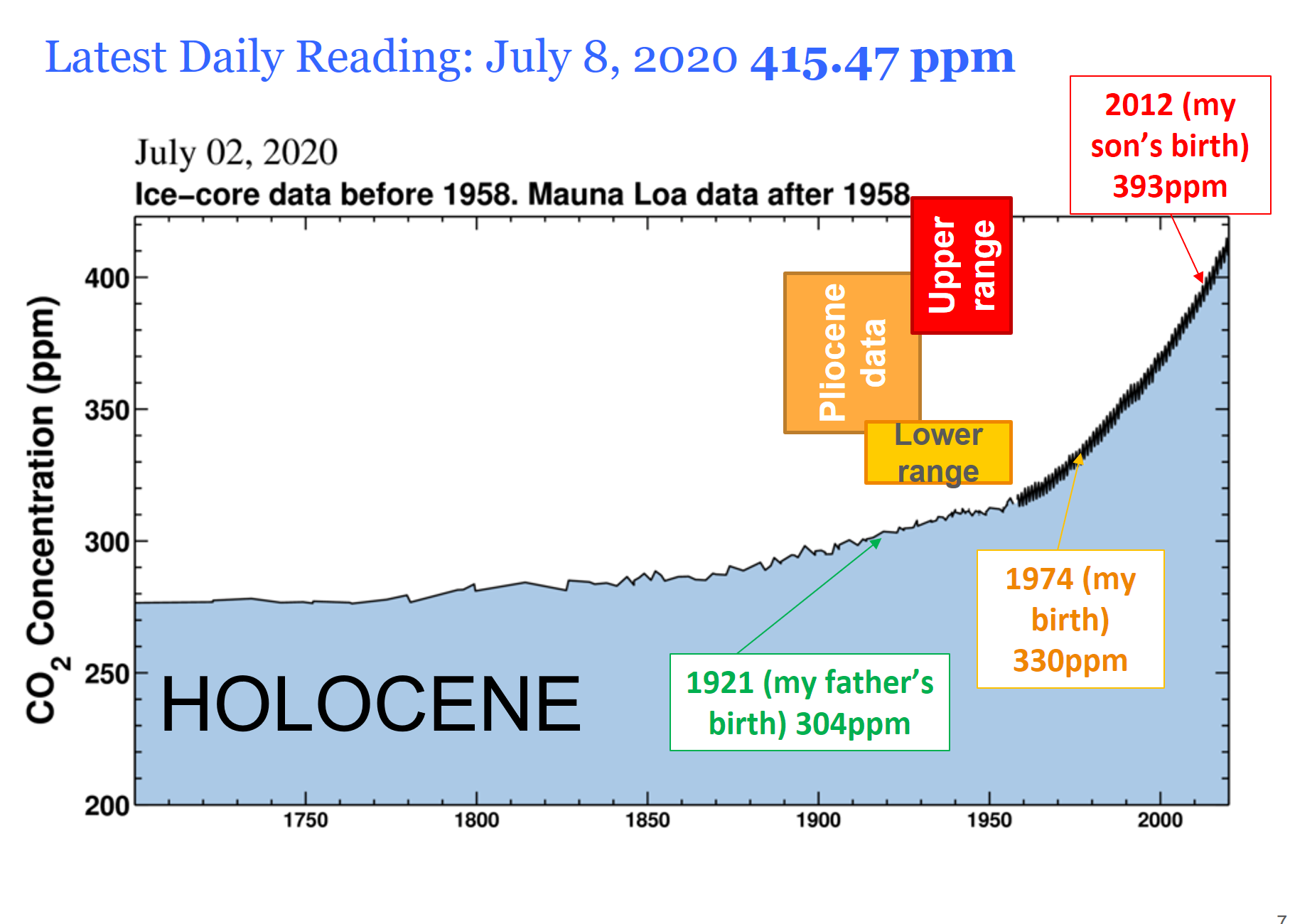
New research, published in Nature, has now measured much more precisely how much of the warming gas carbon dioxide (CO2) was in the atmosphere during this warm spell: 360ppm (parts per million) on average. When my father was born, in 1921, a mere 100 years ago, the CO2 level in the atmosphere was only 304 ppm. By the time my son was born, our fossil-fueled civilization had barreled (joke? hahaha? ha?) past this Pliocene average, to 393ppm. So we are already, today, at CO2 concentrations higher than the Pliocene average: and we’ve moved the climate clock of the planet back more than 3.3 million years in less than 100 years: the lifespan of my father.
CO2 concentrations in the atmosphere since 1700, overlaid with recent Pliocene study levels, and specific values from my family’s history.


If CO2 is so correlated with climate, why are we not already experiencing the temperatures and sea levels of the Pliocene, and witnessed by faraway Homo Habilis, with their almost-human eyes? Professor Gavin Foster, co-author of the Nature study, puts it this way: “The reason we don’t see Pliocene-like temperatures and sea-levels yet today is because it takes a while for Earth’s climate to fully equilibrate (catch up) to higher CO2 levels and, because of human emissions, CO2 levels are still climbing. Our results give us an idea of what is likely in store once the system has reached equilibrium.”

Time lags for equilibration vary between Earth systems: climate temperatures will catch up with the Pliocene with in a few decades, sea levels within a few centuries. But it gets worse. Because not only have we left the agriculture-sheltering Holocene. Not only have we zoomed through Pliocene the span than 1 human lifetime (reminder: we have no evidence that the large scale agriculture we depend upon, in our billions, for survival, is possible in this new climate. Cheers.). We are still going. We are accelerating, in fact, with concentrations of CO2 increasing faster and faster every year.

And by 2025, according to the Nature study authors (my son will be 13! So awkward being a teenager while zooming through geological epochs, don’t you think?), we’ll have exploded CO2 concentrations so much that we have to far, far, far further back in planetary times to find climate analogs. Is your down scrolling finger ready? Miocene, here we come!

________________________________________________________________________________________________________________________________________________________________________________________________________________________________________________________________________________________________________________________________________________________________________________________________________________________________________________________________________________________________________________________________________________________________________________________________________________________________________________________________________________________________________________________________________________________________________________________________________________________________________________________________________________________________________________________________________________________________________________________________________________________________________________________________________________________________________________________________________________________________________________________________________________________________________________________________________________________________________________________________________________________________________________________________________________________________________________________________________________________________________________________________________________________________________________________________________________________________________________________________________________________________________________________________________________________________________________________________________________________________________________________________________________________________________________________________________________________________________________________________________________________________________________________________________________________________________________________________________________________________________________________________________________________________________________________________________________________________________________________________________________________________________________________________________________________________________________________________________________________________________________________________________________________________________________________________________________________________________________________________________________________________________________________________________________________________________________________________________________________________________________________________________________________________________________________________________________________________________________________________________________________________________________________________________________________________________________________________________________________________________________________________________________________________________________________________________________________________________________________________________________________________________________________________________________________________________________________________________________________________________________________________________________________________________________________________________________________________________________________________________________________________________________________________________________________________________________________________________________________________________________________________________________________________________________________________________________________________________________________________________________________________________________________________________________________________________________________________________________________________________________________________________________________________________________________________________________________________________________________________________________________________________________________________________________________________________________________________________________________________________________________________________________________________________________________________________________________________________________________________________________________________________________________________________________________________________________________________________________________________________________________________________________________________________________________________________________________________________________________________________________________________________________________________________________________________________________________________________________________________________________________________________________________________________________________________________________________________________________________________________________________________________________________________________________________________________________________________________________________________________________________________________________________________________________________________________________________________________________________________________________________________________________________________________________________________________________________________________________________________________________________________________________________________________________________________________________________________________________________________________________________________________________________________________________________________________________________________________________________________________________________________________________________________________________________________________________________________________________________________________________________________________________________________________________________________________________________________________________________________________________________________________________________________________________________________________________________________________________________________________________________________________________________________________________________________________________________________________________________________________________________________________________________________________________________________________________________________________________________________________________________________________________________________________________________________________________________________________________________________________________________________________________________________________________________________________________________________________________________________________________________________________________________________________________________________________________________________________________________________________________________________________________________________________________________________________________________________________________________________________________________________________________________________________________________________________________________________________________________________________________________________________________________________________________________________________________________________________________________________________________________________________________________________________________________________________________________________________________________________________________________________________________________________________________________________________________________________________________________________________________________________________________________________________________________________________________________________________________________________________________________________________________________________________________________________________________________________________________________________________________________________________________________________________________________________________________________________________________________________________________________________________________________________________________________________________________________________________________________________________________________________________________________________________________________________________________________________________________________________________________________________________________________________________________________________________________________________________________________________________________________________________________________________________________________________________________________________________________________________________________________________________________________________________________________________________________________________________________________________________________________________________________________________________________________________________________________________________________________________________________________________________________________________________________________________________________________________________________________________________________________________________________________________________________________________________________________________________________________________________________________________________________________________________________________________________________________________________________________________________________________________________________________________________________________________________________________________________________________________________________________________________________________________________________________________________________________________________________________________________________________________________________________________________________________________________________________________________________________________________________________________________________________________________________________________________________________________________________________________________________________________________________________________________________________________________________________________________________________________________________________________________________________________________________________________________________________________________________________________________________________________________________________________________________________________________________________________________________________________________________________________________________________________________________________________________________________________________________________________________________________________________________________________________________________________________________________________________________________________________________________________________________________________________________________________________________________________________________________________________________________________________________________________________________________________________________________________________________________________________________________________________________________________________________________________________________________________________________________________________________________________________________________________________________________________________________________________________________________________________________________________________________________________________________________________________________________________________________________________________________________________________________________________________________________________________________________________________________________________________________________________________________________________________________________________________________________________________________________________________________________________________________________________________________________________________________________________________________________________________________________________________________________________________________________________________________________________________________________________________________________________________________________________________________________________________________________________________________________________________________________________________________________________________________________________________________________________________________________________________________________________________________________________________________________________________________________________________________________________________________________________________________________________________________________________________________________________________________________________________________________________________________________________________________________________________________________________________________________________________________________________________________________________________________________________________________________________________________________________________________________________________________________________________________________________________________________________________________________________________________________________________________________________________________________________________________________________________________________________________________________________________________________________________________________________________________________________________________________________________________________________________________________________________________________________________________________________________________________________________________________________________________________________________________________________________________________________________________________________________________________________________________________________________________________________________________________________________________________________________________________________________________________________________________________________________________________________________________________________________________________________________________________________________________________________________________________ is 15 million years ago. The mid-Miocene. According to the Nature study’s lead author, Dr. de la Vega “Having surpassed Pliocene levels of CO2 by 2025, future levels of CO2 are not likely to have been experienced on Earth at any time for the last 15 millions years, since the Middle Miocene Climatic Optimum, a time of even greater warmth than the Pliocene.”

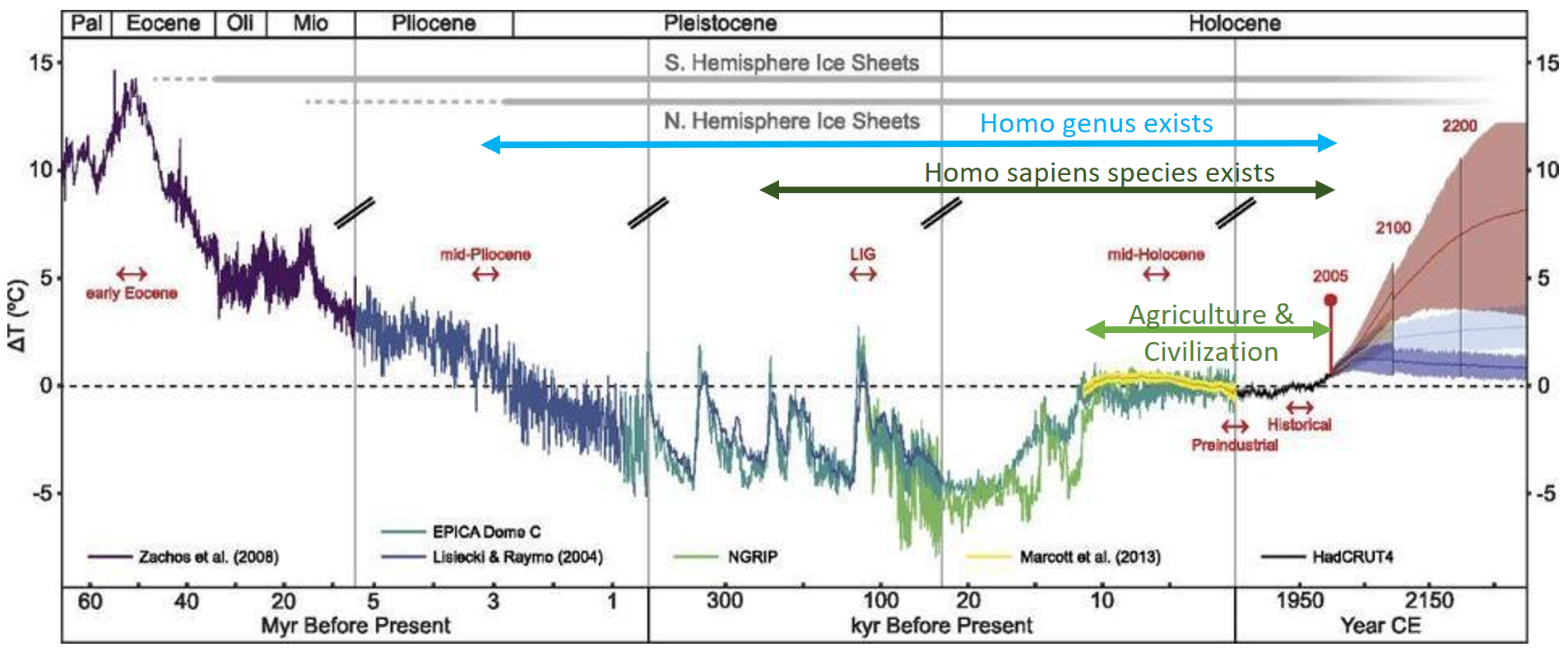
This result echoes a previous study published in PNAS, which showed that future Earth climates will likely resemble ones from our distant past. They compared past Earth climates from the early Eocene (50 million years ago — I won’t inflict that much down scrolling on you, but only if you promise to be good little climate activists and stop this trajectory of destruction, m’kay?) and mid-Pliocene, and found that on our current high emissions trajectory we would zoom through the Pliocene during this century, and end up in the Eocene by 2150. It’s worth noting that many emissions modellers don’t believe that these high emission levels will actually materialize, but it’s also true that the climate response to emissions might be steeper than previously thought, so perhaps that’s not as reassuring as it should be.

Figure from Burke et al in PNAS, showing past and future Earth climates, with Homo genus and species arrows overlayed.


Where do we go from here?

I want to make two short points here.
1: An avoidable disaster

The first is that the current trajectory we are on is both utterly devastating, and utterly avoidable. The loss of life, human and non-human, will be horrific. There is no way that ecosystems and species can adapt to millions of years worth of climate change in the span of decades. We are already in the midst of the 6th mass extinction and have destroyed biodiversity equivalent to millions of years of evolution of our own branches of the tree of life. This is not looking good.

It’s looking particularly bad for those least to blame. So far, I’ve been using the word “we”, as though “we” humans, young, old, poor, rich, were all equally to blame for our current trajectory. We are not. Some of us, specifically the affluent, have a disproportionate share of the blame, and are in fact driving the systems of global production and consumption, extraction, pollution and exploitation, that are causing our disastrous planetary roller coaster ride into a climate unknown to our species. Some of us, the majority world, the young, the poor, the Black and Indigenous and migrants and generally people of color, will suffer the most.

To give one simple example, on our current high emissions trajectory, the tropics will become uninhabitable within this century due to heat & humidity — see the map below. The map of countries with high historical responsibility for emissions is almost the reverse of this one, a clear demonstration of the injustice built in to climate harms.
Figure of deadly heat & humidity days per year by 2100 from Moira et al in Nature Climate Change. (Yes this is RCP 8.5, but RCP 4.5 is not much better.)

But this immense harm is mostly avoidable, still. There is nothing predetermined about it. If we change our energy, consumption and production systems, to focus on sufficiency and decent living standards, we can both reduce our demand for energy while decarbonising our supply. If we change our diets to become plant-based, we can stop deforestation and remove a major source of methane and nitrous oxides, two potent greenhouse gases, as well as providing healthy and nutritious food to all. There is no historical evidence that we need fossil fuels to thrive, and looking into the future, we need to eliminate them to survive.

2: A struggle for survival

The second point I want to make is that we have a huge, immense struggle on our hands to achieve this livable, better (and entirely technically achievable) future. We are in a struggle for survival, and the odds are very much against us.

The main obstacles to our maintaining a planet on which the human species can thrive have names. Naomi Oreskes and Eric Conway, in their short and excellent sciency science-fiction book “The Collapse of Western Civilization: a View from the Future” named two culprits in the world of ideas: scientific positivism (the overcautious nature of current scientific communication) and market fundamentalism (the belief in markets-above-all enshrined in neoclassical economics and neoliberal policy). In my research, I’ve circled around this problem, and come to name capitalism as the intertwined economic, physical and social system as the root cause of our current trajectory. Capitalism manifests itself in concrete ways, in the state capture by industrial interests which are antithetical to different trajectory (as we showed in the case of car dependency) and in the existence of ever growing inequalities, with the affluent most wedded to damaging patterns of consumption and production. The solutions put forward to comfort and maintain these existing power structures and inequalities, such as green growth, have been repeatedly shown to have no basis in reality.

This means that to avoid disaster, we must confront capitalism. That’s hard, certainly. But in my opinion, it’s probably easier than trying to cook a decent meal for one’s extended family of a few billion in the Eocene, you know? And fighting capitalism is definitely the topic for another post (or two or three — in the mean time you might want to read my “how to become a climate activist, just go do it already damn-it” trilogy).

But I did want to say a few words.
  • It can be done.
  • The history of learning how it can be done has been erased from our education. We don’t learn how to be activists, advocates, muckraking journalists or revolutionaries at school. But we can and need to learn this now.
  • It takes the determination to become as revolutionary as we can.

Comfort and security are the past, if you ever had them. Many people never did. The Holocene is behind us. What lies in front is still undetermined, and can still be changed. But it will take the fight of our lives, for all of our lives, to change this. This will not be fun, or fulfilling, or a worthy adventure of self-discovery, or a cute feel-good movie, or a task of personal validation. I mean, maybe from time to time there will be those things, who knows. Who cares. This is a fight for life itself. We get to be depressed, despondent, little creatures against the crushing change of geological epochs and mighty economic systems. But we need to be little creatures who are learning to fight very very very fast and very very very well together against the brutal forces of domination which steer our current course.

So. Read Naomi Klein, Arundhati Roy, George Monbiot, Fantz Fanon, Rosa Luxemburg. Learn to become a revolutionary, get some courage and guts and analysis. Join Extinction Rebellion already, and/or the Sunrise Movement, and/or Fridays for Future, and/or all of them. Let’s do this. GO.

Climate Scientists Steffen and Knorr defend Franzen's position

Fact Checking the Climate Crisis: Franzen vs. Facebook on False New. Wolfgang Knorr and Will Steffen. Feb. 19, 2020.

Critique of Climate Feedback fact checking exercise of an article by the writer Jonathan Franzen in the New Yorker, published September 8, 2019, by leading climate scientists Wolfgang Knorr and Will Steffen. 

Fact Checking the Climate Crisis: Franzen vs. Facebook on False News

Last year, the writer Jonathan Franzen, not known for mincing his words, took up an opportunity offered by the New Yorker to bring his very own perspective to the debate about the impending climate crisis. The headline read: What If We Stopped Pretending? The climate apocalypse is coming. To prepare for it, we need to admit that we can’t prevent it.

You would think that this was just another opinion piece on the climate catastrophe, this time by a writer from whom you would not expect new insights about the climate system, but maybe some other truths related to the general human predicament. If you happened to be a social media user, however, you might be in for some surprise. On February 15th, the moderators of the Facebook group Positive Deep Adaptation received a “partly false information” warning about Franzen’s New Yorker article having been posted in their group. The warning explicitly referred to an article by the fact checking site Climate Feedback (see image 1). Following considerable political pressure, fact checkers are now routinely used by social media sites to prevent the spread of “false news”. Sanctions for repeat offenders include reducing visibility for the group or site, or removing the ability to earn income.

This gives Climate Feedback’s verdict considerable weight. In this article, we will review the fact checking exercise itself, in order to see if the matter has been handled with the necessary care and level of responsibility. According to their web site Climate Feedback is a worldwide network of scientists sorting fact from fiction in climate change media coverage. As senior climate scientists, our goal is to help readers know which news to trust.

Fact checking the fact checkers

The first thing we noticed was that from the headline and the information below it, it was not possible to tell the exact claim that was being assessed. While the headline read “2°C is not known to be a ‘point of no return’, as Jonathan Franzen claims”, the actual claim by Franzen stated further down was “The consensus among scientists and policy-makers is that we’ll pass this point of no return if the global mean temperature rises by more than two degrees Celsius.” What was left out is some text that in the original article follows immediately after and is therefore an integral part of the claim made by Franzen: “(maybe a little more, but also maybe a little less)”. The verdict: incorrect.

There is an important distinction here: is the claim being reviewed that there is a consensus – which Climate Feedback easily refute because none of the scientist reviewers seems to subscribe to this supposed consensus – or is it rather about the existence of a supposed “point of no return”? In the following, we will discuss both possibilities.

Contrary to the claim by Climate Feedback, and the entire point made by the last reviewer, Marcus Fontela, there is indeed a scientific basis for Franzen’s article, even though he vastly overrates the degree of consensus or the level of scientific understanding of such a hypothesis.

All scientist reviewers – except for one who did not provide references at all – referred to an article led by one of us: Steffen and co-workers (2018) Trajectories of the Earth System in the Anthropocene1. It appears that the reviewers correctly identified the source of Franzen’s “point of no return”. The article in question hypothesizes the existence of mutually reinforcing tipping points, or positive feedback mechanisms, in the earth’s climate system. It does not provide definite proof of the existence of such a “tipping cascade”, nor does it say they will all suddenly happen when 2°C of warming is reached, but rather sketches out a plausible scenario. It also provides estimates for the degree of warming required for tipping to be triggered. “Tipping” here means irreversible changes that a return to a lower degree of warming will not be able to stop – or “point of no return”. According to our understanding, the following tipping elements might be affected at 2°C of warming:
  1. West Antarctic Ice Sheet – likely tipped (i.e. irreversibly on the pathway to eventual collapse)2
  2. Coral reefs – likely tipped (wide-spread destruction from heat stress and ocean acidification)
  3. Arctic sea ice cover – likely tipped (irreversible situation arises from increasing heat provided by the darker ocean surface as summer ice disappears)4
  4. Amazon rainforest - likely tipped taking into account current rates of human deforestation (i.e. the loss of forest itself decreases regional precipitation rates, thus increasing the overall reduction in rainfall, further influenced by a weakening AMOC – see next point)5,6
  5. Atlantic meridional overturning circulation (AMOC, the ocean current that brings warm waters to western Europe) – probably not tipped, but significantly weakened7
  6. Permafrost carbon stores – probably not tipped, but significant carbon emissions.3
The Special Report on 1.5°C Warming3 by the Intergovernmental Panel on Climate Change (IPCC) also backs up Franzen’s claim – to some degree. The IPCC assessed the probability of “large-scale singular events” at 2°C of warming and gave a rating of "moderate to high" (Summary for Policymakers, Figure 2). And a recent commentary in the journal Nature by Tim Lenton and co-workers8 shows evidence that some of those tipping elements may have already been activated.

Another point of potential confusion is that the reviewers do not provide a clear definition of what they believe was meant by “point of no return”. They only suggest that Franzen was talking about a sharp boundary at 2°C warming, for example Patrick Brown: “[...] There was never a scientific consensus that 2.0°C represented some well-defined bright line where impacts suddenly became much worse or feedbacks suddenly became completely self-perpetuating.” Franzen does indeed talk about one point being crossed, but it is not clear if he means a sharp and clearly defined boundary, or rather that somewhere around 2°C a tipping cascade will be triggered. And if a tipping cascade exists, then it will be triggered at a single point, so by definition there would have to be a clearly defined point of transition. It is only questionable if it could be characterised simply by degrees of warming. We must also note that Brown’s 2.0°C “bright line” is a rhetorical ploy designed to ridicule the author’s scientific understanding, where Franzen in fact concedes that his “point” may not be reached at exactly 2°C.

A charge repeated by several reviewers is that Franzen does not understand how climate models work. In fact, Amber Kerr and Charles Koven seem to base their criticism entirely on modelling results. This must be a clear misunderstanding: neither does the New Yorker article refer anywhere to computer modelling, nor has it ever been claimed that it was possible to reliably model tipping cascades. Instead, it is the reviewers who display a remarkable lack of apprehension for the limitations of modelling. For example when Amber Kerr writes: “He says that ‘As a non-scientist, I do my own kind of modelling,’ but he seems to be unaware that scientists have already carried out many qualitative and quantitative climate risk assessments, using policy changes and human behavior as variables.” But even the supporters of such models stress their limitations, while others argue that they are entirely unsuitable for the job. 

The most serious criticism brought forwards by the reviewers is that of Franzen’s fatalism, when he claims “that additional warming over 2°C doesn’t matter” (Amber Kerr). This is a criticism we share. We note, however, that Franzen's apparent misinterpretation of the science is based on a gross overstatement of scientific certainty, which is interesting given the reviewers’ own faith in modelling results. As climate scientists having worked with and developed computer models we rather share Franzen’s pessimism about what models can achieve. For very similar reasons, other scientists who have worked specifically on the possibility of catastrophic climate change have based their conclusions mostly on evidence from past climates, using only minimal modelling9.

The most balanced and objective review, in our opinion, is the one by Alexis Berg, whose main point is the speculative nature of the tipping cascade scenario. He is also more honest and cautious when referring to modeling (italics included by the authors): “Climate model simulations, for instance, which do include some of these feedbacks, do not suggest runaway climate change beyond 2°C.” It is true that the article by Steffen and co-workers is “intended to highlight [...] the high side of the risk distribution”. Franzen seems indeed to have ignored that he has based his whole essay on a hypothesis that was just that – a hypothesis and a warning of what could happen if we continue on the current path.

One more important question that the reviewers, and possibly Climate Feedback in general, should address is whether statements that are inherently about the future can even be fact checked. It is true that the review mostly talks about our current understanding of the climate system. But the event this refers to is in the future. We have therefore no way of empirically either proving or refuting the hypothesis of a discontinuity in the climate system. Hence the repeated reference of the reviewers to model results. What they don’t seem to realise, however, is that models are themselves nothing else than codified hypotheses.

Our recommendation

We believe that this New Yorker article – classified as a “cultural commentary” – should never have been fact checked in the first place. Other authors should of course be free to criticise it, as they have done repeatedly. But at the very least Climate Feedbacks should have clearly stated that the fact checking exercise does not concern the possibility of a tipping cascade being triggered – which can be neither proven nor refuted – but only the level of scientific consensus. For such cases, Climate Feedbacks’ methods provide for a set of well-defined categories that should be stated in the details section of the overall verdict:
Overstates scientific confidence: Presents a conclusion as conclusive while the hypothesis is still being investigated and there remains genuine scientific uncertainty about it.
We would have agreed with such a verdict. Instead, the details provided characterise Franzen’s article as “Misleading: While positive feedbacks exist that amplify temperature changes, scientists have not identified a ‘point of no return’ at 2°C.” 

This overall verdict is itself incorrect, or at least seriously misleading. Scientists have indeed identified the likelihood of such a point of no return, even though it is unlikely the point exists at a sharply defined temperature threshold. Identification does not imply there to be a definite, or even a strong scientific proof. And the overall presentation of the verdict is itself misleading for several reasons: it blatantly omits the final part of the sentence being criticised where the author concedes that he does not believe in a definite threshold value, the rhetorical use of “2.0°C”, the reference to climate models and the claim the author does not understand them, while creating the impression the reviewers don’t understand them either, and the lack of understanding that it is not possible to fact check assertions about the future.

In fact, if one is to “fact check” statements about the future, then the criterion for judgment should be whether there is enough credible evidence – be it from paleo studies, observational evidence, modelling results or, more appropriately, a synthesis of all such types of information – to make a well-reasoned case that the statement represents a plausible future. In other words, when dealing with future risks and events in general, the emphasis should be on whether or not the statement presents a plausible risk assessment rather than a “scientific fact”.

The elephant in the room

What most scientists commenting on his piece did not seem to have noticed is the value of Franzen’s article in naming the elephant in the room: that while emissions keep on rising inexorably, no political action even remotely strong enough to address the problem can be seen anywhere on the horizon. Let us listen to his words here:
As a non-scientist, I do my own kind of modelling. I run various future scenarios through my brain, apply the constraints of human psychology and political reality, take note of the relentless rise in global energy consumption [...], and count the scenarios in which collective action averts catastrophe. [...]
Vast sums of government money must be spent without wasting it and without lining the wrong pockets. Here it’s useful to recall the Kafkaesque joke of the European Union’s biofuel mandate, which served to accelerate the deforestation of Indonesia for palm-oil plantations, and the American subsidy of ethanol fuel, which turned out to benefit no one but corn farmers.
Anyone with even the faintest inkling of today’s political reality will agree that it is irrelevant whether we can still prevent major disruptions of the climate system in theory10, when the heads of state of the largest economy and of the country home to the largest tract of rainforest are outspoken climate change deniers. Needless to say, the so-called integrated assessment models used by the IPCC to run various scenarios contain no concept whatsoever of politics.

Fact checking and difficult truths

Our own view of the situation is somewhat different from Fanzen’s – it does not matter at precisely which level of warming tipping points will be reached, but it does matter how much planetary heating we will generate. As long as there is enough carbon11 contained in fossil-fuel reserves to triple even the current already high amounts of atmospheric CO2, and with no mechanism in sight that could guarantee us an end to fossil-fuel extraction, sooner or later the degree of global heating will reach a critical threshold that leads to major disruptions to human society. The question of whether it is already too late is not one that depends so much on the climate system, but on the ability of human society to rapidly change course. Most scientists, policy makers and even activists seem to tend towards optimism. Franzen disagrees, and we believe scientists should at least listen. 

Difficult truths are always hard to deal with, especially when they concern one’s own and all of humanity’s survival. Even if there was a sliver of truth in Franzen’s message, it would be a cause for great concern and anxiety. Since no scientist so far has said what Franzen does here, that it might not only be time to panic, but already too late, the predictable reaction of professional climate researchers has been almost universally negative. Someone known for his provocative writing style was treading on their turf!

We believe that fact checking is not a helpful approach to improve the debate about the climate crisis. It is not helpful when we need to confront a difficult truth that many, including scientists, find difficult to accept. It is also not helpful, because it supports a mistaken view of the sciences as being foremost about hard facts, and not about interpretation, debate, truth seeking and philosophical attitudes. And even more importantly – as George Marshall has amply demonstrated in his book “Don’t Even Talk about It” – opinions in the climate debate are very rarely swayed by facts. But users of social media have the right to know the position of the scientific community with respect to assertions made on matters of climate science. A much more helpful approach would be to offer this view in the form of reviews, critiques or other forms of essay, as it is done traditionally in the print media. Rather than being sent warnings with a threat of sanctions for repeat-offenders, publishers on social media could be required in certain cases to provide a suitable link so that the reader is helped to form his own opinion. In the case of the Franzen article, a simple disclaimer that his view of the climate system is seen as a low-probability but plausible scenario would surely have been appreciated. The climate crisis requires us to build bridges and not to exclude certain groups from the debate. 


Publisher's notes: 

On February 20th 2020 the "false news" warning is no longer showing on the admin panel of Positive Deep Adaptation facebook group. We will send this article to Facebook, Climate Feedback and the New Yorker for information and advice. 

An interview with the co-author of this article, climate scientist Dr Wolfgang Knorr, goes in to more detail about how climate scientists might often mislead audiences through typical modes of communication. An article by IFLAS founder explores the extent to which assumptions about social psychology underpin the motivations and arguments of scientists and activists to criticise people for publically considering the implications of worst case scenarios. 

Co-author of this article, climate scientist Dr Will Steffen recently called for more research, dialogue and action on the possibilities of societal breakdown or collapse due to climate impacts. 

Last year IFLAS released a compendium of recent research that indicates the worst case scenarios for societal disruption from climate change are now increasingly likely. This was produced by Professor Jem Bendell, the initiator of the deep adaptation framework to climate change response. To discuss the issues arising from this article and issue, consider the Narratives and Messaging group on the Deep Adaptation Forum.


References
1 Steffen, W., J. Rockström, K. Richardson, T. M. Lenton, C. Folke, D. Liverman, C. P. Summerhayes, A. D. Barnosky, S. E. Cornell, and M. Crucifix (2018), Trajectories of the Earth System in the Anthropocene, Proceedings of the National Academy of Sciences, 115(33), 8252-8259. (link)
2 IPCC Special Report on the Ocean and Cryosphere in a Changing Climate (IPCC, 2019). (link)
3 IPCC Special Report on Global Warming of 1.5°C (IPCC, 2018). (link)
4 Drijfhout, S., S. Bathiany, C. Beaulieu, V. Brovkin, M. Claussen, C. Huntingford, M. Scheffer, G. Sgubin, and D. Swingedouw (2015), Catalogue of abrupt shifts in Intergovernmental Panel on Climate Change climate models, Proceedings of the National Academy of Sciences, 112(43), E5777-E5786. (link)
5Lovejoy, T. E. A., and C. Nobre (2018), Amazon tipping point, Science Advances, 4(2), eaat2340. (link)
6 Brayshaw, D. J., T. Woollings, and M. Vellinga (2009), Tropical and extratropical responses of the North Atlantic atmospheric circulation to a sustained weakening of the MOC, J. Clim., 22(11), 3146-3155. (link)
7 Caesar, L., S. Rahmstorf, A. Robinson, G. Feulner, and V. Saba (2018), Observed fingerprint of a weakening Atlantic Ocean overturning circulation, Nature, 556(7700), 191-196. (link)
8 Lenton, T. M., J. Rockström, O. Gaffney, S. Rahmstorf, K. Richardson, W. Steffen, and H. J. Schellnhuber (2019), Climate tipping points—too risky to bet against, Nature, 575, 592-595. (link)
9 Hansen, J., M. Sato, G. Russell, and P. Kharecha (2013), Climate sensitivity, sea level and atmospheric carbon dioxide, Philosophical Transactions of the Royal Society A, 371, 20120294. (link)
10 Anderson, K. (2015). Duality in climate science. Nature Geoscience, 8, 898-900. (link)
11 Global Energy Assessment (2012), International Institute for Applied Systems Analysis, Laxenburg, Austria. (link)