Sunday, December 6, 2020

Topic: Climate Change Depression

originally posted Sept 2016; most recently updated January July 2019. Dec 2020


F*ck That: An Honest Meditation


Some fruits of meditation. Ian Welsh.


2020 addition:
[Dr. Jonathan Foley is a renowned climate scientist, sustainability expert, educator, and public speaker. He is also executive director of Project Drawdown — the world’s leading resource for climate solutions. His work focuses on finding solutions to sustain the climate, ecosystems, and natural resources we all depend on.
Foley’s work has led him to become a trusted advisor to governments, foundations, non-profits, and business leaders around the world. He and his colleagues have made major contributions to our understanding of climate change, ecosystems, and the sustainability of the world’s resources. He has published over 130 peer-reviewed scientific articles, including many highly cited works in Nature and Science. He is among the top 1 percent most-cited scientists in the world.]

I’ve been dealing with depression my entire life. It’s been a miserable experience, and it’s taken years to learn how to manage it. But one thing that helped was learning that many people I admire are struggling with depression too. So, despite the risk of going public, I’m going to share my experience, in hopes that it might help someone else.

... In the public sphere, I have been deeply moved by Dr. Susanna Harris, a brilliant young biologist and science communicator who shared her story. I was blown away by Dr. Santa Ono, the President of the University of British Columbia, who now openly discusses his history with mental illness. I am also deeply moved by the books of Matt Haig, who makes depression relatable, and the work of radio personality and author, John Moe.


Articles:


The Best Medicine for My Climate Grief. Peter Kalmus, Yes!Magazine. Aug. 9, 2018.
A climate scientist talks to a psychologist about coping with the crushing stress related to climate change. Here’s what he learned.
... To think daily about climate change and any of its dire implications can be a crushing psychological burden. Each of us is just one mammal, with all our mammalian limitations—we get tired, sad, irritated, sick, overwhelmed—and the climate crisis wields the force of 8 billion humans with infrastructure, corporations, capital, politics, and imaginations heavily invested in burning fossil fuel.

“It’s important to remember that inaction is rarely about a lack of concern or care, but is so much more complex,” Lertzman said. “Namely, that we westerners are living in a society that is still deeply entrenched in the very practices we now know are damaging and destructive. This creates a very specific kind of situation—what psychologists call cognitive dissonance. Unless we know how to work with this dissonance, we will continue to come up against resistance, inaction, and reactivity.” 
I’ve been working through my own climate dissonance since 2006, back when the atmospheric carbon concentration was just 380 parts per million. That year I reached a tipping point in my own awareness of what was happening and what it meant. It was challenging to carry that knowledge when no one close to me seemed to care. But, said Lertzman, “we need to be careful not to make assumptions about other people’s relationships with these issues. Even if people may not be showing it, research shows again and again that it’s still on their minds and a source of discomfort or distress.” If she’s right, maybe the sea change in public action we desperately need is closer than it seems. It would certainly be helpful if we could talk openly about how climate change is making us feel.
It’s the End of the World as They Know It. The distinct burden of being a climate scientist. David Corn, Mother Jones. July 8, 2019.
So what is it like to be cursed with foreknowledge that others ignore? Peter Kalmus, who received his B.A. and Ph.D. from Harvard and Columbia, respectively, spent about a decade working in astrophysics. He then moved to ecological forecasting based on satellite data, and something shifted for him. “Studying earth science and thinking about climate change is a totally different ballgame than thinking about astrophysics,” he says. “Astrophysics was pure science. I was looking for gravitational waves. It had no implication for the possible collapse of human civilization.” But the unrelenting momentum of climate change does. “I’m always thinking about it,” he says. “That can be a burden. Whenever friends talk about flying off to vacation, I feel compelled to point out the large carbon cost to flying. I’d like to take a vacation from thinking about it. I’m not sure that is psychologically possible.
... 
Sarah Myhre, a former senior research associate at the University of Washington’s School of Oceanography, experiences “a profound level of grief on a daily basis because of the scale of the crisis that is coming, and I feel I’m doing all I can but it’s not enough,” she says. “I don’t have clinical depression. I have anxiety exacerbated by the constant background of doom and gloom of science
... 
Jacquelyn Gill, a paleontologist at the University of Maine who co-hosts a podcast on climate change called Warm Regards, says she’s “not depressed but angry, all the time, and anger can be empowering or debilitating. I swing between both. Being constantly angry is exhausting.” But, she adds, it takes a certain resilience to be a scientist in America: “There are so few jobs, so few grants. You’re always dealing with rejection. You have to have a built-in ability to say ‘fuck it.’
... 
Katharine Wilkinson, who has a Ph.D. in geography and the environment, is vice president for communication and engagement at Project Drawdown, a group of scientists and activists that assembles proposed climate change solutions. She makes a distinction between denialism and bystanderism, which takes the form of people saying “they care about it” but not engaging in meaningful action: “That’s when I want to shake people and say, ‘You know how little time we have?’” She has noticed that almost everyone in her line of work seems “to have one dark emotion that is dominant. For some, it’s anger or rage. For me, it’s deep grief—having eyes wide open to what is playing out in our world, and we have a lukewarm response to it. There is no way for me not to have a broken heart most days.” 
For several years, Eric Holthaus, a meteorologist-turned journalist, has written about his own efforts to contend with climate change–induced depression. “I lose sleep over climate change almost every single night,” he wrote last year. “I can’t remember how long this has been happening, but it’s been quite a while, and it’s only getting worse.
... 
Michael Mann, the well-known climate scientist who has spent years clashing with climate deniers, observes that “colleagues who have convinced themselves we have crossed a tipping point—physical or political—and we won’t avert catastrophic climate change clearly become depressed.

Uncovering the Mental Health Crisis of Climate Change: How to move people from apathy to action. Jeremy Deaton, Nexus Media. July 7, 2018.

The Threat Of Climate Change Brings Both Anxiety & Apathy.
The young man believed he only had five years to live. “Not because he was sick,” said Kate Schapira, “not because anything was wrong with him, but because he believed that life on Earth would be impossible for humans.”

The sign on Schapira’s booth read: CLIMATE ANXIETY COUNSELING 5¢ THE DOCTOR IS IN. Time to earn her pennies.

On that muggy June day, she had set up shop in Kennedy Plaza in downtown Providence, Rhode Island. Schapira is not a trained therapist — a fact she makes clear to visitors — but she is happy to chat with anyone suffering from anxiety about climate change. “A lot of what I do is listen and ask questions,” she said.

Over the coming decades, rising temperatures will fuel natural disasters that are more deadly than any seen in human history, destabilizing nations and sending millions to their death. Experts say that we need to prepare for a hotter, less hospitable world by building sea walls, erecting desalination plants and engineering crops that can withstand punishing heat and drought, but few have considered the defenses we need to erect in our minds. Some, like Shapira, have called for more talking, more counseling to process our grief. But will that be enough? Climate change will do untold violence to life on this planet, and we have remarkably few tools to deal with its emotional cost.
... 
The tall, sharply dressed man said humans were a cancer on the Earth. He said that he resented his parents for raising him to be “super hedonistic, just monstrously gaining things.” He said he had grown nihilistic, that he wanted to take up chain smoking and die a slow death. When Schapira asked if he was angry at his family, the young man replied, “I love my family. It’s so hard to know that you only have five years left to love people.” 
The man was undoubtedly troubled, his vision of the future decidedly more apocalyptic than the one offered by science. But, his anxieties were real and, perhaps, understandable given the dire predictions of climatologists. While none believes human civilization will crumble in the next five years, the forecasts get hazier 30, 40 or 50 years down the road. 
If we continue pumping out heat-trapping carbon pollution at the current rate, temperatures will rise by 4 degrees C by 2100, a level of warming climate scientist Kevin Anderson has calledincompatible with an organized global community.” As David Wallace-Wells explained in his bracing account of the terrors of climate change for New York magazine, “Indeed, absent a significant adjustment to how billions of humans conduct their lives, parts of the Earth will likely become close to uninhabitable, and other parts horrifically inhospitable, as soon as the end of this century.” 
Climate change promises to take a massive toll, not just on nature or human society, but on our minds.
... 
Lertzman explained that to grasp the full implications of climate change is daunting — to recognize our part in it all the more so. To fire up a car or step onto an airplane is to defile the very air we breathe. People cope by disavowing their role in climate change. “You’re not denying something, but you are choosing not to know,” Lertzman said. “There rarely is genuine apathy,” she added. “What shows up as apathy is a defense mechanism. It’s a way for people to cope with the very complicated feelings that come up around these issues.” 
Like Lertzman, other mental health professionals have warned of the mental and emotional impact of climate change. Psychiatrist Lise Van Susteren coined the term “pre-traumatic stress disorder” to describe the pervasive dread felt by many scientists, advocates and journalists. In the years ahead, she said, the problem will only grow more widespread. 
... 


Climate depression is for real. Just ask a scientist. Madeleine Thomas, Grist. Oct. 28, 2014.
“I don’t know of a single scientist that’s not having an emotional reaction to what is being lost,” Parmesan is quoted saying in the National Wildlife Federation’s 2012 report, “The Psychological Effects of Global Warming on the United States: And Why the U.S. Mental Health Care System is Not Adequately Prepared.” 
“It’s gotten to be so depressing that I’m not sure I’m going to go back to this particular site again,” she says, referring to an ocean reef she has studied since 2002, “because I just know I’m going to see more and more of it dead, and bleached, and covered with brown algae.” 
Lise Van Susteren, a forensic psychiatrist based in Washington, D.C. — and co-author of the National Wildlife Federation’s report — calls this emotional reaction “pre-traumatic stress disorder,” a term she coined to describe the mental anguish that results from preparing for the worst, before it actually happens
“It’s an intense preoccupation with thoughts we cannot get out of our minds,” Van Susteren says.


The psychological effects of global warming on the United States. And why the U.S. mental healthcare system is not adequately prepared. National Wildlife Federation. Feb. 2012.


A talking cure for climate-based depression? It worked for Renee Lertzman. Heather Smith, Grist. Feb. 18, 2016.


Climate change is wreaking havoc on our mental health, experts say. Tyler Hamilton, The Star. Feb. 28, 2016.


It’s Time to Talk About Ecological Grief. Michaela Cavanagh, UnDark. Jan. 10, 2019. 
As climate change marches forward, it will exact a mounting, tangible toll on our collective mental health and productivity.

What Mary Oliver can teach us about dealing with climate grief. Eric Holthaus, grist. Jan. 22, 2019.


Dancing with Ulysses. Albert Bates. Feb. 9, 2019.


Reports:

Beyond Storms and Droughts: The Psychological Impacts of Climate Change. American Psychological Association.

Psychology and global climate change. APA.

Hope, despair and transformation: Climate change and the promotion of mental health and wellbeing.  Jessica Fritze et al, International Journal of Mental Health Systems. June 2008.

Sites:

Active Hope. How to face the mess we're in without going crazy.

Psychologists for social responsibility. Program on climate change, sustainability and psychology.

Transformational resilience. The Resource Innovation Group.

Ecological Buddhism. A Buddhist response to global warming.


Videos:

Joanna Macy and the Great Turning.

Mental Health and Climate Change. TVO's The Agenda with Steve Paikin. via youtube. Dec. 4, 2018.

Burnout and Despair: Studying the Climate. The Agenda. Jan. 15, 2019.


Conferences:

ITRC Conference To Highlight How Building Build Human Resilience for Climate Change Can Increase Wellbeing & Cut Emissions!
Nov 3-4, 2016. Washington, DC.

Monday, November 30, 2020

Climate Links: November 2020

There is no time to lose. Arctic News. Nov. 25, 2020.

Carbon dioxide levels continue at record levels, despite COVID-19 lockdown, the WMO reports. The increase in carbon dioxide from 2018 to 2019 was larger than that observed from 2017 to 2018 and larger than the average annual growth rate over the last decade.

The rise has continued in 2020. The lockdown did cut emissions of many pollutants and greenhouse gases, but any impact on carbon dioxide levels - the result of cumulative past and current emissions - is in fact no bigger than the normal year to year fluctuations. 

“Carbon dioxide remains in the atmosphere for centuries and in the ocean for even longer. The last time the Earth experienced a comparable concentration of CO₂ was 3-5 million years ago, when the temperature was 2-3°C warmer and sea level was 10-20 meters higher than now. But there weren’t 7.7 billion inhabitants,” said WMO Secretary-General Professor Petteri Taalas.


Accelerated global warming and stadial cooling events: IPCC oversights regarding future climate trends. Andrew Glikson, via Arctic News. Nov. 16, 2020.

The linear nature of global warming projections by the IPCC (2014) Assessment Report (AR5) (Figure 1) appears to take little account of stadial cooling events, such as have followed peak temperature rises in previous interglacial stages. The linear trends appear to take only limited account of amplifying positive feedback effects of the warming from land and ocean. A number of factors cast doubt on IPCC climate change projections to 2100 AD and 2300 AD, including:


However, global temperature measurements for 2015-2020 indicate accelerated warming due to both the greenhouse effect reinforced by a solar radiation maximum (Hansen and Sato 2020) (Figure 2).

The weakening of the northern Jet stream, due to polar warming and thus reduced longitudinal temperature contrasts, allows penetration of warm air masses into the polar region and consequent fires (Figure 3). The clash between tropical and polar air and water masses (Figure 3A) leads to regional storminess and contrasting climate change trajectories in different parts of the Earth, in particular along land-ocean boundaries and island chains.

The weakening of the jet stream and migration of climate zones constitute manifestations of an evolving Earth’s energy imbalance¹, namely a decrease in reflection of solar radiation from Earth to space and thereby global warming. Earth retained 0.6 Watt/m² during 2005-2010 and 0.87 Watt/m² during 2010-2020 (Hansen and Sato 2020), primarily due to a rise in greenhouse gases but also due to a solar radiation peak. During 2015-2020 global warming rates exceeded the 1970-2015 warming rate of 0.18°C/per decade, a deviation greater than climate variability. Hansen and Sato (2020) conclude the accelerated warming is caused by an increasing global climate forcing, specifically by the role of atmospheric aerosols.

....

The consequences for future climate change trends include:
  • Further expansion of the tropical climate zones and a polar-ward shift of intermediate climate zones, leading to encroachment of subtropical deserts over fertile Mediterranean zones.
  • Spates of regional to continent-scale fires, including in Brazil, Siberia, California, around the Mediterranean, Australia.
  • A weakened undulating jet stream (Figure 3) allowing penetration of and clashes between warm and cold air and water masses, with ensuing storms.
  • In Australia the prolonged drought, low vegetation moisture, high temperatures and warm winds emanating from the northern Indian Ocean and from the inland, rendering large parts of the continent tinder dry and creating severe fire weather subject to ignition by lightning.
  • The delayed melting of the large ice sheets due to hysteresis², would be followed by sea level rise to Pliocene levels, ~25 meters above pre-industrial levels, once sea level reaches equilibrium with temperature of 2 to 3 degrees Celsius or higher, changing the geography of the continents.


Abstract
The risk of points-of-no-return, which, once surpassed lock the world into new dynamics, have been discussed for decades. Recently, there have been warnings that some of these tipping points are coming closer and are too dangerous to be disregarded. In this paper we report that in the ESCIMO climate model the world is already past a point-of-no-return for global warming. In ESCIMO we observe self-sustained melting of the permafrost for hundreds of years, even if global society stops all emissions of man-made GHGs immediately. We encourage other model builders to explore our discovery in their (bigger) models, and report on their findings. The melting (in ESCIMO) is the result of a continuing self-sustained rise in the global temperature. This warming is the combined effect of three physical processes: (1) declining surface albedo (driven by melting of the Arctic ice cover), (2) increasing amounts of water vapour in the atmosphere (driven by higher temperatures), and (3) changes in the concentrations of the GHG in the atmosphere (driven by the absorption of CO2 in biomass and oceans, and emission of carbon (CH4 and CO2) from melting permafrost). This self-sustained, in the sense of no further GHG emissions, melting process (in ESCIMO) is a causally determined, physical process that evolves over time. It starts with the man-made warming up to the 1950s, leading to a rise in the amount of water vapour in the atmosphere-further lifting the temperature, causing increasing release of carbon from melting permafrost, and simultaneously a decline in the surface albedo as the ice and snow covers melts. To stop the self-sustained warming in ESCIMO, enormous amounts of CO2 have to be extracted from the atmosphere.


No Matter Who Wins. Nate Hagens. Nov. 1, 2020.

Modern elections—despite their social and political importance—have become more like sporting events than referendums around ideas. We so intensely identify with our partisan tribe, that we focus on the slogans, the rooting against the ‘other guy’ and other us-vs-them dynamics, and often lose sight of the issues, the context, and how ‘winning’ for our country (and world) might actually be influenced by our choices.

We are inherently tribal, after all. Of all of our inherited ancestral heuristics, defending our (historically small) tribe and ostracizing/rooting against the other tribe is one of the strongest human universals. In fact, perhaps humans’ best quality – cooperation and collaboration – was a byproduct of the strong unity born out of common threats, accessing surplus, and tribal warfare. We cooperate – for the good of our group – and for tens/hundreds of thousands of years, this meant survival.

Fast forward to November 2020, USA and the four year inflection point where half the country is rooting for Joe Biden and the other half (roughly) for Donald Trump – in our minds we know this election is an important guidepost for our collective future, but we approach this week with similar temperament and behavior as a Packer/Viking pre-game tailgate.

We are now in the liminal space between our nation’s long history and uncertain future. Facts and expertise matter less by the day. Emotions and tribal affiliations rivet our attention on the ‘cars’ instead of focusing at the road ahead of us. Later this week 50% of our population will be elated and the other 50% will be angry. And most of both camps will be variously: righteous, anxious and uncertain, and perhaps violent. This, along with the various trivia of Democrat and Republican victories and defeats will be the hyper-focus of our media. But below, in no particular order, is a look at some of the critical guideposts of the next 4 years along the winding road of our collective future that – as colleagues, citizens and neighbors in the United States of America, we’ll have to navigate with each other – no matter who wins the election.


COVID 19- Spilling into 2021

As I wrote in March, the ‘cure’ (lockdowns) for COVID would be worse than the disease in aggregate impact. Though death rates were perhaps overblown, the virulence -and ‘long COVID complications’ were not. Various vaccines and treatments and protocols will be developed but the worst months may still be ahead of us. This virus may or may not ultimately have a cure, but either way COVID has permanently redirected the vascular system of the human superorganism, explained below. No matter who wins the election, the Coronavirus will still be with us. And we’ll have to respond in creative ways.


V vs K

Economies tanked in the 2nd quarter and – on the backs of stimulus and central bank support – roared back in Q3. Through July 31, 2020 -when direct stimulus ran out – the US government was responsible for fully 25% of our national wages. While the professional class (and tech companies) are experiencing a sharp V recovery, many hourly workers, small businesses, retail, leisure, transportation, restaurants are seriously struggling. Many people are hanging on via donations and loans from friends and family and ‘food insecurity’ is becoming widespread. The conventional thinking is that in either a Democratic or Republican ‘sweep’, considerably more stimulus (aka borrowing from future to consume today) will arrive. If, there is e.g. a Biden win and the Senate stays Republican, continued government stabilization of the economic patient will be in jeopardy, and many systemic risks ensue.

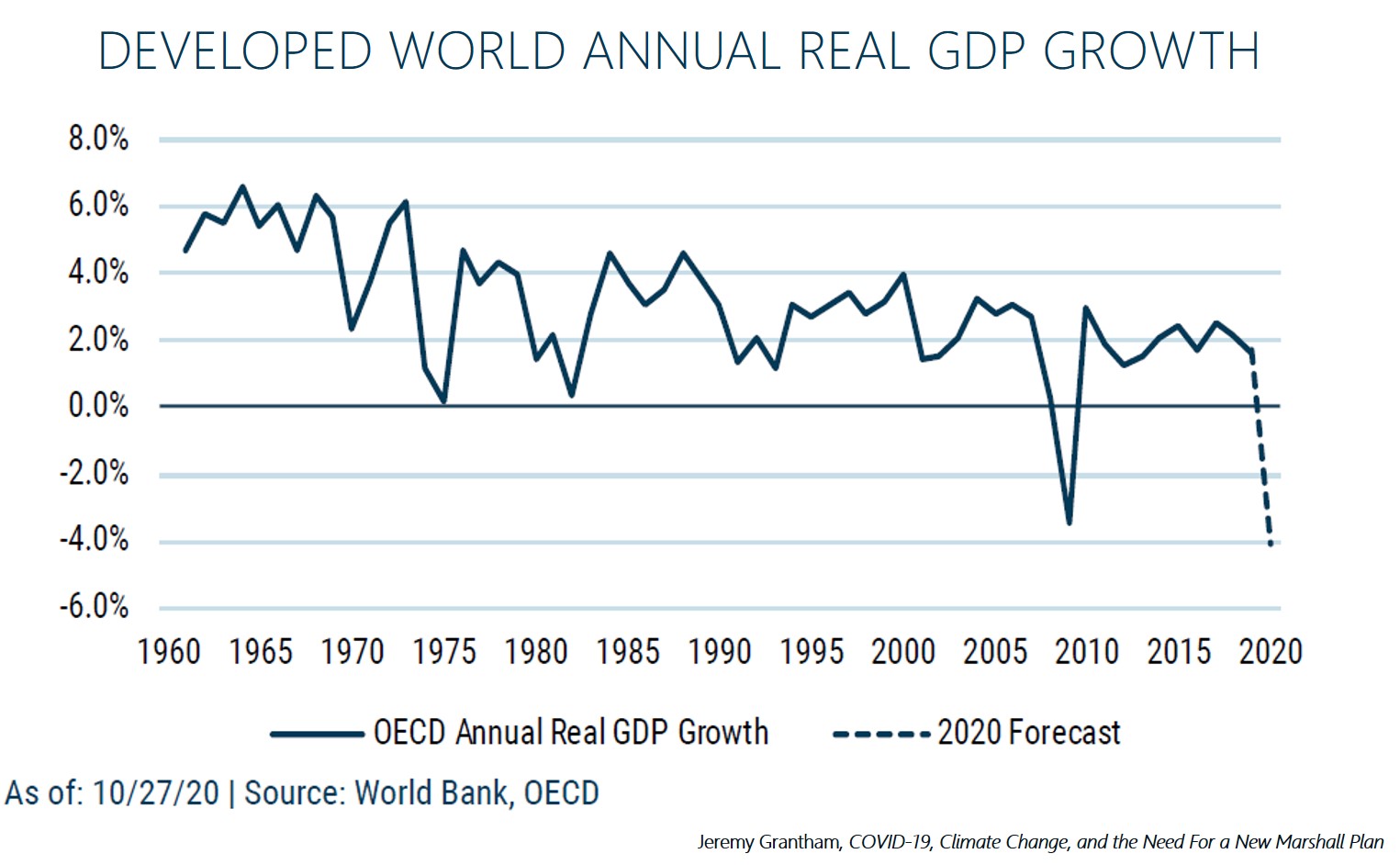
But headline GDP statistics aside, the pandemic has widened already large disparities between the haves and have nots. The COVID recession is the most unequal one in US history. As we recover – or don’t – distribution of resources within our population is going to be a critical issue – (more on this below). At some point if the have nots have nothing, they may be forced to take from the haves – or do without. No matter who wins the election we are going to have to find ways to support the weak, the vulnerable and the unemployed. And I expect these will number in the 10s of millions.


Ideology, Memes and Icebergs


If you haven’t been asleep, traveling or drugged these past few years, you’re aware there is a growing movement pointing out the racial, social and economic injustices of our current system. This is in large part because there are considerable racial, social and economic injustices in our current system. But fairness was never the objective built into our cultural goals or institutions – we optimize for (economic) efficiency, not fairness, nor for resilience. The situation is this: various demographics now quite vocally (and reasonably) want a larger share of the economic pie, but the pie itself is about to shrink, which is something few are aware of – and don’t like to hear/think about.

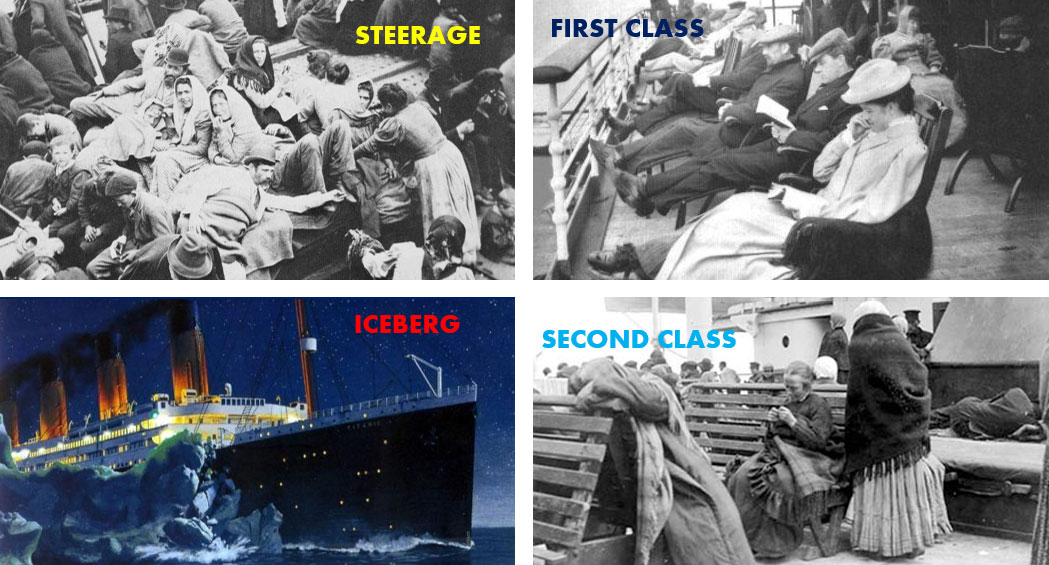
Let’s unpack this using an overused analogy – the Titanic. On the Titanic were 3 classes of passengers – First Class, Second Class and Steerage (or 3rd Class). You can imagine the conversations, hopes, dreams and concerns of the various people on that ship over a century ago. And, history tells us that the tragedy did not befall each class equally – 39% of 1st class passengers perished, 58% of 2nd class and 76% of steerage passengers drowned. The same demographics exist today and are probably having similar conversations within and between groups, focused on maintaining status, moving up in class, or demanding better conditions.

And then there is someone like me – shouting (to all 3 classes) that we just hit an iceberg and need to use science, discourse, reason and planning to find the best solution to navigating evacuation, lifeboats and a new course. You can imagine the reaction – indeed you see it in the news and in your town hall meetings. The ‘first class passengers’ publicly decry that there is no iceberg that technology would never allow the ship to hit an iceberg let alone sink (but privately they are looking to ‘lifeboats’ aka gated communities and the like). The second class passengers are scrambling like mad to ingratiate themselves to the first class passengers to get crumbs of surplus lest they slip into steerage. And the steerage passengers – a full 50%+ of American society today have 2 common responses: 1) “Ok sure there may be an iceberg, but we need to solve our more immediate concerns like our current unacceptable living/working conditions, because we’ll drown from those before any freaking iceberg” (they have valid points) or 2) “Ya right, an iceberg -that is just another story by elites and governments telling us what we have to do and taking away our rights and freedoms”. The difference now (vs on the actual Titanic) is that the steerage class (economically) houses both the far left and the far right, effectively creating additional ‘iceberg’ conditions within the ship itself. The people in ‘steerage’ can’t easily process that in addition to their current challenges, society ALSO has hit an iceberg (see below).

The point here is that the narratives (and religions) that make people feel good are often not based on reality. Which makes discussing, planning and responding to ‘the iceberg of the 2020s’ a very difficult task. The key will be to acknowledge the moral failings of our economic and cultural past while simultaneously acknowledging and planning the lifeboat situation. That’s a difficult thing for a human mind to do.

No matter who wins the election we will be faced with multiple non-overlapping memes and explanations for the upheaval that is coming. Our plight is biophysical (biology and physics) in nature but will be blamed on class, race, politics, and ideology. Navigating this is going to be exceedingly difficult. A new captain can change the morale and surround himself by great minds to make the best civic decisions, but he/she cannot change the fact that our economy and culture has hit an iceberg.


The Zombies are Coming

The central bank purchases and guarantees of various offerings of debt has turned the financial system into a digital Rube Goldberg machine. One of the externalities is that – while the economy was suffering from an exogenous shock from COVID – public companies used the FED bond guarantees to raise cheap debt. For instance, Boeing – a company who arguably will come out of the COVID crisis with worse business prospects due to less demand for planes – nearly doubled its long term debt because it could do so at low rates (the bonds being guaranteed by the FED). This means Boeing – and many other companies – will emerge from this crisis with both lower revenues and higher debt loads, putting them at risk of becoming ‘zombies’. Zombie companies are those whose profits are not enough to pay their interest payments – and they need to take on even more debt (or get direct aid from governments) to stay solvent.

Yes – it’s true stock markets are near all time highs. But this too is a distribution (and expectation) problem. Going into Q3 earnings, the five largest S&P 500 stocks (AAPL, MSFT, AMZN, GOOGL, FB) were expected to grow 3Q sales and EPS by +13% and +1% while the other 495 stocks in SP500 are expected to have a -5% revenue drop and a -24% drop in EPS.

Some great companies. Lots of zombies. No matter who wins this election, we (and the rest of developed world) are going to face a large and growing number of bankrupt and insolvent companies. Stimulus will help – and is critically necessary – but isn’t a long-term solution. And, as the government takes on more and more of this burden, it too risks zombification.


A Cul-de-Sac – and Full of Cans


At year end 2019 we were still recovering from the Great Recession -the ‘temporary’ measures initiated in 2008 – artificially low interest rates, too big to fail guarantees, Quantitative Easing, explosion of government debt, expansion of central bank balance sheets, etc. are still in effect a dozen years later. Even with all this, productivity gains have been tiny – and a fraction of earlier decades.

Now, in addition to all this, governments are adding fiscal stimulus – because they must. The little green man behind the curtain – (currently Jerome Powell) is a very capable and good person but he is not superman. The institution he oversees - the Federal Reserve – is using a giant, and mostly invisible, magic wand to beam what we might’ve consumed in 2030 or 2040 forward to 2020 (in the process leaving less available in 2030 and 2040). Modern Monetary Theory tells us deficits don’t matter – but from a biophysical lens they do – when we create money, we do not create the energy and materials needed to pay it back, so adding more and more debt becomes less productive over time – and has limits, both for companies, for nations, and for economic systems.

What happens when either the government decides to stop stimulus (hard to imagine) or the bond market says ‘no mas’ via higher rates? What is the plan by either the Left or the Right (or anyone) for when QE and stimulus combined cannot plug the economic hole for people and businesses? My opinion is that this question will be answered before 2025 – and the answer will be a drop in GDP akin to the 1930s. Yes, more debt and creative stimulus/infrastructure spending will forestall this for a while, but we will soon face a situation when we can no longer kick the can of growing GDP again to the future. COVID is but a foreshadowing. Money isn’t reality – it’s a marker for the things that matter: built, social, natural and human capital. No matter who wins the election we have a 50+ year physical/financial bill that’s coming due.


Our Basement Larder, is -Unbeknown to Most – Going Bare


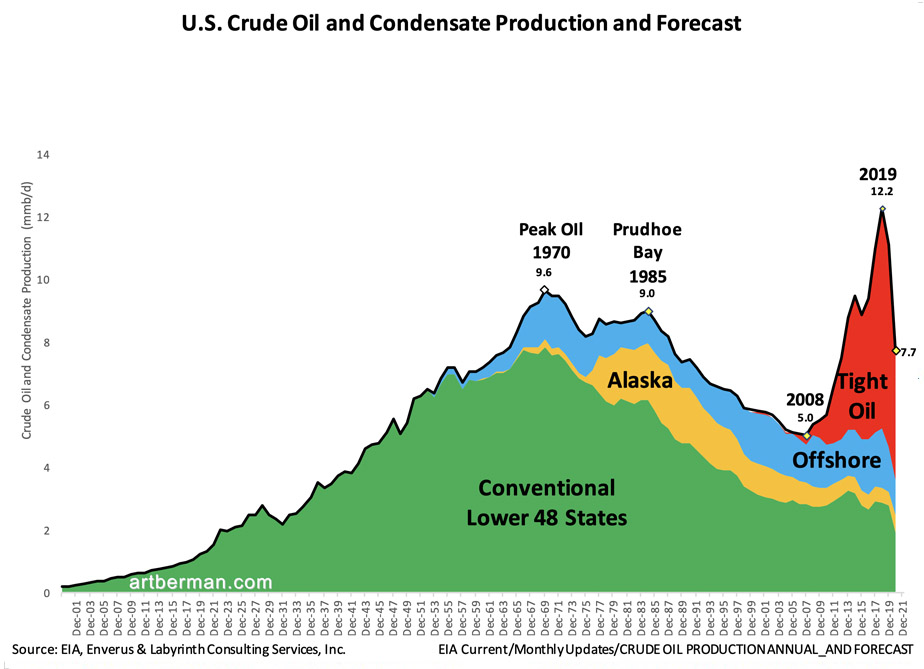
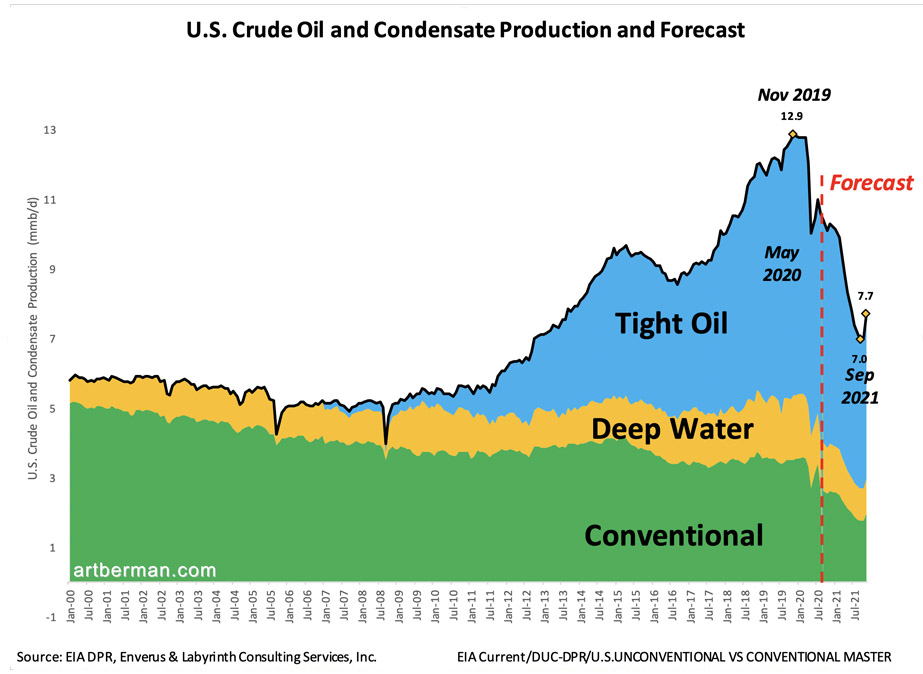
(Charts from Labyrinth Consulting. Assumptions: EIA & Enverus data through August 2020. Sept and Oct guided by EIA tight oil estimates plus Labyrinth estimates for OCS & conventional. Nov 2020 thru Nov 2021 calibrated speculation using to-date tight oil rig count and production correlation extrapolating 2020 ratio average for deep water & conventional production.)


If you took a poll and asked people what the single biggest casualty was from the pandemic, very few people would respond with ‘oil’. But no matter who wins the election, US oil production, including shale oil, is about to fall off a cliff, with massive consequences for society. For the setup of our modern way of life, oil is effectively our hemoglobin – and the COVID arrow hit at the heart of the industry as market prices are far below what it costs to extract oil from the ground. Yet this is all invisible to most people as the media (and economics departments) still conflate price with cost and cost with value. We were in bad shape BEFORE Covid-19 and now the Red Queen (drilling faster and faster just to maintain static production) has stepped off the treadmill for 6+months – meaning the large underlying decline rates of existing fields are not being offset much by new drilling. Worse, most of the recent decline in production is because wells have been shut in. Many of these will never be brought back on line because they cannot meet basic operating expenses and production taxes at current oil prices. In aggregate, US production is so far down -2.28 mmbpd from a 2019 monthly average high of of 12.86 mmbpd. Assuming rig counts and prices stay roughly where they are (and with no stimulus they may get worse), this implies a level of about 7 mmbpd by late summer 2021 – nearly a 50% drop. Globally, the reduction in travel, leisure and transport due to COVID effectively squeezed upstream investment- we are down to 72.8 mb of crude and condensate from 84.6 in November 2018, -which date is highly likely to be the all time peak in global production. Note: this will likely never be recognized as such because there will always be a non-biophysical reason articulated as to why we aren’t getting more oil. E.g. ‘the chinese’ or ‘the environmentalists’ or ‘the war’.)

To label this geologic phenomenon as ‘peak demand for oil’ is the economic equivalent of saying the reindeer on St Matthew Island faced ‘peak demand for lichen’. Oil is the lifeblood of our (current) economy -peak demand for oil also likely means peak growth for economies (unless massive efficiencies and fuel switching occur very fast). We probably won’t notice any lack of oil for many years because affordability by citizens will likely decline faster than oil itself (unless massive stimulus and central bank bazookas arrive). Regardless an accelerated retiring of the fossil armies that do most of our work, and create and deliver our modern smorgasbord of goods and services is now on the horizon.

(Note: I think the graph from my friend Art may be a bit pessimistic, but maybe not. We face a biophysical gauntlet where the price citizens can afford is getting lower and lower and the price energy companies need is higher and higher. If governments guarantee high prices to oil companies, or there are other incentives, production might be higher than indicated here – but here is a glaring statistic – if we were to stop drilling in USA entirely we would lose around 40% of our entire oil production in 1 year – we have to keep investing/drilling in more difficult and costly spots to avoid such a decline. (the 1 year decline rates are: Texas 40%, ND is 52%, Oklahoma 50%, GOM/deepwater 32% New Mexico 45% – these 5 regions are 80% of US production).

This is not remotely being discussed in our culture.

No matter who wins the election, US oil production has peaked – again - and this time including the tight oil provinces – from the ‘source rock’. This will have….large long term consequences, whether one is left, right or libertarian.


Complexity


Increasingly I think it’s neither oil nor finance, nor social disruption that is our core risk but declining returns to complexity

Historian Joseph Tainter famously studied how ancient civilizations declined due to the inability of resources/productivity to keep pace with complexity. In today’s world, this can be seen in myriad ways, from the unemployment software in US States being written in COBOL and FORTRAN, to APIs for majority of our medicines made in India and China, to the paint for a Ford truck only made in Fukushima, Japan.

It’s not something we think about, but we all are part of a complex global supply chain. On the way up, using the concept of ‘comparative advantage’ our society outsourced various manufacturing to countries of the lowest cost production – which in many cases meant locations in Asia with cheap labor. COVID gave us a glimpse of the dangerous underbelly of those decades old decisions: almost 200 drugs currently listed as in short supply by FDA, 6 month wait for bicycles, heavy equipment delays etc. This is a separate issue from short term kinks in the supply chain for e.g. ammunition, canned goods, and toilet paper etc. This issue goes to the embedded fragility of a global system based on growth by perpetually relying on import substitution models of production.

No matter who wins the election, with the geopolitical context that is COVID 19 on financial steroids, making sure that important things are made domestically (or regionally) may become an important question.


Other Energy


Humans – during periods of growth – and contraction – self-organize around energy. Oil is central but our entire energy balance sheet is going to be a critical issue in the coming decade. Under a Biden win, various Green New Deal proposals will lead to a massive increase in scale for renewable energy. In many ways this is good news, because it will be good for GDP, it will create jobs, and grow our supply of low carbon energy. But the key problem with what’s coming is the goal is ‘lower carbon energy’ not ‘systemically addressing human futures’. 

Briefly: 1) renewable energy isn’t renewable, it’s rebuildable and requires vast amounts of non-energy materials, minerals and land 2) only ~20% of (current) energy mix is electricity which is the type of energy produced from most renewables 3) the higher % of RE in our mix the more important back up (NG and coal) will become – and the US is facing an impending gas shortage as US drilling has plummeted. (the largest growth component of supply was the associated gas from tight oil production), 4) the cost of RE isn’t merely adding some solar panels or wind turbines but the full system cost of integrating RE into the grid which will be higher than consumers currently pay, which will weigh on a fragile economy 5) all RE blueprints expect a LARGER economy in the future when (see above) most realistic scenarios using systemic analysis (finance, politics, biophysical inputs) point to a smaller economy.

Still, renewables are our only hope – they are mature, robust and inexpensive vis-à-vis even a decade ago. The problem will be how to ‘increase renewables to a smaller and more complex system’. No matter who wins the election, we will have to face a more complex and less dependable energy future.


Meaning and Well-being


One of the silver linings (if you will) of the pandemic is that now a great number of people are personally aware that US GDP/ 330 million does not represent how well we are doing as individuals or as a nation. The constant media reminders that the SP500 and Dow Jones just made all-time highs is incongruous with most peoples real lived experience (and most of whom have zero money in the stock market). Whether one understands or agrees with the risks of climate change, energy depletion or limits to growth, tens of millions of people are now hungry for living a decent life with access to basic needs, while doing something good and meaningful. The coming decades – by definition but also by desire – are going to be more about well-being than they are about growing our consumption of stuff.

No matter who wins the election, our nation needs to embark on a deep conversation about what our cultural goal is – we are going to need complementary metrics to the econometric measures quantifying how much energy we burned. What is all this energy for is a question that should be part of our national discourse.


Protecting Heaven


Lost in the discussions of Republicans vs Democrats, stimulus, PPP, COVID statistics, stock market gyrations and geopolitics is perhaps the most important story of all – the state of Earth’s ecosystems and the ~10 million species we share the planet with. They are ‘downstream’ of our elections and financial/economic systems, but none of them have a vote.

I have concluded that natural systems and species futures – for better or worse – are linked to human futures – we have to ‘bend not break’ to have the best outcome for (most) Earth Systems (other than perhaps oceans and very remote species). I believe humans are not any better or worse than we were 100 years, 1000 years or 100,000 years ago – there are just more of us so our impact is (much) larger and each and every one of us consuming much more resources than our ancestors did. Humans are good at heart but we are biological organisms following cultural goals that have expiry dates. We have arrived at a ‘species level’ juncture and need to use systems science, reason, discourse, and leadership to navigate a glide path to intact futures.

No matter who wins the election, the state of the natural world needs to be included in our plans and discussions. Unfortunately, it first needs to be included in our values.


Joy, Living, and Goals


The Great Depression, unless you lived in a big city, mostly happened in slow motion. Similarly, unless we’re very unlucky, the events of the coming decade will unfold gradually. We have to take it upon ourselves to civically engage, but also find time to enjoy and appreciate our lives – being alive at this amazing and perilous time.

We all have ‘conditional’ goals, those which rely on something external to us to change in order to succeed. Many of those goals will not get met because external conditions prevent them – perhaps the ‘guy who we didn’t vote for’ winning the election. The key is to also find “unconditional” goals – those which we ourselves can be 100% responsible for. That way we can feel more empowered to reach those goals, which many times can influence the conditional goals in positive ways. Growing food, spending time with your neighbors, learning a new (useful to the future) skill, mutual aid, etc. The key for all of us – is to meet the future halfway.

No matter who wins the election, life, and the opportunity for joy, impact, and meaning will exist, perhaps even more so.


The 2020 Election and beyond


So, dear reader and fellow countrymen/women, go vote. But voting is merely the beginning of our civic duty. Our country will be shaped by how we citizens respond to the challenges ahead of us as much (or more) than it will by which party wins the election. What am I rooting for? Rationality, science, civility, discourse, which opens up other potential pathways. Our culture is capable of much more than guns, germs and steel or being an energy dissipating superorganism.

People who practice common decency and respect are by far the majority in our (and other) countries. When matched with perseverance, common goals and prioritizing social capital and relationships, we might just happen upon the glide path to decent futures. There are 10s of millions of Americans craving having their basic needs met and just doing some good with their lives – they just don’t yet have a roadmap and convening place. Could such a thing be the emergent result of the 2020 election?

Society right now is dancing – and fighting on the roof of an A-frame with the winds blowing hard and a storm shooting lightning at our heads. We need to keep dancing (less fighting) while we climb down to more stable ground.

No matter who wins the election this week we are on the cusp of major change which will require both top-down and bottom up interventions and cultural emergence. I hope you can play a role.


The objective economy, part one. Tim Morgan, Surplus Energy Economics. Nov. 12, 2020


Sunday, October 25, 2020

Chris Hedges: The Politics of Cultural Despair

The Politics of Cultural Despair. Chris Hedges, via ScheerPost. Oct. 19, 2020.


The physical and moral decay of the United States and the malaise it has spawned have predictable results. We have seen in varying forms the consequences of social and political collapse during the twilight of the Greek and Roman empires, the Ottoman and Hapsburg empires, Tsarist Russia, Weimar Germany and the former Yugoslavia. Voices from the past, Aristotle, Cicero, Fyodor Dostoevsky, Joseph Roth and Milovan Djilas, warned us. But blinded by self-delusion and hubris, as if we are somehow exempt from human experience and human nature, we refuse to listen.

The United States is a shadow of itself. It squanders its resources in futile military adventurism, a symptom of all empires in decay as they attempt to restore a lost hegemony by force. Vietnam. Afghanistan. Iraq. Syria. Libya. Tens of millions of lives wrecked. Failed states. Enraged fanatics. There are 1.8 billion Muslims in the world, 24 percent of the global population, and we have turned virtually all of them into our enemies.

We are piling up massive deficits and neglecting our basic infrastructure, including electrical grids, roads, bridges and public transportation, to spend more on our military that all the other major powers on Earth combined. We are the world’s largest producer and exporter of arms and munitions. The virtues we argue we have a right to impose by force on others — human rights, democracy, the free market, the rule of law and personal freedoms — are mocked at home where grotesque levels of social inequality and austerity programs have impoverished most of the public, destroyed democratic institutions, including Congress, the courts and the press, and created militarized forces of internal occupation that carry out wholesale surveillance of the public, run the largest prison system in the world and gun down unarmed citizens in the streets with impunity.

The American burlesque, darkly humorous with its absurdities of Donald Trump, fake ballot boxes, conspiracy theorists who believe the deep state and Hollywood run a massive child sex trafficking ring, Christian fascists that place their faith in magic Jesus and teach creationism as science in our schools, ten hour long voting lines in states such as Georgia, militia members planning to kidnap the governors of Michigan and Virginia and start a civil war, is also ominous, especially as we ignore the accelerating ecocide.

All of our activism, protests, lobbying, petitions, appeals to the United Nations, the work of NGOs and misguided trust in liberal politicians such as Barack Obama have been accompanied by a 60 percent rise in global carbon emissions since 1990. Estimates predict another 40 percent rise in global emissions in the next decade. We are less than a decade away from carbon dioxide levels reaching 450 parts per million, the equivalent to a 2 degree Celsius average temperature rise, a global catastrophe that will make parts of the earth uninhabitable, flood coastal cities, dramatically reduce crop yields and result in suffering and death for billions of people. This is what is coming, and we can’t wish it away.

I speak to you in Troy, New York, once the second largest producer of iron in the country after Pittsburgh. It was an industrial hub for the garment industry, a center for the production of shirts, shirtwaists, collars, and cuffs, and was once home to foundries that made bells to firms that crafted precision instruments. All that is gone, of course, leaving behind the post-industrial decay, the urban blight and the shattered lives and despair that are sadly familiar in most cities in the United States.

It is this despair that is killing us. It eats into the social fabric, rupturing social bonds, and manifests itself in an array of self-destructive and aggressive pathologies. It fosters what the anthropologist Roger Lancaster calls “poisoned solidarity,” the communal intoxication forged from the negative energies of fear, suspicion, envy and the lust for vengeance and violence. Nations in terminal decline embrace, as Sigmund Freud understood, the death instinct. No longer sustained by the comforting illusion of inevitable human progress, they lose the only antidote to nihilism. No longer able to build, they confuse destruction with creation. They descend into an atavistic savagery, something not only Freud but Joseph Conrad and Primo Levi knew lurks beneath the thin veneer of civilized society. Reason does not guide our lives. Reason, as Schopenhauer puts it, echoing Hume, is the hard-pressed servant of the will.

“Men are not gentle creatures who want to be loved, and who at the most can defend themselves if they are attacked,” Freud wrote. “They are, on the contrary, creatures among whose instinctual endowments is to be reckoned a powerful share of aggressiveness. As a result, their neighbor is for them not only a potential helper or sexual object, but also someone who tempts them to satisfy their aggressiveness on him, to exploit his capacity for work without compensation, to use him sexually without his consent, to seize his possessions, to humiliate him, to cause him pain, to torture and to kill him. Homo homini lupus. Who, in the face of all his experience of life and history, will have the courage to dispute this assertion? As a rule, this cruel aggressiveness waits for some provocation or puts itself at the service of some other purpose, whose goal might also have been reached by milder measures. In circumstances that are favorable to it, when the mental counter-forces which ordinarily inhibit it are out of action, it also manifests itself spontaneously and reveals man as a savage beast to whom consideration towards his own kind is something alien.”

Freud, like Primo Levi, got it. The moral life is a matter of circumstances. Moral consideration, as I saw in the wars I covered, largely disappears in moments of extremity. It is the luxury of the privileged. “Ten percent of any population is cruel, no matter what, and 10 percent is merciful, no matter what, and the remaining 80 percent can be moved in either direction,” Susan Sontag said.

To survive, it was necessary, Levi wrote of life in the death camps, “to throttle all dignity and kill all conscience, to climb down into the arena as a beast against other beasts, to let oneself be guided by those unsuspected subterranean forces which sustain families and individuals in cruel times. “It was, he wrote, “a Hobbesian life,” “a continuous war of everyone against everyone.” Varlam Shalamov, imprisoned for 25 years in Stalin’s gulags, was equally pessimistic: “All human emotions–of love, friendship, envy, concern for one’s fellowman, compassion, a longing for fame, honesty–had left us with the flesh that had melted from our bodies during our long fasts. The camp was a great test of our moral strength, of our everyday morality, and 99% of us failed it…Conditions in the camps do not permit men to remain men; that is not what camps were created for.”

Social collapse will bring these latent pathologies to the surface.

But the fact that circumstances can reduce us to savagery does not negate the moral life. As our empire implodes, and with it social cohesion, as the earth increasingly punishes us for our refusal to honor and protect the systems that give us life, triggering a scramble for diminishing natural resources and huge climate migrations, we must face this darkness, not only around us, but within us.

The dance macabre is already underway. Hundreds of thousands of Americans die each year from opioid overdoes, alcoholism and suicide, what sociologists calls deaths of despair. This despair fuels high rates of morbid obesity, some 40 percent of the public, gambling addictions, the pornification of the society with the ubiquitous of images of sexual sadism along with the proliferation of armed right-wing militias and nihilistic mass shootings. As despair mounts, so will these acts of self-immolation.

Those overwhelmed by despair seek magical salvations, whether in crisis cults, such as the Christian Right, or demagogues such as Trump, or rage-filled militias that see violence as a cleansing agent. As long as these dark pathologies are allowed to fester and grow–and the Democratic Party has made it clear it will not enact the kinds of radical social reforms that will curb these pathologies–the United States will continue its march towards disintegration and social upheaval. Removing Trump will neither halt nor slow the descent.

An estimated 300,000 American will be dead from the pandemic in December, a figure that is expected to rise to 400,000 in January. Chronic underemployment and unemployment, close to 20 percent when those who have stopped looking for work, those furloughed with no prospect of being rehired and those who work part-time but are still below the poverty line, are included in the official statistic instead of being magically erased from the unemployment rolls. Our privatized health care system, which is making record profits during the pandemic, is not designed to cope with a public health emergency. It is designed to maximize profit for its owners. There are fewer than 1 million hospital beds nationally, a result of the decades-long trend of hospital mergers and closures that have reduced access to care in communities across the nation. Cities such as Milwaukee have been forced to erect field hospitals. In states such as Mississippi there are no longer any ICU beds available. The for-profit health service did not stockpile the ventilators, masks, tests or drugs to deal with COVID-19. Why should it? That is not a route to increased revenue. And there is no substantial difference between Trump and Biden’s response to the health crisis, where 1,000 people a day are dying.

Forty-eight percent of front line workers remain ineligible for sick pay. Some 43 million Americans have lost their employer-sponsored health insurance. There are ten thousand bankruptcies a day, with perhaps two-thirds of them tied to exorbitant medial costs. Food banks are overrun with tens of thousands of desperate families. Roughly 10 to 14 million renter households, or 23 to 34 million people, were behind on their rent in September. That amounts to $12 to $17 billion in unpaid rent. And that figure is expected to rise to $34 billion in past due rent in January. The lifting of the moratorium on evictions and forecloses will mean that millions of families, many destitute, will be tossed onto the street. Hunger in U.S. households almost tripled between 2019 and August of this year, according to the Census Bureau and the Department of Agriculture. The proportion of American children who do not have enough to eat, the study found, is 14 times higher than it was last year. A study by Columbia University, found that since May there are eight million more Americans who can be classified as poor. Meanwhile, the 50 richest Americans hold as much wealth as half of the United States. Millennials, some 72 million people, have 4.6 percent of U.S. wealth.

Only one thing matters to the corporate state. It is not democracy. It is not truth. It is not the consent of the governed. It is not income inequality. It is not the surveillance state. It is not endless war. It is not jobs. It is not the climate crisis. It is the primacy of corporate power — which has extinguished our democracy, taken from us our most basic civil liberties and left most of the working class in misery — and the increase and consolidation of its wealth and power.

Trump and Biden are repugnant figures, doddering into old age with cognitive lapses and no moral cores. Is Trump more dangerous than Biden? Yes. Is Trump inepter and more dishonest? Yes. Is Trump more of a threat to the open society? Yes. Is Biden the solution? No.

Biden cannot plausibly offer change. He can only offer more of the same. And most Americans do not want more of the same. The country’s largest voting-age bloc, the 100 million-plus citizens who out of apathy or disgust do not vote, will once again stay home. This demoralization of the electorate is by design.

In America we are only permitted to vote against what we hate. Partisan media outlets set one group against another, a consumer version of what George Orwell in his novel 1984 called the “Two minutes of Hate.” Our opinions and prejudices are skillfully catered to and reinforced, with the aid of a detailed digital analysis of our proclivities and habits, and then sold back to us. The result, as Matt Taibbi writes, is “packaged anger just for you.” The public is unable to speak across the manufactured divide. Politics, under the assault, has atrophied into a tawdry reality show centered on manufactured political personalities. Civic discourse has been poisoned by invective and lies. Power, meanwhile, is left unexamined and unchallenged.

Political coverage is modeled, as Taibbi points out, on sports coverage. The sets look like the sets on Sunday NFL Countdown. The anchor is on one side. There are four commentators, two from each team. Graphics keep us updated on the score. Political identities are reduced to easily digestible stereotypes. Tactics, strategy, image, the monthly tallies of campaign contributions and polling are endlessly examined, while real political issues are ignored. It is the language and imagery of war.

This coverage masks the fact that on nearly all the major issues the two major political parties are in complete agreement. The deregulation of the financial industry, trade agreements, the militarization of police — the Pentagon has transferred more than $ 7.4 billion in excess military gear and hardware to nearly 8,000 federal and state law enforcement agencies since 1990 — the explosion in the prison population, deindustrialization, austerity, support for fracking and the fossil fuel industry, the endless wars in the Middle East, the bloated military budget, the control of elections and mass media by corporations and the wholesale government surveillance of the population–and when the government watches you 24 hours a day you cannot use the word liberty, this is the relationship of a master and a slave — all have bipartisan support. And for this reason, these issues are almost never discussed.

This goal is to set demographic against demographic. This stoking of antagonism is not news. It is entertainment, driven not by journalism but marketing strategies to increase viewership and corporate sponsors. News divisions are corporate revenue streams competing against other corporate revenue streams. The template for news, as Taibbi writes in his book Hate Inc., the cover of which has Sean Hannity on one side and Rachel Maddow on the other, is the simplified morality play used in professional wrestling. There are only two real political positions in the United States. You love Trump or you hate him, which comes from the playbook of professional wrestling.

By voting for Biden and the Democratic Party you vote for something.

You vote to endorse the humiliation of courageous women such as Anita Hill who confronted their abusers. You vote for the architects of the endless wars in the Middle East. You vote for the apartheid state in Israel. You vote for wholesale surveillance of the public by government intelligence agencies and the abolition of due process and habeas corpus. You vote for austerity programs, including the destruction of welfare and cuts to Social Security. You vote for NAFTA, free trade deals, de-industrialization, a real decline in wages, the loss of hundreds of thousands of manufacturing jobs and the offshoring of jobs to underpaid workers who toil in sweatshops in Mexico, China or Vietnam. You vote for the assault on teachers and public education and the transfer of federal funds to for-profit and Christian charter schools. You vote for the doubling of our prison population, the tripling and quadrupling of sentences and huge expansion of crimes meriting the death penalty. You vote for militarized police who gun down poor people of color with impunity. You vote against the Green New Deal and immigration reform. You vote for the fracking industry. You vote for limiting a woman’s right to abortion and reproductive rights. You vote for a segregated public-school system in which the wealthy receive educational opportunities and poor people of color are denied a chance. You vote for punitive levels of student debt and the inability to free yourself of those debt obligations even if file for bankruptcy. You vote for deregulating the banking industry and the abolition of Glass-Steagall. You vote for the for-profit insurance and pharmaceutical corporations and against universal health care. You vote for defense budgets that consume more than half of all discretionary spending. You vote for the use of unlimited oligarchic and corporate money to buy our elections. You vote for a politician who during his time in the Senate abjectly served the interests of MBNA, the largest independent credit card company headquartered in Delaware, which also employed Biden’s son Hunter.


Biden was one of the principle architects of the wars in the Middle East, where we have squandered upwards of $7 trillion and destroyed or extinguished the lives of millions of people. He is responsible for far more suffering and death at home and abroad than Trump. If we had a functioning judicial and legislative system, Biden, along with the other architects of our disastrous imperial wars, corporate plundering of the country and betrayal of the American working class, would be put on trial, not offered up as a solution to our political and economic debacle.

The Democrats and their liberal apologists adopt tolerant positions on issues regarding race, religion, immigration, women’s rights and sexual identity and pretend this is politics. These issues are societal or ethical issues. They are important. But they are not social or political issues. The seizure of control of the economy by a class of global speculators and corporations has ruined the lives of the very groups the Democrats pretend to lift up. When Bill Clinton and the Democratic Party, for example, destroyed the old welfare system, 70 percent of the recipients were children. Those on the right of the political spectrum — and we must never forget that the positions of the Democratic Party would make it a far-right party in Europe — demonize those on the margins of society as scapegoats. The culture wars mask the reality. Both parties are full partners in the destruction of our democratic institutions. Both parties have reconfigured American society into a mafia state. It only depends on how you want it dressed up.

The power of politicians such as Nancy Pelosi, Chuck Schumer or Mitch McConnell comes from being able to funnel corporate money to anointed candidates. In a functioning political system, one not saturated with corporate cash, they would not hold power. They have transformed what the Roman philosopher Cicero called a commonwealth, a res publica, a “public thing” or the “property of a people,” into an instrument of pillage and repression on behalf of a global corporate oligarchy. We are serfs ruled by the obscenely rich, omnipotent masters who loot the U.S. Treasury, pay little or no taxes and have perverted the judiciary, the media and the legislative branches of government to strip us of civil liberties and give them the freedom to engage in tax boycotts, financial fraud and theft.

In the midst of the pandemic crisis what did our ruling kleptocratic rulers do?

They looted $4 trillion on a scale unseen since the 2008 bailout overseen by Barack Obama and Biden. They gorged and enriched themselves at our expense, while tossing crumbs out of the windows of their private jets, yachts, penthouses and palatial estates to the suffering and despised masses.

The CARES Act handed trillions in funds or tax breaks to oil companies, the airline industry, which alone got $50 billion in stimulus money, the cruise ship industry, a $170 billion windfall for the real estate industry. It handed subsidies to private equity firms, lobbying groups, whose political action committees have given $191 million in campaign contributions to politicians in the last two decades, the meat industry and corporations that have moved offshore to avoid U.S. taxes. The act allowed the largest corporations to gobble up money that was supposed to keep small businesses solvent to pay workers. It gave 80 percent of tax breaks under the stimulus package to millionaires and allowed the wealthiest to get stimulus checks that average $1.7 million. The CARES Act also authorized $454 billion for the Treasury Department’s Exchange Stabilization Fund, a massive slush fund doled out by Trump cronies to corporations that, when leveraged 10 to 1, can be used to create a staggering $4.5 trillion in assets. The act authorized the Fed to give $1.5 trillion in loans to Wall Street, which no one expects will ever be paid back. American billionaires have gotten $434 billion richer since the pandemic. Jeff Bezos, the richest man in the world, whose corporation Amazon paid no federal taxes last year, alone added nearly $72 billion to his personal wealth since the pandemic started. During this same time period 55 million Americans lost their jobs.

The molding of the public into warring factions works commercially. It works politically. It destroys, as it is designed to do, class solidarity. But it is a recipe for social disintegration. It propels us towards the kind of Hobbesian world Primo Levi and Sigmund Freud warned us about. I watched competing ethnic groups in the former Yugoslavia retreat into antagonistic tribes. They seized rival mass media outlets and used them to spew lies, mythological narratives exalting themselves, along with vitriol and hate against the ethnicities they demonized. This poisoned solidarity, which we are replicating, pumped out month after month in Yugoslavia, destroyed the capacity for empathy, perhaps the best definition of evil, and led to a savage fratricide.

The United States, awash in military-grade weaponry, is already plagued by an epidemic of mass shootings. There are death threats against critics of Trump, including Rep. Ilhan Omar. There was an aborted plot by 13 members of a right-wing militia group to kidnap and perhaps assassinate the governors of Michigan and Virginian and start a civil war. A Trump supporter mailed pipe bombs to prominent Democrats and CNN, an effort to decapitate the hierarchy of the Democratic Party, as well as terrorize the media outlet that is the party’s principal propaganda platform.

The spark that usually sets such tinder ablaze is martyrdom. Aaron “Jay” Danielson, a supporter of the right-wing group Patriot Prayer, was wearing a loaded Glock pistol in a holster and had bear spray and an expandable metal baton when he was shot dead on August 29, allegedly by Michael Forest Reinoehl, a supporter of antifa, in the streets of Portland. A woman in the crowd can be heard shouting after the shooting: “I am not sad that a fucking fascist died tonight.” Reinoehl was ambushed and killed by federal agents in Washington state in what appears to be an act of extra-judicial murder. Once people start being sacrificed for the cause, it takes little for demagogues to insist that self-preservation necessitates violence.

Political stagnation and corruption, along with economic and social misery, spawn what anthropologists call crisis cults–movements led by demagogues that prey on an unbearable psychological and financial distress and champion violence as a form of moral purification. These crisis cults, already well established among followers of the Christian Right, right-wing militia groups and many followers of Donald Trump, who look at him not as a politician but as a cult leader, peddle magical thinking and an infantilism that promises–if you surrender all autonomy–prosperity, restored national glory, a return to a mythical past, order and security. Trump is a symptom. He is not the disease. And if he leaves office far more competent and dangerous demagogues will rise, if the social conditions are not radically improved, to take his place.

I fear we are headed towards a Christianized fascism.

The greatest moral failing of the liberal Christian church was its refusal, justified in the name of tolerance and dialogue, to denounce the followers of the Christian right as heretics. By tolerating the intolerant, it ceded religious legitimacy to an array of con artists, charlatans and demagogues and their cultish supporters. It stood by as the core Gospel message–concern for the poor and the oppressed–was perverted into a magical world where God and Jesus showered believers with material wealth and power. The white race became God’s chosen agent. Imperialism and war became divine instruments for purging the world of infidels and barbarians, evil itself. Capitalism, because God blessed the righteous with wealth and power and condemned the immoral to poverty and suffering, became shorn of its inherent cruelty and exploitation. The iconography and symbols of American nationalism became intertwined with the iconography and symbols of the Christian faith.

The mega-pastors, narcissists who rule despotic, cult-like fiefdoms, make millions of dollars by using this heretical belief system to prey on the despair and desperation of their congregations, victims of neoliberalism and deindustrialization. These believers find in Trump, who preyed on this despair in his casinos and through his sham university, and these mega-pastors, champions of the unfettered greed, cult of masculinity, lust for violence, white supremacy, bigotry, American chauvinism, religious intolerance, anger, racism and conspiracy theories that are the core beliefs of the Christian Right.

When I wrote American Fascists: The Christian Right and the War on America I was quite serious about the term “fascists.”

Tens of millions of Americans live hermetically sealed inside the vast media and educational edifice erected by the Christian Right. In this world, miracles are real, Satan, allied with liberal secular humanists and the deep state, along with Muslims, immigrants, feminists, intellectuals, artists and a host of other internal enemies, is seeking to destroy America. Trump is God’s anointed vessel to build the Christian nation and cement into place a government that instills “biblical values.” These “biblical values” include banning abortion, protecting the traditional family, turning the Ten Commandments into secular law, crushing “infidels,” especially Muslims, indoctrinating children in schools with “biblical” teachings and thwarting sexual license, which includes any sexual relationship other than marriage between a man and a woman. Trump is routinely compared by evangelical leaders to the biblical king Cyrus, who rebuilt the temple in Jerusalem and restored the Jews to the city.

Trump has filled his ideological void with Christian fascism. He has elevated members of the Christian right to prominent positions, including Mike Pence to the vice presidency, Mike Pompeo to secretary of state, Betsy DeVos to secretary of education, Ben Carson to secretary of housing and urban development, William Barr to attorney general, Neil Gorsuch and Brett Kavanaugh to the Supreme Court and the televangelist Paula White to his Faith and Opportunities Initiative. More importantly, Trump has handed the Christian right veto and appointment power over key positions in government, especially in the federal courts. He has installed 133 district court judges out of 677 total, 50 appeals court judges out of 179 total, and two U.S. Supreme Court justices, and with Amy Coney Barrett’s nomination most likely three, out of nine. This is nineteen percent of the federal trial judges currently in service. Nearly all of the extremists who make up the judicial appointees have been rated as unqualified by the American Bar Association, the country’s largest nonpartisan coalition of lawyers.

Trump has adopted the Islamophobia of the Christian fascists. He has banned Muslim immigrants and rolled back civil rights legislation. He has made war on reproductive rights by restricting abortion and defunding Planned Parenthood. He has stripped away LGBTQ rights. He has ripped down the firewall between church and state by revoking the Johnson Amendment, which prohibits churches, which are tax-exempt, from endorsing political candidates. His appointees, including Pence, Pompeo and DeVos, throughout the government routinely use biblical strictures to justify an array of policy decisions including environmental deregulation, war, tax cuts and the replacement of public schools with charter schools, an action that permits the transfer of federal education funds to private “Christian” schools. At the same time, they are building paramilitary organizations, not only through ad hoc militias but through mercenary groups of private contractors controlled by figures such as Erik Prince, the brother of Betsy DeVos and the former CEO of Blackwater now called Xe.

I studied ethics at Harvard Divinity School with James Luther Adams who had been in Germany in 1935 and 1936. Adams witnessed the rise there of the so-called German Christian Church which was pro-Nazi. He warned us about the disturbing parallels between the German Christian Church and the Christian right. Adolf Hitler was in the eyes of the German Christian Church a volk messiah and an instrument of God—a view similar to the one held today about Trump by many of his white evangelical supporters. Those demonized for Germany’s economic collapse, especially Jews and communists, were agents of Satan. Fascism, Adams told us, always cloaked itself in a nation’s most cherished symbols and rhetoric. Fascism would come to America not in the guise of stiff-armed, marching brownshirts and Nazi swastikas but in mass recitations of the Pledge of Allegiance, the biblical sanctification of the state and the sacralization of American militarism. Adams was the first person I heard label the extremists of the Christian right as fascists. Liberals, he warned, as in Nazi Germany, were blind to the tragic dimension of history and radical evil. They would not react until it was too late.

Trump’s legacy will, I fear, be the empowerment of the Christian fascists. They are what comes next. Noam Chomsky, for this reason, is right when he warns that Pence is more dangerous than Trump. For decades the Christian fascists have been organizing to take power. They have built infrastructures and organizations, including lobbying groups, schools, colleges and law schools as well as media platforms, to prepare. They have seeded their cadre into positions of power. We on the left, meanwhile, have seen our institutions and organizations destroyed or corrupted by corporate power and been seduced by the boutique activism of identity politics. FRC Action, the legislative affiliate of the Family Research Council, already gives 245 members of Congress a 100 percent approval rating for supporting legislation that is backed by the Christian Right.

Christian fascism is an emotional life raft for tens of millions of Americans. It is impervious to science and verifiable fact. The Christian fascists, by choice, have severed themselves from rational thought and the secular society that almost destroyed them and their families and thrust them into deep despair. We will not placate or disarm this movement, bent on our destruction, by attempting to claim that we, too, have Christian “values.” This appeal only strengthens the legitimacy of the Christian fascists and weakens our own. These dispossessed people will either be reintegrated into the economy and the society and their shattered social bonds mended, or the movement will grow more virulent and more powerful.

The Christian Right is determined to keep the public focus on societal or ethical as opposed to economic issues. The corporate media, whether it supports or opposes the nomination of Amy Coney Barrett to the Supreme Court, almost exclusively discusses her opposition to abortion and membership in People of Praise, a far-right Catholic sect that practices “speaking in tongues.” What our corporate masters, along with the Christian fascists, do not want examined is Barrett’s subservience to corporate power, her hostility to workers, civil liberties, unions and environmental regulations. Since the Democratic Party is beholden to the same donor class as the Republican Party, and since the media long ago substituted the culture wars for politics, the most ominous threat posed by Barrett and the Christian Right is ignored.

The road to despotism is always paved with righteousness.

All fascist movements paper over their squalid belief systems with the veneer of morality. They mouth pieties about restoring law and order, right and wrong, the sanctity of life, civic and family virtues, patriotism and tradition to mask their dismantling of the open society and silencing and persecution of those who dissent. The Christian Right, awash in money from corporations that understand their political intent, will use any tool, no matter how devious, from right-wing armed militias to the invalidation of ballots, to block Biden and Democratic candidates from assuming office.

Capitalism, driven by the obsession to maximizing profit and reduce the cost of production by slashing worker’s rights and wages, is antithetical to the Christian Gospel, as well as the Enlightenment ethic of Immanuel Kant. But capitalism, in the hands of the Christian fascists, has become sacralized in the form of the Prosperity Gospel, the belief that Jesus came to minister to our material needs, blessing believers with wealth and power. The Prosperity Gospel is an ideological cover for the slow-motion corporate coup d’état. This is why large corporations such as Tyson Foods, which places Christian Right chaplains in its plants, Purdue, Wal-Mart, and Sam’s Warehouse, along with many other corporations, pour money into the movement and its institutions such as Liberty University and Patrick Henry Law School. This is why corporations have given millions to groups such as the Judicial Crisis Network and the U.S. Chamber of Commerce to campaign for Barrett’s appointment to the court. Barrett has ruled to cheat gig workers out of overtime, green light fossil fuel extraction and pollution, gut Obamacare and strip consumers of protection from corporate fraud. Barrett, as a circuit court judge, heard at least 55 cases in which citizens challenged corporate abuse and fraud. She ruled in favor of corporations 76 percent of the time.

Our corporate masters do not care about abortion, gun rights or the sanctity of marriage between a man and a woman. But like the German industrialists who backed the Nazi Party, they know that the Christian Right will give an ideological veneer to ruthless corporate tyranny. These oligarchs view the Christian fascists the same way the German industrialists viewed the Nazis, as buffoons. They are aware that the Christian fascists will trash what is left of our anemic democracy and the natural ecosystem. But they also know they will make huge profits in the process and the rights of workers and citizens will be ruthlessly suppressed.

If you are poor, if you lack proper medical care, if you are paid substandard wages, if you are trapped in the lower class, if you are a victim of police violence, this is because, according to the Prosperity Gospel, you are not a good Christian. In this belief system you deserve what you get. There is nothing wrong, these homegrown fascists preach, with the structures or systems of power. Like all totalitarian movements, followers are seduced into calling for their own enslavement.

As the Nazi propagandist Joseph Goebbels understood: “The best propaganda is that which, as it were, works invisibly, penetrates the whole of life without the public having any knowledge of the propagandistic initiative.”

The tinder that could ignite violent conflagrations lies ominously stacked around us. It may be triggered by Trump’s defeat in the election. Millions of disenfranchised white Americans, who see no way out of their economic and social misery, struggling with an emotional void, are seething with rage against a corrupt ruling class and bankrupt liberal elite that betrayed them. They are tired of the political stagnation, grotesque, mounting social inequality and the punishing fallout from the pandemic. Millions more alienated young men and women, also locked out of the economy and with no realistic prospect for advancement or integration, gripped by the same emotional void, have harnessed their fury in the name of tearing down the governing structures and anti-fascism. These polarized extremes are inching closer and closer to violence.


There are three options: reform, which, given the decay in the American body politic, is impossible, revolution, or tyranny.

If the corporate state is not overthrown, then America will soon become a naked police state where any opposition, however tepid, will be silenced with draconian censorship or force. Police in cities around the country have already thwarted the reporting by dozens of journalists covering the protests through physical force, arrests, tear gas, rubber bullets and pepper spray. This will become normalized. The huge social divides, often built around race, will be used by the Christian fascists to set neighbor against neighbor. Armed Christian patriots will attack those groups blamed for social collapse. Dissent, even nonviolent dissent, will become treason.

Peter Drucker observed that Nazism succeeded not because people believed in its fantastic promises, but in spite of them. Nazi absurdities, he pointed out, had been “witnessed by a hostile press, a hostile radio, a hostile cinema, a hostile church, and a hostile government which untiringly pointed out the Nazi lies, the Nazi inconsistency, the unattainability of their promises, and the dangers and folly of their course.” Nobody, he noted, “would have been a Nazi if rational belief in the Nazi promises had been a prerequisite.” The poet, playwright and socialist revolutionary Ernst Toller, who was forced into exile and stripped of his citizenship when the Nazis took power in 1933, wrote in his autobiography: “The people are tired of reason, tired of thought and reflection. They ask, what has reason done in the last few years, what good have insights and knowledge done us.” After Toller committed suicide in 1939, W.H. Auden in his poem “In Memory of Ernst Toller” wrote:

We are lived by powers we pretend to understand:
They arrange our loves; it is they who direct at the end
The enemy bullet, the sickness, or even our hand.

Once the internal enemies are purged from the nation, we are promised, America will recover its lost glory, except that once one enemy is obliterated another takes its place. Crisis cults require a steady escalation of conflict and a steady stream of victims. Every new crisis becomes more urgent and more extreme than the last. This is what made the war in the former Yugoslavia inevitable. Once one stage of conflict reaches a crescendo it loses its efficacy. It must be replaced by ever more brutal and deadly confrontations. It is what Ernst Jünger called a “feast of death.”

These crisis cults are, as Drucker understood, irrational and schizophrenic. They have no coherent ideology. They turn morality upside down. They appeal exclusively to emotions. Burlesque and spectacle become politics. Depravity becomes morality. Atrocities and murder, as the federal marshals who wantonly gunned down the antifia activist Michael Forest Reinoehl in Washington State illustrated, becomes heroism. Crime and fraud become justice. Greed and nepotism become civic virtues.

What these crisis cults stand for today, they condemn tomorrow. There is no ideological consistency. There is only emotional consistency. At the height of the reign of terror on May 6, 1794 during the French Revolution, Maximilien Robespierre announced that the Committee for Public Safety now recognized the existence of God. The French revolutionaries, fanatical atheists who had desecrated churches and confiscated church property, murdered hundreds of priests and forced another 30,000 into exile, instantly reversed themselves to send to the guillotine those who disparaged religion. In the end, exhausted by the moral confusion and internal contradictions, these crisis cults yearn for self-annihilation.

The ruling elites will no more restore these ruptured social bonds and address the deep despair that grips America than they will respond to the climate emergency. As the country unravels, they will reach for the familiar tools of state repression and the ideological prop provided by Christian fascism.

It is up to us to carry out sustained acts of nonviolent, mass resistance. If we mobilize in large and small ways to fight for an open society, to create communities that, as Vaclav Havel wrote “live in truth,” we hold out the possibility of pushing back against these crisis cults, holding at bay the brutality that accompanies social upheaval, as well as slowing and disrupting the march towards ecocide. This requires us to acknowledge that our systems of governance are incapable of being reformed. No one in power will save us. No one but us will stand up for the vulnerable, the demonized and the earth itself. All we do must have the single aim of crippling the power of the ruling elites in the hopes of new systems of governance that can implement the radical reforms to save us and our world.

The most difficult existential dilemma we face is to at once acknowledge the bleakness before us and act, to refuse to succumb to cynicism and despair. And we will only do this through faith, the faith that the good draws to it the good, that all acts that nurture and protect life have an intrinsic power, even if the empirical evidence shows that things are getting worse. We will find our freedom, our autonomy, our meaning and our social bonds among those who also resist, and this will allow us to endure, and maybe even triumph.