Wednesday, May 30, 2018

Climate Links: May 2018

11 key themes as countries take stock of Paris Agreement progress. Megan Darby, Climate Change News. May 1, 2018.
In the next two weeks in Bonn, national negotiators will meet assorted academics, campaigners and lobbyists in parallel sessions to exchange ideas. They have been asked to answer three questions – the third being the hardest and most important: Where are we? Where do we want to go? How do we get there? 
More than 400 submissions have been made, which give a flavour of the discussions to come. Come the COP24 climate summit in Katowice this December, these will bubble up to the political level. 
Here are 11 of the key themes.
1. 1.5C v 2C 
It may be academic, given emissions trends put us on course for 3-4C of warming, to note that there is still some ambiguity around the Paris Agreement temperature target. 
Small island states cleave to the tougher 1.5C limit – essential, they say, to their survival. China, meanwhile, mentions only the 2C goal, noting development priorities such as energy access, food security and poverty eradication “could not be overridden” by climate targets. 
The EU walks a line between them, reciting verbatim the Paris compromise to hold temperature rise “well below 2C” and “pursue efforts” to 1.5C. In a nod to vulnerable allies, the bloc refers repeatedly to the upcoming Intergovernmental Panel on Climate Change special report on 1.5C. 
2. The blame game 
While Fiji has stressed the process is to be “non-confrontational”, with an emphasis on solutions, there is no getting away from the politics of burden-sharing. 
It is particularly blatant in Saudi Arabia’s input on behalf of the Arab Group, which adds its own question: why are we here? Their answer, of course, is the historic emissions of industrialized economies, with no mention of the oil exporting countries profiting from their energy use. Despite being ranked as high income by the World Bank, Saudi Arabia harks back to its 1990s classification as a developing country. 
The Paris Agreement blurred the rich-poor divide, but did not erase it. China too emphasizes the principle of “common but differentiated responsibility” – citing research by UK-headquartered NGO Oxfam to argue developed countries need to deliver more climate finance. 
3. Money, money, money 
Financial support is a key theme for the Africa Group, in particular for adapting to the impacts of climate change and redressing damages. 
That should include a “significant increase” in money from public sources and “not simply offload finance to [the] private sector,” they urged – plus access to clean technology and expertise. 
“We need to go to a world where developed countries stop making promises but live up to their promises,” the submission said.
4. Early action 
The Paris Agreement is a long-term plan, but deadlines are looming already for commitments developed countries made in earlier rounds of talks. 
... 
As Maldives environment minister Thoriq Ibrahim writes for Climate Home News: “It would be a profound tragedy if we get to 2020 only to discover we waited too long to do what was needed.” 
... 
6. Focus on fossils 
One of the most targeted country-led submissions comes from Switzerland, Costa Rica, Finland, New Zealand and Sweden, making the case for scrapping fossil fuel subsidies. 
An easy win in theory, but reform has been held up in practice by special interests. 
More contentious, but gathering force, are policies to limit production of fossil fuels. The Stockholm Environment Institute outlines how blocking oil exploration, new coal mines and fuel pipelines can complement efforts to curb demand.
... 
7. Eat your greens 
How can we feed a growing population on a warming planet, while cutting the food sector’s greenhouse gas emissions? There is no easy technology fix, which puts lifestyle choices in the frame. 
The meat-rich diets of industrialised countries have a hefty carbon footprint.
... 
11. Beware false saviours 
Models for holding temperature rise below 2C or 1.5C rely heavily on removing carbon dioxide out from the air, on top of cutting emissions. 
Some of this can be done with old-fashioned tree-planting, but many scenarios assume large-scale use of unproven technologies.


Most of the IPCC scenarios for limiting global warming to 2°C assume that humanity will burn twice as much fossil fuel as the current carbon budget allows, but that unproven technologies for carbon capture and atmospheric removal eliminate the excess.
Robert Rohde, Berkley Earth. Twitter.


Twenty eight years since the first IPCC report - this a sad indictment of our collective failure to give a damn for anything other than our own short-term self interest. Are these scenarios really the pinnacle of our climate change community’s ingenuity & analysis? 
Kevin Anderson. Twitter.


CO2 Levels Have Reached a Scary New Milestone, But You're Gonna Ignore It Anyway, Aren't You. David Nield, ScienceAlert. May 8, 2018.

No worries, CO2 at just a 3-million year high.


Melting Arctic Sends a Message: Climate Change Is Here in a Big Way. Mark Serreze, The Energy Collective. May 6, 2018.
Evidence that the Arctic is warming rapidly extends far beyond shrinking ice caps and buckling roads. It also includes a melting Greenland ice sheet; a rapid decline in the extent of the Arctic’s floating sea ice cover in summer; warming and thawing of permafrost; shrubs taking over areas of tundra that formerly were dominated by sedges, grasses, mosses and lichens; and a rise in temperature twice as large as that for the globe as a whole. This outsized warming even has a name: Arctic amplification.

World Is Not on Track to Meet UN’s 2030 Sustainable Energy Goals. Georgina Gustin, Inside Climate News. May 3, 2018.


Aligning fossil fuel production with the Paris Agreement. Stockholm Environment Institute. March, 2018.
Key messages 
• The 2018 Talanoa Dialogue is a crucial opportunity to increase climate mitigation ambition and effectiveness by putting fossil fuel supply on the international climate agenda. 
Managing a decline in global fossil fuel production is essential to meeting the Paris Agreement’s 1.5-2°C temperature limits
• Policies that restrict the supply of fossil fuels – as a complement to those that limit their demand – can lead to greater mitigation potential, cost-effectiveness, benefits to health and the local environment, enhanced popular support for climate action, and reduced carbon lock-in. 
• Supply-side policies are gaining ground globally, from moratoria on new production exploration licenses, to divestment from fossil fuel holdings, to transition plans for workers. But much work remains to be done. 
• Parties should plan the transition away from fossil fuel production to ensure that it is well managed, just and equitable. To this end, NDCs and long-term strategies provide a platform to set and discuss targets and policies. 
• The UNFCCC process can play a key role in raising the profile of supply-side policies and em- powering Parties and non-Party stakeholders to take action in support of effective policies.

Addressing fossil fuel production under the UNFCCC: Paris and beyond. SEI. Sept 2017.
This working paper describes how countries can more explicitly address the phasing out of fossil fuel production within the current architecture of the Paris Agreement.

The influence of social movements on policies that constrain fossil fuel supply. Georgia Piggot, T and F Online. Dec. 8, 2017.
ABSTRACT
Mounting evidence suggests that a large portion of the world's fossil fuel reserves will have to remain in the ground to prevent dangerous climate change. Yet, the fossil fuel industry continues to invest in new infrastructure to expand fuel supply. There appears to be a prevailing logic that extraction is inevitable, in spite of growing climate change concerns. Few political leaders seem to be willing to challenge this logic. The absence of adequate political action on climate change has sparked a burgeoning social movement focused on constraining fossil fuel supply. This article describes this movement, and explores the role that social mobilization may play in enabling policies that limit fossil fuel extraction. Drawing from literature on social mobilization and political change, this work: (1) discusses some of the social and political barriers to mobilization focused on restricting fossil fuel supply; (2) describes the pathways through which mobilization efforts may influence climate policy; and (3) highlights insights from studies of successful social movements that have relevance for the issue of fossil fuel extraction. The article concludes with directions for future research on social mobilization focused on supply-side climate policy.

Are Fossil Fuel Divestment Campaigns Working? A Conversation With Economist Robert Pollin. C.J. Polychroniou, Truthout. May 28, 2018.
There is, rather, one fundamental reason why policy makers in most countries throughout the world are unwilling to cut their CO2 emissions sufficiently, notwithstanding the ever-mounting ecological threat. It is because the only way countries can achieve serious CO2 emissions cuts is to stop burning so much oil, coal and natural gas to produce energy.  
Confronting this reality in turn creates three problems that are distinct but interrelated. 
The first is that workers and communities throughout the world whose livelihoods depend on people consuming fossil fuel energy will face major losses — layoffs, falling incomes and declining public-sector budgets to support schools, health clinics and public safety.  
The second is that profits will fall sharply and permanently for the colossal fossil fuel companies, such as Exxon-Mobil, Shell and the range of energy-based businesses owned by the US mega-billionaires David and Charles Koch. The world’s publicly owned energy companies — such as Saudi Aramco, Gazprom in Russia and Petrobras in Brazil, which together control about 90 percent of the world’s total oil reserves — will take still larger hits to their revenues.  
The third problem pushes us beyond the fossil fuel industry itself and into broader issues of jobs and prospects for economic growth. According to most analysts, economies will face higher energy costs when they are forced to slash their fossil fuel supplies. It will therefore become more expensive to operate the full gamut of buildings, machines and transportation equipment that drive all economies forward. 
Just to say briefly, these three problems may seem overwhelming, but they are actually less daunting than they appear. First, it is not the case that economies will face higher energy costs through a clean energy transformation. The two critical features of a clean energy transformation are investments in energy efficiency and clean renewable energy sources, which will then supplant oil, coal and natural gas as energy sources. These clean energy sources, in combination, are already cheaper than fossil fuels on average in delivering a given amount of energy. 
Second, building the clean energy economy — through a Green New Deal — will generate 2-3 times more jobs overall in all regions of the globe than maintaining our existing fossil-fuel dominant energy infrastructure. Third, there will certainly be job losses and displacement for workers and communities that are presently dependent on the fossil fuel industry. These workers and communities simply need to be supported through generous Just Transition policies, as one critical feature of the Green New Deal. 
And finally, what about the private and public fossil fuel companies? The only answer here is that we simply cannot worry about their profits when we are facing a planetary emergency. Smart investors need to get the message that it is time to move their money out of fossil fuels and into more benign endeavors — starting with clean energy. And even if the investors plug their ears and cover their eyes to reality, we need to succeed in delivering the message anyway through effective political struggles that foreclose their profit opportunities.

Global carbon budgets and the viability of new fossil fuel projects. Mark Jaccard et al, Springer. May 1, 2018.
Abstract
Policy-makers of some fossil fuel-endowed countries wish to know if a given fossil fuel supply project is consistent with the global carbon budget that would prevent a 2 °C temperature rise. But while some studies have identified fossil fuel reserves that are inconsistent with the 2 °C carbon budget, they have not shown the effect on fossil fuel production costs and market prices. Focusing on oil, we develop an oil pricing and climate test model to which we apply future carbon prices and oil consumption from several global energy-economy-emissions models that simulate the energy supply and demand effects of the 2 °C carbon budget. Our oil price model includes key oil market attributes, notably upper and lower market share boundaries for different oil producer categories, such as OPEC. Using the distribution of the global model results as an indicator of uncertainty about future carbon prices and oil demand, we estimate the probability that a new investment of a given oil source category would be economically viable under the 2 °C carbon budget. In our case study of Canada’s oil sands, we find a less than 5% probability that oil sands investments, and therefore new oil pipelines, would be economically viable over the next three decades under the 2 °C carbon budget. Our sensitivity analysis finds that if OPEC agreed to reduce its market share to 30% by 2045, a significant reduction from its steady 40–45% of the past 25 years, then the probability of viable oil sands expansion rises to 30%.


Nationalization or Buyout: What Should be Done with the Fossil Fuel Companies? Robert Delano, Left Voice. May 18, 2018.
Writing in Jacobin, Peter Gowan argues that the government should buy a "controlling stake" in the fossil fuel companies. Does this offer a true solution for the economic and ecological crises?
In the U.S., more natural gas was extracted in 2017 than in any year prior. Crude oil was produced at levels 60 percent higher last year than in the year 2000 and on par with the record years of the early 1970s. With all the advances that have been made in renewable energy technology in recent decades, fossil fuels are still responsible for 81 percent of all energy on the grid in the U.S., while non-nuclear renewable resources such as wind, water and solar account for just 10 percent. China’s emissions of greenhouse gases also rose to a new record last year after falling slightly in 2015 and 2016. 
Given the complete lack of the will of governments to take action to cut fossil fuel production meaningfully and the obvious impossibility of corporations to self-regulate, what program can we put forward to avert climate catastrophe? 
Writing in Jacobin, Peter Gowan notes that market solutions are “incapable of spurring the economic transition needed” and argues that the only way to quickly move from oil, gas and coal to renewable energy sources is to nationalize the fossil fuel companies.
But what kind of nationalization exactly does Gowan suggest?
... 
Rather than buyouts — purchasing a controlling stake in the fossil fuel companies and creating public-private partnerships — what socialists should demand is the immediate nationalization, without compensation, of the entire energy sector, including the public utilities and the fossil fuel companies. Further, these companies must be placed under the democratic control of their workers and consumers in order to achieve an immediate transition to a renewable energy system. 
Federal and state government bureaucrats have no interest in ushering such a transition and therefore cannot be trusted to manage the industry. The fact that some of the world’s biggest polluters are state enterprises — such as PDVSA in Venezuela or public-private partnerships such as Saudi Arabia’s Aramco or Russia’s Gazprom — shows clearly that state management does not necessarily lead to an ecologically-sustainable energy industry. Only workers and working-class consumers have an interest in moving toward new renewable energy projects, and only they are capable of putting the revenue from fossil fuels toward the needs of the majority of the population.


Is the 1.5°C target possible? Exploring the three spheres of transformation. Karen O’Brien, Science Direct. April, 2018.
Carbon roadmaps and pathways are important for describing, planning and tracking the technical, managerial and behavioral changes that are consistent with the Paris Agreement. Nevertheless, roadmaps and pathways for decarbonization often gloss over a fundamental question: ‘How do deliberate social transformations happen?’ Often the social complexity of transformation processes is downplayed or ignored in favor of technical solutions and behavioral approaches. In this article, I explain why they are incomplete and unlikely to ‘bend the curves’ to reduce emissions in accordance with the Paris Agreement. I first discuss the distinction between technical and adaptive challenges and why this is relevant. I then review and describe the dynamics of social change in relation to three related and interacting ‘spheres’ of transformation: the practical, political, and personal spheres. Finally, I explore how these three spheres can be used to identify leverage points for transformations that support the 1.5°C target.

Comparing extraction rates of fossil fuel producers against global climate goals. Saphira A. C. Rekker, Katherine R. O’Brien, Jacquelyn E. Humphrey & Andrew C. Pascale. Nature Climate Change. May 7, 2018.
Abstract
Meeting global and national climate goals requires action and cooperation from a multitude of actors1,2. Current methods to define greenhouse gas emission targets for companies fail to acknowledge the unique influence of fossil fuel producers: combustion of reported fossil fuel reserves has the potential to push global warming above 2 °C by 2050, regardless of other efforts to mitigate climate change3. Here, we introduce a method to compare the extraction rates of individual fossil fuel producers against global climate targets, using two different approaches to quantify a burnable fossil fuel allowance (BFFA). BFFAs are calculated and compared with cumulative extraction since 2010 for the world’s ten largest investor-owned companies and ten largest state-owned entities (SOEs), for oil and for gas, which together account for the majority of global oil and gas reserves and production. The results are strongly influenced by how BFFAs are quantified; allocating based on reserves favours SOEs over investor-owned companies, while allocating based on production would require most reduction to come from SOEs. Future research could refine the BFFA to account for equity, cost-effectiveness and emissions intensity.

UN forest accounting loophole allows CO2 underreporting by EU, UK, US – “There may not be a pathway to 1.5 degrees anymore — at all. Carbon capture and storage is a fantasy.” Desdemona Despair. May 06, 2018.
Booth is darkly pessimistic — a price she pays for knowing too much, she told me. 
... 
Booth’s research opens up the IPCC to charges that its policymaking decisions regarding emissions accounting have been politicized — crafted by negotiators to include built-in loopholes that allow nations to underreport certain emissions while appearing to achieve their carbon-reduction targets.

Earth’s atmosphere just crossed another troubling climate change threshold. Chris Mooney, WashPo. May 3, 2018.


Pakistan may have endured the hottest April temperature ever recorded on Earth. Ajay Nair, Sky News. May 4, 2018.
The hottest April temperature ever witnessed on Earth may have been recorded in Pakistan after meteorologists saw the weather reach a scorching 50.2C (122.4F)


The catastrophe that killed the dinosaurs created a global hothouse for 100,000 years, study says. Joel Achenbach, WashPo. May 24, 2018.
On a very bad day 66 million years ago, a mountain-sized object from space slammed into the Earth, initiating a cascade of calamities that eradicated three-fourths of the species on the planet, including the non-avian dinosaurs. The buried remnants of the 125-mile-wide crater have been identified on the Yucatan Peninsula and in the Gulf of Mexico. Scientists have long theorized that an initial pulse of heat was followed by a devastating global winter. After that, as carbon dioxide in the atmosphere surged, the planet became a hothouse. 
A new study published Thursday in the journal Science has produced hard data to support that global warming hypothesis, and it may have unnerving implications for the world we live in today. The effects of the Chicxulub impact, named for a Yucatan town, produced 5 degrees Celsius (9 degrees Fahrenheit) average warming in a subtropical sea, and this heating persisted for 100,000 years, the researchers concluded. 
“This is crocodiles at the poles and large areas of the tropics uninhabitable on land,” explained lead author Ken MacLeod, a University of Missouri paleontologist.
The study suggests that even a relatively brief pulse of CO2 can have a lingering effect. That's relevant today given many countries' massive greenhouse-gas emissions, which are creating a spike in atmospheric carbon dioxide and associated global warming. 
“The cascading implication of our finding is that carbon dioxide loading would have occurred for just maybe a decade, and the greenhouse warming persisted for 100,000 years,” MacLeod said. “Even if we go back to 1850 levels of CO2 emissions today, we’re locked into 100,000 years of the Earth responding to the CO2 we’ve already put in.”


Bearing Witness to a Disappearing World. Michael Malay, Dark Mountain Issue 13. May 9, 2018.
It is easy to become despondent, indeed sorrowful, about these losses: each day we are confronted with appalling statistics about the loosening footholds (and wing-holds) of mammals and birds in the UK, not to mention thousands of insect species whose habitats are being fundamentally changed by human intervention. As Ursula Heise reminds us, however, narratives of ecological decline, which often borrow from genre conventions such as tragedy and elegy, can easily turn into narratives of human decline. 
Environmental ‘crisis typically becomes a proxy for cultural concerns,’ she writes in Imagining Extinction, a way of telling stories about the fallen experience of modernity. We therefore need to understand when sorrow is misplaced – when it is a projection of cultural anxieties onto nature – and when it stems from a genuine reckoning of what is being lost. The risk of not doing so is to tell a story that begins to tell us – a hopeless story about inevitable decline. 
The other risk of declensionist narratives is that they ignore the capacity of certain creatures to adapt during times of change. As Chris Thomas argues in Inheritors of the Earth, some animals seem to be thriving in the present era. We have damaged the planet beyond any reasonable measure, he admits, altering its ‘great chemical cycles’ and acidifying its oceans, but ‘we are still surrounded by large numbers of species, many of which appear to be benefiting from our presence’ and adapting to ‘this human-altered world’. He also argues that we should situate today’s changes in their ‘appropriate historical context, which involves time spans much longer than we are used to thinking about in our everyday lives.’ This is ‘necessary because the story of life on Earth is one of never-ending change: be that the arrival and disappearance of species from a particular location (ecological change) or the longer-term formation of new species and extinction of others (evolutionary change).’ 
This is not to discount the losses of anthropogenic extinction, which are immense, nor the profligacy with which capitalism exploits human and non-human life. The long view that Thomas takes may also come with a subtle danger. Deep time consoles us by reminding us of earth’s endurance and continuity, but such a view may also desensitise us to the present, to the precious and fragile life being lost now. We are thus relieved of the duties we have as citizens of the earth: the duty to articulate an alternative to the economic systems that are ravaging the planet, the duty to preserve our green and blue commons for future generations, and the duty to foster a notion of citizenship that places the human in humble relations to other creatures, as one ecological fellow among others. Nevertheless, the persistence Thomas celebrates in the natural world is real. And this persistence may offer its own form of hope – that we too may find ways of flourishing in uncertain times, or, more selflessly, that animal life will continue evolving and proliferating with or without their human fellows, inheritors of a future that will continue despite us.

Forever Empty. Guy McPherson, Nature Bats Last. May 3, 2018.
as with most of you, I want to leave the world a better place than when I arrived here.
So far, my record isn’t that great. I was born into captivity as a first-world human. That right there is a helluva burden to shoulder. 
I’ve got a lifetime of conspicuous consumption in my rear-view mirror. It’s not pretty. I’ve got “must go faster” ringing in my ears. I’ve got Mother Culture whispering “success” and “money” in the same breath, yet I know better. I’ve known better since August of 1979. 
What is one poor, conflicted, privileged, Caucasian man supposed to do about abrupt, irreversible climate change on a polluted planet? That’s the nagging question. That’s the never-ending, forever-empty feeling raging at my nonexistent soul at 3 o’clock every goddamned dark morning. 
Enlightenment is a curse. How can I push it away? How can I switch off my relentless mind, when the problems and predicaments keep piling up?

Negative Emission Technologies: maybe we can still save the world, after all! Ugo Bardi. May 8, 2018.
Before I went to hear Klaus Lackner in Les Houches in March 2018, I had a very poor opinion of direct atmospheric capture (DAC) and negative emission technologies (NET). If you had asked me, I would have said that there is no need for these technologies: why can't we just avoid emissions, instead? And if you were to tell me about "artificial trees," I would have told you that Mother Nature spent some 350 million years to develop trees, and She knows better than us how to remove CO2 from the air. 
Well, I changed my mind. I came out of Lackner's seminar convinced that DAC/NET may give us a fighting chance to survive. Consider that it is perfectly possible that we already passed the "tipping point" that will lead Earth's climate to move to a different climate state. In that case, reducing emissions or even zeroing them will not help us. And, in any case, we are not doing that fast enough. So, DAC/NET as the last hope to save civilization? (*) Possible and even likely. Let me explain. 
First of all, let me state a point which is clear to me: the energy transition is NOT a technological problem. We could go through the transition fast enough to avoid running out of energy and before climate change destroys us. But only if we were willing to invest enough in the transition, and we aren't. The problem is financial and political. And, at present, it seems to be impossible to solve since the idea that civilization (and perhaps humankind) is at risk is just not penetrating into the consciousness of the decision makers.
worth reading the (skeptical) comments


Kinder Morgan Sold the Pipeline. Roy L. Hales, CleanTechnica. May 31, 2018.
Prime Minister Justin Trudeau claims that buying the controversial Trans Mountain pipeline is acting in the national interest. Ben Parfait put his feeling about the $4.5 billion purchase to music: “Broken hands on broken ploughs, Broken treaties, broken vows, Broken pipes, broken tools/ People bending broken rules.” Economist Robyn Allan estimates Canadian taxpayers will spend $20 billion before the controversial pipeline expansion is finished; if it is finished. Is anyone surprised to hear that Kinder Morgan sold the pipeline?

Say hello to Justin Trudeau, the world's newest oil executive. Bill McKibben, The Guardian. May 30, 2018.
The Canadian prime minister presents himself as a climate hero. By promising to nationalise the Kinder Morgan pipeline, he reveals his true self. 
... 
Now it’s Trudeau who owns the razor wire, Trudeau who has to battle his own people. All in the name of pouring more carbon into the air, so he can make the oil companies back at the Alberta end of his pipe a little more money. We know now how history will remember Justin Trudeau: not as a dreamy progressive, but as one more pathetic employee of the richest, most reckless industry in the planet’s history.

Thursday, May 17, 2018

Closing the Collapse Gap: Dmitry Orlov

CLOSING THE ‘COLLAPSE GAP’: THE USSR WAS BETTER PREPARED FOR COLLAPSE THAN THE US. Dmitry Orlov, Resilence.org. originally published by Energy Bulletin. Dec. 4, 2006.


Good evening, ladies and gentlemen. I am not an expert or a scholar or an activist. I am more of an eye-witness. I watched the Soviet Union collapse, and I have tried to put my observations into a concise message. I will leave it up to you to decide just how urgent a message it is.

My talk tonight is about the lack of collapse-preparedness here in the United States. I will compare it with the situation in the Soviet Union, prior to its collapse. The rhetorical device I am going to use is the “Collapse Gap” – to go along with the Nuclear Gap, and the Space Gap, and various other superpower gaps that were fashionable during the Cold War.


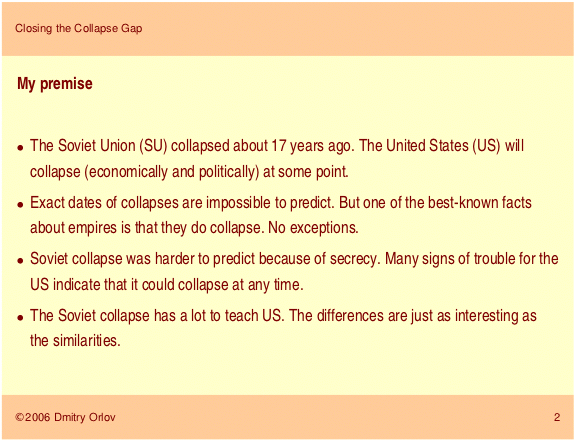
Slide [2] The subject of economic collapse is generally a sad one. But I am an optimistic, cheerful sort of person, and I believe that, with a bit of preparation, such events can be taken in stride. As you can probably surmise, I am actually rather keen on observing economic collapses. Perhaps when I am really old, all collapses will start looking the same to me, but I am not at that point yet.

And this next one certainly has me intrigued. From what I’ve seen and read, it seems that there is a fair chance that the U.S. economy will collapse sometime within the foreseeable future. It also would seem that we won’t be particularly well-prepared for it. As things stand, the U.S. economy is poised to perform something like a disappearing act. And so I am eager to put my observations of the Soviet collapse to good use.


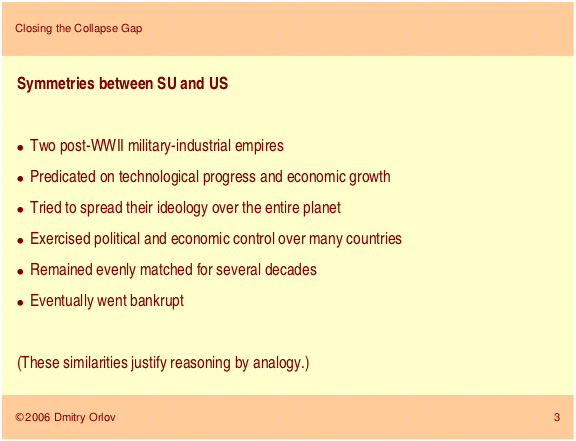
Slide [3] I anticipate that some people will react rather badly to having their country compared to the USSR. I would like to assure you that the Soviet people would have reacted similarly, had the United States collapsed first. Feelings aside, here are two 20th century superpowers, who wanted more or less the same things – things like technological progress, economic growth, full employment, and world domination – but they disagreed about the methods. And they obtained similar results – each had a good run, intimidated the whole planet, and kept the other scared. Each eventually went bankrupt.


Slide [4] The USA and the USSR were evenly matched in many categories, but let me just mention four.

The Soviet manned space program is alive and well under Russian management, and now offers first-ever space charters. The Americans have been hitching rides on the Soyuz while their remaining spaceships sit in the shop.

The arms race has not produced a clear winner, and that is excellent news, because Mutual Assured Destruction remains in effect. Russia still has more nuclear warheads than the US, and has supersonic cruise missile technology that can penetrate any missile shield, especially a nonexistent one.

The Jails Race once showed the Soviets with a decisive lead, thanks to their innovative GULAG program. But they gradually fell behind, and in the end the Jails Race has been won by the Americans, with the highest percentage of people in jail ever.

The Hated Evil Empire Race is also finally being won by the Americans. It’s easy now that they don’t have anyone to compete against.


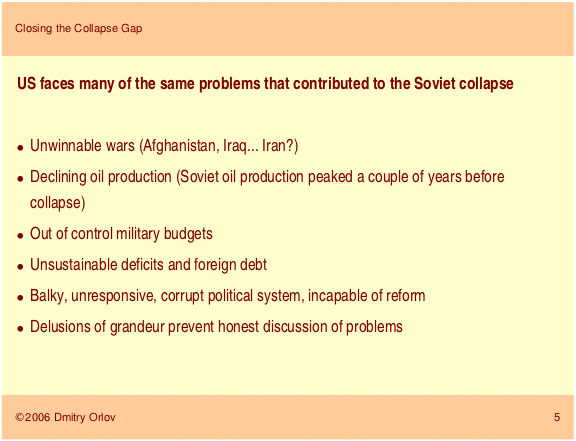
Slide [5] Continuing with our list of superpower similarities, many of the problems that sunk the Soviet Union are now endangering the United States as well. Such as a huge, well-equipped, very expensive military, with no clear mission, bogged down in fighting Muslim insurgents. Such as energy shortfalls linked to peaking oil production. Such as a persistently unfavorable trade balance, resulting in runaway foreign debt. Add to that a delusional self-image, an inflexible ideology, and an unresponsive political system.


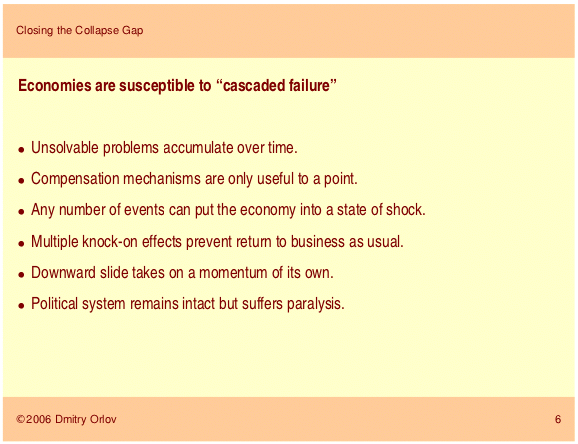
Slide [6] An economic collapse is amazing to observe, and very interesting if described accurately and in detail. A general description tends to fall short of the mark, but let me try. An economic arrangement can continue for quite some time after it becomes untenable, through sheer inertia. But at some point a tide of broken promises and invalidated assumptions sweeps it all out to sea. One such untenable arrangement rests on the notion that it is possible to perpetually borrow more and more money from abroad, to pay for more and more energy imports, while the price of these imports continues to double every few years. Free money with which to buy energy equals free energy, and free energy does not occur in nature. This must therefore be a transient condition. When the flow of energy snaps back toward equilibrium, much of the US economy will be forced to shut down.


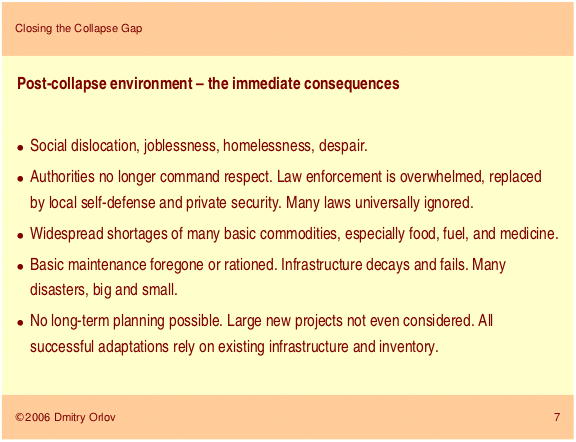
Slide [7] I’ve described what happened to Russia in some detail in one of my articles, which is available on SurvivingPeakOil.com. I don’t see why what happens to the United States should be entirely dissimilar, at least in general terms. The specifics will be different, and we will get to them in a moment. We should certainly expect shortages of fuel, food, medicine, and countless consumer items, outages of electricity, gas, and water, breakdowns in transportation systems and other infrastructure, hyperinflation, widespread shutdowns and mass layoffs, along with a lot of despair, confusion, violence, and lawlessness. We definitely should not expect any grand rescue plans, innovative technology programs, or miracles of social cohesion.


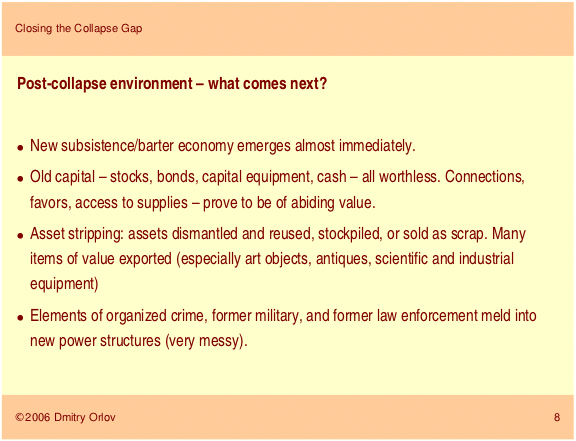
Slide [8] When faced with such developments, some people are quick to realize what it is they have to do to survive, and start doing these things, generally without anyone’s permission. A sort of economy emerges, completely informal, and often semi-criminal. It revolves around liquidating, and recycling, the remains of the old economy. It is based on direct access to resources, and the threat of force, rather than ownership or legal authority. People who have a problem with this way of doing things, quickly find themselves out of the game.

These are the generalities. Now let’s look at some specifics.


Slide [9] One important element of collapse-preparedness is making sure that you don’t need a functioning economy to keep a roof over your head. In the Soviet Union, all housing belonged to the government, which made it available directly to the people. Since all housing was also built by the government, it was only built in places that the government could service using public transportation. After the collapse, almost everyone managed to keep their place.

In the United States, very few people own their place of residence free and clear, and even they need an income to pay real estate taxes. People without an income face homelessness. When the economy collapses, very few people will continue to have an income, so homelessness will become rampant. Add to that the car-dependent nature of most suburbs, and what you will get is mass migrations of homeless people toward city centers.


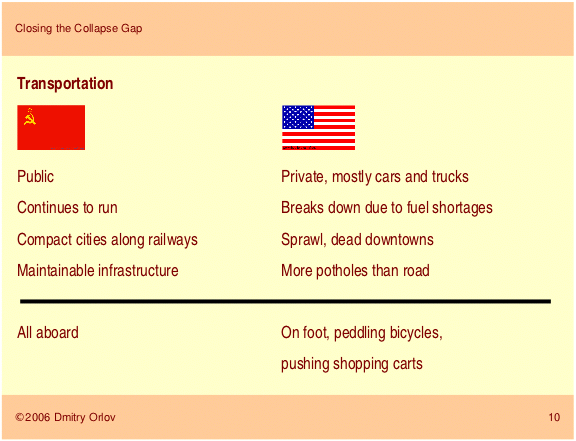
Slide [10] Soviet public transportation was more or less all there was, but there was plenty of it. There were also a few private cars, but so few that gasoline rationing and shortages were mostly inconsequential. All of this public infrastructure was designed to be almost infinitely maintainable, and continued to run even as the rest of the economy collapsed.

The population of the United States is almost entirely car-dependent, and relies on markets that control oil import, refining, and distribution. They also rely on continuous public investment in road construction and repair. The cars themselves require a steady stream of imported parts, and are not designed to last very long. When these intricately interconnected systems stop functioning, much of the population will find itself stranded.


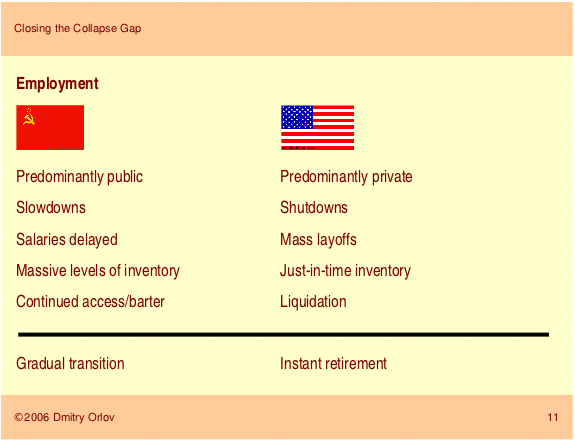
Slide [11] Economic collapse affects public sector employment almost as much as private sector employment, eventually. Because government bureaucracies tend to be slow to act, they collapse more slowly. Also, because state-owned enterprises tend to be inefficient, and stockpile inventory, there is plenty of it left over, for the employees to take home, and use in barter. Most Soviet employment was in the public sector, and this gave people some time to think of what to do next.

Private enterprises tend to be much more efficient at many things. Such laying off their people, shutting their doors, and liquidating their assets. Since most employment in the United States is in the private sector, we should expect the transition to permanent unemployment to be quite abrupt for most people.


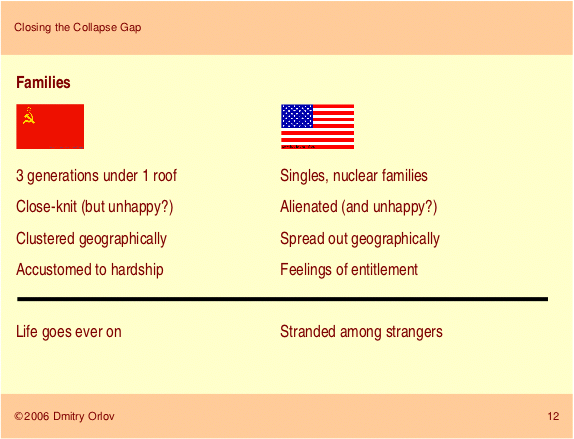
Slide [12] When confronting hardship, people usually fall back on their families for support. The Soviet Union experienced chronic housing shortages, which often resulted in three generations living together under one roof. This didn’t make them happy, but at least they were used to each other. The usual expectation was that they would stick it out together, come what may.

In the United States, families tend to be atomized, spread out over several states. They sometimes have trouble tolerating each other when they come together for Thanksgiving, or Christmas, even during the best of times. They might find it difficult to get along, in bad times. There is already too much loneliness in this country, and I doubt that economic collapse will cure it.


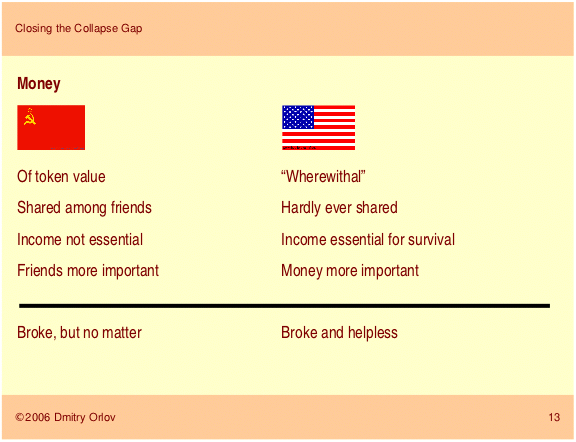
Slide [13] To keep evil at bay, Americans require money. In an economic collapse, there is usually hyperinflation, which wipes out savings. There is also rampant unemployment, which wipes out incomes. The result is a population that is largely penniless.

In the Soviet Union, very little could be obtained for money. It was treated as tokens rather than as wealth, and was shared among friends. Many things – housing and transportation among them – were either free or almost free.


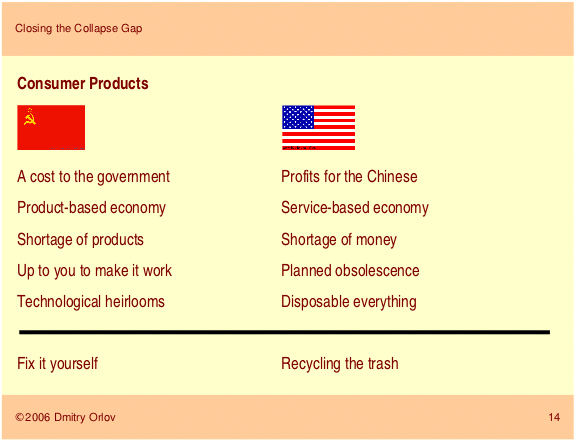
Slide [14] Soviet consumer products were always an object of derision – refrigerators that kept the house warm – and the food, and so on. You’d be lucky if you got one at all, and it would be up to you to make it work once you got it home. But once you got it to work, it would become a priceless family heirloom, handed down from generation to generation, sturdy, and almost infinitely maintainable.

In the United States, you often hear that something “is not worth fixing.” This is enough to make a Russian see red. I once heard of an elderly Russian who became irate when a hardware store in Boston wouldn’t sell him replacement bedsprings: “People are throwing away perfectly good mattresses, how am I supposed to fix them?”

Economic collapse tends to shut down both local production and imports, and so it is vitally important that anything you own wears out slowly, and that you can fix it yourself if it breaks. Soviet-made stuff generally wore incredibly hard. The Chinese-made stuff you can get around here – much less so.


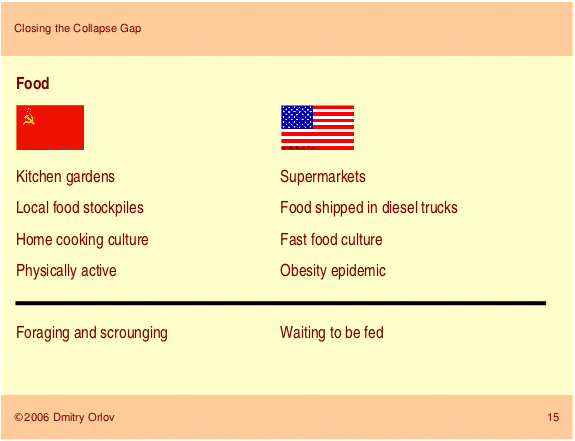
Slide [15] The Soviet agricultural sector was notoriously inefficient. Many people grew and gathered their own food even in relatively prosperous times. There were food warehouses in every city, stocked according to a government allocation scheme. There were very few restaurants, and most families cooked and ate at home. Shopping was rather labor-intensive, and involved carrying heavy loads. Sometimes it resembled hunting – stalking that elusive piece of meat lurking behind some store counter. So the people were well-prepared for what came next.

In the United States, most people get their food from a supermarket, which is supplied from far away using refrigerated diesel trucks. Many people don’t even bother to shop and just eat fast food. When people do cook, they rarely cook from scratch. This is all very unhealthy, and the effect on the nation’s girth, is visible, clear across the parking lot. A lot of the people, who just waddle to and from their cars, seem unprepared for what comes next. If they suddenly had to start living like the Russians, they would blow out their knees.


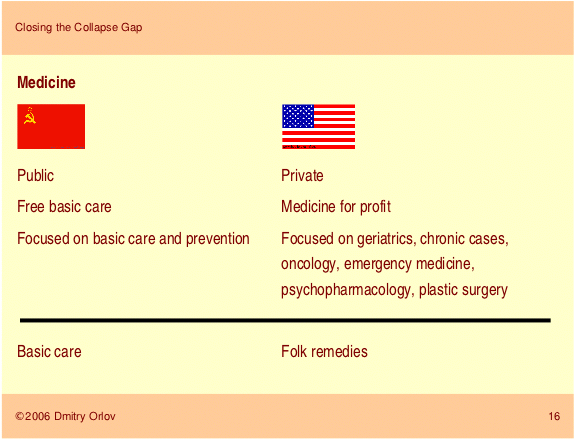
Slide [16] The Soviet government threw resources at immunization programs, infectious disease control, and basic care. It directly operated a system of state-owned clinics, hospitals, and sanatoriums. People with fatal ailments or chronic conditions often had reason to complain, and had to pay for private care – if they had the money.

In the United States, medicine is for profit. People seems to think nothing of this fact. There are really very few fields of endeavor to which Americans would deny the profit motive. The problem is, once the economy is removed, so is the profit, along with the services it once helped to motivate.


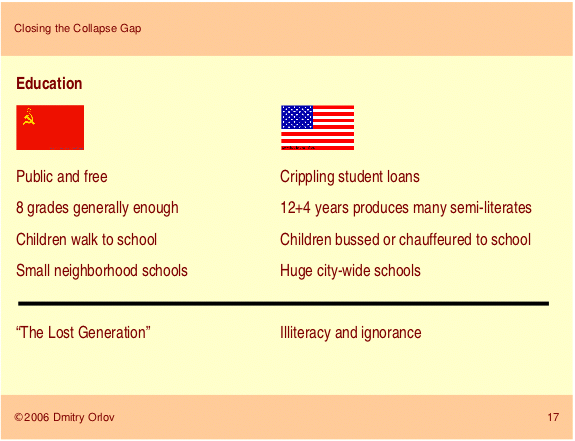
Slide [17] The Soviet education system was generally quite excellent. It produced an overwhelmingly literate population and many great specialists. The education was free at all levels, but higher education sometimes paid a stipend, and often provided room and board. The educational system held together quite well after the economy collapsed. The problem was that the graduates had no jobs to look forward to upon graduation. Many of them lost their way.

The higher education system in the United States is good at many things – government and industrial research, team sports, vocational training… Primary and secondary education fails to achieve in 12 years what Soviet schools generally achieved in 8. The massive scale and expense of maintaining these institutions is likely to prove too much for the post-collapse environment. Illiteracy is already a problem in the United States, and we should expect it to get a lot worse.


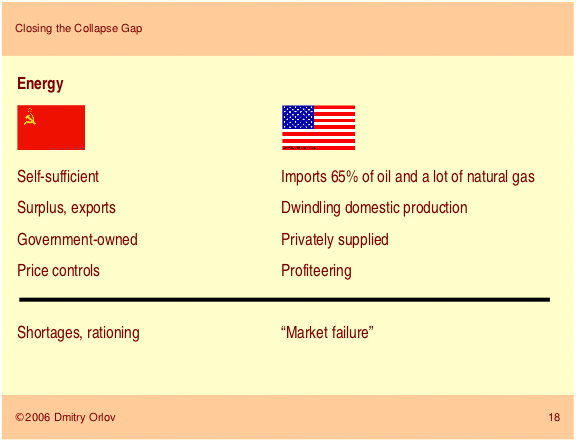
Slide [18] The Soviet Union did not need to import energy. The production and distribution system faltered, but never collapsed. Price controls kept the lights on even as hyperinflation raged.

The term “market failure” seems to fit the energy situation in the United States. Free markets develop some pernicious characteristics when there are shortages of key commodities. During World War II, the United States government understood this, and successfully rationed many things, from gasoline to bicycle parts. But that was a long time ago. Since then, the inviolability of free markets has become an article of faith.


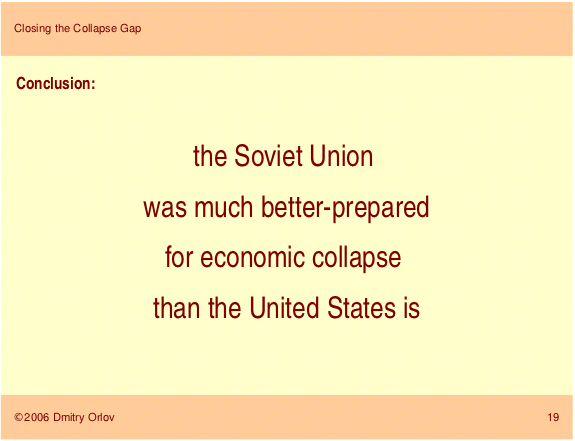
Slide [19] My conclusion is that the Soviet Union was much better-prepared for economic collapse than the United States is.

I have left out two important superpower asymmetries, because they don’t have anything to do with collapse-preparedness. Some countries are simply luckier than others. But I will mention them, for the sake of completeness.

In terms of racial and ethnic composition, the United States resembles Yugoslavia more than it resembles Russia, so we shouldn’t expect it to be as peaceful as Russia was, following the collapse. Ethnically mixed societies are fragile and have a tendency to explode.

In terms of religion, the Soviet Union was relatively free of apocalyptic doomsday cults. Very few people there wished for a planet-sized atomic fireball to herald the second coming of their savior. This was indeed a blessing.


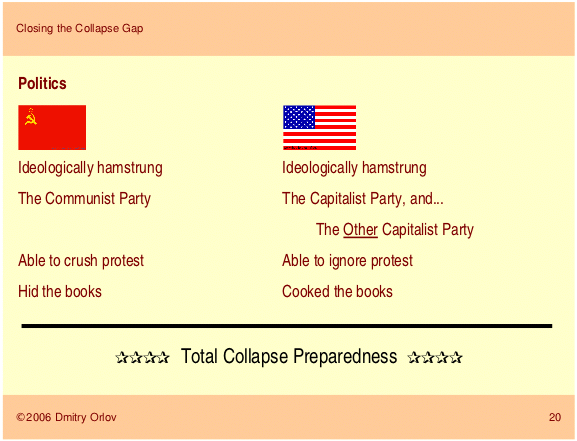
Slide [20] One area in which I cannot discern any Collapse Gap is national politics. The ideologies may be different, but the blind adherence to them couldn’t be more similar.

It is certainly more fun to watch two Capitalist parties go at each other than just having the one Communist party to vote for. The things they fight over in public are generally symbolic little tokens of social policy, chosen for ease of public posturing. The Communist party offered just one bitter pill. The two Capitalist parties offer a choice of two placebos. The latest innovation is the photo finish election, where each party buys 50% of the vote, and the result is pulled out of statistical noise, like a rabbit out of a hat.

The American way of dealing with dissent and with protest is certainly more advanced: why imprison dissidents when you can just let them shout into the wind to their heart’s content?

The American approach to bookkeeping is more subtle and nuanced than the Soviet. Why make a state secret of some statistic, when you can just distort it, in obscure ways? Here’s a simple example: inflation is “controlled” by substituting hamburger for steak, in order to minimize increases to Social Security payments.


Slide [21] Many people expend a lot of energy protesting against their irresponsible, unresponsive government. It seems like a terrible waste of time, considering how ineffectual their protests are. Is it enough of a consolation for them to be able to read about their efforts in the foreign press? I think that they would feel better if they tuned out the politicians, the way the politicians tune them out. It’s as easy as turning off the television set. If they try it, they will probably observe that nothing about their lives has changed, nothing at all, except maybe their mood has improved. They might also find that they have more time and energy to devote to more important things.


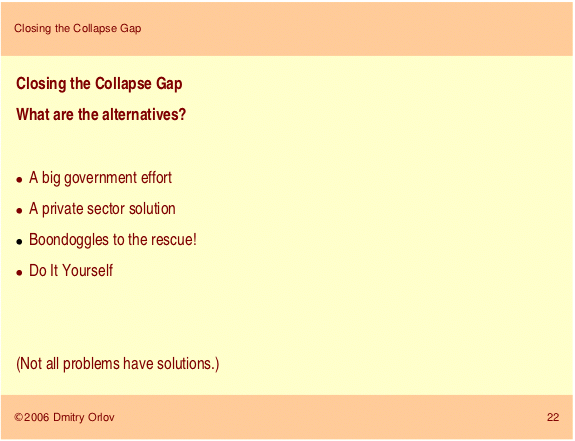
Slide [22] I will now sketch out some approaches, realistic and otherwise, to closing the Collapse Gap. My little list of approaches might seem a bit glib, but keep in mind that this is a very difficult problem. In fact, it’s important to keep in mind that not all problems have solutions. I can promise you that we will not solve this problem tonight. What I will try to do is to shed some light on it from several angles.


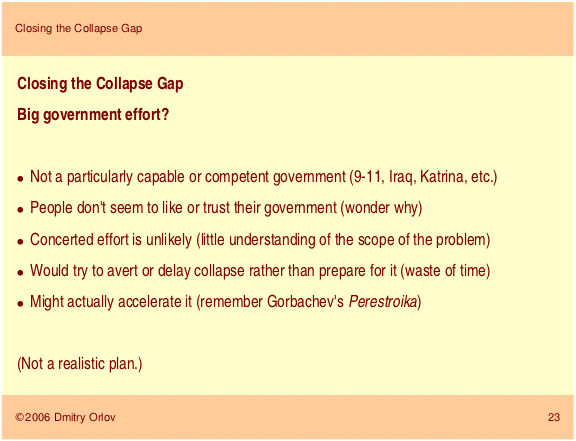
Slide [23] Many people rail against the unresponsiveness and irresponsibility of the government. They often say things like “What is needed is…” plus the name of some big, successful government project from the glorious past – the Marshall Plan, the Manhattan Project, the Apollo program. But there is nothing in the history books about a government preparing for collapse. Gorbachev’s “Perestroika” is an example of a government trying to avert or delay collapse. It probably helped speed it along.


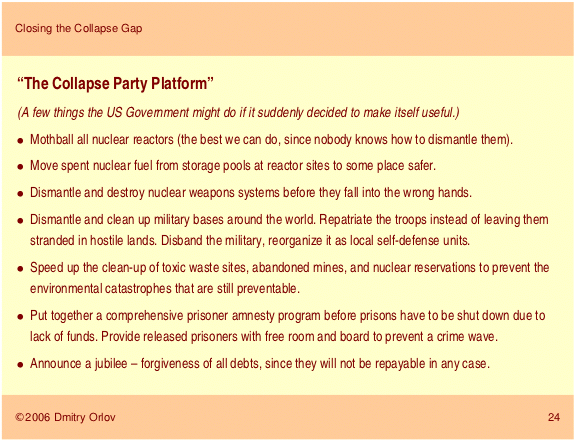
Slide [24] There are some things that I would like the government to take care of in preparation for collapse. I am particularly concerned about all the radioactive and toxic installations, stockpiles, and dumps. Future generations are unlikely to able to control them, especially if global warming puts them underwater. There is enough of this muck sitting around to kill off most of us. I am also worried about soldiers getting stranded overseas – abandoning one’s soldiers is among the most shameful things a country can do. Overseas military bases should be dismantled, and the troops repatriated. I’d like to see the huge prison population whittled away in a controlled manner, ahead of time, instead of in a chaotic general amnesty. Lastly, I think that this farce with debts that will never be repaid, has gone on long enough. Wiping the slate clean will give society time to readjust. So, you see, I am not asking for any miracles. Although, if any of these things do get done, I would consider it a miracle.


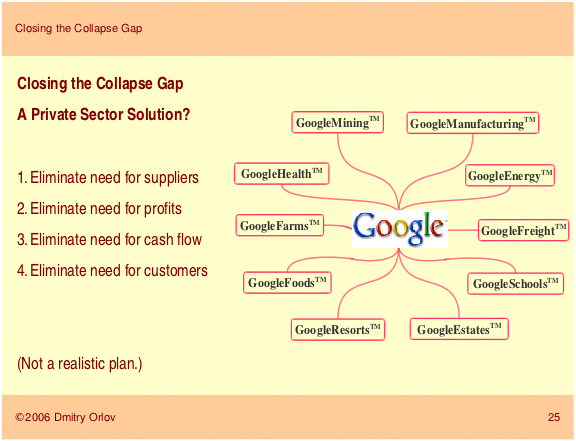
Slide [25] A private sector solution is not impossible; just very, very unlikely. Certain Soviet state enterprises were basically states within states. They controlled what amounted to an entire economic system, and could go on even without the larger economy. They kept to this arrangement even after they were privatized. They drove Western management consultants mad, with their endless kindergartens, retirement homes, laundries, and free clinics. These weren’t part of their core competency, you see. They needed to divest and to streamline their operations. The Western management gurus overlooked the most important thing: the core competency of these enterprises lay in their ability to survive economic collapse. Maybe the young geniuses at Google can wrap their heads around this one, but I doubt that their stockholders will.


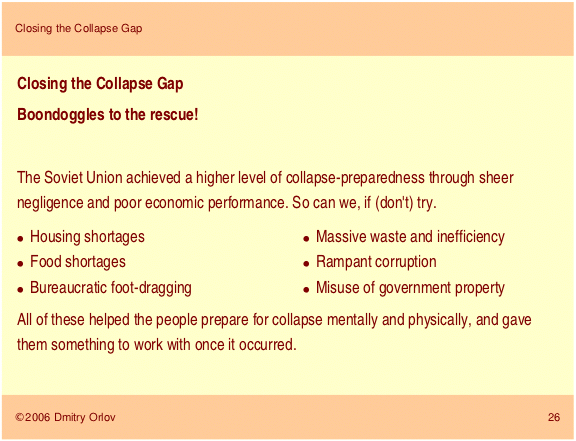
Slide [26] It’s important to understand that the Soviet Union achieved collapse-preparedness inadvertently, and not because of the success of some crash program. Economic collapse has a way of turning economic negatives into positives. The last thing we want is a perfectly functioning, growing, prosperous economy that suddenly collapses one day, and leaves everybody in the lurch. It is not necessary for us to embrace the tenets of command economy and central planning to match the Soviet lackluster performance in this area. We have our own methods, that are working almost as well. I call them “boondoggles.” They are solutions to problems that cause more problems than they solve.

Just look around you, and you will see boondoggles sprouting up everywhere, in every field of endeavor: we have military boondoggles like Iraq, financial boondoggles like the doomed retirement system, medical boondoggles like private health insurance, legal boondoggles like the intellectual property system. The combined weight of all these boondoggles is slowly but surely pushing us all down. If it pushes us down far enough, then economic collapse, when it arrives, will be like falling out of a ground floor window. We just have to help this process along, or at least not interfere with it. So if somebody comes to you and says “I want to make a boondoggle that runs on hydrogen” – by all means encourage him! It’s not as good as a boondoggle that burns money directly, but it’s a step in the right direction.


Slide [27] Certain types of mainstream economic behavior are not prudent on a personal level, and are also counterproductive to bridging the Collapse Gap. Any behavior that might result in continued economic growth and prosperity is counterproductive: the higher you jump, the harder you land. It is traumatic to go from having a big retirement fund to having no retirement fund because of a market crash. It is also traumatic to go from a high income to little or no income. If, on top of that, you have kept yourself incredibly busy, and suddenly have nothing to do, then you will really be in rough shape.

Economic collapse is about the worst possible time for someone to suffer a nervous breakdown, yet this is what often happens. The people who are most at risk psychologically are successful middle-aged men. When their career is suddenly over, their savings are gone, and their property worthless, much of their sense of self-worth is gone as well. They tend to drink themselves to death and commit suicide in disproportionate numbers. Since they tend to be the most experienced and capable people, this is a staggering loss to society.

If the economy, and your place within it, is really important to you, you will be really hurt when it goes away. You can cultivate an attitude of studied indifference, but it has to be more than just a conceit. You have to develop the lifestyle and the habits and the physical stamina to back it up. It takes a lot of creativity and effort to put together a fulfilling existence on the margins of society. After the collapse, these margins may turn out to be some of the best places to live.


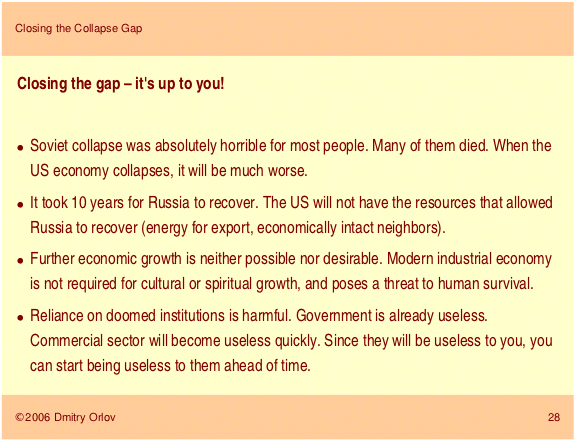
Slide [28] I hope that I didn’t make it sound as if the Soviet collapse was a walk in the park, because it was really quite awful in many ways. The point that I do want to stress is that when this economy collapses, it is bound to be much worse. Another point I would like to stress is that collapse here is likely to be permanent. The factors that allowed Russia and the other former Soviet republics to recover are not present here.

In spite of all this, I believe that in every age and circumstance, people can sometimes find not just a means and a reason to survive, but enlightenment, fulfillment, and freedom. If we can find them even after the economy collapses, then why not start looking for them now?

Sunday, May 13, 2018

Topic: Abrupt Climate Change

Abrupt climate change is here. Robert Hunziker, Counterpunch. Feb. 2, 2015.

Abrupt climate change. Q&A. Earth Institute at Columbia University.

Could abrupt climate change lead to human extinction within 10 years? Charlie Smith, straight.com. Feb. 11, 2017.


Abrupt climate change: past, present and future. Jim White, via youtube. Dec. 2014.


Scientific articles:

Abrupt Climate Change. Stefan Rahmstorf, Elsevier. 2009.
Introduction  
High-resolution paleoclimatic records from ice and sediment cores and other sources have revealed a number of dramatic climatic changes that occurred over surprisingly short times – a few decades or in some cases a few years. In Greenland, for example, temperature rose by 5–10 1C, snowfall rates doubled, and windblown dust decreased by an order of magnitude within 40 years at the end of the last glacial period. In the Sahara, an abrupt transition occurred around 5500 years ago from a relatively green shrubland supporting significant populations of animals and humans to the dry desert we know today. 
One could define an abrupt climate change simply as a large and rapid one – occurring faster than in a given time (say 30 years). The change from winter to summer, a very large change (in many places larger than the glacial–interglacial transition) occurring within 6 months, is, however, not an abrupt change in climate (or weather), it is rather a gradual transition following the solar forcing in its near-sinusoidal path. The term ‘abrupt’ implies not just rapidity but also reaching a breaking point, a threshold – it implies a change that does not smoothly follow the forcing but is rapid in comparison to it. This physical definition thus equates abrupt climate change with a strongly nonlinear response to the forcing. In this definition, the quaternary transitions from glacial to interglacial conditions and back, taking a few hundred or thousand years, are a prime example of abrupt climate change, as the underlying cause, the Earth’s orbital variations (Milankovich cycles), have timescales of tens of thousands of years. On the other hand, anthropogenic global warming occurring within a hundred years is not as such an abrupt climate change as long as it smoothly follows the increase in atmospheric carbon dioxide. Only if global warming triggered a nonlinear response, like a rapid ocean circulation change or decay of the West Antarctic Ice Sheet (WAIS), would one speak of an abrupt climate change.


Abrupt Climate Change. R.B. Alley et al, Science. March, 2003.

Abstract:
Large, abrupt, and widespread climate changes with major impacts have occurred repeatedly in the past, when the Earth system was forced across thresholds. Although abrupt climate changes can occur for many reasons, it is conceivable that human forcing of climate change is increasing the probability of large, abrupt events. Were such an event to recur, the economic and ecological impacts could be large and potentially serious. Unpredictability exhibited near climate thresholds in simple models shows that some uncertainty will always be associated with projections. In light of these uncertainties, policy-makers should consider expanding research into abrupt climate change, improving monitoring systems, and taking actions designed to enhance the adaptability and resilience of ecosystems and economies.


Rapid climate change: lessons from the recent geological past. Jonathan Holmes et al, Science Direct. Dec. 2011.
Abstract 
Rapid, or abrupt, climate change is regarded as a change in the climate system to a new state following the crossing of a threshold. It generally occurs at a rate exceeding that of the change in the underlying cause. Episodes of rapid climate change abound in the recent geological past (defined here as the interval between the last glacial maximum, dated to approximately 20,000 years ago, and the present). Rapid climate changes are known to have occurred over time periods equal to or even less than a human lifespan: moreover, their effects on the global system are sufficiently large to have had significant societal impacts. The potential for similar events to occur in the future provides an important impetus for investigating the nature and causes of rapid climate change. 


Holocene climate variability. Paul A.Mayewski et al, ScienceDirect. Nov. 2004.
Although the dramatic climate disruptions of the last glacial period have received considerable attention, relatively little has been directed toward climate variability in the Holocene (11,500 cal yr B.P. to the present). Examination of ∼50 globally distributed paleoclimate records reveals as many as six periods of significant rapid climate change during the time periods 9000–8000, 6000–5000, 4200–3800, 3500–2500, 1200–1000, and 600–150 cal yr B.P. Most of the climate change events in these globally distributed records are characterized by polar cooling, tropical aridity, and major atmospheric circulation changes, although in the most recent interval (600–150 cal yr B.P.), polar cooling was accompanied by increased moisture in some parts of the tropics. Several intervals coincide with major disruptions of civilization, illustrating the human significance of Holocene climate variability.


Policy tradeoffs under risk of abrupt climate change. Yacov Tsura and Amos Zemel, Journal of Economic Behaviour and Organization. Dec. 2016.
Highlights
  • Serious threats of climate change are associated with abrupt catastrophic events.
  • Mitigation efforts delay the event occurrence.
  • Adaptation efforts minimize the damage inflicted upon occurrence.
  • The role of climate policy is to balance between mitigation and adaptation efforts.
Abstract

By now it is widely recognized that the more serious threats of climate change are associated with abrupt events capable of inflicting losses on a catastrophic scale. Consequently, the main role of climate policies is to balance between mitigation efforts, aimed at delaying (or even preventing) the occurrence of such events, and adaptation actions, aimed at minimizing the damage inflicted upon occurrence. The former affects the accumulation of greenhouse gases in the atmosphere; the latter determines the impact of loss once the event occurs. This work examines the tradeoffs associated with these two types of policy measures by characterizing the optimal mitigation–adaptation mix in the long run.

Wednesday, May 9, 2018

War and Empire Links: A Sampler

So, you watch CNN or NBC and don't know what to think... about Syria, about Iran, about Yemen, about Russia.
Consider that you're not getting the full story from mainstream media.
In fact, that's all propaganda. It really is an Orwellian world.

And its been going on for a very long time... at least since Edward Bernays, circa 1928.

If you want to immunize yourself from the government-approved talking-points, you need to read non-mainstream media, which has been labelled by some as "fake news" but is actually the real journalism that is being done to try to counter the actual fake news we're inundated with all the time by the usual sources (Washington Post, ABC, BBC, etc.)


For starters, read anything and everything by


Caitlin Johnstone,
including:

https://medium.com/@caityjohnstone/how-you-can-be-absolutely-certain-that-mainstream-media-lies-about-everything-a5eec69a9264

https://caitlinjohnstone.com/2018/05/09/we-are-being-lied-to-about-yet-another-middle-eastern-country-by-yet-another-us-president/

https://caitlinjohnstone.com/2018/04/12/the-us-empire-has-been-trying-to-regime-change-syria-since-long-before-2011/

https://caitlinjohnstone.com/2018/04/10/when-a-government-declares-a-verdict-before-an-investigation-its-because-theres-a-preexisting-agenda/

https://caitlinjohnstone.com/2018/04/25/never-let-anyone-call-you-crazy-for-doubting-establishment-war-narratives/

https://caitlinjohnstone.com/2018/05/08/why-you-should-celebrate-loudly-and-unapologetically-when-john-mccain-dies/

https://caitlinjohnstone.com/2018/05/03/israel-is-trying-to-manufacture-support-for-iran-sanctions-to-effect-regime-change/


Chris Hedges

https://www.truthdig.com/articles/the-pandoras-box-of-war-3/

https://www.truthdig.com/articles/deadly-rule-oligarchs/

https://www.truthdig.com/articles/empty-piety-american-press/

https://www.alternet.org/news-amp-politics/donald-trump-tyranny


Eric Zeusse

https://www.strategic-culture.org/news/2018/04/30/how-facebook-etc.-suppress-key-truths.html

https://www.strategic-culture.org/news/2017/04/17/why-trusting-us-government-and-mainstream-media-makes-you-dupe.html


Dmitry Orlov

https://toolatefor2.blogspot.ca/2018/03/the-incomparable-dmitry-orlov.html

https://toolatefor2.blogspot.ca/2017/11/dmitry-orlov-explains-world-like-few.html

https://cluborlov.blogspot.ca/2018/04/the-importance-of-looking-dangerous.html


Pepe Escobar

http://www.atimes.com/article/syria-iran-chaos-international-relations/


William Engdahl

http://thesaker.is/the-rape-of-russia-saker-blog-exclusive-interview/


William Blum

https://williamblum.org/aer/read/140

https://williamblum.org/aer/read/156


Stephen Cohen

https://www.thenation.com/article/russiagate-is-revealing-alarming-truths-about-americas-political-media-elites/


James Howard Kunstler

http://kunstler.com/clusterfuck-nation/state-of-failure/


Howard Zinn

http://www.tomdispatch.com/blog/176052/best_of_tomdispatch%3A_howard_zinn%2C_the_end_of_empire


John Bellamy Foster


Andrew Bacevich


Tom Englehardt


Chalmers Johnson


Jeremy Scahill


Laurie Calhoun


Other Sites:

Sic Semper Tyrannis

http://turcopolier.typepad.com/sic_semper_tyrannis/2017/10/america-desperately-seeking-an-enemy-by-publius-tacitus.html#more


Vineyard of the Saker

http://thesaker.is/when-sanity-fails-the-mindset-of-the-ideological-drone/#f1

http://thesaker.is/the-warmakers/


Moon of Alabama

http://www.moonofalabama.org/2017/11/yemen-having-lost-the-war-saudis-try-genocide-.html#more

http://www.moonofalabama.org/2013/09/a-short-history-of-the-war-on-syria-2006-2014.html

http://www.moonofalabama.org/2018/05/trump-ends-the-nuclear-deal-with-iran-whats-next.html


Other random links, for further background

https://toolatefor2.blogspot.ca/2018/04/war-and-empire-links-april-2018.html

https://www.corbettreport.com/episode-325-the-information-industrial-complex/

https://consortiumnews.com/2018/04/27/weapons-inspector-refutes-u-s-syria-chemical-claims/

https://www.mintpressnews.com/state-of-fear-how-historys-deadliest-bombing-campaign-created-todays-crisis-in-korea/235349/

http://lobelog.com/killing-more-innocents-than-we-admit/

http://nationalinterest.org/blog/the-skeptics/libya-the-forgotten-reason-north-korea-desperately-wants-23129?page=show

https://sites.evergreen.edu/zoltan/interventions/

https://www.nakedcapitalism.com/2017/11/war-making-age-imperial-presidency-war-without-war-powers-not-new-american-way.html

https://www.nakedcapitalism.com/2018/04/middle-east-nightmare-made-washington.html

https://www.strategic-culture.org/news/2017/05/07/war-and-empire-american-way-life.html

https://www.strategic-culture.org/news/2017/04/22/ukraine-korea-syria-iran-falsifying-history-uncle-sam-way-war.html

https://israelpalestinenews.org/oil-for-israel-the-truth-about-the-iraq-war-15-years-later/

Tuesday, May 8, 2018

War and Empire Links: May 2018

Had Enough, Yet? Guy McPherson, Weekly Hubris. Apr. 28, 2018.

Fascism has come to the industrialized world, and the evidence is particularly clear in the United States.

As I wrote in my 2005 book, Killing the Natives: Has the American Dream Become a Nightmare? , regarding the executive branch of the US government:

“[The administration] is characterized by powerful and continuing expressions of nationalism, identification of enemies as a unifying cause, obsession with militaristic national security and military supremacy, interlinking of religion and the ruling elite, obsession with crime and punishment, disdain for the importance of human rights and intellectuals who support them, cronyism, corruption, sexism, protection of corporate power, suppression of labor, control over mass media, and fraudulent elections. These are the defining elements of fascism.”

The situation has progressed, and not in a suitable manner from the perspective of the typical self-proclaimed progressive. Along with fascism, we’re now firmly ensconced in a totalitarian, surveillance-obsessed police state. The United States has been in this condition for many years and the situation grows worse every year, but most people prefer to look away and then claim ignorance while politicians proclaim our exceptionalism as they secure our privileges with extreme violence.

As long as you’re not in jail (yet) or declared a terrorist (yet) and subsequently killed outright (yet), you’re unlikely to bring attention to yourself, regardless of what you know and feel about the morality of the people running/ruining the show.

But why? Is fear such a great motivator that we allow the complete destruction of the living planet to give ourselves a few more years to enable and further that destruction? Is the grip of culture so strong that we cannot break free in defense of the planet we call home? Have we moved so far away from the notion of resistance that we can’t organize a potluck dinner without seeking permission from the Department of Homeland Security?

I know many parents who claim they can’t take action because they want a better world for their children. Their version of a “better world” is my version of a worse world, as they long for growth of the industrial economy at the expense of clean air, clean water, healthy food, the living planet, runaway greenhouse, and human-population overshoot.

I’ve come to call this response “the parent trap.” Trapped by the culture of make believe, these parents cannot bring themselves to imagine a different world. A better world. A world without the boot of the police state on the necks of their children. A world with fewer carnivores every year, instead of more. A world with less pollution, less garbage, and less lying—to ourselves and others— each and every year.

All evidence indicates we prefer Fukushima forever, if it means we can have electric toys. We prefer near-term extinction by climate chaos, if it means we can cool the house to 68 F in the summer. We prefer genocide, if it comes with a milkshake and an order of fries.

Henry Ford was wrong when he pointed out, “It is well enough that people of the nation do not understand our banking and monetary system, for if they did, I believe there would be a revolution before tomorrow morning.”

On the other hand, General Omar Bradley’s sentiments from 1948 ring true: 
“The world has achieved brilliance without conscience. Ours is a world of nuclear giants and ethical infants. We know more about war than we know about peace, more about killing than we know about living. If we continue to develop our technology without wisdom or prudence, our servant may prove to be our executioner.”

We clearly don’t care about the environmental consequences of our greed, at least collectively. So, we keep soldiering on, wishing for a miracle and ignoring the evidence of imperial decline, human-population overshoot, runaway climate change, and a profound extinction crisis.

Ultimately, and sadly, I suspect it comes down to this: When all is said and done, a lot more is said than done. We simply can’t be bothered to contemplate a single issue of importance when the television calls or the shopping mall beckons.

Political “activists” spend hours every day elaborating the many insignificant differences between the two dominant political parties in the United States, but they cannot bring themselves to throw a wrench into the gears of industry. They continue to ignore the prescient words of Archbishop Desmond Tutu long after the consequences of inaction are obvious: “If you are neutral in situations of injustice, you have chosen the side of the oppressor.”

We’re clearly unwilling to begin the process of safely shutting down the nuclear reactors that are poised to kill us. Instead, we steadily increase the number of these uber-expensive sources of electricity, which means means shoving more ammunition into the Gatling gun pointed at our heads. One bullet does the trick. In classic American style, we prefer more. Always more.

How much of this is too much? When have you had enough?

Monday, April 30, 2018

War and Empire Links: April 2018

The League of Assad-Loving Conspiracy Theorists. CJ Hopkins, CounterPunch. Apr. 26, 2018.

So the global capitalist ruling classes’ War on Dissent is now in full swing. With their new and improved official narrative, “Democracy versus the Putin-Nazis,” successfully implanted in the public consciousness, the corporatocracy have been focusing their efforts on delegitimizing any and all forms of deviation from their utterly absurd and increasingly paranoid version of reality
The Democratic Party is suing Russia, the Trump campaign, and Wikileaks (seriously … they’ve filed an actual lawsuit in an actual court of law an everything) for launching “an all-out assault on democracy” by publishing the DNC’s emails, “an act of unprecedented treachery,” according to Party Chairman Tom Perez. Wikileaks founder Julian Assange, having already spent the last six years in a room in the Ecuadorian embassy in London to avoid being arrested by the British authorities, extradited to the United States, and imprisoned for the remainder of his natural life, has been cut off from the outside world in order to prevent him from further “interfering” with democracy by expressing his opinions. 
In Syria, where the “international community” has been battling the “global terrorist threat” by supporting moderate jihadist militias intent on overthrowing the government and establishing a fundamentalist theocracy, the corporate media have been hard at work sanctifying the official story of the “chemical weapons attack” in Douma. According to this story, Bashar al-Assad, an uncooperative brutal dictator whom the corporatocracy has been trying to replace with a more cooperative brutal dictator, dropped a lot of chlorine gas bombs (and possibly sarin, the deadly nerve agent), onto a house full of innocent babies. He did this on the eve of victory over those moderate jihadist militias the “international community” has been supporting in their eight-year attempt to take over his country, slaughter him and his entire family, mount their severed heads on spikes, implement nationwide Sharia law, and then go out hunting homosexuals and heretics to gruesomely behead on YouTube. The evacuation of these freedom fighters was already being negotiated, but Assad didn’t want to miss his last chance to sadistically gas a lot of women and children and have the Western corporate media broadcast his war crimes throughout the world, or something more or less along those lines. 
This gratuitous baby-gassing massacre could not be allowed to go unpunished, so Emmanuel Macron and other senior members of the “international community” hauled Trump in off a golf course somewhere (or wrestled him away from the Gorilla Channel) and ordered him to order a completely pointless one hundred fifty million dollar series of “retaliatory” missile strikes on assorted uninhabited buildings containing zero chemical weapons and of absolutely no strategic value. The corporate media and their paid menagerie of military experts and other talking heads took to the airwaves to celebrate this demonstration of international “resolve,” as did investors in Raytheon, Lockheed Martin, and General Dynamics. 
The celebrations were short-lived, however, as the corporate media needed to immediately turn their attention to aggressively countering the malicious disinformation campaign being waged by the infamous International Putin-Nazi Propaganda Network (i.e., anyone capable of critical thinking). Reports by journalists actually in Syria, like Robert Fisk of The Independent, casting doubt on the official story needed to be strenuously ignored, ridiculed, and delegitimized. Fisk, a respected, award-winning journalist who has covered the Middle East for over four decades, had clearly been duped by his Putin-Nazi minders into publishing pro-Assad propaganda. Just as clearly, any actual Syrians contradicting the official story (which the corporate media had scrupulously fact-checked with the US military and intelligence agencies) had been intimidated into doing so by Putin-Nazi-Assadist death squads. 
But Fisk and the Syrians are small potatoes compared to the discord-sowing threat posed by the International League of Assad-Loving Twitter Conspiracy Theorists, a decentralized network of “anti-Western,” “pro-Assad,” extremist traitors led by people like Sarah Abdallah, a shadowy figure whose current whereabouts the BBC is still trying to pinpoint (and presumably report to MI6), and Vanessa Beeley, an independent journalist who writes about Syria for an “extreme right” website, speaks to “fringe groups,” and has appeared on RT, which the BBC is at pains to remind us is a “state-owned” media organization. 
This nefarious network of dissension-sowers is also responsible for the “4000 percent increase” in Putin-Nazi propaganda in the wake of the Poisoned Porridge Attack that “Russia” carried out in Salisbury in March, in which operatives allegedly smeared the doorknob of a former Russian intelligence officer and his daughter with oatmeal laced with Novichok, “the deadliest nerve agent ever devised,” instead of, well, you know, just shooting the guy, or throwing him out of an upper-floor window. Despite the potency of this lethal nerve agent, which, for some reason, “can only be made in Russia,” both victims are expected to completely recover. Tragically, their cat and guinea pigs, having also managed to survive the attack, were slowly starved to death by the police, presumably out of an abundance of caution. 
In any event, according to the diligent, authoritative investigative journalists at The Guardian, following this brazen porridge attack, “automated bots” “based in Russia,” like @Partisangirl and @Ian56789, spread Putin-Nazi disinformation to millions of unknowing Twitter users in an attempt to “undermine the international system” (whatever that’s supposed to mean). As it turns out, @Partisangirl is just a human being and not a robot at all, and @Ian56789 is just a feisty British pensioner who is tired of being routinely lied to by the government and the corporate media … unless, of course, he’s a sleeper agent just posing as a feisty pensioner, which he hasn’t been able to conclusively disprove to the satisfaction of the corporate media. (Watch Ian being interrogated by a Sky News Russian Bot-Hunting Team and judge his loyalties for yourself!) 
These are just a few examples of how the global capitalist ruling classes and their mouthpieces in the corporate media have been generating an atmosphere of mindless hysteria and paranoia in the service of drawing “a line in the sand” between neoliberalism (i.e., global capitalism) and any and all forms of dissent therefrom. They’ve been at this, relentlessly, for almost two years now, since they recognized they were being confronted with a bona fide widespread “populist” insurgency against the hegemony of global capitalism, not just in the Greater Middle East, but right in the heart of the Western empire. 
I’ve been writing about this since 2016, so I’m not going to try to rehash all that here. The short version is, Western societies are being divided into two opposing camps … two extremely broad ideological camps, both of which encompass the traditional political division into left and right. Let’s call camp number one “the Normals” (i.e., those who support and conform to the values and ideology of global capitalism, regardless of whether they identify as conservatives, liberals, neoliberals, neoconservatives, or anything else). Let’s call camp number two “the Extremists” (i.e., those opposing global capitalism, or not conforming to its ideology, regardless of whether they identify as socialists, communists, anarchists, fascists, anti-fascists, jihadists, or whatever). 
While, of course, real political conflict still takes place within each of these two broad camps, the global capitalist ruling classes are less concerned with the “left/right” equation than they are with “Normal/Extremist” equation. This is the battle they are fighting currently. Short some sort of miraculous event, it is a battle they are going to win. They are going to win it by demonizing anyone opposing global capitalism as one or another form of “extremist” … an Islamic terrorist, an Antifa terrorist, a white supremacist, a Black identity extremist, an anti-Semite, a conspiracy theorist, an Assad apologist, a Russian bot, a Putin-Nazi propagandist … or whatever. It doesn’t really matter which labels they use. The point is, anyone not conforming to the global capitalist version of reality is an enemy of all that is normal and good. 
In an atmosphere of mass hysteria and paranoia (like the one we’re living in at the moment), the authorities’ narratives do not have to make sense, or stand up to any type of real scrutiny. Their primary purpose is not to deceive, but rather, to demarcate an ideological territory of acceptable belief, expression, and emotion to which “normal” people are expected to conform. Beyond the boundaries of that territory lies the outer darkness of “abnormality” and “extremism,” which no “normal” person wants anything to do with. To avoid being cast into this outer darkness, people will conform to the most absurd and paranoid nonsense you can possibly imagine. The global capitalist ruling classes know this, which is why they don’t care if you disprove their narratives on Twitter or some “disreputable” website they’ve rendered virtually invisible anyway. They are not debating the facts or the truth … they are marking the boundaries of that “normal” territory, and herding frightened people into it. 
This article in Haaretz by Alexander Reid Ross, a lecturer at Portland State University who has been publishing (or attempting to publish) a series of rather paranoid pieces smearing people he disagrees with as neo-Strasserist sleeper agents, provides an extreme but clear example of what Western governments and the corporate media have been doing, albeit on a much subtler level. Read the piece through if you can possibly stand it. You will be told how people like Michael Savage, Rania Khalek, Alex Jones, Breitbart’s entire UK office, Cenk Ugyur, Max Blumenthal, Caitlin Johnstone, Glenn Greenwald, The Nation‘s Stephen F. Cohen, Tucker Carlson, Vanessa Beeley (again), various British fascists, Jeremy Corbyn, and that modern-day Rasputin, Lyndon LaRouche, are all parts of the insidious Putin-Nazi plot to … well, I’m not sure, exactly, but I’m pretty sure it has something to do with killing Jews and gassing babies. 
Would you like to be associated with people like that … Assad-loving, Putin-supporting Nazis? No? Then stop and think very carefully before sharing, “liking,” or commenting on this essay.


Weapons Inspector Refutes U.S. Syria Chemical Claims. Dennis Bernstein, Consortium News. Apr. 27, 2018.

Scott Ritter is arguably the most experienced American weapons inspector and in this interview with Dennis J. Bernstein he levels a frank assessment of U.S. government assertions about chemical weapons use.

In the 1980’s, Scott Ritter was a commissioned officer in the United States Marine Corps, specializing in intelligence. In 1987, Ritter was assigned to the On-Site Inspection Agency, which was put together to go into the Soviet Union and oversee the implementation of the Intermediate Nuclear Forces Treaty. This was the first time that on-site inspection had been used as part of a disarmament verification process.

Ritter was one of the ground-breakers in developing on-site inspection techniques and methodologies. With this unique experience behind him, Ritter was asked in 1991, at the end of the Gulf War, to join the United Nations Special Commission, which was tasked by the Security Council to oversee the disarmament of Iraq’s weapons of mass destruction. From 1991 to 1998, Ritter served as a chief weapons inspector and led a number of teams into Iraq.

According to Ritter, in the following Flashpoints Radio interview with Dennis Bernstein conducted on April 23rd, US, British and French claims that the Syrian Government used chemical weapons against civilians last month appear to be totally bogus. 


Dennis Bernstein: You have been speaking out recently about the use of chemical weapons in Syria. Could you outline your case? 

Scott Ritter: There are a lot of similarities between the Syrian case and the Iraqi case. Both countries possess weapons of mass destruction. Syria had a very large chemical weapons program. 

In 2013 there was an incident in a suburb of Damascus called Ghouta, the same suburb where the current controversy is taking place. The allegations were that the Syrian government used sarin nerve agent against the civilian population. The Syrian government denied that, but as a result of that incident the international community got together and compelled Syria into signing the Chemical Weapons Convention, declaring the totality of its chemical weapons holdings, and opening itself to be disarmed by inspections of the Organization for the Prohibition of Chemical Weapons. Russia was chosen to be the guarantor of Syria’s compliance. The bottom line is that Syria had the weapons but was verified by 2016 as being in 100% compliance. The totality of Syria’s chemical weapons program was eliminated. 

At the same time that this disarmament process was taking place, Syria was being engulfed in a civil war which has resulted in a humanitarian crisis. Over a half million people have died. It is a war that pits the Syrian government against a variety of anti-regime forces, many of which are Islamic in nature: the Islamic State, Al Nusra, Al Qaeda. Some of these Islamic factions have been in the vicinity of Ghouta since 2012. 

Earlier this year, the Syrian government initiated an offensive to liberate that area of these factions. It was very heavy fighting, thousands of civilians were killed, with massive aerial bombardment. Government forces were prevailing and by April 6 it looked as if the militants were preparing to surrender. 

Suddenly the allegations come out that there was this chemical weapons attack. It wasn’t a massive chemical weapons attack, it was dropping one or two so-called “barrel bombs,” improvised devices that contained chlorine gas canisters. According to the militants, between 40 and 70 people were killed and up to 500 people were made ill. The United States and other nations picked up on this, saying that this was proof positive that Syria has been lying about its chemical weapons program and that Russia has been behind Syria’s retention of chemical weapons. This is the case the US made to launch its missile strike [on April 14]. 

There are a lot of problems with this scenario. Again, why would the Syrian government, at the moment of victory, use a pinprick chemical attack with zero military value? It added nothing to the military campaign and invited the wrath of the West at a critical time, when the rebels were begging for Western intervention. 

Many, including the Russian government, believe that this was a staged event. There has been no hard evidence put forward by anyone that an attack took place. Shortly after allegations of the attack came out, the entire town of Douma was taken over by the Syrian Army while the rebels were evacuated. 

The places that were alleged to have been attacked were inspected by Russian chemical weapons specialists, who found zero trace of any chemicals weapons activity. The same inspectors who oversaw the disarmament of Syria were mobilized to return to Syria and do an investigation. They were supposed to start their work this past weekend [April 21-22]. They arrived in Damascus the day after the missile strikes occurred but they still haven’t been out to the sites. The United States, France and Great Britain have all admitted that the only evidence they have used to justify this attack were the photographs and videotapes sent to them by the rebel forces. 

I have great concern about the United States carrying out an attack on a sovereign nation based on no hard evidence. The longer we wait, the longer it takes to get inspectors onto the site, the more claims we are going to get that the Russians have sanitized it. I believe that the last thing the United States wanted was inspectors to get on-site and carry out a forensic investigation that would have found that a chemical attack did not in fact take place. 

DB: It is sort of like cleaning up a police crime scene before you check for evidence. 

SR: The United States didn’t actually bomb the site that was attacked. They bombed three other facilities. One was in the suburbs of Damascus, a major metropolitan area. The generals said that they believed there were quantities of nerve agent there. So, in a building in a densely populated area where we believe nerve agent is stored, what do we do? We blow it up! If there had in fact been nerve agent there, it would have resulted in hundreds or even thousands of deaths. That fact that nobody died is the clearest evidence yet that there was no nerve agent there. The United States is just winging it, making it up. 

One of the tragedies is that we can no longer trust our military, our intelligence services, our politicians. They will manufacture whatever narrative they need to justify an action that they deem to be politically expedient. 

DB: Isn’t it also the case that there were problems with the allegations concerning Syria using chemical weapons in 2013 and then again in 2015? I believe The New York Times had to retract their 2013 story. 

SR: They put out a story about thousands of people dying, claiming that it was definitely done by the Syrian government. It turned out later that the number of deaths was far lower and that the weapons systems used were probably in the possession of the rebels. It was a case of the rebels staging a chemical attack in order to get the world to intervene on their behalf

A similar scenario unfolded last year when the Syrian government dropped two or three bombs on a village and suddenly there were reports that there was sarin nerve agent and chlorine gas wafting through the village, killing scores of people. Videotapes were taken of dead and dying and suffering people which prompted Trump to intervene. Inspectors never went to the site. Instead they relied upon evidence collected by the rebels. 

As a weapons inspector, I can tell you that chain of custody of any samples that are to be used in the investigation is an absolute. You have to be at the site when it is collected, it has to be certified to be in your possession until the laboratory. Any break in the chain of custody makes that evidence useless for a legitimate investigation. So we have evidence collected by the rebels. They videotaped themselves carrying out the inspection, wearing training suits that would not have protected them at all from chemical weapons! Like almost everything having to do with these rebels, this was a staged event, an act of theater

DB: Who has been supporting this particular group of rebels? 

SR: On the one hand, we have the actual fighters, the Army of Islam, a Saudi-backed fundamentalist group who are extraordinarily brutal. Embedded within the fighters are a variety of Western-trained and Western-funded NGOs such as the White Helmets and the Syrian-American Medical Society. But their primary focus isn’t rescue, in the case of the White Helmets, or medical care in the case of the Syrian-American Medical Society, but rather anti-regime propaganda. Many of the reports that came out of Douma originated with these two NGO’s. 

DB: You mentioned “chain of custody.” That’s what was most ridiculous about sending in inspectors. The first thing you would want to do is establish chain of custody and nail down the crime scene. 

SR: I was a participant in the Gulf War and we spent the bulk of that war conducting a massive aerial campaign against Iraq. I was one of the people who helped come up with the target list that was used to attack. Each target had to have a purpose. 

Let’s look what happened in Syria [on April 14]. We bombed three targets, a research facility in Damascus and two bunker facilities in western Syria. It was claimed that all three targets were involved with a Syrian chemical weapons program. But the Syria weapons program was verified to be disarmed. So what chemical weapons program are we talking about? Then US officials said that one of these sites stored sarin nerve agent and chemical production equipment. That is a very specific statement. Now, if Syria was verified to be disarmed last year, with all this material eliminated, what are they talking about? What evidence do they have that any of this material exists? They just make it up.  


If I had been a member of that inspections team, I would have been able to tell you with 100% certainty what took place at that site. It wasn’t that long ago that the allegations took place, there are very good forensic techniques that can be applied. We would be able to reverse engineer that site and tell you exactly what happened when. Let’s say an inspection team had gone in and we found that there was sarin nerve agent. Now, the US government can say, there is not supposed to be any sarin nerve agent in Syria, therefore we can state that the Syrians have a covert sarin nerve agent capability. But still you don’t know where it is, so now you have to say we assess that it could be in this bunker.

We bombed empty buildings. We didn’t degrade Syria’s chemical weapons capability. They got rid of it. We were among the nations that certified that they had been disarmed. We just created this phantom threat out of nothing so that we could attack Syria and our president could be seen as being presidential, as being the commander in chief at a time when his credibility was being attacked on the home front. 

DB: Amazing. That helps clarify the situation. Of course, it also leaves us terrified because we are so far away from the truth. 

SR: As an American citizen who happens to be empowered with knowledge about how weapons inspections work, how decisions are made regarding war, I am disillusioned beyond belief. 

This isn’t the first time we have been lied to by the president. But we have been lied to by military officers who are supposed to be above that. Three top Marine Corps officers stood before the American people and told bald-faced lies about what was going on. We have been lied to by Congress, who are supposed to be the people’s representatives who provide a check against executive overreach. And we have been lied to by the corporate media, a bunch of paid mouthpieces who repeat what the government tells them without question.

So Donald Trump can say there are chemical weapons in Syria, the generals parrot his words, the Congress nods its head dumbly, and the mass media repeats it over and over again to the American public. 
DB: Are you worried that we might end up in a shooting war with Russia at this point? 

SR: A week ago I was very worried. If I am going to give kudos to Jim Mattis it will be because he took the desire of Trump and Bolton to create a major crisis with Russia over the allegations of Syrian chemical weapons use and was able to water that down into putting on a show for the American people. We warned the Russians in advance, there were no casualties, we blew up three empty buildings. We spent a quarter of a billion dollars of taxpayer money and we got to pat ourselves on the back and tell everybody how great we are. But we avoided a needless confrontation with the Russians and I am a lot calmer today about the potential of a shooting war with Russia than I was a week ago.


The UK Government's Skripal Conspiracy Theory (Or How To Hold A Mass Of Contradictory Thoughts In Your Head). Rob Slane, via ZeroHedge. Apr. 29, 2018.

The Official Narrative on the poisoning of Sergei and Yulia Skripal is a collection of illogical claims and assertions that cannot be made to fit together, that make no rational sense, and which would require us to hold a mass of contradictory thoughts in our head if we were to accept it. It is in short a conspiracy theory, and a particularly bad one at that

As I have pointed out before, I am not attempting to counter this conspiracy theory with one of my own. I make no claims to know what happened in the Skripal incident. I am merely stating that the story that the UK Government and media have so far asked the public to believe cannot be true, since it is full of discrepancies and claims that are impossible to reconcile with the known facts. 

They are, of course, welcome at any time to show how those contradictions and improbable assertions can be reconciled, but until such time as they advance a compelling and coherent explanation, rational and objective observers shall just have to assume that these contradictions exist for a reason – namely that the official narrative of what happened in the Skripal case is not in fact what really happened in the Skripal case. 

So what exactly are those contradictory elements and improbable assertions in the Official Narrative, which place it firmly in the territory of a Very Bad Conspiracy Theory? There are many, but below are 10 of the most obvious...


Yemen War Great For US Jobs: Watch CNN's Wolf Blitzer Proclaim Civilian Deaths Are Worth It. ZeroHedge. Apr. 28, 2018.

With the still largely ignored Saudi slaughter in Yemen now in its fourth year, RT's In The Now has resurrected a forgotten clip from a 2016 CNN interview with Senator Rand Paul, which is currently going viral.

In a piece of cable news history that rivals Madeleine Albright's infamous words during a 1996 60 Minutes appearance where she calmly and coldly proclaimed of 500,000 dead Iraqi children that "the price is worth it," CNN's Wolf Blitzer railed against Senator Paul's opposition to a proposed $1.1 billion US arms sale to Saudi Arabia by arguing that slaughter of Yemeni civilians was worth it so long as it benefits US jobs and defense contractors.

At the time of the 2016 CNN interview, Saudi Arabia with the help of its regional and Western allies — notably the U.S. and Britain — had been bombing Yemen for a year-and-a-half, and as the United Nations noted, the Saudi coalition had been responsible for the majority of the war's (at that point) 10,000 mostly civilian deaths.

At that time the war was still in its early phases, but now multiple years into the Saudi-led bombing campaign which began in March 2015, the U.N. reports at least "5,000 children dead or hurt and 400,000 malnourished."

And now as the death toll tragically stands at many tens of thousands, and with a subsequent U.N. report from 2017 documenting in detail "the killing and maiming of children" on a mass scale, Blitzer's words are even more revealing of the role that CNN and other major American networks play in enabling and excusing U.S. and allied partners' war crimes abroad.


"No Attacks, No Victims": Syria Chemical Attack Video Participants Speak At OPCW Briefing. ZeroHedge. Apr. 27, 2018.

the West is happy to bomb a sovereign nation based on nothing more than non-public "evidence" suspected to have been staged and provided by the White Helmets, but when actual residents of Douma show up to tell their side of it, they are condemned as an "obscene masquerade" and denied an opportunity to submit their testimony on the record. Sounds about right for the military industrial complex which if nothing else scored a few extra billion in procurement contracts thanks to the latest farcical attack on Syria.


The Corruption and Deceit of the FBI. Publius Tacitus, Sic Semper Tyrannis. Apr. 24, 2018.

Efrem Zimbalist Jr., where are you? You are needed. If you are at least 60 years old I am sure you remember the TV series, the F.B.I., which featured Zimbalist as FBI Agent Lewis Erskine. That show did more to promote the image of the FBI has a straight up, honorable institution then any other PR stunt. It came at a time when news was surfacing that the FBI had spied on Martin Luther King and other Americans. But those real world events did little to tarnish the FBI reputation, which had been carefully stage managed and burnished by Hoover and his successors. 

Well, those days are over. We now have the spectacle of Jim Comey and Andy McCabe. Their escapades are exposing a highly politicized FBI that was easily seduced into punishing political enemies and shading investigations in favor of politicians that embraced the FBI leadership. No blind justice with these cats. Their eyes were firmly fixed on identifying whether the potential target of an investigation was friend or foe. If you were a friend, you got a pass. If you were the enemy then prison rape was in your future. 

The last two weeks have produced very important documentary evidence of the problems with Comey and McCabe. While those two were in cahoots in sand bagging a legitimate investigation of Hillary Clinton and fabricating one against Donald Trump, the expression karma is a bitch appears to be coming true for both.


Scarier Than John Bolton? Think of Nikki Haley for President! Philip Giraldi, Unz Review. Apr. 24, 2018.

The greater problem right now is that Nikki Haley is America’s face to the international community, even more than the Secretary of State. She has used her bully pulpit to do just that, i.e. bully, and she is ugly America personified, having apparently decided that something called American Exceptionalism gives her license to say and do whatever she wants at the United Nations. In her mind, the United States can do what it wants globally because it has a God-given right to do so, a viewpoint that doesn’t go down well with many countries that believe that they have a legal and moral right to be left alone and remain exempt from America’s all too frequent military interventions.


A Special Relationship Born in Hell. Philip Giraldi, South Front. Apr. 3, 2018.

If you want to understand what the “special relationship” between Israel and the United States really means consider the fact that Israeli Army snipers shot dead seventeen unarmed and largely peaceful Gazan demonstrators on Good Friday without a squeak coming out of the White House or State Department. Some of the protesters were shot in the back while running away, while another 1,000 Palestinians were wounded, an estimated 750 by gunfire, the remainder injured by rubber bullets and tear gas.  

The offense committed by the Gazan protesters that has earned them a death sentence was coming too close to the Israeli containment fence that has turned the Gaza strip into the world’s largest outdoor prison. President Donald Trump’s chief Middle East negotiator David Greenblatt described the protest as “a hostile march on the Israel-Gaza border…inciting violence against Israel.” And Nikki Haley at the U.N. has also used the U.S. veto to block any independent inquiry into the violence, demonstrating once again that the White House team is little more than Israel’s echo chamber. America’s enabling of the brutal reality that is today’s Israel makes it fully complicit in the war crimes carried out against the helpless and hapless Palestinian people.  

So where was the outrage in the American media about the massacre of civilians? Characteristically, Israel portrays itself as somehow a victim and the U.S. media, when it bothers to report about dead Palestinians at all, picks up on that line. The Jewish State is portrayed as always endangered and struggling to survive even though it is the nuclear armed regional superpower that is only threatened because of its own criminal behavior. And even when it commits what are indisputable war crimes like the use of lethal force against an unarmed civilian population, the Jewish Lobby and its media accomplices are quick to take up the victimhood refrain.


The Media War On Truthful Reporting And Legitimate Opinions - A Documentary. Moon of Alabama. Apr. 21, 2018.

Early in life I have noticed that no event is ever correctly reported in a newspaper, but in Spain, for the first time, I saw newspaper reports which did not bear any relation to the facts, not even the relationship which is implied in an ordinary lie. I saw great battles reported where there had been no fighting, and complete silence where hundreds of men had been killed. I saw troops who had fought bravely denounced as cowards and traitors, and others who had never seen a shot fired hailed as the heroes of imaginary victories; and I saw newspapers in London retailing these lies and eager intellectuals building emotional superstructures over events that had never happened. I saw, in fact, history being written not in terms of what happened but of what ought to have happened according to various ‘party lines’.
George Orwell, Looking back on the Spanish War, Chapter 4


Syria - Pentagon Hides Attack Failure - 70+ Cruise Missiles Shot Down. Moon of Alabama. Apr. 16, 2018.


Will America accept its defeat or will it challenge the Russian Bear and the Chinese Dragon? Elijah J. Magnier. - Part 1, Part 2, Part 3. March 28, 2018.

The first part describes the current situation at the various fronts in Syria and the most likely next operations. The Syrian government is winning the conflict. U.S. CentCom General Votel admitted that the U.S. strategy in Syria has failed. Magnier concludes: 
The US has lost the « extremist battle »- they were incapable of achieving the “regime change” objective in Syria. That was the awakening of the Russian bear from its long hibernation who realised how the US was trying to corner it. Moscow also relied on the Chinese dragon, which shares Russia’s goals to eliminate all extremists and jihadist terrorists in Syria.  
Both Russia and China are now working closely to put an end to the uni-polar superpower and thus end US world dominance.


The second part looks at the development of U.S.-Russian relations over the last decade and the role U.S. 'regime change' policies in the eastern Europe and Middle East played in it. The U.S. attack on Syria was part of the wider challenging of Russia. It brought up a new coalition which is now countering U.S. moves: 

Obama saw the “Islamic State” growing in Iraq, moving to Syria, watched it occupying Iraq, allowed Jihadists to travel to the Middle East, opened all Saudi jails on condition jihadist extremists imprisoned are shipped to Syria. For one entire year, with “70 countries in a coalition fighting against ISIS” in Syria, the group was in fact expanding and increasing its wealth by selling increasing quantities of oil. All that to stop Iran and Russia, and create failed states (as in Libya) and fight Muslims with Muslims.  
But Moscow, Beijing and Tehran knew that Jihadists must be stopped in the Levant before they had the chance to move to their own countries.  
... 
Syria is not going to be another Libya and Russia and China agreed, along with Iran, to stop once and for all the US unilateral dominance at the gates of the Levant.

Part 3 takes an even wider view and describes how China, and the Russian-Chinese cooperation, succeeds in challenging U.S. unilateral domination of the globe: 

While the United States is selling for $110 billions weapons to Saudi Arabia to kill more Yemenis and threaten its neighbours (Qatar, Syria and Iran), Russia has signed 10 year contracts with China worth 600 billion dollars, and with Iran worth 400 billion dollars. Also, China has signed contracts with Iran worth 400 billion dollars. These contracts are aimed at economic cooperation, energy exchange; they promise an advanced economic future for these countries away from US dominance.  
The US believes it can corner Russia, China and Iran: Russia has a 7,000 kilometre border with China, Iran is not Iraq and Syria is not Afghanistan. In Syria, the destiny of that a world be ruled by unilateralism is over. The world is heading toward pluralism.

The question remains: Is Washington prepared to accept its defeat and acknowledge that it has lost control of the world and pull out of Syria?