Thursday, August 15, 2019

Wednesday, August 14, 2019
Rethinking Renewable Mandates & Why Stimulus Can't Fix Our Energy Problems
Rethinking Renewable Mandates. Gail Tvergerg, Our Finite World. July 31, 2019.
Powering the world’s economy with wind, water and solar, and perhaps a little wood sounds like a good idea until a person looks at the details. The economy can use small amounts of wind, water and solar, but adding these types of energy in large quantities is not necessarily beneficial to the system.
While a change to renewables may, in theory, help save world ecosystems, it will also tend to make the electric grid increasingly unstable. To prevent grid failure, electrical systems will need to pay substantial subsidies to fossil fuel and nuclear electricity providers that can offer backup generation when intermittent generation is not available. Modelers have tended to overlook these difficulties. As a result, the models they provide offer an unrealistically favorable view of the benefit (energy payback) of wind and solar.
...
...
[3] Today’s wind, water, and solar are not part of what Wrigley called the organic economy. Instead, they are utterly dependent on the fossil fuel system.
The name renewables reflects the fact that wind turbines, solar panels, and hydroelectric dams do not burn fossil fuels in their capture of energy from the environment.
Modern hydroelectric dams are constructed with concrete and steel. They are built and repaired using fossil fuels. Wind turbines and solar panels use somewhat different materials, but these too are available only thanks to the use of fossil fuels. If we have difficulty with the fossil fuel system, we will not be able to maintain and repair any of these devices or the electricity transmission system used for distributing the energy that they capture.
[4] With the 7.7 billion people in the world today, adequate energy supplies are an absolute requirement if we do not want population to fall to a very low level.
There is a myth that the world can get along without fossil fuels.
...

Figure 2. World Energy Consumption by Fuel, based on data of 2019 BP Statistical Review of World Energy.
Let’s look at what it would take to ramp up the current renewables percentage from 11% to 100%. The average growth rate over the past five years of the combined group that might be considered renewable (Hydro + Biomass etc + Wind&Solar) has been 5.8%. Maintaining such a high growth rate in the future is likely to be difficult because new locations for hydroelectric dams are hard to find and because biomass supply is limited. Let’s suppose that despite these difficulties, this 5.8% growth rate can be maintained going forward.
To increase the quantity from 2018’s low level of renewable supply to the 2018 total energy supply at a 5.8% growth rate would take 39 years. If population grows between 2018 and 2057, even more energy supply would likely be required. Based on this analysis, increasing the use of renewables from a 11% base to close to a 100% level does not look like an approach that has any reasonable chance of fixing our energy problems in a timeframe shorter than “generations.”
...
[6] A major drawback of wind and solar energy is its variability from hour-to-hour, day-to-day, and season-to-season. Water energy has season-to-season variability as well, with spring or wet seasons providing the most electricity.
...
...
Why stimulus can’t fix our energy problems. Gail Tverberg. July 10, 2019.
Economists tell us that within the economy there is a lot of substitutability, and they are correct. However, there are a couple of not-so-minor details that they overlook:
- There is no substitute for energy. It is possible to harness energy from another source, or to make a particular object run more efficiently, but the laws of physics prevent us from substituting something else for energy. Energy is required whenever physical changes are made, such as when an object is moved, or a material is heated, or electricity is produced.
- Supplemental energy leverages human energy. The reason why the human population is as high as it is today is because pre-humans long ago started learning how to leverage their human energy (available from digesting food) with energy from other sources. Energy from burning biomass was first used over one million years ago. Other types of energy, such as harnessing the energy of animals and capturing wind energy with sails of boats, began to be used later.
...
Many people appear to believe that stimulus programs by governments and central banks can substitute for growth in energy consumption. Others are convinced that efficiency gains can substitute for growing energy consumption. My analysis indicates that workarounds, in the aggregate, don’t keep energy prices high enough for energy producers. Oil prices are at risk, but so are coal and natural gas prices. We end up with a different energy problem than most have expected: energy prices that remain too low for producers. Such a problem can have severe consequences.
...
[1] Despite all of the progress being made in reducing birth rates around the globe, the world’s population continues to grow, year after year.

Figure 1. 2019 World Population Estimates of the United Nations. Source: https://population.un.org/wpp/Download/Standard/Population/
Advanced economies in particular have been reducing birth rates for many years. But despite these lower birth rates, world population continues to rise because of the offsetting impact of increasing life expectancy. The UN estimates that in 2018, world population grew by 1.1%.
[2] This growing world population leads to a growing use of natural resources of every kind.
There are three reasons we might expect growing use of material resources:
(a) The growing world population in Figure 1 needs food, clothing, homes, schools, roads and other goods and services. All of these needs lead to the use of more resources of many different types.
(b) The world economy needs to work around the problems of an increasingly resource-constrained world. Deeper wells and more desalination are required to handle the water needs of a rising population. More intensive agriculture (with more irrigation, fertilization, and pest control) is needed to harvest more food from essentially the same number of arable acres. Metal ores are increasingly depleted, requiring more soil to be moved to extract the ore needed to maintain the use of metals and other minerals. All of these workarounds to accommodate a higher population relative to base resources are likely to add to the economy’s material resource requirements.
(c) Energy products themselves are also subject to limits. Greater energy use is required to extract, process, and transport energy products, leading to higher costs and lower net available quantities.
Somewhat offsetting these rising resource requirements is the inventiveness of humans and the resulting gradual improvements in technology over time.
What does actual resource use look like? UN data summarized by MaterialFlows.net shows that extraction of world material resources does indeed increase most years.

Figure 2. World total extraction of physical materials used by the world economy, calculated using weight in metric tons. Chart is by MaterialFlows.net. Amounts shown are based on the Global Material Flows Database of the UN International Resource Panel. Non-metallic minerals include many types of materials including sand, gravel and stone, as well as minerals such as salt, gypsum and lithium.
[3] The years during which the quantities of material resources cease to grow correspond almost precisely to recessionary years.
[4] World energy consumption (Figure 4) follows a very similar pattern to world resource extraction (Figure 2).

Figure 4. World Energy Consumption by fuel through 2018, based on 2019 BP Statistical Review of World Energy. Quantities are measured in energy equivalence. “Other Renew” includes a number of kinds of renewables, including wind, solar, geothermal, and sawdust burned to provide electricity. Biofuels such as ethanol are included in “Oil.”
Note that the flat periods are almost identical to the flat periods in the extraction of material resources in Figure 2. This is what we would expect, if it takes material resources to make goods and services, and the laws of physics require that energy consumption be used to enable the physical transformations required for these goods and services.
[5] The world economy seems to need an annual growth in world energy consumption of at least 2% per year, to stay away from recession.
There are really two parts to projecting how much energy consumption is needed:
- How much growth in energy consumption is required to keep up with growing population?
- How much growth in energy consumption is required to keep up with the other needs of a growing economy?
To estimate how much growth in energy supply is needed to keep up with the other needs of a growing economy, we can look at per capita historical relationships:
[6] In the years subsequent to 2011, growth in world energy consumption has fallen behind the 2% per year growth rate required to avoid recession.
...
[7] The growth rates of oil, coal and nuclear have all slowed to below 2% per year since 2011. While the consumption of natural gas, hydroelectric and other renewables is still growing faster than 2% per year, their surplus growth is less than the deficit of oil, coal and nuclear.
...
[8] The economy needs to produce its own “demand” for energy products, in order to keep prices high enough for producers. When energy consumption growth is below 2% per year, the danger is that energy prices will fall below the level needed by energy producers.
...
...
Perhaps the best way of summing up how my model of the world economy differs from other ones is to compare it to other popular models.
The Peak Oil model says that our energy problem will be an oil supply problem. Some people believe that oil demand will rise endlessly, allowing prices to rise in a pattern following the ever-rising cost of extraction. In the view of Peak Oilers, a particular point of interest is the date when the supply of oil “peaks” and starts to decline. In the view of many, the price of oil will start to skyrocket at that point because of inadequate supply.
To their credit, Peak Oilers did understand that there was an energy bottleneck ahead, but they didn’t understand how it would work. While oil supply is an important issue, and in fact, the first issue that starts affecting the economy, total energy supply is an even more important issue. The turning point that is important is when energy consumption stops growing rapidly enough–that is, greater than the 2% per year needed to support adequate economic growth.
The growth in oil consumption first fell below the 2% level in 2005, which is the year that some observers have claimed that “conventional” (that is, free flowing, low-cost) oil production peaked. If we look at all types of energy consumption combined, growth fell below the critical 2% level in 2012. Both of these issues have made the world economy more vulnerable to recession. We experienced a recession based on prices that were too high for consumers in 2008-2009. It appears that the next bottleneck may be caused by energy prices that are too low for producers.
Recessions that are based on prices that are too low for the producer are the more severe type. For one thing, such recessions cannot be fixed by a simple interest rate fix. For another, the timing is unpredictable because a problem with low prices for the producer can linger for quite a few years before it actually leads to a major collapse. In fact, individual countries affected by low energy prices, such as Venezuela, can collapse before the overall system collapses.
While the Peak Oil model got some things right and some things wrong, the models used by most conventional economists, including those included in the various IPCC reports, are far more deficient. They assume that energy resources that seem to be in the ground can actually be extracted. They see no limitations caused by prices that are too high for consumers or too low for producers. They do not realize that affordable energy prices can actually fall over time, as the economy weakens.
Conventional economists assume that it is possible for politicians to direct the economy along lines that they prefer, even if doing so contradicts the laws of physics. In particular, they assume that the economy can be made to operate with much less energy consumption than is used today. They assume that we collectively can decide to move away from coal consumption, without having another fuel available that can adequately replace coal in quantity and uses.
History shows that the collapse of economies is very common. Collectively, we have closed our eyes to this possibility ever happening to the world economy in the modern era. If the issue with collapsing demand causing ever-lower energy prices is as severe as my analysis indicates, perhaps we should be examining this scenario more closely.
Tuesday, August 13, 2019
One for the skeptics
#153. One for the skeptics. Tim Morgan. Surplus Energy Economics. July 14, 2019.
THE STRICTLY ECONOMIC CASE FOR ENERGY TRANSITION
We need to be rather careful about the term “opinion is divided”.
When English league champions Manchester City were drawn to play fourth-tier minnows Newport County in the F.A. Cup, the opinions of football-watchers over the expected outcome probably were “divided” – but only in the sense that, whilst 99% expected the giants to win, only 1% hoped (in vain, as it turned out) for a miracle.
The same caution should apply to any claim that informed opinion is “divided” over the threat to the environment. Even if you’re not convinced by the concept of climate change, or of human activity as one of its main causes, you’d struggle to dismiss species extinction, water supply exhaustion, land degradation, desertification, melting glaciers or simple pollution as figments of the imagination.
We don’t, after all, have to assume that absolutely everything ever stated by ‘the establishment’ or the mainstream media is a pack of porky-pies, even if quite a lot of it is.
There’s one point, though, which really does need to be addressed. This is the widespread assumption that environmental and economic objectives are opposed, and that tackling environmental imperatives will have an economic “cost”.
This is a wholly false dichotomy. Far from ensuring ‘business as usual’, continued reliance on fossil fuel energy would have devastating economic consequences. As is explained here, the world economy is already suffering from these effects, and these have prompted the adoption of successively riskier forms of financial manipulation in a failed effort to sustain economic ‘normality’.
If you take just one point from this discussion, it should be that a transition to sustainable forms of energy is every bit as important from an economic as from an environmental imperative.
“What if?” A contrarian hypothesis
To explain this, what follows begins from a hypothetical basis that ‘there’s no truth in the story of man-made climate damage’.
Just for the moment, I’d like you to suspend your disbelief – as, writing this, I’ve had to suspend mine – and adopt the starting position that human activity, and in particular our use of energy, isn’t threatening the planet.
If they were of this persuasion, what conclusions might be reached by decision-makers in government and business?
It’s probable that, stripped of the environmental imperative, the case for transitioning our supplies of energy, away from fossil fuels and towards renewable sources such as solar and wind power, would either be dismissed altogether, or watered down to the point of irrelevance.
Even as things stand, efforts to transition to sustainable sources of energy are faltering.
Once persuaded that we could do so safely, there would be considerable support – reinforced by the human traits of self-interest, conservatism and inertia – for taking a “business as usual” approach, in which oil, gas and coal remained, as they are now, the source of fourth-fifths of the energy that we consume.
From this start-point, a great deal of inconvenience could be prevented. We wouldn’t need to change our practices, or our way of life. We could carry on travelling in gasoline- or diesel-powered vehicles. Holidaying abroad would remain an activity with a future. We needn’t expend huge sums in plastering our countryside with wind turbines and solar panels. We’d be likely to abandon vastly-expensive, technically unproven plans to switch over almost entirely to EVs (electric vehicles), confining them instead to marginal urban use. By heading off the need for drastic increases in power supply, this in turn would make it easier for industry to keep on coming up with new products and processes (like drones and robotics) which call for increases in our use of electricity.
In short, in a purely hypothetical situation in which it could be proved that the environmental activists were wrong, there’d be a huge collective sigh of relief, from government, business and the general public alike. Few people, after all, really like change and disruption.
The energy reality of the economy
What has to be emphasized – indeed, it cannot be stressed too strongly – is that, even if it were environmentally safe to carry on relying on fossil fuels, doing so could be expected to cripple the economy within, at most, twenty-five years.
Indeed, the process of economic deterioration is already well under way.
That this is not generally understood results primarily from the mistaken view that the economy is ‘a financial system’.
It has long been traditional for us to think of the economy in this way. This, in part, is a legacy of the founders of economics, men like Adam Smith, David Ricardo and James Mill. They established what are called the “laws” of economics from a financial perspective. They demonstrated the way in which the pricing process determines supply and demand. Specifically, they contended that, if there’s a shortage of something, the solution is to raise its price, thereby encouraging increased supply. All of their work, then, was expressed in the notation of money.
We should be in no doubt that these founding fathers of economic interpretation have bequeathed us invaluable lessons, of which none is more important than the role of free, fair and uncluttered competition in promoting economic progress. The successors to the early pioneers have added new economic interpretations, of course, but almost all of these are money-based theories, which perpetuate the idea that the economy is a financial system.
But the founders of classical economics lived in a world totally different to that of today. Smith died in 1790, Ricardo in 1823, and Mill in 1836, and even Mill’s son, John Stuart passed away in 1873, which was 99 years before the publication of The Limits To Growth. In their era, there was little or no reason for anyone (other than the maverick Thomas Malthus) to think about physical limitations, still less of the environmental issues that have entered our consciousness over the last twenty-five years or so.
They were right to state that higher prices can stimulate the supply of shoes or beer – but no increase in price can conjure forth new, giant and low-cost oil fields where these do not exist.
There can be few, if any, other matters of twenty-first-century importance which are tackled on the basis of eighteenth-century precepts. Neither, logically considered, is there any reason for clinging on to monetary interpretations of the economy.
If, as in fig. 1, we look at the relationship between, on the one hand, global population numbers (and related economic activity), and, on the other, the use of energy, we can see an unanswerable case for linking the two. It’s no coincidence at all that the exponential upturn in the world’s population took off at the same time that, thanks to James Watt’s 1776 invention of the first effective heat-engine, we learned how to harness the vast energy potential contained in fossil fuels.
Not just the size of the world economy, but its prosperity and complexity, too, are products of the Prometheus unleashed by Watt and his fellow inventors.
Fig. 1.
Moreover, observation surely tells us that literally everything that constitutes the ‘real’ economy of goods and services relies entirely on energy. Without energy supplies, the economy would grind to a halt, and the society built on it would disintegrate.
After all, if you were adrift in a lifeboat in mid-Atlantic, and a passing aircraft dropped you a huge pile of banknotes, but no water or food, you’d soon realize that money has no intrinsic worth, but commands value only in terms of the things for which it can be exchanged.
Money, then, acts simply as a claim on the products of an economy which, itself, is an energy system.
The cost component
Anyone who understands the energy basis of the economy knows that the supply of energy is never cost-free, though the relevant measure of cost needs to be stated in energy rather than financial terms. Drilling a well, digging a mine, building a refinery or laying a pipeline requires the use of energy inputs, as, for that matter, does installing a wind-turbine or a solar panel, or constructing an electricity distribution grid.
This divides the aggregate of available energy into two streams – the energy which has to be consumed in providing a continuity of energy supply, and the remaining (“surplus”) energy which powers all other economic activity.
The cost component is known here as the Energy Cost of Energy (ECoE). This is the critical determinant of the ability of surplus energy to drive economic activity. Low ECoEs provide a large surplus on which to build prosperity, but rising ECoEs erode this surplus, making us poorer.
Further investigation reveals that, where fossil fuels are concerned, four factors determine the level of ECoE.
One of these is geographic reach – by extending its operations from its origins in Pennsylvania to places as far afield as the Middle East and Alaska, the oil industry lowered ECoE by finding new, low-cost sources of supply.
A second is economies of scale – a plant handling 300,000 b/d (barrels per day) of oil is a lot more cost-efficient than one handling only 30,000 b/d.
Now, though, the maturity of the oil, gas and coal industries is such that the benefits of scale and reach have arrived at their limits. This is where the third factor steps in to determine ECoE – and that factor is depletion.
What depletion means is that the lowest-cost sources of any energy resource are used first, leaving costlier alternatives for later.
The crux of our current predicament is that ‘later’ has now arrived. There are no new huge, low-cost sources of oil, gas or coal waiting to be developed.
From here on, ECoEs rise.
To be sure, advances in technology can mitigate the rise in ECoEs, but technology is limited by the physical properties of the resource. Advances in techniques have reduced the cost of shale liquids extraction to levels well below the past cost of extracting those same resources, but have not turned America’s tight sands into the economic equivalent of Saudi Arabia’s al Ghawar, or other giant discoveries of the past.
Physics does tend to have the last word.
Unraveling economic trends
Once we understand the processes involved, we can see recent economic history in a wholly new way. The narrative since the late 1990s can be summarised, very briefly, as follows.
According to SEEDS – the Surplus Energy Economics Data System – world trend ECoE rose from 2.9% in 1990 to 4.1% in 2000. This increase was more than enough to stop Western prosperity growth in its tracks.
Unfortunately, a policy establishment accustomed to seeing all economic developments in purely financial terms was at a loss to explain this phenomenon, though it did give it a name – “secular stagnation”.
Predictably, in the absence of an understanding of the energy basis of the economy, recourse was made to financial policies in order to ‘fix’ this slowdown in growth.
The first such initiative was credit adventurism. It involved making debt easier to obtain than ever before. This approach was congenial to a contemporary mind-set which saw ‘deregulation’ as a cure for all ills.
The results, of course, were predictable enough. Expressed in PPP-converted dollars at constant 2018 values, the world economy grew by 36% between 2000 and 2008, adding $26.8 trillion to recorded GDP. Unfortunately, though, debt escalated by $61.5tn over the same period, meaning that $2.30 had been borrowed for each $1 of “growth”. At the same time, risk proliferated, and became progressively more opaque. Excessive debt and diffuse risk led directly to the 2008 global financial crisis (GFC).
With depressing inevitability, the authorities once again responded financially, this time adding monetary adventurism to the credit variety that had created the GFC. In defiance of a minority who favoured letting market forces work through to their natural conclusions (and who probably were right), the authorities opted for ZIRP (zero interest rate policy). They implemented it by slashing policy rates to all-but-zero, simultaneously driving market rates down by using newly-created money to buy up the prices of bonds.
This policy bailed out reckless borrowers and rescued imprudent lenders, but did so at a horrendous price. Since 2008, we’ve been adding debt at the rate of $3.10 for each $1 of “growth”. The proper functioning of the market economy has been crippled by the distortions of monetary manipulation. The essential regenerative process of ‘creative destruction’ has been stopped in its tracks by policies which have allowed ‘zombie’ companies to stay afloat. Asset prices have soared to stratospheric levels, supported by a tide of debt which can never be repaid, and can be serviced only on the assumption of perpetual injections of negatively-priced credit. The collapse in returns on invested capital has blown a gigantic hole in pension provision. As the Federal Reserve is in the process of discovering, no route exists for a restoration of monetary normality. We are, in short, stuck with monetary adventurism until it reaches its point of termination.
The relentless rise of ECoE
Back in the real economy, meanwhile, ECoEs keep rising. SEEDS calculates that global trend ECoE has risen from 4.1% in 2000, and 5.6% in 2008 (the year of the GFC), to 8.1% now. Critically, the upwards trajectory of ECoE has become exponential, with each incremental increase bigger than the one before.
As this trend has progressed, prosperity has turned downwards, initially in the advanced economies of the West.
To understand this process, we need first to look behind GDP figures which have been inflated by the simple spending of borrowed money. In the decade since 2008, an increase of $34tn in world GDP has been accompanied by a $106tn surge in debt. What this means is that most of the reported “growth” in GDP has been bogus. Rates of apparent “growth” would slump to, at best, 1.5% if we stopped pouring in new credit, and would go into reverse if we ever tried to deleverage the world’s balance sheet.
Once we’ve established the underlying rate of growth – as a “clean” measure of GDP which excludes the effects of credit injection – we can apply ECoE to see what’s really been happening to prosperity.
In the West, people have been getting poorer over an extended period. Prosperity per capita has fallen by 7.2% in the United States since 2005, and by 11.3% in Britain since 2003. Deterioration in most Euro Area economies has been happening for even longer. Not even resource-rich countries like Canada or Australia have been exempt. As an aside, this process of impoverishment, often exacerbated by taxation, can be linked directly to the rise of insurgent political movements sometimes labelled “populist”.
The process which links rising ECoE to falling prosperity is illustrated in figs. 2 and 3. In America, prosperity per person turned down when ECoE hit 5.5%, whereas the weaker British economy started to deteriorate at an ECoE of just 3.4%.
Fig. 2 & 3.
World average prosperity per capita has declined only marginally since 2007, essentially because deterioration in the West has been offset by continued progress in the emerging market (EM) economies. This, though, is nearing its point of inflexion, with clear evidence now showing that the Chinese economy, in particular, is in very big trouble.
As you’d expect, these trends in underlying prosperity have started showing up in ‘real world’ indicators, with trade in goods, and sales of everything from cars and smartphones to computer chips and industrial components, now turning down. As the economy of “stuff” weakens, a logical consequence is likely to be a deterioration in demand for the energy and other commodities used in the supply of “stuff”.
Simply stated, the economy has now started to shrink, and there are limits to how long we can hide this from ourselves by spending ever larger amounts of borrowed money.
Safe to continue?
Let’s revert now to our hypothetical situation in which, unconcerned about the environment, we remain resolutely committed to an economy powered by fossil fuels.
The critical question becomes that of what then happens to the economy moving forwards.
Unfortunately, the ECoEs of fossil fuels will keep rising. SEEDS puts the combined ECoE of fossil fuels today at 10.7%, a far cry from the level in 2008 (6.5%), let alone 1998 (4.2%). Projections show fossil fuel ECoEs hitting 12.5% by 2024, and 14.5% by 2030.
For context, SEEDS studies indicate that, in the advanced economies of the West, prosperity turns down once ECoEs reach a range between 3.5% and 5.5%. Because of their lesser complexity, EM countries enjoy greater ability to cope with rising ECoEs, but even they have their limits. SEEDS analysis identifies an ECoE band of between 8% and 10% within which EM prosperity turns down. Sure enough, China’s current travails coincide with an ECoE which hit 8.7% last year, and is projected to rise from 9.0% in 2019 to 10.0% by 2025. A similar climacteric looms for South Korea (see figs. 4 & 5).
Figs. 4 & 5
In short, then, continued reliance on fossil fuels would condemn the world economy to levels of ECoE which would destroy prosperity.
Hidden behind increasingly desperate (and dangerous) financial manipulation, the world as a whole has been getting poorer since ECoE hit 5.5% in 2007. As more of the EM economies hit the “downturn zone” (ECoEs of 8-10%), the so-far-gradual impoverishment of the average person worldwide can be expected to accelerate.
After that, various adverse consequences start to impact the system. The financial structure cannot be expected to cope with much more of the strain induced by denial-driven manipulation. The political and geopolitical consequences of worsening prosperity, exacerbated perhaps by competition for resources, can be left to the imagination. Economic systems dependent on high rates of capacity utilization can be expected to fail.
This, then, is the grim outlook for a world continuing to rely on fossil fuels. Even if this continued reliance on oil, gas and coal won’t destroy the environment, it can be expected, with very high levels of probability, to wreck the economy.
Even as things stand today, the energy industries seem almost to have stopped trying to keep up. Capital investment in energy, stated at constant 2018 values, was 20% lower last year (at $1.59tn) than it was back in 2014 ($2tn), and is not remotely sufficient to provide continuity of supply. Even shale investment only keeps going courtesy of investors and lenders who are prepared to support “cash-burning” companies.
Critically, what this means is that the supposed conflict between environmental imperatives, on the one hand, and economic (“cost”) considerations, on the other, is a wholly false dichotomy.
For the economy, no less than for the environment, there is a compelling case for transition. But the implications of the future trend in ECoEs go a lot further than that.
As the ECoEs of fossil fuels have risen inexorably, those of renewable alternatives have fallen steadily. It is projected by SEEDS that these will intersect within the next two to three years, after which renewables will be “cheaper” (in ECoE terms) than their fossil alternatives.
At this point, it would be comforting to assume that, as the ECoEs of renewables keep falling, and the extent of their use increases, we can make a relatively painless transition.
Unfortunately, there are at least three factors which make any such assumption dangerously complacent.
First, we need to guard against the extrapolatory fallacy which says that, because the ECoE of renewables has declined by x% over y number of years, it will fall by a further x% over the next y. The problem with this is that it ignores the limits imposed by the laws of physics.
Second, renewable sources of energy remain substantially derivative of fossil fuels inputs. At present, we can only construct wind turbines, solar panels and their associated infrastructure by using energy sourced from fossil fuels. Until and unless this can be overcome, sources termed ‘renewable’ might better be described as ‘secondary applications of primary energy from fossil fuels’.
Third, and perhaps most disturbing of all, there can be no assurance that the ECoE of a renewables-based energy system can ever be low enough to sustain prosperity. Back in the ‘golden age’ of prosperity growth (in the decades immediately following 1945), global ECoE was between 1% and 2%. With renewables, the best that we can hope for might be an ECoE stable at perhaps 8%, far above the levels at which prosperity deteriorates in the West, and ceases growing in the emerging economies.
Policy, reality and the false dichotomy
These cautions do not, it must be stressed, undermine the case for transitioning from fossil fuels to renewables. After all, once we understand the energy processes which drive the economy, we know where continued dependency on ever-costlier fossil fuels would lead.
There can, of course, be no guarantees around a successful transition to renewable forms of energy. The slogan “sustainable development” has been adopted by the policy establishment because it seems to promise the public that we can tackle environmental risk without inflicting economic hardship, or even significant inconvenience.
It is, therefore, far more a matter of assumption than of verifiable practicality.
Even within the limited scope of declared plans for “sustainable development”, efforts at transition are faltering. Here are some examples of this disturbing insufficiency of effort:
– According to the International Energy Agency (IEA), additions of new renewable generating capacity have stalled, with 177 GW added last year, unchanged from 2017. Moreover, the IEA has stated that additions last year needed to be at least 300 GW to stay on track with objectives set out in the Paris Agreement on climate change.
– The IEA has also said that capital investment in renewables, expressed at constant values, was lower last year (at $304bn) than it was back in 2011 ($314bn). Even allowing for reductions in unit cost, this reinforces the observation that renewables capacity simply isn’t growing rapidly enough.
– In 2018, output of electricity generated from renewable sources increased by 314 TWH (terawatt hours), but total energy consumption grew by 938 TWH, with 457 TWH of that increase – a bigger increment than delivered by renewables – sourced from fossil fuels.
The latter observation is perhaps the most worrying of all. Far from replacing the use of fossil fuels in electricity supply, additional output from renewables is failing even to keep pace with growth in demand. Where power generation is concerned, this has worrying implications for our ability to transition road transport to EVs without having to burn a lot more oil, gas and coal in order to do so.
The deceleration in the rate at which renewables capacity and output are being added seems to be linked to decreases in subsidies. These, though affordable enough at very low rates of take-up, have been scaled back as the magnitude of the challenge has increased.
This calls for a thoroughgoing review of energy policy, and it seems bizarre that a system which can provide financial support for the banking system cannot do the same for the far more important matter of energy. Even within the fossil fuels arena, the continued growth of American shale production has relied on cheap capital, channeled into loss-making shale producers by optimistic investors and seemingly-complacent lenders.
We need to understand that, when an individual pays for electricity, or puts fuel in a car’s tank, this represents only a small fraction of what he or she spends on energy. The vast majority of energy expenditure isn’t undertaken as direct purchasing by the consumer, but is embedded in literally all of his or her outlays on goods and services. The scope for direct purchasing is determined by the scale of embedded use.
As prosperity deteriorates, then, the ability of the consumer to purchase energy is reduced. There is every likelihood that energy suppliers could find themselves trapped between the Scylla of rising costs and the Charybdis of impoverished customers.
We should, accordingly, be prepared for the failure of a system which relies almost entirely on commercial enterprise for the supply of energy. Far from prices soaring in response to tightening supplies, it’s likely that the impoverishment of consumers keeps prices below costs, resulting in a shrinkage of energy supply as part of a broader deterioration in economic activity.
As the situation develops, we may need to think outside the “comfort zone” of current policy parameters. For instance, the promise that the public can exchange their current vehicles for EVs may prove not to be capable of fulfillment, forcing us to evaluate alternatives, including electric trams and rail.
For now, though, one imperative predominates. It is that we must stop believing in the false dichotomy in which the environmental need for a transition to renewables is “moderated” by wholly false considerations of “cost”.
Simply put, we’re likely to pay a quite extraordinarily high price for a continuation of the assumption that the economy, demonstrably an energy system, is characterised by, and can be managed using, purely financial interpretation.


Book Review: Secular Cycles
Book Review: Secular Cycles. Scott Alexander, Slate Star Codex. Aug. 12, 2019.
I.
There is a tide in the affairs of men. It cycles with a period of about three hundred years. During its flood, farms and businesses prosper, and great empires enjoy golden ages. During its ebb, war and famine stalk the land, and states collapse into barbarism.
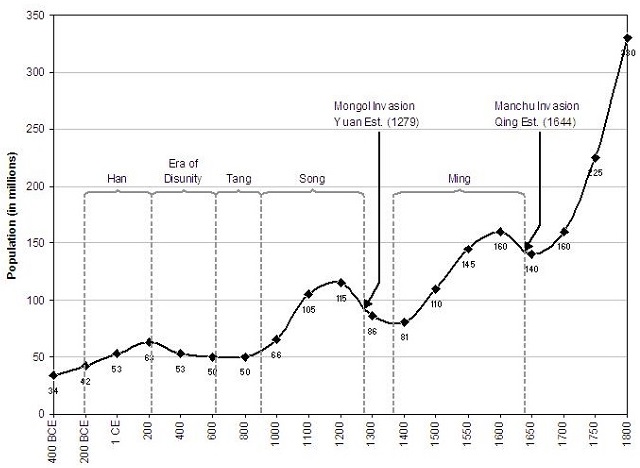
Chinese population over time
At least this is the thesis of Peter Turchin and Sergey Nefedov, authors of Secular Cycles. They start off Malthusian: due to natural reproduction, population will keep increasing until it reaches the limits of what the land can support. At that point, everyone will be stuck at subsistence level. If any group ever enjoys a standard of living above subsistence level, they will keep reproducing until they are back down at subsistence.
Standard Malthusian theory evokes images of a population stable at subsistence level forever. But Turchin and Nefedov argues this isn’t how it works. A population at subsistence will always be one meal away from starving. When a famine hits, many of them will starve. When a plague hits, they will already be too sickly to fight it off. When conflict arrives, they will be desperate enough to enlist in the armies of whichever warlord can offer them a warm meal.
These are not piecemeal events, picking off just enough of the population to bring it back to subsistence. They are great cataclysms. The Black Plague killed 30% – 60% of Europeans; the Antonine Plague of Rome was almost as deadly. The Thirty Years War killed 25% – 40% of Germans; the Time of Troubles may have killed 50% of medieval Russia.
Thus the secular cycle. When population is low, everyone has more than enough land. People grow rich and reproduce. As time goes on, the same amount of farmland gets split among more and more people. Wages are driven down to subsistence. War, Famine, and Pestilence ravage the land, with Death not far behind. The killings continue until population is low again, at which point the cycle starts over.
This applies mostly to peasants, who are most at risk of starving. But nobles go through a related process. As a cycle begins, their numbers are low. As time goes on, their population expands, both through natural reproduction and through upward mobility. Eventually, there are more nobles than there are good positions…
(this part confused me a little. Shouldn’t number of good positions scale with population? IE if one baron rules 1,000 peasants, the number of baronial positions should scale with the size of a society. I think T&N hint at a few answers. First, some positions are absolute rather than relative, eg “King” or “Minister of the Economy”. Second, noble numbers may sometimes increase faster than peasant numbers, since nobles have more food and better chances to reproduce. Third, during boom times, the ranks of nobles are swelled through upward mobility. Fourth, conspicuous consumption is a ratchet effect: during boom times, the expectations of nobility should gradually rise. Fifth, sometimes the relevant denominator is not peasants but land: if a noble only has one acre of land, it doesn’t matter how many peasants he controls. Sixth, nobles usually survive famines and plagues pretty well, so after those have done their work, there are far fewer peasants but basically the same number of nobles. All of these factors contribute to excess noble population – or as T&N call it, “elite overproduction”)
…and the nobles form “rival patronage networks” to fight for the few remaining good spots. The state goes from united (or at least all nobles united against the peasants) to divided, with coalitions of nobles duking it out (no pun intended). This can lead either to successful peasant rebellion, as some nobles support the peasants as part of inter-noble power plays, or just to civil war. Although famine and plague barely affect nobles, war affects them disproportionately – both because they were often knights or other front-line soldiers, and because killing the other side’s nobles was often a major strategic goal (think Game of Thrones). So a civil war usually further depletes the already-depleted peasant population, and finally depletes noble populations, leading to a general underpopulation and the beginning of the next cycle.
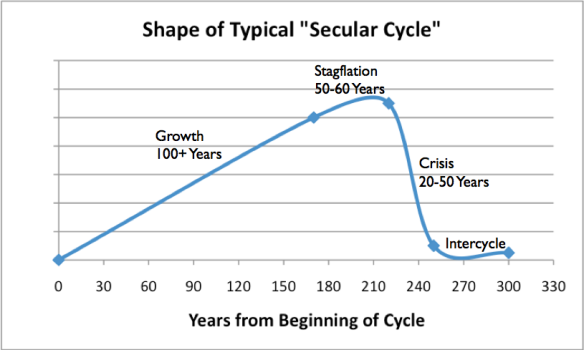
Combine these two processes, and you get the basic structure of a secular cycle. There are about a hundred years of unalloyed growth, as peasant and noble populations rebound from the last disaster. During this period, the economy is strong, the people are optimistic and patriotic, and the state is strong and united.
After this come about fifty years of “stagflation”. There is no more room for easy growth, but the system is able to absorb the surplus population without cracking. Peasants may not have enough land, but they go to the city in search of jobs. Nobles may not have enough of the positions they want, but they go to college in order to become bureaucrats, or join the retinues of stronger nobles. The price of labor reaches its lowest point, and the haves are able to exploit the desperation of the have-nots to reach the zenith of their power. From the outside, this period can look like a golden age: huge cities buzzing with people, universities crammed with students, ultra-rich nobles throwing money at the arts and sciences. From the inside, for most people it will look like a narrowing of opportunity and a hard-to-explain but growing sense that something is wrong.
After this comes a crisis. The mechanisms that have previously absorbed surplus population fail. Famine and disease ravage the peasantry. State finances fall apart. Social trust and patriotism disappear as it becomes increasingly obvious that it’s every man for himself and that people with scruples will be defeated or exploited by people without.
After this comes the depression period (marked “intercycle” on the graph above, but I’m going to stick with the book’s term). The graph makes it look puny, but it can last 100 to 150 years. During this period, the peasant population is low, but the noble population is still high. This is most likely an era of very weak or even absent state power, barbarian invasions, and civil war. The peasant population is in a good position to expand, but cannot do so because wars keep killing people off or forcing them into walled towns where they can’t do any farming. Usually it takes a couple more wars and disasters before the noble population has decreased enough to reverse elite overproduction. At this point the remaining nobles look around, decide that there is more than enough for all of them, and feel incentivized to cooperate with the formation of a strong centralized state.
This cycle is interwoven with a second 40-60 year process that T&N call the “fathers-and-sons cycle” or “bigenerational cycle”. The data tend to show waves of disorder about every 40-60 years. During the “integrative trend” (T&N’s term for the optimistic growth and stagflation phases), these can just be minor protests or a small rebellion that is easily crushed. During the “disintegrative trend” (crisis + depression), they usually represent individual outbreaks of civil war. For example, during the Roman Republic, the violence around the death of Tiberius Gracchus in 133 BC was relatively limited, because Rome had not yet entered its crisis phase. 40 years later, in the depths of the crisis phase, there was a second outbreak of violence (91 – 82 BC) including the Social War and Sulla’s wars, which escalated to full-scale (though limited) civil war. 40 years later there was a third outbreak (49 – 27 BC) including Caesar and Augustus’s very large civil wars. After that the new integrative trend started and further violence was suppressed.
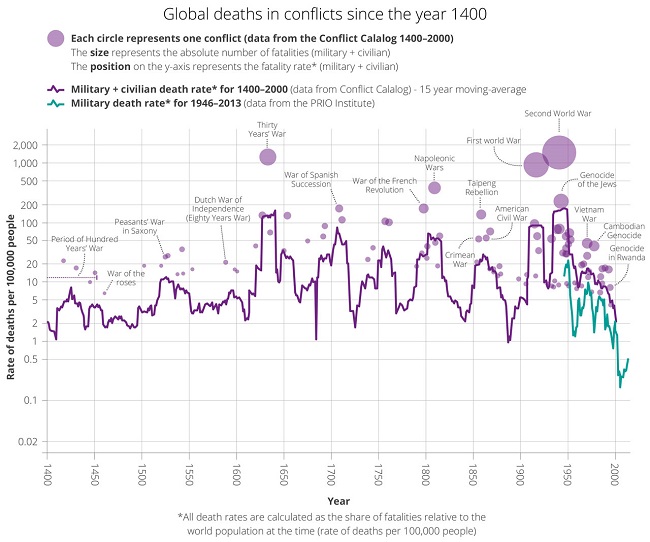
I’m not sure this even makes sense in the Secular Cycle system, since it should apply only to individual countries and not to the entire world, but these sure are some interesting data.
In Secular Cycles, T&N mostly just identify this pattern from the data and don’t talk a lot about what causes it. But in some of Turchin’s other work, he applies some of the math used to model epidemics in public health. His model imagines three kinds of people: naives, radicals, and moderates. At the start of a cycle, most people are naive, with a few radicals. Radicals gradually spread radicalism, either by converting their friends or provoking their enemies (eg a terrorist attack by one side convinces previously disengaged people to join the other side). This spreads like any other epidemic. But as violence gets worse, some people convert to “moderates”, here meaning not “wishy-washy people who don’t care” but something more like “people disenchanted with the cycle of violence, determined to get peace at any price”. Moderates suppress radicals, but as they die off most people are naive and the cycle begins again. Using various parameters for his model Turchin claims this predicts the forty-to-sixty year cycle of violence observed in the data.
So this is the basic thesis of Secular Cycles. Pre-industrial history operates on two cycles: first, a three-hundred year cycle of the rise-and-fall of civilizations. And second, a 40-60 year cycle of violent disorder that only becomes relevant during the lowest parts of the first cycle.
II.
This is all in the first chapter of the book! The next eight chapters are case studies of eight different historical periods and how they followed the secular cycle model.
For example, Chapter 7 is on the Roman Empire. It starts with Augustus in 27 BC. The Roman Republic has just undergone a hundred years of civil war, from the Gracchi to Marius to Sulla to Pompey to Caesar to Antony. All of this decreased its population by 30% from its second-century peak. That means things are set to get a lot better very quickly.
The expansion phase of the Empire lasted from Augustus (27 BC) to Nerva (96 AD), followed by a stagflation phase from Nerva to Antonius Pius (165 AD). Throughout both phases, the population grew – from about 40 million in Augustus’ day to 65 million in Antonius’. Wheat prices stayed stable until Nerva, then doubled from the beginning of the second century to its end. Legionary pay followed the inverse pattern, staying stable until Nerva and then decreasing by a third before 200. The finances of the state were the same – pretty good until the late second century (despite occasional crazy people becoming Emperor and spending the entire treasury building statues of themselves), but cratering during the time of Marcus Aurelius and Commodus (who debased the denarius down to only 2 g silver).
Throughout expansion and stagflation, the Empire was relatively peaceful (the “Pax Romana”). Sure, occasionally a crazy person would become Emperor and they would have to kill him. There was even one small civil war which lasted all of a year (69 AD). But in general, these were isolated incidents.
Throughout the expansion phase, upward mobility was high and income inequality relatively low. T&N measure this as how many consuls (the highest position in the Roman governmental hierarchy) had fathers who were also consuls. This decreased throughout the first century – from 46% to 18% – then started creeping back up during the stagflation phase to reach 32% at the end of the second century.
The crisis phase began in 165 AD at the peak of Rome’s population and wealth. The Antonine Plague ravaged the Empire, killing 30% of the population. Fifteen years later, the century-long dominance of the Good Emperors ended, and Commodus took the throne. Then he was murdered and Pertinax took the throne. Then he was murdered and Didius Julianus took the throne. Then he was murdered and Septimius Severus took the throne.
Now we are well into the disintegrative trend, and the shorter 40-60 year cycle comes into play. Septimius Severus founds a dynasty that lasts 41 years, until Septimius Alexander (the grandson of Septimius Severus’ sister-in-law; it’s complicated) was assassinated by his own soldiers in Germany. This begins the Crisis Of The Third Century, a time of constant civil war, mass depopulation, and economic collapse. The Five Good Emperors of the second century ruled 84 years between them (average of 17 years per emperor). The fifty year Crisis included 27 emperors, for an average of less than 2 years per emperor.
Finally, in 284, Emperor Diocletian ended the civil wars, re-established centralized authority, and essentially refounded the Roman Empire – a nice round 310 years after Augustus did the same. T&N mark this as the end of a secular cycle and the beginning of a new integrative trend.
T&N are able to tell this story. But they don’t just tell the story. They are able to cite various statistics to back themselves up. The Roman population statistics. The price of wheat and other foodstuffs. The average wages for laborers. They especially like coin hoards – the amount of buried treasure from a given period discovered by treasure-hunters – because they argue you only bury your money during times of instability, so this forms a semi-objective way of measuring how unstable things are.
They are at their best when presenting very broad summary statistics. For example, Roman industry produced vast amounts of lead, which entered the atmosphere and settled into the Greenland ice sheet. Here is Roman lead output per year as measured in ice cores:
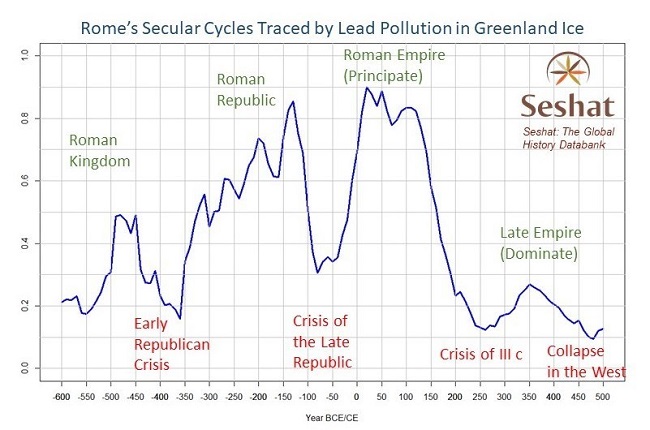
This shows four peaks for the four cycles T&N identify in Rome: the Kingdom, the Republic, the Early Empire of Augustus (Principate, the one described above), and the Late Empire of Diocletian (Dominate). It even shows a sawtooth-y pattern corresponding to the shorter bigenerational cycles.
Or here is building activity in Rome, measured by how many buildings archaeologists have found from a given time:
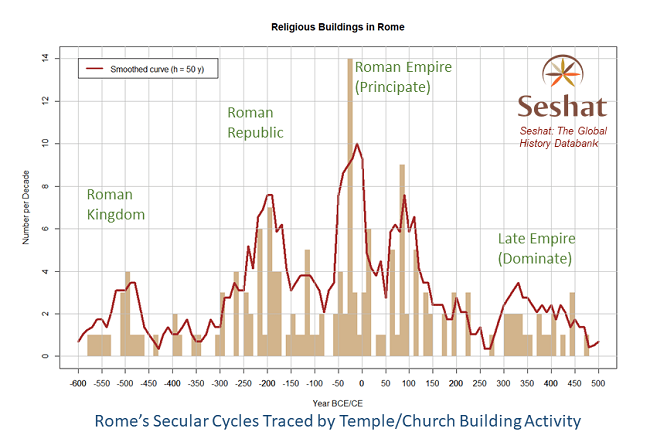
This is a little less perfect (why is there a big gap in the middle of the Principate? I guess Augustus is a hard act to follow, building-wise) but it still looks good for the cycle theory.
And here is an Index Of Political Instability, which “combines measures of duration, intensity, and scale of political instability events, coded by a team of professional historians”:
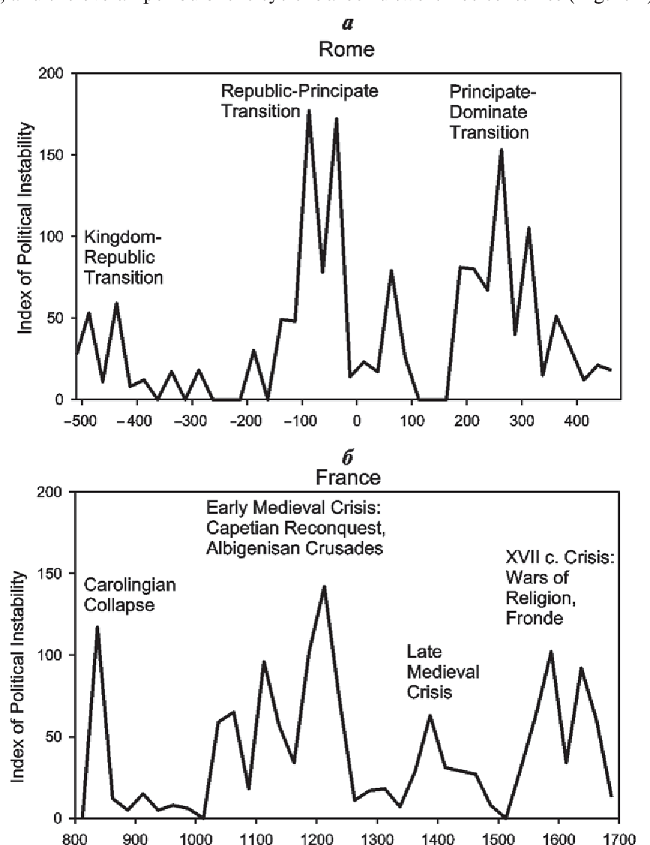
Rome is the one on top. Instability clearly peaks during the crisis-depression phases between T&N’s secular cycles – again with a sawtooth pattern representing the bigenerational cycles.
III.
Seeing patterns in random noise is one of the basic human failure modes. Secular Cycles is so prima facie crackpottish that it should require mountains of data before we even start wondering if it might be true. I want to make it clear that the book – plus Turchin individually in some of his other books and papers – provides these mountains. I can’t show every single case study, graph, and table in this book review. But the chapter above on the Roman Principate included 25 named figures and graphs, plus countless more informal presentations of data series, from “real wages of agricultural laborers in Roman Egypt during the second century” to “mean annual real land rents for wheat fields in artabas per aroura, 27 BC to 268 CE” to “imperial handouts per reign-year” to “importation of African red slip ware into the Albegna Valley of Etruria, 100 – 600”. And this is just one chapter, randomly chosen. There are seven others just like this. This book understands the burden of proof it is under, and does everything it can to meet it.
Still, we should be skeptical. How many degrees of freedom do T&N have, and is it enough to undermine their case?
First, they get some freedom in the civilizations they use as case studies. They could have searched through every region and period and cherry-picked eight civilizations that rose and fell over a periods of three hundred years. Did they? I don’t think so. The case studies are England, France, Rome, and Russia. These are some of the civilizations of greatest interest to the English-speaking world (except Russia, which makes sense in context because the authors are both Russian). They’re also some of the civilizations best-studied by Anglophone historians and with the most data available (the authors’ methodology requires having good time-series of populations, budgets, food production, etc).
Also, it’s not too hard to look at the civilizations they didn’t study and fill in the gaps. The book barely mentions China, but it seems to fit the model pretty well (“the empire united longs to divide; divided longs to unite”). In fact, taking the quotation completely seriously – the empire was first united during the Qin Dynasty starting in 221 BC, which lasted only 20 years before seguing into the Han Dynasty in 202 BC. The Han expanded and prospered for about a century, had another century of complicated intrigue and frequently revolt, and then ended in disaster in the first part of the first century, with a set of failed reforms, civil war, the sack of the capital, some more civil war, peasant revolt, and even more civil war. The separate period of the Eastern Han Dynasty began in 25 AD, about 240 years after the beginning of the Qin-Han cycle. The Eastern Han also grew and prospered for about a hundred years, then had another fifty years of simmering discontent, then fell apart in about 184 AD, with another series of civil wars, peasant rebellions, etc. This was the Three Kingdoms Period during which “the empire united longs to divide, divided longs to unite” was written to describe. It lasted another eighty years until 266 AD, after which the Jin Dynasty began. The Jin Dynasty was kind of crap, but it lasted another 180 years until 420, followed by 160 years of division, followed by the Sui and Tang dynasties, which were not crap. So I don’t think it takes too much pattern-matching to identify a Western-Han-to-Eastern-Han Cycle of 240 years, followed by an Eastern-Han-to-Jin Cycle of 241 years, followed by a Jin-to-Sui/Tang-Cycle of 324 years.
One could make a more hostile analysis. Is it really fair to lump the Western Jin and Eastern Jin conveniently together, but separate the Western Han and Eastern Han conveniently apart? Is it really fair to call the crappy and revolt-prone Jin Dynasty an “integrative trend” rather than a disintegrative trend that lasted much longer than the theory should predict? Is it really fair to round off cycles of 240 and 320 years to “basically 300 years”?
I think the answer to all of these is “T&N aren’t making predictions about the length of Chinese dynasties, they’re making predictions about the nature of secular cycles, which are correlated with dynasties but not identical to them”. If I had the equivalent to lead core readings for China, or an “instability index”, or time series data for wages or health or pottery importation or so on, maybe it would be perfectly obvious that the Eastern and Western Han defined two different periods, but the Eastern and Western Jin were part of the same period – the same way one look at the lead core data for Rome shows that the Julio-Claudian dynasty vs. the Flavian Dynasty is not an interesting transition.
A secondary answer might be that T&N admit all sorts of things can alter the length of secular cycles. They tragically devote only a few pages to “Ibn Khaldun cycles”, the theory of 14th century Arabic historian Ibn Khaldun that civilizations in the Maghreb rise and fall on a one hundred year period. But they discuss it just enough to say their data confirm Ibn Khaldun’s observations. The accelerated timescale (100 vs. 300 years) is because the Maghreb is massively polygynous, with successful leaders having harems of hundreds of concubines. This speeds up the elite overproduction process and makes everything happen in fast-forward. T&N also admit that their theory only describes civilizations insofar as they are self-contained. This approximately holds for hegemons like Rome at its height, but fails for eg Poland, whose history is going to be much more influenced by when Russia or Germany decides to invade than by the internal mechanisms of Polish society. Insofar as external shocks – whether climatic, foreign military, or whatever else – affect a civilization, secular cycles will be stretched out, compressed, or just totally absent.
This sort of thing must obviously be true, and it’s good T&N say it, but it’s also a free pass to add as many epicycles as you need to explain failure to match data. All I can say looking at China is that, if you give it some wiggle room, it seems to fit T&N’s theories okay. The same is true of a bunch of other civilizations I plugged in to see if they would work.
Second, T&N get some degrees of freedom based on what statistics they use. In every case, they present statistics that support the presence of secular cycles, but they’re not the same statistics in every case. On the one hand, this is unavoidable; we may not have good wage data for every civilization, and levels of pottery importation might be more relevant to ancient Rome than to 19th-century Russia. On the other hand, I’m not sure what prevents them from just never mentioning the Instability Index if the Instability Index doesn’t show what they want it to show.
Here are some random Rome-related indicators I found online:
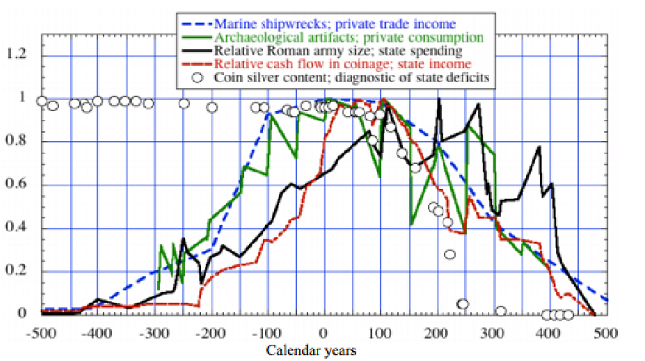
None of them show the same four-peaked Kingdom-Republic-Principate-Dominate pattern as the ones Secular Cycles cites, or the ones Turchin has online.
Third, a lot of the statistics themselves have some degrees of freedom. A lot of them are things like “Instability Index” or “Index of Social Well-Being” or “General Badness Index”. These seem like the kind of scores you can fiddle with to get the results you want. Turchin claims he hasn’t fiddled with them – his instability index is taken from a 1937 paper I haven’t been able to find. But how many papers like that are there? Am I getting too conspiratorial now?
Likewise, we don’t have direct access to the budget of the Roman Empire (or Plantagenet England, or…). Historians have tried to reconstruct it based on archaeology and the few records that have survived. T&N cite these people, and the people they cite are at the top of their fields and say what T&N say they say. But how much flexibility did they have in deciding which estimate of the Roman budget to cite? Is there enough disagreement that they could cite the high estimate for one period and the low estimate for another, then prove it had gone down? I don’t know (though a few hours’ work ought to be enough to establish this).
I wish I could find commentary by other academics and historians on Secular Cycles, or on Turchin’s work more generally. I feel like somebody should either be angrily debunking this, or else throwing the authors a ticker-tape parade for having solved history. Neither is happening. The few comments I can find are mostly limited to navel gazing about whether history should be quantitative or qualitative. The few exceptions find are blog posts by people I already know and respect urging me to read Turchin five years ago, advice I am sorry for not taking. If you know of any good criticism, please tell me where to find it.
Until then, my very quick double-checking suggests T&N are pretty much on the level. But there could still be subtler forms of overfitting going on that I don’t know enough about history to detect.
IV.
If this is true, does it have any implications for people today?
First, a very weak implication: it makes history easier to learn. I was shocked how much more I remembered about the Plantagenets, Tudors, Capetians, etc after reading this book, compared to reading any normal history book about them. I think the secret ingredient is structure. If history is just “one damn thing after another”, there’s no framework for figuring out what matters, what’s worth learning, what follows what else. The secular cycle idea creates a structure that everything fits into neatly. I know that the Plantagenet Dynasty lasted from 1154 – 1485, because it had to, because that’s a 331 year secular cycle. I know that the important events to remember include the Anarchy of 1135 – 1153 and the War of the Roses from 1455 – 1487, because those are the two crisis-depression periods that frame the cycle. I know that after 1485 Henry Tudor took the throne and began a new age of English history, because that’s the beginning of the integrative phase of the next cycle. All of this is a lot easier than trying to remember these names and dates absent any context. I would recommend this book for that reason alone.
Second, I think this might give new context to Piketty on inequality. T&N describe inequality as starting out very low during the growth phase of a secular cycle, rising to a peak during the stagflation phase, then dropping precipitously during the crisis. Piketty describes the same: inequality rising through the peaceful period of 1800 to 1900, dropping precipitously during the two World Wars, then gradually rising again since then. This doesn’t make a huge amount of sense, since I’m not sure you can fit the post industrial world into secular cycles. But I notice Piketty seems to think of this as a once-off event – inequality has been rising forever, broken only by the freak crisis of the two World Wars – and it’s interesting to read T&N talk about the exact same process recurring again and again throughout history.
Finally, and most important: is there any sense in which this is still going on?
The easiest answer would be no, there isn’t. The secular cycles are based around Malthusian population growth, but we are now in a post-Malthusian regime where land is no longer the limiting resource. And the cycles seem to assume huge crises killing off 30% to 50% of the population, but those don’t happen anymore in First World countries; the Civil War was the bloodiest period of US history, and even it only killed 2% of Americans. Even Germany only lost about 15% of its population in World Wars I + II.
But Turchin has another book, Ages Of Discord, arguing that they do. I have bought it and started it and will report back when I’m done.
Even without a framework, this is just interesting to think about. In popular understanding of American history, you can trace out optimistic and pessimistic periods. The national narrative seems to include a story of the 1950s as a golden age of optimism. Then everyone got angry and violent in the early 1970s (the Status 451 review of Days Of Rage is pretty great here, and reminds us that “people have completely forgotten that in 1972 we had over nineteen hundred domestic bombings in the United States”). Then everything suddenly got better once Reagan declared “morning in America” in the 1980s, with an era of optimism and good feelings lasting through the Clinton administration. Then things starting to turn bad sometime around Bush II. And now everybody hates each other, and fascists and antifa are fighting in the streets, and people are talking about how “civility” and “bipartisanship” are evil tools of oppression, and PredictIt says an avowed socialist has a 10% chance of becoming president of the US. To what extent is this narrative true? I don’t know, but it’s definitely the narrative.
One thing that strikes me about T&N’s cycles is the ideological component. They describe how, during a growth phase, everyone is optimistic and patriotic, secure in the knowledge that there is enough for everybody. During the stagflation phase, inequality increases, but concern about inequality increases even more, zero-sum thinking predominates, and social trust craters (both because people are actually defecting, and because it’s in lots of people’s interest to play up the degree to which people are defecting). By the crisis phase, partisanship is much stronger than patriotism and radicals are talking openly about how violence is ethically obligatory.
And then, eventually, things get better. There is a new Augustan Age of virtue and the reestablishment of all good things. This is a really interesting claim. Western philosophy tends to think in terms of trends, not cycles. We see everything going on around us, and we think this is some endless trend towards more partisanship, more inequality, more hatred, and more state dysfunction. But Secular Cycles offers a narrative where endless trends can end, and things can get better after all.
Of course, it also offers a narrative where sometimes this process involves the death of 30% – 50% of the population. Maybe I should read Turchin’s other books before speculating any further.


I.
There is a tide in the affairs of men. It cycles with a period of about three hundred years. During its flood, farms and businesses prosper, and great empires enjoy golden ages. During its ebb, war and famine stalk the land, and states collapse into barbarism.
Chinese population over time
At least this is the thesis of Peter Turchin and Sergey Nefedov, authors of Secular Cycles. They start off Malthusian: due to natural reproduction, population will keep increasing until it reaches the limits of what the land can support. At that point, everyone will be stuck at subsistence level. If any group ever enjoys a standard of living above subsistence level, they will keep reproducing until they are back down at subsistence.
Standard Malthusian theory evokes images of a population stable at subsistence level forever. But Turchin and Nefedov argues this isn’t how it works. A population at subsistence will always be one meal away from starving. When a famine hits, many of them will starve. When a plague hits, they will already be too sickly to fight it off. When conflict arrives, they will be desperate enough to enlist in the armies of whichever warlord can offer them a warm meal.
These are not piecemeal events, picking off just enough of the population to bring it back to subsistence. They are great cataclysms. The Black Plague killed 30% – 60% of Europeans; the Antonine Plague of Rome was almost as deadly. The Thirty Years War killed 25% – 40% of Germans; the Time of Troubles may have killed 50% of medieval Russia.
Thus the secular cycle. When population is low, everyone has more than enough land. People grow rich and reproduce. As time goes on, the same amount of farmland gets split among more and more people. Wages are driven down to subsistence. War, Famine, and Pestilence ravage the land, with Death not far behind. The killings continue until population is low again, at which point the cycle starts over.
This applies mostly to peasants, who are most at risk of starving. But nobles go through a related process. As a cycle begins, their numbers are low. As time goes on, their population expands, both through natural reproduction and through upward mobility. Eventually, there are more nobles than there are good positions…
(this part confused me a little. Shouldn’t number of good positions scale with population? IE if one baron rules 1,000 peasants, the number of baronial positions should scale with the size of a society. I think T&N hint at a few answers. First, some positions are absolute rather than relative, eg “King” or “Minister of the Economy”. Second, noble numbers may sometimes increase faster than peasant numbers, since nobles have more food and better chances to reproduce. Third, during boom times, the ranks of nobles are swelled through upward mobility. Fourth, conspicuous consumption is a ratchet effect: during boom times, the expectations of nobility should gradually rise. Fifth, sometimes the relevant denominator is not peasants but land: if a noble only has one acre of land, it doesn’t matter how many peasants he controls. Sixth, nobles usually survive famines and plagues pretty well, so after those have done their work, there are far fewer peasants but basically the same number of nobles. All of these factors contribute to excess noble population – or as T&N call it, “elite overproduction”)
…and the nobles form “rival patronage networks” to fight for the few remaining good spots. The state goes from united (or at least all nobles united against the peasants) to divided, with coalitions of nobles duking it out (no pun intended). This can lead either to successful peasant rebellion, as some nobles support the peasants as part of inter-noble power plays, or just to civil war. Although famine and plague barely affect nobles, war affects them disproportionately – both because they were often knights or other front-line soldiers, and because killing the other side’s nobles was often a major strategic goal (think Game of Thrones). So a civil war usually further depletes the already-depleted peasant population, and finally depletes noble populations, leading to a general underpopulation and the beginning of the next cycle.
Combine these two processes, and you get the basic structure of a secular cycle. There are about a hundred years of unalloyed growth, as peasant and noble populations rebound from the last disaster. During this period, the economy is strong, the people are optimistic and patriotic, and the state is strong and united.
After this come about fifty years of “stagflation”. There is no more room for easy growth, but the system is able to absorb the surplus population without cracking. Peasants may not have enough land, but they go to the city in search of jobs. Nobles may not have enough of the positions they want, but they go to college in order to become bureaucrats, or join the retinues of stronger nobles. The price of labor reaches its lowest point, and the haves are able to exploit the desperation of the have-nots to reach the zenith of their power. From the outside, this period can look like a golden age: huge cities buzzing with people, universities crammed with students, ultra-rich nobles throwing money at the arts and sciences. From the inside, for most people it will look like a narrowing of opportunity and a hard-to-explain but growing sense that something is wrong.
After this comes a crisis. The mechanisms that have previously absorbed surplus population fail. Famine and disease ravage the peasantry. State finances fall apart. Social trust and patriotism disappear as it becomes increasingly obvious that it’s every man for himself and that people with scruples will be defeated or exploited by people without.
After this comes the depression period (marked “intercycle” on the graph above, but I’m going to stick with the book’s term). The graph makes it look puny, but it can last 100 to 150 years. During this period, the peasant population is low, but the noble population is still high. This is most likely an era of very weak or even absent state power, barbarian invasions, and civil war. The peasant population is in a good position to expand, but cannot do so because wars keep killing people off or forcing them into walled towns where they can’t do any farming. Usually it takes a couple more wars and disasters before the noble population has decreased enough to reverse elite overproduction. At this point the remaining nobles look around, decide that there is more than enough for all of them, and feel incentivized to cooperate with the formation of a strong centralized state.
This cycle is interwoven with a second 40-60 year process that T&N call the “fathers-and-sons cycle” or “bigenerational cycle”. The data tend to show waves of disorder about every 40-60 years. During the “integrative trend” (T&N’s term for the optimistic growth and stagflation phases), these can just be minor protests or a small rebellion that is easily crushed. During the “disintegrative trend” (crisis + depression), they usually represent individual outbreaks of civil war. For example, during the Roman Republic, the violence around the death of Tiberius Gracchus in 133 BC was relatively limited, because Rome had not yet entered its crisis phase. 40 years later, in the depths of the crisis phase, there was a second outbreak of violence (91 – 82 BC) including the Social War and Sulla’s wars, which escalated to full-scale (though limited) civil war. 40 years later there was a third outbreak (49 – 27 BC) including Caesar and Augustus’s very large civil wars. After that the new integrative trend started and further violence was suppressed.
I’m not sure this even makes sense in the Secular Cycle system, since it should apply only to individual countries and not to the entire world, but these sure are some interesting data.
In Secular Cycles, T&N mostly just identify this pattern from the data and don’t talk a lot about what causes it. But in some of Turchin’s other work, he applies some of the math used to model epidemics in public health. His model imagines three kinds of people: naives, radicals, and moderates. At the start of a cycle, most people are naive, with a few radicals. Radicals gradually spread radicalism, either by converting their friends or provoking their enemies (eg a terrorist attack by one side convinces previously disengaged people to join the other side). This spreads like any other epidemic. But as violence gets worse, some people convert to “moderates”, here meaning not “wishy-washy people who don’t care” but something more like “people disenchanted with the cycle of violence, determined to get peace at any price”. Moderates suppress radicals, but as they die off most people are naive and the cycle begins again. Using various parameters for his model Turchin claims this predicts the forty-to-sixty year cycle of violence observed in the data.
So this is the basic thesis of Secular Cycles. Pre-industrial history operates on two cycles: first, a three-hundred year cycle of the rise-and-fall of civilizations. And second, a 40-60 year cycle of violent disorder that only becomes relevant during the lowest parts of the first cycle.
II.
This is all in the first chapter of the book! The next eight chapters are case studies of eight different historical periods and how they followed the secular cycle model.
For example, Chapter 7 is on the Roman Empire. It starts with Augustus in 27 BC. The Roman Republic has just undergone a hundred years of civil war, from the Gracchi to Marius to Sulla to Pompey to Caesar to Antony. All of this decreased its population by 30% from its second-century peak. That means things are set to get a lot better very quickly.
The expansion phase of the Empire lasted from Augustus (27 BC) to Nerva (96 AD), followed by a stagflation phase from Nerva to Antonius Pius (165 AD). Throughout both phases, the population grew – from about 40 million in Augustus’ day to 65 million in Antonius’. Wheat prices stayed stable until Nerva, then doubled from the beginning of the second century to its end. Legionary pay followed the inverse pattern, staying stable until Nerva and then decreasing by a third before 200. The finances of the state were the same – pretty good until the late second century (despite occasional crazy people becoming Emperor and spending the entire treasury building statues of themselves), but cratering during the time of Marcus Aurelius and Commodus (who debased the denarius down to only 2 g silver).
Throughout expansion and stagflation, the Empire was relatively peaceful (the “Pax Romana”). Sure, occasionally a crazy person would become Emperor and they would have to kill him. There was even one small civil war which lasted all of a year (69 AD). But in general, these were isolated incidents.
Throughout the expansion phase, upward mobility was high and income inequality relatively low. T&N measure this as how many consuls (the highest position in the Roman governmental hierarchy) had fathers who were also consuls. This decreased throughout the first century – from 46% to 18% – then started creeping back up during the stagflation phase to reach 32% at the end of the second century.
The crisis phase began in 165 AD at the peak of Rome’s population and wealth. The Antonine Plague ravaged the Empire, killing 30% of the population. Fifteen years later, the century-long dominance of the Good Emperors ended, and Commodus took the throne. Then he was murdered and Pertinax took the throne. Then he was murdered and Didius Julianus took the throne. Then he was murdered and Septimius Severus took the throne.
Now we are well into the disintegrative trend, and the shorter 40-60 year cycle comes into play. Septimius Severus founds a dynasty that lasts 41 years, until Septimius Alexander (the grandson of Septimius Severus’ sister-in-law; it’s complicated) was assassinated by his own soldiers in Germany. This begins the Crisis Of The Third Century, a time of constant civil war, mass depopulation, and economic collapse. The Five Good Emperors of the second century ruled 84 years between them (average of 17 years per emperor). The fifty year Crisis included 27 emperors, for an average of less than 2 years per emperor.
Finally, in 284, Emperor Diocletian ended the civil wars, re-established centralized authority, and essentially refounded the Roman Empire – a nice round 310 years after Augustus did the same. T&N mark this as the end of a secular cycle and the beginning of a new integrative trend.
T&N are able to tell this story. But they don’t just tell the story. They are able to cite various statistics to back themselves up. The Roman population statistics. The price of wheat and other foodstuffs. The average wages for laborers. They especially like coin hoards – the amount of buried treasure from a given period discovered by treasure-hunters – because they argue you only bury your money during times of instability, so this forms a semi-objective way of measuring how unstable things are.
They are at their best when presenting very broad summary statistics. For example, Roman industry produced vast amounts of lead, which entered the atmosphere and settled into the Greenland ice sheet. Here is Roman lead output per year as measured in ice cores:
This shows four peaks for the four cycles T&N identify in Rome: the Kingdom, the Republic, the Early Empire of Augustus (Principate, the one described above), and the Late Empire of Diocletian (Dominate). It even shows a sawtooth-y pattern corresponding to the shorter bigenerational cycles.
Or here is building activity in Rome, measured by how many buildings archaeologists have found from a given time:
This is a little less perfect (why is there a big gap in the middle of the Principate? I guess Augustus is a hard act to follow, building-wise) but it still looks good for the cycle theory.
And here is an Index Of Political Instability, which “combines measures of duration, intensity, and scale of political instability events, coded by a team of professional historians”:
Rome is the one on top. Instability clearly peaks during the crisis-depression phases between T&N’s secular cycles – again with a sawtooth pattern representing the bigenerational cycles.
III.
Seeing patterns in random noise is one of the basic human failure modes. Secular Cycles is so prima facie crackpottish that it should require mountains of data before we even start wondering if it might be true. I want to make it clear that the book – plus Turchin individually in some of his other books and papers – provides these mountains. I can’t show every single case study, graph, and table in this book review. But the chapter above on the Roman Principate included 25 named figures and graphs, plus countless more informal presentations of data series, from “real wages of agricultural laborers in Roman Egypt during the second century” to “mean annual real land rents for wheat fields in artabas per aroura, 27 BC to 268 CE” to “imperial handouts per reign-year” to “importation of African red slip ware into the Albegna Valley of Etruria, 100 – 600”. And this is just one chapter, randomly chosen. There are seven others just like this. This book understands the burden of proof it is under, and does everything it can to meet it.
Still, we should be skeptical. How many degrees of freedom do T&N have, and is it enough to undermine their case?
First, they get some freedom in the civilizations they use as case studies. They could have searched through every region and period and cherry-picked eight civilizations that rose and fell over a periods of three hundred years. Did they? I don’t think so. The case studies are England, France, Rome, and Russia. These are some of the civilizations of greatest interest to the English-speaking world (except Russia, which makes sense in context because the authors are both Russian). They’re also some of the civilizations best-studied by Anglophone historians and with the most data available (the authors’ methodology requires having good time-series of populations, budgets, food production, etc).
Also, it’s not too hard to look at the civilizations they didn’t study and fill in the gaps. The book barely mentions China, but it seems to fit the model pretty well (“the empire united longs to divide; divided longs to unite”). In fact, taking the quotation completely seriously – the empire was first united during the Qin Dynasty starting in 221 BC, which lasted only 20 years before seguing into the Han Dynasty in 202 BC. The Han expanded and prospered for about a century, had another century of complicated intrigue and frequently revolt, and then ended in disaster in the first part of the first century, with a set of failed reforms, civil war, the sack of the capital, some more civil war, peasant revolt, and even more civil war. The separate period of the Eastern Han Dynasty began in 25 AD, about 240 years after the beginning of the Qin-Han cycle. The Eastern Han also grew and prospered for about a hundred years, then had another fifty years of simmering discontent, then fell apart in about 184 AD, with another series of civil wars, peasant rebellions, etc. This was the Three Kingdoms Period during which “the empire united longs to divide, divided longs to unite” was written to describe. It lasted another eighty years until 266 AD, after which the Jin Dynasty began. The Jin Dynasty was kind of crap, but it lasted another 180 years until 420, followed by 160 years of division, followed by the Sui and Tang dynasties, which were not crap. So I don’t think it takes too much pattern-matching to identify a Western-Han-to-Eastern-Han Cycle of 240 years, followed by an Eastern-Han-to-Jin Cycle of 241 years, followed by a Jin-to-Sui/Tang-Cycle of 324 years.
One could make a more hostile analysis. Is it really fair to lump the Western Jin and Eastern Jin conveniently together, but separate the Western Han and Eastern Han conveniently apart? Is it really fair to call the crappy and revolt-prone Jin Dynasty an “integrative trend” rather than a disintegrative trend that lasted much longer than the theory should predict? Is it really fair to round off cycles of 240 and 320 years to “basically 300 years”?
I think the answer to all of these is “T&N aren’t making predictions about the length of Chinese dynasties, they’re making predictions about the nature of secular cycles, which are correlated with dynasties but not identical to them”. If I had the equivalent to lead core readings for China, or an “instability index”, or time series data for wages or health or pottery importation or so on, maybe it would be perfectly obvious that the Eastern and Western Han defined two different periods, but the Eastern and Western Jin were part of the same period – the same way one look at the lead core data for Rome shows that the Julio-Claudian dynasty vs. the Flavian Dynasty is not an interesting transition.
A secondary answer might be that T&N admit all sorts of things can alter the length of secular cycles. They tragically devote only a few pages to “Ibn Khaldun cycles”, the theory of 14th century Arabic historian Ibn Khaldun that civilizations in the Maghreb rise and fall on a one hundred year period. But they discuss it just enough to say their data confirm Ibn Khaldun’s observations. The accelerated timescale (100 vs. 300 years) is because the Maghreb is massively polygynous, with successful leaders having harems of hundreds of concubines. This speeds up the elite overproduction process and makes everything happen in fast-forward. T&N also admit that their theory only describes civilizations insofar as they are self-contained. This approximately holds for hegemons like Rome at its height, but fails for eg Poland, whose history is going to be much more influenced by when Russia or Germany decides to invade than by the internal mechanisms of Polish society. Insofar as external shocks – whether climatic, foreign military, or whatever else – affect a civilization, secular cycles will be stretched out, compressed, or just totally absent.
This sort of thing must obviously be true, and it’s good T&N say it, but it’s also a free pass to add as many epicycles as you need to explain failure to match data. All I can say looking at China is that, if you give it some wiggle room, it seems to fit T&N’s theories okay. The same is true of a bunch of other civilizations I plugged in to see if they would work.
Second, T&N get some degrees of freedom based on what statistics they use. In every case, they present statistics that support the presence of secular cycles, but they’re not the same statistics in every case. On the one hand, this is unavoidable; we may not have good wage data for every civilization, and levels of pottery importation might be more relevant to ancient Rome than to 19th-century Russia. On the other hand, I’m not sure what prevents them from just never mentioning the Instability Index if the Instability Index doesn’t show what they want it to show.
Here are some random Rome-related indicators I found online:
None of them show the same four-peaked Kingdom-Republic-Principate-Dominate pattern as the ones Secular Cycles cites, or the ones Turchin has online.
Third, a lot of the statistics themselves have some degrees of freedom. A lot of them are things like “Instability Index” or “Index of Social Well-Being” or “General Badness Index”. These seem like the kind of scores you can fiddle with to get the results you want. Turchin claims he hasn’t fiddled with them – his instability index is taken from a 1937 paper I haven’t been able to find. But how many papers like that are there? Am I getting too conspiratorial now?
Likewise, we don’t have direct access to the budget of the Roman Empire (or Plantagenet England, or…). Historians have tried to reconstruct it based on archaeology and the few records that have survived. T&N cite these people, and the people they cite are at the top of their fields and say what T&N say they say. But how much flexibility did they have in deciding which estimate of the Roman budget to cite? Is there enough disagreement that they could cite the high estimate for one period and the low estimate for another, then prove it had gone down? I don’t know (though a few hours’ work ought to be enough to establish this).
I wish I could find commentary by other academics and historians on Secular Cycles, or on Turchin’s work more generally. I feel like somebody should either be angrily debunking this, or else throwing the authors a ticker-tape parade for having solved history. Neither is happening. The few comments I can find are mostly limited to navel gazing about whether history should be quantitative or qualitative. The few exceptions find are blog posts by people I already know and respect urging me to read Turchin five years ago, advice I am sorry for not taking. If you know of any good criticism, please tell me where to find it.
Until then, my very quick double-checking suggests T&N are pretty much on the level. But there could still be subtler forms of overfitting going on that I don’t know enough about history to detect.
IV.
If this is true, does it have any implications for people today?
First, a very weak implication: it makes history easier to learn. I was shocked how much more I remembered about the Plantagenets, Tudors, Capetians, etc after reading this book, compared to reading any normal history book about them. I think the secret ingredient is structure. If history is just “one damn thing after another”, there’s no framework for figuring out what matters, what’s worth learning, what follows what else. The secular cycle idea creates a structure that everything fits into neatly. I know that the Plantagenet Dynasty lasted from 1154 – 1485, because it had to, because that’s a 331 year secular cycle. I know that the important events to remember include the Anarchy of 1135 – 1153 and the War of the Roses from 1455 – 1487, because those are the two crisis-depression periods that frame the cycle. I know that after 1485 Henry Tudor took the throne and began a new age of English history, because that’s the beginning of the integrative phase of the next cycle. All of this is a lot easier than trying to remember these names and dates absent any context. I would recommend this book for that reason alone.
Second, I think this might give new context to Piketty on inequality. T&N describe inequality as starting out very low during the growth phase of a secular cycle, rising to a peak during the stagflation phase, then dropping precipitously during the crisis. Piketty describes the same: inequality rising through the peaceful period of 1800 to 1900, dropping precipitously during the two World Wars, then gradually rising again since then. This doesn’t make a huge amount of sense, since I’m not sure you can fit the post industrial world into secular cycles. But I notice Piketty seems to think of this as a once-off event – inequality has been rising forever, broken only by the freak crisis of the two World Wars – and it’s interesting to read T&N talk about the exact same process recurring again and again throughout history.
Finally, and most important: is there any sense in which this is still going on?
The easiest answer would be no, there isn’t. The secular cycles are based around Malthusian population growth, but we are now in a post-Malthusian regime where land is no longer the limiting resource. And the cycles seem to assume huge crises killing off 30% to 50% of the population, but those don’t happen anymore in First World countries; the Civil War was the bloodiest period of US history, and even it only killed 2% of Americans. Even Germany only lost about 15% of its population in World Wars I + II.
But Turchin has another book, Ages Of Discord, arguing that they do. I have bought it and started it and will report back when I’m done.
Even without a framework, this is just interesting to think about. In popular understanding of American history, you can trace out optimistic and pessimistic periods. The national narrative seems to include a story of the 1950s as a golden age of optimism. Then everyone got angry and violent in the early 1970s (the Status 451 review of Days Of Rage is pretty great here, and reminds us that “people have completely forgotten that in 1972 we had over nineteen hundred domestic bombings in the United States”). Then everything suddenly got better once Reagan declared “morning in America” in the 1980s, with an era of optimism and good feelings lasting through the Clinton administration. Then things starting to turn bad sometime around Bush II. And now everybody hates each other, and fascists and antifa are fighting in the streets, and people are talking about how “civility” and “bipartisanship” are evil tools of oppression, and PredictIt says an avowed socialist has a 10% chance of becoming president of the US. To what extent is this narrative true? I don’t know, but it’s definitely the narrative.
One thing that strikes me about T&N’s cycles is the ideological component. They describe how, during a growth phase, everyone is optimistic and patriotic, secure in the knowledge that there is enough for everybody. During the stagflation phase, inequality increases, but concern about inequality increases even more, zero-sum thinking predominates, and social trust craters (both because people are actually defecting, and because it’s in lots of people’s interest to play up the degree to which people are defecting). By the crisis phase, partisanship is much stronger than patriotism and radicals are talking openly about how violence is ethically obligatory.
And then, eventually, things get better. There is a new Augustan Age of virtue and the reestablishment of all good things. This is a really interesting claim. Western philosophy tends to think in terms of trends, not cycles. We see everything going on around us, and we think this is some endless trend towards more partisanship, more inequality, more hatred, and more state dysfunction. But Secular Cycles offers a narrative where endless trends can end, and things can get better after all.
Of course, it also offers a narrative where sometimes this process involves the death of 30% – 50% of the population. Maybe I should read Turchin’s other books before speculating any further.
Monday, August 12, 2019
The end of being
The End of Being: Abrupt Climate Change One of Many Ecological Crises Threatening to Collapse the Biosphere. Glen Barry. June 18, 2017.
As industrial human growth continues its relentless assault upon nature, at least ten unfolding global ecological catastrophes including deadly climate change have the potential to destroy the biosphere. Any number of other environmental planetary boundaries besides climate change such as biodiversity, water, soil, and ecosystem loss and diminishment has the potential to end being. The already substantial climate change movement must embrace a richer ecology ethic, morphing into a concerted effort to more broadly achieve global ecological sustainability.“We could solve climate change tomorrow, and soil and water loss – or any number of combinations of surpassed planetary ecological boundaries – would still destroy civilization, potentially killing the living biosphere, and ending being.” Earth Meanders, Deep Ecology Essays by Dr. Glen Barry
Human industrial growth is systematically dismantling the natural ecosystems which constitute our life support system. Rightly so, there has been an enormous amount of attention given to climate change (though action to rapidly reduce emissions still lags far beyond what is required). Climate change is becoming abrupt and runaway; and threatens just by itself to collapse societies, economies, and ultimately the biosphere.
Yet climate change is only one of at least ten global ecological catastrophes which threaten to destroy the global ecological system and portend an end to human beings, and perhaps all life. Ranging from nitrogen deposition to ocean acidification, and including such basics as soil, water, and air; virtually every ecological system upon which life depends is failing. Gaia is dying.
The threat to global ecological sustainability goes well beyond climate change, and represents a more systematic failing of current political and economic models. Namely, the commodification of natural ecosystems – that are our and all life’s habitat – and their unsustainable industrial clearance for short-term profit, is sheer ecocidal madness.
A branch of ecological science known as Planetary Boundary science knows much regarding ecological thresholds whereby Earth and her life may collapse and die. Planetary boundaries have been identified for ten global-scale processes including climate change, rate of biodiversity loss (terrestrial and marine), nitrogen and phosphorus cycles, ozone depletion, ocean acidification, freshwater, land use change, chemical pollution, and atmospheric aerosol loading (and others clearly exist). For each scientists have set thresholds beyond which the global ecological system’s integrity as a whole is threatened.
At least three thresholds – climate change, biodiversity loss, and nitrogen deposition in ecosystems – are generally considered to already have been surpassed, meaning the planet is already in a state of ecological overshoot.
Recently I proposed in a peer reviewed scientific paper a tenth Planetary Boundary, adding a threshold for terrestrial ecosystem loss: hypothesizing that 2/3 of Earth’s land base must remain ensconced within natural and semi-natural ecosystems to avoid biosphere collapse (see Terrestrial ecosystem loss and biosphere collapse). Already some 50% of natural ecosystems have been cleared, meaning yet another planetary ecological limit has been exceeded. My identification of a terrestrial ecosystem boundary was the first published science proposing a planetary boundary based upon terrestrial ecosystem loss and connectivity, and has since been validated in other studies by scientific luminaries.
The point is that while abrupt climate change may well become runaway, collapsing society, the economy, and the biosphere; it is but one of nearly a dozen means whereby humanity has overshot the carrying capacity of the Earth System. Consider this: nearly half of all topsoil has eroded, 90% of large fish are gone, 4,500 kids die from bad water a day, nearly a billion human-beings live in abject poverty, and daily an unknown numbers of species disappear forever.
Highly inequitable, unjust, and unsustainable industrial human growth is systematically dismantling the ecological systems that make Earth livable.
We could solve climate change tomorrow, and soil and water loss – or any number of combinations of surpassed planetary ecological boundaries – would still destroy civilization, potentially killing the living biosphere, and ending being.
Achieving just and equitable global ecological sustainability depends upon the human family becoming more aware of the numerous ecological threats facing our shared survival and well-being. Together we must commit to the radical, science-based social change necessary to sustain Earth and all her life. This will certainly require a shared “ecology ethic” which universally values nature – the plants, wildlife, and ecological processes that make life possible. Ecology is the meaning of life.
Clearly much more research remains to be done on Planetary Boundaries and threats to the biosphere in sum, as well as communication of dangerous thresholds, and policy development to pull back from the precipice. I hope to look further at lag times in regard to when exceeding planetary boundary’s thresholds become dangerous, and to use what is known regarding Pacific Islands’ sustainability as a test case for terrestrial ecosystem loss, and to publish further ecological science. Most importantly, much more effort must be made to act with urgency and resolve upon the science that indicates we face mortal danger.
The way forward on a potentially terminally-ill planet include 1) transitioning to a steady state economy, 2) slowing population growth and then justly reducing human numbers, 3) committing to equitably meeting all of humanity’s basic human needs, 4) ending all natural ecosystem destruction and assisting remnants to naturally regenerate and spread, 5) ending the use of fossil fuels, 6) embracing organic, non-industrial, perma-culture based agriculture less dependent upon animal husbandry, 7) ending industrial clearance of natural ecosystems such as old-growth forest logging and factory fishing, and 8) demobilizing standing armies and diverting these resources to meeting humanity’s and nature’s needs.
Only such comprehensive, ecological-science based policies can prove sufficient to end climate change and all threats to global ecological sustainability, averting mass human suffering and death as the Earth [biosphere] collapses and dies.
As long as seeds and organisms exist, the propagules to regenerate Earth remain. It is vital that the diminution of Earth’s biotic diversity across scales – from the gene, to plants and animals, through the communities and ecosystems they come together to form, right up to our one shared biosphere – be halted immediately. We must not further squander humanity’s biological inheritance upon the altar of frivolous over-consumption by some. And together we must usher in an era of natural ecosystem protection and restoration.
There are many righteous livelihoods – that go far beyond the benefits provided by a slave-like debt economy – to be found in rewilding and pulling humanity back from the ruin of usurping planetary boundaries. But profiteering upon the systematic ecocide of our one living Earth will have to be banished, and strictly enforced for the common good, by a much reduced government.
There is much joy to be found in nature. Rediscovering wild places and clear waters in communities embraced by nature provides for a far richer life than shopping malls and highways. As we rediscover a sense of place there are multitudes of pleasures to be found as well in human literature, music, drama, sexuality, and community. Urban centers can be reclaimed from automobiles and once again become re-natured centers of commerce, culture, and civilization.
It is time to come together and choose life over death, truth over ignorance, beauty over industry, flowers rather than electronics. It is time to return to the land and embrace nature and ecology as the meaning of life. And to address with sufficient policies climate change and all threats to global ecological sustainability at once. Or being ends.
The waking up syndrome
The Waking Up Syndrome. At Damn the Matrix. Aug. 2, 2019.
By Sarah Anne Edwards PhD, Linda Buzzell, originally published by Hopedance May 1, 2008
“Humankind cannot bear very much reality.” — T. S. Eliot
Just dealing with our daily lives keeps most of us too busy to worry about whether or not the sky is falling. We focus on getting to and from work, paying our bills, doing our errands, and, if our time-stressed schedules allow, enjoying a little time to relax with friends and family.
But we’re deluged of late with dire pronouncements from high-profile newscasts, documentaries, and scientific reports about global warming, melting ice caps, dwindling oil supplies, and a looming imminent economic collapse. Closer to home, we’ve experienced climate-related disasters: floods, wildfires, hurricanes, wildfires, and severe droughts.
While the sky may not be falling, this day-after-day onslaught of alarming news is making it more difficult simply to overlook the triple threat of environmental, climatic and economic concerns. It’s leaving many of us feeling like Alice in Wonderland, being sucked down a Rabbit Hole into some frighteningly grotesque and unfamiliar world that’s anything but wonderful.
Few of us are eager to contemplate, let alone truly face, these looming changes. Just the threat of losing chunks of the comfortable way of life we’re accustomed to (or aspiring to) is a frightening-enough prospect. But there’s no avoiding the current facts and trends of the human and planetary situation. And as the edges of our familiar reality begin to ravel, more and more people are reacting psychologically. A noticeable pattern of behavior is emerging.
We call this pattern the Waking Up Syndrome, and it unfolds in six stages, though not necessarily in any particular order.
Stage 1 – Denial.
When we first get an inkling of the shifting environmental reality and its potential impact on both the national economy and our daily lives, most people begin by denying it. We slip into one of four common ways to discount things we’d rather not deal with:
“I don’t believe it.”
We simply deny the existence of any such concerns and refuse to consider them. This might include latching eagerly onto any few remaining naysayers for confirmation and comfort. But as the number of reputable naysayers dwindles, more people are forced to face the fact that “something” is happening.
“It’s not a problem.”
We may admit there’s a change taking place, but deny that it’s significant, seeing such things as climate change and economic fluctuations as part of a normal pattern that is nothing to concern ourselves with. Or we may incorporate the changes we see happening into our spiritual and religious beliefs, regarding them not as a problem, but a test of faith, a sign of a global spiritual awakening, or evidence of a long-awaited Apocalypse. Some may believe focusing on such problems makes them worse and that we should instead visualize, meditate, or pray for the world to be as we want it to be.
“Someone will fix it.”
We may admit major problematic changes are underway but conclude that there’s nothing we personally can do about them and we needn’t worry because technology, scientists, the government, or some expert authority will come up with a solution in time to save us.
“It’s useless.”
We may believe there’s nothing anyone can do about macro-problems, so why do anything, except perhaps eat, drink and be merry. What will be, will be.
Stage 2 – Semi-consciousness.
In spite of the various ways we may try to discount what’s happening to our environment (and consequently to our economy and whole way of life), as evidence mounts around us and the news coverage escalates, we may begin to feel a vague sense of eco-anxiety. Some express this as virulent anger at all this discussion about global warming. Others dissociate from their growing concern and misdirect their feelings toward other things in their lives, perhaps blaming family members or jobs for their undefined discomfort.
Stage 3 – The moment of realization.
At some point we may encounter something that breaks through our defenses and brings the inevitability and severity of the implications of our collective problems into full consciousness. We might read a particularly compelling article, learn more about the aftermath of Katrina, hear a news broadcast about polar bear deaths or rampant fires and flooding, see a documentary like “An Inconvenient Truth” or “The End of Suburbia.” Or — most dramatically – we might experience a natural disaster ourselves with all its personal and economic costs.
At such moments, suddenly we realize no matter how we try to explain away the changes that are happening, they are and will be accompanied by huge challenges to life as we know it and cause considerable pain and suffering for many, including ourselves and those we love.
Even if we believe all these disruptions are leading to a global spiritual awakening or a long awaited Apocalypse— even if we think some helpful new technology is going to emerge (hopefully soon)— we nonetheless begin to understand on a visceral level that the changes taking place will have dramatically unpleasant implications beyond anything we’ve faced in our lifetimes. In fact, we realize many of these uncomfortable changes are already underway and will be growing in coming months and years, affecting most of the things we love and cherish.
But like the character Neo in the 1999 movie The Matrix, even at this point we still have a choice. We can choose to swallow the metaphorical red pill and find out just how deep this rabbit hole goes and where it leads. Or we can take the soothing metaphorical blue pill and choose to “escape” from the nightmarish Wonderland of the rabbit hole we’ve fallen into by slipping back into the comfort of our favorite form of assuring ourselves that all is well.
But if, like Neo, we take “the red pill,” we wake up to the reality of our individual and collective situation. We get that the triple threat challenge facing us is a real Medusa monster. Once we’re awake, the problem is full-blown in our consciousness. It’s right in our face. It won’t let us turn away, and the force of it makes “waking up” incredibly painful.
The moment we realize — even briefly — that we’re slipping into a dangerously threatening new world that no longer makes sense according what we’ve always believed, our genetic wiring kicks in with predictable physiological and emotional threat responses that can take many forms.
Some of us become obsessive newswatchers, documentary filmgoers, internet compulsives or book readers, wanting to know more and more about what’s really happening. Loved ones may think we’ve gone nuts. Spouses may consider divorce; kids may decide mom and dad are hopeless cranks.
The more fragile or vulnerable among us may get depressed or experience panic attacks. If something about this current eco-trauma retriggers earlier traumas in our lives, we may have a Post-Traumatic Stress Disorder (PTSD) reaction. Even the more resilient may throw themselves obsessively into save-the-planet and other activities, soon to become exhausted and weary from trying to do what no one person can.
Others, once they realize what’s happening, see it as a new business or political opportunity. These green business ventures can sometimes be helpful and productive, but at other times can actively circumvent or sabotage the efforts of those who are trying to solve the problems.
Stage 4 – A Point of No Return.
Once awakened, especially as economic and environmental changes intensify, most of us find there is no turning back. We find ourselves traveling deeper and deeper down the rabbit hole. Whatever methods we’ve used to avoid facing the coming changes is no longer successful to quell our personal concerns. We can no longer help but notice the continuing rapid progress of the bad trends – more expensive energy, higher costs of living, a weaker economy, more species in trouble, rising temperatures, more devastating severe weather events, increasing political, economic and military competition (wars) over remaining resources, etc. It all starts to make a dreadful sort of sense as we let in the enormity of the situation.
One of the most difficult aspects of this stage is the profound but unavoidable sense of isolation and disconnection we may feel when living in a different world from most of those around us, a world we can no longer escape from, but one few others seem to notice. The result is a bizarre sense of surrealism. Interaction and communication can become a challenge. How do we relate to a world that’s no longer real to us, but is business as usual to most? Do we try to reach out to others about the ugly new reality and endure their defenses? Is it better to indulge those who don’t yet see the reality we’ve stumbled into and act “as if” nothing has changed just to get along? Or might it be easier to withdraw from life as we’ve known it and turn into a hermit?
5. Despair, guilt, hopelessness, powerlessness.
The realization sets in that one person or even one group or community can’t stop the effects of such things as climate change and peak oil and their economic consequences from impacting millions of people around the planet and at home. We see this thing spiraling out of control and realize that our species, and even we individually, are responsible for much of what’s happening! As the mayor of Memphis said to the Los Angeles Times when a major heat-wave hit his city and most of the Midwest and South last summer, “This is pretty akin to a seismic event in the sense that there is no solution that we here in this room can come up with that will take care of everybody.”
Some have suggested that this stage is similar to the traditional grief process, and indeed, this is a time of grieving. But there is a significant difference between this awakening and the normal experience of grief. Grief that occurs after a loss usually ends with acceptance of what’s been lost and then one adjusts and goes on. But this is more like the process of accepting a degenerative illness. It’s not a one-time loss one can accommodate and simply move on. It is a chronic, on-going, permanent situation that will not only not improve, but actually continue to worsen and become more uncomfortable in the foreseeable future, probably for the entire lifetime of most people living today. This is what author James Howard Kunstler calls “The Long Emergency.”
Our grief and sorrow are also amplified by having to bear the pain of upbeat acquaintances who go merrily along in their denial, discounting their own uneasiness about what’s happening and wondering why we’re so “negative.”
Stage 6 – Acceptance, empowerment, action.
As we come to accept the limits of our general powerlessness, we also find the parameters of the power we do have in this strange new situation. We discover we no longer need to resist our current and emerging reality. We don’t need to feel compelled to save the entire world or to hold onto a world that no longer makes sense. We are freed, instead, to pursue what James Kunstler calls “the intelligent response, ” seeking and taking whatever creative, constructive action will best sustain those aspects of life that are truly most important to us in the context of the changes unfolding around us. At this point our curiosity and creativity kick in and we can begin following our natural instincts to find what is both feasible and rewarding to safeguard ourselves, our families, our communities and the planet.
And indeed, growing numbers of people are beginning to respond with a plethora of creative, socially and personally responsible actions along four paths that are similar to those identified by Joanna Macy in her book World as Lover, World as Self: Courage for Global Justice and Ecological Renewal and Richard Heinberg in Peak Everything: Waking up to the Century of Declines. We are finding individual and collective ways to:
Resist making matters worse.
What’s going on may or may not be inevitable, but we don’t have to speed it along. We can do at least one thing to ease or lessen the negative impact of these changes. We can join an environmental action group, plant a tree, bike to work, help with a protest march or write letters to our congressperson. Just doing our little bit to limit the damage eases the psychological distress we’re feeling, even if we’re not “saving the whole world.” Taking even a small stand for what Macy calls “the life-sustaining society” (as opposed to the life-destroying one) gives us back our dignity and sense of agency.
Raise our level of consciousness so we can maintain some serenity and not burn out in the midst of all this change. We might adopt a spiritual practice of some kind, take up meditation, expand our understanding of ecology or history, or spend time reconnecting with nature, learning to live our lives in harmony with the rest of the earth.
Build a lifeboat for ourselves and our loved ones.
Many people are already taking steps to create a richer yet more sustainable way of life better suited to weathering the new economic and environmental realities. Some are moving to less vulnerable or expensive locales. Others are simplifying their lives, starting to lower their energy use, or creating personal and community permaculture gardens. Still others are changing into more sustainable careers, joining relocalization efforts to safeguard their local economy, or adopting alternative ways to exchange needed goods and services. Learning more about these positive possibilities is vital. Until we can see that there are options, there’s no way out of despair except to return to dissociating or denying, which only makes us more vulnerable to the difficulties around us.
Join with others in small communities
for support and understanding. Don’t try to cope with this enormous challenge alone! Find others who share your concerns and views. Some people have formed reading or study groups around books like David Korten’s The Great Turning: From Empire to Earth Community, Richard Heinberg’s Powerdown: Options and Actions for a Post-Carbon World, Cecile Andrews’ Circle of Simplicity: Return to the Good Life, or Middle Class Life Boat by Paul and Sarah Edwards. Others are becoming active in relocalization efforts like those described on www.relocalize.net . Still others are joining together to turn their neighborhood into a sustainable “eco-hood” or exploring options for co-housing or eco-villages.
Taking some action in each of these four areas prevents us from getting stuck in panic and paralysis. It energizes us and re-establishes a sense of confidence and security in life. Does it mean we will no longer be plagued with concerns, doubts or even fear at times? No. The threat of what we face is huge and relentless. There’s never been anything like it in human history. All who awaken to the enormity of the challenges before us still slip and slide somewhere along this continuum at times. One day we may feel encouraged with our forward action, the next we may be back to despairing. Or we many need to take a mental holiday altogether for a few days or weeks so we can come back refreshed and reinvigorated, ready to work again on the survivable future we’re creating for ourselves and our loved ones.
When asked in an interview with The Turning Wheel if there are times when she ever thinks “Oh, no! This is impossible,” even Joanna Macy, who has been a leader in championing ways to address these changes, replied, “Every day.” But she goes on to explain that while she does think this at times, such times pass because she can’t think of anything more engaging and enjoyable than addressing the most pressing issues of our time.
Such wisdom seems to be the secret to living positively while navigating the painfully difficult stages of awakening until we get to the point where we can enjoy the daily challenges our dismaying situation presents to our imagination, our creativity and our deep and abiding love for the most valuable aspects of life.
To Learn More
Books
Circle of Simplicity: Return to the Good Life by Cecile Andrews.
World as Lover, World as Self: Courage for Global Justice and Ecological Renewal by Joanna Macy.
The Great Turning: From Empire to Earth Community by David Korten.
The Long Emergency: Surviving the End of Oil, Climate Change and other Converging Catastrophes of the Twenty-first Century by James Howard Kunstler.
Middle-Class Life Boat, Careers and Life Choices for Staying Afloat in an Uncertain Economyby Paul and Sarah Edwards.
Permaculture: Principles & Pathways Beyond Sustainability by David Holmgren
Peak Everything: Waking up to the Century of Decline by Richard Heinberg.
Powerdown: Options and Actions for a Post-Carbon World by Richard Heinberg.
Reconnecting with Nature by Michael J. Cohen.
Documentary DVDs
The End of Suburbia: Oil Depletion and the Collapse of the American Dream. www.endofsuburbia.com/previews.htm
Escape From Suburbia: Beyond the American Dream
The Power of Community: How Cuba Survived Peak Oil
What a Way to Go: Life at the End of the Empire. www.whatawaytogomovie.com/
Crude Impact
Organizations
The Post-Carbon Institute www.postcarbon.org
Sarah Anne Edwards, Ph.D., LCSW, is an ecopsychologist, author, and advocate for sustainable lifestyles. She is founder of the Pine Mountain Institute (www.PineMountainInstitute.com ), a continuing education provider for professionals seeking to empower their clients to respond to today’s challenging economic and environmental realities.
Linda Buzzell, M.A., M.F.T. is a psychotherapist and career counselor in private practice in Santa Barbara and Los Angeles, California. She is the founder of the International Association for Ecotherapy (http://thoughtoffering.blogs.com/ecotherapy ) and the co-editor of Ecotherapy: Psyche and Nature in a Circle of Healing (in press, Sierra Club Books).
Subscribe to:
Posts (Atom)