A completely made up story about the history of economics and ecology. Katy Shields. Feb. 11, 2021.
1970s
ECOLOGISTS: Hi, economists, we've been thinking: all this economic growth, looks like it could be setting us up for some pretty major problems. We're destroying nature at break-neck pace-
ECONOMISTS: But that's just a small price for progress surely! And it's not like we're going to run out of anything any time soon!
ECOLOGISTS: Oil is getting pretty dear…
ECONOMISTS: True, but you see, once resources start to get scarce their price rises and we'll be forced to conserve, look for alternatives. So, it's a good thing! Don’t underestimate human ingenuity!
ECOLOGISTS: Don't you worry about the impact?
ECONOMISTS: Of course, no one wants to have to breathe in smog or drink filthy water! But here in the rich world, we've already started cleaning things up. You see, when people get richer, they start to demand better from their politicians. We need to help other countries to grow. Then we can fix all of the problems…
ECOLOGISTS: Well, if you're sure….
1980s
ECOLOGISTS: Hi, economists, it's us again. So, about that growth…
ECONOMISTS: Wonderful, isn't it! We think we've really cracked it this time. Financial liberalisation! We can grow our economies much faster now! Especially now we've fixed the oil crisis
ECOLOGISTS: Yes--but we're pumping out more than ever now. Do you remember when we talked about the problems? The greenhouse effect-
ECONOMISTS: True, that is a worry. But as we said, as incomes rise people care more about the earth and will demand better. It will trickle down to all the poor folks!
ECOLOGISTS: You don't worry about rising inequality?
ECONOMISTS: How so?
ECOLOGISTS: Well, if you have more money to begin with--it's easier to get more, so the gap will widen--it's a feedback loop
ECONOMISTS: Sorry, a what?
ECOLOGISTS: A feedback…wait, don't your models integrate …?
ECONOMISTS: Er….
1990s
ECONOMISTS: Hey, ecologists! You must be pleased--that agreement to fix the ozone layer
ECOLOGISTS: Yes, amazed actually…
ECONOMISTS: How so?
ECOLOGISTS: Weren't you the ones that said we just need to increase the price, implement a tax, not get rid of the gases entirely?
ECONOMISTS: Oh… anyway, we're super-busy actually, working on a global trade regime. Globalisation. You should be pleased. It's going to help all the poor countries out of poverty, clean up the environment
ECOLOGISTS: By cleaning up do you mean you're going to require those who trade with you, or your companies investing abroad, to meet standards, like on pollution?
ECONOMISTS: Don't be silly! We couldn't possibly enforce that! Anyway, it's not our job. That's a matter for national governments, we have to respect peoples' personal preferences, after all.
ECOLOGISTS: We really ought to sit down, show you some of our numbers. The problems are mounting. Greenhouse gases, deforestation, over-fishing, species loss. We could be reaching some tipping points, may even have overshot some boundaries…
ECONOMISTS: Actually, we've got our own guys working on it now
ECOLOGISTS: That's great! We should talk-
ECONOMISTS: Hmm…that's very kind but we think what we really need to do is work out the cost and benefits. Find the optimum level so we can still keep our economies growing. That's more our domain, don't you think?
ECOLOGISTS: You see, that's our point. Haven't we had enough growth now? Hasn't all the wealth trickled down? Shouldn't we be talking about a different kind of prosperity?
ECONOMISTS: What and leave all the poor countries high and dry! Shame on you! Anyway, once all the manufacturing shifts abroad we're going to have to think of new ways of employing people in rich countries too. Can't have people sitting idle--we need to fund our deficits somehow! But you needn't worry: services like retail, travel, technology and so on use far fewer resources so growth and environmental damage are going to decouple. We'll fix the problems soon enough!
ECOLOGISTS: Uh, really….?
2000s
ECOLOGISTS: Hi economists, so, about the climate problem-
ECONOMISTS: Right, yes, the climate! Good you mention it. Globalisation has gone even better than we could have imagined! Wealth at all-time highs, growth, rocketing all around the world. We reckon we've finally got enough money to clean up the environment
ECOLOGISTS: Good, because things really are looking serious. Temperatures are rising more rapidly than ever-
ECONOMISTS: Yes, funny how for a while there it looked like the problem had gone away…
ECOLOGIST: No, it hadn't. It was the volcanic eruption in the Philippines. We told you that. Enough sulphur released to cool the atmosphere for a few years. Seems some people found it convenient to pretend otherwise, though…
ECONOMISTS: Look, does it really matter? We said we're looking at the problem now. And with the marriage of finance and technology we reckon boom and bust cycles are gone for good. Green investment is going to go up, not down
ECOLOGISTS: So it's just going to be growth from now on? Even with all the debt we're storing up?
ECONOMISTS: Exactly! Wonderful, isn't it. Whoever said you couldn't have your cake and eat it? Now, we just need to calculate the optimal level of warming that will allow us to keep growth going while cleaning up the environment…
ECOLOGISTS: About that—don't you find 3 degrees a bit much? Last time it was that hot on earth sea levels were metres higher!
ECONOMISTS: You really do underestimate the human capacity to adapt, don't you? And they say ours is the dismal science! Anyway, we're not totally agreed on the level of warming. It depends on the discount rate
ECOLOGISTS: Hmm--discount rates. The idea that the present is more valuable than the future. We always wondered why you took that view. Surely we want our children to have lives at least as good as ours…don't you think the economy should also somehow reflect our values? Seems like it does the opposite…
ECONOMISTS: Sorry, values, what? You've lost us…
2010s
ECOLOGISTS: Hi, economists? Economists? Can you hear us?
ECONOMISTS: Oh, it's you lot again. Is that the time? Sorry, been feeling a bit down lately
ECOLOGISTS: The financial crisis?
ECONOMISTS: Yep
ECOLOGISTS: What are you going to do about it?
ECONOMISTS: We plan on pumping money into the system in the form of cheap debt and hoping the private sector will pick it up
ECOLOGISTS: Wait--wasn't it debt that got us into this mess? And it sounds a bit…blunt. How are you going to ensure it will go to all areas we need it to, instead of just those who already have money? We need to be fixing the climate, the biodiversity crisis. Then there's the sustainable development goals! You know estimates of poverty reduction seem to have been a bit off. When you look at the indicators: hunger, access to clean water, sanitation…we have more people living in destitution now than ever before…
ECONOMISTS: Yes and not just in poor countries! Unemployment is rising everywhere. You can't expect lawmakers to worry about sustainable development at a time like this! But look, at least governments have signed up to these goals. Even to limit warming to 2 degrees-
ECOLOGISTS: We did warn you about tipping points, feedback loops--
ECONOMISTS: Yes, yes. Well, in a few years things should be up and running again so we can start to really tackle it
ECOLOGISTS: You're not worried that people in rich countries might care less about the environment now they have more pressing concerns? Even vote for leaders that care less, if they promise they're going to give them their dirty industries back?
ECONOMISTS: Well at least the young people are taking to the streets.
ECOLOGISTS: But they don't vote, do they?
2020s
ECONOMISTS: Hi ecologists. Good to see you. Things are NOT going well. Biodiversity is crashing. We're taking more from the earth than we're putting back, undermining the very conditions for life as we know it! Before the pandemic emissions were still rising. In just a few years we'll have overshot the 1.5 degree warming limit
ECOLOGISTS: We did say 2 degrees was too much…
ECONOMISTS: Well, what we need now is an economy that reflects our values. Do you realise how little nature is valued? We pay people more to destroy our environment than we do to clean it up. Crazy! We need radical action.
ECOLOGISTS: Radical—exactly! It's very late in the day. But, at least you're making the right noises now. Have you been listening to what the ecological economists have been proposing?
ECONOMISTS: Ecological economists. Sorry? Who are they? Are they friends with the behavioural economists? Lovely bunch. I mean they have some useful ideas but they don't really fit into our models…
ECOLOGISTS: It's not like the mainstream can claim to have got things right so far…
ECONOMISTS: Look, we've always said we need to internalise all these externalities-
ECOLOGISTS: You're, erm, still using that word? Externality…like it's somehow taking place elsewhere, on another planet... Look, what's the plan? Shut down polluting industries? Bans on advertising, on political lobbying? A basic income or job guarantee (you can use your money printers) so people can spend time looking after nature and each other? Hard limits on material use, growth….
ECONOMISTS: Whoa there, hold your vegan lattes! When we said radical we didn't mean ending growth altogether. We reckon we can still have sustainable growth
ECOLOGISTS: Really? You sure you've talked with the ecological economists? The earth systems folks? Decoupling hasn't happened so far. Seems almost impossible to reduce emissions and prevent continued loss of nature together with all the damage climate change is already wreaking while simultaneously allowing business as usual to continue. Even if it's gradually getting a bit cleaner, that damage is still mounting up. Face it: time's up. Isn’t it time to abandon the growth idea altogether? Think of a new way to organise ourselves if we want to stick around beyond the next few decades?
ECONOMISTS: We haven't put all this effort into creating this whizzy financial system, the global trade regime, the multinational corporation--for nothing! Our models are predicated on there always being growth. And anyway, even if we have got it all wrong--we'd look like fools to back out now… No, we'll just need to use the system we have. Just… give us a bit more time. Until now, we haven't valued nature--we admit that. So, we need to come up with a value for it. That's it! We'll put a price on it, we'll put a price on everything! Turn everything, including nature, into assets!!
ECOLOGISTS + ALL NON-ECONOMISTS: WHO PUT THESE PEOPLE IN CHARGE??
Thursday, February 25, 2021

Monday, February 15, 2021
Glikson: The extreme rate of global warming
The extreme rate of global warming: IPCC Oversights of future climate trends. Andrew Glikson, Arctic News. Feb. 12, 2021.
Intergovernmental Panel on Climate Change (IPCC) reports and comprehensive summaries of the peer-reviewed literature raise questions regarding the assumptions inherent in computer modelling of future climate changes, including the supposed linearity of future global temperature trends (Figure 1).
 |
| Figure 1. Global mean surface temperature increase as a function of cumulative total global carbon dioxide (CO2) emissions from various lines of evidence. IPCC |
Computer modelling does not
Leading paleoclimate scientists have issued warnings regarding the high sensitivity of the atmosphere in response to extreme forcing, such as near-doubling of greenhouse gas concentrations: According to Wallace Broecker, “The paleoclimate record shouts out to us that, far from being self-stabilizing, the Earth's climate system is an ornery beast which overreacts to even small nudges, and humans have already given the climate a substantial nudge”. As stated by James Zachos, “The Paleocene hot spell should serve as a reminder of the unpredictable nature of climate”.
Holocene examples are abrupt stadial cooling events which followed peak warming episodes which trigger a flow of large volumes of ice melt water into the oceans, inducing stadial events. Stadial events can occur within very short time, as are the Younger dryas stadial (12.9-11.7 kyr) (Steffensen et al. 2008) (Figure 2) and the 8.2 kyr Laurentian cooling episode,
Despite the high rates of warming such stadial cooling intervals do not appear to be shown in IPCC models (Figure 1).
 |
| Figure 2. The younger dryas stadial cooling (Steffensen et al., 2008). Note the abrupt freeze and thaw boundaries of ~3 years and ~1 year. |
Comparisons with paleoclimate warming rates follow: The CO₂ rise interval for the K-T impact is estimated to range from instantaneous to a few 10³ years or a few 10⁴ years (Beerling et al, 2002), or near-instantaneous (Figure 3A). An approximate CO₂ growth range of ~0.114 ppm/year applies to the Paleocene-Eocene Thermal Maximum (PETM) (Figure 3B) and ~0.0116 ppm/year to the Last Glacial Termination (LGT) during 17-11 kyr ago (Figure 3C). Thus the current warming rate of 2 to 3 ppm/year is about or more than 200 times the LGT rate (LGT: 17-11 kyr; ~0.0116 ppm/yr) and 20-30 times faster than the Paleocene-Eocene Thermal Maximum (PETM) rate of ~0.114 ppm/year.
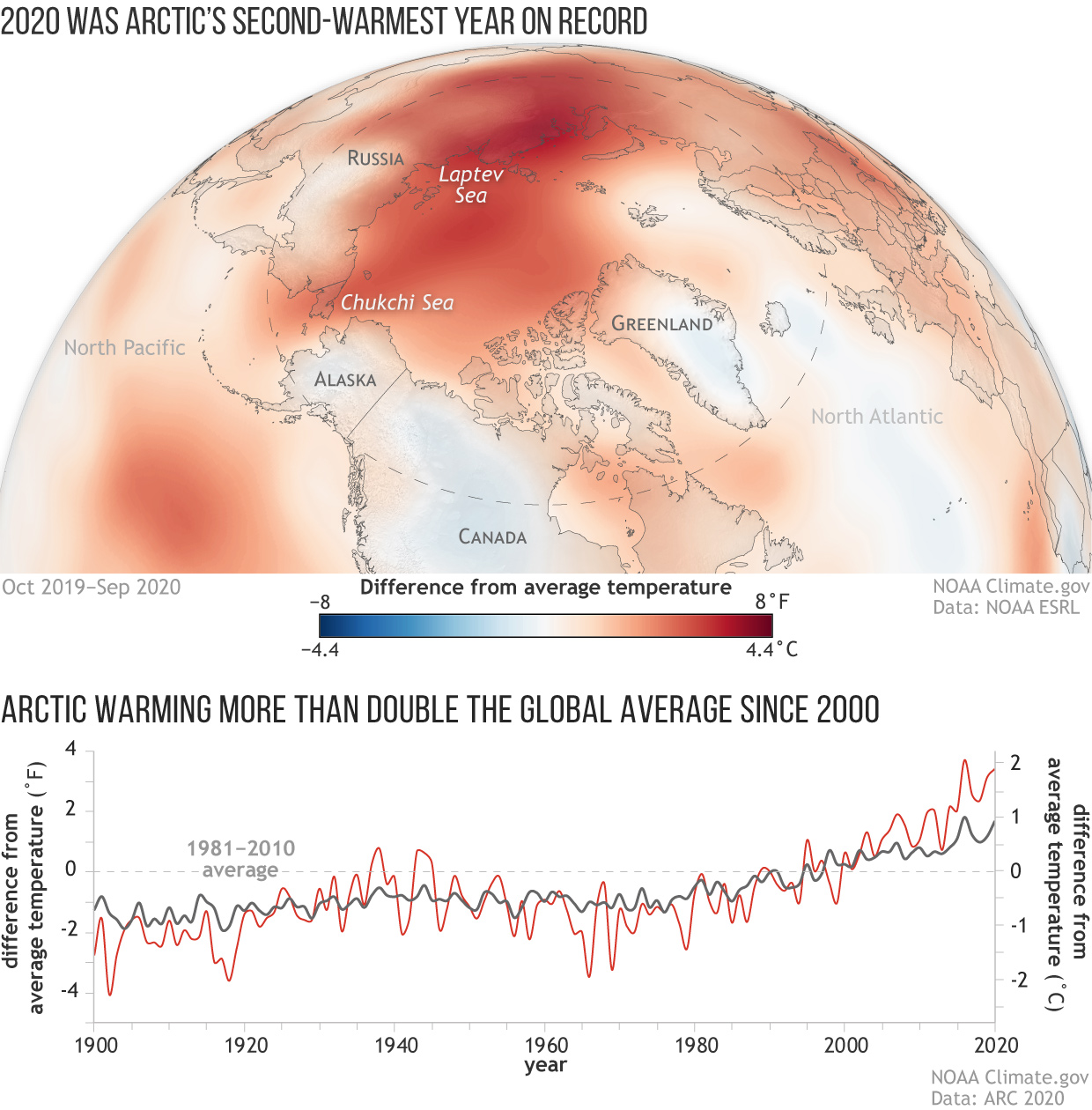
Therefore the term “climate change” for the extreme warming reaching +1.5°C over the continents and more than +3°C over the Arctic over a period of less than 100 years, requires reconsideration.
However, comparisons between the PETM and current global warming may be misleading since, by distinction from the current existence of large ice sheets on Earth, no ice was present about 55 million years ago.
 |
| Figure 3. (A) Reconstructed atmospheric CO₂ variations during the Late Cretaceous–early Tertiary, based on - Stomata indices of fossil leaf cuticles calibrated using inverse regression and stomatal ratios (Beerling et al. 2002); (B) Simulated atmospheric CO₂ at and after the Palaeocene-Eocene boundary (after Zeebe et al., 2009); (C) Global CO₂ and temperature during the last glacial termination (After Shakun et al., 2012) (LGM - Last Glacial Maximum; OD – Older dryas; BA - Bølling–Alerød; YD - Younger dryas) |
Observed climate complexities leading to the disturbance of linear temperature variations include:
In the shorter term such international targets as “zero emissions by 2050” apparently do not include the export of petroleum, coal and gas, thus allowing nations to circumvent domestic emission limits. Australia, the fifth biggest miner and third biggest exporter of fossil fuels, is responsible for about 5% of global greenhouse gas emissions.
At present the total CO₂+CH₄+N₂O level (mixing ratio) is near 500 ppm CO₂-equivalent (Figure 5). From the current atmospheric CO₂ level of above ~415 ppm, at the rise rate of 2 - 3 ppm/year, by 2050 the global CO₂ level would reach about 500 ppm and the CO₂-equivalent near 600 ppm, raising mean temperatures to near-2°C above preindustrial level, enhancing further breakdown of the large ice sheets and a further rise of sea levels.
- The weakening of climate zone boundaries, such as the circum-Arctic jet stream, allowing cold air and water masses to shift from polar to mid-latitude zones and tropical air masses to penetrate polar zones (Figure 4), induce collisions between air masses of contrasted temperatures and storminess, with major effects on continental margins and island chains.
- Amplifying feedbacks, including release of carbon from warming oceans due to reduced CO₂ solubility and therefore reduced intake from the atmosphere, release of methane from permafrost and from marine sediments, desiccated vegetation and extensive bush fires release of CO₂.
- The flow of cold ice melt water into the oceans from melting ice sheets—Greenland (Rahmstorf et al., 2015) and Antarctica (Bonselaer et al., 2018)—ensuing in stadial cooling effects, such as the Younger dryas and following peak interglacial phases during the last 800,000 years (Cortese et al., 2007; Glikson, 2019).
 |
| Figure 4. Weakening and undulation of the jet stream, shifts of climate zones and penetration of air masses across the weakened climate boundary. NOAA. |
At present the total CO₂+CH₄+N₂O level (mixing ratio) is near 500 ppm CO₂-equivalent (Figure 5). From the current atmospheric CO₂ level of above ~415 ppm, at the rise rate of 2 - 3 ppm/year, by 2050 the global CO₂ level would reach about 500 ppm and the CO₂-equivalent near 600 ppm, raising mean temperatures to near-2°C above preindustrial level, enhancing further breakdown of the large ice sheets and a further rise of sea levels.
 |
| Figure 5. Evolution of the CO₂+CH₄+N₂O level (mixing ratio) |
Friday, February 12, 2021
Ikonoclast on "Pure Economics"
“Pure Economics”. Ikonoclast, Real-World Economics Review Blog. Feb. 12, 2021
The whole idea that economics and the economy exist as a self contained discipline and a self-contained system respectively is absurd. First, there is a natural system, the biosphere, which contains economics activity and upon which economic activity is dependent. Second, there is politics and force (power) which condition economic activity.
In relation to the second, Chomsky writes of: “…American Liberalism, reiterated… in the Clinton doctrine, which held that the US has the right to resort to “unilateral use of power” to ensure “uninhibited access to key markets, supplies and strategic resources.” Not a right accorded to others, needless to say.”
Under these conditions, the pretense that there can be “pure economics” and a “science” of economics is absurd. It’s equally important to point out that these conditions (use of force to secure and retain strategic access to markets, supplies and strategic resources) show no sign of abating any time soon in human affairs.
The entire and so far successful attempt of capitalist economics has to been to ideologically and systemically “naturalize” itself, meaning make it seem natural and common sense to all its beneficiaries, and many of its bought-and-suborned wage-slaves and politicians, rather than a system of artifice, imposition, exploitation and appropriation.
Capitalist economics is an ideology through and through. Many of its behaviors, for which its useful fools (the bourgeois economists) seek fundamental laws, are axiomatically-determined outcomes based on its rules, parameters and algorithmic directives. Denying this is like saying that it’s a fundamental scientific law of American Football that all points are scored by crossing the plane of the in-game field to the end zone or by other actions in or from the end zone, like the safety. These are obviously not fundamental scientific laws. They are axiomatic outcomes of the rules and parameters of the competitive-cooperative game.
Behaviors in capitalist economics show a strong tendency to be axiomatic outcomes of the rules, parameters and algorithmic calculation prescriptions of cultural and institutional generation and instantiation. There are two limits sets to this proposition. The first limit set is the general set of natural limits (environmental limits and human biological limits). The second limit set is that of overt elite force. In the first case, the environment cannot be pushed beyond its natural limits. It will fail to supply resources and waste sinks adequately and it will “snap back” when pushed too far. Also, in the first case, humans cannot be pushed too far or they will starve, become exhausted or otherwise incommoded or discontented and they will “snap back”, in insurrection and rebellion which may be revolutionary or reactionary in nature). In the second case, the human elites apply force using security and military proxies, in the form of violence, killing, eviction, expulsion etc.
How can such a system be said to only have economic laws? It is quite absurd. It has economic prescriptions, framed by political prescriptions and applications including violence, framed by natural laws which condition the asymptote possibilities of the human rule system chosen. We need to choose rule systems compatible with natural system limits and compatible with moral philosophy prescriptions which take precedence over mere economic prescription. We already do this. Slave markets are not legal. Certain forms of pollution are not legal. We simply need to extend this thinking and reduce the ambit of the “algorithms of capitalism” and its false equation of equating many incommensurables in the numéraire.
This equates ideationally to the most ambitious project since the scientific enlightenment. It will mean getting people to cease believing that money measures value. This is the deepest and most fallacious belief of the modern mind. It is inculcated from the day each child begins to observe adults and learn language. It will be tremendously difficult to remove this false belief, this profound false consciousness of the modern mind.
Sunday, January 31, 2021
Covid is a pathetic prelude to the next act
Planetary Jeopardy. Ishi Nobu, Jan. 2, 2021

A mass extinction event is well underway, propagated by a burgeoning human population which has raped Nature with technological marvels in the name of ‘progress’. The graphs below show an exponential trend in human environmental impact.

There were less than 300 million hectares of croplands in 1600. Now over 1.5 billion hectares are plowed and planted.

Over 75% of the land on Earth has been scarred by human activity. 97% of the biologically richest ecosystems have been grievously damaged by humans. Yet deforestation continues, especially in tropical forests with the most abundant wildlife left on Earth.
There are over 65 million kilometers of roads crisscrossing the world’s lands. The very existence of these ribbons of death slices habitats into fragments, foreclosing viable lives for many animals. From an environmental perspective, what travels on these roads is pollution incarnate.
Shipping is the lifeblood of economic globalization. Over 60,000 colossal ships crisscross ocean trade routes, burning 2.2+ billion barrels of the foulest possible fuel. Besides massively polluting the oceans and killing large marine mammals, ships contribute ~2.5% of global greenhouse gas emissions.
Mass extinction is picking up pace. Vertebrate populations – amphibians, fish, reptiles, birds, and mammals – plummeted by an average 70% in the past 4 decades.
The decline in global insect populations has been even steeper, owing mostly to pesticides. As insects pollinate many plants and are voluminously significant in the animal food chain, their decimation is a harbinger for larger animal species, as well as spelling a decline for the multitude of crops which require pollination.
The extent of wildfires in Siberia and the western United States this year have been unprecedented. The burning will only worsen as time wears on. The toll will be further biosphere loss, an acceleration in warming, and an addition to air pollution.

The oceans are dying as well as the land. Coral reefs are home to 25% of the ocean’s fish. Those fish are food for much other sea life which doesn’t live there. 80% of the world’s coral reefs have died since their global peak in the mid-20th century. The rest will be gone by 2030.
As with greenhouse gas emissions, the pace of global warming is increasing in a nonlinear way. Climate modelers have been too conservative in their estimates. The worst-case scenario modelers have put out best matches what has gone on this century. It’s going to be a lot hotter sooner than climate modelers have let on.
The most salient – and little appreciated – fact about global warming is that there is an approximate 40-year lag between emissions and atmospheric hotting up. This owes to oceans absorbing ~95% of the initial warmth from greenhouse gas emissions. Essentially, the global atmospheric temperature now owes to emissions in the 1980s.
By 2060, average global air surface temperature is likely to be 4.8 °C above the 1880 benchmark. The hotter parts of the planet – notably portions of southern Asia and Africa – will be uninhabitable for humans by that time.
Global warming alone would be enough wipe out much life on Earth. The rape of Nature otherwise simply ensures more extinction.
A growing scarcity of drinking water, and an increase in global hunger and poverty, are already happening. Harvests peaked worldwide in the mid-1990s. Yields have declined since. The combination of more severe storms, drought, and sporadic flooding are only going to further reduce agricultural production and raise food prices. There is no turnaround in sight for this trend.
Humanity’s ecological wallop is obviously unsustainable. Let’s consider what might be done to ameliorate the damage.
The most significant fact about the mass extinction event underway is its extent. The scale is staggering.
What that means is that piecemeal measures will prove wholly inadequate. Planting trees as a supposed amelioration to deforestation is a childish publicity stunt – only illustrative of how optimistically ignorant people are. Ecosystems aren’t refurbished by planting trees.
A ridiculous notion that will be increasingly brought up to address global warming is geoengineering. This is about as savvy as the “better living through chemistry” program of the post-WW2 era that begat the burgeoning production of pesticides and plastic.
Technology cannot fix what technology created. Not only is it infeasible and inadequate, it’s way too late to make any difference. Technology cannot bring dead creatures back to life, restore ecosystems, or even reverse the intricate dynamics of biospheric degradation that humanity committed itself to – for the luxury of more convenient or adventurous lives and the greedy accumulation of riches by the relative few.
The last refuge of climate deniers was that humans simply could not make that big a dent on the global environment. Geoengineers are on the opposite end of that silly spectrum in thinking that machines can put into reverse on a planetary scale what is accelerating in fast forward.
Another foolhardy endeavor is the promotion of “clean” energy. There is no such thing as clean energy. Taking more from Nature to generate more electricity is not environmental friendliness, even if it does lessen the extraction and burning of fossil fuels. More is not less, even if it draws its initial inspiration from the Sun.
In terms of energy, what is most bizarre is that energy conservation is seldom touted nowadays: a signification that humanity has lost any sense of discipline. Along that line, lessening food waste and limiting population growth go unsung as helpful gestures toward self-preservation. Nearly half of the food grown globally goes uneaten.

Wasting less food requires the same sort of societal organization that dealing with the covid-19 pandemic presented – and we know how well that is turning out.
The perils of unbridled population growth had been known long before the 17th century, when Thomas Malthus made himself unpopular by pointing the problem out at the onset of industrialization. Enforcing social distancing to avoid viral contagion is a truly tiny potato compared to stopping adults from indulging the core biological urge of dancing the horizontal tango.
The number of mouths to feed is not going to be a problem for much longer. Instead, the die-off is going to begin in earnest. The census of people on the planet will peak within the next decade or so before staring a precipitous decline.
Now we come to the nut of the problem. If plutocracy abides, not only will inequity and societal injustice continue to thrive, but the body count from it will climb to truly alarming numbers thanks to capitalism’s cumulative environmental toll.
As this brief survey shows, the mass extinction event underway is a systemic dynamic that may only addressed with a systemic solution. And the hour is running late indeed.
The covid pandemic highlights how humanity now collectively responds to a global crisis: panicked, uncoordinated to the point of disorganized, covetous and cantankerously disobedient. Covid is a pathetic prelude to the next act.
The bottom line: the only societies that have any chance of survival are those that adopt eusocialism. Self-sustaining survival cities must be established to ride out the biospheric decimation gathering force.
World civilization will collapse by 2070. Humans will be extinct by the end of the century.
Suggested further reading:
Ishi Nobu, The Fruits of Civilization (2019).
Ishi Nobu, “Environment” essays.
“Living planet report 2020,” World Wildlife Federation (2020).
Wednesday, January 27, 2021
CJ & CJ -- CJ Hopkins and Caitlin Johnstone.... oh, and MJ too
That’s All Folks!
Authored (mostly satirically) by CJ Hopkins via The Consent Factory. Jan.24, 2021.
As they used to say at the end of all those wacky Looney Tunes cartoons, that’s all folks! The show is over. Literal Russian-Asset Hitler, the Latest Greatest Threat to Western Democracy, the Monster of Mar-a-Lago, Trumpzilla, Trumpenstein, the Ayatollah of Orange Shinola, has finally been humiliated and given the bum-rush out of Washington by the heroic forces of the GloboCap “Resistance,” with a little help from the US military. The whole thing went exactly to script.
Well … OK, not quite exactly to script. Despite four years of dire warnings by the corporate media, the Intelligence Community, Hollywood celebrities, the Democratic Party, faux anti-fascists, fake-Left pundits, and pretty much every utterly deluded, Trump-obsessed liberal with an Internet connection, there was no Hitlerian “Reichstag Fire,” no Boogaloo, no Civil War II, no coup, no white-supremacist uprising. Nothing. The man simply got on a chopper and was flown away to his Florida resort.
I know, you’re probably thinking …
As they used to say at the end of all those wacky Looney Tunes cartoons, that’s all folks! The show is over. Literal Russian-Asset Hitler, the Latest Greatest Threat to Western Democracy, the Monster of Mar-a-Lago, Trumpzilla, Trumpenstein, the Ayatollah of Orange Shinola, has finally been humiliated and given the bum-rush out of Washington by the heroic forces of the GloboCap “Resistance,” with a little help from the US military. The whole thing went exactly to script.
Well … OK, not quite exactly to script. Despite four years of dire warnings by the corporate media, the Intelligence Community, Hollywood celebrities, the Democratic Party, faux anti-fascists, fake-Left pundits, and pretty much every utterly deluded, Trump-obsessed liberal with an Internet connection, there was no Hitlerian “Reichstag Fire,” no Boogaloo, no Civil War II, no coup, no white-supremacist uprising. Nothing. The man simply got on a chopper and was flown away to his Florida resort.
I know, you’re probably thinking …
“Wow, how embarrassing for the GloboCap ‘Resistance,’ being exposed as a bunch of utterly shameless, neo-Goebbelsian propagandists, and liars, and hysterical idiots, and such!”
And, in any other version of reality, you’d have a point … but not in this one.
No, in this reality, “Democracy Has Prevailed!” Yes, it was touch and go there for a while, as there was no guarantee that the Intelligence Community, the military-industrial complex, Western governments, the corporate media, supranational corporations, Internet oligarchs, and virtually every other component of the global-capitalist empire could keep one former game show host with no real political power whatsoever from taking over the entire world.
Still, Trump’s failure to go full-Hitler, or even half-Hitler, was somewhat awkward. I mean, you can’t whip millions of people into a four-year frenzy of fear and hatred of a clearly powerless ass-clown president, and portray him as a Russian Intelligence asset, and the Son of Hitler, and all the rest of it, and then just drop the act cold and laugh in their faces. That would leave them feeling like total morons who had just spent the last four years of their lives being lied to and emotionally manipulated, or like members of a cult, or something.
Fortunately, for GloboCap, this was not a major problem. All they had to do was produce a cheap simulation of “Trump going full-Hitler.” It didn’t even have to be convincing. They just needed a semi-dramatic event to plug into the official narrative, something they could call “an attempted coup,” “an insurrection,” “an attack,” and so on, and which millions of credulous liberals could hysterically shriek about on the Internet.
The “Storming of the Capitol” did the trick.
They held a dress rehearsal in Berlin last August, and then gave the real performance in the Capitol Building (this time it was for all the money, so they went ahead and got a couple people killed). It wasn’t very hard to pull off. All they actually had to do, in both Berlin and DC, was allow a small fringe group of angry protesters to gain access to the building, film it, and then pump out the “attempted coup” narrative. It made no difference whatsoever that the “domestic terrorists” (in both Berlin and Washington) were a completely unorganized, unarmed mob that posed absolutely zero threat of “staging a coup” and “overthrowing the government.” It also made not the slightest difference that Trump didn’t actually “incite” the mob (yes, I put myself through the agony of reading every word of his speech, which was the usual word salad from start to finish). We’re talking propaganda here, not reality.
The so-called “Violent Storming of the Capitol” set the stage for the main event, which was the show of force we have all just witnessed. Someone (I’m not entirely clear who) ordered in the troops, tens of thousands of them, locked down Washington, erected fences, set up road blocks and military check points, and otherwise occupied the government district. It looked like any other US-military post-“regime-change” occupation, because that’s what it was, which was precisely the point. As I have been repeating for … well, for over four years now, it was always going to end this way, with GloboCap making an example of Trump and reminding everyone who is really in charge.
Look, let’s be clear about these last four years, because there are all kinds of crazy theories going around (not to mention the official GloboCap narrative), but what actually happened is pretty simple. Here’s the whole story, as concise as I can make it.
This, basically, is what we’ve just experienced. The global capitalist ruling classes have just reminded us who is really in charge, who the US military answers to, and how quickly they can strip away the facade of democracy and the rule of law. They have reminded us of this for the last ten months, by putting us under house arrest, beating and arresting us for not following orders, for not wearing masks, for taking walks without permission, for having the audacity to protest their decrees, for challenging their official propaganda, about the virus, the election results, etc. They are reminding us currently by censoring dissent, and deplatforming anyone they deem a threat to their official narratives and ideology.
In other words, GloboCap is teaching us a lesson. I don’t know how much clearer they could make it. They just installed a new puppet president, who can’t even simulate mental acuity, in a locked-down, military-guarded ceremony which no one was allowed to attend, except for a few members of the ruling classes. They got some epigone of Albert Speer to convert the Mall (where the public normally gathers) into a “field of flags” symbolizing “unity.” They even did the Nazi “Lichtdom” thing. To hammer the point home, they got Lady Gaga to dress up as a Hunger Games character with a “Mockingjay” brooch and sing the National Anthem. They broadcast this spectacle to the entire world.
And the lesson isn’t quite over yet … it won’t be over for a while. The “War on Populism” will simply morph into the “New Normal War on Domestic Terror,” which will become one more theater in the “Global War on Terror,” which has been on hiatus, and which will now resume. As I have pointed out repeatedly over the past four years, we appear to be headed toward a dystopian future in which there will essentially be two classes of people: (a) “normals” (i.e., those who conform to global-capitalist ideology and decrees); and (b) the “extremists” (i.e., those who don’t).
It will make no difference whatsoever what type of “extremists” these “extremists” are … religious-fundamentalist extremists, Islamic extremists, Christian extremists, right-wing extremists, left-wing extremists, white-supremacist or Black-nationalist extremists, virus deniers, anti-vaxxers, conspiracy theorists, anti-maskers, recalcitrant transphobians, anti-transhumanists, pronoun resisters, defiant oppositionalists, or whatever … the names don’t really matter. The point is, conform or be labelled an “extremist,” a “domestic terrorist,” or some other type of “antisocial person” or “social deviant,” or “potential threat to public health.”
I don’t claim to know every detail, but one thing seems abundantly clear. We are not going back to the way things were. GloboCap has been explaining this to us, over and over, for almost a year. They couldn’t have made it any more explicit. When they warned us to get ready because a “New Normal” was coming, they meant it.
And now … well … here it is.
No, in this reality, “Democracy Has Prevailed!” Yes, it was touch and go there for a while, as there was no guarantee that the Intelligence Community, the military-industrial complex, Western governments, the corporate media, supranational corporations, Internet oligarchs, and virtually every other component of the global-capitalist empire could keep one former game show host with no real political power whatsoever from taking over the entire world.
Still, Trump’s failure to go full-Hitler, or even half-Hitler, was somewhat awkward. I mean, you can’t whip millions of people into a four-year frenzy of fear and hatred of a clearly powerless ass-clown president, and portray him as a Russian Intelligence asset, and the Son of Hitler, and all the rest of it, and then just drop the act cold and laugh in their faces. That would leave them feeling like total morons who had just spent the last four years of their lives being lied to and emotionally manipulated, or like members of a cult, or something.
Fortunately, for GloboCap, this was not a major problem. All they had to do was produce a cheap simulation of “Trump going full-Hitler.” It didn’t even have to be convincing. They just needed a semi-dramatic event to plug into the official narrative, something they could call “an attempted coup,” “an insurrection,” “an attack,” and so on, and which millions of credulous liberals could hysterically shriek about on the Internet.
The “Storming of the Capitol” did the trick.
They held a dress rehearsal in Berlin last August, and then gave the real performance in the Capitol Building (this time it was for all the money, so they went ahead and got a couple people killed). It wasn’t very hard to pull off. All they actually had to do, in both Berlin and DC, was allow a small fringe group of angry protesters to gain access to the building, film it, and then pump out the “attempted coup” narrative. It made no difference whatsoever that the “domestic terrorists” (in both Berlin and Washington) were a completely unorganized, unarmed mob that posed absolutely zero threat of “staging a coup” and “overthrowing the government.” It also made not the slightest difference that Trump didn’t actually “incite” the mob (yes, I put myself through the agony of reading every word of his speech, which was the usual word salad from start to finish). We’re talking propaganda here, not reality.
The so-called “Violent Storming of the Capitol” set the stage for the main event, which was the show of force we have all just witnessed. Someone (I’m not entirely clear who) ordered in the troops, tens of thousands of them, locked down Washington, erected fences, set up road blocks and military check points, and otherwise occupied the government district. It looked like any other US-military post-“regime-change” occupation, because that’s what it was, which was precisely the point. As I have been repeating for … well, for over four years now, it was always going to end this way, with GloboCap making an example of Trump and reminding everyone who is really in charge.
Look, let’s be clear about these last four years, because there are all kinds of crazy theories going around (not to mention the official GloboCap narrative), but what actually happened is pretty simple. Here’s the whole story, as concise as I can make it.
Back in 2016, the American people, sick to the gills of global capitalism and its increasingly oppressive woke ideology, elected an unauthorized, narcissistic ass-clown to the highest office in the land. They did this for a variety of reasons, but mostly it was just a big “fuck you” to the establishment. It was an act of rebellion against a government which they know is owned by unaccountable, supranational corporations and oligarchs who openly detest them. It was an act of rebellion against a system of government they know they have no influence over, and are not going to have any influence over. It was an act of rebellion against global capitalism, the unopposed, global-hegemonic system which has dominated the world for the last thirty years … whether they realized what they were rebelling against or not.
This act of rebellion happened on the heels of Brexit (another such act of rebellion) and in the context of the rise of assorted “populist” movements all throughout the world. When Trump actually won in 2016, the global capitalist ruling classes realized they had a serious problem … a “populist” rebellion in the heart of the empire. So they suspended the Global War on Terror and launched the War on Populism.
The ultimate objective of the War on Populism was to neutralize this “populist” rebellion and remind the public who is actually running things. Think of the Trump era as a prison riot. In any maximum security prison, the prisoners know they can’t escape, but they can definitely raise a little hell now and then, which they tend to do when they get really tired of being abused and neglected by the prison guards. Most prison riots run out of steam on their own, but if they go on too long or get too ugly, the penal authorities typically respond by shooting a few prisoners (usually the ringleaders), and reminding the inmates that they are in a prison, and that the owners of the prison have guns, whereas they have shivs made out of spoons and toothbrushes.
This, basically, is what we’ve just experienced. The global capitalist ruling classes have just reminded us who is really in charge, who the US military answers to, and how quickly they can strip away the facade of democracy and the rule of law. They have reminded us of this for the last ten months, by putting us under house arrest, beating and arresting us for not following orders, for not wearing masks, for taking walks without permission, for having the audacity to protest their decrees, for challenging their official propaganda, about the virus, the election results, etc. They are reminding us currently by censoring dissent, and deplatforming anyone they deem a threat to their official narratives and ideology.
In other words, GloboCap is teaching us a lesson. I don’t know how much clearer they could make it. They just installed a new puppet president, who can’t even simulate mental acuity, in a locked-down, military-guarded ceremony which no one was allowed to attend, except for a few members of the ruling classes. They got some epigone of Albert Speer to convert the Mall (where the public normally gathers) into a “field of flags” symbolizing “unity.” They even did the Nazi “Lichtdom” thing. To hammer the point home, they got Lady Gaga to dress up as a Hunger Games character with a “Mockingjay” brooch and sing the National Anthem. They broadcast this spectacle to the entire world.
And the lesson isn’t quite over yet … it won’t be over for a while. The “War on Populism” will simply morph into the “New Normal War on Domestic Terror,” which will become one more theater in the “Global War on Terror,” which has been on hiatus, and which will now resume. As I have pointed out repeatedly over the past four years, we appear to be headed toward a dystopian future in which there will essentially be two classes of people: (a) “normals” (i.e., those who conform to global-capitalist ideology and decrees); and (b) the “extremists” (i.e., those who don’t).
It will make no difference whatsoever what type of “extremists” these “extremists” are … religious-fundamentalist extremists, Islamic extremists, Christian extremists, right-wing extremists, left-wing extremists, white-supremacist or Black-nationalist extremists, virus deniers, anti-vaxxers, conspiracy theorists, anti-maskers, recalcitrant transphobians, anti-transhumanists, pronoun resisters, defiant oppositionalists, or whatever … the names don’t really matter. The point is, conform or be labelled an “extremist,” a “domestic terrorist,” or some other type of “antisocial person” or “social deviant,” or “potential threat to public health.”
I don’t claim to know every detail, but one thing seems abundantly clear. We are not going back to the way things were. GloboCap has been explaining this to us, over and over, for almost a year. They couldn’t have made it any more explicit. When they warned us to get ready because a “New Normal” was coming, they meant it.
And now … well … here it is.
Be Your Own Revolution. Caitlin Johnstone. Jan. 27, 2021.
I made the mistake of involving myself in a sectarian Twitter spat when I was halfway through my morning coffee today and I instantly felt like an idiot.
People from the Left Twitter faction I’d offended rushed in to push back against the offense I’d caused them, and within minutes I felt it: the all-too familiar sensation of inspiration and creativity draining away from my body. Tension, coldness and defensiveness where previously there was playfulness and the crackling sensation of an exciting new day in which anything was possible.
If you’re active online, you’ve probably experienced this too. The days when you’re involved in sectarian bickering are the days when you are at your least creative, your least inspired, and your least effective at fighting against the machine. At best the drama gives your ego a tickle (as social media platforms are designed to do), after which you feel a bit yuck. The longer you engage in it, the lower the probability that you will produce something creative and inspired that day.
As a general rule, you may find that it works best to reject cliques and factions altogether. When you “belong” to any group you feel compelled to defend it, and to move with it wherever it goes even if that’s not where you feel like the energy is. You get invested in wanting the collective to move in a certain direction, and you get frustrated when it just wants to focus on silly nonsense and sectarian feuds.
So my advice to you here, which you of course can take or leave, is to just blast off on your own and fight your own revolution in your own way.
The unfortunate fact is that our society is insane, and its madness pervades literally every political faction to varying degrees. Marrying yourself to any group means marrying its madness. Instead, focus on becoming more sane, and then act based on that sanity.
Just blast off. Don’t wait for your comrades. Don’t try to pull them along with you before they are ready. Just blast forward into your own revolution, burning brightly and scorching the machine with your own light. If you shine brightly enough, the others may follow when they are ready.
One of the most frustrating things is seeing where we need to move and not being able to get the collective to come with you. You’re like, “It’s there! Let’s move!”, and they just want to bicker and ego spar. Just blast off into health yourself, and trust that the others will follow if and when they are able.
Be your own revolution. You have all the media access you need to help wake the world up with the power of your own inspired action. Reject cliques, factions and sectarianism, and have the courage to stand on your own two feet attacking the machine with your own unique abilities.
This doesn’t mean you can’t organize and work collectively; you absolutely can. If you see people doing something you want to uplift, uplift it. But when you’re done, don’t stay and become a member of the club. Move on and retain your self-sovereignty. If you’re doing something that people want to help uplift and amplify, let them do so. When they don’t want to anymore, let them go. Don’t try to manipulate them into staying.
You are free to collaborate with anyone on any issue at any time. You don’t actually need to be a member of the Blah Blah Whateverist Club to do this. And when nothing is happening that you want to collaborate with others on, you can attack the machine on your own, using your own unique set of tools based on your own inspiration. You are not owned or bound.
All these debates we’re seeing lately over who should be let into and kept out of the Revolution Club, how the Revolution Club should act, who should lead the Revolution Club etc are based on the assumption that there has to be a Revolution Club in the first place, and there just doesn’t. Organize and collaborate on a case-by-case, issue-by-issue basis while remaining sovereign.
Have the compassion to prioritize the needs of the collective and the courage to stand as an individual. Trying to impose your will on exactly how the collective revolution should and should not be moving is a doomed endeavor, because you cannot control the collective, you can only control yourself. So be your own revolution and attack the machine wherever you detect a weak point in its armor.
I’ve avoided all cliques and factions like the plague, and I’ve been far more effective in this fight than I would have been if I’d chosen to glom onto some faction and uphold all its -ists and -isms. It would have killed my ability to move with agility in whatever way is demanded by each present moment, because I would have been binding myself to the movements of a group that isn’t seeing what I’m seeing and can’t move the way I move.
This is just what’s worked for me, and of course your mileage may vary. But if you’re like me and you don’t see the various groups, organizations and factions getting us to where we need to go, consider stepping out of the vehicle, standing on your own two feet, and waging your own revolution.
Get Used to Living under “Subsidiarity” after The Great Reset. Mark Jeftovic. Jan. 25, 2021.
....
What it will lead to is The Great Bifurcation, the 3rd Scenario I posited in The Jackpot Chronicles. Much has come into focus now since I wrote that just this past summer.
If The Great Reset comes about, and I think it’s already here, it will lead to that two tier society where the world’s underclass are governed algorithmically via smartphones, digital, programmable scrip (UBI) and well ordered dopamine hits. Meanwhile the far smaller populace that actually owns all the assets globally live in a parallel universe where they retain agency, freedom of movement, diet, and thought.
On my mailing list I talk about what we can do as individuals to try and get clear of The Great Reset. Because even if we loathe this with every fibre of our being, find it oppressive and tyrannical, anti-human, anti-spirit and soulless, we won’t be able to do anything about it from the wrong side of the impermeable membrane that will very soon cordon off the haves from the haves-nots.
We have to defend our liberties, our civil rights and our assets in the New Normal. In a worst case scenario it’ll require forming an underground network a la Isaac Assimov’s Foundation. The Foundation’s stated purpose was to survive the onset of a Galactic Dark Age and preserve the accumulated culture and wisdom of a civilization that had irrevocably embarked on a path that would trigger its own demise.
Now more than ever it is important we all try to improve things from the grass roots level as the Stakeholder Capitalism rubric may be the last gasp of a system about to come off the rails completely or after a prolonged period of disruption and tyranny.
Saturday, January 23, 2021
Bradshaw et al: Ghastly Future
Expert prognosis for the planet – we’re on track for a ghastly future. Corey J. A. Bradshaw. January 13, 2021.
An international group of 17 leading scientists have produced a comprehensive yet concise assessment of the state of civilization, warning that the outlook is more dire and dangerous than is generally understood.
A loss of biodiversity and accelerating climate change in the coming decades coupled with ignorance and inaction is threatening the survival of all species, including our very own, according to the experts from institutions including Stanford University, UCLA, and Flinders University.
The researchers state that world leaders need a ‘cold shower’ regarding the state of our environment both to plan and act to avoid a ghastly future.
Lead author Professor Corey Bradshaw of Flinders University in Australia says he and his colleagues have summarized the state of the natural world in stark form to help clarify the gravity of the human predicament.
“Humanity is causing a rapid loss of biodiversity and, with it, Earth’s ability to support complex life. But the mainstream is having difficulty grasping the magnitude of this loss, despite the steady erosion of the fabric of human civilization,” Professor Bradshaw says.
“In fact, the scale of the threats to the biosphere and all its lifeforms is so great that it is difficult to grasp for even well-informed experts. The problem is compounded by ignorance and short-term self-interest, with the pursuit of wealth and political interests stymying the action that is crucial for survival,” he says.
Professor Paul Ehrlich of Stanford University says that no political or economic system, or leadership, is prepared to handle the predicted disasters, or even capable of such action.
“Stopping biodiversity loss is nowhere close to the top of any country’s priorities, trailing far behind other concerns such as employment, healthcare, economic growth, or currency stability. While it is positive news that President-elect Biden intends to reengage the US in Paris Climate accord within his first 100 days of office, it is a minuscule gesture given the scale of the challenge. Humanity is running an ecological Ponzi scheme in which society robs nature and future generations to pay for short-term economic enhancement today”.
“Most economies operate on the basis that counteraction now is too costly to be politically palatable. Combined with disinformation campaigns to protect short-term profits it is doubtful that the scale of changes we need will be made in time,” Professor Ehrlich says.
Professor Dan Blumstein from UCLA says the scientists are choosing to speak boldly and fearlessly because life literally depends on it. “What we are saying might not be popular, and indeed is frightening. But we need to be candid, accurate, and honest if humanity is to understand the enormity of the challenges we face in creating a sustainable future. Without political will backed by tangible action that scales to the enormity of the problems facing us, the added stresses to human health, wealth, and well-being will perversely diminish our political capacity to mitigate the erosion of the Earth’s life-support system upon which we all depend. Human population growth and consumption continues to escalate, and we’re still more focused on expanding human enterprise than we are on devising and implementing solutions to critical issues such as biodiversity loss. By the time we fully comprehend the impact of ecological deterioration, it will be too late. Without fully appreciating and broadcasting the scale of the problems and the enormity of the solutions required, society will fail to achieve even modest sustainability goals, and catastrophe will surely follow”.
The experts say their ‘perspective’ paper, which cites more than 150 studies, seeks to outline clearly and unambiguously the likely future trends in biodiversity decline, mass extinction, climate disruption, planetary toxification, all tied to human consumption and population growth to demonstrate the near certainty that these problems will worsen over the coming decades, with negative impacts for centuries to come. It also explains the impact of political impotence and the ineffectiveness of current and planned actions to address the ominous scale of environmental erosion. Summary of major environmental-change categories expressed as percentage relative to the baseline given in the text. Red indicates the percentage of the category that is damaged, lost, or otherwise affected, whereas blue indicates the percentage that is intact, remaining, or otherwise unaffected.
Prof Corey J. A. Bradshaw: Global Ecology, College of Science and Engineering, Flinders University; Australian Research Council Centre of Excellence for Australian Biodiversity and Heritage, EpicAustralia.org
Prof Paul R. Ehrlich: Department of Biology, Stanford University, USA
Prof Daniel T. Blumstein: Department of Ecology and Evolutionary Biology and the Institute of the Environment and Sustainability, University of California, Los Angeles, USA
Emeritus Prof Andrew Beattie: Department of Biological Sciences, Macquarie University, Australia
Dr Gerardo Ceballos: Institute of Ecology, National Autonomous University of Mexico, Mexico
Emeritus Associate Prof Eileen Crist: Department of Science, Technology, and Society, Virginia Tech, USA
Joan Diamond: Millennium Alliance for Humanity and the Biosphere, Stanford University, USA
Prof Rodolfo Dirzo: Department of Biology, Stanford University, USA
Emeritus Dr Anne H. Ehrlich: Department of Biology, Stanford University, USA
Prof John Harte: Energy and Resources Group, University of California, Berkeley, USA; The Rocky Mountain Biological Laboratory, USA
Dr Mary Ellen Harte: The Rocky Mountain Biological Laboratory, USA
Prof Graham Pyke: Department of Biology, Stanford University, USA; The Rocky Mountain Biological Laboratory, USA
Dr Peter H. Raven: Missouri Botanical Garden, USA
Prof William J. Ripple: Department of Forest Ecosystems and Society, Oregon State University, USA
Dr Frédérik Saltré: Global Ecology, College of Science and Engineering, Flinders University; Australian Research Council Centre of Excellence for Australian Biodiversity and Heritage, EpicAustralia.org
Dr Christine Turnbull: Department of Biological Sciences, Macquarie University, Australia
Dr Mathis Wackernagel: Global Footprint Network, USA
Original article: Underestimating the challenges of avoiding a ghastly future
An international group of 17 leading scientists have produced a comprehensive yet concise assessment of the state of civilization, warning that the outlook is more dire and dangerous than is generally understood.
A loss of biodiversity and accelerating climate change in the coming decades coupled with ignorance and inaction is threatening the survival of all species, including our very own, according to the experts from institutions including Stanford University, UCLA, and Flinders University.
The researchers state that world leaders need a ‘cold shower’ regarding the state of our environment both to plan and act to avoid a ghastly future.
► Read original article
► Download original article (pdf)
Lead author Professor Corey Bradshaw of Flinders University in Australia says he and his colleagues have summarized the state of the natural world in stark form to help clarify the gravity of the human predicament.
“Humanity is causing a rapid loss of biodiversity and, with it, Earth’s ability to support complex life. But the mainstream is having difficulty grasping the magnitude of this loss, despite the steady erosion of the fabric of human civilization,” Professor Bradshaw says.
“In fact, the scale of the threats to the biosphere and all its lifeforms is so great that it is difficult to grasp for even well-informed experts. The problem is compounded by ignorance and short-term self-interest, with the pursuit of wealth and political interests stymying the action that is crucial for survival,” he says.
Professor Paul Ehrlich of Stanford University says that no political or economic system, or leadership, is prepared to handle the predicted disasters, or even capable of such action.
“Stopping biodiversity loss is nowhere close to the top of any country’s priorities, trailing far behind other concerns such as employment, healthcare, economic growth, or currency stability. While it is positive news that President-elect Biden intends to reengage the US in Paris Climate accord within his first 100 days of office, it is a minuscule gesture given the scale of the challenge. Humanity is running an ecological Ponzi scheme in which society robs nature and future generations to pay for short-term economic enhancement today”.
“Most economies operate on the basis that counteraction now is too costly to be politically palatable. Combined with disinformation campaigns to protect short-term profits it is doubtful that the scale of changes we need will be made in time,” Professor Ehrlich says.
Professor Dan Blumstein from UCLA says the scientists are choosing to speak boldly and fearlessly because life literally depends on it. “What we are saying might not be popular, and indeed is frightening. But we need to be candid, accurate, and honest if humanity is to understand the enormity of the challenges we face in creating a sustainable future. Without political will backed by tangible action that scales to the enormity of the problems facing us, the added stresses to human health, wealth, and well-being will perversely diminish our political capacity to mitigate the erosion of the Earth’s life-support system upon which we all depend. Human population growth and consumption continues to escalate, and we’re still more focused on expanding human enterprise than we are on devising and implementing solutions to critical issues such as biodiversity loss. By the time we fully comprehend the impact of ecological deterioration, it will be too late. Without fully appreciating and broadcasting the scale of the problems and the enormity of the solutions required, society will fail to achieve even modest sustainability goals, and catastrophe will surely follow”.
The experts say their ‘perspective’ paper, which cites more than 150 studies, seeks to outline clearly and unambiguously the likely future trends in biodiversity decline, mass extinction, climate disruption, planetary toxification, all tied to human consumption and population growth to demonstrate the near certainty that these problems will worsen over the coming decades, with negative impacts for centuries to come. It also explains the impact of political impotence and the ineffectiveness of current and planned actions to address the ominous scale of environmental erosion.
 Summary of major environmental-change categories expressed as percentage relative to the baseline given in the text. Red indicates the percentage of the category that is damaged, lost, or otherwise affected, whereas blue indicates the percentage that is intact, remaining, or otherwise unaffected.
Prof Corey J. A. Bradshaw: Global Ecology, College of Science and Engineering, Flinders University; Australian Research Council Centre of Excellence for Australian Biodiversity and Heritage, EpicAustralia.org
Prof Paul R. Ehrlich: Department of Biology, Stanford University, USA
Prof Daniel T. Blumstein: Department of Ecology and Evolutionary Biology and the Institute of the Environment and Sustainability, University of California, Los Angeles, USA
Emeritus Prof Andrew Beattie: Department of Biological Sciences, Macquarie University, Australia
Dr Gerardo Ceballos: Institute of Ecology, National Autonomous University of Mexico, Mexico
Emeritus Associate Prof Eileen Crist: Department of Science, Technology, and Society, Virginia Tech, USA
Joan Diamond: Millennium Alliance for Humanity and the Biosphere, Stanford University, USA
Prof Rodolfo Dirzo: Department of Biology, Stanford University, USA
Emeritus Dr Anne H. Ehrlich: Department of Biology, Stanford University, USA
Prof John Harte: Energy and Resources Group, University of California, Berkeley, USA; The Rocky Mountain Biological Laboratory, USA
Dr Mary Ellen Harte: The Rocky Mountain Biological Laboratory, USA
Prof Graham Pyke: Department of Biology, Stanford University, USA; The Rocky Mountain Biological Laboratory, USA
Dr Peter H. Raven: Missouri Botanical Garden, USA
Prof William J. Ripple: Department of Forest Ecosystems and Society, Oregon State University, USA
Dr Frédérik Saltré: Global Ecology, College of Science and Engineering, Flinders University; Australian Research Council Centre of Excellence for Australian Biodiversity and Heritage, EpicAustralia.org
Dr Christine Turnbull: Department of Biological Sciences, Macquarie University, Australia
Dr Mathis Wackernagel: Global Footprint Network, USA
Original article: Underestimating the challenges of avoiding a ghastly future
Sunday, January 17, 2021
Blair Fix on moving to a non-growth world
Living the good life in a non-growth world: Investigating the role of hierarchy. Blair Fix. Jan. 5, 2021.
This is the first of two essays written for (and supported by) the Seoul Platform for Initiating Discourses on an Equitable and Resilient Society. These essays investigate the role that hierarchy plays in driving inequality and unsustainability. This piece introduces the facts of hierarchy. The second (long-form) essay will look at how these facts relate to ‘living the good life in a non-growth world’.
This is the first of two essays written for (and supported by) the Seoul Platform for Initiating Discourses on an Equitable and Resilient Society. These essays investigate the role that hierarchy plays in driving inequality and unsustainability. This piece introduces the facts of hierarchy. The second (long-form) essay will look at how these facts relate to ‘living the good life in a non-growth world’.
Sustainability or bust
For the past 200 years, humanity has conducted an unintended experiment. The (tacit) research question is this: how much of the Earth’s resources can one species consume? We have yet to find out the answer … nor do we want to.
By nearly all indicators, humanity is doing immense damage to the biosphere. We are using non-renewable resources at a feverish pace [1]. Wemay be causing the Earth’s sixth mass extinction [2]. And perhaps most alarmingly, we are changing the climate in a way that could put civilization at risk [3]. It is time, then, for our unintended experiment to stop. Instead of plumbing the depths of unsustainability, we must do the opposite. Humanity must become sustainable. The question is, how?
In one sense, the answer is simple. Our impact on the environment is a function of two things: (1) how many people there are; and (2) the amount of resources each person consumes [4]. Becoming sustainable is therefore easy in principle. It requires reducing the human population and reducing resource consumption per person. And yet beneath this simple formula is a web of complexity (and confusion). Here, I will ignore population reduction (which is itself controversial). I will focus on achieving sustainability by reducing per capita resource use.
Mainstream discussions of sustainability tend to focus on efficiency [5,6]. If we can use resources more efficiently, the thinking goes, we will lessen our environmental impact. The problem, though, is that there is little evidence that this is true. Our energy conversion technologies, for instance, have been getting more efficient for two centuries [7]. Yet this greater efficiency has not caused us to consume fewer energy resources. Instead, we are using more than ever. In fact, itmay be that efficiency is a primary driver of resource consumption. The reason is simple: more efficient technology tends to lower costs, which then makes resources cheaper. And so we consume more of them [8].
Outside the mainstream, more emphasis is put on directly reducing resource use by consuming less. This thinking goes by many names, but here I will refer to it as ‘degrowth’. The idea is that instead of pursuing economic growth, we should learn how to live with less. We should voluntarily ‘degrow’ the economy [9,10].
My view is that degrowth is the only sound option for becoming sustainable. I will leave aside the question of how much we need to degrow. Instead, I will focus on how we can consume less while creating a society that is equitable and just.
Hierarchical inequality
The fact that humans organize in hierarchies is, in some ways, unsurprising. The social scientist Herbert Simon thought that hierarchy was a fundamental part of all complex systems [26]. Here was his reasoning.
Hierarchy, Simon noted, allows a complex system to be built from simpler components. Cells, for instance, are built from organelles. And multi-cellular organisms, in turn, are built from cells. This hierarchical organization, Simon thought, is how blind evolution can build complex systems. It does so from the bottom up using trial and error.
Hierarchy is also important, Simon proposed, because it centralizes control. The human body, for instance, is not composed of a mass of autonomous cells. Instead, cells surrender their autonomy to the central nervous system — the body’s command center. The advantage is that this hierarchical organization allows complicated behavior like running — something that would be unthinkable if each cell in the body acted independently. But there is one big disadvantage to this concentration of power — despotism.
True, we do not usually think of cells as being despotic. But that is because multicellular organisms have evolved ways to suppress the selfish tendencies of individual cells [27,28]. So unless there is pathology, we never see brain cells using their control over the body for selfish gain.
Among humans, things are different. Like the cells of the body, humans use hierarchy to organize. But unlike our cells, individual humans retain a healthy dose of selfishness. And so when given the chance, individuals inevitably use their hierarchical power to enrich themselves. The result is that hierarchy is a double-edged sword. It is a potent tool for organization. But it is also a pathological tool for despotism and inequality [29].
The evidence for hierarchical inequality is quite straightforward. Within hierarchies, access to resources (i.e. income) tends to grow with control over subordinates. The more subordinates you have, the greater your relative income. Figure 4 shows the evidence. I plot here relative income in a hierarchy against something I call ‘hierarchical power’ — a shorthand for control over subordinates. I define hierarchical power as:
 Figure 4: Inside hierarchies, relative income grows with hierarchical power. I plot here the relation between relative income (within a hierarchy) and hierarchical power (the number of subordinates + 1). In case-study firms and the US military, I measure income relative to the lowest hierarchical rank. For CEOs, I measure income relative to the firm average. [Sources and methods].
In Figure 4, I plot three different sources of data. Red points come from six case studies of firm hierarchy [30]. Blue points represent the US military (over the last decade). For both the military and case-study firms, each point represents the average income and hierarchical power of a given rank. Green points represent a sample of US CEOs. Each point is an individual CEO [31].
Across a variety of different institutions, it seems that relative income grows with hierarchical power. This suggests that hierarchy is a key driver of inequality [32]. Exactly how hierarchy creates inequality, however, remains poorly understood. In the long-form essay to follow, I will speculate about some of the mechanisms at work.
The sustainable good life
A common thread among degrowth thinkers is that sustainability requires an end to corporate globalism and a transition to community localism. The evidence reviewed here lends credence to this view. The growth of large corporations seems to go hand in hand with using more energy. It makes sense, then, that a reversal towards smaller institutions would help us consume less energy. It is not clear, however, which causes which. Would degrowth energy policy automatically lead to smaller institutions? Or should we focus on making smaller institutions, with energy reduction coming as a side effect? I will investigate these questions in the long-form essay to follow.
And what about inequality? It is tempting to think that if we pursue community localism, inequality will naturally go away. The reasoning is that smaller institutions will have less hierarchy, and hence, less inequality. Unfortunately, this reasoning turns out to be false. The problem (which I will explore in the long-form essay to follow) is that hierarchy is fundamentally non-linear. This means that shrinking large hierarchies has almost no effect on inequality … until the hierarchy has become very small. Pursuing small-scale localism, then, will likely not guarantee equity. Instead, we will need explicit policies for reigning in hierarchical despotism. I will explore these ideas more in the next instalment.
For the past 200 years, humanity has conducted an unintended experiment. The (tacit) research question is this: how much of the Earth’s resources can one species consume? We have yet to find out the answer … nor do we want to.
By nearly all indicators, humanity is doing immense damage to the biosphere. We are using non-renewable resources at a feverish pace [1]. We
In one sense, the answer is simple. Our impact on the environment is a function of two things: (1) how many people there are; and (2) the amount of resources each person consumes [4]. Becoming sustainable is therefore easy in principle. It requires reducing the human population and reducing resource consumption per person. And yet beneath this simple formula is a web of complexity (and confusion). Here, I will ignore population reduction (which is itself controversial). I will focus on achieving sustainability by reducing per capita resource use.
Mainstream discussions of sustainability tend to focus on efficiency [5,6]. If we can use resources more efficiently, the thinking goes, we will lessen our environmental impact. The problem, though, is that there is little evidence that this is true. Our energy conversion technologies, for instance, have been getting more efficient for two centuries [7]. Yet this greater efficiency has not caused us to consume fewer energy resources. Instead, we are using more than ever. In fact, it
Outside the mainstream, more emphasis is put on directly reducing resource use by consuming less. This thinking goes by many names, but here I will refer to it as ‘degrowth’. The idea is that instead of pursuing economic growth, we should learn how to live with less. We should voluntarily ‘degrow’ the economy [9,10].
My view is that degrowth is the only sound option for becoming sustainable. I will leave aside the question of how much we need to degrow. Instead, I will focus on how we can consume less while creating a society that is equitable and just.
The human need for equity
A sustainable future need not be equitable. That is because our impact on the Earth is a function of the average resource use per person. To the Earth, it doesn’t matter if we use resources equitably, or if one person consumes almost everything and the rest of us starve. It does, however, matter to humans.
There is little that is so toxic to human welfare as rampant inequality. When inequality increases, human well-being gets worse [11–13]. This is perhaps one of the most robust findings of the last few decades of social science. In the landscape of neoliberal politics, it is a finding that is surprising. But in the landscape of human evolution, it is not. Humans are a social species. As such, our welfare is inseparable from our relations with others. If these relations are unequal, those at the bottom do worse — regardless of their absolute standard of living. This is not a quirk, but rather a feature we share with other primates [14]. Among social animals, relationships matter.
Assuming we want an equitable society, how can we achieve it while consuming less? Because voluntary degrowth remains largely untested, there are no definitive answers. But I think there are hints. What I will explore, in this essay, is how resource use and equity both relate to hierarchy.
Hierarchy — the ranking of individuals — is part of most social species [14–19]. Humans, however, take this form of organization to a new level. We are unique among animals in having developed an explicit chain of command in which power flows from superior to subordinates. This chain of command allows large human groups to function cohesively in a way that no animal group can [20]. But hierarchical organization comes at a cost. Hierarchy concentrates power, and that leads to despotism and inequality. Less intuitively, hierarchy also appears to be energy intensive. As we organize in larger hierarchies, we tend to consume more energy.
In this introductory essay, I will focus on the facts of hierarchy. I will show how hierarchy relates to energy use and to inequality. In the long-form essay to follow, I will explore how these facts pertain to ‘living the good life in a non-growth world’.
A sustainable future need not be equitable. That is because our impact on the Earth is a function of the average resource use per person. To the Earth, it doesn’t matter if we use resources equitably, or if one person consumes almost everything and the rest of us starve. It does, however, matter to humans.
There is little that is so toxic to human welfare as rampant inequality. When inequality increases, human well-being gets worse [11–13]. This is perhaps one of the most robust findings of the last few decades of social science. In the landscape of neoliberal politics, it is a finding that is surprising. But in the landscape of human evolution, it is not. Humans are a social species. As such, our welfare is inseparable from our relations with others. If these relations are unequal, those at the bottom do worse — regardless of their absolute standard of living. This is not a quirk, but rather a feature we share with other primates [14]. Among social animals, relationships matter.
Assuming we want an equitable society, how can we achieve it while consuming less? Because voluntary degrowth remains largely untested, there are no definitive answers. But I think there are hints. What I will explore, in this essay, is how resource use and equity both relate to hierarchy.
Hierarchy — the ranking of individuals — is part of most social species [14–19]. Humans, however, take this form of organization to a new level. We are unique among animals in having developed an explicit chain of command in which power flows from superior to subordinates. This chain of command allows large human groups to function cohesively in a way that no animal group can [20]. But hierarchical organization comes at a cost. Hierarchy concentrates power, and that leads to despotism and inequality. Less intuitively, hierarchy also appears to be energy intensive. As we organize in larger hierarchies, we tend to consume more energy.
In this introductory essay, I will focus on the facts of hierarchy. I will show how hierarchy relates to energy use and to inequality. In the long-form essay to follow, I will explore how these facts pertain to ‘living the good life in a non-growth world’.
Energizing hierarchy1
That humans organize in hierarchy is a fact that should surprise no one. Our working lives are dominated by taking and giving orders [22]. What many people do not know, however, is that hierarchy has a direction — towards more of it.
This trend is recent. Only in the last two centuries has hierarchy grown significantly. While the exact reasons for this growth remain poorly understood, what we can say (with reasonable certainty) is that hierarchy is connected to energy.
I will make the case for this energy-hierarchy connection using indirect evidence. (I do so because direct data for the growth of hierarchy does not yet exist.) The first strand of evidence comes from institution size. As energy use increases, institutions tend to become larger. Figure 1 shows the trend for business firms. In the main panel, each dot represents a country. I have plotted the country’s average firm size (measured in terms of the number of employees) on the vertical axis, and energy use per capita on the horizontal axis. The trend is clear: as countries use more energy, firms tend to get larger.
 Figure 1: As countries use more energy, firms get larger. The main panel shows how average firm size (within countries) changes with energy use per capita. Color indicates a country’s energy quartile. I have labelled countries using alpha-3 codes. The inset plot shows the firm size distribution within each respective energy quartile. [Sources and methods].
What we cannot tell, by looking at averages, is how this firm growth happens. It could be that the average grows because most firms get slightly larger. It turns out, however, that this is not what happens. As energy use increases, most firms remain small. Instead, average firm size grows because a few large firms get larger still.
We can see this trend in the inset panel in Figure 1. Here I plot the size distribution of firms across countries, grouped by energy quartile. (In the main plot, I have used color to indicate each quartile.) The horizontal axis shows firms size, while the vertical axis shows the portion of firms that are the corresponding size. What is important here are two things. First, most firms are small — and this remains so regardless of energy use. Second, what changes with energy is the number of large firms. More energy means more large firms. It is a rich-get-richer dynamic. Most firms stay small, but a few large ones grow larger still.
Similar trends hold for government. As countries use more energy, government tends to grow larger. For a thorough review of the energy-institution-size evidence, see [23].
The firm-size evidence hints that hierarchy grows with energy use. Here is the reasoning. From our working lives, we know that firms are hierarchically organized. Therefore, as firms grow larger, it follows that hierarchy increases. This, I believe, is sound logic. But is there evidence that it is true?
Figure 2 shows one strand of evidence that confirms our reasoning. Here, I look at the how the managers’ share of employment relates to energy use. The idea is that the relative number of managers provides a window into the amount of hierarchy in a society. The reason is simple: a manager’s job is to command others. It is a job that, without hierarchy, could not exist. So the growth of managers is indirect evidence for the growth of hierarchy.
 Figure 2: As countries use more energy, the relative number of managers increases. Each line represents the path through time of a country. The black line is the smoothed trend across all countries. I have labelled select countries with their alpha-3 codes. [Sources and methods].
What Figure 2 shows is that the relative number of managers tends to grow with energy use. Note, however, that the energy-manager trend is nonlinear. As energy use increases, the relative number of managers grows rapidly at first, but then plateaus.
This non-linear trend, it turns out, is exactly what we expect if hierarchy grows with energy use. The reason has to do with a basic feature of hierarchical organization. In a hierarchy, the number of ranks tends to grow with the logarithm of group size [24]. When a hierarchy is small, adding more members quickly adds more ranks, and hence, more managers. But as the group continues to grow, new ranks are added less rapidly. So the growth of managers slows. Eventually, the hierarchy becomes so large that the portion of people in top ranks becomes constant. The relative number of managers stops growing.
When we formalize this model, it produces the trend shown in Figure 3. Here, black points are the empirical data (the same as in Fig. 2). The rainbow is the model prediction, where color indicates the span of control (how many subordinates each superior controls in a hierarchy). The inset panel shows how the best-fit model compares to the empirical trend. The fit is excellent. The model therefore suggests that managers become more common (as energy use increases) because hierarchy is growing. (See [25] for details about the model.)
 Figure 3: A model of the growth of managers. Black points are empirical observations for energy use and the relative number of managers (the same data as in Figure 2). Colored points represent the model results. Color indicates the span of control in the model — the number subordinates controlled by each superior. The inset panel shows how the best-fit model relates to the empirical trend across all countries. [Sources and methods].
To summarize, there is strong (but indirect) evidence that as energy use increases, hierarchy grows. This fact has many implications for sustainability, which I will discuss in the long-form version of this essay. But for now, let’s move on to another feature of hierarchy — its role in driving inequality.
That humans organize in hierarchy is a fact that should surprise no one. Our working lives are dominated by taking and giving orders [22]. What many people do not know, however, is that hierarchy has a direction — towards more of it.
This trend is recent. Only in the last two centuries has hierarchy grown significantly. While the exact reasons for this growth remain poorly understood, what we can say (with reasonable certainty) is that hierarchy is connected to energy.
I will make the case for this energy-hierarchy connection using indirect evidence. (I do so because direct data for the growth of hierarchy does not yet exist.) The first strand of evidence comes from institution size. As energy use increases, institutions tend to become larger. Figure 1 shows the trend for business firms. In the main panel, each dot represents a country. I have plotted the country’s average firm size (measured in terms of the number of employees) on the vertical axis, and energy use per capita on the horizontal axis. The trend is clear: as countries use more energy, firms tend to get larger.
Figure 1: As countries use more energy, firms get larger. The main panel shows how average firm size (within countries) changes with energy use per capita. Color indicates a country’s energy quartile. I have labelled countries using alpha-3 codes. The inset plot shows the firm size distribution within each respective energy quartile. [Sources and methods].What we cannot tell, by looking at averages, is how this firm growth happens. It could be that the average grows because most firms get slightly larger. It turns out, however, that this is not what happens. As energy use increases, most firms remain small. Instead, average firm size grows because a few large firms get larger still.
We can see this trend in the inset panel in Figure 1. Here I plot the size distribution of firms across countries, grouped by energy quartile. (In the main plot, I have used color to indicate each quartile.) The horizontal axis shows firms size, while the vertical axis shows the portion of firms that are the corresponding size. What is important here are two things. First, most firms are small — and this remains so regardless of energy use. Second, what changes with energy is the number of large firms. More energy means more large firms. It is a rich-get-richer dynamic. Most firms stay small, but a few large ones grow larger still.
Similar trends hold for government. As countries use more energy, government tends to grow larger. For a thorough review of the energy-institution-size evidence, see [23].
The firm-size evidence hints that hierarchy grows with energy use. Here is the reasoning. From our working lives, we know that firms are hierarchically organized. Therefore, as firms grow larger, it follows that hierarchy increases. This, I believe, is sound logic. But is there evidence that it is true?
Figure 2 shows one strand of evidence that confirms our reasoning. Here, I look at the how the managers’ share of employment relates to energy use. The idea is that the relative number of managers provides a window into the amount of hierarchy in a society. The reason is simple: a manager’s job is to command others. It is a job that, without hierarchy, could not exist. So the growth of managers is indirect evidence for the growth of hierarchy.
Figure 2: As countries use more energy, the relative number of managers increases. Each line represents the path through time of a country. The black line is the smoothed trend across all countries. I have labelled select countries with their alpha-3 codes. [Sources and methods].What Figure 2 shows is that the relative number of managers tends to grow with energy use. Note, however, that the energy-manager trend is nonlinear. As energy use increases, the relative number of managers grows rapidly at first, but then plateaus.
This non-linear trend, it turns out, is exactly what we expect if hierarchy grows with energy use. The reason has to do with a basic feature of hierarchical organization. In a hierarchy, the number of ranks tends to grow with the logarithm of group size [24]. When a hierarchy is small, adding more members quickly adds more ranks, and hence, more managers. But as the group continues to grow, new ranks are added less rapidly. So the growth of managers slows. Eventually, the hierarchy becomes so large that the portion of people in top ranks becomes constant. The relative number of managers stops growing.
When we formalize this model, it produces the trend shown in Figure 3. Here, black points are the empirical data (the same as in Fig. 2). The rainbow is the model prediction, where color indicates the span of control (how many subordinates each superior controls in a hierarchy). The inset panel shows how the best-fit model compares to the empirical trend. The fit is excellent. The model therefore suggests that managers become more common (as energy use increases) because hierarchy is growing. (See [25] for details about the model.)
Figure 3: A model of the growth of managers. Black points are empirical observations for energy use and the relative number of managers (the same data as in Figure 2). Colored points represent the model results. Color indicates the span of control in the model — the number subordinates controlled by each superior. The inset panel shows how the best-fit model relates to the empirical trend across all countries. [Sources and methods].To summarize, there is strong (but indirect) evidence that as energy use increases, hierarchy grows. This fact has many implications for sustainability, which I will discuss in the long-form version of this essay. But for now, let’s move on to another feature of hierarchy — its role in driving inequality.
Hierarchical inequality
The fact that humans organize in hierarchies is, in some ways, unsurprising. The social scientist Herbert Simon thought that hierarchy was a fundamental part of all complex systems [26]. Here was his reasoning.
Hierarchy, Simon noted, allows a complex system to be built from simpler components. Cells, for instance, are built from organelles. And multi-cellular organisms, in turn, are built from cells. This hierarchical organization, Simon thought, is how blind evolution can build complex systems. It does so from the bottom up using trial and error.
Hierarchy is also important, Simon proposed, because it centralizes control. The human body, for instance, is not composed of a mass of autonomous cells. Instead, cells surrender their autonomy to the central nervous system — the body’s command center. The advantage is that this hierarchical organization allows complicated behavior like running — something that would be unthinkable if each cell in the body acted independently. But there is one big disadvantage to this concentration of power — despotism.
True, we do not usually think of cells as being despotic. But that is because multicellular organisms have evolved ways to suppress the selfish tendencies of individual cells [27,28]. So unless there is pathology, we never see brain cells using their control over the body for selfish gain.
Among humans, things are different. Like the cells of the body, humans use hierarchy to organize. But unlike our cells, individual humans retain a healthy dose of selfishness. And so when given the chance, individuals inevitably use their hierarchical power to enrich themselves. The result is that hierarchy is a double-edged sword. It is a potent tool for organization. But it is also a pathological tool for despotism and inequality [29].
The evidence for hierarchical inequality is quite straightforward. Within hierarchies, access to resources (i.e. income) tends to grow with control over subordinates. The more subordinates you have, the greater your relative income. Figure 4 shows the evidence. I plot here relative income in a hierarchy against something I call ‘hierarchical power’ — a shorthand for control over subordinates. I define hierarchical power as:
hierarchical power = number of subordinates + 1The idea here is that everyone starts with a hierarchical power of 1, indicating that they have control over themselves. As you accumulate subordinates, your hierarchical power increases. And, as Figure 4 indicates, so does your income.
Figure 4: Inside hierarchies, relative income grows with hierarchical power. I plot here the relation between relative income (within a hierarchy) and hierarchical power (the number of subordinates + 1). In case-study firms and the US military, I measure income relative to the lowest hierarchical rank. For CEOs, I measure income relative to the firm average. [Sources and methods].In Figure 4, I plot three different sources of data. Red points come from six case studies of firm hierarchy [30]. Blue points represent the US military (over the last decade). For both the military and case-study firms, each point represents the average income and hierarchical power of a given rank. Green points represent a sample of US CEOs. Each point is an individual CEO [31].
Across a variety of different institutions, it seems that relative income grows with hierarchical power. This suggests that hierarchy is a key driver of inequality [32]. Exactly how hierarchy creates inequality, however, remains poorly understood. In the long-form essay to follow, I will speculate about some of the mechanisms at work.
The sustainable good life
A common thread among degrowth thinkers is that sustainability requires an end to corporate globalism and a transition to community localism. The evidence reviewed here lends credence to this view. The growth of large corporations seems to go hand in hand with using more energy. It makes sense, then, that a reversal towards smaller institutions would help us consume less energy. It is not clear, however, which causes which. Would degrowth energy policy automatically lead to smaller institutions? Or should we focus on making smaller institutions, with energy reduction coming as a side effect? I will investigate these questions in the long-form essay to follow.
And what about inequality? It is tempting to think that if we pursue community localism, inequality will naturally go away. The reasoning is that smaller institutions will have less hierarchy, and hence, less inequality. Unfortunately, this reasoning turns out to be false. The problem (which I will explore in the long-form essay to follow) is that hierarchy is fundamentally non-linear. This means that shrinking large hierarchies has almost no effect on inequality … until the hierarchy has become very small. Pursuing small-scale localism, then, will likely not guarantee equity. Instead, we will need explicit policies for reigning in hierarchical despotism. I will explore these ideas more in the next instalment.
Subscribe to:
Posts (Atom)