Tuesday, March 30, 2021

Latest CaitOz Fix ... if only because I hadn't previously heard of Discordianism

The Problem Isn’t Human Nature, The Problem Is A Few Manipulative Sociopaths. Caitlin Johnstone. March 30, 2021.

The Principia Discordia is the primary text of Discordianism, which has been described as either an elaborate joke disguised as a religion or a religion disguised as an elaborate joke, depending on who you ask.

One section describes a short dialogue between the Principia‘s author “Malaclypse the Younger” (Mal-2) and “the Goddess”, who speaks to him through a radio:
One day Mal-2 asked the messenger spirit Saint Gulik to approach the Goddess and request Her presence for some desperate advice. Shortly afterwards the radio came on by itself, and an ethereal female Voice said YES?
“O! Eris! Blessed Mother of Man! Queen of Chaos! Daughter of Discord! Concubine of Confusion! O! Exquisite Lady, I beseech You to lift a heavy burden from my heart!”

WHAT BOTHERS YOU, MAL? YOU DON’T SOUND WELL.

“I am filled with fear and tormented with terrible visions of pain. Everywhere people are hurting one another, the planet is rampant with injustices, whole societies plunder groups of their own people, mothers imprison sons, children perish while brothers war. O, woe.”

WHAT IS THE MATTER WITH THAT, IF IT IS WHAT YOU WANT TO DO?

“But nobody Wants it! Everybody hates it.”

OH. WELL, THEN STOP.
At which moment She turned herself into an aspirin commercial and left The Polyfather stranded alone with his species.

“WELL, THEN STOP.” As you would expect from a joke disguised as a religion (or religion disguised as a joke), this is both funny and profound.

Because doesn’t it kind of feel like that’s the message we’ve been getting? From the divine if you like, or from the universe, or just from the mundane reality of our situation? Humanity’s leading problems at this point in history are not due to sabre-toothed tigers or deadly plagues whose nature we don’t understand, but are instead generated by humanity itself. War, tyranny, exploitation, ecocide–these are human-generated problems.

So it kind of feels like the message we’re getting here is, “WELL, THEN STOP.” If we don’t like how things are, we should knock it off. Stop waging wars. Stop exploiting and impoverishing each other. Stop killing the ecosystem. Don’t do those nutty things.

And of course the joke is that while this is true, it’s much easier said than done. It’s one thing for some lofty deity to tell us “WELL, THEN STOP” from on high, and quite another for us to actually do it.

But for those who care about our world, it’s still a question that needs to be taken seriously. Really, why don’t we stop?

One answer you’ll run into a lot is that this is just human nature. That it’s human nature to be selfish, competitive, predatory, exploitative, tyrannical, vicious, brutish, and violent. Some people strongly believe this, and get quite defensive if you challenge that belief.

Personally, I never turn my back on such people. Someone who says it’s human nature to be selfish, competitive, predatory, exploitative, tyrannical, vicious, brutish and violent isn’t telling you about human nature, they’re telling you about their own nature. I look within myself and find none of those things, but if you tell me that’s what you find when you look within yourself, I believe you.

The self-destructive behavioral patterns we’re seeing play out in our species are not the result of some unalterable feature inherent in our nature. This is evidenced by the existence of many human beings whose behavior is kind, gentle, generous, and collaborative. Humans are not inherently self-destructive, it’s just a behavior we see exhibited to varying degrees in some humans.

Most adults understand that it’s wrong to judge a racial, ethnic or religious group for the immoral actions of a few of its members, but sometimes it seems like they often fail to extend this same principle to humanity as a whole. The problem is not “human nature”, the problem is that some humans fail to develop functioning empathy centers in their brains, often as a result of early childhood trauma. Those humans then use the competitive edge their lack of empathy gives them in a system which rewards competitiveness and a willingness to do anything to get ahead to ascend to positions of power. That is why we are in the mess we’re in.

This is an important distinction, because it means we’re not up against some intrinsic aspect of our being here. We’re up against a small minority of manipulative sociopaths and psychopaths and a system which rewards a lack of empathy. The maxim that there are more of us than there are of them remains true, and it means that we can indeed use the power of our numbers to force real change. To move our world into health. To stop.

There’s nothing inherently wrong with humanity itself that is making a mess of things. The problem is that we’re swimming in lies that we’ve been indoctrinated into by liars who benefit from our remaining deceived. All our problems can be solved by moving from lies to truth.

There are no human-generated problems that can’t be solved by truth. The truth about imperialism. The truth about capitalism. The truth about power. The truth about propaganda. The truth about mental narrative. The truth about consciousness. There’s nothing inherently wrong with us as a whole; we’ve just been confused by lies.

All that’s required is for enough people to become sufficiently aware of what’s true for a real revolution against our sociopathy-rewarding systems to become possible. All positive human behavioral changes are always the result of our becoming more aware of the dynamics underlying our negative behaviors, whether you’re talking about addictions, poor anger management, bigotry and prejudice, or unjust political systems. Every single positive development in the way humans behave in the world has been preceded by an increase in awareness, throughout our entire history.

This is how we change things. This is how we stop. We become sufficiently aware in sufficient numbers of the abusive nature of our systems, and of who is doing the abusing, to open up the possibility of a revolutionary movement away from our sociopathy-serving competition-based models to systems in which we collaborate with each other and with our ecosystem for the common good.

There is nothing in us which is preventing this. We’re just not aware enough yet. We have yet to wake up. But just like awakening from sleep, awakening from our propaganda-induced coma can happen suddenly, and lead immediately to a situation that is unrecognizably different from the situation which preceded it.

He's Back! Tom Murphy back to blogging at Do The Math

Not only is he back, but he's written a textbook. Not only has he written a textbook, but he has made the PDF freely available!


Textbook Tour. Tom Murphy, Do the Math. March 22, 2021.


Last week, in the first Do the Math post in years, I kept the post brief, only pointing out the new textbook: Energy and Human Ambitions on a Finite Planet, and giving a brief account of the backstory.

In this post, I take a bit more time to introduce new elements in the book that Do the Math readers have not seen represented in some form in earlier posts. In other words: what new insights or calculations lurk within the book?

The following is organized into three sections. The first takes a brief tour of the book, pointing out large, new blocks that are not already covered by Do the Math in some form. The second highlights the results of new calculations or figures that bring new context to our understanding. Finally, I summarize some of the new big-picture framing that emerges in the book.

Rather than laboriously inserting associated graphics into this post, my intent is that you treat this as a companion to be used side-by-side with the downloadable PDF of the book. References are to sections, figures, boxes, etc. rather than page numbers, which vary between electronic and print forms. So go ahead and get a version of the PDF up, and let’s jump in…


Brief Tour of New Content

The Preface may be worth reading for overall framing and motivation. The middle part about student learning and approach to mathematics/problems might not be as worthwhile, but the beginning and end are likely of interest.

The first four chapters attempt to lay out constraints on growth, initially hewing closely to the first two Do the Math posts on Galactic Scale Energy and Can Economic Growth Last. Chapter 3 on population echoes some points in The Real Population Problem, but adds substantial analysis of the demographic transition. I felt this was an important addition because many academics look to this mechanism to “solve” the population problem. What I point out is that the transition is a double-whammy for planetary resources: even though the result is zero-growth, the road to that point involves a population surge and increasing resource usage per capita. More people multiplied by a higher per-capita resource use is bad news for resource constraints. The dream, therefore, has a nightmarish element that might be neglected by many because demographic transitions of the past were not constrained in this way and seemed to be very positive, on balance. A recurring message: the highly abnormal recent past offers poor guidance to the future. Finally, Chapter 4 echoes the popular Why Not Space post, closing off this exit—or at least prompting the invested believers to cast the book aside and waste their time in a manner more to their liking.

Chapter 5 is a dry one on units, and does not exist on Do the Math except in a static page called Useful Energy Relations. Chapter 6 consolidates several posts on thermal energy and heat pumps. Chapter 7 is basically new, as a snapshot of U.S. and global energy and plots of recent trends.

Elements of Chapter 8 on fossil fuels can be found among the Do the Math posts—especially those on peak oil. But no overview of fossil fuels really existed on the blog. Chapter 9 on climate change is similar to the Recipe for Climate Change in Two Easy Steps, but is considerably expanded to detail the expected impact on temperature, explore limiting-case scenarios for the future, and delve into the thermal requirements for heating the ocean and melting ice.

Chapter 10 provides an overview of Earth’s energy budget and introduces the alternative and renewable energy options. This short chapter has no direct analog in Do the Math.

The heart of the book covers topics that do not change much over time: technologies for harnessing alternative energy. Prices might change, but the fundamentals tend not to. Thus, Chapters 11 through 16 largely echo Do the Math content. Note that the writing itself is new, and has benefited from extensive student feedback to improve clarity and accessibility. So it’s not a cut-and-paste job, but the overall take-aways are going to be familiar to Do the Math readers. Chapter 17 is the book’s version of The Alternative Energy Matrix, and is the closest thing to cut-and-paste in the book, being billed as a slightly edited reproduction of an existing chapter in the State of the World 2013 book.

The two main changes in the alternative energy chapters have to do with solar prices going down (now at under $3/Watt for residential and $1/Watt for utility-scale installations; the panels themselves being $0.50/Watt) and new recommendations for wind-farm turbine spacing, lowering the estimated power per land area available. I also added state-by-state maps for hydroelectricity, wind, and solar photovoltaic utilization in the U.S., for four different attributes (total power, power per area, power per person, and capacity factor).

The last three chapters depart the most from Do the Math content, although containing familiar elements like an exploration of personality types and a description of the Energy Trap. Chapter 20 bears some resemblance to posts on household energy and dietary choices. But the packaging may be different enough that it does not feel like repetition of Do the Math.

The Epilogue is completely new, and likely of interest to Do the Math readers.

Appendix D is the most thoughtful Appendix. Of greatest interest will be D.3 on electric transportation, D.5 on the long view of human success, and D.6 on an evolutionary perspective regarding human intelligence and how that may or may not mesh well in the natural world.


Highlights of New Results


The following tidbits are arranged in chronological order, and for the sake of brevity only represent the more thought-provoking additions.

In Chapter 2, Figure 2.3 on lighting efficiency progress surprised me in that the same 2.3% growth rate adopted for Chapters 1 and 2 on growth of energy fits the lighting history rather well. If the trend continues, we reach theoretical limits well before century’s end.

Chapter 3 has one new development and one new presentation of interest. The development is the recognition that the population surge associated with a demographic transition is proportional to the exponential of the change in birth/death rate times the lag between declining death rate and declining birth rate (Figure 3.16). The factor can easily more than double the pre-transition population. The new presentation is in Figure 3.17, exposing how preposterous the “dream” scenario looks of advancing a growing population to “western” energy standards by the year 2100. Substances that facilitate such delusions are usually illegal.

The only thing I’ll say about Chapter 4 here is that I planted an (accurate) Easter egg in Figure 4.2—only applicable to the electronic version.

I was surprised by Figure 7.9, showing the U.S. as a literal super-power (as measured in Watts) in the mid-twentieth century—using more than 80% of global natural gas and over 70% of global petroleum. I don’t think it’s a coincidence that some Americans long to return to these “glory” years (not at all glorious for less privileged individuals, it should be noted). The mistake is thinking that it’s a matter of choice. America’s dominant role in the world had a resource foundation, and that ship has sailed. It’s not a matter of politics: it’s physics, and anger won’t solve it.

Figure 8.8 made an impression on me as well. A simple calculation based on discovery and consumption of conventional oil, as presented in Figure 8.7, provides a measure of how many years appear to remain in the resource. Simply dividing unconsumed reserves by current consumption gives a timescale, and this can be tracked as a function of time as new discoveries accumulate and consumption rate increases. The startling result is that the predicted endpoint has not budged from around the year 2050 for about four decades! I caution readers not to take this literally to mean that oil runs out in 2050. First, the plot only applies to conventional oil reserves. Second, reduced consumption rate due to scarcity, prices, policy directives, or suitable substitutes will mean a tapering beyond 2050 rather than abrupt termination. Still, it’s a relevant and alarming data point: conventional oil is unlikely to persist in its present dominance for even three more decades! I think that’s big news, people. How many decades old are you?

A number of new results accompany Chapter 9 on climate change. Most rewardingly, I “took it up a notch” from the previous calculations of annual and cumulative CO2 emissions from fossil fuels and used annual data on fossil fuel use to produce a graphs of emissions from the three fossil fuels across time (Figure 9.3). Doing so shows coal’s prominence as the king of CO2 emitters—now and throughout the past. Since we still have more coal than any other fossil fuel, it may just be the gift that keeps on giving. But most remarkable was the exercise of plotting the predicted emission on top of measurements in Figure 9.4. Prior to this, I was satisfied by getting the annual and cumulative emission numbers to match measurements. But to see it graphically: faithfully following the curvature and lying right atop the measurements brought a smile of despair to my face. The same approach lends itself well to exploring CO2 emissions scenarios for fossil fuel expenditures going forward: what happens if we cease growth in consumption; if we replace all coal with natural gas; or if we taper off entirely by 2100 or 2050. Only the last, draconian option limits the ultimate temperature rise to 2.0°C, according to my math.

I also had some “fun” in Chapter 9 stepping through the process by which a radiative imbalance equilibrates (Figure 9.15), and computing the timescales for melting ice and heating up the ocean (section 9.4.2).

Box 13.3 in Chapter 13 looks at solar-powered transportation. Why had I never before computed that a Boeing 737 could only get 4% of its cruise power from direct solar power? It’s an important demonstration of physical limitations.

Box 14.3 computes the thickness of all life on the planet, if squashed to a uniform layer surrounding the globe. It’s 4 mm thick! Or should I say 4 mm thin? That’s precious thin: a fragile wafer. It’s what makes this planet special, and our own lives possible. That’s the ultimate treasure of the planet, and deserves every protection we can offer.

Figures 15.14 and 15.15 are my attempt to explain the origin of nuclear waste, and why the neutron-rich daughter nuclei are radioactive hazards. This resurfaces in Figure 15.19 on nuclear waste radiated power, which I derived from probabilities and decay energies found in the Chart of the Nuclides. On another front, a quick-and-dirty financial assessment for both fission and fusion does not put them in a favorable light against (also expensive) solar, while solar is much safer.

The only good part about Chapter 16 is the fish duo in Figure 16.2.

Box 17.1 is a bit of a follow-up to Box 13.3 on solar transportation, exploring electric (battery-powered) passenger airplanes, concluding that for the same “fuel” load, range would be cut by a factor of 20 (to about 200 km), making them sort-of useless.

Chapter 17 also introduces an alternative scoring of the Matrix, based on student weights for the ten attributes of each source. I was interested to see if the fossil fuel gap persists (it does), and if the rankings change (mostly, they don’t).

Box 19.1 takes a stab at quantifying the dollar value of Earth. It’s a crude approach, and not entirely defensible. But even under dubious assumptions, the resulting price is so preposterously large that the point is fairly robust: Earth is far more valuable than our global annual economy, by as much as a factor of a million. Decisions based on money (i.e., most decisions) are therefore woefully misguided. Earth and its ecosystems should come first in societal decisions. Sorry if capitalism gets hurt in the process. Money ceases to have meaning without a life-bearing planet. Priorities!

Chapter 20 works to frame individual adaptation and quantitative assessment of energy footprints. The biggest new piece is the quantitative toolset developed in Section 20.3.4 for assessing dietary energy impact. I think this kind of analysis has the potential to meaningfully reshape our habits and expectations around food choices.

Section D.3 in the Appendices represents a first attempt on my part to nail down the implications of electrified transport for shipping as well as personal transport. Part of the work was already done for Box 17.1 (airplanes), but I had never put pencil to paper on cargo ships or long-haul trucking. The results address the “why can’t we just…” musings on electrifying all transportation. It’s hard. Table D.2 is still new enough to me that I need to study it more and internalize it.


Big Stuff


Okay—that takes care of the nuts-and-bolts additions. What larger messages might emerge from the textbook that may not have been apparent in previous Do the Math content?


Life is Precious


Much of the focus of this blog, and of the textbook, is on energy and resources. But a consistent undercurrent advocates prioritizing nature above ourselves. See, for instance, the reference to Box 14.3 in the section above. Also, Box 19.1—in computing the monetary value of the planet—stresses the backwards way we assess value. We put the flea (economy) in charge of the dog (Earth), ignoring the important fact that the flea can’t live without the dog. An upcoming post will illustrate this theme in an absurd yet compelling manner.

In the end, as the Epilogue wraps up, I try to encapsulate this in a message to the future (but not too soon to adopt the message now!!): Treat nature at least as well as we treat ourselves. It’s a partnership, and the health of the former is a prerequisite to the health of the latter.


Focus on the Long Term


Chapters 18 and 19 discuss the limitations of short-term focus in the face of our challenges. Democracy and business interests tend to have a very short focus, making us vulnerable to the Energy Trap.

But Section D.5 in the Appendix takes this to an expansive vista. It starts with the observation that civilization (cities, agriculture) began roughly 10,000 years ago. Lest we be nearer our end than the beginning, we should be thinking about practices consistent with another 10,000 years on this planet, at least. Maintaining uninterrupted civilization (preserving knowledge without a catastrophic reset) for this long is what we will call successful. Failure to do so is, well, failure.

What would it take to achieve success? As spelled out in section D.5, almost nothing we do today contributes to ultimate success. Therefore most of our actions today only make failure more likely. To me, that is sad to contemplate. Each passing day that we do not prioritize the natural world makes ultimate success a more distant prospect.

Section D.6 follows this up with musings on the role of human intelligence in an evolutionary context. My conclusion is that evolution tinkers, and is capable of producing a being that is too smart to succeed. We have the power to create our own failure, and take many species down with us. It’s time to “ask not” what we can do with our power, but what we should do to best ensure a long, rewarding existence in partnership with the rest of nature.


This Moment is Abnormal


Perhaps the most important message the new textbook can convey is that the abnormality of the last few centuries has turned us into the worst judges of future possibilities. Several times in the book, I compare the present era to a fireworks show: dazzling, awe inspiring, and a short-lived exception to “normal” activity. At least we can appreciate the aberration that a fireworks display represents by comparing it to a longer baseline: we have a broader context. Yet for those born and raised entirely within the fireworks show, it is easy to understand how their world view would be badly distorted.

Margin note 12 in Chapter 2 and the one below it points out our tendency to extrapolate, and think that just because we got “lucky” once (finding and learning to exploit fossil fuels) does not mean the trend will continue indefinitely. People often process the abnormality of our time in a dangerous way: because people 200 years ago could not possibly have predicted the amazing life of today, we are equally ill-equipped to fathom the miracles of tomorrow. I appreciate the bigness of thought that it takes to conceive of this. It’s a fair and alluring point. But it also ignores data and context: physical limits; a “full” earth; exhaustion of one-time resources; climate change perils; systemic collapses in ecosystems around the globe. Please work harder to incorporate these “wrinkles” into an otherwise grand notion.

Somewhat relatedly, margin note 24 in Chapter 2 and note 11 in the Epilogue make reference to the “Boy Who Cried Wolf” parable. This is a story told by adults to caution kids against raising false alarms, as setting up a reflexive dismissal of “fake news” can have damaging consequences. But consider two overlooked aspects of this story: first, a wolf did eventually appear and wreak havoc; and second, shouldn’t the adults bear responsibility for not protecting the town? Is the child really to blame? What idiots would put the responsibility of town protection on a child? I say that the failure rests mostly on the adults. They should recognize that children are prone to false alarms, and admonish them for knowingly creating disruption—after checking on the possibility of a real threat, for goodness sake! They utterly dropped the ball, and paid the price.

I came to think as I put finishing touches on the textbook that if asked to pick one message to communicate with this book it would be that the recent highly anomalous past has cruelly misshapen our perception of future possibilities. I put this into the abstract (and the back cover of the paperback), and sprinkled it into the text as an afterthought (search the word fireworks for some instances). As important as this point is, its presence throughout is implicit. I will likely try to more directly integrate the thought into a future edition.

A grounded understanding that our time is grossly abnormal in the long view is, I think, a necessary first step in snapping out of our current mindset, shaking off fantastical dreams, and getting to work defining and implementing a future that can actually work. It’s time to break the spell.


HELP SPREAD THE WORD


I am too close/biased to judge whether this book has enough intrinsic merit and appeal to “catch on” and reach a broad audience. But people will not give it a chance and instructors won’t adopt it for classrooms if too few people even know about it. Because I intentionally bypassed a for-profit publisher to make the book freely available, I lose the benefit of any publicity apparatus a publishing company might provide. So it’s down to “the people” to let others know of its existence. Fortunately, social media channels are well suited to this. Please consider sharing this book with others (reference the link to the book, not this “inside baseball” post). I hope the book is written in a way that can draw people in and then inspire them to keep turning pages. If recommending to friends and family, perhaps think about targeting a section or two to avoid their feeling overwhelmed by a textbook-sized reading assignment. If you can think of a personal connection to make it more directly relevant to them, all the better.

I don’t think I have ever asked for this sort of favor, and am not wholly comfortable with the appearance that I am shamelessly self-promoting here. But since I receive no financial benefit (even from the printed book) or prospect of job promotion as a result, I can convince myself that it’s out of a hope that the book might have some power to change minds and play some small role in setting us onto a more successful path. Call it optimism, bias, over-confidence, or whatever, but if the book can gain significant traction, then perhaps it deserves every chance and advantage. If months or years go by, this “old news” textbook will no longer have the shiny luster of newness, and will be less likely to spark a flame equal to the task ahead of us. The book may flop on its own (lack of) merits; then it flops—so be it. But let’s at least be able to say that it wasn’t for lack of trying to make people aware of its presence.


Sir David Nails It. Tom Murphy, Do The Math. March 30, 2021.


If you have not already watched A Life on Our Planet, serving as a witness statement from Sir David Attenborough, please find a way to do so. During his experience-rich lifetime, Attenborough has had a front row seat to the steady whittling down of nature. Any contemporary nature show will justifiably sound the climate change horn, as A Life on Our Planet does as well. But Sir David digs deeper, as few tend to do, and scoops up the essence of the matter.

I have now watched the show three times. The first instance resonated strongly with recent revelations and writings of my own, and I gladly watched it a second time with my wife. The third time, one hand hovered over the pause button while the other scribbled notes and captured key quotations. This post delivers said quotes and connects them to themes dear to my heart. Note: the quotes in the show are delivered verbally, so any formatting emphasis is my own.


The introduction elegantly frames the story as a tragic loss of wild places, in which we mindlessly eliminate biodiversity and unwittingly dismantle our own life-support machine on this spectacular marvel of a planet. Starting a clock when he was a boy of eleven years, in 1937, key figures are updated during the course of the show. Collected in one place, the figures are as follows:

YearPopulationCO2 ppmWild Spaces
19372.3 B28066%
19542.7 B31064%
19603.0 B31562%
19784.3 B33555%
19975.9 B36046%
20207.8 B41535%

The 1950s are portrayed as a time of boundless optimism. World War II was over; the middle class was growing and prospering; technologies, innovations, ideas, and conveniences flooded into peoples’ lives. What could humanity not accomplish?


It was toward the end of the 1960s that a sense of limits began to creep into consciousness. Wild spaces are finite and need protecting, it was realized. The iconic blue marble image of Earth from the Apollo 8 excursion around the moon emphasized our vulnerable isolation: a thin shell of life containing all of humanity, save three temporary tourists. To this, he says:

We are ultimately bound by, and reliant upon, the finite natural world about us.

Amen to that, brother. The first four chapters of my new textbook, Energy and Human Ambitions on a Finite Planet, try to make the same case, as do the first two posts of this blog and an early one on space. Shortly after the decade wrapped up, the groundbreaking Limits to Growth work emerged, planting a cautionary flag intoning that the good times can’t last forever. Therefore, some have appreciated what awaits for 50 years.

In the 1970s, we started noticing extinctions taking place right before our eyes. Attenborough makes the point that no one wanted animals to become extinct, but that lack of awareness and a focus on personal benefits obscured the unfolding tragedy. Having largely eliminated or isolated ourselves from predators, achieved control over diseases, and mastered food to order, nothing was left to restrict or stop us.

We would keep consuming the earth until we had used it up.

Whole habitats were starting to disappear. Cutting down forests was seen as a win–win: timber/lumber supplies, and land to use for human development. Sure, when we only think of ourselves in the short term (as markets are geared to do, incidentally), it is easy to see the logic. After detailing a number of crushing losses perpetrated by human expansion, the bombshell quote drops—as obvious as day following night:

We can’t cut down rain forests forever; and anything that we can’t do forever is—by definition—unsustainable.

Immediately on its heels:

If we do things that are unsustainable, the damage accumulates, ultimately to a point where the whole system collapses. No ecosystem—no matter how big—is secure: even one as vast as the ocean.

Such statements should be so self-evident that they do not need saying. Yet, picture humanity looking up, crumbs on all the faces, wearing blank stares; sensing that something important was just said, but not fully grasping it. Back to the donuts. My mental image is of adolescents having found an abandoned mine. They discover great pleasure knocking out the wooden support columns, enjoying their power to alter their environment, and perhaps burning the wood for light and toasty comfort. It’s fun until it isn’t. Those columns serve a vital function. Humans are present on this planet in the context of many functioning, overlapping ecosystems that provide the support structure for our lives. We’re not separate; better than; above it all. Appendix sections D.5 and D.6 in Energy and Human Ambitions on a Finite Planet explore this theme more fully. We’re smart enough and powerful enough to change our environment, but not wise enough not to. This is echoed by Attenborough’s statement:

Our blind assault on the planet has finally come to alter the very fundamentals of the living world.

Be assured that a production of this magnitude has obsessed over every word in the script. The final word choices reflect important awarenesses. “Blind” conveys unwitting. “Assault” conjures a powerful, armed attack. “Finally” communicates that the consequences are becoming apparent at last. “Fundamentals” tries to tune us in to the underlying immutable principles at play. “Living” focuses attention on the true prize of this world—that which distinguishes us from the various other beautiful yet apparently barren hunks of rock and gas hurtling around the vacuum of space.

Having completed his “witness statement,” attesting to the loss of more than half the wild world under his watch, Sir David transitions to describe what may transpire if we fail to develop awareness of our self-imposed peril. He begins with the series of quotes:

The security and stability of the Holocene—our Garden of Eden—will be lost.

We are facing nothing less than the collapse of the living world: the very thing that gave birth to our civilization; the thing we rely upon for every element of the lives we lead.

No one wants this to happen. None of us can afford for it to happen.

My less charitable translation: people don’t mean harm, they’re just being dumb about it. Bless their hearts.

And then the crux of his advice:

It is quite straightforward. It’s been staring us in the face all along [picture a baby orangutan’s face here]. To restore stability to our planet, we must restore its biodiversity: the very thing that we’ve removed. It’s the only way out of this crisis we’ve created. We must re-wild the world.

We will return to this theme in a bit, but in the interim, the presentation lost me for a while—holding up Japan as a model for stabilizing population. But the accompanying visuals were discordant: city-scapes, not natural spaces. Japan, like all developed nations today, depends heavily on profoundly unsustainable practices: from energy requirements to material inputs. How much does Japanese lifestyle depend on a global net of resource collection from previously wild spaces of the world. That’s not our template, folks.

One must endure the obligatory raft of techno-fix solutions that risk communicating: no need to change your expectations and demands; smart people will make it all work out. I suspect this is all in service of the show’s producers insisting that our psyches be soothed and not perturbed too drastically, lest the audience experience yucky feelings of blame or despair. But eventually he pulls out of this chicanery and returns to substantive messaging:

With all these things, there is one overriding principle: nature is our biggest ally and our greatest inspiration. We just have to do what nature has always done. It worked out the secret of life long ago. In this world, a species can only thrive when everything else around it thrives, too.

The word “just” is often a trigger for me—in this case making something that has eluded us for a few centuries seem like a snap. But I agree with the overall sentiment, which is rephrased by asking us to embrace the following reality:

If we take care of nature, nature will take care of us.

This is very similar to how I end the Epilogue in the textbook: Treat nature at least as well as we treat ourselves. He elaborates:


It’s time for our species to stop simply growing: to establish a life on this planet in balance with nature.

It should be a partnership, not an unwitting (note the word “simply,” as in simpletons) exploitation satisfying immediate desires.

Again echoing musings in Appendix sections D.5 and D.6 of the textbook, Attenborough points out that:

As hunter-gatherers, we lived a sustainable life, because that was the only option. All these years later, it is once again the only option. We need to rediscover how to be sustainable—to move from being apart from nature to becoming a part of nature, once again.

I keep harping on Appendix section D.5 in the textbook, because it is incredible how well aligned some of the thinking is. This section explores what ultimate success really means, concluding that the words success and sustainable are essentially interchangeable. One will not exist without the other, in the long run.

We’re in the middle of a fireworks show, or a giant party, that looks nothing like “normal” times on this planet and has severely mangled our judgment. It’s a party financed by the one-time inheritance of the planet, unlocked and unleashed by the lubricating effect of fossil fuels. Fossil fuels give us the power to access more fossil fuels, mine deep deposits, and clear forests to make way for precious people and their needs. If we don’t begin to use our power to prepare a successful, sustainable path, the party will end in disgrace and regret—an all too familiar experience for many.

Appendix section D.6 also explores relevant aspects of the evolutionary compatibility of lifestyles far from the sustainable-by-design hunter-gatherer state. Evolution wove an ecosystem web that is essentially founded on sustainability, as unsustainable means unsuccessful and therefore not capable of forming a lasting element of ecosystems. As soon as we began combining our best-in-class intelligence with new stocks of materials that had hitherto not been part of the ecosystem’s balanced equation, we lost the protection of evolution’s built-in near-guarantee of success. That’s fine as long as the stocks remain available and are all we need.

But neither are true. The exploited resources are being exhausted, and even aside from that are insufficient on their own to sustain us. We need living, thriving ecosystems for our own survival, yet we hack and burn, knocking out the supports that create a livable space. It’s starting to be less than fun. Let’s stop, yeah, before we cause the roof to come down on our heads.

The final thought in Attenborough’s show, delivered while wandering the ruins of Chernobyl, is:

We’ve come this far because we are the smartest creatures that have ever lived. But to continue, we require more than intelligence: we require wisdom.

This is very much in line with my assessment as well. At this juncture, we have a choice to use our intelligence to “engineer” wisdom: adding a software layer that may not be part of our innate hardware, on the whole. Our guts might say “more for me, please,” but perhaps our heads can intercede to prevent our impulses from getting the better of us.

On the whole, I was deeply impressed by the core messages of this program. It is well aligned with my own conclusions in most places, and dares to look beyond the superficially evident perils of climate change to the deeper foundations of the collision course we have set ourselves upon. Our outsized power as a species bestows on us a grave responsibility to prioritize nature above ourselves, which ironically is the best way to prioritize our own long term happiness on this marvel of a planet.

Sunday, March 7, 2021

Heinberg: Capitalism, the Doomsday Machine

Capitalism, the Doomsday Machine (or, How to Repurpose Growth Capital). Richard Heinberg. Feb. 24, 2021.


David Fleming, the late British economist, contributed many blazing insights; one that’s captivated my attention recently has to do with capital. Fleming counted six kinds of capital (natural, human, social, scientific/cultural, material, and financial), and noted that all six can be used in either of two ways: as foundational capital (for the ongoing maintenance of society) or as growth capital (for the expansion of population and consumption). Here’s the crux of his insight: a healthy society preserves its foundational capital, but periodically destroys or depletes capital that might be used for growth.

To modern minds, this seems insane—like burning piles of paper money. Why would a society do this? Simply because a healthy society recognizes that unrestrained growth is suicidal. When population size and consumption rates exceed environmental carrying capacity, famine (or disease or war) will intervene to prune society back. If the overshoot is large, the pruning will be intense enough to be called “collapse.” And that is something to be avoided.

How do healthy societies destroy their growth capital? Sometimes, just by throwing a big party. Small societies with only semi-permanent settlements that subsisted by horticulture typically hosted annual feasts in which surplus food was eaten, and clothing and other possessions given away or burned. The “Big Man,” the most prestigious member of the society, maintained his position by giving away or destroying virtually everything he had. The potlatch feasts of the Native American peoples of the Pacific Northwest were an example of this cultural feature. More complex pre-industrial societies devoted immense amounts of capital to the building of pyramids or cathedrals and to the fashioning of useless ornaments, as well as to intensive preparations for lengthy carnivals. All these activities served, among other things, to burn off excess energy among young men, who are most often the troublemakers in any society.

In small societies with simple social structure and rudimentary technology, growth is self-limiting over the shorter term, so these kinds of societies more reliably tend to destroy their growth capital. In big societies with complex social structures and technologies, the self-defeating results of growth take longer to show up, because resources can be imported from further away—so it’s easier for people in these societies to ignore eventual peril and push the accelerator pedal to the floor for the giddy immediate thrill that growth delivers.


Welcome to the Machine

Modern industrial society does just the opposite of what a healthy one does: it consumes its most important foundational capital (especially natural resources—forests, fisheries, and minerals), and exploits all six forms of capital for purposes of sustained growth.

Capitalism can be defined as the deliberate and systematic societal encouragement of the accumulation of growth capital through the use of money and debt, the enforcement of private ownership rights (especially of land and natural resources), and the proliferation of incentives and protections for investors. Once set in motion, this dynamic set of arrangements tends to be self-reinforcing, for reasons I’ll unpack in a moment. A rudimentary growth machine was invented roughly 5,000 years ago with the emergence of state societies with money, writing, and slavery. A supercharged capitalist version has gotten going at least twice in history: in China in the eleventh century (though it was quickly halted by traditional authorities who saw it as a threat to their power), and in Europe starting in the sixteenth century (where the rising mercantile class eventually triumphed over ecclesiastical and aristocratic opponents).

If a society is geographically bounded, the systematic encouragement of the accumulation of growth capital just results in localized overshoot or collapse. Once it gets into gear, the eventual outcome is certain. But now the growth mechanisms of society have become global in many important respects, and the impacts of its growth are also global (see climate change). The networked economy has become a kind of a superorganism with a collective metabolism and an inherent imperative toward expansion at all cost. That means collapse will also be global—indeed a kind of doomsday, after which the continuation of the human experiment may be very difficult. There will likely be survivors—human and non-human—but they may be few and miserable, and unable to mount a meaningful ecological or social recovery, perhaps for many centuries if ever.

Doomsday machines were a fixture of 1950s science fiction and futuristic war planning (for example, the classic 1964 Stanley Kubrick film Dr. Strangelove featured a doomsday machine in its plot). In essence, a doomsday machine is a theoretical device that’s powerful enough to destroy all life on Earth. In many fictional scenarios, once the machine’s timer is triggered to start its countdown, any effort to disarm the device will simply result in its immediate detonation.

Industrial capitalism resembles this latter kind of doomsday machine. If left to continue its “countdown” to the bitter end, it will consume nearly all of Earth’s resources and natural habitat while filling waste sinks to overflowing. That is an outcome no one would wish for. But we have all become dependent on the machine for our livelihoods, and stopping it in its tracks will result in economic collapse, throwing billions of people into a state of misery and famine. So, everybody wants the economy to grow—and thus for the machine to continue toward its inevitable destruction. But the longer growth continues, the bigger the eventual collapse. Our entire society is the machine, and we are cogs in its gears.

It’s no accident that the doomsday machine of global industrial capitalism has been constructed largely at the expense not just of nature’s ability to continue functioning, but also the labor of the poorer segments of humanity, who will also be most immediately impacted by the machine’s destruction. As Jason Hickel points out in a brief and searing interview, “the Global South contributes about 80 percent of the labor and resources that go into the global economy, and yet the people who render that labor and those resources receive about five percent of the income that the global economy generates each year.”

Ironically, the doomsday machine in which we live was constructed with what seemed at times to be the best of intentions. Consumerism, the system in which advertising and consumer credit stoke ever-increasing demand for manufactured products, was invented by business and government elites starting in the 1930s as a solution to the very real problems of overproduction and underemployment—which were side effects of earlier growth (as newsman Eric Sevareid once said, “The chief cause of problems is solutions”). Now “green” growth is being sold as the solution to the problems resulting from our use of fossil fuels, which were themselves solutions for all sorts of problems, including stagnating agricultural production due to the need for more sources of nitrogen.

Nearly everyone wants more economic growth so as to patch our problems in the short run, even if it will make matters much worse in the long run. But nobody wants to be around when the timer reaches zero.


Is There Any Way Out of This Thing?

Not many people understand that they’re in a doomsday machine. But those who do naturally feel a responsibility to extricate themselves and others in a way that minimizes overall damage and destruction. Remember: the sooner the machine stops, the fewer the total casualties; however, stopping the machine suddenly now would result in casualties sooner rather than later. What strategy makes the most sense?

Redesign and reform the machine. Theoretically, it might be possible gradually to take the machine apart from the inside, and redesign and replace each of its components with one that at least simulates the way a healthy culture functions—all while the machine is still operating. After a time, everything would have changed without anyone being seriously inconvenienced. How might this work? In industry after industry, the current linear economic model (mining to manufacture to waste disposal) could be made more circular (reuse and recycle; repeat endlessly). We could replace fossil fuels with low-carbon energy sources. We could undo the global economic arrangements that systematically and intentionally funnel wealth to some countries while intensifying poverty in others. Meanwhile, we could replace economic indicators (notably GDP) that promote growth in resource consumption with alternative indicators (such as Gross National Happiness) that promote quality of life. This strategy has been advocated most explicitly by ecological economists, but also by women’s reproductive rights advocates and campaigners for a wide range of environmental regulations.

Build alternatives. Some people have pursued the strategy of building communities that abide more by the principles of a healthy culture. Their hope is that, as the machine increasingly shows signs of imminent failure, people will abandon it in favor of the alternatives. The machine will still self-destruct, but there will be more survivors, who will already have developed some of the skills needed in a post-collapse situation. The folks who have advocated for this course of action include leaders of the ecovillage, permaculture, Transition, and economic localization movements.

Preserve cultural and natural foundational capital. Indigenous societies could survive and adapt, as long as they somehow keep from being swallowed up by global capitalism or the breakdown of the ecological systems on which they depend. Therefore, it makes sense to defend such peoples from capitalist onslaught, not just in order to safeguard their human rights but to promote human survival. At the same time, some ecosystems are still wild; they need to be protected from capitalist exploitation if they are to continue providing habitat for non-human species and indigenous humans. Conservationists and indigenous rights groups have been pursuing these strategies for decades.

Sabotage. The logic is simple: if total casualties will be worse the longer collapse is postponed, then bring it on—the sooner the better! The idea of deliberately initiating societal collapse has been circulating quietly for some time, but for obvious reasons almost no one has talked about it openly (the Unabomber manifesto was a notable exception). Now that’s changing. “Accelerationists” on the political left and right (mostly the latter) acknowledge that industrial capitalism is unsustainable and are looking for ways to bring it to an untimely end. One serious drawback to these schemes—from the standpoint of those who aren’t in on them—is that accelerationists of various stripes bring their own social agendas to the table; so, depending on who is engineering the collapse, survival might be achieved on terms that are terrible for most people (think warlords and serfs; think genocide). Further, if collapse is already in its initial stages, then speeding it up might bring little benefit to anyone, now or in the future. Whoever triggered collapse would likely have blood on their hands. Most ways of doing it would be highly illegal, and it runs the risk of leaving a huge number of unintended casualties.


Preparing for What’s Next

Altogether, these four strategies have made limited headway so far. I say that not to denigrate the folks doing the good work of redesign, protection, and conservation; just to acknowledge that there haven’t been enough of them, and the forces they are pushing against are formidable.

The fact that the machine is still on its path to world annihilation suggests that we may need a fifth strategy. A phrase comes to mind: “brace for impact.”

For the past few years, my organization, Post Carbon Institute, has advocated building community resilience as a pathway toward survival and the widening of opportunities for recovery. Other organizations—including the Rand Corporation, the world’s biggest think tank—have also adopted resilience thinking, though often with only a partial understanding of the global threats that make resilience such a priority.

Resilience—the ability to withstand a shock and recover or adapt—can be cultivated as an individual psychological trait, a household goal, or a community project. As wildfires, droughts, and extreme weather events become more common and severe, towns and cities around the world are beginning to prepare. We at PCI advise a goal of “deep resilience,” in which communities make efforts to assess which practical services and cultural features are most essential, and initiate ways to fortify them through redundant support structures. Further, we advise redesigning economies and institutions so that they will continue to function in a post-carbon, post-growth future. The resilience assessment and planning processes should ideally include representatives from all major segments of the community and participants should be granted the resources to initiate projects on the scale that’s actually needed.

Resilience building begins with identifying vulnerabilities and opportunities. More attention is typically given to threats and vulnerabilities—for example, the likely impacts of floods, fires, and extreme weather on food and water systems. This is as it should be: there’s lots to prepare for, and most communities are woefully vulnerable (as we’ve just seen in Texas). The ongoing coronavirus pandemic has provided many communities with hard lessons about their vulnerabilities to “known unknown” risks, and the likelihood that a crisis in one system or area of the world (e.g., an epidemic originating in Wuhan, China) can trigger cascading failures in other systems in other places. National risk assessments in EU countries have sought to identify and rank potential threats, and to initiate ways of reducing vulnerability. Communities around the world could take similar measures, as we have advised in our Think Resilience video series, using assessment tools such as one developed by the Stockholm Resilience Centre. Some cities, including Amsterdam, are adapting Kate Raworth’s “doughnut economics” to their resilience planning.

But if we take Fleming’s insight to heart, we should also envision ways to maximize our opportunities as the doomsday machine careens toward its inevitable ruin. Recall: capitalism prioritizes the accumulation of growth capital. At this point, after decades of accumulation, growth capital is stashed in enormous quantities in ways and places that make it deadly to ordinary people and ecosystems, but also inaccessible and useless for any reasonable humane purpose. The obvious example is the trillions of dollars held by just a few extremely wealthy individuals—far more money than such folks could conceivably spend in a hundred lifetimes. For people like these, increasing the number of their dollar holdings by one more order of magnitude is a goal in and of itself; it need have no practical point—other than to boost their investments so as to add yet another zero to the end of the bank balance. What good could all that money do if directed toward ecosystem restoration—or toward the building of truly beautiful and durable civic infrastructure, or the alleviation of misery among the burgeoning numbers of the world’s poor?

When the machine crashes, enormous amounts of financial capital will likely simply disappear. In a way, that will be a good thing: most of that capital was ultimately being used to extract more resources and produce more pollution. But the crash may also represent billions of missed opportunities—because institutions, machines, and money all geared for growth could instead be repurposed as foundational capital for a modest, sustainable culture.

Just think of all the commercial real estate waiting to be inhabited by currently homeless people or turned into crafts workshops; or the airport runways waiting to be attacked with pick and shovel and planted as community gardens. What to do with all the tons of irregular concrete chunks from torn-up streets, runways, and ugly office buildings? Call them “urbanite” and use them to build paths and walls.

David Holmgren has written extensively about how lightly-inhabited suburbs could be repurposed as permaculture villages. Rob Hopkins encourages us to use our imagination to envision specific ways in which economic re-localization could make life more interesting and creative for everyone; imagination is also needed in order to get us thinking outside the capitalist box.

Why wait for collapse? Repurposing growth capital now could help unwind the doomsday machine sooner rather than later. It’s a subversive act (see strategy 4 above) as well as a regenerative one. Look around and start to catalog the forms and locations of growth capital begging to be used either for laying the foundation for sustainable culture—or for throwing one hell of a party. When we eventually come out of the pandemic, there will be innumerable opportunities not just to “build back better,” but to completely rethink systems so that they reduce our vulnerabilities, rather than adding to them.

As the doomsday machine’s detonation looms closer and closer, it becomes easier to see how all five strategies can be pursued together in synergistic ways. Redesign, preserve, build alternatives, subvert, and brace for impact: for the remainder of this century, these should be our watchwords.

Sunday, February 28, 2021

More excellence from Tim Morgan: Mapping the economy

Mapping the economy, part one. Tim Morgan, Surplus Energy Economics. Feb. 12, 2021.


HOW WE CAN MEASURE PROSPERITY

Introduction

Because almost every aspect of our lives is shaped by material prosperity, anyone wishing to understand issues such as government, business, finance and the environment needs to make a choice between two conflicting interpretations.

One of these is that the economy is a purely financial system which, if it were true, would mean that our economic fate is in our own hands – our ability to control the human artefact of money would enable us to achieve growth in perpetuity.

The other is that, on the contrary, money simply codifies prosperity, which itself is determined by the use of energy. This interpretation ties our circumstances and prospects to the cost and availability of energy, and explains growth in prosperity since the late 1700s as a function of the availability of cheap and abundant energy from coal, oil and gas.

The critical factor in the energy equation is the relationship between the supply of energy and the cost (expressed in energy terms) of putting energy to use. The cost element is known here as ECoE (the Energy Cost of Energy), which has been rising relentlessly over an extended period.

This means that ECoE is the ‘missing component’ in conventional economic interpretation. Whilst ECoE remained low, its omission mattered much less than it does now. This is why conventional, money-based economic modelling appeared to work pretty well, until ECoE became big enough to introduce progressive invalidation into economic models. This process can be traced to the 1990s, when conventional interpretation noticed – but could not explain – a phenomenon then labelled “secular stagnation”.

If economics should indeed be understood in energy terms, the possibility exists that we can model the economy on this basis, expressing in financial ‘language’ findings derived from energy-based interpretation. From the outset, this has been the aim of the SEEDS economic model. The alternatives to this approach are (a) to persist with money-based models which we know are becoming progressively less effective, or (b) to give up on modelling altogether, and ‘to blindly go’ into a future that we cannot understand.

SEEDS has now reached the point at which we can ‘map’ the economy on a comprehensive basis, starting with a top-level calibration of prosperity which shows that rising ECoEs are impairing the material value of energy, and will in due course reduce energy availability as well.

Starting from this top-level calibration, SEEDS goes on to map out the ways in which, as we get poorer, our scope for discretionary (non-essential) consumption will decrease, whilst economic systems will become less complex through processes including simplification (of products and processes) and de-layering.

As involuntary “de-growth” sets in, a financial system based on the false premise of ‘perpetual growth’ will fail, resulting in falls in asset values and a worsening inability to meet prior financial commitments. If we persist in using monetary manipulation in an effort to defy economic gravity, the result will be a degradation in the quality and viability of current monetary systems.

As personal prosperity shrinks, public priorities will switch towards a greater emphasis on matters of economic well-being, including the choices that we make about the use of prosperity, and its distribution as wealth and incomes.

The aim here is to explain the mapping process and set out its findings. This article starts the process by looking at how prosperity is calibrated, and the trends to be anticipated in aggregate and per-person prosperity.

A second article will evaluate what this will mean in various areas, including finance, business and government. It might then be desirable to examine how we might best adapt our systems to accommodate changes in an economy that is turning out not be a money-driven ‘perpetual growth machine’ after all.


PART ONE: CALIBRATING PROSPERITY

Energy supply

It’s an observable reality that the dramatic expansion in population numbers and economic activity since the start of the Industrial Age in the late 1700s has been a product of access to cheap and abundant energy from coal, oil and natural gas.

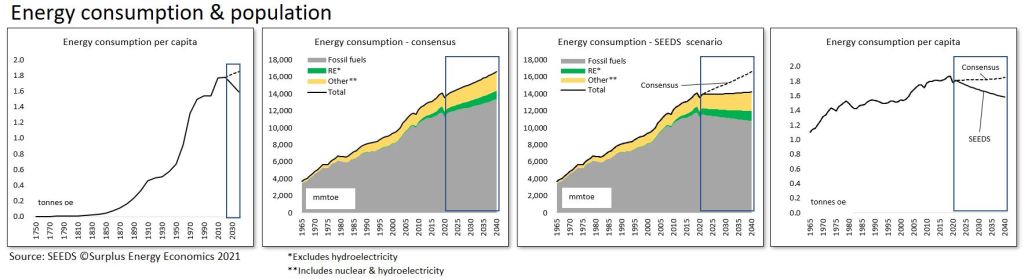
This has been reflected in a correspondingly rapid rise in energy use per capita. This metric has expanded along an exponential progression that has been checked only twice – once during the Great Depression of the 1930s, and again during the oil crises of the 1970s. Even these interruptions to this progression turned out to be temporary, though both were associated with severe economic hardship and financial dislocation.

Importantly, neither of these events was a function of changes in energy fundamentals. Rather, both were consequences of mismanagement within a physical (energy) context which remained favourable for growth. Preceding financial excess was at the root of the Great Depression, whilst the crises of the 1970s resulted from a breakdown in the relationship between producers and consumers of oil.

In recent times, belated recognition of the threat posed to the environment by the use of fossil fuels has shifted the focus towards ambitions for dramatic increases in renewable sources of energy (REs). But the assumption has remained that we will nevertheless be using more energy, not less – and, very probably, more fossil fuels – for the foreseeable future.

The consensus expectation, as of late-2019, was that, despite an assumed rapid increase in the supply of REs, the world would nevertheless be using about 14% more fossil fuels in 2040 than it used in 2018, with the consumption of oil increasing by 10-12%, and no overall fall in the use of coal.

These assumptions were reflected in the depressing conclusion that emissions of CO² would continue to grow, with massive investment in non-fossil alternatives doing nothing more than blunt the rate of emissions increase.

The flip-side of these projections was the almost unchallenged faith that continued to be placed in a ‘future of more’ – for example, it was assumed that, by 2040, there would be an increase of about 75% in the world’s vehicle fleet, and that passenger flights would have expanded by about 90%. Automation – as a use of energy – would continue, as would the consumption of non-essential (discretionary) goods and services.

Government, business and financial planning remains predicated on this assumption of never-ending economic expansion.

Fundamentally, none of these assumptions has been re-thought because of the coronavirus crisis. Expectations for the future ‘mix’ of energy supply may have changed since late-2019, but the consensus view seems to remain that, after the energy consumption hiatus caused by the covid crisis, the future will still be shaped by a continuing expansion in the use of primary energy. It still seems to be assumed that there will be no overall reduction in the use of fossil fuels, at least until the middle years of the century. Needless to say, faith in a ‘future of more’ remains unshaken.

Some commentators may opine that the fossil fuel industries are ‘finished’, but realistic assessments of the rates at which RE capacities are capable of expanding do not support a view that REs can expand rapidly enough to replace much of our current reliance on oil, gas and coal.

The problem with all of the consensus forecasts seems to be that forward energy use projections are a function of economic assumptions. Thus, if the economy is assumed to be X% bigger by, say, 2040, then its energy needs will have risen by Y%, and the deduction of non-fossil supply projections for 2040 leaves our need for fossil fuels in that year as a residual.

This, of course, is to take things in the wrong order. What we should be doing is assessing the future energy outlook, and only then asking ourselves how much economic activity the projected level (and cost) of energy supply is likely to support.

For this reason, SEEDS no longer uses consensus-based projections for future energy supply. The SEEDS alternative scenario sees the world having 8% less fossil fuel energy available in 2040 than was used in 2018. The inclusion of assumed rapid increases in contributions from non-fossil sources still leaves total primary energy supply no higher in 2040 than it was in 2018. Even this scenario might turn out to have been over-optimistic.

This in turn means that primary energy use per person has now started to decline. Something along these lines happened during the 1930s and the 1970s, but neither was more than a temporary hiatus in a continuing upwards trend.

Fig. A


ECoE and surplus energy

For the purposes of economic modelling, the aggregate amount of energy available at any given time needs to be calibrated to incorporate changes in the energy cost of accessing that energy. The principle involved is that, whenever energy is accessed for our use, some of that energy is always consumed in the access process, meaning that it is not available for any other economic purpose. This ‘consumed in access’ component is known here as ECoE (the Energy Cost of Energy).

The processes which drive changes in the level of ECoE are reasonably well understood. In the early stages of the use of any type of energy, ECoEs are driven downwards by a combination of geographic reach and economies of scale. Once these drivers are exhausted, depletion kicks in, driving ECoEs back upwards.

Technology acts to reinforce the downwards pressures exerted by reach and scale, and mitigates the upwards cost pressure of depletion. But the scope of technology is limited by the physical characteristics of the energy resource, such that no amount of technological progress can, for instance, cancel out the effects of depletion.

Thanks to scale and reach, assisted by progress in technology, the ECoEs of fossil fuels fell steadily for most of the Industrial Age until they reached a nadir that occurred during the twenty years after 1945. This meant that, until this nadir arrived, we benefited both from increasing total energy supplies and from falling ECoEs. This is to say that ‘surplus’ (ex-ECoE) energy availability increased more rapidly than the totality of supply.

For a long time now, though, the ECoEs of oil, gas and coal have been rising, a function of depletion, only partially mitigated by technology. With fossil fuels still accounting for more than four-fifths of all primary energy consumption, this has meant that overall ECoE, too, has risen relentlessly. This overall trend, as calibrated by SEEDS, is that ECoE rose from 1.8% in 1980 to 4.2% in 2000 and 6.4% in 2010, with the number for 2020 put at 9.0% and an ECoE of 11.6% projected for 2030.

This interpretation, taken together with volume projections – themselves heavily influenced by ECoE cost trends – suggest that the decline in total energy use per person will be compounded by a still-faster fall in surplus energy supply per person. This, incidentally, means that surplus energy, both in aggregate and per capita, would fall even if the over-optimistic consensus view on aggregate energy supply turned out to be correct.

The great hope, of course, has to be that the downwards trend in the ECoEs of REs will continue indefinitely, eventually driving overall ECoEs back downwards. This is unlikely to happen, not least because expansion in RE capacity continues to depend on inputs made available by the use of resources whose availability relies on the use of fossil fuels. We cannot – yet, anyway – build wind turbines or solar panels using only the energy that wind and solar power generation can provide.

Though the ECoEs of REs are indeed at or near the point of crossover with those of fossil fuels, this is really a function of the continuing, relentless rise in the costs of accessing oil, gas and coal.

It is, of course, a truism that equal calorific quantities of energy from different sources have different characteristics. Energy from petroleum, for instance, is ideally suited for use in cars and commercial vehicles, whereas wind and solar energy are better suited to transport systems like trains and trams. Public transport systems, powered directly, can greatly reduce our reliance on the insertion of batteries into the sequence between the supply and use of electricity.

This, essentially, is a management issue, in which trying to drive petroleum-optimised vehicles with wind or solar electricity can be likened to trying to propel a sailing ship using steam directed at its sails.

Fig. B


Economic output

With the role of prosperity-determining surplus energy understood, the next stage in energy-based mapping of the economy is to connect this to the financial calibrations through which, by convention, economic debate is presented.

Unfortunately, the conventionally favoured metric of GDP is unsuited to this purpose, essentially because rapid expansion in debt (and in other liabilities) creates a sympathetic (and artificial) increase in apparent GDP.

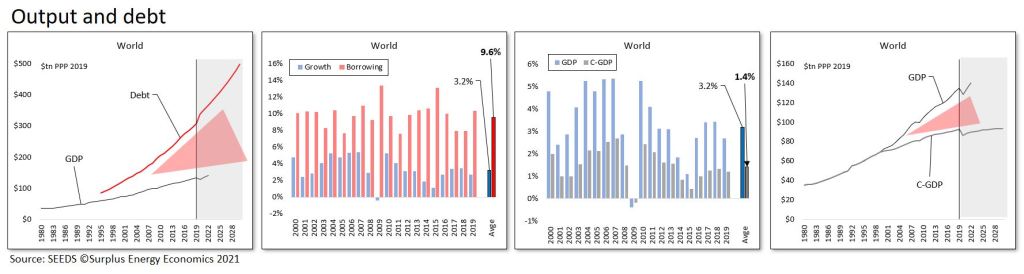
Regular readers will be familiar with the ‘wedge’ interpretation set out in the next set of charts. Between 1999 and 2019, reported GDP increased by $66tn (PPP*) whilst debt expanded by $197tn, meaning that each dollar of reported “growth” was accompanied by $3 of net new debt. Over a period in which GDP grew at an average rate of 3.2%, annual borrowing averaged 9.6% of GDP.

With these credit distortions understood and excluded, the rate of growth falls from the reported 3.2% to just 1.4% on an underlying basis. The calibration of underlying or ‘clean’ output (C-GDP) reveals that the insertion of a ‘wedge’ between debt and C-GDP is reflected in the emergence of a corresponding wedge between reported (GDP) and underlying (C-GDP) economic output.

This in turn means that we are deluding ourselves, not just about the real level of economic output but also about the various ratios and distributions based upon that metric.

Fig. C


Prosperity

Ultimately, the basis of any effective system for interpreting and modelling the economy must be the identification of prosperity, a concept which can then be used as the denominator in a host of important equations. The SEEDS model accomplishes this by identifying C-GDP and then deducting trend ECoE.

C-GDP defines economic output, but recognition of the role of ECoE means that this output is not, in its entirety, ’free and clear’. Output, measured as C-GDP, is the financial counterpart of the aggregate energy available for use. But a proportion of this energy value – and, consequently, a corresponding proportion of economic output – is required for the supply of energy itself, and is not, therefore, available for any other economic purpose. Accordingly, trend ECoE is deducted from C-GDP output to arrive at a calibration of prosperity. This, of course, can be expressed either in aggregate or in per capita amounts.

Before going further, we can note that an equation involving four components defines material well-being calibrated as prosperity. First, we need to know the quantity (Q) of energy available for economic use. Second, we need to identify the conversion efficiency (CE) with which this energy is turned into economic value (O).

Third, we need to deduct ECoE to know how much of this economic value is ‘free and clear’ for use in all economic purposes other than the supply of energy itself.
 Fourth, the division of the resulting aggregate prosperity (P) by the population number (N) tells us the prosperity of the average person in the economy.

At the top level, this equation reveals the onset of a deterioration in global prosperity per person. Energy quantity growth (Q) is slowing, and the best we can expect for conversion efficiency (CE) is somewhere between static and gradually eroding. ECoEs are continuing to rise, and the number of people between whom prosperity (P) is shared continues to increase.

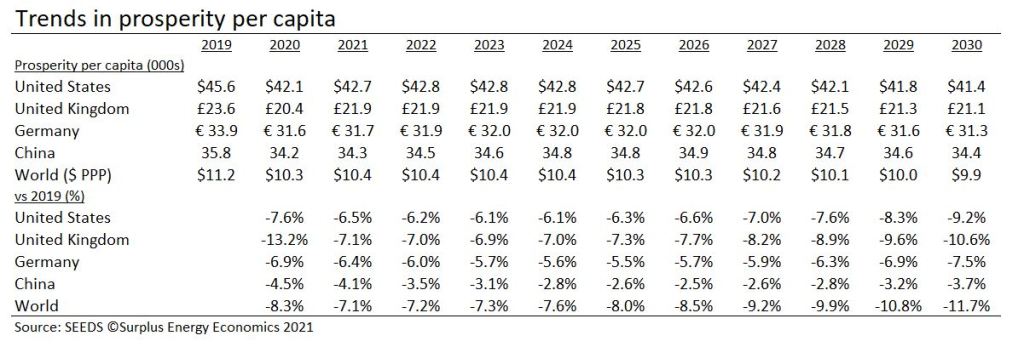
A summary of projected trends in prosperity per person is set out in the following table.

Table 1


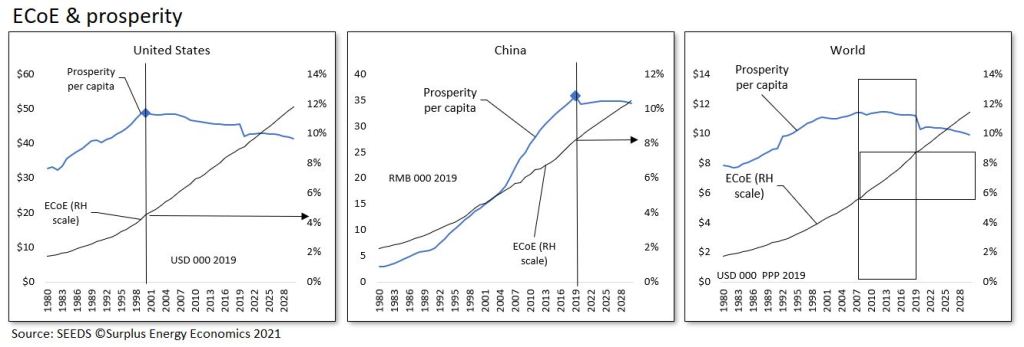
A critical determinant which emerges from this equation is the existence of a direct correlation between ECoE and prosperity per capita. In the United States, prosperity per person turned down after 2000, when American trend ECoE was 4.5%. The coronavirus crisis seems to have brought forwards the inflection-point in China to 2019, when the country’s trend ECoE was 8.2%.

Broad observation across the thirty countries covered by SEEDS indicates that complexity determines the level of ECoE at which prosperity per capita turns downwards. In the sixteen advanced economies group analysed by the model (AE-16), the inflection point occurs at ECoEs of between 3.5% and 5%. The equivalent range for the fourteen EM (emerging market) countries (EM-14) runs from 8% to 10%.

This has meant that EM countries’ prosperity has continued to improve as that of the AE-16 group has turned down. This in turn has meant that global, all-countries prosperity has been on a long plateau, with continued progress in some countries offsetting deterioration in others.

Now, though, the model indicates that the plateau has ended, meaning that, from here on, the world’s average person gets poorer.


Fig. D


These top-down findings are a good point at which to conclude the first part of this explanation of the energy-based mapping of the economy of which SEEDS is now capable. In Part Two, we shall follow some of its implications, looking at assets and liabilities, the outlook for businesses and the challenges facing government.


The map unrolled. Feb. 24, 2021.


THE CONCLUSIONS OF THE SEEDS MAPPING PROJECT

Foreword

What follows is one of the longest articles ever to appear here, and certainly one of the most ambitious. The aim is to take readers all the way through the Surplus Energy Economics interpretation of the economy, from principles and background, via energy supply and cost, to environmental implications, economic output and prosperity, and the circumstances and prospects of individuals, the financial system, business and government.

Because what follows includes some commentary on business, readers are
reminded that this site does not provide investment advice, and must not be used for this purpose. It is, as ever, to be hoped that issues of politics and government can be discussed in a non-partisan way, and that the principle of “play the ball, not the man” can be respected.

The reason for presenting this synopsis at this time is that the second phase of the SEEDS programme – the mapping of the economy from an energy-based perspective – is now all but complete. Three components of this programme remain at the development phase, but provide sufficient indicative information for use here. One of these is the calculation of “essential” calls on household resources; the second is conversion from average per capita to median prosperity; and the third is the SEEDS-specific concept of the excess claims embodied in the financial economy.

SEEDS began as an investigation into whether it was possible to model the economy on the right principles (those of energy) rather than the wrong ones (that the economy is simply a financial system). It was always going to be essential that results should for the most part be expressed in monetary language, even though the model itself operates on energy principles.

With prosperity calibrated, it then made sense to extend the model into comprehensive economic mapping. Aside from the three components still in need of further refinement, this mapping project is now complete.

For the most part, mapping as presented here is global in extent, though some national and regional data is used. If SEEDS is to continue, a logical next step would be to extend the mapping process to individual economies.

Lastly, by way of preface, this article is the most comprehensive guide to SEEDS and the Surplus Energy Economy yet published here, and it would be marvellous if readers were to see fit to pass it on to others as a way of ‘spreading the word’ about how the economy really works.


Introduction

Long before the coronavirus crisis, we had been living in a world suffering from a progressive loss of the ability to understand its own economic predicament. This lack of comprehension results directly from unthinking acceptance of the fundamentally mistaken orthodoxy that the economy is ‘simply a matter of money’.

If this were true – and given that money is a human artefact, wholly under our control – then there need be no obstacle to economic growth ‘in perpetuity’. This never-ending ‘future of more’ is nothing more than an unfounded assumption, yet it is treated as an article of faith by decision-makers in government, business and finance.

Growth in perpetuity’ is a concept which, though seldom challenged, is really an extrapolation from false principles. At the same time, those mechanisms which orthodox economics is pleased to call ‘laws’ are, in reality, nothing more than behavioural observations about the human artefact of money. They are not remotely equivalent to the real laws of science.

The fact of the matter, of course, is that the belief that economics is simply ‘the study of money’ is a fallacy, and defies both logic and observation. At its most fundamental, wholly financial interpretation of the economy is illogical, because it tries to explain a material economy in terms of the immaterial concept of money.

Logic informs us that all of the goods and services that constitute economic output are products of the use of energy. Other natural resources are important, to be sure, but the supply of foodstuffs, water, minerals and so on is wholly a function of the availability of energy. Energy is critical, too, as the link which connects economic activity with environmental and ecological degradation. Without access to energy, the environment would not be subject to human-initiated risk – and the economy itself would not exist.

Observation reveals an indisputable connection between the rapid material (and population) expansion of the Industrial Age and the use of ever-increasing amounts of fossil fuel energy since the first efficient heat-engines were developed in the late 1700s.

Two further observations are important here. The first is that, whenever energy is accessed for our use, some of that energy is always consumed in the access process. We cannot drill a well, build a refinery or a pipeline, construct wind turbines or solar panels, or create and maintain an electricity grid, without using energy. This ‘consumed in access’ component is known in Surplus Energy Economics as the Energy Cost of Energy, or ECoE.

The second critical observation is that money has no intrinsic worth, but commands value only as a ‘claim’ on the goods and services made available by the use of energy. Money can only fulfil its function as a ‘medium of exchange’ if there is something of economic utility for which an exchange can be made. Just as money is a ‘claim on energy’, so debt – as a claim on future money – is in reality a ‘claim on future energy’.


False premises, mistaken decisions

Critical trends in recent economic history can only be understood on the basis of energy, ECoE and exchange. ECoEs, which had fallen throughout much of the Industrial Age, turned upwards in the years after 1945 but, until the 1990s, remained low enough for their omission not to impose a visibly distorting effect on orthodox economic interpretation.

The point at which ECoEs became big enough to start invalidating conventional models was reached during the 1990s. The resulting phenomenon of economic deceleration was noted, and indeed labelled (“secular stagnation”), but it was not traced to its cause.

An orthodoxy resolutely bound to the fallacy of wholly financial interpretation naturally sought monetary explanations and monetary ‘fixes’. The idea that financial tools can overcome physical constraints can be likened to attempting to cure an ailing house-plant with a spanner. Its pursuit pushed us into ‘credit adventurism’ in the years preceding the 2008 global financial crisis, and then into the compounding and hazardous futility of ‘monetary adventurism’ during and after the GFC.

This has left us relying on false maps of a terrain that we do not understand. Almost all of our prior certainties have disappeared. We turned away from market principles by choosing financial legerdemain over market outcomes during 2008-09 and, at the same time, we abandoned the ‘capitalist’ system by destroying real returns on capital. The aim here is to present an alternative basis of interpretation that accords both with logic and with observation.

Beyond vacuous phrases which echo earlier certainties, governments no longer have ‘economic policies’ as such. Even the pretence of economic strategy was ditched when governments abdicated from the economic arena, and handed over the conduct of macroeconomics to central bankers. Asset markets have become wholly dysfunctional – they no longer price risk, and have been stripped of their price discovery function. The relationship between asset prices and all forms of income (wages, profits, dividends, interest and rents) has been distorted far beyond the bounds of sustainability.

Unless real incomes can rise – which is in the highest degree unlikely – asset prices must correct sharply back into an equilibrium with incomes that was jettisoned through the gimmickry of 2008-09. Efforts to prevent asset price slumps can only add to the strains already inflicted upon fiat currencies.

Ultimately, our manipulation of money has had the effect of tying the viability of monetary systems to our ability to go on ignoring and denying the realities of an economy being undermined by a deteriorating energy dynamic.


The energy driver

Our analysis necessarily starts with energy, a topic covered in more detail in
the previous article. The informed consensus position, immediately prior to the coronavirus crisis, was that total energy supply would continue to expand, increasing by about 19% between 2018 and 2040.

Within this overall trajectory, renewable energy sources (REs) would grow their share of primary energy use, and the combined contributions of hydroelectric and nuclear power, too, would expand.

Even so, it was projected that quantities of fossil fuels consumed would rise, with about 10-12% more oil, 30-32% more natural gas, and roughly the same amount of coal being used in 2040 as in 2018.

These consensus views were (and in all probability still are) starkly at variance with a popular narrative which sees us replacing most, perhaps almost all, use of fossil fuels by 2050. The rates of RE capacity expansion that the popular narrative implies would require vast financial investment and, more to the point, would call for a correspondingly enormous amount of material inputs whose availability is, for the foreseeable future, dependent on the continuing use of fossil fuels.

SEEDS uses an alternative energy scenario which projects a decline in the supply of fossil fuels, a trajectory dictated by the rising ECoEs of oil, gas and coal. Essentially, the costs of supplying oil, gas and coal have already risen to levels above consumer affordability. The SEEDS scenario anticipates a pace of growth in RE supply which, whilst outpacing the 2019 consensus, necessarily falls short of a popular narrative which is as weak on practicalities as it is strong on good intentions.

The result of this forecasting is that the total supply of primary energy is unlikely to be any larger in 2040 than it was in 2018.

What this in turn means is that energy supply per person will decline. Such a downturn has only been experienced twice (to any meaningful extent) in the Industrial Age – once during the Great Depression of the 1930s, and again during the oil crises of the 1970s.

Neither of these downturns was physical in causation – they resulted from mismanagement, rather than changes in energy supply fundamentals – but both were associated with serious economic hardship and severe financial dislocation. Furthermore, what happened in the 1930s and the 1970s wasn’t really a downturn but, rather, no more than a pause in the upwards trajectory of energy use per person.

These parameters are illustrated in Fig. A. All of the charts used here can be enlarged for greater clarity, and all of them are sourced from the SEEDS mapping system. [go to the article on Morgan's SEEDs site for better versions of the graphics] 

Fig. A
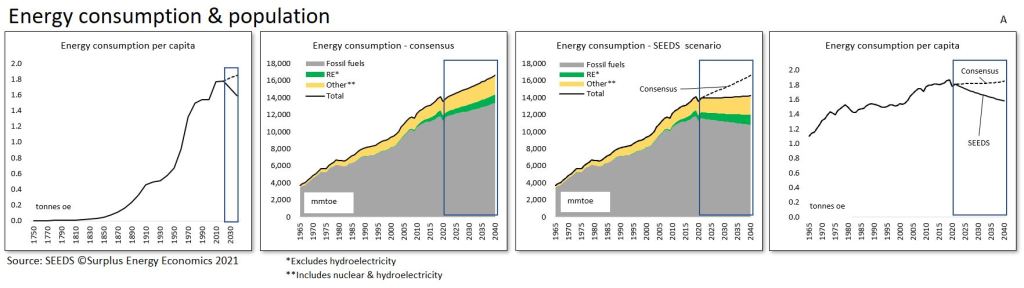


It will be appreciated, then, that we have entered a phase – of declining energy availability per person – which can be expected to have a profoundly adverse effect on economic well-being and financial stability.

These effects will be compounded by a relentless rise in ECoEs that is most unlikely to be stemmed by the volumetric expansion of REs.  As we shall see, prosperity per person turned down at ECoEs of between 3.5% and 5.0% in the advanced economies of the West, and at rather higher (8-10%) thresholds in EM (emerging market) countries. But we cannot realistically expect that the ECoEs of wind and solar power will fall much below 10%. This means that they cannot replicate the economic value delivered by fossil fuels in their heyday.

Accordingly, surplus energy per person – that is, the aggregate amount of energy less the ECoE deduction – is set to decline, and would do so even if the over-optimistic consensus projection for aggregate energy supply could be realised.

Anticipated trends in ECoEs and the availability of surplus energy are summarised in Fig. B.

Fig. B
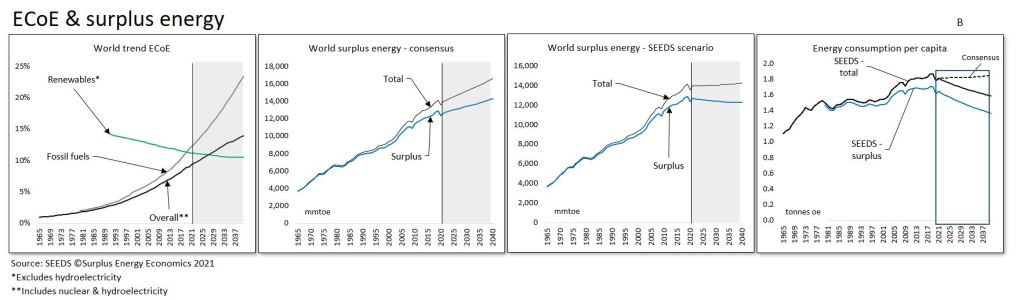


Cleaner, but poorer

This does at least mean that annual emissions of climate-harming CO² can be expected to decrease. Unfortunately, this welcome trend will be a function, not of a seamless transition to an RE-based economy, but of deteriorating prosperity.

On the SEEDS energy scenario, annual emissions of CO² are likely to fall by 10% between 2019 and 2040, rather than rising by about 11% over that period. This, however, will correspond to a projected decline of 27% in global average prosperity per capita.

Some of the environmental projections that emerge from SEEDS mapping are set out in Fig. H. It need hardly be said that the relationship between the economy and the environment cannot meaningfully be interpreted until energy, rather than money, is placed at the centre of the equation.

Promises of a cleaner future are realisable, then, but assurances of a cleaner future combined with sustained (let alone growing) material prosperity are not.

Fig. H
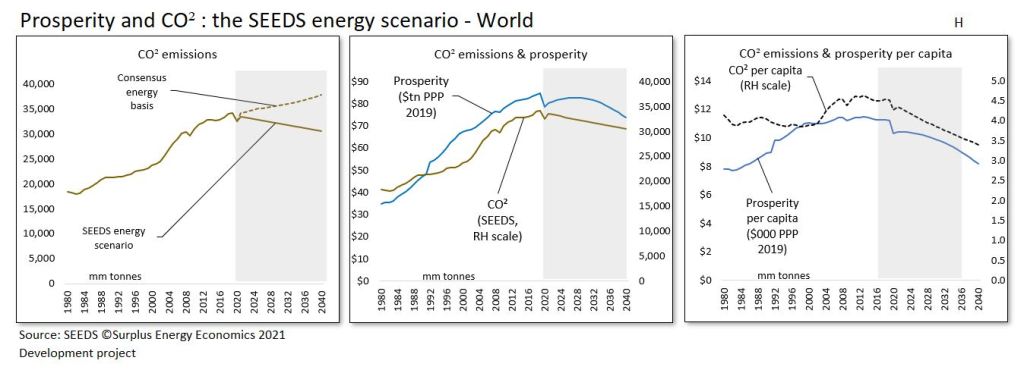


Economic output

When we note that each dollar of reported economic expansion between 1999 and 2019 was accompanied by the creation of $3 of net new debt – and that GDP “growth” of 3.2% was supported by annual borrowing averaging 9.6% of GDP – we are in a position to appreciate that most (indeed, almost two-thirds) of all reported increases in GDP over the past two decades have been the cosmetic effect of credit and monetary expansion. If credit expansion were ever to cease, rates of growth in GDP would fall to barely 1.0% – and, if we ever tried to roll back prior credit expansion, GDP would fall very sharply.

Stripping out the credit effect enables us to identify a “clean” rate of growth in economic output that turns out to have averaged 1.4% (rather than the reported 3.2%) during the twenty years preceding 2019. As can be seen in Fig. C, the driving of a “wedge” between debt and GDP has inserted a corresponding wedge between GDP itself and its underlying or “clean” (C-GDP) equivalent.

Fig. C
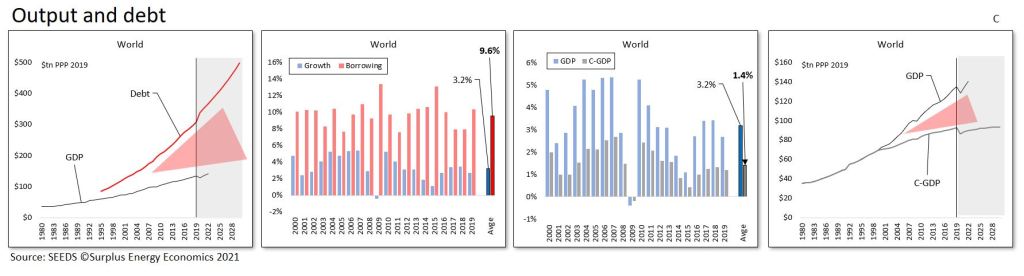


Prosperity

With underlying economic output established, prosperity – both aggregate and per capita – can be identified through the application of trend ECoE. This reflects the fact that ECoE is the component of energy supply which, being consumed in the process of accessing energy, is not available for any other economic purpose. In terms of their relationships with energy, C-GDP corresponds to total energy supply, whilst prosperity corresponds to surplus (ex-ECoE) energy availability. SEEDS identifies the ratio at which energy use converts into economic value, and applies ECoE to establish the relationship between energy consumption and material prosperity.

As well as providing our central economic benchmark, the calibration of prosperity enables us to establish the relationship between material well-being and trends in ECoE. In Western advanced economies, SEEDS analysis shows that prosperity per capita turned down at ECoEs of between 3.5% and 5.0%. In the less complex, less ECoE-sensitive EM countries, the corresponding threshold lies between ECoEs of 8% and 10%.

These relationships, identified by SEEDS, are wholly consistent with what we would expect from a situation in which energy costs are linked directly to the maintenance costs of complex systems.

Illustratively, prosperity per capita in the United States turned down back in 2000, at an ECoE of 4.5% (Fig. D). Chinese prosperity growth appears to have gone into reverse in 2019, at an ECoE of 8.2%, though, had it not been for the coronavirus crisis, the inflection point for China might not have occurred until the point – within the next two or so years – at which the country’s trend ECoE rises to between 8.7% (2021) and 9.1% (2023).

Globally, average prosperity per person has been flat-lining since the early 2000s, but has now turned down in a way that means that the “long plateau” in world material prosperity has ended.

This conclusion is wholly unidentifiable on the conventional, money-only basis of economic interpretation.

Fig. D
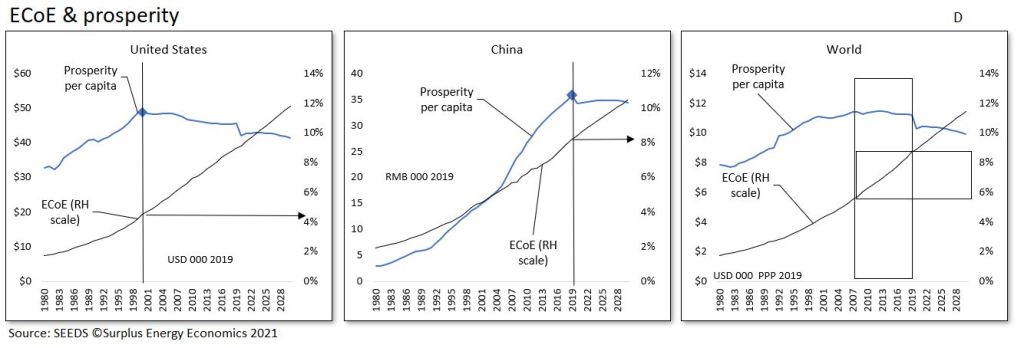


Financial

The identification of aggregate prosperity enables us to recalibrate measurement of financial exposure away from the customary (but wholly misleading) denominator of GDP. Four such calibrations are summarised in Fig. E.

Conventional measurement states that world debt rose from 160% to 230% of GDP between 1999 and 2019 – essentially, a real-terms debt increase of 177% was moderated by a near-doubling (+95%) of recorded GDP, leaving the ratio itself higher by only 42% (230/160).

This, though, is a misleading measurement, because it overlooks the fact that GDP was itself pushed up by the breakneck pace of borrowing.

Rebased to aggregate prosperity – which was only 28% higher in 2019 than it had been in 1999 – the ratio of debt-to-output climbed from 168% to 363% over that same period. Preliminary estimates for 2020 suggest that an increase of around 10% in world debt has combined with a 7.4% fall in prosperity to push the ratio up to 430%.

The second measure of financial exposure generated by SEEDS relates prosperity to the totality of financial assets. SEEDS uses data from 23 of the countries for which financial assets information is available, countries which together equate to just over 75% of the world economy.

On this basis, systemic exposure has exploded, from 326% of prosperity in 2002 (when the data series begin) to 620% at the end of 2019. Extraordinarily loose fiscal and monetary policy during 2020 suggests that this ratio may already exceed 730% of prosperity.

Gaps in pension provision are a further useful indicator of financial unsustainability. Back in 2016, the World Economic Forum
calculated pension gaps for a group of eight countries – Australia, Canada, China, India, Japan, the Netherlands, Britain and America – at $67tn, and projected an increase to more $420tn by 2050.

Converting these numbers from 2015 to 2019 values, and then expressing their local equivalents in dollars on the PPP (purchasing power parity) rather than the market basis of exchange rates, puts the number for the end of 2020 at $112 trillion, which equates to 290% of the eight countries’ aggregate prosperity (and 180% of their combined GDPs). Pension gaps are growing at annual rates of close to 6%, a pace that not even credit-fuelled GDP – let alone underlying prosperity – can be expected to match.

The fourth measure of financial exposure produced by SEEDS is specific to the model. As we have seen, monetary systems embody ‘claims’ on a real (energy) economy that has grown far less rapidly than its financial counterpart. This has resulted in the accumulation of very large excess claims.

Calibration of this all-embracing measure, which is known in the model as E4, remains at the development stage. Indicatively, though, it informs us that the world has been piling on financial claims that cannot possibly be met ‘at value’ from the economic prosperity of the future.

From this it can be inferred that a process of systemic ‘claims destruction’ has become inevitable, suggesting that the process known conventionally as ‘value destruction’ cannot now be prevented from happening at a systemically hazardous scale. The most probable process by which this will happen is the degradation of the value of money, meaning that claims can only be met with monetary quantities whose purchasing power is drastically lower than it was at the time that the claims were created.

Measurement of excess claims forms part of a SEEDS national risk matrix which combines purely financial exposure with a number of other factors, one of which is ‘acquiescence risk’. This calculation references growing popular dissatisfaction induced by deteriorating overall and discretionary prosperity.

Fig. E
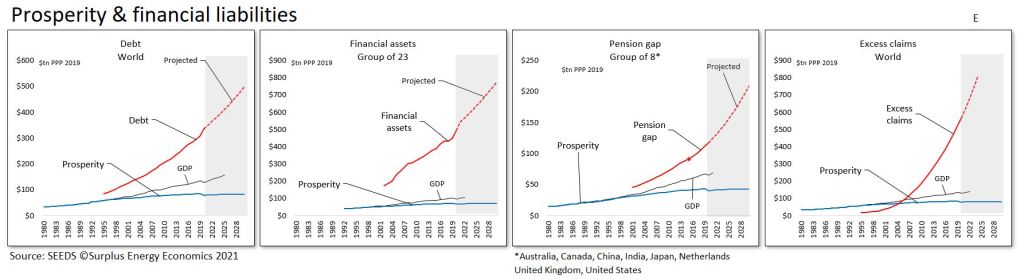


The individual

The ultimate purpose of economics is, or should be, the measurement, interpretation and (where possible) the betterment of the prosperity of the individual. Situations and projections can be expressed either as an average per capita number, or in amounts weighted to the median on the basis of the distribution of incomes. Average calibration is the primary focus of the model, but a new SEEDS capability (‘FW’) – being developed in response to reader interest in this subject – provides some insights into distributional effects.

As we have seen, the prosperity of the average person has been on a downwards trend in almost all of the Western advanced economies since well before the 2008 GFC. In ‘top-level’ prosperity terms, however, declines thus far have appeared pretty modest, even in the worst-affected countries – in 2019, British citizens were 10.4% poorer than they had been in 2004, with Italians poorer by 10.2% since 2001, and Australians worse off by 10.0% since 2003.

But top-line prosperity, like income, isn’t ‘free and clear’ for the individual to spend as he or she sees fit. Rather, prosperity is subject to prior calls, of which “essentials” are the most significant. Only after these essential outlays have been deducted do we arrive at the average person’s discretionary prosperity, meaning the resources that he or she can use to pay for things that they “want, but do not need”.

Measurement of discretionary prosperity produces rates of decline that are much more pronounced, and are distributed differently between countries, than the equivalent top-line calibrations. British citizens have again fared worst, seeing their discretionary prosperity fall by 32% between 2000 and 2019. The average Spaniard had 26.7% less discretionary prosperity in 2019 than he or she enjoyed back in 1999, whilst the decline in the Netherlands (also since 1999) was 26.5%. This decrease in the value of the discretionary “pound (or dollar, or euro, or yen) in your pocket” correlates directly to rising indebtedness and worsening insecurity, but does so in ways that are not recognised by policy-makers tied to conventional interpretation.

Of course, discretionary consumption has, at least until quite recently, continued to increase, even though discretionary prosperity has fallen. The difference between the two equates to rising per-person shares of government, business and household debt.

Calibration of discretionary prosperity obviously requires measurement of the cost of “essentials”. As mentioned earlier, this is one of the three components of the SEEDS mapping system that are still subject to further development. The conclusions which follow should, therefore, be regarded as indicative.

For our purposes, “essentials” are defined as those things that the individual has to pay for. This means that “essentials” include two components. One of these is household necessities, and the other is government expenditure on public services. These services qualify as “essentials” on the “has to pay for” definition, whatever the individual might happen to think about the services which he or she is obliged to fund. The government component of “essentials” relates only to public services, and does not include transfers (such as pension and welfare payments), which simply move money between people and so wash out to zero at the aggregate or the per capita level of calculation.

SEEDS analyses of prosperity per capita are summarised in Fig. F. In the AE-16 group of advanced economies, taxation (and transfers), being more cyclical, have tended to fluctuate more than spending on public services.

Together, the two components of “essentials” have moved up in real terms, even as prosperity has deteriorated, exerting a tightening squeeze on discretionary prosperity. Because of the credit effects which are interposed between GDP and prosperity, this squeeze cannot – despite its profound commercial, financial and political implications – be identified by conventional interpretation. It can be corroborated, though, by analysis of per capita indebtedness and of broader financial commitments.

As the charts show, relatively modest declines in the overall prosperity of citizens in America, Britain and Japan are leveraged into much sharper falls in their discretionary prosperity.

Fig. F


The median individual

Of course, a country’s ‘average’ person is a somewhat theoretical figure, and one of the remaining SEEDS development projects addresses weighting for the difference between the average and the median person.

Because data for income distribution is intermittent, median prosperity per person is illustrated as dashed red lines in Fig. FW. These charts compare median with average prosperity per capita in four countries, and include the household (but, as yet, not the public services) component of “essentials”.

They show a comfortable margin in comparatively egalitarian Denmark (though the cost of public services in Denmark is relatively high). America remains a “rich” country – albeit less rich than she once was – in which household necessities remain affordable within the prosperity of the median person or household. But the situation in South Africa – and even more so in Brazil – must give rise to considerable concern.

Fig. FW
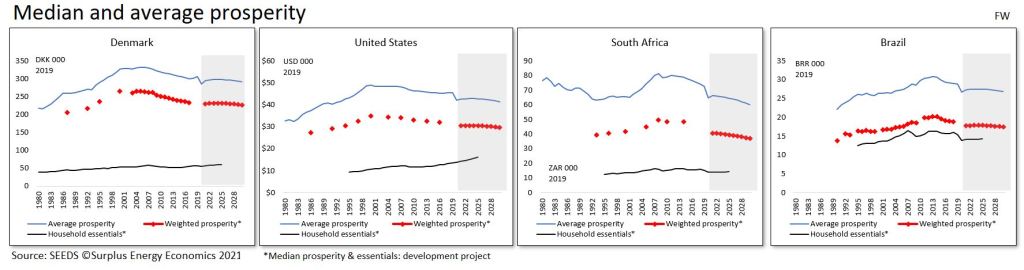


Business

Obviously enough, the compression being exerted on discretionary prosperity is of great importance to businesses, which are in danger of working to false premises when they rely on the promise of ‘perpetual growth’ provided by orthodox economic interpretation. Companies in discretionary sectors may not realise the extent to which their fortunes are tied to the continuity of credit and monetary expansion.

There are two critical (and related) points of context here. The first is that, as societies become less prosperous, they will also become less complex, rolling back much of the increase in complexity that has accompanied the dramatic economic growth of the Industrial Age. The second is that the proportion of prosperity subject to the prior calls of essentials will rise.

A logical outcome of de-complexification is simplification, both of product ranges and of supply processes. This will be accompanied by de-layering, whereby some functions are eliminated.

Two further factors which can be expected to change the business landscape are falling utilization rates and a loss of critical mass. The former occurs where a decline in volumes increases the per-customer (or unit) equivalent of fixed costs. Efforts to pass on these increased unit costs can be expected to accelerate the decline in customer purchases, creating a downwards spiral.

Critical mass is lost when important components or services cease to be available as suppliers are themselves impacted by simplification and utilization effects. It is important to note that falling utilization rates and a loss of critical mass can be expected to occur in conjunction with each other, combining to introduce a structural component into future declines in prosperity.

These considerations put various aspects of prevalent business models at risk, and this should be considered in the context both of worsening financial stress and of deteriorating consumer prosperity. One model worthy of note is that which prioritizes the signing up of customers over immediate sales. Previously confined largely to mortgages, rents and limited consumer credit, these calls on incomes now extend across a gamut of purchase and service commitments which can be expected to degrade as consumer prosperity erodes. This has implications both for business models based on streams of income and for situations in which forward income streams have been capitalized into traded assets.


Government

The SEEDS database reveals a striking consistency between levels of government revenue and recorded GDP. In the AE-16 group of advanced economies, government revenues seldom varied much from 36-37% of GDP over the period between 1995 and 2019. Accordingly, government revenues have expanded at real rates of about 3.2% annually. We can assume that similar assumptions inform revenue expectations for the future.

As we have seen, though, reported GDP has diverged ever further from prosperity, meaning that there has been a relentless increase in taxation when measured as a proportion of prosperity. In the AE-16 countries, this ratio has risen from 38% in 1995 to 49% in 2019, and is set to hit 55% of prosperity by 2025 based on current trends (see Fig. G4A).

It is reasonable to suppose that, as prosperity deterioration continues, as the leveraged fall in discretionary prosperity worsens, and as indebtedness starts to hit unsustainable levels, the attention of the public is going to focus ever more on economic (prosperity) issues. Politically, this means that what has long been a broad ‘centrist consensus’ over economic and political issues can be expected to fracture.

We can further surmise, either that the ‘Left’ in the political spectrum will revert towards its roots in redistribution and public ownership, and/or that insurgent (‘populist’) groups will campaign on issues largely downplayed by the established ‘Left’ since the ‘dual liberal’ strand emerged as the dominant force in Western government during the 1990s.

In practical terms, governments may need to adapt to a future in which deteriorating prosperity changes the political agenda whilst simultaneously reducing scope for public spending.

A ‘wild card’ in this situation is introduced by the likelihood that the deteriorating economics of energy supply may connect with the ECoE effect on the cost of essentials to create demands for intervention across a gamut of issues. These might include everything from subsidisation (and/or nationalisation) of essential services to control over costs, with energy supply and housing likely to be near the top of the list of demands for government action.

Fig. G4A


Afterword

These considerations on the challenges facing governments bring us to the end of what can only be an overview of the economic situation as presented by the SEEDS mapping project.

What has been set out here is a future, conditioned by energy trends, which is going to diverge ever further from what is anticipated both by decision-makers and by the general public. The view expressed here is that, to shape a better and more harmonious world as the prior drivers of cheap energy and increasing complexity go into reverse, it is a matter of urgency that the real nature of the economy as an energy dynamic should gain the broadest possible recognition.