Tuesday, January 18, 2022

Spratt on tipping points

Have tipping points already been passed for critical climate systems? (1) The basics. David Spratt, Climate Code Red. Jan. 18, 2022.

Tipping points and potential cascade effects

First in a series.


As global heating reduces the extent of floating Arctic sea-ice each summer, the heat-reflecting ice is replaced by heat-absorbing dark ocean water, adding energy to the Arctic system, driving more melting. This is a “positive feedback”, a self-reinforcing change. Examples abound in the climate system. On Greenland, for example, warming is reducing the height of the ice, and this lower elevation means it will melt more, because the temperature is higher at lower altitudes.

Sixteen years ago, James Hansen warned that “We live on a planet whose climate is dominated by positive feedbacks, which are capable of taking us to dramatically different conditions. The problem that we face now is that many feedbacks that came into play slowly in the past, driven by slowly changing forcings, will come into play rapidly now, at the pace of our human-made forcings, tempered a few decades by the oceans thermal response time."

Those feedbacks can drive non-linear (or abrupt) change that is difficult to forecast. That happened to Arctic sea-ice in the summer of 2007, when a collapse in the ice extent led one experienced glaciologist to exclaim that it was melting “100 years ahead of schedule”; actually, the scientific understanding was 100 years behind reality! The same thing is happening in Antarctica now, according to the new observations of the Thwaites Glacier.

At a glance...

Positive climate feedback: a process whereby an initial change in the climate system, for example warming generated by a climate forcing, causes a secondary change which in turn magnifies the initial effect and becomes self-reinforcing. 
Tipping point: A threshold at which a small change causes a larger, more critical change to be initiated, taking the climate system from one state to a discreetly different state. The change may be abrupt and irreversible on relevant time frames, possibly leading to cascading events.

Non-linear/abrupt change: Sudden change rather than smooth progress, often associated with a tipping point.
Cascading events: An unforeseen chain of events which may occur when one event in a system has a negative effect on other related components. For example, the mutual interaction of individual climate tipping points and/or abrupt, non-linear changes, which may lead to more profound changes to the system as a whole. 
Hothouse Earth: A planetary threshold in which a cascade of system changes makes warming self-sustaining, leading to conditions hotter than any experienced over the last few hundred thousand years by modern humans. 
Climate forcing: A physical process affecting the Earth’s climate through one or more forcing factors. For example at present, a perturbation (change) in the Earth’s energy system resulting from an imbalance between incoming and outgoing radiation caused by many factors but principally an increase in the “blanket” of human-caused greenhouse gases, with associated warming.


A group of eminent scientists point to “biosphere tipping points which can trigger abrupt carbon release back to the atmosphere… permafrost across the Arctic is beginning to irreversibly thaw and release carbon dioxide and methane… the boreal forest in the subarctic is increasingly vulnerable”. They say that other tipping points could be triggered at low levels of global warming with “a cluster of abrupt shifts between 1.5 °C and 2 °C...”

Feedbacks, with or without abrupt change, can drive a system past its tipping point, which is a critical threshold at which small change causes a larger, more critical change to be initiated, taking components of the Earth system from one state to a discreetly different state. In other words, the system has reached a point of fragility such that it will move to a different state due to its own internal dynamics, even if there is no further external forcing (such as additional warming).

An overview from Australia’s Centre of Excellence for Climate Extremes describes a number of key aspects of tipping points:
  • The implications of tipping points are not thoroughly quantified in the major IPCC analyses.
  • Some tipping point changes are irreversible on timescales of centuries to millennia.
  • We do not know exactly how close we are to a tipping point, or even whether we have already passed it. We also do not always know if the changes are reversible, and if so, on what timescales.
  • There are tipping points that while not yet triggered may already be fully committed to. For example, the warming required for the West Antarctic Ice Sheet to permanently melt might have already been reached.
  • Climate models lack the mechanisms to robustly simulate many tipping points, and the interactions between tipping points that could lead to cascading impacts, and therefore our understanding of the risks is limited.
  • Since the risk is hard to quantify, global negotiations around climate change have not appropriately taken into account the risks of initiating tipping points, which is essentially a gamble on the future of the Earth’s climate.
Tipping may be irreversible on relevant time frames, such as the span of a few human generations. For example, ice sheets can disintegrate abruptly — and drive up sea levels — much faster than they can gain mass. So whilst sea levels could rise two or three metres this century — and rates as high as five metres per century have been recorded in the past — it could take thousands of years to reset the ice and get sea levels back down because there are not abrupt negative feedbacks in play.

This is an example of hysteresis, or bifurcation of a system, where it may be more difficult, or impossible, to return to its previous state. Extinctions are an example of the latter. Carbon Brief explains: “In some cases, there is evidence that once the system has jumped to a different state, then if you remove the climate forcing, the climate system doesn’t just jump back to the original state – it stays in its changed state for some considerable time, or possibly even permanently.”

Major tipping points are interrelated and may cascade, as illustrated. Interactions between these climate systems could lower the critical temperature thresholds at which each tipping point is passed.

For example, Earth is approaching a temperature range above which photosynthesis rates decline and the storage of carbon in the terrestrial biosphere (the “land sink”) falls. This tipping point lies within the next 20–30 years and on a high-emissions trajectory a near halving of the land sink strength may result as early as 2040. This will accelerate the warming rate, trigger further sea-ice loss, more melting on Greenland and freshwater injection into the North Atlantic, helping to further slow the Atlantic Meridional Overturning Circulation (AMOC), often known as the “Gulf Stream”. This in turn would change rainfall patterns over the Amazon and further weaken its carbon stores and Earth’s land sink. And so it goes on.

Physical interactions among the Greenland and West Antarctic ice sheets, AMOC and the Amazon rainforest tend to destabilise the network of tipping elements. The polar sheets are often the initiators of these cascade events, with evidence that Greenland and West Antarctica have passed their tipping (in coming posts).

In 2012, James Hansen warned of scientists’ fear about the Arctic and the cascading of tipping points triggered in the Arctic: “Our greatest concern is that loss of Arctic sea ice creates a grave threat of passing two other tipping points – the potential instability of the Greenland ice sheet and methane hydrates… These latter two tipping points would have consequences that are practically irreversible on time scales of relevance to humanity.”

Cascading events may in turn lead to a “Hothouse Earth” scenario, in which climate system feedbacks and their mutual interaction drive the Earth System climate to a “point of no return”, whereby further warming would become self-sustaining (that is, without further human-caused perturbations). This planetary threshold could exist at a temperature rise as low as 2°C, possibly even in the 1.5°C–2°C range.

The problem, elaborated in a 2019 paper, "Climate tipping points — too risky to bet against", is that time is close to running out: "We argue that the intervention time left to prevent tipping could already have shrunk towards zero, whereas the reaction time to achieve net zero emissions is 30 years at best. Hence we might already have lost control of whether tipping happens. A saving grace is that the rate at which damage accumulates from tipping — and hence the risk posed — could still be under our control to some extent” (emphasis added).

Likewise, former UK Chief Scientist Sir David King warns that: “What global leaders do in the next three-to-five years will determine the future of humanity.”

Tipping point analyst Prof. Tim Lenton says that the evidence from tipping points alone “suggests that we are in a state of planetary emergency: both the risk and urgency of the situation are acute… If damaging tipping cascades can occur and a global tipping point cannot be ruled out, then this is an existential threat to civilization”.


Next post in this series: (2) West Antarctica: The “doomsday” glacier

Thursday, January 13, 2022

Latest from Glikson, Jan 2022

Accelerating global warming and amplifying feedbacks: The imperative of CO₂ drawdown. Andrew Glikson. Jan. 11, 2022.


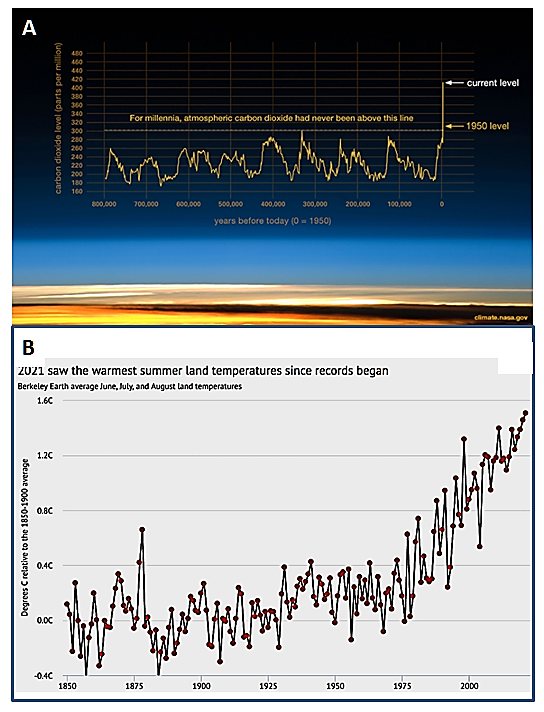
Satellite measurements indicate that 2021 was one of the warmest years on record, with the past seven years being the hottest period recorded globally (Met Office, January 10, 2022). Attempts at global emission reductions, lowered in part due to COVID-19 economic slow-down, appear to have little effect on atmospheric CO₂ rise, as indicated by the current rise of atmospheric carbon dioxide to record high levels of 420 ppm despite reduced emissions in 2020-2021 (Figures 1 and 2).


Figure 1. A. Mean global CO₂ levels from 800,000 years to the present (NASA).
B. Mean global temperature rise from 1850 to 2021 (Berkeley Earth).


As stated by CarbonBrief: “The year so far has been one of extremes, featuring record-shattering heatwaves, wildfires and flooding, as well as the warmest-ever northern-hemisphere summer – June, July and August – in the global land-surface record.”

Whereas climate negotiations mostly focus on possible reductions in emissions, the cumulative buildup of greenhouse gases is determining the future of the terrestrial climate. According to NASA “Once it’s (CO₂) added to the atmosphere, it hangs around, for a long time: between 300 to 1,000 years".

Other estimates are much longer. Because of the longevity of CO₂ and other greenhouses gases in the atmosphere, a decrease in carbon emissions, while essential, is not sufficient to reduce CO₂ levels in the atmosphere in time.

According to the IPCC “about 50% of a CO₂ increase will be removed from the atmosphere within 30 years, and a further 30% will be removed within a few centuries. The remaining 20% may stay in the atmosphere for many thousands of years”. According to the US EPA (Environmental Protection Agency) “Atmospheric lifetime: 50-200 years. No single lifetime can be defined for CO₂ because of the different rates of uptake by different removal processes”.

According to Solomon et al. (2009) and Eby et al. (2009) high levels of CO₂ on the scale of 10² to 10³ ppm would persist for millennia.

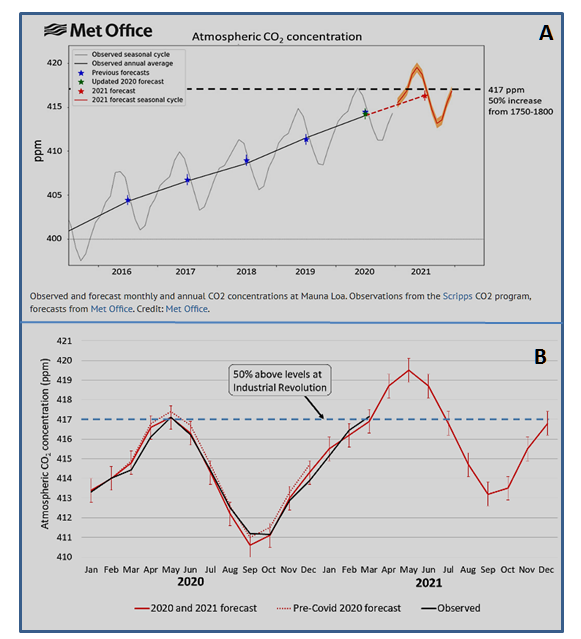
Global emission reductions, decreased in part due to COVID-19 economic slow-down, have little effect on the atmospheric CO₂ level, as indicated by the current trend of atmospheric carbon dioxide, at record high levels despite reduced emissions in 2020 (Figure 2). This suggests to a significant extent the current rise in atmospheric CO₂ arises from amplifying feedbacks from land and ocean.


Figure 2. A. Observed and forecast monthly and annual CO2 concentrations at Mauna Loa. Observations from the Scripps CO2 program, forecasts from Met Office. Credit: Met Office. B. Measured and forecast monthly CO2 concentrations at Mauna Loa Observatory, Hawaii. Black line: measurements by the Scripps Institution of Oceanography, UC San Diego. Solid red line with vertical uncertainty bars: forecast by the Met Office, including the revised forecast for 2020 issued in May 2020 accounting for reduced global emissions due to societal responses to Covid-19. The forecast uncertainty estimate is ± 0.6 ppm. Dotted red line: original Met Office forecast for 2020 issued in January 2020, not accounting for Covid-related emissions reductions. Horizontal dashed blue line: 417 ppm, a 50% increase above 278 ppm, the level in 1750-1800 from ice core records.


All taking place notwithstanding hollow promises made at COP26, a meeting noted for the near-absence of contributions by climate scientists.
In trying to avoid an exponential rise in greenhouse gases toward catastrophic levels, one option exists, namely urgent attempts at drawing down at least part of the CO₂ concentration of the atmosphere. The $trillions of dollars required, constituting the “Price of the Earth”, may not exceed the $trillion dollars military expenses spent by the world over the last 70 years, including nuclear missile fleets which constitute a separate threat for life on Earth, as warned by Albert Einstein: “The unleashed power of the atom has changed everything save our modes of thinking and we thus drift toward unparalleled catastrophe”.


A/Prof. Andrew Glikson

Earth and Paleo-climate scientist
School of Biological, Earth and Environmental Sciences
The University of New South Wales,
Kensington NSW 2052 Australia

Monday, December 20, 2021

Tom Murphy, Not Brainwashed

My Brainwashing. Tom Murphy, Do The Math. Dec. 20, 2021.


People rarely recognize or admit that they have been brainwashed. Perhaps the term brainwashed is too extreme, in which case manipulated or fooled may be substituted.

An insightful quote from Mark Twain says:

It is easier to fool people than it is to convince them that they have been fooled.

What often happens, in fact, is that people on opposite sides of an issue suspect (or are convinced) that the other side has been brainwashed. Sometimes one side is more justified in the charge than the other, in which case the brainwashed victims effectively assert a sort of projected symmetry that rings false.

Bi-directional allegations of brainwashing show up in the context of COVID: masks provide a clear means of identifying either those (masked individuals) who have been fooled into controlled submission to believe that the pandemic is real and deadly vs. those (unmasked fighters for freedom) who have been sadly misled to think it’s all a hoax and in so doing endanger us all. Each side may feel anger or pity toward the other. Climate change is similar: its denial has become an article of faith for the brainwashed non-believers, who accuse the gullible believers of being brainwashed by self-serving scientists vying for funding, power, or something (cake, maybe?).

To either side, it seems inconceivable that someone could deny the truths that are so obvious to them. For me, an uptick in total deaths closely matching reports of COVID deaths is pretty convincing, and it is hard for me to make out why anyone in power would want to wreck the economy and could somehow convince countries around the world to overlook a competitive advantage and follow suit. It boggles the mind. Likewise, I can see how climate change threatens powerful interests like the fossil fuel industry and even perhaps capitalism writ large—via the imposition of unwelcome limits on what we can do. But I have a much harder time understanding the bizarre allegations of scientists rolling in dough by hopping on the climate change bandwagon. That’s not how it works, people.

In this post, I will provide an example of how I evaluate the question of whether I have been brainwashed in the case of climate change, contrasting the way my knowledge is “received” to that of the opposition.


Precipitating Event

This post was motivated by someone in the financial world noticing my textbook, thinking well of it, and writing a piece that began with an extended quote from Appendix D.6:
So here’s the thing. The first species smart enough to exploit fossil fuels will do so with reckless abandon. Evolution did not skip steps and create a wise being—despite the fact that the sapiens in our species name means wise (self-assigned flattery). A wise being would recognize early on the damage inherent in profligate use of fossil fuels and would have refrained from unfettered exploitation. Not only is climate change a problem, but building an entire civilization dependent on a finite energy resource and also enabling a widespread degradation of natural ecosystems seems like an amateur blunder.
The piece got picked up and published at Zero Hedge, where I made the mistake of scanning the comments. I was appalled, and depressed at the sampling of humanity that we hope will act rationally to avoid the worst fate. It gave me an instant appreciation for the high quality, thoughtful comments posted to Do the Math. Granted, I don’t agree with all commenters, and do reject the occasional vacuous or vitriolic entry. But the Zero Hedge comments were dominated by empty posturing. A common refrain followed the formula:
I stopped reading as soon as I saw climate change.
and
Who pays these people to keep writing this BS about climate change?
The former showed up so often that I took it as a learned reaction to signal one’s virtue as a denier: an expression and re-validation of tribal identity. The latter made me laugh, on the basis that my book is offered for free, and actually required me to pay for some permissions, ISBN numbers, etc. I also am abandoning a well-funded research career in astrophysics to do this more important work on planetary limits. In academia, by the way, how much grant funding I receive does not determine my salary, so the often-assumed personal gain incentive is not as direct as is imagined. In any case, I am walking away from any known or likely prospect of research funding. So there! I’ll bet that in the eyes of those who think I am grievously wrong, this choice just makes me the saddest sack: duped into believing a big lie and doing the exact opposite of profiting from it. Stupid, squared!

Ironically, climate change was not even the main point of the quoted message, as it seldom is for me. Yet it’s a third rail that made some readers’ eyes bug out, hair stand on end, ears vent steam, and brains shut out the possibility of absorbing anything else in the article.


My Programming on Climate Change

So let me unpack how I became brainwashed to believe that climate change is anthropogenic, and is responsible for rising global temperatures.

Climate change for me is not as much a matter of belief as it is personal investigation and scientific understanding. Like many or most scientists, I see myself as a skeptic, not a follower. Presumably my out-of-the-mainstream message that our entire system and set of values are pointing us toward self-inflicted ruin, or the fact that my primary astrophysics endeavor was to test whether General Relativity is really correct (it seems to be so far), should give credence to this assertion. As a social animal, it can be hard to adopt an isolating, minority view within a department focused on very different matters.

Is climate change a belief for me? I suppose everything in my head could be described at some (pointless?) philosophical level as a belief. I believe the earth is round. True, I have personally measured its radius myself in various validating ways. I believe that air is made of molecules, themselves composed of atoms, even though I have never seen an atom in my direct experience. I believe that light is carried by photons (okay, I have seen/measured individual photons in my lab, and sent them on round-trip journeys to the moon). Any time I have had an opportunity to check some “known” piece of physics/chemistry for myself, I have come out satisfied that the textbooks are not lying to me. I haven’t checked everything: I’m just one person. But myriad other scientists are just like me, and have checked the things I haven’t—over and over, around the world, for decades and even centuries. Believe me, if a scientist has an opportunity to effect the rewriting of standard textbook material, they’ll jump on it—such is the glory of changing a paradigm. Nobel prizes tend to go to those who have made such a revolutionary impact on knowledge and understanding. I think what I’m saying is that scientists—almost by definition—are better described as explorers than as sheep.

But let’s get to climate change, and why for me it’s not entirely “received wisdom” but checks out through my own independent explorations.

First, I am convinced that methane (natural gas) molecules are formed by one carbon and four hydrogen atoms. I cannot claim direct evidence, but understand the process by which such things are determined—having performed similar experiments in chemistry labs to elucidate ratios of atoms in compounds (it also makes sense in terms of shared electrons and number of bonds). Likewise, I trust that oil is composed of hydrocarbon chains: a backbone of carbon atoms and two hydrogen atoms for each carbon, plus one more at each end. If you’re not on board with me at this point, I can’t decide whether to admire your hairshirt-level scientific empiricism or to shake my head at a lost cause.

The next step is easy: once understanding the composition of fossil fuels, it is almost literally childs’ play to introduce diatomic oxygen molecules from air and then rearrange the “balls-on-sticks” models of the molecules into new arrangements that leave CO2 and H2O—carbon dioxide and water. Together with the masses of the constituents (I understand several angles of verifying this, from both chemistry and nuclear physics), it is straightforward to understand that the resulting carbon dioxide mass is roughly three times the mass of the hydrocarbon input—much of the mass coming from the oxygen molecules.

Many years back, I independently checked my understanding—as scientists are prone to do—of the observed CO2 build-up in the atmosphere by estimating how much I would expect it to rise per year based on reported knowledge of global annual fossil fuel consumption, and also the total post-industrial CO2 rise to date based on cumulative fossil fuel use (later conveyed in a Do the Math blog post). The result was actually twice as high as the observed rise, upon which I learned (or “discovered” for myself) that half of the emitted CO2 is absorbed by the ocean/ground. But even leaving this wrinkle aside, it was very powerful to realize that anthropogenic CO2 emission has no problem accounting for enough CO2 to explain the observed rise: we need not look elsewhere for the source.

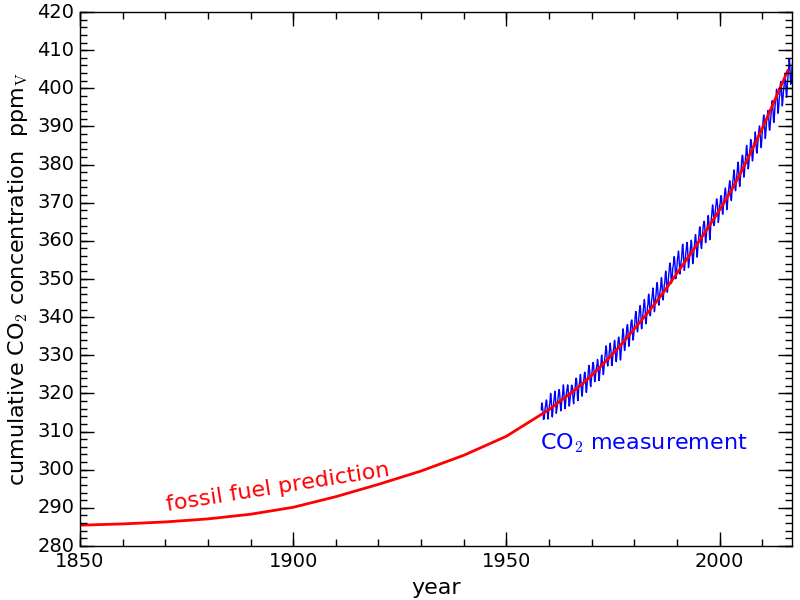
I took this to a new level in preparing my textbook, deciding to produce a “prediction” graph of CO2 emission over time using as inputs only historical fossil fuel records and knowledge of the chemistry. I overlaid the prediction on the measured CO2 from Mauna Kea (the Keeling curve) to just see how well they agreed. The result, reproduced below, made my jaw drop. I mean, I knew it would be decent, having crudely verified annual increase and cumulative increase before. But seeing the entire shape line up gave me a mic-drop moment. I didn’t do anything to force it to be so good!


Predicted CO2 rise from fossil fuel use (red) atop measured CO2 (blue).

No one gave me this plot. I didn’t find it somewhere. I don’t recall ever having seen one like it. I was curious, and went exploring to see what I would find. I wrote the Python program from scratch that read and parsed the historical fossil fuel data file, performed the chemistry calculations, and generated the graph (see text for details). I feel like I own this result in a way that I never would if somebody just showed it to me. I know what went into it, and why I can trust it.

The final step is an understanding of heat transfer and radiative transport in the atmosphere—both of which I have enough personal context to comfortably assess and understand (believe?). Radiative heat transfer is dear to my heart, and I have made loads of personal measurements/confirmations of how this process works. I have thoroughly explored my world using a thermal-infrared camera, performing supporting calculations; dealt with cryogenics in which radiative heat transfer is an enemy that must be well understood/quantified; validated planetary surface temperatures based on this phenomenon; and obtained countless spectra of stars and galaxies that emit radiative power. No talking head can undo all that personal experience. Also, like all astronomers, my observations have been constrained by atmospheric transmission windows, and I know what happens when I try or hope to get infrared light through the atmosphere at absorbed wavelengths. Those absorption features are real and limit the wavelengths I could observe. It’s not just words in a textbook, for me, but direct experiences at observatories where I have (not) seen the blocked wavelengths with my own tools. Incidentally, my gold-standard reference for describing radiative transport in the atmosphere is by Pierrehumbert in a short article in Physics Today.

Given an understanding of how infrared radiation interacts with atmospheric constituents, I can perform calculations of expected heating from trapped solar input that reasonably match observations and climate science. It all becomes rather transparent and personally accessible.


Epistemology


I should be careful throwing around words I rarely use (physics does not often concern itself with lofty language), but I think this one fits: how we know what we know. I have given an account of my background understanding of climate change. It would be fascinating to get a comparably explicit account from one of the Zero Hedge deniers. I suspect many of them would not operate on that plane, and may not even see the value in such a challenge. But if someone did try to articulate their opposition, what themes would emerge?

Most would present second-hand wisdom: repeating what (select) others had said. Even though I am doing some of that as well (though less selective, concerning chemical composition of octane; historical fossil fuel use; absorption spectrum of the atmosphere), the pieces I rely upon are more foundational and not (really) in dispute. I would call these “facts,” but even that word gets called into question by philosopher-deniers. I might also expect to see plenty of distracting anecdotes, anomalies, and even scientific literature waved around that pokes holes in certain temperature records or the like. In enormous, heterogeneous data sets, some data will inevitably have systematic errors or point to unresolved anomalies at the margins. Sometimes those little wrinkles turn out to be profoundly impactful, but scientists are weighing the totality of evidence, careful not to cherry-pick, always seeking the underlying truth. In the case of climate change denial, the flow seems to be from ideology to evidence/anecdote rather than the other way around. It’s not objective science, at that point.

I don’t have to be cryptic about where one might find a climate change viewpoint opposed to my own: right-wing outlets really thump this stuff. The issue has become politicized, so that a proper citizen of the right-hand tribe should adopt and parrot what they are told from their own trusted sources about climate change. It is easy to imagine the almost inevitable projection: that such a person would assume the left-hand side—teeming with dirty hippies and scientists—is similarly educated/inculcated and just parroting what their side tells them. Brainwashing accusations fly in both directions.

But I hope I have provided a window into the asymmetry of the situation. I stand to gain nothing from climate change being real. In fact, I think we all stand to lose a great deal as a result. Like many scientists, I don’t subscribe to the ideology of climate change because of some handed-down strategy, but because I see its straightforward plausibility flowing out of a solid foundation of directly-experienced physical reality. I don’t give a fig about what Al Gore says just because Al Gore says it. But when so many people—including myself—have independently arrived at the same inconvenient truth based on observation and physical reality, that’s a powerful outcome.

As a result, it is easier for me to accept the veracity of scientific outcomes than it is for me to embrace proclamations from other domains. I know something about the process. While not every scientific publication stands up to the inevitable scrutiny of the scientific community (especially if appearing in the sensational-leaning journal Nature, as we often joke), I have some basis for trusting that experts in the field will pick it apart if they can. Surviving results are strong, indeed. The fact that it’s not a blind trust in science is what makes science trustworthy at all.


On Who’s Authority?


One last comment is that academics who actually use the term “epistemology” on a daily basis often concern themselves with the question of authority. In philosophy, for instance, the body of work has come entirely from the words of people (authorities)—whose names we remember, and whose pictures will be in textbooks (why the picture of a bearded fellow has any relevance, I’ll never know—maybe the beard certifies authority?). When coupled with a political predilection toward authoritarianism, one can see how a statement of some right-wing ideology (e.g., about climate change or COVID) from an authority figure might be taken for truth.

Science, on the other hand, receives its “authority” from nature itself—not from people. The findings are repeatable and testable by experimenters, with or without beards. We would still understand electromagnetism without Maxwell (bearded), or relativity without Einstein (no beard). These bright but happenstance people were in the right place at the right time to be the first to stumble on these emergent truths, but they did not create those truths—much as continents and islands would be just as well known today without Columbus or Magellan having ever been born. The individual is incidental, and authority is irrelevant. This ties to my last post on the primacy of physical constructs over artificial human ones. It’s not all about humans, people!


Brainwashing, Perfected


I must say that part of me admires the clever and effective manipulation that right-wing media outlets have perfected. Rather than studying political science, international relations, and history, politicos on the right often study marketing, psychology, and communications. The recipe that hooks the audience is to hammer the messages:
  1. The condescending elitists on the other side think you’re dumb.
  2. We know that you’re smart (wink; we’re experts at lying).
  3. In fact, we can trust you to understand the following insight that the elitists will label as conspiratorial: you will know it (in your bones) to be true, being as smart as you are.
  4. Only we can be trusted to tell the truth: don’t bother even looking at the pack of lies in all the the “lamestream” media outlets, even if they are all oddly and independently consistent with each other (see: conspiracy!).
How brilliant is that? The Soviet propagandists would be proud. The targeted victims/viewers don’t stand a chance against this psychological Jiu Jitsu. They feel belonging, validation, purpose, and—well—smart. Who doesn’t like feeling smart? Having established this bad-faith trust, the outlets can peddle any narrative they want. As long as it has some “truthy” hooks, it will not be questioned. Now, what will they do with this power? Good things, surely.

covid, not climate: Kingsnorth's 3rd part on the vaccine moment

 The Vaccine Moment, part three

Or: How to think about Klaus Schwab

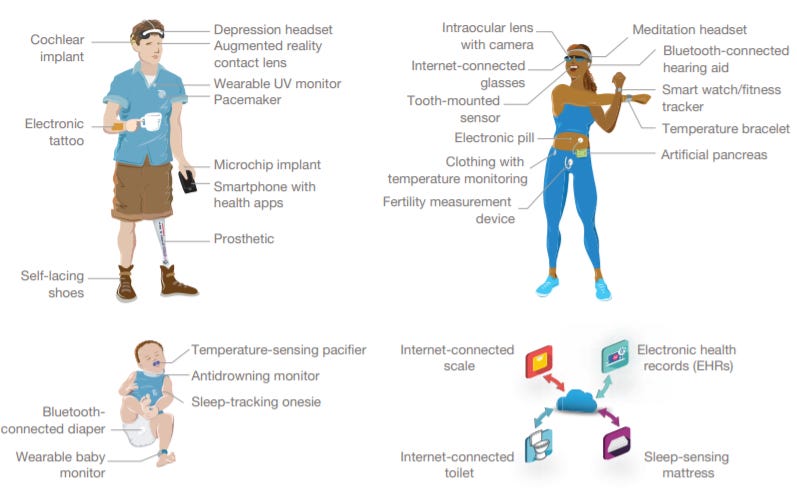
The coming ‘Internet of Bodies’, according to the Rand Corporation.

Everybody knows that the plague is coming
Everybody knows that it's moving fast
Everybody knows that the naked man and woman
Are just a shining artifact of the past
Everybody knows the scene is dead
But there's gonna be a meter on your bed
That will disclose
What everybody knows

- Leonard Cohen, 1988


When is a conspiracy theory not a conspiracy theory? The answer to this question has a bearing on the shape of the coming world.

In this covidian miniseries, I’ve been writing about the stories we tell about the pandemic. In the first essay, I explained why I had grown to disbelieve much of the official story - what I called the Narrative - about the virus and the response to it. For me, the straws that broke the back of this story were the Austrian lockdown of the ‘unvaxxed’, and the Australian quarantine camps: after this, I couldn’t tell myself that what was going on was anything to do with any sane definition of ‘public health’.

Maybe I was slow to get there, but I was only one of many who reached the same conclusion. This last month seems to have marked a tipping point, as resistance continues to grow to what is happening, and hundreds of thousands of people take to the streets across the world, from Turin to Paris, London to Vienna, Melbourne to Barcelona, Christchurch to Tblisi. Mandates, passports, segregation, quarantine camps, censorship, the chilling demonisation of the ‘unvaxxed’: all of this seems to have brought a new clarity about the unprecedented territory into which we are headed.

In the second instalment, I tried to dig into why so many of us see this situation so differently: why those mandates and passports, for example, are seen by some as a necessary health measure which it is irresponsible to refuse, and by others as the beginning of a tyranny which must be resisted. I looked at how the stories we tell about the world determine our responses to the corona moment, and how these stories can divide us against each other, even as we all aim for our own version of a healthier society.

This time around, I want to look at the story the Machine is telling us about these times. I want to look at the world we are being rapidly steered into, as covid-19 becomes a kind of techno-political sandbox: a testing-ground for new ways of being human in an increasingly post-human world.

Stories are the means by which we navigate reality, but they are also the means by which we control it - and by which we are controlled. Control the story, control the population: this has been understood since the Pharaohs, and it is why the narrative battle over covid has been so fierce. It is why the media and the social media companies have worked so hard to shut down difficult questions about the vaccines, and why constant efforts have been made to silence, intimidate or bully people who are said to be spreading ‘misinformation’. And it is also why we have seen a new focus on a very different kind of storyteller, one previously mocked but now increasingly looked upon with both nervousness and wrath: the ‘conspiracy theorist.’

Once upon a time, not so long ago, we knew what a ‘conspiracy theorist’ was. It was somebody who offered up an outsider take - often a very weird one - on an official version of a well-known story. Sometimes the take was convincing (JFK wasn’t shot by a lone gunman), sometimes it wasn’t (the UN wants to kill 95% of the world’s population), and sometimes it was downright poisonous (the Jews are behind it all.) But we all knew that a ‘conspiracy theory’ was a story that pointed towards dark, hidden forces operating in the world: a story that said, something is being hidden, and should be exposed.

Of course, the phrase was something else, too: a smear. The ‘conspiracy theorist’ (who probably wore a ‘tinfoil hat’) was basically unhinged: not like us good and sensible people who obtain our information from TV news, peer-reviewed science and books featured in broadsheet newspapers. Still, these people were mostly harmless - and more importantly, they were irrelevant. People who obsess over the Roswell Incident or the faking of the moon landings are no threat to power, so they are ignored by it. In normal times, ‘conspiracy theorists’ simply don’t matter.

But what about the abnormal times? Times like this one, when trust in official sources of authority is cratering, when the narratives are fractured, and when more and more people are grasping in the fog for new maps? In times like this, three things happen. Firstly, a lot of new conspiracy theories proliferate, like flowers in long-dry soil newly opened by rain. Secondly, the phrase ‘conspiracy theorist’ becomes a useful tool for those trying to hold the official line: a term of dismissal that can be applied to any and all who question the Narrative, no matter how reasonable their questions might be.

Thirdly, some of those theories will turn out to be right.

It’s fair to say that the ‘conspiracy theorists’ have had a good pandemic. I can still remember a glorious headline from a well-known publication which appeared in early 2020, and hasn’t aged well: “Anti-vaxx conspiracy theorists are suggesting that covid-19 will lead to the introduction of ‘vaccine passports.’” There have been countless articles like this over the last eighteen months in numerous outlets, dismissing predictions of everything from passports to mandates to quarantine camps as crazy tinfoil-hattishness. This has only served to underline the craven and unprecedented manner in which much of the media has been behaving, as well as the shredding of their remaining credibility. But that’s another story.

Perhaps the most reported-on ‘conspiracy theory’ of the past year, though, has been that of the ‘Great Reset’. In this lurid tale - so we are told by those same media outlets - globalist evil genius Klaus Schwab, who lives under a volcano in Davos, plans to kill off 95% of the population (again), and take control of the world’s resources. The 5% of us who remain will own nothing but be happy, because there is no longer any climate change and we are all fully vaccinated and boosted and entirely onboard with whatever Klaus and Bill Gates have planned for us next, which will probably involve robots.

It’s true that there are various, shall we say, creative tales doing the rounds about Schwab and the agenda of his World Economic Forum (WEF). But the Great Reset itself is no invention of the paranoid, and neither is it a conspiracy. You could call it a plan, or an agenda, but it is best understood as another story: one that Schwab and his colleagues would like us all to adopt as our map for the coming territory. If you want to understand the simultaneously boring and sinister nature of this story, you don’t need to penetrate the deepest recesses of the mountain redoubt in which it was secretly hatched: you can just watch the online lectures, attend the virtual conferences, or browse the relevant section of the WEF’s website. Or, if you’re really keen, you can do what I did last week, and read Klaus Schwab’s book on the subject.

Covid-19: The Great Reset is disappointingly free of mind control devices, microchips-in-vaccines and reptilian overlords. It is, in fact, almost entirely free of anything interesting at all. It is a standard-issue globalist manifesto, of the kind that could have been put out by any editorial functionary at the WEF, WTO, G8, UN, World Bank or IMF, or any writer for the Economist or Forbes, in any year after 1990. When I was writing my first book, One No, Many Yeses, back in the early 2000s, I read dozens of books and papers like this, in an attempt to understand what drove the promoters of economic and cultural globalisation. They were - and are - always the same: a hymn to the saving grace of global capitalism, dressed up in social justice clichés and aspirational NGO-speak. Diversity, vibrancy, equality, inclusivity, poverty alleviation, motherhood, apple pie: since they first started falling victim to mobs of activists outside their conference centres in the late nineties, the captains of the Black Ships of global capitalism have been careful to disguise their piratical raids as charity projects, powered by a Lennonist desire for universal oneness.

Schwab’s book, then, has to be read on two levels. On the surface, his argument is bland, unsurprising and deliberately hard to disagree with. He says that the pandemic has changed everything, and that the world will never return to what it was. He also argues that ‘what it was’ wasn’t working in any case. The global economy (the one he helped to build) is changing the climate, causing inequalities in and between nations and giving rise to other contemporary bad things, from racism to ocean pollution. We should thus ‘seize the opportunity’ that the virus has conveniently brought about to ‘reset’ the world: to rebuild it in a fairer, better, and more sustainable shape.

So far, so agreeable. Who could object to less poverty and cleaner seas? You have to dig below the surface to understand what any of this actually entails - and, more to the point, how it is to be achieved. And you don’t have to dig very far to see the story beneath the story.

The covid event, explains Schwab, has shown that ‘we live in a world in which no-one is really in charge.’ For plenty of us, this might sound like a good thing, but for globalist thinkers like Schwab it is a problem to be solved. ‘There cannot be a lasting recovery without a global strategic framework of governance’, he writes. Nation states and their kindly allies in the ‘global business community’ must unite to ‘build back better’ (you may have heard this somewhere before). What does this mean? It means that there is no going back.

Schwab is clear that the measures taken to tackle covid - lockdowns, vaccine passports and mandates, medical segregation, mass sackings, widespread destruction of small businesses, the deepening of the profit and reach of Big Tech, and a radical normalisation of digital monitoring, surveillance and state control - have wrought permanent changes on our societies which will not be going away. ‘What was until recently unthinkable’, he writes, ‘suddenly became possible’. This is especially true when we look at the real winner of the covid years: the technological system itself.

While ‘some of the old habits will certainly return’ after the pandemic ends, writes Schwab, ‘many of the tech behaviours that we were forced to adopt during confinement will through familiarity become more natural.’ Home working, digital monitoring of employees by their companies, Zoom meetings and e-deliveries, not to mention the whole structure of the QR-coded ‘vaccine passport’ system: much of this is likely to remain in the new normal that covid has created. In the reset future, we will reconsider things which once would have been second-nature: things like spending time with our loved ones. Why, asks Schwab, would we endure ‘driving to a distant family gathering for the weekend’ when ‘the WhatsApp family group’ (though admittedly ‘not as fun’) is nevertheless ‘safer, cheaper and greener’? Why indeed?

This is the essence of the Great Reset: the construction of a future which is at once controlled and catatonic, dystopian and dull, monitored and monotonous beyond bearing. A future in which global corporations are free to build the world they have long desired: a borderless, interconnected market technocracy, in which each human individual is a tracked, traced and monitored production and consumption machine - all in the name of public health and safety.

Interestingly, Schwab openly observes, in a claim which might land anyone else a Youtube ban, that covid is ‘one of the least deadly pandemics the world has experienced over the last 2000 years’ and that ‘the consequences … in terms of health and mortality will be mild.’ The really lasting consequences, he writes, will not be wrought by the virus itself, but by the response to it. This culminates in the only striking image in the book, which Schwab uses to illustrate how the fear of sickness will linger long after any threat of covid itself has receded, and what this might lead to:

A new obsession with cleanliness will particularly entail the creation of new forms of packaging. We will be encouraged not to touch the products we buy. Simple pleasures like smelling a melon or squeezing a fruit will be frowned upon and may even become a thing of the past.

A smooth, clean, ordered world, free of dangerous melons on little market stalls, free of small businesses and anarchic commercial arrangements and awkward human interactions of any sort - a world run by efficient, clean, digitised corporations offering ‘e-solutions’ for any activity that might threaten our safety and wellbeing: this has been on offer for years now, but the pandemic - as Schwab openly acknowledges - has been a blessing for those behind it. We are prepared to accept things now which would have been inconceivable three years ago. What will be conceived next year? And who will listen to the ragtag mob of conspiracy theorists, anti-vaxxers, fascists and nutters who want us to say no to it?

This is the sort of thing that fuels the genuinely weird ‘conspiracy theories’ around Schwab and his agenda. But it’s not necessary to believe that the virus was deliberately released or doesn’t exist, to simply observe the wider picture. For decades now, nation states and their political leaders have been progressively disempowered by globalisation, and power has been concentrated in the hands of those who create and control the world’s technological infrastructure. Bill Gates, Mark Zuckerberg, Klaus Schwab, Jeff Bezos, Sergey Brin, Ray Kurzweil and the like have been moulding our reality for decades, and the limbic capitalism they pioneered has been hyper-charged by covid - as has awareness of it, and a growing counter-reaction.

We are living through a time in which the conflict between technocracy and democracy has spilled out into the open: the battle is being fought daily now on street and screen. Schwab has caught the spotlight because he is publicly attempting to put a storytelling framework around this conflict. Only last month, at a conference in (where else?) Dubai, he made this ambition explicit by rebranding his Great Reset as the ‘Great Narrative’. The world needed a new global story to unite it, he said. He and the WEF would help to ‘imagine the future, design the future, and then execute the future.’

Klaus Schwab planning to ‘execute the future’ is exactly the kind of thing that gets Alex Jones salivating. But though Schwab and the WEF’s power and influence should not be underplayed, he is not pulling the strings. There are no strings: there is only the Machine, and its direction of travel is long-set. Covid has provided the perfect testing ground and launchpad for a next generation of digital surveillance-and-control technologies which have been on the drawing board for years. The confusion, anger and division swirling around us all right now is a result of our confused inability to navigate the techno-coup we are living through, or even to quite understand what is happening.

But the future is off the drawing board now. Take those QR-enabled vaccine passports, which have been rolled out so rapidly all over the world over the last twelve months. They make little sense from a ‘public health’ perspective, since we know that the currently available vaccines don’t prevent transmission of the virus. But they do have the effect of normalising the technologies involved: technologies which were in the pipeline anyway. Digital vaccine passports have been in preparation in the European Union, for instance, since at 2018. In late 2019, months before the pandemic began, trials of ‘digital identity systems’ linked to vaccination status began in Bangladesh. It was hoped that they would demonstrate how to ‘leverage immunization as an opportunity to establish digital identity’ on a worldwide scale.

Again: no outlandish claims are required to make sense of this. It is simply an acceleration of the existing direction of travel. Most of us already carry around in our pockets a portable tracking device, which monitors our geographical location, harvests data on everything from our political views to our shopping preferences, and can be used by the State in extremis to determine who our friends and contacts are. It’s called a smartphone. As covid becomes endemic over the next year or two, and as new variants keep popping up, there will likely be continuing pressure for permanent guarantees of health and safety. Handily, we may be able to use those smartphones, already apped-up with our covid QR codes, as permanent ‘health passports’, which will allow us to access goods and services safely and digitally in the dangerous new world - whilst penalising or excluding anyone who refuses to avail of the recommended public health measures.

If this sounds like one of those nutty old conspiracy theories, bear in mind that actual passports - the ones we use to go on holiday - were themselves introduced as a temporary measure after World War One. The later justification for making them permanent on a global scale was ‘considerations of health or national security’ provoked by the Spanish Flu outbreak of 1918. A century on, the digital version is close to fruition, and the pandemic provides the perfect opportunity for its rollout. The WHO is currently negotiating with nation states, regional blocs and corporations to agree on the standards for global harmonisation of digital passports:

New tools developed as part of WHO efforts are almost ready. By the end of 2021, the DDCC Gateway (PKI) beta reference software is expected and a Universal Status Checking app beta, using Google Android FHIR SDK and based on the EU DCC … It is intended to be able to recognize all the health pass QR code formats being used worldwide.

So we will have have our permanent, global health passports, and they will then merge with already-existing digital ID technologies and the rollout of digital currency, to create for us all a personalised digital identity wallet which will be presented as an optional convenience but will soon enough become a basic requirement for taking part in the life of society, just as smartphones, credit cards and paper passports have. If you want to experience this future for yourself, you can watch this short film, made especially for you by one of the companies which is pioneering it. Doesn’t it look appealing? Safe? Frictionless? Speaking for myself, I’m feeling tremendously empowered already:

Once we have accepted the premise that deep and ubiquitous levels of surveillance, monitoring and control are a price worth paying for safety - and we seem to have done that already - then almost anything is possible. South Korea has just introduced mass facial recognition technologies in order to ‘speed up notifications of potential exposure to COVID-19.’ China famously operates a social credit system through which citizens are rewarded or penalised for their behaviour in multiple spheres. Media outlets are producing slick little films detailing how your covid passport could be conveniently stored on a microchip embedded in your skin. In the US, the FDA has already approved pills implanted with ‘digital ingestion tracking systems’, which send a signal to a smartphone when the medicine is taken. Perhaps you will be able to pay for them with your biometric cash card, imprinted with your fingerprint data.

Buckle up: these are the coming times, and they are herding us directly and deliberately towards the main target: the ‘Internet of Bodies’, in which we begin to merge, finally, with the machines we have made. Microchip brain implants - ‘human enhacements’ which will allow us to ‘interface’ directly with the web - will be with us sooner than we think: their development is currently being funded by, among others, Elon Musk and Mark Zuckerberg. The Royal Society, Britain’s premier league scientific thinktank, can’t contain its excitement about the possibilities they will offer:

Linking human brains to computers using the power of artificial intelligence could enable people to merge the decision-making capacity and emotional intelligence of humans with the big data processing power of computers, creating a new and collaborative form of intelligence. People could become telepathic to some degree, able to converse not only without speaking but without words—through access to each others’ thoughts at a conceptual level. Not only thoughts, but experiences, could be communicated from brain to brain ...

In this story - the story of the Machine - the whole world, and everyone and everything in it, becomes a node in the glowing web that will make and direct our every waking hour. This future has, of course, been long anticipated. William Morris saw it coming, and so did William Blake. Aldous Huxley and E. M. Forster had its number a century ago, and Edward Abbey predicted it before I was born:

Call it the Anthill State, the Beehive Society, a technocratic despotism — perhaps benevolent, perhaps not, but in either case the enemy of personal liberty, family independence, and community sovereignty, shutting off for a long time to come the freedom to choose among alternate ways of living. The domination of nature made possible by misapplied science leads to the domination of people; to a dreary and totalitarian uniformity.

Covid has both accelerated and justified our dive into the digital anthill, and in coming years it will become more and more relentless. Perhaps many, even most, of us will welcome it. After all, it has been advertised at us for years, in the most deliberate, manipulative mass assault on our wills in human history. We have been trained to love - or at least accept - our smartphones, satnavs, Smart fridges, drones and Alexas. Luddites like me have always been a fringe sect. Certainly the people selected by the WEF as ‘young global leaders’ of tomorrow are excited by the future that they are being groomed to build:

When AI and robots took over so much of our work, we suddenly had time to eat well, sleep well and spend time with other people. The concept of rush hour makes no sense anymore, since the work that we do can be done at any time. I don't really know if I would call it work anymore. It is more like thinking-time, creation-time and development-time.

Although, of course, every society has its downsides:

Once in a while I get annoyed about the fact that I have no real privacy. Nowhere I can go and not be registered. I know that, somewhere, everything I do, think and dream of is recorded. I just hope that nobody will use it against me.

This is not satire; this is prophecy. Or maybe it’s just marketing. Whichever it is, we have come at long last to the foothills of the future: an inverted version of The Matrix in which Agent Smith is the hero. A world both terrible and boring at the same time. As climate change bites, ecosystems continue to degrade, supply chains jam up, the social fabric frays, and mass urbanisation and mass migrations accelerate, it will become more and more necessary to micromanage, nudge and control the citizens of our mass societes just to keep the growth-&-progress show on the road. The pandemic has shown us how this can be achieved. Schwab is right that there is no turning back from the lessons it has taught.

Sometimes I think that what is happening now has no precedent in human history. At other times, it seems like human history as usual, only faster. When did we start augmenting ourselves, after all? When we invented glasses, shoes, armour, chipped flint? If this is what humans do, and what we are - animals who invent ourselves stronger, think worlds into being and then try to build them - is there any way to halt the march towards the merger of man and machine? Or did that already happen?

I could go on - I have gone on for years now. But it’s Christmas week, and I don’t want to end on this note. I want to end instead by saying something else: something I may not have expected to say at the beginning. But then that first essay, from a month ago, already seems like it was written in another time, so fast is everything shifting.

Here’s the thing: for some reason, despite all I have written about in this little trilogy, despite the coming winter, despite the new partial lockdown that my vaxxed-and-passported country has just entered, despite everything that the future seems to hold: despite it all, I feel some strange glimmer of hope. Control: this is the story that the Machine tells about itself, and it is the story that we would all, at some level, like to be true. But control systems never last. The world is beyond both our understanding and our control, and so, in the end, are people. We barely understand ourselves. Perhaps Klaus Schwab’s desire to ‘improve the world’ is real and felt: but he will still never be able to grip it tightly enough to bend it to his will. Who can?

The world is not a mechanism: it is a mystery, one that we participate in daily. When we try to redesign it like a global CEO, or explain it like an essayist, we are going to fail: weakly or gloriously, but fail we shall. The Machine, the technium, the metaverse: whatever we name our 21st century Babel, and however overwhelming it seems to us in the moment, it can never conquer in the end, because it is a manifestation of human will and not the will of God. If you don’t believe in the will of God, call it the law of nature instead: either way, it speaks the same thing to us. It says, gently or firmly: you are not in charge.

I can’t pretend to understand all of this. All I have is my intuition, and these words. But I think that the world is more surprising, and more alive, than I sometimes see or even want to believe. I think that the corona moment highlights an ancient ongoing struggle, between the spirit of the wild and the spirit of the Machine, and that this struggle goes on inside us all every minute of the day. Sometimes, battles must be fought, stands taken, lines drawn. This is one of those times. Once we begin to understand all the stories at play, we can begin to see which one we are taking part in, and what choices we must make.

Winter is here in the north. Tomorrow is the solstice. In the west of Ireland it is dark, damp and cold. The times are raging around us, and it can be hard to keep our heads. But candles are lit in the windows here at night, for it is advent, and an unexpected light is about to break through the shortest of days. The times demand now that we remember and cultivate some of the old virtues. We could start with courage: courage and patience. It may take years, decades, centuries, but the Machine we have built to manage life itself, to squeeze the world into our own small shape - it will come down in the end, and the humming wires will fall silent. Our task in the meantime is to understand, so that we can resist, the shape of the tyranny it brings. But D. H. Lawrence knew: all the prophets knew. The Earth cannot be reset. Not by us; not ever.

They talk of the triumph of the machine,
but the machine will never triumph.

Out of the thousands and thousands of centuries of man
the unrolling of ferns, white tongues of the acanthus lapping at the sun,
for one sad century
machines have triumphed, rolled us hither and thither,
shaking the lark’s nest till the eggs have broken.

Shaken the marshes, till the geese have gone
and the wild swans flown away singing the swan-song at us.

Hard, hard on the earth the machines are rolling,
but through some hearts they will never roll.


This was the third and final part of my three-part series on the virus and the Machine. I’m retreating from screens until the new year, but in January I will return to my wider essay project, digging further into how the Machine age is transforming every aspect of our world.

Saturday, December 11, 2021

Glikson re: PlanetWide Ecocide

Planetwide Ecocide - The Crime Against Life on Earth. Andrew Glikson. Dec. 7, 2021.


“We are simply talking about the very life support system of this planet.”
Hans Joachim Schellnhuber, Germany’s former chief climate scientist (2009)

“Burning all fossil fuels would create a very different planet than the one that humanity knows. The palaeoclimate record and ongoing climate change make it clear that the climate system would be pushed beyond tipping points, setting in motion irreversible changes, including ice sheet disintegration with a continually adjusting shoreline, extermination of a substantial fraction of species on the planet, and increasingly devastating regional climate extremes” and “this equates 400,000 Hiroshima atomic bombs per day 365 days per year” .
James Hansen et al. 2012 and James Hansen 2012.


Figure 1. The change in state of the planetary climate since the onset of the industrial age in the 18ᵗʰ century.

During its last 600 million years-long history planet Earth suffered at least five major mass extinctions, defining the ends of several eras of the Ordovician, Devonian, Permian, Jurassic and Cretaceous, triggered by extra-terrestrial impacts, massive volcanic eruptions, methane release or ocean anoxia. Each of these events included the release of greenhouse gases, inducing changes in atmospheric composition and temperature (Figures 1, 2 and 3). Excepting the role of methanogenic bacteria in releasing methane, the anthropogenic mass extinction constitutes an exception: For the first time in its history the atmosphere, the oceans and the biosphere are disrupted by a living organism, namely the activity of a carbon-emitting biped mammal species.


Fig 2. Temperature trends for the past 65 Ma and potential geo-historical analogs for future climates (Burke et al. (2018)


In the wake of the Pliocene (2.6-5.3 Ma-ago), with temperatures in the range of (+2°C to 3°C above pre-industrial levels) and sea levels (+25 meters) higher than at present, the development of glacial-interglacial conditions saw the appearance of Homo erectus and then Homo sapiens. Between about 10,000 and 7,000 years ago, the stabilization of the climate in the Holocene saw Neolithic agricultural civilization take hold. Anthropogenic processes during this period, denoted as the Anthropocoene (Steffen et al., 2007), led to deforestation and the demise of species, ever increasing carbon pollution of the atmosphere, temperature rise (Figures 1 and 2), acidification, radioactive contamination and a growing threat to the Earth’s life support systems.

Planetwide ecocide results from anthropogenic emission of greenhouse gases into the atmosphere, raising their combined forcing (CO₂ + CH₄ + N₂O, etc.) to levels over 500 ppm CO₂-equivalent, (Figure 3), almost doubling the pre-industrial CO₂ level of ~280 ppm, and corresponding to a rise of +3°C per doubling of CO₂ levels. The consequence of extraction and combustion of the buried products of ancient biospheres, threatens to return Earth to conditions which preceded the emergence of large mammals on land.


Figure 3. Pre-1978 changes in the CO₂-equivalent abundance and AGGI (Annual Greenhouse Gas Index). NOAA Global Monitoring Laboratory

The sharp glacial-interglacial oscillations of the Pleistocene (2.6 million to 10,000 years ago), with rapid mean global temperature changes of up to 5°C over a few millennia and abrupt stadials cooling events over a few years (Steffensen et al., 2008), required humans to develop an extreme adaptability, in particular mastering fire, a faculty no other species, perhaps with the exception of fire birds. Proceeding to manipulate the electromagnetic spectrum, split the atom and travel to other planets, a cultural evolution overtaking biological evolution, the power of sapiens appears to have gone out of control.

Humans have developed an absurd capacity to simultaneously create and destroy, culminating with the destruction of environments that allowed them to flourish in the first place. Possessed by a conscious fear of death and a craving for god-like immortality, there is no murderous obscenity some were not willing to perform, including the transfer of every accessible carbon molecule to the atmosphere.

Based on direct observations and the basic laws of physics, the life support systems of the biosphere are threatened by the rise of greenhouse gases and temperature by an average of more than 1.14°C since 1880, currently tracking toward 2°C. These values take little account of the masking effects of the transient mitigating effects of sulphate aerosols in the range of −0.3 to −1.8 Wm⁻², pushing mean global temperature to >1.5°C. Following the current acceleration (Figure 3), mean temperature could reach 2°C by 2030, 3°C by the 2050s and 4°C by 2100, inducing heat waves and major fires.


Figure 4. Jet Stream, summer, 1988, NASA. Increased undulation of the Arctic boundary zone, allowing penetration of cold air masses southward and warm air masses northward;

Overall warming of large ocean regions, reaching ~700 meter deep levels, reduces the ocean’s ability to absorb CO₂ while much of the gas is trapped in the atmosphere. As ocean heat contents rise oxygen is depleted and methane and hydrogen sulphide poisonous for marine life are produced. Models projecting global warming as a linear trajectory, outlined by the IPCC, take limited account of amplifying feedbacks and transient stadial cooling effects from the flow of ice melt water into near-polar oceans. As the circum-Arctic jet stream undulates and weakens (Figure 4), polar-ward shifts of climate zones (Figure 5) allow penetration of warm air masses into the Arctic, manifested by heat waves and fires. Conversely, injection of cold air masses from the Arctic into mid-latitudes ensues in freezing fronts producing violent snow storms, the so-called “Beast from the East”.


Figure 5. The migration of the Sahara arid climate zone northward into southern Europe. Note the drying up of Spain, Italy, Greece and Turkey and the increased in precipitation in Northern Europe.


As stated by Barnosky et al. (2013) in the paper “Approaching a state shift in Earth's biosphere”: “Localized ecological systems are known to shift abruptly and irreversibly from one state to another when they are forced across critical thresholds. Here we review evidence that the global ecosystem as a whole can react in the same way and is approaching a planetary-scale critical transition as a result of human influence’’ and “Climates found at present on 10–48 % of the planet are projected to disappear within a century, and climates that contemporary organisms have never experienced are likely to cover 12–39 % of Earth. The mean global temperature by 2070 (or possibly a few decades earlier) will be higher than it has been since the human species evolved’’. Figure 6 outlines critical habitats and species involved in the transition.


Figure 6. Summary of major biodiversity-related environmental-change categories expressed as a percentage of human-driven change (in red) relative to baseline (blue); Corey J. A. Bradshaw; Paul R. Ehrlich; Andrew Beattie; et al. (13 January 2021). https://www.frontiersin.org/files/Articles/615419/fcosc-01-615419-HTML-r1/image_m/fcosc-01-615419-g001.jpg - “Underestimating the Challenges of Avoiding a Ghastly Future”, in Frontiers in Conservation Science, volume 1, 13 January 2021. Red indicates the percentage of the category that is damaged, lost, or otherwise affected, whereas blue indicates the percentage that is intact, remaining, or otherwise unaffected.


As $trillions are invested in future wars, who or what will defend life on Earth?


A/Prof. Andrew Glikson

Earth and Paleo-climate scientist
School of Biological, Earth and Environmental Sciences
The University of New South Wales,
Kensington NSW 2052 Australia