Tuesday, January 29, 2019

Topics: Agriculture, Factory Farming, Food, Meat, Vegetarianism

You wont believe what goes on at these farms. Lee Camp, redacted tonight.


Farm to Fridge.


Beef-eating 'must fall drastically' as world population grows. Damian Carrington, Guardian. Dec. 5, 2018.
Current food habits will lead to destruction of all forests and catastrophic climate change by 2050, report finds

Creating a Sustainable Food Future. World Resources Institute.
By 2050, nearly 10 billion people will live on the planet. Can we produce enough food sustainably? 
The synthesis report of the World Resources Report: Creating a Sustainable Food Future shows that it is possible – but there is no silver bullet. This report offers a five-course menu of solutions to ensure we can feed everyone without increasing emissions, fueling deforestation or exacerbating poverty. Intensive research and modeling examining the nexus of the food system, economic development, and the environment show why each of the 22 items on the menu is important and quantifies how far each solution can get us. 
Creating a Sustainable Food Future has been produced by World Resources Institute in partnership with the World Bank, UN Environment, UN Development Programme, and the French agricultural research agencies CIRAD and INRA.


The way we eat is killing us – and the planet. Felicity Lawrence, Guardian. Jan. 28, 2019.
The global food system is causing an ecological and health catastrophe – individual action won’t be enough.

The distinguished medical journal The Lancet has issued not one but two apocalyptic warnings about our food in under a month. One of its special commissions reported earlier this month that civilisation itself was at risk from the effects of the current food system on both human health and the Earth’s ecosystems. 
This week comes the next instalment from another special Lancet commission which finds that pandemics of obesity and malnutrition are interacting with climate change in a feedback loop and represent an existential threat to humans and the planet. The modern western diet has become a highly damaging thing that needs a complete overhaul if we are to avoid potential ecological catastrophe. It concluded that we need to halve global meat consumption, and more than double the volume of whole grains, pulses, nuts, fruit and vegetables we eat. 
Cue howls of indignation from big food and its cheerleaders, the libertarian right. Those nanny statists have gone nuts eating their own double dose of nuts! Cue cries of distress from champions of local, low-impact agriculture who include grass-fed animals, and their meat and manure, in their sustainable mix. These self-appointed experts don’t understand farming! Cue grim food wheels with only a quarter of a rasher of bacon or a fifth of an egg a day. Those miserabilist medics want us all to go vegan!
Yet the evidence that our diets are the largest cause of climate change and biodiversity loss is now overwhelming. The global food system is responsible for up to 30% of total greenhouse gas emissions, the livestock sector on its own accounting for about half of that total or 14.5%. The modern western way of eating is also making very large numbers of people fat and sick as other parts of the world adopt it. Diet-related diseases now cause roughly 11 million deaths a year as preventable cancers, heart disease and strokes, obesity and diabetes have spread along with our way of eating. More than 800 million people are estimated to be chronically undernourished, and 2 billion suffer from micronutrient deficiencies, yet at the same time 2 billion are overweight or obese. In poorer counties you can even find obesity and stunting within the same family as calorie-heavy but nutrient-light processed industrialised foods are adopted. 
In other words, something has gone horribly wrong and we don’t have much time to fix it.


European farms could grow green and still be able to feed population. Rebecca Smithers, Guardian. Feb. 20, 2019.
Research shows loss in yields could be offset by reorienting diets away from grain-fed meat


Can We End Animal Farming Forever? Nathan J. Robinson, Current Affairs. Nov. 12, 2018.
A new book says we should stop killing animals altogether... and that it's possible.

Here is a bit of bad news: Humanity is committing an ongoing moral atrocity at an almost unthinkable scale.
 
There is, however, also some good news: We might be able to end it more easily than people assume. 
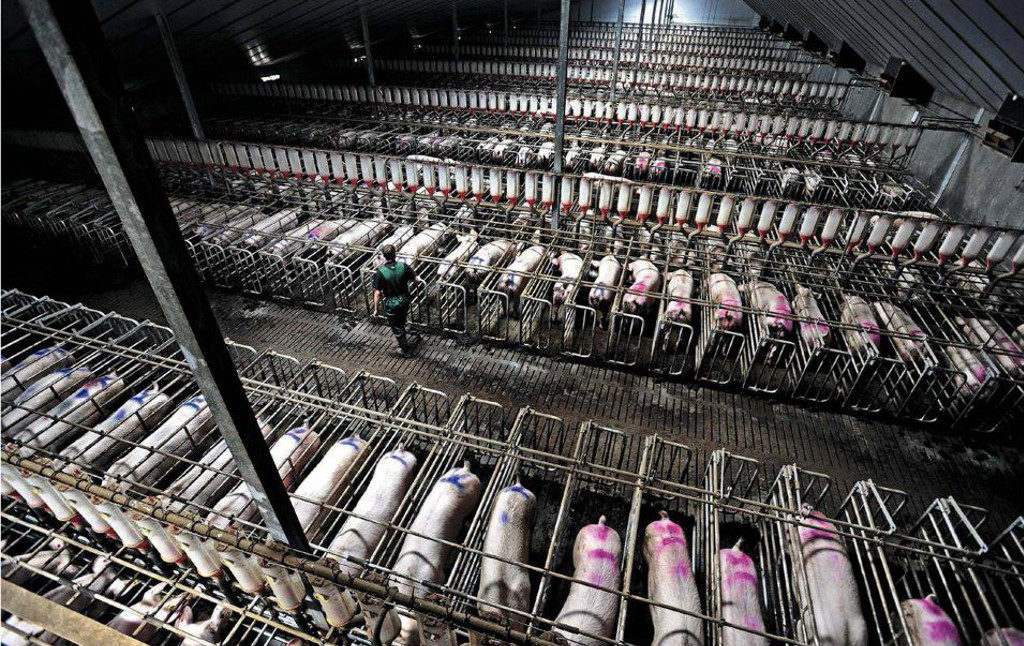
The moral problem with our current practice of killing and eating of animals is very clear. Non-human animals are quite obviously sentient and feel fear, pain, and sorrow. Most of us know this, which is why we object to animal cruelty when it’s perpetrated against puppies or kittens. But off in places we keep out of sight, billions of animals are being constantly subjected to unimaginable cruelty. Baby chicks are thrown away by the thousand to suffocate, animals are raised in crowded darkness, their entire lives consisting of never-ending stress and pain. This only begins to touch on the horrors. 
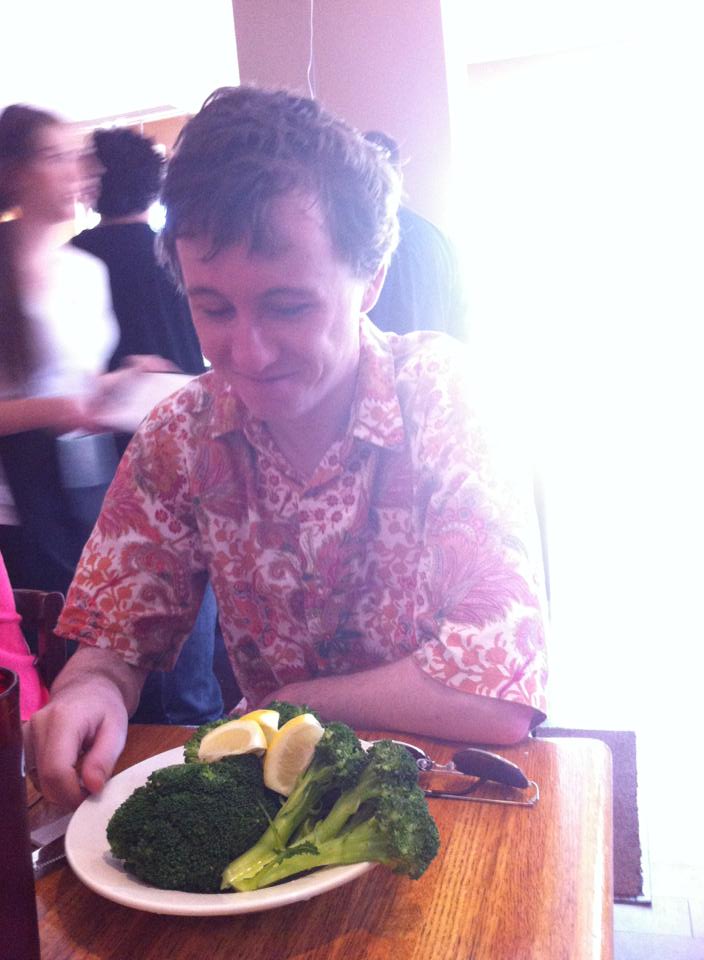
Even though many people are queasy about industrial farming, most of us do not make it one of our main causes. People think that human issues are more important, but they are also simply overwhelmed by the scale of the problem. Meat is such a core part of the average diet (only a tiny fraction of people are vegetarian), and there are so many people on earth, that it’s unclear how you could possibly eliminate, or even substantially reduce, animal suffering. You could convince people one by one to go vegan, since if everyone was a vegan there would be no problem. But as a practical matter, that seems unlikely to work: It’s good to create new vegans where possible, but knowing about the problem does not turn people vegan. (I am not a vegan myself, though I have been a vegetarian for 10 years. I have had to eat a lot of shitty food, and pass up a lot of delicious food, in order to keep it up. Once, when I went to a steak restaurant with some friends and asked for something vegetarian, I was brought nothing but an entire plate of almost-raw broccoli, stalks and all. Here I am looking at it. Many chefs hate vegetarians.) In the absence of a sudden mass conversion to a fruit and nut diet, are we stuck with this problem forever? 
In his new book The End of Animal Farming, Jacy Reese argues that we are not. Reese believes that with considerable effort, we can end animal farming altogether within 100 years, and that when we do, our era will come to seem as morally backward as the distant past now seems to us today.


How Can You Talk to Kids About Factory Farming? These Books Can Help. Reynard Loki, Truthout. Oct. 28, 2018.
Many children play with toys that evoke the bucolic life on a farm. And many will likely visit a small local farm, where animals have space and access to sunlight and the outdoors. But most kids are probably not aware that, for the vast majority of farmed animals, life is anything but happy.

Consider the life of a chicken trapped on a factory farm. If she is one of the 9 billion chickens who suffer and die on US factory farms for their meat, she is committed to a life of unending misery, fed an unnatural diet to spur abnormally rapid and painful growth. Perhaps she is one of the 26 to 30 percent of chickens raised for their meat who can’t even walk normally because their skeletons are not able to support their rapidly growing bodies. She will live an average of just 42 days. If she is one of more than 300 million chickens raised in factory farms every year for their eggs, most of her beak was cut off with a scalding hot blade when she was just hours or days old. As a hen, she lives her entire life in a tiny wire “battery” cage, with up to 10 other hens. She may be sick or injured, but she will receive no medical care. She is forced to live alongside dead and dying cagemates. After about two years of this unimaginable suffering, she is considered “spent,” and sent to a slaughterhouse. After her brief life, she must endure a terrible death as she is stunned in an electrified water bath before her throat is slit. (There is no law requiring chickens to be rendered unconscious before slaughter.)

Consider also the life of a mother pig trapped on a factory farm, where she is confined to a gestation crate barely larger than her own body. She is unable to turn around or even lie down comfortably for almost her entire life. Once she gives birth, she is impregnated again, in a cruel cycle that goes on for up to four years before she is killed for her meat. Her piglets are ripped from her when they are just 10 days old, and their tails cut off and their teeth clipped. Her sons have their testicles ripped out without any anesthesia or painkillers.

These are the brutal realities for millions of animals trapped on factory farms. ...
... 
Q: What would you tell parents who want to avoid purchasing meat produced in factory farms, or parents who are considering switching their families’ diets to more plant-based eating? 
A: I’d tell them they are helping not only the planet but themselves and their children by encouraging them to eat more fruits, vegetables and grains. Factory farming heats up our planet, pollutes waterways and air, and eats up land used to grow the grain that feeds livestock — and lots of water too. It also hurts the people who live near and work at [the farms]. Even if a family isn’t vegetarian or vegan, just reducing the amount of meat and dairy we eat can make a difference, and there are so many good plant-based options these days, with many more coming to market every week.


Investigation Exposes Animal Abuse at US Supplier to World’s Largest Meat Company. Reynard Loki, Truthout. Sep. 8, 2018.
“From the day pigs are born until the day they are violently killed for JBS pork, their lives are filled with misery and deprivation,” said Matt Rice, president of MFA, in a press statement. “If JBS executives abused even one dog or cat the way their suppliers abuse millions of pigs, they would be jailed for cruelty to animals."

Death by Fertilizer. Nathanael Johnson, Grist. Oct. 2, 2018.
This breakthrough solution created a crisis as large as the one it solved. Since Haber’s discovery, humans have nearly doubled Earth’s natural flow of fixed nitrogen, overwhelming the capacity of ecosystems to remove it. The resulting buildup is poisoning the planet’s waterways, creating a crisis some consider even more threatening than the buildup of carbon dioxide in the atmosphere.

Time to Drive Factory-Farmed Food Off the Market. Ronnie Cummins & Martha Rosenberg, Organic Consumers Association. Truthout. Sep. 12, 2016.
Factory farming is a trillion-dollar industry that has a devastating impact on food quality, human health, animal welfare, farmworkers, rural communities, water quality, air pollution, biodiversity, and greenhouse gas emissions. Globally, two-thirds of all farm animals are now confined on factory farms. In the US the figure is even higher — 90-95 percent.

The overwhelming majority of US and global farmland today is used either to raise animals before they are sent to the CAFO feedlots, or to grow the GMO and chemical intensive crops such as alfalfa, canola, corn, cotton, soybeans and sugar beets.

The US factory farm meat, dairy and poultry industry is an out-of-control system based on cruel, filthy, disease-ridden and environmentally destructive animal prisons; GMO-and pesticide-tainted feeds; labor exploitation; false advertising; corporate corruption of government; and the use of massive amounts of dangerous pesticides, chemical fertilizers, antibiotics, hormones and growth promoters.

Factory-farm meat, dairy, poultry and fish are the number one cause of water pollution, soil degradation, greenhouse gas emissions diseases such as cancer, heart disease, diabetes, reproductive defects, hormone disruption and obesity.


More weight on less meat. Mark Bittman, NYT. July 18, 2011.

Meat eater's guide to climate change and health. Environmental Working Group.


Plant-Based Diets Can Help Us Reach The 2 Degree Threshold. Carolyn Fortuna, Clean Technica. Oct. 5, 2018.
A report from researchers Poore and Nemecek at the University of Oxford points to one significant solution to meet the 2 degree threshold — avoiding meat and dairy products. They say that this is the single biggest way to reduce our environmental impact on the planet. Meat and dairy provide just 18% of calories and 37% of protein, yet they use the vast majority – 83% – of farmland and produce 60% of agriculture’s GHG emissions. The report indicates that, without meat and dairy consumption, global farmland use could be reduced by more than 75%.
... 
“A vegan diet is probably the single biggest way to reduce your impact on planet Earth, not just greenhouse gases, but global acidification, eutrophication, land use and water use,” Joseph Poore, who led the research, said in an interview with The Guardian. “It is far bigger than cutting down on your flights or buying an electric car,” he said, as these only cut greenhouse gas emissions. “Agriculture is a sector that spans all the multitude of environmental problems. Really it is animal products that are responsible for so much of this. Avoiding consumption of animal products delivers far better environmental benefits than trying to purchase sustainable meat and dairy.”


Slaughter Age vs. Natural Life Span. Colleen Patrick Goudreau. Apr. 11, 2012.

Though we kill over 10 billion land animals every year to please our palates, we too often try to absolve ourselves by making what we want to believe are guilt-free choices, failing to recognize the paradox of “humane slaughter” and never really knowing what the whole experience is for an animal from cradle (domestication) to grave (our bodies).

Though modern animal factories look nothing like what is idealized in children’s books and advertisements, there are also many misconceptions about the practices and principles of a “humane” operation. When we think about it for just a moment, the idea of breeding animals only to kill them is absurd at best, and people are often surprised to learn that most of the animals sent to slaughter are just babies, whether they are raised conventionally or in operations that are labeled “humane,” “sustainable,” “natural,” “free-range,” “cage-free,” “heritage-bred,” “grass-fed” or “organic.”

Slaughter Age vs. Natural Life Span

Pigs: Slaughtered at 6 months young; Natural life span: 6 to 10 years

Chickens: Slaughtered at 6 weeks young; Natural life span: 5 to 8 years for those birds bred as "egg layers" such as Rhode Island Reds; 1 to 4 years for factory layer breeds such as leghorns; and 1 to 3 years for "meat" breeds.

Turkeys: Slaughtered at 5 to 6 months young; Natural life span: 2 to 6 years

Ducks/Geese: Slaughtered at 7 to 8 weeks young; Natural life span: domestic ducks: 6 to 8 years; geese from 8 to 15 years.

Cattle: “Beef” cattle slaughtered at 18 months young; dairy cows slaughtered at 4 to 5 years young; Natural life span: 18 to 25+ years

Veal Calves: Slaughtered at 16 weeks young; Natural life span: 18 to 25+ years

Goats: Slaughtered at 3 to 5 months young; Natural life span: 12 to 14 years

Rabbits: Slaughtered at 10 to 12 weeks young; Natural life span: 8 to 12+ years

Lambs: Slaughtered at 6 to 8 weeks young for “young lamb” and under 1 year for all other; Natural life span: 12 to 14 years

Horses/Donkeys: Slaughter age varies; Natural life span: 30 to 40 years 

When we tell ourselves we’re eating meat from “humanely raised animals,” we tend to refer to the conditions under which animals are raised—not killed. The slaughtering of an animal is a bloody and unpleasant act, and death does not come easy for those who want to live – whether done on a backyard farm or in a chaotic slaughterhouse where desensitized, stressed-out workers often commit unthinkable acts of cruelty – simply because they can. And this end is the same for all animals, whether they’re used for their flesh, milk, or eggs. Dairy cows and egg-laying hens are ultimately slaughtered for meat when the profits to be gained from their flesh outweigh the cost of keeping them alive.

In my opinion, the movement toward “humanely raised food animals” simply assuages our guilt more than it reduces animal suffering. If we truly want our actions to reflect the compassion for animals we say we have, then the answer is very simple. We can stop eating them.


The lives of beef cattle and dairy cows. Animal Defenders International. December 2018


Cattle are farmed either to produce milk or to produce meat but the two industries are intrinsically linked.

Cows reared for beef

In the UK, some beef cattle spend their time between living indoors in sheds during the winter months and outside for the rest of the year, others are reared indoors in intensive systems year-round. While calves in less intensive systems may stay with their mother until they are weaned, others are taken from their mothers as soon as 12 hours after their birth and are raised in pens on milk replacements and pellet feed. Within the first weeks of life male calves are castrated and have the buds of their horns burned off with no anaesthetic.
Outdoor reared cows feed on pastures before slaughter whilst others are transported to ‘fattening sheds’ and fed high-bulk cereals. The conditions in the fattening sheds are barren and crowded and may or may not have straw covering the slatted concrete floors; the cows often find it difficult to stand and may become lame as a result. They are sent for slaughter at approximately 10-12 months of age. Sometimes transported great distances, this adds to the stress they must endure, and the spread of disease. Once arriving at the slaughterhouse, the cattle are stunned (often ineffectively) using a captive bolt pistol before being shackled upside down by the leg and having their throat slit.

Cows reared for dairy

In the UK, dairy cows are most commonly kept in pastures during the summer months and indoors in the winter. However, the practice of keeping cows indoors all year round, known as zero-grazing, is becoming more prevalent. Cows naturally produce milk for their own babies after giving birth, but dairy cows are subjected to the same cruelty as in other intensive farming systems to constantly supply humans with milk. Maximum production is paramount to farmers and cows are bred to produce between 20 and 50 litres of milk each day; around ten times the amount her calf would suckle.

Calves are usually taken from their mothers within the first two days of birth, breaking the strong maternal bond and causing suffering, anxiety and depression for both mother and baby. Under natural circumstances, a calf would suckle between six months and a year. Cows are impregnated again approximately 60 days after giving birth to continue the cycle of milk production.

Despite being able to live up to twenty years of age, dairy cow milk production reduces after the first two or three years, and so they are sent to slaughter, usually at around 6 years of age. Their meat often ends up in low-grade burgers or pet foods.

Female infants taken from their mothers may also become dairy cows, going through the same process of impregnation and losing several babies, as their mother did. Male infants may be killed as soon as they are removed from the mother or grown for ‘low quality’ meat. Male or female calves could also be sold and reared as veal.

Action

You can help cows reared for meat and dairy by adopting a plant-based, vegan diet.


Options for keeping the food system within environmental limits. Marco Springmann et al, Nature. Oct. 10, 2018.
Abstract
The food system is a major driver of climate change, changes in land use, depletion of freshwater resources, and pollution of aquatic and terrestrial ecosystems through excessive nitrogen and phosphorus inputs. Here we show that between 2010 and 2050, as a result of expected changes in population and income levels, the environmental effects of the food system could increase by 50–90% in the absence of technological changes and dedicated mitigation measures, reaching levels that are beyond the planetary boundaries that define a safe operating space for humanity. We analyse several options for reducing the environmental effects of the food system, including dietary changes towards healthier, more plant-based diets, improvements in technologies and management, and reductions in food loss and waste. We find that no single measure is enough to keep these effects within all planetary boundaries simultaneously, and that a synergistic combination of measures will be needed to sufficiently mitigate the projected increase in environmental pressures.


Mighty Meat Proposes A World Where Meat Alternatives Are Better For You & The Environment. Kyle Field, CleanTechnica. Oct. 12, 2018.
Digging into the ingredients for Mighty Meat’s products will reveal that the core ingredients are a few types of legumes and mushrooms. From a protein standpoint, it is comparable with chicken and ranks positively on every single nutritional marker against any meat.

The Best Vegetarian and Vegan Meat Substitutes to Try. Jolinda Hackett, The Spruce Eats. May 31, 2018.


An electrifying idea. George Monbiot. Nov. 6, 2018.
The most important environmental action we can take is to reduce the area of land and sea used by farming and fishing. This means, above all, switching to a plant-based diet: research published in the journal Science shows that cutting out animal products would reduce the global requirement for farmland by 76%. It would also give us a fair chance of feeding the world. Grazing is no answer to the ecocide caused by grain-fed livestock: it is an astonishingly wasteful use of vast tracts of land that would otherwise support wildlife and wild ecosystems. 
The same action is essential to prevent climate breakdown. Because governments, bowing to the demands of capital, have left it so late, it is almost impossible to see how we can stop more than 1.5° of global warming without drawing carbon dioxide out of the atmosphere. The only way of doing it that has been demonstrated at scale is to allow trees to return to deforested land. 
But could we go beyond even a plant-based diet? Could we go beyond agriculture itself? What if, instead of producing food from soil, we were to produce it from air? What if, instead of basing our nutrition on photosynthesis, we were to use electricity, to fuel a process whose conversion of sunlight into food is ten times more efficient? 
This sounds like science fiction, but it is already approaching commercialization

...

We have allowed a mythical aesthetic to blind us to the ugly realities of industrial agriculture. Instilled with an image of farming that begins in infancy, as about half the books for very small children involve a rosy-cheeked farmer with one cow, one horse, one pig and one chicken, living in bucolic harmony, we fail to see the amazing cruelty of large-scale animal farming, the blood and gore, filth and pollution. We fail to apprehend the mass clearance of land required to feed us, the Insectageddon caused by pesticides, the drying up of rivers, the loss of soil, the reduction of the magnificent diversity of life on Earth to a homogenous grey waste.


3 simple tasks to improve your carbon footprint. Kyle Field, CleanTechnica. Dec. 14, 2018.


According to The Guardian, the meat and dairy industries produce 60% of agriculture’s greenhouse gases, but only 18% of the calories consumed by humans around the world. Additionally, it uses 83% of farmland, which is directly contributing to climate change and, “Loss of wild areas to agriculture is the leading cause of the current mass extinction of wildlife.” That’s a pretty tall side order to take in along with every portion of meat and dairy just by itself. 
Meat fans will list out the ways meat can be raised more responsibly, but it is simply on a different level entirely. It’s to the point where, “even the very lowest impact meat and dairy products still cause much more environmental harm than the least sustainable vegetable and cereal growing,” according to The Guardian. 
I’m not proposing that everyone give up meat entirely, though that is clearly the most sustainable, low carbon way to live. Instead, I think it’s easier to either give up meat most days during the week, or just eat meat as a special treat. Alternately, significant gains could be had from just dropping beef and opting for chicken or pork, which are responsible for just 1/4 of the emissions per serving compared to beef.


What’s the alternative to factory farms? Book review by Martin Empson, Climate & Capitalism. Jan. 20, 2019.

‘Farming, Food and Nature’ offers a powerful critique of industrial livestock production, but fails to challenge the profit-system that drives it.

Joyce D’Silva and Carol McKenna, editors
FARMING, FOOD AND NATURE: Respecting Animals, People and the Environment
Routledge, 2018

Sunday, January 27, 2019

Polymaths

On Famous Polymaths. Rob Mielcarski, un-denial. Sep. 3, 2018.


There are two and only two topics required to understand the basis of every success and problem in our civilization: thermodynamics and genetic behavior.


By thermodynamics I mean:

  • the laws of thermodynamics that govern our universe
  • the relationships between energy, economy, wealth, population, and pollution
  • the relationship between debt and surplus energy
  • the maximum power principle of biology
  • the history of energy use
  • the types, sources, qualities, density, scalability, and applications of energy
  • the discovery rate, consumption rate, and reserves of non-renewable energy
  • what is and is not feasible with, and the dependencies of, non-fossil energy


By genetic behavior I mean:

  • human behaviors that are mostly hard-wired
  • genetic behaviors that contributed to our unique success and predicament
  • why those genetic behaviors evolved


Why is it that every famous intellectual understands many topics except the only two topics that really matter: thermodynamics and genetic behavior?

  • Steven Pinker
  • Sam Harris
  • Jordan Peterson
  • Noam Chomsky
  • Sean Carroll
  • Yuval Noah Harari
  • David Suzuki
  • David Attenborough
  • Neil deGrasse Tyson
  • Stephen Hawking
  • Lawrence Krauss
  • Elon Musk
  • Stewart Brand
  • James Hansen
  • Matt Ridley
  • Richard Dawkins
  • Frans de Waal
  • James Lovelock
  • Jared Diamond
  • Joe Rogan
  • Michael Pollan
  • Ken Burns
  • Chris Hedges
  • Vaclav Smil
  • Niall Ferguson
  • Alan Greenspan
  • Thomas Sowell
  • John Kenneth Galbraith
  • David Stockman
  • Joseph Stiglitz
  • Paul Krugman
  • and many others


Why is it that there is no famous intellectual (nor political or business leader) who understands thermodynamics and genetic behavior?

???


Why is it that the few intellectuals who do understand thermodynamics and genetic behavior are distinctly not famous?

  • Dennis Meadows
  • Tom Murphy
  • William Catton
  • William Rees
  • Charles Hall
  • Nate Hagens
  • Tim Garrett
  • Jay Hanson
  • David Korowicz
  • Tim Watkins
  • Paul Chefurka
  • Reg Morrison
  • Jack Alpert
  • Richard Heinberg
  • Joseph Tainter
  • George Mobus
  • Dave Cohen
  • Gail Zawacki
  • Jason Bradford
  • Nicole Foss
  • Steve Ludlum
  • James @ Megacancer
  • xraymike79
  • and very few others


This can’t be an accidental coincidence because famous polymaths are fluent in many topics.

I suspect the answer is that famous polymaths deny everything they don’t want to know, and they wouldn’t be famous if they didn’t, because their audience doesn’t want to understand those topics either.

It’s a fascinating phenomenon to observe once you see it.


P. S.

Why is there only one person in the world, a cranky old retired electrical engineer, who writes about genetic reality denial?

I suspect because denial is the reality that must be most aggressively denied to avoid collapsing the house of cards that keeps us functioning.

Saturday, January 26, 2019

Michael Mills

How to Avoid Population Overshoot and Collapse. Michael Mills, Psychology Today. Nov. 2, 2011.

Manipulating psychological adaptations to help to prevent ecological overshoot.


"All species expand as much as resources allow and predators, parasites, and physical conditions permit. When a species is introduced into a new habitat with abundant resources that accumulated before its arrival, the population expands rapidly until all the resources are used up."
- David Price, Energy and Human Evolution


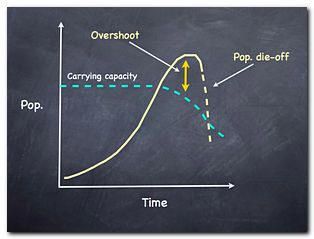
Life scientists are aware of the concept of ecological "carrying capacity" (the maximum population that can be supported by the environment) and Malthus' application of these ideas to human populations. Malthus wrote:
"It is an obvious truth, which has been taken notice of by many writers, that population must always be kept down to the level of the means of subsistence; but no writer that the Author recollects has inquired particularly into the means by which this level is effected..." Thomas Malthus, 1798 An Essay on the Principle of Population 

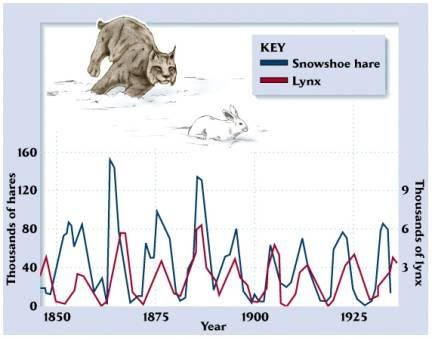
Often, there is a cyclical relationship between the populations of predators and their prey. This keeps the populations of both species in check.


But, what happens when there are no predators?

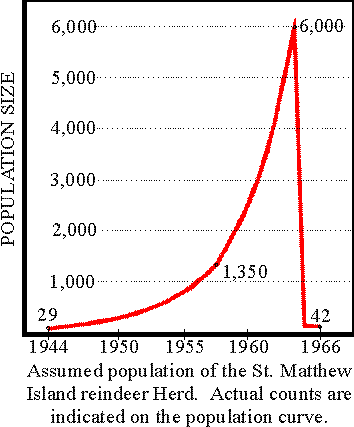
This issue was addressed in a paper by David Klein, "The Introduction, Increase and Crash of Reindeer on St. Matthew Island." Klein reported that in 1944, 29 reindeer were brought to St. Matthew Island. Initially there were abundant food sources, and the reindeer population increased dramatically. There were no predators to cull the population.

About 20 years after they were first introduced, the reindeer had overshot the food carrying capacity of the island, and there was a sudden, massive die-off. About 99% of the reindeer died of starvation.


Source: http://dieoff.org/page80.htm

As shown in the graph below, this is an example of a general phenomenon. All species suffer population collapse or species extinction if they overshoot and degrade the carrying capacity of their ecology.


This is also the fate that awaits bacteria growing in a Petri dish, as you might remember from your high school biology course. Imagine a Petri dish with enough nutrients to support a growing bacteria culture until the dish is completely full of them. One bacterium is placed inside the dish at 11:00am, and the population of bacteria doubles every minute -- such that the Petri dish will be full by noon.

At what time will the Petri dish be half full of bacteria?

Most people reply incorrectly that the Petri dish will be half full at 11:30am, because we are more familiar with linear, rather than with exponential, rates of growth. The correct answer is 11:59am -- which seems rather unintuitive. However, because the rate of growth is exponential (doubling every minute) the time at which the Petri dish is half full is 11:59am. With just one more doubling, in the next minute, the Petri dish is completely full, at noon.

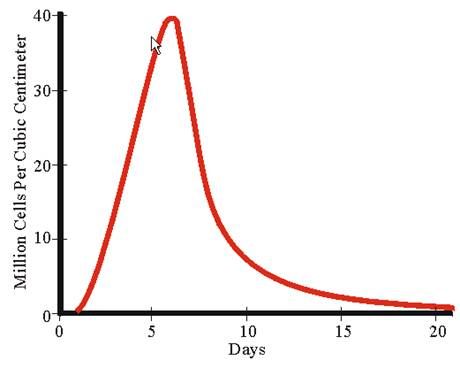
Below is another example of a population overshoot and collapse scenario. This is the population graph of yeast cells in a 10% sugar solution. Note that the yeast population first explodes exponentially, and is then followed by population die-off as the finite nutrients are exhausted and their own waste products pollute their environment.


This is how yeast turns grape juice into wine. The next time you say "cheers" over a glass of wine, remember that you are drinking the waste products (alcohol) of a collapsed yeast colony with poor ecological management skills!

Anyone who perceives a linear rate of growth, but who is actually up against an exponential rate of growth, is likely to be very surprised at how the end comes very quickly and seemingly out of nowhere. They will be completely blindsided.

For more information about the dangers of exponential growth, I highly recommend the video Arithmetic, Population and Energy, by Prof. Albert Bartlett. The key point to remember about Professor Bartlett's lecture: "The greatest shortcoming of the human race is our inability to understand the exponential function."

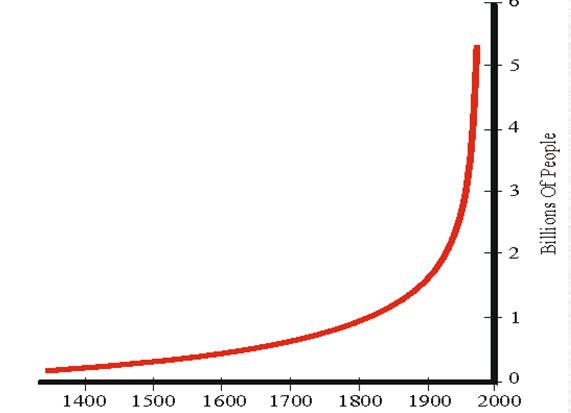
Notice how human population has also been on an exponential trend:


Are we humans smarter than yeast? Or will the graphic above of our population follow the overshoot and collapse graphic of the yeast? Unlike yeast, do we have any evolved psychological adaptations to help us to identify and avoid ecological overshoot?

The fate of humans on Easter Island may help to provide an answer. When the first humans arrived on the island, there were abundant resources to support the small population. Just like the yeast and the reindeer, the human population increased dramatically. There were no predators to cull the population. The human population continued to grow until it eventually overshot the island carrying capacity. After overshoot, most of the population starved. Apparently, they even turned on each other, sometimes resorting to cannibalism.

Human ecological exceptionalism?


It will be a race toward either paradise or oblivion, right to the last moment. -- Buckminster Fuller

Human history becomes more and more a race between education and catastrophe. -- H.G. Wells, The Outline of History

At this point, many people refer to human exceptionalism. Of course we are smarter than yeast or reindeer, and our scientific advances and our technology will save us from ecological overshoot. We can expand the carrying capacity of the Earth.

Raymond Kurzweil has argued in his 2005 book The Singularity is Near that scientific knowledge, like populations, also grows exponentially. He believes that this will allow us to expand the Earth's ecological carrying capacity, cure disease and aging, and solve problems of energy depletion. He is confident that technology will help us prevent ecological overshoot and population collapse.

So, we have two opposing, exponentially increasing trends. One exponential trend leads to ecological overshoot and collapse; the other trend could lead to scientific/technological solutions to these problems. Which will arrive first? Ecological overshoot and collapse (Malthus), or a "techno-fix" (Kurzweil)? No one knows. But, we probably won't have to wait long to find out. One of these two scenarios will likely occur within the next several decades. But, which one? Generally it is healthy to be optimistic, but optimism can be deadly if it produces a Pollyannaish denial of real problems. We should not ignore ecological problems by assuming "someone else" will take care of it, or that "the free market" or "technological breakthroughs" will always come to the rescue in time. Solutions may not come in time, and we may get quite a rude Malthusian smack down later. To avoid this, one problem we must face is how to make the transition from our finite, depleting oil resources to renewable energy. Technological civilization depends on cheap, abundant energy.

Peak oil as an example of human ecological overshoot.


There is no substitute for energy. The whole edifice of modern society is built upon it. It is not "just another commodity" but the precondition of all commodities, a basic factor equal with air, water and earth.
-- E. F. Schumacher (1973)

We know that we cannot sustain a future powered by a fuel that is rapidly disappearing. ...breaking our oil addiction is one of the greatest challenges our generation will ever face. ...This will not be easy.
-- Barack Obama, August 4, 2008


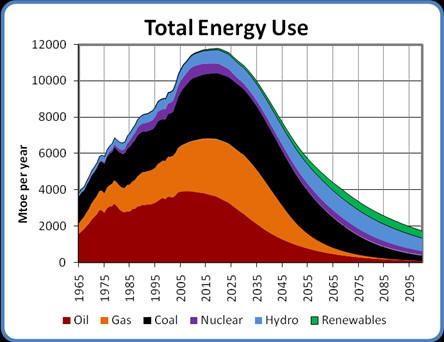
One example of resource depletion is the gradual depletion of fossil fuels, especially oil. The amount of oil produced by a particular oil field, or a region, shows a regular pattern: first oil production increases, then it reaches a peak, and, finally, as the oil field begins to dry up, oil production starts to decline. World "peak oil" is when world oil production peaks, and then starts an inexorable decline as oil fields start to dry up. Many experts believe that world oil production has already peaked, or that it will occur within the next few years. This presents us with a problem: as of now, no combination of renewable energy sources can scale up quickly enough, or provide anywhere near the energy equivalent of oil. We can anticipate that the world is about to enter a severe, worldwide energy shortage. Since food production is so dependent on energy production, following an energy famine will be a food famine. Many poor people, especially in developing countries, will literally starve to death as oil energy depletes.

Unless scientists discover some energy breakthrough "miracle" that can provide scalable and energy dense renewable energy, the predictions made in the graphs below paint some very grim scenarios. As you review these graphs, keep in mind that these nightmares are not in some distant future. They may arrive in less than one or two decades from now.


Here is a brief video of the history of human energy consumption, and the energy challenges we will soon be facing.

General human ecological overshoot


The 1972 book Limits to Growth also made some pretty frightening predictions back in 1972, as did the follow-up book in 2004 Limits to Growth: The 30 Year Update. Using computer simulations, they predicted a world peak population around mid-century, followed by population decline.


Given that these predictions are now approaching 40 years old, how accurate were they? Are they still on track today?

In an article published in Science titled "Revisiting the Limits to Growth After Peak Oil," Hall and Day noted that "the values predicted by the limits-to-growth model and actual data for 2008 are very close." These findings are consistent with another study titled "A Comparison of the Limits of Growth with Thirty Years of Reality" which concluded: "The analysis shows that 30 years of historical data compares favorably with key features... [of the Limits to Growth] 'standard run' scenario, which results in collapse of the global system midway through the 21st Century." To prevent this scenario, the Limits to Growth authors suggested that we must achieve ecological sustainability by 2022 to avoid serious ecological overshoot and population collapse.

Can evolutionary psychology provide insights to aid in our survival?


Can humans be "smarter than yeast?" Can we be the only species that can successfully anticipate and avoid ecological overshoot and collapse? Issues of sustainability are psychological problems. Are we sufficiently psychologically sophisticated to manage our own collective behavior to achieve sustainability on a finite planet?

One sobering answer provided by evolutionary psychology is that we, like all other species, have no evolved psychological adaptations designed specifically to perceive, anticipate and avoid ecological overshoot. In fact, we have just the opposite.


One problem is that inclusive fitness, the "designer" of psychological adaptations, is always relative to others; it is not absolute. That is, nature doesn't "say," "Have two kids (or help 4 full sibs), and then you can stop. Good job! You did your genetic duty, you avoided contributing to ecological overshoot, and you may pass along now..." Instead, nature "says" (relative inclusive fitness): "Out-reproduce your competitors. Your competitors are all of the genes in your species' gene pool that you do not share. If the average inclusive fitness score is four, then you go for five... "In other words, our psychological adaptations are designed to not just "keep up with the Joneses" but to "do better than the Joneses." This is in whatever means that may have generally helped to increase inclusive fitness, such as status, conspicuous consumption, and resource acquisition and control.

If we are to have a fighting chance to be "smarter than yeast," we have to out-smart our own psychological adaptations; we have to "fool Mother Nature." Garrett Harden recognized that the problem of ecological overshoot is the tragedy of the commons writ large. He suggested that the way to solve the tragedy of the commons was "mutual coercion, mutually agreed upon by the majority of the people affected." That is, we must consent, collectively, to use our knowledge of our psychological adaptations to tweak them in the service of sustainability.

For example, we can use such knowledge to manipulate our own perceptions of status so that we actually compete to reduce our consumption of finite resources, such that we compete to "keep down with the Joneses."

Psychologist Robert Cialdini has investigated the use of "psychological illusions" to persuade people to do things they otherwise might be disinclined to do. Here is one description of Cialdini's approach (from: "Finding the 'Weapons' of Persuasion to Save Energy"):

In one San Diego suburb, Cialdini's team went door to door, ringing the doorknobs with signs about energy conservation. There were four types of signs, and each home received one randomly, every week, ...for a month. The first sign urged the homeowner to save energy for the environment's sake; the second said to do it for future generations' benefit. The third sign pointed to the cash savings that would come from conservation. The fourth sign featured Cialdini's trick: "The majority of your neighbors are undertaking energy saving actions every day." ...(Cialdini also) decided to target the below-average energy users with a special message. "When we sent them the message saying you're doing better than your neighbors, we put a smiley face emoticon next to their score," he said. "And that kept them down below what any of their neighbors were doing."

Note how this psychological manipulation helped to redefine high status to "keeping down with the Joneses."

In addition, women may have a special role to play to promote sustainability. Women need to be prepped to find "ecological men" of limited resource consumption really, really sexy. Unfortunately, sexual selection has designed women to tend to prefer "alpha males" -- high status, high consumption, high resource control men (in ancestral times, they helped women's children survive and thrive). Men are adapted to do their best to give women what they want, or face reproductive oblivion. One way that today's men have demonstrated their high status has been to drive big sport utility vehicles (SUVs). However, what if women's psychological adaptations were manipulated (with collective consent) such that they found the guy behind the wheel of an electric car, electric scooter, or, better yet, a bicycle, irresistible? And, what if women sexually rejected the guy driving a big, gas-guzzling SUV?

Our natural tendencies toward nepotism and favoritism also militate against solving the ecological tragedy of the commons. Evolutionary psychology suggests that, when it comes to sharing valuable resources, especially those that are depleting, we will tend to be most altruistic to close genetic kin (inclusive fitness). We may play nice with non-kin if we have established an on-going, mutually beneficial reciprocal relationship (reciprocity). On the negative side, when the above conditions are not met, evolutionary psychology suggests that we will tend to act selfishly. We may even be spiteful (hurt others even at a cost to self) to reduce the relative inclusive fitness of others, especially when competition is increasing because the overall resource pie is shrinking.

But evolutionary psychology also suggests that we might cooperate with people that we identify as part of our "tribe" (strong reciprocity). This feature of human nature may be one of the keys to our ecological survival. Today, the capacity to be altruistic to in-group strangers may result from a serendipitous generalization (or "mismatch") between ancestral tribal living and today's large societies that entail many single interactions with anonymous strangers. Due to this mismatch, we may be fooled into thinking members of our society are part of our "tribe." Result: strong reciprocity -- acting like a "good Samaritan," cognitive concepts of justice, ethics and human rights, and a willingness to conserve finite depleting resources.

However, such strong reciprocity is more likely to occur in a "positive sum game," when the entire resource pie is growing. An individual simply has to cooperate with social rules to expect a progressively larger slice of the pie in the future. So strong reciprocity works well when the overall resource pie is growing (in a "positive sum game"). But, the world-wide depletion of finite resources is a "shrinking pie" situation (a "negative sum game"). Sustainable management of limited Earth resources requires that the whole world cooperate as these resources dwindle.

Such cooperation may be encouraged by using virtual reality to manipulate our psychological adaptations. Today we can enjoy films, TV, and photos precisely because they were not part of our ancestral environment. We have no adaptations to counter these novel tricks - at some unconscious psychological levels we cannot distinguish between reality and virtual reality.


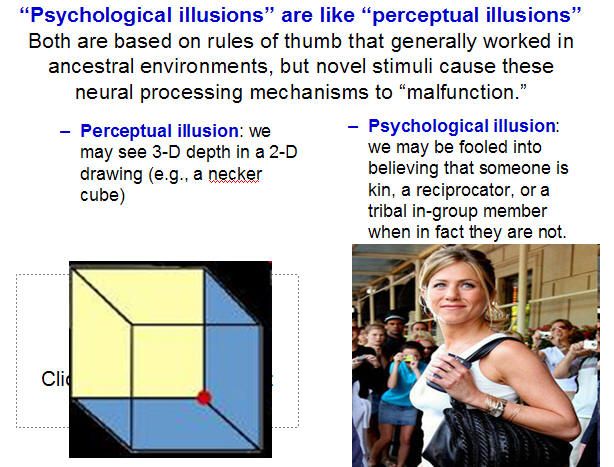
For example, when we watch a TV sitcom, such as Friends, we are fooled (at least on an emotional level) into thinking the characters really are our friends. We may smile and say hello if we see Jennifer Aniston on the street because virtual reality tricked us into believing that we really are friends.

We cry and laugh at movies, despite the fact that we know what we are watching is just light projected through film, the actors are reciting from a script, and there is a sound guy holding a boom mic standing just out of the frame. Sure, it is sad that the ship sank, but no one on the set actually drowned. Nevertheless, our psychological adaptations are fooled, and we may leave the theater a bit misty.


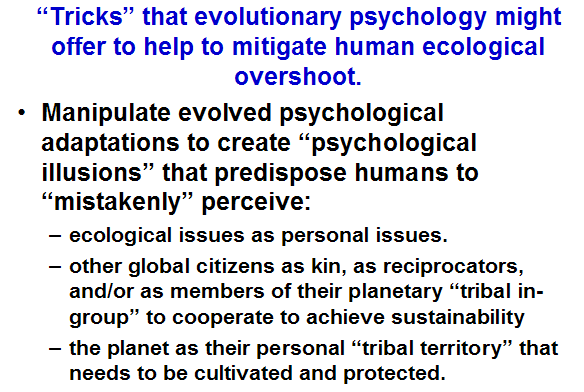
So just as we can be fooled by perceptual illusions, we can also be fooled (and psychologically manipulated) by virtual reality illusions. By mutual consent, we could use virtual reality to intentionally trick ourselves into perceiving that everyone on the planet is a member of our "tribe," that the Earth is our tribal territory that needs to be defended and protected, and that we need to conserve and fairly share finite resources.


For example, we could collectively consent to allow Public Service Announcements (PSAs) - virtual reality media advertisements -- to tweak our psychological adaptations. PSAs have been effective to reduce other self-destructive behaviors, such as smoking. PSAs could help to develop a strong social narrative of mutual cooperation and sustainability on a finite planet.

Needed: A sustainability movement


A new social movement is needed - a sustainability movement. This is particularly important for anyone who plans to live in the future. A grass-roots movement of the magnitude of the civil rights movement in the 1960s, and the women's rights movement of the 1970s, is needed. Today no one wants to be called a racist or a sexist (but being called a "consumerist" does not yet sting). Those movements had clearly defined out-groups to vilify as the "enemy" -- and that may have helped to mobilize and motivate activists.

But who is the enemy now? There is no out-group. The enemy is us. We are fighting against ourselves -- our base psychological adaptations to compete for relative status, mates and resources. Evolutionary psychology can help by identifying which of our "psychological buttons" might be manipulated to promote sustainability. But we must collectively agree to manipulate our psychological adaptations to attempt to "transcend" our self-ecocidal nature. If we succeed, there may be a glimmer of hope of mitigating our own ecological overshoot, and the potential Malthusian nightmares of the future.

For an expanded exploration of these topics, with a particular emphasis on energy depletion, see my webpage:  Evolutionary psychology and peak oil.


References and further reading:

Diamond, J. Collapse. NY: Viking, 2005.

Hall, C. A. S., & Day, J. W. Revisiting the Limits to Growth After Peak Oil. American Scientist, 97 (2009): 230 -238.

Hardin G. The tragedy of the commons. Science, 162 (1968): 1243-1248.

Heinberg, H. Peak Everything: Waking Up to the Century of Declines. NY: New Society Publishers, 2007.

Klein, D. R. The Introduction, Increase and Crash of Reindeer on St. Matthew Island. The Journal of Wildlife Management, 32 (1968): 235-267

Kustler, J. H. The Long Emergency: Surviving the Converging Catastrophes of the Twenty-First Century. NY: Atlantic Monthly Press, 2005.

Kurzweil, R. The Singularity is Near. NY: Penguin, 2005.

Meadows, D. Limits to growth. NY: Signet, 1972.

Meadows, D. H., Randers, J., & Meadows, D. L. Limits to Growth: The 30-Year Update. NY: Chelsea Green, 2004.

Rahim, S. Finding the 'weapons' of persuasion to save energy. New York Times, June 21, 2010.

Turner, G. A Comparison of the Limits of Growth with Thirty Years of Reality. CSIRO Working Paper Series, (2010). Available at: http://www.csiro.au/files/files/plje.pdf


Thursday, January 24, 2019

Nathan Robinson

30 Years Hence

Excerpt from the Current Affairs of 2049… by Nathan J. Robinson, Current Affairs. Jan. 1, 2019.

In my notes this morning, I discovered something strange. A scrap of writing, one seemingly produced by me, but one that I am sure I have never written. It is in my voice, it thinks the way I think, but I had nothing to do with it. It’s hard to take it at face value, because that would require believing the impossible—that it is, as it says, from the Current Affairs of 2049, a ghost of New Year’s future. I am a rationalist, and I do not believe in time travel or parapsychology or cryptozoology, so it is very difficult for me to accept that somehow I will write this piece in 30 years, and it will somehow flutter back to me now. There are paradoxes involved. Besides, it reads more like a somewhat didactic and clumsy attempt at prophecy from present-day me than a genuine temporally displaced artifact. And yet I know, as well as I know anything, that I didn’t write it, have never seen it.

Perhaps you should read the fragment for yourself and see:


Today, looking back at everything I wrote from 2019 onwards, I still think I was pretty perceptive, given the climate of the time. What’s difficult for people to understand, what I can’t even really understand myself, is how everyone—including me—could have been oblivious to so much that was so obvious. I know everyone my age (I am 59) has dealt with the question—even if younger people haven’t asked it explicitly, we’ve all thought it.

Actually, we weren’t even unaware. We knew everything, because we made jokes about it. But we didn’t follow through the implications of what we were saying. There was nobody there to say “Right, but it’s not a joke, is it?” or “And so if that’s true, do you see where it leads? What are you doing standing here?” Is that all we needed—someone to point out that reality is real, that you can’t simultaneously accept something is true and act as if it isn’t? I don’t know what we needed. If you asked a Berliner of a certain era, I doubt they’d have a good answer either.

I’ve been looking through old newspapers and I think one of the main problems was that we didn’t actually have the language to talk about what was happening. The headlines would say “Amazon Seeks To Enter East Asian Markets” or “Deregulation Push At Agency Accelerates.” Everything was reported—the usual criticism of media, that it ignores the facts, was not actually true. If you look at the archives, what you see is something far creepier. It was all there on the printed page, it was just “normalized” to the point where nobody could understand it even as they looked directly at it. The phrase “hiding in plain sight” comes to mind. At one point, I swear to God, the New York Times front page ran a photo across five columns showing George H.W. Bush’s funeral (George H.W. Bush was an insignificant president from the early ’90s, best known for a senseless overseas military action and a pattern of sexual misconduct; the New York Times was a newspaper), with a one-column article squeezed next to it: “Emissions Surge, Hastening Perils Across the Globe.” Oh yes, the perils. Did you see the perils in the paper this morning, dear?

But as I say, it wasn’t just insufficient attention. It was also language itself. Maybe people would have had a better grasp of what was happening if it had been framed more explicitly. “Amazon Enters East Asian Markets” should have been “Amazon Amasses Power Over More Nations, Narrowing Opportunities For Resistance.” But I don’t know, even then people probably would have just watched passively. The newspaper can say “Act Now Or Wolves Will Eat Your Children” and most readers will still just read the paper, go to work, and perhaps make a pessimistic remark to someone. We literally watched people burn alive. “Raising awareness” was a slogan for a while, one that makes me laugh now.

2020 was unfortunate. Usually people treat 2024 as the major event, for obvious reasons. But we all knew 2024 was coming the moment 2020 happened. That sounds strange today, I know, given the mainstream historical interpretation—2020 as a “return to normalcy” after the brief, regrettable detour into Trumpian madness, before the unexpected “backlash” that came in ‘24. There was never any “return,” though. The same conditions were there as had been there for years. The Democrats squeaked into office, but it wasn’t as if they knew how to stop the unfolding forces of history. In fact, personally I think they hastened the ultimate consolidation of power, because by being just “not bad” enough, what had been a thriving opposition movement was sapped of its vitality.

It could have gone the other way, I am still convinced of that. I am not a fatalist or determinist. People make choices, those choices matter. I try not to have regrets, but I keep wondering whether there was something I could have said or done in 2020. Could the “language prison” have been broken out of? I don’t even know today how one could have done it. After all, there was plenty of talk about the “death of democracy” or the “concentration of wealth and power.” They were talking about them at Davos, for God’s sake. (Davos was a conference in which wealthy people pretended to care about others in order to convince themselves they weren’t going to Hell.) Words, words, words, it was all just words. Nobody actually knew what “democracy” meant. Power was consolidating around them, and we were still talking about “regulatory policy.” Everyone still assumed they’d always have the vote.

It all happened in Brazil first, of course. Everyone should have been watching that carefully, since it played out almost exactly as it would here a few years later. Of course, you-know-who made Bolsonaro look like Nelson Mandela. But nobody here could place Brazil on a map. (A map was a way of showing how things looked.)

People were expecting one big Event, and in some ways 2024 was that. But it was mostly frog-in-a-saucepan stuff. We got used to it. Oh, some days the air fills with smoke. That’s just what happens. Then your children grow up never knowing anything different, and eventually there’s nobody around who can even remember that it was once otherwise.

I sometimes insist I wasn’t surprised by anything. But I know that I was, I remember the feeling. A few things truly shocked me, such as how complete the destruction of knowledge could be. “Once something is on the internet it never goes away” is literally a thing I heard people say. No, it can all go away. Every bit of it can be taken. The central lesson, the thing I’d try to impart if I had a chance to go back and shout at my younger self, is how easily things that seem solid can vanish. I remember looking at my mantelpiece and actually thinking “This cannot go away, you will still be here no matter what.” (I liked to talk to objects in those days.) Well, so much for that. No matter what!

I’ll admit, the end of the magazine came as a shock. We had been doing so well. But people’s incomes dried up, and they weren’t spending them on magazines. Besides, there was no way for anyone to access it. With traffic to “fake news” blocked, and anything independent being automatically filtered as “fake,” you couldn’t even tell people you were silenced. The revenue collapsed within six months, the enterprise couldn’t even be sold off. (I got a few hundred bucks for the velvet office chairs.)

I think it’s just very hard to believe that things really can go away until the moment that they do. You don’t know what you take for granted. I just assumed I would live in a world with butterflies, and that they would always be around. (Butterflies were a type of pretty insect. Imagine if the cockroaches had little Persian carpets for wings.) I saw pigeons as a nuisance. I didn’t conceive of the idea that one day I could wake up in a city without birds. The expression is: You don’t miss your water till your well runs dry. And you don’t miss your well until your water reaches the rooftops. Everything had seemed so solid, and by the time I knew how much I loved it, it was gone and I was screaming at no one to please let me have it back. God, I miss birds.

I haven’t talked about the personal losses. My family, my books, my city. In part, I just don’t want to think about it. But also, I have suffered less than almost anybody else. I still write, albeit only for my notes now. With a billion dead, how can I complain?

If my 2019 self was sitting here in my bunker, I wonder if there is anything I could tell him. Not “enjoy it while it lasts,” surely. I could give lessons in how power works: You need to be careful, because it will wrap itself around your neck and only reveal itself when it’s too late to resist. That’s certainly what Amazon did. We all realized what they had done, half a second too late. Call it the “oh, shit” moment. I can’t believe we called them “corporations” and “managers” really. There were so many euphemisms. We lived in a world strung together entirely from euphemisms, one that had almost nothing to do with what was happening or would happen.

I can still feel what it was like on New Year’s Eve, as 2019 began, on my balcony in the French Quarter. (That was a main neighborhood of New Orleans.) I wasn’t naive. Something felt wrong, I could see that even though everyone was drunk and happy in the streets below, there was a sense of it being temporary, of having a few more good parties while there was still time. The waters were rising, but I just stood there. Should I have shouted? Built a raft? Joined a militia? Christ, I don’t know.


OR


Another scrap from the future… Nathan J. Robinson, Current Affairs. Jan. 3, 2019.

Recently I discovered a piece of writing I don’t remember producing. I am still not ready to believe that it came from the future, because I am a sensible person and that is a ridiculous thing to believe. I just don’t know where it came from. Today, I found a second piece of writing. I cannot be sure whether I simply overlooked it the first time, or whether it has appeared since. It, too, appears to be written by me, yet the authors of the two documents cannot possibly be the same.


Sometimes I think about just how close we came to ruining everything. I don’t mean to become a “you kids don’t know how bad we had it” type, especially because I never had it bad myself, but I do believe it’s important to note just how far we’ve come and what it took to get there. It’s hard to believe today, but about thirty years ago people were literally asking whether human civilization should go extinct. Some talked about an impending apocalypse. There was a quite serious notion that we were heading for some kind of large-scale catastrophe, the rise of fascism or the total destruction of the planet. And the truth is, we were.

I don’t know how to get someone to understand, if they didn’t live through it, just how perilous that single moment truly was. The Trump era may seem comical to you, a bit of historical madness like the reign of Caligula, but for those of us who were young then and thinking about our futures, it was horrifying. The planet was heating, authoritarians were coming to power, and there were thousands of nuclear weapons poised to fire at any time. Day-to-day life had its charms, but there was a sense that the good things could not last, because things were beginning to spiral out of control.

What’s interesting to me now is not just how dangerous it was but how quickly we managed to reverse course. Historical change, it turns out, can be rapid in any direction. The Nazis can go from fringe clowns to terrifying rulers within a decade. But so, too, did we build something more beautiful than anything I could have envisioned when I was in my late 20s. Wandering through the world today, I cannot believe it is the same place I once knew. It seems so familiar, but it is so magnificent, so warm, so verdant and friendly. Sometimes people my age and older (I am 59) are asked what it was like to live through the development of the internet. The answer: I barely noticed. It wasn’t a change that mattered, compared to what happened after. I don’t think young people (oh no, I’m about to say I don’t think young people appreciate, what have I become?) appreciate the full extent of what has taken place. I used to worry, back when it seemed a real possibility, that when butterflies disappeared, after a few generations people would forget what they were even missing. Now the whole damn world is butterflies, and the problem is reversed.

I don’t know if you’ve ever looked back at previous generations’ predictions of what the future would be like. They’re often richly amusing. But what’s striking about the time when I grew up is that people had almost stopped imagining. Our films and literature, when they imagined the future, could only turn dystopian. Yet even more creative generations could never have foreseen what actually transpired. Only Star Trek came close (and even they eventually gave up), but life today doesn’t feel like living on the Enterprise. For one thing, everything is so green, so teeming with life of all kinds. I think in order to understand the bleakness of 2019 you have to look at a photo like this:


What strikes us now about this picture is that it is so dead. Quite literally. Nothing in the picture, except a shadow of a person, is alive. It is like being on top of a mountain, or in space, but without the view. Imagine what it was like to see places like this everywhere, to have the whole world being turned into it. Today a photo like this makes us squirm—we recoil at the lack of warmth, decoration, beauty. The blankness of the walls, the utilitarian design. But this was an almost universal aesthetic. Whenever a new building was put up, it would almost always look like this. Is it any wonder that we felt “futureless”?

The rediscovery of life changed everything, and I mean everything. In the early part of this century, before 2020, “environmentalism” had a kind of fringe vibe to it. To be “green” was to have a pet cause, and I literally remember thinking that I hated the color green and I wished the “hippie-ish” associations of environmentalism would go away. I associated it with “urban gardens” with people toiling in dirt to raise a small handful of tomatoes. I’m ashamed that I never saw that with a simple adjustment, it could turn from something pitifully marginal to something all-encompassing and powerful. We did not need “urban gardens.” We needed The Urban Garden, a city of flowers. I think it’s just that phrases like “harmony with nature” had become cliches, their associations had dried up. Do you know that they didn’t even teach plant identification in schools? The miracle of life had ceased to be miraculous. “Nature” was seen as distinct from civilization. Even conservationists reinforced this totally erroneous framework: they wanted to “conserve” the natural world from the encroachment of humanity. You can see why we were heading towards planetary destruction! If you look at the “environment” as something separate from “us,” it will not seem necessary to cultivate or care about it.

The most striking changes in my lifetime have been in the way people think about things. Animals, as you know, were still eaten, with everyone just uncomfortably pretending that the moral problem didn’t exist. The presence of wild animals in day-to-day life today is still striking to me. In the old “gated communities” every trace of wilderness was violently extinguished. Now the presence of animal life is seen as the mark of a place’s vitality. (Today I had to shoo a toucan from my windowsill.) If you wanted to go from one country to another, you had to bring a “passport,” an absurdly elaborate identification document issued by a bureaucratic agency, and the “borders” between countries were militarized and patrolled. How refreshing it is today to look at a map and see countries defined as general areas rather than fixed territories. (One of the most bizarre things in old newspapers is seeing countries referred to as if they were people—“China Goes To The Moon” and the like. Seeing countries as individuals made it easier for us to see ourselves as being in competition with them. Is China gaining on “us”? When of course, we are all one big “us.”) I suppose I should mention the prison system, another feature of life that was taken as a given. Or the gap in wealth between black people and white people. Endless justifications for these things were put forward. You wouldn’t believe how cruel and indifferent to the fate of others some people could be.

There are countless aspects of everyday existence that were almost unthinkable then. Today, when you visit a branch of the GHS, you barely think about it. You find the nearest clinic in whatever country to happen to be in, make an appointment, go, and leave. That is not how it used to go. The idea of a “Global Health Service” would have seemed insane. For one thing, the idea of “world government” and even the word “global” itself had negative connotations. Today we might rejoice in our interconnectedness, but when our governments were dysfunctional, it was very easy to argue that more “government” would be doubly dysfunctional. So healthcare was a patchwork, and it was expensive. You literally had people begging not to be put in an ambulance because they knew they’d receive a huge bill afterwards! You had to find a doctor who would “take your insurance” (healthcare was covered through insurance plans) and even then it could be unaffordable. I remember that when I was in my late 20s, people had to do “crowd funding” campaigns to raise money for their medication. Sometimes they didn’t raise enough money, in which case they might die.

Part of me wishes everyone could relive that era for a day, so they’d know why what we have is special. When I stroll through the city to work, across rope bridges, through gardens, sometimes I find myself near tears. “Who are we that we can be so cruel?” I used to ask. Today, it’s “Who are we that we could build something so incredible?” Perhaps it’s not surprising at all. We were gifted a paradise, and all we needed to do was learn to love it, to manage it correctly and not kill each other. Should have been easy. But it wasn’t.

That’s something I really want to emphasize, not because I think we’ll ever find ourselves in the same position again, but because the people who made the changes happen deserve to have the scale of their achievement recognized. As I say, we were on a path to destruction. It took an immense burst of collective action to steer us away. If you asked me what the “key moment” was, I think it was probably when the Democratic Socialists of America resolved that every single member of the U.S. Congress would be a socialist within twelve years. Every single Congressional and state legislative district, without exception, had a young socialist running in the Democratic primaries. They were organized, and they began to win. The Sanders presidency, like Corbyn’s tenure as prime minister, accelerated the transition into overdrive. A few small victories that began to meaningfully impact people’s lives (such as the Jubilee), then a consensus was built around democratic socialism, from which there was no going back. The adoption of that principle was key, though: Never have an election, at any level, without a socialist candidate running.

It wasn’t just electoral, of course. The organization of workplaces and the development of the One Big Union helped tip the balance of power away from bosses and owners. Internationalism was critical—when the Democratic Socialists of America became the Democratic Socialists of the World, they were finally able to build the worldwide solidarity that was necessary to stop the infamous competitive “race to the bottom” among countries. The ethic of solidarity: it blossomed everywhere. God, it was a time. It felt like being shaken out of a stupor. Of course, the hard work was in actually figuring out the solutions. They took power easily, but avoiding disastrous experiments in social engineering required a commitment to “pragmatic radicalism,” a willingness to think hard about questions like “How do you stop capital flight?” (Capitalism encouraged sociopathy, actually necessitated it in many cases, and capitalists would rather destroy a country and countless lives than see a small bit of their power eroded.)

It was hard and it was easy. It was hard in that it demanded a hell of a lot of hard work from people. It was easy in that once we “got the ball rolling,” the changes happened rapidly. Once you improve something, it’s hard to undo it, so once it was understood that a workplace needed to be democratic, democratic it was forever. Once the “green quotient” became law, it wasn’t going to be undone. Colleges knew there would be an outcry if they reimposed tuition fees, nobody was going to build another slaughterhouse once meat became both unnecessary and inefficient. You couldn’t build a wall between countries if you didn’t know where one ended and the next began, couldn’t build a prison if you didn’t have crimes. I am not saying the world today is perfect (I just had an argument with my neighbor about religion’s place in political life.) We have not reached “the end of history,” a silly notion. But of course there is a sense of excitement about where we are going next. We can approach the “Final Frontier” safe in the knowledge that when we encounter the beings of other planets, we will do so as comrades rather than conquerors (God forbid they are in the same vicious, self-destructive stage we ourselves were so recently).

I am starting to get a bit old, not that age means much now. (My doctor tells me that I could live for another 500 years, hopefully enough time to become good at drawing animals.) I am aware that by spending too much time talking about my memories, I may sound like a long-winded fogey. But I can’t help obsessing over that historic turning point in 2020, that incredible moment when everything suddenly began to feel different in the most wonderful way. The buildings became beautiful again, so much so they took your breath away. (I wouldn’t even quite know how to describe today’s buildings to a stranger. They look more like plants than human-made structures, as if Gaudi was commissioned to do a Garden of Eden.) The trees and animals were everywhere, like living in an Henri Rousseau painting. (Though personally I still prefer the library to a hiking trail!) The workweek was shortened, the militaries all disbanded. Guns became the curious artifact of a dysfunctional past. People wear costumes whenever they please, they have luxury without materialism. Mardi Gras used to only be celebrated in New Orleans, but look at it now! There are no more “museums,” just as there is no more “conservation,” because art and nature are everywhere rather than confined. Every school is gorgeous, with students learning everything from literature to animal husbandry. I am not telling you anything you don’t already know. But I swear to God the orange juice even tastes better!

Today, I look back on all of this and think: how differently it could have gone, and how fortunate we are that it didn’t. Or perhaps “fortune” had nothing to do with it. The people of that time had a choice, and we can all be grateful that they chose so well, did so much, bequeathed us the marvel that is today’s Earth.


Today


Instead of concluding that humans will inevitably destroy the world, why not just stop destroying it? Nathan J. Robinson, Current Affairs. Dec. 18, 2018.

Personally, I enjoy being alive. Not always, but most of the time. You might, too. I have always been of the opinion that—with some exceptions—death is bad and living is better. I like human beings, and while human civilization commits seemingly endless pointless atrocities, I think if we got our act together we could have quite a good thing going here on planet Earth.

In the New York Times, philosopher Todd May considers a question that has never really entered my mind: “Would human extinction be a tragedy?” May concludes that it would indeed be a tragedy, in the sense that we would lose the many fine things that come with being alive, but it might still on the whole be Good. There is nothing inconsistent about this, since we can believe that tragic outcomes are for the best (having to put down an injured horse, for instance). May believes that however unfortunate it may be, the world would be better off without us, because human beings are incorrigible assholes (my phrase, not his):

There is no other creature in nature whose predatory behavior is remotely as deep or as widespread as the behavior we display toward what the philosopher Christine Korsgaard aptly calls “our fellow creatures.”… Human beings are destroying large parts of the inhabitable earth and causing unimaginable suffering to many of the animals that inhabit it. This is happening through at least three means. First, human contribution to climate change is devastating ecosystems… Second, increasing human population is encroaching on ecosystems that would otherwise be intact. Third, factory farming fosters the creation of millions upon millions of animals for whom it offers nothing but suffering and misery before slaughtering them in often barbaric ways. There is no reason to think that those practices are going to diminish any time soon. Humanity, then, is the source of devastation of the lives of conscious animals on a scale that is difficult to comprehend… [We are committing] a wrong whose elimination would likely require the elimination of the species.

May considers the question of whether the benefits of human civilization outweigh its cost to other species. He concludes that they clearly do not—our species’ creation of beautiful buildings and Abbey Road can hardly compensate for the destruction we cause. “There is just too much torment wreaked upon too many animals and too certain a prospect that this is going to continue and probably increase; it would overwhelm anything we might place on the other side of the ledger.” He is agnostic on the question of whether this means we should all kill ourselves (“One might ask here whether, given this view, it would also be a good thing for those of us who are currently here to end our lives in order to prevent further animal suffering… I do not have a final answer to this question…”) but says that we should distinguish between future humans and present humans. So, perhaps we don’t need to kill ourselves, because that would inflict a lot of harm on presently-existing people, but we do have an obligation not to have children, because those children will probably despoil the earth and kill the coral reefs and eat a lot of pigs.

I confess, I don’t find this subject nearly as interesting as May does, in part because—since I am not a philosopher—I tend to be concerned with questions that have actual consequences. If I conclude that the world would be better off without humanity, what am I supposed to do? Join a pro-extinction movement? Just decline to reproduce, an action with an essentially negligible effect on the future of humanity? I feel as if concluding that human beings shouldn’t exist is like concluding that flies shouldn’t exist. Should I kill a bunch of them? Should I launch an anti-fly campaign? Or perhaps meteorites, or earthquakes. Should they exist? Well, they do, and we’re just going to have to take their existence as a given and work within the constraints we have.

But there’s something far more disturbing to me about May’s piece. He thinks that the harm human beings inflict on the world cannot be stopped. It is inevitable. So long as we are here, we will continue to engage in these practices, so the question is whether or not we should be here. This is a little weird to me: To think that “stopping human beings from existing at all” is somehow more of a plausible option than “stopping factory farming and human-made climate change” means an extreme form of pessimism about the possibilities for changing our actions. As he says, the elimination of these wrongs “would likely require the elimination of the species.”

Respectfully, what the fuck? May says this as if it’s a given—there’s not a shred of argumentation offered. He thinks we’ll just nod and agree that it’s impossible to stop climate change, factory farming, and the destruction of ecosystems, that they will only come to an end if we commit civilizational suicide. I’m sorry, but that’s not the sort of proposition you can just state as an uncontroversial fact. Especially because these are all extremely recent phenomena—modern-day industrial animal farming began within the lifetimes of presently-living people. Human beings have been around for 200,000 years and it was only in the last few hundred that we set ourselves on the course toward destroying the earth and the mass destruction of other species’ habitats. Since we lived for many, many millennia without doing any of these things, why would we conclude that it’s totally impossible for us to live sustainably ever again, even with greater knowledge about how to do so than any previous generation of humans ever had?

This kind of pessimism is truly dangerous to me. Nobody should accept these assumptions. Why try to stop industrial animal farming if it would necessarily involve the destruction of humanity itself? The options are suicide or devastation. Since relatively few of us are going to benevolently commit suicide, no matter how persuasively the New York Times philosophy section may encourage it, guess we’ll have to resign ourselves to ruining the earth.

But this is ridiculous. These problems are caused by human actions, and human beings can change their actions. Nothing forces us to have our monstrous factory farm system, or to prize endless growth over sound environmental stewardship. I recently reviewed Jacy Reese’s The End of Animal Farming, which persuasively argues that we could completely end the slaughter of animals within a few hundred years. In the life of humankind, this is no time at all. If we could move toward a more socialistic global economy, one that didn’t ruin the planet for profit, we could stall climate change, too.

Of course, Frederic Jameson was right when he said that it’s easier to imagine the end of the world than the end of capitalism. Todd May can’t even conceive of the end of capitalism—he sees only two possible futures, apocalypse now or apocalypse later. I am not surprised that the New York Times ran this bonkers argument without asking May to back up his assertion that a sustainable planet is impossible. After all, a sustainable planet would be a socialistic planet, and to the Times-mind socialism is impossible. Since liberalism has no solutions, it’s not wonder that liberals believe there are no solutions.

People who are alive right now—like me, and presumably you—are both fortunate and unfortunate. We are unfortunate in that we are on Earth at a time when the threats of climate change and global nuclear conflict mean “doom” can seem just around the corner. We are fortunate, however, in that we also happen to have showed up at a moment when it was possible to do something about it. At the moment, the world is still (relatively) at peace and the worst effects of climate change have still not yet set in. Scientists are warning that we only have a decade to act on climate change in order to mitigate its most severe consequences, but a decade is not nothing. It is the job of socialists, and really anyone who cares about their “fellow creatures,” not to fall into despair or conclude that “extinction is the only option.” Hopelessness is what conservatives want, and pessimism means death. Todd May’s thinking is dangerous, suicidal, wrong. Reject it. It’s not only depressing, it’s irrational. Laugh at it. Write it off. And join the fight to build a humane, decent, and nurturing civilization in which we live in harmony with other species. We have the technology, we have the brains. We just need the resolve. A better world is possible. Death is not the only option.