Thursday, October 17, 2019

What do negative interest rates mean?

A friend and colleague asked today for my thoughts on negative interest rates, why we are seeing them, what caused them, what do they imply?


"I’ve been thinking about this a bit but I can’t quite get my thoughts together. What do low or negative interest rates have to do with the long-term outlook for society? Do low rates imply we are putting more value on the future? I am pretty sure I am mixing up discount rates with interest rates but I still think there is something there to ponder. With high rates the outlook is robust and with low rates not so good. Are the markets pricing in some negative externalities? Perhaps I am way off the mark…"

My partial reply:

So, big topic; real big

Plenty of reading to do to truly try to get a handle on this

Plenty of important books have been written that relate to this issue, in either a core or tangential way; some I’ve read, many I haven’t

To properly understand all the elements and to get all the implications, we might have to read, among others, Piketty’s Capital; Graeber’s Debt; Polanyi’s Great Transformation; or Milanovic’s books on inequality; none of which I’ve read

And, also, books on ecology, and ecological economics, like Hall’s Energy and the Wealth of Nations; Harvey’s 17 Contradictions and the End of Capitalism; Latouche’s Farewell to Growth; Greer’s Wealth of Nature, Economics as if Survival Mattered; Catton’s Overshoot; Turchin’s Secular Cycles; Vaclav Smil’s Harvesting the Biosphere; Daly’s Ecological Economics; Schor’s Plenitude; James Gustave Speth’s The Bridge at the End of the World; Boyd’s Energy and the Financial System, What Every Economist and Investor Needs to Know; Galbraith’s The End of Normal; and a book I think you recommended to me, Streeck’s How Will Capitalism End?...., also, while all on my to-read list, none of which I’ve actually read yet

Though I haven’t yet read those, I have read a bunch along these same lines, such as Meadows’ Limits to Growth; Wright’s Short History of Progress; Maxton’s The End of Progress; and Koo’s Holy Grail of Macroeconomics, Lessons from Japan; Cowen’s The Great Stagnation; Rubin’s The End of Growth; Heinberg’s The End of Growth; Shilling’s The Age of Deleveraging; Homer-Dixon’s The Upside of Down; Diamond’s Collapse; Tainter’s Collapse of Complex Societies; Klein’s This Changes Everything, etc etc


I believe the issues covered in all of these books all inter-relate and all matter (to the subject of the inexorable decline of interest rates).

Plus there’s a ton of stuff on secular stagnation, the natural or neutral rate of interest, on modern monetary theory, etc, worth reading.


But at a good first approximation, Nate Hagen’s work, as well as Robert Gordon’s work, I think, adequately illuminates the crux of the issue.

For Gordon, see relevant papers in PDF here and here and here.

For Hagens, I HIGHLY recommend GDP, Jobs and Fossil Largesse, as well as his video series.


Plus plenty more stuff I’ve archived on this blog regarding sustainability issues and their implications for economic growth (which therefore have implications for rates), including the excellent work of Tim Garrett, e.g. here, and a variety of other writers, such as here


Or, if you prefer, for my quick summary:

( Gordon’s headwinds to growth plus Summers’ secular stagnation plus Fisher’s debt deflation / disinflationary forces ) + ( Hagens et al’s extracted all the cheap energy ) = Lower nominal growth and lower inflation

+ ( Meadows et al’s Limits to Growth ) + ( Czech’s steady state economy ) --> zero nominal growth and zero inflation

+ ( Daly's Degrowth ) + ( Catton’s Overshoot ) + ( Diamond’s Collapse ) --> negative growth


So, given that the average interest rate in the whole economy should approximate the average rate of nominal growth in the economy
(otherwise higher rates would repress growth, as there wouldn’t be sufficient productive uses of capital to provide profit with which to pay the interest)

And, given that the private sector pays some degree of credit spreads above and beyond what the govt’s risk-free rates are
(i.e. the govt’s rates have to be below the average rate in the whole economy, which is below the rates paid by private sector corporate and consumer sectors)
then, lower and lower growth imply lower and lower rates 

Sometimes things can go on longer than you'd think (stock market bubbles, the euro, Stairway to Heaven, Joe Biden's political career)...

But, ultimately, that which is unsustainable ... won't be sustained.

So, if you believe, as I do, that

infinite growth on a finite planet is impossible

then

negative rates are inevitable

or, in other words

if the economy is too big for the biosphere

which it is

(see the planetary boundaries research stuff I sent you in April, e.g. by each of Barnosky, Lenton, Rockstrom, Steffen (linked to at end of here).... not just climate change, nor peak oil, nor ocean acidification, nor deforestation, nor species mass extinction event, aquifer depletion, nor nitrogen cycle, nor etc etc etc, but all of them interwoven simultaneously together)

Then either we stop growing voluntarily
(unlikely)

or

Gaia’s fever will get worse until she gets rid of her virus
(us … and our livestock)

So, I'll put the question back to you: 
What interest rate is appropriate in an economy with zero nominal growth? How about with negative growth?


So, no, IMO, low rates do not imply we are putting more value on the future.

Low rates are because we put way too much value on the present and damn-it-all-forget about the future.


Are low rates pricing in negative externalities? You betcha!

Capitalist corporatocracy refused to price in those externalities appropriately to begin with (reflecting the usage of precious energy/natural resources/habitat/sinks for our waste, etc.), so we’ve collectively mis-allocated resources in the most extravagant fashion, (mostly to the benefit of ~5% of the global population), so we will pay in the future for that mis-pricing of the past

... and if we don't pay for it via degrowth (probably too late anyways), then we will pay for it via collapse

(I forgot to include in my list above, Geisel's The Lorax)

Wednesday, October 16, 2019

Tim Morgan: Actual Fantasy - Our Urgent Need for Rational Economics

Another excellent post by Tim Morgan:

#156. Actual fantasy. Tim Morgan, Surplus Energy Economics. October 13, 2019.

OUR URGENT NEED FOR RATIONAL ECONOMICS

Everyone knows the quotation, of course, which says that “when it gets serious, you have to lie”.

Actually, when it gets even more serious, we have to face the facts.

I’m indebted to Dutch rock music genius Arjen Lucassen for the observation that the counterpart to “virtual reality” is actual fantasy – and that’s where the world economy seems to be right now.

You may think it’s imminent, or you might believe that it still lies some distance in the future, but I’m pretty sure you know that we’re heading, inescapably, for “GFC II”, the much larger (and very different) sequel to the 2008 global financial crisis (GFC).

SEEDS 20 – the latest iteration of the Surplus Energy Economics Data System – has a new module which calculates the scale of exposure to “value destruction”. This exposure now stands at $320 trillion, compared with $67tn (at 2018 values) on the eve of GFC I at the end of 2007.

How this number is reached, and what it means, can be discussed later. Additionally, potential for value destruction needn’t mean that this is the quantity of value which actually will be destroyed when a crash happens. Rather, it gives us a starting order-of-magnitude.

For now, though, we can simply note that risk exposure seems now to be at least four times what it was back in 2008. Moreover, interest rates, now at or close to zero, cannot be slashed again, as they were in 2008-09. Neither can governments again put their now-stretched balance sheets behind their banking systems, even if global interconnectedness didn’t render such actions by individual countries largely ineffective.

Finally – in this litany of risk – two further points need to be borne in mind. First, global prosperity is weakening, and has been falling in most Western economies for at least a decade, so any new crash will test an already-weakened economic resilience.

Second, and relatedly, any attempt to repeat the rescues of 2008 would be unlikely to be accepted by a general public which now – and, in general, correctly – characterises those rescues as ‘bail-outs for the wealthy, and austerity for everyone else’.


The high price of ignorance

It’s tempting – looking at a world divided between struggling, often angry majorities, and tiny minorities rich beyond the dreams of avarice – to think the surreal state of the world’s financial system reflects some grand scheme, driven by greed. Alternatively, you might feel that far too many countries are run by people who simply aren’t up to the job.

Ultimately, though – and whilst greed, arrogance, incompetence and ambition have all been present in abundance – the factor driving most of what has gone wrong in recent years has been simple ignorance. For the most part, disastrous decisions have been made in good faith, because thinking has been conditioned by the false paradigm which states that ‘economics is the study of money’, and which adds, to compound folly still further, that energy is ‘just another input’.

I don’t want to labour a point familiar to most regular readers, so let’s wrap up recent history very briefly.

From the late 1990s, as “secular stagnation” kicked in (for reasons which very few actually understood, then or now), the siren voices of conventional economics argued that this could be ‘fixed’ by making it easier for people to borrow than it had ever been before. This created, not just debt escalation, but a lethal proliferation and dispersal of risk, which led directly to 2008.

In response, the same wise people, those whose insights caused the crisis in the first place, now counselled yet more bizarre gimmicks, the worst of which was that we should pay people to borrow, whilst simultaneously destroying the ability to earn returns on capital. Nobody seems to have wondered (still less explained) how we were supposed to operate a capitalist economy without returns on capital – and that, by the way, is why what we have now isn’t remotely a capitalist system based on properly-functioning markets.

When GFC II turns up, it’s as predictable as night following day that the zealots of the ‘economics is money’ fraternity will come up with yet more hare-brained follies. We already know what some of these are likely to be. There are certain to be strident calls for yet more money creation (but this time with a label saying that “it’s not QE – honest”). Some will advocate ‘helicopter money’, perhaps calling it ‘peoples’ QE’. There will be calls for negative nominal interest rates, with the necessary concomitant of the banning of cash. Ideas even more barking mad than these are likely to turn up, too.

Ultimately, what’s likely to happen is that the authorities will respond to GFC II by pouring into the system more additional money than the credibility of fiat currencies can withstand.

We know, of course, that any new gimmicks, just like the old ones, won’t ‘fix’ anything, and can be expected to make a bad situation even worse.

So the question facing everyone now – but especially decision-makers in government, business and finance, and those who influence their decisions – is whether we abandon conventional economics before, or after, the next mad turn of the roulette wheel.

Put another way, should the creators of “deregulation”, QE and ZIRP – and the facilitators of sub-prime and “cash-back” mortgages, collateralised debt obligations and the alphabet soup of “financial weapons of mass destruction” – be allowed to introduce yet more insanity into the system?

Before making this decision, there’s one further point that everyone needs to bear in mind. In 2008, financial gimmickry nearly, but not quite, destroyed the banking system. The only reason why this didn’t happen was that fiat money retained its credibility. But, whilst the follies which preceded the GFC imperilled only the credit (banking) system, those which have followed have put the credibility of money itself at risk.

This is perhaps the most powerful reason of all for not letting the practitioners of ‘conventional’ economics have another swing at the wrecking-ball.

I hope that, reflecting on this, you’ll agree with me that we can no longer afford the folly of financial economics.
Moreover, we need to say so, making fundamental points forcefully, and resisting any temptation to wander off into esoteric by-ways.


A scientific alternative?

If there can be no doubt at all that money-based interpretation of the economy has ended in abject failure, there can be very little doubt that a workable alternative is ready and waiting. That alternative is the recognition that the economy is an energy system.

This idea is by no means a new one and, though I’d prefer not to particularize, it’s been pioneered by some truly brilliant people. If those of us who base our interpretations on the energy-economics paradigm can see a long way into the future, it’s because we’re “standing on the shoulders of giants”.

Moreover, much of the work of the pioneers is rooted in solid science, meaning that, for the first time, there is the prospect of a genuine science of economics, firmly located within the laws of thermodynamics. This has to be a more rational option than continuing to rely on economic ‘laws’ which try to impute immutable patterns to the behaviour of money – something which is, after all, no more, than a human construct.

I like to think that my much more modest role in this direction of travel has been to recognize that, if energy economics is going to transition from the side-lines of the debate to its centre, it needs to tackle conventional economics on its own turf. That means that, whilst as purists we might prefer to set out our findings in calories, BTUs and joules, we have to talk in dollars, euros and yen if we’re to secure a hearing. It also means that we need models of the economy based firmly on energy principles.

If you’re a regular visitor to this site then the basics of what I call surplus energy economics will be familiar. Even so, and with new visitors in mind, a brief summary of its main principles seems apposite.


Core principles

The first principle of surplus energy economics is that everything that constitutes the economy is a function of energy. Literally nothing – goods, services, infrastructure, travel, information – can be supplied without it. Even in the most basic aspects of our lives, everything that we need – including somewhere to live, food and water – is a product of the application of energy. The more complex a society becomes, the more energy it requires, even if this is sometimes masked when energy-intensive activities are outsourced to other countries. The idea that we can somehow “decouple” economic activity from the use of energy has been debunked comprehensively by the European Environmental Bureau as “a haystack without a needle”.

You need only picture a society even temporarily deprived of energy to see the reality of this. Without energy, food cannot be grown, processed or delivered, water fails when the pumps stop working, our homes and places of work become cold and dark, and schools and hospitals cease to function. Without continuity of energy, machinery falls silent, nothing can move from where it is to where it is needed, individuals lose the mobility that we take for granted, and, in a pretty short time, social order fails and chaos reigns.

Ironically, financial systems are amongst the first to collapse when the energy plug is pulled. People cannot even write learned papers telling us that energy is ‘just another input’ when their computer screens have just gone down.

The second principle of surplus energy economics is that, whenever energy is accessed, some of that energy is always consumed in the access process. Stated at its simplest, you cannot drill an oil or gas well, excavate a mine, or manufacture a wind turbine or a solar panel without using energy. Much of this energy goes into the provision of materials, of which just one example is copper. This is now extracted at ratios as low as one tonne of copper from five hundred tonnes of rock. Supplying copper, then, cannot be done with human or animal labour – and, of course, even if this were possible, the need for nutritional energy would keep the circular, ‘in-out’ energy linkage wholly in place.

Taken together, these principles dictate a division of available energy into two streams or components.

The first is the energy consumed in the access process, known here as the Energy Cost of Energy (ECoE).


The second – constituting all available energy other than ECoE – is known as surplus energy. This powers all economic activity, other than the supply of energy itself.

This makes ECoE an extremely important component, because, the higher ECoE is, the less surplus energy remains for those activities which constitute prosperity.


Four main factors drive trends in ECoEs. Taking oil, gas and coal as examples, these energy sources benefited in their early stages from economies of scale and expanding geographic reach. Latterly, though, with these drivers exhausted – and as a consequence of the natural process of using the most attractive sources first, and leaving costlier alternatives for later – ECoEs have been driven upwards relentlessly by depletion.

A fourth factor, technology, accelerates movement along the early, downwards ECoE trajectory, and then acts to mitigate subsequent increases. Mitigation, though, is all that technology can accomplish, because the scope for technological improvement is bounded by the envelope of the physical properties of the energy resource itself.

Lastly on this, because the four factors driving ECoEs – reach, scale, depletion and technology – all act gradually, ECoEs evolve, and need to be measured as trends.


Application – the money complication

With the basic principles established, and the role of ECoE understood, it might seem that, to arrive at a measure of prosperity, all we need do now is to subtract ECoE from economic activity. That would indeed be the case – if we had a reliable data series for output.

But this is something that we simply don’t possess, least of all in reported GDP. Essentially, GDP has been manipulated for the best part of two decades, and, arguably, for even longer than that.

By manipulation, I’m not referring to tinkering at the production boundary, or understating the deflator necessary for making comparisons over time.

The kind of manipulation I have in mind is the simple matter of pillaging the future to inflate perceptions of the present.

Expressed in PPP-converted dollars at constant 2018 values, reported world GDP increased by 36% between 2000 and 2008, and has grown by a further 34% since then. During those same periods, though, world debt increased by, respectively, 50% and 58%. Each $1 of incremental GDP between 2000 and 2008 was accompanied by $2.30 of net new borrowing, a number that has increased to more than $3 in the decade since then. Sustaining annual “growth” of about 3.5% in recent years has required annual borrowing of about 9% of GDP.

In short, GDP and growth have been faked by the simple spending of borrowed money. This exercise in cannibalising the future to sustain the present would look even more extreme were we to include in the equation the creation of huge holes in pension provision.

In this context, we need to answer two questions before we can calculate a useful output metric against which ECoE can be applied.

First, what would happen now, if we stopped piling on yet more debt?

Second, where would GDP be today if we hadn’t embarked on a massive borrowing spree?

You’ll understand, I’m sure – with government, business and finance still hamstrung by the failed economic methodologies of the past – why I won’t go into details here about the SEEDS algorithms which provide answers to these questions.

What I can say, though, is that, in the absence of further net borrowing, growth in world GDP would fall from a reported level of around 3.5%, to about 1.2% now, decreasing to just 0.6% by 2030.

On the second question, setting growth since 2000 of $61tn against borrowing of $167tn over the same period puts in context quite how far reported GDP has been inflated by the spending of borrowed money – and, if this borrowing binge hadn’t happened, GDP now would be 30% below the numbers actually recorded. Instead of “GDP of $135tn PPP, growing at 3.5% annually”, we’d have “GDP of $94tn, growing at barely 1%”.


Prosperity – the ECoE connection

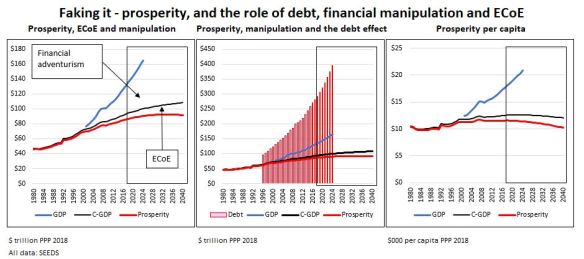
When we set growth in real, “clean” GDP (C-GDP) of 31% since 2000 against a global trend ECoE that has risen from 4.1% to 7.9% over the same period – and stir a 23% increase in population numbers into the pot as well – you’ll readily understand why people have started to become poorer.

This is set out in fig. 1. In the left-hand chart, the gap between reported GDP (in blue) and C-GDP (black) represents the compound rate of divergence in a period when debt of $167tn has been injected into the system, together with large amounts of ultra-cheap liquidity.

If we were now to unwind these injections, GDP would fall to (or below) the black C-GDP line, over whatever period of time the debt reduction was spread. The gap between C-GDP (black) and prosperity (red) shows the impact of rising ECoEs, and illustrates how the worsening ECoE trend is set to turn low (and faltering) growth in C-GDP into a deteriorating prosperity trend.

The middle chart adds debt, to set these trends in context. In the right-hand chart, per capita equivalents illustrate how the average person has been getting poorer, albeit – so far – pretty gradually.

Fig. 1


Comparing 2000 with 2018 (in constant PPP dollars), a rise of 31% in C-GDP has been offset by an ECoE deduction that has soared from $2.7tn to $7.4tn. Aggregate prosperity has thus increased from $69tn ($71.9tn minus ECoE of $2.7tn) in 2000 to $86tn ($93.5tn minus $7.4tn) last year.

This is a rise of 26%, only slightly greater than the increase (of 23%) in world population numbers between those years. In fact, SEEDS indicates that global prosperity per capita peaked in 2007, at $11,720, and had fallen to $11,570 by last year.


On the cusp of degrowth

This, to be sure, has been a very small decrease, essentially meaning that per capita prosperity has plateaued for slightly more than a decade. Before drawing any comfort at all from this observation, though, the following points need to be noted.

First, the post-2007 plateau contrasts starkly with historic improvements in prosperity. The robust growth of the first two decades after 1945, for instance, coincided with a continuing downwards trend in overall ECoE, as the ECoEs of oil, gas and coal moved towards the lowest points on their respective parabolas.

Second, the deterioration in prosperity, though gradual, has taken place at the same time that debt has escalated. Back in 2007, and expressed at 2018 values, the prosperity of the average person was $11,720, and his or her debt was $27,000. Now, though prosperity is only $140 lower now than it was then, debt has soared to $39,000.

Third, these are aggregated numbers, combining Western economies – where prosperity has been falling over an extended period – with emerging market (EM) countries, where prosperity continues to improve. Once EM economies, too, pass the climacteric into deteriorating prosperity – and that is about to start happening – the global average will fall far more rapidly than the gradual erosion of recent years.

Fourth, as these trends unfold we can expect the rate of deterioration to accelerate, not least because our economic system is predicated on perpetual expansion, and is ill-suited to managing degrowth. In a degrowth phase, in which utilization rates slump and trade volumes fall, increasing numbers of activity-types will cease to be viable (a process that has already commenced). Additionally, of course, we ought to expect the process of degrowth to damage the financial system and this, amongst other adverse effects, will put the “wealth effect” – such as it is – into reverse.

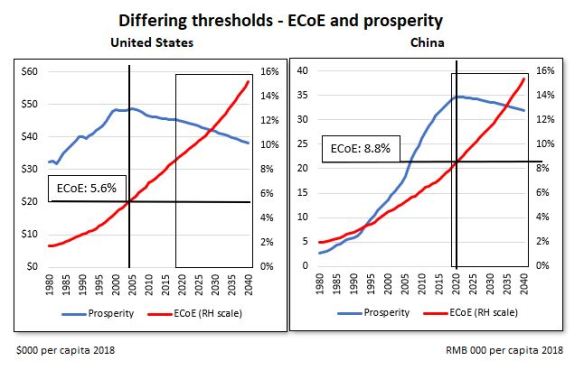
The differences between Western and EM economies is illustrated in fig. 2, which compares the United States with China. On both charts, prosperity per person is shown in blue, and ECoE in red.

In America, prosperity turned down from 2005, when ECoE was 5.6%. In China, on the other hand, SEEDS projects a peaking of prosperity in 2021, by which time ECoE is expected to have reached 8.8%. The reason for this difference is that complex Western economies have far less ECoE-tolerance than less sophisticated EM countries.

As a rule of thumb, prosperity turns downwards in advanced economies at ECoEs of between 3.5% and 5.5%, with the United States far more resilient than weaker Western countries, most notably in Europe. The equivalent band for EM countries seems to lie between 8% and 10%, a threshold that most of these countries are set to cross within the next five or so years.

Where China is concerned, it’s noteworthy that, with ECoE now hitting 8%, there are very evident signs of economic deterioration, including debt dependency, increasing liquidity injections, and falling demand for everything from cars and smartphones to chips and components.

Fig. 2


The energy implications


In conjunction with the SEEDS 20 iteration, the system has adopted a new energy scenario which differs significantly from those set out by institutions such as the U.S. Energy Information Administration and the International Energy Agency.

Essentially, SEEDS broadly agrees with EIA and IEA projections showing increases, between now and 2040, of about 38% for nuclear and 58% for renewables, with the latter defined to include hydroelectricity.

Where SEEDS differs from these institutions is over the outlook for fossil fuels. Using the median expectations of the EIA and the IEA, oil consumption is set to be 11% higher in 2040 than it is now, gas consumption is projected to grow by 32%, and the use of coal is expected to be little changed.

Given the strongly upwards trajectories of the ECoEs of these energy sources, it’s becoming ever harder to see where such increases in supply are supposed to come from. With the US shale liquids sector an established cash-burner, and with most non-OPEC countries now at or beyond their production peaks, it may well be that far too much is being expected of Russia and the Middle East. The oil industry may, in the past, have ‘cried wolf’ over the kind of prices required to finance replacement capacity, but we cannot assume that this is still the case.

The implication for fossil fuels isn’t, necessarily, that worsening scarcity will cause prices to soar but, rather, that it will become increasingly difficult to set prices that are at once both high enough for producers (whose costs are rising) and low enough for consumers (whose prosperity is deteriorating). [MW: see Gail Tverberg on this same exact point.] It’s becoming an increasingly plausible scenario that the supply of oil, gas and coal may cease to be activities suited to for-profit private operators, and that some form of direct subsidy may become inescapable.


Conclusions

It is to be hoped that this discussion has persuaded you of two things – the abject failure of ‘conventional’, money-based economics, and the imperative need to adopt interpretations based on a recognition of the (surely obvious) fact that the economy is an energy system.

Until and unless this happens, we’re going to carry on telling ourselves pretty lies about prosperity, and acting in ways characterised by an increasingly desperate impulse towards denial. Many governments are already taxing their citizens to an extent that, whilst it might seem reasonable in the context of overstated GDP, causes real hardship and discontent when set against the steady deterioration of prosperity.

Meanwhile, risk, as measured financially, keeps rising, and the cumulative gap between assumed GDP and underlying prosperity has reached epic proportions. Expressed in market (rather than PPP) dollars, scope for value destruction has now reached $320tn.

Only part of this is likely to take the form of debt defaults, though these could take on a compounding, domino-like progression. Just as seriously, asset valuations look set to tumble, when we are forced to realise that unleashing tides of cheap debt and cheaper money provides no genuine “fix” to an economy in degrowth, but serves only to compound the illusions on which economic assumptions and decisions are based.

What Extinction Rebellion is Getting Wrong.

What Extinction Rebellion is Getting Wrong. Tim Watkins, Consciousness of Sheep. Oct. 16, 2019.

In many ways, this month’s Extinction Rebellion protests – which have brought city centres around the world to a standstill – are to be welcomed and supported; not least because they have made a huge contribution to raising public awareness of what they call the “climate emergency” (or what I call the climate component of our “predicament”). 

As Polly Toynbee at the Guardian reports:

“For those who doubt the effect of last April’s XR protests, Ben Page of Ipsos Mori says: ‘In our polls in 2013, 59% said the planet was ‘heading for disaster’. This year it’s gone up to 78%.” He reckons Greta Thunberg, the school strikes and XR action played their part. What packs an extra punch is that London is just one of 60 global cities engaged in ‘uprising’ at the same time’…”

The broader question, however, is whether raising awareness is the most critical issue at the moment. Clearly the leaders of Extinction Rebellion believe that it is; since they are prepared to face jail – and to encourage thousands of others to risk jail – in order to push public awareness that extra 10 per cent or so higher than it is now. The trouble is that when four-fifths of the population already say they agree with you that there is a climate emergency, any further effort is going to meet with severely diminishing returns. The final fifth of the population are the ones who will deny the climate is changing even as they are sat on top of the last British mountain not to be engulfed by the rising seas. Trying to win them around is futile. It is on a par with getting four-fifths of the population to oppose racism, but then to claim that you must keep protesting because we haven’t won the Ku Klux Klan over yet.

The climate change-denying section of the press, as expected, have alleged that the overwhelmingly white and middle class composition of the protestors is evidence that the entire movement is little more than the snow-flaky whining of an over-privileged affluent class. There may be something to this in that, given the British police force’s track record when it comes to arresting members of racial minorities, it may be best to put affluent white people at the front of the protests. Indeed, in the planning of the latest round of protests, this is exactly what Extinction Rebellion has done; by selecting those protestors who are least likely to have their lives impacted by an arrest and a criminal record, and then providing them with legal training a and support. The broader criticism is invalid, however. The 78 percent support for action on climate change suggests that there are many more people – I am one of them – who for various reasons – in my case, limited mobility – would like to protest but cannot.

The more damaging right wing critique, however, is mentioned by Toynbee:

“Never mind the science: what free-market obsessives like [Douglas} Murray can’t bear is that solving the climate crisis requires state and international action. He would rather boil to oblivion, faithful to his free-market creed, than see the planet saved by means he regards as statist or even socialist… Murray accuses XR of wanting to ‘engineer the complete destruction of the global economic system’…”

Toynbee is, of course, among the techno-utopian faithful who are wedded to the fantasy of the UK Labour Party’s version of a Green New Deal which will supposedly come to humanity’s rescue if only enough people are prepared to sign up to it. But the reason journalists like Toynbee, Labour politicians and many – if not most – of the Extinction Rebellion protestors believe this (or some variant of it) is largely due to the failings of an education system that left most educated people with no grounding in the sciences.

This gets to the heart of the problem with Extinction Rebellion’s current stance. They call on government to declare something called a “climate emergency” – which, of course, governments are happy to do because it is a meaningless and vacuous declaration. The assumption behind it, however, is the entirely erroneous belief that solutions to our current predicament are still in the gift of governments that have proved incapable of negotiating relatively simple trade deals, of overseeing railways, of running a welfare and pensions service, or more recently, of even keeping the country’s lights on… indeed, in the case of the current UK government, even the Christmas party has been cancelled because they couldn’t find a brewery to host it.

However, while we can – and should – laugh at the political class (don’t get me started on the lunatics on both sides of the aisle on the other side of the Atlantic) in reality, their scope for action is limited by the scale of the crisis that has been unfolding since the banking system crashed in 2008. And Murray is correct here. The neoliberal economic system introduced by Thatcher and Reagan, and set in stone by Clinton and Blair, was deliberately designed to remove national politicians from positions of power over the system. The national economies of the post-war years, with their controls on capital and their focus on full-employment were swept away. In their place is a global economy presided over by a technocracy within global institutions like the G20, the IMF and the World Bank; and – crucially – enforced by a series of secret supranational courts. The mandate that these institutions are bound to follow is that nothing – not national interests or attempts at sustainability – is permitted to get in the way of trade. Unless we tear down what Murray calls “the global economic system,” we can do nothing to prevent it from continuing to undermine life on Earth – and thereby bring about its own end anyway.

This brings us to Extinction Rebellion’s second demand – that governments (collectively, since they would have to dismantle the global trade system) must implement reforms to reduce greenhouse gas emissions to net zero by 2025. This is where the science parts company with the campaigners.

Firstly, there is no net zero because humans have failed to figure out a viable means of capturing and sequestering carbon dioxide for the several centuries that would be required after we ceased burning fossil fuels to restore the climate to something akin to conditions today. At this point, no doubt, some readers will object that trees and soils are natural carbon sinks; and so we might plant more trees and restore more soils. The question, however, is which trees and soils, and to what end? Few trees live beyond a century (especially when some idiot comes along and harvests them to use as “green” biofuel). And when a tree dies and falls to the floor, it dumps all of the carbon back into the atmosphere. Similar problems affect attempts at soil restoration since any further use will unlock the carbon stored there.

There is, you will be pleased to know, one natural process that can sequester and lock up all of the carbon that we have dumped into the atmosphere in the course of the last three centuries. It involves a warmer and wetter climate washing nutrients off the land and out to sea; where plankton and algae blooms can flourish and multiply; giving off noxious hydrogen sulphide – which causes “red tide events” – as a by-product. As these microscopic plants die, they sink to the ocean floor where, along with the carcasses of any marine creature that happened into the oxygen-starved red waters beneath the surface, they gradually decompose into a glutinous mud. Over time, layers and layers of this hydrocarbon-rich mud will pile up. And over centuries it will be subsumed beneath the Earth’s crust, where it will be heated and compressed beneath an impervious layer of rock that prevents it from leaking to the surface. With the carbon sequestered in this way, over millions of years the climate will cool once more.

My more alert readers will be aware that the process that I just described is the one in which the fossil fuels that we have been burning for the past 300 years were created in the first place. As far as I am aware, it is the only process currently known that can lock up large volumes of carbon dioxide for the geological time period required to repair the damage that we have already done.

There is, then, no means of offsetting carbon – the idea of “net zero” is little more than an accounting/public relations device designed to give the impression that corporations are environmentally-friendly when, in truth, any corporate economic activity at this point is merely adding to the damage already inflicted. As I once explained: getting someone to buy meat for me may make my shopping basket look like it belongs to a vegan; but that doesn’t change the fact that I eat meat… it is the same with “green” energy.

There is enough carbon dioxide in the atmosphere already to raise the temperature above 3 degrees over pre-industrial levels; so that even if we ceased burning fossil fuels today, it is highly unlikely that the global economy and a population approaching 8 billion can survive the devastation. Indeed, those at the more pessimistic end of the spectrum argue that we will be lucky if there are any humans at all on Earth by 2030. But even knowing that the current debate is between those who think things are about to get very, very bad and those who think they are about to become fatal will not be enough to prevent humanity from continuing to pump greenhouse gases into the atmosphere.

The reason is simple, the only way in which we can support a global population that is at least eight times the sustainable level is to use fossil-powered industrial agriculture on a global scale. And while switching the diet to lower the volume of cow belches will make an insignificant difference, the fact remains that fossil-powered global plant farming is still a major source of greenhouse gases. Nor do we dare dispense with the fossil-powered global supply chains that have saved the largest part of humanity from the kind of famines that were commonplace just a few decades ago. Growing excess food in favourable regions and transporting it to less favourable ones has always been the means by which humans combated famine. The only difference today is that we do it on a global scale; meaning that disruption in any one supply chain can rapidly undermine the entire system.

At this point, of course, the techo-utopian journalists, politicians and protestors will complain that I am ignoring renewable energy and the fourth industrial revolution. Once again, the reason for this objection is largely a product of an education system that is not fit for purpose. In a recent article on the Peak Prosperity website, scientist Chris Martenson refers to the sheer scale of the task that would be involved just in substituting (i.e. ignoring all of the technical engineering challenges involved) the quantity of energy we get from fossil fuels with renewable energy:
“Suppose we agree on the goal to entirely replace fossil fuel energy by 2050. (We’re going to have to do it by some point, because oil, coal and natural gas are all depleting finite resources.) 
“With 2050 as a starting point we can run some simple math. 
“We start by converting the three main fossil fuels – coal, oil and natural gas – into a common unit: the “millions of tons of oil equivalent” or Mtoe.
“A million tons of oil = 1 Mtoe, obviously. And there’s an amount of coal, if burned that has the same energy as 1 Mtoe. Ditto for natural gas. If we add up all of the fossil fuels burned in a given year, then we can express that as a single number in the many thousands of Mtoe. 
“Roger Pilke has run the math for us in his recent article in Forbes: 
‘In 2018 the world consumed 11,743 Mtoe in the form of coal, natural gas and petroleum. The combustion of these fossil fuels resulted in 33.7 billion tonnes of carbon dioxide emissions. In order for those emissions to reach net-zero, we will have to replace about 12,000 Mtoe of energy consumption expected for 2019’… 
“So, what would it take to replace those 12,000 Mtoe with alternative fuels by 2050?
“Pilke answers that for us: 
Another useful number to know is that there are 11,051 days left until January 1, 2050. 
To achieve net-zero carbon dioxide emissions globally by 2050 thus requires the deployment of >1 Mtoe of carbon-free energy consumption (~12,000 Mtoe/11,051 days) every day, starting tomorrow and continuing for the next 30+ years…
“But that’s only half of the story. 
“We’d also have to decommission and retire an equivalent 1 Mtoe amount of still-functioning fossil fuel property, plant and equipment. Do you have any idea how much money and embedded capital is contained in all the world’s current energy infrastructure — including our cars and homes — that’s built around fossil fuel use? 
“Somehow, the world would have to replace the equivalent of the energy contained within 2.4 Ultra Massive crude ships. Every. Single. Day. For 11,000 days straight, without missing a single day. A 7,000 mile long cargo train of ultra massive ships retired at the rate of 2.4 per day for the next 30 years…
What would that take? Again from Pilke: 
So the math here is simple: to achieve net-zero carbon dioxide emissions by 2050, the world would need to deploy 3 [brand new] nuclear plants worth of carbon-free energy every two days, starting tomorrow and continuing to 2050. At the same time, a nuclear plant’s worth of fossil fuels would need to be decommissioned every day, starting tomorrow and continuing to 2050.
I’ve found that some people don’t like the use of a nuclear power plant as a measuring stick. So we can substitute wind energy as a measuring stick. Net-zero carbon dioxide by 2050 would require the deployment of ~1500 wind turbines (2.5 MW) over ~300 square miles, every day starting tomorrow and continuing to 2050.”

It has taken a Herculean effort in the developed western states just to deploy a relatively small number of wind turbines and solar panels into our electricity generation mix. The idea that we are going to replace the far larger fossil fuel consumption in transport, building temperature control, industry and agriculture is no more than magic thinking. As Martenson concludes:

“Given the math, human tendencies, and the issues pertaining to time, scale and cost, the current green energy movement currently is little more than hot air. It’s just not going to happen in time. 
“We’re nowhere close to being able to build out the massive energy projects required. The equivalent of 3 nuclear plants every two days for the next 30 years? That’s a total pipe dream.
“We lack the political will, the cultural readiness, the proper narrative. Even the appropriate resources. 
“Beyond those concerns, nearly everything about how we heat, move, cool and manufacture the components of our modern lives will have to be refashioned (and possibly jettisoned) as part of that project.”

This is where the charge of hypocrisy that is often levelled against Extinction Rebellion hits home. It is doubtful that more than a handful of the protestors is prepared to make even a fraction of the lifestyle changes that would be involved just to lower the rate at which we are dumping greenhouse gases into the atmosphere. Certainly some will be prepared to give up flying, stop eating meat, use a refillable water bottles and put on an extra layer rather than turn the heating up. Mobile phones are a different matter – even though the data centres on which they depend are among the most polluting buildings on Earth. Few, one suspects, will be prepared to take the radical actions such as giving up the right to have children in favour of the birth licensing system that a rapid shift to a zero-carbon economy implies.

This is where Extinction Rebellion’s third demand – that the emergency is too serious to be political, and must be handed over to a citizen’s assembly – is simply naïve. Everything that we do is political. I am, for example, fully prepared to support and vote for the radical changes that would dismantle, de-grow and disintegrate the current global economic system. I am prepared to forgo the hi-tech health system that has kept me alive for the last decade; even though its end is likely to result in my own premature death. I am NOT, however, prepared to make that sacrifice while others continue to have large families, drive cars, fly and use mobile phones. Nor am I prepared to go without food in order to pay the excessive cost of a non-renewable renewable energy-harvesting infrastructure while the government continues to dole out billions of pounds to parasitic corporate welfare outfits that do little good for any of us. I am not alone in this, as the recent Australian election, the Yellow vest movement in France, and even a proportion of Trump, Sanders, Corbyn and Brexit voters will attest – we simply will not be able to construct an economic lifeboat to save even a proportion of us as we de-grow our population and economy to something more sustainable if we persist in allowing a small minority to “own” more than half of the world’s “wealth” even as a growing majority struggles to put food on the table.

In the end, Extinction Rebellion is facing the same dilemma that has plagued the environmental movement from the start:
  • Should it spell out the enormous effort and sacrifice involved in changing course – and thereby risk alienating the majority of those who need to be won over? Or;
  • Should it pretend – despite all the evidence to the contrary – that a few windmills and solar panels will allow us to continue growing our planet-destroying economy without even pausing to draw a breath.

My fear is that – like the various green parties around the world – this latest manifestation of environmentalism will take the second option so as not to scare the horses. And if those at the gloomier end of the spectrum are correct and that we only have 10 years left, this may not be such a bad thing; after all, they say that dying in your sleep is far preferable than consciously looking death in the face. Either way, one can count on one hand the number of protest movements that have achieved the change they wanted to bring about. The enormity of the predicament does not change this fact. 

The sad reality is that we are all prisoners of the very system that is killing us; dependent upon it for the food, water, clothing and shelter that sustain us even as it destroys the habitat we depend upon. We could end it tomorrow if only the majority of us chose to stop playing the game; but the sacrifice is too great… and few of us are prepared to take the hit while others continue to get a free pass.

And so, while I salute those who have taken to the streets this month (my son is among them and I am proud that he is standing up for what he believes in) I would also caution them that the changes that are coming are not the ones they want; still less the ones the leaders of their movement are pretending they can have. 

Our current civilisation can be compared to the last moments of the Titanic – holed below the waterline and destined to sink into a watery grave. Most of those who are protesting are merely akin to the frightened passengers begging a Captain and crew to respond to a situation that they have already lost control of. The sensible few among the protestors will look to those who are assembling the lifeboats. But the majority – whether they believe the emergency is real or not – will soon meet their tragic end. And protesting icebergs and reckless Captains will do nothing to save them – or us – now!

Flood

Tuesday, October 15, 2019

Getting Real About "Green" Energy

Getting Real About Green EnergyChris Martenson via PeakProsperity.com, Oct. 4, 2019.

An honest analysis of what it can't promise...


I want to be optimistic about the future. I really do.

But there’s virtually no chance of the world transitioning gently to an alternative energy-powered future.

These Are The ‘Good Old Days’

I’m often asked where I stand on wind, solar and other alternative energy sources.

My answer is: I love them. But they’re incapable of enabling our society to smoothly slip over to powering itself by other means.

They’re not going to “save us”.

Some people are convinced otherwise. If we can just fight off the evil oil companies, get our act together, and install a national alternative energy system infrastructure, we’ll be just fine. Meaning that we”ll be able to continue to live as we do today, but powered fully by clean renewable energy.

That’s just not going to happen. At least, not without a lot of painful disruption and sacrifice.

The top three reasons why are:
  • Math
  • Human behavior
  • Time, scale, & cost

I walk through the detail below. I’m doing so to debunk the magical thinking behind the current “Green Revolution” because I fear it offers a false promise.

Look, I’m a huge fan of renewable energy. And I’m 1,000% in favor of weaning the world off of its toxic addiction to fossil fuels.

But we have to be eyes wide open about our future prospects. Deluding ourselves with “feel good” but unrealistic expectations about green energy will result in the same sort of poor decisions, malinvestment, and crushed dreams as fossil-based system has.

As we constantly repeat here at Peak Prosperity: Energy is everything.

Without as much available, the future is going to be exceptionally difficult compared to the present. Which is why I call the time we’re living in now The Good Old Days.

Now is the time to prepare for what’s coming. To acquire the skills, the land, and make the financial, physical and emotional adjustments in your lifestyle that will boost your resilience for a future of less and more expensive energy.

Math

Let’s start with the math.

Suppose we agree on the goal to entirely replace fossil fuel energy by 2050. (We’re going to have to do it by some point, because oil, coal and natural gas are all depleting finite resources.)

With 2050 as a starting point we can run some simple math.

We start by converting the three main fossil fuels – coal, oil and natural gas – into a common unit: the “millions of tons of oil equivalent” or Mtoe.

A million tons of oil = 1 Mtoe, obviously. And there’s an amount of coal, if burned that has the same energy as 1 Mtoe. Ditto for natural gas. If we add up all of the fossil fuels burned in a given year, then we can express that as a single number in the many thousands of Mtoe.

Roger Pilke has run the math for us in his recent article in Forbes:
In 2018 the world consumed 11,743 Mtoe in the form of coal, natural gas and petroleum. The combustion of these fossil fuels resulted in 33.7 billion tonnes of carbon dioxide emissions. In order for those emissions to reach net-zero, we will have to replace about 12,000 Mtoe of energy consumption expected for 2019.
(Source)

So that’s our starting point. Whatever future alternative energy systems get installed will have to replace around 12,000 Mtoe.

Now, it bears noting that 12,000 Mtoe is a truly massive amount of energy.

To visualize this, let’s use gigantic oil-bearing cargo ships. Here’s a picture of the Ultra Large Crude Carrier, the Oceania, which can hold a bit more than 3,000,000 barrels of oil at a time. That’s a staggeringly massive ship. Ginormous.


We’d need 2.4 of these massive ships to hold 1 Mtoe. Which means we’d need a fleet of approximately 30,000 of these tankers to hold 12,000 Mtoe. (By the way, there are currently only 4 ships in the world of this size).

Because these truly gigantic ships are 1,246 feet in length, our fleet of 30,000 would stretch over 7,000 miles if parked stern to nose in a line.

Are you getting a sense yet for how mind-bogglingly large the world’s annual fossil energy consumption is?

So, what would it take to replace those 12,000 Mtoe with alternative fuels by 2050?

Pilke answers that for us:
Another useful number to know is that there are 11,051 days left until January 1, 2050. 
To achieve net-zero carbon dioxide emissions globally by 2050 thus requires the deployment of >1 Mtoe of carbon-free energy consumption (~12,000 Mtoe/11,051 days) every day, starting tomorrow and continuing for the next 30+ years. 
Achieving net-zero also requires the corresponding equivalent decommissioning of more than 1 Mtoe of energy consumption from fossil fuels every single day.

Yikes! More than 1 Mtoe of alt-energy systems would have to be installed every single day? Between now and Jan 1 2050? No resting on Sundays even?

But that’s only half of the story.

We’d also have to decommission and retire an equivalent 1 Mtoe amount of still-functioning fossil fuel property, plant and equipment. Do you have any idea how much money and embedded capital is contained in all the world’s current energy infrastructure — including our cars and homes — that’s built around fossil fuel use?

Somehow, the world would have to replace the equivalent of the energy contained within 2.4 Ultra Massive crude ships. Every. Single. Day. For 11,000 days straight, without missing a single day. A 7,000 mile long cargo train of ultra massive ships retired at the rate of 2.4 per day for the next 30 years.

What would that take? Again from Pilke:
So the math here is simple: to achieve net-zero carbon dioxide emissions by 2050, the world would need to deploy 3 [brand new] nuclear plants worth of carbon-free energy every two days, starting tomorrow and continuing to 2050. At the same time, a nuclear plant’s worth of fossil fuels would need to be decommissioned every day, starting tomorrow and continuing to 2050. 
I’ve found that some people don’t like the use of a nuclear power plant as a measuring stick. So we can substitute wind energy as a measuring stick. Net-zero carbon dioxide by 2050 would require the deployment of ~1500 wind turbines (2.5 MW) over ~300 square miles, every day starting tomorrow and continuing to 2050.

So to dismantle that 7,000 mile long conga-line of ultra massive crude carriers, we’d have to build and commission 3 new nuclear plants every 2 days. Or 1,500 very large wind towers installed across 300 square miles every day.

It’s just not going to happen.

Even if the world got totally, completely serious about doing this, it remains an exceedingly improbable task. That’s being kind, too. When something strays this far over the line of improbability, it’s really an impossibility.

Oh, and I started writing this article on Tuesday. Since it’s now Friday, that means we’re already behind by 9 nuclear plants. We’ll need to hurry to catch those up.

But maybe you’re still holding out hope. If all the countries of the world suddenly made this their #1 priority, could we have a shot?

This brings us to complicating factor #2: human behavior.

Human Behavior

One huge reason that an easy, seamless transition to alternative energy won’t happen is because our biological wiring is terrible at responding to such big, complex, long-range predicaments.

A snarling saber-toothed tiger crouching right in front of us? That we know how to respond to. Filling our bellies from a ripe fruit tree to sate our hunger? We’re absolutely wired for solving problems like that.

But organizing ourselves against a faceless distant threat? Not in our wiring. Trying to convince people to make sacrifices today for no immediate or visible reward? Really not at all in our biological wheelhouse.

When united towards a common goal, humans can do amazing things. Simply brilliant and astonishing works exist that inform us of what’s possible when we set our collective minds to a shared mission. The great pyramids. Towering middle-age cathedrals. The Great Wall of China. The Apollo missions.

But far less is possible when we’re fractured and divided. As we are now. We’re currently having trouble trying to agree on which gender(s) should use a particular bathroom. Or being civil when standing in line for a discounted TV.

Given this, it’s impossible to imagine the increasingly-divided populations in the UK, France, America or Germany agreeing on much of anything, let alone a gigantic and massively expensive energy transition.

Each country is currently struggling with its own brew domestic social and political problems (of their own making, I should add). They have neither the appetite or ability to take on the much more challenging task of a 30-year global energy infrastructure re-build.

Making this energy transition will require an enormous diversion of effort – away from this and towards that.

It will be hard. It will take a lot of political capital and expert leadership. Huge pain and suffering will result as entire industries are shut down and new ones are started up.

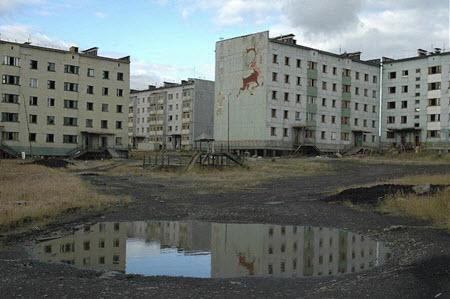
Just drive through any former mill or mining region and you can still see the bitter remnants of its abandoned industries. Some have not yet recovered, even hundreds of years after the initial loss.

When the coal mines died out, so did the cities:


Centralia PA

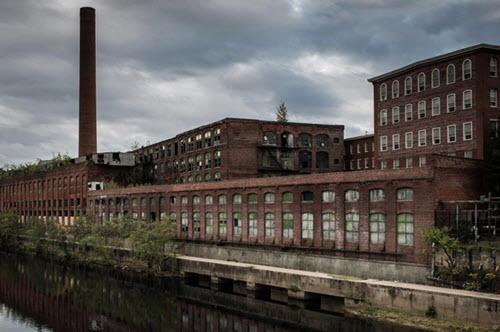
When the mills left, so did the vitality.


Lowell MA
(Source)


With an energy transition away from fossil fuels, there will be similar examples of ruined economic ideas littering the land. Places where refineries now stand with their thousands of jobs will become rusting derelicts. Ditto for hundreds of other dependent businesses, ranging from Jiffy Lube to Boeing to gas stations to airports.

Which brings us to complicating factor #3: time, scale and cost

Time, Scale and Cost

Suppose for a moment that we did decide This is it!, and began building 3 nuclear plants per day in earnest.

First: how much would that cost? Who would pay for it?

Second: are there enough skilled workers and manufacturing facilities to make and install all of the components?

Third: even after these nuclear plants were all up and running, is there even enough Uranium in the world to fuel the eventual 16,500 new, additional plants?

The answer to each of these questions is some form of “no, that isn’t really possible.”

In the third case, the entire amount of all known Uranium reserves are only currently sufficient to supply the existing ~400 reactors in the world of 90 years.

If we expanded the number of reactors by a factor of 41 (16,500/400), that 90 years of supply shrinks to just a bit over 2 years. Nobody is going to build a nuclear plant with just 2 years of Uranium around to supply it. (that said, I am a fan of researching the use and installation of Thorium reactors, which I’ve explored before)

Similar supply constraints arise if we calculate out the amount of resources required to build the amount of wind towers or solar panels that could replace these nuclear plants. The costs are staggering, the global resources too limited. There aren’t enough new hydro dam sites to even make a dent.

Also complicating things, each of these so-called alternative energy systems requires a huge amount of fossil fuels to mine, manufacture, install and maintain. The world has yet to see a single windmill or solar panel that was mined, manufactured and installed without using fossil energy.

The Vision We Need


The answer to the post-fossil fuel era is not an alt-energy system capable of providing us with the same way of life. Because that’s just not feasible.

The answer lies in doing more with less.

We already know how to build structures that will last for hundreds of years and which require almost no energy to operate for heating and cooling. But those are very rarely built today, because they cost more.

We already know how to build small, light vehicles and operate mass transit very energy effectively. But society prefers its huge cars and trucks, because they’re affordable (while debt is cheap) and convenient.

We already know how to grow more food, closer to home, that is far healthier for humans and the ecosystem. But it’s still only done on a boutique basis because it costs a little bit more.

This is why people need to be told the truth and inspired with a vision that we can all share. With a grand cause, anything is possible. Without one, nothing will be done.

The vision we need will align what needs to be done with proper incentives to get those things done. We’ll be told the truth, what is expected, and our role in the project. It will imbue many lives with a sense of meaning and purpose that are currently missing in the lives of most people.

However, given the enormity of the challenge, and the fractured, divisive social and political landscape, you really need to plan for nothing happening. That no vision is coming along, no savior will appear, and that we’re going to merrily continue along until we run out of time and resources to do anything more than regret our mistakes.

Odds are we’re going to keep heading straight along our current trajectory. Until — clunk! — we go right over the edge.

Conclusion

Given the math, human tendencies, and the issues pertaining to time, scale and cost, the current green energy movement currently is little more than hot air. It’s just not going to happen in time.

We’re nowhere close to being able to build out the massive energy projects required. The equivalent of 3 nuclear plants every two days for the next 30 years? That’s a total pipe dream.

We lack the political will, the cultural readiness, the proper narrative. Even the appropriate resources.

Beyond those concerns, nearly everything about how we heat, move, cool and manufacture the components of our modern lives will have to be refashioned (and possibly jettisoned) as part of that project.

Such an ambitious undertaking has no historical analog. It’s a ridiculously complex set of problems (which have solutions) and predicaments (which don’t). It’s exactly the sort of situation that politicians will avoid as long as possible, after which it will be too late to do very much about it.

Which means you need to adjust your expectations and investment of your money and energy, accordingly. The entire world — which is utterly dependent on infinite growth — is only years away from grasping the impossibility of that approach. When it does, everything will change. Quickly.

This is why Peak Prosperity spends so much time and effort alerting people to these realities, and then helping them take informed individual actions that align with the future we all see (or feel) coming.


In Part 2: Reality Shock we examine the most compelling evidence I know of for why taking matters into our own hands is so important now. It explains everything from slowing global economic growth, to the widening wealth gap, to the rising rejection of globalization and the increasingly desperate mad dash (at any cost) for what remains of natural resources.

Humanity is in the early innings of a great transition. Losing access to abundant energy will change things more than you or I can appreciate at this time.

This future is barreling towards us at a furious — and accelerating — pace. Get prepared.

Psychopathy

"Politicians are more likely than people in the general population to be sociopaths. I think you would find no expert in the field of sociopathy / psychopathy / antisocial personality disorder who would dispute this... That a small minority of human beings literally have no conscience was and is a bitter pill for our society to swallow — but it does explain a great many things, shamelessly deceitful political behavior being one."

- Dr. Martha Stout, clinical psychologist and former instructor at Harvard Medical School, from John Whitehead.


On Psychopathy and Power. Caitlin Johnstone. Oct. 15, 2019.
It is interesting that psychopathy should have reached a dark tentacle into my life in the way that it did, given that the three years I’ve been at this gig have been spent writing more and more about the way our world is run by calculating manipulators who are devoid of empathy. I often say that we have found ourselves ruled by psychopaths because we have a system wherein (A) those who are willing to do anything to anyone are rewarded with immense wealth, and (B) immense wealth translates directly to immense political power. Add in the fact that studies have shown that wealth itself kills off empathy and compassion, and you’ve got yourself a perfect recipe for a plutocratic dystopia dominated by antisocial personality disorder.

I’m not really interested in getting into the specific clinical diagnoses of psychopathy and sociopathy for the purposes of this discussion. What I’m talking about here is a specific slice of humanity that is neurologically wired in such a way that they experience the world more as a series of puzzles which can be manipulated around to get them them whatever they want regardless of who it hurts, rather than experiencing a world full of fellow sentient beings with whom you can have deep, meaningful connections and interactions. Not all people who are diagnosed as psychopaths are high-functioning enough to manipulate people at high levels, and not everyone who manipulates people in this way would necessarily be diagnosed as a psychopath or even a sociopath. Feel free to mentally substitute whatever term you prefer.

Whatever you want to call it, people who have this condition (and are able to avoid prison) tend to do quite well for themselves by our society’s standards. Because they don’t see other people as anything other than tools and resources, they don’t let empathy and compassion stand in their way when viciousness and exploitation will help them achieve their goals. Because they don’t value connections with other people, they don’t see narratives and descriptions as paths toward deeper understanding, but as tools which can be twisted and distorted in order to secure themselves more wealth, status, sex, or whatever else they want. They quickly rise to the top in corporate and financial settings, in media institutions, in government agencies, and in politics. In modern society this ability is a natural advantage that the rest of us simply cannot compete with.

But it’s not just our current iteration of society which elevates psychopaths to the top. A casual glance through recorded history all around the world reveals an essentially unbroken track record of genocide, slavery, torture, exploitation and degradation as far as the eye can see, with the driving characters time and again being depraved dominators, conquerors and mass murderers. Research some of the horrors that were inflicted upon the Aboriginal people of Australia and the indigenous populations of the Americas and you’ll see that the whole thing was driven by a total lack of empathy for those human beings. Throughout history our main problems have been caused by the way we keep designing systems which elevate psychopaths to positions of leadership, who then go on to make psychopathic decisions.

Given the fact that people who are indifferent to truth or human suffering have always been so adept at ascending to power positions, it’s hard to even imagine a society where we don’t find ourselves ruled by psychopaths. George RR Martin set out to tell a story about a cast of characters all vying for power in an epic game of thrones, and that story wound up being populated almost entirely by psychopaths and sociopaths. It makes for a compelling tale because it’s very believable based on what we all know deep down about human behavior patterns, but it’s also a relentless assault on the audience’s empathy center.

So what can be done, then? How can we ordinary, feeling, caring human beings protect ourselves from this segment of the population which has been driving us into disaster after disaster since the dawn of civilization before they get us all killed?

Psychopathic leaders have never had any trouble figuring out how to get rid of segments of the population who they deem problematic: they round them up and exterminate them. This would obviously be out of the question for many reasons, not the least because in order to implement it we’d need to become psychopaths ourselves. We’d be “curing” the sickness by becoming the sickness.

Passing a bunch of laws against manipulation and deception wouldn’t work either. Manipulators actually love rules and laws, because they can figure out how to manipulate them and use them to their advantage. Julian Assange is currently awaiting extradition hearings in Belmarsh Prison because a bunch of psychopathic manipulators decided to pretend that it was very, very important to respect a series of laws and rules ranging from bail protocol to whistleblower source protection to government bureaucracy to embassy cat hygiene, and they were able to engineer a result that just so happens to look exactly the same as imprisoning a journalist for exposing US war crimes. All the worst atrocities in human history have been perfectly legal.

I’ve seen some people advocating mandatory brain scans for anyone seeking a leadership position. It is true that a psychopath’s brain shows up differently from the rest of us on a PET scan, and it is possible to envision a future where the collective is so aware of the pernicious dance between psychopathy and power that such a policy might be set and enforced. The problem of course is that manipulators manipulate, and there are many ways to manipulate one’s way around such a system; they’ve been inserting themselves into unofficial leadership positions for ages, for example, which they’d never need to be tested for. Plutocrats, advisors and propagandists are all in unofficial leadership positions.

Maybe you’ve got your own ideas about this, but I personally can’t think of a single solution to the fundamental problem of psychopaths inserting themselves into positions of power which doesn’t involve drastic, unprecedented changes in our civilization and our culture. Even if you completely tore down capitalism, ended plutocracy and replaced the entire system with a government-planned economy, you would still have positions of power and the absolute certainty of psychopaths manipulating their way into those positions sooner or later.

I’m talking about changes as drastic as the end of anyone having any power over anybody at all. A society where the idea of having power over anybody became so culturally taboo that even an unequal power dynamic between spouses would be seen as outrageous and ugly, to say nothing of governments or police forces. Such a society is very far from what we’ve got now, but it would surely be a very inhospitable environment for psychopathy. There would be no positions of leverage for one to manipulate their way into in order to force others to give them what they want, and if you started trying to create one everybody would immediately point at you and yell “Hey! What are you doing? Stop that, that’s weird! If you want something from us you need to form consensual collaborative relationships with us, just like we’re all doing.”

It’s also possible to imagine a culture in which manipulation is seen as an unacceptable taboo which immediately draws public backlash in the same way. In such a culture children would learn from the youngest age what honest and sincere interaction looks like, with examples of deceit and manipulation clearly illustrated for them in all forms as something gravely disordered. Advertising would cease to exist in such a society, as would propaganda in all its forms. And psychopaths would be like fish out of water, because manipulation only works when it isn’t recognized as such.

One can also imagine a culture which values empathy, compassion and helping others instead of valuing wealth, accomplishment and conquest. In such a culture we’d see the ability to connect with people and work for the good of the whole elevated, rather than seeing the ability to do whatever it takes to claw your way to the top of the heap elevated. In such a society psychopathy would actually be an immense disadvantage, rather than an immense advantage.

And that, in my opinion, would be the marker of a healthy society: one in which psychopathy and sociopathy become grave mental handicaps that the afflicted need to actively seek help for. A society that is so empathic and collaborative that having a diagnosis of schizophrenia or bipolar disorder isn’t such a big deal because your neighbors work with you and help you with what you need rather than pushing you to conform and achieve, while having psychopathy or sociopathy is a debilitating disorder which will turn you into a pariah sleeping on park benches if you don’t get help. Right now we have the opposite: people with schizophrenia, bipolar disorder and other serious mental illnesses are treated like worthless hindrances to a society which values achievement over empathy, while psychopaths and sociopaths almost never seek help unless it’s court-ordered.

A healthy society would flip this. It would reward the things psychopaths are unable to do, and it would reject the things that psychopaths excel at. We can actually look at what psychopaths are and are not good at, and from there kind of reverse-engineer an idea of what a wholesome society would look like.

Is such a society possible? I don’t know. I recently put together some evidence which seems to suggest that our species may be on the verge of a drastic shift in consciousness, which would be the only facilitating agent I can think of that would make such massive cultural changes feasible.

We seem to be headed for either huge changes or extinction relatively soon, so if there’s a future humanity on the other side of what’s coming, it likely exists because it made extraordinary changes in both its behavior and in its relationship with the phenomenon of psychopathy. We’ll either make the jump or we won’t.