The Evolution of My Thinking. Erik Michaels at
Problems, Predicaments, and Technology. Jan 24, 2024.
Before I get started, I would like to say that I would love to be wrong about all of this (subject matter contained within this article and my blog in general), but the empirical evidence is not pointing that way. I know that there are lots of people who want more to hope for, but I follow the evidence and where it leads, and I just don't see much room for hope and I still think that Derrick Jensen said it best here about hope. The main reason for this entry is to demonstrate the power of conditioning, indoctrination, and our beliefs, along with manipulative narrative generation within the framework of how we process and think about the predicaments we face.
The evolution of my thinking has undergone a rather huge shift over the last decade and a half. Before I watched Collapse with the late Michael Ruppert, I was your typical American cornucopian and had little knowledge of much of the predicaments I have learned about since then. Ruppert's documentary blasted open the doors of peak oil (energy and resource decline) for me and made me aware of the Limits to Growth and the precursor to ecological overshoot. While I had extensive knowledge about climate change and pollution loading, I was unaware of energy and resource decline and how it will affect us.
As with most people, life was roaring all around me, I was busy working on building my company, and spent my time not only on the weddings themselves, but actively volunteering in my community as well. Life was grand, and it still is, although quite a shift has taken place within me since those days of blissful ignorance. A short 3-4 years after watching Collapse, I discovered overshoot and NTHE. Finally, these predicaments slowly came into focus and I advanced from Stage 2 of Bodhi Paul Chefurka's Continuum of Awareness to Stage 5 over the next several years (see the Continuum of Awareness at the end of Why is Civilization Unsustainable?).
As countless others have done, based upon my new knowledge, I made plans and decisions that would affect me and the rest of my life from that point forward. Some of these plans were rather difficult to make because they represent sacrifice. They go against the grain, so to speak. Some folks just don't really get the fact that personal sacrifice and personal change are the ONLY way to help facilitate external change. Many people seem to think that the way to becoming more sustainable is to buy more "green, clean, renewable, and sustainable" products such as solar panels, EVs, and batteries. Buying products labeled with ANY of those terms changes nothing. More mining, energy use, and material throughput had to be facilitated in order to manufacture those products, no differently than the products they are replacing. If there wasn't anything truly wrong with what they were replaced with, the MORE sustainable choice would have been NOT to buy something new, regardless of what it is. Buying new products in an effort to reduce energy use and material throughput because the newer items are "more sustainable" is an illusory concept. By buying the new product, you are cancelling out any real benefit by continuing the same exact cycle of consumerism you are trying to stop.
I considered buying these types of products myself. After looking into options for a solar system, I concluded that the geographical area I live in is far from ideal for such a system and that solar systems work better in sunnier areas of the world. I also now realize that these systems cannot be maintained once the fossil fuel platform can no longer be maintained itself. Long before the fossil fuel platform can no longer be maintained, however, global supply chains will become problematic and what can be obtained from far away will take a very long time to arrive, if at all. Planning on having access only to local or regional resources is much more realistic. What good would a solar system do me when its realistic life cycle would only last until industrial civilization crashes? Since I already own generators and a power inverter and batteries, adding a solar system would be a massively expensive proposition which really wouldn't help much. Many people simply haven't done their homework to realize how frequently batteries, chargers, inverters, and solar panels degrade or become inoperable and how expensive these systems are to maintain. Add to all of this the inevitable decommissioning and junking/recycling of such materials after their effective life is over. Of course, recycling is yet another whole conversation, but let's just expose the fact that recycling is rather energy intensive and often requires many toxic chemicals, and one never gets the same amount of material out of recycling that one put in. As energy and resource decline continue, recycling will likewise become less and less available to the wider economy, which means more and more junk piling up in landfills - toxic junk. While this is a different conversation than the one I am currently discussing, go to this article for more details on pollution loading or see this file.
Back to this discussion, what the last paragraph demonstrates is that I decided that owning a solar system wouldn't be worth the cost as I couldn't recoup those expenses with the number of cloudy days we have here and the intermittent nature of the electrical supply to begin with (they only produce power when the sun is shining). Likewise, the same thought processes went into other items such as EVs and I came up with the same results - that these are expensive devices and they don't actually change anything we are doing within the system of civilization. In order to actually make a difference, NO car is the better answer by far (Steve Bull points out all the details in this article, so be sure to check all his footnotes). My regular bicycles that I already own are far better than a car for getting from point A to point B. Obviously, this isn't always possible, but there's really no reason to replace anything I have unless what I have is no longer working properly.
The other thing that most people aren't considering is how long the roads they drive on will continue to be maintained at their current rate and at their current quality. This is going to be seriously reduced in the coming years due to collapse, unfolding all around us. In fact, for those of you in the United States, our infrastructure is really in a sad state. For a better understanding of the infrastructural platforms that we depend on daily, check out this article. The system is generally much larger than most people assume and depends on more basic platforms which support the upper layers. Without the basic support structure intact and properly maintained, the upper layers cannot function correctly either. Due to constantly reducing EROEI levels (see this article on what surplus energy is), constantly and continuously reducing amounts of surplus energy will be available to power society.
Combine all these facts with the simple fact that the electrical grid is nowhere near ready to be able to supply the energy that all these EVs would require in the first place (if we were to replace ICE vehicles with EVs). It would be another generation at least before the grid was up to such a level and this is right around the time industrial civilization is expected to be finished. Perhaps a more valid reason NOT to buy an EV is the simple fact that the electrical grid itself is unsustainable and will not outlast industrial civilization, being the one of the weak links that brings the entire system down.
More often than not, many people choose to buy an EV in hopes of making a difference to emissions. Emissions is a symptom predicament of ecological overshoot and cannot be brought down by using more complex technology. The only way to reduce emissions is to reduce overshoot, and this requires less technology use, not more or more complex technology use. Art Berman points this out in his article about how climate change is a rather narrow view of overshoot here.
At the same time that many people hope to use different devices (EVs, solar panels, batteries, and other "clean, green, renewable, and sustainable" devices) instead of ones they already own, they are entirely missing that this doesn't really change anything within the system; they are merely bargaining to maintain civilization which CAN'T be maintained.
Comprehending all of this was difficult and like most people, I went through some serious grief with many periods of denial, anger, bargaining, and depression before reaching acceptance. Even after reaching acceptance I have caught myself going back through different phases of grief. I frequently use sarcasm as a way of coping with all of this, and it does help. But wait...it gets worse! Much worse...
Some people have the wisdom to see all of this and have embarked on projects to build resilience and regeneration through permaculture, planting trees, and/or regenerative agriculture. While this is helpful and a noble goal for people, it just won't be enough. Just like the Degrowth Movement or The Venus Project or even other versions of The Venus Project as I highlighted in my last article, these types of ideas require global unity which is not forthcoming. These types of ideas depend utterly on what amounts to wishful or magical thinking, and the reason I make this statement is because of one of the symptom predicaments of overshoot, climate change. Climate change is slowly but steadily gaining speed and strength and a large portion of the damage has already been done - it's in the rear-view mirror, folks. Discussing ideas about how to reduce emissions at this point is fine, but let's realize that climate change will NEVER get better during our lifetimes or even those of our grandchildren. I struggle with this myself because I hold no illusions in my mind about what the future looks like. Things aren't going to suddenly change most likely (unless a nuclear confrontation takes place), but conditions a decade from now are going to be much different from those today.
Too many people (keep in mind that this is my perspective) do not understand how these changes will affect them. To comprehend these things more fully, the late Will Steffen explained that it isn't just the changing climate so much as it is the rate of change that is so significant. However, even that is paled by the new paper that Hansen et. al. 2023 put out (Global warming in the pipeline). In this new video put out by Nate Hagens, Leon Simons explains the study along with the graphs used for the video where you can follow along as you listen. In order to fully appreciate these changes, it will be helpful to understand how warming affects agriculture and food security. It is further help to understand photosynthesis. Once one has those basics down pat, then one can also understand why almost any type of agriculture will become problematic at best and totally unworkable at worst. An additional set of information is available here in the Aerosol Particulates, Clouds, and Global Dimming file.
Yes, I have posted many of these links before, but it appears rather obvious to me that I need to repeat them as people tend to forget these things (even I do). Perhaps it is the conversations I have with people who fail to understand what it is I am trying to communicate to them because they don't bother to read the articles I post in my conversations, designed to help them understand what I am attempting to communicate. MOST of the information is contained in the articles, so if they don't even bother to read them and continue conversing with me, I am well aware of how well they understand (or lack thereof) the concepts I am trying to communicate. A considerable number of these people clearly don't really want to learn, unfortunately. Initially, this was something I wasn't quite prepared for. Now, I am unfortunately quite used to it. Each one of these conversations teaches me something. Some of them I am impressed with, but overwhelmingly most of them are depressing. Still, they inform me of where I can at least try to direct more information towards. As can be seen in the above paragraph, conditions are progressing pretty much as has been predicted in multiple studies over the past decade, and this should get people focused much more on using less technology, not more. Sadly, this isn't what I am seeing generally. There are a few people who wisely see what is needed with low tech or no tech, but much of society is still chasing more tech or more complex tech, taking us in the wrong direction.
What people need to be doing isn't prescribing technological devices as some sort of way to reduce their ecological footprint, but devising ways instead to change their lifestyles and habits to reflect a lower energy and material throughput future. One successful way to do this is to reduce your income. If you don't have the money to buy gadgets that aren't needed in the first place, you'll appreciate more fully the ones you have. For tools that need replacing, try purchasing hand tools or items that aren't powered by gasoline or electricity. This is the coming reality and one must accept it or suffer.
Needless to say, where I once looked for solutions to every problem I now look to see whether I am facing a problem with a solution or a predicament with an outcome. Predicaments can't be solved, so a response is the best that can be proffered. These responses should be tailored to the future we will be inhabiting, as developing ideas based on today's conditions won't necessarily be of any use tomorrow. EVs won't be of much use if the roads required for them can't be maintained properly. If you live in a desert area today, you may not have a water supply tomorrow. Photosynthesis may be unreliable in the future due to high temperatures, so depending entirely on agricultural crops might be a mistake. Building resilience and regenerative capacity means depending on less technology use, plain and simple. We must all get out of certain mindsets that lead us into trouble.
What I want to promulgate with this post is that most people don't appear to understand that what passes as the correct things to do in response to overshoot are frequently counterintuitive to what many think are the correct things. Buying products or using more technology or more complex technology is a maladaptive behavior and will not help to reduce overshoot. Looking for more efficient technology or items that use less energy or material throughput is a noble idea; but unless what is currently being used needs to be replaced, sticking with what one already has is more often than not a better choice since it has already been manufactured and is located where it needs to be (rather than halfway around the world). The obsession of looking for solutions needs to be replaced with looking for ways to help others. Reductionism and siloed thinking need to be replaced with good, old-fashioned community connectivity. The bottom line is that we are not going to solve anything - the best we can accomplish is to reduce the severity of the outcomes of the predicaments we are enmeshed within. We must come to our senses and realize that the entire human-built world is in the process of simplifying. An individual born today will see within his or her lifetime (IF he or she lives a typical lifetime of about 75 years) the ending of industrial civilization, cars, grid electricity, big box stores, most retail outlets, and many other things that today we take for granted. What I notice with regard to my thinking is that ultimately, my first thoughts (a decade ago) on how to tackle the predicaments we face was precisely the wrong way to go about making the outcomes better. From what I commonly see in groups and threads on certain topics, I can see the same maladaptive thinking at work causing many people to make the incorrect choices in their lives; bringing a reduction of resiliency and regeneration to the forefront rather than an increase. This can only happen if we are changing BOTH how the overall system operates AND our own behavior within that system. Switching to a different or more complex way to power cars or the electrical grid or civilization itself doesn't really change anything does it? No, the system itself is unsustainable, so how it is powered is almost totally irrelevant because it will never make it sustainable. Changing our behavior requires changing our thinking patterns away from wetiko, and this requires a sustained commitment to doing so. As I finished up this article, I came across this video from Nate Hagens which is surprisingly similar.
I understand that most people either aren't going to see these facts or will disagree with them because they don't want to see the facts or agree with them. This unfortunately does not change those facts. Until next time, Live Now!
Wednesday, January 24, 2024

Thursday, December 28, 2023
Conway: The Hump
The Hump. Conway, The Material World. Dec 22, 2023.
Quite early on in Material World I wrote that :
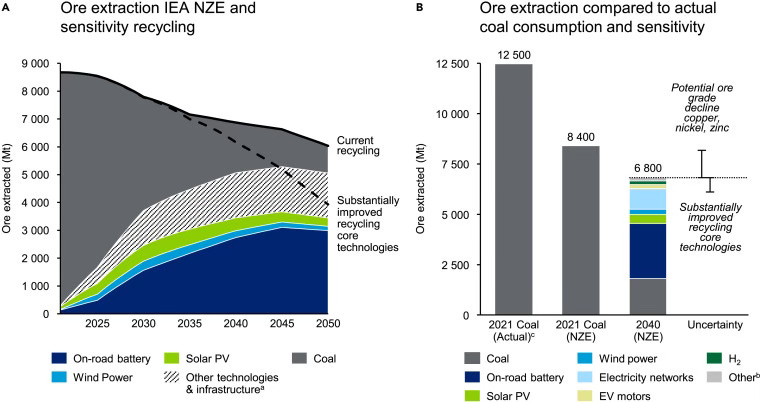
So, how does one square this with a few interesting papers which seem, on the face of it, to be suggesting precisely the opposite thing? Among the most prominent was this recent paper by Joey Nijnens and others. The paper looks at the total amount of material requirements for the energy transition and compares them with our current fossil fuel use.
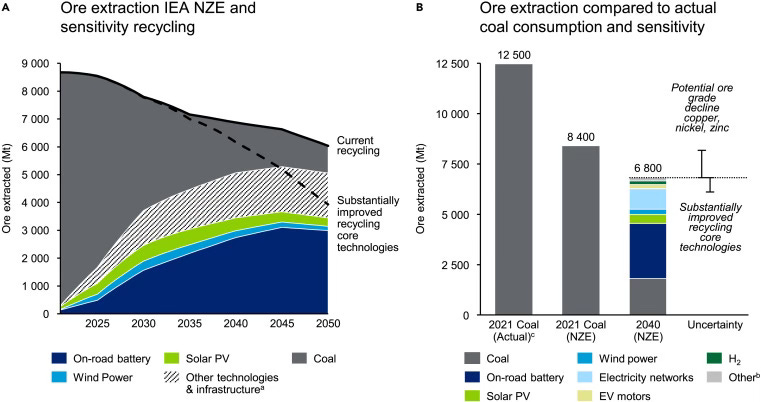
The charts underline an important point. We use an extraordinary amount of fossil fuels each year (far, far more than most people appreciate). And the main message from this chart is that while we’ll certainly need to do a lot of mining to get the copper, lithium, cobalt etc we’ll need, that weight of “new” stuff will be far less than the weight of all the fossil fuels we’re no longer using.
But the chart, which begins at around 2020, seems to suggest that this is happening now.
In other words, far from increasing in the short to medium term, as I wrote in my book, it looks tantalisingly as if humanity’s material footprint is actually about to fall immediately.
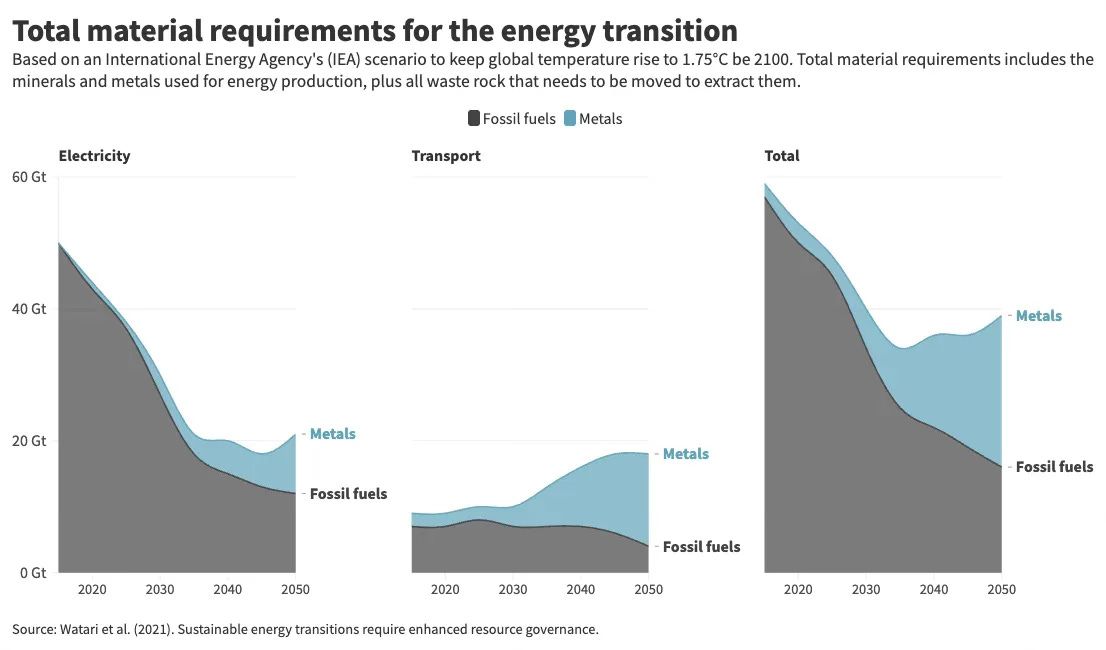
Hannah Ritchie did an excellent post a few weeks ago on that paper and another one making a similar point. As you’ll see from her chart (based on the data in the other paper, this one from Takuma Watari et al), the shape of the line is quite similar:
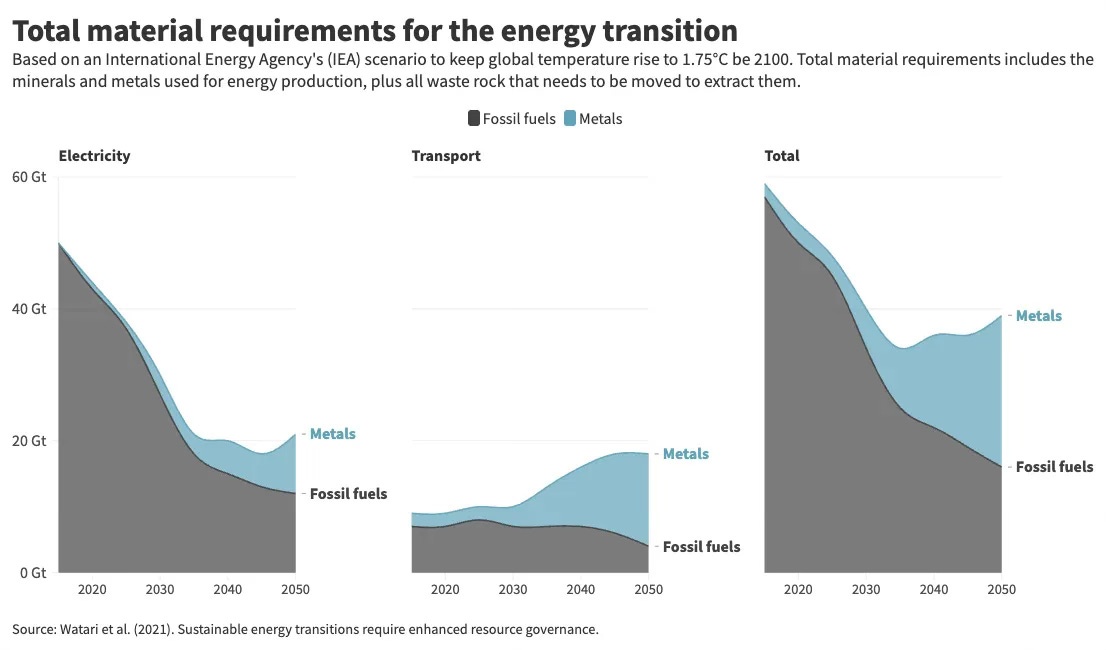
On the basis of all these charts it looks as if our mineral demand has already peaked, and that it will fall on a more or less constant basis in the coming years. Indeed, if we improve our ability to recycle then the line goes down even faster, so that by 2050 our apparent footprint has diminished considerably.
But is this really plausible? In other words, might things have improved so rapidly since I wrote those words above that I am already wrong - that far from growing, our footprint is about to shrink?
Unfortunately, the answer is no, for two reasons.
The first, and by far the most important, is that the charts above are based not on a realistic forecast for where our mineral consumption may actually head in the coming decades, but a very ambitious pathway we are already short of.
You see, the charts above are predicated on the International Energy Agency’s Net Zero Emissions (NZE) pathway.
Long story short, a couple of years ago the IEA produced an excellent report providing a roadmap for how we might be able to get to net zero across the world. Actually they provided three roadmaps: a very ambitious pathway which could actually get the world to net zero by 2050 (the NZE pathway), as well as two other routes - one based on “announced pledges” (APS) - what governments said they would do and “stated policies” (STEPS), which is, for want of a better phrase, “business as usual”.
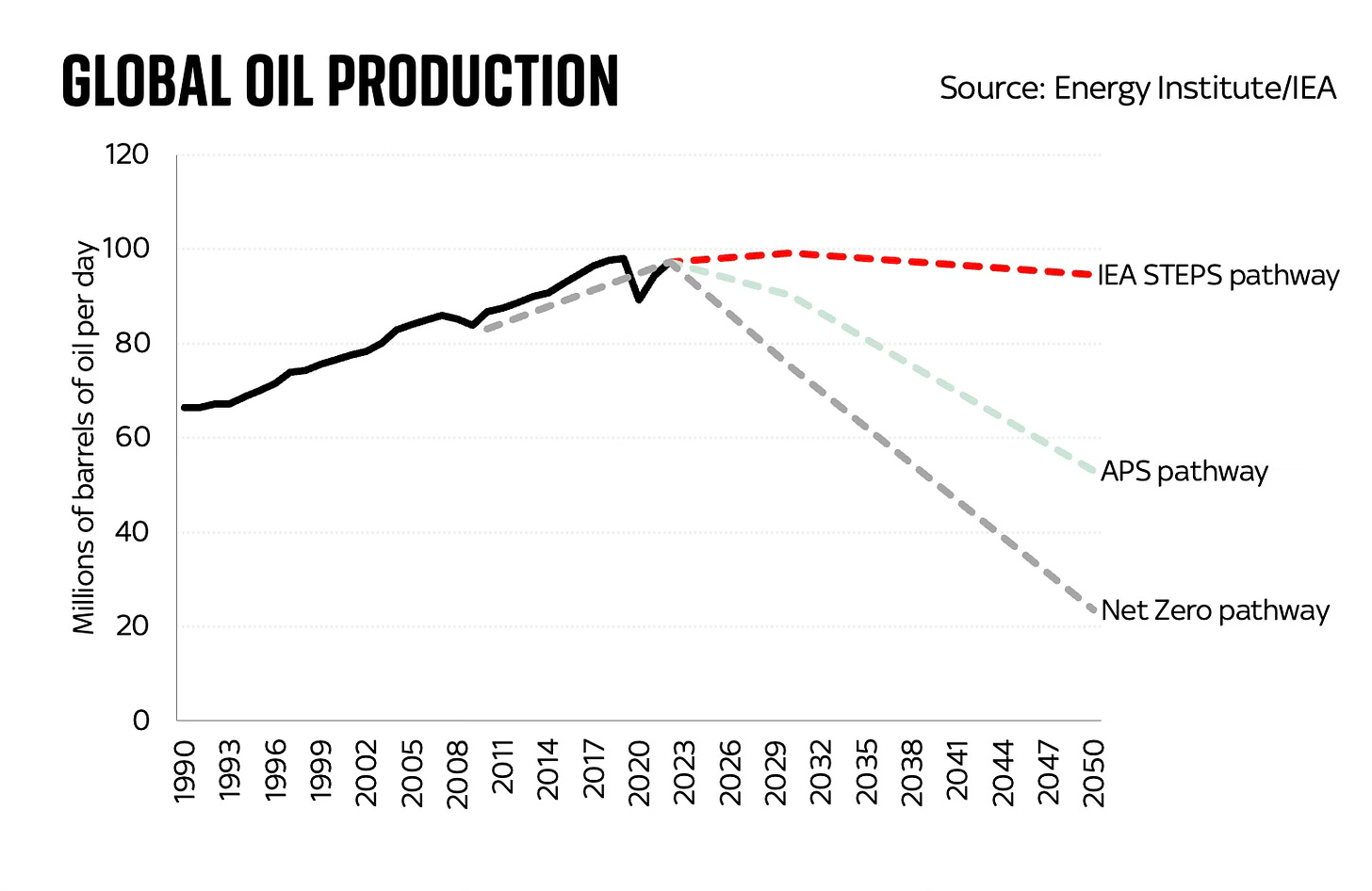
You get a sense of the difference between these pathways when you look at the chart above, in which I’ve mapped out what each of these IEA pathways assumes about crude oil production. The net zero pathway involves a very quick fall in global oil production in the coming years. But the other two pathways see oil production fall far more slowly (and, by extension, we fail to keep global temperatures below the 1.5 degree threshold).
Now let’s look at where the IEA thinks, on the basis of its latest assessment of what’s actually happening in the oil market, production is and is likely to head in the coming years. I’ve added another line to the chart:
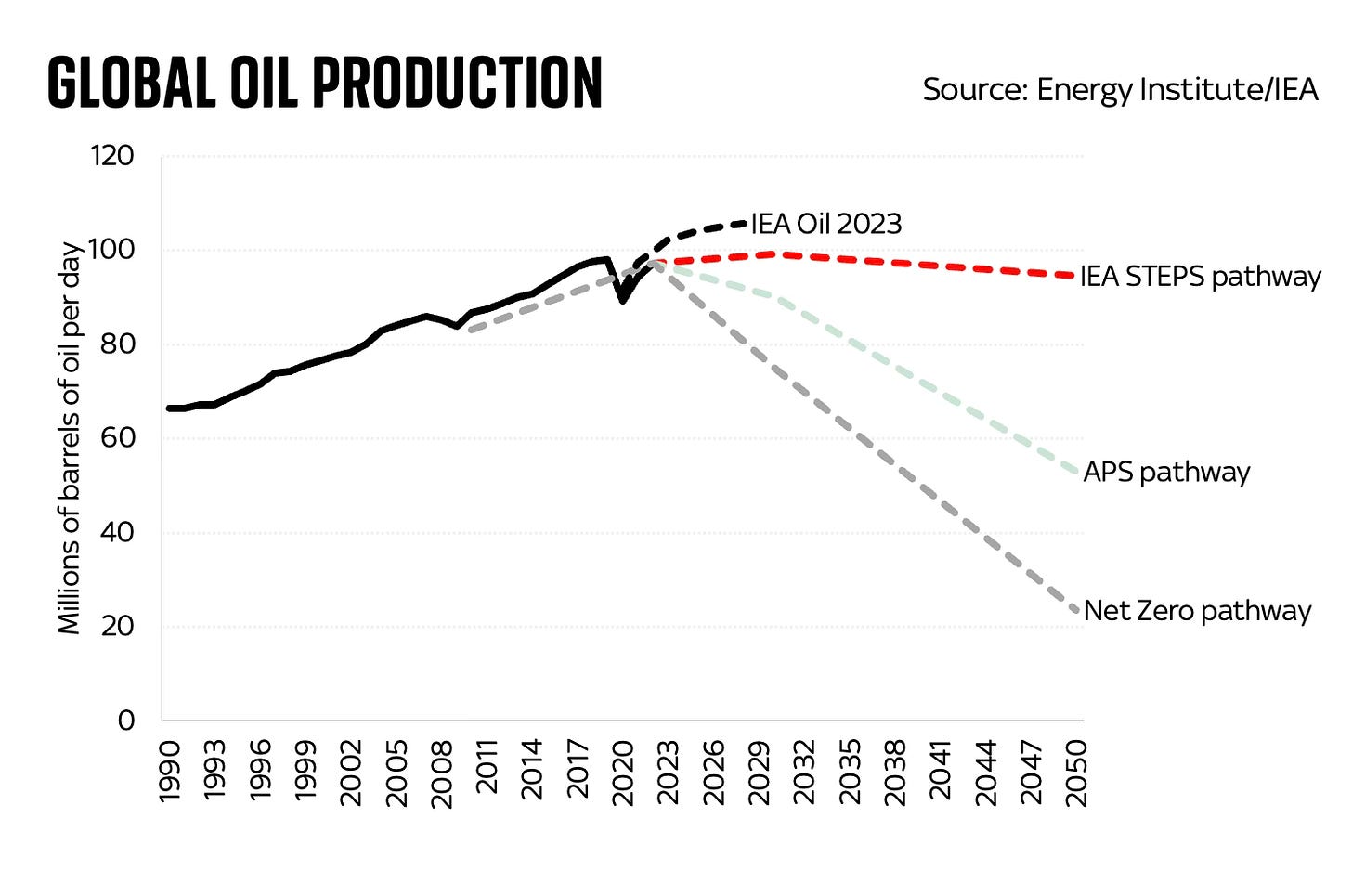
You probably already get the picture. Far from following the net zero pathway, we are already some way short of it. Actually it’s worse than that: oil consumption is likely to overshoot all of those pathways in the coming years.
This, by the way, is precisely the story told by another recent report, the UN Production Gap 2023 report, which compares some of these pathways with where it actually looks, based on what fossil fuel producers are doing, where we’re heading. Look at the difference between the red lines below and, well, pretty much all the other lines.
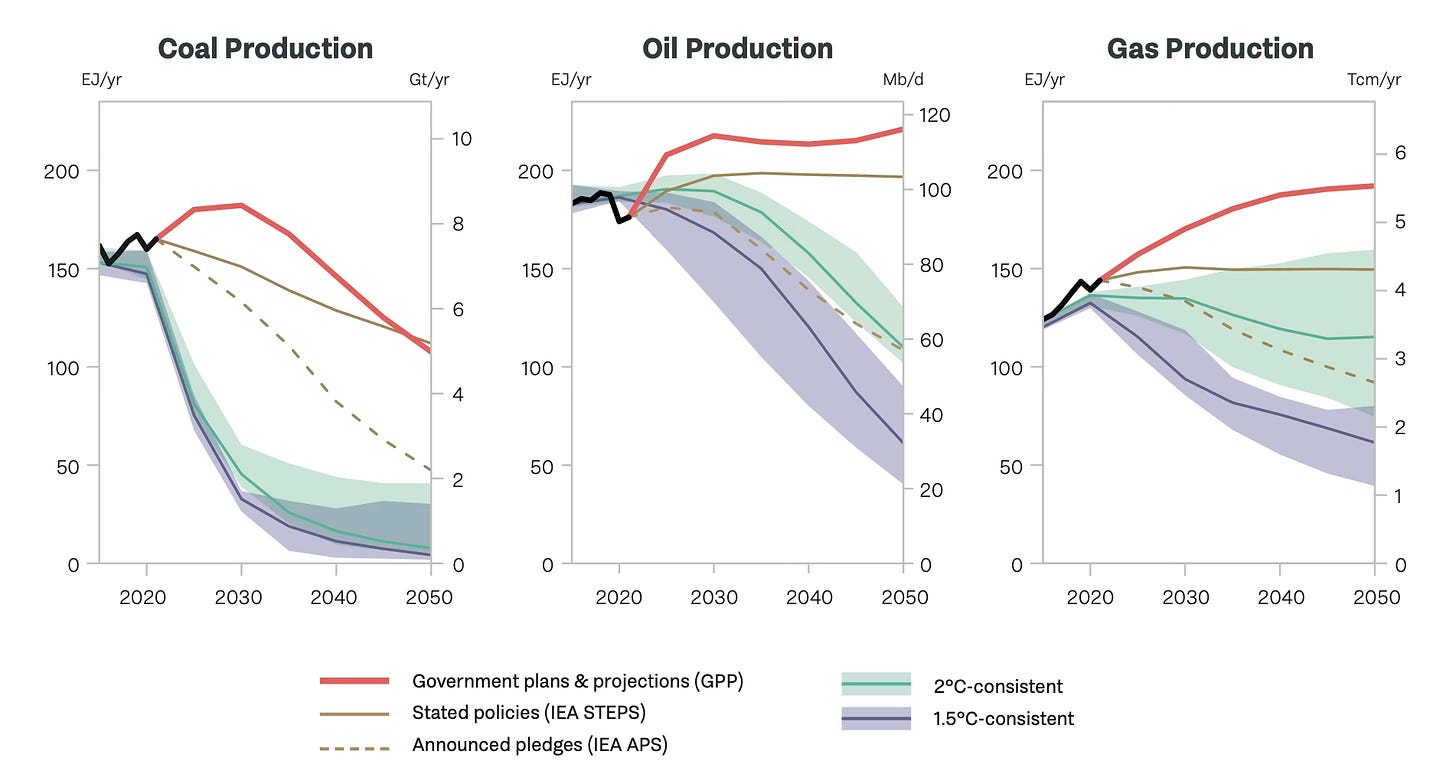
You see, on the basis of revealed preference - what fossil producers are actually doing as opposed to what the IEA and others would rather like them to do - those lines aren’t going down in the coming years. They are rising, and in the case of oil and gas they may be considerably higher in 2050 than they are today. Coal production also just hit a record high in 2023.
Now, I suspect and also rather hope that the reality turns out to be considerably lower than those red lines. But what this exercise does is to underline that far from falling in line with the IEA’s best case scenario, right now fossil fuel use is rising above even its worst case scenario.
So any papers looking at future minerals demand and basing it on the IEA’s net zero scenario must be regarded not as exercises in prediction but as interesting thought experiments. Which, in fairness to these papers, is precisely what they are. And they make an important point: that in due course the energy transition should be far less mineral-intensive than today’s fossil fuel era. But the timing implied by those charts is way off.
Now, it’s worth saying, in the supplementary material to their paper, Nijnens et al say that if the world followed the STEPS scenario (eg the IEA’s worst case scenario) then:
“The estimate for 2040 ROM coal and ore extraction in the STEPS scenario is 8470 Mt, a similar extraction to the 2021 NZE ROM coal and ore extraction calculated in this research.”
In other words (and bear in mind this is based on a scenario which we’re already overshooting), our footprint will increase and then plateau before it decreases. And that decrease won’t begin for a while. There will, in other words, be a hump.
Once we get over that hump, the footprint does indeed start to shrink as the dynamics mapped in these papers suggest. As I wrote in the book, squint a bit and you can envisage a future where:
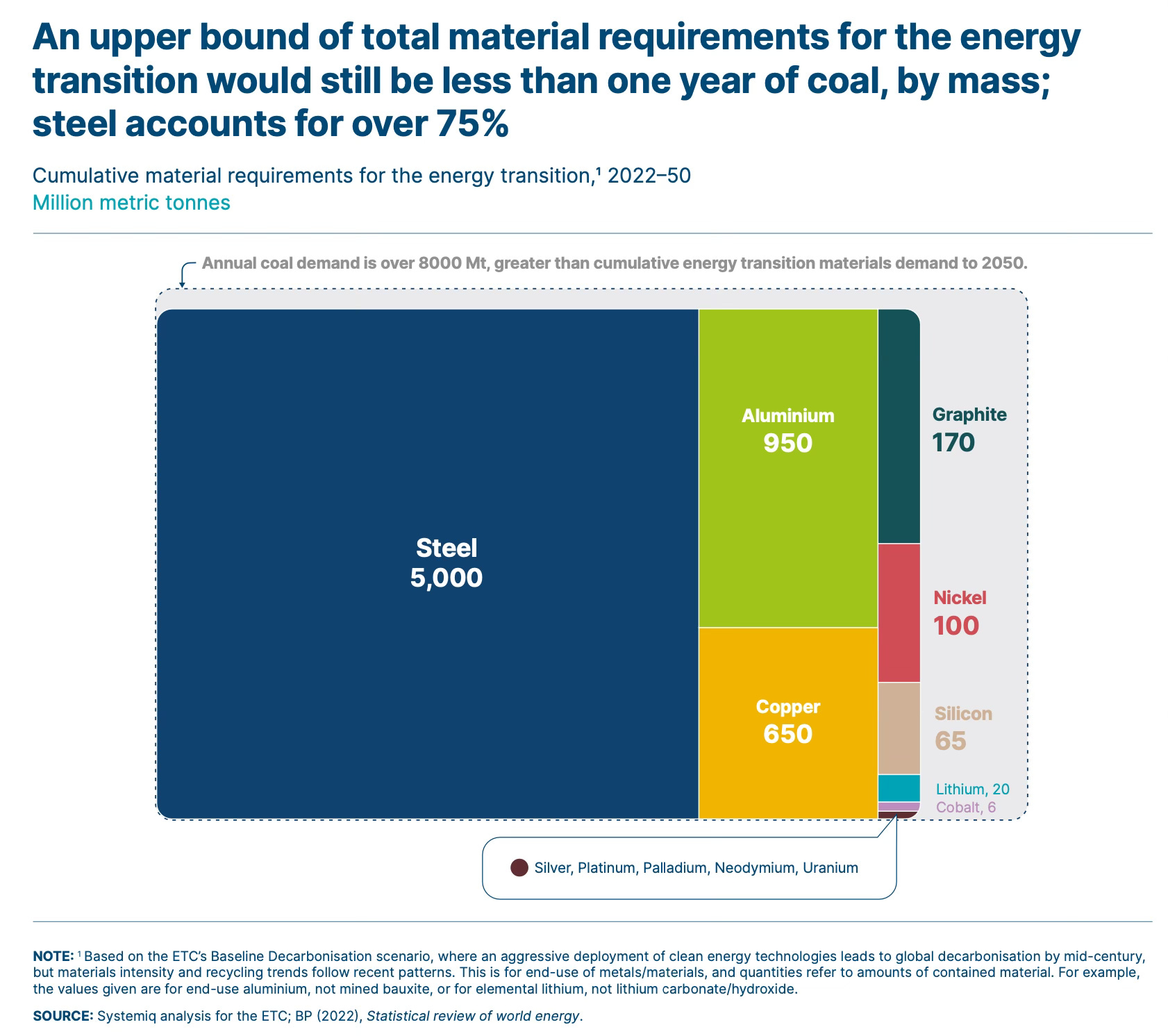
And for further excellent infographics about the sheer difference in scale between fossil fuel mining and future mining for green energy infrastructure (including stuff like steel), there’s a great recent report from the Energy Transitions Commission. With charts like this one:
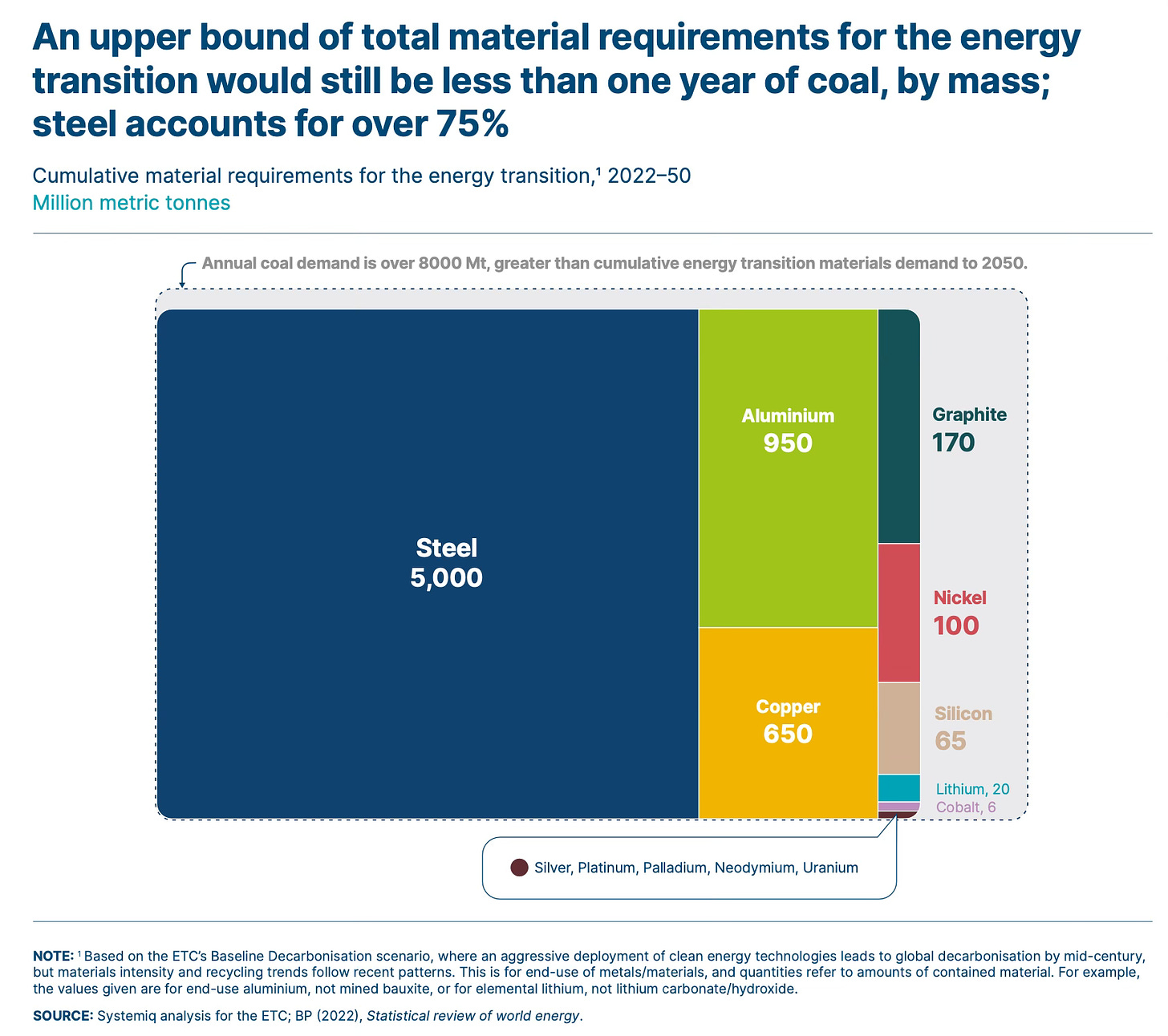
But while this might be the case in the future, it’s not going to be the case for quite some time.
And that hump, like it or not, is probably what we’re heading for in the coming years. Those charts at the top are, like the IEA’s net zero model, better thought of as wishful thinking.
That brings us to a broader point, one recently made by the excellent Rob West of Thunder Said Energy: it’s very important to distinguish between the many models of what could constitute a plausible pathway to net zero and the pathway we’re actually on. None of this is to deny that these models are useful guides to how we might be able to shift towards cleaner energy: but they’re what they are. They’re models.

Rob’s own models, while we’re at it, suggest there will indeed be a peak (or maybe better to call it a plateau) for our material consumption around 2030, mostly thanks to a fall in global coal consumption. But his chart - the one above - is very different indeed to the ones at the top. For one thing, it has that hump.
Anyway, all of this is before you consider the other proviso which has to be appended to the analysis in these papers, which is that they aren’t considering all of the materials.
As you’ll know if you’ve read the book or indeed some of my previous blogs, the majority of our planetary footprint isn’t metals or fossil fuels, but the sands and aggregates and stone we dig and blast out of the earth’s surface to provide us with construction materials. It’s concrete; it’s sand used for land reclamation; it’s the aggregates we use to pave our roads.
And frankly there’s little sign of our consumption of that kind of stuff falling any time soon.
It would have been nice to have ended 2023 by declaring that we had reached the point of “peak stuff” - as those charts at the top seem to imply. But the reality is very different.
Our mineral consumption isn’t about to fall. We’re heading for the hump.
Quite early on in Material World I wrote that :
pursuing our various environmental goals will, in the short and medium term, require considerably more materials to build the electric cars, wind turbines and solar panels needed to replace fossil fuels. The upshot is that in the coming decades we are likely to extract more metals from the earth’s surface than ever before.The point being that while in the long run it’s quite possible that we reduce the size of humanity’s footprint on the planet, in the immediate future we will do a lot more exploiting. We will mine more, refine more and consume more stuff - and the stuff we need for the energy transition will only add to this material intensity. The footprint will grow.
So, how does one square this with a few interesting papers which seem, on the face of it, to be suggesting precisely the opposite thing? Among the most prominent was this recent paper by Joey Nijnens and others. The paper looks at the total amount of material requirements for the energy transition and compares them with our current fossil fuel use.
The charts underline an important point. We use an extraordinary amount of fossil fuels each year (far, far more than most people appreciate). And the main message from this chart is that while we’ll certainly need to do a lot of mining to get the copper, lithium, cobalt etc we’ll need, that weight of “new” stuff will be far less than the weight of all the fossil fuels we’re no longer using.
But the chart, which begins at around 2020, seems to suggest that this is happening now.
In other words, far from increasing in the short to medium term, as I wrote in my book, it looks tantalisingly as if humanity’s material footprint is actually about to fall immediately.
Hannah Ritchie did an excellent post a few weeks ago on that paper and another one making a similar point. As you’ll see from her chart (based on the data in the other paper, this one from Takuma Watari et al), the shape of the line is quite similar:
On the basis of all these charts it looks as if our mineral demand has already peaked, and that it will fall on a more or less constant basis in the coming years. Indeed, if we improve our ability to recycle then the line goes down even faster, so that by 2050 our apparent footprint has diminished considerably.
But is this really plausible? In other words, might things have improved so rapidly since I wrote those words above that I am already wrong - that far from growing, our footprint is about to shrink?
Unfortunately, the answer is no, for two reasons.
The first, and by far the most important, is that the charts above are based not on a realistic forecast for where our mineral consumption may actually head in the coming decades, but a very ambitious pathway we are already short of.
You see, the charts above are predicated on the International Energy Agency’s Net Zero Emissions (NZE) pathway.
Long story short, a couple of years ago the IEA produced an excellent report providing a roadmap for how we might be able to get to net zero across the world. Actually they provided three roadmaps: a very ambitious pathway which could actually get the world to net zero by 2050 (the NZE pathway), as well as two other routes - one based on “announced pledges” (APS) - what governments said they would do and “stated policies” (STEPS), which is, for want of a better phrase, “business as usual”.
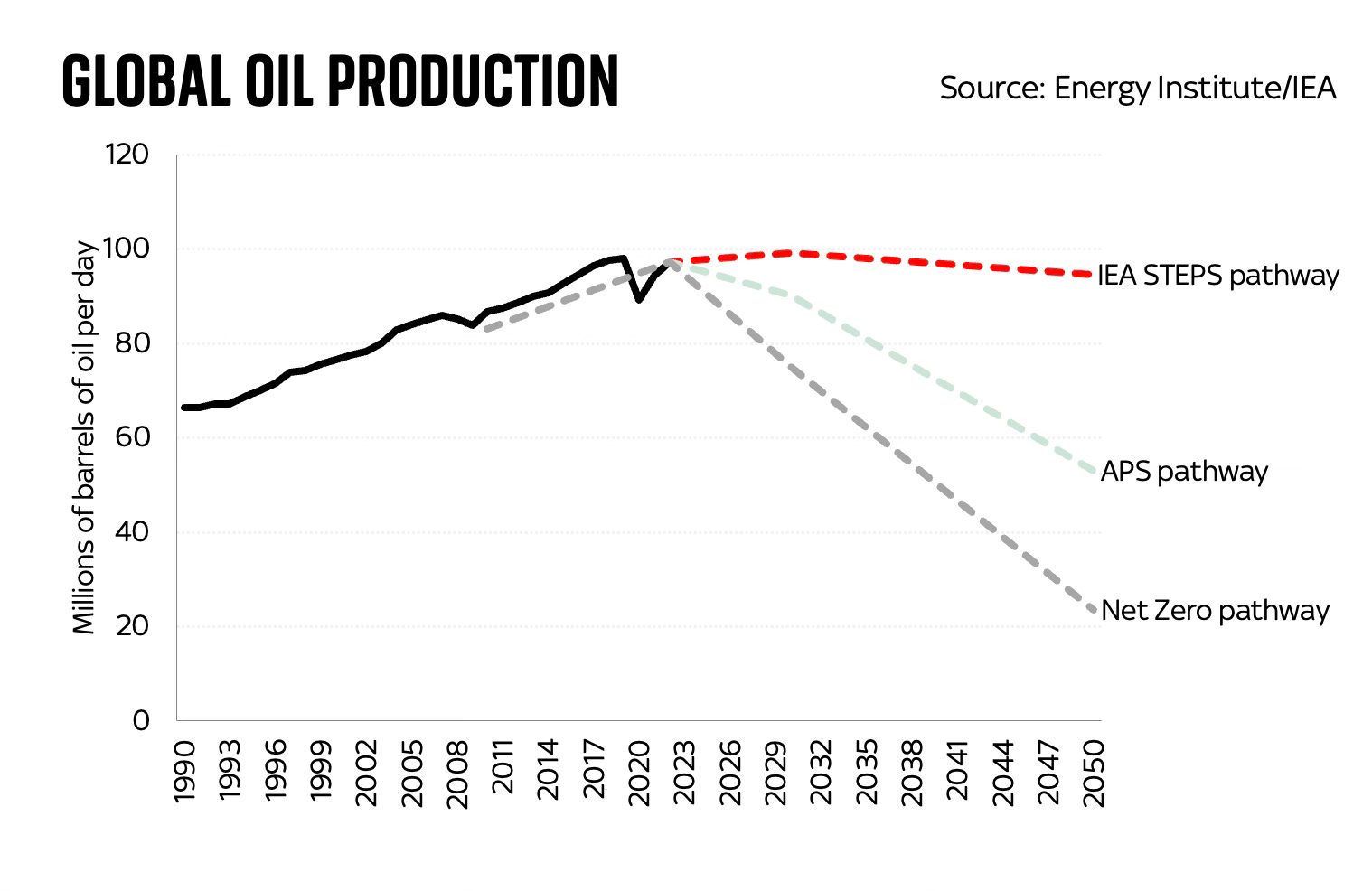
You get a sense of the difference between these pathways when you look at the chart above, in which I’ve mapped out what each of these IEA pathways assumes about crude oil production. The net zero pathway involves a very quick fall in global oil production in the coming years. But the other two pathways see oil production fall far more slowly (and, by extension, we fail to keep global temperatures below the 1.5 degree threshold).
Now let’s look at where the IEA thinks, on the basis of its latest assessment of what’s actually happening in the oil market, production is and is likely to head in the coming years. I’ve added another line to the chart:
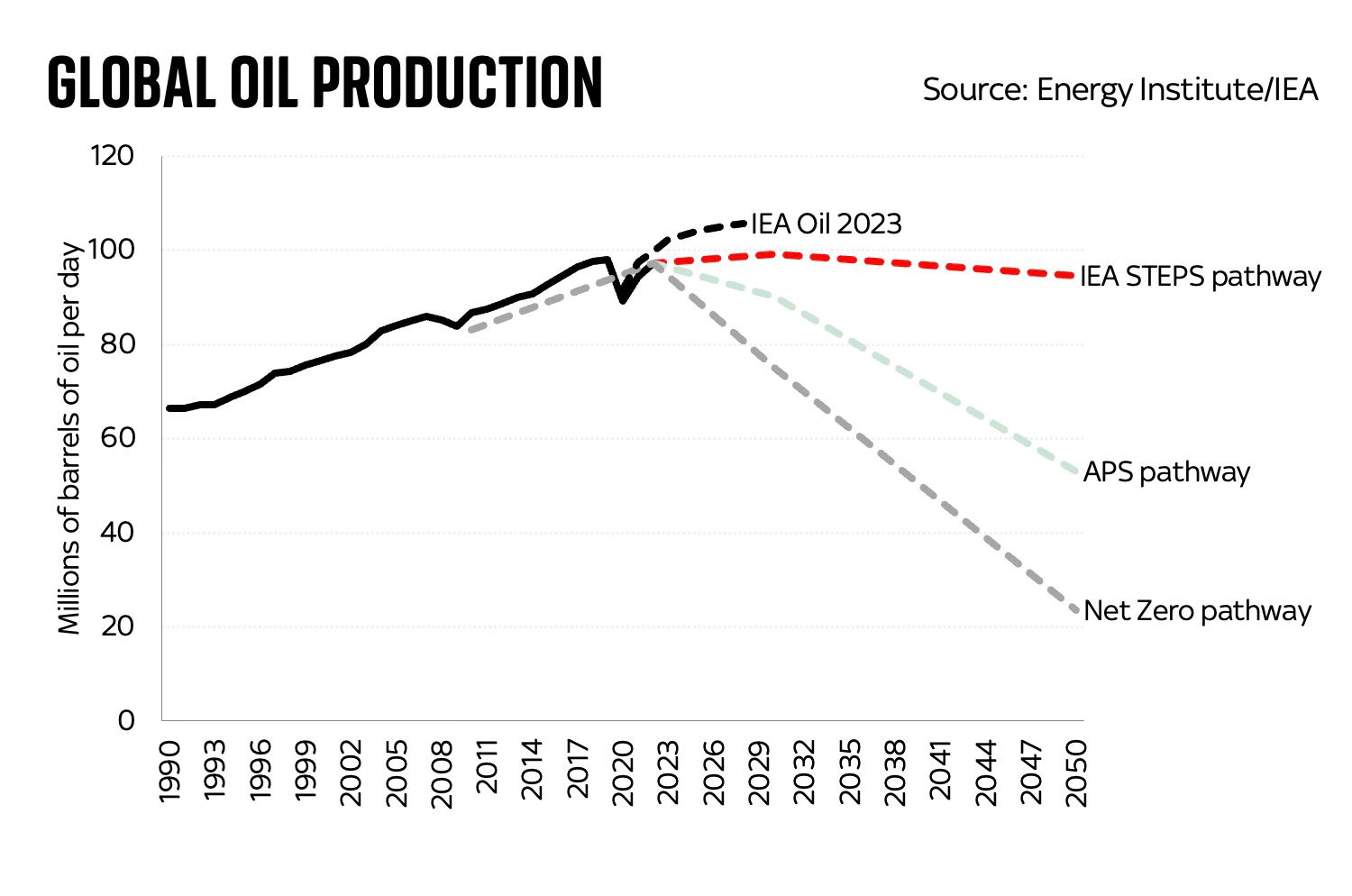
You probably already get the picture. Far from following the net zero pathway, we are already some way short of it. Actually it’s worse than that: oil consumption is likely to overshoot all of those pathways in the coming years.
This, by the way, is precisely the story told by another recent report, the UN Production Gap 2023 report, which compares some of these pathways with where it actually looks, based on what fossil fuel producers are doing, where we’re heading. Look at the difference between the red lines below and, well, pretty much all the other lines.
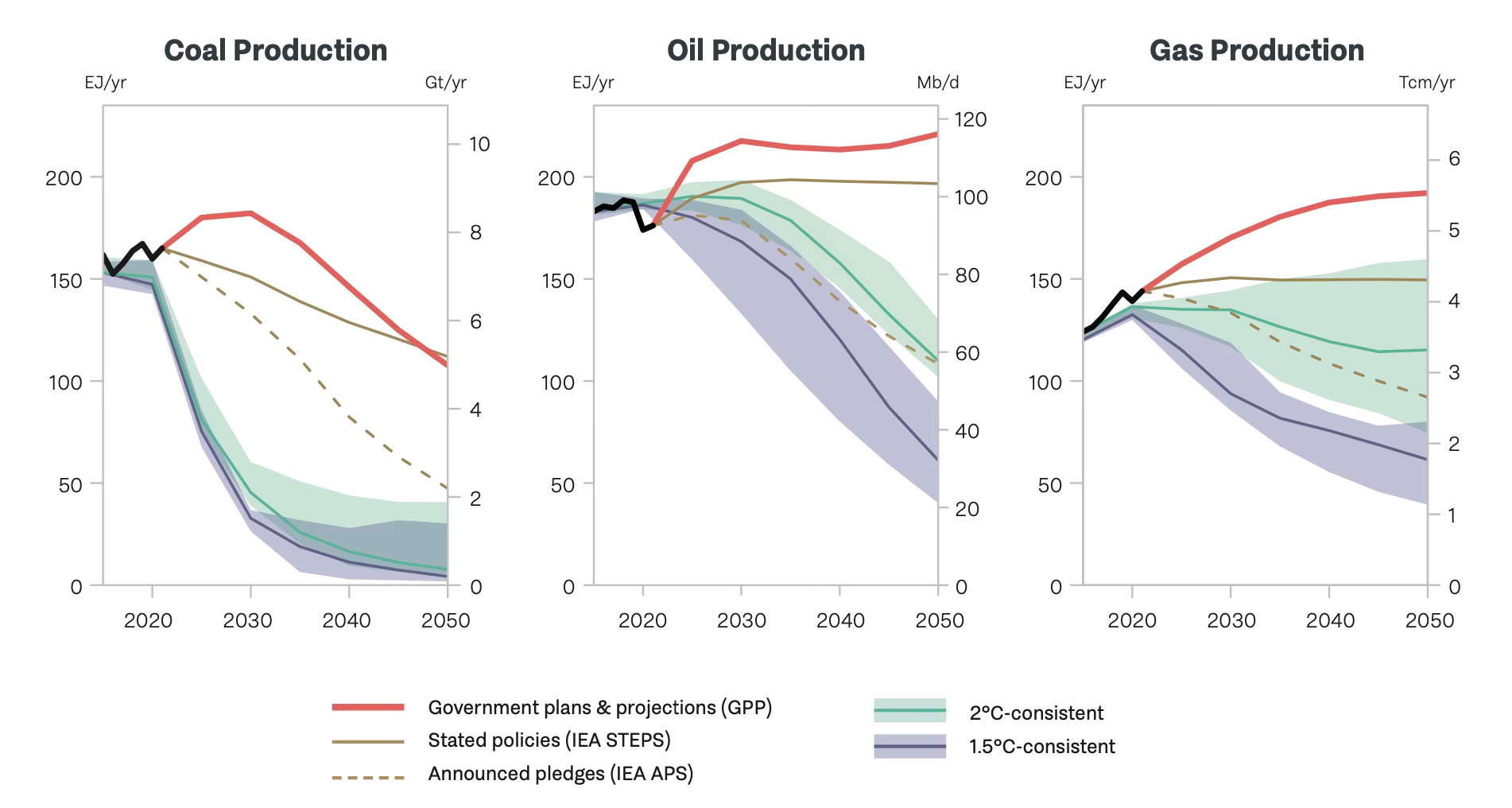
You see, on the basis of revealed preference - what fossil producers are actually doing as opposed to what the IEA and others would rather like them to do - those lines aren’t going down in the coming years. They are rising, and in the case of oil and gas they may be considerably higher in 2050 than they are today. Coal production also just hit a record high in 2023.
Now, I suspect and also rather hope that the reality turns out to be considerably lower than those red lines. But what this exercise does is to underline that far from falling in line with the IEA’s best case scenario, right now fossil fuel use is rising above even its worst case scenario.
So any papers looking at future minerals demand and basing it on the IEA’s net zero scenario must be regarded not as exercises in prediction but as interesting thought experiments. Which, in fairness to these papers, is precisely what they are. And they make an important point: that in due course the energy transition should be far less mineral-intensive than today’s fossil fuel era. But the timing implied by those charts is way off.
Now, it’s worth saying, in the supplementary material to their paper, Nijnens et al say that if the world followed the STEPS scenario (eg the IEA’s worst case scenario) then:
“The estimate for 2040 ROM coal and ore extraction in the STEPS scenario is 8470 Mt, a similar extraction to the 2021 NZE ROM coal and ore extraction calculated in this research.”
In other words (and bear in mind this is based on a scenario which we’re already overshooting), our footprint will increase and then plateau before it decreases. And that decrease won’t begin for a while. There will, in other words, be a hump.
Once we get over that hump, the footprint does indeed start to shrink as the dynamics mapped in these papers suggest. As I wrote in the book, squint a bit and you can envisage a future where:
The world will be a healthier, more productive place, with fewer deaths from pollution, and since we will mine far fewer fossil fuels than today, our footprint will genuinely have shrunk across the world.
And for further excellent infographics about the sheer difference in scale between fossil fuel mining and future mining for green energy infrastructure (including stuff like steel), there’s a great recent report from the Energy Transitions Commission. With charts like this one:
But while this might be the case in the future, it’s not going to be the case for quite some time.
And that hump, like it or not, is probably what we’re heading for in the coming years. Those charts at the top are, like the IEA’s net zero model, better thought of as wishful thinking.
That brings us to a broader point, one recently made by the excellent Rob West of Thunder Said Energy: it’s very important to distinguish between the many models of what could constitute a plausible pathway to net zero and the pathway we’re actually on. None of this is to deny that these models are useful guides to how we might be able to shift towards cleaner energy: but they’re what they are. They’re models.

Rob’s own models, while we’re at it, suggest there will indeed be a peak (or maybe better to call it a plateau) for our material consumption around 2030, mostly thanks to a fall in global coal consumption. But his chart - the one above - is very different indeed to the ones at the top. For one thing, it has that hump.
Anyway, all of this is before you consider the other proviso which has to be appended to the analysis in these papers, which is that they aren’t considering all of the materials.
As you’ll know if you’ve read the book or indeed some of my previous blogs, the majority of our planetary footprint isn’t metals or fossil fuels, but the sands and aggregates and stone we dig and blast out of the earth’s surface to provide us with construction materials. It’s concrete; it’s sand used for land reclamation; it’s the aggregates we use to pave our roads.
And frankly there’s little sign of our consumption of that kind of stuff falling any time soon.
It would have been nice to have ended 2023 by declaring that we had reached the point of “peak stuff” - as those charts at the top seem to imply. But the reality is very different.
Our mineral consumption isn’t about to fall. We’re heading for the hump.
Sunday, December 3, 2023
Radagast re: The Techno-Optimist Manifesto
I read The Techno-Optimist Manifesto so you don’t have to. Rintrah by Radagast. Dec 2, 2023
There’s a growing realization I have, that one of the main effects that wealth and technology have is their ability to shield the mind from reality. Opulence is an insulator. More than anything, opulence makes you feel invulnerable. In Uganda, men prey for rain. They understand that they are tied to their environment and its well-being.
This doesn’t really exist in the modern world. You don’t feel tied to your region. I would encourage you to ask people, why they live where they live. Ask someone: Why do you live in Rotterdam? Why do you live in St. Louis? Why do you live in Maastricht? Why do you live in Memphis? You’ll receive answers like:
“Well because I want to study engineering”
“Because I work at an auto manufacturing plant”
“Because my parents moved here”
I can almost guarantee you there’s one thing nobody will say: Because there’s a river. And yet that’s probably why you live where you live. All the answers you will give come back to that point. Your grandfather moved to Chicago to work at a steel mill? Oh cool. So why is the steel mill there? BECAUSE THERE’S A MASSIVE RIVER LEADING TO NEW ORLEANS, ALLOWING YOU TO SHIP HEAVY GOODS ACROSS THE COUNTRY AT A FRACTION OF THE COST OF TRANSPORTING THEM BY ROAD OR RAIL.
And everything else you’re doing, only exists by the grace of these industries. You don’t work at the steel mill in Chicago, but at a university in Chicago? Well congratulations, you’re even further removed from actual physical reality, making you even more blind.
If you see the coal brought in by boat, or the finished product leave by boat, you might at least once in your entire life remember why you live where you live. But if your job consists of explaining to a bunch of 18 year olds why everything is racist, sexist and/or homophobic, you are permanently protected from understanding how you ended up there. Your entire reality is social, so you end up understanding nothing.
A lot of people have this back to the land fantasy. It’s easy to discover this, when you point out how harmful SUVs are. You’ll discover numerous Americans who insist they need one, to drive back and forth to their permaculture farm somewhere in bumfuck nowhere. In reality, we would be better off with people moving “back to the water” instead of “back to the land”.
I think it is this isolation from the reality of nature, that makes it so difficult for most people to accept that environmental problems are real problems. You can get people in Uganda to understand that climate change is a real problem. You can’t get most Western men to understand it, because technology serves to completely insulate them from reality. When things go wrong, there’s supposed to always be a technological solution for them. The scariest idea to them, is the idea that there are just certain limits you’ll need to respect.
Because billionaires in the United States tend to get rich by embracing technological progress, they tend to feel personally attacked by the idea that technological progress is running into hard limits and is increasingly unable to make life better for the majority of our population. It’s similar to trying to explain the energy problem that Bitcoin has, to someone who became rich through Bitcoin.
There are some billionaires who seem at least somewhat aware of this problem. Ted Turner is notorious for warning about the overpopulation problem. Bill Gates is pretty worried too. He realizes it’s going to take a long time, to solve the climate problem. Hence he wants to block the sun, which angers low IQ low status white males, who would prefer to die in their mobile homes when their air conditioning stops working.
But others are less worried. Others are worried, about our worries. That includes Marc Andreessen. So before I start off reviewing the manifesto he wrote, I want to point out how Andreessen became rich. Andreessen has worked for tech companies for a long time, but in 2009 he founded Andreessen Horowitz with his longtime business partner Ben Horowitz. He started out investing in various software companies.
These companies, as you may know, can reach ridiculous valuations. What Andreessen Horowitz do, is that they enter bubbles before they form. This is why they’re so enthusiastic about cryptocurrency. They invested in Ripple, in Coinbase, in cryptokitties, even in various obscure cryptocurrencies. The advantage this has is that they’re then rewarded with tokens, which they’re legally allowed to dump onto low status white males who fall for these swindles, as these are not securities.
This is basically the Andreessen Horowitz strategy: Ignite a forest fire and then sell it as a heat generating machine. High status white males like Andreessen set up businesses that sell shovels and then they wait for low status white males to go dig for gold. But this business is coming to an end, as low status white males are now stuck with credit card debt and have no money left to buy fake shovels and fake Internet gold from high status white males like Andreessen.
You know the situation is dire, because in the past when you used to point out that these are all scams, a low status white male would immediately appear from thin air, who would argue that every cryptocurrency is a scam, except for his own variety of fake internet money. These days you don’t even really see those types anymore.
So these dudes are in trouble. They don’t make money by funding things that people use. They make their money by investing in things before the dumb herd is able to invest in them. They don’t really care what they invest in, as long as the dumb herd shows up afterwards. But that dumb herd is running out of money.
I think this is some important context to the manifesto. You have a billionaire who moves onto increasingly more speculative ventures, pouring money into them in anticipation of the LSWMs who will show up later to inflate the value of those ventures. I think this man is trying to convince himself that his investments still make the world a better place.
So now onto the manifesto. Starting out with the good, the manifesto makes me feel less cringe. It isn’t any better or worse than something I would write for this blog while home alone on a Friday night. Example:
We all know by now, that when someone writes a book to debunk an idea, it’s because she fears the idea is true. And similarly, when someone writes a manifesto, it’s intended to convince himself of an attitude towards life he no longer believes in. If Ted Kaczynski really believed life in his cabin in Montana was idyllic, he wouldn’t spend his days blowing people up and writing his manifesto.
Let us look at the Techno-Optimist Manifesto again. I had expected it to be somewhat nuanced, to incorporate and then reject the critiques of eternal growth many smart people with far less money have already offered. Consider:
After about 400 years of perpetual growth in energy consumption at 2.3% a year, the Earth’s surface would reach boiling point. This is just basic stuff you would expect people to know, but he either doesn’t know it, or he’s just sticking his fingers in his ears like a toddler and going “LALALALA I CAN’T HEAR YOU”, because he goes on to say:
Consider the nuclear delirium, the insanity that right wingers are peddling now that they’re ever so slowly coming to terms with the fact that yes, we’re rapidly making most of the planet inhospitable to human civilization. Now they have a solution: The whole thing could work, if we simply built nuclear power plants!
This is not a new solution, mind you, nor is the delirious optimism new. In the 70’s the Dutch prime minister sold all our natural gas for pennies, because they assumed it would be worthless and left in the ground as we would soon all be using nuclear energy instead. Today we’re stuck with the hangover from the naive optimism of our parents and grandparents.
There isn’t really a place on Earth, where we see what these people want to have. Not in communist China, not in Japan, not in the former Soviet Union, not in the US of A, not in South Korea, not in Taiwan, there’s no place on Earth that runs on nuclear. The sole exception you could argue is France, but that country depends on the rest of Europe to export and import its electricity, because their reactors have to shut down in summer when the rivers get too warm.
The reason it didn’t happen of course is because you run into scaling problems everywhere. It takes time and experienced crews to build these reactors, the reactors themselves depend on rare minerals, you need special locations near a source of water, away from dense cities and not at risk of war or natural disasters and then eventually you need to figure out a location to dump the waste. The reason the United States didn’t build those 1,000 reactors before the year 2000 is because it can’t.
But the biggest problem, is a problem I already touched on at the start of this post: Water. Everything ultimately depends on water.
What does a nuclear reactor do? It releases heat by splitting atoms, which we then use to generate movement in water and thereby ultimately produce electricity. This releases huge amounts of new heat you’ll need to leave somewhere.
Humans feel very powerful and in control, when they split the atom. But what do you do with the heat that you produce? Where do you leave it? Well, for 95% of all nuclear power generated we decide to cool our reactors with water.
So, we dump that heat into our water supply. If you warm up the water next to your shore, you’re going to produce toxic algae blooms, because the water stops mixing properly and you reduce the influx of oxygen. That means the fish in that environment eat toxic algae, causing the build up of domoic acid. This causes brain damage. Take a look at this:
Around 95% of all nuclear power generation uses water as a coolant. There are alternatives, there are a handful of gas cooled nuclear reactors. But if you want to have a nuclear meltdown, the best way to achieve it is probably to use an obscure type of reactor with a coolant that just disappears into the atmosphere as soon as something breaks. And it’s inevitably more expensive too.
A nuclear power plant is allowed to dump water into our seas and our rivers, that is up to six degree warmer than the water it took in. Do you think I want to cause six degree of local warming in my local water, to reduce global warming by less than 0.01 degree Celsius? That is suicidal.
And more importantly it doesn’t work either. Nuclear energy is intermittent energy. When the local water gets too warm, you can’t dump your water back into the environment. Sweden had to shut down one of its nuclear reactors in the summer of 2018, because the water got too warm. Climate change has the nasty habit of making proposed climate change solutions obsolete.
If the water is getting too warm for Swedish nuclear reactors in 2018, what do you think will happen to Dutch nuclear reactors that we want to start building today, that won’t become operational in 2030? They will cease offering any electricity during summer at all!
But these people don’t want to hear this, because they’re invested in the myth of mankind mastering nature. Not the individual man making it through the merciless Alaskan winter or anything like that mind you. These are not genuine rugged individualists, they are collectivists at heart, like most people. The autists and schizoids, the natural individualists, are rare creatures indeed.
No, Mankind is going to master nature, colonize other planets without atmospheres and figure out some way not to die of space radiation while doing so. So in the Techno-Optimist Manifesto we find Andreessen arguing that “the ultimate mission of technology is to advance life both on Earth and in the stars”.
Note that these people are also never really interested in a consolation price. They don’t speak of building floating cities on the ocean. They don’t speak of colonizing Antarctica. They’re not interesting in building domed underwater cities on the bottom of the ocean floor.
These are all vastly more cost-effective and realistic scenarios than colonizing Mars, or worse, places outside our solar system. It something goes wrong, you can send assistance within hours, instead of months. You have an atmosphere protecting you from harmful radiation. There would be a meaningful economic purpose to pursue.
But nobody is volunteering for this. Nobody is volunteering to live in a city 4000 meter beneath sea level. Nobody is pushing governments to let them build a city in Antarctica. Even the simplest possible option, a floating city, has hardly anyone genuinely interested. When you have 10,000 people living on a floating city, that is self-sufficient in food production, you can begin to think about more ambitious projects.
Keep in mind, these are all opportunities that would have a realistic chance to achieve what the Mars colonization enthusiasts claim to pursue: Protect humanity from extinction. When by 2100, most of the world gets too hot for human survival from time to time, we will still be right in the middle of the release of various greenhouse gasses from natural ecosystems.
What would probably help humanity survive by then, is if we had functional cities in Antarctica, floating cities on the ocean that could be moved to the North Pole or deep underwater cities shielded against above-ground temperatures (and against nuclear fallout). Those would all increase our survival chances as a species. Oceanic cities near the North Pole would even have an additional benefit: They would repair our climate by reflecting sunlight.
Colonies on Mars don’t have any of these benefits. They would inevitably just be an economic drain on planet Earth, unless you think a colony of 400 settlers on Mars would just 3D print their own CT scanners, dialysis machines, the rare earth minerals that go into such machines, antibiotics, pesticides (assuming they don’t just keep importing all food), baby milk powder, tetanus vaccines, radioactive iodine when someone gets sick, birth control pills and anything else humans need eventually. We’re able to have our standard of living, because we live around billions of other people who can deliver us anything we need, most of it within hours.
The actual reason the richest man on the planet wants to colonize Mars of course, is because reality doesn’t matter anymore for making money, as we don’t live in a society that punishes failure. We reward people who show us an image of success. In such a society, you become rich by telling people what they want to hear. You package people’s hopes and dreams and sell them back to them at inflated prices.
The reason this annoys me so much is because there are a handful of people out there who do accept that limits to growth are real and are working on solutions that could allow us to have something resembling a future. These solutions are humble and the people who propose them don’t have loud mouths, so you never hear about them, while the billions continue to flow to guys like Andreessen and Musk, who promise you a future on Mars.
It’s possible to grow seaweed in the ocean, ship it to shore by sailboat, dry it on land, burn it in a thermal power plant and then sequester the CO2 underground. This is a way to sequester CO2. It’s also possible to mine olivine, disperse it on beaches and let the mineral sequester CO2 for us. It’s even possible to bring the air to very low temperatures, until you eventually have frozen CO2, which you can then bury somewhere. A plant built for this purpose on Antarctica would be most cost-effective.
But again, there’s no true interest in ambitious projects. There’s a crisis of meaning, which people like Musk and Andreessen jump into with increasingly ridiculous ideas and visions for the future.
To a large degree, Andreessen’s success can be traced to him saying “Fuck ESG”. In the manifesto he makes this explicit. He writes:
And so, you come to believe in “overcoming nature”, rather than in respecting nature’s boundaries. This doesn’t work. It just makes the eventual terms of surrender worse. If people had understood this simple principle, they would not have done something so stupid as attempting to vaccinate the whole world against a rapidly mutating SARS virus either.
But sadly, the Andreessens of this world don’t understand this. This means they are setting mankind up for just one possible outcome: Unconditional surrender.
There’s a growing realization I have, that one of the main effects that wealth and technology have is their ability to shield the mind from reality. Opulence is an insulator. More than anything, opulence makes you feel invulnerable. In Uganda, men prey for rain. They understand that they are tied to their environment and its well-being.
This doesn’t really exist in the modern world. You don’t feel tied to your region. I would encourage you to ask people, why they live where they live. Ask someone: Why do you live in Rotterdam? Why do you live in St. Louis? Why do you live in Maastricht? Why do you live in Memphis? You’ll receive answers like:
“Well because I want to study engineering”
“Because I work at an auto manufacturing plant”
“Because my parents moved here”
I can almost guarantee you there’s one thing nobody will say: Because there’s a river. And yet that’s probably why you live where you live. All the answers you will give come back to that point. Your grandfather moved to Chicago to work at a steel mill? Oh cool. So why is the steel mill there? BECAUSE THERE’S A MASSIVE RIVER LEADING TO NEW ORLEANS, ALLOWING YOU TO SHIP HEAVY GOODS ACROSS THE COUNTRY AT A FRACTION OF THE COST OF TRANSPORTING THEM BY ROAD OR RAIL.
And everything else you’re doing, only exists by the grace of these industries. You don’t work at the steel mill in Chicago, but at a university in Chicago? Well congratulations, you’re even further removed from actual physical reality, making you even more blind.
If you see the coal brought in by boat, or the finished product leave by boat, you might at least once in your entire life remember why you live where you live. But if your job consists of explaining to a bunch of 18 year olds why everything is racist, sexist and/or homophobic, you are permanently protected from understanding how you ended up there. Your entire reality is social, so you end up understanding nothing.
A lot of people have this back to the land fantasy. It’s easy to discover this, when you point out how harmful SUVs are. You’ll discover numerous Americans who insist they need one, to drive back and forth to their permaculture farm somewhere in bumfuck nowhere. In reality, we would be better off with people moving “back to the water” instead of “back to the land”.
I think it is this isolation from the reality of nature, that makes it so difficult for most people to accept that environmental problems are real problems. You can get people in Uganda to understand that climate change is a real problem. You can’t get most Western men to understand it, because technology serves to completely insulate them from reality. When things go wrong, there’s supposed to always be a technological solution for them. The scariest idea to them, is the idea that there are just certain limits you’ll need to respect.
Because billionaires in the United States tend to get rich by embracing technological progress, they tend to feel personally attacked by the idea that technological progress is running into hard limits and is increasingly unable to make life better for the majority of our population. It’s similar to trying to explain the energy problem that Bitcoin has, to someone who became rich through Bitcoin.
There are some billionaires who seem at least somewhat aware of this problem. Ted Turner is notorious for warning about the overpopulation problem. Bill Gates is pretty worried too. He realizes it’s going to take a long time, to solve the climate problem. Hence he wants to block the sun, which angers low IQ low status white males, who would prefer to die in their mobile homes when their air conditioning stops working.
But others are less worried. Others are worried, about our worries. That includes Marc Andreessen. So before I start off reviewing the manifesto he wrote, I want to point out how Andreessen became rich. Andreessen has worked for tech companies for a long time, but in 2009 he founded Andreessen Horowitz with his longtime business partner Ben Horowitz. He started out investing in various software companies.
These companies, as you may know, can reach ridiculous valuations. What Andreessen Horowitz do, is that they enter bubbles before they form. This is why they’re so enthusiastic about cryptocurrency. They invested in Ripple, in Coinbase, in cryptokitties, even in various obscure cryptocurrencies. The advantage this has is that they’re then rewarded with tokens, which they’re legally allowed to dump onto low status white males who fall for these swindles, as these are not securities.
This is basically the Andreessen Horowitz strategy: Ignite a forest fire and then sell it as a heat generating machine. High status white males like Andreessen set up businesses that sell shovels and then they wait for low status white males to go dig for gold. But this business is coming to an end, as low status white males are now stuck with credit card debt and have no money left to buy fake shovels and fake Internet gold from high status white males like Andreessen.
You know the situation is dire, because in the past when you used to point out that these are all scams, a low status white male would immediately appear from thin air, who would argue that every cryptocurrency is a scam, except for his own variety of fake internet money. These days you don’t even really see those types anymore.
So these dudes are in trouble. They don’t make money by funding things that people use. They make their money by investing in things before the dumb herd is able to invest in them. They don’t really care what they invest in, as long as the dumb herd shows up afterwards. But that dumb herd is running out of money.
I think this is some important context to the manifesto. You have a billionaire who moves onto increasingly more speculative ventures, pouring money into them in anticipation of the LSWMs who will show up later to inflate the value of those ventures. I think this man is trying to convince himself that his investments still make the world a better place.
So now onto the manifesto. Starting out with the good, the manifesto makes me feel less cringe. It isn’t any better or worse than something I would write for this blog while home alone on a Friday night. Example:
We believe that we are, have been, and will always be the masters of technology, not mastered by technology. Victim mentality is a curse in every domain of life, including in our relationship with technology – both unnecessary and self-defeating. We are not victims, we are conquerors.You can be a fifty-something year old billionaire and still just write like an angsty objectivist teenage boy.
We believe in nature, but we also believe in overcoming nature. We are not primitives, cowering in fear of the lightning bolt. We are the apex predator; the lightning works for us.
We all know by now, that when someone writes a book to debunk an idea, it’s because she fears the idea is true. And similarly, when someone writes a manifesto, it’s intended to convince himself of an attitude towards life he no longer believes in. If Ted Kaczynski really believed life in his cabin in Montana was idyllic, he wouldn’t spend his days blowing people up and writing his manifesto.
Let us look at the Techno-Optimist Manifesto again. I had expected it to be somewhat nuanced, to incorporate and then reject the critiques of eternal growth many smart people with far less money have already offered. Consider:
We believe energy should be in an upward spiral. Energy is the foundational engine of our civilization. The more energy we have, the more people we can have, and the better everyone’s lives can be. We should raise everyone to the energy consumption level we have, then increase our energy 1,000x, then raise everyone else’s energy 1,000x as well.The European Union has reduction in energy use as one of its official goals, because we already know this can’t work. Energy is ultimately heat. When we use more energy, we warm up our environment. That’s one of the reasons cities are warmer than the countryside.
After about 400 years of perpetual growth in energy consumption at 2.3% a year, the Earth’s surface would reach boiling point. This is just basic stuff you would expect people to know, but he either doesn’t know it, or he’s just sticking his fingers in his ears like a toddler and going “LALALALA I CAN’T HEAR YOU”, because he goes on to say:
We believe energy need not expand to the detriment of the natural environment. We have the silver bullet for virtually unlimited zero-emissions energy today – nuclear fission. In 1973, President Richard Nixon called for Project Independence, the construction of 1,000 nuclear power plants by the year 2000, to achieve complete US energy independence. Nixon was right; we didn’t build the plants then, but we can now, anytime we decide we want to.The mysterious thing about the techno-optimists is that whenever they see us not doing what they want to do, they assume it must be because we just don’t want it. They never think to themselves “well, perhaps it wasn’t possible after all”.
Consider the nuclear delirium, the insanity that right wingers are peddling now that they’re ever so slowly coming to terms with the fact that yes, we’re rapidly making most of the planet inhospitable to human civilization. Now they have a solution: The whole thing could work, if we simply built nuclear power plants!
This is not a new solution, mind you, nor is the delirious optimism new. In the 70’s the Dutch prime minister sold all our natural gas for pennies, because they assumed it would be worthless and left in the ground as we would soon all be using nuclear energy instead. Today we’re stuck with the hangover from the naive optimism of our parents and grandparents.
There isn’t really a place on Earth, where we see what these people want to have. Not in communist China, not in Japan, not in the former Soviet Union, not in the US of A, not in South Korea, not in Taiwan, there’s no place on Earth that runs on nuclear. The sole exception you could argue is France, but that country depends on the rest of Europe to export and import its electricity, because their reactors have to shut down in summer when the rivers get too warm.
The reason it didn’t happen of course is because you run into scaling problems everywhere. It takes time and experienced crews to build these reactors, the reactors themselves depend on rare minerals, you need special locations near a source of water, away from dense cities and not at risk of war or natural disasters and then eventually you need to figure out a location to dump the waste. The reason the United States didn’t build those 1,000 reactors before the year 2000 is because it can’t.
But the biggest problem, is a problem I already touched on at the start of this post: Water. Everything ultimately depends on water.
What does a nuclear reactor do? It releases heat by splitting atoms, which we then use to generate movement in water and thereby ultimately produce electricity. This releases huge amounts of new heat you’ll need to leave somewhere.
Humans feel very powerful and in control, when they split the atom. But what do you do with the heat that you produce? Where do you leave it? Well, for 95% of all nuclear power generated we decide to cool our reactors with water.
So, we dump that heat into our water supply. If you warm up the water next to your shore, you’re going to produce toxic algae blooms, because the water stops mixing properly and you reduce the influx of oxygen. That means the fish in that environment eat toxic algae, causing the build up of domoic acid. This causes brain damage. Take a look at this:
A rash of attacks by seals on humans in South Africa has been blamed on brain damage caused by diseased fish.Can nuclear energy reduce our CO2 emissions? Probably. But we want to reduce our CO2 emissions, because we want less heat in our environment. If we build nuclear energy power plants, we move from increasing global warming, to increasing local warming. That’s not better, that’s worse.
A “red tide” of toxic algae, boosted by climate change, has found its way into South Africa’s seal population through the fish they eat.
That’s caused a mass die-off of seals – but those that remain have become unusually aggressive.
Around 95% of all nuclear power generation uses water as a coolant. There are alternatives, there are a handful of gas cooled nuclear reactors. But if you want to have a nuclear meltdown, the best way to achieve it is probably to use an obscure type of reactor with a coolant that just disappears into the atmosphere as soon as something breaks. And it’s inevitably more expensive too.
A nuclear power plant is allowed to dump water into our seas and our rivers, that is up to six degree warmer than the water it took in. Do you think I want to cause six degree of local warming in my local water, to reduce global warming by less than 0.01 degree Celsius? That is suicidal.
And more importantly it doesn’t work either. Nuclear energy is intermittent energy. When the local water gets too warm, you can’t dump your water back into the environment. Sweden had to shut down one of its nuclear reactors in the summer of 2018, because the water got too warm. Climate change has the nasty habit of making proposed climate change solutions obsolete.
If the water is getting too warm for Swedish nuclear reactors in 2018, what do you think will happen to Dutch nuclear reactors that we want to start building today, that won’t become operational in 2030? They will cease offering any electricity during summer at all!
But these people don’t want to hear this, because they’re invested in the myth of mankind mastering nature. Not the individual man making it through the merciless Alaskan winter or anything like that mind you. These are not genuine rugged individualists, they are collectivists at heart, like most people. The autists and schizoids, the natural individualists, are rare creatures indeed.
No, Mankind is going to master nature, colonize other planets without atmospheres and figure out some way not to die of space radiation while doing so. So in the Techno-Optimist Manifesto we find Andreessen arguing that “the ultimate mission of technology is to advance life both on Earth and in the stars”.
Note that these people are also never really interested in a consolation price. They don’t speak of building floating cities on the ocean. They don’t speak of colonizing Antarctica. They’re not interesting in building domed underwater cities on the bottom of the ocean floor.
These are all vastly more cost-effective and realistic scenarios than colonizing Mars, or worse, places outside our solar system. It something goes wrong, you can send assistance within hours, instead of months. You have an atmosphere protecting you from harmful radiation. There would be a meaningful economic purpose to pursue.
But nobody is volunteering for this. Nobody is volunteering to live in a city 4000 meter beneath sea level. Nobody is pushing governments to let them build a city in Antarctica. Even the simplest possible option, a floating city, has hardly anyone genuinely interested. When you have 10,000 people living on a floating city, that is self-sufficient in food production, you can begin to think about more ambitious projects.
Keep in mind, these are all opportunities that would have a realistic chance to achieve what the Mars colonization enthusiasts claim to pursue: Protect humanity from extinction. When by 2100, most of the world gets too hot for human survival from time to time, we will still be right in the middle of the release of various greenhouse gasses from natural ecosystems.
What would probably help humanity survive by then, is if we had functional cities in Antarctica, floating cities on the ocean that could be moved to the North Pole or deep underwater cities shielded against above-ground temperatures (and against nuclear fallout). Those would all increase our survival chances as a species. Oceanic cities near the North Pole would even have an additional benefit: They would repair our climate by reflecting sunlight.
Colonies on Mars don’t have any of these benefits. They would inevitably just be an economic drain on planet Earth, unless you think a colony of 400 settlers on Mars would just 3D print their own CT scanners, dialysis machines, the rare earth minerals that go into such machines, antibiotics, pesticides (assuming they don’t just keep importing all food), baby milk powder, tetanus vaccines, radioactive iodine when someone gets sick, birth control pills and anything else humans need eventually. We’re able to have our standard of living, because we live around billions of other people who can deliver us anything we need, most of it within hours.
The actual reason the richest man on the planet wants to colonize Mars of course, is because reality doesn’t matter anymore for making money, as we don’t live in a society that punishes failure. We reward people who show us an image of success. In such a society, you become rich by telling people what they want to hear. You package people’s hopes and dreams and sell them back to them at inflated prices.
The reason this annoys me so much is because there are a handful of people out there who do accept that limits to growth are real and are working on solutions that could allow us to have something resembling a future. These solutions are humble and the people who propose them don’t have loud mouths, so you never hear about them, while the billions continue to flow to guys like Andreessen and Musk, who promise you a future on Mars.
It’s possible to grow seaweed in the ocean, ship it to shore by sailboat, dry it on land, burn it in a thermal power plant and then sequester the CO2 underground. This is a way to sequester CO2. It’s also possible to mine olivine, disperse it on beaches and let the mineral sequester CO2 for us. It’s even possible to bring the air to very low temperatures, until you eventually have frozen CO2, which you can then bury somewhere. A plant built for this purpose on Antarctica would be most cost-effective.
But again, there’s no true interest in ambitious projects. There’s a crisis of meaning, which people like Musk and Andreessen jump into with increasingly ridiculous ideas and visions for the future.
To a large degree, Andreessen’s success can be traced to him saying “Fuck ESG”. In the manifesto he makes this explicit. He writes:
Our present society has been subjected to a mass demoralization campaign for six decades – against technology and against life – under varying names like “existential risk”, “sustainability”, “ESG”, “Sustainable Development Goals”, “social responsibility”, “stakeholder capitalism”, “Precautionary Principle”, “trust and safety”, “tech ethics”, “risk management”, “de-growth”, “the limits of growth”.If everyone else managing large sums of money is worried about making sure they don’t make the planet uninhabitable while adding another zero, but you decide not to worry about that, you have a strategic advantage. But when you use that strategic advantage, you want to justify it to yourself.
And so, you come to believe in “overcoming nature”, rather than in respecting nature’s boundaries. This doesn’t work. It just makes the eventual terms of surrender worse. If people had understood this simple principle, they would not have done something so stupid as attempting to vaccinate the whole world against a rapidly mutating SARS virus either.
But sadly, the Andreessens of this world don’t understand this. This means they are setting mankind up for just one possible outcome: Unconditional surrender.
Saturday, December 2, 2023
Am I an Alarmist?
Am I an Alarmist? "Sarah Connor", Collapse 2050.
Maybe I'm the one that's a fool. Do these people know something I don't know? Am I wrong to think human civilization is circling the drain?
I never share my articles on LinkedIn.
LinkedIn is a circle-jerk of blind corporate optimism and virtue signaling. Between pointless meetings, political finagling and pseudo-intellectualism, there's no way these corporate vine-swingers want to hear that their very reason for existing is soon coming to an end.
Despite superficialities, many of these people are actually quite smart. But perhaps not smart enough to redirect their energy to something useful.
Who knows. Maybe I'm the one that's a fool. Do these people know something I don't know? Am I wrong to think human civilization is circling the drain?
Or, perhaps my assessment of the problem is correct but the techno-optimists are right that we'll eventually be saved by human ingenuity.
I wonder if I'm an alarmist.
I've always been this way. I picked up my anxiety from experience and my family. When was a small child I worried about war, destitution and the cruel world. As my consciousness matured during the height of the cold war, I fully expected to get nuked at any moment. That eventually wound down, but my existential angst violently resurfaced in 2001 when I learned about peak oil and the Olduvai Theory.
Meanwhile, the world was getting peppered with financial and medical calamities. Is it any wonder why I peer around the corner for the next disaster?
Yet, there are many others that are optimistic about the future and human ingenuity. Some even believe developments in AI will thrust humanity to a new era of abundance.
I wonder if I'm projecting my own anxieties onto my outlook for humanity. After all, there are plenty of other people who are equally convinced that I'm wrong.
Here's the thing. If I'm wrong, that would be the best possible outcome. I hope I'm wrong about our dystopian future. Just as I hope I don't crash next time I ride in a car.
Did you know: For every 1000 miles you drive, your chances of getting into a car accident are 1 in 366. That's lower than 1%, yet that doesn't stop me from wearing my seatbelt. I think most people do the same. However, decades ago it was considered alarmist to suggest people wear seatbelts. It became a debate over freedom. Some even argued it was safer to get thrown from a car during an accident.
If one feels the need to prepare for a car crash it certainly makes sense to prepare for crop failures, mass migration and broken supply chains.
Let's say there's only a 1% chance human civilization is wiped out. Even with such a low probability, the downside remains too great to ignore the possibility. People must prepare. I pulled the alarm, not because I'm an alarmist but because I want to warn people of what might be coming. If more people were alarmed, we might actually do something about it, reducing the cause for alarm in the first place.
With that said, I think the probability of civilizational collapse is much greater than 1%. There's a near certainty of collapse.
I've seen the research. Watched the trends. I've even observed the changes first-hand. The implications of a hotter climate - heat deaths, lower crop yields, rising seas - are obvious. The greenhouse effect has been known for about 200 years. Exxon itself forecasted everything we're seeing.
The big question is when and how?
Still, I must leave room for the possibility I'm missing something. Or that I'm underestimating human ingenuity, adaptability and technological advancement.
However, if I look at the evidence laid out in front of me, my predictions are well-supported by observable facts. Meanwhile, the counter argument is founded on unproven technologies and the crude extrapolation that civilization will continue to exist because it currently exists. The optimistic view is built on survivorship bias.
Unfortunately, the ghosts of failed past civilizations don't get a voice. If they did, there'd be a lot more alarmists.
Maybe I'm the one that's a fool. Do these people know something I don't know? Am I wrong to think human civilization is circling the drain?
I never share my articles on LinkedIn.
LinkedIn is a circle-jerk of blind corporate optimism and virtue signaling. Between pointless meetings, political finagling and pseudo-intellectualism, there's no way these corporate vine-swingers want to hear that their very reason for existing is soon coming to an end.
Despite superficialities, many of these people are actually quite smart. But perhaps not smart enough to redirect their energy to something useful.
Who knows. Maybe I'm the one that's a fool. Do these people know something I don't know? Am I wrong to think human civilization is circling the drain?
Or, perhaps my assessment of the problem is correct but the techno-optimists are right that we'll eventually be saved by human ingenuity.
I wonder if I'm an alarmist.
I've always been this way. I picked up my anxiety from experience and my family. When was a small child I worried about war, destitution and the cruel world. As my consciousness matured during the height of the cold war, I fully expected to get nuked at any moment. That eventually wound down, but my existential angst violently resurfaced in 2001 when I learned about peak oil and the Olduvai Theory.
Meanwhile, the world was getting peppered with financial and medical calamities. Is it any wonder why I peer around the corner for the next disaster?
Yet, there are many others that are optimistic about the future and human ingenuity. Some even believe developments in AI will thrust humanity to a new era of abundance.
I wonder if I'm projecting my own anxieties onto my outlook for humanity. After all, there are plenty of other people who are equally convinced that I'm wrong.
Here's the thing. If I'm wrong, that would be the best possible outcome. I hope I'm wrong about our dystopian future. Just as I hope I don't crash next time I ride in a car.
Did you know: For every 1000 miles you drive, your chances of getting into a car accident are 1 in 366. That's lower than 1%, yet that doesn't stop me from wearing my seatbelt. I think most people do the same. However, decades ago it was considered alarmist to suggest people wear seatbelts. It became a debate over freedom. Some even argued it was safer to get thrown from a car during an accident.
If one feels the need to prepare for a car crash it certainly makes sense to prepare for crop failures, mass migration and broken supply chains.
Let's say there's only a 1% chance human civilization is wiped out. Even with such a low probability, the downside remains too great to ignore the possibility. People must prepare. I pulled the alarm, not because I'm an alarmist but because I want to warn people of what might be coming. If more people were alarmed, we might actually do something about it, reducing the cause for alarm in the first place.
With that said, I think the probability of civilizational collapse is much greater than 1%. There's a near certainty of collapse.
I've seen the research. Watched the trends. I've even observed the changes first-hand. The implications of a hotter climate - heat deaths, lower crop yields, rising seas - are obvious. The greenhouse effect has been known for about 200 years. Exxon itself forecasted everything we're seeing.
The big question is when and how?
Still, I must leave room for the possibility I'm missing something. Or that I'm underestimating human ingenuity, adaptability and technological advancement.
However, if I look at the evidence laid out in front of me, my predictions are well-supported by observable facts. Meanwhile, the counter argument is founded on unproven technologies and the crude extrapolation that civilization will continue to exist because it currently exists. The optimistic view is built on survivorship bias.
Unfortunately, the ghosts of failed past civilizations don't get a voice. If they did, there'd be a lot more alarmists.
Sunday, November 19, 2023
Too Late for 2!
...Provisional ERA5 global temperature for 17th November from @CopernicusECMWF was 1.17°C above 1991-2020 - the warmest on record.
— Dr Sam Burgess 🌍🌡🛰 (@OceanTerra) November 19, 2023
Our best estimate is that this was the first day when global temperature was more than 2°C above 1850-1900 (or pre-industrial) levels, at 2.06°C. pic.twitter.com/jXF8oRZeip
...Breaking News!
— Prof. Eliot Jacobson (@EliotJacobson) November 19, 2023
Well humanity, we did it, even if just for one day. Yesterday, Nov. 18, was the first time in recorded history that the global 2m surface temperature breached 2.0°C above the 1850-1900 IPCC baseline.
The long-term average remains below 1.5°C. But not for long. pic.twitter.com/FGdQJP81FM
🌎🌡📈
— Leon Simons (@LeonSimons8) November 19, 2023
ΔT +2.06 °C !!
This is what uncharted territory looks like.
The first time that the global temperature anomaly has broken through +2.0 °C, for a single day in observational history.
Much more to come in the months ahead. https://t.co/58ZjQzpM0s pic.twitter.com/Kp85epOjP3
Sunday, November 5, 2023
Rintrah by Radagast: Deus Ex Machina
I just think this is worth emphasizing again for me: There are not really any plausible scenarios left by now that result in our society fixing its problems on its own through voluntary means.
I’m not referring to any specific problem here, I’m referring to what Guillaume Faye called the convergence of catastrophes. Just as you have to be pretty dense to look at the Hamas demonstration in every major American and Western European city and think “we’ll make it”, you have to be pretty dense to look at the Canadian forests dying in unprecedented forest fires and think “this will work itself out”.
There’s not some scenario where a bunch of people block the road and governments decide “well I guess you’re right, it’s kind of insane that it’s cheaper to fly from Holland to Portugal than to take a train from Eindhoven to Amsterdam” and subsequently solve the climate crisis.
They’re not going to solve it and the reason they’re not going to solve it is because you have perhaps 2 or 3% of the population who are willing to do what it takes to solve it. Forget about the whole China and India question for a moment. Imagine if every government on the planet agreed to these three conditions:
- Nobody is allowed to fly anymore.
- People under 65 are not allowed to heat their homes to more than 15 degree Celsius.
- Nobody is allowed to eat meat.
What would happen? The people would riot. Nobody genuinely wants any of this.
It doesn’t matter what China is doing, because if China subjected its citizens to some North Korean style regime and they were sitting in the dark and eating rats, you people would still reject doing what’s necessary to solve this crisis. So don’t give me the China story.
People want some technological fix to be implemented that doesn’t exist. So frankly, people deserve to die. And keep in mind, these are just three simple conditions. You could add that except for people in wheelchairs, nobody should be allowed to privately own a car, a ban on cryptocurrency mining, a ban on buying new clothing, a two child policy for sub-Saharan Africa, etc.
But what about nuclear? Well if you could snap your fingers and give every single country on the planet, including third world hellholes like Saudi Arabia and South Sudan, zero carbon nuclear power overnight, you would have solved 20% of the problem. Because 80% of our energy use is not even electric! It’s mostly thermal energy for stuff like melting aluminum and producing fertilizer.
See there’s the thing, for most of my life low status white males have denied this problem is even real. And now that the shit is hitting the fan, now that the ecosystems are dying and the farmland is becoming unworkable from the tropical storms, they’re saying: “Alright I guess it’s real, let’s implement $TECHNOFIX”. Sorry, that’s not how it works. You didn’t solve it, so you die. You’re like the idiot who wants to start exercising when his doctor tells him he has heart failure. .........
And my experience is that most people are just hopelessly naive, when it comes to problems that don’t fit neatly into their own biases about the world. .....
Friday, November 3, 2023
Welsh: State of the World 2023 #2
Climate Change and Environmental Collapse (State of the World 2023 #2). Ian Welsh. November 02, 2023
(This is second in the series promised during the 2022 fundraiser. For #1 (imperial collapse) read here.)
I’m going to keep this one brief.
This year has seen the constant shattering of temperature records. Temperatures in the high thirties, in winter, have been common.
The majority of the Mediterranean is going to be uninhabitable without air conditioning for months every year. This includes North Africa and the European areas. The same will be true of most areas of the tropics. Time scale is ten to fifteen years.
Because climate change includes weather instability, it will become impossible to get property insurance in increasing areas, starting with the coasts and areas prone to wildfires.
Wildfires will continue until the ecology of areas has changed to one suitable to their new temperature and rainfall pattern.
In the short to mid term, there will be a lot of river floods, then rivers based on snow pack or coming from glaciers will reduce in size or dry up. Most of the world’s aquifers are drained, and many are poisoned. This means vast areas will become unsuitable for agriculture, which will lead to genuine food shortages. We haven’t had those in a long time, our current shortages are because we can’t be bothered to distribute food, of which we have great excess. But by 2030 we’ll see some real famines, and by 2040 almost everyone’s going to be eating less, even if they aren’t going hungry.
The oceans will become increasingly lifeless, and most fisheries will collapse. Even sea farming will be difficult, as oxygen content drops and acidification increases. If you’re middle aged, you’ll see the start of the Sea of Jellyfish. The real danger is if CO2 fixing and O2 emitting plankton collapse, in which case we’ll see some real problems.
On land, the great rainforests will mostly die. This includes the Amazon and Congo. They will be replaced by wastelands, and will be almost impossible to regrow under the new circumstances. This will, again, lead to vast increases in CO2. The effect on Brazil will be catastrophic.
The first ocean inundations will come sooner than almost anyone thinks and low lying countries and areas which have not built sea walls and pumps will go underwater. Bangladesh is a good weather vane here, but the northern Chinese breadbasket is at risk in the second wave.
If this was only about CO2 and global warming the realist optimist types would be right that it’d suck mightily, but whatever. The danger is that we’ve also got ecological collapse going on. I can’t estimate the odds correctly, but collapse of food chains, and in particular collapses of microbes, insects, plankton and so on could lead to drastic issues. The old line is that if the bees go extinct, so do we, but there’s a lot more risk than that, and that’s the “apocalyptic” scenario.
In your personal life, you should be preparing. Find a way to get your own water, even if it’s condensation. Food is important but understand that growing it outside is going to be tricky because of climate instability. Food you can count on will have some form of environmental control.
Expect everything to come in faster than the consensus ICC estimates. They’ve almost all been wrong to the upside, so consider them the “best case scenario” and don’t plan for that.
Climate change and ecological collapse are going to play into geopolitics in a big way. Normally, as I wrote yesterday, the ascendance of China would be all over except the shooting, but China’s going to get hit hard. They’re not stupid, and they know this. They just penned an absolutely massive deal for food from Russia, for example. But they need to do a lot more, and they and everyone else are going to have to change lifestyles. An economy of millions of cars, with sprawling cities makes no damn sense if the future that is coming.
Refugee waves are going to be absolutely massive, with hundreds of millions of people on the move. Multiple countries will collapse into warlordism and anarchy. There will be real revolutions, with elites murdered en-masse, because when people start starving and going without water, they will freak.
There just isn’t going to be enough to go around, it’s that simple.
If you want to survive, beyond the obvious, make friends and join or create strong community groups. You want a lot of people to like you and want you to live. Find a way to be useful, if possible, too. Plumbers and handymen and makers will be taken care of.
This is still some ways off, but understand clearly, civilization collapse has started, we are past the peak and past the point where we can stop it with any actions which it is even slightly conceivable we are capable of taking politically.
Wednesday, November 1, 2023
Ketcham: When Idiots Do Climate Economics
When Idiot Savants Do Climate Economics. Christopher Ketcham, The Intercept. Oct. 29, 2023.
How an elite clique of math-addled economists hijacked climate policy.
WILLIAM NORDHAUS, WHO turned 82 this year, was the first economist in our time to attempt to quantify the cost of climate change. His climate-modeling wizardry, which won him the Nobel Memorial Prize in Economic Sciences in 2018, has made him one of the world’s most consequential thinkers. His ideas have been adopted by the Intergovernmental Panel on Climate Change, the U.S. Environmental Protection Agency, global risk managers, the financial services industry, and universities worldwide that teach climate economics. Nordhaus’s work literally could affect the lives of billions of people. This is because his quantification of the immediate costs of climate action — as balanced against the long-term economic harms of not acting — is the basis of key proposals to mitigate carbon emissions. It’s not an exaggeration to suggest that the fate of nations and a sizable portion of humanity depends on whether his projections are correct.
The Intergovernmental Panel on Climate Change has assumed Nordhaus is to be trusted. The integrated assessment models used at the IPCC are based on Nordhausian visions of adaptation to warming that only marginally reduces global gross domestic product. If future GDP is barely affected by rising temperatures, there’s less incentive for world governments to act now to reduce emissions.
Nordaus’s models tell us that at a temperature rise somewhere between 2.7 and 3.5 degrees Celsius, the global economy reaches “optimal” adaptation. What’s optimal in this scenario is that fossil fuels can continue to be burned late into the 21st century, powering economic growth, jobs, and innovation. Humanity, asserts Nordhaus, can adapt to such warming with modest infrastructure investments, gradual social change, and, in wealthy developed countries, little sacrifice. All the while, the world economy expands with the spewing of more carbon.
His models, it turns out, are fatally flawed, and a growing number of Nordhaus’s colleagues are repudiating his work. Joseph Stiglitz, former World Bank chief economist and professor of economics at Columbia University, told me recently that Nordhaus’s projections are “wildly wrong.” Stiglitz singled out as especially bizarre the idea that optimization of the world economy would occur at 3.5 C warming, which physical scientists say would produce global chaos and a kind of climate genocide in the poorest and most vulnerable nations.
In a journal article published last year, Stiglitz and co-authors Nicholas Stern and Charlotte Taylor, of the Grantham Research Institute on Climate Change and the Environment at the London School of Economics and Political Science, declared that Nordhausian integrated assessment models are “inadequate to capture deep uncertainty and extreme risk.” They fail to incorporate “potential loss of lives and livelihoods on immense scale and fundamental transformation and destruction of our natural environment.”
Climate change is one of the instances, Stiglitz and Stern told me in an email, in which “it is generally agreed there is extreme risk — we know there are some really extreme events that could occur — and we know we cannot pretend (i.e., act as if) we know the probabilities. Nordhaus’s work doesn’t appropriately take into account either extreme risk or deep uncertainty.”
In other words, the economist who has been embraced as a guiding light by the global institution tasked with shepherding humanity through the climate crisis, who has been awarded a Nobel for climate costing, who is widely feted as the doyen of his field, doesn’t know what he’s talking about.
AMONG MOST SCIENTISTS, it’s lunacy to discuss optimization of anything anywhere when the globe hits even 2 C warming. Climate researchers Yangyang Xu and Veerabhadran Ramanathan, in a widely cited 2017 paper, defined 1.5 C warming as “dangerous” and 3 C or greater as “catastrophic,” while above 5 C was “beyond catastrophic,” with consequences that include “existential threats.” The late Will Steffen, a pioneering Earth systems thinker, warned alongside many of his colleagues that 2 C was a critical marker. At 2 C warming, we could “activate other tipping elements in a domino-like cascade that could take the Earth system to even higher temperatures.” [actually, we already have] Such “tipping cascades” could lead quickly to “conditions that would be inhospitable to current human societies,” a scenario known as hothouse Earth.
But the path to hothouse Earth will be long and tortured. When I interviewed him in 2021, Steffen, who died last January at age 75, was concerned about “near-term collapse” of the global food system. Drought and heat have already reduced global cereal production by as much as 10 percent in recent years, according to Steffen. “Food shocks are likely to get much worse,” he wrote in a 2019 piece co-authored with Aled Jones, director of the Global Sustainability Institute at Anglia Ruskin University. “The risk of multi-breadbasket failure is increasing, and rises much faster beyond 1.5 C of global heating. … Such shocks pose grave threats — rocketing food prices, civil unrest, major financial losses, starvation, and death.”
In a 2022 report titled “Climate Endgame: Exploring Catastrophic Climate Change Scenarios,” 11 leading Earth systems and climate scientists, Steffen among them, concluded there is “ample evidence that climate change could become catastrophic … at even modest levels of warming.” According to the report:
Climate change could exacerbate vulnerabilities and cause multiple, indirect stresses (such as economic damage, loss of land, and water and food insecurity) that coalesce into system-wide synchronous failures. … It is plausible that a sudden shift in climate could trigger systems failures that unravel societies across the globe.
What these scientists are describing is global civilizational collapse, possibly in the lifetime of a young or even middle-aged reader of this article.
According to the “Climate Endgame” report, the current trajectory of carbon emissions puts the world on track for a temperature rise between 2.1 C and 3.9 C by 2100. This is a horrific prospect. Earth systems analysts tell us that habitable and cultivable land in a 3 C to 4 C warming regime would be so reduced and ecosystem services so battered that the deaths of billions of people could occur in the next eight decades or less.
Terrible numbers get thrown around. But scientists mean what they say. Kevin Anderson, professor of energy and climate change at the University of Manchester in the U.K. and Uppsala University in Sweden, asserts that “something like 10 percent of the planet’s population — around half a billion people — will survive if global temperatures rise by 4 C.” He notes, with a modicum of hopefulness, that we “will not make all human beings extinct as a few people with the right sort of resources may put themselves in the right parts of the world and survive. But I think it’s extremely unlikely that we wouldn’t have mass death at 4 C.”
Johan Rockström, director of the Potsdam Institute for Climate Impact Research in Germany and a leading researcher on climate tipping points and “safe boundaries” for humanity, projects that in a 4 C warmer world, “it’s difficult to see how we could accommodate a billion people or even half of that.” Global population today stands at 7.6 billion, with 80 million people added every year.
By contrast, when Nordhaus looked at the effects of 6 C warming, he did not forecast horror. Instead, we should expect “damages” of between 8.5 percent and 12.5 percent of world GDP over the course of the 21st century. Writing in the Economic Journal, Stern set Nordhaus straight in the harshest terms: “We could see deaths on a huge scale, migration of billions of people, and severe conflicts around the world,” he wrote. “It is profoundly implausible that numbers around 10 percent of GDP offer a sensible description of the kind of disruption and catastrophe that 6 C of warming could cause.”
In an email to The Intercept, Nordhaus characterized his colleagues’ critiques as “a distorted and inaccurate description of the work and my views. I have long supported carbon pricing and climate-focused [research and development], which are key to slowing climate change. The proposals in my writings have pointed to targets that are FAR more ambitious than current policies.” He declined to elaborate on any distortions or inaccuracies.
TO UNDERSTAND THE gap between climate scientists and climate economists, one must first understand that most economists — the folks we call mainstream or neoclassical economists — have little knowledge of or interest in how things really work on planet Earth. The problem of their ecological benightedness starts as a matter of training at university, where a typical undergraduate course in economics prepares students for a lifetime of abject ignorance about the complex underpinnings of the thing called the “market.”
Start with your typical textbook for the dismal science — say, the definitive one by Paul Samuelson, co-written with Nordhaus, titled “Economics.” The book is considered “the standard-bearer” of “modern economics principles.” You’ll find in its pages a circular flow diagram that shows “households” and “firms” exchanging money and goods. This is called the market. Households are the owners of land, labor, and capital, which they sell to firms for the manufacture of goods. Households then buy the goods, enriching firms, which allows the firms to buy more land, labor, and capital, enriching households. The quantity in the flow diagram, in ideal circumstances, is ever expanding: The profits of firms grow and so does the income of households.
A simple, imperturbable closed system that’s also ludicrous, fantastical, a fairy tale. In the circular flow diagram of standard economics, nothing enters from the outside to keep it flowing, and nothing exits as a result of the flow. There are no resource inputs from the environment: no oil, coal, or natural gas, no minerals and metals, no water, soil, or food. There are no outputs into the ecosphere: no garbage, no pollution, no greenhouse gasses. That’s because in the circular flow diagram, there is no ecosphere, no environment. The economy is seen as a self-renewing, perpetual-motion merry-go-round set in a vacuum.
“I taught that foolish little diagram to undergraduates at Louisiana State University for 30 years,” the late Herman Daly, one of the 20th century’s great dissenters from standard economics, told me in an interview before his death at age 84 last year. “I thought it was just great. I was well beyond a Ph.D. before it came crashing in on my head that this is a very bad paradigm.”
In the 1970s, working at the University of Maryland, Daly pioneered the field of ecological economics, which models the biophysical reality that delimits all economies. “The human economy,” wrote Daly, “is a fully contained wholly dependent growing subsystem of the non-growing ecosphere” — a commonsense observation that amounted to heresy in mainstream economics. Daly emphasized that the economy depends on nonrenewable resources that are always subject to depletion and a functioning biosphere whose limits need to be respected. His most important contribution to the literature of this renegade economics was his famous (in some circles, infamous) “steady state” model that accounts for biophysical limits to growth. Daly paid the price of heterodoxy. His fellow economists declared him an apostate.
E.F. Schumacher arrived at similar conclusions about mainstream economics in his 1973 book “Small Is Beautiful,” which became a bestseller. “It is inherent in the methodology of economics to ignore man’s dependence on the natural world,” Schumacher wrote, the emphasis his. Economics, said Schumacher, only touches the “surface of society.” It has no capacity to probe the depths of the systemic interactions between civilization and the planet. Faced with the “pressing problems of the times” — the negative environmental effects of growth — economics acts “as a most effective barrier against the understanding of these problems, owing to its addiction to purely quantitative analysis and its timorous refusal to look into the real nature of things.”
Purely quantitative analysis is the amphetamine of the mainstream economist. The steady dosing keeps his pencil sharp and his eyes blind. It has not gone unnoticed that graduate schools produce a kind of ingenious hollowness in economists who race to the finish on the schools’ assembly line. As early as 1991, a report from a commission on “graduate education in economics” warned that the university system in the United States was churning out “too many idiot savants,” economists “skilled in technique but innocent of real economic issues” — unable, that is, to look into the real nature of things.
BY WHAT MATHEMAGICAL sorcery has Nordhaus, celebrated member of the Ivy League elite, arrived at projections that are so out of line with those of climate scientists?
The answer is in something called DICE, the mother of integrated assessment models for climate costing. It stands for dynamic integrated climate-economy. Nordhaus formulated DICE for the first time in 1992 and updated it most recently last year.
In DICE, the effect of a warmed climate is measured solely as a percentage loss (or gain) in GDP. Growth of GDP is assumed to be “exogenously determined,” in the language of economics theory, meaning it will persist at a set rate over time regardless of climate shocks. Earth systems scientists will tell you that to assume exogenously determined growth is the height of hubristic arrogance. By contrast, Nordhaus assures us in his DICE model that growth continues like a cruising Cadillac on the California coast with an occasional pothole. But the reality is rainstorms, mudslides, earthquakes, and other drivers on the road.
This blithe presumption of constant growth in a climate-damaged future is the first of Nordhaus’s errors, as Stern and Stiglitz point out. “Nordhaus’s model doesn’t fully take into account the fact that if we don’t do more to avert climate change, climate change will affect growth rates,” they told me in an email. “We will have to spend more and more repairing damage, leaving us less and less to spend on growth-enhancing investments.” And, they add, some outcomes arising from weak climate action could profoundly alter what is possible in terms of economic activity. Extreme heat, submergence, desertification, hurricanes, and so on: Such weather events and broad climatic shifts could render large areas of the world low productivity, unproductive, or uninhabitable.
The second of Nordhaus’s errors is the use of reductionist mathematical formulas. He employs something called a quadratic to calculate the relationship between rising temperatures and economic outcomes. Among the properties of a quadratic is that it permits no discontinuities; there are no points at which the relationship implied by the function breaks down. But smooth functions chart smooth progressions, and climate change will be anything but smooth. Such calculations do not account for extreme weather, vector-borne diseases, displacement and migration, international and local conflict, mass morbidity and mortality, biodiversity crash, state fragility, or food, fuel, and water shortages. There’s no measurement of amplifying feedbacks and tipping points such as Arctic sea ice loss, shutdown of vital ocean currents, collapse of the Amazon, and the like.
The third of Nordhaus’s errors is related to similarly simplistic formulas. Nordhaus calculates GDP of a particular location as fundamentally related to the temperature of that place. So, if in 2023 it’s a certain temperature in London, and the GDP in London is such-and-such, it’s reasonable to assume that when latitudes north of London rise in temperature in the future, GDP will rise to be the same as London’s today. Make of this what you will — it’s foolishness on a grand scale, and yet it’s central to the Nordhaus model.
The fourth fatal error Nordhaus makes is the most farcical. In a 1991 paper that became a touchstone for all his later work, he assumed that, because 87 percent of GDP occurs in what he called “carefully controlled environments” — otherwise known as “indoors” — it will not be affected by climate. Nordhaus’s list of the indoor activities free of any effects from climate disruption include manufacturing, mining, transportation, communication, finance, insurance, real estate, trade, private sector services, and government services. Nordhaus appears to be conflating weather with climate. The one can make trouble for outdoor dining plans on your yacht. The other sinks the yacht.
Ignorance of systems has its way of plowing forward, juggernaut-like. Nordhaus has opined that agriculture is “the part of the economy that is sensitive to climate change,” but because it accounts for just 3 percent of national output, climate disruption of food production cannot produce a “very large effect on the U.S. economy.” It is unfortunate for his calculations that agriculture is the foundation on which the other 97 percent of GDP depends. Without food — strange that one needs to reiterate this — there is no economy, no society, no civilization. Yet Nordhaus treats agriculture as indifferently fungible.
This crude mess of a model is what won him the Nobel. “It shows how little quality control goes into selecting a winner in economics that he was even nominated for the prize,” Steve Keen, a research fellow at University College London and self-described renegade economist, told me. Keen has authored numerous books that question the orthodoxy of mainstream economics. He was an early critic of the integrated assessment models at the IPCC that owe their optimistic sheen to Nordhaus’s methodology. His caustic 2021 essay, “The Appallingly Bad Neoclassical Economics of Climate Change,” delved into the problems of Nordhausian models.
“Any investigative journalist who overcame a fear of equations and simply read Nordhaus’s texts would have known that his work was nonsense,” Keen told me. “Assuming that 87 percent of the economy would be ‘negligibly affected by climate change’ because it takes place in ‘carefully controlled environments’?”
“When it comes to climate,” Keen said, “the guy is an idiot: an idiot savant, but still fundamentally an idiot.”
And it’s not just Nordhaus. Climate economists have followed dutifully in his footsteps and come up with cost models that appear to have no relationship with known laws of physics, the dynamics of climate, or the complexities of Earth systems.
A 2016 study by economists David Anthoff of University of California, Berkeley; Francisco Estrada of the Institute for Environmental Studies in Amsterdam; and Richard Tol of the University of Sussex offers one of the more egregious examples of Nordhausian nonsense. (Tol is one of Nordhaus’s protégés, and Nordhaus is listed as a reviewer of the paper.) The three academics boldly assert that shutdown of the Atlantic meridional overturning circulation, or AMOC — a pivotally important Earth system that loops warm equatorial water toward the Arctic and cold water back south — could have beneficial effects on the European economy.
Over the last several thousand years, the AMOC, also known as the thermohaline circulation, has functioned to keep Europe relatively warm in winter because of the warm water it draws northward from the equator. The slowing and eventual shutdown of this system could plunge Europe and broad parts of the Northern Hemisphere into extreme cold. Such a shutdown is a growing likelihood as glacial melt pours into the North Atlantic and alters the delicate balance of salt water and fresh water that drives the looping current.
For Tol, Anthoff, and Estrada, however, collapse of one of the Earth systems that undergirds the climatic stability of the Holocene might be a good thing. “If the [AMOC] slows down a little, the global impact is a positive 0.2-0.3 percent of income,” they concluded. “This goes up to 1.3 percent for a more pronounced slowdown.” They argued that while climate heating cooks the rest of the world, European countries will benefit from a cooling effect of the current’s collapse.
This sunny assessment comes as a surprise to James Hansen, father of climate science, who has calculated that a massive temperature differential between the poles and the equator would occur with an AMOC shutdown, producing superstorms of immense fury across the Atlantic Ocean. According to Hansen, the last time Earth experienced those kinds of temperature differentials, during the interglacial Eemian era roughly 120,000 years ago, raging tempests deposited house-sized boulders on coastlines in Europe and the Caribbean. Waves from the storms were estimated to have surged inland to 40 meters above sea level.
Under these extreme conditions, what would happen to shipping lanes, coastal cities and ports, and trans-Atlantic traffic of all kinds? For the climate simpletons Tol, Anthoff, and Estrada, the question doesn’t come up. “It will be a helluva lot stormier on the North Atlantic, especially for Europeans,” Hansen told me in an email. His study team concluded that shutdown of AMOC “is in the cards this century, possibly by mid-century, with continued high emissions.”
It gets worse. Simon Dietz, at the London School of Economics and Political Science, and his fellow economists James Rising, Thomas Stoerk, and Gernot Wagner have offered some of the most ignorant visions of our climate future, using Nordhausian math models. They examined the consequences to GDP of hitting eight Earth system tipping points that climate scientists have identified as existential threats to industrial civilization. The tipping points are as familiar as a funeral litany to anybody schooled in climate literature: loss of Arctic summer ice; loss of the Amazon rainforest; loss of the Greenland and West Antarctic ice sheets; release of ocean methane hydrates; release of carbon in permafrost; collapse of the AMOC; and collapse of the Indian monsoon.
Dietz and friends came to the astounding conclusion that if all eight were tipped, the economic cost by 2100 would amount to an additional 1.4 percent of lost GDP on top of the roughly 8 to 12 percent that Nordhaus projected.
Think of this projection in commonsense terms: A negligible effect on world affairs when the Arctic during summer is deep blue rather than white; when the jungle of the Amazon is no longer green but brown savannah or desert; when in Greenland and the West Antarctic, white ice is barren rock. A transformation of immense proportions on the Earth’s surface, in the atmosphere, and in terrestrial biotic communities. Ocean methane hydrates have an energy content that exceeds that of all other fossil fuel deposits. Permafrost holds an amount of carbon roughly twice the current carbon content of the atmosphere. With the weakening or collapse of the AMOC, Europe could be plunged into conditions akin to the Little Ice Age, with drastic reduction of the land area suitable for wheat and corn farming. Increased variability of the Indian monsoon would jeopardize the lives of over a billion people.
“The claim that these changes would have effectively zero impact upon the human economy is extraordinary,” wrote Keen. The reality is that if all eight Earth system tipping points were reached, humanity would be in terrible trouble.
AN UNCHARITABLE VIEW of the work of climate economists in the Nordhaus school is that they offer a kind of sociopathy as policy prescription. Nordhaus estimates that as economic activity heads poleward with warming, the massive reduction in GDP in the tropics will be offset by optimal adaptation in the Global North. “Massive reduction in GDP,” of course, is not explicitly understood by Nordhaus as food system collapse across the equator, followed by social collapse, mass death, wars, and biblical exoduses that produce cascading nonlinear effects drawing the world into a nexus of unknowns.
Nothing to worry about, assures Nordhaus: The violent extinction of low-GDP nations will hardly affect the outlook for economic growth because things will improve in the cold Global North. This is an embrace of imagined silver linings in a climate genocide.
Do governments, policymakers, and the public have any clue that the message from climate economist elites is unhinged? So far, we have followed along in the belief that all is well. One of the better indicators of this lemming-like fealty to a narrative of delusory optimism is in the financial sector.
Keen authored a report for investors this year in which he noted that pension funds have swallowed whole the Nordhausian projections of our sunny future as the climate system collapses. “Following the advice of investment consultants, pension funds have informed their members that global warming of 2-4.3 C will have only a minimal impact upon their portfolios,” Keen wrote. “This results in a huge disconnect between what scientists expect from global warming, and what pensioners/investors/financial systems are prepared for.” Keen does not expect things to end well for investors.
When I asked him what needed to be done to alter policy at the IPCC, Keen replied, “We need everyone to be as angry as I am.” Negligence by economists like Nordhaus, he said, “will end up killing billions of people.”
Andrew Glikson, who teaches at Australian National University in Canberra and advises the IPCC, has written about the coming era of mass human death, what he calls the Plutocene, the natural successor to the Anthropocene. Global governments, he charges, are “criminals” for ushering in the Plutocene in pursuit of short-term political and economic gain. I first reached out to him during the black summer of bushfires that raged across Australia in 2020. Glikson’s mood was foul then, and it has not gotten better since.
“The governing classes have given up on the survival of numerous species and future generations,” he told me, “and their inaction constitutes the ultimate crime against life on Earth.” Part of the reason for inaction is the false cheer that Nordhaus has spread with his math-genius, climate-idiot models.
Sunday, September 17, 2023
Radagast: It's already here
It’s already here, but you’re too dumb to see it. Radagast. Sept 16, 2023.
What amazes me is that people are not worried. So far, Canada’s wildfires have emitted 410 megatons of carbon. The previous record was in 2014, when the fires emitted 138 megaton. The wildfires in Canada this year emitted more carbon than German fossil fuels do. They tell you that the carbon will be sucked up again when the trees regrow. But this takes decades to happen. Before that time you’re going to be faced with more fires like this.
As you lose the trees, the carbon in the soil becomes vulnerable. Canada has 384 billion tonnes carbon stored in peatland and other soils. So far, humanity has burned 681 billion tonnes of carbon through fossil fuels. In other words, Canada has huge amounts of carbon in its soils that it can introduce into the atmosphere, once the trees that keep this carbon in place are lost.
But the bigger question to ask yourselves is what happens to all these black carbon particles, the dark soot that enters the air. When the forests in Canada burn, black soot tends to end up on the Greenland ice sheet. This absorbs sunlight, thus warming up the ice sheet and increasing surface melt.
Canada has now lost 5% of its forest coverage, in a single year. Outside Canada, hardly anyone is paying attention to this. We hear about Greece, Libya and Maui, because people are dying there. But in Canada, the nightmares of tomorrow are being born right now. This is positive feedback. It’s what we were being warned about decades ago.
This is why the original goal more than thirty years ago was to keep global warming below 1 degree Celsius. Above 1 degree Celsius they realized there was a risk of setting off chain reactions by destabilizing ecosystems. Unfortunately, the world went with Nordhaus’ 2 degree target. This target was not based on scientific understanding of how ecosystems function. It was based on an economist doing some back of the envelope math.
We’re not at the point yet where positive feedback from ecosystem degradation overwhelms the anthropogenic forcing. But we have set a reaction in motion, that can now continue even when we stop pushing. If we somehow get our own emissions down to zero, we’re going to have to figure out how to sequester the natural emissions that we triggered, or how to stop those emissions.
There are still things humanity can do. We can decide to slam the brakes. We could transition to a minimally land-using diet. We can easily return more than 75% of land to nature. We can stop flying. We can grow crops like cactus fruit for ourselves on degraded marginal lands. This would rapidly reduce the greenhouse effect and reduce the heat waves.
But with every day this madness continues, we’re making it harder for our species to have any sort of future on this planet. We are instead moving towards the Idiocracy scenario: A world of low IQ people on a planet suffering dust storms and failing harvests, who are beginning to die of hunger.
You’re living in a situation, where people just no longer have the cognitive capacity necessary to address the problems they’re faced with. That’s the theme of Idiocracy: There are problems, they can be solved, but the people are just too stupid to figure it out. In Idiocracy it’s: “Wait, why don’t we just give water to the plants?” On planet Earth it’s: “Wait, why don’t we just eat the grain and soybeans ourselves instead of feeding it to cows and pigs first?”
We have a similar situation to Idiocracy, where a handful of people realize what’s necessary to reverse this global crisis and are willing to do what’s necessary to reverse it. The majority of people however, especially the low IQ low status white males, are in denial about the crisis and unwilling to do what it takes to reverse the crisis.
The mistake that leftists make is to think that right wingers are evil. In our society, the political right basically fulfills the function of representing the interests and worldview of people with a low IQ. That’s why the whole demographic rallies around a figure like Donald Trump, rather than a DeSantis or any of the other contestants. There are all sorts of anonymous nerds who see some sort of future in rallying the mediocre low IQ masses behind their own favorite autocrat, but dumb people will tend to rally behind a dumb leader, so I don’t give them much chance.
Every attempt at convincing the political right that something needs to be done about reversing the changes to our atmosphere seems doomed to fail. That’s because the political right now exists to serve the interests of people not capable of understanding complex problems. The evolution from “resisting societal changes” to “being too stupid to understand why something needs to change” is a relatively natural and gradual one. .................
What amazes me is that people are not worried. So far, Canada’s wildfires have emitted 410 megatons of carbon. The previous record was in 2014, when the fires emitted 138 megaton. The wildfires in Canada this year emitted more carbon than German fossil fuels do. They tell you that the carbon will be sucked up again when the trees regrow. But this takes decades to happen. Before that time you’re going to be faced with more fires like this.
As you lose the trees, the carbon in the soil becomes vulnerable. Canada has 384 billion tonnes carbon stored in peatland and other soils. So far, humanity has burned 681 billion tonnes of carbon through fossil fuels. In other words, Canada has huge amounts of carbon in its soils that it can introduce into the atmosphere, once the trees that keep this carbon in place are lost.
But the bigger question to ask yourselves is what happens to all these black carbon particles, the dark soot that enters the air. When the forests in Canada burn, black soot tends to end up on the Greenland ice sheet. This absorbs sunlight, thus warming up the ice sheet and increasing surface melt.
Canada has now lost 5% of its forest coverage, in a single year. Outside Canada, hardly anyone is paying attention to this. We hear about Greece, Libya and Maui, because people are dying there. But in Canada, the nightmares of tomorrow are being born right now. This is positive feedback. It’s what we were being warned about decades ago.
This is why the original goal more than thirty years ago was to keep global warming below 1 degree Celsius. Above 1 degree Celsius they realized there was a risk of setting off chain reactions by destabilizing ecosystems. Unfortunately, the world went with Nordhaus’ 2 degree target. This target was not based on scientific understanding of how ecosystems function. It was based on an economist doing some back of the envelope math.
We’re not at the point yet where positive feedback from ecosystem degradation overwhelms the anthropogenic forcing. But we have set a reaction in motion, that can now continue even when we stop pushing. If we somehow get our own emissions down to zero, we’re going to have to figure out how to sequester the natural emissions that we triggered, or how to stop those emissions.
There are still things humanity can do. We can decide to slam the brakes. We could transition to a minimally land-using diet. We can easily return more than 75% of land to nature. We can stop flying. We can grow crops like cactus fruit for ourselves on degraded marginal lands. This would rapidly reduce the greenhouse effect and reduce the heat waves.
But with every day this madness continues, we’re making it harder for our species to have any sort of future on this planet. We are instead moving towards the Idiocracy scenario: A world of low IQ people on a planet suffering dust storms and failing harvests, who are beginning to die of hunger.
You’re living in a situation, where people just no longer have the cognitive capacity necessary to address the problems they’re faced with. That’s the theme of Idiocracy: There are problems, they can be solved, but the people are just too stupid to figure it out. In Idiocracy it’s: “Wait, why don’t we just give water to the plants?” On planet Earth it’s: “Wait, why don’t we just eat the grain and soybeans ourselves instead of feeding it to cows and pigs first?”
We have a similar situation to Idiocracy, where a handful of people realize what’s necessary to reverse this global crisis and are willing to do what’s necessary to reverse it. The majority of people however, especially the low IQ low status white males, are in denial about the crisis and unwilling to do what it takes to reverse the crisis.
The mistake that leftists make is to think that right wingers are evil. In our society, the political right basically fulfills the function of representing the interests and worldview of people with a low IQ. That’s why the whole demographic rallies around a figure like Donald Trump, rather than a DeSantis or any of the other contestants. There are all sorts of anonymous nerds who see some sort of future in rallying the mediocre low IQ masses behind their own favorite autocrat, but dumb people will tend to rally behind a dumb leader, so I don’t give them much chance.
Every attempt at convincing the political right that something needs to be done about reversing the changes to our atmosphere seems doomed to fail. That’s because the political right now exists to serve the interests of people not capable of understanding complex problems. The evolution from “resisting societal changes” to “being too stupid to understand why something needs to change” is a relatively natural and gradual one. .................
continues at his site
Subscribe to:
Posts (Atom)